- describe, and write equations for, the reactions of the elements with oxygen, water and dilute hydrochloric and sulfuric acids
- describe, and write equations for, the reactions of the oxides, hydroxides and carbonates with water and dilute hydrochloric and sulfuric acids
- describe, and write equations for, the thermal decomposition of the nitrates and carbonates, to include the trend in thermal stabilities
- describe, and make predictions from, the trends in physical and chemical properties of the elements involved in the reactions in 10.1.1 and the compounds involved in 10.1.2, 10.1.3 and 10.1.5
- state the variation in the solubilities of the hydroxides and sulfates
第2族
A-Level 化学 · 第 10 主题
 8:01
8:01
Group 2
Before a stomach X-ray, the patient is asked to drink a thick white liquid. It is full of barium — and barium ions are poisonous. Swallow a soluble barium salt…
英文讲解 · 内嵌中英文字幕
10.1
第2族金属(镁到钡)及其化合物性质的相似性与变化趋势

大纲
来源:剑桥国际大纲
族(Group)2 容纳金属镁、钙、锶和钡。它们都有两个外层电子,它们失去这些电子形成 $2+$ 离子。沿族向下,原子变大,外层电子更容易失去,所以金属变得更活泼——它们的反应活性(reactivity)沿族向下增大。

元素的反应
与氧,它们燃烧形成一种氧化物:
$$2\text{Mg} + \text{O}_2 \rightarrow 2\text{MgO}$$

与水,它们形成一种氢氧化物和氢。反应沿族向下变快:
$$\text{Ca} + 2\text{H}_2\text{O} \rightarrow \text{Ca(OH)}_2 + \text{H}_2$$
镁与冷水慢,但与水蒸气反应快,给出 $\text{MgO}$ 和 $\text{H}_2$。
与稀盐酸或硫酸,它们形成一种盐和氢:
$$\text{Mg} + 2\text{HCl} \rightarrow \text{MgCl}_2 + \text{H}_2 \qquad \text{Mg} + \text{H}_2\text{SO}_4 \rightarrow \text{MgSO}_4 + \text{H}_2$$
与硫酸,反应沿族向下变慢,因为形成的硫酸盐(sulfates,如 $\text{BaSO}_4$)不溶并包裹金属。
化合物的反应
氧化物(oxides)和氢氧化物(hydroxides)是碱性的。它们与水和稀酸反应:
$$\text{MgO} + \text{H}_2\text{O} \rightarrow \text{Mg(OH)}_2 \qquad \text{Mg(OH)}_2 + 2\text{HCl} \rightarrow \text{MgCl}_2 + 2\text{H}_2\text{O}$$
碳酸盐(carbonates)与稀酸反应,给出一种盐、水和二氧化碳:
$$\text{CaCO}_3 + 2\text{HCl} \rightarrow \text{CaCl}_2 + \text{H}_2\text{O} + \text{CO}_2$$
热分解
热分解(thermal decomposition)意味着通过加热把一个化合物拆开。
- 碳酸盐分解成氧化物和二氧化碳:
$$\text{CaCO}_3 \rightarrow \text{CaO} + \text{CO}_2$$
- 硝酸盐(nitrates)分解成氧化物、棕色的二氧化氮气体和氧:
$$2\text{Ca(NO}_3)_2 \rightarrow 2\text{CaO} + 4\text{NO}_2 + \text{O}_2$$
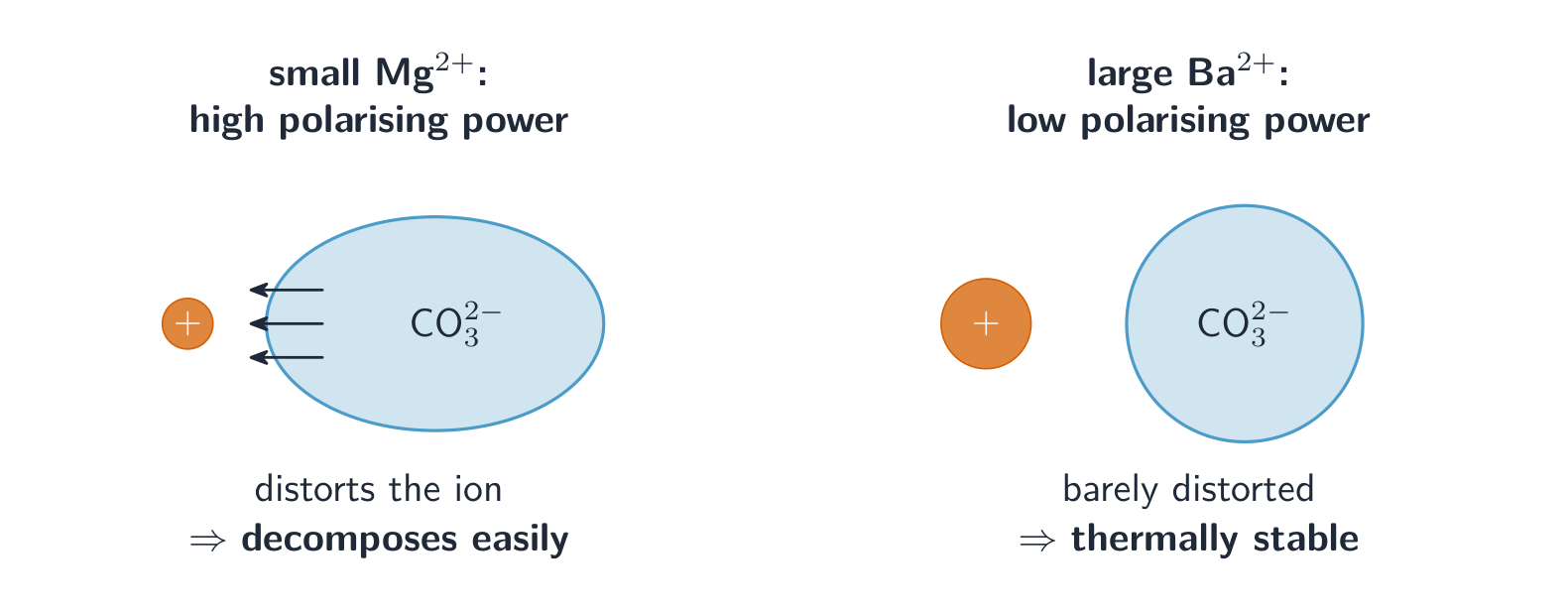
碳酸盐和硝酸盐的热稳定性(thermal stability)都沿族向下增大。一个较大的金属离子对碳酸根或硝酸根离子的吸引较小,所以化合物更难拆开——它需要更高的温度。所以碳酸镁最容易分解,碳酸钡最难。
溶解度的趋势
| 化合物 | 沿族向下溶解度(solubility)的趋势 |
|---|---|
| 氢氧化物 | 增大(Mg(OH)$_2$ 几乎不溶;Ba(OH)$_2$ 可溶) |
| 硫酸盐 | 减小(MgSO$_4$ 可溶;BaSO$_4$ 不溶) |
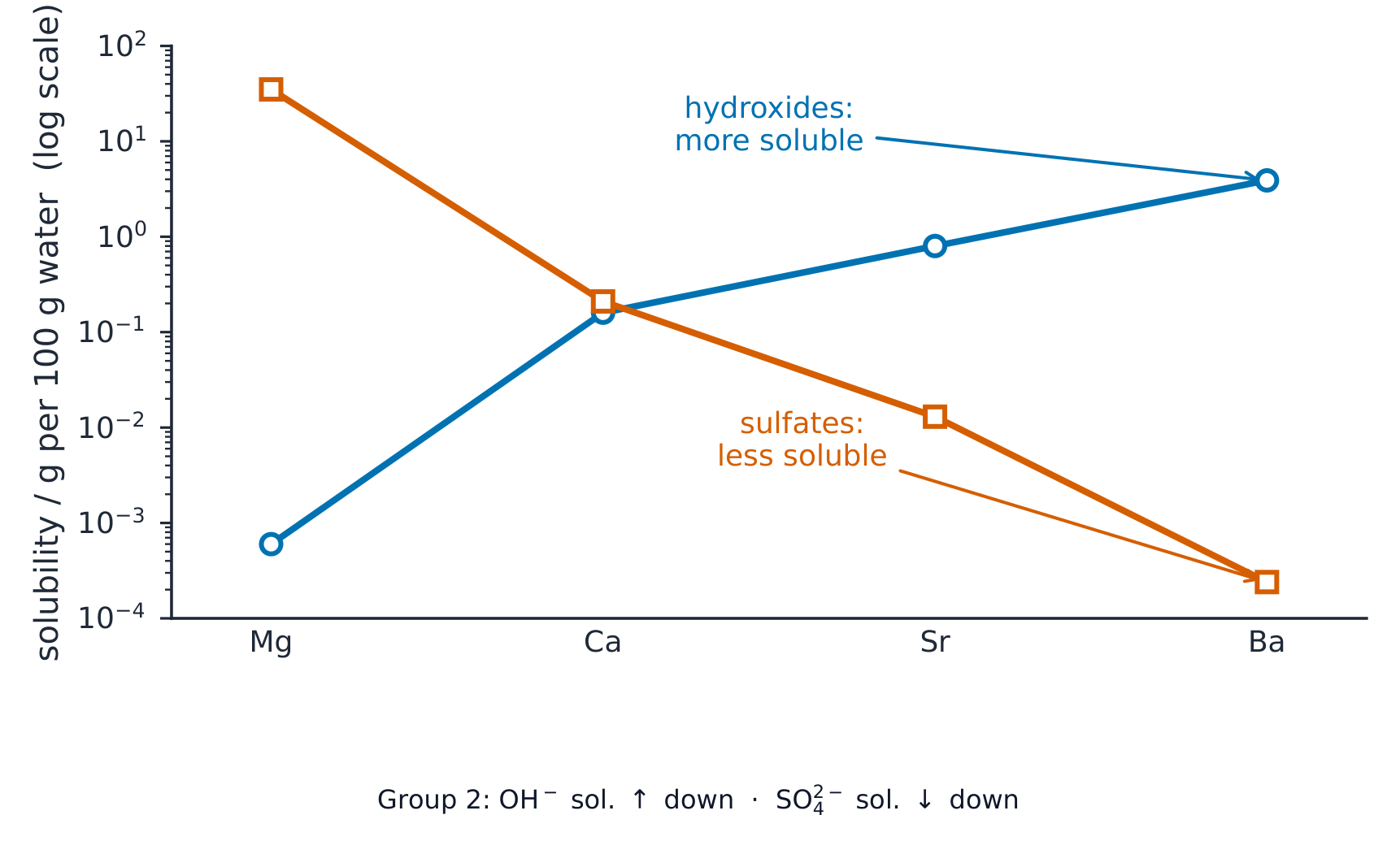
从这些趋势你可以预测再往下的元素镭及其化合物的性质。
例题。 $\text{MgCO}_3$ 在约 $540\ °\text{C}$ 分解,$\text{BaCO}_3$ 在约 $1360\ °\text{C}$ 分解。解释这一趋势,并预测 $\text{CaCO}_3$ 处在什么位置。沿第 2 族向下,阳离子变得更大,所以它的电荷分散在更大的表面上,极化能力下降。极化能力较弱的阳离子对碳酸根离子的扭曲较小,所以 $\text{C-O}$ 键被削弱得较少,需要更多的热才能断开。因此热稳定性沿族向下递增,而位于 Mg 和 Ba 之间的 $\text{CaCO}_3$ 在约 $900\ °\text{C}$ 这个中间温度分解。要把整条链讲完整 - 阳离子半径,再到极化能力,再到对阴离子的扭曲;写"它更活泼"在这里什么也没解释。
探索
Group 2 reactivity ladder
Move down Group 2 and see why reactions become more vigorous.
探索
Group 2 trend lab
Compare thermal stability and solubility trends down Group 2.
词汇表
训练
| 英文 | 中文 | 拼音 |
|---|---|---|
| group/ɡruːp/ | 族 | zú |
| reactivity/rɪəkˈtɪvɪti/ | 反应活性 | fǎn yìng huó xìng |
| sulfate/ˈsʌlfeɪt/ | 硫酸盐 | liú suān yán |
| oxide/ˈɒksaɪd/ | 氧化物 | yǎng huà wù |
| hydroxide/haɪˈdrɒksaɪd/ | 氢氧化物 | qīng yǎng huà wù |
| carbonate/ˈkɑːbəneɪt/ | 碳酸盐 | tàn suān yán |
| thermal decomposition/ˈθɜːml ˌdiːkɒmpəˈzɪʃn/ | 热分解 | rè fēn jiě |
| nitrate/ˈnaɪtreɪt/ | 硝酸盐 | xiāo suān yán |
| thermal stability/ˈθɜːml stəˈbɪlɪti/ | 热稳定性 | rè wěn dìng xìng |
| solubility/ˌsɒljuːˈbɪlɪti/ | 溶解度 | róng jiě dù |
10.1
考试技巧
- 反应活性沿第 2 族向下增大:随着原子变大电离能下降,所以电子更容易失去。
- 与水的反应沿族向下变得更剧烈;Mg 与冷水反应慢但与水蒸气快(→ MgO)。
- 氢氧化物沿族向下更可溶;硫酸盐更不可溶($\text{BaSO}_4$ 不溶——硫酸盐检验的基础)。
- 用正确的 $+2$ 离子写方程式,并陈述观察结果(冒泡、溶解)。
本主题的互动课程
逐步学习,并即时检测练习。