Thermal decomposition and solubility · 热分解和溶解度
| English | 中文 | Pinyin · 拼音 |
|---|---|---|
| thermal decomposition/ˈθɜːml ˌdiːkɒmpəˈzɪʃn/ | 热分解 | rè fēn jiě |
| nitrate/ˈnaɪtreɪt/ | 硝酸盐 | xiāo suān yán |
| polarise/ˈpəʊləraɪz/ | 极化 | jí huà |
| thermal stability/ˈθɜːml stəˈbɪlɪti/ | 热稳定性 | rè wěn dìng xìng |
| solubility/ˌsɒljuːˈbɪlɪti/ | 溶解度 | róng jiě dù |
Heating the carbonates
- Thermal decomposition 热分解 breaks a compound apart by heating.
- Its ease changes in a clear trend down Group 2.
- So do the solubilities of the hydroxides and sulfates.
加热碳酸盐
- 热分解(thermal decomposition)通过加热把一个化合物分开。
- 它的难易沿第 2 族向下以一个清晰的趋势变化。
- 氢氧化物和硫酸盐的溶解度也是。
Group 2 trend lab · 第 2 族趋势实验室
Compare thermal stability and solubility trends down Group 2. · 比较沿第 2 族向下的热稳定性和溶解度趋势。
Group 2 carbonates become more thermally stable down the group. · 第 2 族碳酸盐沿族向下变得热稳定性更强。
Larger cations polarise the carbonate less. · 更大的阳离子对碳酸根极化更少。
Decomposing carbonates and nitrates 硝酸盐
- carbonates → oxide + carbon dioxide: $\text{CaCO}_3 \rightarrow \text{CaO} + \text{CO}_2$.
- nitrates → oxide + brown $\text{NO}_2$ + oxygen: $2\text{Ca(NO}_3)_2 \rightarrow 2\text{CaO} + 4\text{NO}_2 + \text{O}_2$.
A small cation polarises 极化 the carbonate ion more, so it decomposes more easily
分解碳酸盐和硝酸盐
- 碳酸盐 → 氧化物 + 二氧化碳:$\text{CaCO}_3 \rightarrow \text{CaO} + \text{CO}_2$。
- 硝酸盐 → 氧化物 + 棕色 $\text{NO}_2$ + 氧:$2\text{Ca(NO}_3)_2 \rightarrow 2\text{CaO} + 4\text{NO}_2 + \text{O}_2$。
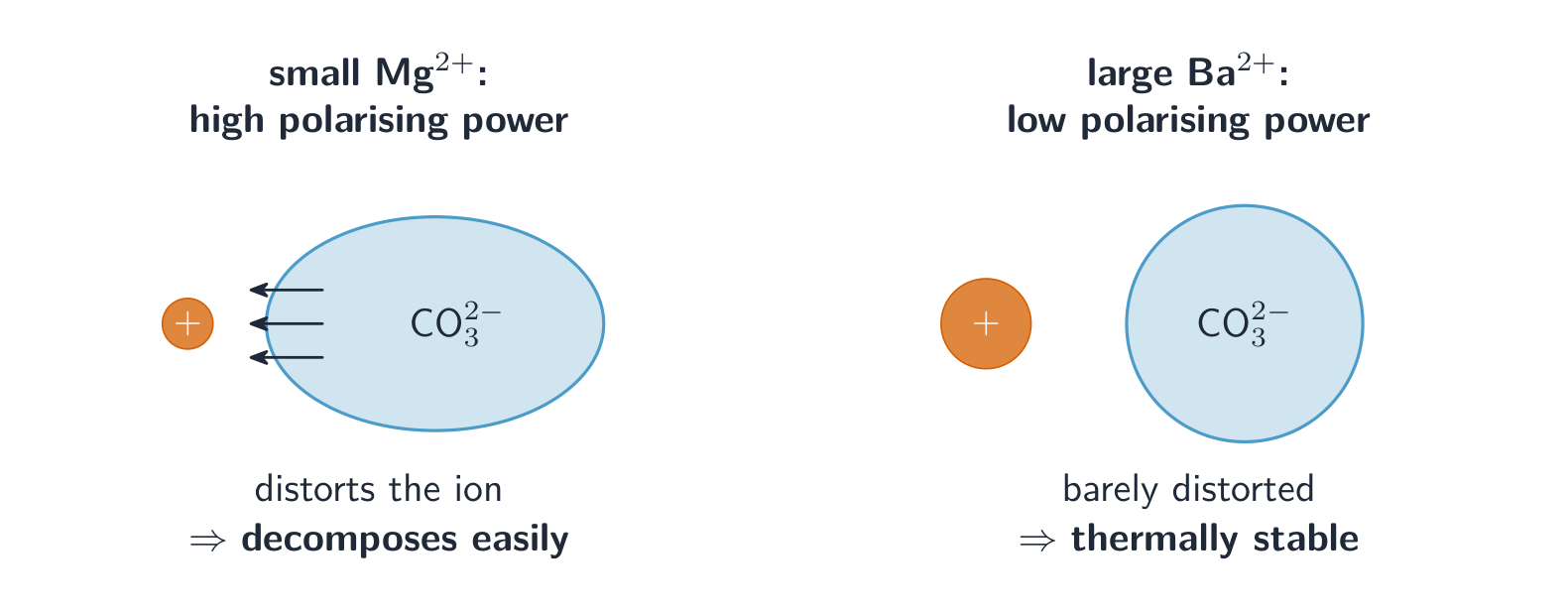
一个小的阳离子更多地极化碳酸根离子,所以它更容易分解
Heating a Group 2 carbonate produces: · 加热一个第 2 族碳酸盐产生:
Thermal decomposition: CaCO₃ → CaO + CO₂. · 热分解:CaCO₃ → CaO + CO₂。
Heating a Group 2 nitrate produces: · 加热一个第 2 族硝酸盐产生:
e.g. 2Ca(NO₃)₂ → 2CaO + 4NO₂ + O₂ (brown NO₂ gas is given off). · 例如 2Ca(NO₃)₂ → 2CaO + 4NO₂ + O₂(放出棕色 NO₂ 气体)。
Match each trend down Group 2. · 匹配沿第 2 族向下的每个趋势。
Each item links the term to its correct meaning. · 每一项把术语链接到它正确的含义。
Thermal stability 热稳定性 rises down the group
- Both carbonates and nitrates get harder to decompose down the group.
- A larger metal ion pulls less on (polarises less) the carbonate/nitrate ion, so it is harder to break apart.
- So MgCO₃ decomposes most easily; BaCO₃ is the hardest.
Down Group 2, hydroxide solubility 溶解度 increases while sulfate solubility decreases
热稳定性沿族向下上升
- 碳酸盐和硝酸盐都沿族向下更难分解。
- 一个更大的金属离子对碳酸根/硝酸根离子的拉力更小(极化更少),所以它更难分开。
- 所以 MgCO₃ 最容易分解;BaCO₃ 是最难的。
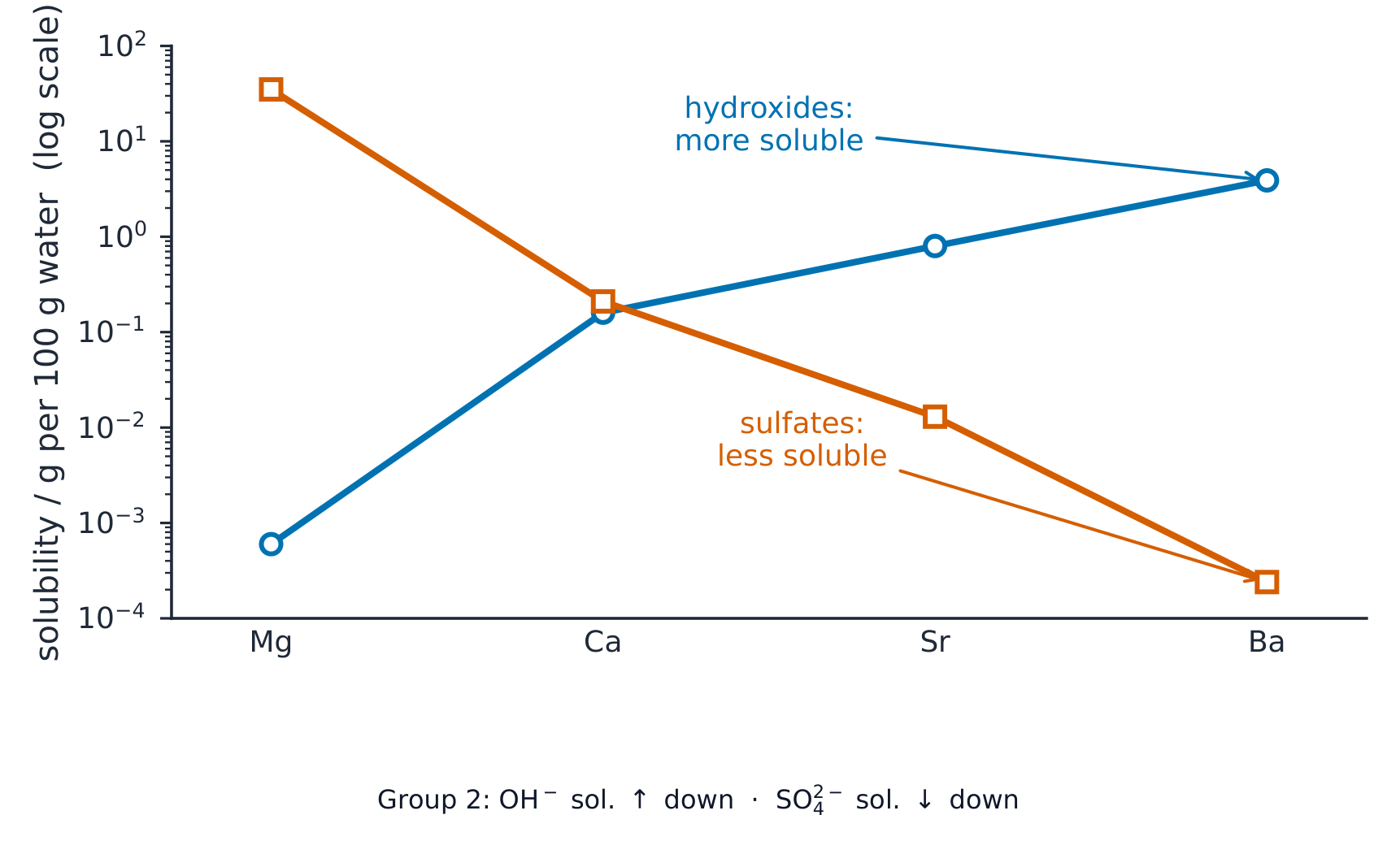
沿第 2 族向下,氢氧化物溶解度增加,而硫酸盐溶解度减小
Thermal stability of the carbonates increases down Group 2 because: · 碳酸盐的热稳定性沿第 2 族向下增加,因为:
A big cation distorts the carbonate ion less, so more energy (a higher temperature) is needed to decompose it. · 一个大的阳离子使碳酸根离子畸变更少,所以需要更多能量(一个更高的温度)来分解它。
Solubility trends
| Compound | Down the group |
|---|---|
| hydroxides | solubility increases (Mg(OH)₂ almost insoluble; Ba(OH)₂ soluble) |
| sulfates | solubility decreases (MgSO₄ soluble; BaSO₄ insoluble) |
溶解度趋势
| 化合物 | 沿族向下 |
|---|---|
| 氢氧化物 | 溶解度增加(Mg(OH)₂ 几乎不溶;Ba(OH)₂ 可溶) |
| 硫酸盐 | 溶解度减小(MgSO₄ 可溶;BaSO₄ 不溶) |
Down Group 2: · 沿第 2 族向下:
Hydroxides become more soluble (Ba(OH)₂ soluble); sulfates become less soluble (BaSO₄ insoluble). · 氢氧化物变得更可溶(Ba(OH)₂ 可溶);硫酸盐变得更不可溶(BaSO₄ 不溶)。
You've got it
- carbonates → oxide + CO₂; nitrates → oxide + NO₂ + O₂ (on heating)
- thermal stability increases down the group (larger ion polarises the anion less)
- down the group: hydroxides more soluble, sulfates less soluble (BaSO₄ insoluble)
你掌握了
- 碳酸盐 → 氧化物 + CO₂;硝酸盐 → 氧化物 + NO₂ + O₂(加热时)
- 热稳定性沿族向下增加(更大的离子对阴离子极化更少)
- 沿族向下:氢氧化物更可溶,硫酸盐更不可溶(BaSO₄ 不溶)