- understand that atoms are mostly empty space surrounding a very small, dense nucleus that contains protons and neutrons; electrons are found in shells in the empty space around the nucleus
- identify and describe protons, neutrons and electrons in terms of their relative charges and relative masses
- understand the terms atomic and proton number; mass and nucleon number
- describe the distribution of mass and charge within an atom
- describe the behaviour of beams of protons, neutrons and electrons moving at the same velocity in an electric field
- determine the numbers of protons, neutrons and electrons present in both atoms and ions given atomic or proton number, mass or nucleon number and charge
- state and explain qualitatively the variations in atomic radius and ionic radius across a period and down a group
原子结构
A-Level 化学 · 第 1 主题
 23:05
23:05
Atomic Structure
No one has ever seen inside an atom. It is far too small — a single atom is about a million times thinner than a human hair. And yet we know exactly how its…
英文讲解 · 内嵌中英文字幕
1.1
原子中的粒子与原子半径

大纲
来源:剑桥国际大纲
一切都由原子(atoms)构成。一个原子大部分是空的。在它的中心是一个微小、很重的原子核(nucleus)。原子核容纳两种粒子:质子(protons)和中子(neutrons)。在原子核周围的空间里,运动着电子(electrons)。电子待在壳层(shells)里——离原子核有一定距离的层。
原子核非常小,却容纳了几乎全部的质量。电子占据了几乎全部的空间,却几乎没有质量。

相对电荷和相对质量
我们用相对电荷(relative charge)和相对质量(relative mass)来比较这三种粒子。这些是简单的数字,不是真实的单位。
| 粒子 | 相对电荷 | 相对质量 |
|---|---|---|
| proton | $+1$ | $1$ |
| neutron | $0$ | $1$ |
| electron | $-1$ | $\tfrac{1}{1836}$ (约 $0$) |
一个质子和一个中子有几乎相同的质量。一个电子约轻 1836 倍。质子带正电,电子带负电,中子不带电——它是中性的(neutral)。
质子数和核子数
两个数字描述原子核:
- 质子数(proton number,也叫原子序数(atomic number)),符号 $Z$——质子的数目。
- 核子数(nucleon number,也叫质量数(mass number)),符号 $A$——质子和中子的总数。质子和中子都是核子(nucleons)。
所以中子的数目是 $A - Z$。
数一个原子或离子中的粒子
对于一个中性原子,电子的数目等于质子的数目,即等于 $Z$。
离子(ion)是一个失去或获得了电子、因而带电的原子:
- 正离子的电子比质子少。
- 负离子的电子比质子多。
例子:$^{27}_{13}\text{Al}^{3+}$ 有 $13$ 个质子、$27 - 13 = 14$ 个中子,以及 $13 - 3 = 10$ 个电子(它失去 3 个电子变成 $3+$)。
质量和电荷如何分布
几乎全部的质量位于原子核里,因为质子和中子很重而电子很轻。全部的正电荷都在原子核里(质子)。负电荷散布在壳层里(电子)。
电场中的粒子束
设想质子、中子和电子束以相同的速率进入两块带电板之间的电场(electric field):
- 质子束朝负板偏(质子带正电)。
- 电子束朝另一方向、朝正板偏。它偏得多得多,因为电子轻得多——相同的力给较小的质量更大的偏转(deflection)。
- 中子束笔直通过。它不带电,所以场对它没有力。

原子半径和离子半径
原子半径(atomic radius)是一个原子的大小。离子半径(ionic radius)是一个离子的大小。
沿一个周期(period,从左到右),原子半径变小。核电荷(nuclear charge,质子的吸引)上升,但电子进入同一个外壳层,所以内壳层的屏蔽(shielding)大致不变。更强的吸引把外壳层拉向内。
沿一个族(group,从上到下),原子半径变大。每往下一步就加一个新壳层,所以外层电子更靠外,并感受到更多来自原子核的屏蔽。

对于离子:
- 正离子(阳离子(cation))比它的原子小。它失去了外壳层,剩下的电子每个感受到更强的吸引。
- 负离子(阴离子(anion))比它的原子大。它获得了电子,所以电子之间有更多的排斥(repulsion)。
- 在电子数相同的离子中,质子更多的那个更小。
探索
Explore the atom
Tap each part. A tiny dense nucleus of protons and neutrons holds the mass; light electrons orbit it in shells.
探索
Atomic and ionic radius trends
Atomic radius falls across a period (rising nuclear charge pulls the same shell in) and rises down a group (an extra shell each time). Step across Period 3 to see it.
词汇表
训练
| 英文 | 中文 | 拼音 |
|---|---|---|
| atom/ˈætəm/ | 原子 | yuán zi |
| nucleus/ˈnjuːklɪəs/ | 原子核 | yuán zǐ hé |
| proton/ˈprəʊtɒn/ | 质子 | zhì zi |
| neutron/ˈnjuːtrɒn/ | 中子 | zhōng zǐ |
| electron/ɪˈlektrɒn/ | 电子 | diàn zi |
| shell/ʃel/ | 壳层 | ké céng |
| relative charge/ˈrelətɪv tʃɑːdʒ/ | 相对电荷 | xiāng duì diàn hè |
| relative mass/ˈrelətɪv mæs/ | 相对质量 | xiāng duì zhì liàng |
| neutral/ˈnjuːtrəl/ | 中性 | zhōng xìng |
| proton number/ˈprəʊtɒn ˈnʌmbə/ | 质子数 | zhì zǐ shù |
| atomic number/əˈtɒmɪk ˈnʌmbə/ | 原子序数 | yuán zi xù shù |
| nucleon number/ˈnjuːklɪən ˈnʌmbə/ | 核子数 | hé zǐ shù |
| mass number/mæs ˈnʌmbə/ | 质量数 | zhì liàng shù |
| nucleon/ˈnjuːklɪən/ | 核子 | hé zǐ |
| ion/ˈaɪɒn/ | 离子 | lí zi |
| electric field/ɪˈlektrɪk fiːld/ | 电场 | diàn chǎng |
| deflection/dɪˈflekʃn/ | 偏转 | piān zhuǎn |
| atomic radius/əˈtɒmɪk ˈreɪdɪəs/ | 原子半径 | yuán zi bàn jìng |
| ionic radius/aɪˈɒnɪk ˈreɪdɪəs/ | 离子半径 | lí zi bàn jìng |
| period/ˈpɪərɪəd/ | 周期 | zhōu qī |
| nuclear charge/ˈnjuːklɪə tʃɑːdʒ/ | 核电荷 | hé diàn hè |
| shielding/ˈʃiːldɪŋ/ | 屏蔽 | píng bì |
| group/ɡruːp/ | 族 | zú |
| cation/ˈkætaɪən/ | 阳离子 | yáng lí zi |
| anion/ˈænaɪən/ | 阴离子 | yīn lí zi |
| repulsion/rɪˈpʌlʃn/ | 排斥 | pái chì |
1.2
同位素

大纲
- define the term isotope in terms of numbers of protons and neutrons
- understand the notation $_y^x\text{A}$ for isotopes, where $x$ is the mass or nucleon number and $y$ is the atomic or proton number
- state that and explain why isotopes of the same element have the same chemical properties
- state that and explain why isotopes of the same element have different physical properties, limited to mass and density
来源:剑桥国际大纲
同位素(isotopes)是同一元素、质子数相同但中子数不同的原子。所以同位素有相同的质子数 $Z$ 但不同的核子数 $A$。
我们把一个同位素写成 $^{A}_{Z}\text{X}$:核子数 $A$ 在上,质子数 $Z$ 在下。例如,氯有两种主要同位素,$^{35}_{17}\text{Cl}$ 和 $^{37}_{17}\text{Cl}$。
相同的化学性质
化学性质(chemical properties)取决于电子,尤其是外层电子。一种元素的同位素有相同数目、以相同方式排布的电子。所以它们以完全相同的方式反应——它们有相同的化学性质。
不同的物理性质
一些物理性质(physical properties)取决于质量,所以在同位素之间不同。较重的同位素有更多的中子,所以质量更大,因而密度(density)更高。(大纲把这个差异限制在质量和密度上。)
探索
Isotope lab
Classify isotope facts by what changes and what stays the same.
词汇表
训练
| 英文 | 中文 | 拼音 |
|---|---|---|
| isotope/ˈaɪsətəʊp/ | 同位素 | tóng wèi sù |
| chemical properties/ˈkemɪkl ˈprɒpətiz/ | 化学性质 | huà xué xìng zhì |
| physical properties/ˈfɪzɪkl ˈprɒpətiz/ | 物理性质 | wù lǐ xìng zhì |
| density/ˈdensɪti/ | 密度 | mì dù |
1.3
电子、能级与原子轨道

大纲
- understand the terms: shells, sub-shells and orbitals; principal quantum number (n); ground state, limited to electronic configuration
- describe the number of orbitals making up s, p and d sub-shells, and the number of electrons that can fill s, p and d sub-shells
- describe the order of increasing energy of the sub-shells within the first three shells and the 4s and 4p sub-shells
- describe the electronic configurations to include the number of electrons in each shell, sub-shell and orbital
- explain the electronic configurations in terms of energy of the electrons and inter-electron repulsion
- determine the electronic configuration of atoms and ions given the atomic or proton number and charge, using either of the following conventions: e.g. for Fe: $1\text{s}^2 2\text{s}^2 2\text{p}^6 3\text{s}^2 3\text{p}^6 3\text{d}^6 4\text{s}^2$ (full electronic configuration) or [Ar] $3\text{d}^6 4\text{s}^2$ (shorthand electronic configuration)
- understand and use the electrons in boxes notation
- describe and sketch the shapes of s and p orbitals
- describe a free radical as a species with one or more unpaired electrons
来源:剑桥国际大纲
电子排布在壳层、亚层和轨道中。
壳层和主量子数
每个壳层由主量子数(principal quantum number)$n = 1, 2, 3, \dots$ 标记。较大的 $n$ 意味着离原子核更远、能量更高的壳层。
亚层和轨道
每个壳层分成亚层(sub-shells),命名为 s、p 和 d。每个亚层由轨道(orbitals)构成。一个轨道是一个可容纳至多两个电子的小区域。
| 亚层 | 轨道数 | 最多电子数 |
|---|---|---|
| s | 1 | 2 |
| p | 3 | 6 |
| d | 5 | 10 |
所以一个 s 亚层容纳 2 个电子,一个 p 亚层容纳 6 个,一个 d 亚层容纳 10 个。
能量递增的顺序
电子先填最低能量的亚层。对于前三个壳层,加上 4s 和 4p,能量上升的顺序是:
$$1\text{s} < 2\text{s} < 2\text{p} < 3\text{s} < 3\text{p} < 4\text{s} < 3\text{d} < 4\text{p}$$
注意这个意外:4s 的能量略低于 3d,所以 4s 先填。

电子排布
电子排布(electronic configuration)列出每个亚层里有多少电子。能量最低的排布是基态(ground state)。
对于铁(Fe,$Z = 26$):
$$1\text{s}^2\,2\text{s}^2\,2\text{p}^6\,3\text{s}^2\,3\text{p}^6\,3\text{d}^6\,4\text{s}^2$$
你可以用方括号里最近的稀有气体(noble gas)写一个简写:
$$[\text{Ar}]\,3\text{d}^6\,4\text{s}^2$$
这里 $[\text{Ar}]$ 代表氩的完整排布。
对于离子,你添加或移走电子。一条关键规则:当一个过渡金属形成正离子时,它在失去它的 3d 电子之前先失去它的 4s 电子。所以 $\text{Fe}^{3+}$ 是 $[\text{Ar}]\,3\text{d}^5$。
电子的方框表示
电子的方框(electrons in boxes)表示法把每个轨道画成一个方框、每个电子画成一个箭头。同一轨道里的两个电子必须指向相反的方向,因为每个电子有一个叫作自旋(spin)的性质,而一个共享的轨道需要相反的自旋。
在一个亚层内,电子一个接一个地填入空轨道、箭头平行,然后才有任何轨道获得第二个电子。像这样分散开使电子彼此远离,降低它们之间的排斥。

为什么排布是这个形状
电子从低能量填到高能量,因为那样给出最稳定(能量最低)的原子。在一个亚层内它们先单个分散开,以减少带负电的电子之间的排斥。
s 轨道和 p 轨道的形状
- 一个 s 轨道是一个以原子核为中心的球形(sphere)。
- 一个 p 轨道有两个瓣,像一个哑铃,沿一个轴指向。三个 p 轨道沿三个互相垂直的方向($x$、$y$ 和 $z$ 轴)指向。

自由基
自由基(free radical)是一个有一个或多个未成对电子(unpaired electrons)的物种。自由基非常活泼。
探索
Filling the electron shells
Change the atomic number Z and watch the electrons fill the shells (2, 8, 8, …) — the pattern that builds the Periodic Table.
词汇表
训练
| 英文 | 中文 | 拼音 |
|---|---|---|
| principal quantum number/ˈprɪnsɪpl ˈkwɒntəm ˈnʌmbə/ | 主量子数 | zhǔ liàng zǐ shù |
| sub-shell/sʌb ʃel/ | 亚层 | yà céng |
| orbital/ˈɔːbɪtl/ | 轨道 | guǐ dào |
| electronic configuration/ɪlekˈtrɒnɪk kənˌfɪɡjəˈreɪʃn/ | 电子排布 | diàn zi pái bù |
| ground state/ɡraʊnd steɪt/ | 基态 | jī tài |
| noble gas/ˈnəʊbl ɡæs/ | 稀有气体 | xī yǒu qì tǐ |
| spin/spɪn/ | 自旋 | zì xuán |
| sphere/sfɪə/ | 球形 | qiú xíng |
| free radical/friː ˈrædɪkl/ | 自由基 | zì yóu jī |
| unpaired electrons/ʌnˈpeəd ɪˈlektrɒnz/ | 未成对电子 | wèi chéng duì diàn zi |
1.4
电离能

大纲
- define and use the term first ionisation energy, IE
- construct equations to represent first, second and subsequent ionisation energies
- identify and explain the trends in ionisation energies across a period and down a group of the Periodic Table
- identify and explain the variation in successive ionisation energies of an element
- understand that ionisation energies are due to the attraction between the nucleus and the outer electron
- explain the factors influencing the ionisation energies of elements in terms of nuclear charge, atomic/ionic radius, shielding by inner shells and sub-shells and spin-pair repulsion
- deduce the electronic configurations of elements using successive ionisation energy data
- deduce the position of an element in the Periodic Table using successive ionisation energy data
来源:剑桥国际大纲
第一电离能
第一电离能(first ionisation energy,IE)是从一摩尔气态原子的每个原子中移走一个电子、形成一摩尔气态 $+1$ 离子所需的能量。
我们用气态原子,以便粒子之间没有力。单位是 $\text{kJ mol}^{-1}$。作为方程,对于元素 X:
$$\text{X}(\text{g}) \rightarrow \text{X}^{+}(\text{g}) + \text{e}^{-}$$
$(\text{g})$ 表示物种是气体。
逐级电离能
移走一个电子后,你可以再移走一个。第二电离能从每个 $+1$ 离子中移走一个电子:
$$\text{X}^{+}(\text{g}) \rightarrow \text{X}^{2+}(\text{g}) + \text{e}^{-}$$
你可以继续下去。这些是逐级电离能(successive ionisation energies)。每一个都比前一个大,因为每个电子都是从一个更正的离子上拉走的。
电离能取决于什么
电离能来自带正电的原子核与外层电子之间的吸引。三个主要因素决定那个吸引有多强:
- 核电荷:更多的质子更强地吸引电子,所以电离能更高。
- 原子半径:外层电子离原子核越远,吸引越弱,所以电离能越低。
- 屏蔽:内壳层挡住一部分对外层电子的吸引。更多的内壳层意味着更多的屏蔽和更低的电离能。
还有一个较小的效应——自旋成对排斥(spin-pair repulsion)。当两个电子共享一个轨道时,它们稍微互相推挤,所以其中一个更容易移走。
第一电离能的趋势
沿一个周期,第一电离能总体上升。核电荷增长而屏蔽大致不变,所以外层电子被束缚得更紧。
沿一个族向下,第一电离能下降。较下方的元素有更多的壳层,所以有更多的屏蔽和更大的半径,外层电子更容易移走。
那些下凹是亚层存在的证据
沿周期的上升不是平滑的。出现两个小的下凹,你应当能够解释这两个:
- 第 2 族到第 13 族(例如 Mg 到 Al):从 Al 移走的电子来自一个 3p 亚层,它的能量比 Mg 中填满的 3s 亚层高。一个 3p 电子更容易移走,所以数值下凹。
- 第 15 族到第 16 族(例如 P 到 S):在 S 中,一个 3p 轨道现在容纳一对电子。自旋成对排斥使其中一个更容易移走,所以数值下凹。
这些下凹是亚层存在的证据。
逐级电离能是壳层的证据
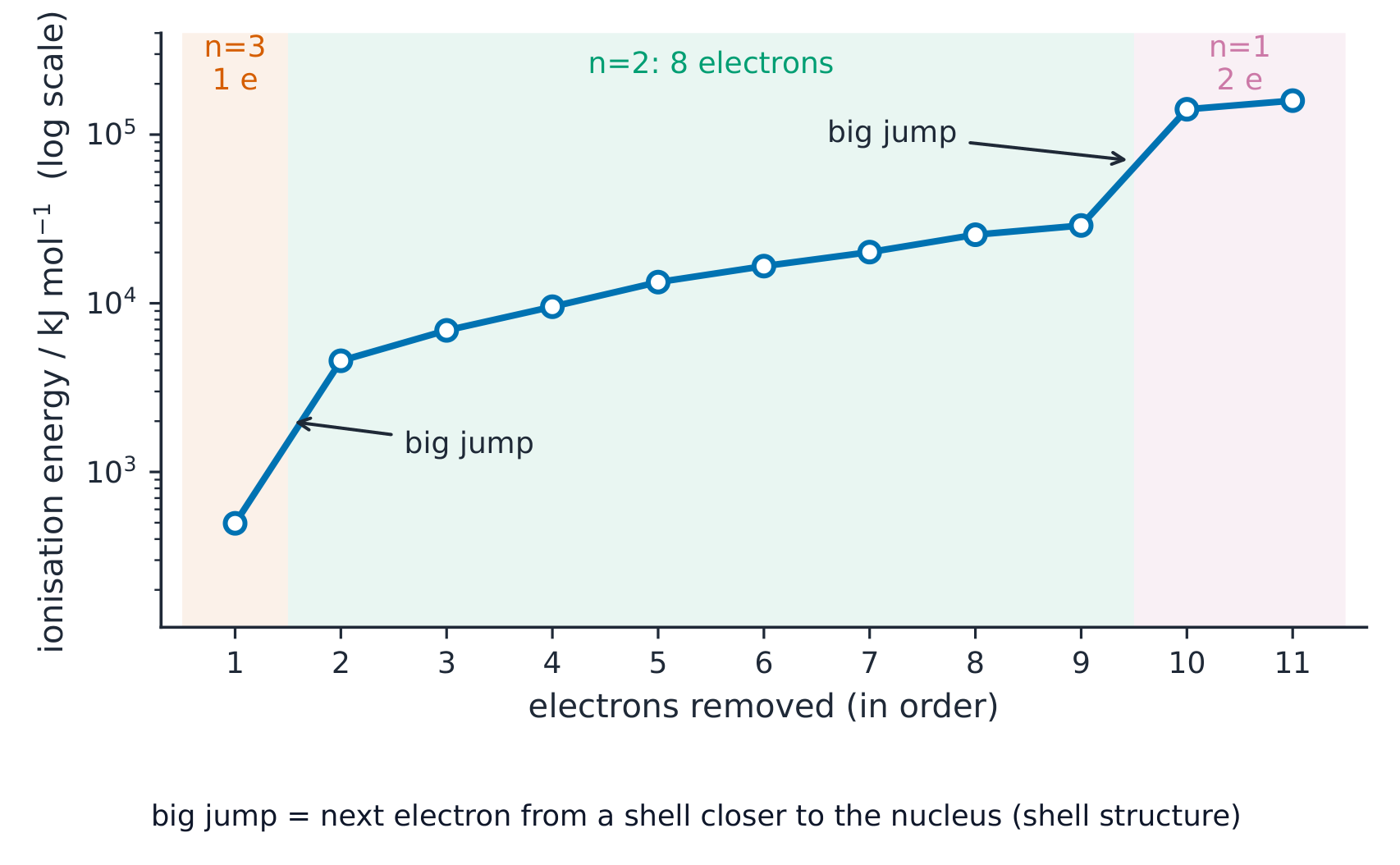
如果你画出一种元素的逐级电离能,数值上升,并在某些点有大的跳跃。当下一个电子必须来自离原子核更近的壳层时,就发生一次大的跳跃。
数一数在第一次大跳跃之前有多少电子容易脱下——那就是外壳层里的电子数,它告诉你元素属于哪个族。你也可以用这个模式推出电子排布和元素在周期表中的位置。
| 第一次大跳跃前脱下的电子数 | 族 |
|---|---|
| 1 | 第 1 族 |
| 2 | 第 2 族 |
| 3 | 第 13 族 |
例题。 某元素的前五个逐级电离能依次为 $590$、$1150$、$4940$、$6480$ 和 $8120\ \text{kJ}\,\text{mol}^{-1}$。它属于第几族?要找的是大跳跃,而不是最大的那个数。从第 1 个到第 2 个大约翻了一倍,这是正常的上升。从第 2 个($1150$)到第 3 个($4940$)涨了四倍多:这就是那个跳跃。所以在它之前有两个电子容易失去,最外层有 2 个电子,该元素属于第 2 族。要数跳跃之前移走的电子数,并把跳跃解释清楚:下一个电子是从更靠近原子核的一层被拉走的,而不是换了一种元素。
探索
The ionisation-energy trend — and its dips
First ionisation energy generally rises across a period, but DIPS where a new p sub-shell starts and where a p-orbital pair first forms. Step across to find the two tell-tale dips.
词汇表
训练
| 英文 | 中文 | 拼音 |
|---|---|---|
| first ionisation energy/fɜːst ˌaɪənaɪˈzeɪʃn ˈenədʒi/ | 第一电离能 | dì yī diàn lí néng |
| successive ionisation energies/səkˈsesɪv ˌaɪənaɪˈzeɪʃn ˈenədʒiz/ | 逐级电离能 | zhú jí diàn lí néng |
| spin-pair repulsion/spɪn peə rɪˈpʌlʃn/ | 自旋成对排斥 | zì xuán chéng duì pái chì |
1.4
考试技巧
- 完整地定义同位素:同一元素、质子数相同但中子数不同的原子——评分标准要两半都答。
- 4s 在 3d 之前填,但形成离子时先从 4s 移走电子,所以 $\text{Fe}^{3+}$ 是 $[\text{Ar}]3\text{d}^5$(不是 $[\text{Ar}]3\text{d}^3 4\text{s}^2$)。
- 在逐级电离能中,一次大跳跃标志着一个新的(内)壳层的开始——用这些跳跃把元素归入它的族。
- 用同样的三个因素解释每一个电离能趋势:核电荷、距离和屏蔽,再加上亚层效应来解释那些小的下凹。
- 记住氧的第一电离能低于氮的确切原因:氧的成对 2p 电子相互排斥,所以其中一个更容易移走。
本主题的互动课程
逐步学习,并即时检测练习。