Ionisation energy
Introduced| English | Meaning |
|---|---|
| ionisation energy/ˌaɪənaɪˈzeɪʃn ˈenədʒi/ | The energy required to remove an electron from a specified gaseous atom or ion, under the stated ionisation process. |
| gaseous/ˈɡeɪsɪəs/ | In the gas state; ionisation-energy processes are defined for separate gaseous atoms or ions. |
| nuclear charge/ˈnjuːklɪə tʃɑːdʒ/ | The total positive charge of an atomic nucleus, determined by its number of protons. |
| atomic radius/əˈtɒmɪk ˈreɪdɪəs/ | A measure of an atom's size based on a stated convention, such as half the distance between bonded identical atoms. |
| shielding/ˈʃiːldɪŋ/ | The reduction in nuclear attraction experienced by an electron because of repulsion from other electrons. |
| spin-pair repulsion/spɪn peə rɪˈpʌlʃn/ | The extra repulsion between two electrons sharing an orbital, slightly lowering ionisation energy. |
A jump in energy is evidence about electrons
- Ionisation energy 电离能 measures the energy needed to remove electrons from gaseous 气态 species. Use it to infer which electron is being removed, rather than simply naming a trend.
- This section assesses ground-state species from hydrogen to krypton. An isotope's extra neutrons do not automatically increase the attraction to an electron.
Define the process and write its equation
- First ionisation energy is the energy needed to remove one electron from each atom in one mole of gaseous atoms, forming one mole of gaseous 1+ ions. The unit is $\dfrac{\mathrm{kJ}}{\mathrm{mol}}$.
- Write $\mathrm{X(g)}\rightarrow\mathrm{X^{+}(g)}+\mathrm{e^-}$. For the second process start with X⁺(g), not another neutral atom; for the third start with X²⁺(g). Include gaseous state symbols and one electron on the product side.
The third ionisation process is $\mathrm{X^{2+}(g)}\rightarrow\mathrm{X^{3+}(g)}+\mathrm{e^-}$. Each step removes one electron from each starting species. Using separate gaseous species avoids including energy for breaking a solid or molecule into atoms.
Why are gaseous atoms specified in the definition of ionisation energy?
Difficulty 1/5 · 100 coins + a small bonus on first completion today
The definition isolates electron removal from gaseous atoms. Starting with a solid or molecule would also involve other energy changes.
The energy needed to remove one electron from each atom in one mole of gaseous atoms is the first ______ energy.
Difficulty 1/5 · 100 coins + a small bonus on first completion today
It measures how tightly the outer electron is held.
Each successive ionisation energy is larger than the last because:
Difficulty 1/5 · 100 coins + a small bonus on first completion today
After each removal the ion is more positive, so the next electron is held more tightly.
Write the equation representing the third ionisation energy of aluminium. Include state symbols and explain why starting from Al(g) would represent a different process.
Al²⁺(g) → Al³⁺(g) + e⁻. The third process removes one electron from each gaseous 2+ ion. Starting from neutral Al(g) and removing one electron would be the first process, not the third; charge balances on both sides.
Explain the competing attractions
- Greater nuclear charge 核电荷 strengthens attraction to electrons. A greater atomic radius 原子半径 places the removed electron farther away, while greater inner-electron shielding 屏蔽 reduces the attraction it experiences.
- Identify the orbital that loses the electron and keep other factors in view. More protons alone do not establish a higher value when the occupied shell or sub-shell also changes.
Which change would LOWER the first ionisation energy?
Difficulty 1/5 · 100 coins + a small bonus on first completion today
More shielding weakens the pull on the outer electron, lowering the ionisation energy.
Match each change to its effect on first ionisation energy.
Difficulty 2/5 · 140 coins + a small bonus on first completion today
IE rises with nuclear pull and falls with distance/shielding; successive ionisations always rise.
Explain the general trends and the dips
- Across a period, increasing nuclear charge usually raises first ionisation energy because the outer electrons occupy the same main shell with similar inner shielding. Down a group, greater distance and shielding outweigh the extra protons, lowering the value.
- In Period 3, Al loses a higher-energy 3p electron rather than Mg's 3s electron. S has a paired 3p electron: spin-pair repulsion 自旋成对排斥 makes it easier to remove than an unpaired 3p electron in P, despite S's greater nuclear charge.
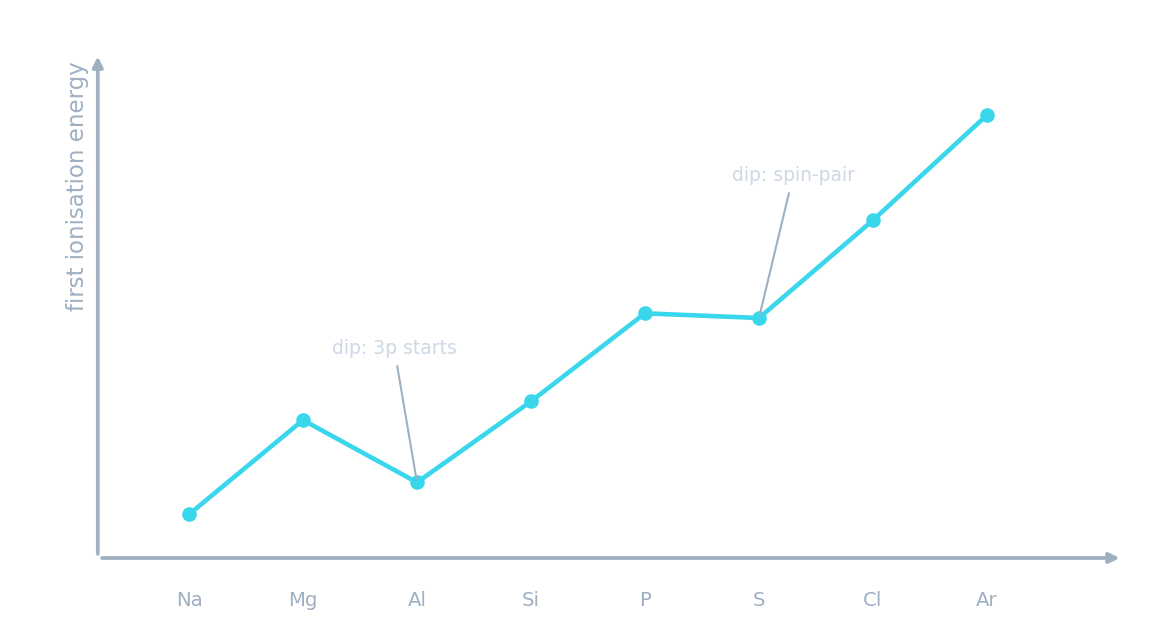
Explain each dip using the electron's sub-shell or pairing, rather than claiming that nuclear charge decreases.
The ionisation-energy trend — and its dips
First ionisation energy generally rises across a period, but DIPS where a new p sub-shell starts and where a p-orbital pair first forms. Step across to find the two tell-tale dips.
The dip in first ionisation energy at aluminium (vs magnesium) is because:
Difficulty 1/5 · 100 coins + a small bonus on first completion today
Al's outer electron is in 3p (higher energy than Mg's full 3s), so it is easier to remove — a dip.
Oxygen has more protons than nitrogen, but its first ionisation energy is lower. Use N: 2p³ and O: 2p⁴ to explain why a nuclear-charge-only prediction fails.
Nitrogen’s three 2p electrons occupy separate orbitals. Oxygen has a pair in one 2p orbital; repulsion between that pair makes one electron easier to remove. The pairing effect outweighs the increased nuclear charge for this comparison. The lower value is not due to oxygen having fewer protons or an extra occupied main shell.
Read successive ionisation energies
- Each successive electron is removed from a more positive species, with less repulsion and a stronger attraction for the remaining electrons. Values increase; a particularly large jump signals removal from a lower inner shell.
- Sodium's first jump is after one electron; another jump occurs after nine have been removed in total. This separates outer-to-inner groups of $1,8,2$, giving the shell arrangement $2,8,1$.
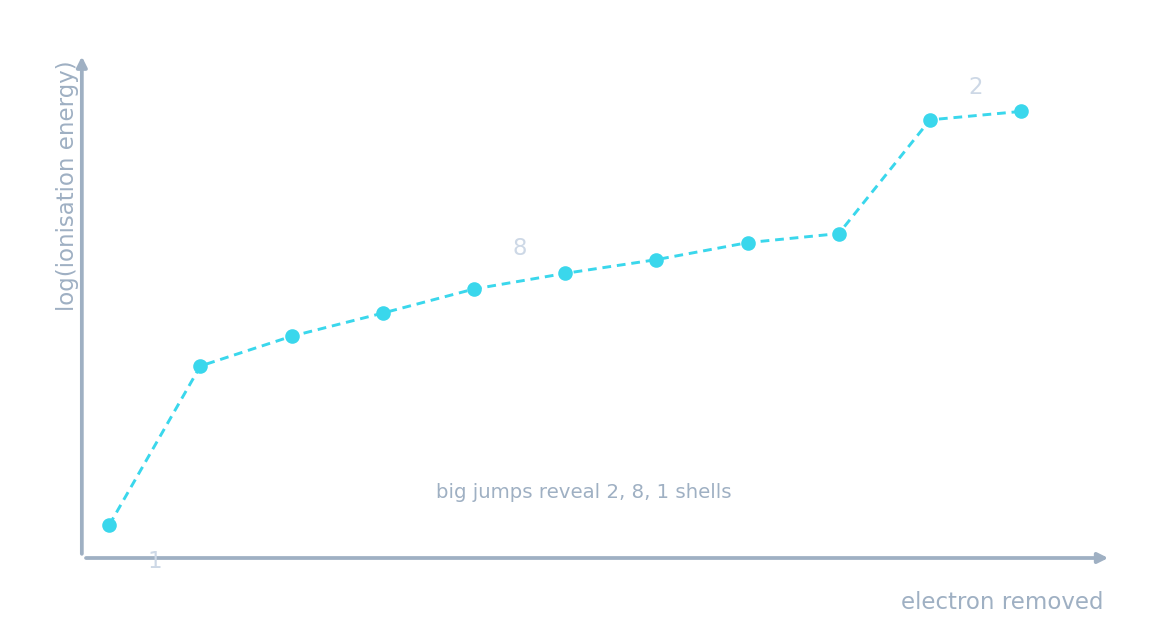
Count electrons removed before a jump; do not count the tall gap itself as another electron.
A big jump in successive ionisation energies happens when:
Difficulty 1/5 · 100 coins + a small bonus on first completion today
The big jump marks moving to an inner shell; counting electrons before the first jump gives the outer-shell number (the group).
A big jump in successive ionisation energies marks the move to a new, inner shell.
Difficulty 1/5 · 100 coins + a small bonus on first completion today
The jumps reveal the shell structure — e.g. sodium's successive IEs split into 1, then 8, then 2.
Deduce a group and know what is still missing
- For main-group elements, the electrons before the first inner-shell jump are the outer-shell electrons. One or two correspond to Groups 1 or 2; three to eight correspond to Groups 13 to 18, with helium as the two-electron Group 18 exception.
- A jump after three removals supports Group 13, not Group 3. The first jump alone does not identify the period: use the number of occupied shells from fuller data, or additional information about the atom.
“Three outer electrons” is an electron count, not the modern group number 3. State the main-group convention and the evidence used for the period. Do not invent a complete electron arrangement from a short list that only establishes a valence count.
A main-group atom has these successive ionisation energies in $\dfrac{\mathrm{kJ}}{\mathrm{mol}}$: 600, 1500, 2800, 12000, 15000 and 19000. Identify the outer-shell electron count and modern group number. Can the period be established from this short list alone?
The largest jump is from the third to fourth removal, so three outer-shell electrons were removed before reaching an inner shell. This supports Group 13 for a main-group atom. The short list does not establish the total number of occupied shells, so it does not determine the period alone.
A neutral main-group atom has 17 electrons. Its successive ionisation energies show major shell-boundary jumps after the seventh and fifteenth electrons have been removed. Deduce the shell arrangement, period and group, explaining the count.
The outer shell has 7 electrons, the next group has 15 − 7 = 8, and the remaining inner shell has 17 − 15 = 2. Write inner-to-outer as 2,8,7. Three occupied shells give Period 3; seven outer electrons give Group 17. The gaps are not additional electrons.
Do not replace charge with nuclear mass
- Neutral atoms of two isotopes have the same proton number and electronic configuration. In this syllabus model their shielding and attraction to the outer electron are the same, so the first ionisation energy is unchanged by the neutron difference.
- When comparing an atom with a positive ion instead, the electron population and attraction change. Explain the particular comparison; a change in nucleon number is not the same as an increased nuclear charge.
Compare the first ionisation energies of neutral ²⁴Mg and ²⁶Mg in the syllabus model. A student predicts a larger value for ²⁶Mg because its nucleus is heavier. Evaluate the prediction.
The prediction is unsupported in this model. Both have 12 protons and the same electron configuration, occupied shells and shielding, so the attraction to the removed electron is the same and the first ionisation energies are the same at this level. The extra neutrons increase mass but not positive nuclear charge.
You've got it
- Define one mole, gaseous species and one electron per starting species; start each successive equation with the correct ion charge.
- Explain nuclear charge, distance, shielding, sub-shell energy and spin-pair repulsion in context.
- Successive jumps locate inner shells. For main-group atoms, convert the valence count to the correct group number and establish the period separately.
- Isotope mass and nuclear charge are different variables.