Electron configuration
Introduced| English | Meaning |
|---|---|
| shell/ʃel/ | A main electron energy level in an atom. |
| sub-shell/sʌb ʃel/ | A group of orbitals within an electron shell sharing the same orbital angular-momentum quantum number. |
| orbital/ˈɔːbɪtl/ | A quantum state associated with an electron's spatial distribution around a nucleus, often represented by a region of high probability. |
| principal quantum number/ˈprɪnsɪpl ˈkwɒntəm ˈnʌmbə/ | The positive integer identifying an electron's main shell and helping determine its orbital energy and size. |
| configuration/kənˌfɪɡjəˈreɪʃn/ | configuration |
| transition metal/trænˈsɪʃn ˈmetl/ | transition metal |
Where the electrons live
- Electrons sit in shells 壳层, split into sub-shells 亚层, built from orbitals 轨道.
- They fill from lowest energy up.
- One surprise: 4s fills before 3d.
The electron configuration of sodium (11 electrons) is 1s² 2s² 2p⁶ ______.
Difficulty 1/5 · 100 coins + a small bonus on first completion today
Sodium has one electron in the 3s sub-shell.
Shells, sub-shells and orbitals
- Each shell has a principal quantum number 主量子数 $n = 1, 2, 3, \dots$ (bigger $n$ = further out, higher energy).
- Sub-shells are s, p, d; each is made of orbitals holding 2 electrons each.
| Sub-shell | Orbitals | Max electrons |
|---|---|---|
| s | 1 | 2 |
| p | 3 | 6 |
| d | 5 | 10 |
Filling the shells
Drag the proton number. Electrons fill the shells from the inside out (2, then 8, then 8) — the basis of the periodic table.
How many electrons can a p sub-shell hold?
Difficulty 1/5 · 100 coins + a small bonus on first completion today
A p sub-shell has 3 orbitals, each holding 2 electrons, so 6 in total (s = 2, d = 10).
Match each sub-shell to how many electrons it holds.
Difficulty 2/5 · 140 coins + a small bonus on first completion today
Each orbital holds 2; s has 1 orbital, p has 3, d has 5 — so 2, 6 and 10 electrons.
Order of filling
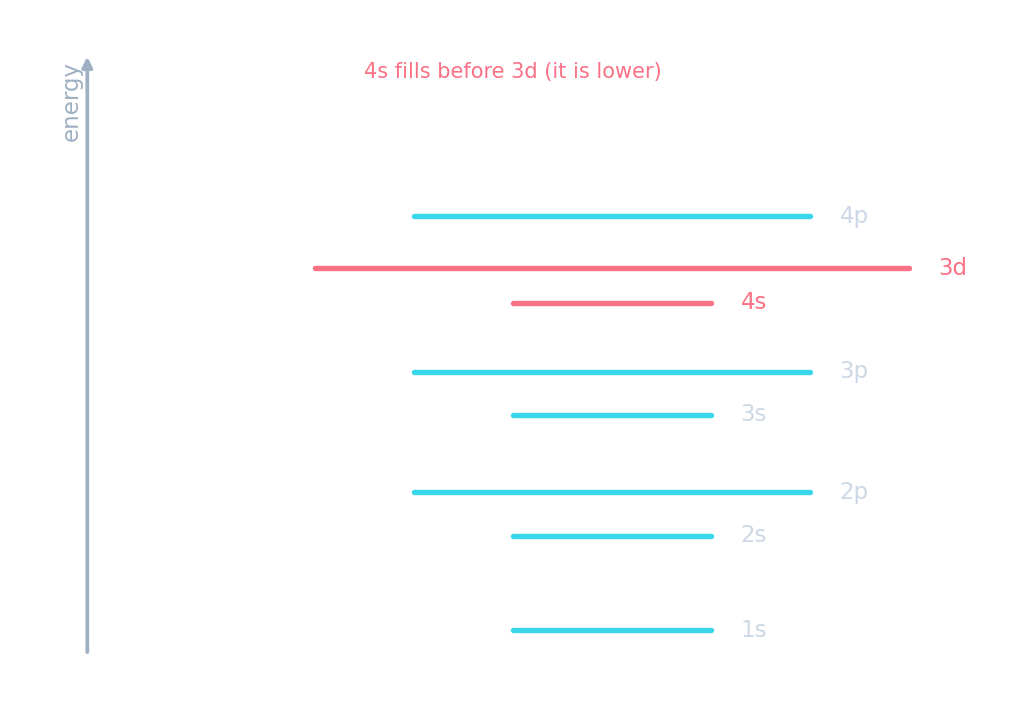
- 4s is lower than 3d, so 4s fills first.
Which sub-shell fills first?
Difficulty 1/5 · 100 coins + a small bonus on first completion today
4s lies just below 3d in energy, so 4s fills before 3d.
Put these sub-shells in the order they fill.
Difficulty 3/5 · 200 coins + a small bonus on first completion today
Fill by energy, not by number: 4s comes before 3d.
Writing configurations 电子排布
- Iron (Fe, $Z=26$): $1\text{s}^2\,2\text{s}^2\,2\text{p}^6\,3\text{s}^2\,3\text{p}^6\,3\text{d}^6\,4\text{s}^2$, or shorthand $[\text{Ar}]\,3\text{d}^6\,4\text{s}^2$.
- For positive ions, a transition metal 过渡金属 loses its 4s electrons first: $\text{Fe}^{3+}$ is $[\text{Ar}]\,3\text{d}^5$.
The ground-state configuration of iron (Z = 26) is:
Difficulty 1/5 · 100 coins + a small bonus on first completion today
After argon (18), iron adds 4s² then 3d⁶: [Ar] 3d⁶ 4s².
When iron forms Fe³⁺, which electrons are lost first?
Difficulty 1/5 · 100 coins + a small bonus on first completion today
Transition metals lose 4s before 3d, so Fe³⁺ is [Ar] 3d⁵.
You've got it
- shells ($n$) → sub-shells (s/p/d) → orbitals (2 electrons each); s=2, p=6, d=10
- fill lowest energy first; 4s fills before 3d
- Fe: $[\text{Ar}]\,3\text{d}^6\,4\text{s}^2$
- ions lose 4s before 3d: $\text{Fe}^{3+} = [\text{Ar}]\,3\text{d}^5$