- (a) understand what is meant by a reversible reaction (b) understand what is meant by dynamic equilibrium in terms of the rate of forward and reverse reactions being equal and the concentration of reactants and products remaining constant (c) understand the need for a closed system in order to establish dynamic equilibrium
- define Le Chatelier’s principle as: if a change is made to a system at dynamic equilibrium, the position of equilibrium moves to minimise this change
- use Le Chatelier’s principle to deduce qualitatively (from appropriate information) the effects of changes in temperature, concentration, pressure or presence of a catalyst on a system at equilibrium
- deduce expressions for equilibrium constants in terms of concentrations, $K_c$
- use the terms mole fraction and partial pressure
- deduce expressions for equilibrium constants in terms of partial pressures, $K_p$ (use of the relationship between $K_p$ and $K_c$ is not required)
- use the $K_c$ and $K_p$ expressions to carry out calculations (such calculations will not require the solving of quadratic equations)
- calculate the quantities present at equilibrium, given appropriate data
- state whether changes in temperature, concentration or pressure or the presence of a catalyst affect the value of the equilibrium constant for a reaction
- describe and explain the conditions used in the Haber process and the Contact process, as examples of the importance of an understanding of dynamic equilibrium in the chemical industry and the application of Le Chatelier’s principle
平衡
A-Level 化学 · 第 7 主题
 10:12
10:12
Equilibria
Some reversible reactions never finish. You mix the reactants, the colour changes, and then everything just stops — halfway. Leave it for a week and it looks…
英文讲解 · 内嵌中英文字幕
7.1
化学平衡:可逆反应与动态平衡

大纲
来源:剑桥国际大纲
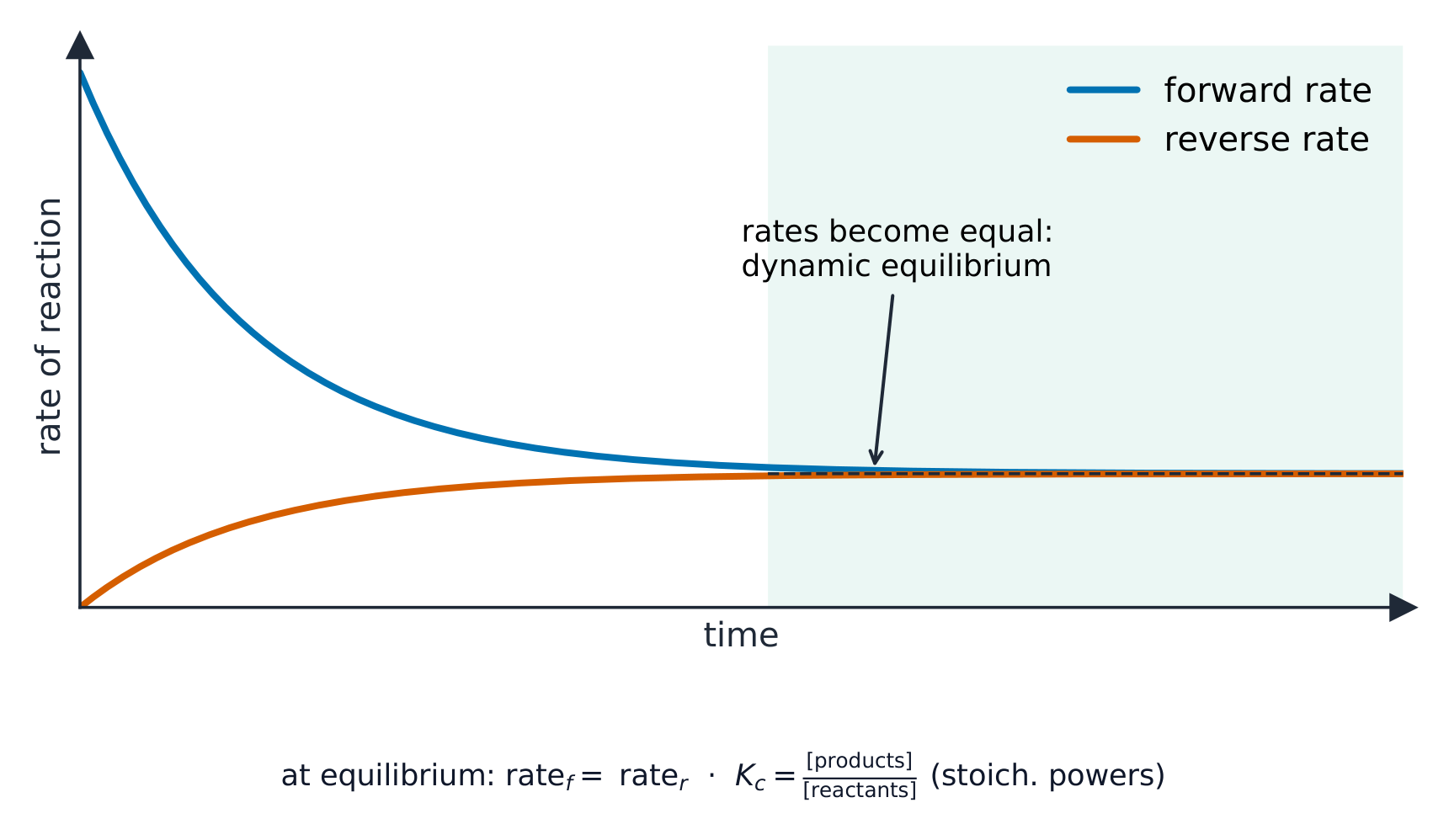
一个可逆反应(reversible reaction)能双向进行。正反应(forward reaction)生成产物;逆反应(reverse reaction)把产物变回反应物。我们用符号 $\rightleftharpoons$ 表示这个。
在一个封闭系统(closed system,没有东西进出)中,当满足下列条件时反应达到动态平衡(dynamic equilibrium):
- 正反应的速率等于逆反应的速率。
- 反应物和产物的浓度保持恒定。
它叫作动态是因为两个反应仍在发生——它们只是相互抵消。需要一个封闭系统,否则产物会逸出,平衡就永远达不到。
探索
Dynamic equilibrium
forward rate = reverse rate
At equilibrium the position can sit anywhere — change a condition and watch it shift.
词汇表
训练
| 英文 | 中文 | 拼音 |
|---|---|---|
| reversible reaction/rɪˈvɜːsɪbl rɪˈækʃn/ | 可逆反应 | kě nì fǎn yìng |
| forward reaction/ˈfɔːwəd rɪˈækʃn/ | 正反应 | zhèng fǎn yìng |
| reverse reaction/rɪˈvɜːs rɪˈækʃn/ | 逆反应 | nì fǎn yìng |
| closed system/kləʊzd ˈsɪstəm/ | 封闭系统 | fēng bì xì tǒng |
| dynamic equilibrium/daɪˈnæmɪk ˌiːkwɪˈlɪbrɪəm/ | 动态平衡 | dòng tài píng héng |
| equilibrium/ˌiːkwɪˈlɪbrɪəm/ | 平衡 | píng héng |
7.1
勒沙特列原理

勒夏特列原理(Le Chatelier's principle)说:如果你改变一个处于平衡的系统,平衡(equilibrium)的位置会移动以对抗(减小)那个变化。
| 你所做的改变 | 平衡向哪个方向移动 |
|---|---|
| 增大一个反应物的浓度 | 朝向产物 |
| 增大压强 | 朝向气体分子较少的一边 |
| 升高温度 | 朝向吸热(endothermic)方向 |
| 加一个催化剂(catalyst) | 不移动(它同等地加速两个方向) |
催化剂让平衡更快达到,但它不改变平衡的位置。
探索
Shifting an equilibrium
Change the temperature, pressure or concentration and watch the equilibrium shift to oppose your change — Le Chatelier's principle in action.
词汇表
训练
| 英文 | 中文 | 拼音 |
|---|---|---|
| Le Chatelier's principle/lə ˈtʃeɪtlɪəz ˈprɪnsɪpl/ | 勒夏特列原理 | lēi xià tè liè yuán lǐ |
| catalyst/ˈkætəlɪst/ | 催化剂 | cuī huà jì |
7.1
平衡常数
对于一个处于平衡的反应,平衡常数(equilibrium constant)把产物和反应物的量联系起来。对于反应 $a\text{A} + b\text{B} \rightleftharpoons c\text{C} + d\text{D}$:
$$K_c = \frac{[\text{C}]^c\,[\text{D}]^d}{[\text{A}]^a\,[\text{B}]^b}$$
其中方括号表示以 $\text{mol dm}^{-3}$ 计的浓度。
例题。 在平衡时混合物 $\text{H}_2 + \text{I}_2 \rightleftharpoons 2\text{HI}$ 有 $[\text{H}_2] = 0.20$、$[\text{I}_2] = 0.20$ 和 $[\text{HI}] = 1.6\ \text{mol dm}^{-3}$。求 $K_c$。
$$K_c = \frac{[\text{HI}]^2}{[\text{H}_2][\text{I}_2]} = \frac{1.6^2}{0.20 \times 0.20} = 64$$
(这里没有单位,因为浓度的幂在上下约去)。
例题(ICE 表)。 $1.00\ \text{mol}$ 的 $\text{H}_2$ 和 $1.00\ \text{mol}$ 的 $\text{I}_2$ 被密封在一个 $1.00\ \text{dm}^3$ 的烧瓶里;在平衡时剩下 $0.20\ \text{mol}$ 的 $\text{H}_2$。列一张 ICE 表(初始 Initial、变化 Change、平衡 Equilibrium):
| $\text{H}_2$ | $\text{I}_2$ | $2\text{HI}$ | |
|---|---|---|---|
| Initial | 1.00 | 1.00 | 0 |
| Change | $-0.80$ | $-0.80$ | $+1.60$ |
| Equilibrium | 0.20 | 0.20 | 1.60 |
$0.80\ \text{mol}$ 的 $\text{H}_2$ 反应了,所以生成 $2\times0.80 = 1.60\ \text{mol}$ 的 HI。在 $1.00\ \text{dm}^3$ 的烧瓶里浓度等于摩尔数,所以 $K_c = \dfrac{1.60^2}{0.20\times0.20} = 64$。
对于气体的反应,我们用分压(partial pressure)代替浓度。一个气体的分压是它提供的那份总压强。它由摩尔分数(mole fraction,所有摩尔中属于那个气体的比例)求得:
$$\text{partial pressure} = \text{mole fraction} \times \text{total pressure}$$
用分压写的常数是 $K_p$。
例题。 一个气体混合物在 $200\ \text{kPa}$ 的总压强下容纳 $2.0\ \text{mol}$ 的 $\text{N}_2$ 和 $6.0\ \text{mol}$ 的 $\text{H}_2$。求每种气体的分压。
总共有 $8.0\ \text{mol}$,所以
$$p(\text{N}_2) = \frac{2.0}{8.0} \times 200 = 50\ \text{kPa}, \qquad p(\text{H}_2) = \frac{6.0}{8.0} \times 200 = 150\ \text{kPa}.$$
例题(一个数值 $K_p$)。 对 $\text{N}_2 + 3\text{H}_2 \rightleftharpoons 2\text{NH}_3$,平衡分压是 $p(\text{N}_2)=20$、$p(\text{H}_2)=40$ 和 $p(\text{NH}_3)=10\ \text{kPa}$。那么
$$K_p = \frac{p(\text{NH}_3)^2}{p(\text{N}_2)\,p(\text{H}_2)^3} = \frac{10^2}{20\times40^3} = 7.8\times10^{-5}\ \text{kPa}^{-2},$$
单位来自 $\dfrac{\text{kPa}^2}{\text{kPa}\times\text{kPa}^3}=\text{kPa}^{-2}$。
只有温度改变 $K_c$ 或 $K_p$ 的值。改变浓度或压强会移动平衡的位置但使常数不变;加催化剂既不改变常数也不改变位置——它只让平衡更快达到。
探索
Le Chatelier and Kc
Change temperature, pressure or concentration and watch the equilibrium shift to oppose it — Kc itself only changes with temperature.
词汇表
训练
| 英文 | 中文 | 拼音 |
|---|---|---|
| equilibrium constant/ˌiːkwɪˈlɪbrɪəm ˈkɒnstənt/ | 平衡常数 | píng héng cháng shù |
| partial pressure/ˈpɑːʃl ˈpreʃə/ | 分压 | fēn yā |
| mole fraction/məʊl ˈfrækʃn/ | 摩尔分数 | mó ěr fēn shù |
7.1
哈伯法与接触法

这两个工业过程是用勒夏特列原理平衡产率、速率和成本来选定的。
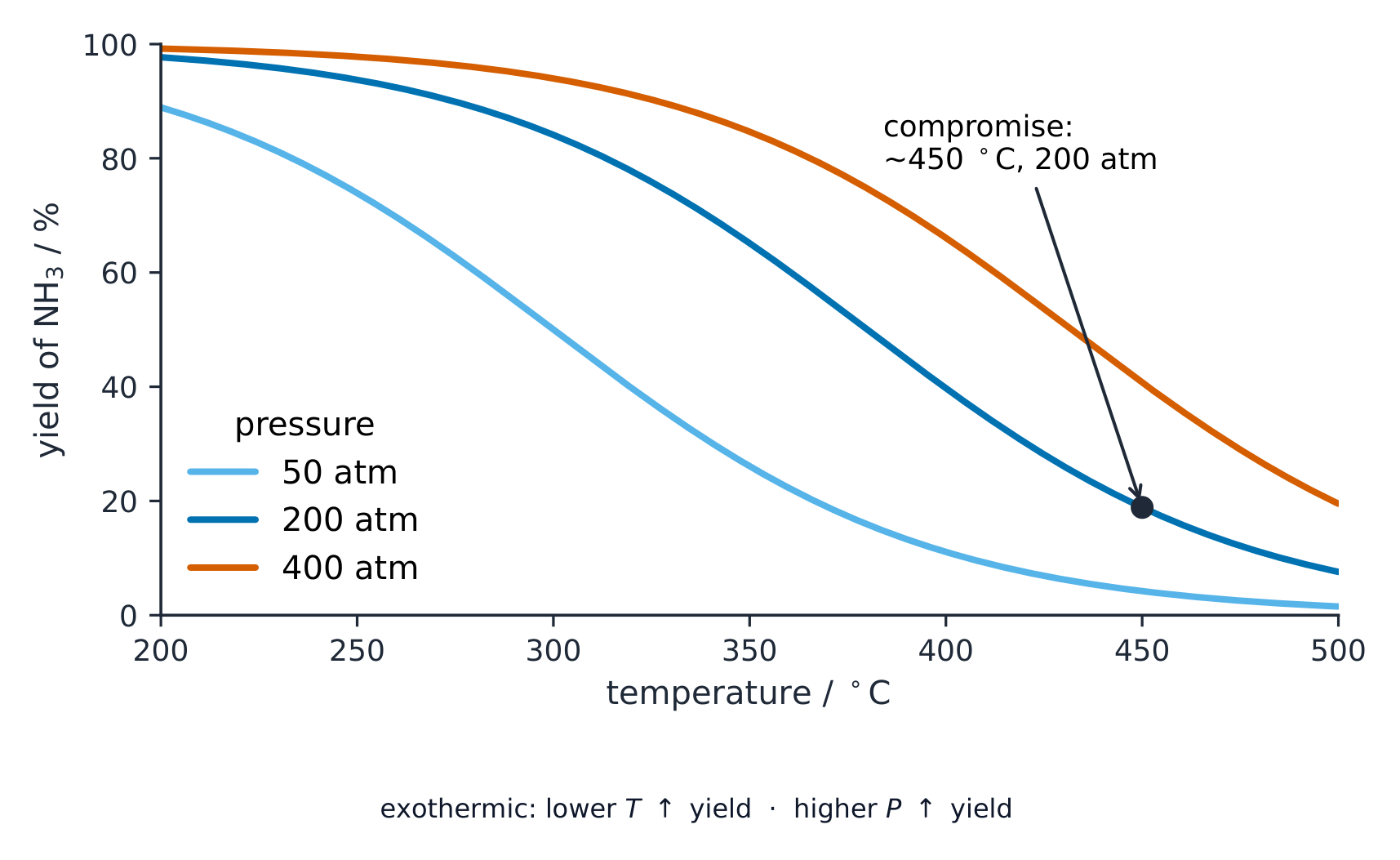
- 哈伯法(Haber process)制造氨:$\text{N}_2 + 3\text{H}_2 \rightleftharpoons 2\text{NH}_3$(放热)。它用约 $450\,°\text{C}$、$200\ \text{atm}$ 和一个铁催化剂。低温会给出更多的氨,但太慢,所以中等温度是一个折中。
- 接触法(Contact process)制造三氧化硫:$2\text{SO}_2 + \text{O}_2 \rightleftharpoons 2\text{SO}_3$(放热)。它用约 $450\,°\text{C}$、接近 $1$–$2\ \text{atm}$ 和一个氧化钒(V)催化剂。
探索
The Haber & Contact processes
compromise: yield vs rate
High pressure boosts yield; high temperature speeds it up but lowers yield — a compromise.
词汇表
训练
| 英文 | 中文 | 拼音 |
|---|---|---|
| Haber process/ˈheɪbə ˈprəʊses/ | 哈伯法 | hā bó fǎ |
| Contact process/ˈkɒntækt ˈprəʊses/ | 接触法 | jiē chù fǎ |
7.2
布朗斯特–劳里酸碱理论

大纲
- state the names and formulas of the common acids, limited to hydrochloric acid, $\text{HCl}$, sulfuric acid, $\text{H}_2\text{SO}_4$, nitric acid, $\text{HNO}_3$, ethanoic acid, $\text{CH}_3\text{COOH}$
- state the names and formulas of the common alkalis, limited to sodium hydroxide, $\text{NaOH}$, potassium hydroxide, $\text{KOH}$, ammonia, $\text{NH}_3$
- describe the Brønsted–Lowry theory of acids and bases
- describe strong acids and strong bases as fully dissociated in aqueous solution and weak acids and weak bases as partially dissociated in aqueous solution
- appreciate that water has pH of 7, acid solutions pH of below 7 and alkaline solutions pH of above 7
- explain qualitatively the differences in behaviour between strong and weak acids including the reaction with a reactive metal and difference in pH values by use of a pH meter, universal indicator or conductivity
- understand that neutralisation reactions occur when $\text{H}^+(\text{aq})$ and $\text{OH}^-(\text{aq})$ form $\text{H}_2\text{O}(\text{l})$
- understand that salts are formed in neutralisation reactions
- sketch the pH titration curves of titrations using combinations of strong and weak acids with strong and weak alkalis
- select suitable indicators for acid-alkali titrations, given appropriate data ($\text{p}K_a$ values will not be used)
来源:剑桥国际大纲
一个质子(proton)就是一个 $\text{H}^+$ 离子。布朗斯特-劳里理论按酸和碱对质子做什么来定义它们:
- 一个酸(acid)是一个质子供体(proton donor,它给出 $\text{H}^+$)。
- 一个碱(base)是一个质子受体(proton acceptor,它接受 $\text{H}^+$)。一个溶于水的碱叫作可溶性碱(alkali)。
你必须知道的常见酸:盐酸($\text{HCl}$)、硫酸($\text{H}_2\text{SO}_4$)、硝酸($\text{HNO}_3$)和乙酸($\text{CH}_3\text{COOH}$)。常见可溶性碱:氢氧化钠($\text{NaOH}$)、氢氧化钾($\text{KOH}$)和氨($\text{NH}_3$)。
探索
The pH scale
Slide the pH or tap a substance — each step down in pH means ten times more H⁺ ions; acids are below 7, alkalis above.
词汇表
训练
| 英文 | 中文 | 拼音 |
|---|---|---|
| proton/ˈprəʊtɒn/ | 质子 | zhì zi |
| acid/ˈæsɪd/ | 酸 | suān |
| proton donor/ˈprəʊtɒn ˈdəʊnə/ | 质子供体 | zhì zi gōng tǐ |
| base/beɪs/ | 碱 | jiǎn |
| proton acceptor/ˈprəʊtɒn əkˈseptə/ | 质子受体 | zhì zi shòu tǐ |
7.2
强酸弱酸与强碱弱碱

这是关于一个酸或碱在水中分开得多完全——而不是它有多浓。
- 一个强酸(strong acid)或强碱(strong base)在水中完全解离(dissociated,几乎每个分子都分成离子)。
- 一个弱酸(weak acid)或弱碱(weak base)只部分解离(大多数分子保持完整)。
pH 标度衡量一个溶液有多酸:纯水是 pH 7,酸低于 7,可溶性碱高于 7。相同浓度下强酸的 pH 比弱酸低。
你可以通过下列方式区分强酸和弱酸:
- 与一个活泼金属的反应:强酸冒泡更快。
- pH:用 pH 计或通用指示剂(universal indicator)测量。
- 导电性:强酸导电更好,因为它有更多的离子。
探索
Strong vs weak acids
A strong acid fully ionises (low pH); a weak acid only partly ionises, so at the same concentration its pH is higher. Slide to compare.
词汇表
训练
| 英文 | 中文 | 拼音 |
|---|---|---|
| strong acid/strɒŋ ˈæsɪd/ | 强酸 | qiáng suān |
| strong base/strɒŋ beɪs/ | 强碱 | qiáng jiǎn |
| dissociated/dɪˈsəʊsɪeɪtɪd/ | 解离 | jiě lí |
| weak acid/wiːk ˈæsɪd/ | 弱酸 | ruò suān |
| weak base/wiːk beɪs/ | 弱碱 | ruò jiǎn |
| universal indicator/ˌjuːnɪˈvɜːsl ˈɪndɪkeɪtə/ | 通用指示剂 | tōng yòng zhǐ shì jì |
| indicator/ˈɪndɪkeɪtə/ | 指示剂 | zhǐ shì jì |
7.2
中和、盐与滴定曲线

当一个酸的氢离子与一个可溶性碱的氢氧根离子反应时,发生中和(neutralisation):
$$\text{H}^+(\text{aq}) + \text{OH}^-(\text{aq}) \rightarrow \text{H}_2\text{O}(\text{l})$$
还从酸和碱的其余部分形成一个盐(salt)。
在一次滴定(titration)中你把一个溶液加入另一个并追踪 pH。滴定曲线(titration curve)在终点附近有一个陡峭、几乎竖直的跳跃。确切的形状取决于每种反应物是强的还是弱的。
要挑一个指示剂(indicator),选一个变色落在那个陡峭跳跃之内的。对于强酸配强碱大多数指示剂都行;对于弱酸配强碱你需要一个在较高 pH 范围变色的。
探索
A titration curve
Add alkali to acid and watch the pH climb. The steep jump is the equivalence point, where the acid is just neutralised.
词汇表
训练
| 英文 | 中文 | 拼音 |
|---|---|---|
| Neutralisation/ˌnjuːtrəlaɪˈzeɪʃn/ | 中和 | zhōng hé |
| salt/sɒlt/ | 盐 | yán |
| titration/taɪˈtreɪʃn/ | 滴定 | dī dìng |
| titration curve/taɪˈtreɪʃn kɜːv/ | 滴定曲线 | dī dìng qū xiàn |
7.2
考试技巧
- 用全部三点定义动态平衡:正逆速率相等、浓度恒定、封闭系统。
- 回答勒夏特列问题时陈述变化、移动的方向和原因;催化剂不移动位置(它同时加速两个速率)。
- 把 $K_c$ 写成产物除以反应物,每个都升到它的配平系数次方;带上状态符号以决定什么出现。
- 把哈伯/接触法的条件论证为产率、速率和成本之间的折中——不要只是照搬它们。
- 布朗斯特:酸 = 质子供体,碱 = 质子受体;共轭对相差一个 $\text{H}^+$。
本主题的互动课程
逐步学习,并即时检测练习。