的伟大Điện có thể làm điều kỳ diệu: nó có thể xé tan một hợp chất. Cho dòng điện chạy qua hợp chất nóng chảy hoặc hòa tan, và nó tách ra thành các的伟大卓越…
English narration · English + 中文 subtitles burned in · Giọng đọc tiếng Anh · phụ đề tiếng Anh + 中文 được ghi trực tiếp
4.1
Electrolysis · Điện phân
Syllabus · Chương trình
English
Core
Supplement
1 Define electrolysis as the decomposition of an ionic compound, when molten or in aqueous solution, by the passage of an electric current
8 Describe the transfer of charge during electrolysis to include: (a) the movement of electrons in the external circuit (b) the loss or gain of electrons at the electrodes (c) the movement of ions in the electrolyte
2 Identify in simple electrolytic cells: (a) the anode as the positive electrode (b) the cathode as the negative electrode (c) the electrolyte as the molten or aqueous substance that undergoes electrolysis
3 Identify the products formed at the electrodes and describe the observations made during the electrolysis of: (a) molten lead(II) bromide (b) concentrated aqueous sodium chloride (c) dilute sulfuric acid using inert electrodes made of platinum or carbon/graphite
9 Identify the products formed at the electrodes and describe the observations made during the electrolysis of aqueous copper(II) sulfate using inert carbon/graphite electrodes and when using copper electrodes
4 State that metals or hydrogen are formed at the cathode and that non-metals (other than hydrogen) are formed at the anode
5 Predict the identity of the products at each electrode for the electrolysis of a binary compound in the molten state
10 Predict the identity of the products at each electrode for the electrolysis of a halide compound in dilute or concentrated aqueous solution
11 Construct ionic half-equations for reactions at the anode (to show oxidation) and at the cathode (to show reduction)
6 State that metal objects are electroplated to improve their appearance and resistance to corrosion
7 Describe how metals are electroplated
Tiếng Việt
Cốt lõi
Bổ sung
1 Định nghĩa điện phân là sự phân hủy một hợp chất ion, khi nóng chảy hoặc trong dung dịch nước, do dòng điện chạy qua
8 Mô tả sự truyền tải điện tích trong quá trình điện phân bao gồm: (a) sự di chuyển của electron trong mạch ngoài (b) sự mất hoặc nhận electron tại các điện cực (c) sự di chuyển của ion trong chất điện phân
2 Xác định trong các tế bào điện phân đơn giản: (a) anode là điện cực dương (b) cathode là điện cực âm (c) chất điện phân là chất nóng chảy hoặc dung dịch nước trải qua điện phân
3 Xác định các sản phẩm tạo thành tại các điện cực và mô tả các quan sát được thực hiện trong quá trình điện phân: (a) chì(II) bromide nóng chảy (b) dung dịch nước natri clorua đặc (c) axit sulfuric loãng sử dụng các điện cực trơ làm bằng bạch kim hoặc carbon/than chì
9 Xác định các sản phẩm tạo thành tại các điện cực và mô tả các quan sát được thực hiện trong quá trình điện phân dung dịch nước đồng(II) sunfat sử dụng các điện cực than/th cacbon trơ và khi sử dụng các điện cực đồng
4 Nêu rằng kim loại hoặc hydro được tạo thành tại cathode và phi kim (ngoài hydro) được tạo thành tại anode
5 Dự đoán danh tính của các sản phẩm tại mỗi điện cực cho quá trình điện phân một hợp chất nhị phân ở trạng thái nóng chảy
10 Dự đoán danh tính của các sản phẩm tại mỗi điện cực cho quá trình điện phân một hợp chất halogen trong dung dịch nước loãng hoặc đặc
11 Xây dựng phương trình bán ion cho các phản ứng tại anode (để thể hiện quá trình oxy hóa) và tại cathode (để thể hiện quá trình khử)
6 Nêu rằng các vật thể kim loại được mạ điện để cải thiện vẻ bề ngoài và khả năng chống ăn mòn
7 Mô tả cách mạ điện cho kim loại
Source: Cambridge International syllabus · Nguồn: Chương trình Cambridge International
English
Electrolysis: ions discharge at the electrodes
Electrolysis 电解 is the breaking down (decomposition 分解) of an ionic compound 离子化合物 — when it is molten 熔融 or in aqueous 水溶液 solution — by passing an electric current 电流 through it.
It only works when the substance is molten or dissolved, because then the ions 离子 are free to move and carry the charge. A solid ionic compound cannot be electrolysed because its ions are locked in place.
The electrolytic cell
The set-up is called an electrolytic cell 电解池. Two electrodes 电极 (solid conductors) dip into the electrolyte 电解质 — the molten or aqueous substance being broken down.
The anode 阳极 is the positive ($+$) electrode.
The cathode 阴极 is the negative ($-$) electrode.
The electrodes are often inert 惰性 (they do not react), such as platinum 铂 or carbon/graphite 石墨.
What is formed at each electrode
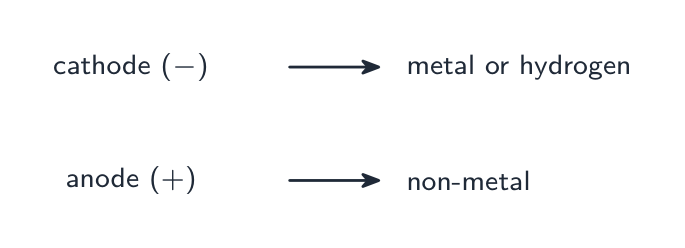
There is a simple rule:
Metals 金属 or hydrogen 氢气 are formed at the cathode.
Non-metals 非金属 (other than hydrogen) are formed at the anode.
For aqueous solutions, the product can depend on whether the solution is dilute 稀 or concentrated 浓. Here are the three Core examples:
Electrolyte
At the cathode ($-$)
At the anode ($+$)
molten lead(II) bromide, $\text{PbBr}_2$
lead 铅 (silvery liquid)
bromine 溴 (red-brown vapour)
concentrated aqueous sodium chloride
hydrogen (bubbles of gas)
chlorine 氯气 (pale green gas)
dilute sulfuric acid 硫酸
hydrogen (bubbles of gas)
oxygen 氧气 (bubbles of gas)
Worked example. Predict the products of electrolysing molten zinc chloride, $\text{ZnCl}_2$. Because it is molten, only zinc ions and chloride ions are present - there is no water to complicate things. Zinc is a metal, so it forms at the cathode: $\text{Zn}^{2+}$ ions gain electrons and silvery zinc appears. Chlorine is a non-metal, so it forms at the anode: pale green chlorine gas bubbles off. Always check the state first. A molten compound simply gives you its own two elements, while an aqueous one brings water into the competition - which is why concentrated sodium chloride solution gives hydrogen at the cathode rather than sodium.
How the charge moves
During electrolysis:
Electrons 电子 move through the wires (the external circuit 外电路) from the power supply.
At the cathode, positive ions gain electrons. Gaining electrons is reduction 还原.
At the anode, negative ions lose electrons. Losing electrons is oxidation 氧化.
Inside the electrolyte, the ions move: positive ions go to the cathode and negative ions go to the anode.
You can write a half-equation 半反应式 for each electrode. For molten lead(II) bromide:
The product at the anode depends on the electrode:
With inert carbon electrodes: copper 铜 forms at the cathode and oxygen forms at the anode. The blue colour of the solution slowly fades as copper is removed.
With copper electrodes: copper forms at the cathode, while the anode itself dissolves into the solution. The blue colour stays the same. This is used to purify copper.
Electroplating
Electroplating 电镀 means covering a metal object with a thin layer of another metal. This improves its appearance and its resistance to corrosion 腐蚀 (rusting and wearing away).
To electroplate an object:
the object to be coated is made the cathode;
the plating metal is made the anode;
the electrolyte is a solution containing ions of the plating metal.
Tiếng Việt
Điện phân: các ion bị khử/oxi hóa tại các điện cực
Điện phân là quá trình phân hủy (decomposition) của một hợp chất ion — khi nó ở trạng thái lỏng nóng chảy hoặc trong dung dịch aqueous — bằng cách truyền một dòng điện qua nó.
Tế bào điện phân tách hợp chất bằng dòng điện.
Nó chỉ hoạt động khi chất tan chảy hoặc hòa tan, vì lúc đó các ion được tự do di chuyển và mang điện tích. Một hợp chất ion rắn không thể điện phân được vì các ion của nó bị khóa chặt tại chỗ.
Điện phân nước: khí bọt ra tại mỗi điện cực và thu thập trong các ống phía trên, với lượng hydro khoảng gấp đôi so với oxy
Tế bào điện phân
Sơ đồ này được gọi là tế bào điện phân. Hai điện cực (dẫn điện rắn) nhúng vào chất điện ly — chất tan chảy hoặc dung dịch đang bị phân tách.
Anode là điện cực dương ($+$).
Cathode là điện cực âm ($-$).
Các điện cực thường trơ (không tham gia phản ứng), như platin hoặc carbon/graphit.
Sản phẩm tạo thành tại mỗi điện cực
Có một quy tắc đơn giản:
Kim loại và hydro tạo thành ở catod; phi kim tạo thành ở anode
Kim loại hoặc hydro được tạo thành tại cathode.
Phi kim (ngoài hydro) được tạo thành tại anode.
Đối với dung dịch, sản phẩm có thể phụ thuộc vào việc dung dịch đó loãng hay đặc. Dưới đây là ba ví dụ cốt lõi:
Chất điện ly
Tại cathode ($-$)
Tại anode ($+$)
Molten chì(II) bromua, $\text{PbBr}_2$
chì (lỏng màu bạc)
brom (hơi màu đỏ nâu)
Dung dịch natri clorua đặc
Hydro (bọt khí)
clo (khí xanh nhạt)
Axit sunfuric loãng
Hydro (bọt khí)
oxy (bọt khí)
Ví dụ đã giải. Dự đoán sản phẩm của quá trình điện phân kẽm clorua nóng chảy, $\text{ZnCl}_2$. Vì là dung dịch nóng chảy, chỉ có ion kẽm và ion clorua tồn tại — không có nước làm phức tạp vấn đề. Kẽm là kim loại, nên tạo thành ở catod: $\text{Zn}^{2+}$ ion nhận electron và kẽm bạc xuất hiện. Clo là phi kim, nên tạo thành ở anod: khí clo màu xanh nhạt sủi bọt. Luôn kiểm tra trạng thái trước. Hợp chất nóng chảy chỉ đơn thuần cho hai nguyên tố của chính nó, trong khi hợp chất dịch aqueous đưa nước vào cuộc cạnh tranh — đó là lý do dung dịch natri clorua đặc tạo ra hydro ở catod thay vì natri.
Cách di chuyển của điện tích
Trong quá trình điện phân:
Electron di chuyển qua dây dẫn (mạch ngoại) từ nguồn điện.
Tại cathode, ion dương nhận electron. Nhận electron là khử.
Tại anode, ion âm mất electron. Mất electron là oxy hóa.
Bên trong chất điện ly, các ion di chuyển: ion dương đi về cathode và ion âm đi về anode.
Bạn có thể viết phương trình bán phần cho từng điện cực. Đối với molten chì(II) bromua:
Trong molten chì(II) bromua, $\text{Pb}^{2+}$ di chuyển về cathode và $\text{Br}^-$ di chuyển về anode, nơi mỗi chất bị khử
Điện phân đồng(II) sunfat
Sản phẩm tại anode phụ thuộc vào điện cực:
Với điện cực carbon trơ: đồng tạo thành tại cathode và oxy tạo thành tại anode. Màu xanh của dung dịch dần nhạt đi khi đồng bị loại bỏ.
Với điện cực đồng: đồng tạo thành tại cathode, trong khi bản thân anode tan vào dung dịch. Màu xanh giữ nguyên. Điều này được sử dụng để tinh chế đồng.
Mạ điện
Mạ điện có nghĩa là phủ lên một vật bằng kim loại một lớp mỏng của kim loại khác. Điều này cải thiện vẻ ngoài và khả năng chống lại ăn mòn (gỉ sét và mài mòn).
Để mạ điện một vật:
vật cần mạ được làm cathode;
kim loại mạ được làm anode;
chất điện ly là dung dịch chứa ion của kim loại mạ.
Để mạ điện, hãy đặt vật thể làm catod và kim loại mạ làm anode, trong dung dịch chứa các ion của kim loại mạ
Explore · Khám phá
Inside an electrolysis cell · Bên trong cell điện phân
Pick an electrolyte and watch ions move: positive ions to the cathode, negative ions to the anode. · Chọn một chất điện ly và quan sát các ion di chuyển: ion dương sang cathode, ion âm sang anode.
It is useful to compare a fuel cell with a normal petrol (gasoline) engine in a vehicle.
Hydrogen–oxygen fuel cell
Petrol engine
Main product
water only
carbon dioxide and pollutants 污染物
Effect on air
clean
adds to air pollution
Fuel storage
hydrogen is hard and dangerous to store (flammable, needs high pressure)
petrol is easy to store
Source
hydrogen may be made using fossil fuels
made from crude oil
Advantages of the fuel cell: the only product is water, so it does not pollute the air, and it changes chemical energy into electricity efficiently. Disadvantages: hydrogen is hard to store and transport safely, and producing the hydrogen can still use energy from fossil fuels.
Tiếng Việt
Một pin nhiên liệu sử dụng hydro và oxy để tạo ra điện trực tiếp. Sản phẩm hóa học duy nhất là nước.
*Pin nhiên liệu hydro–oxy chuyển hóa năng lượng hóa học trực tiếp thành điện, với nước là sản phẩm duy nhất
Nó hữu ích khi so sánh pin nhiên liệu với động cơ xăng (gasoline) thông thường trong xe cộ.
Pin nhiên liệu hydro–oxy
Động cơ xăng
Sản phẩm chính
chỉ nước
carbon dioxide và thải độc
Ảnh hưởng đến không khí
sạch
tăng ô nhiễm không khí
Lưu trữ nhiên liệu
hydro khó và nguy hiểm để lưu trữ (dễ cháy, cần áp suất cao)
xăng dễ lưu trữ
Nguồn gốc
hydro có thể được tạo ra bằng cách sử dụng nhiên liệu hóa thạch
được sản xuất từ dầu thô
Ưu điểm của pin nhiên liệu: sản phẩm duy nhất là nước, nên không gây ô nhiễm không khí, và nó chuyển hóa năng lượng hóa học thành điện hiệu quả. Nhược điểm: hydro khó lưu trữ và vận chuyển an toàn, và việc sản xuất hydro vẫn có thể sử dụng năng lượng từ nhiên liệu hóa thạch.
Explore · Khám phá
Inside a hydrogen–oxygen fuel cell · Bên trong pin nhiên liệu hydro–oxy
Step through a fuel cell. Hydrogen and oxygen combine to make water, and the energy of that reaction is released as electricity — with no carbon dioxide. · Quá trình diễn ra trong pin nhiên liệu. Hydro và oxy kết hợp tạo thành nước, năng lượng từ phản ứng này được giải phóng dưới dạng điện — mà không sinh ra khí cacbon đioxit.
At the cathode (negative) you get a metal or hydrogen; at the anode (positive) you get a non-metal. Positive ions move to the cathode, negative ions to the anode.
A molten compound just gives its two elements. An aqueous solution can give something different (concentrated sodium chloride gives hydrogen and chlorine, not sodium).
Reduction is gain of electrons (at the cathode); oxidation is loss of electrons (at the anode). Remember OIL RIG.
In a half-equation the atoms and the charges must balance, with the electrons on the correct side: $\text{Pb}^{2+} + 2e^- \rightarrow \text{Pb}$ (cathode).
To electroplate an object, make it the cathode, make the plating metal the anode, and use a solution containing ions of the plating metal.
Tiếng Việt
Tại cathode (âm) bạn nhận được kim loại hoặc hydro; tại anode (dương) bạn nhận được phi kim. Ion dương di chuyển về cathode, ion âm di chuyển về anode.
Một hợp chất nóng chảy chỉ tạo ra hai nguyên tố của nó. Một dung dịch nước có thể tạo ra sản phẩm khác (dung dịch natri clorua đặc tạo ra hydro và clo, không phải natri).
Khử là nhận electron (tại catot); oxi hóa là mất electron (tại anot). Hãy nhớ OIL RIG.
Trong phương trình bán phản ứng, số lượng nguyên tử và điện tích phải cân bằng, với các electron nằm ở phía đúng: $\text{Pb}^{2+} + 2e^- \rightarrow \text{Pb}$ (catot).
Để mạ điện một vật, hãy làm cho vật đó là catot, kim loại mạ là anot, và sử dụng dung dịch chứa ion của kim loại mạ.
Interactive lessons on this topic · Bài học tương tác về chủ đề này
Work through it step by step, with instant-check exercises. · Làm theo từng bước, kèm theo bài tập kiểm tra ngay lập tức.
Pick one and the site follows you — notes, papers, videos and practice all open on it. · Chọn một môn và trang sẽ điều hướng theo — ghi chú, tài liệu, video và bài tập đều mở ở đó.
Type to search notes, lessons, code, vocabulary and past-paper questions across every subject. · Nhập để tìm ghi chú, bài học, mã, từ vựng và câu hỏi đề thi cũ trên mọi môn học.