Electrolysis
Introduced| English | Meaning |
|---|---|
| electrolysis/ɪlekˈtrɒləsɪs/ | The decomposition of an electrolyte by an electric current passing through its molten form or a solution. |
| electrolyte/ɪˈlektrəlaɪt/ | A substance that conducts electricity when molten or dissolved because it contains mobile ions. |
| electrodes/ɪˈlektrəʊdz/ | A conductor through which charge enters or leaves an electrochemical system. |
| cathode/ˈkæθəʊd/ | An electrode at which reduction occurs. |
| anode/ˈænəʊd/ | An electrode at which oxidation occurs. |
| reduction/rɪˈdʌkʃn/ | A chemical change involving a gain of electrons or a decrease in oxidation state. |
| oxidation/ˌɒksɪˈdeɪʃn/ | A chemical change involving a loss of electrons or an increase in oxidation state. |
Splitting compounds with electricity
- Some compounds are so stable that heat alone won't break them — but electricity can.
- Electrolysis 电解 uses an electric current to break down an ionic compound.
Electrolysis is the breaking down of a compound using:
Difficulty 1/5 · 100 coins + a small bonus on first completion today
An electric current decomposes the electrolyte.
The molten or dissolved ionic compound being broken down is called the ______.
Difficulty 1/5 · 100 coins + a small bonus on first completion today
The electrolyte supplies the free-moving ions.
The set-up
- The compound (molten or dissolved) is the electrolyte 电解质, holding free-moving ions.
- Two electrodes 电极 dip in: the cathode 阴极 (negative) and the anode 阳极 (positive), connected to a power supply.
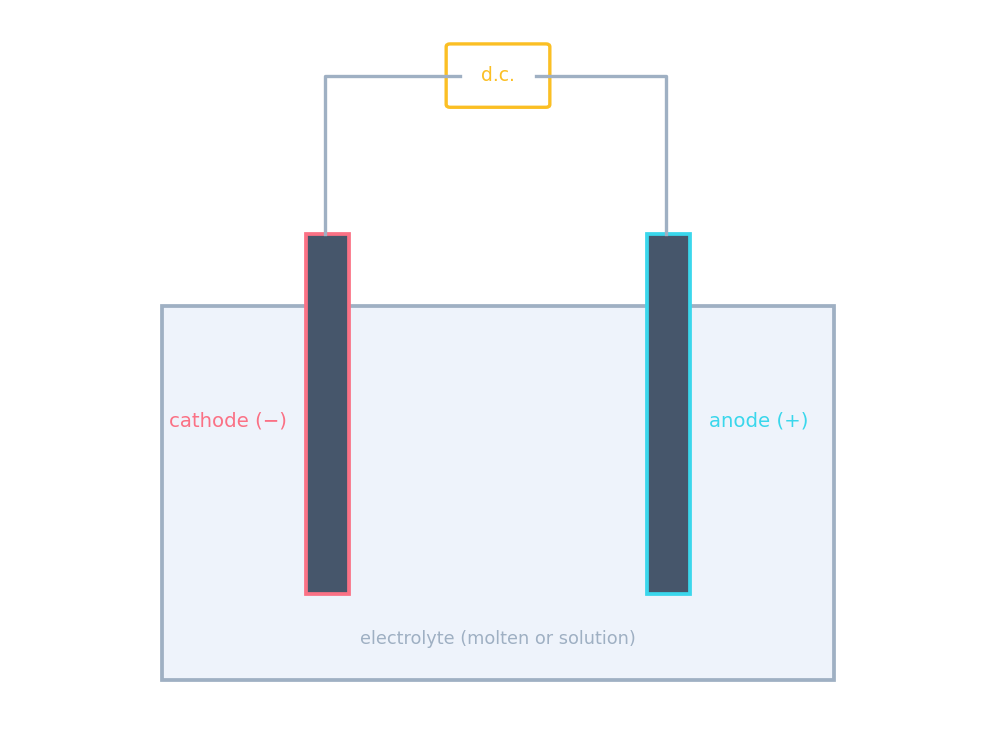
Positive ions move to the cathode; negative ions move to the anode.
Positive ions move towards the:
Difficulty 1/5 · 100 coins + a small bonus on first completion today
Opposite charges attract: positive ions → negative cathode.
Negative ions move towards the positive anode.
Difficulty 1/5 · 100 coins + a small bonus on first completion today
Anions are attracted to the anode.
Where the ions go
- Positive ions (cations) move to the negative cathode.
- Negative ions (anions) move to the positive anode.

Electrolysis of water: gas bubbles off at each electrode and collects in the tubes above
Follow the ions through the cell
Step through it: the molten compound's free ions drift to the oppositely-charged electrode, then are discharged into the two elements — lead at the cathode, bromine at the anode.
For electrolysis to work, the electrolyte must be:
Difficulty 1/5 · 100 coins + a small bonus on first completion today
Free-moving ions are essential.
What happens there
- At the cathode, positive ions gain electrons (reduction 还原).
- At the anode, negative ions lose electrons (oxidation 氧化), and elements are released.
Electrolysis needs free-moving ions. A solid ionic compound won't work — its ions are locked in place. It must be molten or dissolved so the ions can move to the electrodes.
You've got it
- electrolysis breaks down a compound using electricity; the compound is the electrolyte
- positive ions → cathode (−); negative ions → anode (+)
- it needs the electrolyte molten or dissolved so ions can move