| Cốt lõi | Bổ sung |
|---|---|
| 1 Nêu chức năng của mạch gỗ và mạch rây: (a) mạch gỗ – vận chuyển nước và ion khoáng, và nâng đỡ (b) mạch rây – vận chuyển sucrose và axit amin | 3 Liên hệ cấu trúc của ống dẫn mạch gỗ với chức năng của nó, giới hạn ở: (a) thành dày có lignin (không yêu cầu chi tiết về sự lign hóa) (b) không có nội dung tế bào (c) các tế bào nối đầu cuối với nhau không có vách ngăn ngang để tạo thành ống dài liên tục |
| 2 Nhận biết trong sơ đồ và hình ảnh vị trí của xylem và phloem nhìn thấy trong mặt cắt rễ, thân và lá của thực vật hai lá mầm không gỗ |
Vận chuyển trong thực vật
Sinh học IGCSE · Chủ đề 8
 5:54
Vận chuyển ở thực vật
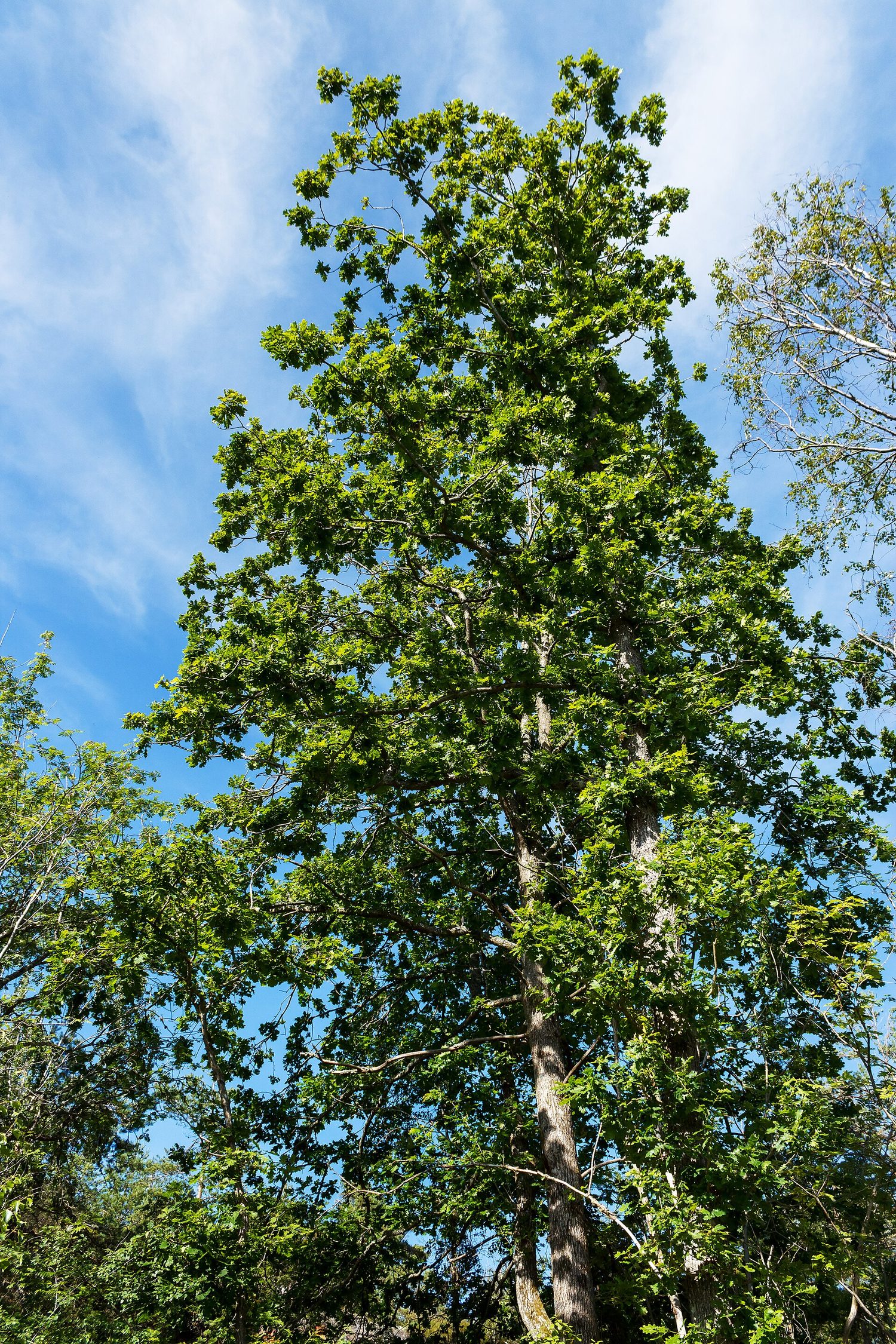
Một cây cao đưa nước lên một trăm mét vào không khí mỗi ngày, không có bơm và không có bộ phận chuyển động nào. Nó làm điều đó chỉ bằng sự bay hơi từ lá của mình…
Thuyết minh tiếng Anh · Có thể chuyển đổi phụ đề tiếng Anh và tiếng Trung
8.1
Xylem và phloem
Chương trình
Nguồn: Chương trình Cambridge International
English
Plants have two transport tissues that run through the roots, stems and leaves:
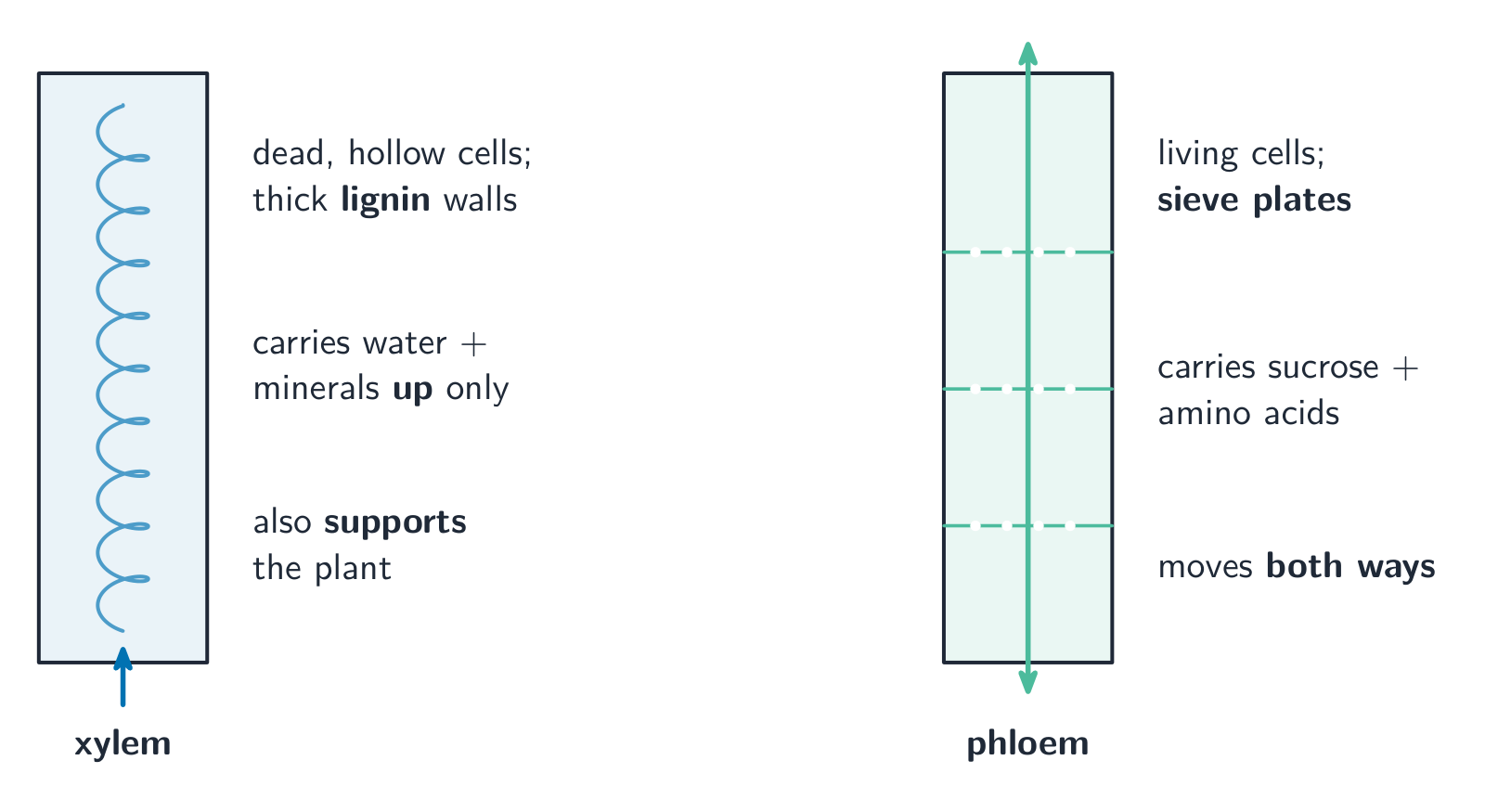
- xylem 木质部 — carries water and mineral ions 矿物质离子 up from the roots, and gives the plant support 支撑.
- phloem 韧皮部 — carries sucrose 蔗糖 and amino acids 氨基酸 to wherever they are needed.
In a root, stem or leaf, the xylem and phloem lie side by side in vascular bundles 维管束.
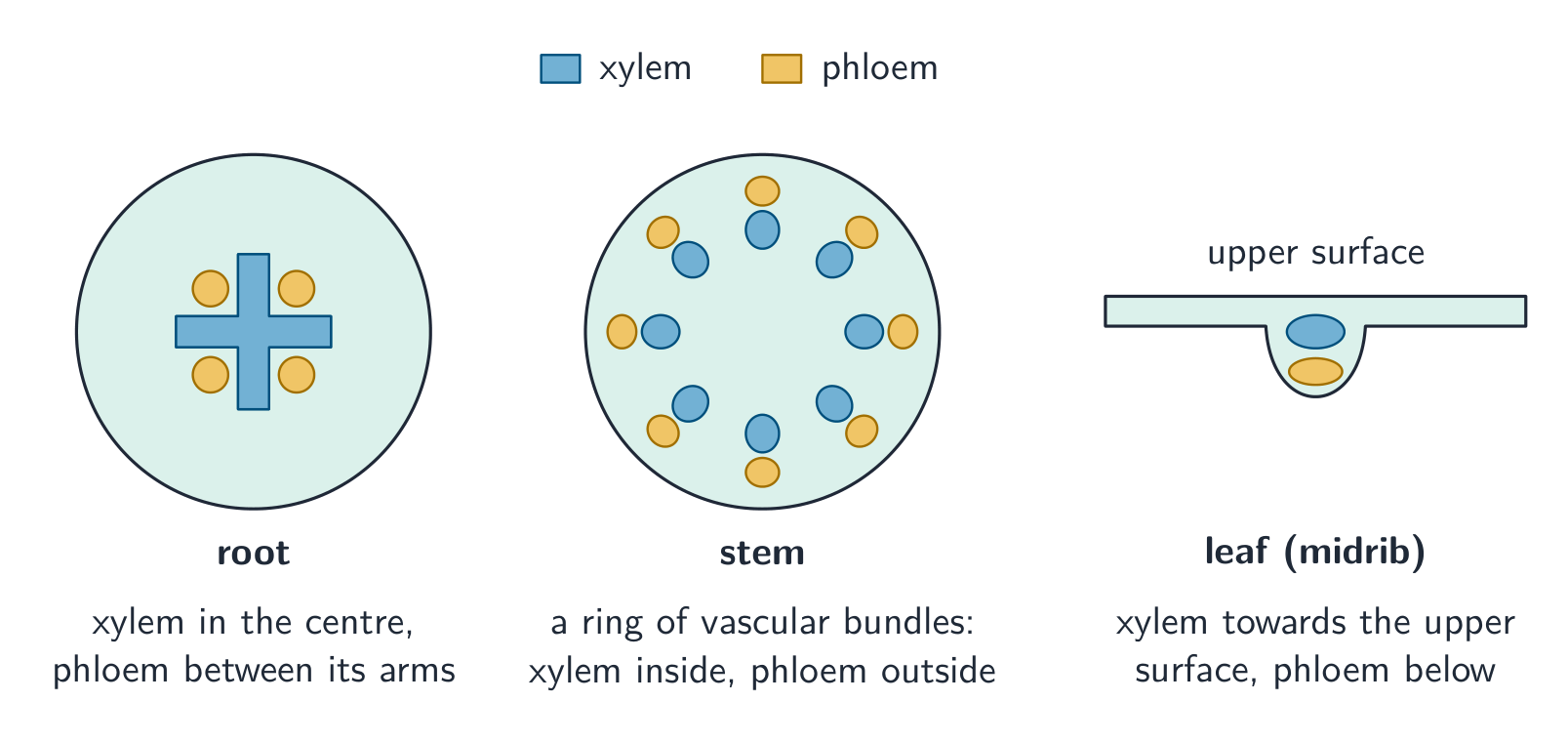
Exams show a section through a root, stem or leaf and ask you to identify the xylem and the phloem. Learn where each one lies:
- root: the xylem is in the centre, often in an X or star shape; the phloem lies in the gaps between its arms. A central core resists the pulling force as the root anchors the plant.
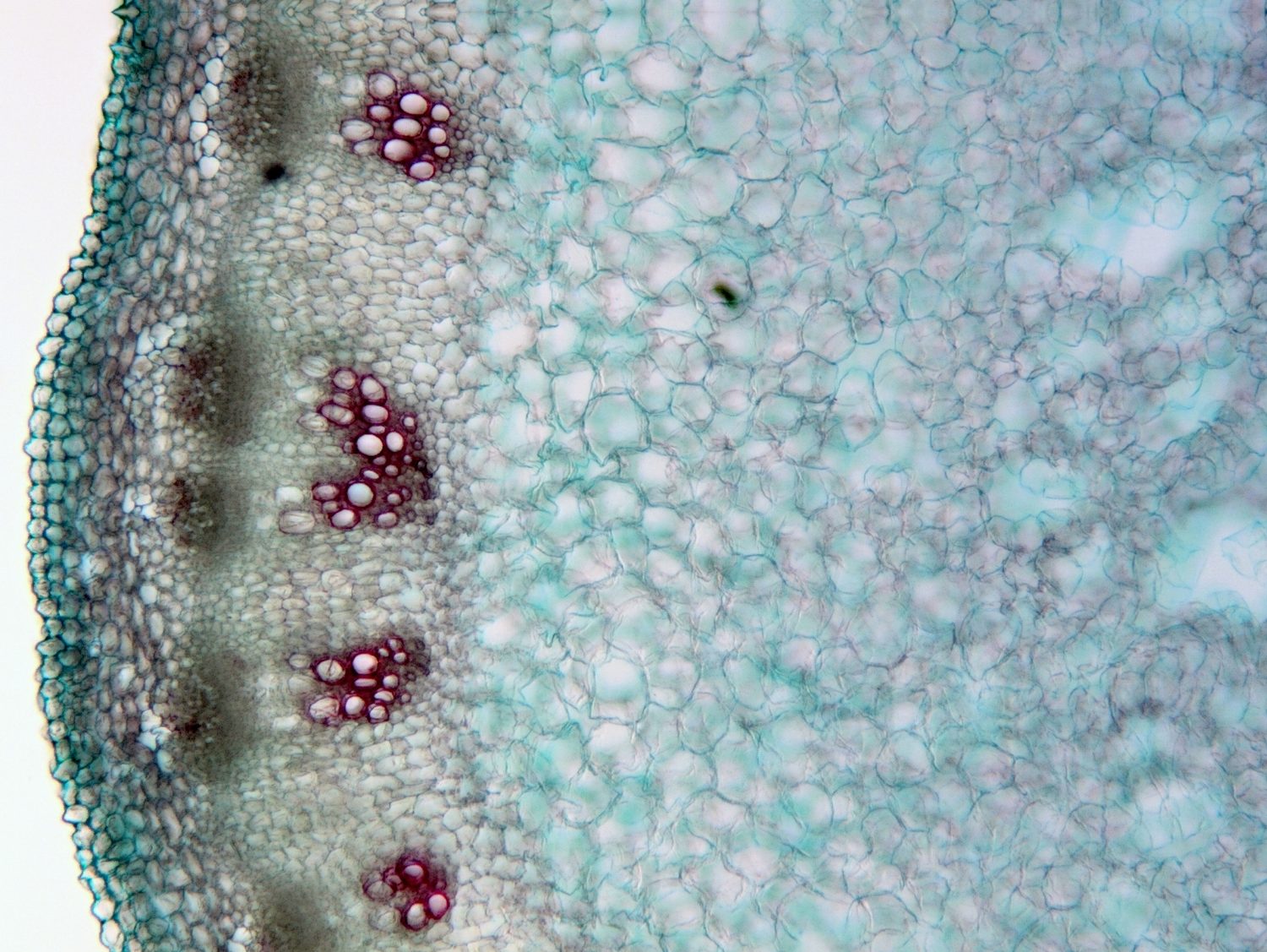
- stem: the vascular bundles form a ring near the outside; in each bundle the xylem is on the inside (towards the centre) and the phloem on the outside. This ring helps the stem resist bending.
- leaf: in the midrib and veins, the xylem is towards the upper surface and the phloem towards the lower surface.
In a photograph, the xylem vessels are the cells with the widest openings and the thickest walls; stains such as the red in the stem section below colour the lignin in their walls.
Xylem structure (Supplement)
Xylem is made of long tubes called vessels 导管, well suited to carrying water:
- their walls are thick and strengthened with lignin 木质素, which also helps support the plant.
- the cells are dead and empty (they have no cell contents), so water flows through freely.
- the cells are joined end to end with no walls across the tube, making one long, continuous pipe.
Khám phá
Tuyến đường vận chuyển Xylem và phloem
Quan sát sự di chuyển của nước và đường qua các mô dẫn truyền khác nhau của cây.
Từ vựng
Luyện tập
| English | Tiếng Việt |
|---|---|
| xylem/ˈzaɪləm/ | mạch gỗ |
| mineral ions/ˈmɪnərəl ˈaɪɒnz/ | ion khoáng |
| support/səˈpɔːt/ | hỗ trợ |
| phloem/ˈfləʊɪm/ | mạch rây |
| sucrose/ˈsuːkrəʊs/ | Sucrose |
| amino acids/əˈmiːnəʊ ˈæsɪdz/ | axit amin |
| vascular bundles/ˈvæskjʊlə ˈbʌndlz/ | bó mạch |
| vessels/ˈveslz/ | bộ mạch |
| lignin/ˈlɪɡnɪn/ | lignin |
8.2
Hấp thụ nước
Chương trình
| Cốt lõi | Bổ sung |
|---|---|
| 1 Nhận biết trong sơ đồ và hình ảnh tế bào lông hút và nêu chức năng của chúng | |
| 2 Nêu rằng diện tích bề mặt lớn của lông hút làm tăng khả năng hấp thụ nước và ion khoáng | |
| 3 Trình bày con đường mà nước di chuyển qua rễ, thân và lá dưới dạng: tế bào lông hút, tế bào vỏ rễ, xylem, tế bào mô bệ | |
| 4 Tìm hiểu, sử dụng thuốc nhuộm phù hợp, con đường di chuyển của nước qua các bộ phận trên mặt đất của cây |
Nguồn: Chương trình Cambridge International
English
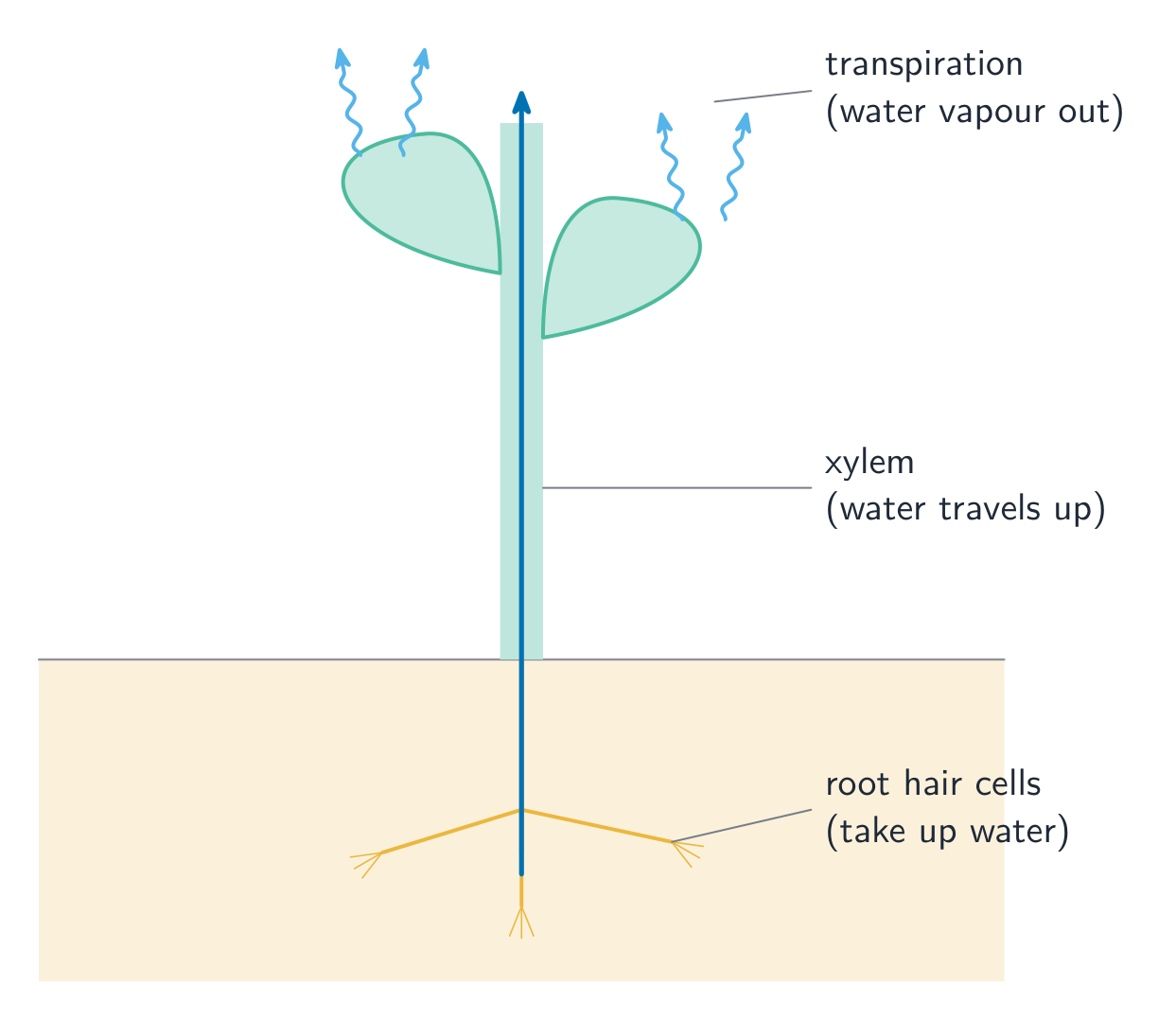
Water and mineral ions enter the plant through root hair cells 根毛细胞. The huge number of root hairs 根毛 gives a very large surface area 表面积, which speeds up the uptake of water and mineral ions.
The water then follows this pathway:
root hair cells → root cortex 皮层 cells → xylem → mesophyll 叶肉 cells in the leaf.
You can show this pathway by standing a plant or a white flower in water that contains a coloured stain 染色剂. The stain is carried up the xylem and colours the veins.
Investigating the pathway. Stand a celery stalk with leaves in water containing a dye (such as food colouring or eosin) for a few hours, in a warm, bright place so that transpiration is fast. Cut thin slices across the stalk and look at them with a hand lens: only small dots near the edge, the xylem in the vascular bundles, are coloured. The leaf veins also become coloured. This shows that water travels up the stem in the xylem and out into the leaves.
Khám phá
Hấp thụ nước bởi lông hút
Tế bào lông hút hấp thụ nước bằng thẩm thấu — nước di chuyển từ đất loãng sang tế bào đặc hơn.
Từ vựng
Luyện tập
| English | Tiếng Việt |
|---|---|
| root hair cells/ruːt heə selz/ | tế bào lông hút |
| root hairs/ruːt heəz/ | root hairs: lông hút |
| surface area/ˈsɜːfɪs ˈeərɪə/ | diện tích bề mặt |
| cortex/ˈkɔːteks/ | cortex |
| mesophyll/ˈmesəfɪl/ | bào mô lá |
| stain/steɪn/ | chất nhuộm |
8.3
Hô hấp hút nước
Chương trình
| Cốt lõi | Bổ sung |
|---|---|
| 1 Mô tả thoát hơi nước là sự mất đi hơi nước từ lá | |
| 2 Mô tả sự bay hơi nước từ bề mặt tế bào mô giác vào khoảng không khí rồi khuếch tán ra ngoài lá dưới dạng hơi nước qua khí khổng | |
| 4 Giải thích mối liên hệ giữa sự mất nước dưới dạng hơi với: diện tích bề mặt lớn bên trong do các khoảng không khí kết nối giữa các tế bào mô giác cung cấp và kích thước cũng như số lượng khí khổng | |
| 5 Giải thích cơ chế di chuyển lên trên của nước trong mạch gỗ theo thuật ngữ lực kéo thoát hơi nước hút lên một cột phân tử nước, được giữ chặt với nhau nhờ lực hút giữa các phân tử nước | |
| 3 Điều tra và mô tả tác động của sự thay đổi nhiệt độ và tốc độ gió lên tốc độ thoát hơi nước | 6 Giải thích tác động đến tốc độ thoát hơi nước khi thay đổi các yếu tố sau: nhiệt độ, tốc độ gió và độ ẩm |
| 7 Giải thích cách thức và nguyên nhân xảy ra héo |
Nguồn: Chương trình Cambridge International
English
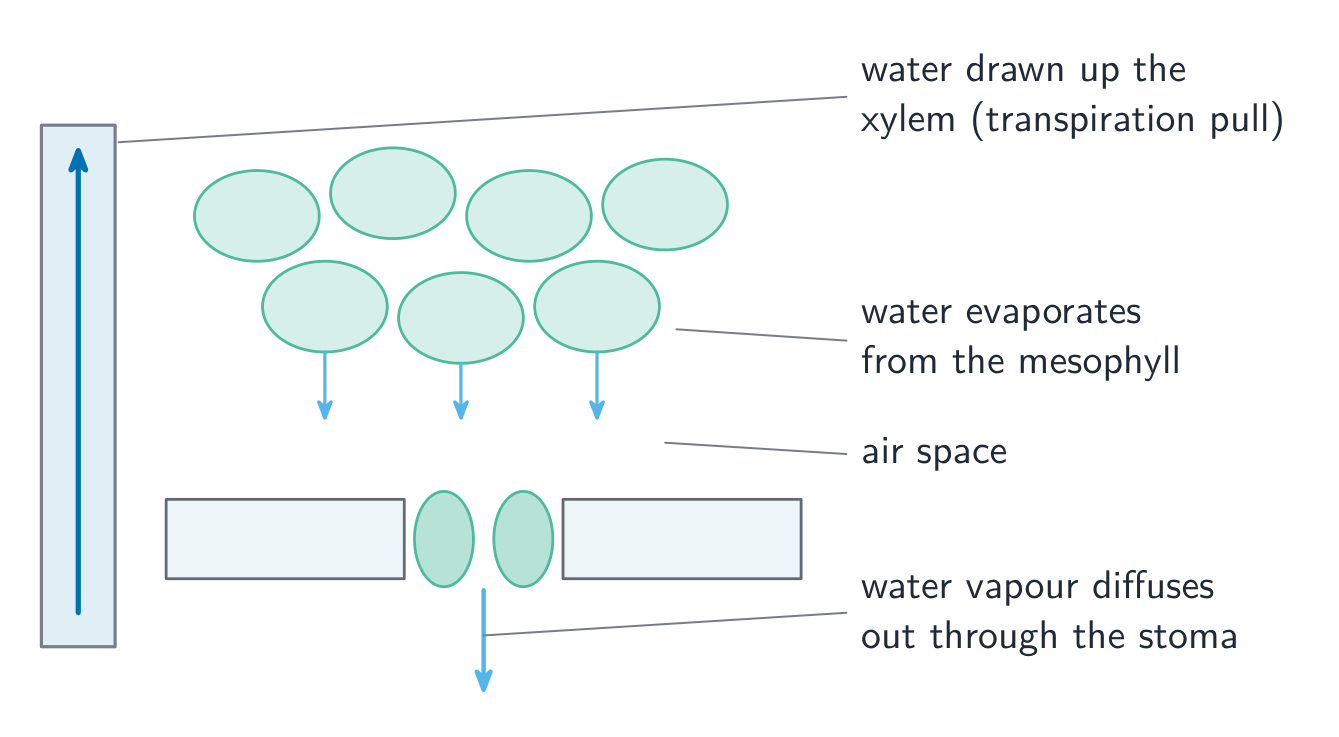
Transpiration 蒸腾作用 is the loss of water vapour 水蒸气 from the leaves.
- Water evaporates 蒸发 from the wet surfaces of the mesophyll cells into the air spaces 气腔 inside the leaf.
- The water vapour then diffuses 扩散 out of the leaf through the stomata 气孔.
(Supplement) The structure of the leaf makes this loss large. The mesophyll cells are surrounded by interconnecting air spaces, which give a very large internal surface area for water to evaporate from. The more stomata there are, and the wider they are open, the faster water vapour diffuses out. Most stomata are on the lower surface, which is cooler and shaded, and the stomata close at night or when the plant is short of water, which cuts water loss.
What changes the rate of transpiration
| Factor | Transpiration is faster when… | Why |
|---|---|---|
| temperature 温度 | it is hotter | water evaporates faster |
| wind speed 风速 | it is windier | wind carries the water vapour away |
| humidity 湿度 (Supplement) | the air is drier | a bigger difference makes water diffuse out faster |
(Supplement) Explaining the factors. Give the full reason:
- temperature: water molecules have more kinetic energy, so more water evaporates from the mesophyll cells and the vapour diffuses out faster.
- wind speed: the wind carries away the water vapour just outside the stomata, so the concentration gradient 浓度梯度 of water vapour between the air spaces and the outside air stays steep.
- humidity: humid air already holds a lot of water vapour, so the concentration gradient between the inside and the outside of the leaf is smaller and diffusion is slower.
Investigating temperature and wind speed. Use a potometer (below). Measure how far the bubble moves in a fixed time, for example 5 minutes, then change one factor: place the shoot at different distances from a fan (or use the fan at different speeds) for wind speed, or put it in rooms or by a heater at different temperatures, checked with a thermometer. Keep the other factors constant: the same shoot, light intensity and humidity. Repeat each reading and find a mean. Reset the bubble each time using the reservoir.
A potometer 蒸腾计 measures how fast a leafy shoot takes up water. The shoot is sealed into a tube full of water; as the leaves lose water by transpiration, the shoot draws water along a thin capillary tube, and an air bubble in the tube moves towards the shoot. The distance the bubble moves in a measured time gives the rate.
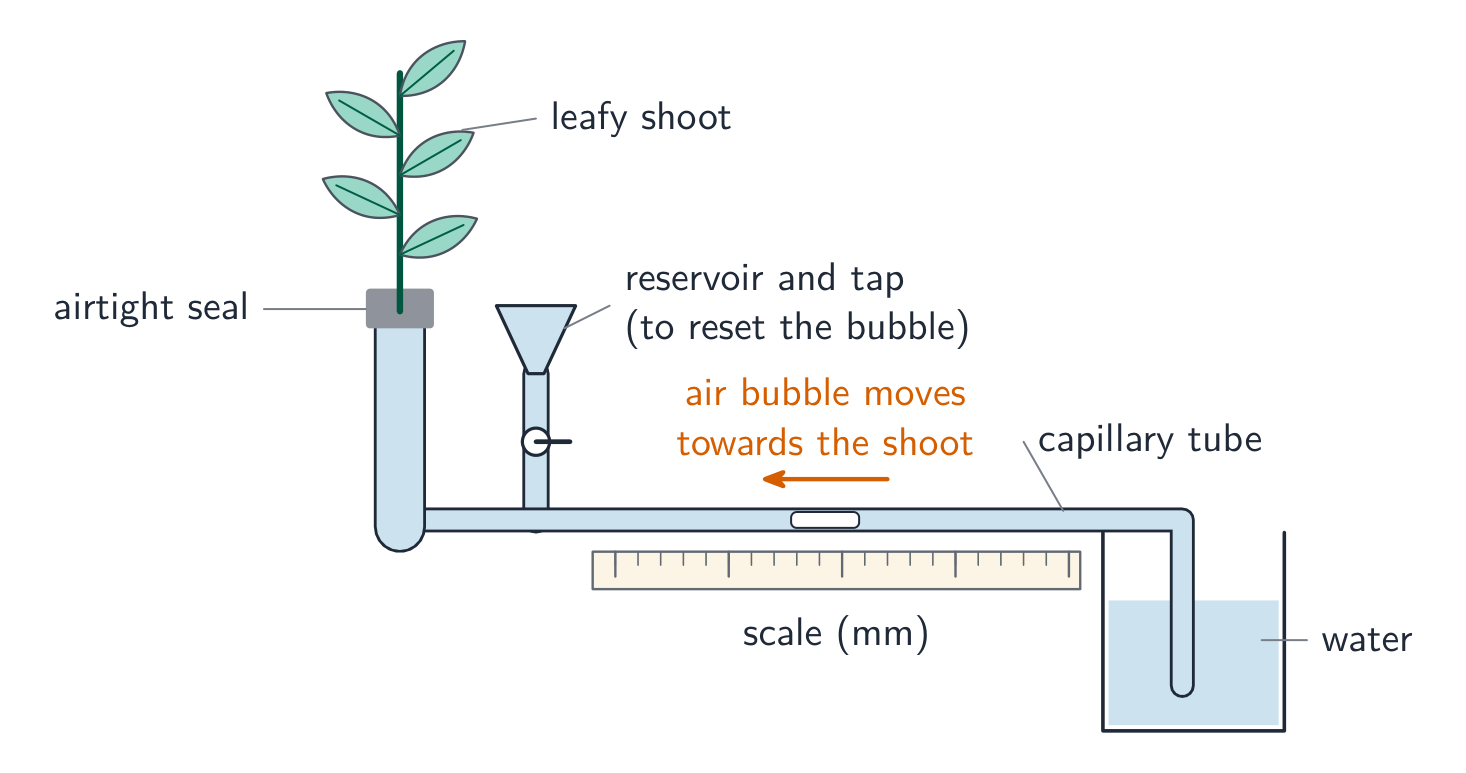
Worked example. In a potometer the air bubble moves 60 mm in 5 minutes. Find the rate of water uptake, and say what happens when a fan is switched on. Rate = distance ÷ time = 60 ÷ 5 = 12 mm per minute. Always give a rate its full unit, "mm per minute", not just "12". A fan raises the wind speed, which carries water vapour away from the leaf, so transpiration speeds up and the bubble moves further in the same 5 minutes.
How water rises up the xylem (Supplement)
As water vapour leaves the leaf, it pulls more water up behind it. This pull is called the transpiration pull 蒸腾拉力. The water molecules stick to one another by forces of attraction 吸引力, so they are drawn up the xylem together as one long column 水柱 of water.
Wilting (Supplement)
If a plant loses water faster than it can take it up, its cells become soft and the plant wilts 萎蔫 — the leaves and stem droop. This often happens on a hot, dry, windy day.
The reason is turgor 膨压. Normally the vacuoles are full of water, which pushes the cytoplasm and cell membrane outwards against the cell wall; the cells are turgid 膨胀 (firm), and they press against each other and hold the plant upright. When more water is lost by transpiration than enters the roots, water leaves the cells by osmosis. The vacuoles shrink, the cells become flaccid 松软 (soft) and no longer support the leaves and stem, so the plant wilts. Wilting also helps the plant: the drooping leaves expose less surface to the sun, and the stomata close, so less water is lost. Watering the plant, or a cool night, lets the cells take up water again and become turgid.
Khám phá
Dòng thoát hơi nước
Nước được kéo lên cây thành một dòng liên tục, từ rễ đến lá nơi nó bay hơi.
Từ vựng
Luyện tập
| English | Tiếng Việt |
|---|---|
| transpiration/trænspəˈreɪʃn/ | thoát hơi nước |
| water vapour/ˈwɔːtə ˈveɪpə/ | hơi nước |
| evaporates/ɪˈvæpəreɪts/ | beside |
| air spaces/eə ˈspeɪsɪz/ | khoảng không khí |
| diffuses/dɪˈfjuːzɪz/ | khuếch tán |
| stomata/ˈstəʊmətə/ | lỗ khí |
| temperature/ˈtemprɪtʃə/ | temperature: nhiệt độ |
| wind speed/wɪnd spiːd/ | tốc độ gió |
| humidity/hjuːˈmɪdɪti/ | độ ẩm |
| concentration gradient/ˌkɒnsənˈtreɪʃn ˈɡreɪdɪənt/ | A change in a substance's concentration across a distance or between regions. |
| potometer | Máy đo thoát hơi nước |
| transpiration pull/trænspəˈreɪʃn pʊl/ | lực hút thoát hơi nước |
| forces of attraction/ˈfɔːsɪz ɒv əˈtrækʃn/ | lực hút |
| column/ˈkɒlʌm/ | cột nước |
| wilts/wɪlts/ | bị héo |
| turgor/ˈtɜːɡə/ | Pressure exerted by a cell's contents against its cell wall after water enters the cell. |
| turgid/ˈtɜːdʒɪd/ | Describing a plant cell swollen and firm because water entering by osmosis produces pressure against its cell wall. |
| flaccid/ˈflæsɪd/ | Describes a plant cell or plant that has lost water and gone soft. |
8.4
Translocation (Supplement)
Chương trình
| Cốt lõi | Bổ sung |
|---|---|
| 1 Mô tả quá trình vận chuyển nội chất như sự di chuyển của sucrose và axit amin trong mạch rây từ nguồn đến đích | |
| 2 Mô tả: (a) nguồn là bộ phận của cây phát thải sucrose hoặc axit amin (b) đích là bộ phận của cây sử dụng hoặc lưu trữ sucrose hoặc axit amin | |
| 3 Giải thích tại sao một số bộ phận của cây có thể đóng vai trò vừa là nguồn vừa là đích vào các thời điểm khác nhau |
Nguồn: Chương trình Cambridge International
English
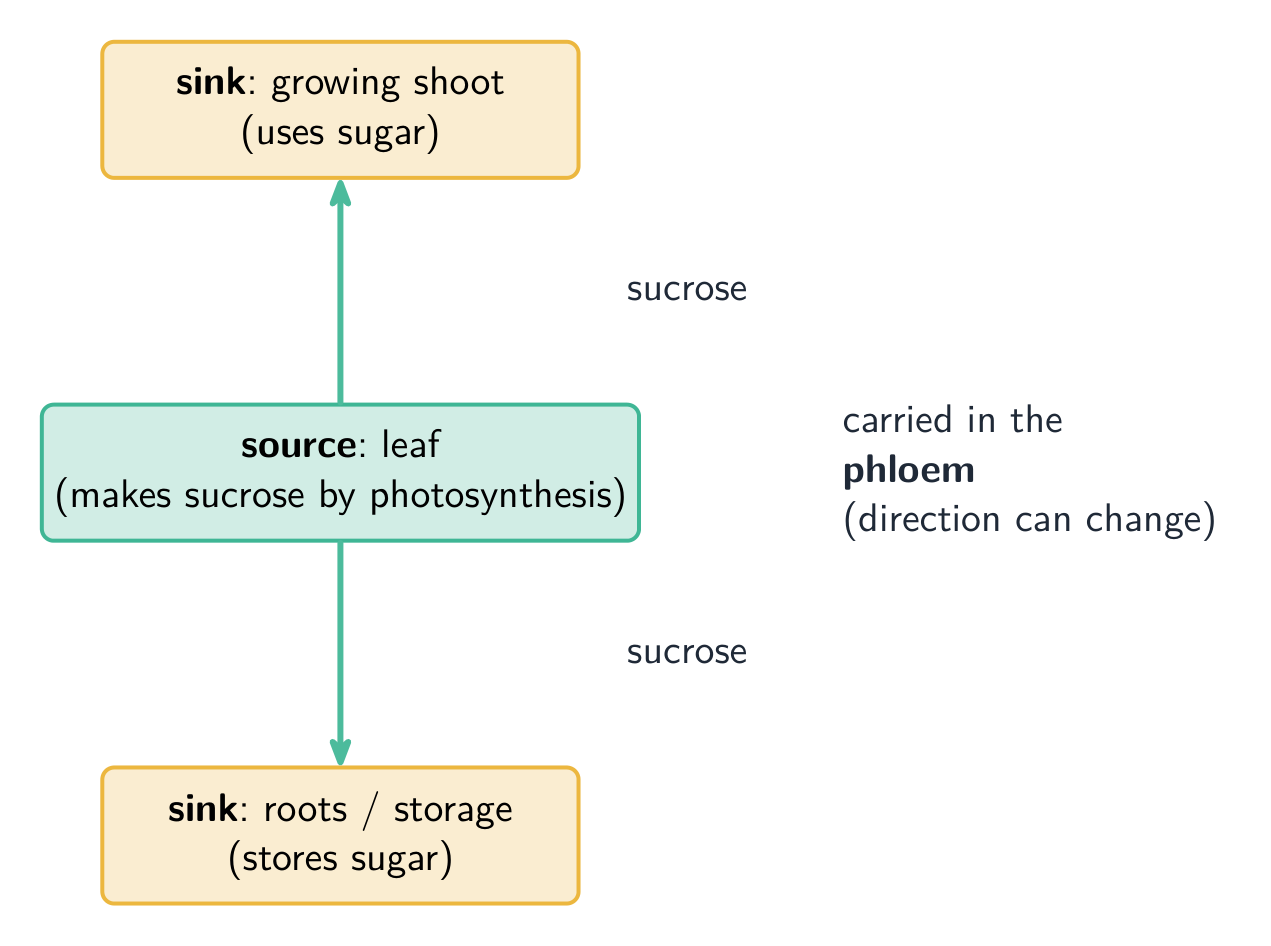
Translocation 转运 is the movement of sucrose and amino acids in the phloem, from sources 源 to sinks 库.
- sources are the parts that release sucrose or amino acids — for example the leaves, which make sugar by photosynthesis.
- sinks are the parts that use or store them — for example growing roots, or a storage organ.
The same part of a plant can be a sink at one time and a source at another. A potato tuber is a sink in summer, when sucrose arrives from the leaves and is stored as starch. In spring, before the new shoots have leaves, the starch is broken down to sucrose and sent to the growing shoots: now the tuber is a source. In the same way, a young leaf is a sink while it grows, and becomes a source once it is photosynthesising more than it needs. This is why phloem can carry sucrose upwards or downwards, unlike xylem.
Common mistakes.
- Saying transpiration is the loss of water through the stomata. Be exact: water evaporates from the mesophyll cell surfaces into the air spaces, and then water vapour diffuses out through the stomata.
- Saying root hairs take up water by active transport 主动运输. Water enters by osmosis 渗透; only mineral ions can need active transport.
- Saying humid air speeds up transpiration. More humid air means a smaller difference in water vapour between the leaf and the air, so transpiration is slower.
- Saying a potometer measures transpiration directly. It measures water uptake; a little of the water taken up is used in the plant (for example in photosynthesis), so uptake is only close to the transpiration rate.
- Saying xylem carries sugar, or that phloem carries water up from the roots. Xylem: water and mineral ions, upward. Phloem: sucrose and amino acids, from source to sink, up or down.
- Giving a rate as a bare number. A bubble that moves 60 mm in 5 minutes gives 12 mm per minute, not "12".
Khám phá
Vận chuyển đồng hóa chất trong mạch rây
Mạch rây mang đường đã hòa tan từ nơi sản xuất (nguồn) đến nơi sử dụng hoặc dự trữ (bể chứa).
Từ vựng
Luyện tập
| English | Tiếng Việt |
|---|---|
| translocation/trænsləʊˈkeɪʃn/ | vận chuyển chất hữu cơ |
| sources/ˈsɔːsɪz/ | nguồn cung cấp |
| sinks/sɪŋks/ | kho dự trữ |
| active transport/ˈæktɪv ˈtrænspɔːt/ | vận chuyển chủ động |
| osmosis/ɒzˈməʊsɪs/ | thẩm thấu |
8.4
Mẹo làm bài thi
English
- Xylem: water and mineral ions, upward only, plus support — its cells are dead, with thick lignin walls. Phloem: sucrose and amino acids, in living cells.
- Learn the water pathway: root hair cell → cortex → xylem → mesophyll.
- Transpiration = evaporation from the mesophyll, then diffusion out of the stomata. It is faster when hotter, windier or drier.
- Water rises by the transpiration pull; the water molecules hold together as a column.
- Translocation goes from a source (where sugar is made or stored) to a sink (where it is used). The direction can change with the season.
- To identify the tissues in a section: root — xylem in the centre; stem — bundles in a ring, xylem inside and phloem outside; leaf — xylem above, phloem below.
- (Supplement) Explain wilting with osmosis and turgor: water leaves the cells, they become flaccid, and they stop supporting the plant.
Bài học tương tác về chủ đề này
Làm theo từng bước, kèm theo bài tập kiểm tra ngay lập tức.