Hãy nhìn bất kỳ dây xích treo nào, bất kỳ đường dây điện nào, bất kỳ cáp treo nào. Nó luôn ổn định thành một đường cong đặc biệt. Bạn có thể đoán đó là một parabol — nhưng không phải. Đó là…
English narration · English + 中文 subtitles burned in · Giọng đọc tiếng Anh · phụ đề tiếng Anh + 中文 được ghi trực tiếp
English
This handout covers Topic 2: Further Pure Mathematics 进阶纯数学 2. It adds hyperbolic functions, eigenvalues, new differentiation and integration, de Moivre's theorem, and methods for differential equations.
Tiếng Việt
Tài liệu này bao gồm Chủ đề 2: Toán Thuần Nâng cao 2. Nó bổ sung các hàm hyperbolic, giá trị riêng, các phương pháp vi phân và tích phân mới, định lý de Moivre, và các phương pháp cho phương trình vi phân.
2.1
Hyperbolic functions · Hàm Hyperbolic
Syllabus · Chương trình
English
Candidates should be able to:
Notes and examples
understand the definitions of the hyperbolic functions$\sinh x$, $\cosh x$, $\tanh x$, $\text{sech } x$, $\text{cosech } x$, $\text{coth } x$ in terms of the exponential function
sketch the graphs of hyperbolic functions
prove and use identities involving hyperbolic functions
e.g. $\cosh^2 x - \sinh^2 x \equiv 1$, $\sinh 2x \equiv 2 \sinh x \cosh x$, and similar results corresponding to the standard trigonometric identities.
understand and use the definitions of the inverse hyperbolic functions and derive and use the logarithmic forms
Tiếng Việt
thí sinh có khả năng:
Ghi chú và ví dụ
hiểu các định nghĩa của các hàm hyperbolic$\sinh x$, $\cosh x$, $\tanh x$, $\text{sech } x$, $\text{cosech } x$, $\text{coth } x$ theo hàm mũ
vẽ sơ đồ các đồ thị của hàm hyperbolic
chứng minh và sử dụng các đẳng thức liên quan đến hàm hyperbolic
Vd. $\cosh^2 x - \sinh^2 x \equiv 1$, $\sinh 2x \equiv 2 \sinh x \cosh x$, và các kết quả tương tự tương ứng với các đẳng thức lượng giác tiêu chuẩn.
hiểu và sử dụng các định nghĩa của các hàm hyperbolic nghịch đảo và suy ra và sử dụng các dạng logarit
Source: Cambridge International syllabus · Nguồn: Chương trình Cambridge International
English
cosh and sinh built from exponentials
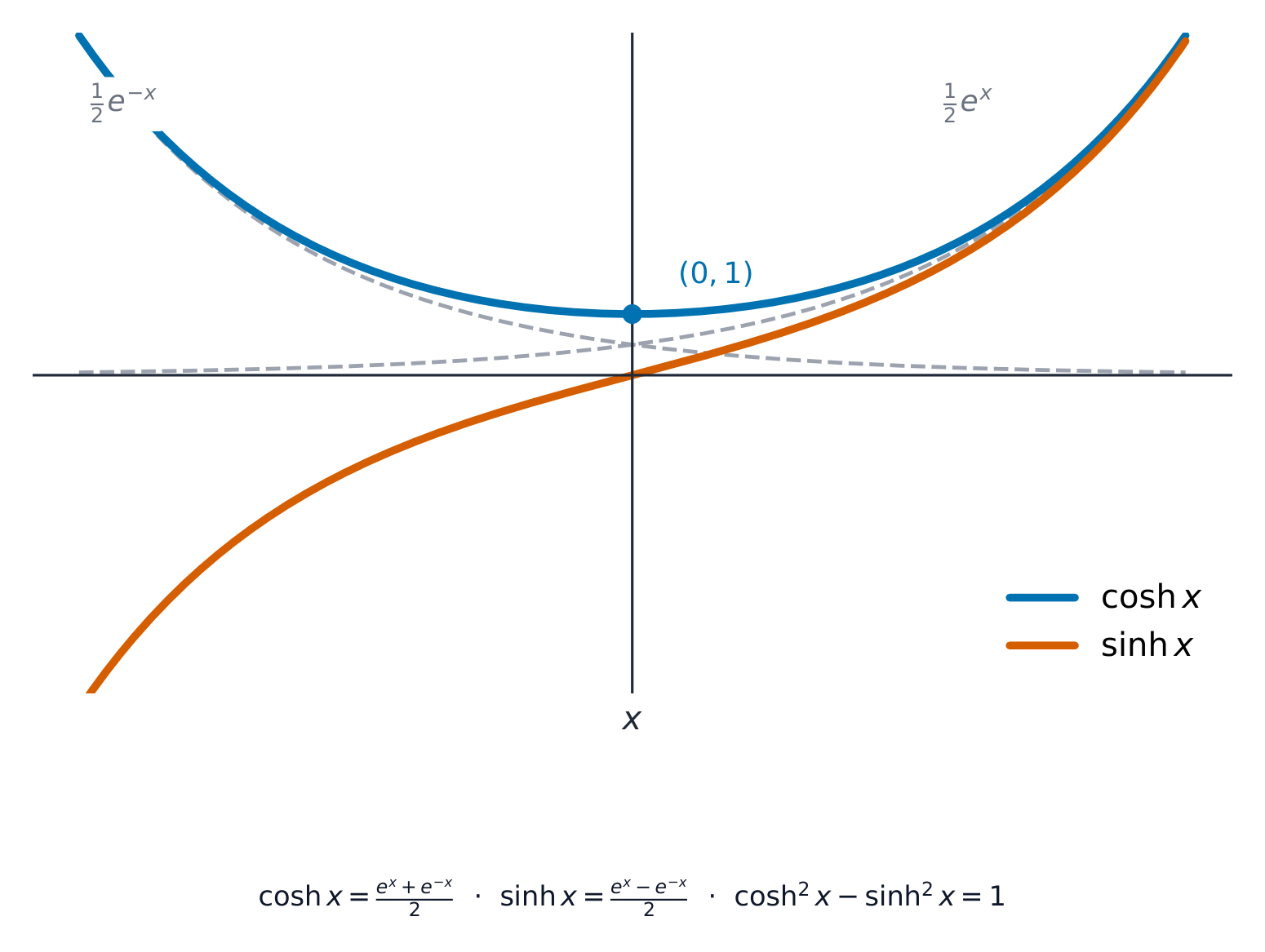
The hyperbolic functions 双曲函数 are built from the exponential function:
$$\cosh x = \frac{e^x + e^{-x}}{2}, \qquad \sinh x = \frac{e^x - e^{-x}}{2}, \qquad \tanh x = \frac{\sinh x}{\cosh x}.$$
They obey identities much like the trigonometric ones, the main one being $\cosh^2 x - \sinh^2 x = 1$. The three reciprocals complete the set: $\operatorname{sech} x = \dfrac{1}{\cosh x}$, $\operatorname{cosech} x = \dfrac{1}{\sinh x}$, and $\coth x = \dfrac{1}{\tanh x} = \dfrac{\cosh x}{\sinh x}$ – all built from $e^x$ too, and worth recognising in integrals and mark schemes. The inverse hyperbolic functions 反双曲函数 have a logarithmic form 对数形式, for example $\sinh^{-1} x = \ln\!\left(x + \sqrt{x^2 + 1}\right)$.
Worked example. Show that $\cosh^2 x - \sinh^2 x = 1$.
cosh và sinh được xây dựng từ hàm mũDây cáp treo tự do tạo thành đường cong catenary — chính là đồ thị của hyperbolic cosine.
Các hàm hyperbolic được xây dựng từ hàm mũ:
$$\cosh x = \frac{e^x + e^{-x}}{2}, \qquad \sinh x = \frac{e^x - e^{-x}}{2}, \qquad \tanh x = \frac{\sinh x}{\cosh x}.$$
$\cosh$ là trung bình cộng của $e^x$ và $e^{-x}$; $\sinh$ là một nửa hiệu của chúng.
Chúng tuân theo các đẳng thức giống như các hằng đẳng thức lượng giác, trong đó quan trọng nhất là $\cosh^2 x - \sinh^2 x = 1$. Ba hàm nghịch đảo hoàn bộ: $\operatorname{sech} x = \dfrac{1}{\cosh x}$, $\operatorname{cosech} x = \dfrac{1}{\sinh x}$, và $\coth x = \dfrac{1}{\tanh x} = \dfrac{\cosh x}{\sinh x}$ – tất cả đều được xây dựng từ $e^x$, và rất hữu ích khi nhận diện trong tích phân và đáp án điểm số. Các hàm hyperbolic ngược có dạng logarit, ví dụ $\sinh^{-1} x = \ln\!\left(x + \sqrt{x^2 + 1}\right)$.
Ví dụ minh họa. Chứng minh rằng $\cosh^2 x - \sinh^2 x = 1$.
cosh is the catenary (a hanging chain) — even, with its minimum at (0, a). · cosh là đường dây treo (dây xích treo lủng lẳng) — ngay cả khi có điểm cực tiểu tại (0, a).
2.2
Matrices · Ma trận
Syllabus · Chương trình
English
Candidates should be able to:
Notes and examples
formulate a problem involving the solution of 3 linear simultaneous equations in 3 unknowns as a problem involving the solution of a matrix equation, or vice versa
understand the cases that may arise concerning the consistency or inconsistency of 3 linear simultaneous equations, relate them to the singularity or otherwise of the corresponding matrix, solve consistent systems, and interpret geometrically in terms of lines and planes
e.g. three planes meeting in a common point, or in a common line, or having no common points.
understand the terms 'characteristic equation', 'eigenvalue' and 'eigenvector', as applied to square matrices
Including use of the definition $\mathbf{Ae} = \lambda \mathbf{e}$ to prove simple properties, e.g. that $\lambda^n$ is an eigenvalue of $\mathbf{A}^n$.
find eigenvalues and eigenvectors of $2 \times 2$ and $3 \times 3$ matrices
Restricted to cases where the eigenvalues are real and distinct.
express a square matrix in the form $\mathbf{QDQ}^{-1}$, where $\mathbf{D}$ is a diagonal matrix of eigenvalues and $\mathbf{Q}$ is a matrix whose columns are eigenvectors, and use this expression
e.g. in calculating powers of $2 \times 2$ or $3 \times 3$ matrices.
use the fact that a square matrix satisfies its own characteristic equation.
e.g. in finding successive powers of a matrix or finding an inverse matrix; restricted to $2 \times 2$ or $3 \times 3$ matrices only.
Tiếng Việt
thí sinh có khả năng:
Ghi chú và ví dụ
xây dựng một bài toán liên quan đến việc giải 3 phương trình tuyến tính đồng thời với 3 ẩn số dưới dạng một bài toán liên quan đến việc giải phương trình ma trận, hoặc ngược lại
hiểu các trường hợp có thể xảy ra liên quan đến tính nhất quán hoặc không nhất quán của 3 phương trình tuyến tính đồng thời, liên hệ chúng với tính đặc biệt hoặc không của ma trận tương ứng, giải các hệ nhất quán, và diễn giải theo hình học dưới dạng các đường thẳng và mặt phẳng
Vd. ba mặt phẳng gặp nhau tại một điểm chung, hoặc tại một đường thẳng chung, hoặc không có điểm chung nào.
hiểu các thuật ngữ 'phương trình đặc trưng', 'giá trị riêng' và 'vector riêng', áp dụng cho các ma trận vuông
Bao gồm việc sử dụng định nghĩa $\mathbf{Ae} = \lambda \mathbf{e}$ để chứng minh các tính chất đơn giản, ví dụ như rằng $\lambda^n$ là một giá trị riêng của $\mathbf{A}^n$.
tìm giá trị riêng và véc-tơ riêng của $2 \times 2$ và $3 \times 3$
Chỉ giới hạn trong trường hợp các giá trị riêng là số thực và phân biệt.
biểu diễn một ma trận vuông dưới dạng $\mathbf{QDQ}^{-1}$, trong đó $\mathbf{D}$ là ma trận chéo của các giá trị riêng và $\mathbf{Q}$ là ma trận mà các cột của nó là các vectơ riêng, và sử dụng biểu thức này
Ví dụ: trong việc tính lũy thừa của $2 \times 2$ hoặc $3 \times 3$ ma trận.
sử dụng việc một ma trận vuông thỏa mãn phương trình đặc trưng của chính nó.
ví dụ: khi tìm lũy thừa liên tiếp của một ma trận hoặc tìm ma trận nghịch đảo; chỉ giới hạn cho $2 \times 2$ hoặc $3 \times 3$.
Source: Cambridge International syllabus · Nguồn: Chương trình Cambridge International
English
A matrix moves the plane
You can write three linear equations in three unknowns as a single matrix equation 矩阵方程$A\mathbf{x} = \mathbf{b}$. If $A$ is non-singular there is one solution; if $A$ is singular the equations are either inconsistent (no solution) or have infinitely many.
For a square matrix $A$, the characteristic equation 特征方程 is $\det(A - \lambda I) = 0$. Its solutions are the eigenvalues 特征值$\lambda$, and for each one the vector $\mathbf{v}$ with $A\mathbf{v} = \lambda\mathbf{v}$ is an eigenvector 特征向量. You can then write $A = QDQ^{-1}$, where $D$ is a diagonal matrix 对角矩阵 of eigenvalues and the columns of $Q$ are the eigenvectors.
Worked example. Find the eigenvalues of $A = \begin{pmatrix} 2 & 1 \\ 1 & 2 \end{pmatrix}$.
So $\lambda = 1$ or $\lambda = 3$. (The eigenvector for $\lambda = 3$ is $\begin{pmatrix} 1 \\ 1 \end{pmatrix}$ and for $\lambda = 1$ is $\begin{pmatrix} 1 \\ -1 \end{pmatrix}$.)
Tiếng Việt
A matrix moves the plane
Bạn có thể viết ba phương trình tuyến tính với ba ẩn dưới dạng một phương trình ma trận duy nhất $A\mathbf{x} = \mathbf{b}$. Nếu $A$ không suy biến thì có đúng một nghiệm; nếu $A$ suy biến thì hệ phương trình vô nghiệm hoặc có vô số nghiệm.
Đối với ma trận vuông $A$, phương trình đặc trưng là $\det(A - \lambda I) = 0$. Các nghiệm của nó là các giá trị riêng$\lambda$, và đối với mỗi giá trị riêng, vector $\mathbf{v}$ thỏa mãn $A\mathbf{v} = \lambda\mathbf{v}$ là một vector riêng. Sau đó bạn có thể viết $A = QDQ^{-1}$, trong đó $D$ là ma trận chéo gồm các giá trị riêng và các cột của $Q$ là các vector riêng.
Nhân một vectơ riêng với $A$ chỉ làm kéo dãn nó; một vectơ tổng quát sẽ bị quay sang một hướng mới.
Ví dụ minh họa. Tìm các giá trị riêng của $A = \begin{pmatrix} 2 & 1 \\ 1 & 2 \end{pmatrix}$.
Vậy $\lambda = 1$ hoặc $\lambda = 3$. (Vector riêng tương ứng với $\lambda = 3$ là $\begin{pmatrix} 1 \\ 1 \end{pmatrix}$ và với $\lambda = 1$ là $\begin{pmatrix} 1 \\ -1 \end{pmatrix}$.)
Explore · Khám phá
Transformations and the determinant · Biến đổi và định thức
Change the matrix to rotate, stretch or shear the unit square; the determinant shows how area changes. · Thay đổi ma trận để quay, kéo giãn hoặc xé lệch hình vuông đơn vị; định thức cho thấy sự thay đổi của diện tích.
• differentiate hyperbolic functions and differentiate $\sin^{-1}x$, $\cos^{-1}x$, $\sinh^{-1}x$, $\cosh^{-1}x$ and $\tanh^{-1}x$
• obtain an expression for $\frac{\text{d}^2y}{\text{d}x^2}$ in cases where the relation between $x$ and $y$ is defined implicitly or parametrically
• derive and use the first few terms of a Maclaurin's series for a function.
Derivation of a general term is not included, but successive 'implicit' differentiation steps may be required, e.g. for $y = \tan x$ following an initial differentiation rearranged as $y' = 1 + y^2$.
Tiếng Việt
thí sinh có khả năng:
Ghi chú và ví dụ
• đạo hàm hàm hyperbolic và đạo hàm $\sin^{-1}x$, $\cos^{-1}x$, $\sinh^{-1}x$, $\cosh^{-1}x$ và $\tanh^{-1}x$
• tìm biểu thức cho $\frac{\text{d}^2y}{\text{d}x^2}$ trong các trường hợp mà mối quan hệ giữa $x$ và $y$ được xác định tiền ẩn hoặc tham số
• rút ra và sử dụng các số hạng đầu tiên của dãy Maclaurin cho một hàm số.
Việc rút ra số hạng tổng quát không bao gồm, nhưng các bước đạo hàm 'ngầm' liên tiếp có thể cần thiết, ví dụ đối với $y = \tan x$ sau khi đạo hàm ban đầu được biến đổi thành $y' = 1 + y^2$.
Source: Cambridge International syllabus · Nguồn: Chương trình Cambridge International
English
You can now differentiate the hyperbolic functions and the inverse functions $\sin^{-1}x$, $\tan^{-1}x$, $\sinh^{-1}x$ and so on. You can also find $\dfrac{d^2y}{dx^2}$ for curves given implicitly or parametrically.
A Maclaurin's series 麦克劳林级数 writes a function as a power series:
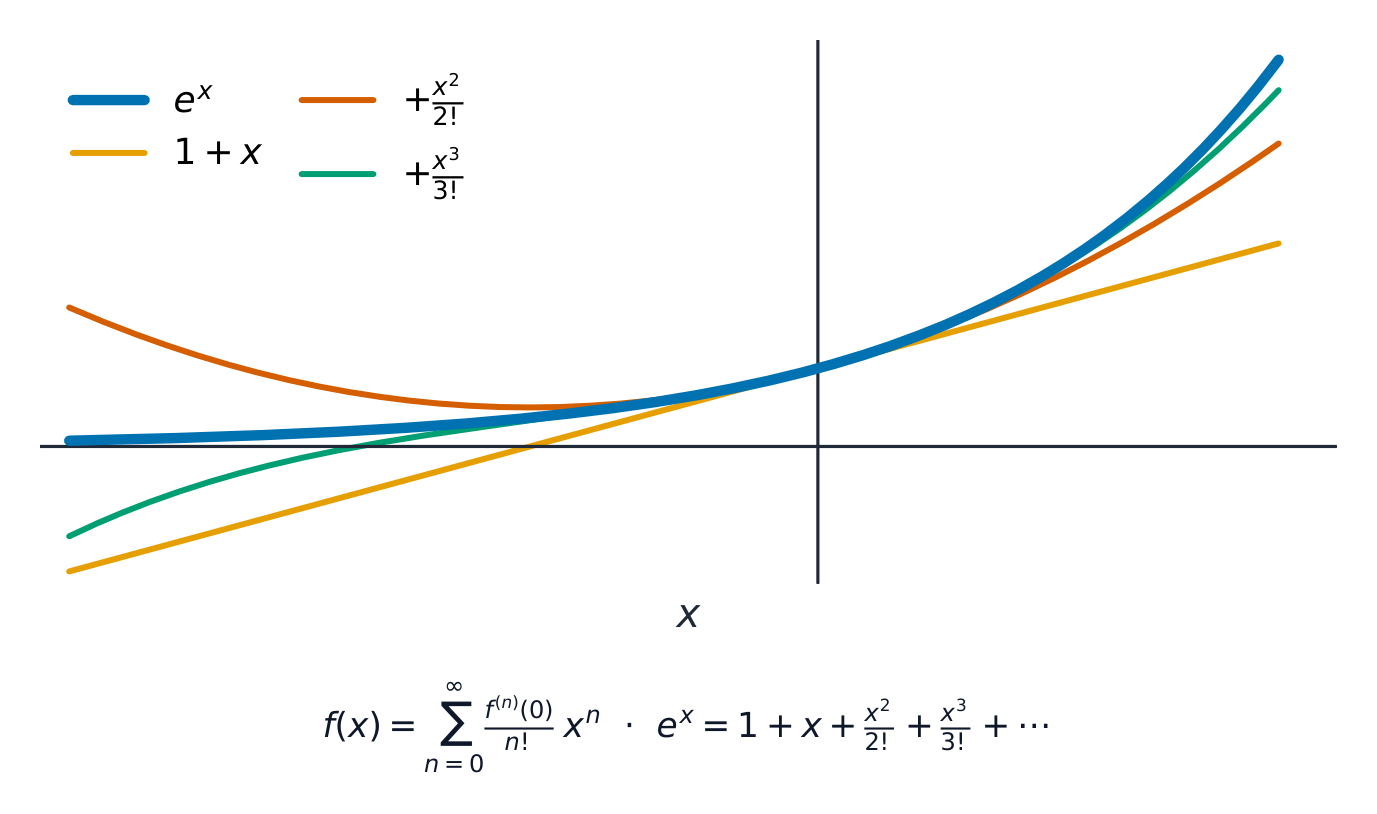
For example $e^x = 1 + x + \dfrac{x^2}{2!} + \dfrac{x^3}{3!} + \cdots$
Worked example. Find the Maclaurin series of $f(x) = \ln(1+x)$ up to the term in $x^3$.
$f(0) = 0$; $f'(x) = \dfrac{1}{1+x}$ so $f'(0) = 1$; $f''(x) = \dfrac{-1}{(1+x)^2}$ so $f''(0) = -1$; $f'''(x) = \dfrac{2}{(1+x)^3}$ so $f'''(0) = 2$. Substituting into the series:
$$\ln(1+x) = x - \frac{x^2}{2} + \frac{x^3}{3} - \cdots$$
Tiếng Việt
Bây giờ bạn có thể đạo hàm các hàm hyperbolic và các hàm ngược $\sin^{-1}x$, $\tan^{-1}x$, $\sinh^{-1}x$ và cứ thế. Bạn cũng có thể tìm $\dfrac{d^2y}{dx^2}$ cho các đường cong được cho dưới dạng ẩn hoặc tham số.
Chuỗi Maclaurin biểu diễn một hàm số dưới dạng chuỗi lũy thừa:
Ví dụ $e^x = 1 + x + \dfrac{x^2}{2!} + \dfrac{x^3}{3!} + \cdots$Thêm nhiều số hạng hơn giúp đa thức khớp với $e^x$ trên một khoảng rộng hơn quanh $x=0$.
Ví dụ minh họa. Tìm chuỗi Maclaurin của $f(x) = \ln(1+x)$ đến số hạng chứa $x^3$.
$f(0) = 0$; $f'(x) = \dfrac{1}{1+x}$ nên $f'(0) = 1$; $f''(x) = \dfrac{-1}{(1+x)^2}$ nên $f''(0) = -1$; $f'''(x) = \dfrac{2}{(1+x)^3}$ nên $f'''(0) = 2$. Thay vào chuỗi:
$$\ln(1+x) = x - \frac{x^2}{2} + \frac{x^3}{3} - \cdots$$
Explore · Khám phá
The gradient at a point · Độ dốc tại một điểm
gradient = dy/dx
The derivative is the slope of the tangent, however exotic the function. · Đạo hàm là độ dốc của tiếp tuyến, dù hàm số có phức tạp đến đâu.
• integrate hyperbolic functions and recognise integrals of functions of the form $\frac{1}{\sqrt{a^2 - x^2}}$, $\frac{1}{\sqrt{x^2 + a^2}}$ and $\frac{1}{\sqrt{x^2 - a^2}}$, and integrate associated functions using trigonometric substitutions or hyperbolic substitutions as appropriate
Including use of completing the square where necessary, e.g. to integrate $\frac{1}{\sqrt{x^2 + x}}$.
• derive and use reduction formulae for the evaluation of definite integrals
e.g. $\int_0^{\frac{1}{2}\pi} \sin^n x \text{ d}x$, $\int_0^1 \text{e}^{-x}(1-x)^n \text{ d}x$. In harder cases hints may be given, e.g. $\int_0^{\frac{1}{4}\pi} \sec^n x \text{ d}x$ by considering $\frac{\text{d}}{\text{d}x}(\tan x \sec^n x)$.
• understand how the area under a curve may be approximated by areas of rectangles, and use rectangles to estimate or set bounds for the area under a curve or to derive inequalities or limits concerning sums
Questions may involve either rectangles of unit width or rectangles whose width can tend to zero, e.g. $1 + \ln n > \sum_{r=1}^n \frac{1}{r} > \ln(n+1)$, $\sum_{r=1}^n \frac{1}{n}\left(1 + \frac{r}{n}\right)^{-1} \approx \int_0^1 (1+x)^{-1} \text{ d}x$. continued
• use integration to find – arc lengths for curves with equations in Cartesian coordinates, including the use of a parameter, or in polar coordinates – surface areas of revolution about one of the axes for curves with equations in Cartesian coordinates, including the use of a parameter.
Any questions involving integration may require techniques from Cambridge International A Level Mathematics (9709) applied to more difficult cases, e.g. integration by parts for $\int e^x \sin x \mathrm{d}x$, or use of the substitution $t = \tan \frac{1}{2}x$. Surface areas of revolution for curves with equations in polar coordinates will not be required.
Tiếng Việt
thí sinh có khả năng:
Ghi chú và ví dụ
• tích phân hàm hyperbolic và nhận biết các tích phân của các hàm có dạng $\frac{1}{\sqrt{a^2 - x^2}}$, $\frac{1}{\sqrt{x^2 + a^2}}$ và $\frac{1}{\sqrt{x^2 - a^2}}$, và tích phân các hàm liên kết bằng cách thay thế lượng giác hoặc thay thế hyperbolic tùy thuộc
Bao gồm việc sử dụng hoàn thành bình phương nếu cần, ví dụ để tích phân $\frac{1}{\sqrt{x^2 + x}}$.
• rút ra và sử dụng công thức giảm bậc để đánh giá tích phân xác định
Ví dụ: $\int_0^{\frac{1}{2}\pi} \sin^n x \text{ d}x$, $\int_0^1 \text{e}^{-x}(1-x)^n \text{ d}x$. Trong các trường hợp khó hơn, gợi ý có thể được đưa ra, ví dụ: $\int_0^{\frac{1}{4}\pi} \sec^n x \text{ d}x$ bằng cách xét $\frac{\text{d}}{\text{d}x}(\tan x \sec^n x)$.
• hiểu cách diện tích dưới đường cong có thể được xấp xỉ bởi diện tích của các hình chữ nhật, và sử dụng các hình chữ nhật để ước tính hoặc đặt cận cho diện tích dưới đường cong, hoặc để suy ra các bất đẳng thức hay giới hạn liên quan đến tổng
Câu hỏi có thể liên quan đến các hình chữ nhật có chiều rộng đơn vị hoặc các hình chữ nhật có chiều rộng tiến tới zero, ví dụ: $1 + \ln n > \sum_{r=1}^n \frac{1}{r} > \ln(n+1)$, $\sum_{r=1}^n \frac{1}{n}\left(1 + \frac{r}{n}\right)^{-1} \approx \int_0^1 (1+x)^{-1} \text{ d}x$. tiếp theo
• sử dụng tích phân để tìm – độ dài cung của các đường cong có phương trình trong tọa độ Descartes, bao gồm cả việc sử dụng tham số, hoặc trong tọa độ cực – diện tích mặt tròn xoay quanh một trong hai trục tọa độ cho các đường cong có phương trình trong tọa độ Descartes, bao gồm cả việc sử dụng tham số.
Bất kỳ câu hỏi nào liên quan đến tích phân có thể yêu cầu các kỹ thuật từ Toán học Cambridge International A Level (9709) áp dụng vào các trường hợp khó hơn, ví dụ: tích phân từng phần cho $\int e^x \sin x \mathrm{d}x$, hoặc sử dụng phép thế $t = \tan \frac{1}{2}x$. Diện tích mặt tròn xoay cho các đường cong có phương trình trong tọa độ cực sẽ không được yêu cầu.
Source: Cambridge International syllabus · Nguồn: Chương trình Cambridge International
A trigonometric substitution, a hyperbolic substitution, or completing the square 配方法 in the denominator handles related forms. A reduction formula 递推公式 links an integral $I_n$ to $I_{n-1}$, so you can work down step by step. Integration also gives the arc length 弧长 of a curve and the surface area of revolution 旋转曲面面积 when a curve is turned about an axis.
Worked example. Find $\displaystyle\int \frac{1}{\sqrt{4 - x^2}}\,dx$.
Bounding a sum by an integral. Draw rectangles of unit width under, or over, a decreasing curve such as $y=\frac1x$. Each rectangle of height $\frac1r$ is trapped between two integral strips, so summing gives
$$\ln(n+1) < \sum_{r=1}^{n}\frac1r < 1 + \ln n.$$
Shrinking the rectangle width to $\frac1n\to 0$ turns such a sum into a Riemann sum 黎曼和 that equals the integral in the limit, e.g. $\displaystyle\lim_{n\to\infty}\frac1n\sum_{r=1}^{n}f\!\left(\frac{r}{n}\right)=\int_0^1 f(x)\,dx$.
Phép thế lượng giác, phép thế hyperbolic, hoặc hoàn thành bình phương ở mẫu số giải quyết các dạng liên quan. Một công thức hạ bậc liên kết tích phân $I_n$ với $I_{n-1}$, giúp bạn tính toán từng bước. Tích phân còn cung cấp chiều dài cung của đường cong và diện tích mặt tròn xoay khi đường cong quay quanh một trục.
Ước lượng tổng bằng tích phân. Vẽ các hình chữ nhật có chiều rộng đơn vị nằm dưới hoặc trên một đường cong giảm như $y=\frac1x$. Mỗi hình chữ nhật có độ cao $\frac1r$ bị kẹp giữa hai dải tích phân, nên việc cộng lại sẽ cho
$$\ln(n+1) < \sum_{r=1}^{n}\frac1r < 1 + \ln n.$$
Thu nhỏ chiều rộng hình chữ nhật về $\frac1n\to 0$ biến tổng này thành tổng Riemann bằng với tích phân trong giới hạn, ví dụ $\displaystyle\lim_{n\to\infty}\frac1n\sum_{r=1}^{n}f\!\left(\frac{r}{n}\right)=\int_0^1 f(x)\,dx$.
Explore · Khám phá
The area under the curve · Diện tích dưới đường cong
area = ∫ f(x) dx
Every integral measures the area under the curve — drag the limits. · Mỗi tích phân đo diện tích dưới đường cong — kéo giới hạn.
• understand de Moivre’s theorem, for a positive or negative integer exponent, in terms of the geometrical effect of multiplication and division of complex numbers
• prove de Moivre’s theorem for a positive integer exponent
e.g. by induction.
• use de Moivre’s theorem for a positive or negative rational exponent
e.g. expressing $\cos 5\theta$ in terms of $\cos \theta$ or $\tan 5\theta$ in terms of $\tan \theta$.
– to express trigonometrical ratios of multiple angles in terms of powers of trigonometrical ratios of the fundamental angle
e.g. expressing $\sin^6 \theta$ in terms of $\cos 2\theta$, $\cos 4\theta$ and $\cos 6\theta$.
– to express powers of $\sin \theta$ and $\cos \theta$ in terms of multiple angles
– in the summation of series
e.g. using the '$C + \mathrm{i}S$' method to sum series such as $\sum_{r=1}^{n} \binom{n}{r} \sin r\theta$.
– in finding and using the $n$th roots of unity.
Tiếng Việt
thí sinh có khả năng:
Ghi chú và ví dụ
• hiểu định lý de Moivre, với số mũ nguyên dương hoặc âm, dưới góc độ hiệu ứng hình học của phép nhân và chia số phức
• chứng minh định lý de Moivre cho số mũ nguyên dương
ví dụ: bằng phương pháp quy nạp.
• sử dụng định lý de Moivre cho số mũ nguyên有理数
ví dụ: biểu diễn $\cos 5\theta$ theo $\cos \theta$ hoặc $\tan 5\theta$ theo $\tan \theta$.
– biểu diễn các tỷ số lượng giác của các góc nhiều lần theo lũy thừa của các tỷ số lượng giác của góc cơ bản
Ví dụ: biểu diễn $\sin^6 \theta$ theo $\cos 2\theta$, $\cos 4\theta$ và $\cos 6\theta$.
– để biểu diễn lũy thừa của $\sin \theta$ và $\cos \theta$ theo các góc bội
– trong việc cộng chuỗi
ví dụ: sử dụng phương pháp '$C + \mathrm{i}S$' để cộng các chuỗi như $\sum_{r=1}^{n} \binom{n}{r} \sin r\theta$.
– trong việc tìm và sử dụng căn $n$ thứ căn bậc n của đơn vị.
Source: Cambridge International syllabus · Nguồn: Chương trình Cambridge International
English
The nth roots of unity form a polygonMultiplying complex numbers: lengths multiply, angles addMultiplying by i is a rotation
A complex number 复数 in polar form is $z = r(\cos\theta + i\sin\theta)$. De Moivre's theorem 棣莫弗定理 says that for any integer $n$,
It is used to expand $\cos n\theta$ and $\sin n\theta$ in powers, to sum series, and to find the $n$roots of unity 单位根 (the solutions of $z^n = 1$, equally spaced around the unit circle).
Worked example. Use de Moivre's theorem to express $\cos 3\theta$ in terms of $\cos\theta$.
Take the real part of $(\cos\theta + i\sin\theta)^3 = \cos 3\theta + i\sin 3\theta$:
Căn bậc n của đơn vị tạo thành đa giácNhân số phức: độ dài nhân với nhau, góc cộng lạiNhân với i là phép quayCác mẫu tự tương tự như bông cải Romanesco xuất hiện từ việc lặp lại các hàm trong mặt phẳng phức.
Một số phức dạng cực là $z = r(\cos\theta + i\sin\theta)$. Định lý De Moivre phát biểu rằng với mọi số nguyên $n$,
Nó được dùng để khai triển $\cos n\theta$ và $\sin n\theta$ thành lũy thừa, tính tổng chuỗi, và tìm $n$căn bậc n của đơn vị (nghiệm của $z^n = 1$, phân bố đều trên đường tròn đơn vị).
Năm nghiệm của $z^5=1$ được phân bố đều cách nhau $72^\circ$ trên đường tròn đơn vị.
Ví dụ minh họa. Sử dụng định lý De Moivre để biểu diễn $\cos 3\theta$ theo $\cos\theta$.
Lấy phần thực của $(\cos\theta + i\sin\theta)^3 = \cos 3\theta + i\sin 3\theta$:
Drag the point to explore modulus and argument — the language of complex numbers in polar (modulus–argument) form. · Kéo điểm để khám phá mô-đun và argument — ngôn ngữ của số phức dưới dạng cực (mô-đun–argument).
• find an integrating factor for a first order linear differential equation, and use an integrating factor to find the general solution
e.g. $\frac{\mathrm{d}y}{\mathrm{d}x} - 2y = x^2$, $x\frac{\mathrm{d}y}{\mathrm{d}x} - y = x^4$, $\frac{\mathrm{d}y}{\mathrm{d}x} + y\coth x = \cosh x$.
• recall the meaning of the terms 'complementary function' and 'particular integral' in the context of linear differential equations, and recall that the general solution is the sum of the complementary function and a particular integral
find the complementary function for a first or second order linear differential equation with constant coefficients
For second order equations, including the cases where the auxiliary equation has distinct real roots, a repeated real root or conjugate complex roots.
recall the form of, and find, a particular integral for a first or second order linear differential equation in the cases where a polynomial or $ae^{bx}$ or $a\cos px + b\sin px$ is a suitable form, and in other simple cases find the appropriate coefficient(s) given a suitable form of particular integral
e.g. evaluate $k$ given that $kx \cos 2x$ is a particular integral of
use a given substitution to reduce a differential equation to a first or second order linear equation with constant coefficients or to a first order equation with separable variables
e.g. the substitution $x = e^t$ to reduce to linear form a differential equation with terms of the form
use initial conditions to find a particular solution to a differential equation, and interpret a solution in terms of a problem modelled by a differential equation.
Tiếng Việt
thí sinh có khả năng:
Ghi chú và ví dụ
• tìm hệ số nhân cho một phương trình vi phân tuyến tính bậc nhất, và sử dụng hệ số nhân để tìm nghiệm tổng quát
Ví dụ: $\frac{\mathrm{d}y}{\mathrm{d}x} - 2y = x^2$, $x\frac{\mathrm{d}y}{\mathrm{d}x} - y = x^4$, $\frac{\mathrm{d}y}{\mathrm{d}x} + y\coth x = \cosh x$.
• nhớ lại ý nghĩa của các thuật ngữ 'nghiệm bổ sung' và 'nguyên đặc biệt' trong bối cảnh phương trình vi phân tuyến tính, và nhớ rằng nghiệm tổng quát là tổng của nghiệm bổ sung và một nguyên đặc biệt
tìm nghiệm bổ sung cho phương trình vi phân tuyến tính bậc nhất hoặc bậc hai với hệ số hằng
Đối với phương trình bậc hai, bao gồm cả các trường hợp mà phương trình phụ có các nghiệm thực phân biệt, nghiệm thực lặp lại hoặc nghiệm phức liên hợp.
nhớ lại dạng và tìm nguyên đặc biệt cho phương trình vi phân tuyến tính bậc nhất hoặc bậc hai trong các trường hợp mà một đa thức hoặc $ae^{bx}$ hoặc $a\cos px + b\sin px$ là dạng thích hợp, và trong các trường hợp đơn giản khác, tìm hệ số(s) phù hợp khi đã cho dạng thích hợp của nguyên đặc biệt
ví dụ: đánh giá $k$ khi biết rằng $kx \cos 2x$ là một nguyên đặc biệt của
sử dụng một phép thế đã cho để thu gọn phương trình vi phân về dạng phương trình tuyến tính bậc nhất hoặc bậc hai với hệ số hằng, hoặc về dạng phương trình bậc nhất với các biến có thể tách rời
ví dụ: phép thế $x = e^t$ để thu gọn về dạng tuyến tính một phương trình vi phân có các số hạng có dạng
sử dụng điều kiện ban đầu để tìm nghiệm riêng của một phương trình vi phân, và giải thích nghiệm theo ngữ cảnh của một vấn đề được mô hình hóa bởi phương trình vi phân.
Source: Cambridge International syllabus · Nguồn: Chương trình Cambridge International
English
For a first order linear equation $\dfrac{dy}{dx} + P(x)\,y = Q(x)$, multiply by the integrating factor 积分因子$\mu = e^{\int P\,dx}$. The left side then becomes $\dfrac{d}{dx}(\mu y)$, so you can integrate directly.
For a linear equation with constant coefficients, the general solution 通解 is the sum of two parts: the complementary function 余函数 (the solution of the equation with the right side set to $0$, found from the auxiliary equation) and a particular integral 特积分 (any one solution of the full equation). Initial conditions then fix the constants to give the particular solution 特解; simpler equations with separable variables 可分离变量 are integrated directly.
Worked example. Solve $\dfrac{dy}{dx} + 2y = e^x$.
The integrating factor is $\mu = e^{\int 2\,dx} = e^{2x}$. Multiplying through gives $\dfrac{d}{dx}\!\left(y\,e^{2x}\right) = e^{3x}$, so
$$y\,e^{2x} = \tfrac13 e^{3x} + C \;\Rightarrow\; y = \tfrac13 e^x + C e^{-2x}.$$
Second order, constant coefficients. For $\dfrac{d^2y}{dx^2}+b\dfrac{dy}{dx}+cy=f(x)$, solve the auxiliary equation 辅助方程$m^2+bm+c=0$. The complementary function depends on its roots:
two distinct real roots $m_1,m_2$: $y=Ae^{m_1x}+Be^{m_2x}$;
Then add a particular integral by trying a form matching $f(x)$ (a polynomial, $ae^{bx}$, or $a\cos px+b\sin px$); if that trial already appears in the complementary function, multiply it by $x$.
Worked example. Solve $\dfrac{d^2y}{dx^2}-4\dfrac{dy}{dx}+4y=0$. The auxiliary equation $m^2-4m+4=(m-2)^2=0$ has a repeated root $m=2$, so $y=(A+Bx)e^{2x}$.
Tiếng Việt
Đối với phương trình bậc nhất tuyến tính $\dfrac{dy}{dx} + P(x)\,y = Q(x)$, nhân với thừa số tích phân$\mu = e^{\int P\,dx}$. vế trái lúc này trở thành $\dfrac{d}{dx}(\mu y)$, nên bạn có thể tích phân trực tiếp.
Đối với phương trình tuyến tính hệ số hằng, nghiệm tổng quát là tổng của hai phần: hàm bổ sung (nghiệm của phương trình khi vế phải bằng $0$, tìm được từ phương trình phụ) và tích phân riêng (bất kỳ một nghiệm nào của phương trình đầy đủ). Điều kiện ban đầu sau đó xác định các hằng số để thu được nghiệm riêng; các phương trình đơn giản hơn có biến tách rời được tích phân trực tiếp.
Đường nghiệm chạy theo trường vectơ, luôn tiếp xúc với các đoạn nhỏ tại mọi điểm.
Ví dụ minh họa. Giải $\dfrac{dy}{dx} + 2y = e^x$.
Thừa số tích phân là $\mu = e^{\int 2\,dx} = e^{2x}$. Nhân cả hai vế ta được $\dfrac{d}{dx}\!\left(y\,e^{2x}\right) = e^{3x}$, nên
$$y\,e^{2x} = \tfrac13 e^{3x} + C \;\Rightarrow\; y = \tfrac13 e^x + C e^{-2x}.$$
Bậc hai, hệ số hằng. Với $\dfrac{d^2y}{dx^2}+b\dfrac{dy}{dx}+cy=f(x)$, giải phương trình phụ$m^2+bm+c=0$. Hàm bổ sung phụ thuộc vào các nghiệm của nó:
hai nghiệm thực phân biệt $m_1,m_2$: $y=Ae^{m_1x}+Be^{m_2x}$;
Sau đó cộng một tích phân riêng bằng cách thử một dạng phù hợp với $f(x)$ (đa thức, $ae^{bx}$, hoặc $a\cos px+b\sin px$); nếu dạng thử này đã xuất hiện trong hàm bổ sung, nhân nó với $x$.
Ví dụ có hướng dẫn. Giải $\dfrac{d^2y}{dx^2}-4\dfrac{dy}{dx}+4y=0$. Phương trình phụ $m^2-4m+4=(m-2)^2=0$ có nghiệm bội $m=2$, nên $y=(A+Bx)e^{2x}$.
Explore · Khám phá
Differential equations · Phương trình vi phân
dy/dx = a y
The equation sets the slope everywhere; the solution follows those slopes. · Phương trình thiết lập độ dốc tại mọi nơi; nghiệm tuân theo những độ dốc đó.
Pick one and the site follows you — notes, papers, videos and practice all open on it. · Chọn một môn và trang sẽ điều hướng theo — ghi chú, tài liệu, video và bài tập đều mở ở đó.
Type to search notes, lessons, code, vocabulary and past-paper questions across every subject. · Nhập để tìm ghi chú, bài học, mã, từ vựng và câu hỏi đề thi cũ trên mọi môn học.