Integration (Further Pure 2)
Introduced| English | Meaning |
|---|---|
| antiderivative/ˌæntɪdɪˈrɪvətɪv/ | A function whose derivative equals a given function. |
| standard form/ˈstændəd fɔːm/ | standard form |
| substitution/ˌsʌbstɪˈtjuːʃn/ | Replacing a variable or expression with another value or expression to simplify or transform a problem. |
| hyperbolic/ˌhaɪpəˈbɒlɪk/ | Relating to hyperbolas or to functions such as sinh, cosh and tanh, which can be defined using exponential functions. |
| trigonometric/ˌtrɪɡənəʊˈmetrɪk/ | Relating to functions such as sine, cosine and tangent and their relationships with angles. |
| surd/sɜːd/ | An expression involving a root that cannot be simplified to a rational number. |
| reduction formula/rɪˈdʌkʃn ˈfɔːmjʊlə/ | A recurrence relating an integral with one index or power to integrals with smaller indices or powers. |
| arc length/ɑːk leŋθ/ | The distance along a curved part of a circle or another curve. |
Integrals that fight back
- Some integrals have no obvious antiderivative 原函数 — until you spot the standard form 标准形式 or the right substitution 代换.
- Further Pure 2 gives you a toolkit: inverse-trig standard integrals, trig/hyperbolic 双曲 substitutions, and reduction formulae.
Standard integrals
- Two results worth memorising:
- Match the integral to the form, read off $a$, and write the answer.
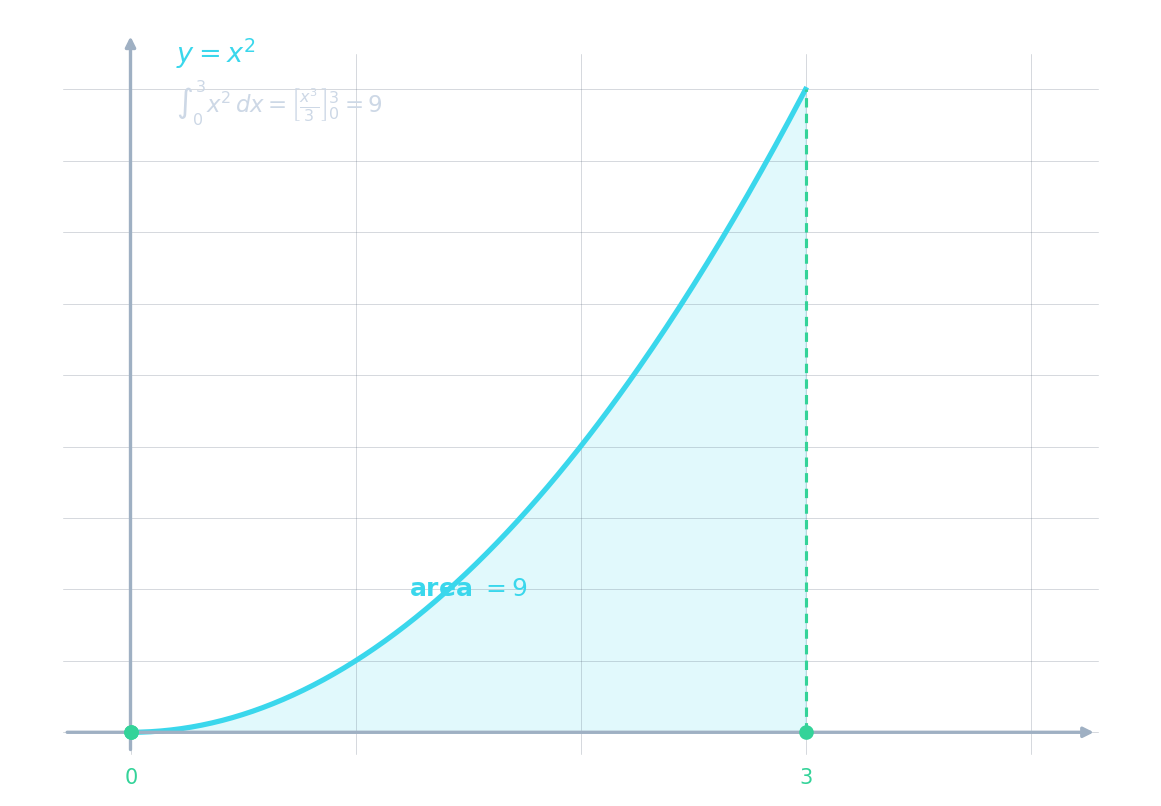
A definite integral measures the area under a curve
The area under the curve
area = ∫ f(x) dx
Every integral measures the area under the curve — drag the limits.
What is ∫ 1/(a² + x²) dx?
Difficulty 1/5 · 100 coins + a small bonus on first completion today
This is the standard inverse-tangent integral.
What is ∫ 1/√(4 − x²) dx?
Difficulty 1/5 · 100 coins + a small bonus on first completion today
With a = 2, ∫1/√(a²−x²) dx = sin⁻¹(x/a) = sin⁻¹(x/2) + C.
Match each integral to its result.
Difficulty 2/5 · 140 coins + a small bonus on first completion today
The first two are the inverse-trig standard forms; ∫1/x dx = ln|x| + C.
Substitution
- A trigonometric 三角 substitution ($x = a\sin\theta$ or $x = a\tan\theta$) turns a surd 根式 or quadratic denominator into something simple.
- A hyperbolic substitution ($x = a\sinh u$) handles $\sqrt{a^2 + x^2}$.
Worked example. $\displaystyle\int \frac{1}{9 + x^2}\,dx$. Here $a^2 = 9$, so $a = 3$: the answer is $\dfrac{1}{3}\tan^{-1}\dfrac{x}{3} + C$.
In ∫ 1/(9 + x²) dx = (1/a)tan⁻¹(x/a) + C, what is a?
Difficulty 2/5 · 140 coins + a small bonus on first completion today
a² = 9 so a = 3; the integral is (1/3)tan⁻¹(x/3) + C.
Reduction formulae
- A reduction formula 递推公式 links an integral $I_n$ to a lower one $I_{n-1}$ (or $I_{n-2}$).
- Apply it repeatedly to climb down to a base case you can integrate directly.
Don't lose the limits. For a definite integral, the boundary term in a reduction formula is evaluated at the limits each time — a common place to drop a sign or a factor.
A reduction formula links an integral Iₙ to Iₙ₋₁ so you can work down step by step.
Difficulty 1/5 · 100 coins + a small bonus on first completion today
Reduction formulae express a higher-index integral in terms of a lower one.
Applications
- Integration also measures curves themselves:
- Arc length 弧长: $\displaystyle s = \int \sqrt{1 + \left(\frac{dy}{dx}\right)^2}\,dx$.
- Surface area of revolution: $\displaystyle S = \int 2\pi y\,\sqrt{1 + \left(\frac{dy}{dx}\right)^2}\,dx$.
- Integrate using trigonometric substitutions, hyperbolic functions, and completing the square in the denominator.
Arc length is the integral of √(1 + (______)²) dx.
Difficulty 1/5 · 100 coins + a small bonus on first completion today
Arc length s = ∫√(1 + (dy/dx)²) dx.
You've got it
- $\int\dfrac{1}{a^2+x^2}dx = \dfrac1a\tan^{-1}\dfrac{x}{a} + C$; $\int\dfrac{1}{\sqrt{a^2-x^2}}dx = \sin^{-1}\dfrac{x}{a} + C$
- use a trig / hyperbolic substitution for surds and quadratic denominators
- a reduction formula steps $I_n$ down to $I_{n-1}$; integration also gives arc length and surface area