Hyperbolic functions
Introduced| English | Meaning |
|---|---|
| catenary/kæˈtiːnəri/ | catenary |
| hyperbolic function/ˌhaɪpəˈbɒlɪk ˈfʌŋkʃn/ | hyperbolic function |
| exponential/ˌekspəˈnenʃl/ | Describing a relationship in which a variable occurs in an exponent. |
| identity/aɪˈdentɪti/ | An equation that is true for every allowed value of its variables. |
| derivative/dɪˈrɪvətɪv/ | The instantaneous rate of change of a function with respect to its input. |
| inverse/ɪnˈvɜːs/ | A function that reverses another function's mapping on a suitable one-to-one domain. |
The curves that hang from chains
- A hanging chain forms a catenary 悬链线 curve — not a parabola, but the graph of $\cosh x$.
- Hyperbolic functions 双曲函数 are built from exponentials 指数 and appear everywhere: suspension bridges, power lines, and even the shape of the universe in general relativity.
Definitions
- Built from the exponential function:
Worked example. $\cosh 0 = \dfrac{e^0 + e^0}{2} = \dfrac{2}{2} = 1$. $\sinh 0 = \dfrac{1 - 1}{2} = 0$. So the catenary passes through $(0, 1)$, not the origin.
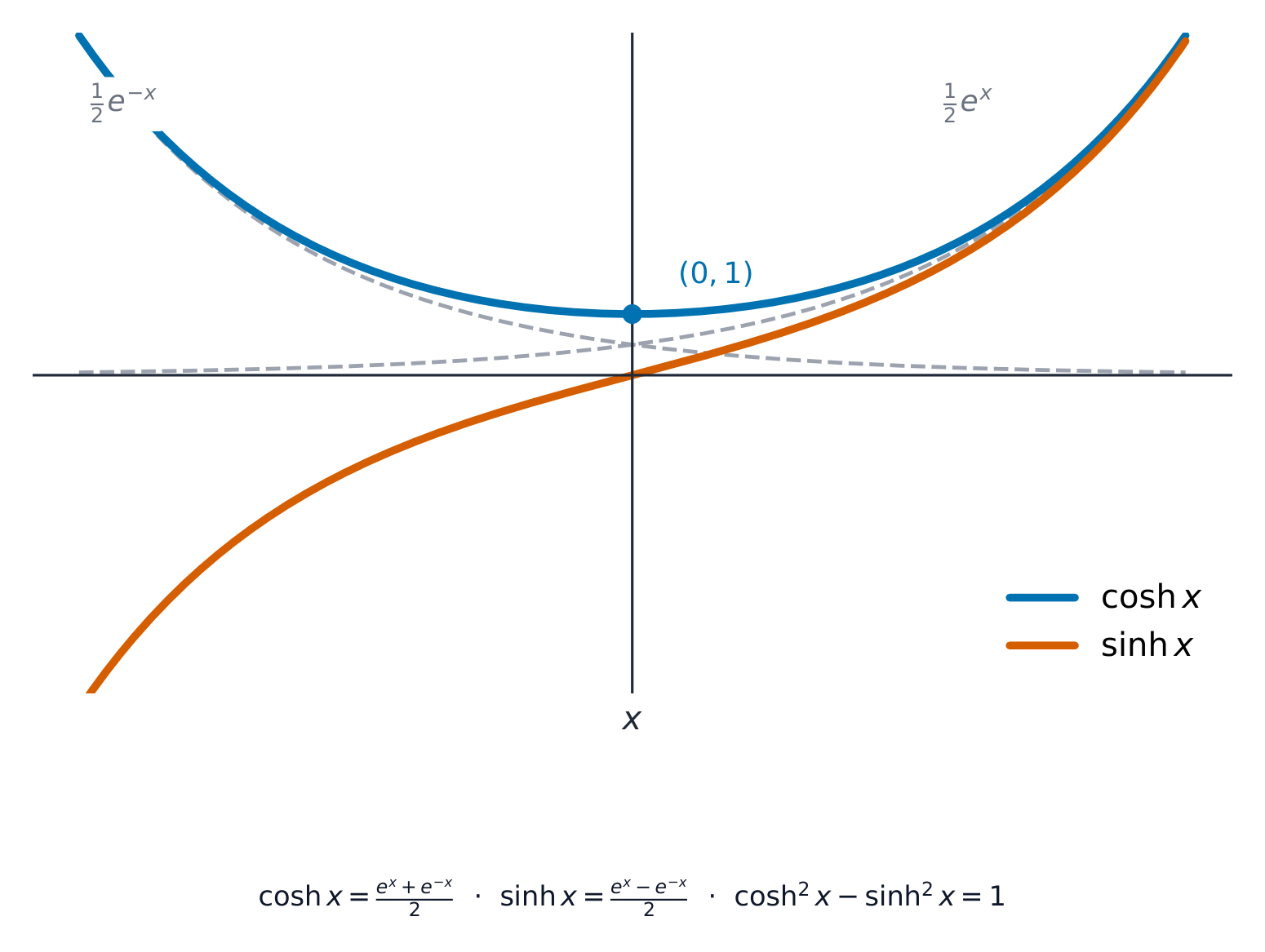
cosh and sinh are the average and half-difference of e^x and e^-x
Hyperbolic functions
y = a cosh(x)
cosh is the catenary (a hanging chain) — even, with its minimum at (0, a).
Using cosh x = (eˣ + e⁻ˣ)/2, what is cosh 0?
Difficulty 2/5 · 140 coins + a small bonus on first completion today
cosh 0 = (e⁰ + e⁰)/2 = (1 + 1)/2 = 1.
Using sinh x = (eˣ − e⁻ˣ)/2, what is sinh 0?
Difficulty 2/5 · 140 coins + a small bonus on first completion today
sinh 0 = (1 − 1)/2 = 0.
Key identities
- Main identity 恒等式: $\cosh^2 x - \sinh^2 x = 1$ (compare with $\cos^2 x + \sin^2 x = 1$).
- Addition: $\sinh(A + B) = \sinh A \cosh B + \cosh A \sinh B$.
Minus sign, not plus. The identity is $\cosh^2 x - \sinh^2 x = 1$ (minus), not $\cosh^2 x + \sinh^2 x = 1$. This is the key difference from trigonometric identities.

A hanging cable forms a catenary, the curve of the hyperbolic cosine y = a cosh(x/a)
For any x, what does cosh²x − sinh²x equal?
Difficulty 2/5 · 140 coins + a small bonus on first completion today
The hyperbolic identity is cosh²x − sinh²x = 1.
The identity cosh²x + sinh²x = 1 is correct.
Difficulty 1/5 · 100 coins + a small bonus on first completion today
The correct identity is cosh²x − sinh²x = 1 (minus, not plus).
Derivatives 导数
- $\dfrac{d}{dx}\sinh x = \cosh x$, $\quad\dfrac{d}{dx}\cosh x = \sinh x$ (no minus sign!).
- $\dfrac{d}{dx}\tanh x = \text{sech}^2 x$.
The derivative of sinh x is:
Difficulty 1/5 · 100 coins + a small bonus on first completion today
d/dx(sinh x) = cosh x (no minus sign, unlike the trig derivative d/dx(sin x) = cos x).
The derivative of cosh x is:
Difficulty 1/5 · 100 coins + a small bonus on first completion today
d/dx(cosh x) = sinh x (no minus sign, unlike d/dx(cos x) = −sin x).
Inverse 反函数 hyperbolic functions
- Inverse forms are logarithmic:
- $\sinh^{-1}x = \ln(x + \sqrt{x^2 + 1})$
- $\cosh^{-1}x = \ln(x + \sqrt{x^2 - 1})$ for $x \geq 1$.
You've got it
- $\cosh x = \dfrac{e^x + e^{-x}}{2}$, $\sinh x = \dfrac{e^x - e^{-x}}{2}$
- key identity: $\cosh^2 x - \sinh^2 x = 1$
- inverse hyperbolics have logarithmic forms
Write from cosh of ln 2
- Find cosh of ln 2 from the exponential definition.
- The identity is cosh squared minus sinh squared, not plus.
What is cosh of ln 2, and why is the hyperbolic identity a difference rather than a sum?
cosh x is half of e to the x plus e to the minus x. The minus in the identity is the difference from cosine.
What is cosh of ln 2?
Difficulty 1/5 · 100 coins + a small bonus on first completion today
(2 plus 0.5) divided by 2 is 1.25. Other options — 1 (the value of cosh 0); 2 (the value of e to the power ln 2).