This handout covers Topic 3: Further Mechanics 进阶力学. It extends mechanics to projectiles, rigid bodies, circular motion, elastic strings, variable forces and collisions. Take $g = 10\ \text{m s}^{-2}$.
Further Mechanics
A-Level Further Mathematics · Topic 3
 8:04
8:04
Further Mechanics
Throw a ball, fire a jet of water, launch anything into the air — and it traces the same elegant curve: a parabola. The secret is to split the motion in two.…
English narration · English + 中文 subtitles burned in
3.1
Motion of a projectile

Syllabus
| Candidates should be able to: | Notes and examples |
|---|---|
| • model the motion of a projectile as a particle moving with constant acceleration and understand any limitations of the model | Vector methods are not required |
| • use horizontal and vertical equations of motion to solve problems on the motion of projectiles, including finding the magnitude and direction of the velocity at a given time or position, the range on a horizontal plane and the greatest height reached | |
| • derive and use the Cartesian equation of the trajectory of a projectile, including problems in which the initial speed and/or angle of projection may be unknown. | Knowledge of the 'bounding parabola' for accessible points is not included. |
Source: Cambridge International syllabus
A projectile 抛射体 moves freely under gravity, so it has constant acceleration 匀加速 $g$ downwards and no horizontal acceleration. Treat the horizontal and vertical motions separately. If it is launched at speed $u$ and angle $\alpha$:
$$\text{horizontal: } x = u\cos\alpha\,\cdot t, \qquad \text{vertical: } y = u\sin\alpha\,\cdot t - \tfrac12 g t^2.$$
Eliminating $t$ gives the Cartesian equation 直角坐标方程 of the trajectory 轨迹 (the path), which is a parabola. For a fixed launch speed, all the trajectories lie under a bounding parabola 包络抛物线 (the envelope of reachable points). The range on level ground is $\dfrac{u^2\sin 2\alpha}{g}$ and the greatest height is $\dfrac{u^2\sin^2\alpha}{2g}$.

Worked example. A ball is thrown at $u = 20\ \text{m s}^{-1}$ at $30^\circ$ to the horizontal. Find the range and greatest height.
$$\text{range} = \frac{20^2\sin 60^\circ}{10} = 40\times 0.866 = 34.6\ \text{m}, \qquad \text{height} = \frac{20^2\sin^2 30^\circ}{2\times 10} = \frac{400\times 0.25}{20} = 5\ \text{m}.$$
Explore
Launch a projectile
Fire the ball, then change the angle and speed. The horizontal motion is steady while gravity pulls it down — together they trace a parabola. Find the angle for the longest range, and try the Moon.
Vocabulary
Train
| English |
|---|
| Further Mechanics/ˈfɜːðə mɪˈkænɪks/ |
| projectile/prəˈdʒektaɪl/ |
| constant acceleration/ˈkɒnstənt əkˌseləˈreɪʃn/ |
| Cartesian equation/kɑːˈtiːzɪən ɪˈkweɪʒn/ |
| trajectory/trəˈdʒektəri/ |
| bounding parabola/ˈbaʊndɪŋ pəˈræbələ/ |
3.2
Equilibrium of a rigid body

Syllabus
| Candidates should be able to: | Notes and examples |
|---|---|
| • calculate the moment of a force about a point | For questions involving coplanar forces only; understanding of the vector nature of moments is not required. |
| • use the result that the effect of gravity on a rigid body is equivalent to a single force acting at the centre of mass of the body, and identify the position of the centre of mass of a uniform body using considerations of symmetry | |
| • use given information about the position of the centre of mass of a triangular lamina and other simple shapes | Proofs of results given in the MF19 List of formulae are not required. |
| • determine the position of the centre of mass of a composite body by considering an equivalent system of particles | Simple cases only, e.g. a uniform L-shaped lamina, or a uniform cone joined at its base to a uniform hemisphere of the same radius. |
| • use the principle that if a rigid body is in equilibrium under the action of coplanar forces then the vector sum of the forces is zero and the sum of the moments of the forces about any point is zero, and the converse of this | |
| • solve problems involving the equilibrium of a single rigid body under the action of coplanar forces, including those involving toppling or sliding. |
Source: Cambridge International syllabus
The moment 力矩 of a force about a point is force $\times$ perpendicular distance; it measures turning effect. The weight of a body acts at its centre of mass 质心, which you can find using symmetry 对称 for a uniform flat shape (a lamina 薄片), or by treating a composite body as a set of particles.
A rigid body under coplanar forces 共面力 is in equilibrium 平衡 when two conditions both hold: the vector sum of the forces is zero, and the sum of the moments about any point is zero. A body may also be on the edge of toppling 翻倒 (turning over) or sliding 滑动 (slipping).
Worked example. A uniform beam $AB$ of length $4\ \text{m}$ and weight $100\ \text{N}$ rests on a pivot at $A$. A vertical force $F$ at $B$ keeps it horizontal. Find $F$.
Take moments about $A$ (the weight acts at the centre, $2\ \text{m}$ from $A$):
$$F\times 4 = 100\times 2 \;\Rightarrow\; F = 50\ \text{N}.$$
Explore
Equilibrium of forces
resultant = 0
A body is in equilibrium when the forces add tip-to-tail back to zero.
Vocabulary
Train
| English |
|---|
| moment/ˈməʊmənt/ |
| centre of mass/ˈsentə ɒv mæs/ |
| symmetry/ˈsɪmətri/ |
| equilibrium/ˌiːkwɪˈlɪbrɪəm/ |
| toppling/ˈtɒplɪŋ/ |
| sliding/ˈslaɪdɪŋ/ |
| lamina/ˈlæmɪnə/ |
| coplanar forces/ˌkəʊˈpleɪnə ˈfɔːsɪz/ |
3.3
Circular motion

Syllabus
| Candidates should be able to: | Notes and examples |
|---|---|
| understand the concept of angular speed for a particle moving in a circle, and use the relation $v = r\omega$ | |
| understand that the acceleration of a particle moving in a circle with constant speed is directed towards the centre of the circle, and use the formulae $r\omega^2$ and $\frac{v^2}{r}$. | Proof of the acceleration formulae is not required. |
| solve problems which can be modelled by the motion of a particle moving in a horizontal circle with constant speed | |
| solve problems which can be modelled by the motion of a particle in a vertical circle without loss of energy. | Including finding a normal contact force or the tension in a string, locating points at which these are zero, and conditions for complete circular motion. |
Source: Cambridge International syllabus
For a particle moving in a circle of radius $r$, the angular speed 角速度 $\omega$ links to the speed by $v = r\omega$. The acceleration points towards the centre — the centripetal acceleration 向心加速度 — with size
$$a = r\omega^2 = \frac{v^2}{r}.$$

In a horizontal circle 水平圆 the speed is constant — as in a conical pendulum 圆锥摆 (a mass swung on a string). In a vertical circle 竖直圆 use energy conservation, because the speed changes with height; the normal contact force 法向接触力 or string tension provides the centripetal force.
Worked example. A particle moves in a horizontal circle of radius $2\ \text{m}$ with angular speed $3\ \text{rad s}^{-1}$. Find its speed and acceleration.
$$v = r\omega = 2\times 3 = 6\ \text{m s}^{-1}, \qquad a = r\omega^2 = 2\times 3^2 = 18\ \text{m s}^{-2}.$$
Explore
Angle in radians
Circular motion is measured in radians: drag the angle θ and radius r to see the arc swept — angular speed ω turns this into v = rω.
Vocabulary
Train
| English |
|---|
| angular speed/ˈæŋɡjʊlə spiːd/ |
| centripetal acceleration/senˈtrɪpɪtl əkˌseləˈreɪʃn/ |
| horizontal circle/ˌhɒrɪˈzɒntl ˈsɜːkl/ |
| vertical circle/ˈvɜːtɪkl ˈsɜːkl/ |
| conical pendulum/ˈkɒnɪkl ˈpendjʊləm/ |
| normal contact force/ˈnɔːml ˈkɒntækt fɔːs/ |
3.4
Hooke's law
Syllabus
| Candidates should be able to: | Notes and examples |
|---|---|
| use Hooke’s law as a model relating the force in an elastic string or spring to the extension or compression, and understand the term modulus of elasticity | |
| use the formula for the elastic potential energy stored in a string or spring | Proof of the formula is not required. |
| solve problems involving forces due to elastic strings or springs, including those where considerations of work and energy are needed. | e.g. a particle moving horizontally or vertically or on an inclined plane while attached to one or more strings or springs, or a particle attached to an elastic string acting as a 'conical pendulum'. |
Source: Cambridge International syllabus
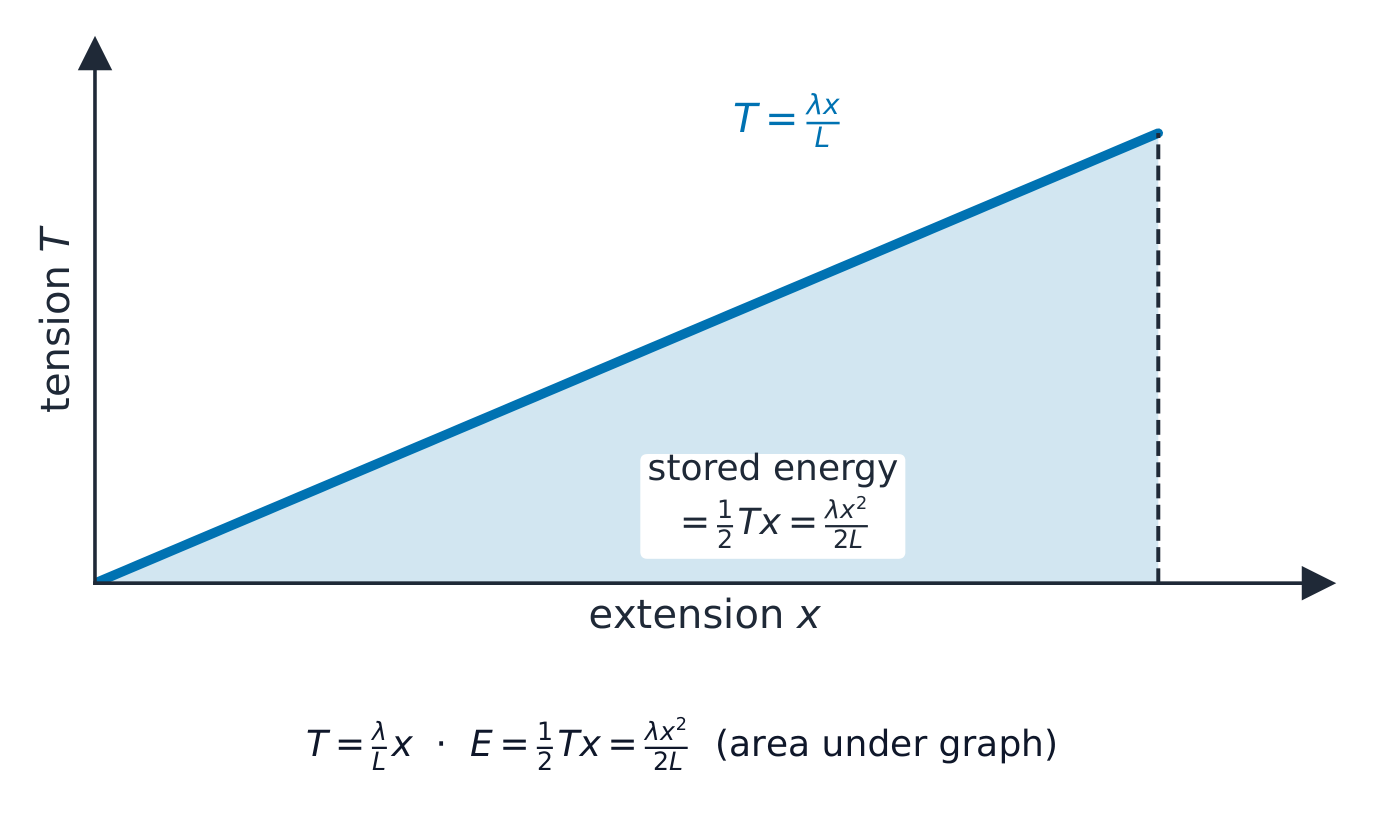
Hooke's law 胡克定律 says the tension in an elastic string or spring is proportional to its extension $x$:
$$T = \frac{\lambda x}{L},$$
where $L$ is the natural length and $\lambda$ is the modulus of elasticity 弹性模量. Stretching stores elastic potential energy 弹性势能:
$$E = \frac{\lambda x^2}{2L}.$$
Worked example. An elastic string of natural length $2\ \text{m}$ and modulus $50\ \text{N}$ is stretched by $0.5\ \text{m}$. Find the tension and the stored energy.
$$T = \frac{50\times 0.5}{2} = 12.5\ \text{N}, \qquad E = \frac{50\times 0.5^2}{2\times 2} = 3.125\ \text{J}.$$
Explore
Hooke's law
F = k·x
Force is proportional to extension — the gradient is the stiffness k.
Vocabulary
Train
| English |
|---|
| Hooke's law/hʊks lɔː/ |
| modulus of elasticity/ˈmɒdjʊləs ɒv ɪlæˈstɪsɪti/ |
| elastic potential energy/ɪˈlæstɪk pəˈtenʃl ˈenədʒi/ |
3.5
Linear motion under a variable force

Syllabus
| Candidates should be able to: | Notes and examples |
|---|---|
| solve problems which can be modelled as the linear motion of a particle under the action of a variable force, by setting up and solving an appropriate differential equation. | Including use of $v \frac{\mathrm{d}v}{\mathrm{d}x}$ for acceleration, where appropriate. Calculus required is restricted to content from Pure Mathematics 3 in Cambridge International A Level Mathematics (9709). Only differential equations in which the variables are separable are included. |
Source: Cambridge International syllabus
When the force depends on position $x$, use acceleration in the form $a = v\dfrac{dv}{dx}$, which turns Newton's law into a differential equation 微分方程 relating $v$ and $x$.
Worked example. A particle of mass $8\ \text{kg}$ moves along a line under a variable force 变力 of size $(x^3 + 4x)\ \text{N}$ acting in the direction of motion. When $x = 0$, $v = 1$. Find $v$ in terms of $x$.
Newton's law gives $8v\dfrac{dv}{dx} = x^3 + 4x$. Separating and integrating:
$$\int 8v\,dv = \int (x^3 + 4x)\,dx \;\Rightarrow\; 4v^2 = \tfrac14 x^4 + 2x^2 + C.$$
At $x = 0$, $v = 1$ gives $C = 4$, so $4v^2 = \tfrac14 x^4 + 2x^2 + 4 = 4\left(\tfrac{x^2}{4} + 1\right)^2$. Hence $v = \tfrac14 x^2 + 1$.

Explore
Work from a variable force
W = ∫ F dx
When the force changes, the work done is the area under the force–distance graph.
Vocabulary
Train
| English |
|---|
| differential equation/ˌdɪfəˈrenʃl ɪˈkweɪʒn/ |
| variable force/ˈveərɪəbl fɔːs/ |
3.6
Momentum

Syllabus
| Candidates should be able to: | Notes and examples |
|---|---|
| recall Newton’s experimental law and the definition of the coefficient of restitution, the property $0 \leqslant e \leqslant 1$, and the meaning of the terms ‘perfectly elastic’ ($e = 1$) and ‘inelastic’ ($e = 0$) | |
| use conservation of linear momentum and/or Newton’s experimental law to solve problems that may be modelled as the direct or oblique impact of two smooth spheres, or the direct or oblique impact of a smooth sphere with a fixed surface. |
Source: Cambridge International syllabus
In a collision, total linear momentum is conserved — the conservation of linear momentum 动量守恒. The bounciness is measured by Newton's experimental law 牛顿实验定律, which defines the coefficient of restitution 恢复系数 $e$:
$$e = \frac{\text{speed of separation}}{\text{speed of approach}}, \qquad 0 \leqslant e \leqslant 1.$$
Here $e = 1$ is perfectly elastic (no energy lost) and $e = 0$ is inelastic (the bodies stay together). In an oblique impact 斜碰撞, resolve the velocities along and perpendicular to the line of impact, applying restitution along it.

Worked example. A sphere $A$ of mass $2\ \text{kg}$ moving at $5\ \text{m s}^{-1}$ hits a stationary sphere $B$ of mass $3\ \text{kg}$, with $e = 0.5$. Find the speeds afterwards.
Momentum: $2(5) = 2v_A + 3v_B$, so $2v_A + 3v_B = 10$. Restitution: $v_B - v_A = 0.5(5) = 2.5$. Solving together gives $v_A = 0.5\ \text{m s}^{-1}$ and $v_B = 3.0\ \text{m s}^{-1}$.
Explore
A collision
Set each mass and speed, then collide them. Total momentum is conserved — see how the velocities come out.
Vocabulary
Train
| English |
|---|
| conservation of momentum/ˌkɒnsəˈveɪʃn ɒv məʊˈmentəm/ |
| Newton's experimental law/ˈnjuːtnz ekˌsperɪˈmentl lɔː/ |
| coefficient of restitution/ˌkəʊɪˈfɪʃənt ɒv rɪstɪˈtjuːʃn/ |
| oblique impact/əˈbliːk ˈɪmpækt/ |
3.6
Exam tips
- For projectiles, resolve into horizontal (constant velocity) and vertical ($a = g$) motion, linked by the same time.
- For a rigid body in equilibrium, take moments about a point that removes an unknown force.
- For circular motion, use $F = mv^2/r = m\omega^2 r$ towards the centre; in a vertical circle check the minimum speed at the top.
- With a variable force, use $a = v\,\frac{dv}{dx}$ and integrate; elastic PE $= \frac{\lambda x^2}{2L}$.
Interactive lessons on this topic
Work through it step by step, with instant-check exercises.