Differential equations (Further Pure 2)
Introduced| English | Meaning |
|---|---|
| differential equation/ˌdɪfəˈrenʃl ɪˈkweɪʒn/ | An equation involving a function and one or more of its derivatives. |
| integrating factor/ˈɪntɪɡreɪtɪŋ ˈfæktə/ | A factor used to multiply a differential equation so that an expression becomes a complete derivative and can be integrated. |
| general solution/ˈdʒenərəl səˈluːʃn/ | A family of solutions containing arbitrary constants or parameters that represents all solutions of the specified type. |
| complementary function/ˌkɒmplɪˈmentəri ˈfʌŋkʃn/ | The general solution of the homogeneous differential equation associated with a linear nonhomogeneous differential equation. |
| auxiliary equation/ɔːkˈsɪlɪəri ɪˈkweɪʒn/ | For a linear differential equation with constant coefficients, the polynomial equation obtained by substituting an exponential trial solution. |
| boundary condition/ˈbaʊndəri kənˈdɪʃn/ | A specified value or relationship that a solution must satisfy at a boundary or stated position, helping determine constants or allowable solutions. |
| initial condition/ɪˈnɪʃl kənˈdɪʃn/ | A specified starting value used to determine a particular solution of an equation or model. |
| particular integral/pəˈtɪkjʊlə ˈɪntɪɡrəl/ | One specific solution of a nonhomogeneous linear differential equation, added to the complementary function to obtain the general solution. |
When the unknown is a function
- Ordinary equations solve for a number. A differential equation 微分方程 solves for a whole function — given a rule about its rate of change.
- They model cooling coffee, growing populations, charging capacitors, and swinging pendulums.
First-order linear: the integrating factor 积分因子
- For $\dfrac{dy}{dx} + P(x)\,y = Q(x)$, multiply through by the integrating factor:
- This makes the left side collapse to $\dfrac{d}{dx}(\mu y)$, so you can integrate both sides directly.
Worked example. $\dfrac{dy}{dx} + 2y = e^x$. Here $P = 2$, so $\mu = e^{\int 2\,dx} = e^{2x}$. The left side becomes $\dfrac{d}{dx}(e^{2x}y)$.
Differential equations
dy/dx = a y
The equation sets the slope everywhere; the solution follows those slopes.
For dy/dx + 2y = eˣ, the integrating factor μ = e^(∫2 dx) is:
Difficulty 1/5 · 100 coins + a small bonus on first completion today
∫2 dx = 2x, so μ = e^(2x).
Multiplying by the integrating factor makes the left side d/dx(μy), so you can integrate directly.
Difficulty 1/5 · 100 coins + a small bonus on first completion today
That is the whole point of the integrating factor — it makes the left side an exact derivative.
Second-order, constant coefficients
- For $a\dfrac{d^2y}{dx^2} + b\dfrac{dy}{dx} + cy = f(x)$, the general solution 通解 has two parts:
- The complementary function 余函数 (CF) comes from the auxiliary equation 辅助方程 $am^2 + bm + c = 0$.
For a constant-coefficient linear equation, the general solution is:
Difficulty 1/5 · 100 coins + a small bonus on first completion today
General solution = complementary function (RHS = 0) + a particular integral.
Reading the auxiliary roots
- The roots of the auxiliary equation decide the shape of the CF:
| roots | complementary function |
|---|---|
| real & distinct $m_1, m_2$ | $Ae^{m_1 x} + Be^{m_2 x}$ |
| repeated $m$ | $(A + Bx)e^{mx}$ |
| complex $p \pm qi$ | $e^{px}(A\cos qx + B\sin qx)$ |
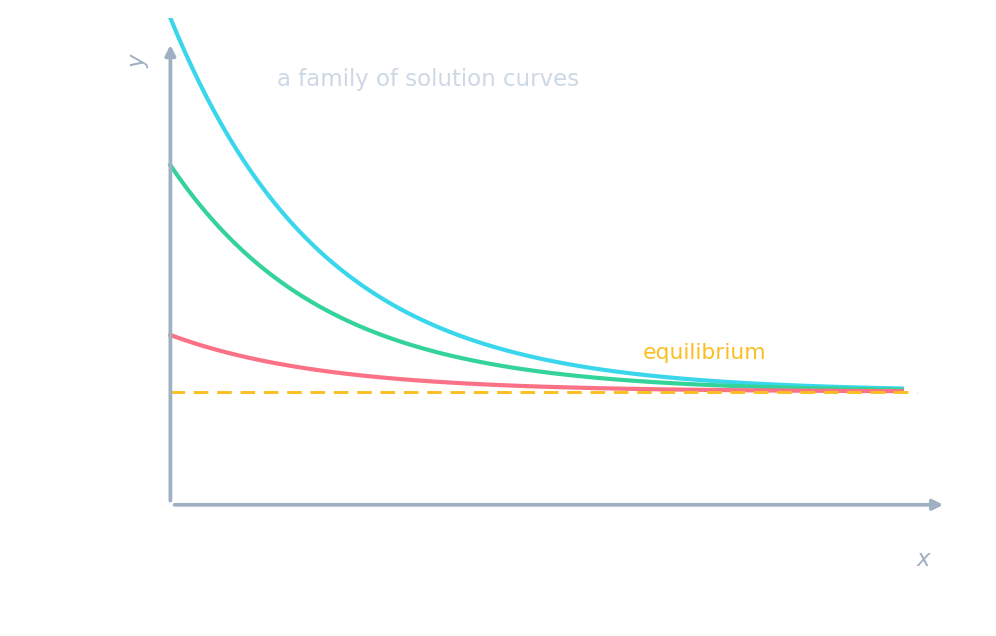
A differential equation has a whole family of solution curves; the boundary conditions 边界条件 pick out one.
For y″ − 5y′ + 6y = 0 the auxiliary equation is m² − 5m + 6 = 0. What is its larger root?
Difficulty 2/5 · 140 coins + a small bonus on first completion today
m² − 5m + 6 = (m − 2)(m − 3) = 0, so m = 2 or 3; the larger is 3.
Match each type of auxiliary root to the complementary function it gives.
Difficulty 2/5 · 140 coins + a small bonus on first completion today
Distinct reals give two exponentials; a repeated root adds a factor of x; complex roots give an oscillating, exponentially-scaled form.
Boundary conditions
- The constants $A, B$ are fixed by boundary or initial conditions 初始条件 (e.g. $y(0) = 1$, $y'(0) = 0$).
- Without them you get the whole family; with them, the one curve that fits.
- Solve differential equations with a substitution or by separable variables, then apply initial conditions for the particular solution.
The arbitrary constants A and B are fixed by the ______ conditions.
Difficulty 1/5 · 100 coins + a small bonus on first completion today
Boundary or initial conditions (like y(0) = 1) determine A and B.
You've got it
- first-order linear: multiply by $\mu = e^{\int P\,dx}$, then integrate
- second-order: general = complementary function + particular integral 特积分
- the CF comes from the auxiliary equation; boundary conditions fix the constants