Motion of a projectile
Introduced| English | Meaning |
|---|---|
| horizontal/ˌhɒrɪˈzɒntl/ | Parallel to the horizon or perpendicular to the local vertical direction. |
| vertical/ˈvɜːtɪkl/ | Along the local direction of gravity, or perpendicular to a horizontal reference. |
| gravity/ˈɡrævɪti/ | The attractive interaction between objects with mass. |
| projectile/prəˈdʒektaɪl/ | An object moving after being launched, typically modelled under gravity with air resistance neglected. |
| parabola/pəˈræbələ/ | The curve formed by points equally distant from a fixed point and a fixed straight line. |
| range/reɪndʒ/ | The horizontal distance travelled by a projectile between its launch and a specified landing level or point. |
| greatest height/ˈɡreɪtɪst haɪt/ | greatest height |
The cannonball problem
- Fire a ball at an angle and it traces a smooth arch, then lands. Where, and how high?
- Galileo's insight: treat the horizontal 水平 and vertical 竖直 motions completely separately — they only share the clock.
Two independent motions
- Launched at speed $u$ and angle $\alpha$:
- Horizontal: constant velocity $u\cos\alpha$ (no force sideways).
- Vertical: gravity 重力 only, acceleration $g$ downward.

Water jets follow parabolic paths, the classic projectile 抛射体 motion under gravity
Launch a projectile
Fire the ball, then change the angle and speed. The horizontal motion is steady while gravity pulls it down — together they trace a parabola. Find the angle for the longest range, and try the Moon.
During the flight, the horizontal velocity of a projectile (ignoring air resistance):
Difficulty 1/5 · 100 coins + a small bonus on first completion today
There is no horizontal force, so u cos α is constant throughout.
The initial horizontal velocity of a projectile launched at speed u and angle α is u ______ α.
Difficulty 1/5 · 100 coins + a small bonus on first completion today
Horizontal component = u cos α; vertical = u sin α.
The parabola 抛物线
- Eliminating $t$ leaves $y$ as a quadratic in $x$ — so the path is a parabola.
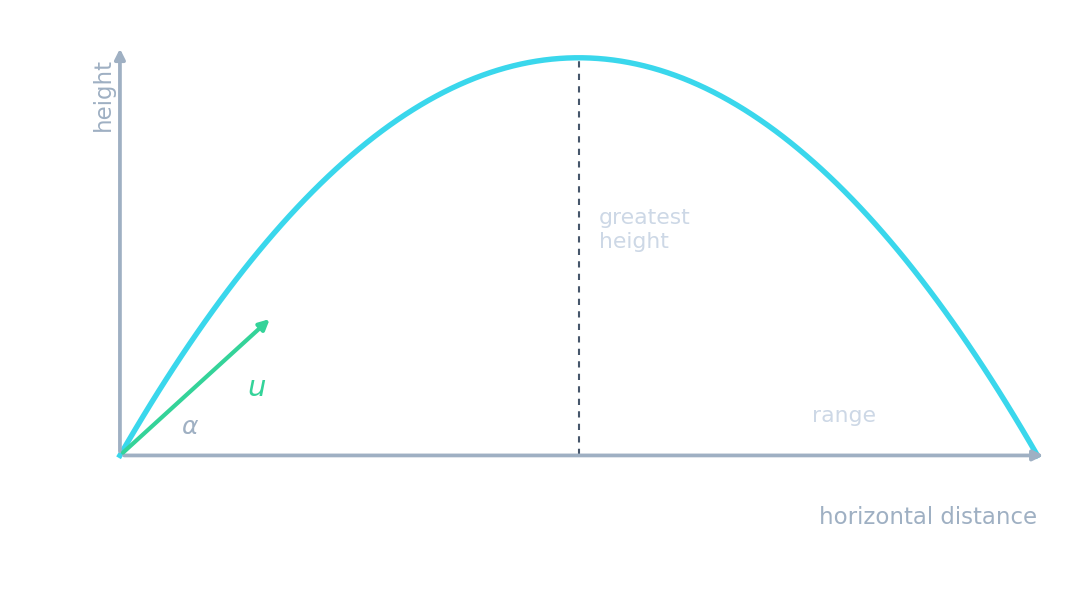
Horizontal speed stays constant; gravity bends the vertical motion into a parabola.
The path of a projectile (no air resistance) is a:
Difficulty 1/5 · 100 coins + a small bonus on first completion today
Eliminating t gives y as a quadratic in x — a parabola.
Range 射程 and greatest height 最大高度
- At the top, the vertical velocity is momentarily zero. The key results:
Worked example. $u = 20\ \tfrac{\text{m}}{\text{s}}$, $\alpha = 30^\circ$, $g = 10$. Greatest height $= \dfrac{400 \times 0.25}{20} = 5\ \text{m}$.
A ball is thrown at u = 20 m/s at 30°. Using height = u²sin²α/(2g) with g = 10, find the greatest height (m).
Difficulty 2/5 · 140 coins + a small bonus on first completion today
400 × sin²30° / 20 = 400 × 0.25 / 20 = 5 m.
At what launch angle (degrees) is the range greatest?
Difficulty 2/5 · 140 coins + a small bonus on first completion today
Range ∝ sin 2α, which is largest when 2α = 90°, i.e. α = 45°.
At the highest point of the flight, the vertical component of velocity is zero.
Difficulty 1/5 · 100 coins + a small bonus on first completion today
Vertical velocity decreases to zero at the top, then becomes negative (downward).
Common trap
Range is maximised at $45^\circ$, not $90^\circ$. $\sin 2\alpha$ peaks when $2\alpha = 90^\circ$. Firing straight up gives zero range — all the speed goes into height.
- Eliminating time gives the Cartesian equation of the path; all trajectories lie under a bounding parabola.
You've got it
- resolve into horizontal ($u\cos\alpha$, constant) and vertical ($u\sin\alpha$, gravity) parts
- the path is a parabola
- range $= \dfrac{u^2\sin 2\alpha}{g}$ (max at $45^\circ$); greatest height $= \dfrac{u^2\sin^2\alpha}{2g}$