Differentiation (Further Pure 2)
Introduced| English | Meaning |
|---|---|
| polynomial/ˌpɒlɪˈnəʊmɪəl/ | An expression formed by adding terms with non-negative integer powers of its variables. |
| Maclaurin series/məˈklɔːrɪn ˈsɪəriːz/ | A Taylor series centred at zero, whose coefficients are determined by the function's derivatives at zero. |
| differentiation/ˌdɪfəˌrenʃɪˈeɪʃn/ | The process of finding a derivative, which describes a function's local rate of change. |
| hyperbolic/ˌhaɪpəˈbɒlɪk/ | Relating to hyperbolas or to functions such as sinh, cosh and tanh, which can be defined using exponential functions. |
| coefficient/ˌkəʊɪˈfɪʃənt/ | A numerical or constant factor multiplying a term in an expression. |
| interval of convergence/ˈɪntəvl ɒv kənˈvɜːdʒəns/ | The set of real input values over which a power series converges, including any endpoints that satisfy convergence tests. |
| diverge/daɪˈvɜːdʒ/ | Fails to approach a finite limit, in the context of a sequence or the partial sums of a series. |
How does a calculator find eˣ?
- Your calculator can't "do" $e^{0.7}$ directly — there's no button-press that knows it.
- Instead it adds up a few terms of a polynomial 多项式 that mimics $e^x$ near zero.
- That polynomial is a Maclaurin series 麦克劳林级数 — and building one starts with repeated differentiation 微分.
New derivatives to know
- Further Pure 2 adds derivatives of the hyperbolic 双曲 and inverse functions:
| function | derivative |
|---|---|
| $\sinh x$ | $\cosh x$ |
| $\cosh x$ | $\sinh x$ |
| $\sin^{-1}x$ | $\dfrac{1}{\sqrt{1-x^2}}$ |
| $\tan^{-1}x$ | $\dfrac{1}{1+x^2}$ |
- You can also find $\dfrac{d^2y}{dx^2}$ for implicit and parametric curves.
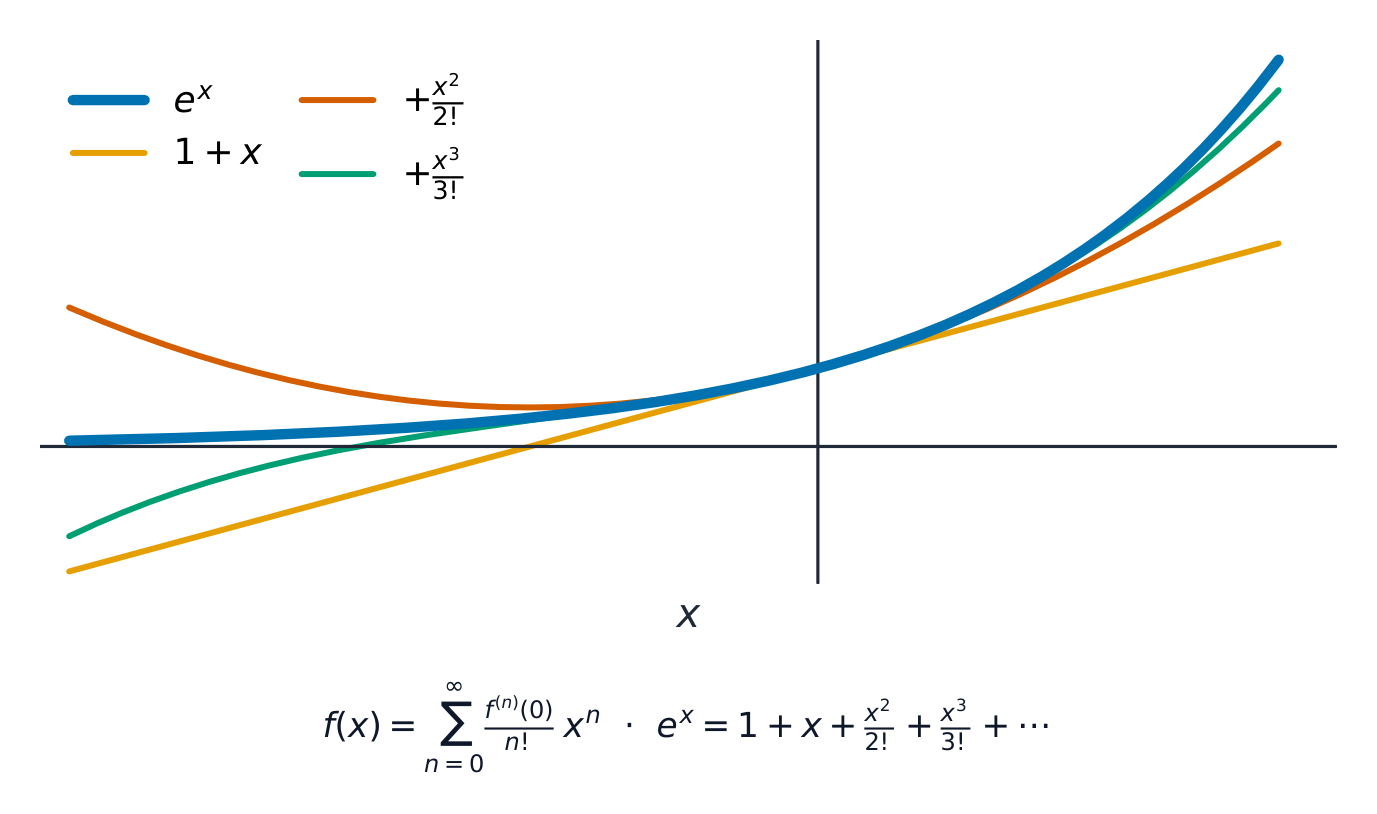
Each extra Maclaurin term hugs e^x over a wider range
The gradient at a point
gradient = dy/dx
The derivative is the slope of the tangent, however exotic the function.
The derivative of sinh x is:
Difficulty 1/5 · 100 coins + a small bonus on first completion today
d/dx(sinh x) = cosh x (and d/dx(cosh x) = sinh x).
The derivative of tan⁻¹x is 1/(1+x²). What is its value at x = 0?
Difficulty 2/5 · 140 coins + a small bonus on first completion today
1/(1+0²) = 1.
Match each function to its derivative.
Difficulty 2/5 · 140 coins + a small bonus on first completion today
The hyperbolic pair swap (no minus sign, unlike sin/cos); the inverse trig derivatives are the standard rational/surd forms.
Maclaurin's series
- A Maclaurin series rebuilds a function as an infinite polynomial using its derivatives at $0$:
- Each coefficient 系数 needs the next derivative, evaluated at $x = 0$.
In a Maclaurin series, the constant term is f(0). For f(x) = eˣ, what is f(0)?
Difficulty 2/5 · 140 coins + a small bonus on first completion today
e⁰ = 1, so the constant term is 1.
In the Maclaurin series, the coefficient of xⁿ has n-factorial (written n!) in the ______.
Difficulty 1/5 · 100 coins + a small bonus on first completion today
The xⁿ term is f⁽ⁿ⁾(0)/n! · xⁿ — the n! is in the denominator.
Worked example — the series for eˣ
- For $f(x) = e^x$, every derivative is $e^x$, and $e^0 = 1$. So every coefficient is $\dfrac{1}{n!}$:
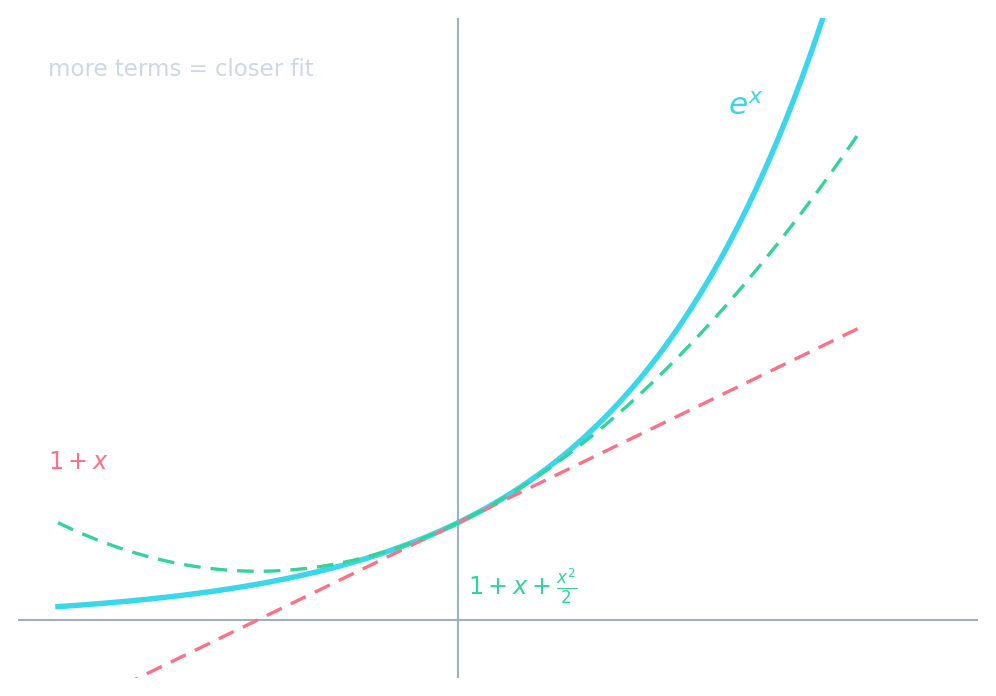
Each extra term bends the polynomial closer to $e^x$ near $x = 0$ — exactly how a calculator works.
More standard series. $\sin x = x - \dfrac{x^3}{3!} + \dfrac{x^5}{5!} - \cdots$ and $\ln(1+x) = x - \dfrac{x^2}{2} + \dfrac{x^3}{3} - \cdots$ (valid for $|x| < 1$).
The Maclaurin series of eˣ begins:
Difficulty 1/5 · 100 coins + a small bonus on first completion today
eˣ = Σ xⁿ/n! = 1 + x + x²/2! + x³/3! + …
Where the series is valid
- A Maclaurin series only matches the function within its interval of convergence 收敛区间.
- $e^x$, $\sin x$, $\cos x$ converge for all $x$; but $\ln(1+x)$ only for $-1 < x \leq 1$.
Check convergence before you trust it. Far outside the valid interval the polynomial diverges 发散 wildly from the function — more terms make it worse, not better.
- Differentiate hyperbolic functions and inverse functions, and relations given implicitly or parametrically.
The Maclaurin series for ln(1+x) is valid for every value of x.
Difficulty 1/5 · 100 coins + a small bonus on first completion today
It only converges for −1 < x ≤ 1; outside that interval it diverges.
You've got it
- new derivatives: $\sinh x \to \cosh x$, $\tan^{-1}x \to \dfrac{1}{1+x^2}$, $\sin^{-1}x \to \dfrac{1}{\sqrt{1-x^2}}$
- Maclaurin: $f(x) = f(0) + f'(0)x + \dfrac{f''(0)}{2!}x^2 + \cdots$
- $e^x = 1 + x + \dfrac{x^2}{2!} + \cdots$ — more terms fit better, within the interval of convergence