This handout covers Topic 1, Number. Cambridge Maths has two levels: Core and Extended. Parts marked (Extended) are only tested on the Extended papers; everything else is for both levels.
Identify and use: • natural numbers • integers (positive, zero and negative) • prime numbers • square numbers • cube numbers • common factors • common multiples • rational and irrational numbers • reciprocals.
Example tasks include: • convert between numbers and words, e.g. six billion is 6000000000 10007 is ten thousand and seven • express 72 as a product of its prime factors • find the highest common factor (HCF) of two numbers • find the lowest common multiple (LCM) of two numbers.
A factor 因数 of a number divides into it exactly, leaving no remainder 余数. The factors of $18$ are $1, 2, 3, 6, 9, 18$.
A multiple 倍数 of a number is that number times an integer. Multiples of $6$ are $6, 12, 18, 24, \dots$
A common factor 公因数 of two numbers is a factor of both.
A common multiple 公倍数 of two numbers is a multiple of both.
Prime, square and cube numbers
A prime number 质数 has exactly two factors: $1$ and itself. The first primes are $2, 3, 5, 7, 11, 13, \dots$ Note that $1$ is not prime.
A square number 平方数 is a whole number times itself: $1, 4, 9, 16, 25, \dots$
A cube number 立方数 uses a whole number three times: $1, 8, 27, 64, \dots$
Rational, irrational and reciprocal
A rational number 有理数 can be written as a fraction 分数$\frac{a}{b}$ of two integers. Examples: $\frac{3}{4}$, $5$, $0.7$.
An irrational number 无理数 cannot be written this way. Examples: $\pi$ and $\sqrt{2}$.
The reciprocal 倒数 of a number is $1$ divided by that number. The reciprocal of $4$ is $\frac{1}{4}$; the reciprocal of $0.25$ is $4$; the reciprocal of $\frac{2}{3}$ is $\frac{3}{2}$.
Prime factors, HCF and LCM
Every integer above $1$ is prime, or can be written as a product 乘积 of prime numbers. To write a number as a product of its prime factors 质因数, keep dividing by the smallest prime that fits.
Worked example. Write $72$ as a product of its prime factors.
The highest common factor (HCF) 最大公因数 of two numbers is the largest factor they share. The lowest common multiple (LCM) 最小公倍数 is the smallest multiple they share. Prime factors give a quick method.
Worked example. Find the HCF and LCM of $72$ and $120$.
factor ตัวประกอบของตัวเลขคือตัวเลขที่หารเข้ากันได้พอดี ไม่มี remainder余数 The factors of $18$ are $1, 2, 3, 6, 9, 18$.
multiple พหุคูณของตัวเลขคือตัวเลขนั้นคูณด้วยจำนวนเต็ม Multiples of $6$ are $6, 12, 18, 24, \dots$
common factor ตัวประกอบร่วมของตัวเลขสองจำนวนคือตัวประกอบของทั้งสอง
common multiple พหุคูณร่วมของตัวเลขสองจำนวนคือพหุคูณของทั้งสอง
จำนวน prime square และ cube
prime number จำนวนเฉพาะมีตัวประกอบเพียงสองตัว: $1$ และตัวมันเอง Prime numbers แรกๆ คือ $2, 3, 5, 7, 11, 13, \dots$ หมายเหตุว่า $1$not ไม่ใช่ prime number
square number จำนวนกำลังสองคือจำนวนเต็มคูณกับตัวเอง: $1, 4, 9, 16, 25, \dots$
cube number จำนวนกำลังสามคือการนำจำนวนเต็มมาคูณกันสามครั้ง: $1, 8, 27, 64, \dots$
irrational number จำนวนอตรรกยะไม่สามารถเขียนแบบนี้ได้ ตัวอย่าง: $\pi$ และ $\sqrt{2}$
reciprocal ส่วนกลับของตัวเลขคือ $1$ หารด้วยตัวเลขนั้น The reciprocal of $4$ is $\frac{1}{4}$; The reciprocal of $0.25$ is $4$; The reciprocal of $\frac{2}{3}$ is $\frac{3}{2}$
ตัวประกอบเฉพาะ HCF และ LCM
จำนวนเต็มทุกจำนวนมากกว่า $1$ เป็น prime number หรือสามารถเขียนเป็น product ผลคูณของจำนวนเฉพาะได้ ในการเขียนตัวเลขเป็นผลคูณของ prime factors ให้หารด้วยจำนวนเฉพาะที่เล็กที่สุดที่ยังหารลงตัวเรื่อยๆ
Worked example. เขียน $72$ เป็นผลคูณของ prime factors
แยกย่อยต่อไปจนทุกกิ่งจบด้วย prime number (วงกลม); การรวบรวม将它们 gives $72 = 2^{3} \times 3^{2}$
HCF Highest Common Factor ตัวประกอบร่วมสูงสุดของตัวเลขสองจำนวนคือตัวประกอบที่ใหญ่ที่สุดที่พวกเขาร่วมกันมี LCM Lowest Common Multiple พหุคูณร่วมต่ำสุดคือพหุคูณที่น้อยที่สุดที่พวกเขาร่วมกันมี Prime factors ให้วิธีการคำนวณที่รวดเร็ว
HCF: เลือก lowest power ของแต่ละ prime number ที่ปรากฏใน both: $2^{3} \times 3 = 24$
LCM: เลือก highest power ของ every prime number ที่ปรากฏ: $2^{3} \times 3^{2} \times 5 = 360$
Explore · สำรวจ
Sets of numbers · เซตของตัวเลข
Every counting number is also an integer, every integer a rational — see how the number sets nest, and how union and intersection combine them. · ทุกจำนวนนับเป็นจำนวนเต็ม, ทุกจำนวนเต็มเป็นจำนวนตรรกยะ — ดูว่าเซตของตัวเลขซ้อนกันอย่างไร และ how union and intersection รวมพวกมันเข้าด้วยกัน
Understand and use set language, notation and Venn diagrams to describe sets.
Venn diagrams are limited to two sets. The following set notation will be used: • $n(A)$ Number of elements in set $A$ • $A'$ Complement of set $A$ • $\mathscr{E}$ Universal set • $A \cup B$ Union of $A$ and $B$ • $A \cap B$ Intersection of $A$ and $B$. Example definition of sets: $A = \{x : x \text{ is a natural number}\}$$B = \{a, b, c, \dots\}$$C = \{x : a \leqslant x \leqslant b\}$.
แผนภาพเวนน์จำกัดอยู่แค่สองเซ็ตProgramming set notation will be used: • $n(A)$ จำนวนองค์ประกอบในเซ็ต $A$ • $A'$ คอมพลีเมนต์ของเซ็ต $A$ • $\mathscr{E}$ เซ็ตเอกภพ • $A \cup B$ ยูเนียนของ $A$ และ $B$ • $A \cap B$ อินเตอร์เซคชันของ $A$ และ $B$. ตัวอย่างนิยามของเซ็ต: $A = \{x : x \text{ is a natural number}\}$$B = \{a, b, c, \dots\}$$C = \{x : a \leqslant x \leqslant b\}$.
English
Subject content
Notes and examples
Understand and use set language, notation and Venn diagrams to describe sets and represent relationships between sets.
Venn diagrams are limited to two or three sets. The following set notation will be used: • $n(A)$ Number of elements in set $A$ • $\in$ "... is an element of ..." • $\notin$ "... is not an element of ..." • $A'$ Complement of set $A$ • $\varnothing$ The empty set • $\mathscr{E}$ Universal set • $A \subseteq B$$A$ is a subset of $B$ • $A \nsubseteq B$$A$ is not a subset of $B$ • $A \cup B$ Union of $A$ and $B$ • $A \cap B$ Intersection of $A$ and $B$. Example definition of sets: $A = \{x : x \text{ is a natural number}\}$$B = \{(x, y) : y = mx + c\}$$C = \{x : a \leqslant x \leqslant b\}$$D = \{a, b, c, \dots\}$.
Tap the regions to see union, intersection and complement — the language of sets. · แตะพื้นที่เพื่อดู ** UNION, INTERSECTION** และส่วนเสริม — ภาษาของเซต
Calculate with the following: • squares • square roots • cubes • cube roots • other powers and roots of numbers.
Includes recall of squares and their corresponding roots from 1 to 15, and recall of cubes and their corresponding roots of 1, 2, 3, 4, 5 and 10, e.g.: • Write down the value of $\sqrt{169}$ . • Work out $5^2 \times \sqrt[3]{8}$ .
Calculate with the following: • squares • square roots • cubes • cube roots • other powers and roots of numbers.
Includes recall of squares and their corresponding roots from 1 to 15, and recall of cubes and their corresponding roots of 1, 2, 3, 4, 5 and 10, e.g.: • Write down the value of $\sqrt{169}$. • Work out $5^2 \times \sqrt[3]{8}$.
Source: Cambridge International syllabus · แหล่งที่มา: หลักสูตร Cambridge International
English
A power 幂 (also called an index 指数, plural indices) shows how many times to multiply a number by itself: $2^{5} = 2 \times 2 \times 2 \times 2 \times 2 = 32$.
A square root 平方根 of a number gives that number when squared: $\sqrt{169} = 13$ because $13^{2} = 169$.
A cube root 立方根 works the same way for cubes: $\sqrt[3]{8} = 2$ because $2^{3} = 8$.
You should be able to recall the squares from $1^2$ to $15^2$ (and their roots), and the cubes of $1, 2, 3, 4, 5$ and $10$.
Worked example. Work out $5^{2} \times \sqrt[3]{8}$.
Source: Cambridge International syllabus · แหล่งที่มา: หลักสูตร Cambridge International
English
Standard form 科学记数法 writes a number as $A \times 10^{n}$, where $1 \leqslant A < 10$ and $n$ is an integer. It is used for very large or very small numbers.
To convert, count how many places the decimal point moves:
$4\,500\,000 = 4.5 \times 10^{6}$ — the point moves $6$ places left, so the power is positive.
$0.00072 = 7.2 \times 10^{-4}$ — the point moves $4$ places right, so the power is negative.
Worked example. Work out $(3 \times 10^{5}) \times (2 \times 10^{-2})$.
Multiply the front numbers and add the powers:
$$3 \times 2 = 6, \qquad 10^{5} \times 10^{-2} = 10^{3}, \qquad \text{so the answer is } 6 \times 10^{3}.$$
To rationalise the denominator 分母有理化 means to remove a surd from the bottom of a fraction (the denominator 分母). Multiply the top and bottom by a value that clears the surd.
Worked example. Rationalise $\dfrac{10}{\sqrt{5}}$ and $\dfrac{1}{-1+\sqrt{3}}$.
rationalise the denominator/ˈræʃənəlaɪz ðə dɪˈnɒmɪneɪtə/
ทำให้ส่วนเป็นจำนวนเต็ม
denominator/dɪˈnɒmɪneɪtə/
ตัวส่วน
numerator/ˈnjuːməreɪtə/
ตัวเศษ
proper fraction/ˈprɒpə ˈfrækʃn/
เศษส่วนแท้
improper fraction/ɪmˈprɒpə ˈfrækʃn/
เศษเกิน
mixed number/mɪkst ˈnʌmbə/
เลขคละ
1.4
Fractions, decimals and percentages · เศษส่วน ทศนิยม และเปอร์เซ็นต์
Syllabus · หลักสูตร
English
Subject content
Notes and examples
1 Use the language and notation of the following in appropriate contexts: • proper fractions • improper fractions • mixed numbers • decimals • percentages.
Candidates are expected to be able to write fractions in their simplest form. Candidates are not expected to use recurring decimal notation.
2 Recognise equivalence and convert between these forms.
Candidates are not expected to demonstrate the conversion of a recurring decimal to a fraction and vice versa.
1 Use the language and notation of the following in appropriate contexts: • proper fractions • improper fractions • mixed numbers • decimals • percentages.
Candidates are expected to be able to write fractions in their simplest form. Recurring decimal notation is required, e.g. • $0.1\dot{7} = 0.1777...$ • $0.1\dot{2}\dot{3} = 0.1232323...$ • $0.\dot{1}2\dot{3} = 0.123123...$
2 Recognise equivalence and convert between these forms.
Includes converting between recurring decimals and fractions and vice versa, e.g. write $0.1\dot{7}$ as a fraction.
Source: Cambridge International syllabus · แหล่งที่มา: หลักสูตร Cambridge International
English
A fraction has a numerator 分子 (the top) and a denominator (the bottom).
proper fraction 真分数: numerator smaller than denominator, e.g. $\frac{3}{4}$.
improper fraction 假分数: numerator the same or larger, e.g. $\frac{7}{4}$.
mixed number 带分数: a whole number plus a fraction, e.g. $1\frac{3}{4}$.
Change between improper and mixed: $\frac{7}{4} = 1\frac{3}{4}$ because $7 \div 4 = 1$ remainder $3$.
A decimal 小数 uses place value after a point. A percentage 百分比 means "out of $100$", so $37\% = \frac{37}{100} = 0.37$.
Converting between forms
To change
Method
Example
fraction → decimal
divide top by bottom
$\frac{3}{8} = 3 \div 8 = 0.375$
decimal → percentage
multiply by $100$
$0.07 = 7\%$
percentage → fraction
put over $100$, then simplify
$7\% = \frac{7}{100}$
percentage → decimal
divide by $100$
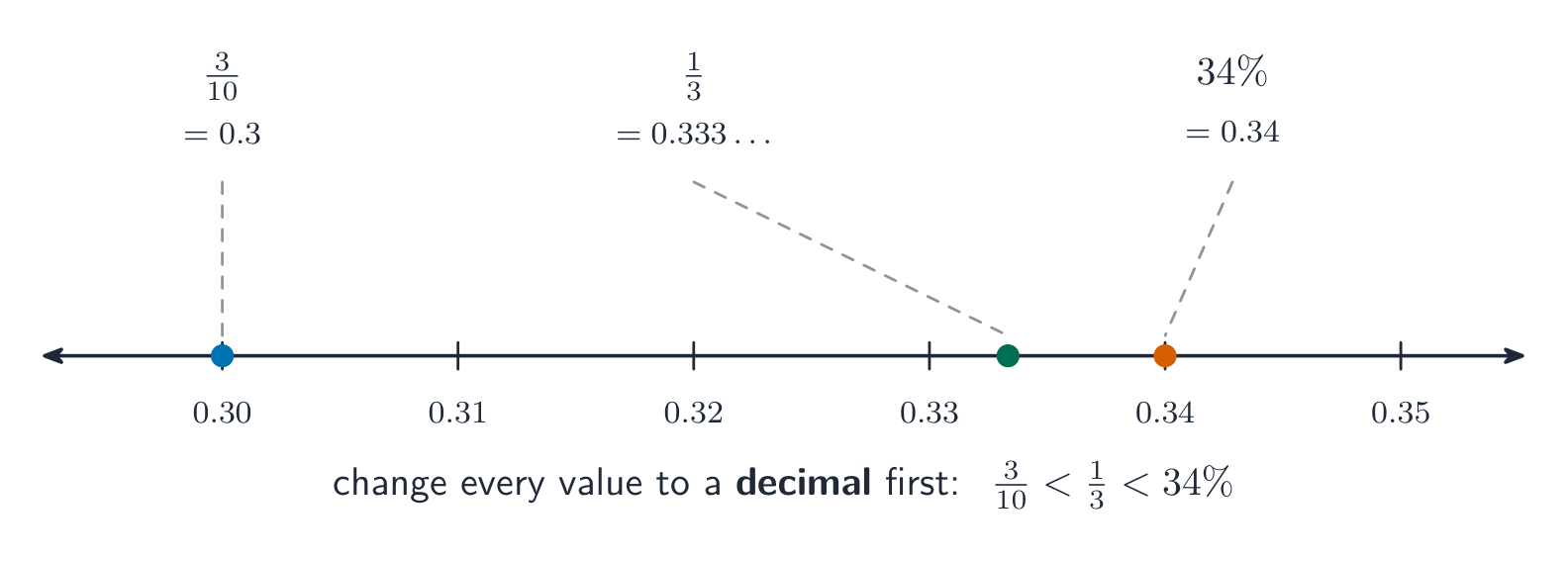
$34\% = 0.34$
Write a fraction in its simplest form 最简形式 by dividing the top and bottom by their HCF: $\frac{18}{24} = \frac{3}{4}$ (both divided by $6$).
Recurring decimals (Extended)
A recurring decimal 循环小数 repeats the same digits forever. Dots mark the repeating part: $0.1\dot{7} = 0.1777\ldots$ and $0.\dot{1}2\dot{3} = 0.123123\ldots$
To turn a recurring decimal into a fraction, multiply so the repeating parts line up, then subtract.
Worked example. Write $0.1\dot{7}$ as a fraction.
Let $x = 0.1777\ldots$ Only the $7$ repeats, so use $10x$ and $100x$:
Source: Cambridge International syllabus · แหล่งที่มา: หลักสูตร Cambridge International
English
Order of operations
Work in this order — the order of operations 运算顺序: brackets first, then indices (powers and roots), then multiply and divide (left to right), then add and subtract (left to right).
Worked example. Work out $-6 \times -3 + 7 \times 2$.
Do the multiplications first: $-6 \times -3 = 18$ and $7 \times 2 = 14$. Then add: $18 + 14 = 32$.
Negative numbers
Adding a negative: $5 + (-3) = 5 - 3 = 2$.
Subtracting a negative: $5 - (-3) = 5 + 3 = 8$.
Multiplying or dividing: same signs give a positive; different signs give a negative. So $-6 \times -3 = 18$ but $-12 \div 4 = -3$.
A change in temperature from $-5\,{}^{\circ}\text{C}$ to $3\,{}^{\circ}\text{C}$ is a rise of $8\,{}^{\circ}\text{C}$.
Calculating with fractions
Multiply: multiply the tops, multiply the bottoms: $\frac{2}{3} \times \frac{4}{5} = \frac{8}{15}$.
Divide: multiply by the reciprocal of the second fraction: $\frac{2}{3} \div \frac{4}{5} = \frac{2}{3} \times \frac{5}{4} = \frac{10}{12} = \frac{5}{6}$.
Add or subtract: use a common denominator (the LCM of the bottoms).
Worked example. Work out $1\frac{7}{15} - \frac{4}{5}$, giving the answer in its simplest form.
Change the mixed number to an improper fraction, then use denominator $15$:
2 Express one quantity as a percentage of another.
3 Calculate percentage increase or decrease.
4 Calculate with simple and compound interest.
Formulas are not given. Percentage calculations may include: • deposit • discount • profit and loss (as an amount or a percentage) • earnings • percentages over 100%.
2 Express one quantity as a percentage of another.
3 Calculate percentage increase or decrease.
4 Calculate with simple and compound interest.
Problems may include repeated percentage change. Formulas are not given.
5 Calculate using reverse percentages.
e.g. find the cost price given the selling price and the percentage profit. Percentage calculations may include: • deposit • discount • profit and loss (as an amount or a percentage) • earnings • percentages over 100%.
A reverse percentage 逆百分比 problem gives the amount after a change and asks for the original. To solve it, divide by the multiplier — do not just take the percentage off.
Worked example. A coat costs $\$60$ after a $20\%$ increase. Find the original price.
$\$60$ is $120\%$ of the original, so the original price is $60 \div 1.2 = \$50$.
Exponential growth and decay (Extended) · การเติบโตและการลดลงแบบเอ็กซ์โพเนนเชียล (ส่วนขยาย)
Syllabus · หลักสูตร
English
Subject content
Notes and examples
Use exponential growth and decay.
e.g. depreciation, population change. Knowledge of e is not required.
ไทย
เนื้อหารายวิชา
หมายเหตุและตัวอย่าง
ใช้การเติบโตและการลดลงแบบเอ็กซ์โพเนนเชียล
เช่น การเสื่อมมูลค่า, การเปลี่ยนแปลงของประชากร ไม่จำเป็นต้องมีความรู้เรื่อง e
Source: Cambridge International syllabus · แหล่งที่มา: หลักสูตร Cambridge International
English
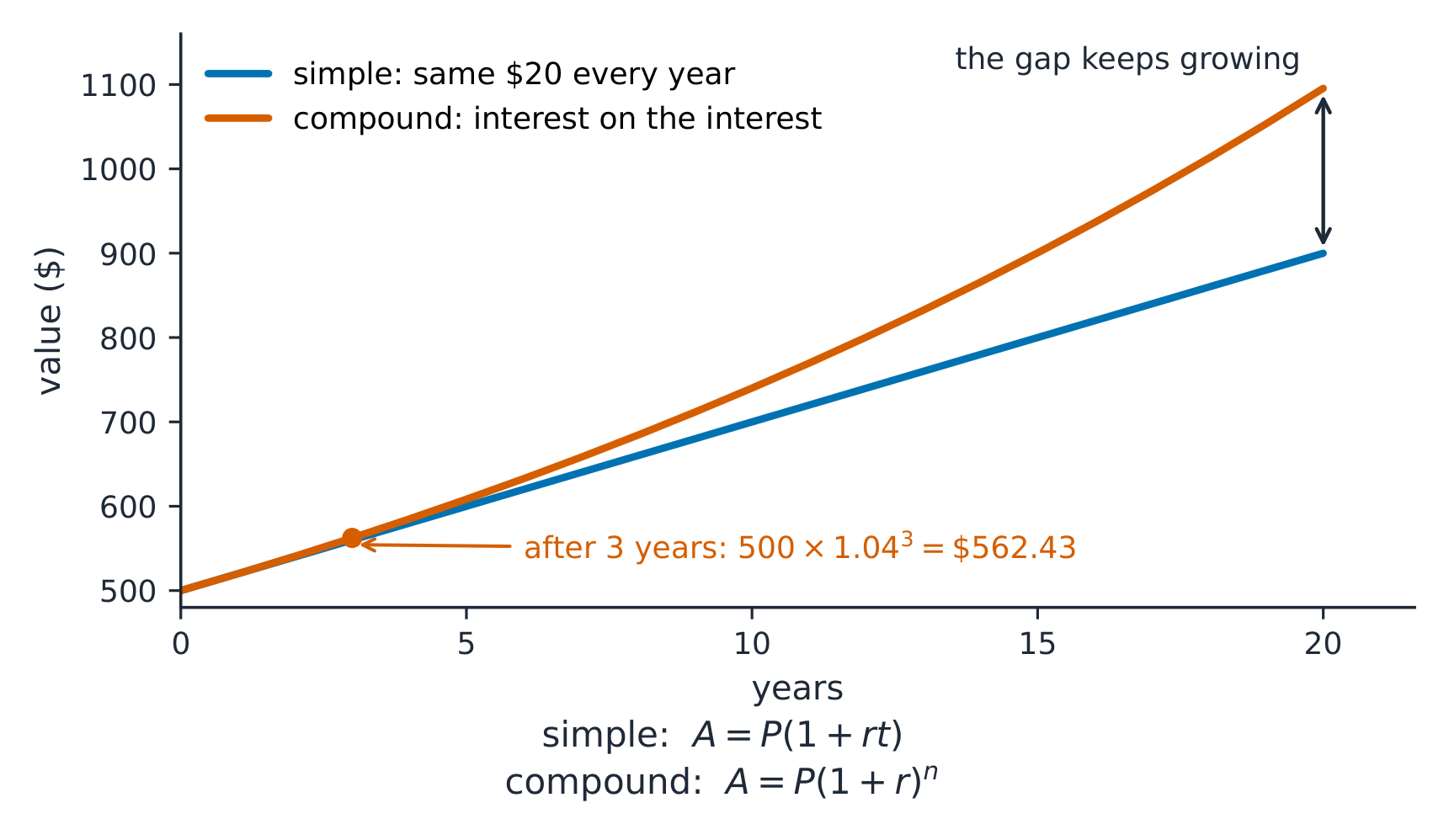
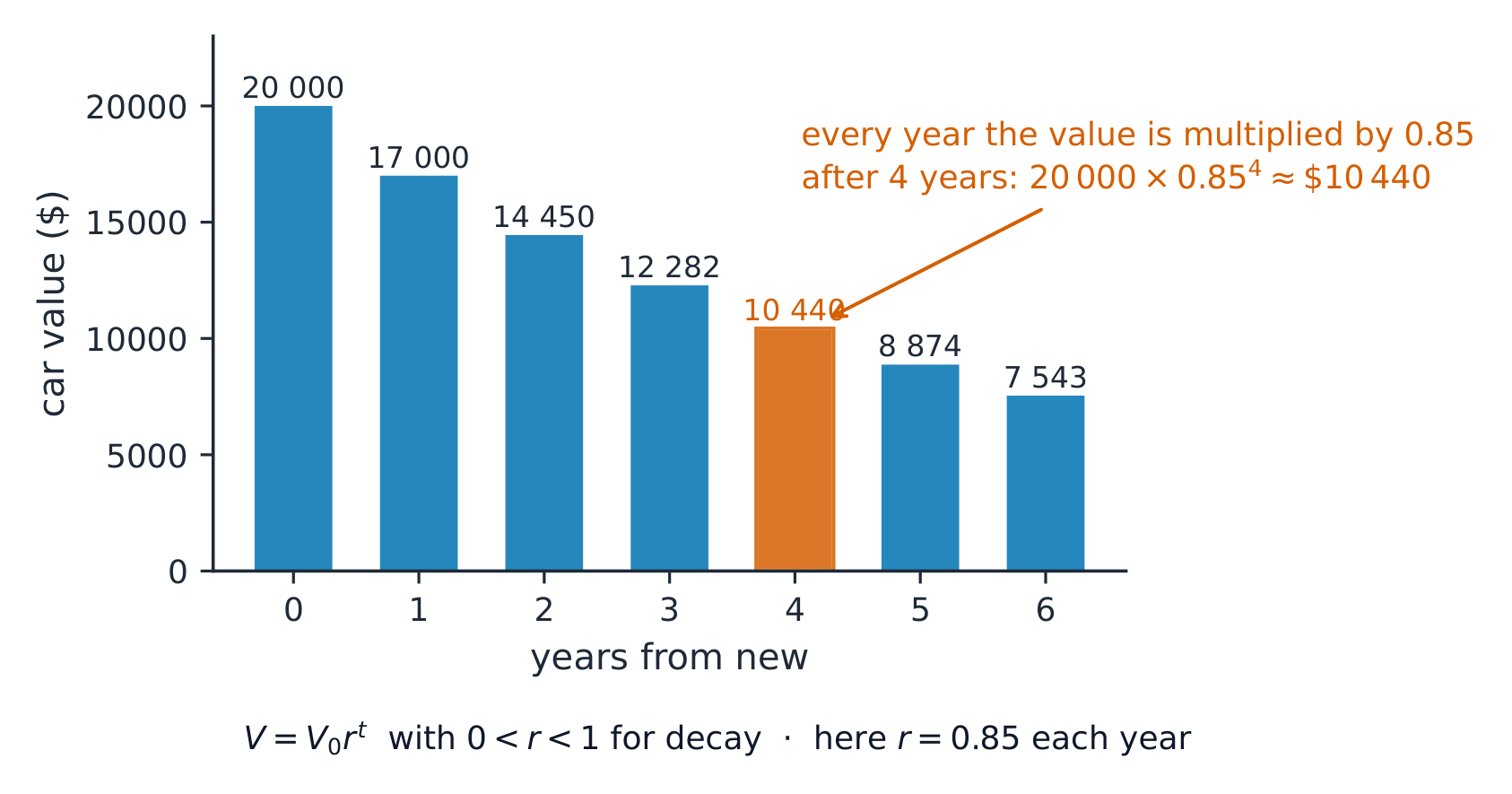
When a quantity changes by the same percentage in each time period, it shows exponential growth 指数增长 (it gets bigger) or exponential decay 指数衰减 (it gets smaller). Use the compound formula. Depreciation 折旧, where something like a car loses value each year, is decay.
Worked example. A car worth $\$20\,000$ loses $15\%$ of its value each year. Find its value after $4$ years.
Money grows by (1 + r) every year, so compound interest curves above simple interest. Drag the rate and the number of years. · เงินโตขึ้นด้วย (1 + r) ทุกปี ทำให้กราฟดอกเบี้ยทบต้นอยู่เหนือดอกเบี้ยธรรมดา ลากอัตราและจำนวนปี
Change the base b: b > 1 grows, 0 < b < 1 decays — useful for interest and populations. · เปลี่ยน ฐาน b: b > 1 เติบโต, 0 < b < 1 ลดลง — ใช้ได้กับการดอกเบี้ยและประชากร
Direct proportion is a straight line through the origin — double x and you double y. · ความสัมพันธ์แปรผันตรงคือ เส้นตรงผ่านจุดกำเนิด — เมื่อ x เป็นสองเท่า y ก็เป็นสองเท่า
1.12
Rates and average speed · อัตราและความเร็วเฉลี่ย
Syllabus · หลักสูตร
English
Subject content
Notes and examples
1 Use common measures of rate.
e.g. calculate with: • hourly rates of pay • exchange rates between currencies • flow rates • fuel consumption.
2 Apply other measures of rate.
e.g. calculate with: • pressure • density • population density. Required formulas will be given in the question.
3 Solve problems involving average speed.
Knowledge of speed/distance/time formula is required. e.g. A cyclist travels 45 km in 3 hours 45 minutes. What is their average speed? Notation used will be, e.g. m/s (metres per second), $\text{g/cm}^3$ (grams per cubic centimetre).
ต้องมีความรู้เกี่ยวกับสูตรความเร็ว/ระยะทาง/เวลา เช่น. นักปั่นจักรยานเดินทาง 45 กม. ใน 3 ชั่วโมง 45 นาที ความเร็วเฉลี่ยของเขา是多少?符号将使用, e.g. m/s (เมตรต่อวินาที), $\text{g/cm}^3$ (กรัมต่อลูกบาศก์เซนติเมตร).
English
Subject content
Notes and examples
1 Use common measures of rate.
e.g. calculate with: • hourly rates of pay • exchange rates between currencies • flow rates • fuel consumption.
2 Apply other measures of rate.
e.g. calculate with: • pressure • density • population density. Required formulas will be given in the question.
3 Solve problems involving average speed.
Knowledge of speed/distance/time formula is required. e.g. A cyclist travels 45 km in 3 hours 45 minutes. What is their average speed? Notation used will be, e.g. m/s (metres per second), g/cm$^{3}$ (grams per cubic centimetre).
Other examples are flow rate, fuel consumption and population density 人口密度. If a rate needs a special formula (such as pressure 压强), the question will give it to you.
Rounding and bounds lab · ห้องปฏิบัติการการปัดเศษและขอบเขต
Classify numbers by the decision needed for accuracy. · จำแนกตัวเลขตามการตัดสินใจที่ต้องใช้เพื่อความแม่นยำ
1.10
Limits of accuracy · ขอบเขตของความแม่นยำ
Syllabus · หลักสูตร
English
Subject content
Notes and examples
Give upper and lower bounds for data rounded to a specified accuracy.
e.g. write down the upper bound of a length measured correct to the nearest metre. Candidates are not expected to find the bounds of the results of calculations which have used data rounded to a specified accuracy.
1 Give upper and lower bounds for data rounded to a specified accuracy.
e.g. write down the upper bound of a length measured correct to the nearest metre.
2 Find upper and lower bounds of the results of calculations which have used data rounded to a specified accuracy.
Example calculations include: • calculate the upper bound of the perimeter or the area of a rectangle given dimensions measured to the nearest centimetre • find the lower bound of the speed given rounded values of distance and time.
Source: Cambridge International syllabus · แหล่งที่มา: หลักสูตร Cambridge International
English
A rounded value could really be anything that rounds to it. The smallest possible value is the lower bound 下界; the largest is the upper bound 上界. For a value rounded to the nearest unit, the bounds lie half a unit on each side.
Worked example. A height $h$ is $635\text{ m}$, correct to the nearest metre. Give the bounds.
$$634.5 \leqslant h < 635.5.$$
So the lower bound is $634.5\text{ m}$ and the upper bound is $635.5\text{ m}$.
Bounds in calculations (Extended)
Combine the bounds to get the bound you want.
Worked example. A rectangle is $8\text{ cm}$ by $5\text{ cm}$, each side to the nearest cm. Find the largest possible area 面积.
Use the upper bounds of both sides: $8.5 \times 5.5 = 46.75\text{ cm}^{2}$. (The smallest area uses the lower bounds: $7.5 \times 4.5 = 33.75\text{ cm}^{2}$.)
For a divided quantity such as $\text{speed} = \dfrac{\text{distance}}{\text{time}}$, the largest speed comes from the largest distance divided by the smallest time.
อ่านหน้าจอตามบริบท: ในกรณีของเงิน $4.8$ หมายถึง $\$4.80$; in time, $3.25$ hours means $3$ hours $15$ นาที
1.14
Exam tips · ข้อแนะนำสำหรับการสอบ
English
Follow BIDMAS (brackets, indices, division/multiplication, addition/subtraction) in order, and remember a negative times a negative is positive.
In standard form the number in front is between 1 and 10; a small number (like $0.0004$) has a negative power of 10.
A percentage change is worked out on the original amount. For a reverse percentage, divide by the multiplier (e.g. $\div 1.2$ undoes a $20\%$ rise).
Do not round part-way through — keep the full value and round only at the end, to the accuracy the question asks for (decimal places or significant figures).
For limits of accuracy, a value rounded to the nearest whole number can be up to $0.5$ either side (so $8$ means $7.5 \le x < 8.5$).
This handout covers Topic 2, Algebra and graphs. Parts marked (Extended) are only tested on the Extended papers; everything else is for both levels.
2.1
Working with algebra
Syllabus · หลักสูตร
English
Subject content
Notes and examples
1 Know that letters can be used to represent generalised numbers.
2 Substitute numbers into expressions and formulas.
ไทย
เนื้อหารายวิชา
หมายเหตุและตัวอย่าง
1 รู้ว่าตัวอักษรสามารถใช้แทนจำนวนทั่วไป
2 แทนค่าตัวเลขลงในนิพจน์และสูตร
Source: Cambridge International syllabus · แหล่งที่มา: หลักสูตร Cambridge International
In algebra 代数 we use letters to stand for numbers. A letter whose value can change is a variable 变量. To substitute 代入 means to put a number in place of a letter.
Worked example. Find the value of $3x^{2} - 2y$ when $x = 4$ and $y = 5$.
Source: Cambridge International syllabus · แหล่งที่มา: หลักสูตร Cambridge International
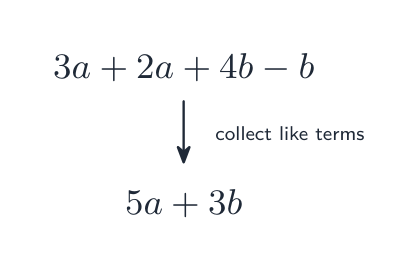
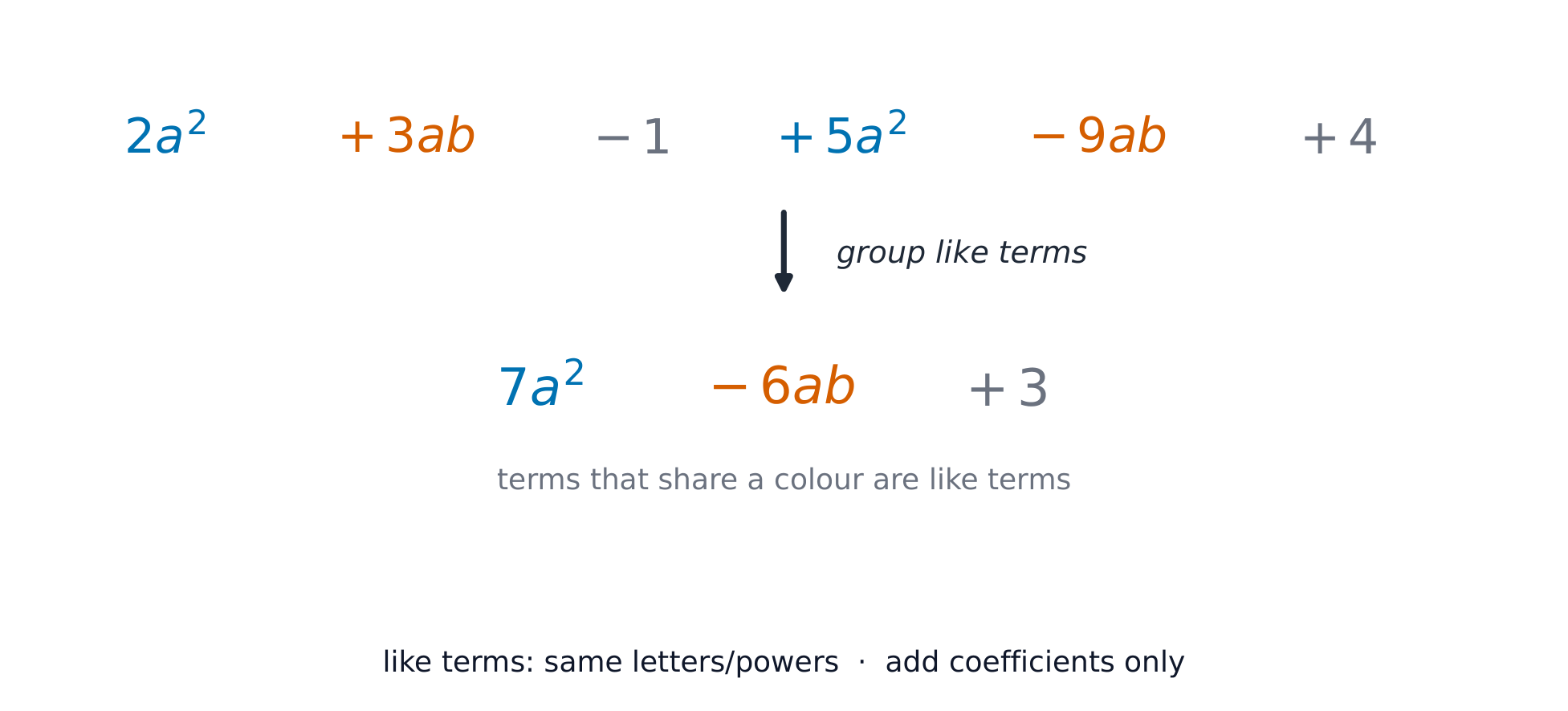
A term 项 is a single part of an expression 表达式, such as $5a$ or $-9b$. Like terms 同类项 have exactly the same letters; you may add or subtract them. The number in front of the letter is the coefficient 系数.
Expanding a bracket with an area modelCollecting like terms: add terms with the same letter
Collect like terms: $2a^{2} + 5a^{2} = 7a^{2}$, $3ab - 9ab = -6ab$, $-1 + 4 = 3$. So the answer is
$$7a^{2} - 6ab + 3.$$
To expand 展开 means to multiply out brackets 括号. Multiply every term inside by the term outside; for two brackets, multiply every term in the first by every term in the second.
Source: Cambridge International syllabus · แหล่งที่มา: หลักสูตร Cambridge International
An algebraic fraction 分式 has algebra on the top or bottom. Add and subtract using a common denominator; multiply and divide as with ordinary fractions.
1 Understand and use indices (positive, zero, negative and fractional).
e.g. solve: • $32^x = 2$ • $5^{x+1} = 25^x$.
2 Understand and use the rules of indices.
e.g. simplify: • $3x^{-4} \times \frac{2}{3}x^{\frac{1}{2}}$ • $\frac{2}{5}x^{\frac{1}{2}} \div 2x^{-2}$ • $\left(\frac{2x^5}{3}\right)^3$. Knowledge of logarithms is not required.
4 Solve simultaneous linear equations in two unknowns.
5 Solve simultaneous equations, involving one linear and one non-linear.
With powers no higher than two.
6 Solve quadratic equations by factorisation, completing the square and by use of the quadratic formula.
Includes writing a quadratic expression in completed square form. Candidates may be expected to give solutions in surd form. The quadratic formula is given in the List of formulas.
7 Change the subject of formulas.
e.g. change the subject of a formula where: • the subject appears twice • there is a power or root of the subject.
Represent and interpret inequalities, including on a number line.
When representing and interpreting inequalities on a number line: • open circles should be used to represent strict inequalities (<, >) • closed circles should be used to represent inclusive inequalities ($\leqslant$, $\geqslant$) e.g. $-3 \leqslant x < 1$
1 Represent and interpret inequalities, including on a number line.
When representing and interpreting inequalities on a number line: • open circles should be used to represent strict inequalities (<, >) • closed circles should be used to represent inclusive inequalities ($\leqslant$, $\geqslant$). e.g. $-3 \leqslant x < 1$
2 Construct, solve and interpret linear inequalities.
3 Represent and interpret linear inequalities in two variables graphically.
The following conventions should be used: • broken lines should be used to represent strict inequalities (<, >) • solid lines should be used to represent inclusive inequalities ($\leqslant$, $\geqslant$) • shading should be used to represent unwanted regions (unless otherwise directed in the question). e.g. graphs of $x < 1$ and $y \geqslant 1$
Source: Cambridge International syllabus · แหล่งที่มา: หลักสูตร Cambridge International
An inequality 不等式 uses $<$, $>$, $\leqslant$ or $\geqslant$. Solve it like an equation, but reverse the sign if you multiply or divide by a negative number.
On a number line 数轴, use an open circle for $<$ or $>$ (value not included) and a closed circle for $\leqslant$ or $\geqslant$ (value included).
$-\tfrac{1}{3} \leqslant x < 3$: a closed circle includes the end value, an open circle excludes it.
Regions (Extended)
An inequality in two letters describes a region 区域 of the graph. Draw the boundary line (broken for $<$ or $>$, solid for $\leqslant$ or $\geqslant$) and shade the unwanted side. You may also be asked to list the inequalities that define a given region.
Explore · สำรวจ
Inequalities · อสมการ
y = ax + b
An inequality asks where the line is above or below a value. · อสมการถามว่า เส้นกราฟอยู่เหนือหรือต่ำกว่า ค่าใดค่าหนึ่ง
Source: Cambridge International syllabus · แหล่งที่มา: หลักสูตร Cambridge International
Romanesco broccoli: self-similar spirals form a natural number pattern.
A sequence 数列 is a list of numbers that follow a rule. The term-to-term rule 递推规则 tells you how to get the next term from the one before.
To find the rule for the term in position $n$ (the $n$th term), look at how the terms change.
Linear sequence (the terms go up by the same amount each time). The difference is the multiple of $n$.
Worked example. Find the $n$th term of $2, 5, 8, 11, \dots$
The terms go up by $3$, so start with $3n$. Since $3 \times 1 = 3$ but the first term is $2$, subtract $1$: the $n$th term is $3n - 1$.
Quadratic sequence (the differences themselves change by the same amount). The second difference equals $2 \times$ the coefficient of $n^{2}$.
Worked example. Find the $n$th term of $2, 5, 10, 17, \dots$
First differences are $3, 5, 7$; the second difference is $2$, so the $n^{2}$ part is $1n^{2}$. Subtracting $n^{2}$ ($1, 4, 9, 16$) from the sequence leaves $1, 1, 1, 1$. So the $n$th term is $n^{2} + 1$.
A cubic 三次 sequence such as $1, 8, 27, 64, \dots$ has $n$th term $n^{3}$. An exponential sequence 指数数列 such as $2, 6, 18, 54, \dots$ multiplies by a fixed number each time; here the $n$th term is $2 \times 3^{\,n-1}$.
Explore · สำรวจ
Number sequences · ลำดับตัวเลข
Build an arithmetic (add d) or geometric (times r) sequence term by term. · สร้างลำดับเลขคณิต (บวก d) หรือเรขาคณิต (คูณ r) เทอมต่อเทอม
Source: Cambridge International syllabus · แหล่งที่มา: หลักสูตร Cambridge International
Two quantities are in direct proportion 正比例 if one is always a fixed multiple of the other: $y \propto x$ means $y = kx$, where $k$ is a constant 常数. They are in inverse proportion 反比例 if one rises as the other falls: $y \propto \dfrac{1}{x}$ means $y = \dfrac{k}{x}$. The symbol $\propto$ is read "is proportional to". You can also have proportion to a square, square root, cube or cube root.
Worked example.$y$ is in direct proportion to $x$, and $y = 12$ when $x = 3$. Find $y$ when $x = 7$.
First find $k$: $12 = k \times 3$, so $k = 4$ and $y = 4x$. Then $y = 4 \times 7 = 28$.
Explore · สำรวจ
Inverse proportion · ความแปรผันผกผัน
y = a/x
Inverse proportion: as x doubles, y halves — a reciprocal curve with two asymptotes. · ความแปรผันผกผัน: เมื่อ x เป็นสองเท่า y减半 — curves reciprocal ที่มี asymptotes สองเส้น
Source: Cambridge International syllabus · แหล่งที่มา: หลักสูตร Cambridge International
Speed-time graphs: gradient and area
The gradient 斜率 (steepness) of a graph shows a rate of change 变化率.
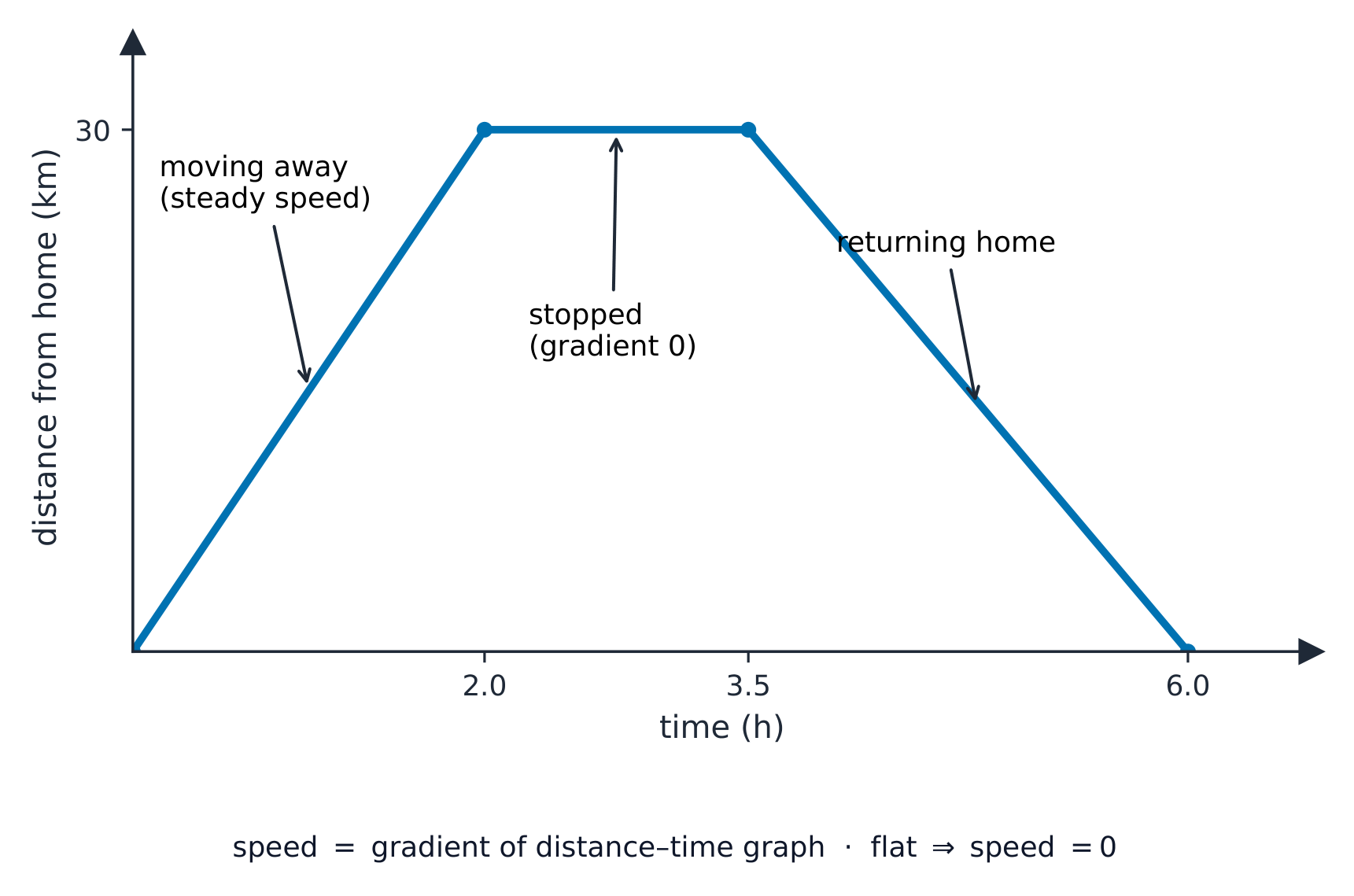
A travel graph 行程图 (distance–time graph) has gradient equal to speed; a flat part means the object is not moving.
A conversion graph 换算图 is a straight line used to change between two units (for example, miles and kilometres).
On a distance–time graph the gradient is the speed; a flat section means the object has stopped.
Speed–time graphs (Extended)
On a speed–time graph the gradient is the acceleration 加速度 (or deceleration 减速度 if the speed falls), and the area 面积 under the graph is the distance 距离 travelled.
Worked example. A car speeds up from rest to $20\text{ m/s}$ in $8\text{ s}$, then stays at $20\text{ m/s}$ for $12\text{ s}$. Find the acceleration and the total distance.
Acceleration $= \dfrac{20}{8} = 2.5\text{ m/s}^{2}$. The distance is the area: a triangle plus a rectangle,
On a speed–time graph the gradient is the acceleration and the area underneath is the distance travelled.
Explore · สำรวจ
Real-life graphs · กราฟในชีวิตจริง
y = ax + b
A distance–time or cost graph is read from its gradient and its intercept. · กราฟระยะทาง–เวลาหรือกราฟค่าใช้จ่ายอ่านได้จาก gradient และ intercept ของมัน
1 Construct tables of values, and draw, recognise and interpret graphs for functions of the following forms: • $ax + b$ • $\pm x^2 + ax + b$ • $\frac{a}{x} \ (x \neq 0)$ where $a$ and $b$ are integer constants.
2 Solve associated equations graphically, including finding and interpreting roots by graphical methods.
1 Construct tables of values, and draw, recognise and interpret graphs for functions of the following forms: • $a x^n$ (includes sums of no more than three of these) • $a b^x + c$ where $n = -2, -1, -\frac{1}{2}, 0, \frac{1}{2}, 1, 2, 3$; $a$ and $c$ are rational numbers; and $b$ is a positive integer.
Source: Cambridge International syllabus · แหล่งที่มา: หลักสูตร Cambridge International
To draw a graph, make a table of values 数值表: choose values of $x$, work out $y$, then plot the coordinates 坐标 and join them with a smooth curve.
The points where a graph crosses the $x$-axis (the horizontal axis 坐标轴) are the roots 根 — the solutions of $y = 0$.
You can solve an equation by reading a graph. The intersection point 交点 of a line and a curve gives the solution of the two equations together.
For exponential growth 指数增长 and exponential decay 指数衰减, the graph of $y = a\,b^{x} + c$ rises (or falls) faster and faster and flattens towards a horizontal line.
Explore · สำรวจ
Graphing a quadratic · กราฟฟังก์ชันกำลังสอง
y = ax² + bx + c
Drag a, b and c and watch the parabola move — its turning point and where it crosses the axes. · ลาก a, b และ c แล้วดูว่าพาราโบลาขยับไปไหน — จุดกลับด้านและจุดตัดแกน
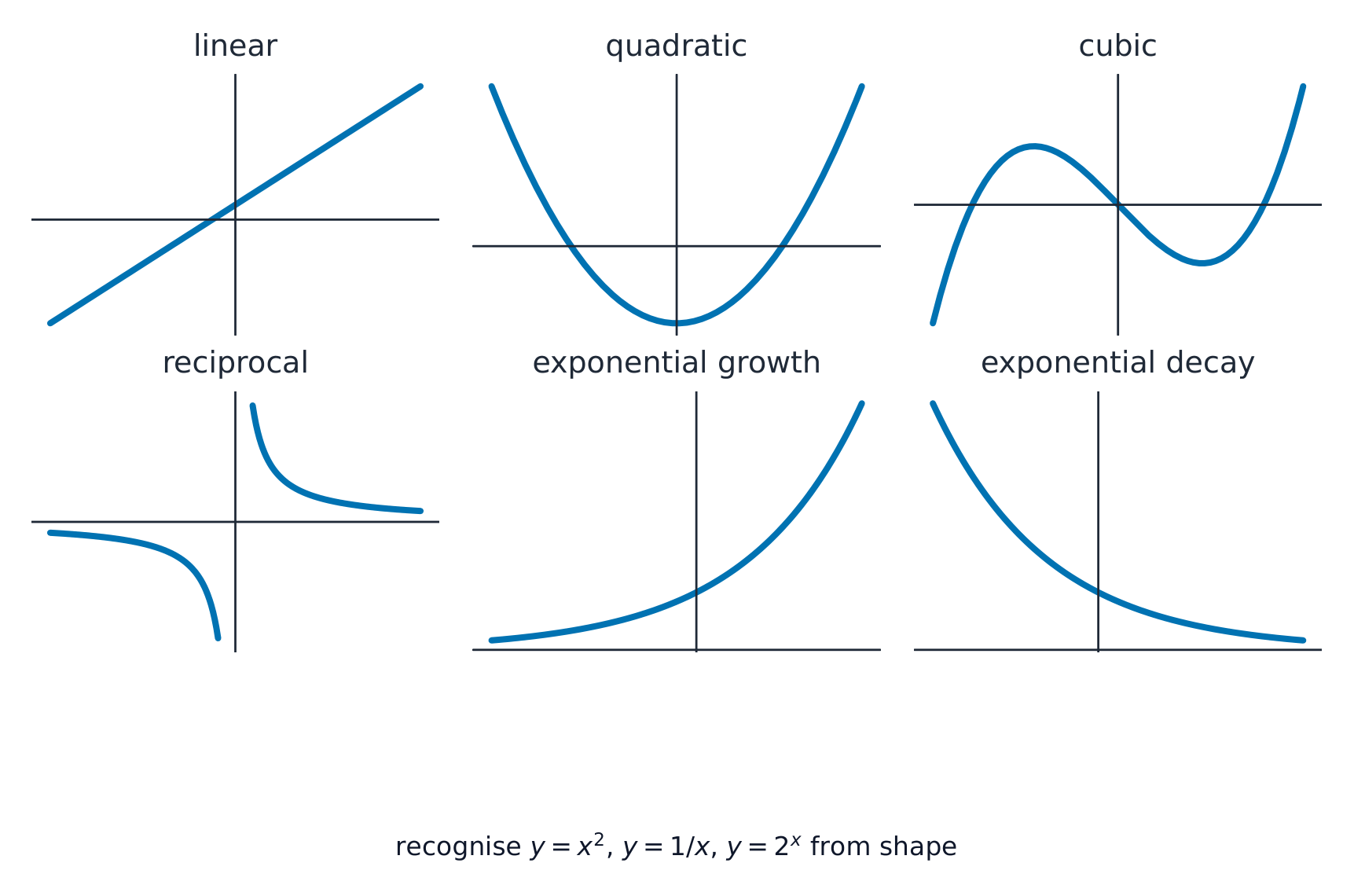
Recognise, sketch and interpret graphs of the following functions: (a) linear (b) quadratic (c) cubic (d) reciprocal (e) exponential.
Functions will be equivalent to: • $ax + by = c$ • $y = ax^2 + bx + c$ • $y = ax^3 + b$ • $y = ax^3 + bx^2 + cx$ • $y = \frac{a}{x} + b$ • $y = ar^x + b$ where $a$, $b$ and $c$ are rational numbers and $r$ is a rational, positive number. Knowledge of turning points, roots and symmetry is required. Knowledge of vertical and horizontal asymptotes is required. Finding turning points of quadratics by completing the square is required.
Source: Cambridge International syllabus · แหล่งที่มา: หลักสูตร Cambridge International
A quick sketch should show the right shape and the key features: where it crosses the axes, any symmetry 对称, and any line the curve gets close to.
Function
Shape
linear, $y = mx + c$
straight line; gradient $m$, $y$-intercept 截距$c$
quadratic, $y = ax^{2} + bx + c$
a parabola 抛物线 (U-shape if $a>0$, $\cap$-shape if $a<0$)
cubic, $y = ax^{3} + bx + c$
an S-shaped curve
reciprocal, $y = \dfrac{a}{x} + b$
two separate curves
exponential, $y = a\,r^{x} + b$
fast growth or decay
The basic graph shapes; knowing each shape lets you sketch quickly from the equation.
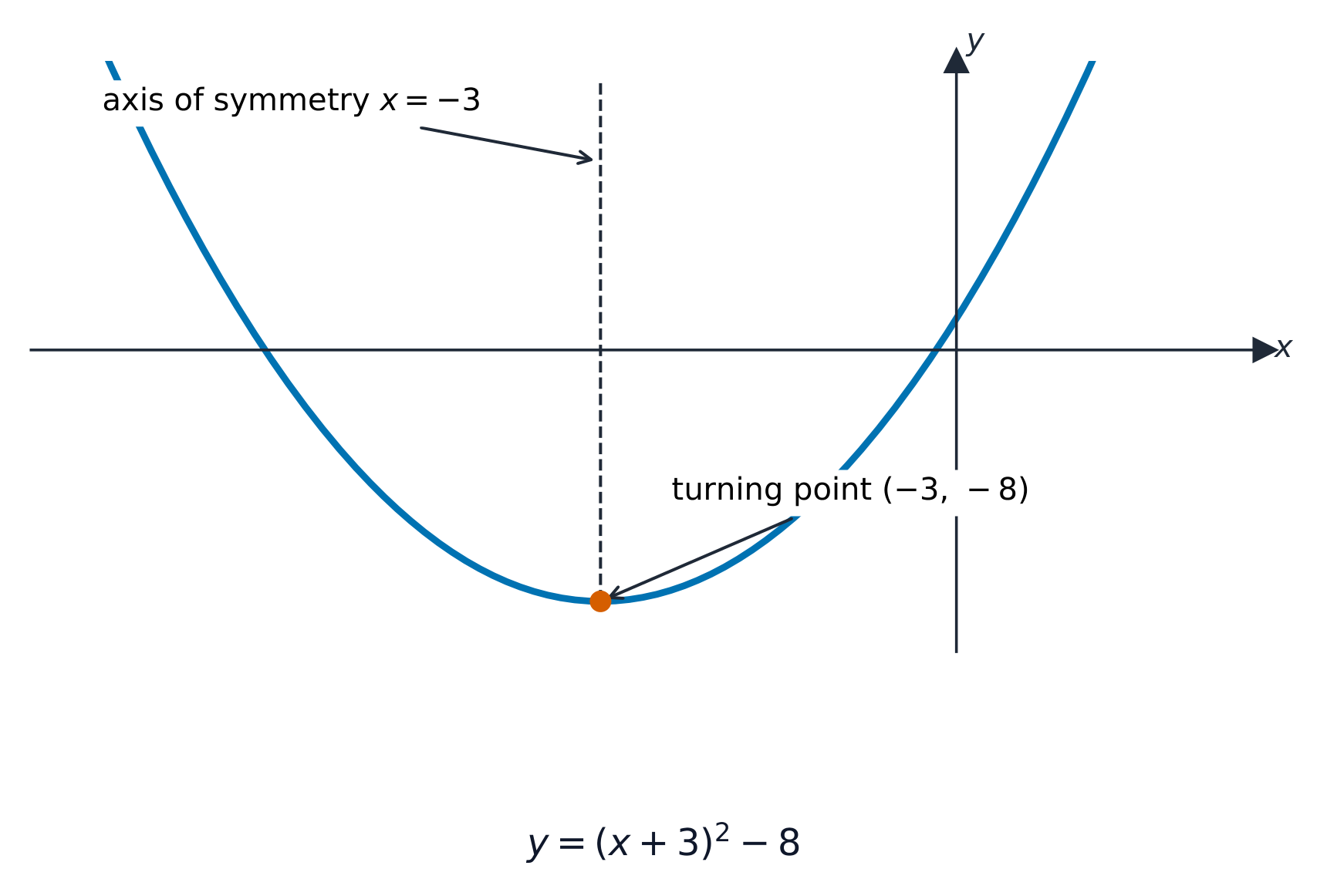
For a parabola, completing the square gives the turning point 转折点 (the lowest or highest point). For example $y = (x + 3)^{2} - 8$ has its turning point at $(-3, -8)$.
Completing the square, $y=(x+3)^2-8$, shows the turning point $(-3,-8)$ and the line of symmetry $x=-3$.
An asymptote 渐近线 is a line that the curve gets closer and closer to but never touches — for example, the $x$-axis for $y = \dfrac{a}{x}$, or the line $y = b$ for $y = a\,r^{x} + b$.
1 Estimate gradients of curves by drawing tangents.
2 Use the derivatives of functions of the form $ax^n$, where $a$ is a rational constant and $n$ is a positive integer or zero, and simple sums of not more than three of these.
$\frac{\mathrm{d}y}{\mathrm{d}x}$ notation will be expected.
3 Apply differentiation to gradients and stationary points (turning points).
4 Discriminate between maxima and minima by any method.
Maximum and minimum points may be identified by: • an accurate sketch • use of the second differential • inspecting the gradient either side of a turning point. Candidates are not expected to identify points of inflection.
Source: Cambridge International syllabus · แหล่งที่มา: หลักสูตร Cambridge International
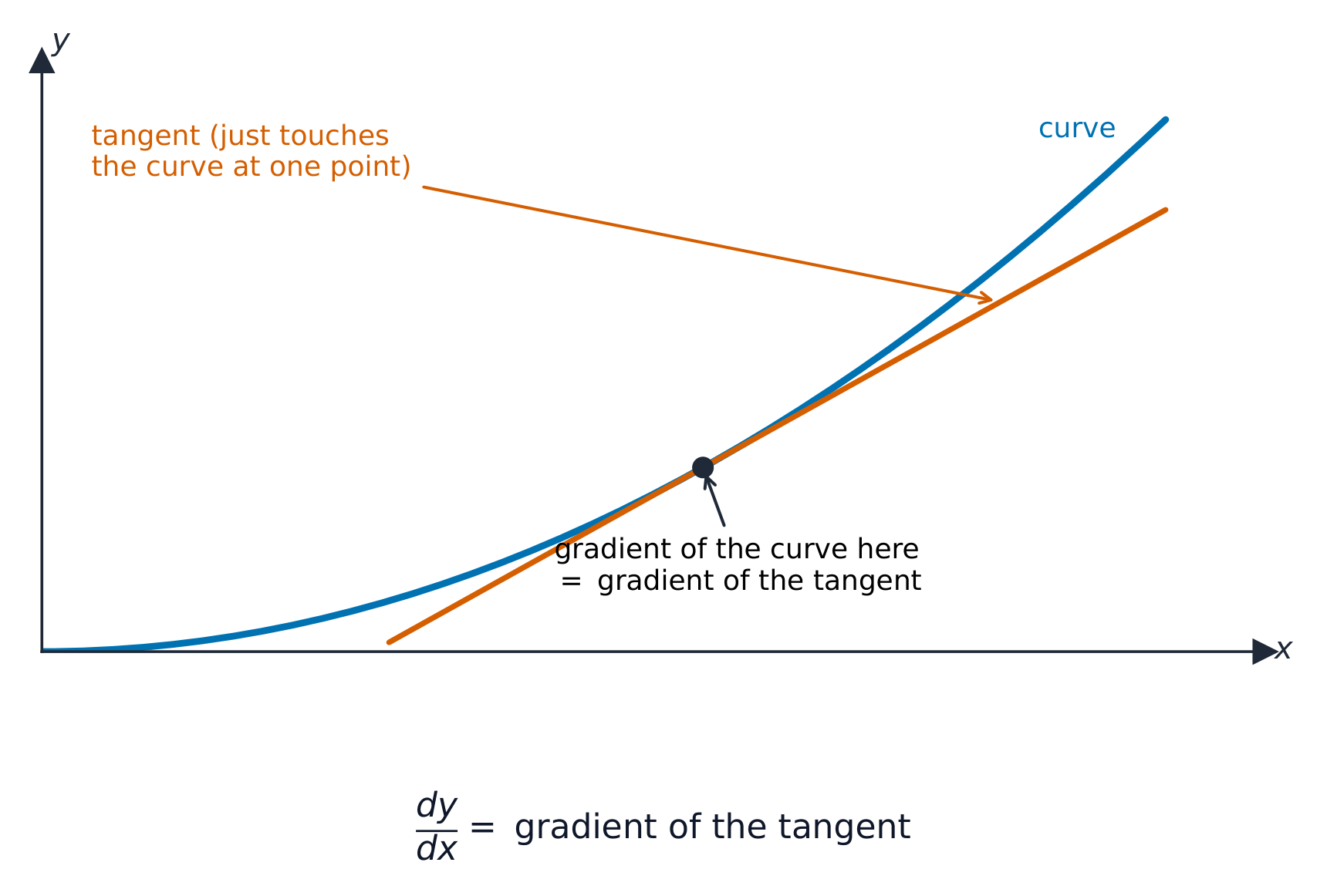
Differentiation 微分 finds the gradient of a curve at any point. You can estimate it by drawing a tangent 切线 (a line that just touches the curve) and measuring its gradient.
The gradient of a curve at a point equals the gradient of the tangent there — what differentiation finds.
The exact rule: if $y = ax^{n}$, then the derivative 导数 is
The turning point is $(3, -4)$. To decide whether a turning point is a maximum 最大值 or a minimum 最小值, check the sign of the gradient on each side, or use the second derivative (positive means a minimum).
Explore · สำรวจ
Gradient of a curve · ความชันของเส้นโค้ง
y = ax³ + bx² + cx + d
Move the point: the tangent shows the gradient there, which is what differentiation finds. · เคลื่อนจุด: เส้นสัมผัส แสดงความชันที่จุดนั้น ซึ่งเป็นสิ่งที่ดิฟเฟอเรนเชียลหาได้
2 Understand and find inverse functions $f^{-1}(x)$.
3 Form composite functions as defined by $gf(x) = g(f(x))$.
e.g. $f(x) = \frac{3}{x + 2}$ and $g(x) = (3x + 5)^2$. Find $fg(x)$. Give your answer as a fraction in its simplest form. Candidates are not expected to find the domains and ranges of composite functions. This topic may include mapping diagrams.
Source: Cambridge International syllabus · แหล่งที่มา: หลักสูตร Cambridge International
A function 函数 turns each input into one output. We write $f(x)$, for example $f(x) = 3x - 5$, so $f(2) = 1$. The set of allowed inputs is the domain 定义域; the set of possible outputs is the range 值域.
The inverse function 反函数$f^{-1}(x)$ undoes the function. To find it, write $y = f(x)$, swap the roles, and make $x$ the subject.
Worked example. Find the inverse of $f(x) = 3x - 5$.
A function turns each input into exactly one output — watch its shape. · ฟังก์ชันจะแปลงแต่ละ อินพุต เป็น เอาต์พุต อย่างเดียว — ให้สังเกตรูปร่างของมัน
Use and interpret Cartesian coordinates in two dimensions.
ไทย
เนื้อหารายวิชา
หมายเหตุและตัวอย่าง
ใช้และตีความพิกัดคาร์เทเซียนในสองมิติ
Source: Cambridge International syllabus · แหล่งที่มา: หลักสูตร Cambridge International
English
A point on a graph is described by its coordinates 坐标, sometimes called Cartesian coordinates, written $(x, y)$. The first number is the across value and the second is the up value.
The two number lines are the axes 坐标轴: the horizontal 水平$x$-axis and the vertical 竖直$y$-axis.
They cross at the origin 原点, the point $(0, 0)$.
The axes split the grid into four quadrants 象限.
So the point $(3, -2)$ is found by going $3$ to the right and $2$ down.
Every point has an (x, y) coordinate. A straight line is the set of points where y depends on x in a fixed way. · ทุกจุดมีพิกัด (x, y) เส้นตรงคือเซตของจุดที่ y ขึ้นอยู่กับ x ในรูปแบบที่กำหนดตายตัว
The equation of a straight line · สมการของเส้นตรง
Syllabus · หลักสูตร
English
Subject content
Notes and examples
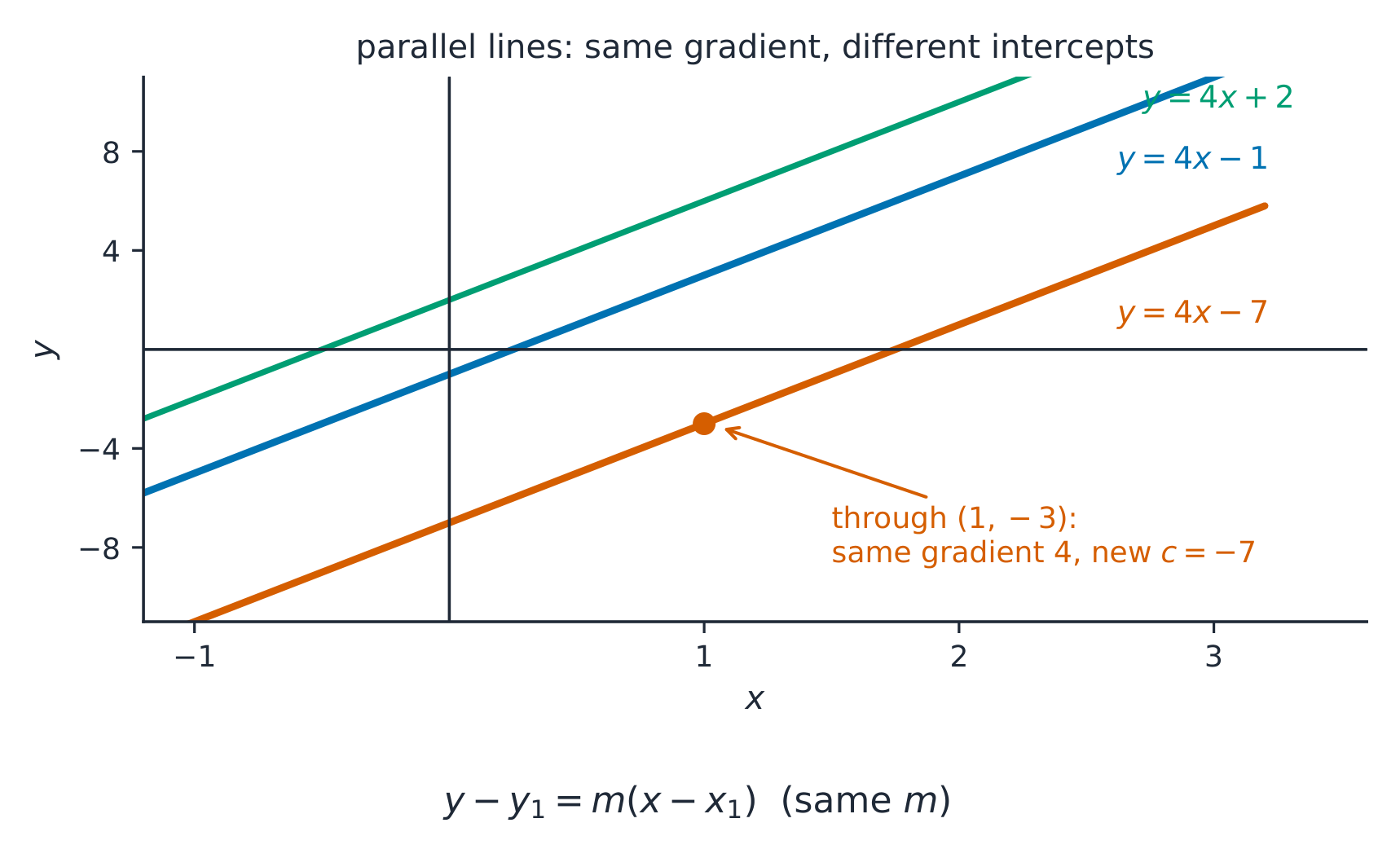
Interpret and obtain the equation of a straight-line graph in the form $y = mx + c$.
Questions may: • use and request lines in the forms $y = mx + c$, $x = k$ • involve finding the equation when the graph is given • ask for the gradient or $y$-intercept of a graph from an equation, e.g. find the gradient and $y$-intercept of the graph with the equation $y = 6x + 3$. Candidates are expected to give equations of a line in a fully simplified form.
Interpret and obtain the equation of a straight-line graph.
Questions may: • use and request lines in different forms, e.g. $ax + by = c$, $y = mx + c$, $x = k$ • involve finding the equation when the graph is given • ask for the gradient or $y$-intercept of a graph from an equation, e.g. find the gradient and $y$-intercept of the graph with equation $5x + 4y = 8$. Candidates are expected to give equations of a line in a fully simplified form.
Drag the gradient and the intercept. a is the gradient (steepness) and b is where the line crosses the y-axis. · ลากความชันและจุดตัดแกน a คือความชัน (ความชัน) และ b คือจุดที่เส้นตัดแกน y
3.3
Gradient · ความชัน
Syllabus · หลักสูตร
English
Subject content
Notes and examples
Find the gradient of a straight line.
From a grid only.
ไทย
เนื้อหารายวิชา
หมายเหตุและตัวอย่าง
หาความชันของเส้นตรง
จากตารางพิกัดเท่านั้น
English
Subject content
Notes and examples
1 Find the gradient of a straight line.
2 Calculate the gradient of a straight line from the coordinates of two points on it.
Finding the equation of a line · การหาค่าสมการของเส้นตรง
Syllabus · หลักสูตร
English
Subject content
Notes and examples
Interpret and obtain the equation of a straight-line graph in the form $y = mx + c$.
Questions may: • use and request lines in the forms $y = mx + c$, $x = k$ • involve finding the equation when the graph is given • ask for the gradient or $y$-intercept of a graph from an equation, e.g. find the gradient and $y$-intercept of the graph with the equation $y = 6x + 3$. Candidates are expected to give equations of a line in a fully simplified form.
Interpret and obtain the equation of a straight-line graph.
Questions may: • use and request lines in different forms, e.g. $ax + by = c$, $y = mx + c$, $x = k$ • involve finding the equation when the graph is given • ask for the gradient or $y$-intercept of a graph from an equation, e.g. find the gradient and $y$-intercept of the graph with equation $5x + 4y = 8$. Candidates are expected to give equations of a line in a fully simplified form.
Find the gradient and equation of a straight line perpendicular to a given line.
Examples include: • find the gradient of a line perpendicular to $2y = 3x + 1$ • find the equation of the perpendicular bisector of the line joining the points $(-3, 8)$ and $(9, -2)$.
Worked example. Find the gradient of a line perpendicular to $2y = 3x + 1$.
Rearrange: $y = \tfrac{3}{2}x + \tfrac{1}{2}$, so the gradient is $\tfrac{3}{2}$. The perpendicular gradient is $-\tfrac{2}{3}$.
Perpendicular bisector
The perpendicular bisector 垂直平分线 of a segment cuts it in half at a right angle. To find its equation: get the midpoint, then use the perpendicular gradient through that midpoint.
Worked example. Find the perpendicular bisector of the segment joining $(-3, 8)$ and $(9, -2)$.
This handout covers Topic 4, Geometry. Parts marked (Extended) are only tested on the Extended papers; everything else is for both levels. In the exam you must give reasons using the correct names below, not just the numbers.
1 Use and interpret the following geometrical terms: • point • vertex • line • parallel • perpendicular • bearing • right angle • acute, obtuse and reflex angles • interior and exterior angles • similar • congruent • scale factor.
Candidates are not expected to show that two shapes are congruent.
2 Use and interpret the vocabulary of: • triangles • special quadrilaterals • polygons • nets • simple solids.
Includes the following terms: Triangles: • equilateral • isosceles • scalene • right-angled. Quadrilaterals: • square • rectangle • kite • rhombus • parallelogram • trapezium. Polygons: • regular and irregular polygons • pentagon • hexagon • octagon • decagon.
1 Use and interpret the following geometrical terms: • point • vertex • line • plane • parallel • perpendicular • perpendicular bisector • bearing • right angle • acute, obtuse and reflex angles • interior and exterior angles • similar • congruent • scale factor.
Candidates are not expected to show that two shapes are congruent.
2 Use and interpret the vocabulary of: • triangles • special quadrilaterals • polygons • nets • solids.
Includes the following terms. Triangles: • equilateral • isosceles • scalene • right-angled. Quadrilaterals: • square • rectangle • kite • rhombus • parallelogram • trapezium.
Includes the following terms: • centre • radius (plural radii) • diameter • circumference • semicircle • chord • tangent • major and minor arc • sector • segment.
Source: Cambridge International syllabus · แหล่งที่มา: หลักสูตร Cambridge International
English
A corner where two lines meet is a vertex 顶点. Two lines are parallel 平行 if they never meet, and perpendicular 垂直 if they meet at a right angle. Angles are named by their size:
Name
Size
acute angle 锐角
less than $90^{\circ}$
right angle 直角
exactly $90^{\circ}$
obtuse angle 钝角
between $90^{\circ}$ and $180^{\circ}$
reflex angle 优角
between $180^{\circ}$ and $360^{\circ}$
We name an angle with three letters, e.g. angle $ABC$ is the angle at $B$.
Shape and angle lab · ห้องปฏิบัติการรูปทรงและมุม
Classify angle facts by the diagram feature that creates them. · จำแนกข้อเท็จจริงเกี่ยวกับมุมตามลักษณะในแผนภาพที่ทำให้เกิดมุนั้นๆ
4.6
Angle facts · ความจริงเกี่ยวกับมุม
Syllabus · หลักสูตร
English
Subject content
Notes and examples
1 Calculate unknown angles and give simple explanations using the following geometrical properties: • sum of angles at a point = 360° • sum of angles at a point on a straight line = 180° • vertically opposite angles are equal • angle sum of a triangle = 180° and angle sum of a quadrilateral = 360°.
Knowledge of three-letter notation for angles is required, e.g. angle $ABC$. Candidates are expected to use the correct geometrical terminology when giving reasons for answers.
2 Calculate unknown angles and give geometric explanations for angles formed within parallel lines: • corresponding angles are equal • alternate angles are equal • co-interior angles sum to 180° (supplementary).
3 Know and use angle properties of regular polygons.
Includes exterior and interior angles, and angle sum.
1 Calculate unknown angles and give simple explanations using the following geometrical properties: • sum of angles at a point = 360° • sum of angles at a point on a straight line = 180° • vertically opposite angles are equal • angle sum of a triangle = 180° and angle sum of a quadrilateral = 360°.
Knowledge of 3-letter notation for angles is required, e.g. angle $ABC$. Candidates are expected to use the correct geometrical terminology when giving reasons for answers.
2 Calculate unknown angles and give geometric explanations for angles formed within parallel lines: • corresponding angles are equal • alternate angles are equal • co-interior angles sum to 180° (supplementary).
3 Know and use angle properties of regular and irregular polygons.
Includes exterior and interior angles, and angle sum.
Parallel line and polygon lab · ห้องปฏิบัติการเส้นขนานและรูปหลายเหลี่ยม
Pick the angle rule that unlocks each diagram. · เลือกกฎมุมที่จะ解开แต่ละแผนภาพ
4.6
Angles in parallel lines · มุมในเส้นขนาน
Syllabus · หลักสูตร
English
Subject content
Notes and examples
1 Calculate unknown angles and give simple explanations using the following geometrical properties: • sum of angles at a point = 360° • sum of angles at a point on a straight line = 180° • vertically opposite angles are equal • angle sum of a triangle = 180° and angle sum of a quadrilateral = 360°.
Knowledge of three-letter notation for angles is required, e.g. angle $ABC$. Candidates are expected to use the correct geometrical terminology when giving reasons for answers.
2 Calculate unknown angles and give geometric explanations for angles formed within parallel lines: • corresponding angles are equal • alternate angles are equal • co-interior angles sum to 180° (supplementary).
3 Know and use angle properties of regular polygons.
Includes exterior and interior angles, and angle sum.
1 Calculate unknown angles and give simple explanations using the following geometrical properties: • sum of angles at a point = 360° • sum of angles at a point on a straight line = 180° • vertically opposite angles are equal • angle sum of a triangle = 180° and angle sum of a quadrilateral = 360°.
Knowledge of 3-letter notation for angles is required, e.g. angle $ABC$. Candidates are expected to use the correct geometrical terminology when giving reasons for answers.
2 Calculate unknown angles and give geometric explanations for angles formed within parallel lines: • corresponding angles are equal • alternate angles are equal • co-interior angles sum to 180° (supplementary).
3 Know and use angle properties of regular and irregular polygons.
Includes exterior and interior angles, and angle sum.
Source: Cambridge International syllabus · แหล่งที่มา: หลักสูตร Cambridge International
English
When a line crosses two parallel lines:
Corresponding angles 同位角 (in matching positions, an "F" shape) are equal.
Alternate angles 内错角 (opposite sides of the crossing line, a "Z" shape) are equal.
Co-interior angles 同旁内角 (a "C" shape) add up to $180^{\circ}$; we say they are supplementary 互补.
Worked example. A straight line crosses two parallel lines. One angle is $110^{\circ}$. The co-interior angle $y$ satisfies $110 + y = 180$, so $y = 70^{\circ}$.
1 Use and interpret the following geometrical terms: • point • vertex • line • parallel • perpendicular • bearing • right angle • acute, obtuse and reflex angles • interior and exterior angles • similar • congruent • scale factor.
Candidates are not expected to show that two shapes are congruent.
2 Use and interpret the vocabulary of: • triangles • special quadrilaterals • polygons • nets • simple solids.
Includes the following terms: Triangles: • equilateral • isosceles • scalene • right-angled. Quadrilaterals: • square • rectangle • kite • rhombus • parallelogram • trapezium. Polygons: • regular and irregular polygons • pentagon • hexagon • octagon • decagon.
1 Use and interpret the following geometrical terms: • point • vertex • line • plane • parallel • perpendicular • perpendicular bisector • bearing • right angle • acute, obtuse and reflex angles • interior and exterior angles • similar • congruent • scale factor.
Candidates are not expected to show that two shapes are congruent.
2 Use and interpret the vocabulary of: • triangles • special quadrilaterals • polygons • nets • solids.
Includes the following terms. Triangles: • equilateral • isosceles • scalene • right-angled. Quadrilaterals: • square • rectangle • kite • rhombus • parallelogram • trapezium.
Includes the following terms: • centre • radius (plural radii) • diameter • circumference • semicircle • chord • tangent • major and minor arc • sector • segment.
1 Use and interpret the following geometrical terms: • point • vertex • line • parallel • perpendicular • bearing • right angle • acute, obtuse and reflex angles • interior and exterior angles • similar • congruent • scale factor.
Candidates are not expected to show that two shapes are congruent.
2 Use and interpret the vocabulary of: • triangles • special quadrilaterals • polygons • nets • simple solids.
Includes the following terms: Triangles: • equilateral • isosceles • scalene • right-angled. Quadrilaterals: • square • rectangle • kite • rhombus • parallelogram • trapezium. Polygons: • regular and irregular polygons • pentagon • hexagon • octagon • decagon.
1 Use and interpret the following geometrical terms: • point • vertex • line • plane • parallel • perpendicular • perpendicular bisector • bearing • right angle • acute, obtuse and reflex angles • interior and exterior angles • similar • congruent • scale factor.
Candidates are not expected to show that two shapes are congruent.
2 Use and interpret the vocabulary of: • triangles • special quadrilaterals • polygons • nets • solids.
Includes the following terms. Triangles: • equilateral • isosceles • scalene • right-angled. Quadrilaterals: • square • rectangle • kite • rhombus • parallelogram • trapezium.
Includes the following terms: • centre • radius (plural radii) • diameter • circumference • semicircle • chord • tangent • major and minor arc • sector • segment.
1 Calculate unknown angles and give simple explanations using the following geometrical properties: • sum of angles at a point = 360° • sum of angles at a point on a straight line = 180° • vertically opposite angles are equal • angle sum of a triangle = 180° and angle sum of a quadrilateral = 360°.
Knowledge of three-letter notation for angles is required, e.g. angle $ABC$. Candidates are expected to use the correct geometrical terminology when giving reasons for answers.
2 Calculate unknown angles and give geometric explanations for angles formed within parallel lines: • corresponding angles are equal • alternate angles are equal • co-interior angles sum to 180° (supplementary).
3 Know and use angle properties of regular polygons.
Includes exterior and interior angles, and angle sum.
1 Calculate unknown angles and give simple explanations using the following geometrical properties: • sum of angles at a point = 360° • sum of angles at a point on a straight line = 180° • vertically opposite angles are equal • angle sum of a triangle = 180° and angle sum of a quadrilateral = 360°.
Knowledge of 3-letter notation for angles is required, e.g. angle $ABC$. Candidates are expected to use the correct geometrical terminology when giving reasons for answers.
2 Calculate unknown angles and give geometric explanations for angles formed within parallel lines: • corresponding angles are equal • alternate angles are equal • co-interior angles sum to 180° (supplementary).
3 Know and use angle properties of regular and irregular polygons.
Includes exterior and interior angles, and angle sum.
Source: Cambridge International syllabus · แหล่งที่มา: หลักสูตร Cambridge International
English
A shape has line symmetry 轴对称 if a mirror line splits it into two matching halves.
A shape has rotational symmetry 旋转对称 if it fits onto itself as you turn it. The order is how many times it fits in one full turn.
For solids (Extended), a flat slice that splits the solid into mirror halves is a plane of symmetry 对称面, and a line you can spin it around is an axis of symmetry 对称轴.
Symmetry as a reflection · ความสมมาตรด้วยการสะท้อน
A shape has line symmetry if reflecting it leaves it unchanged. Reflect the shape and watch what is preserved. · รูปทรงมีเส้นสมมาตรหากสะท้อนแล้วไม่เปลี่ยนแปลง สะท้อนรูปทรงและดูว่าสิ่งใดคงอยู่เดิม.
4.1
Circles: the parts · วงกลม: ส่วนประกอบ
Syllabus · หลักสูตร
English
Subject content
Notes and examples
1 Use and interpret the following geometrical terms: • point • vertex • line • parallel • perpendicular • bearing • right angle • acute, obtuse and reflex angles • interior and exterior angles • similar • congruent • scale factor.
Candidates are not expected to show that two shapes are congruent.
2 Use and interpret the vocabulary of: • triangles • special quadrilaterals • polygons • nets • simple solids.
Includes the following terms: Triangles: • equilateral • isosceles • scalene • right-angled. Quadrilaterals: • square • rectangle • kite • rhombus • parallelogram • trapezium. Polygons: • regular and irregular polygons • pentagon • hexagon • octagon • decagon.
1 Use and interpret the following geometrical terms: • point • vertex • line • plane • parallel • perpendicular • perpendicular bisector • bearing • right angle • acute, obtuse and reflex angles • interior and exterior angles • similar • congruent • scale factor.
Candidates are not expected to show that two shapes are congruent.
2 Use and interpret the vocabulary of: • triangles • special quadrilaterals • polygons • nets • solids.
Includes the following terms. Triangles: • equilateral • isosceles • scalene • right-angled. Quadrilaterals: • square • rectangle • kite • rhombus • parallelogram • trapezium.
Includes the following terms: • centre • radius (plural radii) • diameter • circumference • semicircle • chord • tangent • major and minor arc • sector • segment.
Drag the angle and radius to see the arc (part of the circumference) and the sector (pie slice) it cuts off. · ลากมุมและรัศมีเพื่อดู ส่วนโค้ง (ส่วนหนึ่งของเส้นรอบวง) และ ส่วนวงกลม (ชิ้นพิซซ่า) ที่มันตัดออก.
Calculate unknown angles and give explanations using the following geometrical properties of circles: • angle in a semicircle = 90° • angle between tangent and radius = 90°.
Candidates will be expected to use the geometrical properties listed in the syllabus when giving reasons for answers.
Calculate unknown angles and give explanations using the following geometrical properties of circles: • angle in a semicircle = 90° • angle between tangent and radius = 90° • angle at the centre is twice the angle at the circumference • angles in the same segment are equal • opposite angles of a cyclic quadrilateral sum to 180° (supplementary) • alternate segment theorem.
Candidates are expected to use the geometrical properties listed in the syllabus when giving reasons for answers.
Use the following symmetry properties of circles: • equal chords are equidistant from the centre • the perpendicular bisector of a chord passes through the centre • tangents from an external point are equal in length.
Candidates are expected to use the geometrical properties listed in the syllabus when giving reasons for answers.
Source: Cambridge International syllabus · แหล่งที่มา: หลักสูตร Cambridge International
English
Angle in a semicircle: always 90 degreesAngle at the centre: always double
Use these to find unknown angles, always giving the reason.
For both levels:
The angle in a semicircle is $90^{\circ}$.
The angle between a tangent and a radius is $90^{\circ}$.
Extended (theorems I):
The angle at the centre is twice the angle at the circumference (standing on the same arc).
Angles in the same segment are equal.
Opposite angles of a cyclic quadrilateral 圆内接四边形 add up to $180^{\circ}$.
The alternate segment theorem 弦切角定理: the angle between a tangent and a chord equals the angle in the other segment.
Extended (theorems II): equal chords are the same distance from the centre; the perpendicular bisector of a chord passes through the centre; two tangents from the same outside point are equal in length.
Worked example. A, B, C are on a circle. The angle at the circumference $ABC$ is $40^{\circ}$. Find the angle $AOC$ at the centre $O$.
The angle at the centre is twice the angle at the circumference: $2 \times 40^{\circ} = 80^{\circ}$.
Source: Cambridge International syllabus · แหล่งที่มา: หลักสูตร Cambridge International
English
Two shapes are similar 相似 if one is an enlargement of the other: same angles, and all sides multiplied by the same scale factor 比例因子$k$. (Shapes that are exactly the same size and shape are congruent 全等.)
For similar shapes and solids:
$$\frac{\text{area of } A}{\text{area of } B} = k^{2}, \qquad \frac{\text{volume of } A}{\text{volume of } B} = k^{3}.$$
Worked example. Two similar solids have lengths in the ratio $2 : 3$. The smaller has volume $40\text{ cm}^{3}$. Find the volume of the larger.
The volume ratio is $2^{3} : 3^{3} = 8 : 27$. So the larger volume is $40 \times \dfrac{27}{8} = 135\text{ cm}^{3}$.
Similar shapes — enlargement · รูปทรงคล้ายกัน — การขยายขนาด
Similar shapes are the same shape but a different size. An enlargement scales every length by the same factor; angles stay the same. · รูปทรงคล้ายกันคือรูปร่างเดียวกันแต่ขนาดต่างกัน การขยายขนาดจะคูณทุกความยาวด้วยอัตราส่วนเดียวกัน; มุมยังคงเดิม.
1 Calculate unknown angles and give simple explanations using the following geometrical properties: • sum of angles at a point = 360° • sum of angles at a point on a straight line = 180° • vertically opposite angles are equal • angle sum of a triangle = 180° and angle sum of a quadrilateral = 360°.
Knowledge of three-letter notation for angles is required, e.g. angle $ABC$. Candidates are expected to use the correct geometrical terminology when giving reasons for answers.
2 Calculate unknown angles and give geometric explanations for angles formed within parallel lines: • corresponding angles are equal • alternate angles are equal • co-interior angles sum to 180° (supplementary).
3 Know and use angle properties of regular polygons.
Includes exterior and interior angles, and angle sum.
1 Calculate unknown angles and give simple explanations using the following geometrical properties: • sum of angles at a point = 360° • sum of angles at a point on a straight line = 180° • vertically opposite angles are equal • angle sum of a triangle = 180° and angle sum of a quadrilateral = 360°.
Knowledge of 3-letter notation for angles is required, e.g. angle $ABC$. Candidates are expected to use the correct geometrical terminology when giving reasons for answers.
2 Calculate unknown angles and give geometric explanations for angles formed within parallel lines: • corresponding angles are equal • alternate angles are equal • co-interior angles sum to 180° (supplementary).
3 Know and use angle properties of regular and irregular polygons.
Includes exterior and interior angles, and angle sum.
Source: Cambridge International syllabus · แหล่งที่มา: หลักสูตร Cambridge International
English
A bearing 方位角 gives a direction as a three-figure angle, measured clockwise 顺时针 from north, from $000^{\circ}$ to $360^{\circ}$. So due east is $090^{\circ}$ and due south is $180^{\circ}$.
Worked example. The bearing of $B$ from $A$ is $025^{\circ}$. Find the bearing of $A$ from $B$.
The return (back) bearing differs by $180^{\circ}$: $025^{\circ} + 180^{\circ} = 205^{\circ}$.
Bearings are measured clockwise from north (000° to 360°). e.g. find the bearing of A from B if the bearing of B from A is 025°.
Includes an understanding of the terms north, east, south and west. e.g. point D is due east of point C.
ไทย
เนื้อหารายวิชา
หมายเหตุและตัวอย่าง
1 วาดและตีความแบบจำลองตามมาตราส่วน
ต้องใช้ไม้บรรทัดสำหรับทุกเส้นตรง
2 ใช้และตีความทิศทางสามหลัก
ทิศทางวัดทวนเข็มนาฬิกาจากทิศเหนือ (000° ถึง 360°) เช่น หาทิศทางของ A จาก B หากทิศทางของ B จาก A คือ 025°
รวมถึงความเข้าใจในพจน์ทิศเหนือ ทิศตะวันออก ทิศใต้ และทิศตะวันตก เช่น จุด D อยู่ทางตะวันออกของจุด C โดยตรง
English
Subject content
Notes and examples
1 Draw and interpret scale drawings.
A ruler must be used for all straight edges.
2 Use and interpret three-figure bearings.
Bearings are measured clockwise from north ($000^{\circ}$ to $360^{\circ}$). e.g. find the bearing of $A$ from $B$ if the bearing of $B$ from $A$ is $025^{\circ}$. Includes an understanding of the terms north, east, south and west. e.g. point $D$ is due east of point $C$.
Source: Cambridge International syllabus · แหล่งที่มา: หลักสูตร Cambridge International
English
To construct 作图 a triangle from three given sides, draw the base with a ruler, then use a pair of compasses 圆规 to mark each other side as an arc. Leave the construction arcs showing.
A net 展开图 is a flat shape that folds up into a solid. You can use a net to work out surface areas.
A scale drawing 比例图 shows a real object smaller (or larger) by a fixed scale, such as $1\text{ cm}$ to $5\text{ m}$.
Common solids 几何体 and their parts:
Solid
Note
cube 立方体 / cuboid 长方体
box shapes
prism 棱柱
the same shape all along its length
cylinder 圆柱
a circular prism
pyramid 棱锥 / cone 圆锥
come to a point
sphere 球 / hemisphere 半球
a ball / half a ball
frustum 平截头体
a cone or pyramid with the top cut off
A flat side of a solid is a face 面, two faces meet at an edge 棱, and the whole outside is its surface 表面.
Angles on a straight line add to $180°$, around a point to $360°$, and in a triangle to $180°$. Give a reason for every step of an angle question.
Learn the circle theorems: the angle at the centre is twice the angle at the circumference; the angle in a semicircle is $90°$; angles in the same segment are equal; opposite angles of a cyclic quadrilateral add to $180°$.
The exterior angles of any polygon add to $360°$, and each interior angle + its exterior angle = $180°$.
Bearings are measured clockwise from north and always written with three figures (e.g. $072°$).
This handout covers Topic 5, Mensuration (measuring length, area and volume). The Core and Extended content here is almost the same. In the exam, some formulas are given in the List of formulas, but you should still learn them all.
Use metric units of mass, length, area, volume and capacity in practical situations and convert quantities into larger or smaller units.
Units include: • mm, cm, m, km • $\text{mm}^2$, $\text{cm}^2$, $\text{m}^2$, $\text{km}^2$ • $\text{mm}^3$, $\text{cm}^3$, $\text{m}^3$ • ml, l • g, kg. Conversion between units includes: • between different units of area, e.g. $\text{cm}^2 \leftrightarrow \text{m}^2$ • between units of volume and capacity, e.g. $\text{m}^3 \leftrightarrow \text{litres}$.
Source: Cambridge International syllabus · แหล่งที่มา: หลักสูตร Cambridge International
English
The perimeter 周长 is the distance all the way round a shape. The area is the amount of flat space inside it. Here $b$ is the base 底 and $h$ is the perpendicular height 高.
Shape
Area
rectangle 矩形
$\text{length} \times \text{width}$
triangle 三角形
$\tfrac{1}{2} \times b \times h$
parallelogram 平行四边形
$b \times h$
trapezium 梯形
$\tfrac{1}{2}(a + b)h$, where $a$ and $b$ are the two parallel sides
Worked example. A trapezium has parallel sides $6\text{ cm}$ and $10\text{ cm}$, and height $4\text{ cm}$. Find its area.
1 Carry out calculations involving the circumference and area of a circle.
Answers may be asked for in terms of $\pi$.
2 Carry out calculations involving arc length and sector area as fractions of the circumference and area of a circle, where the sector angle is a factor of $360^\circ$.
1 Carry out calculations involving the circumference and area of a circle.
Answers may be asked for in terms of $\pi$.
2 Carry out calculations involving arc length and sector area as fractions of the circumference and area of a circle, where the sector angle is a factor of $360^\circ$.
Source: Cambridge International syllabus · แหล่งที่มา: หลักสูตร Cambridge International
English
An arc 弧 is part of the circumference. A sector 扇形 is a "pizza slice" between two radii. If the sector angle is $\theta$, the arc and sector are that fraction $\dfrac{\theta}{360}$ of the whole circle:
A bigger angle or radius means a longer arc and larger sector area. · มุมหรือรัศมีที่ใหญ่ขึ้นจะทำให้เส้นโค้งยาวขึ้นและส่วนวงกลมมีขนาดใหญ่ขึ้น
Explore · สำรวจ
Arc length and sector area · ความยาวส่วนโค้งและพื้นที่ส่วน-sector
Change the angle and radius and read off the arc length and sector area — a fraction of the whole circle. · เปลี่ยนมุมและรัศมีและอ่านค่า ความยาวส่วนโค้ง และ พื้นที่ส่วน-sector — เป็นเศษหนึ่งของวงกลมทั้งวง
Surface area and volume of solids · พื้นที่ผิวและปริมาตรของรูปทรงสามมิติ
Syllabus · หลักสูตร
English
Subject content
Notes and examples
Carry out calculations and solve problems involving the surface area and volume of a: • cuboid • prism • cylinder • sphere • pyramid • cone.
Answers may be asked for in terms of $\pi$. The following formulas are given in the List of formulas: • curved surface area of a cylinder • curved surface area of a cone • surface area of a sphere • volume of a prism • volume of a pyramid • volume of a cylinder • volume of a cone • volume of a sphere. The term prism refers to any solid with a uniform cross-section, e.g. a cylindrical sector.
This handout covers Topic 6, Trigonometry. Parts marked (Extended) are only tested on the Extended papers; everything else is for both levels. Give angle answers to one decimal place.
Source: Cambridge International syllabus · แหล่งที่มา: หลักสูตร Cambridge International
English
Pythagoras: the rearrangement proof
Pythagoras' theorem 勾股定理 links the three sides of a right-angled triangle 直角三角形 (a triangle 三角形 with one $90^{\circ}$ angle). If the longest side (the hypotenuse 斜边, opposite the right angle) is $c$, then
$$a^{2} + b^{2} = c^{2}.$$
Use it to find a missing side.
Worked example. A right-angled triangle has a hypotenuse of $13\text{ cm}$ and one short side of $5\text{ cm}$. Find the other short side.
Change the two short sides and see $a^2 + b^2 = c^2$ — the squares on the sides really do add up. · เปลี่ยนด้านสั้นทั้งสองข้างแล้วดู $a^2 + b^2 = c^2$ — สี่เหลี่ยมบนด้านต่างๆ相加กันจริงๆ
Source: Cambridge International syllabus · แหล่งที่มา: หลักสูตร Cambridge International
English
SOH CAH TOA: the ratio belongs to the angle
Label the sides from the angle you are using: the opposite 对边 (across from the angle), the adjacent 邻边 (next to the angle), and the hypotenuse. The three ratios are the sine 正弦, cosine 余弦 and tangent ratio 正切 (sin, cos, tan):
Source: Cambridge International syllabus · แหล่งที่มา: หลักสูตร Cambridge International
English
The angle of elevation 仰角 is the angle up from the horizontal to an object above you. The angle of depression 俯角 is the angle down from the horizontal to an object below you. The shortest distance from a point to a line is the perpendicular 垂直 distance.
Worked example. From a point $50\text{ m}$ from the foot of a tower, the angle of elevation to the top is $40^{\circ}$. Find the height of the tower.
Graphs and trigonometric equations (Extended) · กราฟและสมการทริกโกนอมตรี (ส่วนขยาย)
Syllabus · หลักสูตร
English
Subject content
Notes and examples
1 Recognise, sketch and interpret the following graphs for $0^\circ \leqslant x \leqslant 360^\circ$: • $y = \sin x$ • $y = \cos x$ • $y = \tan x$.
2 Solve trigonometric equations involving $\sin x$, $\cos x$ or $\tan x$, for $0^\circ \leqslant x \leqslant 360^\circ$.
e.g. solve: • $\sin x = \frac{\sqrt{3}}{2}$ for $0^\circ \leqslant x \leqslant 360^\circ$ • $2 \cos x + 1 = 0$ for $0^\circ \leqslant x \leqslant 360^\circ$.
เช่น แก้: • $\sin x = \frac{\sqrt{3}}{2}$ สำหรับ $0^\circ \leqslant x \leqslant 360^\circ$ • $2 \cos x + 1 = 0$ สำหรับ $0^\circ \leqslant x \leqslant 360^\circ$.
Source: Cambridge International syllabus · แหล่งที่มา: หลักสูตร Cambridge International
English
For $0^{\circ} \leqslant x \leqslant 360^{\circ}$:
$y = \sin x$ is a wave starting at $0$, peaking at $90^{\circ}$, back to $0$ at $180^{\circ}$, down to $-1$ at $270^{\circ}$.
$y = \cos x$ is the same wave but starting at $1$.
$y = \tan x$ rises steeply and repeats every $180^{\circ}$.
A trigonometric equation 三角方程 often has more than one answer in this range. Use the graph (or the symmetry of the wave) to find them all.
Worked example. Solve $\sin x = \tfrac{\sqrt{3}}{2}$ for $0^{\circ} \leqslant x \leqslant 360^{\circ}$.
One answer is $x = 60^{\circ}$. The sine wave is also $\tfrac{\sqrt{3}}{2}$ at $180^{\circ} - 60^{\circ} = 120^{\circ}$. So $x = 60^{\circ}$ or $120^{\circ}$.
Worked example. Solve $2\cos x + 1 = 0$ for $0^{\circ} \leqslant x \leqslant 360^{\circ}$.
$$\cos x = -\tfrac{1}{2} \;\Rightarrow\; x = 120^{\circ} \text{ or } 240^{\circ}.$$
ไทย
ล้อหมุน: จุดบนขอบล้อจะวาดเส้นโค้งไซน์ขณะหมุน
สำหรับ $0^{\circ} \leqslant x \leqslant 360^{\circ}$:
Use the sine rule 正弦定理 when you have a side and its opposite angle. Use the cosine rule 余弦定理 when you have two sides and the angle between them, or all three sides. With the sine rule, watch for the ambiguous case 两解情况, where an angle could be acute or obtuse.
The area of any triangle is
$$\text{area} = \tfrac{1}{2}ab\sin C.$$
Worked example. A triangle has $b = 7\text{ cm}$, $c = 8\text{ cm}$ and the angle between them $A = 40^{\circ}$. Find side $a$.
ใช้ กฎไซน์ เมื่อคุณมีด้านและมุมตรงข้าม用它 Use the cosine rule when you have two sides and the angle between them, or all three sides. With the sine rule, watch for the ambiguous case, where an angle could be acute or obtuse.
Two sides and the angle between them fix the triangle: the cosine rule finds the third side, the sine rule the other angles. · สองด้านและมุมระหว่างมันกำหนดรูปสามเหลี่ยม: กฎโคไซน์หาด้านที่สาม กฎسينหามุมอื่นๆ
Explore · สำรวจ
What sin and cos mean · ความหมายของ sin และ cos
Spin the angle on the unit circle: the horizontal leg is cos θ and the vertical leg is sin θ — the same ratios the sine and cosine rules use. · หมุนมุมบนวงกลมหน่วย: ขาแนวนอนคือ cos θ และขาแนวตั้งคือ sin θ — ซึ่งเป็นอัตราส่วนเดียวกันที่ใช้ในกฎ سینและกฎโคไซน์
Pythagoras and trigonometry in 3D (Extended) · ทฤษฎีบทพีทาโกรัสและตรีโกณมิติใน 3D (ขยายความ)
Syllabus · หลักสูตร
English
Subject content
Notes and examples
Carry out calculations and solve problems in three dimensions using Pythagoras' theorem and trigonometry, including calculating the angle between a line and a plane.
Source: Cambridge International syllabus · แหล่งที่มา: หลักสูตร Cambridge International
English
In three dimensions, find a right-angled triangle inside the solid, then use Pythagoras or trigonometry on it. A common task is the angle between a line and a flat surface (a plane 平面).
Worked example. A box has a base $6\text{ cm}$ by $8\text{ cm}$ and height $5\text{ cm}$. Find the angle between a space diagonal and the base.
First the base diagonal: $\sqrt{6^{2} + 8^{2}} = \sqrt{100} = 10\text{ cm}$. This diagonal and the height form a right-angled triangle, so the angle $\theta$ with the base is
This handout covers Topic 7, Transformations and vectors. Parts marked (Extended) are only tested on the Extended papers; everything else is for both levels. Vectors as a whole topic are Extended.
4 การเลื่อนรูปตามเวกเตอร์ $\begin{pmatrix} x \\ y \end{pmatrix}$.
Source: Cambridge International syllabus · แหล่งที่มา: หลักสูตร Cambridge International
English
Translate, reflect, rotate, enlarge
A transformation 变换 changes the position or size of a shape. The original is the object and the result is the image. There are four types. When asked to describe one, you must name the type and give all the details below.
Reflection
A reflection 反射 flips the shape over a mirror line 对称轴. Each image point is the same distance from the line as the object point, on the other side.
To describe it, give the equation of the mirror line (for Core, a horizontal or vertical line; Extended allows any line such as $y = x$).
Worked example. Reflect the point $(3, 2)$ in the $y$-axis. Only the sign of $x$ changes: the image is $(-3, 2)$. (In the $x$-axis it would be $(3, -2)$.)
Rotation
A rotation 旋转 turns the shape about a fixed point, the centre 中心 of rotation, through multiples of $90^{\circ}$.
To describe it, give the centre, the angle, and the direction (clockwise or anticlockwise).
Worked example. Rotate $(3, 1)$ by $90^{\circ}$ anticlockwise about the origin. The rule is $(x, y) \to (-y, x)$, so the image is $(-1, 3)$.
Enlargement
An enlargement 放大 changes the size by a scale factor 比例因子$k$, measured from a fixed centre. Each distance from the centre is multiplied by $k$.
To describe it, give the centre and the scale factor. A fractional scale factor (between 0 and 1) makes the shape smaller. For Extended, $k$ may also be negative (the image appears on the other side of the centre).
Worked example. Enlarge $(1, 2)$ from the origin by scale factor $2$. Multiply both coordinates: the image is $(2, 4)$.
Translation
A translation 平移 slides the shape with no turning, by a vector 向量 written as a column vector 列向量$\begin{pmatrix} x \\ y \end{pmatrix}$ ($x$ across, $y$ up).
Worked example. Translate $(5, 3)$ by $\begin{pmatrix} -2 \\ 4 \end{pmatrix}$: move $2$ left and $4$ up to get $(3, 7)$.
(Extended: a question may ask you to combine two transformations and describe the single transformation that has the same effect.)
Magnitude of a vector (Extended) · ขนาดของเวกเตอร์ (Extended)
Syllabus · หลักสูตร
English
Magnitude of a vector
Notes and examples
Calculate the magnitude of a vector $\begin{pmatrix} x \\ y \end{pmatrix}$ as $\sqrt{x^2 + y^2}$.
The magnitudes of vectors will be denoted by modulus signs, e.g. • $|\mathbf{a}|$ is the magnitude of $\mathbf{a}$ • $|\overrightarrow{AB}|$ is the magnitude of $\overrightarrow{AB}$.
ไทย
ขนาดของเวกเตอร์
หมายเหตุและตัวอย่าง
คำนวณขนาดของเวกเตอร์ $\begin{pmatrix} x \\ y \end{pmatrix}$ เป็น $\sqrt{x^2 + y^2}$.
where $\mathbf{a}$ and $\mathbf{b}$ are the position vectors of $A$ and $B$.
Two vectors are parallel 平行 if one is a scalar multiple of the other (for example $\overrightarrow{AB} = 2\,\overrightarrow{CD}$). Three points are collinear 共线 (in a straight line) if the vectors between them are parallel and share a point. You can express any vector in terms of two coplanar 共面 vectors.
Worked example.$O$ is the origin, with $\overrightarrow{OA} = \mathbf{a}$ and $\overrightarrow{OB} = \mathbf{b}$. $M$ is the midpoint of $AB$. Find $\overrightarrow{OM}$ in terms of $\mathbf{a}$ and $\mathbf{b}$.
Fully describe each transformation: a translation (a vector), a reflection (the mirror line), a rotation (centre, angle and direction), an enlargement (centre and scale factor).
A negative scale factor turns the image upside down through the centre; a fractional one (between 0 and 1) makes it smaller.
Add vectors tip-to-tail — add the top numbers, then the bottom numbers. The magnitude of a vector comes from Pythagoras on its components.
$\overrightarrow{AB} = \mathbf{b} - \mathbf{a}$ (end minus start). Two vectors are parallel if one is a scalar multiple of the other.
1 Understand and use the probability scale from 0 to 1.
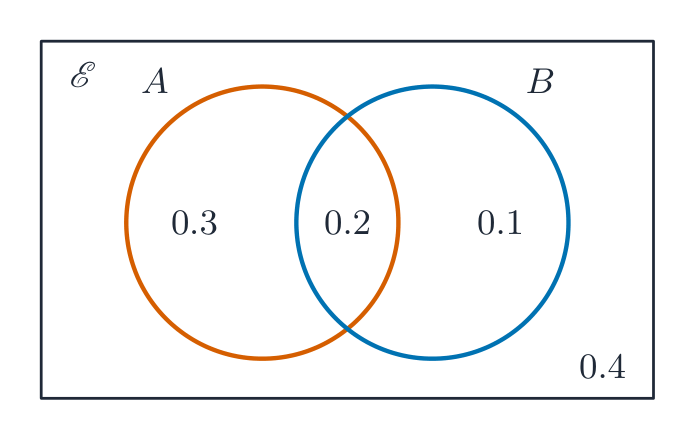
Probability notation is not required. Probabilities should be given as a fraction, decimal or percentage. Problems may require using information from tables, graphs or Venn diagrams (limited to two sets).
2 Calculate the probability of a single event.
3 Understand that the probability of an event not occurring = 1 – the probability of the event occurring.
e.g. The probability that a counter is blue is 0.8. What is the probability that it is not blue?
Source: Cambridge International syllabus · แหล่งที่มา: หลักสูตร Cambridge International
English
Probability 概率 measures how likely an event 事件 is. It runs on a scale from $0$ (impossible) to $1$ (certain), and can be written as a fraction, decimal or percentage. We write $\text{P}(A)$ for the probability of event $A$.
For equally likely outcomes 结果,
$$\text{P}(\text{event}) = \frac{\text{number of favourable outcomes}}{\text{total number of outcomes}}.$$
The probability that an event does not happen is
$$\text{P}(A') = 1 - \text{P}(A).$$
Worked example. A bag has $3$ red and $5$ blue counters. Find the probability of not drawing red.
Slide the marker from 0 (impossible) to 1 (certain) to place an event on the probability scale. · เลื่อนมาร์คเกอร์จาก 0 (เป็นไปได้ยาก) ถึง 1 (แน่นอน) เพื่อวางเหตุการณ์บน สเกลความน่าจะเป็น
Source: Cambridge International syllabus · แหล่งที่มา: หลักสูตร Cambridge International
English
When outcomes are not equally likely, do an experiment. The relative frequency 相对频率 estimates the probability:
$$\text{relative frequency} = \frac{\text{number of times it happened}}{\text{total number of trials}}.$$
The more trials you do, the better the estimate. A fair 公平 object gives equal chances; one with bias 偏倚 does not; random 随机 means each outcome happens by chance.
The expected frequency 期望频数 is how many times you expect an event in $n$ trials:
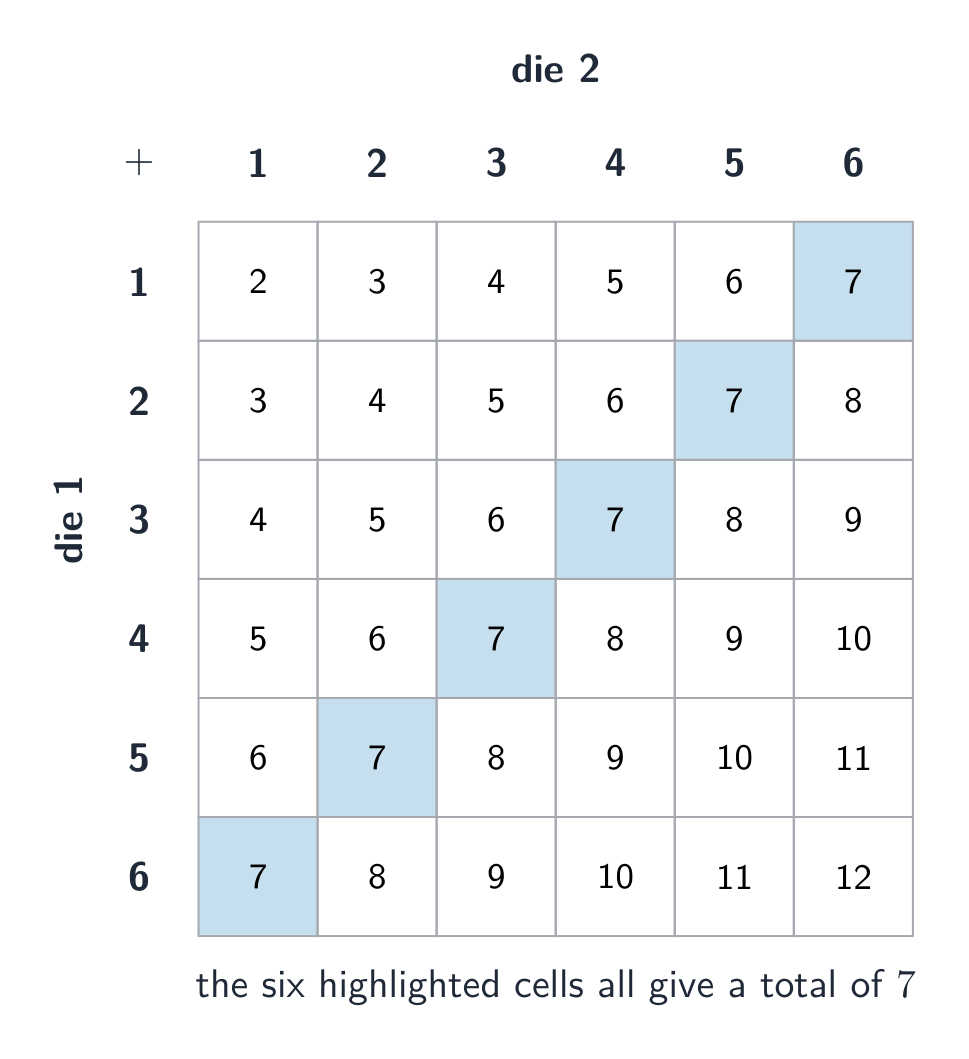
Two-dice probability · ความน่าจะเป็นของลูกเต๋าสองลูก
Roll the two dice many times: the bars start jumpy but settle into the theoretical triangle peaking at 7 — experimental probability closing in on theory. · โยกลูกเต๋าสองลูกหลายครั้ง: แท่งกราฟเริ่มผันผวนแต่จะนิ่งลงเป็นสามเหลี่ยมทางทฤษฎีที่ยอดที่ 7 — ความน่าจะเป็นเชิงทดลองเข้าใกล้ทฤษฎี
Source: Cambridge International syllabus · แหล่งที่มา: หลักสูตร Cambridge International
English
For two or more events together (combined events 组合事件), two rules help:
AND (both happen): multiply the probabilities — when the events are independent 独立事件 (one does not affect the other).
OR (either happens): add the probabilities — when the events are mutually exclusive 互斥 (they cannot both happen).
Three pictures help you organise the work.
Sample space diagrams
A sample space diagram 样本空间图 is a table or grid listing every possible outcome — useful for two dice or two spinners. Count the outcomes you want out of the total.
Venn diagrams
A Venn diagram 维恩图 sorts outcomes into overlapping sets. From it you can read $\text{P}(A \cap B)$ (in both) and $\text{P}(A \cup B)$ (in either).
Tree diagrams
A tree diagram 树状图 shows each stage as a set of branches. Write the probability on each branch and the outcome at the end. Multiply along the branches, then add the paths you want.
Worked example (with replacement). From the bag ($3$ red, $5$ blue), a counter is drawn, replaced, then a second is drawn. This is with replacement 有放回, so the chances do not change. Find the probability of two reds.
Worked example (without replacement, Extended). Now the first counter is not replaced — drawing without replacement 无放回. After one red is taken, $2$ reds remain out of $7$:
Multiply the probabilities along each branch; the four outcomes always add up to 1. · คูณความน่าจะเป็นตามกิ่งแต่ละเส้น; ผลลัพธ์สี่อย่างรวมกันได้ 1 เสมอ
Explore · สำรวจ
Combined events · เหตุการณ์ร่วม
P(A ∩ B) = P(A)·P(B|A)
Combine two events: the area model shows AND (overlap) versus OR (union). · รวมสองเหตุการณ์: โมเดลพื้นที่ แสดง AND (ทับซ้อน) เทียบกับ OR ( unión )
Source: Cambridge International syllabus · แหล่งที่มา: หลักสูตร Cambridge International
English
Conditional probability 条件概率 is the probability of one event given that another has already happened. Read it from a Venn diagram, two-way table or tree diagram by looking only at the part that matches the condition.
Worked example. In a class of $30$, $18$ study French and, of those, $7$ also study German. A French student is picked. Find the probability they also study German.
Change the branch probabilities and read combined and conditional probabilities off the tree. · เปลี่ยนความน่าจะเป็นในแต่ละกิ่งและอ่านความน่าจะเป็นร่วมและความน่าจะเป็นเงื่อนไขจาก ต้นไม้
8.4
Exam tips · ข้อแนะนำสำหรับการสอบ
English
Every probability lies between $0$ and $1$, and the probabilities of all the outcomes add to $1$.
For "and" (both events) multiply the probabilities; for "or" (either event) add them. On a tree diagram, multiply along the branches.
Watch for without replacement: the second probability changes because one item has already been removed.
Expected frequency = probability × number of trials.
1 Calculate the mean, median, mode, quartiles, range and interquartile range for individual data and distinguish between the purposes for which these are used.
2 Calculate an estimate of the mean for grouped discrete or grouped continuous data.
3 Identify the modal class from a grouped frequency distribution.
1 Calculate the mean, median, mode, quartiles, range and interquartile range for individual data and distinguish between the purposes for which these are used.
2 Calculate an estimate of the mean for grouped discrete or grouped continuous data.
3 Identify the modal class from a grouped frequency distribution.
For grouped data 分组数据, you cannot find the exact mean, so estimate it using the midpoint of each group as the value. The modal class 众数组 is simply the group with the highest frequency.
ไทย
เมื่อข้อมูลถูก listing พร้อม ความถี่ (จำนวนครั้งที่แต่ละค่าเกิดขึ้น), mean คือ
Measures of spread (Extended) · ค่าวัดการกระจาย (ส่วนขยาย)
Syllabus · หลักสูตร
English
Subject content
Notes and examples
1 Calculate the mean, median, mode, quartiles, range and interquartile range for individual data and distinguish between the purposes for which these are used.
2 Calculate an estimate of the mean for grouped discrete or grouped continuous data.
3 Identify the modal class from a grouped frequency distribution.
Source: Cambridge International syllabus · แหล่งที่มา: หลักสูตร Cambridge International
English
When data is in order, the quartiles 四分位数 cut it into four equal parts. The lower quartile (LQ) is one quarter of the way up; the upper quartile (UQ) is three quarters of the way up. The interquartile range 四分位距 measures the spread of the middle half:
Build a box plot from the five-number summary: the box is the middle 50% (the interquartile range) and the median's position shows the skew. · สร้างแผนภูมิกล่องจากรายละเอียด 5 ค่า: กล่องคือ 50% ตรงกลาง (ช่วงควอไทล์) และตำแหน่งมัธยฐานบ่งบอกความเบ้
Each slice's angle is its share of the whole turned into degrees — frequency ÷ total × 360 — and the slices always add to 360°. · มุมของแต่ละชิ้นส่วนคือสัดส่วนของมันเทียบกับทั้งหมดที่แปลงเป็นองศา — ความถี่ ÷ รวม × 360 — และชิ้นส่วนทั้งหมดต้องรวมกันได้ 360° เสมอ
Explore · สำรวจ
Chart choice lab · ห้องปฏิบัติการเลือกแผนภูมิ
Choose the chart that fits the kind of data. · เลือกแผนภูมิที่เหมาะกับประเภทของข้อมูล
frequency distribution/ˈfriːkwənsi ˌdɪstrɪˈbjuːʃn/
การแจกแจงความถี่
scatter diagram/ˈskætə ˈdaɪəɡræm/
แผนภูมิกระจาย
9.5
Scatter diagrams and correlation · แผนภาพกระจายและสหสัมพันธ์
Syllabus · หลักสูตร
English
Subject content
Notes and examples
1 Draw and interpret scatter diagrams.
Plotted points should be clearly marked, for example as small crosses (×).
2 Understand what is meant by positive, negative and zero correlation.
3 Draw by eye, interpret and use a straight line of best fit.
A line of best fit: • should be a single ruled line drawn by inspection • should extend across the full data set • does not need to coincide exactly with any of the points but there should be a roughly even distribution of points either side of the line over its entire length.
Plotted points should be clearly marked, for example as small crosses (x).
2 Understand what is meant by positive, negative and zero correlation.
3 Draw by eye, interpret and use a straight line of best fit.
A line of best fit: • should be a single ruled line drawn by inspection • should extend across the full data set • does not need to coincide exactly with any of the points but there should be a roughly even distribution of points either side of the line over its entire length.
ไทย
เนื้อหารายวิชา
หมายเหตุและตัวอย่าง
1 วาดและตีความแผนภาพกระจาย.
จุดที่กราฟควรทำเครื่องหมายให้ชัดเจน เช่น ด้วยเครื่องหมาย x เล็กๆ.
Source: Cambridge International syllabus · แหล่งที่มา: หลักสูตร Cambridge International
English
A scatter diagram 散点图 plots pairs of values as points to show whether two things are linked. The link is the correlation 相关性:
positive correlation 正相关 — as one goes up, the other goes up.
negative correlation 负相关 — as one goes up, the other goes down.
zero correlation 零相关 — no clear link.
If there is correlation, draw a line of best fit 最佳拟合线: one straight ruled line through the middle of the points, with about the same number of points on each side. Use it to predict values.
Scatter and correlation · กราฟกระจายและสหสัมพันธ์
Change the strength of the relationship and add a line of best fit to spot the trend. · เปลี่ยนความแข็งแกร่งของความสัมพันธ์และเพิ่ม เส้นแนวโน้ม เพื่อดูแนวโน้ม
Source: Cambridge International syllabus · แหล่งที่มา: หลักสูตร Cambridge International
English
The cumulative frequency 累积频数 is a running total of the frequencies. Plot it against the upper end of each class and join the points with a smooth curve.
From the curve you can read the median (at half the total), the quartiles (at one quarter and three quarters), and any percentile 百分位数 (for example, the $90$th percentile is at $90\%$ of the total).
Source: Cambridge International syllabus · แหล่งที่มา: หลักสูตร Cambridge International
English
A histogram 直方图 looks like a bar chart, but the bars can have different widths and the area of each bar (not its height) shows the frequency. The vertical axis is the frequency density 频数密度:
With unequal class widths the bar height is frequency density, so the area (not the height) represents the frequency. · เมื่อความกว้างชั้นไม่เท่ากัน ความสูงของแท่งคือความหนาแน่นความถี่ ดังนั้นพื้นที่ (ไม่ใช่ความสูง) จึงแทนค่าความถี่
Pick one and the site follows you — notes, papers, videos and practice all open on it. · เลือกหนึ่งตัว และเว็บจะติดตามคุณ — หมายเหตุ, ใบงาน, วิดีโอ และการฝึกฝนจะเปิดอยู่ที่นั้น
Type to search notes, lessons, code, vocabulary and past-paper questions across every subject. · พิมพ์เพื่อค้นหาบันทึก, บทเรียน, โค้ด, คำศัพท์ และคำถามข้อสอบเก่าในทุกวิชา