English narration · English + 中文 subtitles burned in · การบรรยายภาษาอังกฤษ · คำบรรยายภาษาอังกฤษ + 中文 ลอยตัวบนภาพ
4.1
Electrolysis · การอิเล็กโทรไลซิส
Syllabus · หลักสูตร
English
Core
Supplement
1 Define electrolysis as the decomposition of an ionic compound, when molten or in aqueous solution, by the passage of an electric current
8 Describe the transfer of charge during electrolysis to include: (a) the movement of electrons in the external circuit (b) the loss or gain of electrons at the electrodes (c) the movement of ions in the electrolyte
2 Identify in simple electrolytic cells: (a) the anode as the positive electrode (b) the cathode as the negative electrode (c) the electrolyte as the molten or aqueous substance that undergoes electrolysis
3 Identify the products formed at the electrodes and describe the observations made during the electrolysis of: (a) molten lead(II) bromide (b) concentrated aqueous sodium chloride (c) dilute sulfuric acid using inert electrodes made of platinum or carbon/graphite
9 Identify the products formed at the electrodes and describe the observations made during the electrolysis of aqueous copper(II) sulfate using inert carbon/graphite electrodes and when using copper electrodes
4 State that metals or hydrogen are formed at the cathode and that non-metals (other than hydrogen) are formed at the anode
5 Predict the identity of the products at each electrode for the electrolysis of a binary compound in the molten state
10 Predict the identity of the products at each electrode for the electrolysis of a halide compound in dilute or concentrated aqueous solution
11 Construct ionic half-equations for reactions at the anode (to show oxidation) and at the cathode (to show reduction)
6 State that metal objects are electroplated to improve their appearance and resistance to corrosion
Source: Cambridge International syllabus · แหล่งที่มา: หลักสูตร Cambridge International
English
Electrolysis: ions discharge at the electrodes
Electrolysis 电解 is the breaking down (decomposition 分解) of an ionic compound 离子化合物 — when it is molten 熔融 or in aqueous 水溶液 solution — by passing an electric current 电流 through it.
It only works when the substance is molten or dissolved, because then the ions 离子 are free to move and carry the charge. A solid ionic compound cannot be electrolysed because its ions are locked in place.
The electrolytic cell
The set-up is called an electrolytic cell 电解池. Two electrodes 电极 (solid conductors) dip into the electrolyte 电解质 — the molten or aqueous substance being broken down.
The anode 阳极 is the positive ($+$) electrode.
The cathode 阴极 is the negative ($-$) electrode.
The electrodes are often inert 惰性 (they do not react), such as platinum 铂 or carbon/graphite 石墨.
What is formed at each electrode
There is a simple rule:
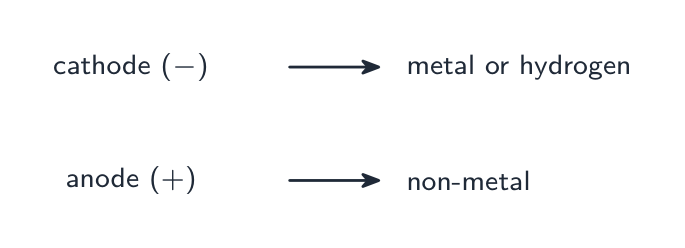
Metals 金属 or hydrogen 氢气 are formed at the cathode.
Non-metals 非金属 (other than hydrogen) are formed at the anode.
For aqueous solutions, the product can depend on whether the solution is dilute 稀 or concentrated 浓. Here are the three Core examples:
Electrolyte
At the cathode ($-$)
At the anode ($+$)
molten lead(II) bromide, $\text{PbBr}_2$
lead 铅 (silvery liquid)
bromine 溴 (red-brown vapour)
concentrated aqueous sodium chloride
hydrogen (bubbles of gas)
chlorine 氯气 (pale green gas)
dilute sulfuric acid 硫酸
hydrogen (bubbles of gas)
oxygen 氧气 (bubbles of gas)
Worked example. Predict the products of electrolysing molten zinc chloride, $\text{ZnCl}_2$. Because it is molten, only zinc ions and chloride ions are present - there is no water to complicate things. Zinc is a metal, so it forms at the cathode: $\text{Zn}^{2+}$ ions gain electrons and silvery zinc appears. Chlorine is a non-metal, so it forms at the anode: pale green chlorine gas bubbles off. Always check the state first. A molten compound simply gives you its own two elements, while an aqueous one brings water into the competition - which is why concentrated sodium chloride solution gives hydrogen at the cathode rather than sodium.
How the charge moves
During electrolysis:
Electrons 电子 move through the wires (the external circuit 外电路) from the power supply.
At the cathode, positive ions gain electrons. Gaining electrons is reduction 还原.
At the anode, negative ions lose electrons. Losing electrons is oxidation 氧化.
Inside the electrolyte, the ions move: positive ions go to the cathode and negative ions go to the anode.
You can write a half-equation 半反应式 for each electrode. For molten lead(II) bromide:
The product at the anode depends on the electrode:
With inert carbon electrodes: copper 铜 forms at the cathode and oxygen forms at the anode. The blue colour of the solution slowly fades as copper is removed.
With copper electrodes: copper forms at the cathode, while the anode itself dissolves into the solution. The blue colour stays the same. This is used to purify copper.
Electroplating
Electroplating 电镀 means covering a metal object with a thin layer of another metal. This improves its appearance and its resistance to corrosion 腐蚀 (rusting and wearing away).
To electroplate an object:
the object to be coated is made the cathode;
the plating metal is made the anode;
the electrolyte is a solution containing ions of the plating metal.
Pick an electrolyte and watch ions move: positive ions to the cathode, negative ions to the anode. · เลือกอิเล็กโทรไลต์และดูไอออนเคลื่อนที่: ไอออนบวกไป แคโทด ไอออนลบไป แอโนด
It is useful to compare a fuel cell with a normal petrol (gasoline) engine in a vehicle.
Hydrogen–oxygen fuel cell
Petrol engine
Main product
water only
carbon dioxide and pollutants 污染物
Effect on air
clean
adds to air pollution
Fuel storage
hydrogen is hard and dangerous to store (flammable, needs high pressure)
petrol is easy to store
Source
hydrogen may be made using fossil fuels
made from crude oil
Advantages of the fuel cell: the only product is water, so it does not pollute the air, and it changes chemical energy into electricity efficiently. Disadvantages: hydrogen is hard to store and transport safely, and producing the hydrogen can still use energy from fossil fuels.
Inside a hydrogen–oxygen fuel cell · ภายในเซลล์เชื้อเพลิงไฮโดรเจน-ออกซิเจน
Step through a fuel cell. Hydrogen and oxygen combine to make water, and the energy of that reaction is released as electricity — with no carbon dioxide. · อธิบายการทำงานของเซลล์เชื้อเพลิง ไฮโดรเจนและออกซิเจนรวมตัวกันเกิดเป็นน้ำ และพลังงานจากปฏิกิริยานี้จะถูกปล่อยออกมาในรูปของไฟฟ้า — โดยไม่มีการปล่อยคาร์บอนไดออกไซด์
At the cathode (negative) you get a metal or hydrogen; at the anode (positive) you get a non-metal. Positive ions move to the cathode, negative ions to the anode.
A molten compound just gives its two elements. An aqueous solution can give something different (concentrated sodium chloride gives hydrogen and chlorine, not sodium).
Reduction is gain of electrons (at the cathode); oxidation is loss of electrons (at the anode). Remember OIL RIG.
In a half-equation the atoms and the charges must balance, with the electrons on the correct side: $\text{Pb}^{2+} + 2e^- \rightarrow \text{Pb}$ (cathode).
To electroplate an object, make it the cathode, make the plating metal the anode, and use a solution containing ions of the plating metal.
Pick one and the site follows you — notes, papers, videos and practice all open on it. · เลือกหนึ่งตัว และเว็บจะติดตามคุณ — หมายเหตุ, ใบงาน, วิดีโอ และการฝึกฝนจะเปิดอยู่ที่นั้น
Type to search notes, lessons, code, vocabulary and past-paper questions across every subject. · พิมพ์เพื่อค้นหาบันทึก, บทเรียน, โค้ด, คำศัพท์ และคำถามข้อสอบเก่าในทุกวิชา