Skip to content · ⁨ข้ามไปยังเนื้อหา⁩

Networks of Exchange

AP World History: Modern · ⁨AP ประวัติศาสตร์โลก: สมัยใหม่⁩ · Topic 2 · ⁨หัวข้อ 2⁩

Video lesson for this topic · ⁨บทเรียนวิดีโอสำหรับหัวข้อนี้⁩ Open the video page · ⁨เปิดหน้าวิดีโอ⁩
6:50

หน่วย 2: ระบบเครือข่ายการแลกเปลี่ยน

ผ้าไหม, เครื่องเคลือบ, เครื่องเทศ, ทองคำ, เกลือ นักเรียนใช้เวลาหลายชั่วโมงเรียนรู้ว่าใครค้าขายอะไร และเมื่อมีคำถามถามว่าทำไมการค้าจึงเติบโต รายการข้างต้นก็ไม่มีประโยชน์เลย…

English narration · English + 中文 subtitles burned in · ⁨การบรรยายภาษาอังกฤษ · คำบรรยายภาษาอังกฤษ + 中文 ลอยตัวบนภาพ⁩

2.1

What Made the Networks Grow · ⁨สิ่งที่ทำให้เครือข่ายเติบโตขึ้น⁩

Syllabus · ⁨หลักสูตร⁩
English

2.1 The Silk Roads

Thematic Focus (ECN): Economics Systems — As societies develop, they affect and are affected by the ways that they produce, exchange, and consume goods and services.

Learning Objective Unit 2.A: Explain the causes and effects of growth of networks of exchange after 1200.

  • KC-3.1.I.A.i Improved commercial practices led to an increased volume of trade and expanded the geographical range of existing trade routes— including the Silk Roads—promoting the growth of powerful new trading cities.
  • KC-3.1.I.C.i The growth of interregional trade in luxury goods was encouraged by innovations in previously existing transportation and commercial technologies, including the caravanserai, forms of credit, and the development of money economies.
  • KC-3.3.I.B Demand for luxury goods increased in Afro-Eurasia. Chinese, Persian, and Indian artisans and merchants expanded their production of textiles and porcelains for export; manufacture of iron and steel expanded in China.

Illustrative examples:

  • Trading cities:
    • Kashgar
    • Samarkand
  • New forms of credit and money economies:
    • Bills of exchange
    • Banking houses
    • Use of paper money
ไทย

2.1 เส้นทางสายไหม

จุดเน้นเชิงประเด็น (ECN): ระบบเศรษฐกิจ — เมื่อสังคมพัฒนาขึ้น จะส่งผลกระทบต่อและได้รับผลกระทบจากวิธีการผลิต แลกเปลี่ยน และบริโภคสินค้าและบริการ

วัตถุประสงค์การเรียนรู้ หน่วย 2.A: อธิบายสาเหตุและผลกระทบของการเติบโตของเครือข่ายแลกเปลี่ยนหลังปี ค.ศ. 1200

  • KC-3.1.I.A.i วิธีการทางการค้าที่ดีขึ้นนำไปสู่ปริมาณการค้าที่เพิ่มขึ้นและขยายขอบเขตทางภูมิศาสตร์ของเส้นทางค้าขายที่มีอยู่—includingเส้นทางสายไหม—ส่งเสริมการเติบโตของเมืองค้าขายใหม่ที่มีอำนาจ
  • KC-3.1.I.C.i การเติบโตของการค้าข้ามภูมิภาคสินค้าหรูหราได้รับการสนับสนุน olehนวัตกรรมด้านเทคโนโลยีการขนส่งและการค้าที่มีอยู่เดิม—includingคาร์วาเซอรี รูปแบบของเครดิต และการพัฒนาของเศรษฐกิจเงินตรา
  • KC-3.3.I.B ความต้องการสินค้าหรูเพิ่มสูงขึ้นในแอฟริกา-ยูเรเซีย ช่างฝีมือและผู้ค้าจีน เปอร์เซีย และอินเดียได้ขยายการผลิตสิ่งทอและเครื่องเคลือบสำหรับส่งออก; การผลิตเหล็กและเหล็กกล้าขยายตัวในจีน

ตัวอย่างประกอบ:

  • เมืองค้าขาย:
    • คาชการ์
    • ซามَرْกัณฑ์
  • รูปแบบใหม่ของเครดิตและเศรษฐกิจเงินตรา:
    • บิลแห่งการ exchanging
    • บ้านธนาคาร
    • การใช้ธนบัตร

Source: College Board AP Course and Exam Description · ⁨แหล่งที่มา: คำอธิบายหลักสูตรและข้อสอบ College Board AP⁩

English

Unit 2 covers the three great exchange networks of 1200 to 1450 - the Silk Roads, the Indian Ocean, and the trans-Saharan routes - and asks the same question of each: what made trade grow, and what did that growth change?

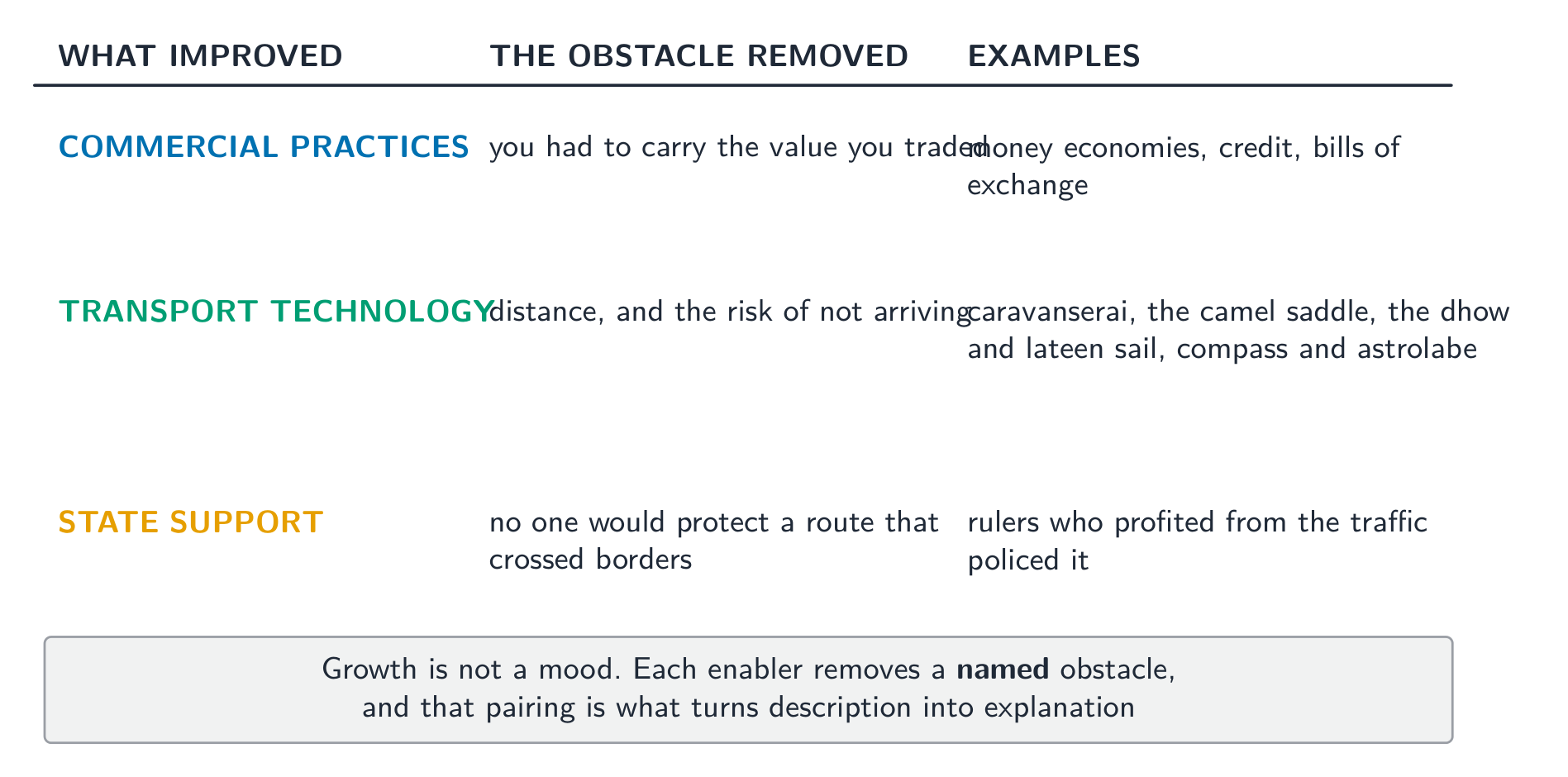
Growth had three common causes, and naming them is worth more than listing goods:

  • Improved commercial practices 商业惯例的改进 - money economies 货币经济, credit 信贷, and forms of partnership that spread risk.
  • Improved transportation technologies 交通技术的改进 - better ships, saddles, and navigation.
  • State support 国家支持 - empires that secured routes and taxed the trade benefited from protecting it.

Demand mattered too: luxury goods 奢侈品 from Chinese, Persian, and Indian artisans found expanding markets across Afro-Eurasia, and producers increased output to meet that demand.

ไทย

หน่วยที่ 2 ครอบคลุมเครือข่ายแลกเปลี่ยนอันยิ่งใหญ่สามแห่งระหว่างปี 1200 ถึง 1450 ได้แก่ เส้นทางไหม, มหาสมุทรอินเดีย และเส้นทางข้ามทะเลทรายซาฮารา โดยตั้งคำถามSame กับทุกเครือข่ายว่า: อะไรทำให้การค้าเติบโตขึ้น และการเติบโตนั้นเปลี่ยนแปลงอะไร?

การเติบโตมีสาเหตุร่วมสามประการ และการระบุชื่อสาเหตุเหล่านี้มีค่ามากกว่าการแค่รายการสินค้า:

  • วิธีการค้าที่ดีขึ้น - เศรษฐกิจเงินตรา, สินเชื่อ และรูปแบบหุ้นส่วนที่ช่วยกระจายความเสี่ยง
  • เทคโนโลยีการขนส่งที่ดีขึ้น - เรือที่ดียิ่งขึ้น, เกราะม้า และเครื่องมือนำทาง
  • สนับสนุนจากรัฐ - จักรวรรดิที่รักษาเส้นทางไว้และเก็บภาษีการค้าจะ受益于การปกป้องการค้าดังกล่าว

ความต้องการก็สำคัญ: สินค้าหรูหรา จากช่างฝีมือจีน, เปอร์เซีย และอินเดีย พบตลาดที่กว้างขึ้นทั่วแอฟโร-ยูเรเชีย และผู้ผลิตเพิ่มผลผลิตเพื่อตอบสนองความต้องการนั้น

ตัวเอื้อeach ตัดทอนอุปสรรคที่มีชื่อเฉพาะ - คู่แบบนี้คือสิ่งที่เปลี่ยนคำบรรยายให้เป็นคำอธิบาย
Explore · ⁨สำรวจ⁩

Pair each enabler with the obstacle it removed

Growth is not a mood: each enabler removes a named obstacle, and that pairing turns description into explanation.

2.1

The Silk Roads · ⁨เส้นทางไหม⁩

Syllabus · ⁨หลักสูตร⁩
English

2.1 The Silk Roads

Thematic Focus (ECN): Economics Systems — As societies develop, they affect and are affected by the ways that they produce, exchange, and consume goods and services.

Learning Objective Unit 2.A: Explain the causes and effects of growth of networks of exchange after 1200.

  • KC-3.1.I.A.i Improved commercial practices led to an increased volume of trade and expanded the geographical range of existing trade routes— including the Silk Roads—promoting the growth of powerful new trading cities.
  • KC-3.1.I.C.i The growth of interregional trade in luxury goods was encouraged by innovations in previously existing transportation and commercial technologies, including the caravanserai, forms of credit, and the development of money economies.
  • KC-3.3.I.B Demand for luxury goods increased in Afro-Eurasia. Chinese, Persian, and Indian artisans and merchants expanded their production of textiles and porcelains for export; manufacture of iron and steel expanded in China.

Illustrative examples:

  • Trading cities:
    • Kashgar
    • Samarkand
  • New forms of credit and money economies:
    • Bills of exchange
    • Banking houses
    • Use of paper money
ไทย

2.1 เส้นทางสายไหม

จุดเน้นเชิงประเด็น (ECN): ระบบเศรษฐกิจ — เมื่อสังคมพัฒนาขึ้น จะส่งผลกระทบต่อและได้รับผลกระทบจากวิธีการผลิต แลกเปลี่ยน และบริโภคสินค้าและบริการ

วัตถุประสงค์การเรียนรู้ หน่วย 2.A: อธิบายสาเหตุและผลกระทบของการเติบโตของเครือข่ายแลกเปลี่ยนหลังปี ค.ศ. 1200

  • KC-3.1.I.A.i วิธีการทางการค้าที่ดีขึ้นนำไปสู่ปริมาณการค้าที่เพิ่มขึ้นและขยายขอบเขตทางภูมิศาสตร์ของเส้นทางค้าขายที่มีอยู่—includingเส้นทางสายไหม—ส่งเสริมการเติบโตของเมืองค้าขายใหม่ที่มีอำนาจ
  • KC-3.1.I.C.i การเติบโตของการค้าข้ามภูมิภาคสินค้าหรูหราได้รับการสนับสนุน olehนวัตกรรมด้านเทคโนโลยีการขนส่งและการค้าที่มีอยู่เดิม—includingคาร์วาเซอรี รูปแบบของเครดิต และการพัฒนาของเศรษฐกิจเงินตรา
  • KC-3.3.I.B ความต้องการสินค้าหรูเพิ่มสูงขึ้นในแอฟริกา-ยูเรเซีย ช่างฝีมือและผู้ค้าจีน เปอร์เซีย และอินเดียได้ขยายการผลิตสิ่งทอและเครื่องเคลือบสำหรับส่งออก; การผลิตเหล็กและเหล็กกล้าขยายตัวในจีน

ตัวอย่างประกอบ:

  • เมืองค้าขาย:
    • คาชการ์
    • ซามَرْกัณฑ์
  • รูปแบบใหม่ของเครดิตและเศรษฐกิจเงินตรา:
    • บิลแห่งการ exchanging
    • บ้านธนาคาร
    • การใช้ธนบัตร

Source: College Board AP Course and Exam Description · ⁨แหล่งที่มา: คำอธิบายหลักสูตรและข้อสอบ College Board AP⁩

English

The Silk Roads 丝绸之路 carried high-value, low-bulk goods overland across Eurasia: silk, porcelain, spices, and precious metals.

Its enabling innovations were commercial as much as technical - caravanserai 商队旅馆 along the routes, the use of paper money 纸币 and bills of exchange 汇票 in China, and forms of credit that let merchants trade without carrying bullion.

The consequence for producers: Chinese artisans expanded output, and cities along the routes grew wealthy on the traffic passing through.

ไทย

เส้นทางไหม ขนส่งสินค้ามูลค่าสูงแต่ปริมาณน้อยทางบกผ่านเอเชียและยุโรป: ไหม, พอร์เซเลน,เครื่องเทศ และโลหะมีค่า

นวัตกรรมที่เอื้อต่อการค้าเป็นทั้งด้านธุรกิจและเทคนิค - คาร์วาเนเซอรี ตามเส้นทาง, การใช้ ธนบัตร และ ใบสั่งจ่าย ในจีน และรูปแบบสินเชื่อที่ช่วยให้พ่อค้าซื้อขายโดยไม่ต้องพกพาโลหะมีค่า

ผลกระทบสำหรับผู้ผลิต: ช่างฝีมือจีนเพิ่มผลผลิต และเมืองตามเส้นทางร่ำรวยจากการค้าที่ผ่านเข้ามา

2.2

The Mongol Empire · ⁨จักรวรรดิมองโกล⁩

Syllabus · ⁨หลักสูตร⁩
English

2.2 The Mongol Empire and the Making of the Modern World

Thematic Focus (GOV): Governance — A variety of internal and external factors contribute to state formation, expansion, and decline. Governments maintain order through a variety of administrative institutions, policies, and procedures, and governments obtain, retain, and exercise power in different ways and for different purposes.

Thematic Focus (CDI): Cultural Developments and Interactions — The development of ideas, beliefs, and religions illustrates how groups in society view themselves, and the interactions of societies and their beliefs often have political, social, and cultural implications.

Learning Objective Unit 2.B: Explain the process of state building and decline in Eurasia over time. THEMATIC FOCUS Economics Systems ECN As societies develop, they affect and are affected by the ways that they produce, exchange, and consume goods and services. LEARNING OBJECTIVE

  • KC-3.2.I.B.iii Empires collapsed in different regions of the world and in some areas were replaced by new imperial states, including the Mongol khanates. HISTORICAL DEVELOPMENTS

Learning Objective Unit 2.C: Explain how the expansion of empires influenced trade and communication over time.

  • KC-3.1.I.E.i The expansion of empires—including the Mongols—facilitated Afro-Eurasian trade and communication as new people were drawn into their conquerors’ economies and trade networks.

Learning Objective Unit 2.D: Explain the significance of the Mongol Empire in larger patterns of continuity and change.

  • KC-3.2.II.A.ii Interregional contacts and conflicts between states and empires, including the Mongols, encouraged significant technological and cultural transfers.

Illustrative examples:

  • Technological and cultural transfers:
    • Transfer of Greco– Islamic medical knowledge to western Europe
    • Transfer of numbering systems to Europe
    • Adoption of Uyghur script
ไทย

2.2 จักรวรรดิมองโกลและการสร้างโลกสมัยใหม่

ประเด็นเน้น (GOV): การปกครอง — ปัจจัยภายในและภายนอกหลากหลายชนิดมีส่วนร่วมในการก่อตัว การขยายตัว และการล่มสลายของรัฐ รัฐบาลรักษาความสงบเรียบร้อยผ่านสถาบัน นโยบาย และขั้นตอนการบริหารจัดการที่หลากหลาย และรัฐบาลได้รับ รักษาส Powers และใช้อำนาจในรูปแบบและด้วยวัตถุประสงค์ที่แตกต่างกัน

ประเด็นเน้น (CDI): การพัฒนาและการปฏิสัมพันธ์ทางวัฒนธรรม — การพัฒนาของแนวคิด ความเชื่อ และศาสนาแสดงให้เห็นว่ากลุ่มคนในสังคมมองเห็นตนเองอย่างไร และการปฏิสัมพันธ์ระหว่างสังคมและความเชื่อของพวกเขา มักจะมีนัยสำคัญทางการเมือง สังคม และวัฒนธรรม

วัตถุประสงค์การเรียนรู้ หน่วย 2.B: อธิบายกระบวนการสร้างรัฐและการเสื่อมถอยของรัฐในทวีป(numeroia)ตามกาลเวลา จุดเน้นเชิงหัวข้อ เศรษฐกิจ ระบบ ECN เมื่อสังคมพัฒนาขึ้น จะส่งผลต่อและได้รับผลกระทบจากวิธีการผลิต การแลกเปลี่ยน และการบริโภคสินค้าและบริการ วัตถุประสงค์การเรียนรู้

  • KC-3.2.I.B.iii จักรวรรดิล่มสลาย在不同的 regions ของโลก และในบางพื้นที่ถูกแทนที่โดยรัฐจักรวรรดิใหม่ รวมถึงรัฐมองโกล HISTORICAL DEVELOPMENTS

วัตถุประสงค์การเรียนรู้ หน่วย 2.C: อธิบายว่าการขยายตัวของจักรวรรดิมีผลต่อการค้าและการสื่อสารอย่างไรตามกาลเวลา

  • KC-3.1.I.E.i การขยายตัวของจักรวรรดิ—including มงโกล—ช่วยส่งเสริมการค้าและการสื่อสารระหว่างแอฟริกา-ยูเรเซีย เนื่องจากกลุ่มคนใหม่ถูกดึงเข้ามาสู่เศรษฐกิจและเครือข่ายการค้าของผู้พิชิต

วัตถุประสงค์การเรียนรู้ หน่วย 2.D: อธิบายความสำคัญของจักรวรรdsmongol ในรูปแบบใหญ่ของการคงอยู่และการเปลี่ยนแปลง

  • KC-3.2.II.A.ii การติดต่อและความขัดแย้งระหว่างรัฐและจักรวรรดิ—including มงโกล—กระตุ้นให้เกิดการถ่ายโอนเทคโนโลยีและวัฒนธรรมที่สำคัญ

ตัวอย่างประกอบ:

  • การถ่ายโอนเทคโนโลยีและวัฒนธรรม:
    • การถ่ายโอนความรู้ทางการแพทย์กรีก–อิสลามไปยังยุโรปตะวันตก
    • การถ่ายโอนระบบตัวเลขไปยังยุโรป
    • การนำอักษรอูยกันมาใช้

Source: College Board AP Course and Exam Description · ⁨แหล่งที่มา: คำอธิบายหลักสูตรและข้อสอบ College Board AP⁩

English

Empires collapsed and were reconstituted in this period, and the largest transformation came from the Mongol Empire 蒙古帝国.

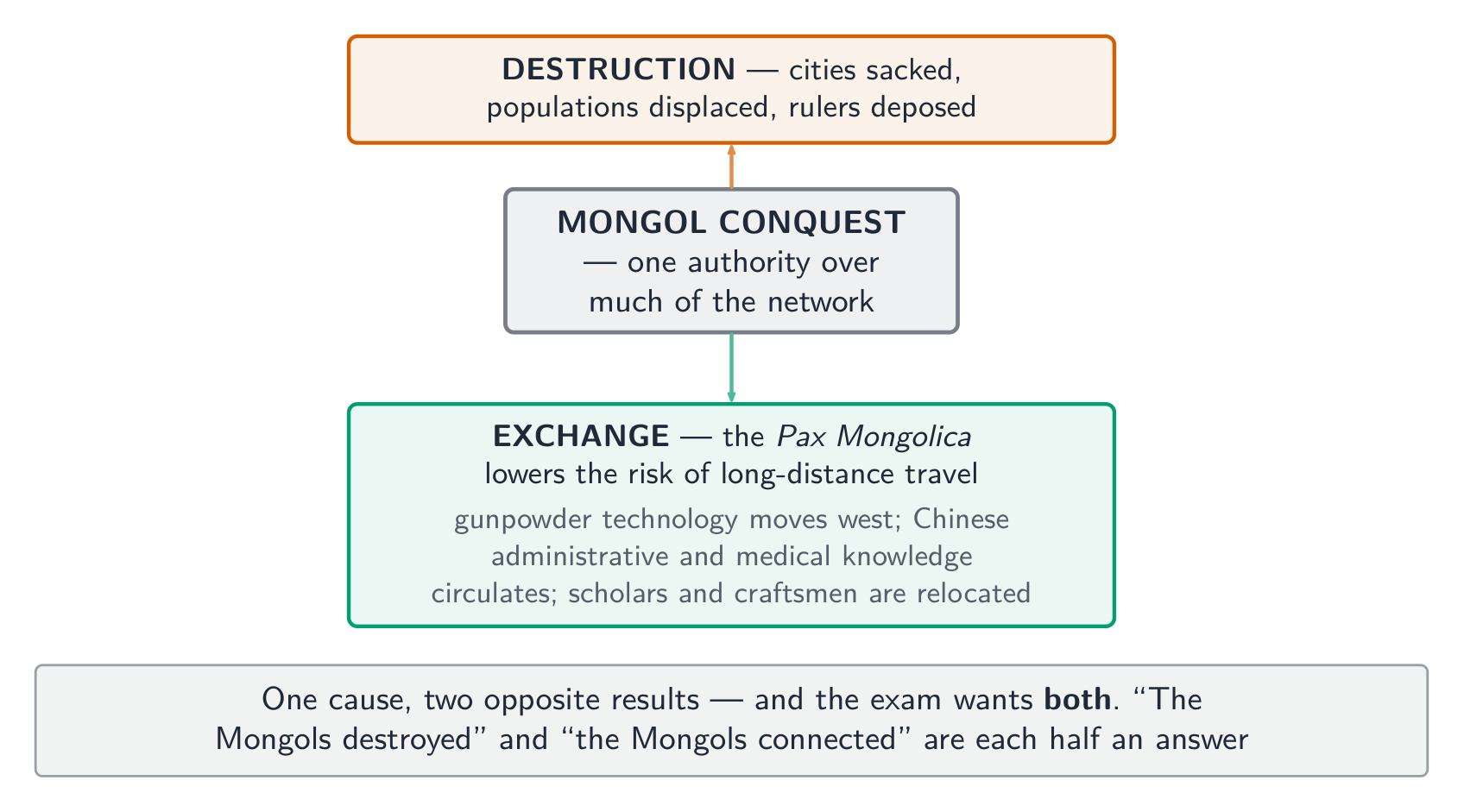
Mongol expansion facilitated Afro-Eurasian trade and communication by bringing much of the network under a single authority, which lowered the risk of long-distance travel - a period often called the Pax Mongolica 蒙古和平.

Interregional contacts and conflicts also encouraged technological and cultural transfers: gunpowder technology moved west, Chinese administrative and medical knowledge circulated, and scholars and craftsmen were relocated across the empire.

The Mongols illustrate the unit's central irony: conquest and destruction produced the conditions for exchange.

ไทย

จักรวรรดิล่มสลายและถูกสร้างใหม่ในช่วงเวลานี้ และการเปลี่ยนแปลงครั้งใหญ่ที่สุดเกิดจาก จักรวรรดิมองโกล

การขยายตัวของมองโกล ส่งเสริมการค้าและการสื่อสารระหว่างแอฟโร-ยูเรเชีย โดยนำเครือข่ายส่วนใหญ่เข้าภายใต้อำนาจเดียว ซึ่งลดความเสี่ยงของการเดินทางระยะไกล - ช่วงเวลานี้มักเรียกว่า (stripes Mongolica)

ความสัมพันธ์ระหว่างภูมิภาคและความขัดแย้งยัง กระตุ้นการถ่ายโอนเทคโนโลยีและวัฒนธรรม: เทคโนโลยีปืนpowder เคลื่อนย้ายไปตะวันตก, ความรู้ด้านการปกครองและการแพทย์ของจีนหมุนเวียน และนักวิชาการ serta ช่างฝีมือถูกย้ายถิ่นไปทั่วนิคม

มองโกลแสดงถึงironyหลักของหน่วยนี้: การพิชิตและการทำลายล้าง สร้างเงื่อนไขสำหรับการแลกเปลี่ยน

ironyหลักของหน่วย: สาเหตุหนึ่ง ผลลัพธ์ตรงข้ามสองอย่าง และข้อสอบต้องการทั้งสอง
2.3

The Indian Ocean · ⁨มหาสมุทรอินเดีย⁩

Syllabus · ⁨หลักสูตร⁩
English

2.3 Exchange in the Indian Ocean

Thematic Focus (ECN): Economics Systems — As societies develop, they affect and are affected by the ways that they produce, exchange, and consume goods and services.

Thematic Focus (CDI): Cultural Developments and Interactions — The development of ideas, beliefs, and religions illustrates how groups in society view themselves, and the interactions of societies and their beliefs often have political, social, and cultural implications.

Learning Objective Unit 2.E: Explain the causes of the growth of networks of exchange after 1200.

  • KC-3.1.I.A.ii Improved transportation technologies and commercial practices led to an increased volume of trade and expanded the geographical range of existing trade routes, including the Indian Ocean, promoting the growth of powerful new trading cities.
  • KC-3.1.I.C.ii The growth of interregional trade in luxury goods was encouraged by significant innovations in previously existing transportation and commercial technologies, including the use of the compass, the astrolabe, and larger ship designs.
  • KC-3.1.I.A.iii The Indian Ocean trading network fostered the growth of states.

Learning Objective Unit 2.F: Explain the effects of the growth of networks of exchange after 1200. THEMATIC FOCUS Humans and the Environments ENV The environment shapes human societies, and as populations grow and change, these populations in turn shape their environments. LEARNING OBJECTIVE

  • KC-3.1.III.B In key places along important trade routes, merchants set up diasporic communities where they introduced their own cultural traditions into the indigenous cultures and, in turn, indigenous cultures influenced merchant cultures.
  • KC-3.2.II.A.iii Interregional contacts and conflicts between states and empires encouraged significant technological and cultural transfers, including during Chinese maritime activity led by Ming Admiral Zheng He. HISTORICAL DEVELOPMENTS

Learning Objective Unit 2.G: Explain the role of environmental factors in the development of networks of exchange in the period from c. 1200 to c. 1450.

  • KC-3.1.II.A.i The expansion and intensification of long-distance trade routes often depended on environmental knowledge, including advanced knowledge of the monsoon winds.

Illustrative examples:

  • Growth of states:
    • City-states of the Swahili Coast
    • Gujarat
    • Sultanate of Malacca
  • (CONT’D) Diasporic communities:
    • Arab and Persian communities in East Africa
    • Chinese merchant communities in Southeast Asia
    • Malay communities in the Indian Ocean basin
ไทย

2.3 การแลกเปลี่ยนในมหาสมุทรอินเดีย

จุดเน้นเชิงประเด็น (ECN): ระบบเศรษฐกิจ — เมื่อสังคมพัฒนาขึ้น จะส่งผลกระทบต่อและได้รับผลกระทบจากวิธีการผลิต แลกเปลี่ยน และบริโภคสินค้าและบริการ

ประเด็นเน้น (CDI): การพัฒนาและการปฏิสัมพันธ์ทางวัฒนธรรม — การพัฒนาของแนวคิด ความเชื่อ และศาสนาแสดงให้เห็นว่ากลุ่มคนในสังคมมองเห็นตนเองอย่างไร และการปฏิสัมพันธ์ระหว่างสังคมและความเชื่อของพวกเขา มักจะมีนัยสำคัญทางการเมือง สังคม และวัฒนธรรม

วัตถุประสงค์การเรียนรู้ หน่วย 2.E: อธิบายสาเหตุของการเติบโตของเครือข่ายการแลกเปลี่ยนหลังปี 1200

  • KC-3.1.I.A.ii เทคโนโลยีการขนส่งที่ดีขึ้นและแนวปฏิบัติทางการพาณิชย์นำไปสู่ปริมาณการค้าที่เพิ่มขึ้นและขยายขอบเขตทางภูมิศาสตร์ของเส้นทางค้าที่มีอยู่เดิม—including มหาสมุทรอินเดีย ซึ่งส่งเสริมการเติบโตของเมืองค้าขายใหม่ที่มีอำนาจ
  • KC-3.1.I.C.ii การเติบโตของการค้าข้ามภูมิภาคในสินค้าฟุ่มเฟือยได้รับการส่งเสริมด้วยนวัตกรรมที่สำคัญในด้านเทคโนโลยีการขนส่งและพาณิชย์ที่มีอยู่เดิม—including การใช้เข็มทิศ เครื่องมือวัดดาว (astrolabe) และการออกแบบเรือที่ใหญ่ขึ้น
  • KC-3.1.I.A.iii เครือข่ายการค้ามหาสมุทรอินเดียเอื้อต่อการเติบโตของรัฐ

วัตถุประสงค์การเรียนรู้ หน่วย 2.F: อธิบายผลกระทบของการเติบโตของเครือข่ายการแลกเปลี่ยนหลังปี 1200 จุดเน้นเชิงหัวข้อ มนุษย์กับสิ่งแวดล้อม ENV สิ่งแวดล้อมกำหนดลักษณะของสังคมมนุษย์ และเมื่อประชากรเพิ่ม数量和เปลี่ยนแปลง ประชากรเหล่านี้ก็จะ反过来塑造 their environments. วัตถุประสงค์การเรียนรู้

  • KC-3.1.III.B ในสถานที่สำคัญตามเส้นทางค้าที่สำคัญ ผู้ค้าได้จัดตั้งชุมชนพลัดถิ่น (diasporic communities) ที่พวกเขาได้นำประเพณีทางวัฒนธรรมของตนเองเข้าไปในวัฒนธรรมพื้นเมือง และในทางกลับกัน วัฒนธรรมพื้นเมืองก็ส่งผลต่อวัฒนธรรมของผู้ค้า
  • KC-3.2.II.A.iii การติดต่อและความขัดแย้งระหว่างรัฐและจักรวรรดิกระตุ้นให้เกิดการถ่ายโอนเทคโนโลยีและวัฒนธรรมที่สำคัญ รวมถึงในช่วงกิจกรรมทางทะเลของจีนที่นำโดยนายพลจางเหอแห่งราชวงศ์หมิง HISTORICAL DEVELOPMENTS

วัตถุประสงค์การเรียนรู้ หน่วย 2.G: อธิบายบทบาทของปัจจัยด้านสิ่งแวดล้อมในการพัฒนาเครือข่ายการแลกเปลี่ยนในช่วง c. 1200 ถึง c. 1450

  • KC-3.1.II.A.i การขยายตัวและเข้มข้นขึ้นของเส้นทางค้าระยะไกลมักขึ้นอยู่กับความรู้ด้านสิ่งแวดล้อม—including ความรู้ขั้นสูงเกี่ยวกับลมมรสุม

ตัวอย่างประกอบ:

  • การเติบโตของรัฐ:
    • เมืองรัฐของชายฝั่งสวาฮีลี
    • กุจาต
    • สल्ตานาตมะละกา
  • (CONT’D) ชุมชนพลัดถิ่น:
    • ชุมชนอาหรับและเปอร์เซียในแอฟริกาตะวันออก
    • ชุมชนผู้ค้าจีนในเอเชียตะวันออกเฉียงใต้
    • ชุมชนมาเลย์ในแอ่งมหาสมุทรอินเดีย

Source: College Board AP Course and Exam Description · ⁨แหล่งที่มา: คำอธิบายหลักสูตรและข้อสอบ College Board AP⁩

English

The Indian Ocean network moved bulkier goods than the Silk Roads - textiles, timber, grain, and spices - because ships carry more than camels.

Its enabling technologies were maritime: knowledge of the monsoon winds 季风, the lateen sail 三角帆, the dhow 单桅帆船, and navigational tools including the compass 罗盘 and astrolabe 星盘.

Its consequences are the most examinable in the unit:

  • The network fostered the growth of states, such as the Swahili city-states on the East African coast and Srivijaya and Majapahit in Southeast Asia.
  • Merchants established diasporic communities 侨居社群 in key ports, introducing their own culture while adopting local ways.
  • Long-distance trade depended on and expanded coerced labour and on the movement of people as well as goods.
ไทย
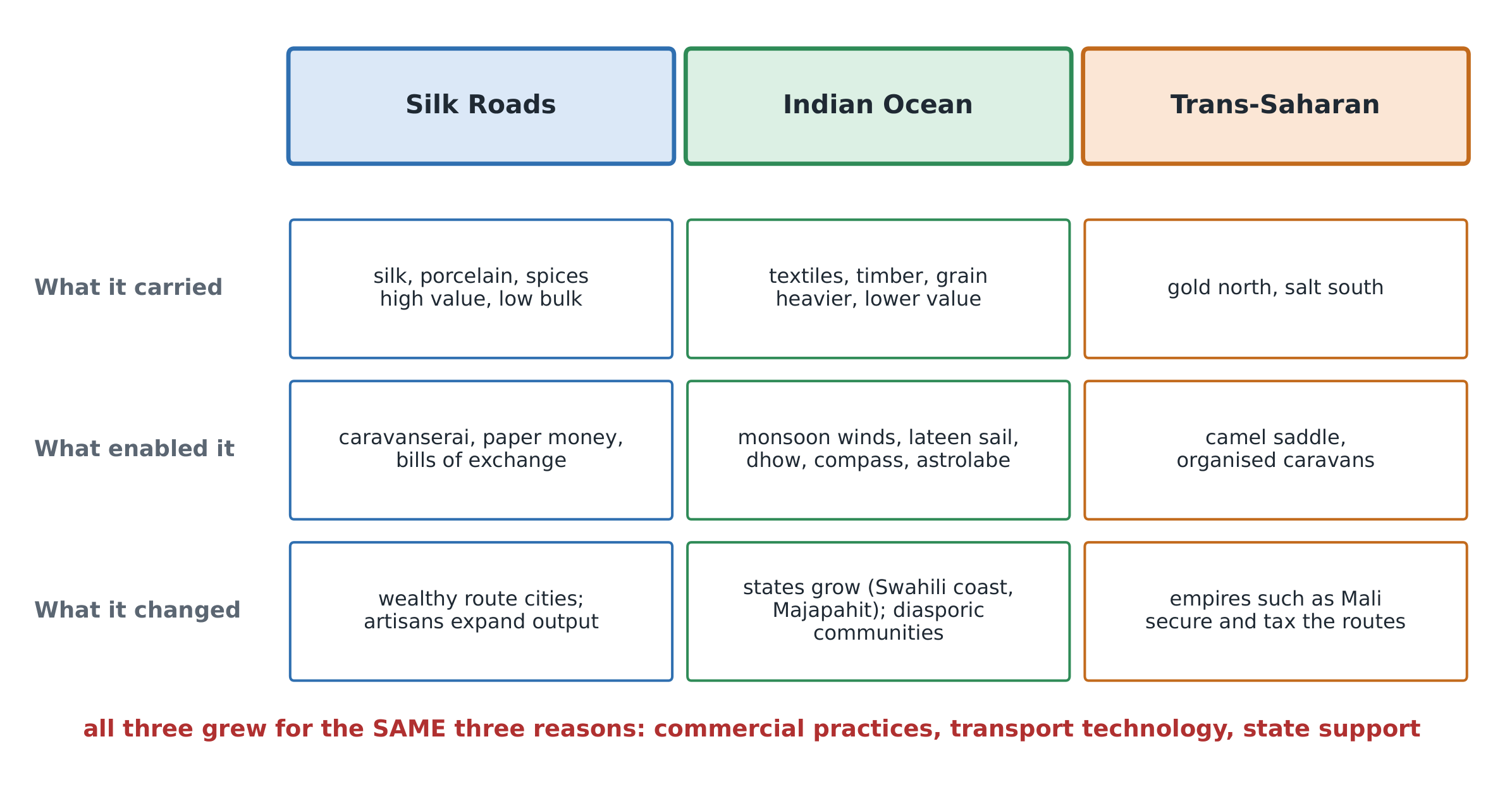
เครือข่ายสามแห่งเปรียบเทียบตามสิ่งที่ขน, สิ่งที่เอื้อต่อการค้า และสิ่งที่เปลี่ยนแปลง
สามเครือข่าย, กรอบการทำงานเดียว: สินค้า, เทคโนโลยีที่เอื้อต่อการค้า และผลกระทบ คือสิ่งที่ข้อสอบถาม

เครือข่ายมหาสมุทรอินเดีย ขนส่งสินค้าที่มีปริมาณมากกว่าเส้นทางไหม - ผ้า, ไม้, ธัญพืช และเครื่องเทศ - เพราะเรือบรรทุกได้มากกว่าอูฐ

เทคโนโลยีที่เอื้อต่อการค้าเป็นทางทะเล: ความรู้เรื่อง ลมมรสุม, ** sail ลาด**, dhow และเครื่องมือนำทางรวมถึง เข็มทิศ และ อัสโทรลาบ

ผลกระทบของมันสามารถออกสอบได้มากที่สุดในหน่วยนี้:

  • เครือข่าย ส่งเสริมการเติบโตของรัฐ เช่น เมืองรัฐสวาฮีลีบนชายฝั่งแอฟริกาตะวันออก และศรีวิชัยกับมาจาปหิตในเอเชียตะวันออกเฉียงใต้
  • พ่อค้าจัดตั้ง ชุมชน diaspora ในท่าเรือสำคัญ นำวัฒนธรรมของตนเองเข้ามาwhile adopting当地 ways
  • การค้าระยะยาวขึ้นอยู่กับและขยาย แรงงานที่ถูกบังคับ以及对 people movement alongside goods.
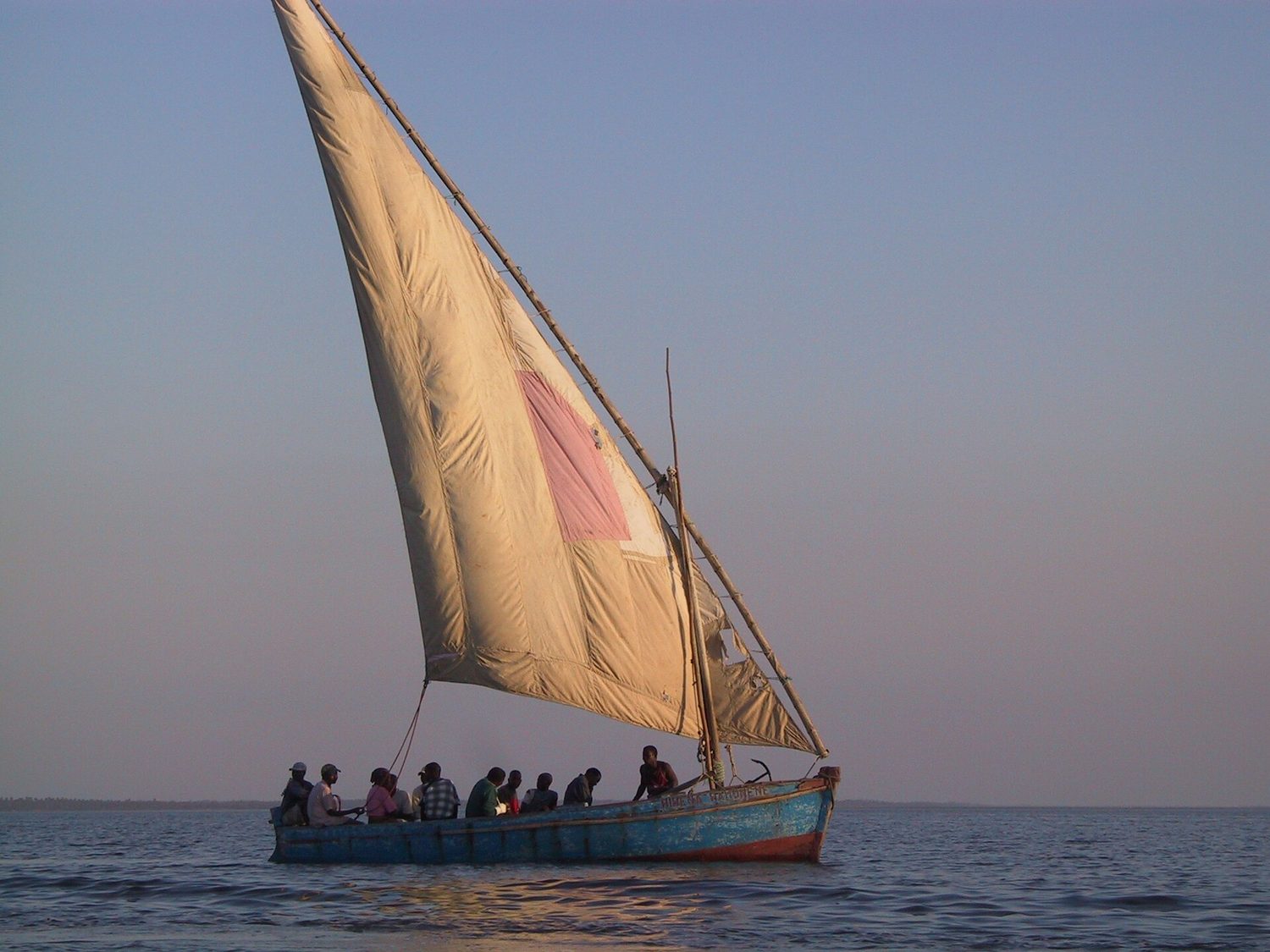
dhow ใต้ lateen sail - Rig ที่讓เรือทำงาน across monsoon system
Vocabulary · ⁨คำศัพท์⁩ Train · ⁨ฝึกฝน⁩
English ไทย
lateen sail/ˈlætiːn seɪl/ sail แบบ lateen
dhow/ˈdiːhaʊ/ เรือดอว์
compass/ˈkʌmpəs/ เข็มทิศ (compass)
astrolabe/ˈæstrəleɪb/ เครื่องวัดดาว (astrolabe)
diasporic communities/ˌdaɪəˈspɒrɪk kəˈmjuːnɪtiz/ ชุมชนพลัดถิ่น
camel saddle/ˈkæml ˈsædl/ อานอูฐ (camel saddle)
2.4

Trans-Saharan Trade · ⁨การค้าข้ามทะเลทรายซาฮารา⁩

Syllabus · ⁨หลักสูตร⁩
English

2.4 Trans-Saharan Trade Routes

Thematic Focus (TEC): Technology and Innovation — Human adaptation and innovation have resulted in increased efficiency, comfort, and security, and technological advances have shaped human development and interactions with both intended and unintended consequences.

Thematic Focus (GOV): Governance — A variety of internal and external factors contribute to state formation, expansion, and decline. Governments maintain order through a variety of administrative institutions, policies, and procedures, and governments obtain, retain, and exercise power in different ways and for different purposes.

Learning Objective Unit 2.H: Explain the causes and effects of the growth of trans-Saharan trade.

  • KC-3.1.II.A.ii The growth of interregional trade was encouraged by innovations in existing transportation technologies.
  • KC-3.1.I.A.iv Improved transportation technologies and commercial practices led to an increased volume of trade and expanded the geographical range of existing trade routes, including the trans-Saharan trade network.

Learning Objective Unit 2.I: Explain how the expansion of empires influenced trade and communication over time.

  • KC-3.1.I.E.ii The expansion of empires—including Mali in West Africa–facilitated Afro-Eurasian trade and communication as new people were drawn into the economies and trade networks.

Illustrative examples:

  • Technologies encouraging interregional trade:
    • Camel saddle
    • Caravans
ไทย

2.4 เส้นทางค้าข้ามทะเลทรายซาฮารา

จุดเน้นเชิงหัวข้อ (TEC): เทคโนโลยีและนวัตกรรม — การปรับตัวและนวัตกรรมของมนุษย์ได้ส่งผลให้ประสิทธิภาพ ความสบาย และความปลอดภัยเพิ่มขึ้น และการพัฒนาทางเทคโนโลยีได้กำหนดการพัฒนาของมนุษย์และการมีปฏิสัมพันธ์กับทั้งผลที่คาดหวังและไม่คาดคิด

ประเด็นเน้น (GOV): การปกครอง — ปัจจัยภายในและภายนอกหลากหลายชนิดมีส่วนร่วมในการก่อตัว การขยายตัว และการล่มสลายของรัฐ รัฐบาลรักษาความสงบเรียบร้อยผ่านสถาบัน นโยบาย และขั้นตอนการบริหารจัดการที่หลากหลาย และรัฐบาลได้รับ รักษาส Powers และใช้อำนาจในรูปแบบและด้วยวัตถุประสงค์ที่แตกต่างกัน

วัตถุประสงค์การเรียนรู้ หน่วย 2.H: อธิบายสาเหตุและผลกระทบของการเติบโตของการค้าข้ามทะเลทรายซาฮารา

  • KC-3.1.II.A.ii การเติบโตของการค้าข้ามภูมิภาคได้รับการส่งเสริมด้วยนวัตกรรมในด้านเทคโนโลยีการขนส่งที่มีอยู่เดิม
  • KC-3.1.I.A.iv เทคโนโลยีการขนส่งที่ดีขึ้นและแนวปฏิบัติทางการพาณิชย์นำไปสู่ปริมาณการค้าที่เพิ่มขึ้นและขยายขอบเขตทางภูมิศาสตร์ของเส้นทางค้าที่มีอยู่เดิม—including เส้นทางค้าข้ามทะเลทรายซาฮารา

วัตถุประสงค์การเรียนรู้ หน่วย 2.I: อธิบายว่าการขยายตัวของจักรวรรดิมีผลต่อการค้าและการสื่อสารอย่างไรตามกาลเวลา

  • KC-3.1.I.E.ii การขยายตัวของจักรวรรดิ—including มาลีในแอฟริกาตะวันตก—ช่วยส่งเสริมการค้าและการสื่อสารระหว่างแอฟริกา-ยูเรเซีย เนื่องจากกลุ่มคนใหม่ถูกดึงเข้ามาสู่เศรษฐกิจและเครือข่ายการค้า

ตัวอย่างประกอบ:

  • เทคโนโลยีที่ส่งเสริมการค้าข้ามภูมิภาค:
    • เบาะสำหรับอูฐ
    • ขบวนรถ

Source: College Board AP Course and Exam Description · ⁨แหล่งที่มา: คำอธิบายหลักสูตรและข้อสอบ College Board AP⁩

English

The trans-Saharan routes crossed the desert on innovations in existing technology - above all the camel saddle 骆驼鞍 and organised caravans 商队.

Gold from West Africa moved north and salt 盐 moved south. The expansion of empires, including Mali 马里帝国, facilitated Afro-Eurasian trade by securing the routes and taxing them - and Mali's wealth and its ruler's famous pilgrimage advertised the region across the Islamic world.

ไทย

เส้นทางข้ามทะเลทรายซาฮารา ข้ามทะเลทรายด้วยนวัตกรรมในเทคโนโลยีที่มีอยู่เดิม - โดยเฉพาะอย่างยิ่ง เบาะอูฐ และ คาร์วาน ที่จัดระเบียบ

ทองคำจากตะวันตกของแอฟริกาเคลื่อนย้ายไปทางเหนือและ เกลือ เคลื่อนย้ายไปทางใต้ การขยายตัวของจักรวรรดิ ซึ่งรวมถึง มาลี ช่วยส่งเสริมการค้าระหว่างแอฟริกา-ยูเรเซีย通过将เส้นทางค้าขายให้ปลอดภัยและเก็บภาษี - และความมั่งคั่งของมาลีและการเดินทางแสวงบุญที่มีชื่อเสียงของ君主ได้ประกาศชื่อเสียงของภูมิภาคนี้ทั่วทั้งโลกอิสลาม。

2.5 2.6

Cultural and Environmental Consequences · ⁨ผลกระทบทางวัฒนธรรมและสิ่งแวดล้อม⁩

Syllabus · ⁨หลักสูตร⁩
English

2.5 Cultural Consequences of Connectivity

Thematic Focus (CDI): Cultural Developments and Interactions — The development of ideas, beliefs, and religions illustrates how groups in society view themselves, and the interactions of societies and their beliefs often have political, social, and cultural implications.

Learning Objective Unit 2.J: Explain the intellectual and cultural effects of the various networks of exchange in Afro-Eurasia from c. 1200 to c. 1450.

  • KC-3.1.III.D Increased cross-cultural interactions resulted in the diffusion of literary, artistic, and cultural traditions, as well as scientific and technological innovations.
  • KC-3.3.II The fate of cities varied greatly, with periods of significant decline and periods of increased urbanization, buoyed by rising productivity and expanding trade networks.
  • KC-3.1.III.C As exchange networks intensified, an increasing number of travelers within Afro-Eurasia wrote about their travels.

Illustrative examples:

  • Diffusion of cultural traditions:
    • The influence of Buddhism in East Asia
    • The spread of Hinduism and Buddhism into Southeast Asia
    • The spread of Islam in sub-Saharan Africa and Asia
  • Diffusion of scientific or technological innovations:
    • Gunpowder from China
    • Paper from China
  • Travelers:
    • Ibn Battuta
    • Margery Kempe
    • Marco Polo
ไทย

2.5 ผลกระทบทางวัฒนธรรมจากการเชื่อมโยง

ประเด็นเน้น (CDI): การพัฒนาและการปฏิสัมพันธ์ทางวัฒนธรรม — การพัฒนาของแนวคิด ความเชื่อ และศาสนาแสดงให้เห็นว่ากลุ่มคนในสังคมมองเห็นตนเองอย่างไร และการปฏิสัมพันธ์ระหว่างสังคมและความเชื่อของพวกเขา มักจะมีนัยสำคัญทางการเมือง สังคม และวัฒนธรรม

วัตถุประสงค์การเรียนรู้ หน่วย 2.J: อธิบายผลกระทบทางปัญญาและวัฒนธรรมของเครือข่ายการแลกเปลี่ยนต่างๆ ในแอฟริกา-ยูเรเซียตั้งแต่ c. 1200 ถึง c. 1450

  • KC-3.1.III.D การมีปฏิสัมพันธ์ข้ามวัฒนธรรมที่เพิ่มขึ้นส่งผลให้เกิดการแพร่กระจายของแบบแผนวรรณกรรม ศิลปะ และวัฒนธรรม รวมถึงนวัตกรรมทางวิทยาศาสตร์และเทคโนโลยี
  • KC-3.3.II บาดับของเมืองมีความหลากหลายอย่างมาก โดยมีช่วงเวลาที่ลดลงอย่างมีนัยสำคัญและช่วงที่มีการขยายตัวของเมืองเพิ่มขึ้น ซึ่งสนับสนุน由高 rising productivity และ expanding trade networks
  • KC-3.1.III.C เมื่อเครือข่ายการแลกเปลี่ยนเข้มข้นขึ้น จำนวนนักเดินทางภายในแอฟริกา-ยูเรเซียที่เขียนเกี่ยวกับการเดินทาง他们也 increasingly

ตัวอย่างประกอบ:

  • การแพร่กระจายของแบบแผนทางวัฒนธรรม:
    • อิทธิพลของพุทธศาสนาในเอเชียตะวันออก
    • การ распространของ Hinduism และ Buddhism เข้าสู่อسیอาตะวันออกเฉียงใต้
    • การplugin of Islam ในแอฟริกาใต้ Sahara และเอเชีย
  • การแพร่กระจายของนวัตกรรมทางวิทยาศาสตร์หรือเทคโนโลยี:
    • ปoppershot จากจีน
    • กระดาษจากจีน
  • นักเดินทาง:
    • อิบน์ บัตตูตะ
    • มาร์เจรี เค็มป์
    • มาร์โค โพลो
English

2.6 Environmental Consequences of Connectivity

Thematic Focus (ENV): Humans and the Environments — The environment shapes human societies, and as populations grow and change, these populations in turn shape their environments.

Learning Objective Unit 2.K: Explain the environmental effects of the various networks of exchange in Afro-Eurasia from c. 1200 to c. 1450.

  • KC-3.1.IV There was continued diffusion of crops and pathogens, with epidemic diseases, including the bubonic plague, along trade routes.

Illustrative examples:

  • Diffusion of crops:
    • Bananas in Africa
    • New rice varieties in East Asia
    • Spread of citrus in the Mediterranean
ไทย

2.6 ผลกระทบทางสิ่งแวดล้อมจากการเชื่อมโยง

ประเด็นหลัก (ENV): มนุษย์และสิ่งแวดล้อม — สิ่งแวดล้อมมีผลต่อสังคมของมนุษย์ และเมื่อประชากรเพิ่มขึ้นหรือเปลี่ยนแปลง ประชากรเหล่านั้นก็จะส่งผลกลับไปยังสิ่งแวดล้อมในทางกลับกัน

วัตถุประสงค์การเรียนรู้ หน่วย 2.K: อธิบายผลกระทบทางสิ่งแวดล้อมจากเครือข่ายการแลกเปลี่ยนต่างๆ ในแอฟริกา-ยูเรเซีย ในช่วงประมาณ ค.ศ. 1200 ถึง ค.ศ. 1450

  • KC-3.1.IV มีการแพร่กระจายของพืชผลและเชื้อโรคอย่างต่อเนื่อง รวมถึงโรคระบาด เช่น plague ตามเส้นทางค้าขาย

ตัวอย่างประกอบ:

  • การแพร่กระจายของพืชผล:
    • กล้วยในแอฟริกา
    • ข้าวพันธุ์ใหม่ในเอเชียตะวันออก
    • การแพร่หลายของส้มมנדารินในทะเลเมดิเตอร์เรเนียน

Source: College Board AP Course and Exam Description · ⁨แหล่งที่มา: คำอธิบายหลักสูตรและข้อสอบ College Board AP⁩

English

Increased cross-cultural interaction produced diffusion 传播 of literary, artistic, scientific, and religious traditions - the spread of Islam along trade routes, Buddhist and Neo-Confucian influence in East Asia, and the movement of scientific and mathematical knowledge.

An increasing number of travellers 旅行者 moved within and between regions, and their accounts are the period's key evidence.

The fate of cities varied: some declined as routes shifted or invasions came, while others grew into major commercial centres.

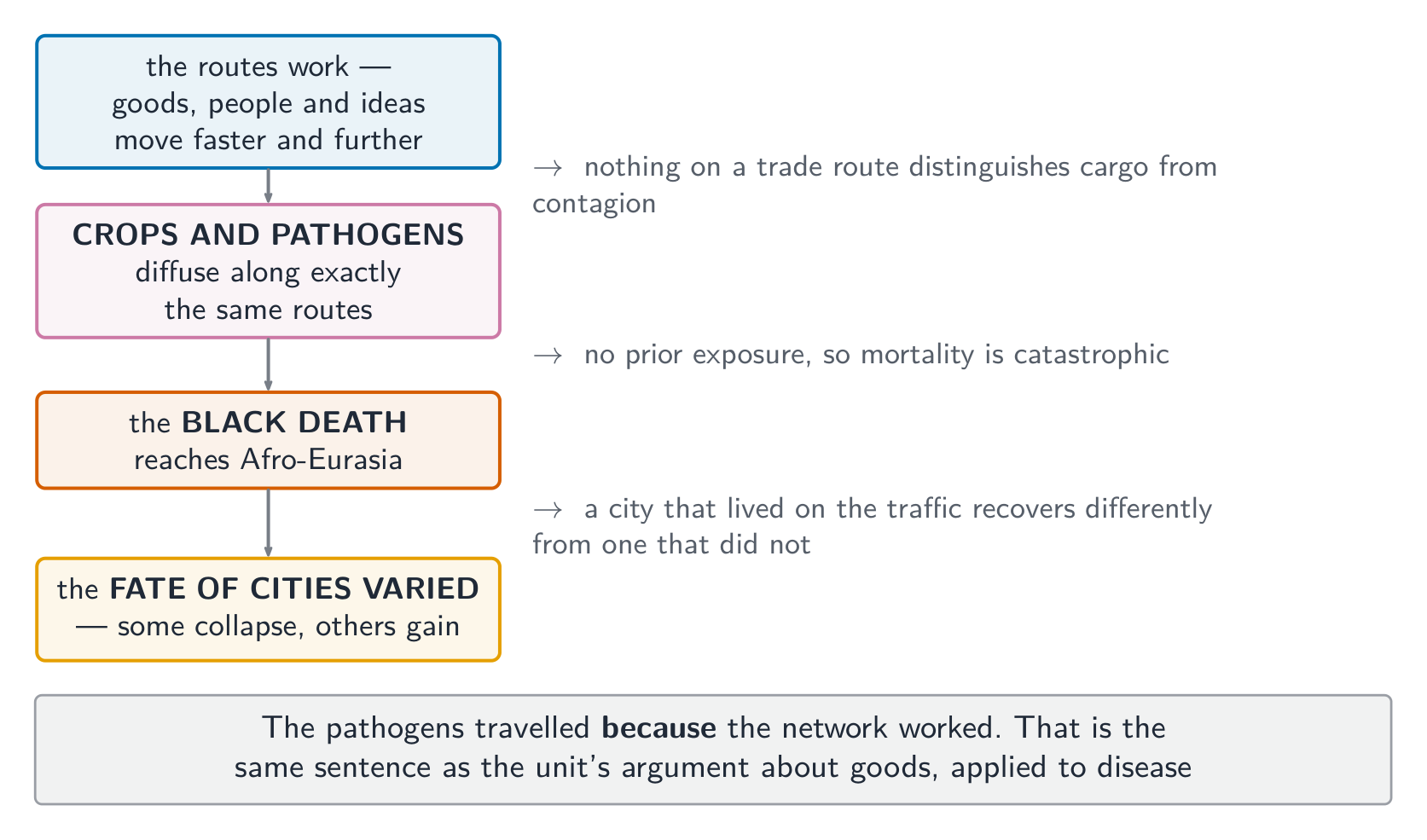
The environmental consequences were as large as the cultural ones. There was continued diffusion of crops and pathogens, and epidemic disease travelled with trade - most catastrophically the Black Death 黑死病, which moved along the same routes that carried goods and killed a large share of the population of Afro-Eurasia.

ไทย

การมีปฏิสัมพันธ์ข้ามวัฒนธรรมที่เพิ่มขึ้นนำไปสู่ การแพร่กระจาย ของประเพณีทางวรรณกรรม ศิลปะ วิทยาศาสตร์ และศาสนา - การแพร่ระบาดของอิสลามตามเส้นทางค้าขาย อิทธิพลของพุทธศาสนาและนอวคอนฟิวเซียนในเอเชียตะวันออก และการเคลื่อนย้ายองค์ความรู้ทางวิทยาศาสตร์และคณิตศาสตร์

จำนวน นักเดินทาง ที่เพิ่มขึ้นเคลื่อนย้ายภายในและระหว่างภูมิภาค และบันทึกเล่าขานของพวกเขาเป็นหลักฐานสำคัญในยุคนี้

ชะตากรรมของ เมืองต่างๆ แตกต่างกัน: บางเมืองเสื่อมลงเนื่องจากเส้นทางค้าขายเปลี่ยนหรือมีการรุกราน ในขณะที่บางเมืองเติบโตขึ้นเป็นศูนย์กลางการค้าหลัก

ผลกระทบด้านสิ่งแวดล้อมมีขนาดใหญ่เท่ากับการผลกระทบด้านวัฒนธรรม มีการ แพร่กระจายของพืชผลและเชื้อโรค อย่างต่อเนื่อง และโรคระบาดเดินทางไปตามเส้นทางการค้า - อย่างเลวร้ายที่สุดคือ โรค/black Death (瘟疫), ซึ่งเคลื่อนที่ตามเส้นทางเดียวกันที่ลำเลียงสินค้าและฆ่าประชากรส่วนใหญ่ของแอฟริกา-ยูเรเซีย

เชื้อโรคเดินทางเพราะเครือข่ายทำงาน - เหตุผลเดียวกันที่ประยุกต์ใช้กับโรค
Explore · ⁨สำรวจ⁩

Follow the network's most consequential cargo

The pathogens travelled because the network worked — the same argument the unit makes about goods, applied to disease.

Vocabulary · ⁨คำศัพท์⁩ Train · ⁨ฝึกฝน⁩
English ไทย
Black Death/blæk deθ/ โรคระบาดดำ (Black Death)
2.7

Comparison of Economic Exchange · ⁨เปรียบเทียบการแลกเปลี่ยนทางเศรษฐกิจ⁩

Syllabus · ⁨หลักสูตร⁩
English

2.7 Comparison of Economic Exchange

Learning Objective Unit 2.L: Explain the similarities and differences among the various networks of exchange in the period from c. 1200 to c. 1450.

  • KC-3.1 A deepening and widening of networks of human interaction within and across regions contributed to cultural, technological, and biological diffusion within and between various societies.
    • KC-3.1.I.A.i Improved commercial practices led to an increased volume of trade and expanded the geographical range of existing trade routes—including the Silk Roads—promoting the growth of powerful new trading cities.
    • KC-3.1.I.C.i The growth of interregional trade in luxury goods was encouraged by innovations in previously existing transportation and commercial technologies, including the caravanserai, forms of credit, and the development of money economies.
  • KC-3.3 Changes in trade networks resulted from and stimulated increasing productive capacity, with important implications for social and gender structures and environmental processes.
    • KC-3.3.I.B Demand for luxury goods increased in Afro-Eurasia. Chinese, Persian, and Indian artisans and merchants expanded their production of textiles and porcelains for export; manufacture of iron and steel expanded in China.
ไทย

2.7 เปรียบเทียบการแลกเปลี่ยนทางเศรษฐกิจ

วัตถุประสงค์การเรียนรู้ หน่วย 2.L: อธิบายความคล้ายคลึงและความแตกต่างระหว่างเครือข่ายการแลกเปลี่ยนต่างๆ ในช่วงเวลาประมาณ ค.ศ. 1200 ถึง ค.ศ. 1450

  • KC-3.1 การขยายตัวและความลึกซึ้งของเครือข่ายความสัมพันธ์ระหว่างมนุษย์ทั้งภายในและข้ามภูมิภาค ช่วยส่งเสริมการแพร่กระจายทางวัฒนธรรม เทคโนโลยี และชีวภาพ ภายในและระหว่างสังคมต่างๆ
    • KC-3.1.I.A.i การพัฒนาวิธีการค้าที่ดียิ่งขึ้น นำไปสู่ปริมาณการค้าที่เพิ่มขึ้น และขยายขอบเขตทางภูมิศาสตร์ของเส้นทางค้าที่มีอยู่เดิม—including那条丝绸之路—ส่งเสริมการเติบโตของเมืองค้าขายใหม่ที่มีอำนาจ
    • KC-3.1.I.C.i การเติบโตของการค้าข้ามภูมิภาคสินค้าฟุ่มเฟือย ถูกกระตุ้นด้วยนวัตกรรมในเทคโนโลยีการขนส่งและการค้าที่มีอยู่เดิม รวมถึงการคาราวันเซอรี รูปแบบของเครดิต และการพัฒนาของระบบเงินตรา
  • KC-3.3 การเปลี่ยนแปลงในเครือข่ายการค้าเกิดจากและกระตุ้นให้เพิ่มกำลังการผลิต ซึ่งส่งผลกระทบต่อโครงสร้างทางสังคมและเพศสภาพ serta กระบวนการทางสิ่งแวดล้อมอย่างมีนัยสำคัญ
    • KC-3.3.I.B ความต้องการสินค้าฟุ่มเฟือยเพิ่มขึ้นในแอฟริกา-ยูเร시아 ช่างฝีมือและพ่อค้าชาวจีน เปอร์เซีย และอินเดียขยายการผลิตสิ่งทอและเครื่องกระเบื้องสำหรับส่งออก;การผลิตเหล็กและเหล็กกล้าขยายตัวในประเทศจีน

Source: College Board AP Course and Exam Description · ⁨แหล่งที่มา: คำอธิบายหลักสูตรและข้อสอบ College Board AP⁩

English

The unit's reasoning skill is comparison. Compare the networks on what they carried, what made them possible, and what they changed - not on which was "most important".

Worked example (a real AP exam question). AP World short-answer questions frequently ask students to "Explain one similarity" or "Explain one difference" between two trade networks in this period. A full-mark answer names the feature and applies it to both, then explains: "Both the Silk Roads and the Indian Ocean network expanded because of improved commercial practices, but the Indian Ocean carried heavier, lower-value goods such as timber and grain because ships could transport far greater bulk than overland caravans." Notice the shape: the because clause is what turns a difference into an explanation, and without it the answer only describes.

ไทย

ทักษะการคิดของหน่วยนี้คือ การเปรียบเทียบ เปรียบเทียบเครือข่ายโดยดูว่าพวกเขาส่งอะไร ทำให้เกิดอะไรขึ้น และเปลี่ยนแปลงอะไร - ไม่ใช่ดูว่าอันไหน "สำคัญที่สุด"

ตัวอย่างวิธีทำ (คำถามจริงในการสอบ AP). คำถามตอบสั้นของ AP World มัก要求学生 "อธิบายความคล้ายคลึงหนึ่งอย่าง" หรือ "อธิบายความแตกต่างหนึ่งอย่าง" ระหว่างเครือข่ายการค้าสองแห่งในยุคนี้ คำตอบเต็มคะแนนจะระบุลักษณะและนำไปใช้กับทั้งสอง แล้วอธิบาย: "ทั้งถนนสายไหมและเครือข่ายมหาสมุทรอินเดียขยายตัวเนื่องจากปรับปรุงวิธีการค้า แต่เครือข่ายมหาสมุทรอินเดียขนส่งสินค้าที่มีน้ำหนักมากแต่มีมูลค่าต่ำเช่นไม้และข้าวbecauseเรือสามารถขนส่งปริมาณมหาศาลได้มากกว่าขบวนคาราวานบนบก" ระวังรูปแบบ: clause because คือสิ่งที่แปลงความแตกต่างให้เป็นคำอธิบาย และหากไม่มีมันคำตอบจะเพียงบรรยายเท่านั้น

2.7

Exam tips · ⁨ข้อแนะนำสำหรับการสอบ⁩

English
  • Explain growth with the three causes - commercial practices, transport technology, state support - rather than listing trade goods.
  • Match cargo to carrier: overland routes move high-value, low-bulk goods; maritime routes move bulk.
  • Learn the enabling technologies by network: caravanserai and credit; monsoons, lateen sail and dhow; the camel saddle.
  • The Mongols' examinable role is facilitating exchange, not conquest for its own sake.
  • The Black Death is the environmental consequence to name, and it travelled on the trade network itself.
  • On difference questions, always add the because. A stated difference without a cause is only half an answer.
ไทย
  • อธิบายการเติบโตด้วยสาเหตุสามอย่าง - วิธีการค้า เทคโนโลยีการขนส่ง การสนับสนุนของรัฐ แทนที่จะรายการสินค้าค้า
  • จับคู่ cargo กับ carrier: เส้นทางบนบก ขนส่งสินค้ามีมูลค่าสูงแต่ปริมาณน้อย; เส้นทางทางทะเล ขนส่งปริมาณมาก
  • เรียนรู้เทคโนโลยีที่เอื้ออำนวยโดยเครือข่าย: caravanserai และเครดิต; ฤดูลมมรสุม sail ลายจระเข้ และ dhow; จักรยานอูฐ
  • บทบาทที่ออกข้อสอบของมองโกลคือ การ facilitating การแลกเปลี่ยน ไม่ใช่การพิชิตเพื่อความบันเทิงตัวเอง
  • Black Death เป็นผลกระทบด้านสิ่งแวดล้อมที่ต้องระบุ และมันเดินทางบนเครือข่ายการค้าเอง
  • ในคำถามความแตกต่าง ต้องเพิ่ม because เสมอ ความแตกต่างที่กล่าวถึงโดยไม่ระบุสาเหตุเป็นเพียงครึ่งหนึ่งของคำตอบ
Vocabulary · ⁨คำศัพท์⁩ Train · ⁨ฝึกฝน⁩
English ไทย
Improved commercial practices/ɪmˈpruːvd kəˈmɜːʃl ˈpræktɪsɪz/ การพัฒนาวิธีการค้าขาย
money economies/ˈmʌni ɪˈkɒnəmiz/ เศรษฐกิจที่ใช้เงิน
credit/ˈkredɪt/ เครดิต
Improved transportation technologies/ɪmˈpruːvd trænspɔːˈteɪʃn tekˈnɒlədʒiz/ เทคโนโลยีการขนส่งที่ดีขึ้น
State support/steɪt səˈpɔːt/ การสนับสนุนของรัฐ
luxury goods/ˈlʌkʃəri ɡʊdz/ สินค้าหรูหรา
Silk Roads/sɪlk rəʊdz/ เส้นทางสายไหม
caravanserai/ˈkærəvænsəraɪ/ คาราเวนเซไร (caravanserai)
paper money/ˈpeɪpə ˈmʌni/ เงินกระดาษ
bills of exchange/bɪlz ɒv eksˈtʃeɪndʒ/ bills of exchange (ใบสั่งแลกเงิน)
Mongol Empire/ˈmɒŋɡɒl ˈempaɪə/ จักรวรรดิมองโกล
Pax Mongolica/pæks mɒnˈɡɒlɪkə/ สันติภาพแห่งมองโกล (Pax Mongolica)
monsoon winds/mɒnˈsuːn wɪndz/ ลมมรสุม
caravans/ˈkærəvænz/ ขบวนรถ
salt/sɒlt/ เกลือ
Mali/ˈmɑːli/ มาลี
diffusion/dɪˈfjuːʒn/ การแพร่
travellers/ˈtræveləz/ นักเดินทาง

Interactive lessons on this topic · ⁨บทเรียนเชิงโต้ตอบสำหรับหัวข้อนี้⁩

Work through it step by step, with instant-check exercises. · ⁨ทำทีละขั้นตอน พร้อมแบบฝึกหัดตรวจสอบผลทันที⁩

Past Papers · ⁨ข้อสอบย้อนหลัง⁩

More topics in AP World History: Modern · ⁨AP ประวัติศาสตร์โลก: สมัยใหม่⁩ · ⁨หัวข้อเพิ่มเติมใน AP World History: Modern · ⁨AP ประวัติศาสตร์โลก: สมัยใหม่⁩⁩

Log in or create account · ⁨เข้าสู่ระบบหรือสร้างบัญชี⁩

IGCSE, A-Level & AP