Skip to content · ⁨ข้ามไปยังเนื้อหา⁩
Subjects · ⁨รายวิชา⁩

AP World History: Modern · ⁨AP ประวัติศาสตร์โลก: สมัยใหม่⁩

Tips · ⁨เคล็ดลับ⁩

AP World History: Modern covers roughly 1200 CE to the present in nine units - the global tapestry of societies around 1200, networks of exchange, land-based empires, transoceanic connections, revolutions, the consequences of industrialisation, global conflict, the Cold War and decolonisation, and globalisation.

The scale is global, and so is the thinking. Questions rarely ask about one country alone. They ask you to compare regions, trace a network across continents, or explain why a similar pressure produced different outcomes in different places.

Themes carry across the whole course: governance, economic systems, cultural developments, social interactions and organisation, technology and innovation, and humans and the environment. Each topic names the theme it belongs to, which is the fastest way to see how distant units connect.

Learn processes, not just events. Trade networks, state formation, industrialisation and migration are processes with causes, mechanisms and effects - and that structure is what written answers are built on.

The notes below follow the College Board framework unit by unit, with the key concepts and the illustrative examples the framework itself offers.

  • 1

    The Global Tapestry

    Watch lesson · ⁨ดูบทเรียน⁩
    1.1

    Reading the World in 1200 · ⁨การอ่านโลกในศตวรรษที่ 1200⁩

    Syllabus · ⁨หลักสูตร⁩
    English

    1.1 Developments in East Asia from c. 1200 to c. 1450

    Thematic Focus (GOV): Governance — A variety of internal and external factors contribute to state formation, expansion, and decline. Governments maintain order through a variety of administrative institutions, policies, and procedures, and governments obtain, retain, and exercise power in different ways and for different purposes.

    Thematic Focus (CDI): Cultural Developments and Interactions — The development of ideas, beliefs, and religions illustrates how groups in society view themselves, and the interactions of societies and their beliefs often have political, social, and cultural implications.

    Learning Objective Unit 1.A: Explain the systems of government employed by Chinese dynasties and how they developed over time.

    • KC-3.2.I.A Empires and states in Afro-Eurasia and the Americas demonstrated continuity, innovation, and diversity in the 13th century. This included the Song Dynasty of China, which utilized traditional methods of Confucianism and an imperial bureaucracy to maintain and justify its rule.

    Learning Objective Unit 1.B: Explain the effects of Chinese cultural traditions on East Asia over time. THEMATIC FOCUS Economics Systems ECN As societies develop, they affect and are affected by the ways that they produce, exchange, and consume goods and services. LEARNING OBJECTIVE

    • KC-3.1.III.D.i Chinese cultural traditions continued, and they influenced neighboring regions.
    • KC-3.1.III.D.ii Buddhism and its core beliefs continued to shape societies in Asia and included a variety of branches, schools, and practices. HISTORICAL DEVELOPMENTS

    Learning Objective Unit 1.C: Explain the effects of innovation on the Chinese economy over time.

    • KC-3.3.III.A.i The economy of Song China became increasingly commercialized while continuing to depend on free peasant and artisanal labor.
    • KC-3.1.I.D The economy of Song China flourished as a result of increased productive capacity, expanding trade networks, and innovations in agriculture and manufacturing.

    Illustrative examples:

    • Cultural traditions:
      • Filial piety in East Asia
      • Influence of Neo-Confucianism and Buddhism in East Asia
      • Confucian traditions of both respect for and expected deference from women
      • Chinese literary and scholarly traditions and their spread to Heian Japan and Korea
    • Branches of Buddhism:
      • Theravada
      • Mahayana
      • Tibetan
    • Technological innovations:
      • Champa rice
      • Transportation innovations, like the Grand Canal expansion
      • Steel and iron production
      • Textiles and porcelains for export
    ไทย

    1.1 การพัฒนาในเอเชียตะวันออกตั้งแต่ประมาณ ค.ศ. 1200 ถึงประมาณ ค.ศ. 1450

    ประเด็นเน้น (GOV): การปกครอง — ปัจจัยภายในและภายนอกหลากหลายชนิดมีส่วนร่วมในการก่อตัว การขยายตัว และการล่มสลายของรัฐ รัฐบาลรักษาความสงบเรียบร้อยผ่านสถาบัน นโยบาย และขั้นตอนการบริหารจัดการที่หลากหลาย และรัฐบาลได้รับ รักษาส Powers และใช้อำนาจในรูปแบบและด้วยวัตถุประสงค์ที่แตกต่างกัน

    ประเด็นเน้น (CDI): การพัฒนาและการปฏิสัมพันธ์ทางวัฒนธรรม — การพัฒนาของแนวคิด ความเชื่อ และศาสนาแสดงให้เห็นว่ากลุ่มคนในสังคมมองเห็นตนเองอย่างไร และการปฏิสัมพันธ์ระหว่างสังคมและความเชื่อของพวกเขา มักจะมีนัยสำคัญทางการเมือง สังคม และวัฒนธรรม

    เป้าหมายการเรียนรู้ หน่วย 1.A: อธิบายระบบการปกครองที่ราชวงศ์จีนใช้ และวิธีการพัฒนาระบบเหล่านี้ตามกาลเวลา

    • KC-3.2.I.A จักรวรรดิและรัฐในแอฟริกา-ยูเรเชียและอเมริกา แสดงถึงความต่อเนื่อง นวัตกรรม และความหลากหลายในศตวรรษที่ 13 ซึ่งรวมถึงราชวงศ์ซ่งของจีน ที่ใช้วิธีดั้งเดิมของขงจื้อและระบบราชการจักรพรรดิเพื่อรักษาส Powers และให้เหตุผลในการปกครอง

    เป้าหมายการเรียนรู้ หน่วย 1.B: อธิบายผลกระทบของมรดกทางวัฒนธรรมจีนที่มีต่อเอเชียตะวันออกตามกาลเวลา. ประเด็นเน้น เศรษฐศาสตร์ ระบบ ECN เมื่อสังคมพัฒนาขึ้น พวกมันส่งผลและถูกส่งผลโดยวิธีการผลิต แลกเปลี่ยน และบริโภคสินค้าและบริการ

    • KC-3.1.III.D.i มรดกทางวัฒนธรรมจีนยังคงอยู่ และส่งผลกระทบต่อภูมิภาคเพื่อนบ้าน
    • KC-3.1.III.D.ii ศาสนาพุทธและความเชื่อหลักของมันยังคงมีอิทธิพลต่อสังคมในเอเชีย รวมถึงสาย流派不同,学校不同的,实践不同的。การพัฒนาทางประวัติศาสตร์

    เป้าหมายการเรียนรู้ หน่วย 1.C: อธิบายผลกระทบของนวัตกรรมต่อเศรษฐกิจจีนตามกาลเวลา

    • KC-3.3.III.A.i เศรษฐกิจของจีนราชวงศ์ซ่งมีการเชิงพาณิชย์มากขึ้นในขณะที่ยังคงพึ่งพาแรงงาน农民的อิสระและช่างฝีมือ
    • KC-3.1.I.D เศรษฐกิจของจีนราชวงศ์ซ่งเจริญรุ่งเรืองเนื่องจากความสามารถในการผลิตที่เพิ่มขึ้น เครือข่ายการค้าที่ขยายตัว และนวัตกรรมในเกษตรกรรมและอุตสาหกรรม

    ตัวอย่างประกอบ:

    • มรดกทางวัฒนธรรม:
      • ความกตัญญูต่อพ่อแม่ในเอเชียตะวันออก
      • อิทธิพลของขงจื้อสมัยใหม่และศาสนาพุทธในเอเชียตะวันออก
      • ขงจื้อประเพณีของการเคารพและคาดหวังความสุภาพจากผู้หญิง
      • มรดกทางวรรณกรรมและวิชาการของจีนและการแพร่กระจายไปยังญี่ปุ่นไฮอันและเกาหลี
    • สาย流派ของศาสนาพุทธ:
      • เถรวาท
      • มหายาน
      • ทิเบต
    • นวัตกรรมทางเทคโนโลยี:
      • ข้าวชัมปา
      • นวัตกรรมด้านการขนส่ง เช่น การขยายคลองใหญ่
      • การผลิตเหล็กและเหล็กกล้า
      • สิ่งทอและเครื่องปั้นดินเผาสำหรับการส่งออก

    Source: College Board AP Course and Exam Description · ⁨แหล่งที่มา: คำอธิบายหลักสูตรและข้อสอบ College Board AP⁩

    English

    Unit 1 surveys the major regions of the world around 1200 to 1450, just before the great connecting networks of Unit 2. Its purpose is comparison: by the end you should be able to say how any two of these societies were governed, what held them together, and how they made their living.

    Three questions apply everywhere, and answering them for each region is the whole unit:

    • How is the state organised? Who rules, through what officials, and paid for how?
    • What belief system shapes society? Religion supplies law, education, and legitimacy in every region here.
    • What is the economic base? Agriculture almost everywhere, but with very different labour systems and levels of trade.
    ไทย

    หน่วยที่ 1 พิจารณาภูมิภาคหลักของโลกในช่วง 1200 ถึง 1450 ก่อนเครือข่ายการเชื่อมโยงครั้งใหญ่ของหน่วยที่ 2 วัตถุประสงค์คือการเปรียบเทียบ: เมื่อสิ้นสุดคุณควร会说ได้ว่าสังคมสองแห่ง中的任意两个是如何治理的,什么将它们维系在一起,以及它们如何谋生。

    มีสามคำถามที่ใช้ได้กับทุกภูมิภาค และการตอบคำถามเหล่านี้สำหรับแต่ละภูมิภาคคือเนื้อหาทั้งหมดของหน่วยนี้:

    • รัฐถูกจัดระเบียบอย่างไร? ใครเป็นผู้นำ ผ่านเจ้าหน้าที่ใด และ谁来支付费用?
    • ระบบความเชื่อใดที่มีอิทธิพลต่อสังคม? ศาสนาให้กฎหมาย การศึกษา และความชอบธรรมในทุกภูมิภาคที่นี่
    • ฐานเศรษฐกิจคืออะไร? การเกษตรเกือบทุกที่ แต่มีระบบแรงงานและระดับการค้าที่แตกต่างกันอย่างมาก
    1.1

    East Asia · ⁨เอเชียตะวันออก⁩

    Syllabus · ⁨หลักสูตร⁩
    English

    1.1 Developments in East Asia from c. 1200 to c. 1450

    Thematic Focus (GOV): Governance — A variety of internal and external factors contribute to state formation, expansion, and decline. Governments maintain order through a variety of administrative institutions, policies, and procedures, and governments obtain, retain, and exercise power in different ways and for different purposes.

    Thematic Focus (CDI): Cultural Developments and Interactions — The development of ideas, beliefs, and religions illustrates how groups in society view themselves, and the interactions of societies and their beliefs often have political, social, and cultural implications.

    Learning Objective Unit 1.A: Explain the systems of government employed by Chinese dynasties and how they developed over time.

    • KC-3.2.I.A Empires and states in Afro-Eurasia and the Americas demonstrated continuity, innovation, and diversity in the 13th century. This included the Song Dynasty of China, which utilized traditional methods of Confucianism and an imperial bureaucracy to maintain and justify its rule.

    Learning Objective Unit 1.B: Explain the effects of Chinese cultural traditions on East Asia over time. THEMATIC FOCUS Economics Systems ECN As societies develop, they affect and are affected by the ways that they produce, exchange, and consume goods and services. LEARNING OBJECTIVE

    • KC-3.1.III.D.i Chinese cultural traditions continued, and they influenced neighboring regions.
    • KC-3.1.III.D.ii Buddhism and its core beliefs continued to shape societies in Asia and included a variety of branches, schools, and practices. HISTORICAL DEVELOPMENTS

    Learning Objective Unit 1.C: Explain the effects of innovation on the Chinese economy over time.

    • KC-3.3.III.A.i The economy of Song China became increasingly commercialized while continuing to depend on free peasant and artisanal labor.
    • KC-3.1.I.D The economy of Song China flourished as a result of increased productive capacity, expanding trade networks, and innovations in agriculture and manufacturing.

    Illustrative examples:

    • Cultural traditions:
      • Filial piety in East Asia
      • Influence of Neo-Confucianism and Buddhism in East Asia
      • Confucian traditions of both respect for and expected deference from women
      • Chinese literary and scholarly traditions and their spread to Heian Japan and Korea
    • Branches of Buddhism:
      • Theravada
      • Mahayana
      • Tibetan
    • Technological innovations:
      • Champa rice
      • Transportation innovations, like the Grand Canal expansion
      • Steel and iron production
      • Textiles and porcelains for export
    ไทย

    1.1 การพัฒนาในเอเชียตะวันออกตั้งแต่ประมาณ ค.ศ. 1200 ถึงประมาณ ค.ศ. 1450

    ประเด็นเน้น (GOV): การปกครอง — ปัจจัยภายในและภายนอกหลากหลายชนิดมีส่วนร่วมในการก่อตัว การขยายตัว และการล่มสลายของรัฐ รัฐบาลรักษาความสงบเรียบร้อยผ่านสถาบัน นโยบาย และขั้นตอนการบริหารจัดการที่หลากหลาย และรัฐบาลได้รับ รักษาส Powers และใช้อำนาจในรูปแบบและด้วยวัตถุประสงค์ที่แตกต่างกัน

    ประเด็นเน้น (CDI): การพัฒนาและการปฏิสัมพันธ์ทางวัฒนธรรม — การพัฒนาของแนวคิด ความเชื่อ และศาสนาแสดงให้เห็นว่ากลุ่มคนในสังคมมองเห็นตนเองอย่างไร และการปฏิสัมพันธ์ระหว่างสังคมและความเชื่อของพวกเขา มักจะมีนัยสำคัญทางการเมือง สังคม และวัฒนธรรม

    เป้าหมายการเรียนรู้ หน่วย 1.A: อธิบายระบบการปกครองที่ราชวงศ์จีนใช้ และวิธีการพัฒนาระบบเหล่านี้ตามกาลเวลา

    • KC-3.2.I.A จักรวรรดิและรัฐในแอฟริกา-ยูเรเชียและอเมริกา แสดงถึงความต่อเนื่อง นวัตกรรม และความหลากหลายในศตวรรษที่ 13 ซึ่งรวมถึงราชวงศ์ซ่งของจีน ที่ใช้วิธีดั้งเดิมของขงจื้อและระบบราชการจักรพรรดิเพื่อรักษาส Powers และให้เหตุผลในการปกครอง

    เป้าหมายการเรียนรู้ หน่วย 1.B: อธิบายผลกระทบของมรดกทางวัฒนธรรมจีนที่มีต่อเอเชียตะวันออกตามกาลเวลา. ประเด็นเน้น เศรษฐศาสตร์ ระบบ ECN เมื่อสังคมพัฒนาขึ้น พวกมันส่งผลและถูกส่งผลโดยวิธีการผลิต แลกเปลี่ยน และบริโภคสินค้าและบริการ

    • KC-3.1.III.D.i มรดกทางวัฒนธรรมจีนยังคงอยู่ และส่งผลกระทบต่อภูมิภาคเพื่อนบ้าน
    • KC-3.1.III.D.ii ศาสนาพุทธและความเชื่อหลักของมันยังคงมีอิทธิพลต่อสังคมในเอเชีย รวมถึงสาย流派不同,学校不同的,实践不同的。การพัฒนาทางประวัติศาสตร์

    เป้าหมายการเรียนรู้ หน่วย 1.C: อธิบายผลกระทบของนวัตกรรมต่อเศรษฐกิจจีนตามกาลเวลา

    • KC-3.3.III.A.i เศรษฐกิจของจีนราชวงศ์ซ่งมีการเชิงพาณิชย์มากขึ้นในขณะที่ยังคงพึ่งพาแรงงาน农民的อิสระและช่างฝีมือ
    • KC-3.1.I.D เศรษฐกิจของจีนราชวงศ์ซ่งเจริญรุ่งเรืองเนื่องจากความสามารถในการผลิตที่เพิ่มขึ้น เครือข่ายการค้าที่ขยายตัว และนวัตกรรมในเกษตรกรรมและอุตสาหกรรม

    ตัวอย่างประกอบ:

    • มรดกทางวัฒนธรรม:
      • ความกตัญญูต่อพ่อแม่ในเอเชียตะวันออก
      • อิทธิพลของขงจื้อสมัยใหม่และศาสนาพุทธในเอเชียตะวันออก
      • ขงจื้อประเพณีของการเคารพและคาดหวังความสุภาพจากผู้หญิง
      • มรดกทางวรรณกรรมและวิชาการของจีนและการแพร่กระจายไปยังญี่ปุ่นไฮอันและเกาหลี
    • สาย流派ของศาสนาพุทธ:
      • เถรวาท
      • มหายาน
      • ทิเบต
    • นวัตกรรมทางเทคโนโลยี:
      • ข้าวชัมปา
      • นวัตกรรมด้านการขนส่ง เช่น การขยายคลองใหญ่
      • การผลิตเหล็กและเหล็กกล้า
      • สิ่งทอและเครื่องปั้นดินเผาสำหรับการส่งออก
    Source: College Board AP Course and Exam Description · ⁨แหล่งที่มา: คำอธิบายหลักสูตรและข้อสอบ College Board AP⁩

    English

    Song China 宋朝中国 is the unit's benchmark state. Its economy became increasingly commercialized 商业化 while remaining largely agrarian 农业为主, supported by rising productive capacity - Champa rice 占城稻, iron and steel production, and transport improvements such as the expanded Grand Canal 大运河.

    Government ran through a bureaucracy 官僚体系 staffed by the civil service examination 科举制度, which recruited officials on merit and gave the state unusual administrative depth.

    Chinese cultural traditions continued and influenced neighbouring regions - Korea, Japan, and Vietnam adopted writing, bureaucratic models, and belief systems. Neo-Confucianism 新儒学 shaped society, including filial piety 孝道 and the expectation of women's deference. Buddhism 佛教 continued to shape Asian societies and spread further, in forms including Theravada 上座部佛教, Mahayana 大乘佛教, and Tibetan 藏传佛教 Buddhism.

    What Song China made, and why it matters later. The commercialised economy did not only feed itself: it produced textiles 纺织品, porcelains 瓷器 and iron for export, in workshops organised for volume rather than for a household's own use. Paper money and credit instruments circulated to pay for it. This is the supply side of the Indian Ocean trade you meet in the next unit — the demand for Chinese porcelain and silk is what put ships on those routes, so treat Song manufacturing as a cause of the trading world, not a detail about China.

    Confucian expectations cut both ways for women. Neo-Confucianism held that women were owed respect within the family and were morally central to it, while also expecting deference 顺从 to father, husband and son. Both halves are in the CED, and a question asking about continuity and change in women's status wants the tension between them rather than one side alone; the spread of foot binding 缠足 among elite families in this period is the usual evidence for the restrictive half.

    ไทย

    จีนราชวงศ์ซ่ง เป็นรัฐมาตรฐานของหน่วย เศรษฐกิจมีความเป็นเชิงพาณิชย์มากขึ้นwhile remaining largely agrarian, supported by rising productive capacity - Champa rice, iron and steel production, and transport improvements such as the expanded Grand Canal.

    รัฐบาลดำเนินการผ่านระบบ ราชการ ที่ staffing by the civil service examination, which recruited officials on merit and gave the state unusual administrative depth.

    ประเพณีทางวัฒนธรรมของจีนยังคงอยู่และมีอิทธิพลต่อภูมิภาคเพื่อนบ้าน - เกาหลี ญี่ปุ่น และเวียดนามได้นำการเขียน ระบบราชการ และระบบความเชื้อมาใช้ Neo-Confucianism shaped society, including filial piety and the expectation of women's deference. Buddhism continued to shape Asian societies and spread further, in forms including Theravada, Mahayana, and Tibetan Buddhism.

    Song China as one chain: agricultural gains pay for the bureaucracy that the examination staffs

    สิ่งที่ราชวงศ์ซ่งผลิต และทำไมมันจึงสำคัญในอนาคต The commercialised economy did not only feed itself: it produced textiles, porcelains and iron for export, in workshops organised for volume rather than for a household's own use. Paper money and credit instruments circulated to pay for it. This is the supply side of the Indian Ocean trade you meet in the next unit — the demand for Chinese porcelain and silk is what put ships on those routes, so treat Song manufacturing as a cause of the trading world, not a detail about China.

    ความคาดหวังแบบCONFUCIANICTO CUT BOTH WAYS FOR WOMEN. Neo-Confucianism held that women were owed respect within the family and were morally central to it, while also expecting deference to father, husband and son. Both halves are in the CED, and a question asking about continuity and change in women's status wants the tension between them rather than one side alone; the spread of foot binding among elite families in this period is the usual evidence for the restrictive half.

    Explore · ⁨สำรวจ⁩

    Build the Song engine · ⁨สร้างเครื่องยนต์ของราชวงศ์ซง⁩

    Champa rice, the canal and the examination are one chain: agricultural gains pay for a bureaucracy that merit staffs. · ⁨ข้าวชัมปา คลอง และระบบสอบเป็นห่วงโซ่เดียว: ผลผลิตทางการเกษตรจ่ายค่าข้าราชการที่มีบุคลากรตามสมรรถนะ⁩

    Vocabulary · ⁨คำศัพท์⁩ Train · ⁨ฝึกฝน⁩
    English ไทย
    Song China/sɒŋ ˈtʃaɪnə/ ราชวงศ์ซงจีน
    commercialized/kəˈmɜːʃəlaɪzd/ เชิงพาณิชย์
    agrarian/æˈɡreərɪən/ เกษตรกรรม
    Champa rice/ˈtʃæmpə raɪs/ ข้าวฉางมา (Champa rice)
    Grand Canal/ɡrænd kəˈnæl/ คลองใหญ่
    bureaucracy/bjʊəˈrɒkrəsi/ ราชการ
    civil service examination/ˈsɪvl ˈsɜːvɪs eɡˌzæmɪˈneɪʃn/ การสอบข้าราชการ
    Neo-Confucianism/ˈniːəʊ kənˈfjuːʃɪənɪzəm/ neo-confucianism
    filial piety/ˈfɪlɪəl ˈpaɪəti/ ความกตัญญูต่อบิดามารดา (filial piety)
    Buddhism/ˈbʊdɪzəm/ พุทธศาสนา
    Theravada/ðəræˈvɑːdə/ เถรวาท
    Mahayana/ˌmæheɪˈɑːnə/ มหายาน
    Tibetan/tɪˈbetn/ ทิเบต
    textiles/ˈtekstaɪlz/ สิ่งทอ
    porcelains/ˈpɔːsɪlɪnz/ เครื่องเคลือบ
    deference/ˈdefrəns/ การเคารพ
    foot binding/fʊt ˈbaɪndɪŋ/ การมัดเท้า
    1.2

    Dar al-Islam · ⁨ดารอัล-อิสলাম⁩

    Syllabus · ⁨หลักสูตร⁩
    English

    1.2 Developments in Dar al-Islam from c. 1200 to c. 1450

    Thematic FocusLearning ObjectiveHistorical Developments

    CDI
    Cultural Developments and Interactions — The development of ideas, beliefs, and religions illustrates how groups in society view themselves, and the interactions of societies and their beliefs often have political, social, and cultural implications.

    Unit 1.D
    Explain how systems of belief and their practices affected society in the period from c. 1200 to c. 1450. THEMATIC FOCUS Governance GOV A variety of internal and external factors contribute to state formation, expansion, and decline. Governments maintain order through a variety of administrative institutions, policies, and procedures, and governments obtain, retain, and exercise power in different ways and for different purposes. LEARNING OBJECTIVE

    • KC-3.1.III.D.iii Islam, Judaism, Christianity, and the core beliefs and practices of these religions continued to shape societies in Africa and Asia. HISTORICAL DEVELOPMENTS

    Unit 1.E
    Explain the causes and effects of the rise of Islamic states over time.

    • KC-3.2.I As the Abbasid Caliphate fragmented, new Islamic political entities emerged, most of which were dominated by Turkic peoples. These states demonstrated continuity, innovation, and diversity.
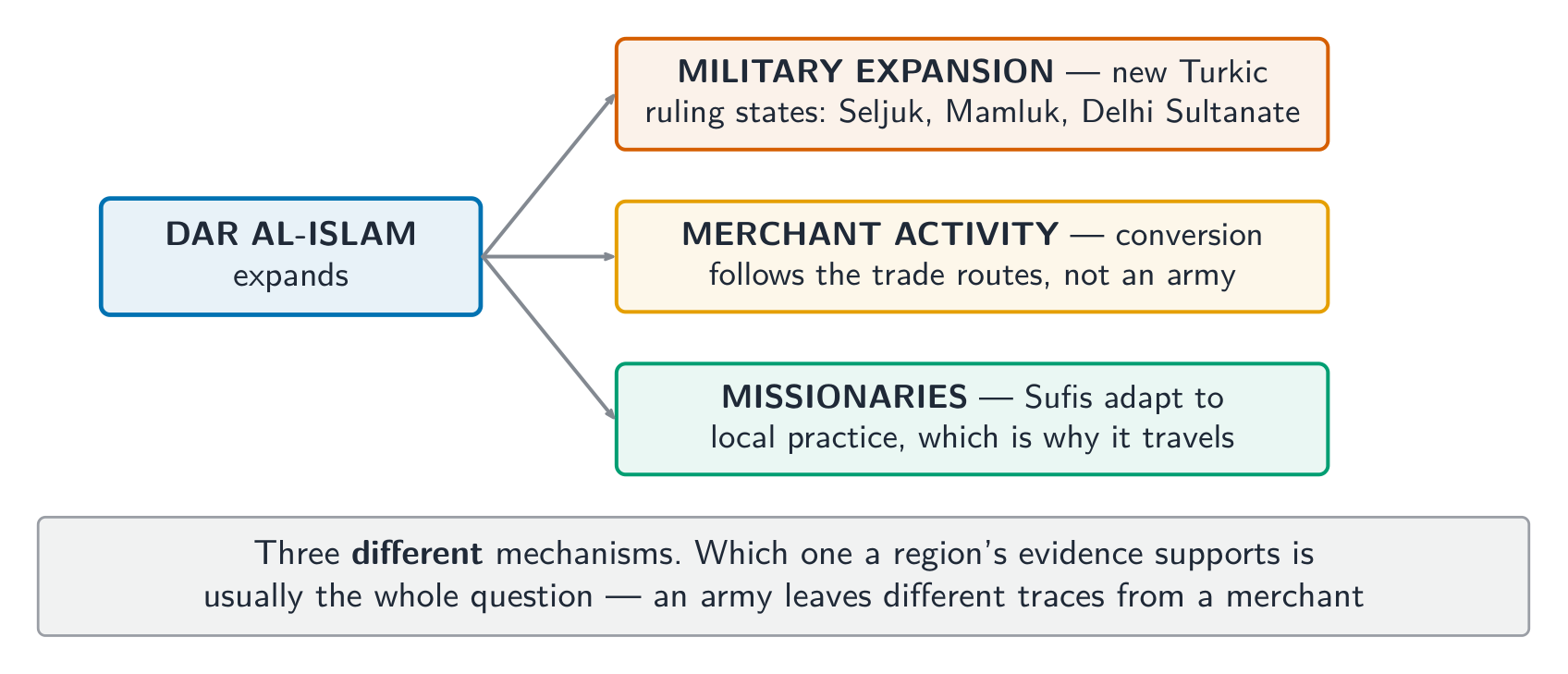
    • KC-3.1.III.A Muslim rule continued to expand to many parts of Afro-Eurasia due to military expansion, and Islam subsequently expanded through the activities of merchants, missionaries, and Sufis. HISTORICAL DEVELOPMENTS

    Unit 1.F
    Explain the effects of intellectual innovation in Dar al-Islam.

    • KC-3.2.II.A.i Muslim states and empires encouraged significant intellectual innovations and transfers.

    Illustrative examples:

    • New Islamic political entities:
      • Seljuk Empire
      • Mamluk sultanate of Egypt
      • Delhi sultanates (CONT’D) Innovations:
      • Advances in mathematics (Nasir al-Din al-Tusi)
      • Advances in literature ('A'ishah al-Ba'uniyyah)
      • Advances in medicine Transfers:
      • Preservation and commentaries on Greek moral and natural philosophy
      • House of Wisdom in Abbasid Bagdad
      • Scholarly and cultural transfers in Muslim and Christian Spain
    ไทย

    1.2 Development in Dar al-Islam from c. 1200 to c. 1450

    ประเด็นเน้น (CDI): การพัฒนาและการปฏิสัมพันธ์ทางวัฒนธรรม — การพัฒนาของแนวคิด ความเชื่อ และศาสนาแสดงให้เห็นว่ากลุ่มคนในสังคมมองเห็นตนเองอย่างไร และการปฏิสัมพันธ์ระหว่างสังคมและความเชื่อของพวกเขา มักจะมีนัยสำคัญทางการเมือง สังคม และวัฒนธรรม วัตถุประสงค์การเรียนรู้หน่วย 1.D: อธิบายว่าระบบความเชื่อและแนวปฏิบัติต่างๆ ส่งผลต่อสังคมในช่วงเวลาประมาณ 1200 ถึงประมาณ 1450 อย่างไร FOCUS หัวข้อ Governance GOV ปัจจัยภายในและภายนอกหลากหลายประการมีส่วน促成การสร้าง ขยายตัว และการลดลงของรัฐ รัฐบาลรักษาความสงบเรียบร้อยผ่านสถาบัน นโยบาย และขั้นตอนการปกครองที่หลากหลาย และรัฐบาลรับมา เก็บรักษา และใช้อำนาจในรูปแบบและวัตถุประสงค์ที่แตกต่างกัน LEARNING OBJECTIVE

    • KC-3.1.III.D.iii อิสลาม ยูดาอิส คริสต์ศาสนา และความเชื่อและแนวปฏิบัติหลักของศาสนาเหล่านี้ ยังคงกำหนดรูปแบบสังคมในแอฟริกาและเอเชีย การพัฒนาทางประวัติศาสตร์
    Learning ObjectiveHistorical Developments

    Unit 1.E
    อธิบายสาเหตุและผลกระทบของการ rising of Islamic states over time.

    • KC-3.2.I เมื่อจักรวรรดิอาบباسิดแตกสลาย เกิดรัฐการเมืองislamic ใหม่ขึ้น หลายแห่งซึ่งส่วนใหญ่ถูกควบคุมโดยชนเผ่าตุรกี รัฐเหล่านี้แสดงความต่อเนื่อง นวัตกรรม และความหลากหลาย
    • KC-3.1.III.A การปกครองของมุสลิมยังคงขยายไปยังหลายส่วนของแอฟโร-ยูเรเซียเนื่องจากความขยายตัวทางการทหาร และislamic subsequently ขยายขอบเขตผ่านกิจกรรมของพ่อค้า นักเผยแผ่ศาสนา และซุฟี่ การพัฒนาทางประวัติศาสตร์

    Unit 1.F
    อธิบาย effects of intellectual innovation in Dar al-Islam.

    • KC-3.2.II.A.i รัฐและจักรวรรดิของมุสลิมส่งเสริมนวัตกรรมทางปัญญาและการถ่ายทอดความรู้ที่สำคัญ

    ตัวอย่างประกอบ:

    • New Islamic political entities:
      • Seljuk Empire
      • Mamluk sultanate of Egypt
      • Delhi sultanates (CONT’D) Innovations:
      • Advances in mathematics (Nasir al-Din al-Tusi)
      • Advances in literature ('A'ishah al-Ba'uniyyah)
      • Advances in medicine Transfers:
      • Preservation and commentaries on Greek moral and natural philosophy
      • House of Wisdom in Abbasid Bagdad
      • Scholarly and cultural transfers in Muslim and Christian Spain

    Source: College Board AP Course and Exam Description · ⁨แหล่งที่มา: คำอธิบายหลักสูตรและข้อสอบ College Board AP⁩

    English

    As the Abbasid Caliphate 阿拔斯哈里发国 fragmented, new Islamic political entities emerged, most of them Turkic 突厥人 in origin - among them the Seljuk Empire 塞尔柱帝国, the Mamluk sultanate of Egypt 埃及马穆鲁克苏丹国, and the Delhi Sultanate 德里苏丹国.

    Muslim rule continued to expand across Afro-Eurasia through military expansion, merchant activity 商人活动, and the work of missionaries 传教士, especially Sufis 苏非派, whose adaptable practice helped Islam spread.

    Muslim states encouraged significant intellectual innovations and transfers 智识创新与传播: advances in mathematics, medicine, and astronomy, gathered in the House of Wisdom 智慧宫 in Abbasid Baghdad, and the preservation and extension of Greek learning that later moved into Europe.

    ไทย

    As the Abbasid Caliphate fragmented, new Islamic political entities emerged, most of them Turkic in origin - among them the Seljuk Empire, the Mamluk sultanate of Egypt, and the Delhi Sultanate.

    Muslim rule continued to expand across Afro-Eurasia through military expansion, merchant activity, and the work of missionaries, especially Sufis, whose adaptable practice helped Islam spread.

    Muslim states encouraged significant intellectual innovations and transfers: advances in mathematics, medicine, and astronomy, gathered in the House of Wisdom in Abbasid Baghdad, and the preservation and extension of Greek learning that later moved into Europe.

    Three different mechanisms of expansion - which one the evidence supports is usually the question
    Explore · ⁨สำรวจ⁩

    Match each expansion to its mechanism · ⁨จับคู่แต่ละการขยายกับกลไกของมัน⁩

    Military expansion, merchant activity and Sufi missionaries leave different evidence — which one a region supports is usually the question. · ⁨การขยายตัวทางทหาร กิจกรรมการค้า และนักเผยแผ่ซุฟี่ทิ้งร่องรอยต่างกัน — การที่ภูมิภาคใดรองรับสิ่งใด มักเป็นคำถามหลัก⁩

    Vocabulary · ⁨คำศัพท์⁩ Train · ⁨ฝึกฝน⁩
    English ไทย
    Abbasid Caliphate/ˈæbeɪsɪd ˈkælɪfeɪt/ -caliphate Abbasid Caliphate
    Turkic/ˈtɜːkɪk/ Turkic
    Seljuk Empire/ˈseldʒʌk ˈempaɪə/ Empire Seljuk Empire
    Mamluk sultanate of Egypt/ˈmæmlʌk ˈsʌltəneɪt ɒv ˈiːdʒɪpt/ Sultanate Mamluk sultanate of Egypt
    Delhi Sultanate/ˈdeli ˈsʌltəneɪt/ Delhi Sultanate
    merchant activity/ˈmɜːtʃənt ækˈtɪvɪti/ กิจกรรมการค้า
    missionaries/ˈmɪʃənəriz/ missionaries
    Sufis/ˈsjuːfiz/ Sufis
    intellectual innovations and transfers/ˌɪntəˈlektʃuːəl ˌɪnəˈveɪʃnz ænd ˈtrænsfɜːz/ นวัตกรรมและ Transfer intellectual innovations and transfers
    House of Wisdom/haʊs ɒv ˈwɪzdəm/ House of Wisdom
    1.3

    South and Southeast Asia · ⁨เอเชียใต้และเอเชียตะวันออกเฉียงใต้⁩

    Syllabus · ⁨หลักสูตร⁩
    English

    1.3 Developments in South and Southeast Asia from c. 1200 to c. 1450

    Thematic FocusLearning ObjectiveHistorical Developments

    CDI
    Cultural Developments and Interactions — The development of ideas, beliefs, and religions illustrates how groups in society view themselves, and the interactions of societies and their beliefs often have political, social, and cultural implications.

    Unit 1.G
    Explain how the various belief systems and practices of South and Southeast Asia affected society over time. THEMATIC FOCUS Governance GOV A variety of internal and external factors contribute to state formation, expansion, and decline. Governments maintain order through a variety of administrative institutions, policies, and procedures, and governments obtain, retain, and exercise power in different ways and for different purposes. LEARNING OBJECTIVE

    • KC-3.1.III.D.iv Hinduism, Islam, and Buddhism, and their core beliefs and practices, continued to shape societies in South and Southeast Asia. HISTORICAL DEVELOPMENTS

    Unit 1.H
    Explain how and why various states of South and Southeast Asia developed and maintained power over time.

    • KC-3.2.I.B.i State formation and development demonstrated continuity, innovation, and diversity, including the new Hindu and Buddhist states that emerged in South and Southeast Asia.

    Illustrative examples:

    • Beliefs and practices:
      • Bhakti movement
      • Sufism
      • Buddhist monasticism
    • Hindu/Buddhist states:
      • Vijayanagara Empire
      • Srivijaya Empire
      • Rajput kingdoms
      • Khmer Empire
      • Majapahit
      • Sukhothai kingdom
      • Sinhala dynasties
    ไทย

    1.3 Developments in South and Southeast Asia from c. 1200 to c. 1450

    ประเด็นเน้น (CDI): การพัฒนาและการปฏิสัมพันธ์ทางวัฒนธรรม — การพัฒนาของแนวคิด ความเชื่อ และศาสนาแสดงให้เห็นว่ากลุ่มคนในสังคมมองเห็นตนเองอย่างไร และการปฏิสัมพันธ์ระหว่างสังคมและความเชื่อของพวกเขา มักจะมีนัยสำคัญทางการเมือง สังคม และวัฒนธรรม วัตถุประสงค์การเรียนรู้หน่วย 1.G: อธิบายว่าระบบความเชื่อและแนวปฏิบัติต่างๆ ของเอเชียใต้และเอเชียตะวันออกเฉียงใต้ส่งผลต่อสังคมอย่างไรตามกาลเวลา FOCUS หัวข้อ Governance GOV ปัจจัยภายในและภายนอกหลากหลายประการมีส่วน促成การสร้าง ขยายตัว และการลดลงของรัฐ รัฐบาลรักษาความสงบเรียบร้อยผ่านสถาบัน นโยบาย และขั้นตอนการปกครองที่หลากหลาย และรัฐบาลรับมา เก็บรักษา และใช้อำนาจในรูปแบบและวัตถุประสงค์ที่แตกต่างกัน LEARNING OBJECTIVE

    • KC-3.1.III.D.iv ฮินดูอิส伊斯兰 and Buddhism และความเชื่อและแนวปฏิบัติหลักของพวกเขา ยังคงกำหนดรูปแบบสังคมในเอเชียใต้และเอเชียตะวันออกเฉียงใต้ การพัฒนาทางประวัติศาสตร์
    Learning ObjectiveHistorical Developments

    Unit 1.H
    อธิบาย how and why various states of South and Southeast Asia developed and maintained power over time.

    • KC-3.2.I.B.i การก่อตัวและการพัฒนาของรัฐแสดงถึงความต่อเนื่อง นวัตกรรม และความหลากหลาย รวมถึงรัฐใหม่ทางศาสนาฮินดูและพุทธที่เกิดขึ้นในเอเชียใต้และเอเชียตะวันออกเฉียงใต้

    ตัวอย่างประกอบ:

    • ความเชื่อและประเพณี:
      • การเคลื่อนไหวของภักติ
      • สูฟิยัม
      • วิหารสงฆ์แบบพุทธ
    • รัฐฮินดู/พุทธ:
      • ราชวงศ์วิญยานการะ
      • ราชวงศ์ศรีวิชัย
      • ราชวงศ์ราชปุต
      • ราชวงศ์ขمر
      • ราชวงศ์มาจาพหิต
      • ราชวงศ์สุโขทัย
      • ราชวงศ์ซิงหลา

    Source: College Board AP Course and Exam Description · ⁨แหล่งที่มา: คำอธิบายหลักสูตรและข้อสอบ College Board AP⁩

    English

    Hinduism 印度教, Islam, and Buddhism continued to shape the region, and their meeting produced new devotional forms - the bhakti movement 巴克提运动 in Hinduism and Sufism in Islam, both emphasising direct personal devotion.

    State formation showed the unit's theme of continuity and diversity: the Delhi Sultanate ruled much of the north, Vijayanagara 维查耶纳伽尔 arose in the south, and in Southeast Asia the sea-based Majapahit 满者伯夷 and the land-based Khmer Empire 高棉帝国 organised power in different ways.

    ไทย

    Hinduism, Islam, and Buddhism continued to shape the region, and their meeting produced new devotional forms - the bhakti movement in Hinduism and Sufism in Islam, both emphasising direct personal devotion.

    State formation showed the unit's theme of continuity and diversity: the Delhi Sultanate ruled much of the north, Vijayanagara arose in the south, and in Southeast Asia the sea-based Majapahit and the land-based Khmer Empire organised power in different ways.

    Vocabulary · ⁨คำศัพท์⁩ Train · ⁨ฝึกฝน⁩
    English ไทย
    Hinduism/ˈhɪndjuːɪzəm/ ฮินดูศาสนา
    bhakti movement/ˈbʌkti ˈmuːvmənt/ bhakti movement
    Vijayanagara/ˌvɪdʒeɪˌænəˈɡɑːrə/ วิชยานการ
    Majapahit/ˈmædʒəpæhɪt/ Majapahit
    Khmer Empire/kmɪə ˈempaɪə/ จักรวรรดิขมร
    1.4 1.5

    The Americas and Africa · ⁨อเมริกาและแอฟริกา⁩

    Syllabus · ⁨หลักสูตร⁩
    English

    1.4 State Building in the Americas

    Thematic Focus (GOV): Governance — A variety of internal and external factors contribute to state formation, expansion, and decline. Governments maintain order through a variety of administrative institutions, policies, and procedures, and governments obtain, retain, and exercise power in different ways and for different purposes.

    Learning Objective Unit 1.I: Explain how and why states in the Americas developed and changed over time.

    • KC-3.2.I.D.i In the Americas, as in Afro-Eurasia, state systems demonstrated continuity, innovation, and diversity, and expanded in scope and reach.

    Illustrative examples:

    • State systems in the Americas:
      • Maya city-states
      • Mexica
      • Inca
      • Chaco
      • Mesa Verde
      • Cahokia
    ไทย

    1.4 การสร้างรัฐในทวีปอเมริกา

    ประเด็นเน้น (GOV): การปกครอง — ปัจจัยภายในและภายนอกหลากหลายชนิดมีส่วนร่วมในการก่อตัว การขยายตัว และการล่มสลายของรัฐ รัฐบาลรักษาความสงบเรียบร้อยผ่านสถาบัน นโยบาย และขั้นตอนการบริหารจัดการที่หลากหลาย และรัฐบาลได้รับ รักษาส Powers และใช้อำนาจในรูปแบบและด้วยวัตถุประสงค์ที่แตกต่างกัน

    วัตถุประสงค์การเรียนรู้ หน่วย 1.I: อธิบายว่ารัฐในทวีปอเมริกามีการพัฒนาและเปลี่ยนแปลงไปอย่างไรและทำไมจึงเป็นเช่นนั้น

    • KC-3.2.I.D.i ในทวีปอเมริกา เช่นเดียวกับแอฟริกา-ยูเรเชีย ระบบรัฐได้แสดงถึงความต่อเนื่อง นวัตกรรม และความหลากหลาย และขยายขอบเขตและอิทธิพลออกไป

    ตัวอย่างประกอบ:

    • ระบบรัฐในทวีปอเมริกา:
      • นครรัฐมายา
      • เมกซิกา
      • อินคา
      • ชาคो
      • เมซา เวร์เด
      • คาโฮκια
    English

    1.5 State Building in Africa

    Thematic Focus (GOV): Governance — A variety of internal and external factors contribute to state formation, expansion, and decline. Governments maintain order through a variety of administrative institutions, policies, and procedures, and governments obtain, retain, and exercise power in different ways and for different purposes.

    Learning Objective Unit 1.J: Explain how and why states in Africa developed and changed over time.

    • KC-3.2.I.D.ii In Africa, as in Eurasia and the Americas, state systems demonstrated continuity, innovation, and diversity and expanded in scope and reach.

    Illustrative examples:

    • State systems in Africa:
      • Great Zimbabwe
      • Ethiopia
      • Hausa kingdoms
    ไทย

    1.5 การสร้างรัฐในทวีปแอฟริกา

    ประเด็นเน้น (GOV): การปกครอง — ปัจจัยภายในและภายนอกหลากหลายชนิดมีส่วนร่วมในการก่อตัว การขยายตัว และการล่มสลายของรัฐ รัฐบาลรักษาความสงบเรียบร้อยผ่านสถาบัน นโยบาย และขั้นตอนการบริหารจัดการที่หลากหลาย และรัฐบาลได้รับ รักษาส Powers และใช้อำนาจในรูปแบบและด้วยวัตถุประสงค์ที่แตกต่างกัน

    วัตถุประสงค์การเรียนรู้ หน่วย 1.J: อธิบายว่ารัฐในทวีปแอฟริกามีการพัฒนาและเปลี่ยนแปลงไปอย่างไรและทำไมจึงเป็นเช่นนั้น

    • KC-3.2.I.D.ii ในทวีปแอฟริกา เช่นเดียวกับยูเรเซียและทวีปอเมริกา ระบบรัฐได้แสดงถึงความต่อเนื่อง นวัตกรรม และความหลากหลาย และขยายขอบเขตและอิทธิพลออกไป

    ตัวอย่างประกอบ:

    • ระบบรัฐในทวีปแอฟริกา:
      • กษัตริย์ซิมบาบเว่
      • เอธิโอเปีย
      • ราชวงศ์เฮาซา

    Source: College Board AP Course and Exam Description · ⁨แหล่งที่มา: คำอธิบายหลักสูตรและข้อสอบ College Board AP⁩

    English

    In the Americas, state systems showed continuity, innovation, and diversity: the Maya 玛雅 city-states, the Mexica 墨西加人 (Aztec) with tribute-based expansion, and the Inca 印加 with a centralised administration, labour obligation, and road system.

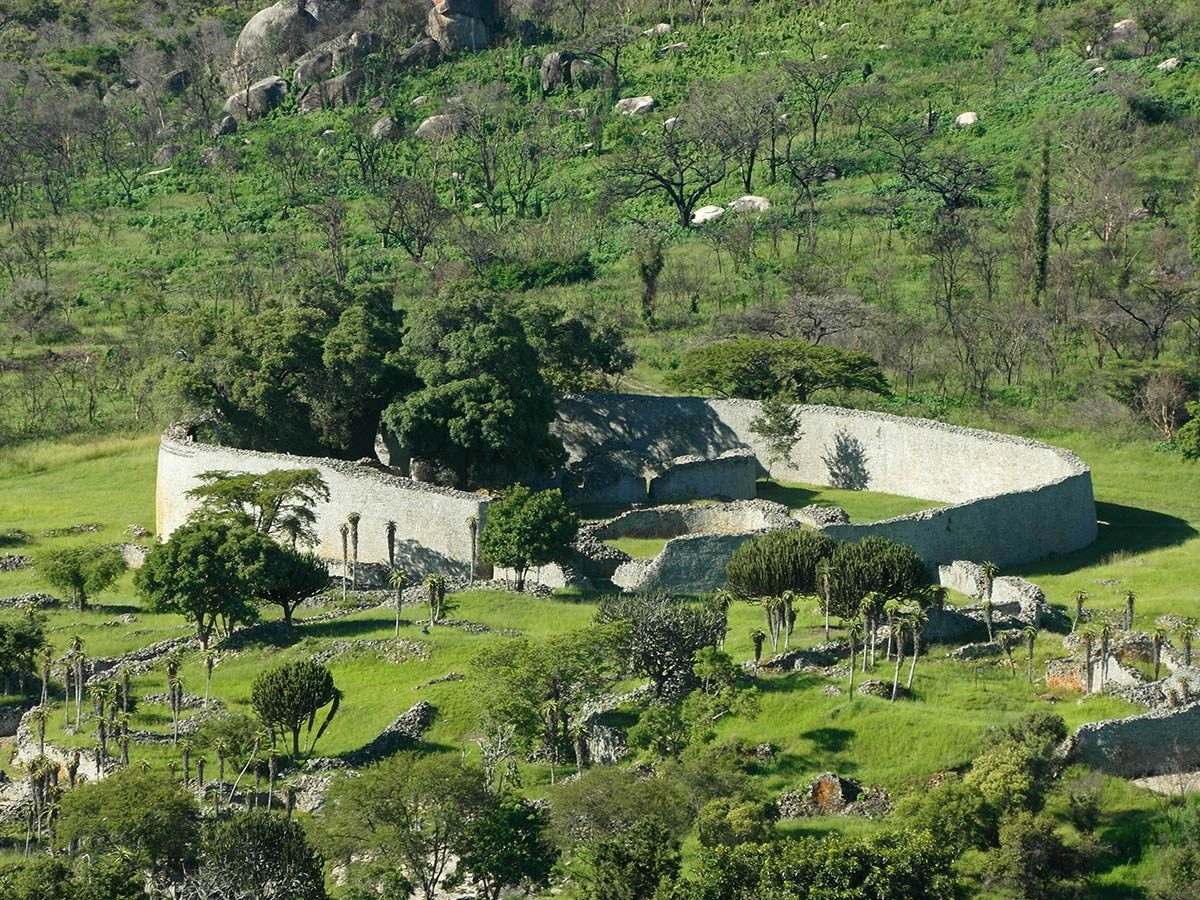
    In Africa, state systems likewise varied: Great Zimbabwe 大津巴布韦 grew on gold and cattle, Ethiopia 埃塞俄比亚 was a long-established Christian kingdom, and the Hausa Kingdoms 豪萨城邦 sat on trans-Saharan trade routes.

    ไทย
    The same three questions asked of six regions - the comparison the unit is built to support
    One framework, six regions: state, belief system, and economic base are what comparison questions actually ask about

    In the Americas, state systems showed continuity, innovation, and diversity: the Maya city-states, the Mexica (Aztec) with tribute-based expansion, and the Inca with a centralised administration, labour obligation, and road system.

    In Africa, state systems likewise varied: Great Zimbabwe grew on gold and cattle, Ethiopia was a long-established Christian kingdom, and the Hausa Kingdoms sat on trans-Saharan trade routes.

    The outer walls of Great Zimbabwe - dry-stone construction, and a state built on the gold trade
    Vocabulary · ⁨คำศัพท์⁩ Train · ⁨ฝึกฝน⁩
    English ไทย
    Maya/ˈmaɪə/ Maya
    Mexica/ˈmeksɪkə/ เม็กซิคา
    Inca/ˈɪŋkə/ อินคา
    Great Zimbabwe/ɡreɪt zɪmˈbɑːbwi/ เกรตซิมบับเว
    Ethiopia/ˌiːθɪˈəʊpɪə/ เอธิโอเปีย
    Hausa Kingdoms/ˈhɔːsə ˈkɪŋdəmz/ Hausa Kingdoms
    comparison/kəmˈpærɪsn/ การเปรียบเทียบ
    1.6

    Europe · ⁨ยุโรป⁩

    Syllabus · ⁨หลักสูตร⁩
    English

    1.6 Developments in Europe from c. 1200 to c. 1450

    Thematic Focus (CDI): Cultural Developments and Interactions — The development of ideas, beliefs, and religions illustrates how groups in society view themselves, and the interactions of societies and their beliefs often have political, social, and cultural implications.

    Thematic Focus (SIO): Social Interactions and Organization — The process by which societies group their members and the norms that govern the interactions between these groups and between individuals influence political, economic, and cultural institutions and organization.

    Learning Objective Unit 1.K: Explain how the beliefs and practices of the predominant religions in Europe affected European society. THEMATIC FOCUS Governance GOV A variety of internal and external factors contribute to state formation, expansion, and decline. Governments maintain order through a variety of administrative institutions, policies, and procedures, and governments obtain, retain, and exercise power in different ways and for different purposes. LEARNING OBJECTIVE

    • KC-3.1.III.D.v Christianity, Judaism, Islam, and the core beliefs and practices of these religions continued to shape societies in Europe. HISTORICAL DEVELOPMENTS

    Learning Objective Unit 1.L: Explain the causes and consequences of political decentralization in Europe from c. 1200 to c. 1450.

    • KC-3.2.I.B.ii Europe was politically fragmented and characterized by decentralized monarchies, feudalism, and the manorial system.

    Learning Objective Unit 1.M: Explain the effects of agriculture on social organization in Europe from c. 1200 to c. 1450.

    • KC-3.3.III.C Europe was largely an agricultural society dependent on free and coerced labor, including serfdom.
    ไทย

    1.6 การพัฒนาในยุโรปตั้งแต่ ค.ศ. 1200 ถึง ค.ศ. 1450

    ประเด็นเน้น (CDI): การพัฒนาและการปฏิสัมพันธ์ทางวัฒนธรรม — การพัฒนาของแนวคิด ความเชื่อ และศาสนาแสดงให้เห็นว่ากลุ่มคนในสังคมมองเห็นตนเองอย่างไร และการปฏิสัมพันธ์ระหว่างสังคมและความเชื่อของพวกเขา มักจะมีนัยสำคัญทางการเมือง สังคม และวัฒนธรรม

    จุดเน้นเชิงประเด็น (SIO): ปฏิสัมพันธ์และการจัดระเบียบทางสังคม — กระบวนการที่สังคมรวมกลุ่มสมาชิกของตนและบรรทัดฐานที่ควบคุมการปฏิสัมพันธ์ระหว่างกลุ่มเหล่านี้และระหว่างบุคคลมีผลต่อสถาบันและการจัดระเบียบทางการเมือง เศรษฐกิจ และวัฒนธรรม

    วัตถุประสงค์การเรียนรู้ หน่วย 1.K: อธิบายว่าความเชื่อและประเพณีของศาสนาหลักในยุโรปส่งผลต่อสังคมยุโรปอย่างไร จุดเน้นเชิงประเด็น: การปกครอง GOV ปัจจัยภายในและภายนอกหลากหลายชนิดมีส่วนร่วมในการก่อตัว ขยายตัว และการล่มสลายของรัฐ รัฐบาลรักษาความเป็นระเบียบผ่านสถาบัน นโยบาย และกระบวนการบริหารต่างๆ และรัฐบาลรับ得来 รักษำ และใช้อำนาจในรูปแบบและด้วยวัตถุประสงค์ที่แตกต่างกัน

    • KC-3.1.III.D.v ศาสนาคริสต์ ยูดาห์ อิสลาม และความเชื่อและประเพณีหลักของศาสนาดังกล่าวยังคงกำหนดลักษณะของสังคมในยุโรป

    วัตถุประสงค์การเรียนรู้ หน่วย 1.L: อธิบายสาเหตุและผลกระทบของการกระจายอำนาจทางการเมืองในยุโรปตั้งแต่ ค.ศ. 1200 ถึง ค.ศ. 1450

    • KC-3.2.I.B.ii ยุโรปมีการแบ่งแยกทางการเมืองและมีลักษณะเป็น монаρχีแบบกระจายอำนาจ feudalism และระบบแมนอเรียล

    วัตถุประสงค์การเรียนรู้ หน่วย 1.M: อธิบายผลกระทบของเกษตรกรรมต่อการจัดระเบียบทางสังคมในยุโรปตั้งแต่ ค.ศ. 1200 ถึง ค.ศ. 1450

    • KC-3.3.III.C ยุโรปส่วนใหญ่เป็นสังคมเกษตรกรรมที่พึ่งพาแรงงานอิสระและแรงงานถูกบังคับ รวมถึงระบบทาส

    Source: College Board AP Course and Exam Description · ⁨แหล่งที่มา: คำอธิบายหลักสูตรและข้อสอบ College Board AP⁩

    English

    Europe was politically fragmented 政治上分裂, characterised by decentralised monarchies and by feudalism 封建制度 - a system of land held in exchange for service. Monarchs slowly consolidated power, but nothing here approached the administrative reach of Song China.

    Christianity 基督教, Judaism 犹太教, and Islam all shaped European society, with the Church supplying law, learning, and legitimacy.

    Europe was largely agricultural, dependent on free and coerced labour 自由与强制劳动, including serfdom 农奴制.

    ไทย

    Europe was politically fragmented, characterised by decentralised monarchies and by feudalism - a system of land held in exchange for service. Monarchs slowly consolidated power, but nothing here approached the administrative reach of Song China.

    Christianity, Judaism, and Islam all shaped European society, with the Church supplying law, learning, and legitimacy.

    Europe was largely agricultural, dependent on free and coerced labour, including serfdom.

    Vocabulary · ⁨คำศัพท์⁩ Train · ⁨ฝึกฝน⁩
    English ไทย
    politically fragmented/pəˈlɪtɪkli fræɡˈmentɪd/ การแบ่งแยกทางpolitically fragmented
    feudalism/ˈfjuːdəlɪzəm/ ระบบฟิวดัล
    Christianity/ˌkrɪstɪˈænɪti/ คริสตศาสนา
    Judaism/ˈdʒuːdeɪɪzəm/ اليهود
    free and coerced labour/friː ænd ˌkəʊˈɜːst ˈleɪbə/ แรงงานอิสระและแรงงานถูกบังคับ
    serfdom/ˈsɜːfdəm/ ระบบทาส
    1.7

    Comparison in the Period · ⁨การเปรียบเทียบในช่วงเวลานี้⁩

    Syllabus · ⁨หลักสูตร⁩
    English

    1.7 Comparison in the Period from c. 1200 to c. 1450

    Learning Objective Unit 1.N: Explain the similarities and differences in the processes of state formation from c. 1200 to c. 1450.

    • KC-3.2 State formation and development demonstrated continuity, innovation, and diversity in various regions.
      • KC-3.2.I As the Abbasid Caliphate fragmented, new Islamic political entities emerged, most of which were dominated by Turkic peoples. These states demonstrated continuity, innovation, and diversity.
      • KC-3.2.I.A Empires and states in Afro-Eurasia and the Americas demonstrated continuity, innovation, and diversity in the 13th century. This included the Song Dynasty of China, which utilized traditional methods of Confucianism and an imperial bureaucracy to maintain and justify its rule.
      • KC-3.2.I.B.i State formation and development demonstrated continuity, innovation, and diversity, including the new Hindu and Buddhist states that emerged in South and Southeast Asia.
      • KC-3.2.I.D.i In the Americas, as in Afro-Eurasia, state systems demonstrated continuity, innovation, and diversity, and expanded in scope and reach.
      • KC-3.2.I.D.ii In Africa, as in Eurasia and the Americas, state systems demonstrated continuity, innovation, and diversity, and expanded in scope and reach.
    ไทย

    1.7 การเปรียบเทียบในช่วงเวลาตั้งแต่ ค.ศ. 1200 ถึง ค.ศ. 1450

    วัตถุประสงค์การเรียนรู้ หน่วย 1.N: อธิบายความคล้ายคลึงและความแตกต่างในกระบวนการก่อตัวของรัฐตั้งแต่ ค.ศ. 1200 ถึง ค.ศ. 1450

    • KC-3.2 การก่อตัวและการพัฒนาของรัฐแสดงถึงความต่อเนื่อง นวัตกรรม และความหลากหลายในภูมิภาคต่างๆ
      • KC-3.2.I เมื่อจักรวรรดิอับบาซีดยิ่งใหญ่แตกสลาย มีหน่วยงานทางการเมืองอิสลามใหม่เกิดขึ้น ส่วนใหญ่ถูกครอบงำโดยชนกลุ่มคนตุรกี รัฐเหล่านี้แสดงถึงความต่อเนื่อง นวัตกรรม และความหลากหลาย
      • KC-3.2.I.A จักรวรรดิและรัฐในแอฟริกา-ยูเรเซียและทวีปอเมริกาแสดงถึงความต่อเนื่อง นวัตกรรม และความหลากหลายในศตวรรษที่ 13 ซึ่งรวมถึงราชวงศ์ซ่งของจีนที่ใช้วิธีการดั้งเดิมของขงจื้อและระบบราชการจักรพรรดิเพื่อรักษำและรับรอง合法性ของการปกครอง
      • KC-3.2.I.B.i การก่อตัวและการพัฒนาของรัฐแสดงถึงความต่อเนื่อง นวัตกรรม และความหลากหลาย รวมถึงรัฐใหม่ทางศาสนาฮินดูและพุทธที่เกิดขึ้นในเอเชียใต้และเอเชียตะวันออกเฉียงใต้
      • KC-3.2.I.D.i ในทวีปอเมริกา เช่นเดียวกับแอฟริกา-ยูเรเซีย ระบบรัฐได้แสดงถึงความต่อเนื่อง นวัตกรรม และความหลากหลาย และขยายขอบเขตและอิทธิพลออกไป
      • KC-3.2.I.D.ii ในทวีปแอฟริกา เช่นเดียวกับยูเรเซียและทวีปอเมริกา ระบบรัฐได้แสดงถึงความต่อเนื่อง นวัตกรรม และความหลากหลาย และขยายขอบเขตและอิทธิพลออกไป

    Source: College Board AP Course and Exam Description · ⁨แหล่งที่มา: คำอธิบายหลักสูตรและข้อสอบ College Board AP⁩

    English

    The unit's reasoning skill is comparison 比较. The productive comparisons are structural rather than evaluative:

    • Centralised administration (Song China, Inca) against fragmented or decentralised rule (Europe, post-Abbasid Islamic states).
    • Recruitment by examination against recruitment by birth.
    • States funded by tribute (Mexica) against states funded by taxation (Song China).

    Worked example (a real AP exam question). AP World short-answer questions regularly ask students to "Identify one similarity" or "Explain one difference" between two regions in a period. A full-mark answer for this unit names the feature and applies it to both: "Both Song China and the Inca Empire used a centralised bureaucracy to govern a large territory, but Song China recruited officials through a competitive examination system while the Inca staffed administration through hereditary elites and a labour obligation." Notice the shape: a comparison must be one feature, two societies. Describing each society in turn and leaving the reader to infer the comparison does not earn the point.

    ไทย

    The unit's reasoning skill is comparison. The productive comparisons are structural rather than evaluative:

    • การปกครองแบบรวมศูนย์ (ราชวงศ์ซ่ง, จักรวรรดิอินคา) เทียบกับการปกครองแบบกระจายอำนาจหรือแยกส่วน (ยุโรป, รัฐอิสลามหลังอับบะซิด)
    • การคัดเลือกผ่านการสอบ เทียบกับการคัดเลือกตามสายเลือด
    • รัฐที่พึ่งพาภาษีบรรจบ (เมกسیกา) เทียบกับรัฐที่พึ่งพาการเก็บภาษี (ราชวงศ์ซ่ง)

    ตัวอย่างวิธีทำ (ข้อสอบจริงระดับ AP). ข้อสอบสั้นๆ ของ AP World History มักให้ให้นักเรียนระบุ “ความคล้ายคลึงกันหนึ่งอย่าง” หรือ “อธิบายความแตกต่างหนึ่งอย่าง” ระหว่างสองภูมิภาคในช่วงเวลาหนึ่ง คำตอบเต็มคะแนนสำหรับหน่วยนี้ต้องระบุคุณลักษณะและนำไปใช้กับทั้งสอง: “ทั้งราชวงศ์ซ่งและจักรวรรดิอินคาคงใช้ระบบราชการแบบรวมศูนย์ในการปกครองดินแดนกว้างใหญ่ แต่ราชวงศ์ซ่งเลือกเจ้าหน้าที่ผ่านระบบการสอบแข่งขัน ในขณะที่จักรวรรดิอินคาใช้กลุ่มชนชั้นสูงทางสายเลือดและระบบงานบังคับเพื่อบริหาร” ระวังรูปแบบคำตอบ: การเปรียบเทียบต้องเป็น “คุณลักษณะเดียว ในสองสังคม” การอธิบายแต่ละสังคมแยกต่างหากแล้วให้ผู้อ่านคิดเองว่า有什么区别 จะไม่ได้รับคะแนน

    ระบบความเชื่อจำแนกตามหน้าที่ที่มีต่ออำนาจ ไม่ใช่ตามสิ่งที่สอน
    1.7

    Exam tips · ⁨ข้อแนะนำสำหรับการสอบ⁩

    English
    • Learn each region through the same three questions - state, belief system, economy - so any comparison question already has a structure.
    • Song China is the benchmark: examination-based bureaucracy, commercialised agriculture, and cultural influence on neighbours.
    • For Dar al-Islam, remember the pattern is fragmentation into new states plus continued expansion by trade and Sufi missionaries.
    • Give a named state for the Americas and Africa. Mexica tribute, Inca labour obligation, Mali and Great Zimbabwe gold are the reliable examples.
    • Europe's distinguishing features are fragmentation, feudalism, and coerced agricultural labour.
    • Write comparisons as one feature across two societies, never as two separate descriptions.
    ไทย
    • เรียนรู้แต่ละภูมิภาคผ่านคำถามสามข้อเดียวกัน - รัฐ, ระบบความเชื่อ, เศรษฐกิจ - เพื่อให้ทุกข้อเปรียบเทียบมีโครงสร้างชัดเจน
    • ราชวงศ์ซ่ง คือมาตรฐานอ้างอิง: ระบบราชการจากการสอบ, เกษตรเชิงพาณิชย์ และอิทธิพลทางวัฒนธรรมต่อบ้านบ้าน
    • สำหรับ Dar al-Islam ให้จำรูปแบบคือ การแตกแยกออกเป็นรัฐใหม่ พร้อมกับการ ขยายตัว ต่อเนื่องผ่านการค้าและการเผยแผ่ศาสนาของสุฟี่
    • ระบุชื่อรัฐในทวีปอเมริกาและแอฟริกา. ภาษีบรรจบเมกسیกา, งานบังคับอินคา, มาลี และ ทองคำเกรตซิมบาบเว่ เป็นตัวอย่างที่เชื่อถือได้
    • คุณสมบัติเด่นของยุโรปคือ การแตกแยก, ระบบศักดินา และ แรงงานเกษตรที่ถูกบังคับ
    • เขียนการเปรียบเทียบเป็น “คุณลักษณะเดียว Across สองสังคม” อย่าเขียนเป็นการอธิบายแยกต่างหาก
  • 2

    Networks of Exchange

    Watch lesson · ⁨ดูบทเรียน⁩
    2.1

    What Made the Networks Grow · ⁨สิ่งที่ทำให้เครือข่ายเติบโตขึ้น⁩

    Syllabus · ⁨หลักสูตร⁩
    English

    2.1 The Silk Roads

    Thematic Focus (ECN): Economics Systems — As societies develop, they affect and are affected by the ways that they produce, exchange, and consume goods and services.

    Learning Objective Unit 2.A: Explain the causes and effects of growth of networks of exchange after 1200.

    • KC-3.1.I.A.i Improved commercial practices led to an increased volume of trade and expanded the geographical range of existing trade routes— including the Silk Roads—promoting the growth of powerful new trading cities.
    • KC-3.1.I.C.i The growth of interregional trade in luxury goods was encouraged by innovations in previously existing transportation and commercial technologies, including the caravanserai, forms of credit, and the development of money economies.
    • KC-3.3.I.B Demand for luxury goods increased in Afro-Eurasia. Chinese, Persian, and Indian artisans and merchants expanded their production of textiles and porcelains for export; manufacture of iron and steel expanded in China.

    Illustrative examples:

    • Trading cities:
      • Kashgar
      • Samarkand
    • New forms of credit and money economies:
      • Bills of exchange
      • Banking houses
      • Use of paper money
    ไทย

    2.1 เส้นทางสายไหม

    จุดเน้นเชิงประเด็น (ECN): ระบบเศรษฐกิจ — เมื่อสังคมพัฒนาขึ้น จะส่งผลกระทบต่อและได้รับผลกระทบจากวิธีการผลิต แลกเปลี่ยน และบริโภคสินค้าและบริการ

    วัตถุประสงค์การเรียนรู้ หน่วย 2.A: อธิบายสาเหตุและผลกระทบของการเติบโตของเครือข่ายแลกเปลี่ยนหลังปี ค.ศ. 1200

    • KC-3.1.I.A.i วิธีการทางการค้าที่ดีขึ้นนำไปสู่ปริมาณการค้าที่เพิ่มขึ้นและขยายขอบเขตทางภูมิศาสตร์ของเส้นทางค้าขายที่มีอยู่—includingเส้นทางสายไหม—ส่งเสริมการเติบโตของเมืองค้าขายใหม่ที่มีอำนาจ
    • KC-3.1.I.C.i การเติบโตของการค้าข้ามภูมิภาคสินค้าหรูหราได้รับการสนับสนุน olehนวัตกรรมด้านเทคโนโลยีการขนส่งและการค้าที่มีอยู่เดิม—includingคาร์วาเซอรี รูปแบบของเครดิต และการพัฒนาของเศรษฐกิจเงินตรา
    • KC-3.3.I.B ความต้องการสินค้าหรูเพิ่มสูงขึ้นในแอฟริกา-ยูเรเซีย ช่างฝีมือและผู้ค้าจีน เปอร์เซีย และอินเดียได้ขยายการผลิตสิ่งทอและเครื่องเคลือบสำหรับส่งออก; การผลิตเหล็กและเหล็กกล้าขยายตัวในจีน

    ตัวอย่างประกอบ:

    • เมืองค้าขาย:
      • คาชการ์
      • ซามَرْกัณฑ์
    • รูปแบบใหม่ของเครดิตและเศรษฐกิจเงินตรา:
      • บิลแห่งการ exchanging
      • บ้านธนาคาร
      • การใช้ธนบัตร

    Source: College Board AP Course and Exam Description · ⁨แหล่งที่มา: คำอธิบายหลักสูตรและข้อสอบ College Board AP⁩

    English

    Unit 2 covers the three great exchange networks of 1200 to 1450 - the Silk Roads, the Indian Ocean, and the trans-Saharan routes - and asks the same question of each: what made trade grow, and what did that growth change?

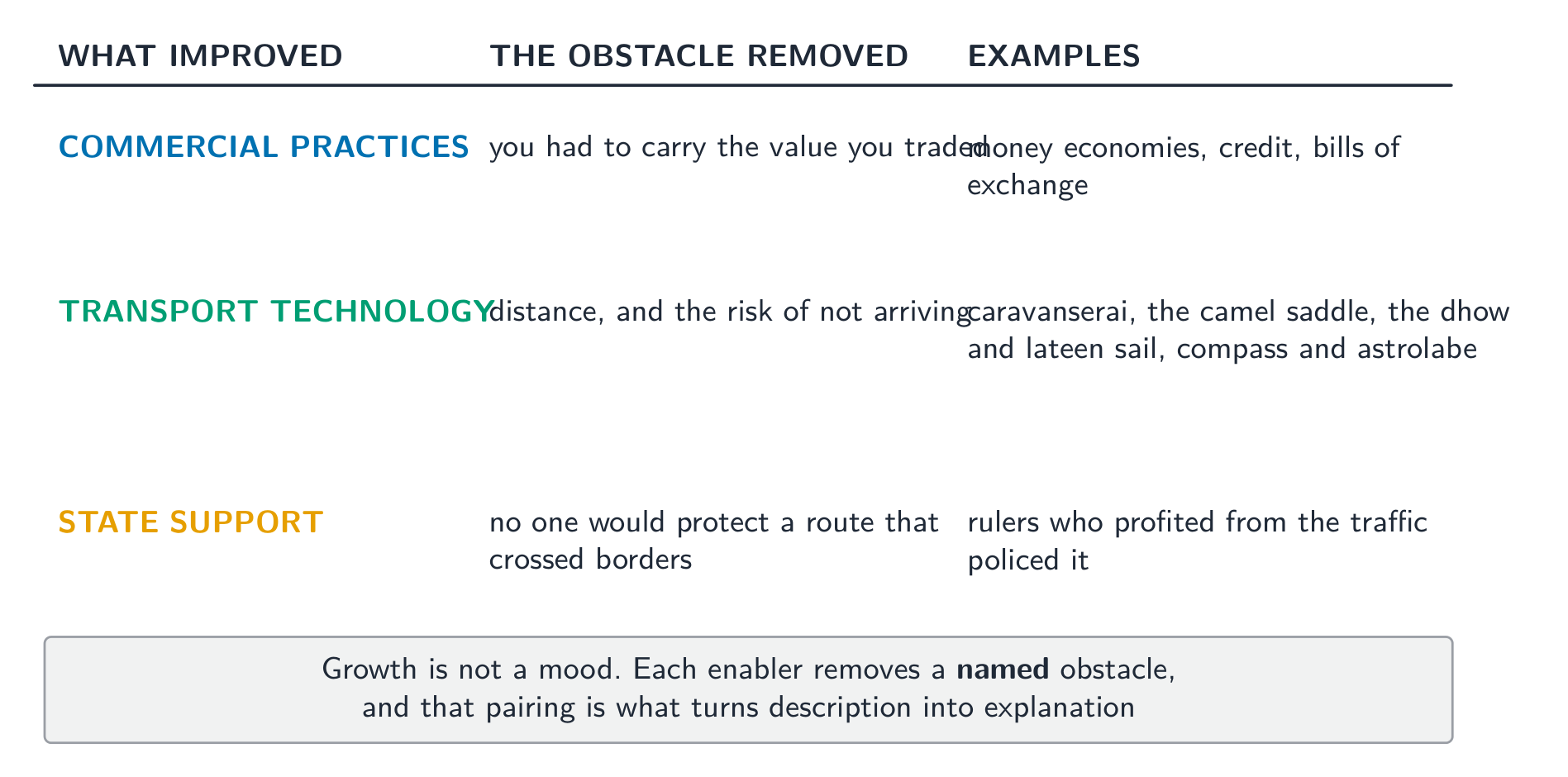
    Growth had three common causes, and naming them is worth more than listing goods:

    • Improved commercial practices 商业惯例的改进 - money economies 货币经济, credit 信贷, and forms of partnership that spread risk.
    • Improved transportation technologies 交通技术的改进 - better ships, saddles, and navigation.
    • State support 国家支持 - empires that secured routes and taxed the trade benefited from protecting it.

    Demand mattered too: luxury goods 奢侈品 from Chinese, Persian, and Indian artisans found expanding markets across Afro-Eurasia, and producers increased output to meet that demand.

    ไทย

    หน่วยที่ 2 ครอบคลุมเครือข่ายแลกเปลี่ยนอันยิ่งใหญ่สามแห่งระหว่างปี 1200 ถึง 1450 ได้แก่ เส้นทางไหม, มหาสมุทรอินเดีย และเส้นทางข้ามทะเลทรายซาฮารา โดยตั้งคำถามSame กับทุกเครือข่ายว่า: อะไรทำให้การค้าเติบโตขึ้น และการเติบโตนั้นเปลี่ยนแปลงอะไร?

    การเติบโตมีสาเหตุร่วมสามประการ และการระบุชื่อสาเหตุเหล่านี้มีค่ามากกว่าการแค่รายการสินค้า:

    • วิธีการค้าที่ดีขึ้น - เศรษฐกิจเงินตรา, สินเชื่อ และรูปแบบหุ้นส่วนที่ช่วยกระจายความเสี่ยง
    • เทคโนโลยีการขนส่งที่ดีขึ้น - เรือที่ดียิ่งขึ้น, เกราะม้า และเครื่องมือนำทาง
    • สนับสนุนจากรัฐ - จักรวรรดิที่รักษาเส้นทางไว้และเก็บภาษีการค้าจะ受益于การปกป้องการค้าดังกล่าว

    ความต้องการก็สำคัญ: สินค้าหรูหรา จากช่างฝีมือจีน, เปอร์เซีย และอินเดีย พบตลาดที่กว้างขึ้นทั่วแอฟโร-ยูเรเชีย และผู้ผลิตเพิ่มผลผลิตเพื่อตอบสนองความต้องการนั้น

    ตัวเอื้อeach ตัดทอนอุปสรรคที่มีชื่อเฉพาะ - คู่แบบนี้คือสิ่งที่เปลี่ยนคำบรรยายให้เป็นคำอธิบาย
    Explore · ⁨สำรวจ⁩

    Pair each enabler with the obstacle it removed

    Growth is not a mood: each enabler removes a named obstacle, and that pairing turns description into explanation.

    2.1

    The Silk Roads · ⁨เส้นทางไหม⁩

    Syllabus · ⁨หลักสูตร⁩
    English

    2.1 The Silk Roads

    Thematic Focus (ECN): Economics Systems — As societies develop, they affect and are affected by the ways that they produce, exchange, and consume goods and services.

    Learning Objective Unit 2.A: Explain the causes and effects of growth of networks of exchange after 1200.

    • KC-3.1.I.A.i Improved commercial practices led to an increased volume of trade and expanded the geographical range of existing trade routes— including the Silk Roads—promoting the growth of powerful new trading cities.
    • KC-3.1.I.C.i The growth of interregional trade in luxury goods was encouraged by innovations in previously existing transportation and commercial technologies, including the caravanserai, forms of credit, and the development of money economies.
    • KC-3.3.I.B Demand for luxury goods increased in Afro-Eurasia. Chinese, Persian, and Indian artisans and merchants expanded their production of textiles and porcelains for export; manufacture of iron and steel expanded in China.

    Illustrative examples:

    • Trading cities:
      • Kashgar
      • Samarkand
    • New forms of credit and money economies:
      • Bills of exchange
      • Banking houses
      • Use of paper money
    ไทย

    2.1 เส้นทางสายไหม

    จุดเน้นเชิงประเด็น (ECN): ระบบเศรษฐกิจ — เมื่อสังคมพัฒนาขึ้น จะส่งผลกระทบต่อและได้รับผลกระทบจากวิธีการผลิต แลกเปลี่ยน และบริโภคสินค้าและบริการ

    วัตถุประสงค์การเรียนรู้ หน่วย 2.A: อธิบายสาเหตุและผลกระทบของการเติบโตของเครือข่ายแลกเปลี่ยนหลังปี ค.ศ. 1200

    • KC-3.1.I.A.i วิธีการทางการค้าที่ดีขึ้นนำไปสู่ปริมาณการค้าที่เพิ่มขึ้นและขยายขอบเขตทางภูมิศาสตร์ของเส้นทางค้าขายที่มีอยู่—includingเส้นทางสายไหม—ส่งเสริมการเติบโตของเมืองค้าขายใหม่ที่มีอำนาจ
    • KC-3.1.I.C.i การเติบโตของการค้าข้ามภูมิภาคสินค้าหรูหราได้รับการสนับสนุน olehนวัตกรรมด้านเทคโนโลยีการขนส่งและการค้าที่มีอยู่เดิม—includingคาร์วาเซอรี รูปแบบของเครดิต และการพัฒนาของเศรษฐกิจเงินตรา
    • KC-3.3.I.B ความต้องการสินค้าหรูเพิ่มสูงขึ้นในแอฟริกา-ยูเรเซีย ช่างฝีมือและผู้ค้าจีน เปอร์เซีย และอินเดียได้ขยายการผลิตสิ่งทอและเครื่องเคลือบสำหรับส่งออก; การผลิตเหล็กและเหล็กกล้าขยายตัวในจีน

    ตัวอย่างประกอบ:

    • เมืองค้าขาย:
      • คาชการ์
      • ซามَرْกัณฑ์
    • รูปแบบใหม่ของเครดิตและเศรษฐกิจเงินตรา:
      • บิลแห่งการ exchanging
      • บ้านธนาคาร
      • การใช้ธนบัตร

    Source: College Board AP Course and Exam Description · ⁨แหล่งที่มา: คำอธิบายหลักสูตรและข้อสอบ College Board AP⁩

    English

    The Silk Roads 丝绸之路 carried high-value, low-bulk goods overland across Eurasia: silk, porcelain, spices, and precious metals.

    Its enabling innovations were commercial as much as technical - caravanserai 商队旅馆 along the routes, the use of paper money 纸币 and bills of exchange 汇票 in China, and forms of credit that let merchants trade without carrying bullion.

    The consequence for producers: Chinese artisans expanded output, and cities along the routes grew wealthy on the traffic passing through.

    ไทย

    เส้นทางไหม ขนส่งสินค้ามูลค่าสูงแต่ปริมาณน้อยทางบกผ่านเอเชียและยุโรป: ไหม, พอร์เซเลน,เครื่องเทศ และโลหะมีค่า

    นวัตกรรมที่เอื้อต่อการค้าเป็นทั้งด้านธุรกิจและเทคนิค - คาร์วาเนเซอรี ตามเส้นทาง, การใช้ ธนบัตร และ ใบสั่งจ่าย ในจีน และรูปแบบสินเชื่อที่ช่วยให้พ่อค้าซื้อขายโดยไม่ต้องพกพาโลหะมีค่า

    ผลกระทบสำหรับผู้ผลิต: ช่างฝีมือจีนเพิ่มผลผลิต และเมืองตามเส้นทางร่ำรวยจากการค้าที่ผ่านเข้ามา

    2.2

    The Mongol Empire · ⁨จักรวรรดิมองโกล⁩

    Syllabus · ⁨หลักสูตร⁩
    English

    2.2 The Mongol Empire and the Making of the Modern World

    Thematic Focus (GOV): Governance — A variety of internal and external factors contribute to state formation, expansion, and decline. Governments maintain order through a variety of administrative institutions, policies, and procedures, and governments obtain, retain, and exercise power in different ways and for different purposes.

    Thematic Focus (CDI): Cultural Developments and Interactions — The development of ideas, beliefs, and religions illustrates how groups in society view themselves, and the interactions of societies and their beliefs often have political, social, and cultural implications.

    Learning Objective Unit 2.B: Explain the process of state building and decline in Eurasia over time. THEMATIC FOCUS Economics Systems ECN As societies develop, they affect and are affected by the ways that they produce, exchange, and consume goods and services. LEARNING OBJECTIVE

    • KC-3.2.I.B.iii Empires collapsed in different regions of the world and in some areas were replaced by new imperial states, including the Mongol khanates. HISTORICAL DEVELOPMENTS

    Learning Objective Unit 2.C: Explain how the expansion of empires influenced trade and communication over time.

    • KC-3.1.I.E.i The expansion of empires—including the Mongols—facilitated Afro-Eurasian trade and communication as new people were drawn into their conquerors’ economies and trade networks.

    Learning Objective Unit 2.D: Explain the significance of the Mongol Empire in larger patterns of continuity and change.

    • KC-3.2.II.A.ii Interregional contacts and conflicts between states and empires, including the Mongols, encouraged significant technological and cultural transfers.

    Illustrative examples:

    • Technological and cultural transfers:
      • Transfer of Greco– Islamic medical knowledge to western Europe
      • Transfer of numbering systems to Europe
      • Adoption of Uyghur script
    ไทย

    2.2 จักรวรรดิมองโกลและการสร้างโลกสมัยใหม่

    ประเด็นเน้น (GOV): การปกครอง — ปัจจัยภายในและภายนอกหลากหลายชนิดมีส่วนร่วมในการก่อตัว การขยายตัว และการล่มสลายของรัฐ รัฐบาลรักษาความสงบเรียบร้อยผ่านสถาบัน นโยบาย และขั้นตอนการบริหารจัดการที่หลากหลาย และรัฐบาลได้รับ รักษาส Powers และใช้อำนาจในรูปแบบและด้วยวัตถุประสงค์ที่แตกต่างกัน

    ประเด็นเน้น (CDI): การพัฒนาและการปฏิสัมพันธ์ทางวัฒนธรรม — การพัฒนาของแนวคิด ความเชื่อ และศาสนาแสดงให้เห็นว่ากลุ่มคนในสังคมมองเห็นตนเองอย่างไร และการปฏิสัมพันธ์ระหว่างสังคมและความเชื่อของพวกเขา มักจะมีนัยสำคัญทางการเมือง สังคม และวัฒนธรรม

    วัตถุประสงค์การเรียนรู้ หน่วย 2.B: อธิบายกระบวนการสร้างรัฐและการเสื่อมถอยของรัฐในทวีป(numeroia)ตามกาลเวลา จุดเน้นเชิงหัวข้อ เศรษฐกิจ ระบบ ECN เมื่อสังคมพัฒนาขึ้น จะส่งผลต่อและได้รับผลกระทบจากวิธีการผลิต การแลกเปลี่ยน และการบริโภคสินค้าและบริการ วัตถุประสงค์การเรียนรู้

    • KC-3.2.I.B.iii จักรวรรดิล่มสลาย在不同的 regions ของโลก และในบางพื้นที่ถูกแทนที่โดยรัฐจักรวรรดิใหม่ รวมถึงรัฐมองโกล HISTORICAL DEVELOPMENTS

    วัตถุประสงค์การเรียนรู้ หน่วย 2.C: อธิบายว่าการขยายตัวของจักรวรรดิมีผลต่อการค้าและการสื่อสารอย่างไรตามกาลเวลา

    • KC-3.1.I.E.i การขยายตัวของจักรวรรดิ—including มงโกล—ช่วยส่งเสริมการค้าและการสื่อสารระหว่างแอฟริกา-ยูเรเซีย เนื่องจากกลุ่มคนใหม่ถูกดึงเข้ามาสู่เศรษฐกิจและเครือข่ายการค้าของผู้พิชิต

    วัตถุประสงค์การเรียนรู้ หน่วย 2.D: อธิบายความสำคัญของจักรวรรdsmongol ในรูปแบบใหญ่ของการคงอยู่และการเปลี่ยนแปลง

    • KC-3.2.II.A.ii การติดต่อและความขัดแย้งระหว่างรัฐและจักรวรรดิ—including มงโกล—กระตุ้นให้เกิดการถ่ายโอนเทคโนโลยีและวัฒนธรรมที่สำคัญ

    ตัวอย่างประกอบ:

    • การถ่ายโอนเทคโนโลยีและวัฒนธรรม:
      • การถ่ายโอนความรู้ทางการแพทย์กรีก–อิสลามไปยังยุโรปตะวันตก
      • การถ่ายโอนระบบตัวเลขไปยังยุโรป
      • การนำอักษรอูยกันมาใช้

    Source: College Board AP Course and Exam Description · ⁨แหล่งที่มา: คำอธิบายหลักสูตรและข้อสอบ College Board AP⁩

    English

    Empires collapsed and were reconstituted in this period, and the largest transformation came from the Mongol Empire 蒙古帝国.

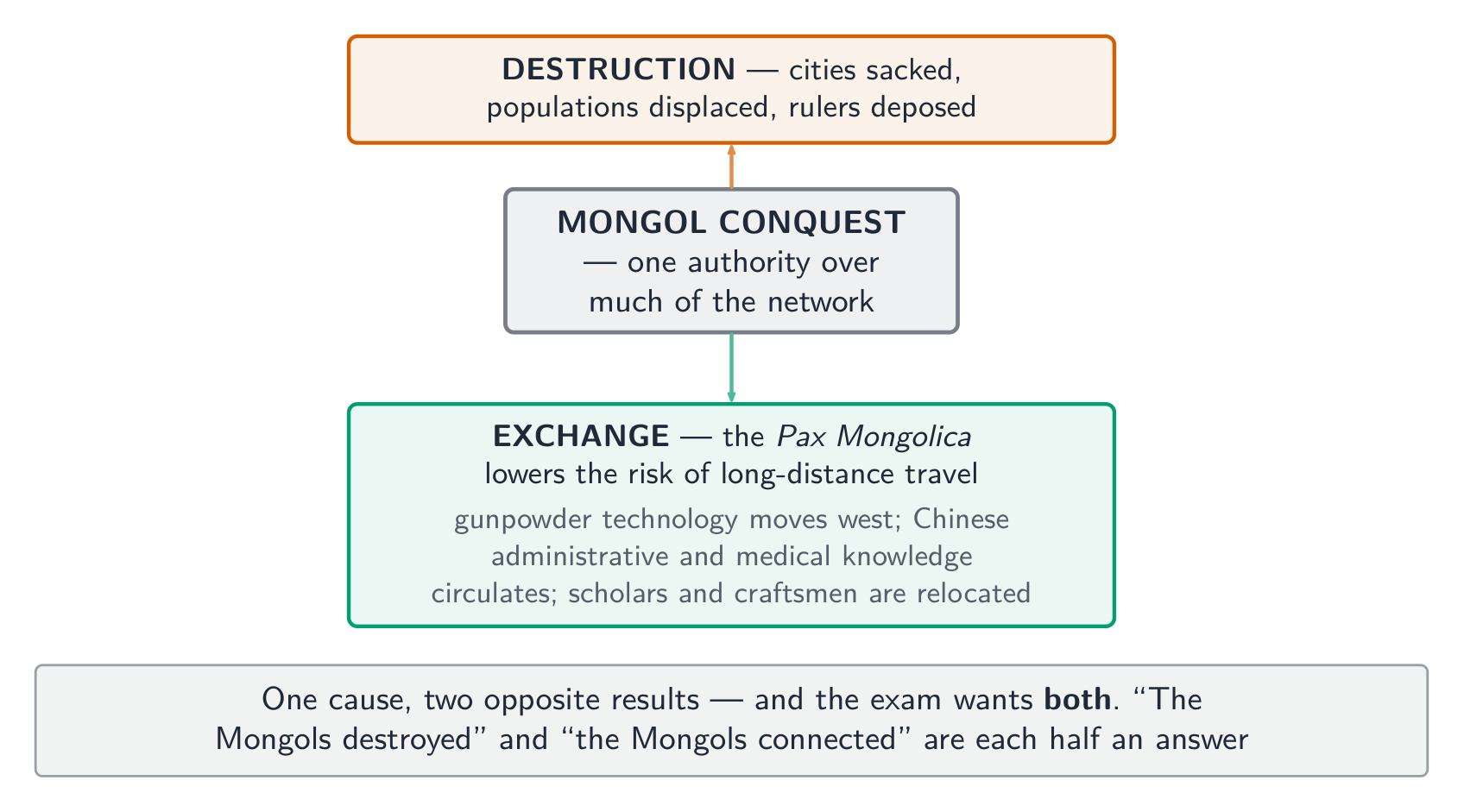
    Mongol expansion facilitated Afro-Eurasian trade and communication by bringing much of the network under a single authority, which lowered the risk of long-distance travel - a period often called the Pax Mongolica 蒙古和平.

    Interregional contacts and conflicts also encouraged technological and cultural transfers: gunpowder technology moved west, Chinese administrative and medical knowledge circulated, and scholars and craftsmen were relocated across the empire.

    The Mongols illustrate the unit's central irony: conquest and destruction produced the conditions for exchange.

    ไทย

    จักรวรรดิล่มสลายและถูกสร้างใหม่ในช่วงเวลานี้ และการเปลี่ยนแปลงครั้งใหญ่ที่สุดเกิดจาก จักรวรรดิมองโกล

    การขยายตัวของมองโกล ส่งเสริมการค้าและการสื่อสารระหว่างแอฟโร-ยูเรเชีย โดยนำเครือข่ายส่วนใหญ่เข้าภายใต้อำนาจเดียว ซึ่งลดความเสี่ยงของการเดินทางระยะไกล - ช่วงเวลานี้มักเรียกว่า (stripes Mongolica)

    ความสัมพันธ์ระหว่างภูมิภาคและความขัดแย้งยัง กระตุ้นการถ่ายโอนเทคโนโลยีและวัฒนธรรม: เทคโนโลยีปืนpowder เคลื่อนย้ายไปตะวันตก, ความรู้ด้านการปกครองและการแพทย์ของจีนหมุนเวียน และนักวิชาการ serta ช่างฝีมือถูกย้ายถิ่นไปทั่วนิคม

    มองโกลแสดงถึงironyหลักของหน่วยนี้: การพิชิตและการทำลายล้าง สร้างเงื่อนไขสำหรับการแลกเปลี่ยน

    ironyหลักของหน่วย: สาเหตุหนึ่ง ผลลัพธ์ตรงข้ามสองอย่าง และข้อสอบต้องการทั้งสอง
    2.3

    The Indian Ocean · ⁨มหาสมุทรอินเดีย⁩

    Syllabus · ⁨หลักสูตร⁩
    English

    2.3 Exchange in the Indian Ocean

    Thematic Focus (ECN): Economics Systems — As societies develop, they affect and are affected by the ways that they produce, exchange, and consume goods and services.

    Thematic Focus (CDI): Cultural Developments and Interactions — The development of ideas, beliefs, and religions illustrates how groups in society view themselves, and the interactions of societies and their beliefs often have political, social, and cultural implications.

    Learning Objective Unit 2.E: Explain the causes of the growth of networks of exchange after 1200.

    • KC-3.1.I.A.ii Improved transportation technologies and commercial practices led to an increased volume of trade and expanded the geographical range of existing trade routes, including the Indian Ocean, promoting the growth of powerful new trading cities.
    • KC-3.1.I.C.ii The growth of interregional trade in luxury goods was encouraged by significant innovations in previously existing transportation and commercial technologies, including the use of the compass, the astrolabe, and larger ship designs.
    • KC-3.1.I.A.iii The Indian Ocean trading network fostered the growth of states.

    Learning Objective Unit 2.F: Explain the effects of the growth of networks of exchange after 1200. THEMATIC FOCUS Humans and the Environments ENV The environment shapes human societies, and as populations grow and change, these populations in turn shape their environments. LEARNING OBJECTIVE

    • KC-3.1.III.B In key places along important trade routes, merchants set up diasporic communities where they introduced their own cultural traditions into the indigenous cultures and, in turn, indigenous cultures influenced merchant cultures.
    • KC-3.2.II.A.iii Interregional contacts and conflicts between states and empires encouraged significant technological and cultural transfers, including during Chinese maritime activity led by Ming Admiral Zheng He. HISTORICAL DEVELOPMENTS

    Learning Objective Unit 2.G: Explain the role of environmental factors in the development of networks of exchange in the period from c. 1200 to c. 1450.

    • KC-3.1.II.A.i The expansion and intensification of long-distance trade routes often depended on environmental knowledge, including advanced knowledge of the monsoon winds.

    Illustrative examples:

    • Growth of states:
      • City-states of the Swahili Coast
      • Gujarat
      • Sultanate of Malacca
    • (CONT’D) Diasporic communities:
      • Arab and Persian communities in East Africa
      • Chinese merchant communities in Southeast Asia
      • Malay communities in the Indian Ocean basin
    ไทย

    2.3 การแลกเปลี่ยนในมหาสมุทรอินเดีย

    จุดเน้นเชิงประเด็น (ECN): ระบบเศรษฐกิจ — เมื่อสังคมพัฒนาขึ้น จะส่งผลกระทบต่อและได้รับผลกระทบจากวิธีการผลิต แลกเปลี่ยน และบริโภคสินค้าและบริการ

    ประเด็นเน้น (CDI): การพัฒนาและการปฏิสัมพันธ์ทางวัฒนธรรม — การพัฒนาของแนวคิด ความเชื่อ และศาสนาแสดงให้เห็นว่ากลุ่มคนในสังคมมองเห็นตนเองอย่างไร และการปฏิสัมพันธ์ระหว่างสังคมและความเชื่อของพวกเขา มักจะมีนัยสำคัญทางการเมือง สังคม และวัฒนธรรม

    วัตถุประสงค์การเรียนรู้ หน่วย 2.E: อธิบายสาเหตุของการเติบโตของเครือข่ายการแลกเปลี่ยนหลังปี 1200

    • KC-3.1.I.A.ii เทคโนโลยีการขนส่งที่ดีขึ้นและแนวปฏิบัติทางการพาณิชย์นำไปสู่ปริมาณการค้าที่เพิ่มขึ้นและขยายขอบเขตทางภูมิศาสตร์ของเส้นทางค้าที่มีอยู่เดิม—including มหาสมุทรอินเดีย ซึ่งส่งเสริมการเติบโตของเมืองค้าขายใหม่ที่มีอำนาจ
    • KC-3.1.I.C.ii การเติบโตของการค้าข้ามภูมิภาคในสินค้าฟุ่มเฟือยได้รับการส่งเสริมด้วยนวัตกรรมที่สำคัญในด้านเทคโนโลยีการขนส่งและพาณิชย์ที่มีอยู่เดิม—including การใช้เข็มทิศ เครื่องมือวัดดาว (astrolabe) และการออกแบบเรือที่ใหญ่ขึ้น
    • KC-3.1.I.A.iii เครือข่ายการค้ามหาสมุทรอินเดียเอื้อต่อการเติบโตของรัฐ

    วัตถุประสงค์การเรียนรู้ หน่วย 2.F: อธิบายผลกระทบของการเติบโตของเครือข่ายการแลกเปลี่ยนหลังปี 1200 จุดเน้นเชิงหัวข้อ มนุษย์กับสิ่งแวดล้อม ENV สิ่งแวดล้อมกำหนดลักษณะของสังคมมนุษย์ และเมื่อประชากรเพิ่ม数量和เปลี่ยนแปลง ประชากรเหล่านี้ก็จะ反过来塑造 their environments. วัตถุประสงค์การเรียนรู้

    • KC-3.1.III.B ในสถานที่สำคัญตามเส้นทางค้าที่สำคัญ ผู้ค้าได้จัดตั้งชุมชนพลัดถิ่น (diasporic communities) ที่พวกเขาได้นำประเพณีทางวัฒนธรรมของตนเองเข้าไปในวัฒนธรรมพื้นเมือง และในทางกลับกัน วัฒนธรรมพื้นเมืองก็ส่งผลต่อวัฒนธรรมของผู้ค้า
    • KC-3.2.II.A.iii การติดต่อและความขัดแย้งระหว่างรัฐและจักรวรรดิกระตุ้นให้เกิดการถ่ายโอนเทคโนโลยีและวัฒนธรรมที่สำคัญ รวมถึงในช่วงกิจกรรมทางทะเลของจีนที่นำโดยนายพลจางเหอแห่งราชวงศ์หมิง HISTORICAL DEVELOPMENTS

    วัตถุประสงค์การเรียนรู้ หน่วย 2.G: อธิบายบทบาทของปัจจัยด้านสิ่งแวดล้อมในการพัฒนาเครือข่ายการแลกเปลี่ยนในช่วง c. 1200 ถึง c. 1450

    • KC-3.1.II.A.i การขยายตัวและเข้มข้นขึ้นของเส้นทางค้าระยะไกลมักขึ้นอยู่กับความรู้ด้านสิ่งแวดล้อม—including ความรู้ขั้นสูงเกี่ยวกับลมมรสุม

    ตัวอย่างประกอบ:

    • การเติบโตของรัฐ:
      • เมืองรัฐของชายฝั่งสวาฮีลี
      • กุจาต
      • สल्ตานาตมะละกา
    • (CONT’D) ชุมชนพลัดถิ่น:
      • ชุมชนอาหรับและเปอร์เซียในแอฟริกาตะวันออก
      • ชุมชนผู้ค้าจีนในเอเชียตะวันออกเฉียงใต้
      • ชุมชนมาเลย์ในแอ่งมหาสมุทรอินเดีย

    Source: College Board AP Course and Exam Description · ⁨แหล่งที่มา: คำอธิบายหลักสูตรและข้อสอบ College Board AP⁩

    English

    The Indian Ocean network moved bulkier goods than the Silk Roads - textiles, timber, grain, and spices - because ships carry more than camels.

    Its enabling technologies were maritime: knowledge of the monsoon winds 季风, the lateen sail 三角帆, the dhow 单桅帆船, and navigational tools including the compass 罗盘 and astrolabe 星盘.

    Its consequences are the most examinable in the unit:

    • The network fostered the growth of states, such as the Swahili city-states on the East African coast and Srivijaya and Majapahit in Southeast Asia.
    • Merchants established diasporic communities 侨居社群 in key ports, introducing their own culture while adopting local ways.
    • Long-distance trade depended on and expanded coerced labour and on the movement of people as well as goods.
    ไทย
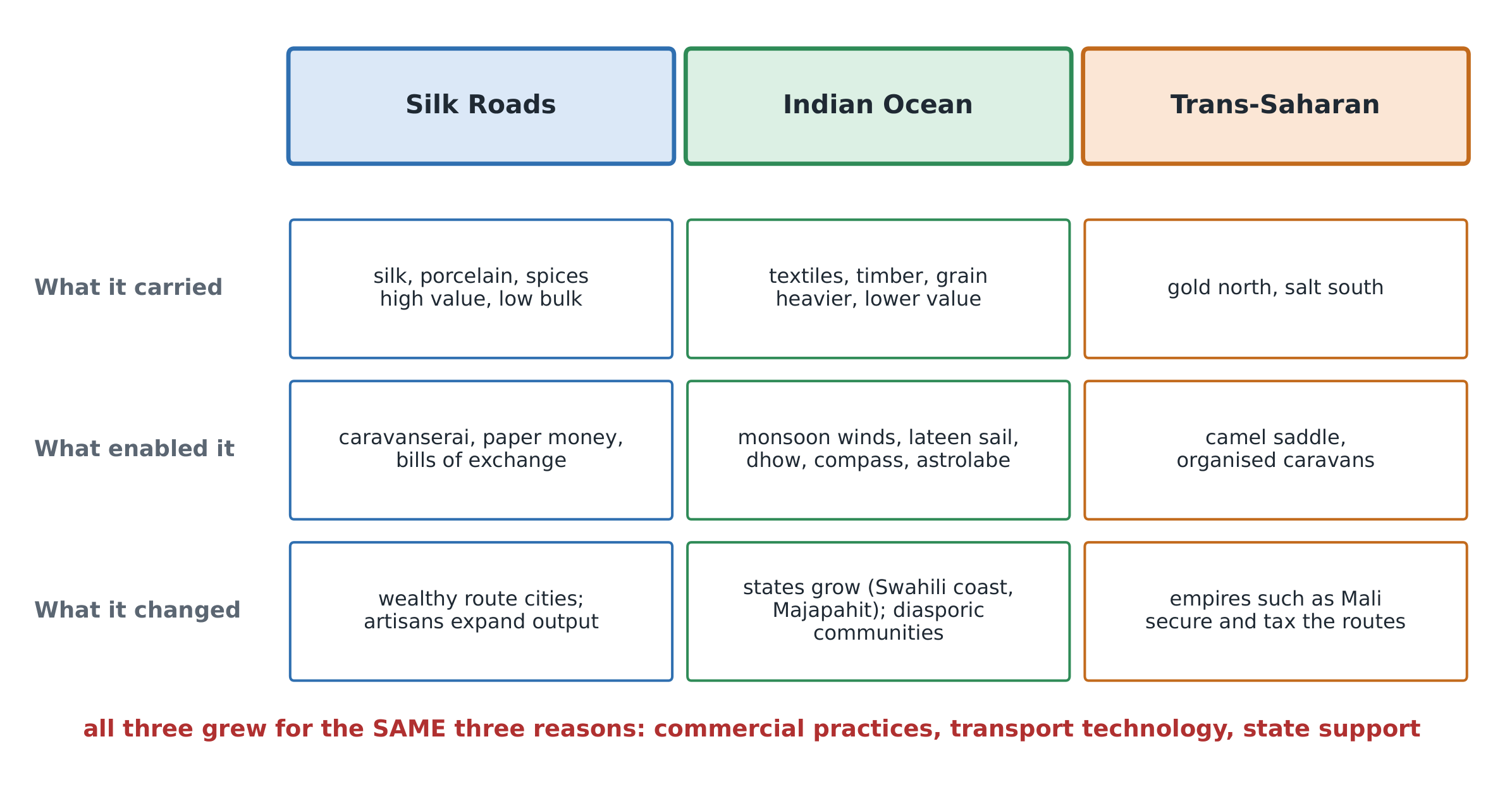
    เครือข่ายสามแห่งเปรียบเทียบตามสิ่งที่ขน, สิ่งที่เอื้อต่อการค้า และสิ่งที่เปลี่ยนแปลง
    สามเครือข่าย, กรอบการทำงานเดียว: สินค้า, เทคโนโลยีที่เอื้อต่อการค้า และผลกระทบ คือสิ่งที่ข้อสอบถาม

    เครือข่ายมหาสมุทรอินเดีย ขนส่งสินค้าที่มีปริมาณมากกว่าเส้นทางไหม - ผ้า, ไม้, ธัญพืช และเครื่องเทศ - เพราะเรือบรรทุกได้มากกว่าอูฐ

    เทคโนโลยีที่เอื้อต่อการค้าเป็นทางทะเล: ความรู้เรื่อง ลมมรสุม, ** sail ลาด**, dhow และเครื่องมือนำทางรวมถึง เข็มทิศ และ อัสโทรลาบ

    ผลกระทบของมันสามารถออกสอบได้มากที่สุดในหน่วยนี้:

    • เครือข่าย ส่งเสริมการเติบโตของรัฐ เช่น เมืองรัฐสวาฮีลีบนชายฝั่งแอฟริกาตะวันออก และศรีวิชัยกับมาจาปหิตในเอเชียตะวันออกเฉียงใต้
    • พ่อค้าจัดตั้ง ชุมชน diaspora ในท่าเรือสำคัญ นำวัฒนธรรมของตนเองเข้ามาwhile adopting当地 ways
    • การค้าระยะยาวขึ้นอยู่กับและขยาย แรงงานที่ถูกบังคับ以及对 people movement alongside goods.
    dhow ใต้ lateen sail - Rig ที่讓เรือทำงาน across monsoon system
    Vocabulary · ⁨คำศัพท์⁩ Train · ⁨ฝึกฝน⁩
    English ไทย
    lateen sail/ˈlætiːn seɪl/ sail แบบ lateen
    dhow/ˈdiːhaʊ/ เรือดอว์
    compass/ˈkʌmpəs/ เข็มทิศ (compass)
    astrolabe/ˈæstrəleɪb/ เครื่องวัดดาว (astrolabe)
    diasporic communities/ˌdaɪəˈspɒrɪk kəˈmjuːnɪtiz/ ชุมชนพลัดถิ่น
    camel saddle/ˈkæml ˈsædl/ อานอูฐ (camel saddle)
    2.4

    Trans-Saharan Trade · ⁨การค้าข้ามทะเลทรายซาฮารา⁩

    Syllabus · ⁨หลักสูตร⁩
    English

    2.4 Trans-Saharan Trade Routes

    Thematic Focus (TEC): Technology and Innovation — Human adaptation and innovation have resulted in increased efficiency, comfort, and security, and technological advances have shaped human development and interactions with both intended and unintended consequences.

    Thematic Focus (GOV): Governance — A variety of internal and external factors contribute to state formation, expansion, and decline. Governments maintain order through a variety of administrative institutions, policies, and procedures, and governments obtain, retain, and exercise power in different ways and for different purposes.

    Learning Objective Unit 2.H: Explain the causes and effects of the growth of trans-Saharan trade.

    • KC-3.1.II.A.ii The growth of interregional trade was encouraged by innovations in existing transportation technologies.
    • KC-3.1.I.A.iv Improved transportation technologies and commercial practices led to an increased volume of trade and expanded the geographical range of existing trade routes, including the trans-Saharan trade network.

    Learning Objective Unit 2.I: Explain how the expansion of empires influenced trade and communication over time.

    • KC-3.1.I.E.ii The expansion of empires—including Mali in West Africa–facilitated Afro-Eurasian trade and communication as new people were drawn into the economies and trade networks.

    Illustrative examples:

    • Technologies encouraging interregional trade:
      • Camel saddle
      • Caravans
    ไทย

    2.4 เส้นทางค้าข้ามทะเลทรายซาฮารา

    จุดเน้นเชิงหัวข้อ (TEC): เทคโนโลยีและนวัตกรรม — การปรับตัวและนวัตกรรมของมนุษย์ได้ส่งผลให้ประสิทธิภาพ ความสบาย และความปลอดภัยเพิ่มขึ้น และการพัฒนาทางเทคโนโลยีได้กำหนดการพัฒนาของมนุษย์และการมีปฏิสัมพันธ์กับทั้งผลที่คาดหวังและไม่คาดคิด

    ประเด็นเน้น (GOV): การปกครอง — ปัจจัยภายในและภายนอกหลากหลายชนิดมีส่วนร่วมในการก่อตัว การขยายตัว และการล่มสลายของรัฐ รัฐบาลรักษาความสงบเรียบร้อยผ่านสถาบัน นโยบาย และขั้นตอนการบริหารจัดการที่หลากหลาย และรัฐบาลได้รับ รักษาส Powers และใช้อำนาจในรูปแบบและด้วยวัตถุประสงค์ที่แตกต่างกัน

    วัตถุประสงค์การเรียนรู้ หน่วย 2.H: อธิบายสาเหตุและผลกระทบของการเติบโตของการค้าข้ามทะเลทรายซาฮารา

    • KC-3.1.II.A.ii การเติบโตของการค้าข้ามภูมิภาคได้รับการส่งเสริมด้วยนวัตกรรมในด้านเทคโนโลยีการขนส่งที่มีอยู่เดิม
    • KC-3.1.I.A.iv เทคโนโลยีการขนส่งที่ดีขึ้นและแนวปฏิบัติทางการพาณิชย์นำไปสู่ปริมาณการค้าที่เพิ่มขึ้นและขยายขอบเขตทางภูมิศาสตร์ของเส้นทางค้าที่มีอยู่เดิม—including เส้นทางค้าข้ามทะเลทรายซาฮารา

    วัตถุประสงค์การเรียนรู้ หน่วย 2.I: อธิบายว่าการขยายตัวของจักรวรรดิมีผลต่อการค้าและการสื่อสารอย่างไรตามกาลเวลา

    • KC-3.1.I.E.ii การขยายตัวของจักรวรรดิ—including มาลีในแอฟริกาตะวันตก—ช่วยส่งเสริมการค้าและการสื่อสารระหว่างแอฟริกา-ยูเรเซีย เนื่องจากกลุ่มคนใหม่ถูกดึงเข้ามาสู่เศรษฐกิจและเครือข่ายการค้า

    ตัวอย่างประกอบ:

    • เทคโนโลยีที่ส่งเสริมการค้าข้ามภูมิภาค:
      • เบาะสำหรับอูฐ
      • ขบวนรถ

    Source: College Board AP Course and Exam Description · ⁨แหล่งที่มา: คำอธิบายหลักสูตรและข้อสอบ College Board AP⁩

    English

    The trans-Saharan routes crossed the desert on innovations in existing technology - above all the camel saddle 骆驼鞍 and organised caravans 商队.

    Gold from West Africa moved north and salt 盐 moved south. The expansion of empires, including Mali 马里帝国, facilitated Afro-Eurasian trade by securing the routes and taxing them - and Mali's wealth and its ruler's famous pilgrimage advertised the region across the Islamic world.

    ไทย

    เส้นทางข้ามทะเลทรายซาฮารา ข้ามทะเลทรายด้วยนวัตกรรมในเทคโนโลยีที่มีอยู่เดิม - โดยเฉพาะอย่างยิ่ง เบาะอูฐ และ คาร์วาน ที่จัดระเบียบ

    ทองคำจากตะวันตกของแอฟริกาเคลื่อนย้ายไปทางเหนือและ เกลือ เคลื่อนย้ายไปทางใต้ การขยายตัวของจักรวรรดิ ซึ่งรวมถึง มาลี ช่วยส่งเสริมการค้าระหว่างแอฟริกา-ยูเรเซีย通过将เส้นทางค้าขายให้ปลอดภัยและเก็บภาษี - และความมั่งคั่งของมาลีและการเดินทางแสวงบุญที่มีชื่อเสียงของ君主ได้ประกาศชื่อเสียงของภูมิภาคนี้ทั่วทั้งโลกอิสลาม。

    2.5 2.6

    Cultural and Environmental Consequences · ⁨ผลกระทบทางวัฒนธรรมและสิ่งแวดล้อม⁩

    Syllabus · ⁨หลักสูตร⁩
    English

    2.5 Cultural Consequences of Connectivity

    Thematic Focus (CDI): Cultural Developments and Interactions — The development of ideas, beliefs, and religions illustrates how groups in society view themselves, and the interactions of societies and their beliefs often have political, social, and cultural implications.

    Learning Objective Unit 2.J: Explain the intellectual and cultural effects of the various networks of exchange in Afro-Eurasia from c. 1200 to c. 1450.

    • KC-3.1.III.D Increased cross-cultural interactions resulted in the diffusion of literary, artistic, and cultural traditions, as well as scientific and technological innovations.
    • KC-3.3.II The fate of cities varied greatly, with periods of significant decline and periods of increased urbanization, buoyed by rising productivity and expanding trade networks.
    • KC-3.1.III.C As exchange networks intensified, an increasing number of travelers within Afro-Eurasia wrote about their travels.

    Illustrative examples:

    • Diffusion of cultural traditions:
      • The influence of Buddhism in East Asia
      • The spread of Hinduism and Buddhism into Southeast Asia
      • The spread of Islam in sub-Saharan Africa and Asia
    • Diffusion of scientific or technological innovations:
      • Gunpowder from China
      • Paper from China
    • Travelers:
      • Ibn Battuta
      • Margery Kempe
      • Marco Polo
    ไทย

    2.5 ผลกระทบทางวัฒนธรรมจากการเชื่อมโยง

    ประเด็นเน้น (CDI): การพัฒนาและการปฏิสัมพันธ์ทางวัฒนธรรม — การพัฒนาของแนวคิด ความเชื่อ และศาสนาแสดงให้เห็นว่ากลุ่มคนในสังคมมองเห็นตนเองอย่างไร และการปฏิสัมพันธ์ระหว่างสังคมและความเชื่อของพวกเขา มักจะมีนัยสำคัญทางการเมือง สังคม และวัฒนธรรม

    วัตถุประสงค์การเรียนรู้ หน่วย 2.J: อธิบายผลกระทบทางปัญญาและวัฒนธรรมของเครือข่ายการแลกเปลี่ยนต่างๆ ในแอฟริกา-ยูเรเซียตั้งแต่ c. 1200 ถึง c. 1450

    • KC-3.1.III.D การมีปฏิสัมพันธ์ข้ามวัฒนธรรมที่เพิ่มขึ้นส่งผลให้เกิดการแพร่กระจายของแบบแผนวรรณกรรม ศิลปะ และวัฒนธรรม รวมถึงนวัตกรรมทางวิทยาศาสตร์และเทคโนโลยี
    • KC-3.3.II บาดับของเมืองมีความหลากหลายอย่างมาก โดยมีช่วงเวลาที่ลดลงอย่างมีนัยสำคัญและช่วงที่มีการขยายตัวของเมืองเพิ่มขึ้น ซึ่งสนับสนุน由高 rising productivity และ expanding trade networks
    • KC-3.1.III.C เมื่อเครือข่ายการแลกเปลี่ยนเข้มข้นขึ้น จำนวนนักเดินทางภายในแอฟริกา-ยูเรเซียที่เขียนเกี่ยวกับการเดินทาง他们也 increasingly

    ตัวอย่างประกอบ:

    • การแพร่กระจายของแบบแผนทางวัฒนธรรม:
      • อิทธิพลของพุทธศาสนาในเอเชียตะวันออก
      • การ распространของ Hinduism และ Buddhism เข้าสู่อسیอาตะวันออกเฉียงใต้
      • การplugin of Islam ในแอฟริกาใต้ Sahara และเอเชีย
    • การแพร่กระจายของนวัตกรรมทางวิทยาศาสตร์หรือเทคโนโลยี:
      • ปoppershot จากจีน
      • กระดาษจากจีน
    • นักเดินทาง:
      • อิบน์ บัตตูตะ
      • มาร์เจรี เค็มป์
      • มาร์โค โพลो
    English

    2.6 Environmental Consequences of Connectivity

    Thematic Focus (ENV): Humans and the Environments — The environment shapes human societies, and as populations grow and change, these populations in turn shape their environments.

    Learning Objective Unit 2.K: Explain the environmental effects of the various networks of exchange in Afro-Eurasia from c. 1200 to c. 1450.

    • KC-3.1.IV There was continued diffusion of crops and pathogens, with epidemic diseases, including the bubonic plague, along trade routes.

    Illustrative examples:

    • Diffusion of crops:
      • Bananas in Africa
      • New rice varieties in East Asia
      • Spread of citrus in the Mediterranean
    ไทย

    2.6 ผลกระทบทางสิ่งแวดล้อมจากการเชื่อมโยง

    ประเด็นหลัก (ENV): มนุษย์และสิ่งแวดล้อม — สิ่งแวดล้อมมีผลต่อสังคมของมนุษย์ และเมื่อประชากรเพิ่มขึ้นหรือเปลี่ยนแปลง ประชากรเหล่านั้นก็จะส่งผลกลับไปยังสิ่งแวดล้อมในทางกลับกัน

    วัตถุประสงค์การเรียนรู้ หน่วย 2.K: อธิบายผลกระทบทางสิ่งแวดล้อมจากเครือข่ายการแลกเปลี่ยนต่างๆ ในแอฟริกา-ยูเรเซีย ในช่วงประมาณ ค.ศ. 1200 ถึง ค.ศ. 1450

    • KC-3.1.IV มีการแพร่กระจายของพืชผลและเชื้อโรคอย่างต่อเนื่อง รวมถึงโรคระบาด เช่น plague ตามเส้นทางค้าขาย

    ตัวอย่างประกอบ:

    • การแพร่กระจายของพืชผล:
      • กล้วยในแอฟริกา
      • ข้าวพันธุ์ใหม่ในเอเชียตะวันออก
      • การแพร่หลายของส้มมנדารินในทะเลเมดิเตอร์เรเนียน

    Source: College Board AP Course and Exam Description · ⁨แหล่งที่มา: คำอธิบายหลักสูตรและข้อสอบ College Board AP⁩

    English

    Increased cross-cultural interaction produced diffusion 传播 of literary, artistic, scientific, and religious traditions - the spread of Islam along trade routes, Buddhist and Neo-Confucian influence in East Asia, and the movement of scientific and mathematical knowledge.

    An increasing number of travellers 旅行者 moved within and between regions, and their accounts are the period's key evidence.

    The fate of cities varied: some declined as routes shifted or invasions came, while others grew into major commercial centres.

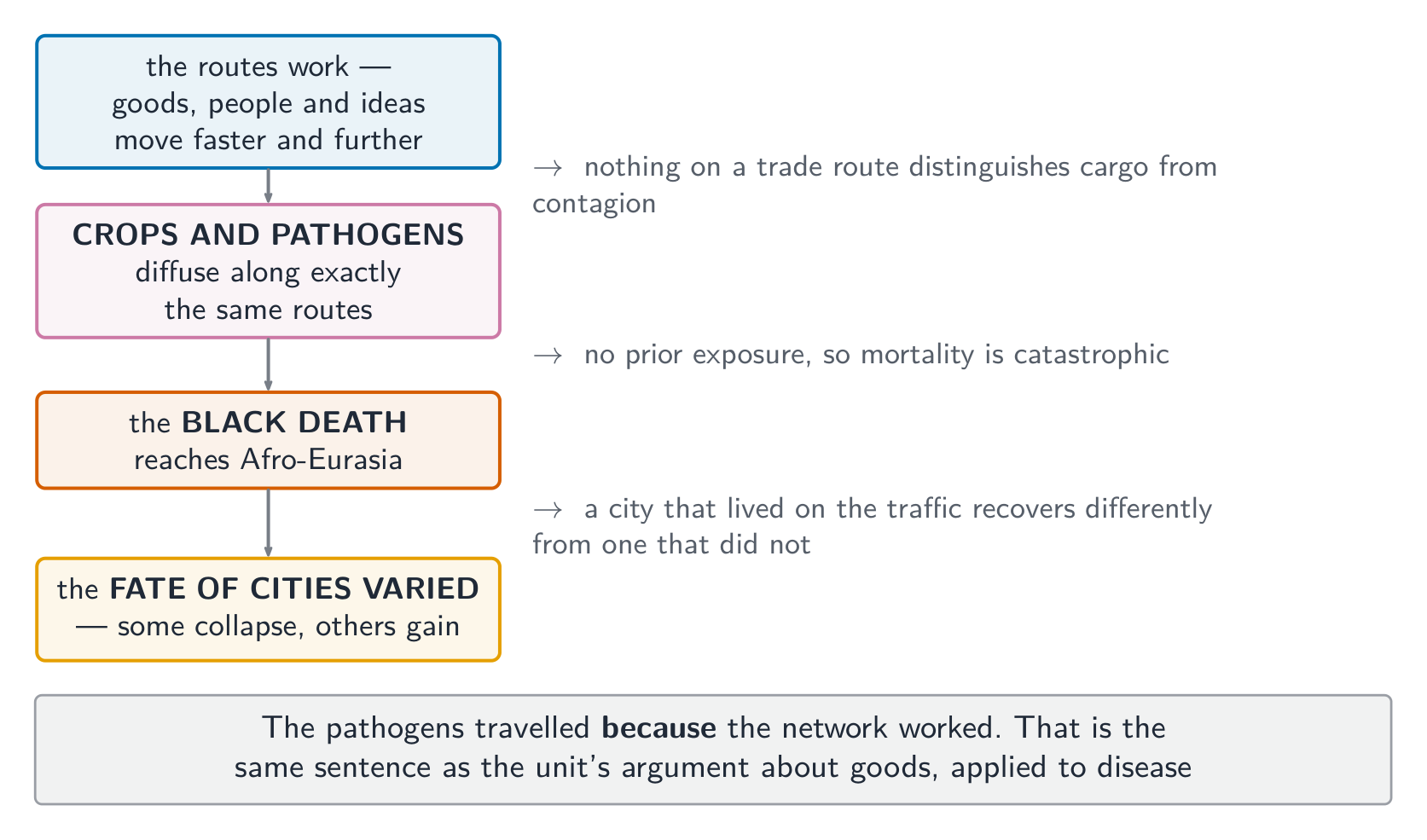
    The environmental consequences were as large as the cultural ones. There was continued diffusion of crops and pathogens, and epidemic disease travelled with trade - most catastrophically the Black Death 黑死病, which moved along the same routes that carried goods and killed a large share of the population of Afro-Eurasia.

    ไทย

    การมีปฏิสัมพันธ์ข้ามวัฒนธรรมที่เพิ่มขึ้นนำไปสู่ การแพร่กระจาย ของประเพณีทางวรรณกรรม ศิลปะ วิทยาศาสตร์ และศาสนา - การแพร่ระบาดของอิสลามตามเส้นทางค้าขาย อิทธิพลของพุทธศาสนาและนอวคอนฟิวเซียนในเอเชียตะวันออก และการเคลื่อนย้ายองค์ความรู้ทางวิทยาศาสตร์และคณิตศาสตร์

    จำนวน นักเดินทาง ที่เพิ่มขึ้นเคลื่อนย้ายภายในและระหว่างภูมิภาค และบันทึกเล่าขานของพวกเขาเป็นหลักฐานสำคัญในยุคนี้

    ชะตากรรมของ เมืองต่างๆ แตกต่างกัน: บางเมืองเสื่อมลงเนื่องจากเส้นทางค้าขายเปลี่ยนหรือมีการรุกราน ในขณะที่บางเมืองเติบโตขึ้นเป็นศูนย์กลางการค้าหลัก

    ผลกระทบด้านสิ่งแวดล้อมมีขนาดใหญ่เท่ากับการผลกระทบด้านวัฒนธรรม มีการ แพร่กระจายของพืชผลและเชื้อโรค อย่างต่อเนื่อง และโรคระบาดเดินทางไปตามเส้นทางการค้า - อย่างเลวร้ายที่สุดคือ โรค/black Death (瘟疫), ซึ่งเคลื่อนที่ตามเส้นทางเดียวกันที่ลำเลียงสินค้าและฆ่าประชากรส่วนใหญ่ของแอฟริกา-ยูเรเซีย

    เชื้อโรคเดินทางเพราะเครือข่ายทำงาน - เหตุผลเดียวกันที่ประยุกต์ใช้กับโรค
    Explore · ⁨สำรวจ⁩

    Follow the network's most consequential cargo

    The pathogens travelled because the network worked — the same argument the unit makes about goods, applied to disease.

    Vocabulary · ⁨คำศัพท์⁩ Train · ⁨ฝึกฝน⁩
    English ไทย
    Black Death/blæk deθ/ โรคระบาดดำ (Black Death)
    2.7

    Comparison of Economic Exchange · ⁨เปรียบเทียบการแลกเปลี่ยนทางเศรษฐกิจ⁩

    Syllabus · ⁨หลักสูตร⁩
    English

    2.7 Comparison of Economic Exchange

    Learning Objective Unit 2.L: Explain the similarities and differences among the various networks of exchange in the period from c. 1200 to c. 1450.

    • KC-3.1 A deepening and widening of networks of human interaction within and across regions contributed to cultural, technological, and biological diffusion within and between various societies.
      • KC-3.1.I.A.i Improved commercial practices led to an increased volume of trade and expanded the geographical range of existing trade routes—including the Silk Roads—promoting the growth of powerful new trading cities.
      • KC-3.1.I.C.i The growth of interregional trade in luxury goods was encouraged by innovations in previously existing transportation and commercial technologies, including the caravanserai, forms of credit, and the development of money economies.
    • KC-3.3 Changes in trade networks resulted from and stimulated increasing productive capacity, with important implications for social and gender structures and environmental processes.
      • KC-3.3.I.B Demand for luxury goods increased in Afro-Eurasia. Chinese, Persian, and Indian artisans and merchants expanded their production of textiles and porcelains for export; manufacture of iron and steel expanded in China.
    ไทย

    2.7 เปรียบเทียบการแลกเปลี่ยนทางเศรษฐกิจ

    วัตถุประสงค์การเรียนรู้ หน่วย 2.L: อธิบายความคล้ายคลึงและความแตกต่างระหว่างเครือข่ายการแลกเปลี่ยนต่างๆ ในช่วงเวลาประมาณ ค.ศ. 1200 ถึง ค.ศ. 1450

    • KC-3.1 การขยายตัวและความลึกซึ้งของเครือข่ายความสัมพันธ์ระหว่างมนุษย์ทั้งภายในและข้ามภูมิภาค ช่วยส่งเสริมการแพร่กระจายทางวัฒนธรรม เทคโนโลยี และชีวภาพ ภายในและระหว่างสังคมต่างๆ
      • KC-3.1.I.A.i การพัฒนาวิธีการค้าที่ดียิ่งขึ้น นำไปสู่ปริมาณการค้าที่เพิ่มขึ้น และขยายขอบเขตทางภูมิศาสตร์ของเส้นทางค้าที่มีอยู่เดิม—including那条丝绸之路—ส่งเสริมการเติบโตของเมืองค้าขายใหม่ที่มีอำนาจ
      • KC-3.1.I.C.i การเติบโตของการค้าข้ามภูมิภาคสินค้าฟุ่มเฟือย ถูกกระตุ้นด้วยนวัตกรรมในเทคโนโลยีการขนส่งและการค้าที่มีอยู่เดิม รวมถึงการคาราวันเซอรี รูปแบบของเครดิต และการพัฒนาของระบบเงินตรา
    • KC-3.3 การเปลี่ยนแปลงในเครือข่ายการค้าเกิดจากและกระตุ้นให้เพิ่มกำลังการผลิต ซึ่งส่งผลกระทบต่อโครงสร้างทางสังคมและเพศสภาพ serta กระบวนการทางสิ่งแวดล้อมอย่างมีนัยสำคัญ
      • KC-3.3.I.B ความต้องการสินค้าฟุ่มเฟือยเพิ่มขึ้นในแอฟริกา-ยูเร시아 ช่างฝีมือและพ่อค้าชาวจีน เปอร์เซีย และอินเดียขยายการผลิตสิ่งทอและเครื่องกระเบื้องสำหรับส่งออก;การผลิตเหล็กและเหล็กกล้าขยายตัวในประเทศจีน

    Source: College Board AP Course and Exam Description · ⁨แหล่งที่มา: คำอธิบายหลักสูตรและข้อสอบ College Board AP⁩

    English

    The unit's reasoning skill is comparison. Compare the networks on what they carried, what made them possible, and what they changed - not on which was "most important".

    Worked example (a real AP exam question). AP World short-answer questions frequently ask students to "Explain one similarity" or "Explain one difference" between two trade networks in this period. A full-mark answer names the feature and applies it to both, then explains: "Both the Silk Roads and the Indian Ocean network expanded because of improved commercial practices, but the Indian Ocean carried heavier, lower-value goods such as timber and grain because ships could transport far greater bulk than overland caravans." Notice the shape: the because clause is what turns a difference into an explanation, and without it the answer only describes.

    ไทย

    ทักษะการคิดของหน่วยนี้คือ การเปรียบเทียบ เปรียบเทียบเครือข่ายโดยดูว่าพวกเขาส่งอะไร ทำให้เกิดอะไรขึ้น และเปลี่ยนแปลงอะไร - ไม่ใช่ดูว่าอันไหน "สำคัญที่สุด"

    ตัวอย่างวิธีทำ (คำถามจริงในการสอบ AP). คำถามตอบสั้นของ AP World มัก要求学生 "อธิบายความคล้ายคลึงหนึ่งอย่าง" หรือ "อธิบายความแตกต่างหนึ่งอย่าง" ระหว่างเครือข่ายการค้าสองแห่งในยุคนี้ คำตอบเต็มคะแนนจะระบุลักษณะและนำไปใช้กับทั้งสอง แล้วอธิบาย: "ทั้งถนนสายไหมและเครือข่ายมหาสมุทรอินเดียขยายตัวเนื่องจากปรับปรุงวิธีการค้า แต่เครือข่ายมหาสมุทรอินเดียขนส่งสินค้าที่มีน้ำหนักมากแต่มีมูลค่าต่ำเช่นไม้และข้าวbecauseเรือสามารถขนส่งปริมาณมหาศาลได้มากกว่าขบวนคาราวานบนบก" ระวังรูปแบบ: clause because คือสิ่งที่แปลงความแตกต่างให้เป็นคำอธิบาย และหากไม่มีมันคำตอบจะเพียงบรรยายเท่านั้น

    2.7

    Exam tips · ⁨ข้อแนะนำสำหรับการสอบ⁩

    English
    • Explain growth with the three causes - commercial practices, transport technology, state support - rather than listing trade goods.
    • Match cargo to carrier: overland routes move high-value, low-bulk goods; maritime routes move bulk.
    • Learn the enabling technologies by network: caravanserai and credit; monsoons, lateen sail and dhow; the camel saddle.
    • The Mongols' examinable role is facilitating exchange, not conquest for its own sake.
    • The Black Death is the environmental consequence to name, and it travelled on the trade network itself.
    • On difference questions, always add the because. A stated difference without a cause is only half an answer.
    ไทย
    • อธิบายการเติบโตด้วยสาเหตุสามอย่าง - วิธีการค้า เทคโนโลยีการขนส่ง การสนับสนุนของรัฐ แทนที่จะรายการสินค้าค้า
    • จับคู่ cargo กับ carrier: เส้นทางบนบก ขนส่งสินค้ามีมูลค่าสูงแต่ปริมาณน้อย; เส้นทางทางทะเล ขนส่งปริมาณมาก
    • เรียนรู้เทคโนโลยีที่เอื้ออำนวยโดยเครือข่าย: caravanserai และเครดิต; ฤดูลมมรสุม sail ลายจระเข้ และ dhow; จักรยานอูฐ
    • บทบาทที่ออกข้อสอบของมองโกลคือ การ facilitating การแลกเปลี่ยน ไม่ใช่การพิชิตเพื่อความบันเทิงตัวเอง
    • Black Death เป็นผลกระทบด้านสิ่งแวดล้อมที่ต้องระบุ และมันเดินทางบนเครือข่ายการค้าเอง
    • ในคำถามความแตกต่าง ต้องเพิ่ม because เสมอ ความแตกต่างที่กล่าวถึงโดยไม่ระบุสาเหตุเป็นเพียงครึ่งหนึ่งของคำตอบ
    Vocabulary · ⁨คำศัพท์⁩ Train · ⁨ฝึกฝน⁩
    English ไทย
    Improved commercial practices/ɪmˈpruːvd kəˈmɜːʃl ˈpræktɪsɪz/ การพัฒนาวิธีการค้าขาย
    money economies/ˈmʌni ɪˈkɒnəmiz/ เศรษฐกิจที่ใช้เงิน
    credit/ˈkredɪt/ เครดิต
    Improved transportation technologies/ɪmˈpruːvd trænspɔːˈteɪʃn tekˈnɒlədʒiz/ เทคโนโลยีการขนส่งที่ดีขึ้น
    State support/steɪt səˈpɔːt/ การสนับสนุนของรัฐ
    luxury goods/ˈlʌkʃəri ɡʊdz/ สินค้าหรูหรา
    Silk Roads/sɪlk rəʊdz/ เส้นทางสายไหม
    caravanserai/ˈkærəvænsəraɪ/ คาราเวนเซไร (caravanserai)
    paper money/ˈpeɪpə ˈmʌni/ เงินกระดาษ
    bills of exchange/bɪlz ɒv eksˈtʃeɪndʒ/ bills of exchange (ใบสั่งแลกเงิน)
    Mongol Empire/ˈmɒŋɡɒl ˈempaɪə/ จักรวรรดิมองโกล
    Pax Mongolica/pæks mɒnˈɡɒlɪkə/ สันติภาพแห่งมองโกล (Pax Mongolica)
    monsoon winds/mɒnˈsuːn wɪndz/ ลมมรสุม
    caravans/ˈkærəvænz/ ขบวนรถ
    salt/sɒlt/ เกลือ
    Mali/ˈmɑːli/ มาลี
    diffusion/dɪˈfjuːʒn/ การแพร่
    travellers/ˈtræveləz/ นักเดินทาง
  • 3

    Land-Based Empires

    Watch lesson · ⁨ดูบทเรียน⁩
    3.1

    How the Land Empires Expanded · ⁨การขยายตัวของจักรวรรดินั้น⁩

    Syllabus · ⁨หลักสูตร⁩
    English

    3.1 Empires Expand

    Thematic Focus (GOV): Governance — A variety of internal and external factors contribute to state formation, expansion, and decline. Governments maintain order through a variety of administrative institutions, policies, and procedures, and governments obtain, retain, and exercise power in different ways and for different purposes.

    Learning Objective Unit 3.A: Explain how and why various land-based empires developed and expanded from 1450 to 1750.

    • KC-4.3.II Imperial expansion relied on the increased use of gunpowder, cannons, and armed trade to establish large empires in both hemispheres.
    • KC-4.3.II.B Land empires included the Manchu in Central and East Asia; the Mughal in South and Central Asia; the Ottoman in Southern Europe, the Middle East, and North Africa; and the Safavids in the Middle East.
    • KC-4.3.III.i Political and religious disputes led to rivalries and conflict between states.

    Illustrative examples:

    • State rivalries:
      • Safavid–Mughal conflict
      • Songhai Empire’s conflict with Morocco
    ไทย

    3.1 จักรวรรดิขยายตัว

    ประเด็นเน้น (GOV): การปกครอง — ปัจจัยภายในและภายนอกหลากหลายชนิดมีส่วนร่วมในการก่อตัว การขยายตัว และการล่มสลายของรัฐ รัฐบาลรักษาความสงบเรียบร้อยผ่านสถาบัน นโยบาย และขั้นตอนการบริหารจัดการที่หลากหลาย และรัฐบาลได้รับ รักษาส Powers และใช้อำนาจในรูปแบบและด้วยวัตถุประสงค์ที่แตกต่างกัน

    วัตถุประสงค์การเรียนรู้ หน่วย 3.A: อธิบายว่าและทำไมจักรวรรดิบนแผ่นดินต่างๆ จึงพัฒนาและขยายตัวในช่วงปี ค.ศ. 1450 ถึง 1750

    • KC-4.3.II การขยายตัวของจักรวรรดิพึ่งพาการใช้ปืนดำ ปืนใหญ่ และการค้าแบบ مسلх более активно дляสร้างจักรวรรดิขนาดใหญ่ในทั้งสองซีกโลก
    • KC-4.3.II.B จักรวรรดินั้นรวม: มานชู่ ในเอเชียกลางและเอเชียตะวันออก; มุกล์ ในเอเชียใต้และเอเชียกลาง; ออตโตมัน ในยุโรปใต้ ตะวันออกกลาง และแอฟริกาเหนือ; และซาฟาวิด ในตะวันออกกลาง
    • KC-4.3.III.i ความขัดแย้งทางการเมืองและศาสนานำไปสู่การแข่งขันและความขัดแย้งระหว่างรัฐ

    ตัวอย่างประกอบ:

    • การแข่งขันระหว่างรัฐ:
      • ความขัดแย้งระหว่างซาฟาวิดกับมุกล์
      • ความขัดแย้งของจักรวรรดิซงไฮ่กับโมร็อกโก

    Source: College Board AP Course and Exam Description · ⁨แหล่งที่มา: คำอธิบายหลักสูตรและข้อสอบ College Board AP⁩

    English

    Unit 3 covers the great land-based empires 陆基帝国 of roughly 1450 to 1750. Four questions organise it: how they expanded, how they governed, how they paid for themselves, and how they used religion.

    Expansion relied on the increased use of gunpowder, cannons, and armed trade - which is why these are often called the gunpowder empires 火药帝国. Access to gunpowder weapons let a central ruler overpower regional rivals and fortified nobles, so military technology and political centralisation grew together.

    The empires to know:

    • The Manchu (Qing) 满清 in Central and East Asia.
    • The Mughal 莫卧儿 in South Asia.
    • The Ottoman 奥斯曼 in the eastern Mediterranean and beyond.
    • The Safavid 萨法维 in Persia.
    ไทย

    หน่วย 3 ครอบคลุม จักรวรรดินั้นใหญ่ ในช่วงประมาณ 1450 ถึง 1750 สี่คำถามจัดระเบียบเนื้อหา: วิธีการขยายตัว วิธีการปกครอง การจ่ายค่าใช้จ่ายของตนเอง และการใช้ศาสนา

    การขยายตัวพึ่งพา การใช้ปืนpowder ปืนและ armed trade ที่เพิ่มขึ้น - นี่คือเหตุผลที่มักเรียกว่า จักรวรรดิปืนpowder การเข้าถึงอาวุธปืนช่วยให้君主กลางควบคุมคู่แข่งระดับภูมิภาคและขุนนางผู้ยึดครองป้อมปราการได้ ดังนั้นเทคโนโลยีทางทหารและการรวมศูนย์ทางการเมืองจึงเติบโตไปด้วยกัน

    จักรวรรดิที่ต้องรู้:

    • Manchu (Qing) ในเอเชียกลางและเอเชียตะวันออก
    • Mughal ในเอเชียใต้
    • Ottoman ในเมดิเตอร์เรเนียนตะวันออกและ beyond
    • Safavid ในเปอร์เซีย
    ทำไมเขาจึงเรียกว่าจักรวรรดิปืนpowder: เทคโนโลยีทางทหารและการรวมศูนย์เติบโตไปด้วยกัน
    Explore · ⁨สำรวจ⁩

    Assemble the gunpowder-empire claim · ⁨ประกอบข้ออ้างเรื่องจักรวรรดิปืนpowder⁩

    Military technology and political centralisation grew together — and the mechanism is that a cannon ends a fortified lord's advantage. · ⁨เทคโนโลยีทางทหารและการรวมศูนย์ทางการเมืองเติบโตไปพร้อมกัน — และกลไกคือการปืนใหญ่จบความได้เปรียบของผู้ทรงอำนาจที่มีป้อมปราการ⁩

    Vocabulary · ⁨คำศัพท์⁩ Train · ⁨ฝึกฝน⁩
    English ไทย
    land-based empires/lænd beɪst ˈempaɪəz/ จักรวรรดินิเวศน์
    gunpowder empires/ˈɡʌnpaʊdə ˈempaɪəz/ จักรวรรดิปืนpowder empires
    Manchu (Qing)/ˈmæntʃuː/ مانชू (ชิง)
    Mughal/ˈməʊɡl/ มุกล์ (Mughal)
    Ottoman/ˈɒtəmən/ ออตโตแมน (Ottoman)
    Safavid/ˈsæfəvɪd/ ซัฟาวี
    Recruitment of bureaucratic elites/rɪˈkruːtmənt ɒv ˌbjʊərəʊˈkrætɪk ɪˈliːts/ การสรรหาชนชั้นนำระบบราชการ
    3.2

    Administration · ⁨การบริหาร⁩

    Syllabus · ⁨หลักสูตร⁩
    English

    3.2 Empires: Administration

    Thematic Focus (GOV): Governance — A variety of internal and external factors contribute to state formation, expansion, and decline. Governments maintain order through a variety of administrative institutions, policies, and procedures, and governments obtain, retain, and exercise power in different ways and for different purposes.

    Learning Objective Unit 3.B: Explain how rulers used a variety of methods to legitimize and consolidate their power in land-based empires from 1450 to 1750.

    • KC-4.3.I.C Recruitment and use of bureaucratic elites, as well as the development of military professionals, became more common among rulers who wanted to maintain centralized control over their populations and resources.
    • KC-4.3.I.A Rulers continued to use religious ideas, art, and monumental architecture to legitimize their rule.
    • KC-4.3.I.D Rulers used tribute collection, tax farming, and innovative tax-collection systems to generate revenue in order to forward state power and expansion.

    Illustrative examples:

    • Bureaucratic elites or military professionals:
      • Ottoman devshirme
      • Salaried samurai
    • Religious ideas:
      • Mexica practice of human sacrifice
      • European notions of divine right
      • Songhai promotion of Islam
    • Art and monumental architecture:
      • Qing imperial portraits
      • Incan sun temple of Cuzco
      • Mughal mausolea and mosques
      • European palaces, such as Versailles
    • Tax-collection systems:
      • Mughal zamindar tax collection
      • Ottoman tax farming
      • Mexica tribute lists
      • Ming practice of collecting taxes in hard currency
    ไทย

    3.2 จักรวรรดิ: การปกครอง

    ประเด็นเน้น (GOV): การปกครอง — ปัจจัยภายในและภายนอกหลากหลายชนิดมีส่วนร่วมในการก่อตัว การขยายตัว และการล่มสลายของรัฐ รัฐบาลรักษาความสงบเรียบร้อยผ่านสถาบัน นโยบาย และขั้นตอนการบริหารจัดการที่หลากหลาย และรัฐบาลได้รับ รักษาส Powers และใช้อำนาจในรูปแบบและด้วยวัตถุประสงค์ที่แตกต่างกัน

    วัตถุประสงค์การเรียนรู้ หน่วย 3.B: อธิบายว่าผู้ปกครองใช้วิธีการต่างๆ อย่างไรเพื่อสร้างความชอบธรรมและเสริมสร้างอำนาจในจักรวรรดินั้นๆ ระหว่างปี ค.ศ. 1450 ถึง 1750

    • KC-4.3.I.C การสรรหาและใช้กลุ่มชนชั้นนักบริหาร以及การพัฒนาทหารมืออาชีพ กลายเป็นเรื่องปกติมากขึ้นสำหรับผู้ปกครองที่ต้องการรักษาการควบคุมส่วนกลางต่อประชาชนและทรัพยากรของตน
    • KC-4.3.I.A ผู้ปกครองยังคงใช้แนวคิดทางศิลปะ ศิลปะ และสถาปัตยกรรมอันยิ่งใหญ่ เพื่อสร้างความชอบธรรมในการปกครอง
    • KC-4.3.I.D ผู้ปกครองใช้การจัดเก็บบรรณาชีพ การเช่าจัดเก็บภาษี และระบบจัดเก็บภาษีที่สร้างสรรค์ เพื่อสร้างรายได้เพื่อยกระดับอำนาจรัฐและการขยายตัว

    ตัวอย่างประกอบ:

    • ชนชั้นนักบริหารหรือทหารมืออาชีพ:
      • เดวชีร์เม ออตโตมัน
      • ซามูไรได้รับเงินเดือน
    • แนวคิดทางศาสนา:
      • ประเพณีการบูชายัญมนุษย์ของเม็กซิคา
      • แนวคิดสิทธิแห่งสวรรค์ของยุโรป
      • การส่งเสริมศาสนาอิสลามของซงไฮ่
    • ศิลปะและสถาปัตยกรรมอันยิ่งใหญ่:
      • ภาพวาดพระบรมรูปราชวงศ์ชิง
      • วัดพระอาทิตย์แห่งคูสโกของอินคา
      • ม่าซอลียะและมัสยิดของมุกล์
      • พระราชวังยุโรป เช่น แวร์ซาย
    • ระบบจัดเก็บภาษี:
      • การจัดเก็บภาษีโดยซามินดาร์ของมุกล์
      • การเช่าจัดเก็บภาษีของออตโตมัน
      • รายการบรรณาชีพของเม็กซิคา
      • ธรรมเนียมการเก็บภาษีเป็นเงินสดของหมิง

    Source: College Board AP Course and Exam Description · ⁨แหล่งที่มา: คำอธิบายหลักสูตรและข้อสอบ College Board AP⁩

    English

    Rulers faced the same problem: how to control territory far from the capital. The CED names the tools they used.

    Recruitment of bureaucratic elites 官僚精英的选任 and the development of military professionals 职业军人 gave rulers officials who owed their position to the state rather than to birth. The clearest case is the Ottoman devshirme 德夫希尔梅 system, which recruited and trained administrators and soldiers, including the janissaries 耶尼切里; the Manchu continued China's examination system; the Safavids used ghulams 古拉姆.

    Revenue came through tribute collection 纳贡, tax farming 包税制, and innovative tax-collection systems. The Mughal zamindar 柴明达尔 system and Ottoman tax farming are the standard examples, and the Ming practice of collecting taxes in hard currency 硬通货 is another.

    ไทย
    สี่จักรวรรดิ เครื่องมือชุดเดียว: แต่ละแห่ง recruited官员อย่างไร รวบรวมรายได้และ claiming legitimacyอย่างไร
    ปัญหาสามอย่างเดิม - Params, Revenue, Legitimacy - แก้ไข differently โดยแต่ละจักรวรรดิ

    君主เผชิญปัญหาเดียวกัน: จะควบคุมดินแดนที่ห่างไกลจากเมืองหลวงได้อย่างไร CEDตั้งชื่อเครื่องมือที่ใช้

    Recruitment ของ elite burocratic และการพัฒนา military professionals ให้君主มี官员 who oweตำแหน่ง themselves to the state rather than to birth กรณีที่ชัดเจนที่สุดคือระบบ devshirme ของ Ottoman ซึ่ง recruit และ training administrators และ soldiers รวมถึง janissaries; Manchu ต่อเนื่อง China's examination system; Safavids ใช้ ghulams

    Revenue มาจาก tax collection, tax farming, และระบบเก็บภาษีที่สร้างสรรค์ Mughal zamindar system และ Ottoman tax farming เป็นตัวอย่างมาตรฐาน และ Ming practice of collecting taxes in hard currency เป็นอีกตัวอย่างหนึ่ง

    Vocabulary · ⁨คำศัพท์⁩ Train · ⁨ฝึกฝน⁩
    English ไทย
    military professionals/ˈmɪlɪtəri prəˈfeʃənlz/ มืออาชีพทางทหาร
    devshirme/ˈdevʃɜːm/ เดวชีร์เม
    janissaries/ˈdʒænɪsəriz/ เจนีซารี
    ghulams/ˈɡjʊlæmz/ กูลามส์
    tribute collection/ˈtrɪbjuːt kəˈlekʃn/ การเก็บภาษีส่งมอบ
    tax farming/tæks ˈfɑːmɪŋ/ การจัดเก็บภาษีแบบเช่า
    zamindar/ˈzæmaɪndɑː/ ซามินดาร์
    hard currency/hɑːd ˈkʌrənsi/ สกุลเงินแข็ง
    3.3

    Legitimacy and Belief

    Syllabus · ⁨หลักสูตร⁩
    English

    3.3 Empires: Belief Systems

    Thematic Focus (CDI): Cultural Developments and Interactions — The development of ideas, beliefs, and religions illustrates how groups in society view themselves, and the interactions of societies and their beliefs often have political, social, and cultural implications.

    Learning Objective Unit 3.C: Explain continuity and change within the various belief systems during the period from 1450 to 1750.

    • KC-4.1.VI.i The Protestant Reformation marked a break with existing Christian traditions and both the Protestant and Catholic reformations contributed to the growth of Christianity.
    • KC-4.1.VI.ii Political rivalries between the Ottoman and Safavid empires intensified the split within Islam between Sunni and Shi’a.
    • KC-4.1.VI.iii Sikhism developed in South Asia in a context of interactions between Hinduism and Islam.
    ไทย

    3.3 จักรวรรดิ: ระบบความเชื่อ

    ประเด็นเน้น (CDI): การพัฒนาและการปฏิสัมพันธ์ทางวัฒนธรรม — การพัฒนาของแนวคิด ความเชื่อ และศาสนาแสดงให้เห็นว่ากลุ่มคนในสังคมมองเห็นตนเองอย่างไร และการปฏิสัมพันธ์ระหว่างสังคมและความเชื่อของพวกเขา มักจะมีนัยสำคัญทางการเมือง สังคม และวัฒนธรรม

    วัตถุประสงค์การเรียนรู้ หน่วย 3.C: อธิบายความต่อเนื่องและการเปลี่ยนแปลงในระบบความเชื่อต่างๆ ในช่วงปี ค.ศ. 1450 ถึง 1750

    • KC-4.1.VI.i การปฏิรูปโปรเตสแตนต์เป็นการตัดขาดจากประเพณีคริสต์ศาสนาก่อนหน้า และการปฏิรูปทั้งโปรเตสแตนต์และคาทอลิกได้ส่งเสริมการเติบโตของศาสนาคริสต์
    • KC-4.1.VI.ii การแข่งขันทางการเมืองระหว่างจักรวรรดิออตโตมันและซาฟาวิด ทำให้ความแตกแยกใน.espresso ระหว่างสุหนี่และชีอะ intensified up
    • KC-4.1.VI.iii ศีคข์พัฒนาระบบความเชื่อในเอเชียใต้ ภายใต้บริบทของการปฏิสัมพันธ์ระหว่างฮินดูและอิสลาม

    Source: College Board AP Course and Exam Description · ⁨แหล่งที่มา: คำอธิบายหลักสูตรและข้อสอบ College Board AP⁩

    English

    Rulers continued to use religious ideas, art, and monumental architecture to legitimise their rule - Mughal mosques and mausolea, Ottoman mosque complexes, Qing imperial portraits, and European palaces such as Versailles all do the same work.

    Religious change also produced conflict:

    • The Protestant Reformation 新教改革 marked a break with existing Christian traditions and led to sustained religious and political conflict in Europe.
    • Political rivalry between the Ottoman and Safavid empires intensified the Sunni-Shia split 逊尼派与什叶派分裂, showing how state rivalry can deepen a religious division.
    • Sikhism 锡克教 developed in South Asia in a context of interaction between Hinduism and Islam.

    Political and religious disputes together produced rivalries and conflict between states across Eurasia.

    ไทย

    君主ยังคงใช้ ความคิดทางศิลปะ มุขนิยมและ monumental architecture เพื่อ legitimise ราชสมบัติ - Mughal mosques และ mausolea, Ottoman mosque complexes, Qing imperial portraits และ European palaces เช่น Versailles都做相同的工作

    การเปลี่ยนแปลงทางศาสนา juga产生了 conflict:

    • Protestant Reformation ทำลาย break กับ existing Christian traditions และ导致 sustained religious และ political conflict ในยุโรป
    • Political rivalry ระหว่าง Ottoman และ Safavid Jintensified Sunni-Shia split, แสดงให้เห็นว่า state rivalry สามารถ deepen Religious division ได้
    • Sikhism พัฒนาใน Asia South ในบริบทของการ interaction ระหว่าง Hinduism และ Islam

    Political และ religious disputes together 产生了 rivalries และ conflict ระหว่าง states Across Eurasia

    Three instruments对于一个 ruler对于people不是他自己的 - 由each empire differently
    สามนิกายทางศาสนา อ่านเพื่อทำความเข้าใจว่าแต่ละนิกายมีผลต่ออำนาจรัฐอย่างไร
    มัสยิดซูเลย์มานีเย - สถาปัตยกรรมอันยิ่งใหญ่ในฐานะเครื่องมือแห่งความชอบธรรม
    taj mahal - เครื่องมือเดียวกันนี้ถูกใช้โดยกษัตริย์มูกล์เหนือประชากรที่หลากหลายทางศาสนา
    Explore · ⁨สำรวจ⁩

    Sort each instrument of legitimacy · ⁨จำแนกเครื่องมือ legitimacies (ความชอบธรรม) แต่ละอย่าง⁩

    These rulers governed people who shared neither their language nor their faith, so legitimacy had to be manufactured. · ⁨ผู้ปกครองเหล่านี้บริหารชนชาติที่ neither ภาษา nor ศาสนา与他们相同,所以 legitimacy ต้องถูกสร้างขึ้น⁩

    Vocabulary · ⁨คำศัพท์⁩ Train · ⁨ฝึกฝน⁩
    English ไทย
    Protestant Reformation/ˈprɒtɪstənt rɪfɔːˈmeɪʃn/ การปฏิรูปนิกายโปรเตสแตนต์
    Sunni-Shia split/ˈsʌni ʃɪə splɪt/ ความแตกแยกซุนนี่-ชีอะ
    Sikhism/ˈsiːkɪzəm/ ซิกข์
    3.4

    Comparison in Land-Based Empires · ⁨เปรียบเทียบในจักรวรรดิบนบก⁩

    Syllabus · ⁨หลักสูตร⁩
    English

    3.4 Comparison in Land-Based Empires

    Learning Objective Unit 3.D: Compare the methods by which various empires increased their influence from 1450 to 1750.

    • KC-4.1 The interconnection of the Eastern and Western Hemispheres made possible by transoceanic voyaging, transformed trade and had a significant social impact on the world.
      • KC-4.1.VI In some cases, the increase and intensification of interactions between newly connected hemispheres expanded the reach and furthered development of existing religions, and contributed to religious conflicts and the development of syncretic belief systems and practices.
    • KC-4.3 Empires achieved increased scope and influence around the world, shaping and being shaped by the diverse populations they incorporated.
      • KC-4.3.II Imperial expansion relied on the increased use of gunpowder, cannons, and armed trade to establish large empires in both hemispheres.
      • KC-4.3.II.B Land empires included the Manchu in Central and East Asia; Mughal in South and Central Asia; Ottoman in Southern Europe, the Middle East, and North Africa; and the Safavids in the Middle East.
      • KC-4.3.III.i Political and religious disputes led to rivalries and conflict between states.
    ไทย

    3.4 เปรียบเทียบในจักรวรรดินั้น

    วัตถุประสงค์การเรียนรู้ หน่วย 3.D: เปรียบเทียบวิธีการที่จักรวรรดิต่างๆ ใช้เพื่อเพิ่มอิทธิพลของตนระหว่างปี ค.ศ. 1450 ถึง 1750

    • KC-4.1 การเชื่อมโยงระหว่างซีกโลกตะวันออกและตะวันตกซึ่งเกิดขึ้นจากการเดินเรือข้ามมหาสมุทร ได้เปลี่ยนรูปแบบการค้าและมีผลกระทบทางสังคมอย่างมากต่อโลก
      • KC-4.1.VI ในบางกรณี การเพิ่มขึ้นและความเข้มข้นของการ interaksiระหว่างซีกโลกที่ถูกเชื่อมโยงใหม่ ได้ขยายขอบเขตและส่งเสริมการพัฒนาของศาสนาที่มีอยู่เดิม รวมถึงก่อให้เกิดความขัดแย้งทางศาสนาและการพัฒนาระบบความเชื่อและการปฏิบัติแบบผสมผสาน
    • KC-4.3 จักรวรรดิได้เพิ่มขอบเขตและอิทธิพลไปทั่วโลก โดยมีการ塑造和被 diverse populations they incorporated
      • KC-4.3.II การขยายตัวของจักรวรรดิอาศัยการใช้ปืนpowder ปืนใหญ่ และการค้าด้วยอาวุธอย่างกว้างขวางเพื่อสร้างจักรวรรดิขนาดใหญ่ในทั้งสองซีกโลก
      • KC-4.3.II.B อารยธรรมดินแดนรวมถึงชนمانจูในเอเชียกลางและเอเชียตะวันออก; มุกล์มานในเอเชียใต้และเอเชียกลาง; ออตโตแมนในยุโรปตอนใต้, ตะวันออกกลาง และAfricaเหนือ; และซาฟาวิดในตะวันออกกลาง
      • KC-4.3.III.i ความขัดแย้งทางการเมืองและศาสนาได้ก่อให้เกิดการแข่งขันและความขัดแย้งระหว่างรัฐ

    Source: College Board AP Course and Exam Description · ⁨แหล่งที่มา: คำอธิบายหลักสูตรและข้อสอบ College Board AP⁩

    English

    The unit's reasoning skill is comparison, and the productive comparisons are about method, not size:

    • Recruiting officials by examination (Qing) against by enslaved-elite systems (Ottoman devshirme, Safavid ghulams).
    • Tax farming (Ottoman) against land-revenue intermediaries (Mughal zamindars) against direct taxation (Ming hard currency).
    • Legitimacy through religious identity (Safavid Shi'ism as state religion) against through tolerance of diversity (Mughal policy under Akbar).

    Worked example (a real AP exam question). AP World short-answer questions in this unit typically ask students to "Explain one similarity" or "Explain one difference in how land-based empires maintained power." A full-mark answer names the method for both and explains the effect: "Both the Ottoman and Mughal empires used intermediaries to collect revenue rather than salaried tax officials, but the Ottomans used tax farming, which sold the right to collect for a fixed payment, while the Mughals relied on zamindars, hereditary landholders whose local standing gave them a permanent interest in the countryside." Notice the shape: the comparison is one function (raising revenue), performed two ways, with the consequence stated.

    ไทย

    ทักษะการคิดของหน่วยนี้คือ การเปรียบเทียบ และการเปรียบเทียบที่สำคัญเกี่ยวกับ วิธีการ ไม่ใช่ขนาด:

    • การสรรหาเจ้าหน้าที่ผ่าน การสอบ (ชิง) เทียบกับการใช้ ระบบชนชั้นผู้ถูก enslaved (เดฟชีร์เมอ ออตโตมัน, กูลามส์.OpenSafavid).
    • การจัดเก็บภาษีแบบเช่า (ออตโตมัน) เทียบกับ ตัวกลางจัดเก็บรายได้จากที่ดิน (ซามินดาร์ มูกล์) เทียบกับ การเก็บภาษีโดยตรง (หมิง ใช้เงินตราแข็ง).
    • ความชอบธรรมผ่าน อัตลักษณ์ทางศาสนา (ชียะฮ์.OpenSafavid เป็นศาสนาของรัฐ) เทียบกับผ่าน ความอดทนต่อความหลากหลาย (นโยบายมูกล์ภายใต้ราชวงศ์อาคบาร์).

    ตัวอย่างวิธีทำ (ข้อสอบ AP จริง). ข้อสอบสั้น AP World ในหน่วยนี้มักถามให้นักเรียน "อธิบายความคล้ายคลึงหนึ่งอย่าง" หรือ "อธิบายความแตกต่างหนึ่งอย่างในการที่จักรวรรดิบนบกรักษาอำนาจไว้". คำตอบเต็มคะแนนจะระบุวิธีการสำหรับทั้งสองฝ่ายและอธิบายผลกระทบ: "ทั้งจักรวรรดิออตโตมันและมูกล์ต่างใช้ตัวกลางในการจัดเก็บรายได้แทนที่จะใช้เจ้าหน้าที่เก็บภาษีรับเงินเดือน แต่ออตโตมันใช้การจัดเก็บภาษีแบบเช่า ซึ่งขายสิทธิ์ในการจัดเก็บด้วยค่าตอบแทนคงที่ ในขณะที่มูกล์พึ่งพาสامينดาร์ ผู้ถือครองดินแดนสืบต่อกันมาซึ่งสถานะในระดับท้องถิ่นทำให้他们有 Permanent interest in the countryside." หมายเหตุโครงสร้าง: การเปรียบเทียบคือ หน้าที่ หนึ่งอย่างที่ทำสองวิธี พร้อมระบุผลลัพธ์.

    3.4

    Exam tips · ⁨ข้อแนะนำสำหรับการสอบ⁩

    English
    • Say why gunpowder mattered: it let central rulers overpower regional rivals, so military change and centralisation go together.
    • Learn the four empires by their administrative method, not their territory - devshirme, examinations, zamindars, ghulams.
    • Tax farming sells the right to collect; a zamindar is a hereditary landholder. Questions turn on that difference.
    • Monumental architecture is evidence of legitimation, not decoration. Say what it was doing.
    • The Ottoman-Safavid rivalry is the example of political conflict deepening a religious divide.
    • Comparisons should be one function performed two ways, with the consequence stated.
    ไทย
    • บอก เหตุผล ที่ป้อมป.registry matters: มันช่วยให้ผู้ปกครองส่วนกลาง战胜了 regional rivals, ดังนั้นการเปลี่ยนแปลงทางทหารและการรวมศูนย์จึงไปด้วยกัน.
    • จำจักรวรรดิสี่แห่งตาม วิธีการบริหาร ไม่ใช่พื้นที่ - เดฟชีร์เมอ, การสอบ, ซามินดาร์, กูลามส์.
    • การจัดเก็บภาษีแบบเช่า ขายสิทธิ์ในการจัดเก็บ; ซามินดาร์ คือผู้ถือครองดินแดนสืบต่อกันมา. คำถาม.test on that difference.
    • สถาปัตยกรรมอันยิ่งใหญ่เป็น หลักฐานของการสร้าง legitimacy, ไม่ใช่แค่ตกแต่ง. บอกว่ามันทำหน้าที่อะไร.
    • ความขัดแย้งระหว่าง ออตโตมัน-.OpenSafavid เป็นตัวอย่างของความขัดแย้งทางการเมืองที่ลึกซึ้งขึ้นจากความแบ่งแยกทางศาสนา.
    • การเปรียบเทียบควรเป็น หน้าที่ หนึ่งอย่างที่ทำสองวิธี พร้อมระบุผลลัพธ์.
  • 4

    Transoceanic Interconnections

    Watch lesson · ⁨ดูบทเรียน⁩
    4.1 4.2

    Why Europeans Sailed · ⁨เหตุผลที่ยุโรปออกทะเล⁩

    Syllabus · ⁨หลักสูตร⁩
    English

    4.1 Technological Innovations from1450 to 1750

    Thematic Focus (TEC): Technology and Innovation — Human adaptation and innovation have resulted in increased efficiency, comfort, and security, and technological advances have shaped human development and interactions with both intended and unintended consequences.

    Learning Objective Unit 4.A: Explain how cross-cultural interactions resulted in the diffusion of technology and facilitated changes in patterns of trade and travel from 1450 to 1750.

    • KC-4.1.II Knowledge, scientific learning, and technology from the Classical, Islamic, and Asian worlds spread, facilitating European technological developments and innovation.
    • KC-4.1.II.A The developments included the production of new tools, innovations in ship designs, and an improved understanding of regional wind and currents patterns—all of which made transoceanic travel and trade possible.

    Illustrative examples:

    • Innovations in ship design:
      • Caravel
      • Carrack
      • Fluyt
    • European technological developments influenced by cross-cultural interactions with the Classical, Islamic, and Asian worlds:
      • Lateen sail
      • Compass
      • Astronomical charts
    ไทย

    4.1 นวัตกรรมทางเทคโนโลยีจากปี 1450 ถึง 1750

    จุดเน้นเชิงหัวข้อ (TEC): เทคโนโลยีและนวัตกรรม — การปรับตัวและนวัตกรรมของมนุษย์ได้ส่งผลให้ประสิทธิภาพ ความสบาย และความปลอดภัยเพิ่มขึ้น และการพัฒนาทางเทคโนโลยีได้กำหนดการพัฒนาของมนุษย์และการมีปฏิสัมพันธ์กับทั้งผลที่คาดหวังและไม่คาดคิด

    วัตถุประสงค์การเรียนรู้หน่วย 4.A: อธิบายว่าปฏิสัมพันธ์ข้ามวัฒนธรรมส่งผลให้เกิดการแพร่กระจายของเทคโนโลยีและเอื้อต่อการเปลี่ยนแปลงในรูปแบบการค้าและการเดินทางในช่วงปี 1450 ถึง 1750 อย่างไร

    • KC-4.1.II ความรู้ การเรียนรู้ทางวิทยาศาสตร์และเทคโนโลยีจากโลกคลาสสิก โลกอิสลาม และโลกเอเชียได้แพร่หลาย ช่วยสนับสนุนการพัฒนาและนวัตกรรมทางเทคโนโลยีของยุโรป
    • KC-4.1.II.A นวัตกรรมเหล่านี้รวมถึงการผลิตเครื่องมือใหม่ ๆ การพัฒนาการออกแบบเรือ และความเข้าใจที่ดีขึ้นเกี่ยวกับรูปแบบลมและกระแสน้ำในพื้นที่—all of which made transoceanic travel and trade possible.

    ตัวอย่างประกอบ:

    • นวัตกรรมในการออกแบบเรือ:
      • คาราเวล
      • คารรัค
      • ฟลอยต์
    • การพัฒนาทางเทคโนโลยีของยุโรปซึ่งได้รับอิทธิพลจากการปฏิสัมพันธ์ข้ามวัฒนธรรมกับโลกคลาสสิก โลกอิสลาม และโลกเอเชีย:
      • sail ลีเตน
      • เข็มทิศ (Compass)
      • แผนที่ดาราศาสตร์
    English

    4.2 Exploration: Causes and Events from 1450 to 1750

    Thematic Focus (GOV): Governance — A variety of internal and external factors contribute to state formation, expansion, and decline. Governments maintain order through a variety of administrative institutions, policies, and procedures, and governments obtain, retain, and exercise power in different ways and for different purposes.

    Learning Objective Unit 4.B: Describe the role of states in the expansion of maritime exploration from 1450 to 1750. THEMATIC FOCUS Economics Systems ECN As societies develop, they affect and are affected by the ways that they produce, exchange, and consume goods and services. LEARNING OBJECTIVE

    • KC-4.1.III New state-supported transoceanic maritime exploration occurred in this period. HISTORICAL DEVELOPMENTS

    Learning Objective Unit 4.C: Explain the economic causes and effects of maritime exploration by the various European states.

    • KC-4.1.III.A Portuguese development of maritime technology and navigational skills led to increased travel to and trade with Africa and Asia and resulted in the construction of a global trading-post empire.
    • KC-4.1.III.B Spanish sponsorship of the voyages of Columbus and subsequent voyages across the Atlantic and Pacific dramatically increased European interest in transoceanic travel and trade.
    • KC-4.1.III.C Northern Atlantic crossings were undertaken under English, French, and Dutch sponsorship, often with the goal of finding alternative sailing routes to Asia.
    ไทย

    4.2 การสำรวจ: สาเหตุและเหตุการณ์จากปี 1450 ถึง 1750

    ประเด็นเน้น (GOV): การปกครอง — ปัจจัยภายในและภายนอกหลากหลายชนิดมีส่วนร่วมในการก่อตัว การขยายตัว และการล่มสลายของรัฐ รัฐบาลรักษาความสงบเรียบร้อยผ่านสถาบัน นโยบาย และขั้นตอนการบริหารจัดการที่หลากหลาย และรัฐบาลได้รับ รักษาส Powers และใช้อำนาจในรูปแบบและด้วยวัตถุประสงค์ที่แตกต่างกัน

    วัตถุประสงค์การเรียนรู้หน่วย 4.B: อธิบายบทบาทของรัฐในการขยายตัวของการสำรวจทางทะเลจากปี 1450 ถึง 1750. จุดเน้นเชิงประจักษ์ เศรษฐกิจ ระบบ ECN เมื่อสังคมพัฒนาขึ้น จะส่งผลกระทบต่อวิธีการผลิต แลกเปลี่ยน และบริโภคสินค้าและบริการของตนเอง และได้รับผลกระทบ也从这些方式中。 LEARNING OBJECTIVE

    • KC-4.1.III การสำรวจทางทะเลข้ามมหาสมุทรภายใต้การสนับสนุนของรัฐเกิดขึ้นในช่วงนี้ HISTORICAL DEVELOPMENTS

    วัตถุประสงค์การเรียนรู้หน่วย 4.C: อธิบายสาเหตุและผลกระทบทางเศรษฐกิจของการสำรวจทางทะเลโดยรัฐยุโรปต่าง ๆ

    • KC-4.1.III.A การพัฒนาเทคโนโลยีทางทะเลและทักษะการนำทางของโปรตุเกสทำให้การเดินทางไปและค้าขายกับแอฟริกาและเอเชียเพิ่มขึ้น ส่งผลให้ก่อสร้างจักรวรรดิฐานการค้าทั่วโลก
    • KC-4.1.III.B การสนับสนุนการ voyages ของคอลลัมบ์และการ voyages ต่อเนื่องผ่านแอตแลนติกและแปซิฟิกของสเปน เพิ่มความสนใจของยุโรปในการเดินทางและค้าขายข้ามมหาสมุทรอย่างมาก
    • KC-4.1.III.C การข้ามมหาสมุทรแอตแลนติกตอนเหนือดำเนินการภายใต้การสนับสนุนของอังกฤษ ฝรั่งเศส และเนเธอร์แลนด์ มักมีเป้าหมายเพื่อค้นหาเส้นทางเดินเรือทางเลือกไปยังเอเชีย

    Source: College Board AP Course and Exam Description · ⁨แหล่งที่มา: คำอธิบายหลักสูตรและข้อสอบ College Board AP⁩

    English

    Unit 4 covers 1450 to 1750 - the period in which the Eastern and Western Hemispheres are permanently joined, and the consequences of that joining.

    The voyages rested on borrowed knowledge. Learning and technology from the Classical, Islamic, and Asian worlds was gathered and applied in Europe: new tools, innovations in ship design 船舶设计, and better understanding of navigation 航海 - the caravel 卡拉维尔帆船, the astrolabe, the magnetic compass, and knowledge of wind patterns.

    State-supported maritime exploration 国家支持的海上探索 then followed:

    • Portuguese development of maritime technology and navigational skill led to the sea route around Africa to the Indian Ocean.
    • Spanish sponsorship of Columbus and subsequent voyages opened the Atlantic to the Americas.
    • English, French, and Dutch crossings of the northern Atlantic followed.

    Motives combined the search for wealth, competition between states, and religious mission.

    ไทย

    หน่วยที่ 4 ครอบคลุม 1450 ถึง 1750 - ช่วงเวลาที่半球ตะวันออกและตะวันตกถูกเชื่อมต่อกันอย่างถาวร และผลกระทบจากการเชื่อมต่อนั้น.

    การสำรวจ rests on borrowed knowledge. Learning and technology from the Classical, Islamic, and Asian worlds was gathered and applied in Europe: new tools, innovations in ship design, and better understanding of navigation - the caravel, the astrolabe, the magnetic compass, and knowledge of wind patterns.

    State-supported maritime exploration then followed:

    • การพัฒนาเทคโนโลยีทางทะเลและทักษะการนำทางของ โปรตุเกส นำไปสู่เส้นทางทะเลรอบแอฟริกาสู่มหาสมุทรอินเดีย.
    • การสนับสนุนจาก สเปน ต่อ Columbus และการสำรวจครั้งต่อไปเปิดมหาสมุทรแอตแลนติกสู่อเมริกา.
    • การข้ามมหาสมุทรแอตแลนติกตอนเหนือของ อังกฤษ, ฝรั่งเศส, และเนเธอร์แลนด์ ตามมา.

    Motives combine the search for wealth, competition between states, and religious mission.

    สี่เงื่อนไขจำเป็น ไม่ใช่เพียง Motivation - ความรู้และเครื่องมือยังต้องการ Sponsor
    แบบจำลอง caravel - การออกแบบเรือที่ทำให้การสำรวจมหาสมุทรเป็นไปได้
    Explore · ⁨สำรวจ⁩

    Collect the four conditions for a voyage · ⁨รวบรวมเงื่อนไขสี่ประการสำหรับการเดินทาง⁩

    Knowledge, ship design, navigation and a sponsor: any three without the fourth produces no voyage. · ⁨ความรู้ การออกแบบเรือ การนำทาง และผู้สนับสนุน: อย่างใดอย่างหนึ่งขาดไปจากการเลือกสามอย่าง จะไม่มี voyages发生⁩

    Vocabulary · ⁨คำศัพท์⁩ Train · ⁨ฝึกฝน⁩
    English ไทย
    ship design/ʃɪp dɪˈzaɪn/ การออกแบบเรือ
    navigation/ˌnævɪˈɡeɪʃn/ การนำทาง
    caravel/ˈkærævl/ caravel
    State-supported maritime exploration/steɪt səˈpɔːtɪd ˈmærɪtaɪm eksplɔːˈreɪʃn/ การสำรวจทางทะเลที่รัฐสนับสนุน
    4.3

    The Columbian Exchange · ⁨การแลกเปลี่ยนคูลัมเบีย⁩

    Syllabus · ⁨หลักสูตร⁩
    English

    4.3 Columbian Exchange

    Thematic Focus (ENV): Humans and the Environments — The environment shapes human societies, and as populations grow and change, these populations in turn shape their environments.

    Learning Objective Unit 4.D: Explain the causes of the Columbian Exchange and its effects on the Eastern and Western Hemispheres.

    • KC-4.1.V The new connections between the Eastern and Western Hemispheres resulted in the exchange of new plants, animals, and diseases, known as the Columbian Exchange.
    • KC-4.1.V.A European colonization of the Americas led to the unintentional transfer of disease vectors, including mosquitoes and rats, and the spread of diseases that were endemic in the Eastern Hemisphere, including smallpox, measles, and malaria. Some of these diseases substantially reduced the indigenous populations, with catastrophic effects in many areas.
    • KC-4.1.V.B American foods became staple crops in various parts of Europe, Asia, and Africa. Cash crops were grown primarily on plantations with coerced labor and were exported mostly to Europe and the Middle East.
    • KC-4.1.V.C Afro-Eurasian fruit trees, grains, sugar, and domesticated animals were brought by Europeans to the Americas, while other foods were brought by African enslaved persons.
    • KC-4.1.V.D Populations in Afro-Eurasia benefitted nutritionally from the increased diversity of American food crops.

    Illustrative examples:

    • Domesticated animals:
      • Horses
      • Pigs
      • Cattle
    • Foods brought by African enslaved persons:
      • Okra
      • Rice
    ไทย

    4.3 การแลกเปลี่ยนคอลลัมเบีย

    ประเด็นหลัก (ENV): มนุษย์และสิ่งแวดล้อม — สิ่งแวดล้อมมีผลต่อสังคมของมนุษย์ และเมื่อประชากรเพิ่มขึ้นหรือเปลี่ยนแปลง ประชากรเหล่านั้นก็จะส่งผลกลับไปยังสิ่งแวดล้อมในทางกลับกัน

    วัตถุประสงค์การเรียนรู้หน่วย 4.D: อธิบายสาเหตุของการแลกเปลี่ยนคอลลัมเบียและผลกระทบ其对 Eastern and Western Hemispheres.

    • KC-4.1.V การเชื่อมโยงใหม่ระหว่างซีกโลกตะวันออกและตะวันตกส่งผลให้เกิดการแลกเปลี่ยนพืช สัตว์ และโรคใหม่ ๆ ซึ่งเรียกว่า การแลกเปลี่ยนคอลลัมเบีย
    • KC-4.1.V.A การอาณานิคมของยุโรปในอเมริกาทำให้เกิดการถ่ายทอดเชื้อโรคโดยไม่ตั้งใจ รวมถึงยุงและหนู และการแพร่ระบาดของโรคที่เป็นโรคประจำถิ่นในซีกโลกตะวันออก เช่น ไข้ทรุด ไข้สุกเสียด และมาลาเรีย บางส่วนของโรคเหล่านี้ลดจำนวนประชากรพื้นเมืองลงอย่างมีนัยสำคัญ พร้อมผลลัพธ์ที่ร้ายแรง在许多地区。
    • KC-4.1.V.B อาหารจากอเมริกากลายเป็นพืชหลักในหลายส่วนของยุโรป เอเชีย และแอฟริกา พืชเงินสดถูกปลูกบน plantation ด้วยแรงงานที่ถูกบังคับและส่งออกส่วนใหญ่ไปยังยุโรปและตะวันออกกลาง
    • KC-4.1.V.C ต้นไม้ผล ธัญพืช น้ำตาล และสัตว์เลี้ยงในครัวเรือนจากแอฟริกา-ยูเรเซียถูก brought by Europeans to the Americas, while other foods were brought by African enslaved persons.
    • KC-4.1.V.D ประชากรในแอฟริกา-ยูเรเซียได้รับประโยชน์ด้านโภชนาการจากความหลากหลายของพืชอาหารจากอเมริกาที่เพิ่มขึ้น

    ตัวอย่างประกอบ:

    • สัตว์เลี้ยงในครัวเรือน:
      • ม้า
      • หมู
      • วัว
    • อาหารที่ brought by African enslaved persons:
      • โอครา
      • ข้าว

    Source: College Board AP Course and Exam Description · ⁨แหล่งที่มา: คำอธิบายหลักสูตรและข้อสอบ College Board AP⁩

    English

    New connections between the hemispheres produced the Columbian Exchange 哥伦布大交换, and the CED spells out four consequences.

    • European colonisation led to the unintentional transfer of disease 疾病的非蓄意传播 to the Americas, causing catastrophic population loss.
    • American foods 美洲作物 - maize, potatoes, cassava - became staple crops in parts of Europe, Asia, and Africa.
    • Afro-Eurasian fruit trees, grains, sugar, and domesticated animals 驯化动物 were brought to the Americas, reshaping its landscapes and economies.
    • Populations in Afro-Eurasia benefited nutritionally 营养状况改善 from a more diverse diet, contributing to population growth.

    The asymmetry is the examinable point: the same exchange raised population in Afro-Eurasia and destroyed it in the Americas.

    ไทย
    Columbian Exchange ทั้งสองทิศทาง พร้อมผลกระทบทางประชากรที่ขับเคลื่อนการค้าทาสใน Atlantic
    การแลกเปลี่ยนดำเนินไปทั้งสองทิศทาง แต่ผลกระทบไม่สมมาตร

    การเชื่อมโยงใหม่ระหว่าง hemisphere สร้าง Columbian Exchange, และ CED ระบุ four consequences.

    • การอาณานิคมของยุโรปนำไปสู่ การแพร่ระบาดของโรคโดยไม่ตั้งใจ สู่อเมริกา ทำให้เกิด loss of population อย่างน่าสงสาร.
    • อาหารจากอเมริกา - ข้าวโพด, มันฝรั่ง, มันสำปะหลัง - กลายเป็นพืชหลักในบางส่วนของยุโรป, เอเชีย, และแอฟริกา.
    • Afro-Eurasian ต้นผลไม้, ธัญพืช, น้ำตาล, และ สัตว์เลี้ยง ถูกนำเข้าสู่อเมริกา เปลี่ยนแปลงภูมิทัศน์และเศรษฐกิจของมัน.
    • ประชากรใน Afro-Eurasia ได้รับประโยชน์ด้านโภชนาการ จากอาหารที่หลากหลายมากขึ้น ช่วยเพิ่มจำนวนประชากร.

    ความไม่สมมาตรคือจุดที่ test: การแลกเปลี่ยนเดียวกันเพิ่มจำนวนประชากรใน Afro-Eurasia แต่ทำลาย它在 America.

    Vocabulary · ⁨คำศัพท์⁩ Train · ⁨ฝึกฝน⁩
    English ไทย
    Columbian Exchange/kəˈlʌmbɪən eksˈtʃeɪndʒ/ การแลกเปลี่ยนคอลัมเบีย
    unintentional transfer of disease/ˌʌnɪnˈtenʃənl ˈtrænsfɜː ɒv dɪˈziːz/ การแพร่กระจายของโรคโดยไม่ตั้งใจ
    American foods/əˈmerɪkən fuːdz/ อาหารจากอเมริกา
    domesticated animals/dəˈmestɪkeɪtɪd ˈænɪmlz/ สัตว์เลี้ยงในครัวเรือน
    benefited nutritionally/ˈbenɪfɪtɪd njuːˈtrɪʃənəli/ ได้รับประโยชน์ด้านโภชนาการ
    trading posts/ˈtreɪdɪŋ pəʊsts/ สถานีการค้า
    4.4

    Maritime Empires Established · ⁨จักรวรรดิทางทะเลได้รับการสถาปนา⁩

    Syllabus · ⁨หลักสูตร⁩
    English

    4.4 Maritime Empires Established

    Thematic FocusLearning ObjectiveHistorical Developments

    ECN
    Economics Systems — As societies develop, they affect and are affected by the ways that they produce, exchange, and consume goods and services.

    Unit 4.E
    Explain the process of state building and expansion among various empires and states in the period from 1450 to 1750.

    • KC-4.3.II.A.i Europeans established new trading posts in Africa and Asia, which proved profitable for the rulers and merchants involved in new global trade networks. Some Asian states sought to limit the disruptive economic and cultural effects of European-dominated long-distance trade by adopting restrictive or isolationist trade policies.
    • KC-4.3.II.C Driven largely by political, religious, and economic rivalries, European states established new maritime empires, including the Portuguese, Spanish, Dutch, French, and British.
    • KC-4.3.II.A.ii The expansion of maritime trading networks fostered the growth of states in Africa, including the Asante and the Kingdom of the Kongo, whose participation in trading networks led to an increase in their influence.

    Unit 4.F
    Explain the continuities and changes in economic systems and labor systems from 1450 to 1750. THEMATIC FOCUS Social Interactions and Organization SIO The process by which societies group their members and the norms that govern the interactions between these groups and between individuals influence political, economic, and cultural institutions and organization. LEARNING OBJECTIVE

    • KC-4.3.II.A.iii Despite some disruption and restructuring due to the arrival of Portuguese, Spanish, and Dutch merchants, existing trade networks in the Indian Ocean continued to flourish and included intra-Asian trade and Asian merchants.
    • KC-4.2.II.D Newly developed colonial economies in the Americas largely depended on agriculture, utilized existing labor systems, including the Incan mit’a, and introduced new labor systems including chattel slavery, indentured servitude, and encomienda and hacienda systems. HISTORICAL DEVELOPMENTS

    Unit 4.G
    Explain changes and continuities in systems of slavery in the period from 1450 to 1750.

    • KC-4.2.II.B Enslavement in Africa continued in its traditional forms, including incorporation of enslaved persons into households and the export of enslaved persons to the Mediterranean and the Indian Ocean regions.
    • KC-4.2.II.C The growth of the plantation economy increased the demand for enslaved labor in the Americas, leading to significant demographic, social, and cultural changes.

    Illustrative examples:

    • Asian states that adopted restrictive or isolationist trade policies:
      • Ming China
      • Tokugawa Japan
    • (CONT’D) Indian Ocean Asian merchants:
      • Swahili Arabs
      • Omanis
      • Gujaratis
      • Javanese
    ไทย

    4.4 จักรวรรดิทางทะเลถูกสถาปนาขึ้น

    ประเด็นเน้น (GOV): การปกครอง — ปัจจัยภายในและภายนอกหลากหลายชนิดมีส่วนร่วมในการก่อตัว การขยายตัว และการล่มสลายของรัฐ รัฐบาลรักษาความสงบเรียบร้อยผ่านสถาบัน นโยบาย และขั้นตอนการบริหารจัดการที่หลากหลาย และรัฐบาลได้รับ รักษาส Powers และใช้อำนาจในรูปแบบและด้วยวัตถุประสงค์ที่แตกต่างกัน จุดเน้นเชิงประเด็น (ECN): ระบบเศรษฐกิจ — เมื่อสังคมพัฒนาขึ้น จะส่งผลกระทบต่อและได้รับผลกระทบจากวิธีการผลิต แลกเปลี่ยน และบริโภคสินค้าและบริการ วัตถุประสงค์การเรียนรู้หน่วย 4.E: อธิบายกระบวนการสร้างรัฐและการขยายตัวของจักรวรรดิและรัฐต่าง ๆ ในช่วงปี 1450 ถึง 1750

    • KC-4.3.II.A.i ยุโรปตั้งฐานการค้าใหม่ในแอฟริกาและเอเชีย ซึ่งพิสูจน์แล้วว่าให้กำไรต่อผู้ปกครองและพ่อค้าที่เกี่ยวข้องกับเครือข่ายการค้าทั่วโลกใหม่ ๆ รัฐเอเชียบางแห่งพยายามจำกัดผลกระทบทางเศรษฐกิจและวัฒนธรรมที่รบกวนจากการค้าระยะไกลที่ควบคุมโดยยุโรป bằng cách adopting restrictive or isolationist trade policies.
    • KC-4.3.II.C ขับเคลื่อนด้วยการแข่งขันทางการเมือง ศาสนา และเศรษฐกิจ รัฐยุโรปได้สถาปนาจักรวรรดิทางทะเลใหม่ ได้แก่ โปรตุเกส สเปน เนเธอร์แลนด์ ฝรั่งเศส และอังกฤษ
    • KC-4.3.II.A.ii การขยายตัวของเครือข่ายการค้าทางทะเลส่งเสริมการเติบโตของรัฐในแอฟริกา بما包括 Asante และ Kingdom of the Kongo, whose participation in trading networks led to an increase in their influence. วัตถุประสงค์การเรียนรู้หน่วย 4.F: อธิบายความต่อเนื่องและการเปลี่ยนแปลงในระบบเศรษฐกิจและระบบแรงงานจากปี 1450 ถึง 1750. จุดเน้นเชิงประจักษ์ ปฏิสัมพันธ์ทางสังคมและการจัดระเบียบ SIO กระบวนการที่ societies grouping their members and the norms that govern the interactions between these groups and between individuals influence political, economic, and cultural institutions and organization. LEARNING OBJECTIVE
    • KC-4.3.II.A.iii แม้ว่าจะมีการรบกวน和调整เนื่องจาก presence of Portuguese, Spanish, and Dutch merchants, existing trade networks in the Indian Ocean continued to flourish and included intra-Asian trade and Asian merchants.
    • KC-4.2.II.D เศรษฐกิจอาณานิคมที่พัฒนาขึ้นใหม่ในทวีปอเมริกาส่วนใหญ่พึ่งพาการเกษตร ใช้ระบบแรงงานที่มีอยู่เดิม เช่น ระบบมิตาของอินคา และนำระบบแรงงานใหม่เข้ามาใช้ ได้แก่ ทาสแบบมีเจ้าของ, การรับจ้างทำงานตามสัญญา และการจัดตั้งระบบเอนคอมเอนดัมและฮาซึเอนดะ HISTORICAL DEVELOPMENTS
    Learning ObjectiveHistorical Developments

    Unit 4.G
    อธิบายการเปลี่ยนแปลงและความต่อเนื่องในระบบทาสในช่วงปี ค.ศ. 1450 ถึง 1750.

    • KC-4.2.II.B การจับเป็นทาสในแอฟริกายังคงดำเนินต่อไปในรูปแบบดั้งเดิม รวมถึงการรวมทาสเข้าเป็นส่วนหนึ่งของครอบครัวและการส่งออกทาสไปยังภูมิภาคทะเลเมดิเทอเรเนียนและมหาสมุทรอินเดีย
    • KC-4.2.II.C การเติบโตของเศรษฐกิจ plantation เพิ่มความต้องการแรงงานทาสในทวีปอเมริกา นำไปสู่การเปลี่ยนแปลงทางประชากรศาสตร์ สังคม และวัฒนธรรมที่สำคัญ

    ตัวอย่างประกอบ:

    • รัฐเอเชียที่ยึดใช้นโยบายการค้าแบบจำกัดหรือแยกตัว:
      • จีนราชวงศ์หมิง
      • ญี่ปุ่นราชวงศ์โทกุงาวะ
    • (CONT’D) พ่อค้าชาวเอเชียในมหาสมุทรอินเดีย:
      • ชาวอาหรับสวาฮิลี
      • ชาวอومان
      • ชาวกุชราต
      • ชาวจาวา

    Source: College Board AP Course and Exam Description · ⁨แหล่งที่มา: คำอธิบายหลักสูตรและข้อสอบ College Board AP⁩

    English

    Europeans established trading posts 商站 in Africa and Asia, which proved profitable, and pursued colonisation in the Americas driven by political, religious, and economic rivalries 对抗.

    Where existing states were strong, Europeans traded rather than conquered: despite disruption caused by Portuguese arrival, existing trade networks in the Indian Ocean continued, and Asian states largely dictated the terms.

    In the Americas the pattern was different. Colonial economies depended on agriculture and on coerced labour 强制劳动:

    • Enslavement in Africa continued in its traditional forms, including incorporation into households.
    • The growth of the plantation economy 种植园经济 increased demand for enslaved labour, and the Atlantic slave trade expanded enormously to supply it.
    • Systems such as the encomienda and mita 米塔制 compelled Indigenous labour.
    ไทย

    ยุโรปได้ตั้ง ฐานการค้า ในแอฟริกาและเอเชีย ซึ่งพิสูจน์แล้วว่าทำกำไรได้ และดำเนินการอาณานิคมในอเมริกา โดยแรงจูงใจจาก rivalries ทางการเมือง, ศาสนา, และเศรษฐกิจ.

    เมื่อรัฐเดิมมีอำนาจ kuat, ยุโรป traded มากกว่าจะ conquer: แม้会发生 disruption จาก Portuguese arrival, ** Existing trade networks in the Indian Ocean continued**, และAsian states largely dictate the terms.

    ในอเมริการูปแบบ differently. Colonial economies depend on agriculture และ coerced labour:

    • Enslavement ในแอฟริกาดำเนินต่อไปในรูปแบบดั้งเดิม, รวมถึงการ incorporated into households.
    • การเติบโตของ ** plantation economy** เพิ่มความต้องการแรงงาน enslaved, และการ Atlantic slave trade ขยายตัวอย่างมหาศาลเพื่อ supply it.
    • ระบบเช่น encomienda และ mita บังคับให้ Indigenous labor work.
    Four coerced-labour systems distinguished by who, where, and what each supplied
    Cerro Rico at Potosi - mountain ที่ระบบ labor mita được organised to work
    Explore · ⁨สำรวจ⁩

    Tell the coerced-labour systems apart · ⁨แยกแยะระบบแรงงานถูกบังคับออกจากกัน⁩

    'Coerced labour' is a category, not an answer: name the system, its people and its purpose. · ⁨'แรงงานถูกบังคับ' เป็นหมวดหมู่ ไม่ใช่คำตอบ: ระบุชื่อระบบ คนในนั้น และวัตถุประสงค์⁩

    Vocabulary · ⁨คำศัพท์⁩ Train · ⁨ฝึกฝน⁩
    English ไทย
    rivalries/ˈraɪvəlriz/ การแข่งขัน
    coerced labour/ˌkəʊˈɜːst ˈleɪbə/ แรงงานถูกบังคับ
    plantation economy/plænˈteɪʃn ɪˈkɒnəmi/ เศรษฐกิจ plantation
    mita/ˈmiːtə/ มิตา
    Mercantilist/ˈmɜːkæntɪlɪst/ Mercantilist
    Atlantic trading system/ətˈlæntɪk ˈtreɪdɪŋ ˈsɪstəm/ ระบบการค้าแอตแลนติก
    social hierarchies/ˈsəʊʃl ˈhaɪərɑːkiz/ ลำดับชั้นทางสังคม
    rebellion/rɪˈbelɪən/ การกบฏ
    maroon communities/məˈruːn kəˈmjuːnɪtiz/ ชุมชนมาร์วูน
    4.5 4.7

    Maritime Empires Maintained · ⁨จักรวรรดิทางทะเลได้รับการรักษา⁩

    Syllabus · ⁨หลักสูตร⁩
    English

    4.5 Maritime Empires Maintained and Developed

    Thematic FocusLearning ObjectiveHistorical Developments

    CDI
    Cultural Developments and Interactions — The development of ideas, beliefs, and religions illustrates how groups in society view themselves, and the interactions of societies and their beliefs often have political, social, and cultural implications.

    Unit 4.H
    Explain how rulers employed economic strategies to consolidate and maintain power throughout the period from 1450 to 1750.

    • KC-4.1.IV.C Mercantilist policies and practices were used by European rulers to expand and control their economies and claim overseas territories. Joint-stock companies, influenced by these mercantilist principles, were used by rulers and merchants to finance exploration and were used by rulers to compete against one another in global trade.
    • KC-4.3.III.ii Economic disputes led to rivalries and conflict between states.

    Unit 4.I
    Explain the continuities and changes in networks of exchange from 1450 to 1750. THEMATIC FOCUS Social Interactions and Organization SIO The process by which societies group their members and the norms that govern the interactions between these groups and between individuals influence political, economic, and cultural institutions and organization. LEARNING OBJECTIVE

    • KC-4.1.IV.D.i The Atlantic trading system involved the movement of goods, wealth, and labor, including enslaved persons.
    • KC-4.1.IV The new global circulation of goods was facilitated by chartered European monopoly companies and the global flow of silver, especially from Spanish colonies in the Americas, which was used to purchase Asian goods for the Atlantic markets and satisfy Chinese demand for silver. Regional markets continued to flourish in Afro-Eurasia by using established commercial practices and new transoceanic and regional shipping services developed by European merchants.
    • KC-4.2.II.A Peasant and artisan labor continued and intensified in many regions as the demand for food and consumer goods increased. HISTORICAL DEVELOPMENTS

    Unit 4.J
    Explain how political, economic, and cultural factors affected society from 1450 to 1750.

    • KC-4.2.III.C Some notable gender and family restructuring occurred, including demographic changes in Africa that resulted from the trade of enslaved persons.
    • KC-4.1.IV.D.ii The Atlantic trading system involved the movement of labor—including enslaved persons and the mixing of African, American, and European cultures and peoples, with all parties contributing to this cultural synthesis.

    Unit 4.K
    Explain the similarities and differences in how various belief systems affected societies from 1450 to 1750.

    • KC-4.1.VI In some cases, the increase and intensification of interactions between newly connected hemispheres expanded the reach and furthered development of existing religions, and contributed to religious conflicts and the development of syncretic belief systems and practices.

    Illustrative examples:

    • Competition over trade routes:
      • Muslim–European rivalry in the Indian Ocean
      • Moroccan conflict with the Songhai Empire
    • (CONT’D) Increased peasant and artisan labor:
      • Western Europe— wool and linen
      • India—cotton
      • China—silk
    ไทย

    4.5 จักรวรรดิทางทะเล: รักษามาตรฐานและพัฒนาต่อ

    ประเด็นเน้น (GOV): การปกครอง — ปัจจัยภายในและภายนอกหลากหลายชนิดมีส่วนร่วมในการก่อตัว การขยายตัว และการล่มสลายของรัฐ รัฐบาลรักษาความสงบเรียบร้อยผ่านสถาบัน นโยบาย และขั้นตอนการบริหารจัดการที่หลากหลาย และรัฐบาลได้รับ รักษาส Powers และใช้อำนาจในรูปแบบและด้วยวัตถุประสงค์ที่แตกต่างกัน จุดเน้นเชิงประเด็น (ECN): ระบบเศรษฐกิจ — เมื่อสังคมพัฒนาขึ้น จะส่งผลกระทบต่อและได้รับผลกระทบจากวิธีการผลิต แลกเปลี่ยน และบริโภคสินค้าและบริการ ประเด็นเน้น (CDI): การพัฒนาและการปฏิสัมพันธ์ทางวัฒนธรรม — การพัฒนาของแนวคิด ความเชื่อ และศาสนาแสดงให้เห็นว่ากลุ่มคนในสังคมมองเห็นตนเองอย่างไร และการปฏิสัมพันธ์ระหว่างสังคมและความเชื่อของพวกเขา มักจะมีนัยสำคัญทางการเมือง สังคม และวัฒนธรรม

    Learning ObjectiveHistorical Developments

    Unit 4.H
    อธิบายว่าผู้ปกครองใช้กลยุทธ์ทางเศรษฐกิจอย่างไรในการรวมศูนย์และรักษาอำนาจตลอดช่วงปี ค.ศ. 1450 ถึง 1750

    • KC-4.1.IV.C นโยบายและปฏิบัติทางการพาณิชย์นิยมถูกใช้โดยผู้ปกครองยุโรปเพื่อขยายและควบคุมเศรษฐกิจของตน serta claiming อาณาเขตต่างประเทศ บริษัทหุ้นส่วน (Joint-stock companies) ที่ได้รับอิทธิพลจากหลักการพาณิชย์นิยมนี้ ถูกใช้โดยผู้ปกครองและผู้ค้าเพื่อระดมทุนสำหรับการสำรวจ และใช้โดยผู้ปกครองเพื่อแข่งขันกันในทางการค้าระดับโลก
    • KC-4.3.III.ii ข้อพิพาททางเศรษฐกิจนำไปสู่การแข่งขันและความขัดแย้งระหว่างรัฐ

    Unit 4.I
    อธิบายความต่อเนื่องและการเปลี่ยนแปลงในเครือข่ายการซื้อขายตั้งแต่ปี ค.ศ. 1450 ถึง 1750. THEMATIC FOCUS Social Interactions and Organization SIO กระบวนการที่สังคมจัดกลุ่มสมาชิกของตนเองและบรรทัดฐานที่ควบคุมปฏิสัมพันธ์ระหว่างกลุ่มเหล่านี้และระหว่างบุคคลมีผลต่อสถาบันและการจัดระเบียบทางการเมือง เศรษฐกิจ และวัฒนธรรม LEARNING OBJECTIVE

    • KC-4.1.IV.D.i ระบบการค้าแอตแลนติกเกี่ยวข้องกับการเคลื่อนย้ายสินค้า ทรัพย์สิน และแรงงาน รวมถึงทาสด้วย
    • KC-4.1.IV การหมุนเวียนสินค้าระดับโลกใหม่ถูกเอื้ออำนวยโดยบริษัทผูกขาดของยุโรปที่ได้รับการแต่งตั้ง และกระแสเงินฟอกสีทั่วโลก โดยเฉพาะจากอาณานิคมสเปนในทวีปอเมริกา ซึ่งถูกนำไปซื้อสินค้าเอเชียสำหรับตลาดแอตแลนติกและตอบสนองความต้องการเงินฟอกสีของจีน ตลาดระดับภูมิภาคยังคงเจริญรุ่งเรืองในแอฟโร-ยูเรเซียโดยใช้วิธีการค้า Bye-established และการบริการขนส่งข้ามมหาสมุทรและระดับภูมิภาคใหม่ที่พัฒนาขึ้นโดยพ่อค้ายุโรป
    • KC-4.2.II.A แรงงานชาวนาและช่างฝีมือยังคงมีอยู่และเข้มข้นขึ้นในหลายพื้นที่เมื่อความต้องการอาหารและสินค้าอุปโภคบริโภคเพิ่มขึ้น HISTORICAL DEVELOPMENTS

    Unit 4.J
    อธิบายว่าปัจจัยทางการเมือง เศรษฐกิจ และวัฒนธรรมมีผลต่อสังคมอย่างไรในช่วงปี ค.ศ. 1450 ถึง 1750

    • KC-4.2.III.C มีการปรับโครงสร้างเพศและครอบครัวที่สำคัญบางประการ รวมถึงการเปลี่ยนแปลงทางประชากรศาสตร์ในแอฟริกาซึ่งเกิดจากการค้าทาส
    • KC-4.1.IV.D.ii ระบบการค้าแอตแลนติกเกี่ยวข้องกับการเคลื่อนย้ายแรงงาน—including ทาส และการผสมผสานของวัฒนธรรมและชนชาติแอฟริกา อเมริกา และยุโรป โดยทุกฝ่ายมีส่วนร่วมในการสังเคราะห์ทางวัฒนธรรมนี้

    Unit 4.K
    อธิบายความคล้ายคลึงและความแตกต่างในวิธีที่ระบบความเชื่อต่างๆ มีผลต่อสังคมตั้งแต่ปี ค.ศ. 1450 ถึง 1750

    • KC-4.1.VI ในบางกรณี การเพิ่มขึ้นและ intensified ของการปฏิสัมพันธ์ระหว่างครึ่งโลกที่เชื่อมต่อกันใหม่ได้ขยายขอบเขตและส่งเสริมการพัฒนาของศาสนาที่มีอยู่ และนำไปสู่ความขัดแย้งทางศาสนาและการพัฒนาของระบบความเชื่อและการปฏิบัติแบบผสมผสาน

    ตัวอย่างประกอบ:

    • การแข่งขันเหนือเส้นทางค้าขาย:
      • ความขัดแย้งระหว่างมุสลิมกับยุโรปในมหาสมุทรอินเดีย
      • ความขัดแย้งของโมร็อกโกกับจักรวรรดิซงไฮ
    • (CONT’D) แรงงานชาวนาและช่างฝีมือที่เพิ่มขึ้น:
      • ยุโรปตะวันตก—ขนแกะและผ้าลินิน
      • อินเดีย—ผ้าฝ้าย
      • จีน—ไหม
    English

    4.7 Changing Social Hierarchies from1450 to 1750

    Thematic FocusLearning ObjectiveHistorical Developments

    SIO
    Social Interactions and Organization — The process by which societies group their members and the norms that govern the interactions between these groups and between individuals influence political, economic, and cultural institutions and organization.

    Unit 4.M
    Explain how social categories, roles, and practices have been maintained or have changed over time.

    • KC-4.3.I.B Many states, such as the Mughal and Ottoman empires, adopted practices to accommodate the ethnic and religious diversity of their subjects or to utilize the economic, political, and military contributions of different ethnic or religious groups. In other cases, states suppressed diversity or limited certain groups’ roles in society, politics, or the economy.
    • KC-4.2.III.A Imperial conquests and widening global economic opportunities contributed to the formation of new political and economic elites, including in China with the transition to the Qing Dynasty and in the Americas with the rise of the Casta system.
    • KC-4.2.III.B The power of existing political and economic elites fluctuated as the elites confronted new challenges to their ability to affect the policies of the increasingly powerful monarchs and leaders.

    Illustrative examples:

    • Differential treatment of groups in society, politics, and the economy:
      • Expulsion of Jews from Spain and Portugal; the acceptance of Jews in the Ottoman Empire
      • Restrictive policies against Han Chinese in Qing China
      • Varying status of different classes of women within the Ottoman Empire
    • Existing elites:
      • Ottoman timars
      • Russian boyars
      • European nobility
    ไทย

    4.7 การเปลี่ยนแปลงของลำดับชั้นทางสังคมตั้งแต่ปี ค.ศ. 1450 ถึง 1750

    จุดเน้นเชิงประเด็น (SIO): ปฏิสัมพันธ์และการจัดระเบียบทางสังคม — กระบวนการที่สังคมรวมกลุ่มสมาชิกของตนและบรรทัดฐานที่ควบคุมการปฏิสัมพันธ์ระหว่างกลุ่มเหล่านี้และระหว่างบุคคลมีผลต่อสถาบันและการจัดระเบียบทางการเมือง เศรษฐกิจ และวัฒนธรรม

    Learning ObjectiveHistorical Developments

    Unit 4.M
    อธิบายว่าหมวดหมู่ บทบาท และปฏิบัติทางสังคมได้รับการรักษามาหรือมีการเปลี่ยนแปลงไปตามกาลเวลาอย่างไร

    • KC-4.3.I.B รัฐหลายแห่ง เช่น จักรวรรدمุกัลและออตโตมัน ได้ยึดใช้นโยบายเพื่อรองรับความหลากหลายทางชาติพันธุ์และศาสนาของประชาชน หรือเพื่อใช้ประโยชน์จากการมีส่วนร่วมทางเศรษฐกิจ การเมือง และทหารของกลุ่มชาติพันธุ์หรือศาสนาที่แตกต่างกัน ในบางกรณี รัฐก็กดขี่ความหลากหลายหรือจำกัดบทบาทของกลุ่ม tertentuในสังคม การเมือง หรือเศรษฐกิจ
    • KC-4.2.III.A การพิชิตดินแดนและการขยายโอกาสทางเศรษฐกิจระดับโลกได้ส่งผลให้เกิดการก่อตัวของกลุ่มชนชั้นนำทางการเมืองและเศรษฐกิจใหม่ รวมถึงในจีนกับการเปลี่ยนผ่านสู่ราชวงศ์ชิง และในทวีปอเมริกาด้วยการเกิดขึ้นของระบบคาสตา
    • KC-4.2.III.B อำนาจของกลุ่มชนชั้นนำเดิมมีการเปลี่ยนแปลงเมื่อพวกเขาเผชิญกับความท้าทายต่อความสามารถในการกำหนดนโยบายของพระมหากษัตริย์และผู้มีอำนาจที่เพิ่มขึ้น

    ตัวอย่างประกอบ:

    • การปฏิบัติต่อกลุ่มคนต่าง ๆ ในสังคม การเมือง และเศรษฐกิจแตกต่างกัน:
      • การเนรเทศชาวยิวออกจากสเปนและโปรตุเกส; การยอมรับชาวยิวในจักรวรรดิออตโตมัน
      • นโยบายจำกัดต่อชาวฮั่นในราชวงศ์ชิง
      • สถานะที่แตกต่างกันของสตรีแต่ละระดับในจักรวรรดิออตโตมัน
    • ชนชั้นนำเดิม:
      • ทิมาร์ของออตโตมัน
      • บอยารัสของรัสเซีย
      • กษัตริย์ราชวงศ์ยุโรป

    Source: College Board AP Course and Exam Description · ⁨แหล่งที่มา: คำอธิบายหลักสูตรและข้อสอบ College Board AP⁩

    English

    Mercantilist 重商主义 policies were used by European rulers to expand and control their economies: colonies existed to supply raw materials and buy finished goods, and trade was directed through the mother country.

    The Atlantic trading system 大西洋贸易体系 moved goods, wealth, and people between Europe, Africa, and the Americas - the pattern usually taught as triangular trade, though real routes were more complex.

    Economic disputes led to rivalries and conflict between states, and commercial competition became a standing cause of European war.

    Colonial societies developed new social hierarchies 社会等级, defined by ancestry and by place of birth - the Spanish casta system being the most formally codified.

    ไทย

    นโยบายเมอร์แคนติลิสต์ ถูกใช้โดยผู้ปกครองยุโรปเพื่อขยายและควบคุมเศรษฐกิจของพวกเขา: อาณานิคมมีอยู่เพื่อจัดหาน้ำดิบและซื้อสินค้าสำเร็จรูป และการค้าถูกนำผ่านประเทศแม่

    ระบบการค้ามหาสมุทรแอตแลนติก เคลื่อนย้ายสินค้า ทรัพย์สิน และผู้คนระหว่างยุโรป แอฟริกา และอเมริกา - รูปแบบนี้มักเรียนการสอนว่าเป็นการค้าสามเหลี่ยม แม้เส้นทางจริงจะซับซ้อนกว่านั้น

    ความขัดแย้งทางเศรษฐกิจนำไปสู่การแข่งขันและความขัดแย้ง ระหว่างรัฐ และการแข่งขันทางการค้ากลายเป็นสาเหตุปกติของสงครามในยุโรป

    สังคมอาณานิคมพัฒนา ลำดับชั้นทางสังคม ใหม่ ๆ ซึ่งกำหนดโดยบรรพบุรุษและสถานที่เกิด - ระบบ คาสตา ของสเปนเป็นระบบที่เขียนกฎระเบียบไว้อย่างเป็นทางการที่สุด

    4.6

    Internal and External Challenges · ⁨ความท้าทายภายในและภายนอก⁩

    Syllabus · ⁨หลักสูตร⁩
    English

    4.6 Internal and External Challenges to State Power from 1450 to 1750

    Thematic FocusLearning ObjectiveHistorical Developments

    GOV
    Governance — A variety of internal and external factors contribute to state formation, expansion, and decline. Governments maintain order through a variety of administrative institutions, policies, and procedures, and governments obtain, retain, and exercise power in different ways and for different purposes.

    Unit 4.L
    Explain the effects of the development of state power from 1450 to 1750.

    • KC-4.3.III.iii State expansion and centralization led to resistance from an array of social, political, and economic groups on a local level.
    • KC-5.3.III.C Enslaved persons challenged existing authorities in the Americas through organized resistance.

    Illustrative examples:

    • Local resistance:
      • Pueblo Revolts
      • Fronde
      • Cossack revolts
      • Maratha conflict with Mughals
      • Ana Nzinga’s resistance (as ruler of Ndongo and Matamba)
      • Metacom’s War (King Philip’s War)
    • Resistance of enslaved persons:
      • The establishment of Maroon societies in the Caribbean and Brazil
      • Resistance of enslaved persons in North America
    ไทย

    4.6 ความท้าทายภายในและภายนอกต่ออำนาจรัฐตั้งแต่ปี ค.ศ. 1450 ถึง 1750

    ประเด็นเน้น (GOV): การปกครอง — ปัจจัยภายในและภายนอกหลากหลายชนิดมีส่วนร่วมในการก่อตัว การขยายตัว และการล่มสลายของรัฐ รัฐบาลรักษาความสงบเรียบร้อยผ่านสถาบัน นโยบาย และขั้นตอนการบริหารจัดการที่หลากหลาย และรัฐบาลได้รับ รักษาส Powers และใช้อำนาจในรูปแบบและด้วยวัตถุประสงค์ที่แตกต่างกัน

    Learning ObjectiveHistorical Developments

    Unit 4.L
    อธิบายผลกระทบของการพัฒนาอำนาจรัฐตั้งแต่ปี ค.ศ. 1450 ถึง 1750

    • KC-4.3.III.iii การขยายตัวและการรวมศูนย์ของรัฐนำไปสู่การต่อต้านจากกลุ่มสังคม การเมือง และเศรษฐกิจหลากหลายประเภทในระดับท้องถิ่น
    • KC-5.3.III.C ทาสได้ท้าทายอำนาจที่มีอยู่ในทวีปอเมริกาผ่านการต่อต้านอย่างเป็นรูปธรรม

    ตัวอย่างประกอบ:

    • การต่อต้านในระดับท้องถิ่น:
      • การกบฏของปูเอโบล
      • ฟรงด์
      • การกบฏของคอสแซค
      • ความขัดแย้งของมาราธากับมุกัล
      • การต่อต้านของอานา นซิ่งกา (ในฐานะเจ้าหญิงแห่งนดองโกและมาتابา)
      • สงครามเมทาคอม (King Philip’s War)
    • การต่อต้านของทาส:
      • การก่อตั้งชุมชนมารู้นในicast Caribbean และบราซิล
      • การต่อต้านของทาสใน北美America

    Source: College Board AP Course and Exam Description · ⁨แหล่งที่มา: คำอธิบายหลักสูตรและข้อสอบ College Board AP⁩

    English

    Rulers everywhere faced resistance. Enslaved people resisted through rebellion 起义 and maroon communities 逃奴社群; Indigenous peoples resisted colonial demands; peasants and religious groups challenged state power across Eurasia.

    ไทย

    ผู้ปกครองทุกแห่งเผชิญกับการต่อต้าน ผู้ถูกทาสต่อต้านผ่าน การกบฏ และ ชุมชนมาร์รัน;ชนพื้นเมืองต่อต้านคำขอจากอาณานิคม;ชาวนาและกลุ่มศาสนาท้าทายอำนาจรัฐทั่วทั้งเอเชียและยุโรป

    การกบฏและการหลบหนีไปอยู่ในป่าเป็นคำตอบที่แตกต่างกันสองแบบต่อระเบียบที่บังคับ
    4.8

    Continuity and Change from 1450 to 1750 · ⁨ความต่อเนื่องและการเปลี่ยนแปลงตั้งแต่ปี ค.ศ. 1450 ถึง 1750⁩

    Syllabus · ⁨หลักสูตร⁩
    English

    4.8 Continuity and Change from 1450 to 1750

    Learning Objective Unit 4.N: Explain how economic developments from 1450 to 1750 affected social structures over time.

    • KC-4.1 The interconnection of the Eastern and Western Hemispheres, made possible by transoceanic voyaging, transformed trade and had a significant social impact on the world.
      • KC-4.1.II Knowledge, scientific learning, and technology from the Classical, Islamic, and Asian worlds spread, facilitating European technological developments and innovation.
      • KC-4.1.II.A The developments included the production of new tools, innovations in ship designs, and an improved understanding of regional wind and currents patterns—all of which made transoceanic travel and trade possible.
    • KC-4.2 Although the world’s productive systems continued to be heavily centered on agriculture, major changes occurred in agricultural labor, the systems and locations of manufacturing, gender and social structures, and environmental processes.
      • KC-4.2.II The demand for labor intensified as a result of the growing global demand for raw materials and finished products. Traditional peasant agriculture increased and changed in nature, plantations expanded, and the Atlantic slave trade developed and intensified.
    • KC-4.3 Empires achieved increased scope and influence around the world, shaping and being shaped by the diverse populations they incorporated.
      • KC-4.3.III.ii Economic disputes led to rivalries and conflict between states.
    ไทย

    4.8 ความต่อเนื่องและการเปลี่ยนแปลงระหว่างปี ค.ศ. 1450 ถึง 1750

    วัตถุประสงค์การเรียนรู้หน่วยที่ 4.N: อธิบายว่าพัฒนาการทางเศรษฐกิจระหว่างปี ค.ศ. 1450 ถึง 1750 ส่งผลต่อโครงสร้างทางสังคมอย่างไรตามกาลเวลา

    • KC-4.1 การเชื่อมโยงระหว่างครึ่งโลกตะวันออกและตะวันตก ซึ่งเกิดจากการเดินทางข้ามมหาสมุทร ได้เปลี่ยนแปลงการค้าและมีผลกระทบทางสังคมที่สำคัญต่อโลก
      • KC-4.1.II ความรู้ การเรียนรู้ด้านวิทยาศาสตร์และเทคโนโลยีจากโลกคลาสสิก โลกอิสลาม และเอเชีย được spread, ช่วยส่งเสริมการพัฒนาเทคโนโลยีและนวัตกรรมของยุโรป
      • KC-4.1.II.A การพัฒนาเหล่านี้รวมถึงการผลิตเครื่องมือใหม่ นวัตกรรมในการออกแบบเรือ และความเข้าใจที่ดีขึ้นเกี่ยวกับรูปแบบลมและกระแสน้ำในพื้นที่—all of which made transoceanic travel and trade possible.
    • KC-4.2 แม้ว่าระบบการผลิตของโลกจะยังคงพึ่งพาเกษตรกรรมอย่างมาก แต่เกิดการเปลี่ยนแปลงครั้งใหญ่ในการแรงงานทางการเกษตร ระบบและสถานที่ผลิต การแบ่งแยกเพศและโครงสร้างทางสังคม และกระบวนการสิ่งแวดล้อม
      • KC-4.2.II ความต้องการแรงงานเพิ่มขึ้นเนื่องจากความต้องการวัตถุดิบและสินค้าสำเร็จรูปทั่วโลกที่เพิ่มมากขึ้น การเกษตรแบบชาวบ้านดั้งเดิมเพิ่มขึ้นและเปลี่ยนแปลงลักษณะไปSerializeFieldations were expanded, and the Atlantic slave trade developed and intensified.
    • KC-4.3 จักรวรรดิได้เพิ่มขอบเขตและอิทธิพลไปทั่วโลก โดยมีการ塑造和被 diverse populations they incorporated
      • KC-4.3.III.ii ข้อพิพาททางเศรษฐกิจนำไปสู่ความขัดแย้งและความวุ่นวายระหว่างรัฐ

    Source: College Board AP Course and Exam Description · ⁨แหล่งที่มา: คำอธิบายหลักสูตรและข้อสอบ College Board AP⁩

    English

    The unit's reasoning skill is continuity and change. The strongest answers hold both: connection between hemispheres was genuinely new, while the dominance of agriculture, coerced labour, and land empires continued.

    Worked example (a real AP exam question). AP World short-answer questions in this unit ask, for example, to "Explain one effect of the Columbian Exchange on the Americas" and "…on Afro-Eurasia." A full-mark pair states the effect and the mechanism for each: "In the Americas, transferred diseases such as smallpox caused a demographic collapse, which created the labour shortage that European colonisers met by expanding the Atlantic slave trade. In Afro-Eurasia, American crops such as the potato and maize improved nutrition and contributed to population growth." Notice the shape: effect questions want the consequence traced, and the two halves must not be the same answer twice.

    ไทย

    ทักษะการคิดของหน่วยนี้คือ ความต่อเนื่องและการเปลี่ยนแปลง คำตอบที่ดีที่สุดจะครอบคลุมทั้งสองอย่าง: การเชื่อมต่อระหว่างซีกโลกเป็นเรื่องใหม่จริง ๆ ในขณะที่ความเหนือมั่นของการเกษตร แรงงานถูกบังคับ และจักรวรรดิบนแผ่นดินยังคงอยู่

    ตัวอย่างวิธีทำ (ข้อสอบ AP จริง) ข้อสอบตอบสั้นของ AP World ในหน่วยนี้ถามว่า ตัวอย่างเช่น "อธิบายผลกระทบหนึ่งของการแลกเปลี่ยนคูลัมเบียต่ออเมริกา" และ "…ต่อแอฟริกา-เอเชีย" คู่คำตอบเต็มคะแนนจะระบุผลกระทบและกลไกสำหรับแต่ละส่วน: "ในอเมริกา โรคที่ถูกส่งต่อเช่นไข้สุกใสทำให้ประชากรลดลงอย่างมาก ซึ่งสร้างภาวะขาดแคลนแรงงานที่นักอาณานิคมยุโรปแก้ไขด้วยการขยายการค้าทาสในมหาสมุทรแอตแลนติก ในแอฟริกา-เอเชีย พืชผลจาก美洲เช่นมันฝรั่งและข้าวโพดช่วยปรับปรุงโภชนาการและส่งเสริมการเติบโตของประชากร" ระวังรูปแบบ:คำถาม ผลกระทบ ต้องการให้ติดตามผลลัพธ์ และสองส่วนไม่ควรเป็นคำตอบเดียวกันซ้ำ

    4.8

    Exam tips · ⁨ข้อแนะนำสำหรับการสอบ⁩

    English
    • Explain the voyages with borrowed technology plus state support, not with individual explorers.
    • Keep the Columbian Exchange two-directional and asymmetrical: population fell in the Americas and rose in Afro-Eurasia.
    • Where Asian states were strong, Europeans traded; where disease had shattered societies, they conquered. That contrast answers many questions.
    • Mercantilism is the policy, the Atlantic system is the flow, and coerced labour is what made the plantation economy work.
    • Always include resistance - rebellion, maroon communities, Indigenous refusal - since it is examinable and often omitted.
    • On effect questions, trace the consequence. A named change with no mechanism is only half the mark.
    ไทย
    • อธิบายการสำรวจด้วย เทคโนโลยีที่นำมาใช้ร่วมกับการสนับสนุนของรัฐ ไม่ใช่ด้วยนักสำรวจรายบุคคล
    • รักษาการแลกเปลี่ยนคูลัมเบียให้เป็น สองทิศทางและไม่สมมาตร: ประชากรลดลงในอเมริกาและเพิ่มขึ้นในแอฟริกา-เอเชีย
    • เมื่อรัฐเอเชียแข็งแกร่ง ยุโรป ค้าขาย;เมื่อโรคทำลายสังคมแล้ว พวกเขา พิชิต ความแตกต่างนี้ตอบคำถามได้หลายข้อ
    • เมอร์แคantilิสต์ คือนโยบาย ระบบแอตแลนติก คือการไหลเวียน และ แรงงานถูกบังคับ คือสิ่งที่ทำให้เศรษฐกิจฟาร์มปศุสัตว์ทำงานได้
    • ต้องรวม การต่อต้าน - การกบฏ ชุมชนมาร์รัน การปฏิเสธของชนพื้นเมือง - เนื่องจากเป็นข้อสอบและมักถูกละเลย
    • ในคำถามเกี่ยวกับผลกระทบ ให้ติดตามผลลัพธ์ การเปลี่ยนแปลงที่มีชื่อแต่ไม่มีกลไกได้แค่ครึ่งหนึ่งของคะแนน
  • 5

    Revolutions

    Watch lesson · ⁨ดูบทเรียน⁩
    5.1

    The Enlightenment · ⁨启蒙运动⁩

    Syllabus · ⁨หลักสูตร⁩
    English

    5.1 The Enlightenment

    Thematic Focus (CDI): Cultural Developments and Interactions — The development of ideas, beliefs, and religions illustrates how groups in society view themselves, and the interactions of societies and their beliefs often have political, social, and cultural implications.

    Thematic Focus (SIO): Social Interactions and Organization — The process by which societies group their members and the norms that govern the interactions between these groups and between individuals influence political, economic, and cultural institutions and organization.

    Learning Objective Unit 5.A: Explain the intellectual and ideological context in which revolutions swept the Atlantic world from 1750 to 1900.

    • KC-5.3.I.A Enlightenment philosophies applied new ways of understanding and empiricist approaches to both the natural world and human relationships; they also reexamined the role that religion played in public life and emphasized the importance of reason. Philosophers developed new political ideas about the individual, natural rights, and the social contract.
    • KC-5.3.I The rise and diffusion of Enlightenment thought that questioned established traditions in all areas of life often preceded revolutions and rebellions against existing governments.
    • KC-5.3.II.i Nationalism also became a major force shaping the historical development of states and empires.

    Learning Objective Unit 5.B: Explain how the Enlightenment affected societies over time.

    • KC-5.3.I.C Enlightenment ideas and religious ideals influenced various reform movements. These reform movements contributed to the expansion of rights, as seen in expanded suffrage, the abolition of slavery, and the end of serfdom.
    • KC-5.3.IV.B Demands for women’s suffrage and an emergent feminism challenged political and gender hierarchies.

    Illustrative examples:

    • Demands:
      • Mary Wollstonecraft’s A Vindication of the Rights of Woman
      • Olympe de Gouges’s Declaration of the Rights of Woman and of the Female Citizen
      • Seneca Falls Conference (1848) organized by Elizabeth Cady Stanton and Lucretia Mott
    ไทย

    5.1 Era of Enlightenment

    ประเด็นเน้น (CDI): การพัฒนาและการปฏิสัมพันธ์ทางวัฒนธรรม — การพัฒนาของแนวคิด ความเชื่อ และศาสนาแสดงให้เห็นว่ากลุ่มคนในสังคมมองเห็นตนเองอย่างไร และการปฏิสัมพันธ์ระหว่างสังคมและความเชื่อของพวกเขา มักจะมีนัยสำคัญทางการเมือง สังคม และวัฒนธรรม

    จุดเน้นเชิงประเด็น (SIO): ปฏิสัมพันธ์และการจัดระเบียบทางสังคม — กระบวนการที่สังคมรวมกลุ่มสมาชิกของตนและบรรทัดฐานที่ควบคุมการปฏิสัมพันธ์ระหว่างกลุ่มเหล่านี้และระหว่างบุคคลมีผลต่อสถาบันและการจัดระเบียบทางการเมือง เศรษฐกิจ และวัฒนธรรม

    วัตถุประสงค์การเรียนรู้หน่วยที่ 5.A: อธิบายบริบททางปัญญาและอุดมการณ์ที่ทำให้การปฏิวัติแผ่กระจายทั่วโลกแอตแลนติกระหว่างปี ค.ศ. 1750 ถึง 1900

    • KC-5.3.I.A ปรัชญาแห่งยุค Enlightenment ได้นำแนวทางใหม่ในการทำความเข้าใจและวิธีการเชิงประจักษ์มาประยุกต์ใช้ทั้งกับธรรมชาติและความสัมพันธ์ระหว่างมนุษย์;他们还重新审视了宗教在公共生活中的作用并强调了理性的importance。哲学家们开发了关于个人、自然权利和社会契约的新政治思想。
    • KC-5.3.I การเกิดขึ้นและการแพร่กระจายของความคิดแห่งยุค Enlightenment ที่ตั้งคำถามต่อกำหนดการเดิมในทุกด้านของชีวิต มักเกิดขึ้นก่อนการปฏิวัติและการกบฏต่อรัฐบาลที่มีอยู่
    • KC-5.3.II.iNationalism also became a major force shaping the historical development of states and empires.

    วัตถุประสงค์การเรียนรู้หน่วยที่ 5.B: อธิบายว่ายุค Enlightenment ส่งผลต่อสังคมอย่างไรตามกาลเวลา

    • KC-5.3.I.C ความคิดแห่งยุค Enlightenment และค่านิยมทางศาสนาได้ส่งผลกระทบต่อขบวนการปฏิรูปต่างๆ ขบวนการเหล่านี้มีส่วนร่วมในการขยายสิทธิ เช่น การขยายสิทธิ์เลือกตั้ง การเลิกทาส และการสิ้นสุดระบบทาส
    • KC-5.3.IV.B ความต้องการสิทธิ์ออกเสียงของสตรีและการเกิด Feminism ได้ท้าทายลำดับชั้นทางการเมืองและเพศ

    ตัวอย่างประกอบ:

    • ความต้องการ:
      • A Vindication of the Rights of Woman โดย Mary Wollstonecraft
      • Declaration of the Rights of Woman and of the Female Citizen โดย Olympe de Gouges
      • Seneca Falls Conference (1848) จัดโดย Elizabeth Cady Stanton และ Lucretia Mott

    Source: College Board AP Course and Exam Description · ⁨แหล่งที่มา: คำอธิบายหลักสูตรและข้อสอบ College Board AP⁩

    English

    Unit 5 covers 1750 to 1900, and it has two engines running at once: an intellectual revolution that changed how people justified political authority, and an industrial revolution that changed how societies produced and lived. Most questions ask you to connect them.

    Enlightenment 启蒙运动 philosophies applied new ways of understanding and empirical approaches 实证方法 to both the natural world and human relationships. From that came ideas that questioned established traditions:

    • Individualism 个人主义, natural rights 天赋权利, and the social contract 社会契约.
    • Calls for religious tolerance 宗教宽容 and limits on established authority.

    Those ideas influenced reform movements 改革运动: the expansion of suffrage, the abolition of slavery, and demands for women's suffrage 妇女选举权诉求 alongside an emergent feminism 女权主义 that challenged political and gender hierarchies.

    ไทย

    หน่วย 5 ครอบคลุม ปี ค.ศ. 1750 ถึง 1900 และมีสองเครื่องยนต์ทำงานพร้อมกัน: การปฏิวัติทางปัญญาที่เปลี่ยนวิธีการพิสูจน์ความชอบธรรมทางการเมือง และการปฏิวัติอุตสาหกรรมที่เปลี่ยนวิธีการผลิตและวิถีชีวิตของสังคม ส่วนใหญ่คำถามขอให้คุณเชื่อมโยงสิ่งเหล่านี้เข้าด้วยกัน

    ปรัชญาแห่งยุคตรรกะ นำเสนอวิธีการเข้าใจใหม่และ แนวทางเชิงประจักษ์ ต่อทั้งโลกธรรมชาติและความสัมพันธ์ของมนุษย์ จากนั้นจึงเกิดแนวคิดที่ตั้งคำถามกับประเพณีเดิม:

    • อัตลักษณ์ส่วนบุคคล, สิทธิตามธรรมชาติ และ สัญญาสังคม
    • การเรียกร้องให้มีความ religious tolerance และการจำกัดอำนาจขององค์กรที่确立ไว้

    แนวคิดเหล่านี้มีอิทธิพลต่อ ขบวนการปฏิรูป: การขยายสิทธิ์ออกเสียง, การยกเลิกการทาส, และ การเรียกร้องให้ผู้หญิงมีสิทธิออกเสียง พร้อมกับการเกิด เฟมินิซึม ที่ท้าทายลำดับชั้นทางการเมืองและเพศ

    ความคิด สติปัญญา และขบวนการ - คอลัมน์ตรงกลางคือจุดที่ได้คะแนน
    Explore · ⁨สำรวจ⁩

    Trace an idea to a movement · ⁨ติดตามไอเดียไปสู่ movement (movement)⁩

    'Enlightenment ideas led to revolution' is the claim. The reason in the middle is the explanation. · ⁨'Enlightenment ideas (Enlightenment_ideas) นำไปสู่ revolution (revolution)' คือ claims (claims). The reason (reason) ตรงกลางคือ explanation (explanation)⁩

    Vocabulary · ⁨คำศัพท์⁩ Train · ⁨ฝึกฝน⁩
    English ไทย
    Enlightenment/enˈlaɪtənmənt/ ยุคแห่งแสงสว่าง (Enlightenment)
    empirical approaches/emˈpɪrɪkl əˈprəʊtʃɪz/ แนวทางเชิงประจักษ์
    Individualism/ˌɪndɪˈvɪdʒuːəlɪzəm/ Individualism (วัฒนธรรมแบบเน้นตัวบุคคล)
    natural rights/ˈnætʃərəl raɪts/ สิทธิธรรมชาติ
    social contract/ˈsəʊʃl ˈkɒntrækt/ สัญญาทางสังคม
    religious tolerance/rɪˈlɪdʒəs ˈtɒlərəns/ ความอดทนต่อศาสนา
    reform movements/rɪˈfɔːm ˈmuːvmənts/ ขบวนการปฏิรูป
    demands for women's suffrage/dɪˈmændz fɔː ˈwɪmɪnz ˈsʌfrɪdʒ/ ข้อเรียกร้องให้ผู้หญิงมีสิทธิออกเสียง
    feminism/ˈfemɪnɪzəm/ ฟ_teamism (feminism)
    5.2

    Nationalism and Revolution · ⁨ความรักชาติและการปฏิวัติ⁩

    Syllabus · ⁨หลักสูตร⁩
    English

    5.2 Nationalism and Revolutions in the Period from 1750 to 1900

    Thematic Focus (GOV): Governance — A variety of internal and external factors contribute to state formation, expansion, and decline. Governments maintain order through a variety of administrative institutions, policies, and procedures, and governments obtain, retain, and exercise power in different ways and for different purposes.

    Learning Objective Unit 5.C: Explain causes and effects of the various revolutions in the period from 1750 to 1900.

    • KC-5.3.II.ii People around the world developed a new sense of commonality based on language, religion, social customs, and territory. This was sometimes harnessed by governments to foster a sense of unity.
    • KC-5.3 The 18th century marked the beginning of an intense period of revolution and rebellion against existing governments, leading to the establishment of new nation-states around the world.
    • KC-5.3.IV.A.i Discontent with monarchist and imperial rule encouraged the development of systems of government and various ideologies, including democracy and 19th-century liberalism.
    • KC-5.3.III.B Colonial subjects in the Americas led a series of rebellions inspired by democratic ideals. The American Revolution, and its successful establishment of a republic, the United States of America, was a model and inspiration for a number of the revolutions that followed. The American Revolution, the Haitian Revolution, and the Latin American independence movements facilitated the emergence of independent states in the Americas.
    • KC-5.3.I.B The ideas of Enlightenment philosophers, as reflected in revolutionary documents— including the American Declaration of Independence during the American Revolution, the French “Declaration of the Rights of Man and of the Citizen” during the French Revolution, and Bolívar’s “Letter from Jamaica” on the eve of the Latin American revolutions— influenced resistance to existing political authority, often in pursuit of independence and democratic ideals.
    • KC-5.3.II.iii Newly imagined national communities often linked this new national identity with borders of the state, and in some cases, nationalists challenged boundaries or sought unification of fragmented regions.

    Illustrative examples:

    • Call for national unification or liberation:
      • Propaganda Movement in the Philippines
      • Maori nationalism and the New Zealand wars in New Zealand
      • Puerto Rico—writings of Lola Rodríguez de Tió
      • German and Italian unifications
      • Balkan nationalisms
      • Ottomanism
    ไทย

    5.2 Nationalism and Revolutions in the Period from 1750 to 1900

    ประเด็นเน้น (GOV): การปกครอง — ปัจจัยภายในและภายนอกหลากหลายชนิดมีส่วนร่วมในการก่อตัว การขยายตัว และการล่มสลายของรัฐ รัฐบาลรักษาความสงบเรียบร้อยผ่านสถาบัน นโยบาย และขั้นตอนการบริหารจัดการที่หลากหลาย และรัฐบาลได้รับ รักษาส Powers และใช้อำนาจในรูปแบบและด้วยวัตถุประสงค์ที่แตกต่างกัน

    วัตถุประสงค์การเรียนรู้หน่วยที่ 5.C: อธิบายสาเหตุและผลกระทบของการปฏิวัติต่างๆ ในช่วงปี ค.ศ. 1750 ถึง 1900

    • KC-5.3.II.ii ประชาชนทั่วโลกได้พัฒนาความรู้สึกเป็นหนึ่งเดียวกันใหม่โดยอาศัยภาษา ศาสนา ประเพณีทางสังคม และอาณาเขต บางครั้งรัฐบาลได้นำความรู้สึกนี้มาใช้เพื่อส่งเสริมความสามัคคี
    • KC-5.3 ศตวรรษที่ 18 เป็นจุดเริ่มต้นของช่วงเวลาแห่งการปฏิวัติและการกบฏอย่างเข้มข้นต่อรัฐบาลที่มีอยู่ นำไปสู่การสถาปนารัฐชาติใหม่ทั่วโลก
    • KC-5.3.IV.A.i ความไม่พอใจต่อการปกครองแบบสมบูรณสิทธิราชและจักรวรรดิได้กระตุ้นให้เกิดระบบการปกครองและอุดมการณ์ต่างๆ รวมถึงประชาธิปไตยและลัทธิเสรีนิยมในศตวรรษที่ 19
    • KC-5.3.III.B ชาวพื้นเมืองในทวีปอเมริกาได้นำการกบฏมาอย่างต่อเนื่องซึ่งได้รับแรงบันดาลใจจากอุดมการณ์ประชาธิปไตย การปฏิวัติอเมริกันและการสถาปนาสภา republic ของสหรัฐอเมริกา ซึ่งประสบความสำเร็จ จึงเป็นแบบอย่างและแหล่งแรงบันดาลใจสำหรับการปฏิวัติหลายครั้งต่อจากนั้น การปฏิวัติอเมริกัน การปฏิวัติไฮตี และการเคลื่อนไหวเพื่อความเอกราชของลาตินอเมริกา ได้เอื้อต่อการเกิดขึ้นของรัฐอิสระในทวีปอเมริกา
    • KC-5.3.I.B ความคิดของนักปรัชญายุคแสงสว่าง ซึ่งสะท้อนอยู่ในเอกสารการปฏิวัติ—including การประกาศเอกราชอเมริกันในช่วงการปฏิวัติอเมริกัน, "ประกาศสิทธิมนุษยชนและประชาชน" ของฝรั่งเศสในช่วงการปฏิวัติฝรั่งเศส, และ "จดหมายจากจาเมกา" ของโบลิ瓦尔ก่อนหน้าการปฏิวัติลาตินอเมริกา—มีอิทธิพลต่อการต่อต้านอำนาจทางการเมืองที่มีอยู่ มักมุ่งสู่เป้าหมายแห่งเอกราชและอุดมการณ์ประชาธิปไตย
    • KC-5.3.II.iii ชุมชนชาติที่จินตนาการขึ้นใหม่มักเชื่อมโยงอัตลักษณ์ชาติดังกล่าวกับพรมแดนของรัฐ และในบางกรณี ผู้รักชาติได้ท้าทายขอบเขตหรือพยายามรวมดินแดนที่แตกแยกเข้าด้วยกัน

    ตัวอย่างประกอบ:

    • การเรียกร้องให้รวมชาติหรือปลดปล่อย:
      • การเคลื่อนไหว пропаганดาในฟิลิปปินส์
      • ลัทธิชาตินิยมมาוריและสงครามนิวซีแลนด์ในนิวซีแลนด์
      • ปูเอร์โตริโก—งานเขียนของโลลา โรดრიเกส เดอ ทิโอ
      • การรวมชาติเยอรมันและอิตาลี
      • ลัทธิชาตินิยมบอลکان
      • ออตโตมานนิซม

    Source: College Board AP Course and Exam Description · ⁨แหล่งที่มา: คำอธิบายหลักสูตรและข้อสอบ College Board AP⁩

    English

    Nationalism 民族主义 became a major force shaping historical developments. People developed a new sense of commonality 共同体意识 based on language, religion, social customs, and territory, and these newly imagined national communities were often linked to state-building.

    Discontent with monarchist and imperial rule encouraged revolution 革命. Enlightenment ideas, as reflected in revolutionary documents, justified those movements, and colonial subjects in the Americas led a series of rebellions inspired by them - the examinable set being the American, French, Haitian, and Latin American revolutions.

    The pattern to hold: an idea (rights, consent, nation) plus a grievance (taxation, exclusion, slavery, colonial rule) produces a movement. Answers that give only the idea, or only the grievance, explain nothing.

    ไทย

    Nationalism กลายเป็นแรงสำคัญที่กำหนดการพัฒนาทางประวัติศาสตร์ คนได้พัฒนาความรู้สึกถึง ความเป็นหนึ่งเดียว ใหม่ ๆ บนพื้นฐานของภาษา ศาสนา วัฒนธรรมทางสังคม และดินแดน และชุมชนชาติที่จินตนาการขึ้นใหม่นี้มักเชื่อมโยงกับการสร้างรัฐ

    ความไม่พอใจต่อการปกครองแบบกษัตริย์และจักรวรรดิกระตุ้น การปฏิวัติ ความคิดแห่งยุคตรรกะตามที่ปรากฏในเอกสารการปฏิวัติ เป็นเหตุผลสนับสนุนขบวนการเหล่านี้ และ ชนในอาณานิคมในอเมริกาได้นำการกบฏมา一连串 โดยได้รับแรงบันดาลใจจากสิ่งเหล่านี้ - ชุดข้อสอบที่ควรจำคือการปฏิวัติอเมริกัน ฝรั่งเศส ฮายตี และลาตินอเมริกา

    รูปแบบที่ต้องจำ: แนวคิด (สิทธิ การยินยอม ชาติ) บวกกับ ความไม่ยุติธรรม (ภาษี การกีดกัน การทาส การปกครองอาณานิคม) สร้างขบวนการ คำตอบที่ให้เพียงแนวคิดหรือเพียงความไม่ยุติธรรมไม่สามารถอธิบายอะไรได้เลย

    Vocabulary · ⁨คำศัพท์⁩ Train · ⁨ฝึกฝน⁩
    English ไทย
    Nationalism/ˈnæʃənəlɪzəm/ Nationalism (Nationalism)
    commonality/ˌkɒməˈnælɪti/ ความคล้ายคลึงกัน
    5.3

    The Industrial Revolution Begins · ⁨การปฏิวัติอุตสาหกรรมเริ่มต้นขึ้น⁩

    Syllabus · ⁨หลักสูตร⁩
    English

    5.3 Industrial Revolution Begins

    Thematic Focus (ENV): Humans and the Environments — The environment shapes human societies, and as populations grow and change, these populations in turn shape their environments.

    Learning Objective Unit 5.D: Explain how environmental factors contributed to industrialization from 1750 to 1900.

    • KC-5.1.I.A A variety of factors contributed to the growth of industrial production and eventually resulted in the Industrial Revolution, including: Bullet Proximity to waterways; access to rivers and canals Bullet Geographical distribution of coal, iron, and timber Bullet Urbanization Bullet Improved agricultural productivity Bullet Legal protection of private property Bullet Access to foreign resources Bullet Accumulation of capital
    • KC-5.1.I.C The development of the factory system concentrated production in a single location and led to an increasing degree of specialization of labor.
    ไทย

    5.3 การปฏิวัติอุตสาหกรรมเริ่มขึ้น

    ประเด็นหลัก (ENV): มนุษย์และสิ่งแวดล้อม — สิ่งแวดล้อมมีผลต่อสังคมของมนุษย์ และเมื่อประชากรเพิ่มขึ้นหรือเปลี่ยนแปลง ประชากรเหล่านั้นก็จะส่งผลกลับไปยังสิ่งแวดล้อมในทางกลับกัน

    วัตถุประสงค์การเรียนรู้หน่วย 5.D: อธิบายว่าปัจจัยด้านสิ่งแวดล้อมมีส่วนช่วยในการเกิดอุตสาหกรรมระหว่างปี ค.ศ. 1750 ถึง 1900 อย่างไร

    • KC-5.1.I.A ปัจจัยหลากหลายชนิดได้ contributing ต่อการเติบโตของการผลิตอุตสาหกรรมและนำไปสู่การปฏิวัติอุตสาหกรรมในที่สุด ได้แก่: Bullet ระยะใกล้กับเส้นทางน้ำ; การเข้าถึงแม่น้ำและคลอง Bullet การกระจายตัวของถ่านหิน เหล็ก และไม้ Bullet การขยายตัวของเมือง Bullet ผลผลิตทางการเกษตรที่ดีขึ้น Bullet การคุ้มครองทางกฎหมายสำหรับทรัพย์สินส่วนบุคคล Bullet การเข้าถึงทรัพยากรต่างประเทศ Bullet การสะสมทุน
    • KC-5.1.I.C การพัฒนาระบบโรงงานทำให้การผลิตกระจุกตัวอยู่ในสถานที่เดียวและนำไปสู่ระดับความเชี่ยวชาญของแรงงานที่เพิ่มขึ้น

    Source: College Board AP Course and Exam Description · ⁨แหล่งที่มา: คำอธิบายหลักสูตรและข้อสอบ College Board AP⁩

    English

    A variety of factors contributed to the growth of industrial production: access to coal 煤炭 and iron 铁, navigable rivers and canals, agricultural productivity 农业生产率 that freed labour, capital 资本 and legal protection for it, urbanisation, and access to raw materials and markets through overseas empire.

    The factory system 工厂制度 concentrated production in a single location under supervision, replacing dispersed household production. That change - as much organisational as technical - is what made the scale of output possible.

    ไทย
    ทำไมอังกฤษถึงก่อน: ปัจจัยที่ CED ระบุ และสิ่งที่แต่ละอย่างจัดหาให้
    การทำให้เป็นอุตสาหกรรมต้องการหลายเงื่อนไขพร้อมกัน - นี่คือเหตุผลที่คำถาม همیشهเป็น "ทำไมที่นี่ และทำไมตอนนั้น"

    ปัจจัยหลากหลาย มีส่วน促成การเติบโตของการผลิตอุตสาหกรรม: การเข้าถึง ถ่านหิน และ เหล็ก, แม่น้ำและคลองที่เรือล่องได้, ผลผลิตทางการเกษตร ที่ปลดปล่อยแรงงาน, ทุน และการคุ้มครองทางกฎหมายสำหรับมัน, การเป็นเมือง, และการเข้าถึงวัตถุดิบและตลาดผ่านจักรวรรดิต่างประเทศ

    ระบบโรงงาน รวมการผลิตไว้ในสถานที่เดียวภายใต้การดูแล แทนที่การผลิตกระจาย在家中 การเปลี่ยนแปลงนี้ - ทั้งด้านการจัดระเบียบและด้านเทคนิค - คือสิ่งที่ทำให้ขนาดการผลิตที่เป็นไปได้

    เครื่องดีเซล Boulton และ Watt - พลังที่ไม่ขึ้นอยู่กับแม่น้ำ ลม หรือสัตว์
    Vocabulary · ⁨คำศัพท์⁩ Train · ⁨ฝึกฝน⁩
    English ไทย
    steam engine/stiːm ˈendʒɪn/ เครื่องจักรไอน้ำ
    internal combustion engine/ɪnˈtɜːnl kəmˈbʌstʃn ˈendʒɪn/ เครื่องยนต์สันดาปภายใน
    second industrial revolution/ˈsekənd ɪnˈdʌstrɪəl ˌrevəˈluːʃn/ การปฏิวัติอุตสาหกรรมครั้งที่สอง
    railroads/ˈreɪlrəʊdz/ ระบบรถไฟ
    steamships/ˈstiːmʃɪps/ เรือไอน้ำ
    telegraph/ˈtelɪɡræf/ โทรเลข
    states sponsored industrialisation/steɪts ˈspɒnsəd ɪnˌdʌstrɪəlaɪˈzeɪʃn/ รัฐสนับสนุนการอุตสาหกรรม
    5.4 5.5

    Industrialisation Spreads · ⁨การทำให้เป็นอุตสาหกรรมแพร่หลาย⁩

    Syllabus · ⁨หลักสูตร⁩
    English

    5.4 Industrialization Spreads in the Period from 1750 to 1900

    Thematic Focus (TEC): Technology and Innovation — Human adaptation and innovation have resulted in increased efficiency, comfort, and security, and technological advances have shaped human development and interactions with both intended and unintended consequences.

    Learning Objective Unit 5.E: Explain how different modes and locations of production have developed and changed over time.

    • KC-5.1.II.B The rapid development of steam-powered industrial production in European countries and the U.S. contributed to the increase in these regions’ share of global manufacturing during the first Industrial Revolution. While Middle Eastern and Asian countries continued to produce manufactured goods, these regions’ share in global manufacturing declined.
    • KC-5.1.I.D As new methods of industrial production became more common in parts of northwestern Europe, they spread to other parts of Europe and the United States, Russia, and Japan.

    Illustrative examples:

    • Decline of Middle Eastern and Asian share in global manufacturing:
      • Shipbuilding in India and Southeast Asia
      • Iron works in India
      • Textile production in India and Egypt
    ไทย

    5.4 การขยายตัวของอุตสาหกรรมในช่วงปี ค.ศ. 1750 ถึง 1900

    จุดเน้นเชิงหัวข้อ (TEC): เทคโนโลยีและนวัตกรรม — การปรับตัวและนวัตกรรมของมนุษย์ได้ส่งผลให้ประสิทธิภาพ ความสบาย และความปลอดภัยเพิ่มขึ้น และการพัฒนาทางเทคโนโลยีได้กำหนดการพัฒนาของมนุษย์และการมีปฏิสัมพันธ์กับทั้งผลที่คาดหวังและไม่คาดคิด

    วัตถุประสงค์การเรียนรู้หน่วย 5.E: อธิบายว่ารูปแบบและสถานที่ของการผลิตได้พัฒนาและเปลี่ยนแปลงไปตามกาลเวลาอย่างไร

    • KC-5.1.II.B การพัฒนาอย่างรวดเร็วของการผลิตอุตสาหกรรมที่ใช้พลังไอน้ำในประเทศยุโรปและสหรัฐฯ contribute ต่อการเพิ่มขึ้นของสัดส่วนการผลิตในภูมิภาคเหล่านี้during การปฏิวัติอุตสาหกรรมครั้งแรก ในขณะที่ประเทศตะวันออกกลางและเอเชียยังคงผลิตสินค้าอุตสาหกรรม แต่สัดส่วนการผลิตในภูมิภาคเหล่านี้ลดลง
    • KC-5.1.I.D เมื่อวิธีการผลิตอุตสาหกรรมใหม่ ๆ ปรากฏเป็นปกติใน部分地区ของยุโรปตะวันตก มันก็แพร่กระจายไปยัง部分地区ของยุโรป สหรัฐฯ รัสเซีย และญี่ปุ่น

    ตัวอย่างประกอบ:

    • การลดลงของสัดส่วนการผลิตของตะวันออกกลางและเอเชียในระดับโลก:
      • การสร้างเรือในอินเดียและเอเชียตะวันออกเฉียงใต้
      • โรงงานเหล็กในอินเดีย
      • การผลิตสิ่งทอในอินเดียและอียิปต์
    English

    5.5 Technology of the Industrial Age

    Thematic Focus (TEC): Technology and Innovation — Human adaptation and innovation have resulted in increased efficiency, comfort, and security, and technological advances have shaped human development and interactions with both intended and unintended consequences.

    Learning Objective Unit 5.F: Explain how technology shaped economic production over time.

    • KC-5.1.I.B The development of machines, including steam engines and the internal combustion engine, made it possible to take advantage of both existing and vast newly discovered resources of energy stored in fossil fuels, specifically coal and oil. The fossil fuels revolution greatly increased the energy available to human societies.
    • KC-5.1.I.E The “second industrial revolution” led to new methods in the production of steel, chemicals, electricity, and precision machinery during the second half of the 19th century.
    • KC-5.1.IV Railroads, steamships, and the telegraph made exploration, development, and communication possible in interior regions globally, which led to increased trade and migration.
    ไทย

    5.5 เทคโนโลยีในยุคอุตสาหกรรม

    จุดเน้นเชิงหัวข้อ (TEC): เทคโนโลยีและนวัตกรรม — การปรับตัวและนวัตกรรมของมนุษย์ได้ส่งผลให้ประสิทธิภาพ ความสบาย และความปลอดภัยเพิ่มขึ้น และการพัฒนาทางเทคโนโลยีได้กำหนดการพัฒนาของมนุษย์และการมีปฏิสัมพันธ์กับทั้งผลที่คาดหวังและไม่คาดคิด

    วัตถุประสงค์การเรียนรู้หน่วย 5.F: อธิบายว่าเทคโนโลยีมีบทบาท shaping การผลิตทางเศรษฐกิจตามกาลเวลาอย่างไร

    • KC-5.1.I.B การพัฒนาเครื่องจักร รวมถึงเครื่องยนต์ไอน้ำและเครื่องยนต์สันดาปภายใน ทำให้สามารถใช้ประโยชน์จากแหล่งพลังงานที่มีอยู่และแหล่งพลังงานใหม่ที่ถูกค้นพบจำนวนมากที่เก็บอยู่ในเชื้อเพลิงฟอสซิล โดยเฉพาะถ่านหินและน้ำมัน การปฏิวัติเชื้อเพลิงฟอสซิลเพิ่มพลังงานที่มีให้แก่มนุษยชาติอย่างมาก
    • KC-5.1.I.E "การปฏิวัติอุตสาหกรรมครั้งที่สอง" นำไปสู่วิธีการใหม่ในการผลิตเหล็ก เคมีไฟฟ้า และเครื่องจักรความละเอียดสูงในช่วงครึ่งหลังของศตวรรษที่ 19
    • KC-5.1.IV ทางรถไฟ เรอกลำไอน้ำ และโทรเลขทำให้การสำรวจ การพัฒนา และการสื่อสารในพื้นที่ภายในของโลกเป็นไปได้ ซึ่งนำไปสู่การเพิ่มการค้าและการอพยพ

    Source: College Board AP Course and Exam Description · ⁨แหล่งที่มา: คำอธิบายหลักสูตรและข้อสอบ College Board AP⁩

    English

    The rapid development of steam-powered 蒸汽动力 industrial production in Europe spread to other regions, and as new methods became common, states that industrialised gained enormous advantages in wealth and military power over those that did not.

    Technology compounded the change: the steam engine 蒸汽机 and later the internal combustion engine 内燃机; the second industrial revolution 第二次工业革命 in steel, chemicals, and electricity; and railroads 铁路, steamships 蒸汽船, and the telegraph 电报, which made exploration, colonisation, and administration at a distance possible.

    ไทย

    การพัฒนาอย่างรวดเร็วของการผลิตอุตสาหกรรมที่ใช้ พลังดีเซล ในยุโรปแพร่ไปยังภูมิภาคอื่น ๆ และเมื่อวิธีการใหม่ ๆ กลายเป็นมาตรฐาน รัฐที่ทำอุตสาหกรรมได้จะมีความได้เปรียบมหาศาลในด้านความมั่งคั่งและอำนาจทหารเหนือรัฐที่ไม่ได้ทำ如此

    เทคโนโลยี ทำให้การเปลี่ยนแปลงรุนแรงขึ้น: เครื่องจักรไอน้ำ และในภายหลังคือ เครื่องยนต์สันดาปภายใน; ปฏิวัติอุตสาหกรรมครั้งที่สอง ในด้านเหล็ก, เคมีภัณฑ์, และไฟฟ้า; รวมถึง ทางรถไฟ, เรือไอน้ำ, และ โทรเลข ซึ่งทำให้การสำรวจ การอาณานิคคม และการบริหารราชการจากที่ไกลๆ เป็นไปได้

    การปฏิวัติอุตสาหกรรมครั้งแรกและครั้งที่สอง, วางแยกกันเพื่อให้สามารถระบุช่วงเวลาของหลักฐานได้
    Vocabulary · ⁨คำศัพท์⁩ Train · ⁨ฝึกฝน⁩
    English ไทย
    revolution/ˌrevəˈluːʃn/ انقلاب
    coal/kəʊl/ ถ่านหิน
    iron/ˈaɪən/ เหล็ก
    agricultural productivity/ˌæɡrɪˈkʌltʃərəl ˌprɒdəkˈtɪvɪti/ ผลผลิตทางการเกษตร
    capital/ˈkæpɪtl/ ทุน (capital)
    factory system/ˈfæktəri ˈsɪstəm/ ระบบโรงงาน
    steam-powered/stiːm ˈpaʊəd/ ขับเคลื่อนด้วยไอน้ำ
    5.6 5.7 5.8

    Government, Economy, and Reaction · ⁨รัฐบาล เศรษฐกิจ และการตอบสนอง⁩

    Syllabus · ⁨หลักสูตร⁩
    English

    5.6 Industrialization: Government’s Role from 1750 to 1900

    Thematic Focus (GOV): Governance — A variety of internal and external factors contribute to state formation, expansion, and decline. Governments maintain order through a variety of administrative institutions, policies, and procedures, and governments obtain, retain, and exercise power in different ways and for different purposes.

    Learning Objective Unit 5.G: Explain the causes and effects of economic strategies of different states and empires.

    • KC-5.1.V.C As the influence of the Industrial Revolution grew, a small number of states and governments promoted their own state-sponsored visions of industrialization.
    • KC-5.2.II.A The expansion of U.S. and European influence in Asia led to internal reform in Japan that supported industrialization and led to the growing regional power of Japan in the Meiji Era.

    Illustrative examples:

    • State-sponsored visions of industrialization:
      • Muhammad Ali’s development of a cotton textile industry in Egypt
    ไทย

    5.6 อุตสาหกรรม: บทบาทของรัฐบาลระหว่างปี ค.ศ. 1750 ถึง 1900

    ประเด็นเน้น (GOV): การปกครอง — ปัจจัยภายในและภายนอกหลากหลายชนิดมีส่วนร่วมในการก่อตัว การขยายตัว และการล่มสลายของรัฐ รัฐบาลรักษาความสงบเรียบร้อยผ่านสถาบัน นโยบาย และขั้นตอนการบริหารจัดการที่หลากหลาย และรัฐบาลได้รับ รักษาส Powers และใช้อำนาจในรูปแบบและด้วยวัตถุประสงค์ที่แตกต่างกัน

    วัตถุประสงค์การเรียนรู้หน่วย 5.G: อธิบายสาเหตุและผลกระทบของกลยุทธ์ทางเศรษฐกิจของรัฐและจักรวรรดิต่างๆ

    • KC-5.1.V.C เมื่ออิทธิพลของการปฏิวัติอุตสาหกรรมเพิ่มขึ้น รัฐและรัฐบาลจำนวนเล็กน้อยได้ส่งเสริมวิสัยทัศน์การเกิดอุตสาหกรรมของตนเองภายใต้การสนับสนุนของรัฐ
    • KC-5.2.II.A การขยายอิทธิพลของสหรัฐฯ และยุโรปในเอเชียนำไปสู่การปฏิรูปภายในของญี่ปุ่นซึ่งสนับสนุนการเกิดอุตสาหกรรมและทำให้ญี่ปุ่นมีอำนาจเพิ่มขึ้นในภูมิภาค during ยุคเมจิ

    ตัวอย่างประกอบ:

    • วิสัยทัศน์การเกิดอุตสาหกรรมภายใต้การสนับสนุนของรัฐ:
      • การพัฒนาอุตสาหกรรมสิ่งทอฝ้ายของมุฮัมหมัด อาลีในอียิปต์
    English

    5.7 Economic Developments and Innovations in the Industrial Age

    Thematic Focus (ECN): Economics Systems — As societies develop, they affect and are affected by the ways that they produce, exchange, and consume goods and services.

    Learning Objective Unit 5.H: Explain the development of economic systems, ideologies, and institutions and how they contributed to change in the period from 1750 to 1900.

    • KC-5.1.III.A Western European countries began abandoning mercantilism and adopting free trade policies, partly in response to the growing acceptance of Adam Smith’s theories of laissez-faire capitalism and free markets.
    • KC-5.1.III.B The global nature of trade and production contributed to the proliferation of large-scale transnational businesses that relied on new practices in banking and finance.
    • KC-5.1 The development of industrial capitalism led to increased standards of living for some, and to continued improvement in manufacturing methods that increased the availability, affordability, and variety of consumer goods.

    Illustrative examples:

    • Transnational businesses:
      • Hong Kong and Shanghai Banking Corporation (HSBC)
      • Unilever based in England and the Netherlands and operating in British West Africa and the Belgian Congo
    • Financial instruments:
      • Stock markets
      • Limited-liability corporations
    ไทย

    5.7 การพัฒนาทางเศรษฐกิจและนวัตกรรมในยุคอุตสาหกรรม

    จุดเน้นเชิงประเด็น (ECN): ระบบเศรษฐกิจ — เมื่อสังคมพัฒนาขึ้น จะส่งผลกระทบต่อและได้รับผลกระทบจากวิธีการผลิต แลกเปลี่ยน และบริโภคสินค้าและบริการ

    วัตถุประสงค์การเรียนรู้หน่วย 5.H: อธิบายการพัฒนาของระบบเศรษฐกิจ อุดมการณ์ และสถาบัน以及如何 contribute ต่อการเปลี่ยนแปลงในช่วงปี ค.ศ. 1750 ถึง 1900

    • KC-5.1.III.A ประเทศยุโรปตะวันตกเริ่มละทิ้งลัทธิmercantilism และ Adopting นโยบายการค้าเสรีบางส่วนเพื่อตอบสนองต่อการยอมรับทฤษฎีทุนนิยม laissez-faire และตลาด آزادของอดาม สมิธที่เพิ่มขึ้น
    • KC-5.1.III.B ธรรมชาติของธุรกิจระหว่างประเทศและการผลิตได้ส่งผลให้เกิดการขยายตัวของธุรกิจข้ามชาติขนาดใหญ่ที่พึ่งพาแนวปฏิบัติใหม่ๆ ในด้านธนาคารและการเงิน
    • KC-5.1 การพัฒนา Capitalism ทางอุตสาหกรรมนำไปสู่มาตรฐานการใช้ชีวิตที่สูงขึ้นสำหรับบางคน และการปรับปรุงวิธีการผลิตอย่างต่อเนื่องซึ่งทำให้สินค้าอุปโภคบริโภคมีปริมาณมากขึ้น ราคาถูกลง และมีหลากหลายมากขึ้น

    ตัวอย่างประกอบ:

    • ธุรกิจข้ามชาติ:
      • ธนาคารฮ่องกงและเซี่ยงไฮ้ (HSBC)
      • ยูนิเลเวอร์ ซึ่งมีฐานอยู่ในอังกฤษและเนเธอร์แลนด์ และดำเนินการในแอฟริกาตะวันตกของอังกฤษและคองโกเบลเยียม
    • เครื่องมือทางการเงิน:
      • ตลาดหุ้น
      • บริษัทจำกัด
    English

    5.8 Reactions to the Industrial Economy from 1750 to 1900

    Thematic Focus (SIO): Social Interactions and Organization — The process by which societies group their members and the norms that govern the interactions between these groups and between individuals influence political, economic, and cultural institutions and organization.

    Learning Objective Unit 5.I: Explain the causes and effects of calls for changes in industrial societies from 1750 to 1900.

    • KC-5.1.V.D In response to the social and economic changes brought about by industrial capitalism, some governments, organizations, and individuals promoted various types of political, social, educational, and urban reforms.
    • KC-5.1.V.A In industrialized states, many workers organized themselves, often in labor unions, to improve working conditions, limit hours, and gain higher wages. Workers’ movements and political parties emerged in different areas, promoting alternative visions of society.
    • KC-5.3.IV.A.ii Discontent with established power structures encouraged the development of various ideologies, including those espoused by Karl Marx, and the ideas of socialism and communism.
    • KC-5.1.V.B In response to the expansion of industrializing states, some governments in Asia and Africa, including the Ottoman Empire and Qing China, sought to reform and modernize their economies and militaries. Reform efforts were often resisted by some members of government or established elite groups.
    ไทย

    5.8 การตอบสนองต่อเศรษฐกิจอุตสาหกรรมจากปี 1750 ถึง 1900

    จุดเน้นเชิงประเด็น (SIO): ปฏิสัมพันธ์และการจัดระเบียบทางสังคม — กระบวนการที่สังคมรวมกลุ่มสมาชิกของตนและบรรทัดฐานที่ควบคุมการปฏิสัมพันธ์ระหว่างกลุ่มเหล่านี้และระหว่างบุคคลมีผลต่อสถาบันและการจัดระเบียบทางการเมือง เศรษฐกิจ และวัฒนธรรม

    วัตถุประสงค์การเรียนรู้หน่วย 5.I: อธิบายสาเหตุและผลกระทบของการเรียกร้องให้เปลี่ยนแปลงในสังคมอุตสาหกรรมตั้งแต่ปี 1750 ถึง 1900

    • KC-5.1.V.D เพื่อตอบสนองต่อการเปลี่ยนแปลงทางสังคมและเศรษฐกิจที่เกิดจากทุนนิยมอุตสาหกรรม รัฐบาล องค์กร และบุคคลบางกลุ่มได้ส่งเสริมการปฏิรูปทางการเมือง สังคม การศึกษา และเมืองรูปแบบต่างๆ
    • KC-5.1.V.A ในรัฐที่ผ่านกระบวนการอุตสาหกรรม คนงานจำนวนมากจัดตั้งตนเองขึ้น โดยมักอยู่ในสหภาพแรงงาน เพื่อปรับปรุงสภาพการทำงาน ลดชั่วโมงทำงาน และได้รับค่าจ้างที่สูงขึ้น การเคลื่อนไหวของคนงานและพรรคการเมืองเกิดขึ้นในพื้นที่ต่างๆ เพื่อเสนอวิสัยทัศน์ทางเลือกของสังคม
    • KC-5.3.IV.A.ii ความไม่พอใจต่อโครงสร้างอำนาจที่มีอยู่กระตุ้นให้เกิดการพัฒนาของอุดมการณ์ต่างๆ รวมถึงแนวคิดของคาร์ล มาร์กซ์ และแนวคิดสังคมนิยมและคอมมิวนิสต์
    • KC-5.1.V.B เพื่อตอบสนองต่อการขยายตัวของรัฐที่กำลังผ่านกระบวนการอุตสาหกรรม รัฐบาลบางแห่งในเอเชียและแอฟริกา بما帝國ออตโตมันและจีนราชวงศ์ชิง ได้พยายามปฏิรูปและพัฒนาเศรษฐกิจและทหารของตนเอง มาตรการปฏิรูปมักถูกต่อต้านโดยสมาชิกบางส่วนของรัฐบาลหรือกลุ่มชนชั้นสูงที่มีอำนาจ

    Source: College Board AP Course and Exam Description · ⁨แหล่งที่มา: คำอธิบายหลักสูตรและข้อสอบ College Board AP⁩

    English

    As industrial influence grew, a small number of states sponsored industrialisation 国家推动工业化 directly - the standard examples being Meiji Japan, Russia under state-led programmes, and Egypt under Muhammad Ali.

    Western European countries began abandoning mercantilism and adopting free trade 自由贸易 policies, and the global nature of trade and production contributed to the proliferation of transnational businesses 跨国企业 and new financial instruments.

    Reaction came from several directions:

    • Workers organised, often in labour unions 工会, and pressed for shorter hours, safety, and wages.
    • Alternative visions of society emerged - socialism 社会主义, communism 共产主义, and anarchism 无政府主义 - as critiques of industrial capitalism.
    • Some governments passed reform legislation 改革立法 on working conditions, child labour, and public health.
    • The expansion of industrialising states led to internal reform movements 内部改革运动 elsewhere in Asia, as states tried to respond to new pressure.
    ไทย

    เมื่ออิทธิพลของการอุตสาหกรรมเพิ่มขึ้นรัฐขนาดเล็กบางแห่งจึง สนับสนุนการอุตสาหกรรมโดยตรง - ตัวอย่างมาตรฐานได้แก่ ญี่ปุ่นยุคเมจิ, รัสเซียภายใต้โครงการนำโดยรัฐ, และอียิปต์ภายใต้มุฮัมหมัด อลี

    ประเทศยุโรปตะวันตกเริ่มละทิ้ง ** MERCANTILISM (นโยบาย保護主義 )** และ Adopting ** free trade (นโยบายการค้าเสรี )** และลักษณะระหว่างประเทศของการค้าและการผลิต contribute to the proliferation of transnational businesses (ธุรกิจข้ามชาติ) และเครื่องมือทางการเงินใหม่

    การตอบสนองเกิดขึ้นจากหลายทิศทาง:

    • พนักงานจัดตั้งเป็น สหภาพแรงงาน และเรียกร้องให้ลดเวลาทำงาน เพิ่มความปลอดภัย และเพิ่มค่าจ้าง
    • แนวคิดทางเลือก ของสังคมปรากฏขึ้น - สังคมนิยม, คอมมิวนิสต์, และ อนารกิสต์ - ในฐานะการวิพากษ์วิจารณ์ทุนนิยมอุตสาหกรรม
    • รัฐบาลบางแห่งออก กฎหมายปฏิรูป เกี่ยวกับสภาพการทำงาน劳动เด็ก และสุขอนามัยสาธารณะ
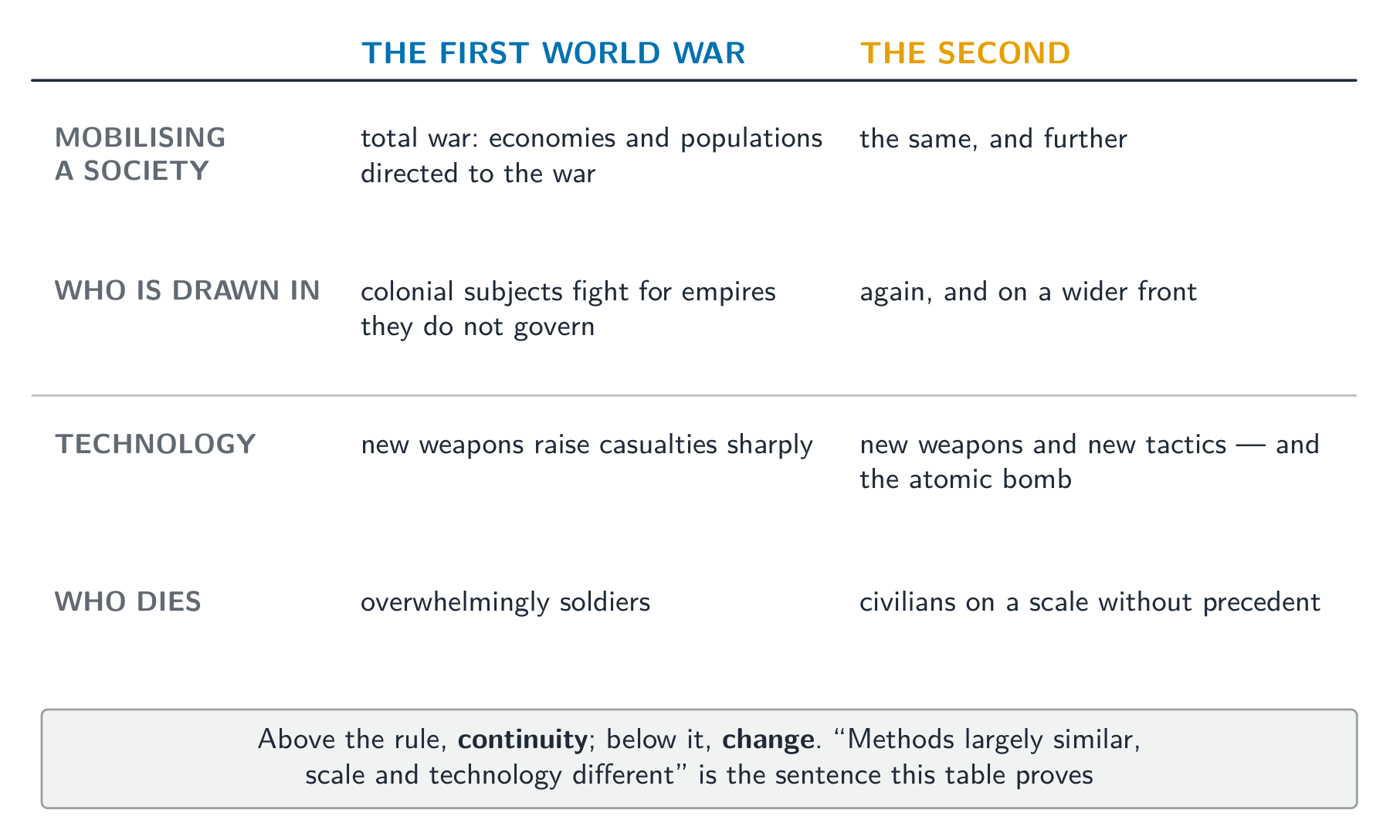
    • การขยายตัวของรัฐที่กำลัง undergoing industrialisation นำไปสู่ ขบวนการปฏิรูปภายใน ในเอเชีย其他地区 как governments trying to respond to new pressure
    สี่รูปแบบการตอบสนองที่ถูกแบ่งด้วยคำถามเดียว: สังคมอุตสาหกรรมที่ถูกต้อง หรือหยุดมัน?
    Explore · ⁨สำรวจ⁩

    Sort each response by what it wants · ⁨จำแนกการตอบสนองแต่ละอย่างตามสิ่งที่มันต้องการ⁩

    Unions, socialism, communism, anarchism and reform legislation split on one question: correct industrial society, or end it? · ⁨Unions (Unions), socialism (socialism), communism (communism), anarchism (anarchism) และ reform legislation (reform_legislation) แตกแยกจากคำถามเดียว: แก้ไขสังคมอุตสาหกรรม หรือ ending it?⁩

    Vocabulary · ⁨คำศัพท์⁩ Train · ⁨ฝึกฝน⁩
    English ไทย
    free trade/friː treɪd/ การค้าเสรี
    transnational businesses/trænˈsnæʃənl ˈbɪznəsɪz/ ธุรกิจข้ามชาติ
    labour unions/ˈleɪbə ˈjuːnɪənz/ สหภาพแรงงาน
    socialism/ˈsəʊʃəlɪzəm/ socialism
    communism/ˈkɒmjuːnɪzəm/ คอมมิวนิสต์
    anarchism/ˈænəkɪzəm/ anarchism
    reform legislation/rɪˈfɔːm ˌledʒɪˈsleɪʃn/ กฎหมายปฏิรูป
    internal reform movements/ɪnˈtɜːnl rɪˈfɔːm ˈmuːvmənts/ ขบวนการปฏิรูปภายใน
    social classes/ˈsəʊʃl ˈklæsɪz/ ชนชั้นทางสังคม
    middle class/ˈmɪdl klæs/ ชนชั้นกลาง
    industrial working class/ɪnˈdʌstrɪəl ˈwɜːkɪŋ klæs/ ชนชั้นแรงงานในภาคอุตสาหกรรม
    urbanisation/ˌɜːbənaɪˈzeɪʃn/ การเป็นเมือง
    family structure/ˈfæmɪli ˈstrʌktʃə/ โครงสร้างครอบครัว
    standards of living/ˈstændədz ɒv ˈlɪvɪŋ/ มาตรฐานการดำรงชีวิต
    5.9

    Society in the Industrial Age · ⁨สังคมในยุคอุตสาหกรรม⁩

    Syllabus · ⁨หลักสูตร⁩
    English

    5.9 Society and the Industrial Age

    Thematic Focus (SIO): Social Interactions and Organization — The process by which societies group their members and the norms that govern the interactions between these groups and between individuals influence political, economic, and cultural institutions and organization.

    Learning Objective Unit 5.J: Explain how industrialization caused change in existing social hierarchies and standards of living.

    • KC-5.1.VI.A New social classes, including the middle class and the industrial working class, developed.
    • KC-5.1.VI.B While women and often children in working class families typically held wage-earning jobs to supplement their families’ income, middle-class women who did not have the same economic demands to satisfy were increasingly limited to roles in the household or roles focused on child development.
    • KC-5.1.VI.C The rapid urbanization that accompanied global capitalism at times led to a variety of challenges, including pollution, poverty, increased crime, public health crises, housing shortages, and insufficient infrastructure to accommodate urban growth.
    ไทย

    5.9 สังคมและยุคอุตสาหกรรม

    จุดเน้นเชิงประเด็น (SIO): ปฏิสัมพันธ์และการจัดระเบียบทางสังคม — กระบวนการที่สังคมรวมกลุ่มสมาชิกของตนและบรรทัดฐานที่ควบคุมการปฏิสัมพันธ์ระหว่างกลุ่มเหล่านี้และระหว่างบุคคลมีผลต่อสถาบันและการจัดระเบียบทางการเมือง เศรษฐกิจ และวัฒนธรรม

    วัตถุประสงค์การเรียนรู้หน่วย 5.J: อธิบายว่ากระบวนการอุตสาหกรรมทำให้เกิดการเปลี่ยนแปลงในลำดับชั้นทางสังคมและมาตรฐานการดำรงชีวิตเดิมๆ อย่างไร

    • KC-5.1.VI.A ชนชั้นสังคมใหม่ เช่น ชนชั้นกลางและชนชั้นแรงงานอุตสาหกรรม ได้เกิดขึ้น
    • KC-5.1.VI.B ในขณะที่ผู้หญิงและมักจะเป็นเด็กในครอบครัวชนชั้นแรงงานมีงานทำเพื่อหาเงินมาช่วย家庭经济 ส่วนผู้หญิงชนชั้นกลางที่ไม่มีความต้องการทางเศรษฐกิจเท่ากัน increasingly ถูกจำกัดอยู่ในบทบาทในบ้านหรือบทบาทที่เกี่ยวข้องกับการเลี้ยงดูบุตร
    • KC-5.1.VI.C การเป็นเมืองอย่างรวดเร็วซึ่งมาพร้อมกับทุนนิยมระดับโลก บางครั้งนำไปสู่ความท้าทายหลากหลายรูปแบบ รวมถึง มลพิษ ความยากจนอาชญากรรมที่เพิ่มขึ้น วิกฤตสุขภาพสาธารณะ ความขาดแคลนที่อยู่อาศัย และโครงสร้างพื้นฐานที่ไม่เพียงพอต่อการรองรับการเติบโตของเมือง

    Source: College Board AP Course and Exam Description · ⁨แหล่งที่มา: คำอธิบายหลักสูตรและข้อสอบ College Board AP⁩

    English

    New social classes 社会阶级 formed, including a middle class 中产阶级 and an industrial working class 工业工人阶级, each with its own culture and politics.

    Other changes are examinable: rapid urbanisation 城市化 with overcrowding and disease; changes in family structure 家庭结构 and in women's work as production left the home; and rising standards of living 生活水平 over the long run, unevenly distributed and reached only after decades of hardship.

    ไทย

    กลุ่มสังคมใหม่เกิดขึ้นมา รวมถึง ชนชั้นกลาง และ ชนชั้นแรงงานอุตสาหกรรม แต่ละกลุ่มมีวัฒนธรรมและการเมืองของตนเอง

    การเปลี่ยนแปลงอื่นๆ ที่สามารถสอบได้: การ reshape urbanization อย่างรวดเร็วพร้อมกับการแออัดและโรคระบาด; การเปลี่ยนแปลงใน โครงสร้างครอบครัว และงานของผู้หญิงเมื่อการผลิตออกจากบ้าน; และการเพิ่มขึ้นของ ระดับชีวิต ในระยะยาวซึ่งกระจายอย่างไม่สม่ำเสมอและเข้าถึงได้ก็ต่อหลังจากผ่านความยากลำบากมาหลายทศวรรษแล้วเท่านั้น

    5.10

    Continuity and Change in the Industrial Age · ⁨ความต่อเนื่องและการเปลี่ยนแปลงในยุคอุตสาหกรรม⁩

    Syllabus · ⁨หลักสูตร⁩
    English

    5.10 Continuity and Change in the Industrial Age

    Learning Objective Unit 5.K: Explain the extent to which industrialization brought change from 1750 to 1900.

    • KC-5.1 The development of industrial capitalism led to increased standards of living for some, and to continued improvement in manufacturing methods that increased the availability, affordability, and variety of consumer goods.
      • KC-5.1.IV Railroads, steamships, and the telegraph made exploration, development, and communication possible in interior regions globally, which led to increased trade and migration.
    • KC-5.3 The 18th century marked the beginning of an intense period of revolution and rebellion against existing governments, leading to the establishment of new nation-states around the world.
      • KC-5.3.I.A Enlightenment philosophies applied new ways of understanding and empiricist approaches to both the natural world and human relationships; they also reexamined the role that religion played in public life and emphasized the importance of reason. Philosophers developed new political ideas about the individual, natural rights, and the social contract.
      • KC-5.3.I The rise and diffusion of Enlightenment thought that questioned established traditions in all areas of life often preceded revolutions and rebellions against existing governments.
      • KC-5.3.II.i Nationalism also became a major force shaping the historical development of states and empires
    ไทย

    5.10 ความต่อเนื่องและการเปลี่ยนแปลงในยุคอุตสาหกรรม

    วัตถุประสงค์การเรียนรู้หน่วยที่ 5.K: อธิบายขอบเขตของการเปลี่ยนแปลงที่เกิดจาก Industrialization ระหว่างปี ค.ศ. 1750 ถึง 1900

    • KC-5.1 การพัฒนา Capitalism ทางอุตสาหกรรมนำไปสู่มาตรฐานการใช้ชีวิตที่สูงขึ้นสำหรับบางคน และการปรับปรุงวิธีการผลิตอย่างต่อเนื่องซึ่งทำให้สินค้าอุปโภคบริโภคมีปริมาณมากขึ้น ราคาถูกลง และมีหลากหลายมากขึ้น
      • KC-5.1.IV ทางรถไฟ เรือไอน้ำ และโทรเลขทำให้การสำรวจ การพัฒนา และการสื่อสารในพื้นที่ภายในเป็นไปได้ทั่วโลก ซึ่งนำไปสู่การเพิ่มขึ้นของการค้าและการย้ายถิ่น
    • KC-5.3 ศตวรรษที่ 18 เป็นจุดเริ่มต้นของช่วงเวลาแห่งการปฏิวัติและการกบฏอย่างเข้มข้นต่อรัฐบาลที่มีอยู่ นำไปสู่การสถาปนารัฐชาติใหม่ทั่วโลก
      • KC-5.3.I.A ปรัชญาแห่งยุค Enlightenment ได้นำแนวทางใหม่ในการทำความเข้าใจและวิธีการเชิงประจักษ์มาประยุกต์ใช้ทั้งกับธรรมชาติและความสัมพันธ์ระหว่างมนุษย์;他们还重新审视了宗教在公共生活中的作用并强调了理性的importance。哲学家们开发了关于个人、自然权利和社会契约的新政治思想。
      • KC-5.3.I การเกิดขึ้นและการแพร่กระจายของความคิดแห่งยุค Enlightenment ที่ตั้งคำถามต่อกำหนดการเดิมในทุกด้านของชีวิต มักเกิดขึ้นก่อนการปฏิวัติและการกบฏต่อรัฐบาลที่มีอยู่
      • KC-5.3.II.i Nationalism also became a major force shaping the historical development of states and empires

    Source: College Board AP Course and Exam Description · ⁨แหล่งที่มา: คำอธิบายหลักสูตรและข้อสอบ College Board AP⁩

    English

    The unit's reasoning skill is continuity and change. Production and class structure changed fundamentally, while imperial competition, coerced labour in colonised regions, and inequality persisted in new forms.

    Worked example (a real AP exam question). AP World short-answer questions here ask, for example, to "Explain one way in which industrialisation changed social structures" between 1750 and 1900. A full-mark answer names the change and traces it: "Industrialisation created a large industrial working class, because the factory system concentrated production in single locations and drew rural labourers into cities to work for wages, replacing household production and the rural social order that depended on it." Notice the shape: explain requires the mechanism - factory system, urban migration, wage labour - not just the statement that new classes appeared.

    ไทย

    ทักษะการคิดของหน่วยนี้คือ ความต่อเนื่องและการเปลี่ยนแปลง การผลิตและโครงสร้างชนชั้นเปลี่ยนไปอย่างพื้นฐาน ในขณะที่การแข่งขันเชิงจักรวรรดิ แรงงายถูกบังคับในภูมิภาคอาณานิคม และความไม่เท่าเทียมยังคงอยู่ในรูปแบบใหม่

    ตัวอย่างคำอธิบาย (ข้อสอบ AP จริง) ข้อสอบตอบสั้น AP World在这里 ask, for example, to "Explain one way in which industrialisation changed social structures" ระหว่างปี 1750 ถึง 1900 คำตอบเต็มคะแนนจะระบุการเปลี่ยนแปลงและติดตามผล: "การอุตสาหกรรมสร้างชนชั้นแรงงานอุตสาหกรรมขนาดใหญ่ขึ้น เพราะระบบโรงงานรวมการผลิตไว้ในสถานที่เดียวและดึงแรงงานชนบทเข้าเมืองเพื่อทำงานเพื่อค่าจ้าง แทนที่การผลิตในครัวเรือนและระเบียบสังคมชนบทที่พึ่งพามัน" ระวังรูปร่าง: explain ต้องการกลไก - ระบบโรงงาน, การย้ายถิ่นสู่เมือง, แรงงานเพื่อค่าจ้าง - ไม่ใช่แค่การระบุว่ามีการปรากฏขึ้นของกลุ่มชนชั้นใหม่

    5.10

    Exam tips · ⁨ข้อแนะนำสำหรับการสอบ⁩

    English
    • Answer "why Britain first" with several factors at once - coal, capital, agriculture, empire - not one cause.
    • The factory system is an organisational change; say what it replaced.
    • For revolutions, pair an idea with a grievance. Either alone explains nothing.
    • State-sponsored industrialisation (Meiji Japan, Russia, Egypt) is the contrast to the British pattern.
    • Give the reactions as a set: unions, socialism and communism, and reform legislation.
    • Living standards rose eventually and unevenly. Saying so is what makes an answer an evaluation.
    ไทย
    • ตอบ "ทำไมอังกฤษก่อน" ด้วย ปัจจัยหลายอย่างพร้อมกัน - ถ่านหิน, ทุน, การเกษตร, จักรวรรดิ - ไม่ใช่สาเหตุเดียว
    • ระบบโรงงาน เป็นการเปลี่ยนแปลงด้านการจัดระเบียบ; บอกว่ามันแทนที่อะไร
    • สำหรับการปฏิวัติ ให้จับคู่ แนวคิด กับ ข้อร้องเรียน ถ้ามีเพียงอย่างเดียวจะไม่อธิบายอะไรได้เลย
    • การอุตสาหกรรมที่สนับสนุนโดยรัฐ (ญี่ปุ่นยุคเมจิ, รัสเซีย, อียิปต์) คือความแตกต่างจากรูปแบบของอังกฤษ
    • ให้การตอบสนองเป็นชุด: สหภาพ, สังคมนิยมและคอมมิวนิสต์, และ กฎหมายปฏิรูป
    • ระดับชีวิตเพิ่มขึ้น ในที่สุดและไม่สม่ำเสมอ การบอกแบบนี้คือสิ่งที่ทำให้คำตอบเป็นการประเมิน
  • 6

    Consequences of Industrialization

    Watch lesson · ⁨ดูบทเรียน⁩
    6.1

    Justifying Empire · ⁨การอ้างถึงจักรวรรดินิยม⁩

    Syllabus · ⁨หลักสูตร⁩
    English

    6.1 Rationales for Imperialism from1750 to 1900

    Thematic Focus (CDI): Cultural Developments and Interactions — The development of ideas, beliefs, and religions illustrates how groups in society view themselves, and the interactions of societies and their beliefs often have political, social, and cultural implications.

    Learning Objective Unit 6.A: Explain how ideologies contributed to the development of imperialism from 1750 to 1900.

    • KC-5.2.III A range of cultural, religious, and racial ideologies were used to justify imperialism, including Social Darwinism, nationalism, the concept of the civilizing mission, and the desire to religiously convert indigenous populations.
    ไทย

    6.1 เหตุผลของการรุกรานdesde 1750 ถึง 1900

    ประเด็นเน้น (CDI): การพัฒนาและการปฏิสัมพันธ์ทางวัฒนธรรม — การพัฒนาของแนวคิด ความเชื่อ และศาสนาแสดงให้เห็นว่ากลุ่มคนในสังคมมองเห็นตนเองอย่างไร และการปฏิสัมพันธ์ระหว่างสังคมและความเชื่อของพวกเขา มักจะมีนัยสำคัญทางการเมือง สังคม และวัฒนธรรม

    วัตถุประสงค์การเรียนรู้หน่วย 6.A: อธิบายว่าอุดมการณ์ใด contributes to the development of imperialism from 1750 to 1900.

    • KC-5.2.III อุดมการณ์ทางวัฒนธรรม ศาสนา และเชื้อชาติหลากหลายชนิดถูกนำมาใช้เพื่อ justificating imperialism, including Social Darwinism, nationalism, the concept of the civilizing mission, and the desire to religiously convert indigenous populations.

    Source: College Board AP Course and Exam Description · ⁨แหล่งที่มา: คำอธิบายหลักสูตรและข้อสอบ College Board AP⁩

    English

    Unit 6 covers the consequences of industrialisation, 1750 to 1900: why industrial states expanded, how people resisted, how the world economy reorganised, and who moved.

    A range of cultural, religious, and racial ideologies were used to justify imperialism. The examinable ones are the civilising mission 文明教化使命, missionary activity, Social Darwinism 社会达尔文主义 applied to nations and peoples, and nationalism - the claim that colonies proved a state's greatness.

    These are justifications, not causes. Naming them as ideology, and separating them from the economic and strategic motives in the next sections, is what a strong answer does.

    ไทย

    หน่วยที่ 6 ครอบคลุม ผลกระทบของการอุตสาหกรรม, 1750 ถึง 1900: ทำไมรัฐอุตสาหกรรมจึงขยายตัว, คน如何应对, เศรษฐกิจโลก how it reorganised, และใคร who moved

    ideology ทาง วัฒนธรรม, ศาสนา, และเชื้อชาติ ถูกใช้เพื่อ justify imperialism. The examinable ones are the civilising mission (ภารกิจ civilizatrice), กิจกรรมของนักบวช, Social Darwinism (ดาร์วินทางสังคม) ที่ใช้กับชาติและประชาชน, และ nationalism (ชาตินิยม) - claim that colonies prove a state's greatness

    สิ่งเหล่านี้คือ เหตุผลประกอบ, ไม่ใช่สาเหตุ การระบุว่าเป็น ideology และแยกออกจาก motives ทางเศรษฐกิจและยุทธศาสตร์ในส่วนถัดไปคือสิ่งที่คำตอบที่ดีทำ

    สามเหตุผลประกอบที่ทำให้ claims สามแบบ: หน้าที่, กฎหมายธรรมชาติ, Prestige
    Explore · ⁨สำรวจ⁩

    Match each justification to the claim it makes · ⁨จับคู่ each justification (each_justification) กับ claim (claim) ที่มันทำ⁩

    They are not one bundle of ideas: a duty, a law of nature and a matter of prestige are three different arguments. · ⁨They are not one bundle of ideas (not_one_bundle): a duty (duty), a law of nature (law_of_nature) และ a matter of prestige (matter_of_prestige) เป็น three different arguments (three_different_arguments)⁩

    Vocabulary · ⁨คำศัพท์⁩ Train · ⁨ฝึกฝน⁩
    English ไทย
    civilising mission/ˈsɪvəlaɪzɪŋ ˈmɪʃn/ ภารกิจ civilizings
    Social Darwinism/ˈsəʊʃl ˈdɑːwɪnɪzəm/ ดาร์วินิยมทางสังคม
    warfare and diplomacy/ˈwɔːfeə ænd dɪˈpləʊməsi/ สงครามและการทูต
    6.2

    State Expansion · ⁨การขยายตัวของรัฐ⁩

    Syllabus · ⁨หลักสูตร⁩
    English

    6.2 State Expansion from 1750 to 1900

    Thematic Focus (GOV): Governance — A variety of internal and external factors contribute to state formation, expansion, and decline. Governments maintain order through a variety of administrative institutions, policies, and procedures, and governments obtain, retain, and exercise power in different ways and for different purposes.

    Learning Objective Unit 6.B: Compare processes by which state power shifted in various parts of the world from 1750 to 1900.

    • KC-5.2.I.A Some states with existing colonies strengthened their control over those colonies and in some cases assumed direct control over colonies previously held by non-state entities.
    • KC-5.2.I.B European states as well as the United States and Japan acquired territories throughout Asia and the Pacific, while Spanish and Portuguese influence declined.
    • KC-5.2.I.C Many European states used both warfare and diplomacy to expand their empires in Africa.
    • KC-5.2.I.D Europeans established settler colonies in some parts of their empires.
    • KC-5.2.II.B The United States, Russia, and Japan expanded their land holdings by conquering and settling neighboring territories.

    Illustrative examples:

    • Non-state to state colonial control:
      • Shift from the private ownership of the Congo by King Leopold II to the Belgium government
      • Shift from the Dutch East India Company to Dutch government control in Indonesia and Southeast Asia
    • European states that expanded empires in Africa:
      • Britain in West Africa
      • Belgium in the Congo
      • French in West Africa
    • Settler colonies established in empires:
      • New Zealand
    ไทย

    6.2 การขยายตัวของรัฐ desde 1750 ถึง 1900

    ประเด็นเน้น (GOV): การปกครอง — ปัจจัยภายในและภายนอกหลากหลายชนิดมีส่วนร่วมในการก่อตัว การขยายตัว และการล่มสลายของรัฐ รัฐบาลรักษาความสงบเรียบร้อยผ่านสถาบัน นโยบาย และขั้นตอนการบริหารจัดการที่หลากหลาย และรัฐบาลได้รับ รักษาส Powers และใช้อำนาจในรูปแบบและด้วยวัตถุประสงค์ที่แตกต่างกัน

    วัตถุประสงค์การเรียนรู้หน่วย 6.B: เปรียบเทียบกระบวนการที่อำนาจรัฐเปลี่ยนไปในส่วนต่างๆ ของโลกตั้งแต่ปี 1750 ถึง 1900

    • KC-5.2.I.A บางรัฐที่มีอาณานิคมอยู่แล้วได้เสริมการควบคุมเหนืออาณานิคมเหล่านั้นและในบางกรณีได้เข้ารับ控制权โดยตรงเหนืออาณานิคมที่เคยถือครองโดย entity ที่ไม่ใช่รัฐ
    • KC-5.2.I.B รัฐยุโรป รวมถึงสหรัฐอเมริกาและญี่ปุ่น ได้ยึดครองดินแดนทั่วเอเชียและแปซิฟิก ในขณะที่อิทธิพลของสเปนและโปรตุเกลดดลง
    • KC-5.2.I.C รัฐยุโรปหลายแห่งใช้ทั้งสงครามและ外交手段ในการขยายจักรวรรดิในแอฟริกา
    • KC-5.2.I.D ยุโรป创建了 settler colonies ในบางส่วนของจักรวรรดิของตน
    • KC-5.2.II.B สหรัฐฯ รัสเซีย และญี่ปุ่น ขยายดินแดนของตนโดยการ conquest and settling neighboring territories.

    ตัวอย่างประกอบ:

    • การควบคุมอาณานิคมจาก non-state เป็น state:
      • การเปลี่ยนแปลงจากการ ownership by private King Leopold II of Congo to the Belgian government
      • การเปลี่ยนแปลงจาก Dutch East India Company to Dutch government control in Indonesia and Southeast Asia
    • รัฐยุโรปที่ขยายจักรวรรดิในแอฟริกา:
      • อังกฤษในแอฟริกาตะวันตก
      • เบลเยียม ในคองโก
      • ฝรั่งเศสในแอฟริกาตะวันตก
    • Settler colonies ที่ถูกสร้างในจักรวรรดิ:
      • นิวซีแลนด์

    Source: College Board AP Course and Exam Description · ⁨แหล่งที่มา: คำอธิบายหลักสูตรและข้อสอบ College Board AP⁩

    English

    Expansion took several forms, and the CED distinguishes them:

    • Some states strengthened control over existing colonies, converting trading relationships into direct rule.
    • European states, the United States, and Japan acquired new territory, showing that imperialism was not only European.
    • Many European states used both warfare and diplomacy 战争与外交 to expand - conquest, but also treaties, protectorates, and partition agreements made in Europe.
    • Europeans established settler colonies 定居殖民地 in some places, which displaced Indigenous populations far more thoroughly than administrative rule.
    • The United States, Russia, and Japan expanded by taking contiguous land rather than overseas territory.
    ไทย

    การขยายตัวมีหลายรูปแบบ และ CED แยกแยะ them:

    • บางรัฐ เสริมการควบคุม над existing colonies, เปลี่ยนความสัมพันธ์ทางการค้าให้เป็น direct rule
    • รัฐยุโรป, สหรัฐอเมริกา, และญี่ปุ่น ได้ดินแดนใหม่ แสดงให้เห็นว่า imperialism ไม่ใช่เฉพาะของยุโรปเท่านั้น
    • รัฐยุโรปจำนวนมากใช้ทั้ง สงครามและการทูต เพื่อ expand - conquest, แต่ also treaties, protectorates, and partition agreements made in Europe
    • ยุโรป建立了 settler colonies ในบางพื้นที่ ซึ่ง displacement Indigenous populations thoroughly มากกว่า administration rule
    • สหรัฐอเมริกา, รัสเซีย, และญี่ปุ่น ขยายตัว bằngการ taking contiguous land Rather than overseas territory
    Vocabulary · ⁨คำศัพท์⁩ Train · ⁨ฝึกฝน⁩
    English ไทย
    settler colonies/ˈsetlə ˈkɒləniz/ อาณานิคมผู้ตั้งถิ่นฐาน
    6.3

    Resistance · ⁨การต่อต้าน⁩

    Syllabus · ⁨หลักสูตร⁩
    English

    6.3 Indigenous Responses to State Expansion from 1750 to 1900

    Thematic Focus (GOV): Governance — A variety of internal and external factors contribute to state formation, expansion, and decline. Governments maintain order through a variety of administrative institutions, policies, and procedures, and governments obtain, retain, and exercise power in different ways and for different purposes.

    Learning Objective Unit 6.C: Explain how and why internal and external factors have influenced the process of state building from 1750 to 1900.

    • KC-5.3.III.D Increasing questions about political authority and growing nationalism contributed to anticolonial movements.
    • KC-5.2.II.C Anti-imperial resistance took various forms, including direct resistance within empires and the creation of new states on the peripheries.
    • KC-5.3.III.E Increasing discontent with imperial rule led to rebellions, some of which were influenced by religious ideas.

    Illustrative examples:

    • Direct resistance:
      • Túpac Amaru II’s rebellion in Peru
      • Samory Touré’s military battles in West Africa
      • Yaa Asantewaa War in West Africa
      • 1857 rebellion in India
    • New states:
      • Establishment of independent states in the Balkans
      • Sokoto Caliphate in modern-day Nigeria
      • Cherokee Nation
      • Zulu Kingdom
    • Rebellions:
      • Ghost Dance in the U.S.
      • Xhosa Cattle-Killing Movement in Southern Africa
      • Mahdist wars in Sudan
    ไทย

    6.3 การตอบสนองของชนพื้นเมืองต่อการขยายตัวของรัฐ since 1750 ถึง 1900

    ประเด็นเน้น (GOV): การปกครอง — ปัจจัยภายในและภายนอกหลากหลายชนิดมีส่วนร่วมในการก่อตัว การขยายตัว และการล่มสลายของรัฐ รัฐบาลรักษาความสงบเรียบร้อยผ่านสถาบัน นโยบาย และขั้นตอนการบริหารจัดการที่หลากหลาย และรัฐบาลได้รับ รักษาส Powers และใช้อำนาจในรูปแบบและด้วยวัตถุประสงค์ที่แตกต่างกัน

    วัตถุประสงค์การเรียนรู้หน่วย 6.C: อธิบายว่าปัจจัยภายในและภายนอก how they have influenced the process of state building from 1750 to 1900.

    • KC-5.3.III.D คำถามที่เพิ่มขึ้นเกี่ยวกับอำนาจทางการเมืองและ民族主义ที่เพิ่มขึ้น contributing to anticolonial movements.
    • KC-5.2.II.C การต้านทานการรุกราน takes various forms, including direct resistance within empires and the creation of new states on the peripheries.
    • KC-5.3.III.E ความไม่พอใจที่เพิ่มขึ้นต่อการปกครองของจักรวรรดิ led to rebellions, some of which were influenced by religious ideas.

    ตัวอย่างประกอบ:

    • Direct resistance:
      • การrevolt of Túpac Amaru II ในเปรู
      • battles of Samory Touré in West Africa
      • Yaa Asantewaa War in West Africa
      • การrevolt of 1857 in India
    • New states:
      • การestablishment of independent states in the Balkans
      • Sokoto Caliphate in modern-day Nigeria
      • Cherokee Nation
      • Zulu Kingdom
    • Rebellions:
      • Ghost Dance in the U.S.
      • Xhosa Cattle-Killing Movement in Southern Africa
      • Mahdist wars in Sudan

    Source: College Board AP Course and Exam Description · ⁨แหล่งที่มา: คำอธิบายหลักสูตรและข้อสอบ College Board AP⁩

    English

    Anti-imperial resistance 抵抗 took various forms, and listing only armed revolt loses marks:

    • Direct resistance 直接抵抗 - armed rebellion against colonial authority.
    • Creation of new states 建立新国家 by leaders organising against imperial power.
    • Religious and cultural movements 宗教与文化运动 that reasserted local identity against colonial rule.

    Increasing questions about political authority and growing nationalism in colonised regions led to rebellions, some of which were sustained enough to change imperial policy. The important point: resistance is continuous throughout the period, not a late reaction.

    The examples the CED names, one per form

    An essay needs a case, not a category. These are the ones the CED lists, sorted by the form of resistance they illustrate:

    Case Where Form it illustrates
    Samory Touré's 萨莫里·杜尔 military campaigns West Africa direct armed resistance, sustained for years against the French
    Yaa Asantewaa War 雅阿·阿散蒂瓦战争 Asante, West Africa direct resistance led by a woman, in defence of a sacred symbol of sovereignty
    Sokoto Caliphate 索科托哈里发国 modern-day Nigeria the creation of a NEW state, founded in a religious reform movement

    The Congo shows how the argument about empire changed. The territory was first held as the private property of King Leopold II of Belgium rather than as a colony of Belgium at all; the atrocities of the rubber regime became an international scandal, and in 1908 ownership was transferred to the Belgian government. It is the clearest case in the unit of imperial practice being altered by publicity and criticism — useful evidence in any question about how empire was justified or challenged.

    ไทย

    Anti-imperial resistance มีหลายรูปแบบ และการ listing only armed revolt จะเสียคะแนน:

    • Direct resistance (การต่อต้านโดยตรง) - การกบฏ مسل against colonial authority
    • การสร้างรัฐใหม่ โดยผู้นำที่ organize against imperial power
    • ขบวนการศาสนาและวัฒนธรรม ที่ reaffirm local identity against colonial rule

    คำถามที่เพิ่มขึ้นเกี่ยวกับอำนาจทางการเมืองและความรู้สึก ความรักชาติ ที่เพิ่มขึ้นในพื้นที่ที่ถูกอาณานิคม นำไปสู่การกบฏ ซึ่งบางกรณีมีความต่อเนื่องเพียงพอที่จะเปลี่ยนแปลงนโยบายของจักรวรรดิ ข้อสำคัญ: การต่อต้านเป็นกระบวนการต่อเนื่องตลอดช่วงเวลา ไม่ใช่ปฏิกิริยาในท้ายท้ายเท่านั้น

    การต่อต้านเกิดขึ้นในสามรูปแบบ โดยNationalism เป็นเส้นสายที่貫穿ทุกแบบ

    ตัวอย่างที่ CED ระบุมา, อย่างละรูปแบบ

    เรียงลำดับตามรูปแบบการต่อต้านที่แต่ละกรณีแสดง:

    กรณีศึกษา สถานที่ รูปแบบที่แสดง
    Samory Touré· การ campaigns ทางทหาร แอฟริกาตะวันตก การต่อต้านด้วยอาวุธโดยตรง, ยาวนานหลายปีต่อฝรั่งเศส
    Yaa Asantewaa War· Asante, แอฟริกาตะวันตก การต่อต้านโดยตรงนำโดยผู้หญิง, เพื่อปกป้องสัญลักษณ์ศักดิ์สิทธิ์แห่งอำนาจอธิปไตย
    Sokoto Caliphate 尼日利亚สมัยใหม่ การสร้างรัฐ NEW, ก่อตั้งขึ้นจากการเคลื่อนไหวปฏิรูปศาสนา

    Congo แสดงให้เห็นว่าข้อโต้แย้งเกี่ยวกับempire เปลี่ยนแปลงไปอย่างไรดินแดนนี้ถูกครอบครองครั้งแรกในฐานะ ทรัพย์สินส่วนตัวของ King Leopold II ของเบลเยียม ไม่ใช่เป็นอาณานิคมของเบลเยียมเลย; ความรุนแรงของระบอบยางพารากลายเป็นเรื่องสยองขวัญระหว่างประเทศ, และในปี 1908 ความเป็นเจ้าของได้ ถูกโอนให้รัฐบาลเบลเยียม นี่คือกรณีที่ชัดเจนที่สุดในหน่วยว่าแนวปฏิบัติของempire ถูกเปลี่ยนแปลงโดยสื่อและคำวิจารณ์ — ซึ่งเป็นหลักฐานที่มีประโยชน์สำหรับคำถามใดๆ เกี่ยวกับ how empire ถูกใช้เพื่อ justify หรือถูกท้าทาย

    Vocabulary · ⁨คำศัพท์⁩ Train · ⁨ฝึกฝน⁩
    English ไทย
    resistance/rɪˈzɪstəns/ ความต้านทาน
    Direct resistance/daɪˈrekt rɪˈzɪstəns/ การต่อต้านโดยตรง
    Creation of new states/kriːˈeɪʃn ɒv njuː steɪts/ การสร้างรัฐใหม่
    Religious and cultural movements/rɪˈlɪdʒəs ænd ˈkʌltʃərəl ˈmuːvmənts/ ขบวนการทางศาสนาและวัฒนธรรม
    Samory Touré's/ˈsæməri tʊəˈreɪz/ ของซามอรี โทเร่
    Yaa Asantewaa War/jɑː əˈsæntjuːɑː wɔː/ สงครามยา อาซานเทวา
    Sokoto Caliphate/səˈkəʊtəʊ ˈkælɪfeɪt/ คาליฟะตซอกोटो
    6.4 6.5

    The Global Economy · ⁨เศรษฐกิจโลก⁩

    Syllabus · ⁨หลักสูตร⁩
    English

    6.4 Global Economic Development from1750 to 1900

    Thematic Focus (ENV): Humans and the Environments — The environment shapes human societies, and as populations grow and change, these populations in turn shape their environments.

    Learning Objective Unit 6.D: Explain how various environmental factors contributed to the development of the global economy from 1750 to 1900.

    • KC-5.1.II.A The need for raw materials for factories and increased food supplies for the growing population in urban centers led to the growth of export economies around the world that specialized in commercial extraction of natural resources and the production of food and industrial crops. The profits from these raw materials were used to purchase finished goods.

    Illustrative examples:

    • Resource export economies:
      • Cotton production in Egypt
      • Rubber extraction in the Amazon and the Congo basin
      • The palm oil trade in West Africa
      • The guano industries in Peru and Chile
      • Meat from Argentina and Uruguay
      • Diamonds from Africa
    ไทย

    6.4 การพัฒนาทางเศรษฐกิจระดับโลก since 1750 ถึง 1900

    ประเด็นหลัก (ENV): มนุษย์และสิ่งแวดล้อม — สิ่งแวดล้อมมีผลต่อสังคมของมนุษย์ และเมื่อประชากรเพิ่มขึ้นหรือเปลี่ยนแปลง ประชากรเหล่านั้นก็จะส่งผลกลับไปยังสิ่งแวดล้อมในทางกลับกัน

    วัตถุประสงค์การเรียนรู้หน่วย 6.D: อธิบายว่าปัจจัยด้านสิ่งแวดล้อมต่างๆ มีส่วนร่วมต่อการพัฒนาเศรษฐกิจโลกในช่วงปี ค.ศ. 1750 ถึง 1900 อย่างไร

    • KC-5.1.II.A ความต้องการวัตถุดิบสำหรับโรงงานและอาหารที่เพิ่มขึ้นสำหรับประชากรในเขตเมืองที่ขยายตัว นำไปสู่การเติบโตของเศรษฐกิจการส่งออกทั่วโลกที่เชี่ยวชาญในการ extracting ทรัพยากรธรรมชาติและการผลิตพืชอาหารและพืชอุตสาหกรรม กำไรจากวัตถุดิบเหล่านี้ถูกนำไปใช้ซื้อสินค้าสำเร็จรูป

    ตัวอย่างประกอบ:

    • เศรษฐกิจการส่งออกทรัพยากร:
      • การผลิตผ้าฝ้ายในอียิปต์
      • การextract ยางพาราในแอมะซอนและแอ่งคองโก
      • การค้าปาล์มน้ำมันในตะวันตกแห่งแอฟริกา
      • อุตสาหกรรมขี้ไก่ในเปรูและชิลี
      • เนื้อสัตว์จากอาร์เจนตินาและอุรุกวัย
      • เพชรจากแอฟริกา
    English

    6.5 Economic Imperialism from 1750 to 1900

    Thematic Focus (ECN): Economics Systems — As societies develop, they affect and are affected by the ways that they produce, exchange, and consume goods and services.

    Learning Objective Unit 6.E: Explain how various economic factors contributed to the development of the global economy from 1750 to 1900.

    • KC-5.2.I.E Industrialized states and businesses within those states practiced economic imperialism primarily in Asia and Latin America.
    • KC-5.1.II.C Trade in some commodities was organized in a way that gave merchants and companies based in Europe and the U.S. a distinct economic advantage.

    Illustrative examples:

    • Industrialized states practicing economic imperialism:
      • Britain and France expanding their influence in China through the Opium Wars
      • The construction of the Port of Buenos Aires with the support of British firms
    • Commodities that contributed to European and American economic advantage:
      • Opium produced in the Middle East or South Asia and exported to China
      • Cotton grown in South Asia and Egypt and exported to Great Britain and other European countries
      • Palm oil produced in sub-Saharan Africa and exported to European countries
      • Copper extracted in Chile
    ไทย

    6.5 Imperialism ทางเศรษฐกิจจาก 1750 ถึง 1900

    จุดเน้นเชิงประเด็น (ECN): ระบบเศรษฐกิจ — เมื่อสังคมพัฒนาขึ้น จะส่งผลกระทบต่อและได้รับผลกระทบจากวิธีการผลิต แลกเปลี่ยน และบริโภคสินค้าและบริการ

    วัตถุประสงค์การเรียนรู้หน่วย 6.E: อธิบายว่าปัจจัยทางเศรษฐกิจต่างๆ มีส่วนร่วมต่อการพัฒนาเศรษฐกิจโลกในช่วงปี ค.ศ. 1750 ถึง 1900 อย่างไร

    • KC-5.2.I.E รัฐและธุรกิจที่ผ่านกระบวนการ industrialize ได้ปฏิบัติ economic imperialism เป็นหลักในเอเชียและลาตินอเมริกา
    • KC-5.1.II.C การค้าในบาง commodities ถูกจัดตั้งในรูปแบบที่ให้พ่อค้าและบริษัทที่ตั้งอยู่ในยุโรปและสหรัฐอเมริกาได้เปรียบทางเศรษฐกิจอย่างชัดเจน

    ตัวอย่างประกอบ:

    • รัฐที่ผ่านกระบวนการ industrialize ที่ปฏิบัติ economic imperialism:
      • สหราชอาณาจักรและฝรั่งเศสที่ขยายอิทธิพลในจีนผ่านการสงคราม Opium
      • การก่อสร้างท่าเรือบuetypeiros ด้วยความช่วยเหลือจากบริษัทสหราชอาณาจักร
    • Commodities ที่ช่วยให้ยุโรปและสหรัฐอเมริกาได้เปรียบทางเศรษฐกิจ:
      • Opium ที่ผลิตในตะวันออกกลางหรือเอเชียใต้และส่งออกไปยังจีน
      • ผ้าฝ้ายที่ปลูกในเอเชียใต้และอียิปต์และส่งออกไปยังสหราชอาณาจักรและประเทศยุโรปอื่นๆ
      • ปาล์มน้ำมันที่ผลิตในแอฟริกาใต้สะ哈拉และส่งออกไปยังประเทศยุโรป
      • ทองแดงที่ extract ในชิลี

    Source: College Board AP Course and Exam Description · ⁨แหล่งที่มา: คำอธิบายหลักสูตรและข้อสอบ College Board AP⁩

    English

    The need for raw materials 原材料 for factories and increased food supplies 粮食供应 for growing urban populations reorganised production across the world. Colonies and dependent regions were pushed toward cash crops 经济作物 and extractive industries 采掘业, often at the cost of food production for local use.

    The commodities are worth knowing by name and origin, because a question usually supplies one and expects you to place it: cotton from Egypt and India, rubber from the Congo and the Amazon, palm oil from West Africa, sugar from the Caribbean, guano from Peru, and meat from Argentina and Uruguay — the last made possible by refrigerated shipping, which turned distant grassland into a supplier for European cities.

    Economic imperialism 经济帝国主义 is the examinable distinction. Industrialised states and their businesses exercised control through investment, loans, and trade dominance without necessarily taking political control - so a region could be economically dominated while remaining formally independent.

    Trade in some commodities was organised so that merchants and firms in industrialised states held disproportionate power 不成比例的权力 over producers, setting prices and terms.

    ไทย
    Industrial states ต้องการใช้วัตถุดิบและตลาด; อาณานิคมถูกจัดระเบียบใหม่เพื่อจัดหาสิ่งเหล่านี้
    Economic imperialism ไม่ได้ต้องการpolitical control เสมอไป - นั่นคือเหตุผลว่าทำไมทั้งสองต้องถูกแยกออกจากกัน

    ความต้องการ วัตถุดิบ สำหรับโรงงานและการเพิ่ม อาหาร สำหรับประชากรในเมืองที่เพิ่มขึ้น ได้จัดระเบียบการผลิตทั่วโลกอาณานิคมและดินแดนขึ้นอยู่ถูกผลัก toward cash crops และ extractive industries, มักจะเสียสละการผลิตอาหารสำหรับการบริโภคภายใน

    สินค้าเหล่านี้ควรรู้จักชื่อและแหล่งกำเนิด, เพราะคำถามมักให้มาหนึ่งอย่างและคาดหวังให้คุณ placement: cotton จากEgyptและIndia, rubber จากCongoและAmazon, palm oil จากWest Africa, sugar จากCaribbean, guano จากPeru, และ meat from Argentina and Uruguay — สิ่งสุดท้ายทำให้เป็นไปได้โดย refrigerated shipping, ซึ่งเปลี่ยน grassland ที่ห่างไกลให้เป็น supplier สำหรับเมืองยุโรป

    Economic imperialism คือการแยกแยะที่สำคัญในการสอบ Industrialised states และธุรกิจของพวกเขา exercising control through investment, loans, and trade dominance โดยไม่จำเป็นต้อง lấypolitical control - ดังนั้นภูมิภาคสามารถถูก的经济 dominate While remaining formally independent.

    การค้าในบาง commodities được organised such that merchants และ firms ใน industrialised states held disproportionate power over producers, setting prices and terms.

    Vocabulary · ⁨คำศัพท์⁩ Train · ⁨ฝึกฝน⁩
    English ไทย
    cash crops/kæʃ krɒps/ พืชเศรษฐกิจ
    extractive industries/ekˈstræktɪv ˈɪndʌstriz/ อุตสาหกรรม استخراج
    Economic imperialism/ˌiːkəˈnɒmɪk ɪmˈpɪərɪəlɪzəm/ ลัทธิจักรวรรดิทางเศรษฐกิจ
    disproportionate power/ˌdɪsprəˈpɔːʃənət ˈpaʊə/ อำนาจที่ไม่สมส่วน
    6.6

    Migration · ⁨การย้ายถิ่น⁩

    Syllabus · ⁨หลักสูตร⁩
    English

    6.6 Causes of Migration in an Interconnected World

    Thematic Focus (ENV): Humans and the Environments — The environment shapes human societies, and as populations grow and change, these populations in turn shape their environments.

    Thematic Focus (ECN): Economics Systems — As societies develop, they affect and are affected by the ways that they produce, exchange, and consume goods and services.

    Learning Objective Unit 6.F: Explain how various environmental factors contributed to the development of varied patterns of migration from 1750 to 1900.

    • KC-5.4.I Migration in many cases was influenced by changes in demographics in both industrialized and unindustrialized societies that presented challenges to existing patterns of living.
    • KC-5.4.I.B Because of the nature of new modes of transportation, both internal and external migrants increasingly relocated to cities. This pattern contributed to the significant global urbanization of the 19th century. The new methods of transportation also allowed for many migrants to return, periodically or permanently, to their home societies.

    Learning Objective Unit 6.G: Explain how various economic factors contributed to the development of varied patterns of migration from 1750 to 1900.

    • KC-5.4.II.A Many individuals chose freely to relocate, often in search of work.
    • KC-5.4.II.B The new global capitalist economy continued to rely on coerced and semicoerced labor migration, including enslavement Chinese and Indian indentured servitude, and convict labor.

    Illustrative examples:

    • Return of migrants:
      • Japanese agricultural workers in the Pacific
      • Lebanese merchants in the Americas
      • Italian industrial workers in Argentina
    • (CONT’D) Migrants:
      • Irish to the United States
      • British engineers and geologists to South Asia and Africa
    ไทย

    6.6 สาเหตุของการย้ายถิ่นฐานในโลกที่เชื่อมโยงกัน

    ประเด็นหลัก (ENV): มนุษย์และสิ่งแวดล้อม — สิ่งแวดล้อมมีผลต่อสังคมของมนุษย์ และเมื่อประชากรเพิ่มขึ้นหรือเปลี่ยนแปลง ประชากรเหล่านั้นก็จะส่งผลกลับไปยังสิ่งแวดล้อมในทางกลับกัน

    จุดเน้นเชิงประเด็น (ECN): ระบบเศรษฐกิจ — เมื่อสังคมพัฒนาขึ้น จะส่งผลกระทบต่อและได้รับผลกระทบจากวิธีการผลิต แลกเปลี่ยน และบริโภคสินค้าและบริการ

    วัตถุประสงค์การเรียนรู้หน่วย 6.F: อธิบายว่าปัจจัยด้านสิ่งแวดล้อมต่างๆ มีส่วนร่วมต่อการพัฒนารูปแบบการย้ายถิ่นฐานที่หลากหลายในช่วงปี ค.ศ. 1750 ถึง 1900 อย่างไร

    • KC-5.4.I การย้ายถิ่นฐานในหลายกรณีได้รับผลกระทบจากการเปลี่ยนแปลงด้านประชากรศาสตร์ในสังคมทั้งที่ผ่านกระบวนการ industrialize และไม่ผ่าน ซึ่งสร้างความท้าทายต่อรูปแบบการดำรงชีวิตที่มีอยู่เดิม
    • KC-5.4.I.B เนื่องจากลักษณะของรูปแบบการขนส่งใหม่ ทั้งผู้ย้ายถิ่นภายในและภายนอก increasingly ย้ายไปอาศัยในเมือง รูปแบบนี้มีส่วนทำให้การ urbanization ระดับโลกที่สำคัญในศตวรรษที่ 19เกิดขึ้น วิธีการขนส่งใหม่ยังช่วยให้ผู้ย้ายถิ่นจำนวนมากสามารถกลับคืนสู่สังคมต้นทางของตนได้อย่างเป็นระยะหรือถาวร

    วัตถุประสงค์การเรียนรู้หน่วย 6.G: อธิบายว่าปัจจัยทางเศรษฐกิจต่างๆ มีส่วนร่วมต่อการพัฒนารูปแบบการย้ายถิ่นฐานที่หลากหลายในช่วงปี ค.ศ. 1750 ถึง 1900 อย่างไร

    • KC-5.4.II.A บุคคลจำนวนมากเลือกที่จะย้ายไป resides อย่างอิสระ มักจะเพื่อค้นหาโอกาสงาน
    • KC-5.4.II.B เศรษฐกิจทุนนิยมระดับโลกใหม่ยังคงพึ่งพาการย้ายถิ่นฐานแรงงานที่ถูกบังคับและกึ่งบังคับ รวมถึงการ enslaved การ indentured servitude ของชาวจีนและชาวอินเดีย และการ labor จาก convict

    ตัวอย่างประกอบ:

    • การกลับมาของผู้ย้ายถิ่น:
      • เกษตรกรญี่ปุ่นในมหาสมุทรแปซิฟิก
      • พ่อค้าเลบานอนในทวีปอเมริกา
      • ช่างอุตสาหกรรมอิตาลีในอาร์เจนตินา
    • (ต่อ) ผู้ย้ายถิ่น:
      • ชาวไอร์แลนด์ไปยังสหรัฐอเมริกา
      • วิศวกรและนักธรณีวิทยาชาวบริติชไปยังเอเชียใต้และแอฟริกา

    Source: College Board AP Course and Exam Description · ⁨แหล่งที่มา: คำอธิบายหลักสูตรและข้อสอบ College Board AP⁩

    English

    Migration in this period was shaped by demographic change in both sending and receiving societies, and by new modes of transportation 交通方式 - steamships and railways - which made long-distance and often temporary or seasonal 临时或季节性 movement possible for the first time.

    Two kinds must be distinguished:

    • Many people chose freely to relocate, usually in search of work.
    • The global capitalist economy continued to rely on coerced and semi-coerced labour 强制与半强制劳动, including indentured servitude 契约劳工 and convict labour, after the legal end of the slave trade.
    ไทย

    Migration ในช่วงนี้受 shaped by demographic change ทั้งใน sending และ receiving societies, และโดย new modes of transportation - steamships และ railways - ซึ่งทำให้ long-distance และมักจะเป็น temporary or seasonal movement เป็นไปได้เป็นครั้งแรก

    สองชนิดต้องถูกแยกออกจากกัน:

    • หลายคน เลือกที่จะ relocate ด้วยตนเอง, โดยทั่วไปเพื่อหา work.
    • เศรษฐกิจ capitalist โลกยังคงพึ่งพา coerced และ semi-coerced labour, รวมถึง indentured servitude และ convict labour, หลังจาก legal end ของ slave trade.
    Vocabulary · ⁨คำศัพท์⁩ Train · ⁨ฝึกฝน⁩
    English ไทย
    modes of transportation/məʊdz ɒv trænspɔːˈteɪʃn/ รูปแบบการขนส่ง
    temporary or seasonal/ˈtemprəri ɔː ˈsiːzənl/ ชั่วคราวหรือตามฤดูกาล
    coerced and semi-coerced labour/ˌkəʊˈɜːst ænd ˈsemi ˌkəʊˈɜːst ˈleɪbə/ แรงงานถูกบังคับและกึ่งถูกบังคับ
    indentured servitude/ˌɪnˈdentʃəd ˈsɜːvɪtjuːd/ การเป็นทาสตามสัญญา
    6.7

    Effects of Migration · ⁨ผลกระทบของการย้ายถิ่น⁩

    Syllabus · ⁨หลักสูตร⁩
    English

    6.7 Effects of Migration

    Thematic Focus (SIO): Social Interactions and Organization — The process by which societies group their members and the norms that govern the interactions between these groups and between individuals influence political, economic, and cultural institutions and organization.

    Learning Objective Unit 6.H: Explain how and why new patterns of migration affected society from 1750 to 1900.

    • KC-5.4.III.A Migrants tended to be male, leaving women to take on new roles in the home society that had been formerly occupied by men.
    • KC-5.4.III.B Migrants often created ethnic enclaves in different parts of the world that helped transplant their culture into new environments.
    • KC-5.4.III.C Receiving societies did not always embrace immigrants, as seen in the various degrees of ethnic and racial prejudice and the ways states attempted to regulate the increased flow of people across their borders.

    Illustrative examples:

    • Migrant ethnic enclaves:
      • Chinese in Southeast Asia, the Caribbean, South America, and North America
      • Indians in East and Southern Africa, the Caribbean, and Southeast Asia
      • Irish in North America
      • Italians in North and South America
    • Regulation of immigrants:
      • Chinese Exclusion Act
      • White Australia policy
    ไทย

    6.7 ผลกระทบของการย้ายถิ่นฐาน

    จุดเน้นเชิงประเด็น (SIO): ปฏิสัมพันธ์และการจัดระเบียบทางสังคม — กระบวนการที่สังคมรวมกลุ่มสมาชิกของตนและบรรทัดฐานที่ควบคุมการปฏิสัมพันธ์ระหว่างกลุ่มเหล่านี้และระหว่างบุคคลมีผลต่อสถาบันและการจัดระเบียบทางการเมือง เศรษฐกิจ และวัฒนธรรม

    วัตถุประสงค์การเรียนรู้หน่วย 6.H: อธิบายว่ารูปแบบการย้ายถิ่นฐานใหม่ส่งผลต่อสังคมอย่างไรและทำไมถึงเกิดขึ้นในช่วงปี ค.ศ. 1750 ถึง 1900

    • KC-5.4.III.A ผู้ย้ายถิ่นมีแนวโน้มเป็นผู้ชาย ทำให้ผู้หญิงต้องรับบทบาทใหม่ในสังคมต้นทางซึ่งเคยเป็นหน้าที่ของผู้ชาย
    • KC-5.4.III.B ผู้ย้ายถิ่นมักสร้าง ethnic enclaves ในส่วนต่างๆ ของโลกที่ช่วย transplant วัฒนธรรมของพวกเขาเข้าสู่อากาศแวดล้อมใหม่
    • KC-5.4.III.C สังคมผู้รับไม่ได้อพยม移民เสมอไป如下图所示各种程度的ethnic และ racial prejudice และวิธีการที่รัฐพยายาม regulate การไหลเวียนของpeople ที่เพิ่มขึ้นข้ามพรมแดน

    ตัวอย่างประกอบ:

    • Ethnic enclaves ของผู้ย้ายถิ่น:
      • ชาวจีนในเอเชียตะวันออกเฉียงใต้ แคริบเบียน อเมริกาใต้และอเมริกาเหนือ
      • ชาวอินเดียในเอเชียตะวันออกและแอฟริกาใต้ แคริบเบียนและเอเชียตะวันออกเฉียงใต้
      • ชาวไอร์แลนด์ในอเมริกาเหนือ
      • ชาวอิตาลีในอเมริกาเหนือและอเมริกาใต้
    • การ regulate ผู้เข้าเมือง:
      • Chinese Exclusion Act
      • White Australia policy

    Source: College Board AP Course and Exam Description · ⁨แหล่งที่มา: คำอธิบายหลักสูตรและข้อสอบ College Board AP⁩

    English

    Three effects are named directly in the CED:

    • Migrants tended to be male, leaving women to take on new roles in the home societies they left.
    • Migrants created ethnic enclaves 族裔聚居区 in destination societies, transplanting and adapting their cultures.
    • Receiving societies did not always embrace immigrants, and the examinable evidence is legal exclusion - most clearly the restriction of Chinese and other Asian migration in several countries.
    ไทย

    สาม effects ถูก named โดยตรงใน CED:

    • Migrants มีแนวโน้มจะเป็น male, ทิ้ง women ให้承担起 new roles ใน home societies ที่พวกเขาทิ้งไว้
    • Migrants สร้าง ethnic enclaves ใน destination societies, transplanting และ adapting วัฒนธรรมของพวกเขา
    • Receiving societies ไม่ได้接纳 immigrants เสมอไป, และ examinable evidence คือ legal exclusion - ชัดเจนที่สุดคือการจำกัด Chinese และAsian migration ในหลายประเทศ
    สอง kinds ของ movement, one set of effects - พวกมัน follow from composition ของ flow
    Explore · ⁨สำรวจ⁩

    Sort the two kinds of movement and their effects · ⁨จำแนกการเคลื่อนย้ายสองประเภทและผลกระทบของมัน⁩

    The effects follow from the composition of the flow, not from whether it was voluntary — which is why they are the same on both sides. · ⁨ผลกระทบเกิดจากการประกอบของกระแสการไหล ไม่ใช่จากความเป็นไปโดยสมัครใจ — นั่นคือเหตุผลว่าทำไมมันจึงเหมือนกันทั้งสองฝั่ง⁩

    Vocabulary · ⁨คำศัพท์⁩ Train · ⁨ฝึกฝน⁩
    English ไทย
    ethnic enclaves/ˈeθnɪk ˈeŋkleɪvz/ ethnic enclaves
    6.8

    Causation in the Imperial Age · ⁨Causation ใน Imperial Age⁩

    Syllabus · ⁨หลักสูตร⁩
    English

    6.8 Causation in the Imperial Age

    Learning Objective Unit 6.I: Explain the relative significance of the effects of imperialism from 1750 to 1900.

    • KC-5.1 The development of industrial capitalism led to increased standards of living for some, and to continued improvement in manufacturing methods that increased the availability, affordability, and variety of consumer goods.
    • KC-5.2 As states industrialized, they also expanded existing overseas empires and established new colonies and transoceanic relationships.
    • KC-5.3 The 18th century marked the beginning of an intense period of revolution and rebellion against existing governments, leading to the establishment of new nation-states around the world.
    • KC-5.4 As a result of the emergence of transoceanic empires and a global capitalist economy, migration patterns changed dramatically, and the numbers of migrants increased significantly.
    ไทย

    6.8 Causation ในยุค Imperial Age

    วัตถุประสงค์การเรียนรู้หน่วย 6.I: อธิบายถึงความสำคัญสัมพัทธ์ของผลกระทบจาก Imperialism ในช่วงปี ค.ศ. 1750 ถึง 1900

    • KC-5.1 การพัฒนา Capitalism ทางอุตสาหกรรมนำไปสู่มาตรฐานการใช้ชีวิตที่สูงขึ้นสำหรับบางคน และการปรับปรุงวิธีการผลิตอย่างต่อเนื่องซึ่งทำให้สินค้าอุปโภคบริโภคมีปริมาณมากขึ้น ราคาถูกลง และมีหลากหลายมากขึ้น
    • KC-5.2 เมื่อรัฐผ่านกระบวนการ industrialize พวกเขา juga ขยาย imprints overseas ที่มีอยู่และตั้ง colonies ใหม่และความสัมพันธ์ transoceanic
    • KC-5.3 ศตวรรษที่ 18 เป็นจุดเริ่มต้นของช่วงเวลาแห่งการปฏิวัติและการกบฏอย่างเข้มข้นต่อรัฐบาลที่มีอยู่ นำไปสู่การสถาปนารัฐชาติใหม่ทั่วโลก
    • KC-5.4 ในฐานะผลของการเกิด transoceanic empires และเศรษฐกิจทุนนิยมโลก รูปแบบการย้ายถิ่นฐานเปลี่ยนไปอย่างมากและจำนวนผู้ย้ายถิ่นเพิ่มขึ้นอย่างมีนัยสำคัญ

    Source: College Board AP Course and Exam Description · ⁨แหล่งที่มา: คำอธิบายหลักสูตรและข้อสอบ College Board AP⁩

    English

    The unit's reasoning skill is causation. The strongest chain: industrial production created demand for raw materials and markets, which drove expansion; expansion required justification, which ideology supplied; and both produced resistance and mass migration.

    Worked example (a real AP exam question). AP World short-answer questions here ask, for example, to "Explain one way in which industrialisation contributed to imperialism" between 1750 and 1900. A full-mark answer traces the mechanism: "Industrial factories required raw materials such as cotton and rubber that could not be produced in Europe, so industrial states took political or economic control of regions that could supply them, reorganising those economies around export crops." Notice the shape: the mark is for the link, not for asserting that industrialisation and imperialism are connected.

    ไทย

    The unit's reasoning skill is causation. The strongest chain: industrial production created demand for raw materials และ markets, which drove expansion; expansion required justification, which ideology supplied; และทั้งสอง产生了 resistance และ mass migration.

    Worked example (a real AP exam question). AP World short-answer questions在这里 ask,为例 to "Explain one way in which industrialisation contributed to imperialism" ระหว่าง 1750 ถึง 1900. A full-mark answer traces the mechanism: "Industrial factories ต้องการ raw materials เช่น cotton และ rubber ที่ไม่สามารถผลิตใน Europe ได้, ดังนั้น industrial states จึง取了political หรือeconomic control ของ regions ที่สามารถ supply它们, reorganising Those economies around export crops." Notice the shape: The mark คือสำหรับ link, ไม่ใช่สำหรับ asserting ว่า industrialisation และ imperialism เชื่อมโยงกัน

    Vocabulary · ⁨คำศัพท์⁩ Train · ⁨ฝึกฝน⁩
    English ไทย
    raw materials/rɔː məˈtɪərɪəlz/ วัตถุดิบ
    food supplies/fuːd səˈplaɪz/ แหล่งอาหาร
    6.8

    Exam tips · ⁨ข้อแนะนำสำหรับการสอบ⁩

    English
    • Separate justifications (civilising mission, Social Darwinism) from causes (raw materials, markets, strategy). Questions often ask for one and reward not confusing it with the other.
    • Economic imperialism works without political control; that distinction answers many questions on its own.
    • Give three kinds of resistance - direct, new states, religious and cultural movements.
    • Migration questions want the split between free and coerced or semi-coerced movement.
    • For effects, use the CED's own three: male migration changing home societies, ethnic enclaves, and exclusion laws.
    • Causation answers must trace a mechanism. Asserting a connection is not explaining one.
    ไทย
    • แยก justifications (civilising mission, Social Darwinism) ออกจาก causes (raw materials, markets, strategy). Questions มักถามหาอย่างใดอย่างหนึ่ง และ reward ไม่ให้สับสน它与อีกอย่างหนึ่ง
    • Economic imperialism ทำงานได้โดยไม่มีความcontrolทาง政治; ความแตกต่างนี้ตอบคำถามมากมายได้ด้วยตัวเอง
    • ให้ three kinds of resistance - direct, new states, religious และ cultural movements.
    • Migration questions ต้องการ split ระหว่าง free และ coerced หรือ semi-coerced movement
    • สำหรับ effects, ใช้ CED's own three: male migration เปลี่ยน home societies, ethnic enclaves, และ exclusion laws
    • Causation answers ต้อง trace一个 mechanism. Asserting一个 connection ไม่ใช่การ解释 one
  • 7

    Global Conflict

    Watch lesson · ⁨ดูบทเรียน⁩
    7.1

    Shifting Power After 1900 · ⁨การเปลี่ยนแปลงอำนาจหลัง 1900⁩

    Syllabus · ⁨หลักสูตร⁩
    English

    7.1 Shifting Power After 1900

    Thematic Focus (GOV): Governance — A variety of internal and external factors contribute to state formation, expansion, and decline. Governments maintain order through a variety of administrative institutions, policies, and procedures, and governments obtain, retain, and exercise power in different ways and for different purposes.

    Learning Objective Unit 7.A: Explain how internal and external factors contributed to change in various states after 1900.

    • KC-6.2.I The West dominated the global political order at the beginning of the 20th century, but both land-based and maritime empires gave way to new states by the century’s end.
    • KC-6.2.I.A The older, land-based Ottoman, Russian, and Qing empires collapsed due to a combination of internal and external factors. These changes in Russia eventually led to communist revolution.
    • KC-6.2.II.D States around the world challenged the existing political and social order, including the Mexican Revolution that arose as a result of political crisis.
    ไทย

    7.1 การเปลี่ยนแปลงอำนาจหลังปี 1900

    ประเด็นเน้น (GOV): การปกครอง — ปัจจัยภายในและภายนอกหลากหลายชนิดมีส่วนร่วมในการก่อตัว การขยายตัว และการล่มสลายของรัฐ รัฐบาลรักษาความสงบเรียบร้อยผ่านสถาบัน นโยบาย และขั้นตอนการบริหารจัดการที่หลากหลาย และรัฐบาลได้รับ รักษาส Powers และใช้อำนาจในรูปแบบและด้วยวัตถุประสงค์ที่แตกต่างกัน

    วัตถุประสงค์การเรียนรู้หน่วย 7.A: อธิบายว่าปัจจัยภายในและภายนอกมีส่วนร่วมต่อการเปลี่ยนแปลงในรัฐต่างๆ หลังปี 1900 อย่างไร

    • KC-6.2.I ตะวันออก dominates order political โลกที่จุดเริ่มต้นของศตวรรษที่ 20 แต่ทั้ง land-based และ maritime empires都被 replaced by new states بحلولปลายศตวรรษ
    • KC-6.2.I.A Imprints Ottoman, Russian และQing ที่เก่ากว่าและ land-based ล้มลงเนื่องจาก combination ของปัจจัยภายในและภายนอก การเปลี่ยนแปลงในรัสเซียเหล่านี้ eventually นำไปสู่ communist revolution
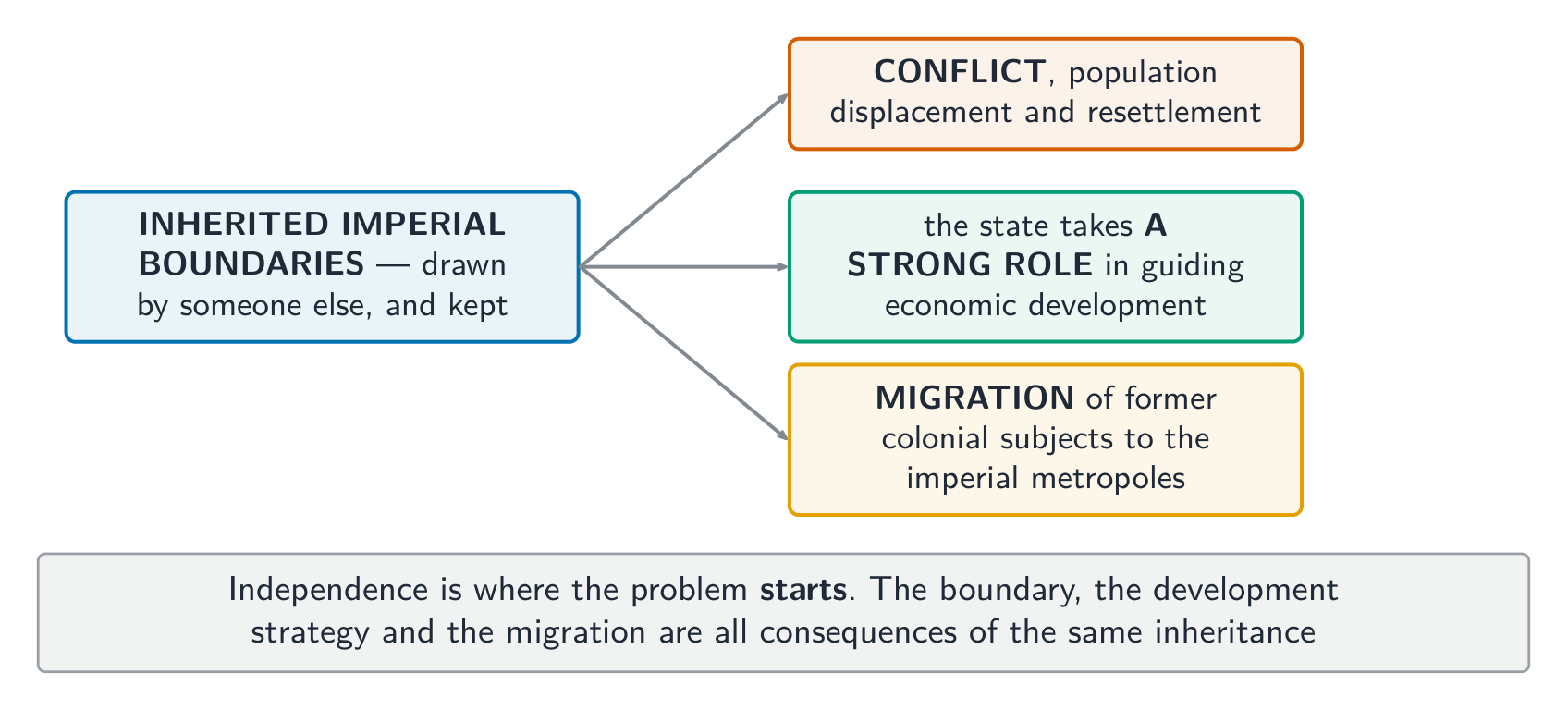
    • KC-6.2.II.D ประเทศต่างๆ ทั่วโลกท้าทายระเบียบทางการเมืองและสังคมที่มีอยู่ รวมถึงการปฏิวัติเม็กซิโกที่เกิดขึ้นจากวิกฤตการณ์ทางการเมือง

    Source: College Board AP Course and Exam Description · ⁨แหล่งที่มา: คำอธิบายหลักสูตรและข้อสอบ College Board AP⁩

    English

    Unit 7 covers global conflict from 1900, and its organising question is not "what happened in the wars" but why the political order that existed in 1900 collapsed, and what replaced it.

    At the start of the century the West dominated the global political order. Over the following decades both land-based and maritime empires gave way to new states, and the CED names the mechanism as a combination of internal and external factors 内外因素.

    • The older land-based Ottoman, Russian, and Qing empires collapsed under that combination - internal strain and pressure from outside at the same time.
    • States around the world challenged the existing political and social order, and the CED's named case is the Mexican Revolution 墨西哥革命, which arose from political and economic inequality.

    The examinable habit here is pairing. An answer that gives only internal weakness, or only external pressure, has given half the explanation.

    ไทย

    Unit 7 ครอบคลุม global conflict ตั้งแต่ 1900, และ organizing question ของมันไม่ใช่ "what happened in the wars" แต่ why political order ที่มีอยู่ใน 1900 руิน, และอะไร取而代之มัน

    ในช่วงต้นศตวรรษ ตะวันตกครองความโดดเด่นในระบบการเมืองโลก ในช่วงทศวรรษถัดมา ทั้งจักรวรรดิทางบกและทางทะเลถูกแทนที่โดยรัฐใหม่ และ CED ชี้กลไกนี้ว่าเป็นผลจากการผสมผสานระหว่าง ปัจจัยภายในและภายนอก
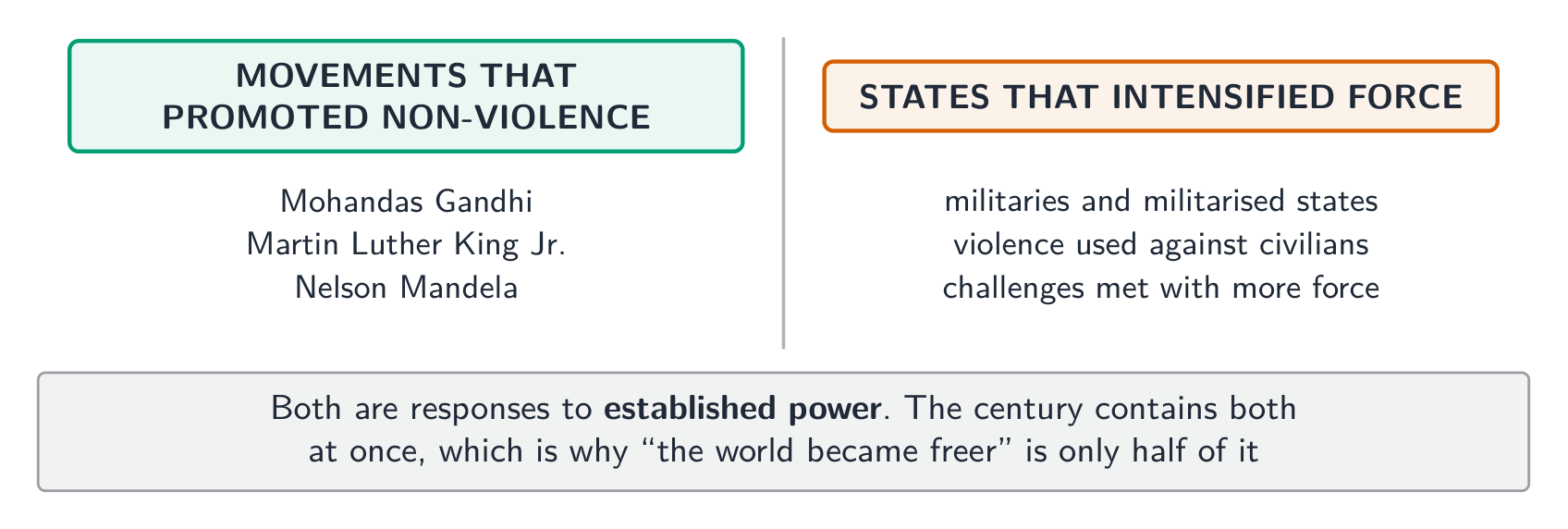
    • จักรวรรดิบนบกเก่าแก่อย่าง ออตโตมัน, รัสเซีย และชิง ได้ล่มสลายภายใต้การผสมผสานนี้ - ความเครียดภายในและความกดดันจากภายนอกพร้อมกัน
    • รัฐทั่วโลก ท้าทายระเบียบทางการเมืองและสังคมที่มีอยู่เดิม และกรณีตัวอย่างที่ CED นำมาคือ ปฏิวัติเม็กซิโก ซึ่งเกิดขึ้นจากความไม่เท่าเทียมทางpoliticsและเศรษฐกิจ

    ทักษะที่มักออกสอบในที่นี้คือการจับคู่คำตอบ หากให้เพียงความอ่อนแอภายใน หรือเพียงแรงกดดันภายนอก แสดงว่าอธิบายได้แค่ครึ่งหนึ่งเท่านั้น

    7.2

    Causes of World War I · ⁨สาเหตุของสงครามโลกครั้งที่หนึ่ง⁩

    Syllabus · ⁨หลักสูตร⁩
    English

    7.2 Causes of World War I

    Thematic Focus (GOV): Governance — A variety of internal and external factors contribute to state formation, expansion, and decline. Governments maintain order through a variety of administrative institutions, policies, and procedures, and governments obtain, retain, and exercise power in different ways and for different purposes.

    Learning Objective Unit 7.B: Explain the causes and consequences of World War I.

    • KC-6.2.IV.B.i The causes of World War I included imperialist expansion and competition for resources. In addition, territorial and regional conflicts combined with a flawed alliance system and intense nationalism to escalate the tensions into global conflict.
    ไทย

    7.2 สาเหตุของสงครามโลกครั้งที่หนึ่ง

    ประเด็นเน้น (GOV): การปกครอง — ปัจจัยภายในและภายนอกหลากหลายชนิดมีส่วนร่วมในการก่อตัว การขยายตัว และการล่มสลายของรัฐ รัฐบาลรักษาความสงบเรียบร้อยผ่านสถาบัน นโยบาย และขั้นตอนการบริหารจัดการที่หลากหลาย และรัฐบาลได้รับ รักษาส Powers และใช้อำนาจในรูปแบบและด้วยวัตถุประสงค์ที่แตกต่างกัน

    จุดประสงค์การเรียนรู้หน่วยที่ 7.B: อธิบายสาเหตุและผลกระทบของสงครามโลกครั้งที่หนึ่ง

    • KC-6.2.IV.B.i สาเหตุของสงครามโลกครั้งที่หนึ่งรวมถึงการขยายตัวแบบลัทธิอาณานิคมและการแข่งขันเพื่อทรัพยากร นอกจากนี้ ความขัดแย้งด้านดินแดนและระดับภูมิภาค ร่วมกับระบบพันธมิตรที่บกพร่อง และลัทธิชาตินิยมที่รุนแรง ได้ทำให้ความตึงเครียด escalate เป็นความขัดแย้งระดับโลก

    Source: College Board AP Course and Exam Description · ⁨แหล่งที่มา: คำอธิบายหลักสูตรและข้อสอบ College Board AP⁩

    English

    The CED compresses the causes into one statement, and every element of it is worth marks:

    • Imperialist expansion 帝国主义扩张 and competition for resources 资源竞争.
    • Territorial and regional conflicts 领土与地区冲突.
    • A flawed alliance system 结盟体系 that turned a local conflict into a general one.
    • Intense nationalism 极端民族主义.

    Notice the shape of the claim: the first three supply the tension, and the alliance system supplies the escalation 升级. That distinction - between what made conflict likely and what made it global - is the single most useful thing to hold from this topic.

    ไทย

    CED รวบเหตุผลทั้งหมดไว้เป็นประโยคเดียว และทุกองค์ประกอบในนั้นมีค่าคะแนน:

    • การขยายตัวของจักรวรรดินิยม และ การแข่งขันเพื่อทรัพยากร
    • ความขัดแย้งด้านอาณาเขตและภูมิภาค
    • ระบบพันธมิตรที่มีข้อบกพร่อง ซึ่งทำให้ความขัดแย้งระดับท้องถิ่นกลายเป็นสงครามทั่วไป
    • ชาตินิยมที่รุนแรง

    สังเกตโครงสร้างของข้ออ้าง: สามอย่างแรกสร้างความตึงเครียด ส่วนระบบพันธมิตรสร้างความ ** escalated (escalation)** ความแตกต่างนี้ - ระหว่างสิ่งที่ทำให้สงครามเป็นไปได้กับสิ่งที่ทำให้它是 global - เป็นสิ่งที่สำคัญที่สุดที่ต้องจดจำจากหัวข้อนี้

    สภาวะสี่ประการมารวมกัน - สามอย่างอธิบายความตึงเครียด ส่วนระบบพันธมิตรอธิบายการ escalating
    Explore · ⁨สำรวจ⁩

    Assemble the causes, then find the escalator · ⁨รวบรวมสาเหตุ แล้วหาตัวเร่ง⁩

    Three conditions explain tension; only the alliance system explains how a local conflict became a general one. · ⁨สามเงื่อนไขอธิบายความตึงเครียด; ระบบพันธมิตรเพียงอย่างเดียวอธิบายว่าความขัดแย้งระดับท้องถิ่นกลายเป็นความขัดแย้งทั่วไปได้อย่างไร⁩

    Vocabulary · ⁨คำศัพท์⁩ Train · ⁨ฝึกฝน⁩
    English ไทย
    internal and external factors/ɪnˈtɜːnl ænd ekˈstɜːnl ˈfæktəz/ ปัจจัยภายในและภายนอก
    Mexican Revolution/ˈmeksɪkən ˌrevəˈluːʃn/ การปฏิวัติเม็กซิโก
    Imperialist expansion/ɪmˈpɪərɪəlɪst ekˈspænʃn/ การขยายอำนาจจักรวรรดิ
    competition for resources/ˌkɒmpəˈtɪʃn fɔː rɪˈzɔːsɪz/ การแข่งขันเพื่อทรัพยากร
    Territorial and regional conflicts/ˌterɪˈtɔːrɪəl ænd ˈriːdʒənl ˈkɒnflɪkts/ ความขัดแย้งด้านดินแดนและภูมิภาค
    flawed alliance system/flɔːd əˈlaɪəns ˈsɪstəm/ ระบบพันธมิตรที่มีข้อบกพร่อง
    Intense nationalism/ɪnˈtens ˈnæʃənəlɪzəm/ ลัทธิ民族主义ที่รุนแรง
    escalation/ˌeskəˈleɪʃn/ การยกระดับ
    first total war/fɜːst ˈtəʊtl wɔː/ สงครามโลกครั้งแรก
    Political propaganda/pəˈlɪtɪkl ˌprɒpəˈɡændə/ โฆษณาทางการเมือง
    Intensified forms of nationalism/ɪnˈtensɪfaɪd fɔːmz ɒv ˈnæʃənəlɪzəm/ รูปแบบNationalism ที่เข้มข้นขึ้น
    economies and populations/ɪˈkɒnəmiz ænd ˌpɒpjʊˈleɪʃnz/ เศรษฐกิจและประชากร
    colonial subjects/kəˈləʊnɪəl ˈsʌbdʒekts/ ชนภายใต้การปกครองอาณานิคม
    7.3

    Conducting World War I · ⁨การดำเนินสงครามโลกครั้งที่หนึ่ง⁩

    Syllabus · ⁨หลักสูตร⁩
    English

    7.3 Conducting World War I

    Thematic Focus (TEC): Technology and Innovation — Human adaptation and innovation have resulted in increased efficiency, comfort, and security, and technological advances have shaped human development and interactions with both intended and unintended consequences.

    Learning Objective Unit 7.C: Explain how governments used a variety of methods to conduct war.

    • KC-6.2.IV.A.i World War I was the first total war. Governments used a variety of strategies, including political propaganda, art, media, and intensified forms of nationalism, to mobilize populations (both in the home countries and the colonies) for the purpose of waging war.
    • KC-6.1.III.C.i New military technology led to increased levels of wartime casualties.
    ไทย

    7.3 การดำเนินสงครามโลกครั้งที่หนึ่ง

    จุดเน้นเชิงหัวข้อ (TEC): เทคโนโลยีและนวัตกรรม — การปรับตัวและนวัตกรรมของมนุษย์ได้ส่งผลให้ประสิทธิภาพ ความสบาย และความปลอดภัยเพิ่มขึ้น และการพัฒนาทางเทคโนโลยีได้กำหนดการพัฒนาของมนุษย์และการมีปฏิสัมพันธ์กับทั้งผลที่คาดหวังและไม่คาดคิด

    จุดประสงค์การเรียนรู้หน่วยที่ 7.C: อธิบายว่ารัฐบาลใช้วิธีการหลากหลายในการดำเนินสงครามอย่างไร

    • KC-6.2.IV.A.i สงครามโลกครั้งที่หนึ่งเป็นสงครามทั้งหมด (total war) แรก รัฐบาลใช้กลยุทธ์หลากหลาย รวมถึงโฆษณาทางpolitics ศิลปะ สื่อ และรูปแบบของลัทธิชาตินิยมที่เข้มข้นขึ้น เพื่อระดมประชาชน (ทั้งในประเทศแม่และอาณานิคม) เพื่อวัตถุประสงค์ในการทำสงคราม
    • KC-6.1.III.C.i เทคโนโลยีทหารใหม่นำไปสู่การเพิ่มขึ้นของจำนวนผู้เสียชีวิตในระหว่างสงคราม

    Source: College Board AP Course and Exam Description · ⁨แหล่งที่มา: คำอธิบายหลักสูตรและข้อสอบ College Board AP⁩

    English

    World War I was the first total war 总体战. The CED lists the methods governments used, and they are not only military:

    • Political propaganda 政治宣传, art, and media to sustain public support.
    • Intensified forms of nationalism 强化的民族主义.
    • Mobilisation of economies and populations 经济与人口动员 - conscription, war production, and the direction of labour.
    • Recruitment and use of colonial subjects 殖民地臣民 as soldiers and labourers.

    Alongside this, new military technology led to increased levels of wartime casualties. The technological point and the mobilisation point are separate marks, so give both.

    ไทย
    สงครามรวม: สิ่งที่รัฐบาลต้องควบคุมเมื่อสงครามไม่ใช่เรื่องเฉพาะกองทัพอีกต่อไป
    เครื่องมือทั้งสี่ปรากฏในทั้งสองสงคราม นี่คือเหตุผลที่คำถามเปรียบเทียบสามารถตอบได้

    สงครามโลกครั้งที่หนึ่งคือ สงครามรวมพลังครั้งแรก CED รวบรวมวิธีการที่รัฐบาลใช้ ซึ่งไม่ได้มีเพียงด้านทหารเท่านั้น:

    • การ numberOf propagandapolitical, ศิลปะ และสื่อ เพื่อรักษาการสนับสนุนของประชาชน
    • รูปแบบชาตินิยมที่เข้มข้นขึ้น
    • การระดม เศรษฐกิจและประชากร - การรับเข้าทัพ, การผลิตสำหรับสงคราม และการจัดทิศทางแรงงาน
    • การสรรหาและใช้ ชนพื้นเมืองในอาณานิคม เป็นทหารและแรงงาน

    alongside与之, เทคโนโลยีทางการทหารใหม่ทำให้จำนวนผู้เสียชีวิตในสงครามเพิ่มขึ้น จุดเกี่ยวกับเทคโนโลยีและจุดเกี่ยวกับการระดมกำลังเป็นคะแนนแยกกัน ดังนั้นควรตอบทั้งสองส่วน

    7.4

    Economy in the Interwar Period · ⁨เศรษฐกิจในช่วงระหว่างสงคราม⁩

    Syllabus · ⁨หลักสูตร⁩
    English

    7.4 Economy in the Interwar Period

    Thematic Focus (ECN): Economics Systems — As societies develop, they affect and are affected by the ways that they produce, exchange, and consume goods and services.

    Learning Objective Unit 7.D: Explain how different governments responded to economic crisis after 1900.

    • KC-6.3.I.B Following World War I and the onset of the Great Depression, governments began to take a more active role in economic life.
    • KC-6.3.I.A.i In the Soviet Union, the government controlled the national economy through the Five Year Plans, often implementing repressive policies, with negative repercussions for the population.

    Illustrative examples:

    • Government intervention in the economy:
      • The New Deal
      • The fascist corporatist economy
      • Governments with strong popular support in Brazil and Mexico
    ไทย

    7.4 เศรษฐกิจในช่วงระหว่างสงคราม

    จุดเน้นเชิงประเด็น (ECN): ระบบเศรษฐกิจ — เมื่อสังคมพัฒนาขึ้น จะส่งผลกระทบต่อและได้รับผลกระทบจากวิธีการผลิต แลกเปลี่ยน และบริโภคสินค้าและบริการ

    จุดประสงค์การเรียนรู้หน่วยที่ 7.D: อธิบายว่ารัฐบาลต่าง ๆ ตอบสนองต่อวิกฤตการณ์ทางเศรษฐกิจหลังปี 1900 อย่างไร

    • KC-6.3.I.B หลังสงครามโลกครั้งที่หนึ่งและการเริ่มต้นของวิกฤตเศรษฐกิจครั้งใหญ่ รัฐบาลเริ่มเข้ามามีบทบาทเชิงรุกมากขึ้นในชีวิตทางเศรษฐกิจ
    • KC-6.3.I.A.i ในสหภาพโซเวียท รัฐบาลควบคุมเศรษฐกิจแห่งชาติผ่านแผนห้าปี โดยมักดำเนินการนโยบายที่กดขี่ ซึ่งส่งผลกระทบต่อประชาชนอย่างมีนัยสำคัญ

    ตัวอย่างประกอบ:

    • การแทรกแซงของรัฐบาลในเศรษฐกิจ:
      • นโยบาย New Deal
      • เศรษฐกิจแบบคอร์ปอเรตติสมฟาสซิสต์
      • รัฐบาลที่มีฐานสนับสนุนประชาชนอย่างแข็งแกร่งในบราซิลและเม็กซิโก

    Source: College Board AP Course and Exam Description · ⁨แหล่งที่มา: คำอธิบายหลักสูตรและข้อสอบ College Board AP⁩

    English

    Following World War I and the onset of the Great Depression 大萧条, governments began to take a more active role in economic life. That is the general claim; the CED then supplies contrasting cases of how far that role went.

    In the Soviet Union 苏联, the government controlled the national economy through the Five Year Plans 五年计划, implementing repressive policies at significant cost to the population 人口代价 while achieving rapid industrialisation.

    The general pattern that makes this comparable across cases: economic crisis increased the state's claim on the economy everywhere, but the extent 程度 differed enormously - from regulation and public works at one end to full state control at the other. Questions about the interwar economy almost always reward that spectrum.

    ไทย

    หลังจากสงครามโลกครั้งที่หนึ่งและการเริ่มต้นของ วิกฤตเศรษฐกิจครั้งใหญ่ (Great Depression) รัฐบาลเริ่มเข้ามามี บทบาทที่กระตือรือร้นมากขึ้นในชีวิตเศรษฐกิจ นี่คือข้ออ้างทั่วไป; จากนั้น CED จึงนำเสนอกรณีเปรียบเทียบว่าบทบาทนั้น延伸至多远

    ใน สหภาพโซเวียต รัฐบาลควบคุมเศรษฐกิจแห่งชาติผ่าน แผนห้าปี โดยดำเนินนโยบายที่กดขี่ไปพร้อมๆ กับ ต้นทุนที่สูงต่อประชาชน ในขณะที่บรรลุการอุตสาหกรรมอย่างรวดเร็ว

    รูปแบบทั่วไปที่ทำให้กรณีเหล่านี้เทียบกันได้: วิกฤตเศรษฐกิจเพิ่มการเรียกร้องของรัฐต่อยอดเศรษฐกิจในทุกที่ แต่ ขอบเขต แตกต่างกันอย่างมาก - ตั้งแต่การควบคุมและการก่อสร้างสาธารณะ的一端 ไปจนถึงการควบคุมโดยรัฐเต็มรูปแบบ ข้อคำถามเกี่ยวกับเศรษฐกิจระหว่างสงครามเกือบทุกครั้งจะให้คะแนนตามสเปกตรัมนี้

    วิกฤตเศรษฐกิจผลักรัฐที่แตกต่างกันไปในทิศทางเดียวกัน แต่ถึงขอบเขตที่แตกต่างกันมาก
    Vocabulary · ⁨คำศัพท์⁩ Train · ⁨ฝึกฝน⁩
    English ไทย
    Great Depression/ɡreɪt dɪˈpreʃn/ recession ใหญ่
    Soviet Union/ˈsəʊvɪət ˈjuːnɪən/ สหภาพโซเวียต
    Five Year Plans/faɪv jɪə plænz/ แผนห้าปี
    cost to the population/kɒst tə ðə ˌpɒpjʊˈleɪʃn/ ต้นทุนต่อประชาชน
    extent/ekˈstent/ ขอบเขต
    self-determination/self dɪˌtɜːmɪˈneɪʃn/ สิทธิกำหนดตนเอง (Self-determination)
    unsustainable peace settlement/ʌnsəˈsteɪnəbl piːs ˈsetəlmənt/ ข้อตกลงสันติภาพที่ยั่งยืนไม่ได้
    global economic crisis/ˈɡləʊbl ˌiːkəˈnɒmɪk ˈkraɪsɪs/ วิกฤตการณ์เศรษฐกิจโลก
    Continued imperialist practices/kənˈtɪnjuːd ɪmˈpɪərɪəlɪst ˈpræktɪsɪz/ การปฏิบัติแบบอิมพีเรียลิสต์ต่อเนื่อง
    atomic bomb/əˈtɒmɪk bɒm/ ระเบิดปรมาณู
    civilian/sɪˈvɪlɪən/ พลเรือน
    extremist groups in power/ekˈstriːmɪst ɡruːps ɪn ˈpaʊə/ กลุ่ม extremist ในอำนาจ
    7.5

    Unresolved Tensions After World War I · ⁨ความตึงเครียดที่ยังไม่ได้รับการแก้ไขหลังสงครามโลกครั้งที่หนึ่ง⁩

    Syllabus · ⁨หลักสูตร⁩
    English

    7.5 Unresolved Tensions After World War I

    Thematic Focus (GOV): Governance — A variety of internal and external factors contribute to state formation, expansion, and decline. Governments maintain order through a variety of administrative institutions, policies, and procedures, and governments obtain, retain, and exercise power in different ways and for different purposes.

    Learning Objective Unit 7.E: Explain the continuities and changes in territorial holdings from 1900 to the present.

    • KC-6.2.I.B Between the two world wars, Western and Japanese imperial states predominantly maintained control over colonial holdings; in some cases, they gained additional territories through conquest or treaty settlement and in other cases faced anti-imperial resistance.

    Illustrative examples:

    • Territorial gains:
      • Transfer of former German colonies to Great Britain and France under the system of League of Nations mandates
      • Manchukuo/Greater East Asia Co-Prosperity Sphere
    • Anti-imperial resistance:
      • Indian National Congress
      • West African resistance (strikes/congresses) to French rule
    ไทย

    7.5 ความตึงเครียดที่ยังไม่คลี่คลายหลังสงครามโลกครั้งที่หนึ่ง

    ประเด็นเน้น (GOV): การปกครอง — ปัจจัยภายในและภายนอกหลากหลายชนิดมีส่วนร่วมในการก่อตัว การขยายตัว และการล่มสลายของรัฐ รัฐบาลรักษาความสงบเรียบร้อยผ่านสถาบัน นโยบาย และขั้นตอนการบริหารจัดการที่หลากหลาย และรัฐบาลได้รับ รักษาส Powers และใช้อำนาจในรูปแบบและด้วยวัตถุประสงค์ที่แตกต่างกัน

    จุดประสงค์การเรียนรู้หน่วยที่ 7.E: อธิบายความต่อเนื่องและการเปลี่ยนแปลงของเขตแดนตั้งแต่ปี 1900 จนถึงปัจจุบัน

    • KC-6.2.I.B ระหว่างสงครามโลกทั้งสองครั้ง รัฐจักรวรรดิตะวันตกและญี่ปุ่นยังคงควบคุมอาณานิคมเป็นหลัก ในบางกรณีพวกเขาได้เพิ่มดินแดนผ่านการพิชิตหรือข้อตกลงสนธิสัญญา และในบางกรณีก็เผชิญกับการต่อต้านลัทธิอาณานิคม

    ตัวอย่างประกอบ:

    • การได้รับดินแดน:
      • การโอนอาณานิคมเดิมของเยอรมนีให้ Großbritannien และฝรั่งเศสภายใต้ระบบ mandat ของสันนิบาตชาติ
      • มานจูโกว/สเฟียร์ความร่วมมือเอเชียตะวันออกอันยิ่งใหญ่
    • การต่อต้านลัทธิอาณานิคม:
      • สภาแห่งชาติอินเดีย
      • การต่อต้านในแอฟริกาตะวันตก (การ huelga/การประชุม) ต่อการปกครองของฝรั่งเศส

    Source: College Board AP Course and Exam Description · ⁨แหล่งที่มา: คำอธิบายหลักสูตรและข้อสอบ College Board AP⁩

    English

    Between the two world wars, Western and Japanese imperial states predominantly maintained control over colonial holdings, and in some cases gained new territory. The hopes for self-determination 民族自决 raised by the peace settlement were largely not met for colonised peoples.

    This is the bridge topic: the tensions the settlement left unresolved feed directly into both the causes of the next war and the anti-imperial movements of Unit 8. Naming that link is what makes a continuity answer strong.

    ไทย

    ระหว่างสองสงครามโลก รัฐจักรวรรดินิยมตะวันตกและญี่ปุ่นยังคงครองอำนาจเหนือดินแดนอาณานิคม ในบางกรณียังได้ดินแดนใหม่ ความหวังเรื่อง การกำหนด nasibตนเอง ที่ถูกยกขึ้นจากการลงนามสนธิสัญญาสันติภาพส่วนใหญ่ไม่ได้เกิดขึ้นจริงสำหรับชนพื้นเมืองที่ถูกปกครอง

    นี่คือหัวข้อสะพานเชื่อม: ความตึงเครียดที่สนธิสัญญาทิ้งไว้ยังไม่คลี่คลาย สัมผัสโดยตรงเข้ากับสาเหตุของสงครามถัดไปและการเคลื่อนไหวต่อต้านจักรวรรดินิยมในหน่วยที่ 8 การระบุความสัมพันธ์นี้คือสิ่งที่ทำให้คำตอบแบบต่อเนื่องมีความแข็งแกร่ง

    7.6

    Causes of World War II · ⁨สาเหตุของสงครามโลกครั้งที่สอง⁩

    Syllabus · ⁨หลักสูตร⁩
    English

    7.6 Causes of World War II

    Thematic Focus (GOV): Governance — A variety of internal and external factors contribute to state formation, expansion, and decline. Governments maintain order through a variety of administrative institutions, policies, and procedures, and governments obtain, retain, and exercise power in different ways and for different purposes.

    Learning Objective Unit 7.F: Explain the causes and consequences of World War II.

    • KC-6.2.IV.B.ii The causes of World War II included the unsustainable peace settlement after World War I, the global economic crisis engendered by the Great Depression, continued imperialist aspirations, and especially the rise to power of fascist and totalitarian regimes that resulted in the aggressive militarism of Nazi Germany under Adolf Hitler.
    ไทย

    7.6 สาเหตุของสงครามโลกครั้งที่สอง

    ประเด็นเน้น (GOV): การปกครอง — ปัจจัยภายในและภายนอกหลากหลายชนิดมีส่วนร่วมในการก่อตัว การขยายตัว และการล่มสลายของรัฐ รัฐบาลรักษาความสงบเรียบร้อยผ่านสถาบัน นโยบาย และขั้นตอนการบริหารจัดการที่หลากหลาย และรัฐบาลได้รับ รักษาส Powers และใช้อำนาจในรูปแบบและด้วยวัตถุประสงค์ที่แตกต่างกัน

    จุดประสงค์การเรียนรู้หน่วยที่ 7.F: อธิบายสาเหตุและผลกระทบของสงครามโลกครั้งที่สอง

    • KC-6.2.IV.B.ii สาเหตุของสงครามโลกครั้งที่สองรวมถึงการตกลงสงบสุขที่ไม่ยั่งยืนหลังสงครามโลกครั้งที่หนึ่ง วิกฤตการณ์ทางเศรษฐกิจระดับโลกที่เกิดจากวิกฤตเศรษฐกิจครั้งใหญ่ ความปรารถนาในลัทธิอาณานิคมที่ต่อเนื่อง และการขึ้นสู่อำนาจของระบอบฟาสซิสต์และระบอบรวมอำนาจซึ่งนำไปสู่การทหารรุกรานของนาซีเยอรมนีภายใต้อดอล์ฟ ฮิตเลอร์

    Source: College Board AP Course and Exam Description · ⁨แหล่งที่มา: คำอธิบายหลักสูตรและข้อสอบ College Board AP⁩

    English

    The CED again gives a compound cause, and each element is examinable:

    • The unsustainable peace settlement 和约 after World War I.
    • The global economic crisis 全球经济危机 produced by the Great Depression.
    • Continued imperialist practices 帝国主义行径.
    • The rise of fascism and extreme nationalism.

    Compare this with the World War I list and a real pattern appears: economic pressure and nationalism are common to both, while the specific additions in 1939 are the failed settlement and the new ideological regimes. A comparison question wants exactly that structure - shared causes named, then the differences.

    ไทย

    CED ให้สาเหตุแบบผสมอีกครั้ง และแต่ละองค์ประกอบสามารถออกสอบได้:

    • การตกลงสงบสุขที่ไม่ยั่งยืน หลังสงครามโลกครั้งที่หนึ่ง
    • วิกฤตเศรษฐกิจทั่วโลก ที่เกิดจาก Great Depression
    • การปฏิบัติแบบจักรวรรดินิยมที่ต่อเนื่อง
    • การขึ้นมาของฟาสซิสต์และชาตินิยมสุดขั้ว

    เปรียบเทียบกับรายการสงครามโลกครั้งที่หนึ่ง จะเห็นรูปแบบที่แท้จริง: แรงกดดันทางเศรษฐกิจและความรักชาติมีอยู่ในทั้งสอง แต่สิ่งที่ เพิ่มเข้ามา ใน 1939 คือการตกลงที่ล้มเหลวและระบอบอุดมการณ์ใหม่ คำถามเปรียบเทียบต้องการโครงสร้างนี้พอดี - ระบุสาเหตุร่วมกันก่อน แล้วจึงบอกความแตกต่าง

    7.7

    Conducting World War II · ⁨การดำเนินสงครามโลกครั้งที่สอง⁩

    Syllabus · ⁨หลักสูตร⁩
    English

    7.7 Conducting World War II

    Thematic Focus (GOV): Governance — A variety of internal and external factors contribute to state formation, expansion, and decline. Governments maintain order through a variety of administrative institutions, policies, and procedures, and governments obtain, retain, and exercise power in different ways and for different purposes.

    Learning Objective Unit 7.G: Explain similarities and differences in how governments used a variety of methods to conduct war.

    • KC-6.2.IV.A.ii World War II was a total war. Governments used a variety of strategies, including political propaganda, art, media, and intensified forms of nationalism, to mobilize populations (both in the home countries and the colonies or former colonies) for the purpose of waging war. Governments used ideologies, including fascism and communism to mobilize all of their state’s resources for war and, in the case of totalitarian states, to repress basic freedoms and dominate many aspects of daily life during the course of the conflicts and beyond.
    • KC-6.1.III.C.ii New military technology and new tactics, including the atomic bomb, fire-bombing, and the waging of “total war” led to increased levels of wartime casualties.

    Illustrative examples:

    • Western democracies mobilizing for war:
      • Great Britain under Winston Churchill
      • United States under Franklin Roosevelt
    • Totalitarian states mobilizing for war:
      • Germany under Adolf Hitler
      • USSR under Joseph Stalin
    ไทย

    7.7 การดำเนินสงครามโลกครั้งที่สอง

    ประเด็นเน้น (GOV): การปกครอง — ปัจจัยภายในและภายนอกหลากหลายชนิดมีส่วนร่วมในการก่อตัว การขยายตัว และการล่มสลายของรัฐ รัฐบาลรักษาความสงบเรียบร้อยผ่านสถาบัน นโยบาย และขั้นตอนการบริหารจัดการที่หลากหลาย และรัฐบาลได้รับ รักษาส Powers และใช้อำนาจในรูปแบบและด้วยวัตถุประสงค์ที่แตกต่างกัน

    จุดประสงค์การเรียนรู้หน่วยที่ 7.G: อธิบายความคล้ายคลึงและความแตกต่างในการที่รัฐบาลใช้วิธีการหลากหลายในการดำเนินสงคราม

    • KC-6.2.IV.A.ii สงครามโลกครั้งที่สองเป็นสงครามทั้งหมด (total war) รัฐบาลใช้กลยุทธ์หลากหลาย รวมถึงโฆษณาทางpolitics ศิลปะ สื่อ และรูปแบบของลัทธิชาตินิยมที่เข้มข้นขึ้น เพื่อระดมประชาชน (ทั้งในประเทศแม่และอาณานิคมหรืออดีตอาณานิคม) เพื่อวัตถุประสงค์ในการทำสงคราม รัฐบาลใช้ ideologies รวมถึงฟาสซิสต์และคอมมิวนิสต์ เพื่อระดมทรัพยากรทั้งหมดของรัฐสำหรับการทำสงคราม และในกรณีของรัฐรวมอำนาจ เพื่อปราบปรามเสรีภาพพื้นฐานและครอบครองหลายมิติของชีวิตประจำวันในระหว่างการ conflito และหลังจากนั้น
    • KC-6.1.III.C.ii เทคโนโลยีทหารใหม่และยุทธวิธีใหม่ รวมถึงระเบิดนิวเคลียร์ การทิ้งระเบิดเพลิง และการดำเนิน "สงครามทั้งหมด" นำไปสู่การเพิ่มขึ้นของจำนวนผู้เสียชีวิตในระหว่างสงคราม

    ตัวอย่างประกอบ:

    • ประชาธิปไตยตะวันตกระดมกำลังสำหรับสงคราม:
      • สหราชอาณาจักร ภายใต้วินสตัน ชูร์ชิลล์
      • สหรัฐอเมริกา ภายใต้แฟรงกิ้น รูสเวลท์
    • รัฐรวมอำนาจระดมกำลังสำหรับสงคราม:
      • เยอรมนี ภายใต้อดอล์ฟ ฮิตเลอร์
      • สหภาพโซเวียต ภายใต้โจเซฟ สตาลิน

    Source: College Board AP Course and Exam Description · ⁨แหล่งที่มา: คำอธิบายหลักสูตรและข้อสอบ College Board AP⁩

    English

    World War II was also a total war, and governments used the same broad categories of method: propaganda, art and media, intensified nationalism, and the mobilisation of economies and populations including colonial subjects.

    What changed was the technology and its scale. New military technology and new tactics - including the atomic bomb 原子弹, fire-bombing, and the waging of total war - led to increased levels of casualties, including a far higher proportion of civilian 平民 deaths than in the previous conflict.

    The examinable comparison is therefore: methods largely similar, scale and technology different. An answer that says only "both were total wars" has not compared them; an answer that says only "the second was more destructive" has not explained why.

    ไทย

    สงครามโลกครั้งที่สองก็ เป็นสงครามรวมพลังเช่นกัน และรัฐบาลใช้หมวดหมู่วิธีการกว้างๆ เดียวกัน: การโฆษณาชวนเชื่อ ศิลปะและสื่อ ความรักชาติที่เข้มข้นขึ้น และการระดมทรัพยากรทางเศรษฐกิจและประชากร รวมถึงชนพื้นเมืองในอาณานิคม

    สิ่งที่เปลี่ยนไปคือเทคโนโลยีและขนาด เทคโนโลยีทางการทหารใหม่และยุทธวิธีใหม่ - รวมถึง ระเบิดนิวเคลียร์, การโจมตีด้วยเพลิงไหม้ และการดำเนินสงครามรวม - ทำให้จำนวนผู้เสียชีวิตเพิ่มขึ้น รวมถึงสัดส่วนผู้เสียชีวิตที่เป็น พลเรือน สูงกว่ามากในสงครามก่อนหน้า

    การเปรียบเทียบที่ออกสอบคือ: วิธีการคล้ายกันมาก ขนาดและเทคโนโลยีต่างกัน คำตอบที่บอกว่า "ทั้งสองเป็นสงครามรวม" เท่านั้น ไม่ได้เปรียบเทียบกัน; คำตอบที่บอกว่า "第二次 more destructive" เท่านั้น ไม่ได้อธิบายเหตุผล

    สงครามรวมทั้งสอง: ความต่อเนื่องอยู่เหนือกฎ, การเปลี่ยนแปลงอยู่ใต้กฎ
    Explore · ⁨สำรวจ⁩

    Sort each feature as continuity or change · ⁨จำแนกแต่ละคุณลักษณะว่าเป็นความต่อเนื่องหรือการเปลี่ยนแปลง⁩

    The CED's own verdict: methods largely similar, scale and technology different. That is a continuity-and-change judgement. · ⁨คำตัดสินของ CED เอง: วิธีการคล้ายคลึงกันมาก ขนส่งและเทคโนโลยีต่างกัน นั่นเป็นการตัดสินแบบความต่อเนื่องและการเปลี่ยนแปลง⁩

    7.8

    Mass Atrocities After 1900 · ⁨การสังหารหมู่หลังปี 1900⁩

    Syllabus · ⁨หลักสูตร⁩
    English

    7.8 Mass Atrocities After 1900

    Thematic Focus (SIO): Social Interactions and Organization — The process by which societies group their members and the norms that govern the interactions between these groups and between individuals influence political, economic, and cultural institutions and organization.

    Learning Objective Unit 7.H: Explain the various causes and consequences of mass atrocities in the period from 1900 to the present.

    • KC-6.2.III.C The rise of extremist groups in power led to the attempted destruction of specific populations, notably the Nazi killing of the Jews in the Holocaust during World War II, and to other atrocities, acts of genocide, or ethnic violence.

    Illustrative examples:

    • Genocide, ethnic violence, or attempted destruction of specific populations:
      • Armenians in the Ottoman Empire during and after World War I
      • Cambodia during the late 1970s
      • Tutsi in Rwanda in the 1990s
      • Ukraine in the Soviet Union in the 1920s and 1930s
    ไทย

    7.8 การกระทำที่เลวร้ายต่อมนุษยชนขนาดใหญ่หลังปี 1900

    จุดเน้นเชิงประเด็น (SIO): ปฏิสัมพันธ์และการจัดระเบียบทางสังคม — กระบวนการที่สังคมรวมกลุ่มสมาชิกของตนและบรรทัดฐานที่ควบคุมการปฏิสัมพันธ์ระหว่างกลุ่มเหล่านี้และระหว่างบุคคลมีผลต่อสถาบันและการจัดระเบียบทางการเมือง เศรษฐกิจ และวัฒนธรรม

    จุดประสงค์การเรียนรู้หน่วยที่ 7.H: อธิบายสาเหตุและผลกระทบของการกระทำที่เลวร้ายต่อมนุษยชนขนาดใหญ่ในช่วงปี 1900 ถึงปัจจุบัน

    • KC-6.2.III.C การยกกลุ่ม-extremist ขึ้นสู่อำนาจนำไปสู่ความพยายามทำลายประชากรเฉพาะกลุ่ม โดยเฉพาะอย่างยิ่งการฆ่าชาวยิวโดยนาซีใน holocaust ระหว่างสงครามโลกครั้งที่สอง และการกระทำที่เลวร้ายอื่นๆ การฆ่าล้างเผ่าพันธุ์ หรือความรุนแรงทางชาติพันธุ์

    ตัวอย่างประกอบ:

    • การฆ่าล้างเผ่าพันธุ์ ความรุนแรงทางชาติพันธุ์ หรือความพยายามทำลายประชากรเฉพาะกลุ่ม:
      • ชาวอาร์มีเนียในจักรวรรดิออตโตมันในช่วงและหลังสงครามโลกครั้งที่หนึ่ง
      • กัมพูชา ในช่วงปลายทศวรรษ 1970
      • ชาวทูตซีในrwanda ในช่วงทศวรรษ 1990
      • ยูเครน ในสหภาพโซเวียต ในช่วงทศวรรษ 1920 และ 1930

    Source: College Board AP Course and Exam Description · ⁨แหล่งที่มา: คำอธิบายหลักสูตรและข้อสอบ College Board AP⁩

    English

    This topic asks for causes and consequences of mass atrocities in the period from 1900 to the present. The CED's framing is that the rise of extremist groups in power 极端主义团体 led to the attempted destruction of specific populations, and it names the Holocaust 犹太人大屠杀 - the Nazi killing of Jewish people - as the principal case, alongside other twentieth-century genocides and mass killings.

    Handled as history, the examinable content is the pattern: an extremist regime takes state power, defines a population as outside the political community, and uses the machinery of the modern state - bureaucracy, transport, communication - to carry out destruction on a scale earlier regimes could not achieve. That last point connects this topic to the technology theme running through the whole unit.

    ไทย

    หัวข้อนี้ถามถึง สาเหตุและผลกระทบของการสังหารหมู่ครั้งใหญ่ ในช่วงตั้งแต่ 1900 จนถึงปัจจุบัน กรอบแนวคิดของ CED คือ การเพิ่มขึ้นของ กลุ่ม extremist เข้าสู่อำนาจ นำไปสู่ความพยายามในการทำลายล้างประชากรกลุ่มเฉพาะ และระบุ Holocaust - การฆ่าชาวยิวโดยนาซี - เป็นตัวอย่างหลัก alongside with other twentieth-century genocides and mass killings.

    เมื่อพิจารณาในฐานะประวัติศาสตร์ เนื้อหาที่จะออกสอบคือรูปแบบ: รัฐบาล extremist ยึดอำนาจรัฐ กำหนดให้ประชากรกลุ่มหนึ่งอยู่นอกเหนือชุมชนทางการเมือง และใช้โครงสร้างของรัฐสมัยใหม่ - ระบบราชการ การขนส่ง การสื่อสาร - เพื่อดำเนินการทำลายล้างในระดับที่รัฐบาลในอดีตไม่สามารถทำได้ ข้อสุดท้ายนี้เชื่อมโยงหัวข้อนี้เข้ากับธีมเทคโนโลยีที่贯穿ทั้งหน่วยเรียน

    Vocabulary · ⁨คำศัพท์⁩ Train · ⁨ฝึกฝน⁩
    English ไทย
    Holocaust/ˈhɒləkɔːst/ Holocaust
    7.9

    Causation in Global Conflict · ⁨สาเหตุของความขัดแย้งระดับโลก⁩

    Syllabus · ⁨หลักสูตร⁩
    English

    7.9 Causation in Global Conflict

    Learning Objective Unit 7.I: Explain the relative significance of the causes of global conflict in the period 1900 to the present.

    • KC-6.1 Rapid advances in science and technology altered the understanding of the universe and the natural world and led to advances in communication, transportation, industry, agriculture, and medicine.
    • KC-6.2 Peoples and states around the world challenged the existing political and social order in varying ways, leading to unprecedented worldwide conflicts.
      • KC-6.2.I The West dominated the global political order at the beginning of the 20th century, but both land-based and maritime empires gave way to new states by the century’s end.
      • KC-6.2.I.A The older, land-based Ottoman, Russian, and Qing empires collapsed due to a combination of internal and external factors. These changes in Russia eventually led to communist revolution.
      • KC-6.2.II.D States around the world challenged the existing political and social order, including the Mexican Revolution that arose as a result of political crisis.
    ไทย

    7.9 สาเหตุของความขัดแย้งระดับโลก

    จุดประสงค์การเรียนรู้หน่วยที่ 7.I: อธิบายถึงความสำคัญของสาเหตุของความขัดแย้งระดับโลกในช่วงปี 1900 ถึงปัจจุบัน

    • KC-6.1 ความก้าวหน้าอย่างรวดเร็วทางวิทยาศาสตร์และเทคโนโลยีได้เปลี่ยนความเข้าใจเกี่ยวกับจักรวาลและธรรมชาติ และนำไปสู่ความก้าวหน้าด้านการสื่อสาร การขนส่ง อุตสาหกรรม การเกษตร และเวชศาสตร์
    • KC-6.2 peoples และ states ทั่วโลกท้าทายระเบียบทางการเมืองและสังคมที่มีอยู่ในรูปแบบต่างๆ นำไปสู่ความขัดแย้งระดับโลกที่ไม่เคยมีมาก่อน
      • KC-6.2.I ตะวันตกควบคุมระเบียบการเมืองระดับโลกในช่วงต้นศตวรรษที่ 20 แต่ทั้งจักรวรรดิบนบกและทางทะเลได้ nhườngที่ให้กับรัฐใหม่ๆ بحلولสิ้นศตวรรษ
      • KC-6.2.I.A อารยธรรมดินแดนเก่าแก่อย่างออตโตแมน รัสเซีย และชิงล้มลงเนื่องจากปัจจัยภายในและภายนอกผสมผสานกัน การเปลี่ยนแปลงในรัสเซียเหล่านี้ในที่สุดได้นำไปสู่การปฏิวัติคอมมิวนิสต์
      • KC-6.2.II.D รัฐต่างๆ ทั่วโลกได้ท้าทายระเบียบการเมืองและสังคมที่มีอยู่ รวมถึงการปฏิวัติเม็กซิโกที่เกิดขึ้นจากความวิกฤตทางการเมือง

    Source: College Board AP Course and Exam Description · ⁨แหล่งที่มา: คำอธิบายหลักสูตรและข้อสอบ College Board AP⁩

    English

    The unit's reasoning skill is causation, and specifically the relative significance 相对重要性 of causes. That word "relative" is the whole task: you are not listing causes, you are ranking them and defending the ranking.

    Worked example (a real AP exam question). AP World short-answer questions in this unit ask, for example, to "Explain one similarity between the ways governments conducted World War I and World War II." A full-mark answer names the similarity and supports it with specifics from both: "Both wars were total wars in which governments mobilised entire economies and populations. In both, states used propaganda and media to sustain public support, directed industrial production toward war material, and recruited soldiers and labourers from their colonies." Notice the requirement: a similarity claim must be evidenced on both sides. Evidence from one war only cannot demonstrate a similarity.

    ไทย

    ทักษะการคิดของหน่วยนี้คือ สาเหตุ (causation) โดยเฉพาะ ความสำคัญสัมพัทธ์ (relative significance) คำว่า "สัมพัทธ์" คือหัวใจของโจทย์ทั้งหมด: คุณไม่ได้แค่ liệt kê สาเหตุ แต่คุณต้องจัดลำดับความสำคัญและอธิบายเหตุผลในการจัดลำดับนั้น

    ตัวอย่างวิธีทำ (คำถามจริงจากข้อสอบ AP). คำถามตอบสั้นในหน่วยนี้ของ AP World ถามว่า ตัวอย่างเช่น "อธิบายความคล้ายคลึงหนึ่งอย่างระหว่างวิธีการที่รัฐบาลดำเนินสงครามโลกครั้งที่หนึ่งและสงครามโลกครั้งที่สอง" คำตอบเต็มคะแนนต้องระบุความคล้ายคลึงและสนับสนุนด้วยรายละเอียดจากทั้งสอง: "สงครามทั้งสองเป็นสงครามรวมพลังที่รัฐบาลระดมทั้งเศรษฐกิจและประชากร ในทั้งสอง kasus รัฐใช้การโฆษณาชวนเชื่อและสื่อเพื่อรักษาการสนับสนุนสาธารณะ จัดการการผลิตอุตสาหกรรมสู่วัสดุสงคราม และรับคนงานและทหารจากอาณานิคม" หมายเหตุความต้องการ: locator claim ต้องมี หลักฐานรองรับทั้งสองด้าน หลักฐานจากสงครามเพียงข้างเดียวไม่สามารถแสดงความคล้ายคลึงได้

    Vocabulary · ⁨คำศัพท์⁩ Train · ⁨ฝึกฝน⁩
    English ไทย
    relative significance/ˈrelətɪv sɪɡˈnɪfɪkəns/ ความสำคัญสัมพัทธ์
    7.9

    Exam tips · ⁨ข้อแนะนำสำหรับการสอบ⁩

    English
    • For the collapse of the Ottoman, Russian, and Qing empires, always pair internal strain with external pressure. One alone is half an answer.
    • Separate what made World War I likely (imperial competition, nationalism, regional conflict) from what made it global (the alliance system).
    • Total war has a checklist: propaganda, nationalism, economic mobilisation, colonial recruitment. Use it for both wars and the comparison writes itself.
    • The interwar economy is a spectrum of state involvement, not a single policy. Say how far a state went, not just that it intervened.
    • Comparison questions need evidence on both sides. A detail about only one case cannot support a similarity or a difference.
    • "Relative significance" means rank and justify. A list of causes with no argument about which mattered most does not answer the question asked.
    ไทย
    • สำหรับการล่มสลายของ อิมเพเรียล Ottomans, รัสเซีย และชิง ต้องจับคู่ความเครียด ภายใน กับแรงกดดัน ภายนอก อย่างเสมอ ถ้ามีอย่างใดอย่างหนึ่งเพียงอย่างเดียว ถือว่าคำตอบ incomplete.
    • แยกสิ่งที่ทำให้สงครามโลกครั้งที่หนึ่ง เป็นไปได้ (การแข่งขันทางจักรวรรดิ ความรักชาติ ความขัดแย้งระดับภูมิภาค) ออกจากสิ่งที่ทำให้มัน เป็นสงครามระดับโลก (ระบบพันธมิตร)
    • Total war มีรายการตรวจสอบ: propaganda, Nationalism, การระดมเศรษฐกิจ, การสรรหาคนจากอาณานิคม ใช้สำหรับสงครามทั้งสองและการเปรียบเทียบจะเขียนเองได้
    • เศรษฐกิจระหว่างสงครามเป็น สเปกตรัม ของการมีส่วนร่วมของรัฐ ไม่ใช่นโยบายเดียว บอกว่ารัฐไปไกลแค่ไหน ไม่ใช่แค่บอกว่าแทรกแซง
    • ข้อสอบเปรียบเทียบต้องการหลักฐานใน ทั้งสองด้าน รายละเอียดเกี่ยวกับกรณีใดกรณีหนึ่งไม่สามารถรองรับความคล้ายคลึงหรือความแตกต่างได้
    • "Relative significance" หมายถึง จัดอันดับและให้เหตุผล การ liệt kêสาเหตุโดยไม่มีการถกเถียงว่าสิ่งใดสำคัญที่สุด ไม่ได้ตอบคำถามที่ถาม
  • 8

    Cold War and Decolonization

    Watch lesson · ⁨ดูบทเรียน⁩
    8.1

    Setting the Stage for the Cold War

    Syllabus · ⁨หลักสูตร⁩
    English

    8.1 Setting the Stage for the Cold War and Decolonization

    Thematic Focus (GOV): Governance — A variety of internal and external factors contribute to state formation, expansion, and decline. Governments maintain order through a variety of administrative institutions, policies, and procedures, and governments obtain, retain, and exercise power in different ways and for different purposes.

    Learning Objective Unit 8.A: Explain the historical context of the Cold War after 1945.

    • KC-6.2.II Hopes for greater self-government were largely unfulfilled following World War I; however, in the years following World War II, increasing anti-imperialist sentiment contributed to the dissolution of empires and the restructuring of states.
    • KC-6.2.IV.C.i Technological and economic gains experienced during World War II by the victorious nations shifted the global balance of power.
    ไทย

    8.1 การเตรียมความพร้อมสำหรับสงครามเย็นและการปลดปล่อยอาณานิคม

    ประเด็นเน้น (GOV): การปกครอง — ปัจจัยภายในและภายนอกหลากหลายชนิดมีส่วนร่วมในการก่อตัว การขยายตัว และการล่มสลายของรัฐ รัฐบาลรักษาความสงบเรียบร้อยผ่านสถาบัน นโยบาย และขั้นตอนการบริหารจัดการที่หลากหลาย และรัฐบาลได้รับ รักษาส Powers และใช้อำนาจในรูปแบบและด้วยวัตถุประสงค์ที่แตกต่างกัน

    วัตถุประสงค์การเรียนรู้หน่วย 8.A: อธิบายบริบททางประวัติศาสตร์ของสงครามเย็นหลังปี ค.ศ. 1945

    • KC-6.2.II ความหวังที่จะมีความปกครองตนเองมากขึ้นถูกทำให้ล้มเหลวส่วนใหญ่หลังจากสงครามโลกครั้งที่หนึ่ง; อย่างไรก็ตาม ในช่วงไม่กี่ปีหลังสงครามโลกครั้งที่สอง ความรู้สึกต่อต้านลัทธิจักรวรรดินิยมที่เพิ่มขึ้นได้ส่งผลต่อการยุบสลายของจักรวรรดิและการจัดระเบียบรัฐใหม่
    • KC-6.2.IV.C.i ผลลัพธ์ด้านเทคโนโลยีและเศรษฐกิจที่ได้รับจากประเทศผู้ชนะระหว่างสงครามโลกครั้งที่สอง ได้เปลี่ยนสมดุลอำนาจระดับโลก

    Source: College Board AP Course and Exam Description · ⁨แหล่งที่มา: คำอธิบายหลักสูตรและข้อสอบ College Board AP⁩

    Unit 8 covers the period after 1945, and two processes run through it at once: a global ideological rivalry and the end of empire. Most of the unit's questions turn on how those two interacted.

    Hopes for greater self-government were largely unfulfilled after World War I. In the years following World War II, increasing anti-imperialist sentiment 反帝情绪 built momentum in colonised regions, and this time it produced independence rather than promises.

    At the same time, the technological and economic gains 技术与经济收益 made during World War II by the victorious nations shifted the global balance of power. This is the historical context the CED asks for: the war did not just destroy, it redistributed capability.

    Vocabulary · ⁨คำศัพท์⁩ Train · ⁨ฝึกฝน⁩
    English ไทย
    increasing anti-imperialist sentiment/ɪnˈkriːsɪŋ ˈænti ɪmˈpɪərɪəlɪst ˈsentɪmənt/ ความรู้สึกต่อต้านลัทธิอาณานิคมที่เพิ่มขึ้น
    technological and economic gains/ˌteknəˈlɒdʒɪkl ænd ˌiːkəˈnɒmɪk ɡeɪnz/ ผลกำไรด้านเทคโนโลยีและเศรษฐกิจ
    8.2

    The Cold War

    Syllabus · ⁨หลักสูตร⁩
    English

    8.2 The Cold War

    Thematic Focus (CDI): Cultural Developments and Interactions — The development of ideas, beliefs, and religions illustrates how groups in society view themselves, and the interactions of societies and their beliefs often have political, social, and cultural implications.

    Learning Objective Unit 8.B: Explain the causes and effects of the ideological struggle of the Cold War.

    • KC-6.2.IV.C.ii The global balance of economic and political power shifted during and after World War II and rapidly evolved into the Cold War. The democracy of the United States and the authoritarian communist Soviet Union emerged as superpowers, which led to ideological conflict and a power struggle between capitalism and communism across the globe.
    • KC-6.2.V.B Groups and individuals, including the Non-Aligned Movement, opposed and promoted alternatives to the existing economic, political, and social orders.

    Illustrative examples:

    • Non-Aligned Movement:
      • Sukarno in Indonesia
      • Kwame Nkrumah in Ghana
    ไทย

    8.2 สงครามเย็น

    ประเด็นเน้น (CDI): การพัฒนาและการปฏิสัมพันธ์ทางวัฒนธรรม — การพัฒนาของแนวคิด ความเชื่อ และศาสนาแสดงให้เห็นว่ากลุ่มคนในสังคมมองเห็นตนเองอย่างไร และการปฏิสัมพันธ์ระหว่างสังคมและความเชื่อของพวกเขา มักจะมีนัยสำคัญทางการเมือง สังคม และวัฒนธรรม

    วัตถุประสงค์การเรียนรู้หน่วย 8.B: อธิบายสาเหตุและผลกระทบของการต่อสู้เชิงอุดมการณ์ในสงครามเย็น

    • KC-6.2.IV.C.ii สมดุลอำนาจทางเศรษฐกิจและการเมืองในระดับโลกได้เปลี่ยนไประหว่างและหลังสงครามโลกครั้งที่สอง และพัฒนาอย่างรวดเร็วสู่สงครามเย็น สหรัฐอเมริกาแบบประชาธิปไตยและสหภาพโซเวียตแบบคอมมิวนิสต์แบบเผด็จการได้ปรากฏตัวในฐานะมหาอำนาจ ซึ่งนำไปสู่ความขัดแย้งทางอุดมการณ์และความขัดแย้งด้านอำนาจระหว่างทุนนิยมกับคอมมิวนิสต์ทั่วโลกระหว่างและภายในรัฐหลังอาณานิคมในอเมริกาใต้ แอฟริกา และเอเชีย
    • KC-6.2.V.B กลุ่มและบุคคล รวมถึงขบวนการไม่เข้าข้างใด (Non-Aligned Movement) ได้คัดค้านและส่งเสริมทางเลือกอื่นนอกเหนือจากระเบียบเศรษฐกิจ การเมือง และสังคมที่มีอยู่เดิม

    ตัวอย่างประกอบ:

    • ขบวนการไม่เข้าข้างใด (Non-Aligned Movement):
      • ซูการ์โน ในอินโดนีเซีย
      • ควาเม นครุมะ ในกานา

    Source: College Board AP Course and Exam Description · ⁨แหล่งที่มา: คำอธิบายหลักสูตรและข้อสอบ College Board AP⁩

    The shifted balance rapidly evolved into the Cold War - a rivalry between the democracies led by the United States and the communist states led by the Soviet Union, conducted as an ideological struggle 意识形态斗争 rather than direct war between the two principals.

    The CED insists that this was not a world of only two options. Groups and individuals - including the Non-Aligned Movement 不结盟运动 - opposed and promoted alternatives to the existing economic, political, and social order. Leaving the non-aligned states out of an answer describes a two-sided world that did not exist.

    Vocabulary · ⁨คำศัพท์⁩ Train · ⁨ฝึกฝน⁩
    English ไทย
    ideological struggle/ˌaɪdɪəˈlɒdʒɪkl ˈstrʌɡl/ การต่อสู้ทางอุดมการณ์
    Non-Aligned Movement/nɒn əˈlaɪnd ˈmuːvmənt/ ขบวนการไม่เข้าข้าง
    8.3

    Effects of the Cold War

    Syllabus · ⁨หลักสูตร⁩
    English

    8.3 Effects of the Cold War

    Thematic Focus (GOV): Governance — A variety of internal and external factors contribute to state formation, expansion, and decline. Governments maintain order through a variety of administrative institutions, policies, and procedures, and governments obtain, retain, and exercise power in different ways and for different purposes.

    Learning Objective Unit 8.C: Compare the ways in which the United States and the Soviet Union sought to maintain influence over the course of the Cold War.

    • KC-6.2.IV.D The Cold War produced new military alliances, including NATO and the Warsaw Pact, and led to nuclear proliferation and proxy wars between and within postcolonial states in Latin America, Africa, and Asia.

    Illustrative examples:

    • Proxy wars:
      • Korean War
      • Angolan Civil War
      • Sandinista-Contras conflict in Nicaragua
    ไทย

    8.3 ผลกระทบของสงครามเย็น

    ประเด็นเน้น (GOV): การปกครอง — ปัจจัยภายในและภายนอกหลากหลายชนิดมีส่วนร่วมในการก่อตัว การขยายตัว และการล่มสลายของรัฐ รัฐบาลรักษาความสงบเรียบร้อยผ่านสถาบัน นโยบาย และขั้นตอนการบริหารจัดการที่หลากหลาย และรัฐบาลได้รับ รักษาส Powers และใช้อำนาจในรูปแบบและด้วยวัตถุประสงค์ที่แตกต่างกัน

    วัตถุประสงค์การเรียนรู้หน่วย 8.C: เปรียบเทียบวิธีการที่สหรัฐอเมริกาและสหภาพโซเวียตพยายามรักษาอิทธิพลตลอดช่วงสงครามเย็น

    • KC-6.2.IV.D สงครามเย็นได้สร้างพันธมิตรทางการทหารใหม่ๆ รวมถึงนาโต้ (NATO) และสนธิสัญญาวอร์ซาว (Warsaw Pact) และนำไปสู่การแพร่กระจายของอาวุธนิวเคลียร์และสงครามตัวแทนระหว่างและภายในรัฐหลังอาณานิคมในอเมริกาใต้ แอฟริกา และเอเชีย

    ตัวอย่างประกอบ:

    • สงครามตัวแทน:
      • Korean War
      • สงครามกลางเมืองแองโกลา
      • ความขัดแย้งซันดีนิสต้า-คอนตรัส ในนิคารากัว

    Source: College Board AP Course and Exam Description · ⁨แหล่งที่มา: คำอธิบายหลักสูตรและข้อสอบ College Board AP⁩

    The rivalry produced concrete institutions and conflicts:

    • New military alliances 军事同盟 - NATO 北约 and the Warsaw Pact 华沙条约组织.
    • Nuclear proliferation 核扩散 - the spread of nuclear weapons to more states.
    • Proxy wars 代理人战争 between and within states, in which the two blocs supported opposing sides in conflicts elsewhere rather than fighting each other directly.

    The comparison this topic sets up is how each superpower maintained influence over other states - through alliances, aid, military support, and intervention. Both used all four, which is why the comparison question is answerable in both directions.

    A rivalry that built three things - and non-alignment was a response to all three
    Explore · ⁨สำรวจ⁩

    Follow the rivalry to what it built · ⁨ติดตามการแข่งขันไปยังสิ่งที่มันสร้าง⁩

    A rivalry that never becomes a direct war produces alliances, proliferation and proxy wars instead — and non-alignment is a response to all three. · ⁨การแข่งขันที่ไม่ pernahกลายเป็นสงครามโดยตรงจะผลิตพันธมิตร การแพร่กระจาย และสงครามตัวแทนขึ้นแทน — และการไม่เข้าฝ่ายใดฝ่ายหนึ่งเป็นคำตอบต่อทั้งสามอย่างนี้⁩

    Vocabulary · ⁨คำศัพท์⁩ Train · ⁨ฝึกฝน⁩
    English ไทย
    New military alliances/njuː ˈmɪlɪtəri əˈlaɪənsɪz/ พันธมิตรทางทหารใหม่
    NATO/ˈneɪtəʊ/ NATO
    Warsaw Pact/ˈwɔːsɔː pækt/ สนธิสัญญาWarsaw
    Nuclear proliferation/ˈnjuːklɪə prəˌlɪfəˈreɪʃn/ การแพร่กระจายของอาวุธนิวเคลียร์
    Proxy wars/ˈprɒksi wɔːz/ สงครามตัวแทน
    8.4

    Spread of Communism After 1900

    Syllabus · ⁨หลักสูตร⁩
    English

    8.4 Spread of Communism After 1900

    Thematic Focus (ECN): Economics Systems — As societies develop, they affect and are affected by the ways that they produce, exchange, and consume goods and services.

    Learning Objective Unit 8.D: Explain the causes and consequences of China’s adoption of communism. THEMATIC FOCUS Social Interactions and Organization SIO The process by which societies group their members and the norms that govern the interactions between these groups and between individuals influence political, economic, and cultural institutions and organization. LEARNING OBJECTIVE

    • KC-6.2.I.i As a result of internal tension and Japanese aggression, Chinese communists seized power. These changes in China eventually led to communist revolution.
    • KC-6.3.I.A.ii In communist China, the government controlled the national economy through the Great Leap Forward, often implementing repressive policies, with negative repercussions for the population. HISTORICAL DEVELOPMENTS

    Learning Objective Unit 8.E: Explain the causes and effects of movements to redistribute economic resources.

    • KC-6.2.II.D.i Movements to redistribute land and resources developed within states in Africa, Asia, and Latin America, sometimes advocating communism or socialism.

    Illustrative examples:

    • Land and resource redistribution:
      • Communist Revolution for Vietnamese independence
      • Mengistu Haile Mariam in Ethiopia
      • Land reform in Kerala and other states within India
      • White Revolution in Iran
    ไทย

    8.4 การแพร่หลายของคอมมิวนิสต์หลังปี ค.ศ. 1900

    จุดเน้นเชิงประเด็น (ECN): ระบบเศรษฐกิจ — เมื่อสังคมพัฒนาขึ้น จะส่งผลกระทบต่อและได้รับผลกระทบจากวิธีการผลิต แลกเปลี่ยน และบริโภคสินค้าและบริการ

    วัตถุประสงค์การเรียนรู้หน่วย 8.D: อธิบายสาเหตุและผลของการที่จีนยอมรับลัทธิคอมมิวนิสต์ จุดเน้นเชิงธีม: ปฏิสัมพันธ์ทางสังคมและการจัดระเบียบ SIO กระบวนการที่สังคมรวมกลุ่มสมาชิกของตนและบรรทัดฐานที่กำหนดการแลกเปลี่ยนระหว่างกลุ่มเหล่านี้และระหว่างบุคคลมีอิทธิพลต่อสถาบันและการจัดระเบียบด้านการเมือง เศรษฐกิจ และวัฒนธรรม วัตถุประสงค์การเรียนรู้

    • KC-6.2.I.i จากความตึงเครียดภายในและการรุกรานของญี่ปุ่น นักคอมมิวนิสต์จีนได้ยึดอำนาจ การเปลี่ยนแปลงในจีนเหล่านี้ในที่สุดได้นำไปสู่การปฏิวัติคอมมิวนิสต์
    • KC-6.3.I.A.ii ในจีนคอมมิวนิสต์ รัฐบาลควบคุมเศรษฐกิจแห่งชาติผ่านการก้าวกระโดดครั้งใหญ่ (Great Leap Forward) โดยมักใช้นโยบายที่กดขี่ ซึ่งมีผลกระทบเชิงลบต่อประชาชน

    วัตถุประสงค์การเรียนรู้หน่วย 8.E: อธิบายสาเหตุและผลกระทบของการเคลื่อนไหวเพื่อจัดสรรทรัพยากรทางเศรษฐกิจใหม่

    • KC-6.2.II.D.i การเคลื่อนไหวเพื่อจัดสรรที่ดินและทรัพยากรใหม่ได้เกิดขึ้นภายในรัฐในแอฟริกา เอเชีย และอเมริกาใต้ บางครั้งสนับสนุนลัทธิคอมมิวนิสต์หรือสังคมนิยม

    ตัวอย่างประกอบ:

    • การจัดสรรที่ดินและทรัพยากรใหม่:
      • การปฏิวัติคอมมิวนิสต์เพื่อเอกราชของเวียดนาม
      • เมงิสตู เฮย์เล มาริแอม ในเอธิโอเปีย
      • การปฏิรูปที่ดินในเคอราลาและรัฐอื่นๆ ในอินเดีย
      • การปฏิวัติสีขาวในอิหร่าน

    Source: College Board AP Course and Exam Description · ⁨แหล่งที่มา: คำอธิบายหลักสูตรและข้อสอบ College Board AP⁩

    Two examinable threads run here. First, China: as a result of internal tension 内部矛盾 and Japanese aggression 日本侵略, Chinese communists seized power, and the CED notes this eventually contributed to communist revolutions elsewhere.

    Second, state control of the economy. As in the Soviet Five Year Plans of Unit 7, the Chinese government controlled the national economy through the Great Leap Forward 大跃进, implementing repressive policies with significant costs to the population. The CED presents these as a matched pair, which is exactly how a comparison question will ask for them.

    Beyond these, movements to redistribute land and resources developed within states in Africa, Asia, and Latin America, some advocating communism or socialism and some not. That distinction matters: land reform is not the same claim as revolution, and the CED separates them.

    Vocabulary · ⁨คำศัพท์⁩ Train · ⁨ฝึกฝน⁩
    English ไทย
    internal tension/ɪnˈtɜːnl ˈtenʃn/ ความตึงเครียดภายใน
    Japanese aggression/ˌdʒæpəˈniːz əˈɡreʃn/ การรุกรานของญี่ปุ่น
    Great Leap Forward/ɡreɪt liːp ˈfɔːwəd/ ก้าวใหญ่แห่งความยิ่งใหญ่
    8.5

    Decolonization After 1900

    Syllabus · ⁨หลักสูตร⁩
    English

    8.5 Decolonization After 1900

    Thematic Focus (GOV): Governance — A variety of internal and external factors contribute to state formation, expansion, and decline. Governments maintain order through a variety of administrative institutions, policies, and procedures, and governments obtain, retain, and exercise power in different ways and for different purposes.

    Learning Objective Unit 8.F: Compare the processes by which various peoples pursued independence after 1900.

    • KC-6.2.II.A Nationalist leaders and parties in Asia and Africa sought varying degrees of autonomy within or independence from imperial rule.
    • KC-6.2.I.C After the end of World War II, some colonies negotiated their independence, while others achieved independence through armed struggle.
    • KC-6.2.II.B Regional, religious, and ethnic movements challenged colonial rule and inherited imperial boundaries. Some of these movements advocated for autonomy.

    Illustrative examples:

    • Nationalist leaders and parties:
      • Indian National Congress
      • Ho Chi Minh in French Indochina (Vietnam)
      • Kwame Nkrumah in British Gold Coast (Ghana)
      • Gamal Abdel Nasser in Egypt
    • Negotiated independence:
      • India from the British Empire
      • The Gold Coast from the British Empire
      • French West Africa
    • Independence through armed struggle:
      • Algeria from the French empire
      • Angola from the Portuguese empire
      • Vietnam from the French empire
    • Regional, religious, and ethnic movements:
      • Muslim League in British India
      • Québécois separatist movement in Canada
      • Biafra secessionist movement in Nigeria
    ไทย

    8.5 การปลดปล่อยอาณานิคมหลังปี ค.ศ. 1900

    ประเด็นเน้น (GOV): การปกครอง — ปัจจัยภายในและภายนอกหลากหลายชนิดมีส่วนร่วมในการก่อตัว การขยายตัว และการล่มสลายของรัฐ รัฐบาลรักษาความสงบเรียบร้อยผ่านสถาบัน นโยบาย และขั้นตอนการบริหารจัดการที่หลากหลาย และรัฐบาลได้รับ รักษาส Powers และใช้อำนาจในรูปแบบและด้วยวัตถุประสงค์ที่แตกต่างกัน

    วัตถุประสงค์การเรียนรู้หน่วย 8.F: เปรียบเทียบกระบวนการที่ชนชาติต่างๆ พยายาม追求的เอกราชหลังปี ค.ศ. 1900

    • KC-6.2.II.A ผู้นำและพรรคการเมืองแนวชาตินิยมในเอเชียและแอฟริกาได้แสวงหาความเป็นอิสระในระดับต่างๆ ภายในหรือออกจากอำนาจการปกครองของจักรวรรดิ
    • KC-6.2.I.C หลังสิ้นสุดสงครามโลกครั้งที่สอง บางอาณานิคมได้เจรจาเอกราช ในขณะที่บางแห่งได้รับเอกราชผ่านการต่อสู้ด้วยอาวุธ
    • KC-6.2.II.B การเคลื่อนไหวระดับภูมิภาค ศาสนา และชาติพันธุ์ได้ท้าทายอำนาจการปกครองของอาณานิคมและรับขอบเขตจักรวรรดิที่สืบทอดมา下来 บางการเคลื่อนไหวนี้สนับสนุนความเป็นอิสระ

    ตัวอย่างประกอบ:

    • ผู้นำและพรรคการเมืองแนวชาตินิยม:
      • สภาแห่งชาติอินเดีย
      • โฮ ชี มิน ในอินโดจีนฝรั่งเศส (เวียดนาม)
      • ควาเม นครุมะ ใน 골드โคสต์อังกฤษ (กานา)
      • กามาล อับเดล นัสเซอร์ ในอียิปต์
    • การเจรจาเอกราช:
      • อินเดีย จากจักรวรรดิอังกฤษ
      • ทองคอสต์ จากจักรวรรดิอังกฤษ
      • ตะวันออกเฉียงเหนือของฝรั่งเศส
    • เอกราชจากการต่อสู้ด้วยอาวุธ:
      • อัลเจเรีย จากจักรวรรดิฝรั่งเศส
      • แองโกลา จากจักรวรรดิโปรตุเกส
      • เวียดนาม จากจักรวรรดิฝรั่งเศส
    • การเคลื่อนไหวระดับภูมิภาค ศาสนา และชาติพันธุ์:
      • มุสลิมลีก ในอินเดียอังกฤษ
      • การเคลื่อนไหวแยกตัวของควีเบค ในแคนาดา
      • การเคลื่อนไหวแยกตัวของเบียฟรา ในไนจีเรีย

    Source: College Board AP Course and Exam Description · ⁨แหล่งที่มา: คำอธิบายหลักสูตรและข้อสอบ College Board AP⁩

    The CED's own division: how a colony reached independence shaped what the new state inherited
    Both routes end in a new state - but they do not end in the same new state

    Nationalist leaders and parties 民族主义领袖与政党 in Asia and Africa sought varying degrees of autonomy within, or independence from, imperial rule. The examinable set of examples includes the Indian National Congress, Ho Chi Minh in French Indochina, Kwame Nkrumah in the Gold Coast, and Gamal Abdel Nasser in Egypt.

    After World War II, some colonies negotiated their independence while others achieved it through armed struggle. India and the Gold Coast are the standard negotiated cases; Angola, Vietnam, and Algeria the standard armed ones.

    A third strand is easily missed: regional, religious, and ethnic movements challenged both colonial rule and the inherited imperial boundaries 沿袭的帝国边界 those empires left behind. Those boundaries are the reason so many post-independence conflicts were about borders rather than about the departing power.

    Vocabulary · ⁨คำศัพท์⁩ Train · ⁨ฝึกฝน⁩
    English ไทย
    Nationalist leaders and parties/ˈnæʃənəlɪst ˈliːdəz ænd ˈpɑːtiz/ ผู้นำและพรรคชาตินิยม
    inherited imperial boundaries/ɪnˈherɪtɪd ɪmˈpɪərɪəl ˈbaʊndəriz/ พรมแดนจักรวรรดิที่สืบทอดมา
    8.6

    Newly Independent States

    Syllabus · ⁨หลักสูตร⁩
    English

    8.6 Newly Independent States

    Thematic Focus (GOV): Governance — A variety of internal and external factors contribute to state formation, expansion, and decline. Governments maintain order through a variety of administrative institutions, policies, and procedures, and governments obtain, retain, and exercise power in different ways and for different purposes.

    Thematic Focus (ECN): Economics Systems — As societies develop, they affect and are affected by the ways that they produce, exchange, and consume goods and services.

    Learning Objective Unit 8.G: Explain how political changes in the period from c. 1900 to the present led to territorial, demographic, and nationalist developments.

    • KC-6.2.III.A.i The redrawing of political boundaries after the withdrawal of former colonial authorities led to the creation of new states.
    • KC-6.2.III.A.ii The redrawing of political boundaries in some cases led to conflict as well as population displacement and/or resettlements, including those related to the Partition of India and the creation of the state of Israel.

    Learning Objective Unit 8.H: Explain the economic changes and continuities resulting from the process of decolonization.

    • KC-6.3.I.C In newly independent states after World War II, governments often took on a strong role in guiding economic life to promote development.
    • KC-6.2.III.B The migration of former colonial subjects to imperial metropoles (the former colonizing country), usually in the major cities, maintained cultural and economic ties between the colony and the metropole even after the dissolution of empires.

    Illustrative examples:

    • States created by redrawing of political boundaries:
      • Israel
      • Cambodia
      • Pakistan
    • (CONT’D) Governments guiding economic life:
      • Gamal Abdel Nasser’s promotion of economic development in Egypt
      • Indira Gandhi's economic policies in India
      • Julius Nyerere’s modernization in Tanzania
      • Sirimavo Bandaranaike’s economic policies in Sri Lanka
    • Migrations:
      • South Asians to Britain
      • Algerians to France
      • Filipinos to the United States
    ไทย

    8.6 รัฐใหม่ที่เอกราชแล้ว

    ประเด็นเน้น (GOV): การปกครอง — ปัจจัยภายในและภายนอกหลากหลายชนิดมีส่วนร่วมในการก่อตัว การขยายตัว และการล่มสลายของรัฐ รัฐบาลรักษาความสงบเรียบร้อยผ่านสถาบัน นโยบาย และขั้นตอนการบริหารจัดการที่หลากหลาย และรัฐบาลได้รับ รักษาส Powers และใช้อำนาจในรูปแบบและด้วยวัตถุประสงค์ที่แตกต่างกัน

    จุดเน้นเชิงประเด็น (ECN): ระบบเศรษฐกิจ — เมื่อสังคมพัฒนาขึ้น จะส่งผลกระทบต่อและได้รับผลกระทบจากวิธีการผลิต แลกเปลี่ยน และบริโภคสินค้าและบริการ

    วัตถุประสงค์การเรียนรู้หน่วย 8.G: อธิบายว่าความเปลี่ยนแปลงทางการเมืองในช่วงเวลาตั้งแต่ประมาณปี ค.ศ. 1900 จนถึงปัจจุบัน นำไปสู่การพัฒนาด้านอาณาเขต ประชากร และชาตินิยมได้อย่างไร

    • KC-6.2.III.A.i การวาดเส้นแบ่งแดนทางการเมืองใหม่หลังการถอนตัวของเจ้าหน้าที่อาณานิคมเก่า ส่งผลให้เกิดการสร้างรัฐใหม่
    • KC-6.2.III.A.ii การวาดเส้นแบ่งแดน سیاسیใหม่ในบางกรณีนำไปสู่ความขัดแย้ง และการเคลื่อนย้ายประชากรและ/หรือการตั้งถิ่นฐานใหม่ รวมถึงที่เกี่ยวข้องกับการแบ่งแยกอินเดียและการสร้างรัฐอิสราเอล

    วัตถุประสงค์การเรียนรู้หน่วย 8.H: อธิบายการเปลี่ยนแปลงทางเศรษฐกิจและ continuité ที่เกิดจากกระบวนการปลดปล่อยอาณานิคม

    • KC-6.3.I.C ในรัฐที่เพิ่งได้รับเอกราชหลังสงครามโลกครั้งที่สอง รัฐบาลมักมีบทบาทสำคัญในการนำทางเศรษฐกิจเพื่อส่งเสริมการพัฒนา
    • KC-6.2.III.B การย้ายถิ่นของชนชาติที่เคยเป็นอาณานิคมไปยังประเทศแม่ (ประเทศที่เคยเป็นเจ้าอาณานิคม) ซึ่งส่วนใหญ่อยู่ในเมืองใหญ่ ช่วยรักษาความสัมพันธ์ทั้งด้านวัฒนธรรมและเศรษฐกิจระหว่างอาณานิคมกับประเทศแม่ แม้หลังจากการล่มสลายของจักรวรรดิแล้วก็ตาม

    ตัวอย่างประกอบ:

    • รัฐที่ถูกสร้างขึ้นจากการวาดเส้นแบ่งเขตการปกครองใหม่:
      • อิสราเอล
      • กัมพูชา
      • ปากีสถาน
    • (ต่อจากเดิม) รัฐบาลที่นำทางชีวิตทางเศรษฐกิจ:
      • การส่งเสริมการพัฒนาเศรษฐกิจของกามาล अब্দेल นัสเซอร์ในอียิปต์
      • นโยบายทางเศรษฐกิจของอินดिरา แกลันดีในอินเดีย
      • การพัฒนาสมัยใหม่ของจูเลียส นเยเรเรในแทนซาเนีย
      • นโยบายทางเศรษฐกิจของซิริมาโว บันดารานายักในศรีลังกา
    • การย้ายถิ่น:
      • ชาวเอเชียใต้ไปยังสหราชอาณาจักร
      • ชาว阿尔เจเรียไปยังฝรั่งเศส
      • ชาวฟิลิปปินส์ไปยังสหรัฐอเมริกา

    Source: College Board AP Course and Exam Description · ⁨แหล่งที่มา: คำอธิบายหลักสูตรและข้อสอบ College Board AP⁩

    The redrawing of political boundaries after colonial withdrawal led to the creation of new states, and in some cases to conflict, population displacement, and resettlement. The partition of British India is the standard case of all three at once.

    Economically, governments in newly independent states often took a strong role in guiding economic life to promote development - a continuity with the interwar pattern of Unit 7, arrived at from a completely different direction.

    There was also a reverse flow of people: the migration of former colonial subjects to imperial metropoles - usually to major cities - which maintained cultural and economic ties between the former colony and the former colonial power long after independence.

    Independence is where the problem starts: one inheritance, three consequences
    Explore · ⁨สำรวจ⁩

    Sort what a new state inherited from what it then did · ⁨จำแนกสิ่งที่รัฐใหม่ได้รับ mew จากสิ่งที่มันทำ subsequently⁩

    Independence is where the examinable problem starts: a boundary the new state did not draw produces the rest. · ⁨เอกราชคือจุดเริ่มต้นของปัญหาที่ทดสอบได้: พรมแดนที่รัฐใหม่ไม่ได้วาดขึ้น ก่อให้เกิดสิ่งอื่นๆ ต่อเนื่องมา⁩

    8.7

    Global Resistance to Established Power Structures

    Syllabus · ⁨หลักสูตร⁩
    English

    8.7 Global Resistance to Established Power Structures After 1900

    Thematic Focus (CDI): Cultural Developments and Interactions — The development of ideas, beliefs, and religions illustrates how groups in society view themselves, and the interactions of societies and their beliefs often have political, social, and cultural implications.

    Learning Objective Unit 8.I: Explain various reactions to existing power structures in the period after 1900.

    • KC-6.2.V Although conflict dominated much of the 20th century, many individuals and groups— including states—opposed this trend. Some individuals and groups, however, intensified the conflicts.
    • KC-6.2.V.A Groups and individuals challenged the many wars of the century, and some, such as Mohandas Gandhi, Martin Luther King Jr., and Nelson Mandela, promoted the practice of nonviolence as a way to bring about political change.
    • KC-6.2.V.C Militaries and militarized states often responded to the proliferation of conflicts in ways that further intensified conflict.
    • KC-6.2.V.D Some movements used violence against civilians in an effort to achieve political aims.

    Illustrative examples:

    • Responses that intensified conflict:
      • Chile under Augusto Pinochet
      • Spain under Francisco Franco
      • Uganda under Idi Amin
      • The buildup of the military–industrial complex and weapons trading
    • Movements that used violence:
      • Shining Path
      • Al-Qaeda
    ไทย

    8.7 ความต้านทานระดับโลกต่อโครงสร้างอำนาจ established หลังปี 1900

    ประเด็นเน้น (CDI): การพัฒนาและการปฏิสัมพันธ์ทางวัฒนธรรม — การพัฒนาของแนวคิด ความเชื่อ และศาสนาแสดงให้เห็นว่ากลุ่มคนในสังคมมองเห็นตนเองอย่างไร และการปฏิสัมพันธ์ระหว่างสังคมและความเชื่อของพวกเขา มักจะมีนัยสำคัญทางการเมือง สังคม และวัฒนธรรม

    วัตถุประสงค์การเรียนรู้หน่วย 8.I: อธิบายปฏิกิริยาต่างๆ ต่อโครงสร้างอำนาจที่มีอยู่ในช่วงหลังปี 1900

    • KC-6.2.V แม้ความขัดแย้งจะครอบงำช่วงเวลาส่วนใหญ่ของศตวรรษที่ 20 แต่บุคคลและกลุ่มหลายแห่ง รวมถึงรัฐ ก็ต่อต้านแนวโน้มนี้ อย่างไรก็ตาม บางบุคคลและกลุ่มกลับทำให้ความขัดแย้งรุนแรงขึ้น
    • KC-6.2.V.A กลุ่มและบุคคลได้ท้าทายสงครามต่างๆ ที่เกิดขึ้น throughout ศตวรรษ และบางราย เช่น มหัตม gandhi, มาร์ติน ลูเธอร์ คิง จูเนียร์ และเนลสัน แมนเดลา ได้ส่งเสริมการปฏิบัติแบบไม่ใช้ความรุนแรงในฐานะวิธีการในการเปลี่ยนแปลงทางการเมือง
    • KC-6.2.V.C กองทัพและรัฐที่มีลักษณะทางทหารมักตอบสนองต่อการแพร่กระจายของความขัดแย้งในวิธีที่ทำให้ความขัดแย้งรุนแรงยิ่งขึ้น
    • KC-6.2.V.D บางขบวนการได้ใช้ความรุนแรงต่อพลเรือนด้วยความพยายามที่จะบรรลุเป้าหมายทางการเมือง

    ตัวอย่างประกอบ:

    • การตอบสนองที่ทำให้ความขัดแย้งรุนแรงขึ้น:
      • ชิลีภายใต้ อากุสโต ปิโนเชต์
      • สเปนภายใต้ ฟรานซิสโก FRANCO
      • ยูกันดาภายใต้ อิดี อามิน
      • การขยายตัวของระบบอุตสาหกรรมทางทหารและการค้าอาวุธ
    • ขบวนการที่ใช้ความรุนแรง:
      • เส้นทางแสงสว่าง (Shining Path)
      • อัล-কাอิดะ (Al-Qaeda)

    Source: College Board AP Course and Exam Description · ⁨แหล่งที่มา: คำอธิบายหลักสูตรและข้อสอบ College Board AP⁩

    Although conflict dominated much of the twentieth century, many individuals and groups - including states - opposed that trend. The CED names three distinct patterns, and they should not be blurred:

    • Groups and individuals challenged the wars of the century, and some - Mohandas Gandhi 甘地, Martin Luther King Jr. 马丁·路德·金, and Nelson Mandela 曼德拉 - promoted non-violence 非暴力 as a method of change.
    • Militaries and militarised states often responded to the proliferation of conflicts in ways that further intensified them.
    • Some movements used violence against civilians in an effort to achieve political aims.

    Both the third and second points are examinable content, not asides. A question on "reactions to existing power structures" expects the full range, not only the non-violent one.

    Both are responses to established power - the century contains both at once
    Vocabulary · ⁨คำศัพท์⁩ Train · ⁨ฝึกฝน⁩
    English ไทย
    Mohandas Gandhi/məʊˈhændəz ˈɡɑːndi/ โมฮัสด์ กานดี้
    Martin Luther King Jr./ˈmɑːtɪn ˈluːðə kɪŋ ˌdʒeɪˈɑː/ มาร์ติน ลูเธอร์ คิง จnr.
    Nelson Mandela/ˈnelsn mænˈdelə/ เนลสัน曼德拉
    promoted non-violence/prəˈməʊtɪd nɒn ˈvaɪələns/ ส่งเสริมความไม่รุนแรง
    8.8

    End of the Cold War

    Syllabus · ⁨หลักสูตร⁩
    English

    8.8 End of the Cold War

    Thematic Focus (GOV): Governance — A variety of internal and external factors contribute to state formation, expansion, and decline. Governments maintain order through a variety of administrative institutions, policies, and procedures, and governments obtain, retain, and exercise power in different ways and for different purposes.

    Learning Objective Unit 8.J: Explain the causes of the end of the Cold War.

    • KC-6.2.IV.E Advances in U.S. military and technological development, the Soviet Union’s costly and ultimately failed invasion of Afghanistan, and public discontent and economic weakness in communist countries led to the end of the Cold War and the collapse of the Soviet Union.
    ไทย

    8.8 สิ้นสุดของสงครามเย็น

    ประเด็นเน้น (GOV): การปกครอง — ปัจจัยภายในและภายนอกหลากหลายชนิดมีส่วนร่วมในการก่อตัว การขยายตัว และการล่มสลายของรัฐ รัฐบาลรักษาความสงบเรียบร้อยผ่านสถาบัน นโยบาย และขั้นตอนการบริหารจัดการที่หลากหลาย และรัฐบาลได้รับ รักษาส Powers และใช้อำนาจในรูปแบบและด้วยวัตถุประสงค์ที่แตกต่างกัน

    วัตถุประสงค์การเรียนรู้หน่วย 8.J: อธิบายสาเหตุของการสิ้นสุดของสงครามเย็น

    • KC-6.2.IV.E ความก้าวหน้าด้านการทหารและเทคโนโลยีของสหรัฐฯ, การรุกราน_afghanistan ของสหภาพโซเวียตที่สูญเสีย高昂且ล้มเหลว, และความไม่พอใจของประชาชนและความอ่อนแอทางเศรษฐกิจในประเทศคอมมิวนิสต์ นำไปสู่การสิ้นสุดของสงครามเย็นและการล่มสลายของสหภาพโซเวียต

    Source: College Board AP Course and Exam Description · ⁨แหล่งที่มา: คำอธิบายหลักสูตรและข้อสอบ College Board AP⁩

    The CED gives a compound cause here too: advances in United States military and technological development, the Soviet Union's costly and ultimately failed invasion of Afghanistan, public discontent 公众不满, and economic problems 经济困难 within the Soviet system.

    Notice that three of the four are internal to the Soviet Union. An answer that explains the end of the Cold War purely as external pressure has missed the CED's own weighting.

    Vocabulary · ⁨คำศัพท์⁩ Train · ⁨ฝึกฝน⁩
    English ไทย
    public discontent/ˈpʌblɪk dɪskənˈtent/ ความไม่พอใจของประชาชน
    economic problems/ˌiːkəˈnɒmɪk ˈprɒbləmz/ ปัญหาทางเศรษฐกิจ
    8.9

    Causation in the Age of the Cold War

    Syllabus · ⁨หลักสูตร⁩
    English

    8.9 Causation in the Age of the Cold War and Decolonization

    Learning Objective Unit 8.K: Explain the extent to which the effects of the Cold War were similar in the Eastern and Western Hemispheres.

    • KC-6.2 Peoples and states around the world challenged the existing political and social order in varying ways, leading to unprecedented worldwide conflicts.
      • KC-6.2.II Hopes for greater self-government were largely unfulfilled following the World War I; however, in the years following the World War II, increasing anti-imperialist sentiment contributed to the dissolution of empires and the restructuring of states.
      • KC-6.2.IV.C The Cold War conflict extended beyond its basic ideological origins to have profound effects on economic, political, social, and cultural aspects of global events.
    • KC-6.3 The role of the state in the domestic economy varied, and new institutions of global association emerged and continued to develop throughout the century.
      • KC-6.3.I States responded in a variety of ways to the economic challenges of the 20th century.
    ไทย

    8.9 สาเหตุในยุคนั้นของสงครามเย็นและการปลดปล่อยอาณานิคม

    วัตถุประสงค์การเรียนรู้หน่วย 8.K: อธิบายระดับที่ผลกระทบของสงครามเย็นมีความคล้ายคลึงกันในซีกโลกตะวันออกและตะวันตก

    • KC-6.2 peoples และ states ทั่วโลกท้าทายระเบียบทางการเมืองและสังคมที่มีอยู่ในรูปแบบต่างๆ นำไปสู่ความขัดแย้งระดับโลกที่ไม่เคยมีมาก่อน
      • KC-6.2.II ความหวังในการปกครองตนเองมากขึ้นถูกทำให้ล้มเหลวอย่างมากหลังจากสงครามโลกครั้งที่หนึ่ง แต่ในช่วงปีหลังสงครามโลกครั้งที่สอง อารมณ์ต่อต้านลัทธิจักรวรรดินิยมที่เพิ่มขึ้นได้ส่งผลให้จักรวรรดิสลายตัวและมีการจัดโครงสร้างรัฐใหม่
      • KC-6.2.IV.C ความขัดแย้งของสงครามเย็นได้ขยาย beyond จุดกำเนิดทางอุดมการณ์พื้นฐานของมันไปส่งผลอย่างลึกซึ้งต่อมิติทางเศรษฐกิจ การเมือง สังคม และวัฒนธรรมของเหตุการณ์ทั่วโลก
    • KC-6.3 บทบาทของรัฐในเศรษฐกิจภายในประเทศมีความแตกต่างกัน และสถาบันใหม่ของความร่วมมือระดับโลกก็เกิดขึ้นและพัฒนาอย่างต่อเนื่องตลอดศตวรรษ
      • KC-6.3.I รัฐได้ตอบสนองต่อความท้าทายทางเศรษฐกิจของศตวรรษที่ 20 ด้วยวิธีที่หลากหลาย

    Source: College Board AP Course and Exam Description · ⁨แหล่งที่มา: คำอธิบายหลักสูตรและข้อสอบ College Board AP⁩

    The unit's reasoning task is to explain the extent to which the effects of the Cold War were similar in the Eastern and Western Hemispheres. "Extent" is a comparison word: it asks for similarity and difference, with a judgement about which dominates.

    Worked example (a real AP exam question). AP World short-answer questions here ask, for example, to "Explain one difference between the processes of decolonisation in two different regions after 1945." A full-mark answer names both cases and the difference between them: "In the Gold Coast, independence was achieved largely through negotiation, as nationalist parties won elections and Britain transferred power without a war. In Algeria, independence came through a prolonged armed struggle against France, which left the new state with a military-led government and a devastated economy." Notice what earns the mark: the difference is stated in terms that apply to both cases, and each side carries its own evidence.

    8.9

    Exam tips

    • The Cold War was not two-sided. The Non-Aligned Movement is examinable content, and including it lifts an answer immediately.
    • Give the effects as the CED does: alliances, nuclear proliferation, proxy wars. Three named effects beat one described at length.
    • Negotiated versus armed independence is the highest-value comparison in the unit, because it explains what the new state inherited.
    • Inherited imperial boundaries explain post-independence conflict better than any other single factor. Use the phrase.
    • For resistance, give all three CED patterns - non-violence, militarised response, and violence against civilians.
    • The end of the Cold War was mostly internal to the Soviet system. Weight the causes that way and say why.
  • 9

    Globalization

    Watch lesson · ⁨ดูบทเรียน⁩
    9.1

    Advances in Technology and Exchange

    Syllabus · ⁨หลักสูตร⁩
    English

    9.1 Advances in Technology and Exchange After 1900

    Thematic Focus (TEC): Technology and Innovation — Human adaptation and innovation have resulted in increased efficiency, comfort, and security, and technological advances have shaped human development and interactions with both intended and unintended consequences.

    Learning Objective Unit 9.A: Explain how the development of new technologies changed the world from 1900 to present.

    • KC-6.1.I.A New modes of communication—including radio communication, cellular communication, and the internet—as well as transportation, including air travel and shipping containers, reduced the problem of geographic distance.
    • KC-6.1.I.D Energy technologies, including the use of petroleum and nuclear power, raised productivity and increased the production of material goods.
    • KC-6.1.III.B More effective forms of birth control gave women greater control over fertility, transformed reproductive practices, and contributed to declining rates of fertility in much of the world.
    • KC-6.1.I.B The Green Revolution and commercial agriculture increased productivity and sustained the earth’s growing population as it spread chemically and genetically modified forms of agriculture.
    • KC-6.1.I.C Medical innovations, including vaccines and antibiotics, increased the ability of humans to survive and live longer lives.
    ไทย

    9.1 ความก้าวหน้าทางเทคโนโลยีและการแลกเปลี่ยนหลังปี 1900

    จุดเน้นเชิงหัวข้อ (TEC): เทคโนโลยีและนวัตกรรม — การปรับตัวและนวัตกรรมของมนุษย์ได้ส่งผลให้ประสิทธิภาพ ความสบาย และความปลอดภัยเพิ่มขึ้น และการพัฒนาทางเทคโนโลยีได้กำหนดการพัฒนาของมนุษย์และการมีปฏิสัมพันธ์กับทั้งผลที่คาดหวังและไม่คาดคิด

    วัตถุประสงค์การเรียนรู้หน่วย 9.A: อธิบายว่าการพัฒนาเทคโนโลยีใหม่ๆ เปลี่ยนโลกอย่างไรตั้งแต่ปี 1900 ถึงปัจจุบัน

    • KC-6.1.I.A รูปแบบการสื่อสารใหม่—including การสื่อสารวิทยุ, การสื่อสารมือถือ, และอินเทอร์เน็ต—as well as การขนส่ง, بما includes การเดินทางทางอากาศและตู้คอนเทนเนอร์, ลดปัญหาของระยะทางทางภูมิศาสตร์ลง
    • KC-6.1.I.D เทคโนโลยีพลังงาน, بما includes การใช้ปิโตรเลียมและพลังงานนิวเคลียร์, เพิ่มผลผลิตและเพิ่มการผลิตสินค้าโภคภัณฑ์
    • KC-6.1.III.B วิธีการคุมกำเนิดที่มีประสิทธิภาพมากขึ้นช่วยให้ผู้หญิงมีควบคุม生育力ที่ดีขึ้น, เปลี่ยนแปลงการปฏิบัติ concerning การสืบพันธุ์, และ contribute to อัตราการเกิดที่ลดลงในพื้นที่ส่วนใหญ่ของโลก
    • KC-6.1.I.B การปฏิวัติสีเขียวและการเกษตรเชิงพาณิชย์เพิ่มผลผลิตและ sustaining ประชากรที่เพิ่มขึ้นของโลกเมื่อมัน spread forms ของเกษตรกรรมที่แก้ไขด้วยสารเคมีและพันธุกรรม
    • KC-6.1.I.C นวัตกรรมทางการแพทย์, بما includes วัคซีนและยาปฏิชีวนะ, เพิ่มความสามารถของมนุษย์ในการดำรงชีวิตและliving ยาวนานขึ้น

    Source: College Board AP Course and Exam Description · ⁨แหล่งที่มา: คำอธิบายหลักสูตรและข้อสอบ College Board AP⁩

    Unit 9 covers 1900 to the present, and its central move is evaluative rather than narrative: almost every development it names produced both a benefit and a cost, and questions reward answers that hold both.

    The CED names the advances directly:

    • New modes of communication 通信方式 - radio, cellular technology, and the internet.
    • Energy technologies 能源技术, including the use of petroleum 石油 and nuclear power 核能.
    • Medical innovations 医学创新, including vaccines 疫苗 and antibiotics 抗生素, which increased lifespans 寿命.
    • The Green Revolution 绿色革命 and commercial agriculture, which increased the global food supply.
    • More effective forms of birth control 节育, which gave women greater control over fertility 生育, transformed reproductive practices, and contributed to declining fertility rates in industrialised states.

    Note the last one carefully. It is a technological change with a demographic and a social consequence, which makes it unusually useful evidence in questions about the changing role of women.

    Vocabulary · ⁨คำศัพท์⁩ Train · ⁨ฝึกฝน⁩
    English ไทย
    New modes of communication/njuː məʊdz ɒv kəˌmjuːnɪˈkeɪʃn/ รูปแบบการสื่อสารใหม่
    Energy technologies/ˈenədʒi tekˈnɒlədʒiz/ เทคโนโลยีพลังงาน
    petroleum/pəˈtrəʊliːəm/ ปิโตรเลียม
    nuclear power/ˈnjuːklɪə ˈpaʊə/ พลังงานนิวเคลียร์
    Medical innovations/ˈmedɪkl ˌɪnəˈveɪʃnz/ นวัตกรรมทางการแพทย์
    vaccines/vækˈsiːnz/ วัคซีน
    antibiotics/ˌæntɪbaɪˈɒtɪks/ ยาต้านเชื้อแบคทีเรีย
    increased lifespans/ɪnˈkriːst ˈlaɪfspænz/ อายุขัยที่เพิ่มขึ้น
    Green Revolution/ɡriːn ˌrevəˈluːʃn/ ปฏิวัติเขียว
    birth control/bɜːθ kənˈtrəʊl/ การคุมกำเนิด
    fertility/fɜːˈtɪlɪti/ อัตรา fertility
    9.2

    Technological Advances and Limitations: Disease

    Syllabus · ⁨หลักสูตร⁩
    English

    9.2 Technological Advances and Limitations After 1900: Disease

    Thematic Focus (ENV): Humans and the Environments — The environment shapes human societies, and as populations grow and change, these populations in turn shape their environments.

    Learning Objective Unit 9.B: Explain how environmental factors affected human populations over time.

    • KC-6.1.III Diseases, as well as medical and scientific developments, had significant effects on populations around the world.
    • KC-6.1.III.A Diseases associated with poverty persisted while other diseases emerged as new epidemics and threats to human populations, in some cases leading to social disruption. These outbreaks spurred technological and medical advances. Some diseases occurred at higher incidence merely because of increased longevity.

    Illustrative examples:

    • Diseases associated with poverty: § Malaria § Tuberculosis § Cholera Emergent epidemic diseases: § 1918 influenza pandemic § Ebola § HIV/AIDS Diseases associated with increased longevity: § Heart disease § Alzheimer’s disease
    ไทย

    9.2 ความก้าวหน้าทางเทคโนโลยีและข้อจำกัดหลังปี 1900: โรคภัย

    ประเด็นหลัก (ENV): มนุษย์และสิ่งแวดล้อม — สิ่งแวดล้อมมีผลต่อสังคมของมนุษย์ และเมื่อประชากรเพิ่มขึ้นหรือเปลี่ยนแปลง ประชากรเหล่านั้นก็จะส่งผลกลับไปยังสิ่งแวดล้อมในทางกลับกัน

    วัตถุประสงค์การเรียนรู้หน่วย 9.B: อธิบายว่าปัจจัยทางสิ่งแวดล้อมส่งผลต่อประชากรมนุษย์อย่างไรตามกาลเวลา

    • KC-6.1.III โรคภัย以及各种医学和科学发展 have显著 effects on populations around the world.
    • KC-6.1.III.A โรคที่เกี่ยวข้องกับความยากจนยังคง persists ในขณะที่โรคอื่นๆ เติบโตขึ้นเป็น pandemics ใหม่และ threats ต่อประชากรมนุษย์, ในบางกรณี leading to social disruption. การ outbreaks เหล่านี้กระตุ้น technological และ medical advances. บางโรค occur at higher incidence merely because of increased longevity.

    ตัวอย่างประกอบ:

    • โรคที่เกี่ยวข้องกับความยากจน: § embeddings malaria § Tuberculosis § Cholera โรค epidemics ใหม่: § Influenza pandemic ปี 1918 § Ebola § HIV/AIDS โรคที่เกี่ยวข้องกับความยาวอายุที่เพิ่มขึ้น: § Heart disease § Alzheimer’s disease

    Source: College Board AP Course and Exam Description · ⁨แหล่งที่มา: คำอธิบายหลักสูตรและข้อสอบ College Board AP⁩

    Every advance in this unit carries a cost, and the exam rewards naming both
    This is why Unit 9 questions ask you to evaluate rather than to describe

    Diseases, as well as medical and scientific developments, had significant effects on populations across the century. The CED splits the effect in two:

    • Diseases associated with poverty persisted, while other diseases emerged as epidemics and pandemics.
    • Diseases associated with longer lifespans - conditions such as heart disease and neurological illnesses of old age - became more prominent precisely because medical advances extended life.

    That second point is the unit's logic in miniature: the success of one intervention produced the conditions for a different problem. It is not a contradiction, and saying so is what makes an answer analytical.

    9.3

    Debates About the Environment

    Syllabus · ⁨หลักสูตร⁩
    English

    9.3 Technological Advances: Debates About the Environment After 1900

    Thematic Focus (ENV): Humans and the Environments — The environment shapes human societies, and as populations grow and change, these populations in turn shape their environments.

    Learning Objective Unit 9.C: Explain the causes and effects of environmental changes in the period from 1900 to present.

    • KC-6.1.II.A As human activity contributed to deforestation, desertification, a decline in air quality, and increased consumption of the world’s supply of fresh water, humans competed over these and other resources more intensely than ever before.
    • KC-6.1.II.B The release of greenhouse gases and pollutants into the atmosphere contributed to debates about the nature and causes of climate change.
    ไทย

    9.3 ความก้าวหน้าทางเทคโนโลยี: การถกเถียงเกี่ยวกับสิ่งแวดล้อมหลังปี 1900

    ประเด็นหลัก (ENV): มนุษย์และสิ่งแวดล้อม — สิ่งแวดล้อมมีผลต่อสังคมของมนุษย์ และเมื่อประชากรเพิ่มขึ้นหรือเปลี่ยนแปลง ประชากรเหล่านั้นก็จะส่งผลกลับไปยังสิ่งแวดล้อมในทางกลับกัน

    วัตถุประสงค์การเรียนรู้หน่วย 9.C: อธิบายสาเหตุและผลกระทบของการเปลี่ยนแปลงสิ่งแวดล้อมในช่วงเวลาตั้งแต่ปี 1900 ถึงปัจจุบัน

    • KC-6.1.II.A เมื่อกิจกรรมของมนุษย์ส่งผลต่อการตัดไม้ทำลายป่า การกลายสภาพเป็นทะเลทราย คุณภาพอากาศที่ลดลง และการบริโภคแหล่งน้ำจืดของโลกที่เพิ่มขึ้น มนุษย์จึงแข่งขันกันเพื่อทรัพยากรเหล่านี้และอื่นๆ อย่างหนักหน่วงกว่าที่เคยมีมา
    • KC-6.1.II.B การปล่อยก๊าซเรือนกระจกและมลพิษเข้าสู่ชั้นบรรยากาศได้กระตุ้นให้เกิดการถกเถียงเกี่ยวกับลักษณะและสาเหตุของการเปลี่ยนแปลงสภาพภูมิอากาศ

    Source: College Board AP Course and Exam Description · ⁨แหล่งที่มา: คำอธิบายหลักสูตรและข้อสอบ College Board AP⁩

    Human activity contributed to deforestation 森林砍伐, desertification 荒漠化, a decline in air quality 空气质量下降, and increased consumption of the world's supply of fresh water 淡水.

    The release of greenhouse gases 温室气体 and pollutants into the atmosphere provoked debates about climate change 气候变化. The CED's word is debates - the examinable content is that the science and its policy implications became a subject of international argument, not a settled instruction.

    The pressures are measured; the response is argued
    Explore · ⁨สำรวจ⁩

    Separate what is measured from what is argued · ⁨แยกสิ่งที่วัดออกจากสิ่งที่ถกเถียง⁩

    The pressures are measured; the response is argued. A question here is usually about the second and needs the first as evidence. · ⁨แรงกดดันถูกวัด; การตอบสนองถูกถกเถียง คำถามที่นี่มักเกี่ยวกับอย่างหลังและต้องการอย่างแรกเป็นหลักฐาน⁩

    Vocabulary · ⁨คำศัพท์⁩ Train · ⁨ฝึกฝน⁩
    English ไทย
    deforestation/diːˌfɒrɪˈsteɪʃn/ การตัดไม้ทำลายป่า
    desertification/dɪˌzɜːtɪfɪˈkeɪʃn/ การกลายเป็นทะเลทราย
    decline in air quality/dɪˈklaɪn ɪn eə ˈkwɒlɪti/ คุณภาพอากาศลดลง
    fresh water/freʃ ˈwɔːtə/ น้ำสะอาด
    greenhouse gases/ˈɡriːnhaʊs ˈɡæsɪz/ ก๊าซเรือนกระจก
    debates about climate change/dɪˈbeɪts əˈbaʊt ˈklaɪmət tʃeɪndʒ/ การถกเถียงเกี่ยวกับการเปลี่ยนแปลงสภาพภูมิอากาศ
    9.4

    Economics in the Global Age

    Syllabus · ⁨หลักสูตร⁩

    9.4 Economics in the Global Age

    Thematic FocusLearning ObjectiveHistorical Developments

    ECN
    Economics Systems — As societies develop, they affect and are affected by the ways that they produce, exchange, and consume goods and services.

    Unit 9.D
    Explain the continuities and changes in the global economy from 1900 to present.

    • KC-6.3.I.D In a trend accelerated by the end of the Cold War, many governments encouraged free-market economic policies and promoted economic liberalization in the late 20th century.
    • KC-6.3.I.E In the late 20th century, revolutions in information and communications technology led to the growth of knowledge economies in some regions, while industrial production and manufacturing were increasingly situated in Asia and Latin America.
    • KC-6.3.II.B Changing economic institutions, multinational corporations, and regional trade agreements reflected the spread of principles and practices associated with free-market economics throughout the world.

    Illustrative examples:

    • Governments’ increased encouragement of free-market policies: § The United States under Ronald Reagan § Britain under Margaret Thatcher § China under Deng Xiaoping § Chile under Augusto Pinochet Knowledge economies: § Finland § Japan § U.S. Asian production and manufacturing economies: § Vietnam
      • Bangladesh
    • Latin American production and manufacturing economies:
      • Mexico
      • Honduras
    • Economic institutions and regional trade agreements:
      • World Trade Organization (WTO)
      • North American Free Trade Agreement (NAFTA)
      • Association of Southeast Asian Nations (ASEAN)
    • Multinational corporations:
      • Nestlé
      • Nissan
      • Mahindra and Mahindra

    Source: College Board AP Course and Exam Description · ⁨แหล่งที่มา: คำอธิบายหลักสูตรและข้อสอบ College Board AP⁩

    Three developments define the period's economic history, and all three accelerated after 1990:

    • Many governments encouraged free-market economic policies 自由市场政策, a trend accelerated by the end of the Cold War.
    • Revolutions in information and communications technology led to the growth of knowledge economies 知识经济 in some regions, while other regions remained centred on agriculture or manufacturing.
    • Changing economic institutions, multinational corporations, and regional trade agreements 区域贸易协定 reshaped how production and trade were organised across borders.

    The continuity worth naming: this is the same story as Unit 6's economic imperialism, in new institutional form. Firms in wealthy states again hold disproportionate influence over the terms on which producers elsewhere participate.

    Vocabulary · ⁨คำศัพท์⁩ Train · ⁨ฝึกฝน⁩
    English ไทย
    free-market economic policies/friː ˈmɑːkɪt ˌiːkəˈnɒmɪk ˈpɒlɪsiz/ นโยบายเศรษฐกิจตลาดเสรี
    knowledge economies/ˈnɒlɪdʒ ɪˈkɒnəmiz/ เศรษฐกิจความรู้
    and regional trade agreements/ænd ˈriːdʒənl treɪd əˈɡriːmənts/ และข้อตกลงการค้าระดับภูมิภาค
    9.5

    Calls for Reform and Responses

    Syllabus · ⁨หลักสูตร⁩

    9.5 Calls for Reform and Responses After 1900

    Thematic FocusLearning ObjectiveHistorical Developments

    SIO
    Social Interactions and Organization — The process by which societies group their members and the norms that govern the interactions between these groups and between individuals influence political, economic, and cultural institutions and organization.

    Unit 9.E
    Explain how social categories, roles, and practices have been maintained and challenged over time.

    • KC-6.3.III.i Rights-based discourses challenged old assumptions about race, class, gender, and religion.
    • KC-6.3.III.ii In much of the world, access to education as well as participation in new political and professional roles became more inclusive in terms of race, class, gender, and religion.
    • KC-6.3.II.C Movements throughout the world protested the inequality of the environmental and economic consequences of global integration.

    Illustrative examples:

    • Challenges to assumptions about race, class, gender, and religion:
      • The U.N. Universal Declaration of Human Rights, especially as it sought to protect the rights of children, women, and refugees
      • Global feminism movements
      • Negritude movement
      • Liberation theology in Latin America
    • Increased access to education and political and professional roles:
      • The right to vote and/ or to hold public office granted to women in the United States (1920), Brazil (1932), Turkey (1934), Japan (1945), India (1947), and Morocco (1963)
      • The rising rate of female literacy and the increasing numbers of women in higher education, in most parts of the world
      • The U.S. Civil Rights Act of 1965
      • The end of apartheid
      • Caste reservation in India
    • Environmental movements:
      • Greenpeace
      • Professor Wangari Maathai’s Green Belt Movement in Kenya
    • Economic movements:
      • World Fair Trade Organization

    Source: College Board AP Course and Exam Description · ⁨แหล่งที่มา: คำอธิบายหลักสูตรและข้อสอบ College Board AP⁩

    Rights-based discourses 权利话语 challenged old assumptions about race, class, gender, and religion. In much of the world, access to education 受教育机会 and participation in new political and professional roles became more inclusive - an uneven process, but a real one.

    At the same time, movements throughout the world protested the inequality of the environmental and economic consequences of global integration 全球一体化. Both halves are examinable: greater inclusion, and organised objection to how the benefits were distributed.

    One form of argument, made by very different groups
    Vocabulary · ⁨คำศัพท์⁩ Train · ⁨ฝึกฝน⁩
    English ไทย
    Rights-based discourses/raɪts beɪst ˈdɪskɔːsɪz/ บทสนทนาที่เน้นสิทธิ
    access to education/ˈækses tʊ ˌedʒuːˈkeɪʃn/ การเข้าถึงการศึกษา
    global integration/ˈɡləʊbl ˌɪntɪˈɡreɪʃn/ การรวมตัวระดับโลก
    9.6

    Globalized Culture

    Syllabus · ⁨หลักสูตร⁩

    9.6 Globalized Culture After 1900

    Thematic FocusLearning ObjectiveHistorical Developments

    CDI
    Cultural Developments and Interactions — The development of ideas, beliefs, and religions illustrates how groups in society view themselves, and the interactions of societies and their beliefs often have political, social, and cultural implications.

    Unit 9.F
    Explain how and why globalization changed culture over time.

    • KC-6.3.IV.i Political and social changes of the 20th century led to changes in the arts and in the second half of the century, popular and consumer culture became more global.
    • KC-6.3.IV.ii Arts, entertainment, and popular culture increasingly reflected the influence of a globalized society.
    • KC-6.3.IV.iii Consumer culture became globalized and transcended national borders.

    Illustrative examples:

    • Global culture:
      • Music: Reggae
      • Movies: Bollywood
      • Social media: Facebook, Twitter
      • Television: BBC
      • Sports: World Cup soccer, the Olympics
    • Global consumerism:
      • Online commerce: Alibaba, eBay
      • Global brands: Toyota, Coca-Cola

    Source: College Board AP Course and Exam Description · ⁨แหล่งที่มา: คำอธิบายหลักสูตรและข้อสอบ College Board AP⁩

    The CED makes three separate claims about culture, and they are not the same claim:

    • Political and social changes of the twentieth century led to changes in the arts and other forms of cultural expression.
    • Arts, entertainment, and popular culture increasingly reflected global influence 全球影响 - forms borrowed, adapted, and recombined across regions.
    • Consumer culture 消费文化 became globalised and transcended national borders.

    The third is the strongest for essays because it is the most measurable: the same products, brands, and consumption patterns appearing across very different societies.

    Vocabulary · ⁨คำศัพท์⁩ Train · ⁨ฝึกฝน⁩
    English ไทย
    increasingly reflected global influence/ɪnˈkriːsɪŋli rɪˈflektɪd ˈɡləʊbl ˈɪnfluːəns/ สะท้อนอิทธิพลระดับโลกอย่างชัดเจนขึ้น
    Consumer culture/kənˈsuːmə ˈkʌltʃə/ วัฒนธรรม tiêuบริโภค
    9.7

    Resistance to Globalization

    Syllabus · ⁨หลักสูตร⁩

    9.7 Resistance to Globalization After 1900

    Thematic FocusLearning ObjectiveHistorical Developments

    CDI
    Cultural Developments and Interactions — The development of ideas, beliefs, and religions illustrates how groups in society view themselves, and the interactions of societies and their beliefs often have political, social, and cultural implications.

    Unit 9.G
    Explain the various responses to increasing globalization from 1900 to present.

    • KC-6.3.IV.iv Responses to rising cultural and economic globalization took a variety of forms.

    Illustrative examples:

    • Responses to economic globalization:
      • Anti-IMF and anti-World Bank activism
      • Advent of locally developed social media (Weibo in China)

    Source: College Board AP Course and Exam Description · ⁨แหล่งที่มา: คำอธิบายหลักสูตรและข้อสอบ College Board AP⁩

    Responses to rising cultural and economic globalisation took a variety of forms. The CED deliberately leaves the category broad, and a good answer fills it with distinct kinds rather than repeating one:

    • Movements defending local or national cultural identity against homogenising influence.
    • Organised opposition to trade agreements and international financial institutions on economic grounds.
    • Religious and traditionalist movements 宗教与传统主义运动 rejecting the social changes that accompanied integration.
    Three refusals of three different things - 'anti-globalisation' collapses them into one word
    Explore · ⁨สำรวจ⁩

    Sort each refusal by what it defends · ⁨จำแนกการปฏิเสธแต่ละอย่างโดยสิ่งที่มันปกป้อง⁩

    'Anti-globalisation' collapses three refusals of three different things into one word. · ⁨'?panti?globalization' รวบสามการปฏิเสธสามสิ่งต่าง ๆ เข้าเป็นคำเดียว⁩

    Vocabulary · ⁨คำศัพท์⁩ Train · ⁨ฝึกฝน⁩
    English ไทย
    Religious and traditionalist movements/rɪˈlɪdʒəs ænd trəˈdɪʃənəlɪst ˈmuːvmənts/ ขบวนการทางศาสนาและแบบดั้งเดิม
    9.8

    Institutions in a Globalized World

    Syllabus · ⁨หลักสูตร⁩
    English

    9.8 Institutions Developing in a Globalized World

    Thematic Focus (GOV): Governance — A variety of internal and external factors contribute to state formation, expansion, and decline. Governments maintain order through a variety of administrative institutions, policies, and procedures, and governments obtain, retain, and exercise power in different ways and for different purposes.

    Learning Objective Unit 9.H: Explain how and why globalization changed international interactions among states.

    • KC-6.3.II.A New international organizations, including the United Nations, formed with the stated goal of maintaining world peace and facilitating international cooperation.
    ไทย

    9.8 Institutions Developing in a Globalized World

    ประเด็นเน้น (GOV): การปกครอง — ปัจจัยภายในและภายนอกหลากหลายชนิดมีส่วนร่วมในการก่อตัว การขยายตัว และการล่มสลายของรัฐ รัฐบาลรักษาความสงบเรียบร้อยผ่านสถาบัน นโยบาย และขั้นตอนการบริหารจัดการที่หลากหลาย และรัฐบาลได้รับ รักษาส Powers และใช้อำนาจในรูปแบบและด้วยวัตถุประสงค์ที่แตกต่างกัน

    จุดประสงค์การเรียนรู้ หน่วย 9.H: อธิบายว่าและทำไมโลกาภิวัตน์จึงเปลี่ยนการปฏิสัมพันธ์ระหว่างประเทศของรัฐ

    • KC-6.3.II.A องค์กรระหว่างประเทศใหม่ รวมถึงองค์การสหประชาชาติ ก่อตั้งขึ้นด้วยเป้าหมายที่ระบุไว้เพื่อรักษาสภาพสันติภาพของโลกและเอื้ออำนวยความร่วมมือระหว่างประเทศ

    Source: College Board AP Course and Exam Description · ⁨แหล่งที่มา: คำอธิบายหลักสูตรและข้อสอบ College Board AP⁩

    New international organisations 国际组织, including the United Nations 联合国, emerged to manage problems no single state could handle alone - security, health, refugees, trade, and the environment.

    This closes the arc of the course: Unit 7 opened with the collapse of an order and unprecedented conflict; Unit 9 ends with the institutions built in response, and with the argument - still unresolved - about how much authority they should hold.

    Vocabulary · ⁨คำศัพท์⁩ Train · ⁨ฝึกฝน⁩
    English ไทย
    New international organisations/njuː ˌɪntəˈnæʃənl ˌɔːɡənaɪˈzeɪʃnz/ องค์กรระหว่างประเทศใหม่
    United Nations/juːˈnaɪtɪd ˈneɪʃnz/ องค์การสหประชาชาติ
    9.9

    Continuity and Change in a Globalized World

    Syllabus · ⁨หลักสูตร⁩
    English

    9.9 Continuity and Change in a Globalized World

    Learning Objective Unit 9.I: Explain the extent to which science and technology brought change in the period from 1900 to the present.

    • KC-6.1 Rapid advances in science and technology altered the understanding of the universe and the natural world and led to advances in communication, transportation, industry, agriculture, and medicine.
      • KC-6.1.I.A New modes of communication— including radio communication, cellular communication, and the internet—as well as transportation, including air travel and shipping containers, reduced the problem of geographic distance.
      • KC-6.1.I.D Energy technologies, including the use of petroleum and nuclear power, raised productivity and increased the production of material goods.
      • KC-6.1.III.B More effective forms of birth control gave women greater control over fertility, transformed reproductive practices, and contributed to declining rates of fertility in much of the world.
      • KC-6.1.I.B The Green Revolution and commercial agriculture increased productivity and sustained the earth’s growing population as it spread chemically and genetically modified forms of agriculture.
      • KC-6.1.I.C Medical innovations, including vaccines and antibiotics, increased the ability of humans to survive and live longer lives.
    • KC-6.3.I States responded in a variety of ways to the economic challenges of the 20th century.
    • KC-6.3.III.i Rights-based discourses challenged old assumptions about race, class, gender, and religion.
    • KC-6.3.III.ii In much of the world, access to education as well as participation in new political and professional roles became more inclusive in terms of race, class, gender, and religion.
    • KC-6.3.IV.i Political and social changes of the 20th century led to changes in the arts and in the second half of the century, popular and consumer culture became more global.
    • KC-6.3.IV.ii Arts, entertainment, and popular culture increasingly reflected the influence of a globalized society.
    • KC-6.3.IV.iii Consumer culture became globalized and transcended national borders.
    ไทย

    9.9 ความต่อเนื่องและการเปลี่ยนแปลงในโลกที่ globalize

    จุดประสงค์การเรียนรู้ หน่วย 9.I: อธิบาย的程度ที่วิทยาศาสตร์และเทคโนโลยีได้นำการเปลี่ยนแปลงในช่วงจากปี ค.ศ. 1900 จนถึงปัจจุบัน

    • KC-6.1 ความก้าวหน้าอย่างรวดเร็วทางวิทยาศาสตร์และเทคโนโลยีได้เปลี่ยนความเข้าใจเกี่ยวกับจักรวาลและธรรมชาติ และนำไปสู่ความก้าวหน้าด้านการสื่อสาร การขนส่ง อุตสาหกรรม การเกษตร และเวชศาสตร์
      • KC-6.1.I.A รูปแบบใหม่ของการสื่อสาร— รวมถึงการสื่อสารวิทยุ การสื่อสาร cellular และอินเทอร์เน็ต— serta การขนส่ง รวมถึงการเดินทางทางอากาศและตู้คอนเทนเนอร์ ลดปัญหาเรื่องระยะทางทางภูมิศาสตร์
      • KC-6.1.I.D เทคโนโลยีพลังงาน รวมถึงการใช้ปิโตรเลียมและพลังงานนิวเคลียร์ ทำให้เกิดผลผลิตเพิ่มขึ้นและเพิ่มการผลิตสินค้าวัตถุ
      • KC-6.1.III.B รูปแบบการคุมกำเนิดที่มีประสิทธิภาพมากขึ้นช่วยให้ผู้หญิงมีอำนาจควบคุมการมีบุตรมากขึ้น เปลี่ยนแปลงแนวปฏิบัติในการสืบพันธุ์ และส่งผลให้อัตราการมีบุตรลดลงในหลายพื้นที่ทั่วโลก
      • KC-6.1.I.B การปฏิวัติสีเขียวและการเกษตรเชิงพาณิชย์เพิ่มผลผลิตและรักษาประชากรโลกที่กำลังเติบโตขึ้น โดยขยายรูปแบบการเกษตรแบบเคมีและดัดแปลงพันธุกรรม
      • KC-6.1.I.C นวัตกรรมทางการแพทย์ รวมถึงวัคซีนและยาปฏิชีวนะ เพิ่มความสามารถของมนุษย์ในการอยู่รอดและมีอายุขัยที่ยาวนานขึ้น
    • KC-6.3.I รัฐต่าง ๆ ได้ตอบสนองต่อความท้าทายทางเศรษฐกิจในศตวรรษที่ 20 ด้วยวิธีที่หลากหลาย
    • KC-6.3.III.i การสนทนาที่เน้นสิทธิได้ท้าทายสมมติฐานเก่าๆ เกี่ยวกับเชื้อชาติ ชั้นชน เพศ และศาสนา
    • KC-6.3.III.ii ในหลายส่วนของโลก การเข้าถึงการศึกษา รวมถึงการมีส่วนร่วมในบทบาททางการเมืองและวิชาชีพใหม่ๆ ได้มีความเป็น inklusiveness มากขึ้นในด้านเชื้อชาติ ชั้นชน เพศ และศาสนา
    • KC-6.3.IV.i การเปลี่ยนแปลงทางการเมืองและสังคมในศตวรรษที่ 20 นำไปสู่การเปลี่ยนแปลงในศิลปะและในช่วงครึ่งหลังของศตวรรษ วัฒนธรรม populerและ consumer กลายเป็น global มากขึ้น
    • KC-6.3.IV.ii ศิลปะ บันเทิง และวัฒนธรรม populer สะท้อนอิทธิพลของสังคมที่ globalize increasingly
    • KC-6.3.IV.iii วัฒนธรรมconsumer กลายเป็น global และทะลุผ่านพรมแดนแห่งชาติ

    Source: College Board AP Course and Exam Description · ⁨แหล่งที่มา: คำอธิบายหลักสูตรและข้อสอบ College Board AP⁩

    The unit's reasoning skill is continuity and change, applied across the whole modern period.

    Worked example (a real AP exam question). AP World short-answer questions here ask, for example, to "Explain one way in which technological developments after 1900 affected the world's population." A full-mark answer names the development and traces its effect: "Medical innovations such as vaccines and antibiotics reduced deaths from infectious disease, which increased average lifespans and contributed to rapid population growth, particularly in regions where these treatments were introduced faster than birth rates fell." Notice the mechanism: a reason the population changed, not the statement that it did.

    9.9

    Exam tips

    • Unit 9 questions are evaluative. For almost every advance, name the benefit and the cost. That single habit lifts most answers here.
    • Birth control is technological, demographic, and social evidence at once - unusually flexible in questions about women's changing roles.
    • The rise of diseases of longer life is caused by medical success. Say that explicitly; it demonstrates causal reasoning.
    • On climate, the CED's word is debates. Write about the argument, not a verdict.
    • Connect the global economy back to Unit 6: the same asymmetry, new institutions. Cross-period links score well on essays.
    • For resistance to globalisation, give distinct kinds - cultural, economic, religious - not one kind three times.

Log in or create account · ⁨เข้าสู่ระบบหรือสร้างบัญชี⁩

IGCSE, A-Level & AP