Skip to content · ⁨ข้ามไปยังเนื้อหา⁩
Subjects · ⁨รายวิชา⁩

AP Physics 1

Tips · ⁨เคล็ดลับ⁩

AP Physics 1 เป็นกลศาสตร์ที่ ใช้พีชคณิต: จลนศาสตร์, แรง, งาน พลังงานและกำลัง, โมเมนตัม, แรงบิดและการหมุน, การสั่นสะเทือน และของไหล ไม่จำเป็นต้องใช้แคลคูลัส — ซึ่งทำให้เรื่องนี้เป็นเรื่อง ยากขึ้น ในแง่แนวคิด ไม่ใช่ง่ายขึ้น คุณต้องวิเคราะห์สถานการณ์แทนที่จะแค่หมุนปุ่มหรือคำนวณตามสูตร

ส่วนคำตอบเชิงบรรยายแยกคะแนนออกมา โจทย์จะให้คุณ ให้เหตุผล, เปรียบเทียบสองสถานการณ์ และอธิบายผลลัพธ์ เป็นข้อความ จำนวนที่ถูกต้องแต่ขาดเหตุผลจะได้คะแนนน้อยมาก

ตั้งชื่อหลักการก่อนเสมอ “เนื่องจากโมเมนตัมถูกอนุรักษ์และไม่มีความแรงภายนอกในแนวแนวนอนกระทำ…” คือประโยคที่เกณฑ์การให้คะแนนต้องการ วาดแผนภาพวัตถุอิสระสำหรับทุกปัญหา แม้ดูเหมือนจะไม่จำเป็น — เพราะนี่คือนิสัยที่มีค่าสูงสุดในการเรียนรายวิชานี้

หมายเหตุด้านล่างนี้เรียงตามหน่วยตลอดทั้ง CED ตั้งแต่จลนศาสตร์จนถึงการเคลื่อนที่แบบฮาร์มอนิกอย่างง่าย โดยแต่ละหน่วยมีตัวอย่างวิธีทำ ข้อสอบตัวอย่างที่ออกจริงและเกณฑ์การให้คะแนนอยู่ในห้องสมุด และข้อสอบ ออกแบบการทดลอง ควรฝึกฝนเป็นพิเศษ — เพราะปรากฏทุกปีและให้คะแนนตามขั้นตอนที่ชัดเจนมากกว่าสูตร

  • 1

    Kinematics · ⁨จลนศาสตร์⁩

    Watch lesson · ⁨ดูบทเรียน⁩
    1.1

    Scalars and Vectors in One Dimension

    Syllabus · ⁨หลักสูตร⁩
    English

    Learning Objective 1.1.A: Describe a scalar or vector quantity using magnitude and direction, as appropriate.

    • 1.1.A.1 Scalars are quantities described by magnitude only; vectors are quantities described by both magnitude and direction.
    • 1.1.A.2 Vectors can be visually modeled as arrows with appropriate direction and lengths proportional to their magnitude.
    • 1.1.A.3 Distance and speed are examples of scalar quantities, while position, displacement, velocity, and acceleration are examples of vector quantities.
      • 1.1.A.3.i Vectors are notated with an arrow above the symbol for that quantity.
        • Equation: $\vec{v} = \vec{v}_0 + \vec{a}t$
      • 1.1.A.3.ii Vector notation is not required for vector components along an axis. In one dimension, the sign of the component completely describes the direction of that component.
        • Derived equation: $v_x = v_{x0} + a_x t$

    Learning Objective 1.1.B: Describe a vector sum in one dimension.

    • 1.1.B.1 When determining a vector sum in a given one-dimensional coordinate system, opposite directions are denoted by opposite signs.
    ไทย

    วัตถุประสงค์การเรียนรู้ 1.1.A: อธิบายปริมาณสเกลาร์หรือเวกเตอร์โดยใช้ขนาดและทิศทาง ตามความเหมาะสม

    • 1.1.A.1 สเกลาร์คือปริมาณที่อธิบายได้ด้วยขนาดเพียงอย่างเดียว; เวกเตอร์คือปริมาณที่อธิบายได้ด้วยทั้งขนาดและทิศทาง
    • 1.1.A.2 เวกเตอร์สามารถแสดงด้วยภาพเป็นลูกศรที่มีทิศทางที่เหมาะสมและความยาวแปรผันตรงกับขนาดของมัน
    • 1.1.A.3 ระยะทางและอัตราเร็วเป็นตัวอย่างของปริมาณสเกลาร์ ในขณะที่ตำแหน่ง, การกระจัด, ความเร็ว, และความเร่งเป็นตัวอย่างของปริมาณเวกเตอร์
      • 1.1.A.3.i เวกเตอร์จะเขียนสัญลักษณ์โดยใส่ลูกศรด้านบนเหนือสัญลักษณ์ของปริมาณนั้น
        • สมการ: $\vec{v} = \vec{v}_0 + \vec{a}t$
      • 1.1.A.3.ii ไม่จำเป็นต้องใช้สัญลักษณ์เวกเตอร์สำหรับองค์ประกอบของเวกเตอร์ตามแกน ในหนึ่งมิติ ค่าบวกหรือลบขององค์ประกอบจะระบุทิศทางขององค์ประกอบนั้นได้อย่างสมบูรณ์
        • สมการที่ได้จาก: $v_x = v_{x0} + a_x t$

    วัตถุประสงค์การเรียนรู้ 1.1.B: อธิบายผลรวมของเวกเตอร์ในหนึ่งมิติ

    • 1.1.B.1 เมื่อหาผลรวมของเวกเตอร์ในระบบพิกัดหนึ่งมิติที่กำหนด ทิศทางตรงข้ามจะถูกแทนที่ด้วยเครื่องหมายตรงข้าม
    Source: College Board AP Course and Exam Description · ⁨แหล่งที่มา: คำอธิบายหลักสูตรและข้อสอบ College Board AP⁩

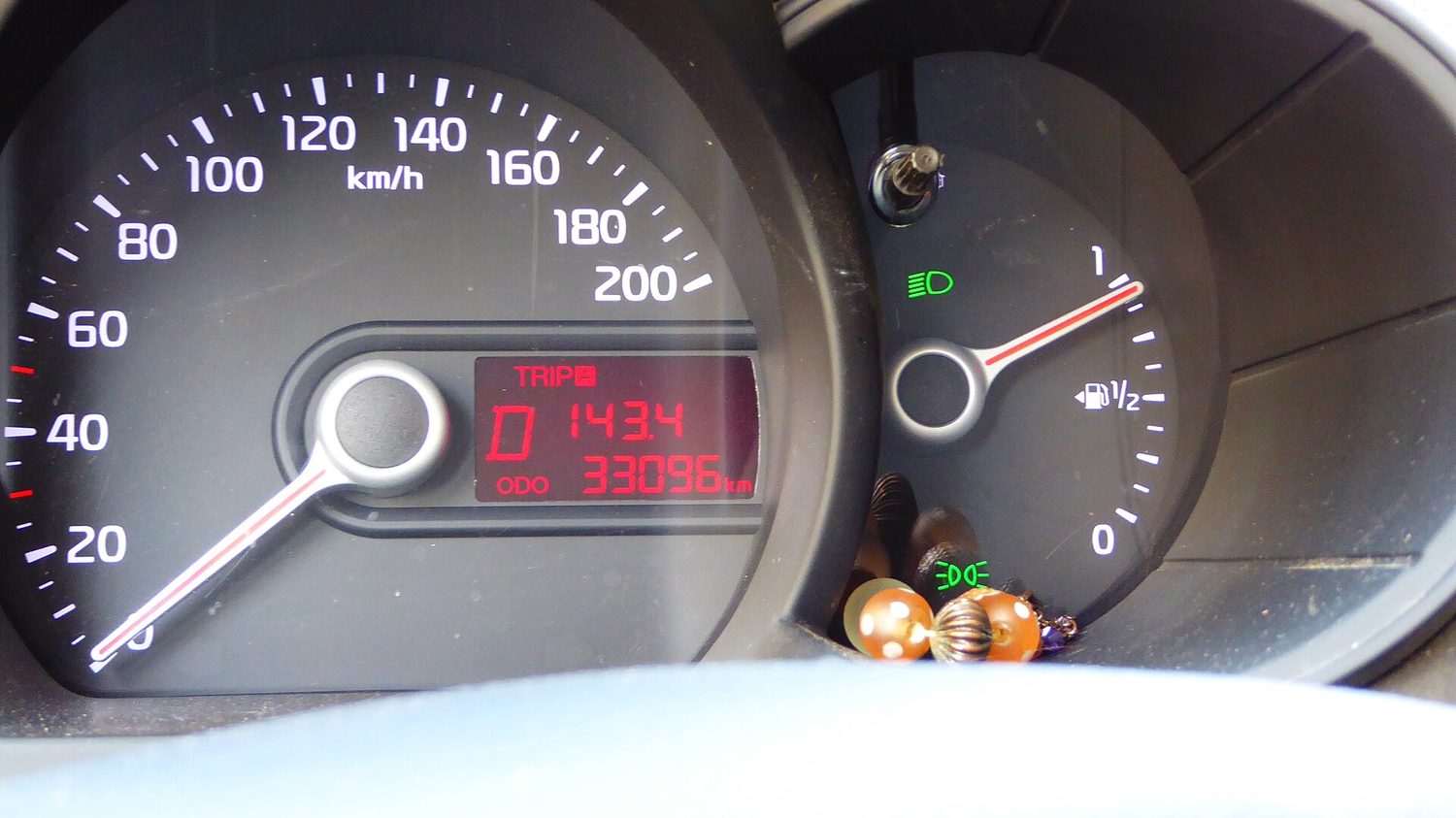
    A car speedometer: speed is the magnitude of velocity — a scalar rate of motion
    A car speedometer: speed is the magnitude of velocity — a scalar rate of motion

    Kinematics 运动学 describes how objects move, without asking why. First, two kinds of quantity:

    • A scalar 标量 has only size (magnitude 大小): distance 距离, speed, time, mass.
    • A vector 矢量 has magnitude and direction: displacement, velocity, acceleration, force.

    The difference matters. Distance is the total path length travelled – a scalar that only grows. Displacement is the straight-line change in position, with a direction. Walk $3\ \text{m}$ east then $1\ \text{m}$ back west: the distance is $4\ \text{m}$, but the displacement is only $2\ \text{m}$ east.

    In one dimension, direction is just a sign (+ or −) along a chosen axis. Choosing the positive direction first is essential – every vector's sign depends on it. A velocity of $-5\ \text{m/s}$ does not mean "slow"; it means $5\ \text{m/s}$ in the negative direction.

    Vocabulary · ⁨คำศัพท์⁩ Train · ⁨ฝึกฝน⁩
    English ไทย
    Kinematics/ˌkɪnɪˈmætɪks/ จลนศาสตร์
    scalar/ˈskeɪlə/ สเกลาร์
    magnitude/ˈmæɡnɪtjuːd/ ขนาด
    vector/ˈvektə/ เวกเตอร์
    distance/ˈdɪstəns/ ระยะทาง
    1.2

    Displacement, Velocity, and Acceleration

    Syllabus · ⁨หลักสูตร⁩
    English

    Learning Objective 1.2.A: Describe a change in an object's position.

    • 1.2.A.1 When using the object model, the size, shape, and internal configuration are ignored. The object may be treated as a single point with extensive properties such as mass and charge.
    • 1.2.A.2 Displacement is the change in an object's position.
      • Equation: $\Delta x = x - x_0$

    Learning Objective 1.2.B: Describe the average velocity and acceleration of an object.

    • 1.2.B.1 Averages of velocity and acceleration are calculated considering the initial and final states of an object over an interval of time.
    • 1.2.B.2 Average velocity is the displacement of an object divided by the interval of time in which that displacement occurs.
      • Equation: $\vec{v}_{avg} = \dfrac{\Delta \vec{x}}{\Delta t}$
    • 1.2.B.3 Average acceleration is the change in velocity divided by the interval of time in which that change in velocity occurs.
      • Equation: $\vec{a}_{avg} = \dfrac{\Delta \vec{v}}{\Delta t}$

    Learning Objective 1.2.B: Describe the velocity and acceleration of an object.

    • 1.2.B.4 An object is accelerating if the magnitude and/or direction of the object's velocity are changing.
    • 1.2.B.5 Calculating average velocity or average acceleration over a very small time interval yields a value that is very close to the instantaneous velocity or instantaneous acceleration.
    ไทย

    วัตถุประสงค์การเรียนรู้ 1.2.A: อธิบายการเปลี่ยนแปลงตำแหน่งของวัตถุ

    • 1.2.A.1 เมื่อใช้โมเดลวัตถุ ขนาด รูปร่าง และการจัดเรียงภายในถูกตัดทอนไป วัตถุนั้นอาจถูกพิจารณาเป็นจุดเดียวที่มีคุณสมบัติเชิง extensive เช่น มวลและประจุไฟฟ้า
    • 1.2.A.2 การกระจัดคือการเปลี่ยนแปลงตำแหน่งของวัตถุ
      • สมการ: $\Delta x = x - x_0$

    วัตถุประสงค์การเรียนรู้ 1.2.B: อธิบายความเร็วเฉลี่ยและความเร่งเฉลี่ยของวัตถุ

    • 1.2.B.1 ค่าเฉลี่ยของความเร็วและความเร่งคำนวณโดยพิจารณาจากสถานะเริ่มต้นและสถานะสุดท้ายของวัตถุในช่วงเวลาหนึ่ง
    • 1.2.B.2 ความเร็วเฉลี่ยคือค่าของการกระจัดของวัตถุหารด้วยช่วงเวลาที่ยังมีการกระดกลนั้นเกิดขึ้น
      • สมการ: $\vec{v}_{avg} = \dfrac{\Delta \vec{x}}{\Delta t}$
    • 1.2.B.3 ความเร่งเฉลี่ยคือค่าของการเปลี่ยนแปลงความเร็วหารด้วยช่วงเวลาที่ยังเกิดการเปลี่ยนแปลงความเร็วนั้นขึ้น
      • สมการ: $\vec{a}_{avg} = \dfrac{\Delta \vec{v}}{\Delta t}$

    วัตถุประสงค์การเรียนรู้ 1.2.B: อธิบายความเร็วและความเร่งของวัตถุ

    • 1.2.B.4 วัตถุกำลังมีความเร่งหากขนาดและ/หรือทิศทางของความเร็วของวัตถุนั้นมีการเปลี่ยนแปลง
    • 1.2.B.5 การคำนวณความเร็วเฉลี่ยหรือความเร่งเฉลี่ยในช่วงเวลาที่สั้นมากจะได้ค่าที่ใกล้เคียงกับความเร็วทันทีหรือความเร่งทันทีมาก

    Source: College Board AP Course and Exam Description · ⁨แหล่งที่มา: คำอธิบายหลักสูตรและข้อสอบ College Board AP⁩

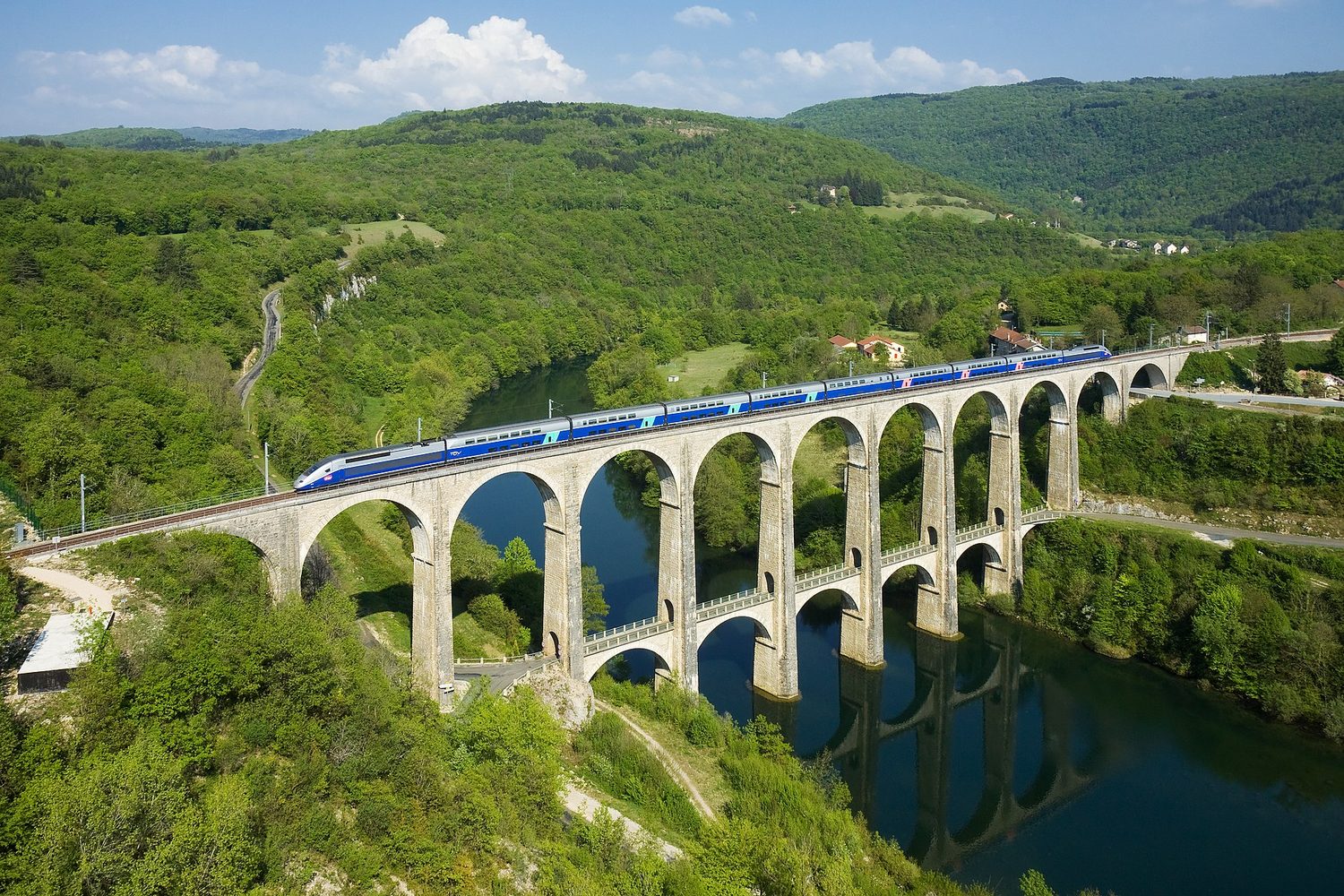
    A high-speed train: kinematics describes displacement, velocity and acceleration over time
    A high-speed train: kinematics describes displacement, velocity and acceleration over time
    Projectile motion is two independent motions

    Three linked vectors describe motion along a line:

    • Displacement 位移 $\Delta x$ is the change in position – a vector from start to end (not the total path length, which is distance).
    • Velocity 速度 is the rate of change of position, $v=\dfrac{\Delta x}{\Delta t}$. Its sign gives direction; its magnitude is speed 速率.
    • Acceleration 加速度 is the rate of change of velocity, $a=\dfrac{\Delta v}{\Delta t}$.

    Be careful to separate average velocity 平均速度 (total displacement over total time) from instantaneous velocity 瞬时速度 (the velocity at one instant, the slope of the position–time graph at that point). They are equal only when the velocity is constant.

    An object speeds up when $v$ and $a$ have the same sign, and slows down (deceleration 减速) when they have opposite signs. Note that a negative acceleration does not always mean slowing down – a ball falling faster and faster has negative velocity and negative acceleration.

    For constant acceleration, the four kinematic equations (often called SUVAT) apply:

    $$v=v_0+at,\qquad \Delta x=v_0 t+\tfrac{1}{2}at^2,\qquad v^2=v_0^2+2a\,\Delta x,\qquad \Delta x=\tfrac{1}{2}(v_0+v)\,t.$$
    Pick the equation that contains the three quantities you know plus the one you want, so only one unknown is left. They apply only while $a$ is constant.

    Worked example. A car starts from rest and accelerates uniformly at $2.0\ \text{m/s}^2$ for $6.0\ \text{s}$. Find its final velocity and the distance it travels.

    List what you know: $v_0=0$, $a=2.0\ \text{m/s}^2$, $t=6.0\ \text{s}$.

    $$v=v_0+at=0+2.0\times 6.0=12\ \text{m/s},$$
    $$\Delta x=v_0 t+\tfrac12 at^2=0+\tfrac12\times 2.0\times 6.0^2=36\ \text{m}.$$

    Worked example (free fall). A ball is thrown straight up at $15\ \text{m/s}$. Taking $g=9.8\ \text{m/s}^2$ and up as positive, how high does it rise, and how long is it in the air before returning to the thrower's hand?

    At the highest point the velocity is momentarily zero, and $a=-g=-9.8\ \text{m/s}^2$ throughout (this is free fall 自由落体, ignoring air resistance 空气阻力):

    $$v^2=v_0^2+2a\,\Delta x \;\Rightarrow\; 0=15^2+2(-9.8)\Delta x \;\Rightarrow\; \Delta x=\frac{225}{19.6}=11.5\ \text{m}.$$
    Time to the top: $0=15-9.8\,t \Rightarrow t=1.53\ \text{s}$. By symmetry the fall takes the same time, so the total is $3.1\ \text{s}$.

    Vocabulary · ⁨คำศัพท์⁩ Train · ⁨ฝึกฝน⁩
    English ไทย
    Displacement/dɪˈspleɪsmənt/ การแทนที่
    Velocity/vəˈlɒsɪti/ ความเร็ว
    speed/spiːd/ ความเร็ว
    Acceleration/əkˌseləˈreɪʃn/ ความเร่ง
    average velocity/ˈævrɪdʒ vəˈlɒsɪti/ ความเร็วเฉลี่ย
    instantaneous velocity/ˌɪnstənˈteɪnɪəs vəˈlɒsɪti/ ความเร็วทันที
    deceleration/dɪˌseləˈreɪʃn/ การลดความเร็ว
    free fall/friː fɔːl/ การตกอย่างอิสระ
    air resistance/eə rɪˈzɪstəns/ แรงต้านอากาศ
    1.3

    Representing Motion

    Syllabus · ⁨หลักสูตร⁩
    English

    Learning Objective 1.3.A: Describe the position, velocity, and acceleration of an object using representations of that object's motion.

    • 1.3.A.1 Motion can be represented by motion diagrams, figures, graphs, equations, and narrative descriptions.
    • 1.3.A.2 For constant acceleration, three kinematic equations can be used to describe instantaneous linear motion in one dimension:
      • Equation: $v_x = v_{x0} + a_x t$
      • Equation: $x = x_0 + v_{x0}t + \dfrac{1}{2}a_x t^2$
      • Equation: $v_x^2 = v_{x0}^2 + 2a_x(x - x_0)$
      • Note: The equations above are written to indicate motion in the x-direction, but these equations can be used in any single dimension as appropriate.
    • 1.3.A.3 Near the surface of Earth, the vertical acceleration caused by the force of gravity is downward, constant, and has a measured value approximately equal to $a_g = g \approx 10 \ m/s^2$.
    • 1.3.A.4 Graphs of position, velocity, and acceleration as functions of time can be used to find the relationships between those quantities.
      • 1.3.A.4.i An object's instantaneous velocity is the rate of change of the object's position, which is equal to the slope of a line tangent to a point on a graph of the object's position as a function of time.
      • 1.3.A.4.ii An object's instantaneous acceleration is the rate of change of the object's velocity, which is equal to the slope of a line tangent to a point on a graph of the object's velocity as a function of time.
      • 1.3.A.4.iii The displacement of an object during a time interval is equal to the area under the curve of a graph of the object's velocity as a function of time (i.e., the area bounded by the function and the horizontal axis for the appropriate interval).
      • 1.3.A.4.iv The change in velocity of an object during a time interval is equal to the area under the curve of a graph of the acceleration of the object as a function of time.

    Boundary statement: AP Physics 1 does not expect students to quantitatively analyze nonuniform acceleration. However, students will be expected to be able to qualitatively analyze, sketch appropriate graphs of, and discuss situations in which acceleration is nonuniform.

    Boundary statement: For all situations in which a numerical quantity is required for $g$, the value $g \approx 10 \ m/s^2$ will be used. However, students will not be penalized for correctly using the more precise commonly accepted values of $g = 9.81 \ \text{m/s}^2$ or $g = 9.8 \ \text{m/s}^2$.

    ไทย

    วัตถุประสงค์การเรียนรู้ 1.3.A: อธิบายตำแหน่ง, ความเร็ว, และความเร่งของวัตถุโดยใช้การแสดงการเคลื่อนที่ของวัตถุนั้น

    • 1.3.A.1 การเคลื่อนที่สามารถแสดงได้ด้วยแผนภาพการเคลื่อนที่, ภาพ, กราฟ, สมการ, และการบรรยายแบบข้อความ
    • 1.3.A.2 สำหรับกรณีที่มีความเร่งคงที่ สามารถใช้สมการจลนศาสตร์สามสมการเพื่ออธิบายการเคลื่อนที่เชิงเส้นทันทีในหนึ่งมิติ:
      • สมการ: $v_x = v_{x0} + a_x t$
      • สมการ: $x = x_0 + v_{x0}t + \dfrac{1}{2}a_x t^2$
      • สมการ: $v_x^2 = v_{x0}^2 + 2a_x(x - x_0)$
      • หมายเหตุ: สมการข้างต้นเขียนขึ้นเพื่อบ่งบอกการเคลื่อนที่ในทิศทาง x แต่สามารถใช้ได้ในทุกมิติเดียวตามความเหมาะสม
    • 1.3.A.3 ใกล้ผิวดิน ความเร่งแนวตั้งที่เกิดจากแรงโน้มถ่วงมีทิศลง, คงที่ และมีค่าที่วัดได้ประมาณเท่ากับ $a_g = g \approx 10 \ m/s^2$
    • 1.3.A.4 กราฟของตำแหน่ง, ความเร็ว, และความเร่งในฟังก์ชันของเวลาสามารถใช้เพื่อหาความสัมพันธ์ระหว่างปริมาณเหล่านั้นได้
      • 1.3.A.4.i ความเร็วทันทีของวัตถุคืออัตราการเปลี่ยนแปลงตำแหน่งของวัตถุ ซึ่งมีค่าเท่ากับความชันของเส้นสัมผัสกับจุดบนกราฟตำแหน่งของวัตถุในฟังก์ชันของเวลา
      • 1.3.A.4.ii ความเร่งทันทีของวัตถุคืออัตราการเปลี่ยนแปลงความเร็วของวัตถุ ซึ่งมีค่าเท่ากับความชันของเส้นสัมผัสกับจุดบนกราฟความเร็วของวัตถุในฟังก์ชันของเวลา
      • 1.3.A.4.iii การกระจัดของวัตถุในช่วงเวลาหนึ่งมีค่าเท่ากับพื้นที่ใต้เส้นโค้งของกราฟความเร็วของวัตถุในฟังก์ชันของเวลา (นั่นคือ พื้นที่ที่ถูกปิดล้อมโดยฟังก์ชันและแกนแนวนอนสำหรับช่วงเวลาที่กำหนด)
      • 1.3.A.4.iv การเปลี่ยนแปลงความเร็วของวัตถุในช่วงเวลาหนึ่งมีค่าเท่ากับพื้นที่ใต้เส้นโค้งของกราฟความเร่งของวัตถุในฟังก์ชันของเวลา

    ข้อจำกัด: AP Physics 1 ไม่ได้คาดหวังให้นักเรียนวิเคราะห์ความเร่งที่ไม่สม่ำเสมอเชิงปริมาณ อย่างไรก็ตาม นักเรียนจะต้องสามารถวิเคราะห์เชิงคุณภาพ, วาดกราฟที่เหมาะสม, และอภิปรายสถานการณ์ที่มีความเร่งไม่สม่ำเสมอได้

    ข้อจำกัด: สำหรับทุกสถานการณ์ที่ต้องการจำนวนตัวเลขสำหรับ $g$ จะใช้ค่า $g \approx 10 \ m/s^2$ อย่างไรก็ตาม นักเรียนจะไม่ถูกหักคะแนนหากใช้ค่าที่ยอมรับกันทั่วไปที่แม่นยำกว่าของ $g = 9.81 \ \text{m/s}^2$ หรือ $g = 9.8 \ \text{m/s}^2$ ได้อย่างถูกต้อง

    Source: College Board AP Course and Exam Description · ⁨แหล่งที่มา: คำอธิบายหลักสูตรและข้อสอบ College Board AP⁩

    The same motion appears as a description, a graph, a table, or an equation, and you should move between them:

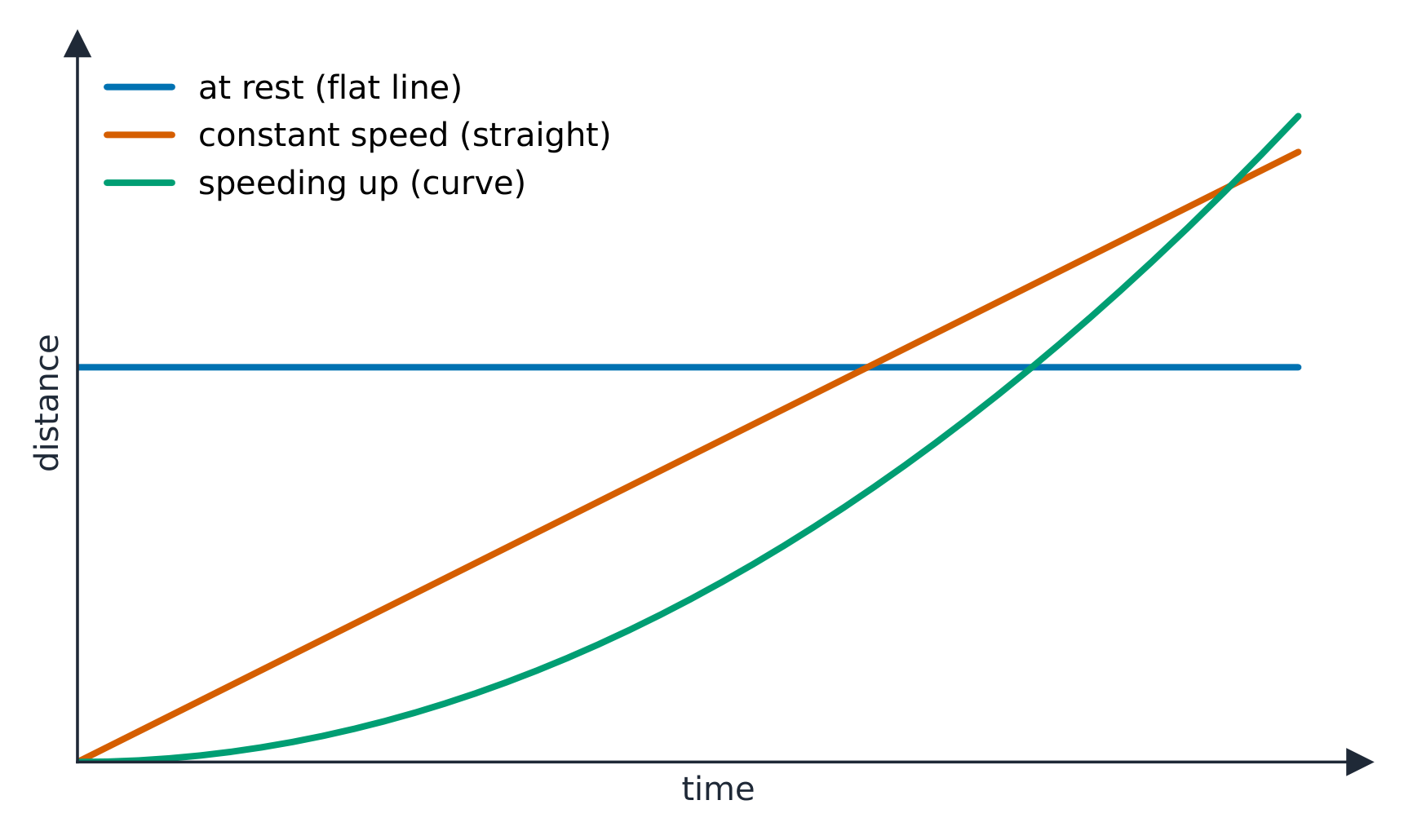
    Reading a distance-time graph: flat means at rest, a straight slope means constant speed
    Reading a distance-time graph: flat means at rest, a straight slope means constant speed
    • On a position–time graph, the slope is velocity (steeper = faster; a curve = changing velocity).
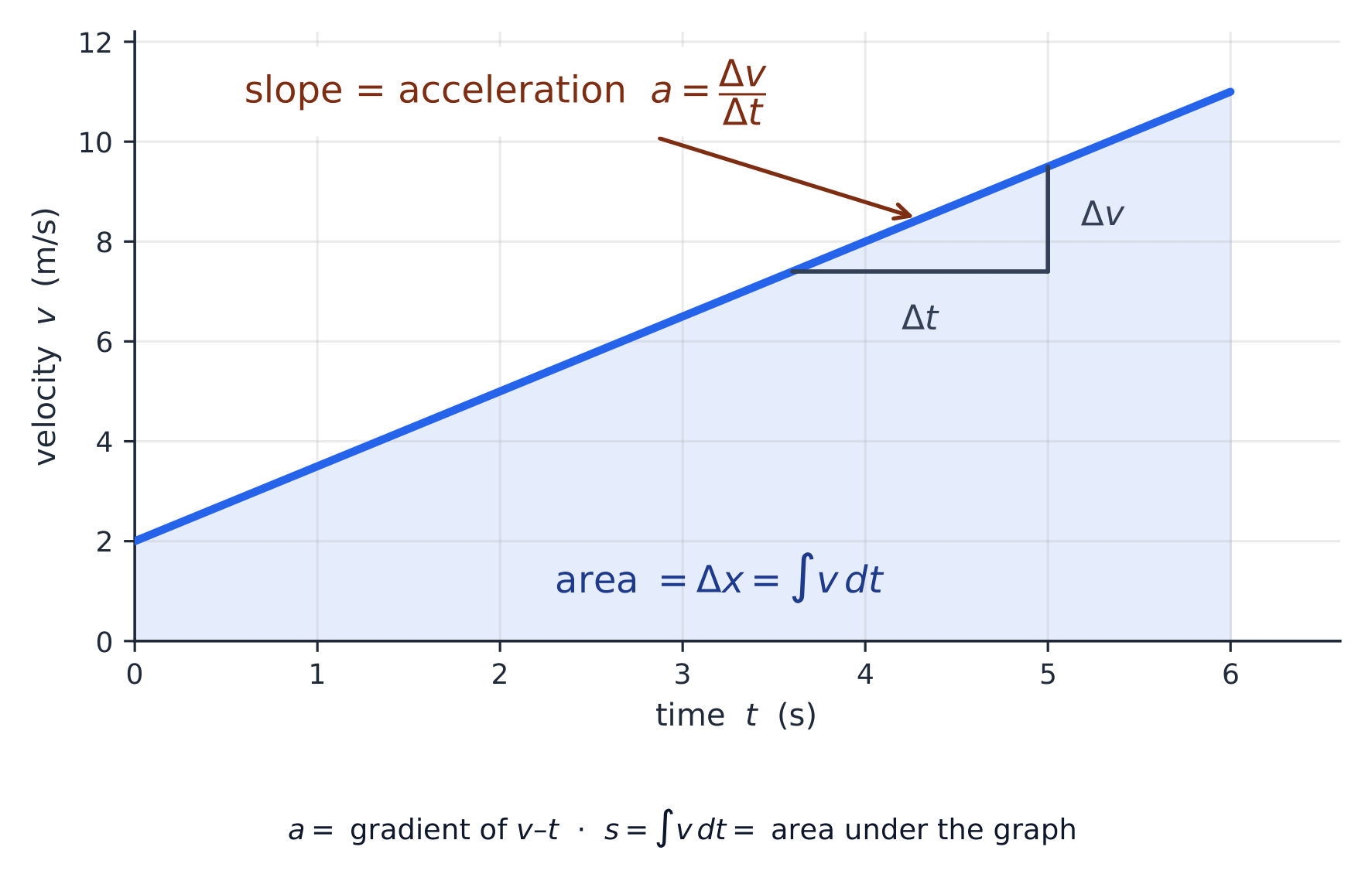
    • On a velocity–time graph, the slope is acceleration, and the area under the line is displacement.

    Reading slopes and areas off graphs is a core exam skill. To get displacement from a velocity–time graph, split the area into triangles and rectangles and add them up; area below the time axis counts as negative displacement (motion the other way).

    On a velocity-time graph the slope is the acceleration and the shaded area is the displacement
    On a velocity-time graph the slope is the acceleration and the shaded area is the displacement

    Worked example. A cyclist speeds up uniformly from rest to $8.0\ \text{m/s}$ in $4.0\ \text{s}$, then holds $8.0\ \text{m/s}$ for $6.0\ \text{s}$. Find the total distance from the velocity–time graph.

    The area is a triangle followed by a rectangle:

    $$\Delta x=\underbrace{\tfrac12\times 4.0\times 8.0}_{\text{triangle}}+\underbrace{6.0\times 8.0}_{\text{rectangle}}=16+48=64\ \text{m}.$$

    Explore · ⁨สำรวจ⁩

    Explore the velocity–time graph · ⁨สำรวจกราฟความเร็ว-เวลา⁩

    Change the start velocity $u$ and the acceleration $a$. The gradient (slope) of the line is the acceleration; the area between the line and the time axis is the displacement. · ⁨เปลี่ยนความเร็วเริ่มต้น $u$ และความเร่ง $a$. ความชัน (gradient) ของเส้นคือ ความเร่ง; พื้นที่ ระหว่างเส้นกับแกนเวลาคือ การกระจัด⁩

    1.4

    Reference Frames and Relative Motion

    Syllabus · ⁨หลักสูตร⁩
    English

    Learning Objective 1.4.A: Describe the reference frame of a given observer.

    • 1.4.A.1 The choice of reference frame will determine the direction and magnitude of quantities measured by an observer in that reference frame.

    Learning Objective 1.4.B: Describe the motion of objects as measured by observers in different inertial reference frames.

    • 1.4.B.1 Measurements from a given reference frame may be converted to measurements from another reference frame.
    • 1.4.B.2 The observed velocity of an object results from the combination of the object's velocity and the velocity of the observer's reference frame.
      • 1.4.B.2.i Combining the motion of an object and the motion of an observer in a given reference frame involves the addition or subtraction of vectors.
      • 1.4.B.2.ii The acceleration of any object is the same as measured from all inertial reference frames.

    Boundary statement: Unless otherwise stated, the frame of reference of any problem may be assumed to be inertial.

    Boundary statement: Adding or subtracting vectors to find relative velocities is restricted to motion along one dimension for AP Physics 1.

    ไทย

    วัตถุประสงค์การเรียนรู้ 1.4.A: อธิบายกรอบอ้างอิงของผู้สังเกตที่กำหนดให้

    • 1.4.A.1 การเลือกกรอบอ้างอิงจะกำหนดทิศทางและขนาดของปริมาณที่ผู้สังเกตในกรอบอ้างอิงนั้นวัดได้

    วัตถุประสงค์การเรียนรู้ 1.4.B: อธิบายการเคลื่อนที่ของวัตถุตามที่ผู้สังเกตในกรอบอ้างอิงเฉื่อยที่แตกต่างกันวัดได้

    • 1.4.B.1 ข้อมูลการวัดจากกรอบอ้างอิงที่กำหนดสามารถแปลงเป็นข้อมูลการวัดจากกรอบอ้างอิงอื่นได้
    • 1.4.B.2 ความเร็วที่สังเกตได้จากวัตถุเกิดจากการรวมกันระหว่างความเร็วของวัตถุนั้นและความเร็วของกรอบอ้างอิงของผู้สังเกต
      • 1.4.B.2.i การรวมการเคลื่อนที่ของวัตถุและการเคลื่อนที่ของผู้สังเกตในกรอบอ้างอิงที่กำหนดเกี่ยวข้องกับการบวกหรือลบเวกเตอร์
      • 1.4.B.2.ii ความเร่งของวัตถุใดๆ มีค่าเท่ากันเมื่อวัดจากกรอบอ้างอิงเฉื่อยทุกกรอบ

    คำจำกัดความ: เว้นแต่จะระบุไว้เป็นพิเศษ กรอบอ้างอิงของโจทย์ปัญหาใด ๆ สามารถสมมติว่าเป็นกรอบอ้างอิงเฉื่อยได้

    คำจำกัดความ: การบวกหรือลบเวกเตอร์เพื่อหาความเร็วสัมพัทธ์ถูกจำกัดอยู่แค่การเคลื่อนที่ตามมิติเดียวสำหรับ AP Physics 1

    Source: College Board AP Course and Exam Description · ⁨แหล่งที่มา: คำอธิบายหลักสูตรและข้อสอบ College Board AP⁩

    All motion is measured against a reference frame 参考系. Velocities measured in different frames differ, and you combine them by vector addition. The velocity of A relative to C is

    $$\vec{v}_{A/C}=\vec{v}_{A/B}+\vec{v}_{B/C}.$$
    A person walking on a moving train has one velocity relative to the train and another relative to the ground – this is relative motion 相对运动. A useful shortcut: the velocity of A relative to B is $\vec{v}_{A/B}=\vec{v}_A-\vec{v}_B$ (subtract B's velocity).

    A frame that is not accelerating is an inertial reference frame 惯性参考系: one in which a free object (no net force) obeys Newton's first law, staying at rest or moving at constant velocity. A frame that accelerates – a braking car – is non-inertial, where objects seem to speed up with no force acting on them.

    Worked example. A boat points straight across a river and moves at $3.0\ \text{m/s}$ relative to the water. The current flows at $4.0\ \text{m/s}$ along the river. Find the boat's speed and direction relative to the bank.

    The two velocities are perpendicular, so add them as a right triangle:

    $$v=\sqrt{3.0^2+4.0^2}=5.0\ \text{m/s},\qquad \theta=\tan^{-1}\!\frac{4.0}{3.0}=53^{\circ}\ \text{downstream from straight across.}$$

    Vocabulary · ⁨คำศัพท์⁩ Train · ⁨ฝึกฝน⁩
    English ไทย
    reference frame/ˈrefrəns freɪm/ กรอบอ้างอิง
    relative motion/ˈrelətɪv ˈməʊʃn/ การเคลื่อนที่สัมพัทธ์
    inertial reference frame/ɪˈnɜːʃl ˈrefrəns freɪm/ กรอบอ้างอิงเฉื่อย
    1.5

    Vectors and Motion in Two Dimensions

    Syllabus · ⁨หลักสูตร⁩
    English

    Learning Objective 1.5.A: Describe the perpendicular components of a vector.

    • 1.5.A.1 Vectors can be mathematically modeled as the resultant of two perpendicular components.
    • 1.5.A.2 Vectors can be resolved into components using a chosen coordinate system.
    • 1.5.A.3 Vectors can be resolved into perpendicular components using trigonometric functions and relationships.
      • Equation: $\sin \theta = \dfrac{a}{c}$
      • Equation: $\cos \theta = \dfrac{b}{c}$
      • Equation: $\tan \theta = \dfrac{a}{b}$
      • Equation: $a^2 + b^2 = c^2$

    Learning Objective 1.5.B: Describe the motion of an object moving in two dimensions.

    • 1.5.B.1 Motion in two dimensions can be analyzed using one-dimensional kinematic relationships if the motion is separated into components.
    • 1.5.B.2 Projectile motion is a special case of two-dimensional motion that has zero acceleration in one dimension and constant, nonzero acceleration in the second dimension.
    ไทย

    วัตถุประสงค์การเรียนรู้ 1.5.A: อธิบายองค์ประกอบตั้งฉากของเวกเตอร์

    • 1.5.A.1 เวกเตอร์สามารถสร้างแบบจำลองทางคณิตศาสตร์ได้ว่าเป็นผลรวมขององค์ประกอบตั้งฉากสององค์ประกอบ
    • 1.5.A.2 เวกเตอร์สามารถแยกออกเป็นองค์ประกอบโดยใช้ระบบพิกัดที่เลือก
    • 1.5.A.3 เวกเตอร์สามารถแยกออกเป็นองค์ประกอบตั้งฉากได้โดยใช้ฟังก์ชันตรีโกณมิติและความสัมพันธ์ต่างๆ
      • สมการ: $\sin \theta = \dfrac{a}{c}$
      • สมการ: $\cos \theta = \dfrac{b}{c}$
      • สมการ: $\tan \theta = \dfrac{a}{b}$
      • สมการ: $a^2 + b^2 = c^2$

    วัตถุประสงค์การเรียนรู้ 1.5.B: อธิบายการเคลื่อนที่ของวัตถุที่เคลื่อนที่ในสองมิติ

    • 1.5.B.1 การเคลื่อนที่ในสองมิติสามารถวิเคราะห์โดยใช้ความสัมพันธ์ทางจลนศาสตร์หนึ่งมิติได้ หากมีการแยกการเคลื่อนที่ออกเป็นองค์ประกอบ
    • 1.5.B.2 การเคลื่อนที่แบบโปรเจคไทล์เป็นกรณีพิเศษของการเคลื่อนที่ในสองมิติที่มีค่าความเร่งเป็นศูนย์ตามหนึ่งมิติ และมีความเร่งคงที่ไม่เป็นศูนย์ตามอีกมิติหนึ่ง

    Source: College Board AP Course and Exam Description · ⁨แหล่งที่มา: คำอธิบายหลักสูตรและข้อสอบ College Board AP⁩

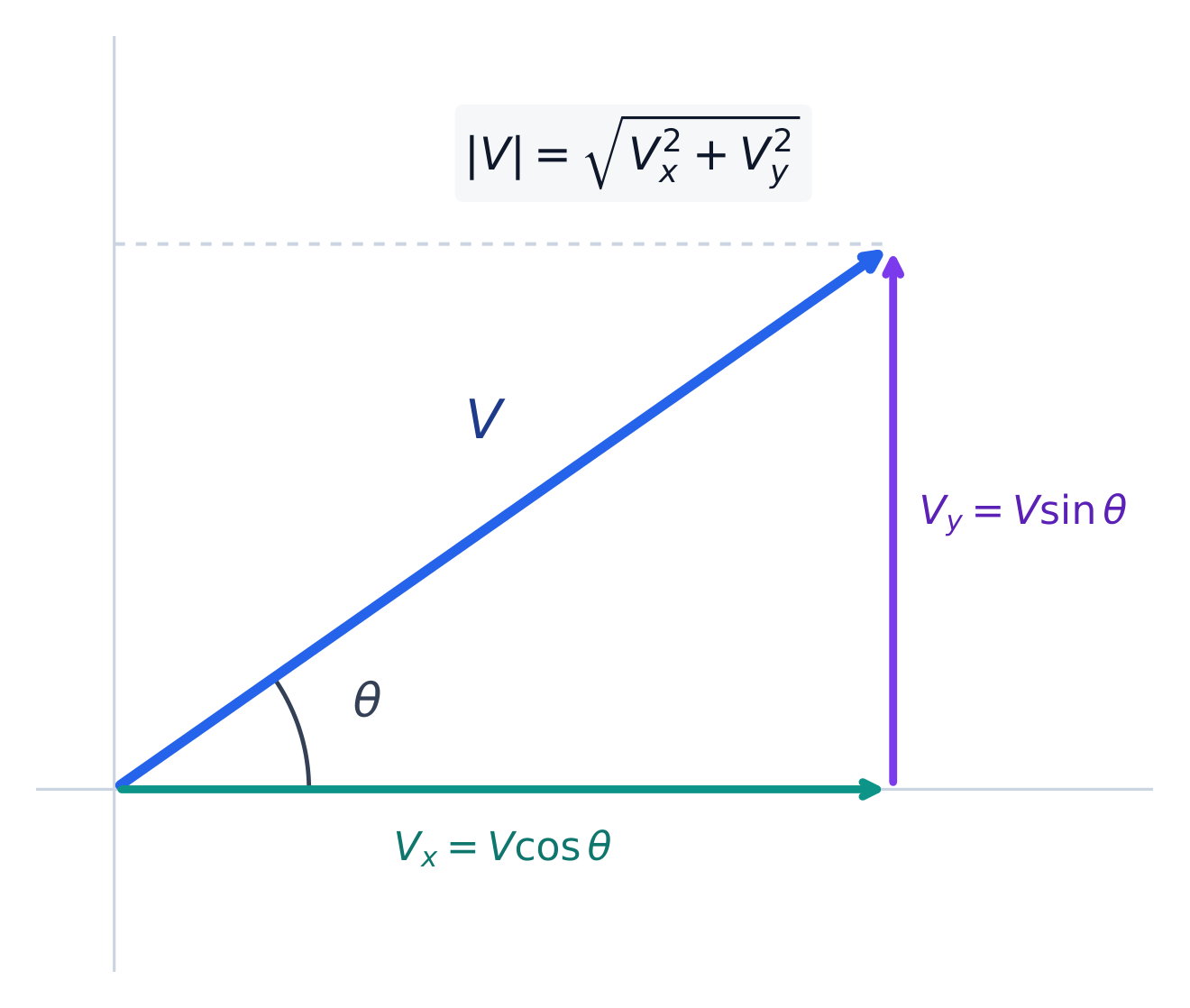
    In two dimensions, resolve each vector into components 分量 along perpendicular axes ($x$ and $y$), handle each axis separately, then recombine. A velocity $v$ at angle $\theta$ to the horizontal has components $v_x=v\cos\theta$ and $v_y=v\sin\theta$.

    A velocity vector resolved into its horizontal and vertical components
    A velocity vector resolved into its horizontal and vertical components

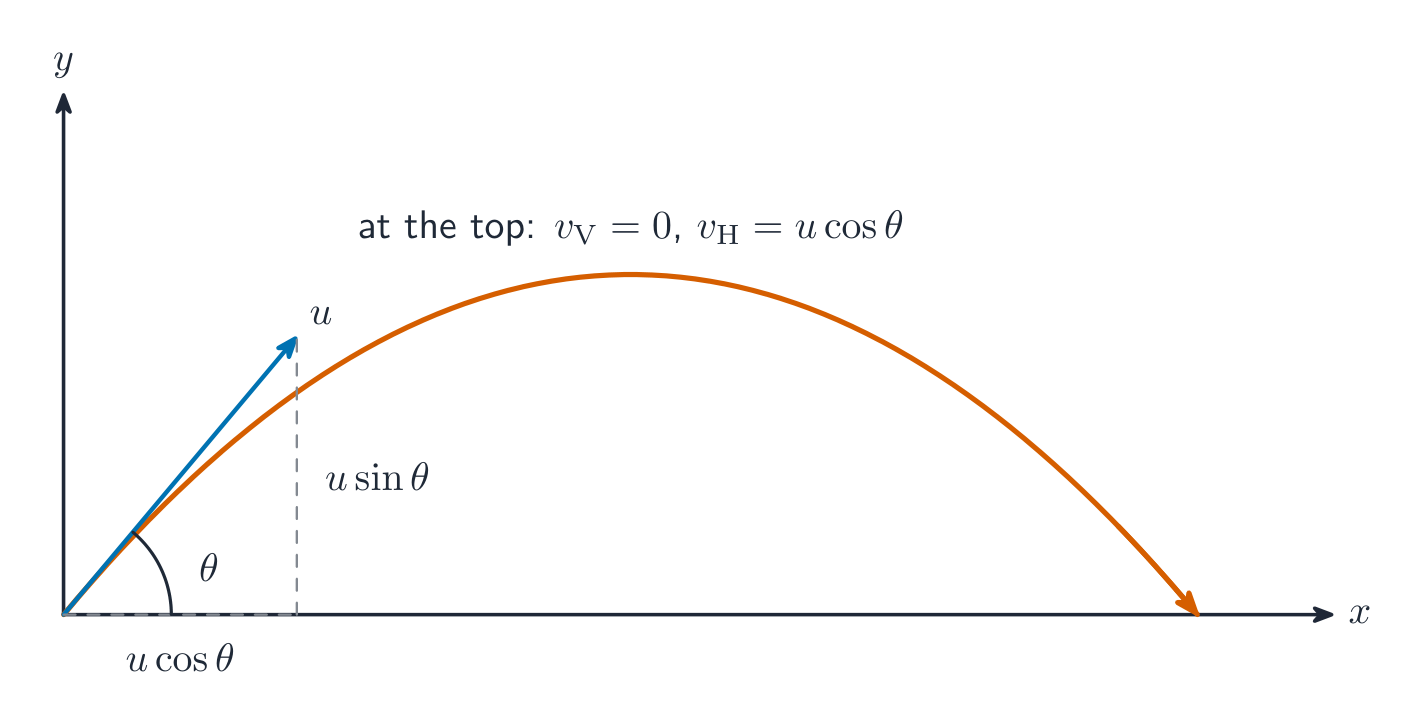
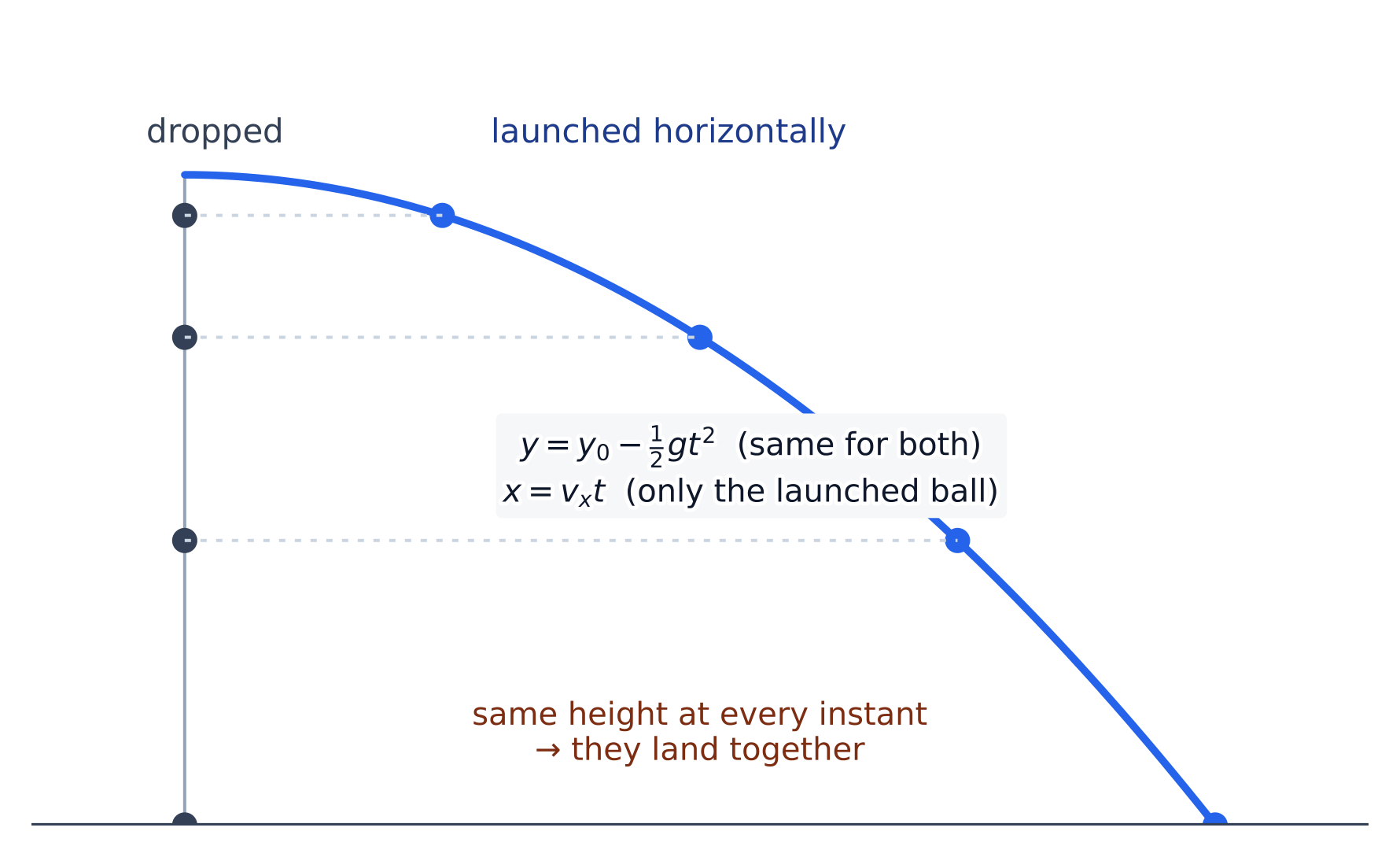
    For projectile motion 抛体运动 (an object moving under gravity alone): the horizontal and vertical motions are independent. Horizontally, velocity is constant ($a_x=0$); vertically, acceleration is $-g$ (down). The two motions share only the time. So a projectile's path (its trajectory 轨迹) is a parabola, and you solve it as two one-dimensional problems joined by $t$.

    A projectile launched at an angle: the horizontal and vertical motions are independent
    A projectile launched at an angle: the horizontal and vertical motions are independent
    A dropped ball and a horizontally launched ball fall together – the vertical motions are identical
    A dropped ball and a horizontally launched ball fall together – the vertical motions are identical

    Worked example. A ball is kicked at $20\ \text{m/s}$, $30^{\circ}$ above the horizontal. Taking $g=9.8\ \text{m/s}^2$, find the time of flight, the maximum height, and the horizontal range 射程 (assume it lands at launch height).

    Split the launch velocity into components:

    $$v_{0x}=20\cos 30^{\circ}=17.3\ \text{m/s},\qquad v_{0y}=20\sin 30^{\circ}=10\ \text{m/s}.$$
    Vertical motion sets the time. At the top $v_y=0$, so $0=10-9.8\,t \Rightarrow t_{\text{up}}=1.02\ \text{s}$, and the total flight is $2t_{\text{up}}=2.0\ \text{s}$. The maximum height is
    $$\Delta y=\frac{v_{0y}^2}{2g}=\frac{10^2}{19.6}=5.1\ \text{m}.$$
    Horizontal motion runs at constant $v_{0x}$ for the whole flight, so the range is
    $$R=v_{0x}\times t_{\text{flight}}=17.3\times 2.0=35\ \text{m}.$$

    A common trap: at the top of the flight the vertical velocity is zero, but the ball is not at rest – its horizontal velocity $v_{0x}$ never changes. The speed at the top equals $v_{0x}=17.3\ \text{m/s}$.

    Explore · ⁨สำรวจ⁩

    Explore projectile motion · ⁨สำรวจการเคลื่อนที่แบบโปรเจกไทล์⁩

    Fire the ball, then change the angle and speed. The horizontal motion stays steady while gravity pulls it down — together they trace a parabola. Find the launch angle that gives the longest range, and try the Moon. · ⁨ยิงลูกบอล แล้วเปลี่ยน มุม และ ความเร็ว การเคลื่อนที่แนวนอนคงที่ในขณะที่แรงโน้มถ่วงดึงลง — รวมกันแล้วสร้างเส้น พาราโบลา หามุมที่ยิงให้ ระยะ ยาวที่สุด และลองบนดวงจันทร์⁩

    Explore · ⁨สำรวจ⁩

    Explore vectors and their components · ⁨สำรวจเวกเตอร์และองค์ประกอบของมัน⁩

    Drag the vectors to change their $x$- and $y$-components. See how a single vector is built from independent horizontal and vertical parts, and how two vectors add tip-to-tail into a resultant. · ⁨ลากเวกเตอร์เพื่อเปลี่ยนองค์ประกอบ $x$- และ $y$-. ดูว่าเวกเตอร์เดียวถูกสร้างจากส่วนแนวนอนและแนวตั้งที่เป็นอิสระได้อย่างไร และสองเวกเตอร์บวกกันแบบ ปลายชนปลาย เป็น เวกเตอร์ลัพธ์⁩

    Vocabulary · ⁨คำศัพท์⁩ Train · ⁨ฝึกฝน⁩
    English ไทย
    components/kəmˈpəʊnənts/ components
    projectile motion/prəˈdʒektaɪl ˈməʊʃn/ การเคลื่อนที่ของโปรเจกไทล์
    trajectory/trəˈdʒektəri/ เส้นทาง
    range/reɪndʒ/ range
    1.5

    Exam tips

    • Choose the right kinematic equation by listing the three quantities you know plus the one you want, so only one unknown remains; the SUVAT equations apply only while acceleration is constant.
    • Fix a positive direction first — every displacement, velocity, and acceleration then carries a sign; a negative velocity means "moving the other way", not "slow".
    • Treat a projectile as two independent 1-D problems sharing only the time $t$: constant velocity horizontally, $a=-g$ vertically. At the top $v_y=0$ but $v_x$ is unchanged.
    • On a velocity–time graph the gradient is the acceleration and the area is the displacement (area below the axis is negative).
    • Distinguish distance (scalar, total path) from displacement (vector, start-to-end), and speed from velocity.
  • 2

    Force and Translational Dynamics · ⁨แรงและพลวัตการเคลื่อนที่เชิงเส้น⁩

    Watch lesson · ⁨ดูบทเรียน⁩
    2.1

    Systems and Center of Mass

    Syllabus · ⁨หลักสูตร⁩
    English

    Learning Objective 2.1.A: Describe the properties and interactions of a system.

    • 2.1.A.1 System properties are determined by the interactions between objects within the system.
    • 2.1.A.2 If the properties or interactions of the constituent objects within a system are not important in modeling the behavior of the macroscopic system, the system can itself be treated as a single object.
    • 2.1.A.3 Systems may allow interactions between constituent parts of the system and the environment, which may result in the transfer of energy or mass.
    • 2.1.A.4 Individual objects within a chosen system may behave differently from each other as well as from the system as a whole.
    • 2.1.A.5 The internal structure of a system affects the analysis of that system.
    • 2.1.A.6 As variables external to a system are changed, the system's substructure may change.

    Learning Objective 2.1.B: Describe the location of a system's center of mass with respect to the system's constituent parts.

    • 2.1.B.1 For systems with symmetrical mass distributions, the center of mass is located on lines of symmetry.
    • 2.1.B.2 The location of a system's center of mass along a given axis can be calculated using the equation
      • Equation: $\vec{x}_{cm} = \dfrac{\sum m_i \vec{x}_i}{\sum m_i}$
    • 2.1.B.3 A system can be modeled as a singular object that is located at the system's center of mass.

    Boundary statement: AP Physics 1 only expects students to calculate the center of mass for systems of five or fewer particles arranged in a two-dimensional configuration or for systems that are highly symmetrical.

    ไทย

    วัตถุประสงค์การเรียนรู้ 2.1.A: อธิบายคุณสมบัติและปฏิสัมพันธ์ของระบบ

    • 2.1.A.1 คุณสมบัติของระบบถูกกำหนดโดยปฏิสัมพันธ์ระหว่างวัตถุภายในระบบ
    • 2.1.A.2 หากคุณสมบัติหรือปฏิสัมพันธ์ของวัตถุส่วนประกอบภายในระบบไม่สำคัญในการสร้างแบบจำลองพฤติกรรมของระบบมาโครสโคปิก ระบบนั้นเองสามารถถูกพิจารณาเป็นวัตถุเดียวได้
    • 2.1.A.3 ระบบอาจอนุญาตให้มีความสัมพันธ์ระหว่างส่วนประกอบภายในระบบกับสิ่งแวดล้อม ซึ่งอาจนำไปสู่การถ่ายโอนพลังงานหรือมวล
    • 2.1.A.4 วัตถุแต่ละตัวภายในระบบที่ถูกเลือกอาจมีพฤติกรรมที่แตกต่างจากกันเองและต่างจากระบบโดยรวม
    • 2.1.A.5 โครงสร้างภายในของระบบมีผลต่อการวิเคราะห์ระบบนั้น
    • 2.1.A.6 เมื่อตัวแปรภายนอกที่นอกเหนือจากระบบมีการเปลี่ยนแปลง โครงสร้างย่อยของระบบอาจเปลี่ยนแปลงไปด้วย

    วัตถุประสงค์การเรียนรู้ 2.1.B: อธิบายตำแหน่งของจุดศูนย์กลางมวลของระบบเมื่อเทียบกับส่วนประกอบต่างๆ ของระบบ

    • 2.1.B.1 สำหรับระบบที่มีการกระจายตัวของมวลสมมาตร จุดศูนย์กลางมวลจะอยู่บนเส้นสมมาตร
    • 2.1.B.2 ตำแหน่งของจุดศูนย์กลางมวลของระบบตามแกนที่กำหนดสามารถคำนวณได้โดยใช้สมการ ⟦number⟧
      • สมการ: $\vec{x}_{cm} = \dfrac{\sum m_i \vec{x}_i}{\sum m_i}$
    • 2.1.B.3 ระบบสามารถสร้างแบบจำลองเป็นวัตถุเดี่ยวซึ่งมีตำแหน่งอยู่ที่จุดศูนย์กลางมวลของระบบ

    คำจำกัดความ: AP Physics 1 คาดหวังให้นักเรียนคำนวณจุดศูนย์กลางมวลเฉพาะสำหรับระบบที่มีอนุภาคห้าตัวหรือน้อยกว่าที่จัดอยู่ในรูปแบบสองมิติ หรือสำหรับระบบที่มีความสมมาตรสูงเท่านั้น

    Source: College Board AP Course and Exam Description · ⁨แหล่งที่มา: คำอธิบายหลักสูตรและข้อสอบ College Board AP⁩

    A system 系统 is the object or group of objects you choose to analyze. A system can be treated as a single point at its center of mass 质心 – the average position of its mass. External forces change the motion of the center of mass; internal forces (between parts of the system) do not.

    This is why a wrench spinning across a table still has its center of mass move in a straight line: the spinning is internal, and only the (near-zero) external force matters for the center of mass. For two masses $m_1,m_2$ on a line at positions $x_1,x_2$, the center of mass sits at $x_{\text{cm}}=\dfrac{m_1x_1+m_2x_2}{m_1+m_2}$ – always closer to the heavier mass.

    Vocabulary · ⁨คำศัพท์⁩ Train · ⁨ฝึกฝน⁩
    English ไทย
    system/ˈsɪstəm/ ระบบ
    center of mass/ˈsentə ɒv mæs/ ศูนย์กลางมวล
    2.2

    Forces and Free-Body Diagrams

    Syllabus · ⁨หลักสูตร⁩
    English

    Learning Objective 2.2.A: Describe a force as an interaction between two objects or systems.

    • 2.2.A.1 Forces are vector quantities that describe the interactions between objects or systems.
      • 2.2.A.1.i A force exerted on an object or system is always due to the interaction of that object with another object or system.
      • 2.2.A.1.ii An object or system cannot exert a net force on itself.
    • 2.2.A.2 Contact forces describe the interaction of an object or system touching another object or system and are macroscopic effects of interatomic electric forces.

    Learning Objective 2.2.B: Describe the forces exerted on an object or system using a free-body diagram.

    • 2.2.B.1 Free-body diagrams are useful tools for visualizing forces being exerted on a single object or system and for determining the equations that represent a physical situation.
    • 2.2.B.2 The free-body diagram of an object or system shows each of the forces exerted on the object by the environment.
    • 2.2.B.3 Forces exerted on an object or system are represented as vectors originating from the representation of the center of mass, such as a dot. A system is treated as though all of its mass is located at the center of mass.
    • 2.2.B.4 A coordinate system with one axis parallel to the direction of acceleration of the object or system simplifies the translation from free-body diagram to algebraic representation. For example, in a free-body diagram of an object on an inclined plane, it is useful to set one axis parallel to the surface of the incline.

    Boundary statement: AP Physics 1 only expects students to depict the forces exerted on objects, not the force components on free-body diagrams. On the AP Physics exams, individual forces represented on a free-body diagram must be drawn as individual straight arrows, originating on the dot and pointing in the direction of the force. Individual forces that are in the same direction must be drawn side by side, not overlapping.

    ไทย

    วัตถุประสงค์การเรียนรู้ 2.2.A: อธิบายแรงในฐานะปฏิสัมพันธ์ระหว่างวัตถุสองวัตถุหรือระบบสองระบบ

    • 2.2.A.1 แรงเป็นปริมาณเวกเตอร์ที่อธิบายปฏิสัมพันธ์ระหว่างวัตถุหรือระบบ
      • 2.2.A.1.i แรงที่กระทำต่อวัตถุหรือระบบนั้นเกิดจากการปฏิสัมพันธ์ของวัตถุนั้นกับวัตถุหรือระบบอื่นเสมอ
      • 2.2.A.1.ii วัตถุหรือระบบไม่สามารถ exert แรงสุทธิต่อตัวเองได้
    • 2.2.A.2 แรงสัมผัสอธิบายการสัมผัสระหว่างวัตถุหรือระบบกับวัตถุหรือระบบอื่น และเป็นผลกระทบทางมาโครสโคปิกของแรงไฟฟ้าระหว่างอะตอม

    วัตถุประสงค์การเรียนรู้ 2.2.B: อธิบายแรงที่กระทำต่อวัตถุหรือระบบโดยใช้แผนภาพร่างกายอิสระ

    • 2.2.B.1 แผนภาพร่างกายอิสระเป็นเครื่องมือที่มีประโยชน์สำหรับการจินตนาการถึงแรงที่กระทำต่อวัตถุหรือวัตถุเดียวหรือระบบ และการหาคำสมการที่แสดงถึงสถานการณ์ทางฟิสิกส์
    • 2.2.B.2 แผนภาพร่างกายอิสระของวัตถุหรือระบบแสดงแรงทั้งหมดที่กระทำต่อวัตถุนั้นจากสิ่งแวดล้อม
    • 2.2.B.3 แรงที่กระทำต่อวัตถุหรือระบบจะถูกแทนด้วยเวกเตอร์ที่เริ่มต้นจากตัวแทนของจุดศูนย์กลางมวล เช่น จุดจุดหนึ่ง ระบบจะถูกพิจารณาว่ามวลทั้งหมดรวมอยู่ที่จุดศูนย์กลางมวล
    • 2.2.B.4 การใช้ระบบพิกัดที่มีแกนหนึ่งขนานกับทิศทางการเคลื่อนที่ของวัตถุหรือระบบ ช่วยให้ง่ายต่อการแปลงจากแผนภาพร่างกายอิสระไปเป็นรูปสมการทางพีชคณิต ตัวอย่างเช่น ในแผนภาพร่างกายอิสระของวัตถุบนพื้นเอียง จะช่วยได้หากกำหนดให้แกนหนึ่งขนานกับพื้นผิวของพื้นเอียง

    คำจำกัดความ: AP Physics 1 คาดหวังให้นักเรียนแสดงเฉพาะแรงที่กระทำต่อวัตถุ ไม่ใช่องค์ประกอบของแรงบนแผนภาพร่างกายอิสระ ในการสอบ AP Physics แรงแต่ละตัวที่แสดงบนแผนภาพร่างกายอิสระต้องวาดเป็นลูกศรตรงเดี่ยว เริ่มต้นที่จุดจุดเดียวกันและชี้ไปในทิศทางของแรง แรงที่เป็นทิศทางเดียวกันต้องวาดวางข้างกัน ไม่ซ้อนทับกัน

    Source: College Board AP Course and Exam Description · ⁨แหล่งที่มา: คำอธิบายหลักสูตรและข้อสอบ College Board AP⁩

    A skydiver: free-body diagrams balance gravity and air resistance at terminal speed
    A skydiver: free-body diagrams balance gravity and air resistance at terminal speed
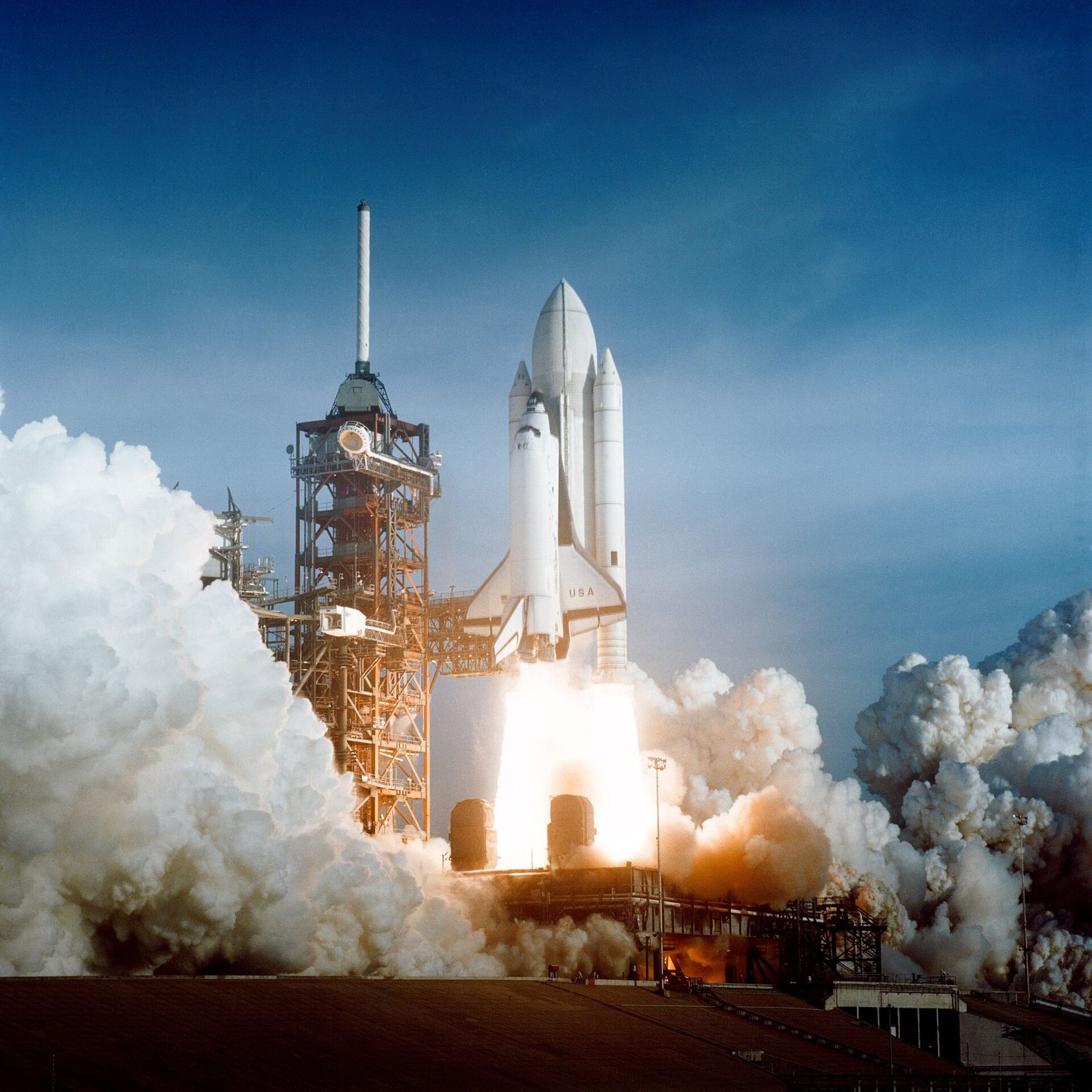
    A rocket launch: net force changes momentum — F_net = ma for translational dynamics
    A rocket launch: net force changes momentum — F_net = ma for translational dynamics

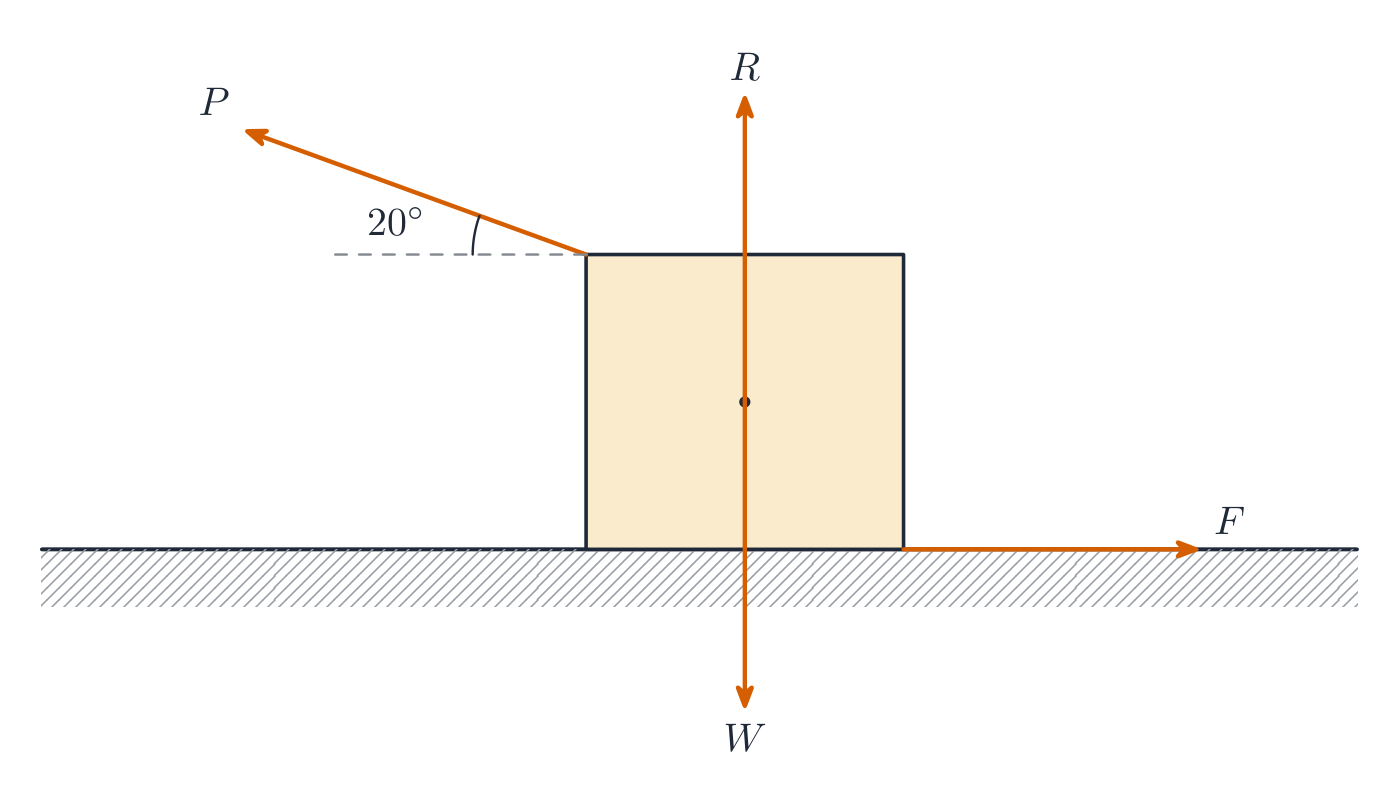
    A force 力 is a push or pull – a vector, measured in newtons (N). A free-body diagram 受力图 shows one object as a dot with arrows for every force acting on it (weight 重力, normal, tension 张力, friction, applied), each labelled and pointing the right way. Draw it before any dynamics problem; it is where most marks are won or lost.

    A free-body diagram shows every force acting on one object
    A free-body diagram shows every force acting on one object

    Two rules keep free-body diagrams honest: draw only forces acting on the chosen object (not forces it exerts on other things), and draw only real, physical forces (a rope, a surface, gravity, a hand) – never an "$ma$" arrow, which is the result of the forces, not a force itself.

    Explore · ⁨สำรวจ⁩

    Balance the forces on a free-body diagram · ⁨ดุลย์แรงบนแผนภาพวัตถุอิสระ⁩

    A free-body diagram shows every force on one object as an arrow. The object accelerates only if the forces don't cancel — the net force sets $a=F/m$. · ⁨แผนภาพวัตถุอิสระ แสดงแรงทั้งหมดที่กระทำต่อวัตถุหนึ่งด้วยลูกศร วัตถุจะเร่งความเร็วได้ก็ต่อเมื่อแรงไม่หักล้างกัน — แรงลัพธ์ กำหนด $a=F/m$⁩

    Vocabulary · ⁨คำศัพท์⁩ Train · ⁨ฝึกฝน⁩
    English ไทย
    force/fɔːs/ แรง
    free-body diagram/friː ˈbɒdi ˈdaɪəɡræm/ แผนภาพวัตถุอิสระ
    weight/weɪt/ น้ำหนัก
    tension/ˈtenʃn/ แรงตึง
    2.3

    Newton's Third Law

    Syllabus · ⁨หลักสูตร⁩
    English

    Learning Objective 2.3.A: Describe the interaction of two objects using Newton's third law and a representation of paired forces exerted on each object.

    • 2.3.A.1 Newton's third law describes the interaction of two objects in terms of the paired forces that each exerts on the other.
      • Equation: $\vec{F}_{\text{A on B}} = -\vec{F}_{\text{B on A}}$
    • 2.3.A.2 Interactions between objects within a system (internal forces) do not influence the motion of a system's center of mass.
    • 2.3.A.3 Tension is the macroscopic net result of forces that segments of a string, cable, chain, or similar system exert on each other in response to an external force.
      • 2.3.A.3.i An ideal string has negligible mass and does not stretch when under tension.
      • 2.3.A.3.ii The tension in an ideal string is the same at all points within the string.
      • 2.3.A.3.iii In a string with nonnegligible mass, tension may not be the same at all points within the string.
      • 2.3.A.3.iv An ideal pulley is a pulley that has negligible mass and rotates about an axle through its center of mass with negligible friction.

    Boundary statement: AP Physics 1 only expects students to describe tension qualitatively in a string, cable, chain, or similar system with mass. For example, students might note that the tension in a hanging chain is greater toward the top of the chain.

    Boundary statement: The interaction between objects or systems at a distance is limited to gravitational forces in AP Physics 1. In AP Physics 2, gravitational, electric, and magnetic forces may be considered.

    ไทย

    จุดประสงค์การเรียนรู้ 2.3.A: อธิบายการมีปฏิสัมพันธ์ระหว่างวัตถุสองชนิดโดยใช้กฎข้อที่สามของนิวตันและการแสดงภาพแรงคู่ที่กระทำต่อกันและกัน

    • 2.3.A.1 กฎข้อที่สามของนิวตันอธิบายการมีปฏิสัมพันธ์ระหว่างวัตถุสองชนิดในแง่ของแรงคู่ที่แต่ละวัตถุกระทำต่ออีกฝ่ายหนึ่ง
      • สมการ: $\vec{F}_{\text{A on B}} = -\vec{F}_{\text{B on A}}$
    • 2.3.A.2 การมีปฏิสัมพันธ์ระหว่างวัตถุภายในระบบ (แรงภายใน) ไม่ส่งผลต่อการเคลื่อนที่ของจุดศูนย์กลางมวลของระบบ
    • 2.3.A.3 แรงตึงเชือกเป็นผลรวมเชิงมหภาคของแรงที่ส่วนต่างๆ ของเชือก สายเคเบิล โซ่ หรือระบบคล้ายคลึงกันกระทำต่อกันเพื่อตอบสนองต่อแรงภายนอก
      • 2.3.A.3.i เชือกในอุดมคติมีมวลน้อยจนสามารถละเลยได้และไม่ยืดเมื่อถูกดึงตึง
      • 2.3.A.3.ii แรงตึงเชือกในอุดมคตินั้นเท่ากันทุกจุดภายในเชือก
      • 2.3.A.3.iii ในกรณีของเชือกที่มีมวลไม่เล็กน้อย แรงตึงอาจไม่เท่ากันทุกจุดภายในเชือก
      • 2.3.A.3.iv รอกในอุดมคตินั้นคือรอกที่มีมวลน้อยจนสามารถละเลยได้และหมุนรอบแกนผ่านจุดศูนย์กลางมวลโดยมีแรงเสียดทานน้อยจนสามารถละเลยได้

    ขอบเขตเนื้อหา: AP Physics 1 คาดหวังให้นักเรียนอธิบายแรงตึงเชือก สายเคเบิล โซ่ หรือระบบคล้ายคลึงกันที่มีมวลในเชิงคุณภาพเท่านั้น ตัวอย่างเช่น นักเรียนอาจสังเกตว่าแรงตึงในโซ่ที่ห้อยอยู่จะมีความมากกว่าบริเวณด้านบนของโซ่

    ขอบเขตเนื้อหา: การมีปฏิสัมพันธ์ระหว่างวัตถุหรือระบบในระยะไกลใน AP Physics 1 จะจำกัดเฉพาะแรงโน้มถ่วงเท่านั้น ใน AP Physics 2 สามารถพิจารณาแรงโน้มถ่วง ไฟฟ้า และแม่เหล็กได้

    Source: College Board AP Course and Exam Description · ⁨แหล่งที่มา: คำอธิบายหลักสูตรและข้อสอบ College Board AP⁩

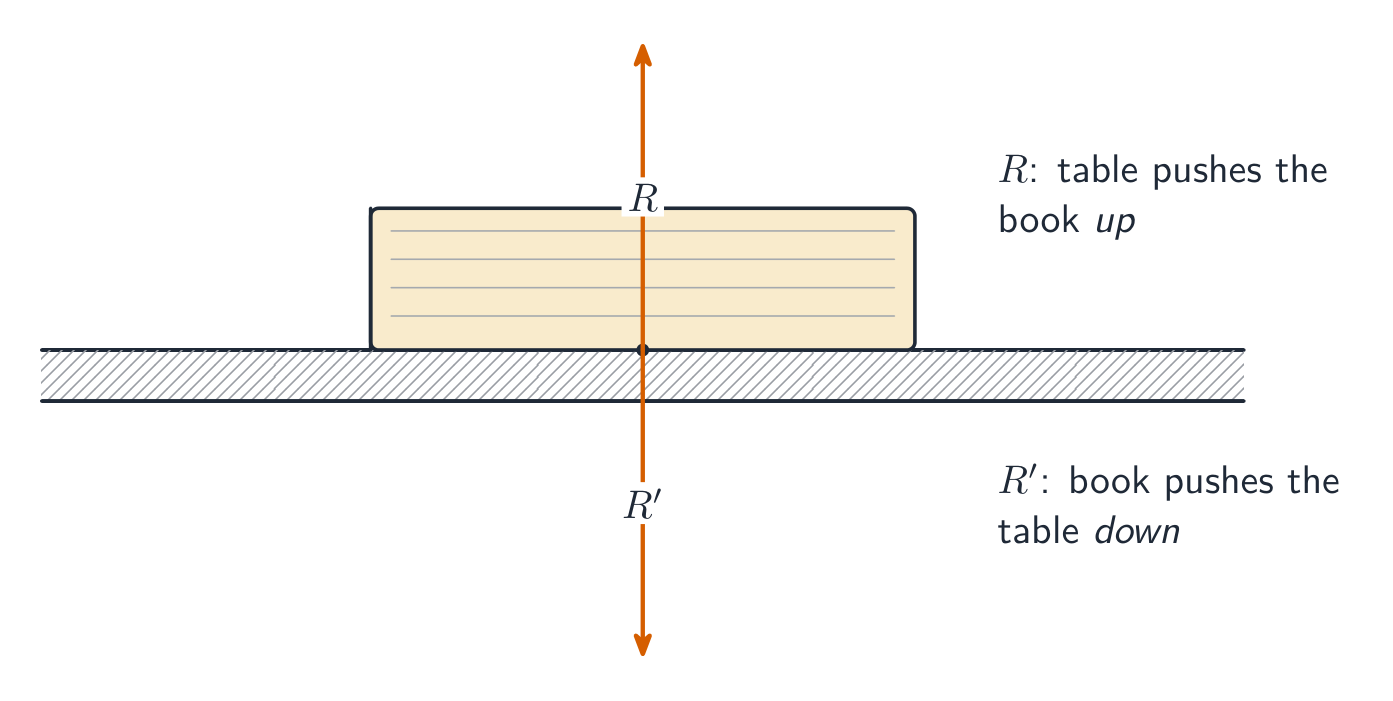
    Newton's third law 牛顿第三定律: if object A pushes on object B, then B pushes back on A with a force equal in size and opposite in direction. These two forces act on different objects, so they never cancel each other. Identify third-law pairs by the "A on B / B on A" wording.

    A Newton's third-law pair: equal and opposite forces on two different objects
    A Newton's third-law pair: equal and opposite forces on two different objects

    A classic trap: the weight of a book and the normal force from the table are not a third-law pair – they act on the same object (the book). The partner of the book's weight is the pull the book exerts on the Earth; the partner of the table's push is the push the book makes on the table.

    Vocabulary · ⁨คำศัพท์⁩ Train · ⁨ฝึกฝน⁩
    English ไทย
    Newton's third law/ˈnjuːtnz θɜːd lɔː/ กฎข้อที่สามของนิวตัน
    2.4

    Newton's First Law

    Syllabus · ⁨หลักสูตร⁩
    English

    Learning Objective 2.4.A: Describe the conditions under which a system's velocity remains constant.

    • 2.4.A.1 The net force on a system is the vector sum of all forces exerted on the system.
    • 2.4.A.2 Translational equilibrium is a configuration of forces such that the net force exerted on a system is zero.
      • Derived equation: $\sum_i \vec{F}_i = 0$
    • 2.4.A.3 Newton's first law states that if the net force exerted on a system is zero, the velocity of that system will remain constant.
    • 2.4.A.4 Forces may be balanced in one dimension but unbalanced in another. The system's velocity will change only in the direction of the unbalanced force.
    • 2.4.A.5 An inertial reference frame is one from which an observer would verify Newton's first law of motion.
    ไทย

    จุดประสงค์การเรียนรู้ 2.4.A: อธิบายเงื่อนไขภายใต้ซึ่งความเร็วของระบบคงที่

    • 2.4.A.1 แรงสุทธิที่กระทำต่อ系统是ผลบวกเวกเตอร์ของแรงทั้งหมดที่กระทำต่อระบบ
    • 2.4.A.2 สมดุลการเลื่อนคือสภาวะของแรงที่ทำให้แรงสุทธิที่กระทำต่อระบบเป็นศูนย์
      • สมการที่ได้มา: $\sum_i \vec{F}_i = 0$
    • 2.4.A.3 กฎข้อที่หนึ่งของนิวตันระบุว่าหากแรงสุทธิที่กระทำต่อระบบเป็นศูนย์ ความเร็วของระบบนั้นจะคงที่
    • 2.4.A.4 แรงอาจสมดุลกันในมิติเดียวแต่ไม่สมดุลในอีกมิติหนึ่ง ความเร็วของระบบจะเปลี่ยนแปลงเพียงในทิศทางของแรงที่ไม่สมดุล
    • 2.4.A.5 กรอบอ้างอิงเฉื่อยคือกรอบอ้างอิงที่ผู้สังเกตสามารถยืนยันกฎข้อที่หนึ่งของนิวตันได้

    Source: College Board AP Course and Exam Description · ⁨แหล่งที่มา: คำอธิบายหลักสูตรและข้อสอบ College Board AP⁩

    Newton's first law 牛顿第一定律 (the law of inertia 惯性): an object's velocity stays constant unless a net force 合力 acts on it. So zero net force means constant velocity (including rest) – the object is in translational equilibrium 平衡. Inertia is the tendency to resist changes in motion, measured by mass.

    Worked example. A $1200\ \text{kg}$ car cruises at a steady $25\ \text{m/s}$ on a level road. What is the net force on it? Because the velocity is constant, the acceleration is zero, so by the first law the net force is zero – the forward drive force exactly balances drag and friction. "Steady speed" always means balanced forces.

    Vocabulary · ⁨คำศัพท์⁩ Train · ⁨ฝึกฝน⁩
    English ไทย
    Newton's first law/ˈnjuːtnz fɜːst lɔː/ กฎข้อที่หนึ่งของนิวตัน
    inertia/ɪˈnɜːʃə/ ความเฉื่อย
    net force/net fɔːs/ แรงลัพธ์
    translational equilibrium/trænˈsleɪʃənl ˌiːkwɪˈlɪbrɪəm/ สมดุลการเลื่อน
    2.5

    Newton's Second Law

    Syllabus · ⁨หลักสูตร⁩
    English

    Learning Objective 2.5.A: Describe the conditions under which a system's velocity changes.

    • 2.5.A.1 Unbalanced forces are a configuration of forces such that the net force exerted on a system is not equal to zero.
    • 2.5.A.2 Newton's second law of motion states that the acceleration of a system's center of mass has a magnitude proportional to the magnitude of the net force exerted on the system and is in the same direction as that net force.
      • Equation: $\vec{a}_{\text{sys}} = \dfrac{\sum \vec{F}}{m_{\text{sys}}} = \dfrac{\vec{F}_{\text{net}}}{m_{\text{sys}}}$
    • 2.5.A.3 The velocity of a system's center of mass will only change if a nonzero net external force is exerted on that system.
    ไทย

    จุดประสงค์การเรียนรู้ 2.5.A: อธิบายเงื่อนไขภายใต้ซึ่งความเร็วของระบบเปลี่ยนไป

    • 2.5.A.1 แรงที่ไม่สมดุลคือสภาวะของแรงที่ทำให้แรงสุทธิที่กระทำต่อระบบไม่เท่ากับศูนย์
    • 2.5.A.2 กฎข้อที่สองของการเคลื่อนที่ของนิวตันระบุว่าความเร่งของจุดศูนย์กลางมวลของระบบมีขนาดแปรผันตรงกับขนาดของแรงสุทธิที่กระทำต่อระบบ และมีทิศทางเดียวกับแรงสุทธินั้น
      • สมการ: $\vec{a}_{\text{sys}} = \dfrac{\sum \vec{F}}{m_{\text{sys}}} = \dfrac{\vec{F}_{\text{net}}}{m_{\text{sys}}}$
    • 2.5.A.3 ความเร็วของจุดศูนย์กลางมวลของระบบจะเปลี่ยนแปลงก็ต่อเมื่อมีแรงภายนอกสุทธิที่ไม่เป็นศูนย์กระทำต่อระบบเท่านั้น

    Source: College Board AP Course and Exam Description · ⁨แหล่งที่มา: คำอธิบายหลักสูตรและข้อสอบ College Board AP⁩

    Newton's second law 牛顿第二定律 relates net force to acceleration:

    $$\vec{a}=\frac{\sum \vec{F}}{m},\qquad\text{i.e.}\qquad \sum\vec{F}=m\vec{a}.$$
    Apply it one axis at a time: add the force components along each axis and set the sum equal to $ma$ for that axis. Acceleration points the same way as the net force.

    Worked example. A $4.0\ \text{kg}$ box is pulled along the floor by a horizontal force of $18\ \text{N}$. Friction on the box is $6.0\ \text{N}$. Find its acceleration. Along the direction of motion the net force is $18-6.0=12\ \text{N}$, so

    $$a=\frac{\sum F}{m}=\frac{12}{4.0}=3.0\ \text{m/s}^2.$$

    Worked example (incline 斜面). A block of mass $m$ slides down a frictionless ramp tilted at angle $\theta$. Find its acceleration. Resolve gravity into components along and perpendicular to the ramp; only the along-ramp part, $mg\sin\theta$, drives the motion, so

    $$a=\frac{mg\sin\theta}{m}=g\sin\theta.$$
    The steeper the ramp, the larger $\sin\theta$ and the faster it accelerates; at $\theta=90^{\circ}$ it is free fall.

    Vocabulary · ⁨คำศัพท์⁩ Train · ⁨ฝึกฝน⁩
    English ไทย
    Newton's second law/ˈnjuːtnz ˈsekənd lɔː/ กฎข้อที่สองของนิวตัน
    incline/ɪnˈklaɪn/ พื้นผิวเอียง
    2.6

    Gravitational Force

    Syllabus · ⁨หลักสูตร⁩
    English

    Learning Objective 2.6.A: Describe the gravitational interaction between two objects or systems with mass.

    • 2.6.A.1 Newton's law of universal gravitation describes the gravitational force between two objects or systems as directly proportional to each of their masses and inversely proportional to the square of the distance between the systems' centers of mass.
      • Equation: $\left|\vec{F}_g\right| = G\dfrac{m_1 m_2}{r^2}$
      • 2.6.A.1.i The gravitational force is attractive.
      • 2.6.A.1.ii The gravitational force is always exerted along the line connecting the centers of mass of the two interacting systems.
      • 2.6.A.1.iii The gravitational force on a system can be considered to be exerted on the system's center of mass.
    • 2.6.A.2 A field models the effects of a noncontact force exerted on an object at various positions in space.
      • 2.6.A.2.i The magnitude of the gravitational field created by a system of mass $M$ at a point in space is equal to the ratio of the gravitational force exerted by the system on a test object of mass $m$ to the mass of the test object.
        • Equation: $\left|\vec{g}\right| = \dfrac{\left|\vec{F}_g\right|}{m} = G\dfrac{M}{r^2}$
      • 2.6.A.2.ii If the gravitational force is the only force exerted on an object, the observed acceleration of the object (in m/s$^2$) is numerically equal to the magnitude of the gravitational field strength (in N/kg) at that location.
    • 2.6.A.3 The gravitational force exerted by an astronomical body on a relatively small nearby object is called weight.
      • Equation: $\text{Weight} = F_g = mg$

    Learning Objective 2.6.B: Describe situations in which the gravitational force can be considered constant.

    • 2.6.B.1 If the gravitational force between two systems' centers of mass has a negligible change as the relative position of the two systems changes, the gravitational force can be considered constant at all points between the initial and final positions of the systems.
    • 2.6.B.2 Near the surface of Earth, the strength of the gravitational field is $g \approx 10 \text{ N/kg}$

    Learning Objective 2.6.C: Describe the conditions under which the magnitude of a system's apparent weight is different from the magnitude of the gravitational force exerted on that system.

    • 2.6.C.1 The magnitude of the apparent weight of a system is the magnitude of the normal force exerted on the system.
    • 2.6.C.2 If the system is accelerating, the apparent weight of the system is not equal to the magnitude of the gravitational force exerted on the system.
    • 2.6.C.3 A system appears weightless when there are no forces exerted on the system or when the force of gravity is the only force exerted on the system.
    • 2.6.C.4 The equivalence principle states that an observer in a noninertial reference frame is unable to distinguish between an object's apparent weight and the gravitational force exerted on the object by a gravitational field.

    Learning Objective 2.6.D: Describe inertial and gravitational mass.

    • 2.6.D.1 Objects have inertial mass, or inertia, a property that determines how much an object's motion resists changes when interacting with another object.
    • 2.6.D.2 Gravitational mass is related to the force of attraction between two systems with mass.
    • 2.6.D.3 Inertial mass and gravitational mass have been experimentally verified to be equivalent.
    ไทย

    จุดประสงค์การเรียนรู้ 2.6.A: อธิบายการมีปฏิสัมพันธ์ทางโน้มถ่วงระหว่างวัตถุหรือระบบที่มีมวล

    • 2.6.A.1 กฎความโน้มถ่วงสากลของนิวตันอธิบายแรงโน้มถ่วงระหว่างวัตถุหรือสองระบบว่าเป็นสัดส่วนโดยตรงกับมวลของแต่ละ物体และเป็นสัดส่วนผกผันกับกำลังสองของระยะห่างระหว่างจุดศูนย์กลางมวลของระบบ
      • สมการ: $\left|\vec{F}_g\right| = G\dfrac{m_1 m_2}{r^2}$
      • 2.6.A.1.i แรงโน้มถ่วงมีลักษณะเป็นการดึงดูด
      • 2.6.A.1.ii แรงโน้มถ่วงจะถูกกระทำเสมอตามเส้นตรงที่เชื่อมจุดศูนย์กลางมวลของระบบทั้งสองที่มีปฏิสัมพันธ์กัน
      • 2.6.A.1.iii แรงโน้มถ่วงที่กระทำต่อระบบสามารถพิจารณาได้ว่ากระทำที่จุดศูนย์กลางมวลของระบบ
    • 2.6.A.2 สนามเป็นแบบจำลองที่แสดงผลของแรงที่ไม่สัมผัสที่ทำต่อวัตถุ ณ ตำแหน่งต่างๆ ในอวกาศ
      • 2.6.A.2.i ขนาดของสนามโน้มถ่วงที่เกิดจากระบบที่มีมวล $M$ ที่จุดหนึ่งในอวกาศ มีค่าเท่ากับอัตราส่วนของแรงโน้มถ่วงที่ระบบกระทำต่อวัตถุทดสอบที่มีมวล $m$ ต่อมวลของวัตถุทดสอบ
        • สมการ: $\left|\vec{g}\right| = \dfrac{\left|\vec{F}_g\right|}{m} = G\dfrac{M}{r^2}$
      • 2.6.A.2.ii หากแรงโน้มถ่วงเป็นแรงเดียวที่กระทำต่อวัตถุ ความเร่งที่สังเกตได้จากวัตถุนั้น (ในหน่วย m/s$^2$) จะมีค่าตัวเลขเท่ากับขนาดของความเข้มสนามโน้มถ่วง (ในหน่วย N/kg) ณ ตำแหน่งนั้น
    • 2.6.A.3 แรงโน้มถ่วงที่วัตถุทางดาราศาสตร์กระทำต่อวัตถุใกล้เคียงขนาดเล็กเรียกว่า น้ำหนัก
      • สมการ: $\text{Weight} = F_g = mg$

    จุดประสงค์การเรียนรู้ 2.6.B: อธิบายสถานการณ์ที่แรงโน้มถ่วงสามารถพิจารณาได้ว่าคงที่

    • 2.6.B.1 หากแรงโน้มถ่วงระหว่างจุดศูนย์กลางมวลของระบบสองระบบมีการเปลี่ยนแปลงน้อยจนสามารถละเลยได้เมื่อตำแหน่งสัมพัทธ์ของระบบทั้งสองเปลี่ยนไป แรงโน้มถ่วงสามารถพิจารณาได้ว่าคงที่ตลอดช่วงระหว่างตำแหน่งเริ่มต้นและตำแหน่งสุดท้ายของระบบ
    • 2.6.B.2 ใกล้พื้นผิวโลก ความเข้มของสนามโน้มถ่วงมีค่า $g \approx 10 \text{ N/kg}$

    จุดประสงค์การเรียนรู้ 2.6.C: อธิบายเงื่อนไขภายใต้ซึ่งขนาดของน้ำหนัก apparent ของระบบต่างจากขนาดของแรงโน้มถ่วงที่กระทำต่อระบบนั้น

    • 2.6.C.1 ขนาดของน้ำหนัก apparent ของระบบคือขนาดของแรงปฏิกิริยาที่กระทำต่อระบบ
    • 2.6.C.2 หากระบบมีความเร่ง น้ำหนัก apparent ของระบบจะไม่เท่ากับขนาดของแรงโน้มถ่วงที่กระทำต่อระบบ
    • 2.6.C.3 ระบบจะรู้สึกไร้وزนเมื่อไม่มีแรงใดกระทำต่อระบบ หรือเมื่อแรงโน้มถ่วงเป็นแรงเดียวที่กระทำต่อระบบ
    • 2.6.C.4 หลักการสมมูลระบุว่าผู้สังเกตในกรอบอ้างอิงที่ไม่ใช่กรอบอ้างอิงเฉื่อยไม่สามารถแยกแยะระหว่างน้ำหนักที่ปรากฏของวัตถุกับแรงโน้มถ่วงที่กระทำต่อวัตถุจากสนามโน้มถ่วงได้

    วัตถุประสงค์การเรียนรู้ 2.6.D: อธิบายมวลเฉื่อยและมวลโน้มถ่วง

    • 2.6.D.1 วัตถุมีมวลเฉื่อย หรือ ความเฉื่อย ซึ่งเป็นคุณสมบัติที่กำหนดว่าความเคลื่อนไหวของวัตถุนั้นจะต้านทานการเปลี่ยนแปลงมากเพียงใดเมื่อมีปฏิสัมพันธ์กับวัตถุอื่น
    • 2.6.D.2 มวลโน้มถ่วงเกี่ยวข้องกับแรงดึงดูดระหว่างระบบสองระบบที่มีมวล
    • 2.6.D.3 มวลเฉื่อยและมวลโน้มถ่วงได้รับการยืนยันด้วยวิธีการทดลองแล้วว่าสมมูลกัน

    Source: College Board AP Course and Exam Description · ⁨แหล่งที่มา: คำอธิบายหลักสูตรและข้อสอบ College Board AP⁩

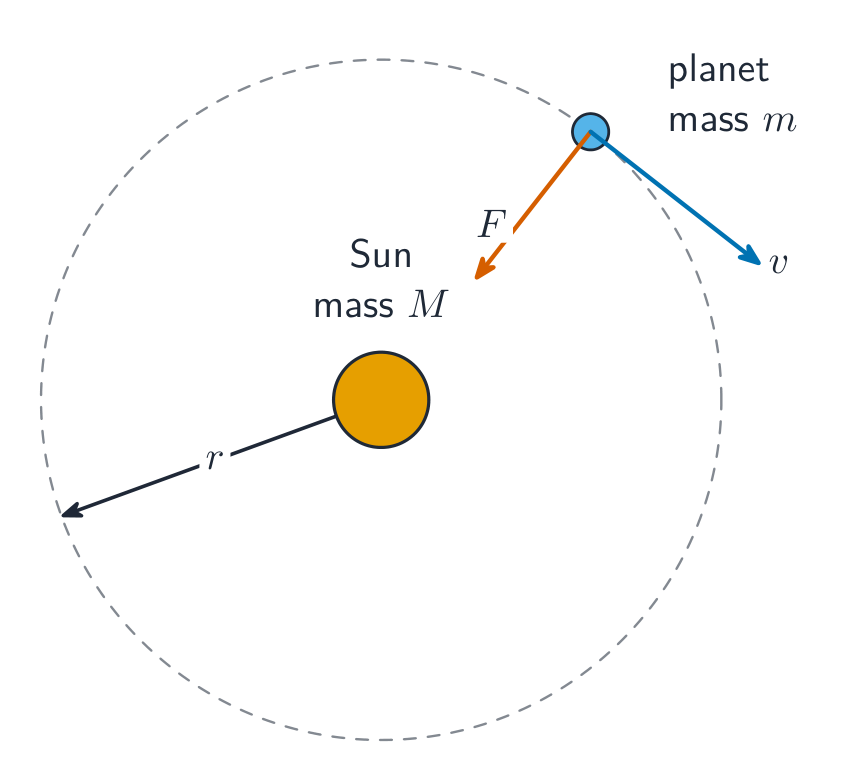
    Orbital motion (Kepler's 2nd law)

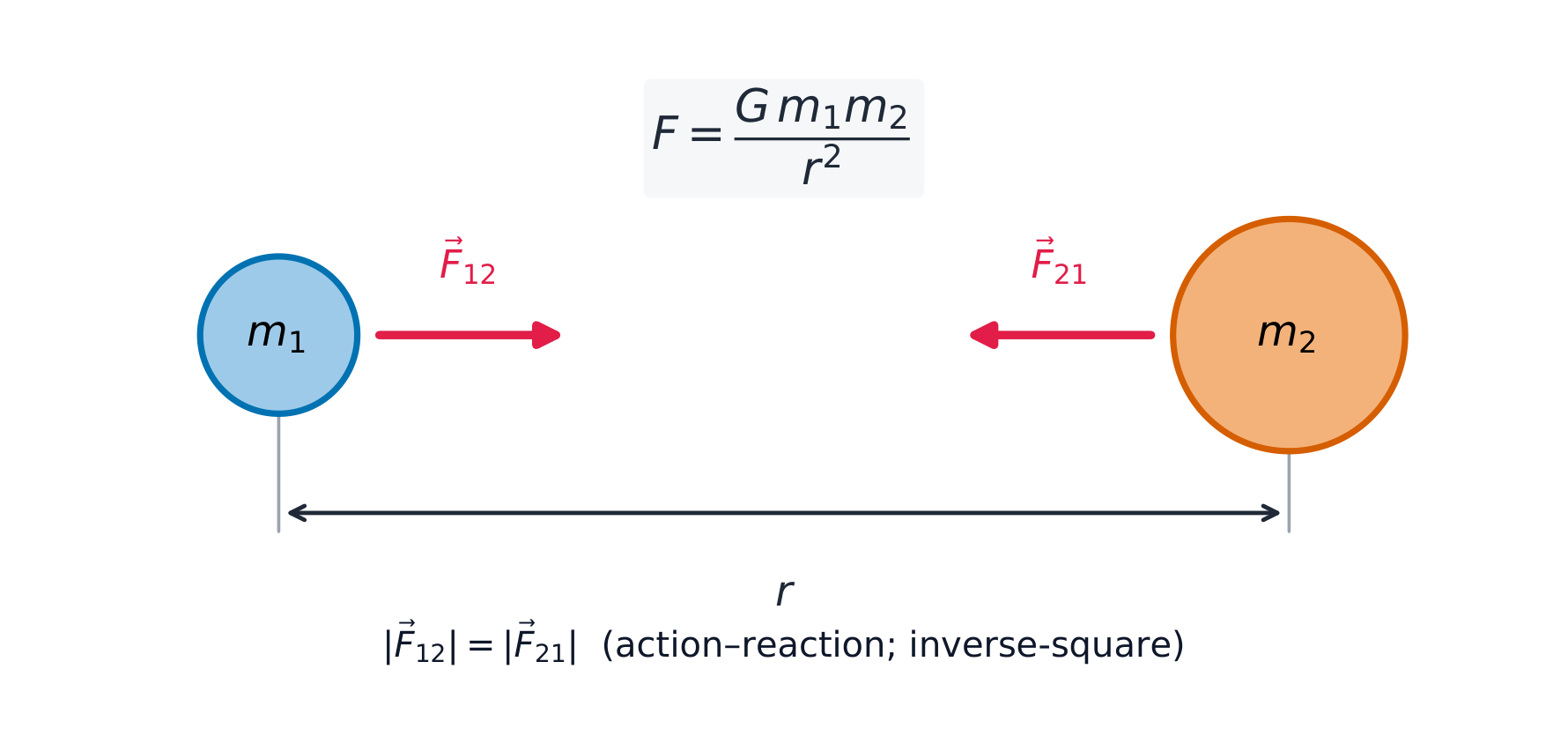
    Near a planet's surface, the gravitational force (weight) is $F_g=mg$, directed down, where $g$ is the gravitational field strength 重力场强度. More generally, Newton's law of gravitation 万有引力定律 gives the attraction between any two masses:

    $$F_g=\frac{G m_1 m_2}{r^2},$$
    directed along the line joining them, weaker as the distance $r$ grows (an inverse-square law). Doubling the separation quarters the force.

    Two masses attract each other with equal, opposite, inverse-square forces along the line joining them
    Two masses attract each other with equal, opposite, inverse-square forces along the line joining them

    Worked example. A $2.0\ \text{kg}$ object weighs $19.6\ \text{N}$ on Earth ($g=9.8\ \text{m/s}^2$). On the Moon $g_{\text{Moon}}=1.6\ \text{m/s}^2$. Its mass is unchanged ($2.0\ \text{kg}$), but its weight becomes $F_g=mg=2.0\times1.6=3.2\ \text{N}$. Mass measures inertia; weight is a force that depends on where you are.

    Mass actually plays two distinct roles. Inertial mass 惯性质量 sets how strongly an object resists acceleration ($F=ma$); gravitational mass 引力质量 sets how strongly it attracts other masses ($F=Gm_1m_2/r^2$). Experiments confirm the two are equal – which is exactly why every object, heavy or light, falls with the same $g$.

    Vocabulary · ⁨คำศัพท์⁩ Train · ⁨ฝึกฝน⁩
    English ไทย
    gravitational field strength/ˌɡrævɪˈteɪʃənl fiːld streŋθ/ ความเข้มของสนามโน้มถ่วง
    Newton's law of gravitation/ˈnjuːtnz lɔː ɒv ˌɡrævɪˈteɪʃn/ กฎความโน้มถ่วงของนิวตัน
    Inertial mass/ɪˈnɜːʃl mæs/ มวลความเฉื่อย
    gravitational mass/ˌɡrævɪˈteɪʃənl mæs/ มวลโน้มถ่วง
    2.7

    Kinetic and Static Friction

    Syllabus · ⁨หลักสูตร⁩
    English

    Learning Objective 2.7.A: Describe kinetic friction between two surfaces

    • 2.7.A.1 Kinetic friction occurs when two surfaces in contact move relative to each other.
      • 2.7.A.1.i The kinetic friction force is exerted in a direction opposite to the motion of each surface relative to the other surface.
      • 2.7.A.1.ii The force of friction between two surfaces does not depend on the size of the surface area of contact.
    • 2.7.A.2 The magnitude of the kinetic friction force exerted on an object is the product of the normal force the surface exerts on the object and the coefficient of kinetic friction.
      • Equation: $\left|\vec{F}_{f,k}\right| = \left|\mu_k \vec{F}_n\right|$
      • 2.7.A.2.i The coefficient of kinetic friction depends on the material properties of the surfaces that are in contact.
      • 2.7.A.2.ii Normal force is the perpendicular component of the force exerted on an object by the surface with which it is in contact; it is directed away from the surface.

    Learning Objective 2.7.B: Describe static friction between two surfaces.

    • 2.7.B.1 Static friction may occur between the contacting surfaces of two objects that are not moving relative to each other.
    • 2.7.B.2 Static friction adopts the value and direction required to prevent an object from slipping or sliding on a surface.
      • Equation: $\left|\vec{F}_{f,s}\right| \leq \left|\mu_s \vec{F}_n\right|$
      • 2.7.B.2.i Slipping and sliding refer to situations in which two surfaces are moving relative to each other.
      • 2.7.B.2.ii There exists a maximum value for which static friction will prevent an object from slipping on a given surface.
        • Equation: $F_{f,s,\max} = \mu_s F_n$
    • 2.7.B.3 The coefficient of static friction is typically greater than the coefficient of kinetic friction for a given pair of surfaces.
    ไทย

    วัตถุประสงค์การเรียนรู้ 2.7.A: อธิบายแรงเสียดทานแบบเคลื่อนที่ระหว่างพื้นผิวสองชนิด

    • 2.7.A.1 แรงเสียดทานแบบเคลื่อนที่เกิดขึ้นเมื่อพื้นผิวสองชนิดที่สัมผัสกันเคลื่อนที่สัมพัทธ์ต่อกัน
      • 2.7.A.1.i แรงเสียดทานแบบเคลื่อนที่จะกระทำในทิศทางตรงข้ามกับการเคลื่อนที่ของแต่ละพื้นผิวสัมพัทธ์ต่อกัน
      • 2.7.A.1.ii แรงเสียดทานระหว่างพื้นผิวสองชนิดไม่ขึ้นอยู่กับขนาดของพื้นที่สัมผัส
    • 2.7.A.2 ขนาดของแรงเสียดทานแบบเคลื่อนที่ที่กระทำต่อวัตถุเท่ากับผลคูณของแรงตั้งฉากที่พื้นผิวกระทำต่อวัตถุและสัมประสิทธิ์แรงเสียดทานแบบเคลื่อนที่
      • สมการ: $\left|\vec{F}_{f,k}\right| = \left|\mu_k \vec{F}_n\right|$
      • 2.7.A.2.i สัมประสิทธิ์แรงเสียดทานแบบเคลื่อนที่ขึ้นอยู่กับคุณสมบัติของวัสดุของพื้นผิวที่สัมผัสกัน
      • 2.7.A.2.ii แรงตั้งฉากคือองค์ประกอบในแนวตั้งฉากของแรงที่กระทำต่อวัตถุโดยพื้นผิวที่สัมผัสกัน โดยจะมีทิศทางออกจากพื้นผิวนั้น

    วัตถุประสงค์การเรียนรู้ 2.7.B: อธิบายแรงเสียดทานแบบหยุดนิ่งระหว่างพื้นผิวสองชนิด

    • 2.7.B.1 แรงเสียดทานแบบหยุดนิ่งอาจเกิดขึ้นระหว่างพื้นผิวที่สัมผัสกันของวัตถุสองชิ้นที่ไม่เคลื่อนที่สัมพัทธ์ต่อกัน
    • 2.7.B.2 แรงเสียดทานแบบหยุดนิ่งจะปรับค่าและทิศทางตามที่ต้องการเพื่อป้องกันไม่ให้วัตถุลื่นไถลหรือเลื่อนบนพื้นผิว
      • สมการ: $\left|\vec{F}_{f,s}\right| \leq \left|\mu_s \vec{F}_n\right|$
      • 2.7.B.2.i การลื่นไถลและการเลื่อนหมายถึงสถานการณ์ที่พื้นผิวสองชนิดเคลื่อนที่สัมพัทธ์ต่อกัน
      • 2.7.B.2.ii จะมีค่าสูงสุดสำหรับแรงเสียดทานแบบหยุดนิ่งที่จะสามารถป้องกันไม่ให้วัตถุลื่นไถลบนพื้นผิวที่กำหนดได้
        • สมการ: $F_{f,s,\max} = \mu_s F_n$
    • 2.7.B.3 สัมประสิทธิ์แรงเสียดทานแบบหยุดนิ่งมักจะมีค่ามากกว่าสัมประสิทธิ์แรงเสียดทานแบบเคลื่อนที่สำหรับคู่พื้นผิวที่กำหนด

    Source: College Board AP Course and Exam Description · ⁨แหล่งที่มา: คำอธิบายหลักสูตรและข้อสอบ College Board AP⁩

    Friction 摩擦力 acts along a surface, opposing relative sliding (or the tendency to slide):

    • Kinetic friction 动摩擦 (while sliding): $f_k=\mu_k N$.
    • Static friction 静摩擦 (while not yet sliding): $f_s\le \mu_s N$ – it adjusts up to a maximum to prevent motion.

    Here $N$ is the normal force 法向力 (surface push, perpendicular to the surface) and $\mu$ is the coefficient of friction 摩擦系数.

    Worked example. A $5.0\ \text{kg}$ crate sits on a level floor with $\mu_s=0.40$. Will a horizontal push of $15\ \text{N}$ move it? On a level floor $N=mg=5.0\times9.8=49\ \text{N}$, so the largest static friction is $f_{s,\max}=\mu_s N=0.40\times49=19.6\ \text{N}$. The $15\ \text{N}$ push is smaller than $19.6\ \text{N}$, so friction rises to match it and the crate stays still.

    Explore · ⁨สำรวจ⁩

    Slide a block down a slope with friction · ⁨ลื่น BLOCK ลงบนลาดเอียงที่มีแรงเสียดทาน⁩

    Friction opposes motion up to a maximum $\mu N$. Tilt the slope until gravity's pull along it beats static friction and the block starts to slide. · ⁨แรงเสียดทาน ทวนการเคลื่อนที่จนถึงค่าสูงสุด $\mu N$ เอียงลาดเอียงจนกว่าแรงโน้มถ่วงตามแนวลาดจะเหนือกว่าแรงเสียดทานสถิตและ BLOCK เริ่มลื่นไหล⁩

    Vocabulary · ⁨คำศัพท์⁩ Train · ⁨ฝึกฝน⁩
    English ไทย
    Friction/ˈfrɪkʃn/ แรงเสียดทาน
    Kinetic friction/kɪˈnetɪk ˈfrɪkʃn/ แรงเสียดทานจลน์
    Static friction/ˈstætɪk ˈfrɪkʃn/ แรงเสียดทานสถิต
    normal force/ˈnɔːml fɔːs/ แรงปฏิกิริยาตั้งฉาก
    coefficient of friction/ˌkəʊɪˈfɪʃənt ɒv ˈfrɪkʃn/ สัมประสิทธิ์ความเสียดทาน
    2.8

    Spring Forces

    Syllabus · ⁨หลักสูตร⁩
    English

    Learning Objective 2.8.A: Describe the force exerted on an object by an ideal spring

    • 2.8.A.1 An ideal spring has negligible mass and exerts a force that is proportional to the change in its length as measured from its relaxed length.
    • 2.8.A.2 The magnitude of the force exerted by an ideal spring on an object is given by Hooke's law:
      • Equation: $\vec{F}_s = -k\Delta\vec{x}$
    • 2.8.A.3 The force exerted on an object by a spring is always directed toward the equilibrium position of the object–spring system.
    ไทย

    วัตถุประสงค์การเรียนรู้ 2.8.A: อธิบายแรงที่กระทำต่อวัตถุโดยสปริงในอุดมคติ

    • 2.8.A.1 สปริงในอุดมติศึกษามีมวลน้อยจนละเลยได้ และกระทำแรงซึ่งแปรผันตามการเปลี่ยนแปลงของความยาวเมื่อวัดจากความยาวที่ผ่อนคลาย
    • 2.8.A.2 ขนาดของแรงที่กระทำโดยสปริงในอุดมคติต่อวัตถุกำหนดโดยกฎของฮุก:
      • สมการ: $\vec{F}_s = -k\Delta\vec{x}$
    • 2.8.A.3 แรงที่กระทำต่อวัตถุโดยสปริงจะมีทิศทางเข้าหาตำแหน่งสมดุลของระบบวัตถุ-สปริงเสมอ

    Source: College Board AP Course and Exam Description · ⁨แหล่งที่มา: คำอธิบายหลักสูตรและข้อสอบ College Board AP⁩

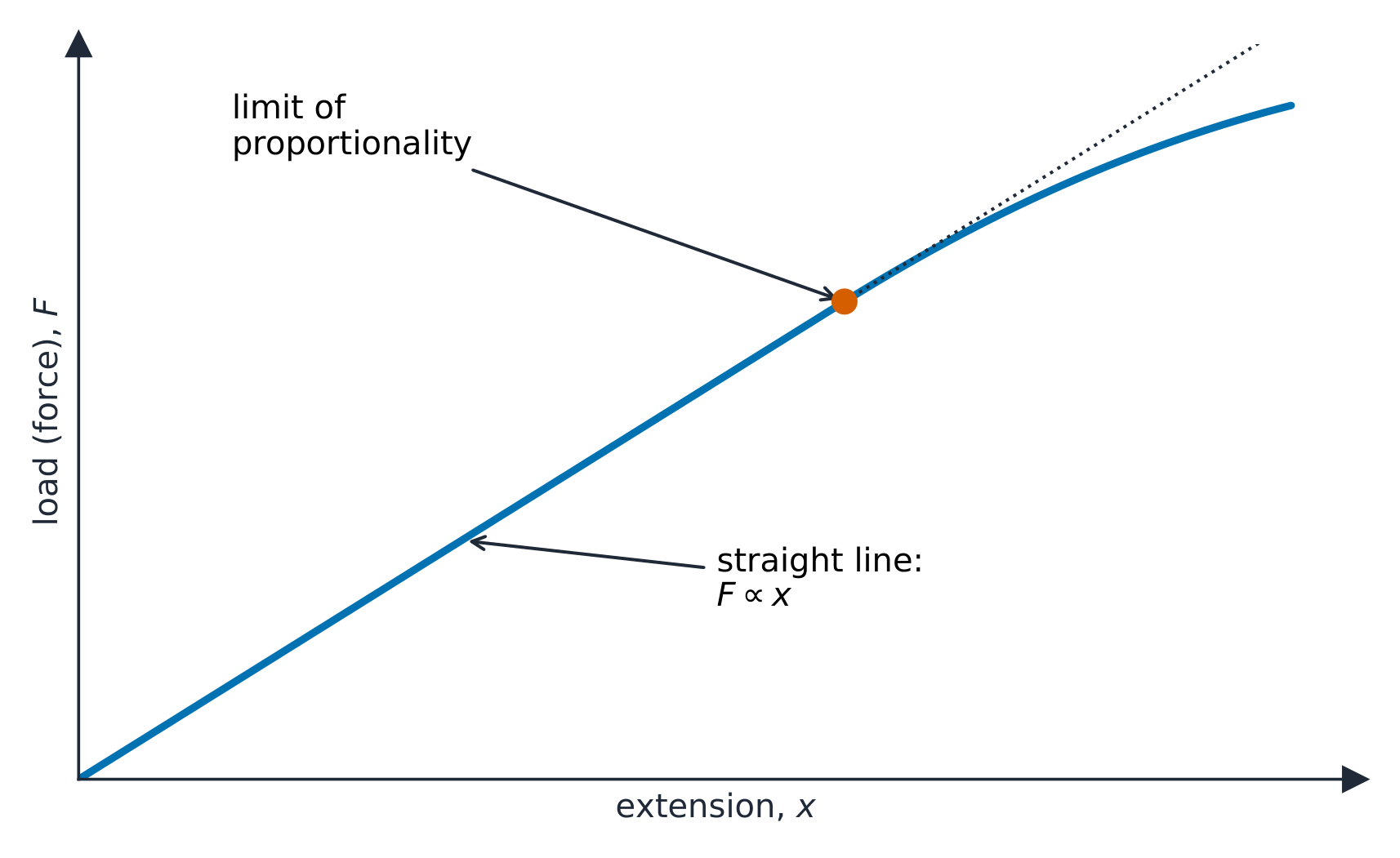
    Hooke's law & the elastic limit

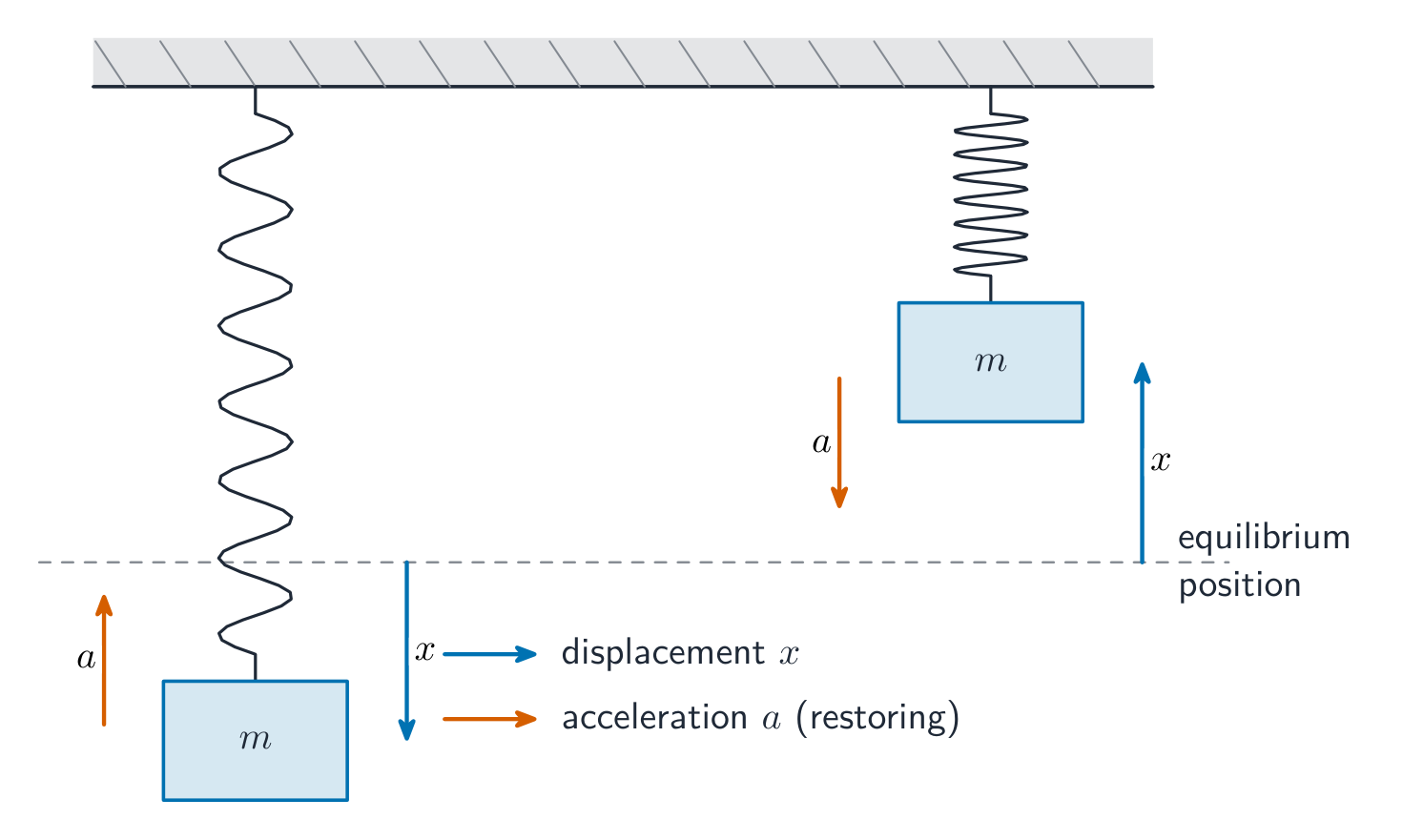
    An ideal spring exerts a restoring force 回复力 proportional to its stretch or compression – Hooke's law 胡克定律:

    $$F_s=-kx,$$
    where $k$ is the spring constant 弹簧常数 (stiffness) and $x$ is the displacement from the spring's natural length. The minus sign means the force points back toward equilibrium.

    Hooke's law: extension is proportional to load up to the limit of proportionality
    Hooke's law: extension is proportional to load up to the limit of proportionality

    Worked example. A spring with $k=200\ \text{N/m}$ hangs vertically and a $0.50\ \text{kg}$ mass is hung on it. How far does it stretch at rest? At rest the spring force balances the weight, $kx=mg$, so

    $$x=\frac{mg}{k}=\frac{0.50\times9.8}{200}=0.025\ \text{m}=2.5\ \text{cm}.$$

    Explore · ⁨สำรวจ⁩

    Stretch a spring (Hooke's law) · ⁨ยืดสปริง (กฎของฮุค)⁩

    A spring's force is proportional to its extension, $F=kx$ (Hooke's law). Pull harder and the extension grows in step — until the spring's limit. · ⁨แรงของสปริงแปรผันตรงกับระยะยืด $F=kx$ (กฎของฮุค) ดึงแรงขึ้น ระยะยืดก็เพิ่มขึ้นตาม比例 — จนกว่าจะถึงขีดจำกัดของสปริง⁩

    Vocabulary · ⁨คำศัพท์⁩ Train · ⁨ฝึกฝน⁩
    English ไทย
    restoring force/rɪˈstɔːrɪŋ fɔːs/ แรงฟื้นฟู
    Hooke's law/hʊks lɔː/ กฎของฮুক
    spring constant/sprɪŋ ˈkɒnstənt/ ค่าคงที่ของสปริง
    2.9

    Circular Motion

    Syllabus · ⁨หลักสูตร⁩
    English

    Learning Objective 2.9.A: Describe the motion of an object traveling in a circular path.

    • 2.9.A.1 Centripetal acceleration is the component of an object's acceleration directed toward the center of the object's circular path.
      • 2.9.A.1.i The magnitude of centripetal acceleration for an object moving in a circular path is the ratio of the object's tangential speed squared to the radius of the circular path.
        • Equation: $a_c = \dfrac{v^2}{r}$
      • 2.9.A.1.ii Centripetal acceleration is directed toward the center of an object's circular path.
    • 2.9.A.2 Centripetal acceleration can result from a single force, more than one force, or components of forces exerted on an object in circular motion.
      • 2.9.A.2.i At the top of a vertical, circular loop, an object requires a minimum speed to maintain circular motion. At this point, and with this minimum speed, the gravitational force is the only force that causes the centripetal acceleration.
        • Equation: $v = \sqrt{gr}$
      • 2.9.A.2.ii Components of the static friction force and the normal force can contribute to the net force producing centripetal acceleration of an object traveling in a circle on a banked surface.
      • 2.9.A.2.iii A component of tension contributes to the net force producing centripetal acceleration experienced by a conical pendulum.
    • 2.9.A.3 Tangential acceleration is the rate at which an object's speed changes and is directed tangent to the object's circular path.
    • 2.9.A.4 The net acceleration of an object moving in a circle is the vector sum of the centripetal acceleration and tangential acceleration.
    • 2.9.A.5 The revolution of an object traveling in a circular path at a constant speed (uniform circular motion) can be described using period and frequency.
      • 2.9.A.5.i The time to complete one full circular path, one full rotation, or a full cycle of oscillatory motion is defined as period, $T$.
      • 2.9.A.5.ii The rate at which an object is completing revolutions is defined as frequency, $f$.
        • Equation: $T = \dfrac{1}{f}$
      • 2.9.A.5.iii For an object traveling at a constant speed in a circular path, the period is given by the derived equation
        • Equation: $T = \dfrac{2\pi r}{v}$

    Learning Objective 2.9.B: Describe circular orbits using Kepler's third law.

    • 2.9.B.1 For a satellite in circular orbit around a central body, the satellite's centripetal acceleration is caused only by gravitational attraction. The period and radius of the circular orbit are related to the mass of the central body.
      • Equation: $T^2 = \dfrac{4\pi^2}{GM} R^3$

    Boundary statement: AP Physics 1 only expects students to quantitatively analyze banked curves in which no friction is required to maintain uniform circular motion. Analysis of situations in which friction is required on a banked curve is limited to qualitative descriptions.

    Boundary statement: AP Physics 1 does not expect students to know Kepler's first or second laws of planetary motion.

    ไทย

    วัตถุประสงค์การเรียนรู้ 2.9.A: อธิบายการเคลื่อนที่ของวัตถุที่เดินทางตามเส้นโค้งวงกลม

    • 2.9.A.1 ความเร่งเข้าสู่ศูนย์กลางคือองค์ประกอบของความเร่งของวัตถุที่มีทิศทางเข้าหาจุดกึ่งกลางของเส้นโค้งวงกลม
      • 2.9.A.1.i ขนาดของความเร่งเข้าสู่ศูนย์กลางสำหรับวัตถุที่เคลื่อนที่ตามเส้นโค้งวงกลมเป็นอัตราส่วนของความเร็วเชิงสัมผัสยกกำลังสองของวัตถุมุม半径ของเส้นโค้งวงกลม
        • สมการ: $a_c = \dfrac{v^2}{r}$
      • 2.9.A.1.ii ความเร่งเข้าสู่ศูนย์กลางจะมีทิศทางเข้าหาจุดกึ่งกลางของเส้นโค้งวงกลมของวัตถุนั้น
    • 2.9.A.2 ความเร่งเข้าสู่ศูนย์กลางอาจเกิดจากแรงเดียว, หลายแรง, หรือองค์ประกอบของแรงที่กระทำต่อวัตถุที่กำลังเคลื่อนที่วงกลม
      • 2.9.A.2.i ที่จุดสูงสุดของวงแหวนแนวตั้ง วัตถุจำเป็นต้องมีความเร็วขั้นต่ำเพื่อรักษาการเคลื่อนที่วงกลม ณ จุดนี้และความเร็วขั้นต่ำนั้น แรงโน้มถ่วงเป็นแรงเดียวที่ทำให้เกิดความเร่งเข้าสู่ศูนย์กลาง
        • สมการ: $v = \sqrt{gr}$
      • 2.9.A.2.ii องค์ประกอบของแรงเสียดทานแบบหยุดนิ่งและแรงตั้งฉากสามารถมีส่วนร่วมในแรงสุทธิที่ทำให้เกิดความเร่งเข้าสู่ศูนย์กลางของวัตถุที่เดินทางบนพื้นผิวที่เอียง
      • 2.9.A.2.iii องค์ประกอบของแรงตึงสายมีส่วนร่วมในแรงสุทธิที่ทำให้เกิดความเร่งเข้าสู่ศูนย์กลางที่ experiencing ของลูกตุ้มนาฬิกาทราย
    • 2.9.A.3 ความเร่งเชิงสัมผัสคืออัตราการเปลี่ยนแปลงความเร็วของวัตถุและมีทิศทางสัมผัสกับเส้นโค้งวงกลมของวัตถุนั้น
    • 2.9.A.4 ความเร่งสุทธิของวัตถุที่เคลื่อนที่วงกลมเป็นผลรวมของเวกเตอร์ของความเร่งเข้าสู่中心和และความเร่งเชิงสัมผัส
    • 2.9.A.5 การหมุนรอบของวัตถุที่เดินทางตามเส้นโค้งวงกลมด้วยความเร็วคงที่ (การเคลื่อนที่วงกลมสม่ำเสมอ) สามารถอธิบายได้ด้วยคาบและความถี่
      • 2.9.A.5.i เวลาที่ใช้ในการ走完เส้นทางวงกลมหนึ่งรอบ, หมุนรอบหนึ่งรอบ, หรือรอบเต็มของการสั่นสะเทือนถูกกำหนดให้เป็นคาบ, $T$
      • 2.9.A.5.ii อัตราที่วัตถุทำรอบการหมุนรอบถูกกำหนดให้เป็นความถี่, $f$
        • สมการ: $T = \dfrac{1}{f}$
      • 2.9.A.5.iii สำหรับวัตถุที่เดินทางด้วยความเร็วคงที่ตามเส้นโค้งวงกลม คาบกำหนดโดยสมการที่ได้มา
        • สมการ: $T = \dfrac{2\pi r}{v}$

    วัตถุประสงค์การเรียนรู้ 2.9.B: อธิบายวงโคจรวงกลมโดยใช้กฎที่สามของเคปเลอร์

    • 2.9.B.1 สำหรับดาวเทียมในวงโคจรวงกลมรอบวัตถุศูนย์กลาง ความเร่งเข้าสู่ศูนย์กลางของดาวเทียมเกิดจากแรงดึงดูดเท่านั้น คาบและรัศมีของวงโคจรวงกลมสัมพันธ์กับมวลของวัตถุศูนย์กลาง
      • สมการ: $T^2 = \dfrac{4\pi^2}{GM} R^3$

    คำประกาศขอบเขต: AP Physics 1 ต้องการให้นักเรียนวิเคราะห์ทางปริมาณเฉพาะเส้นโค้งที่เอียงซึ่งไม่ต้องการแรงเสียดทานเพื่อรักษาการเคลื่อนที่วงกลมสม่ำเสมอ การวิเคราะห์สถานการณ์ที่ต้องการแรงเสียดทานบนเส้นโค้งที่เอียงจำกัดอยู่เพียงคำอธิบายเชิงคุณภาพเท่านั้น

    Boundary statement: AP Physics 1 ไม่expect students to know Kepler's first or second laws of planetary motion.

    Source: College Board AP Course and Exam Description · ⁨แหล่งที่มา: คำอธิบายหลักสูตรและข้อสอบ College Board AP⁩

    Uniform circular motion

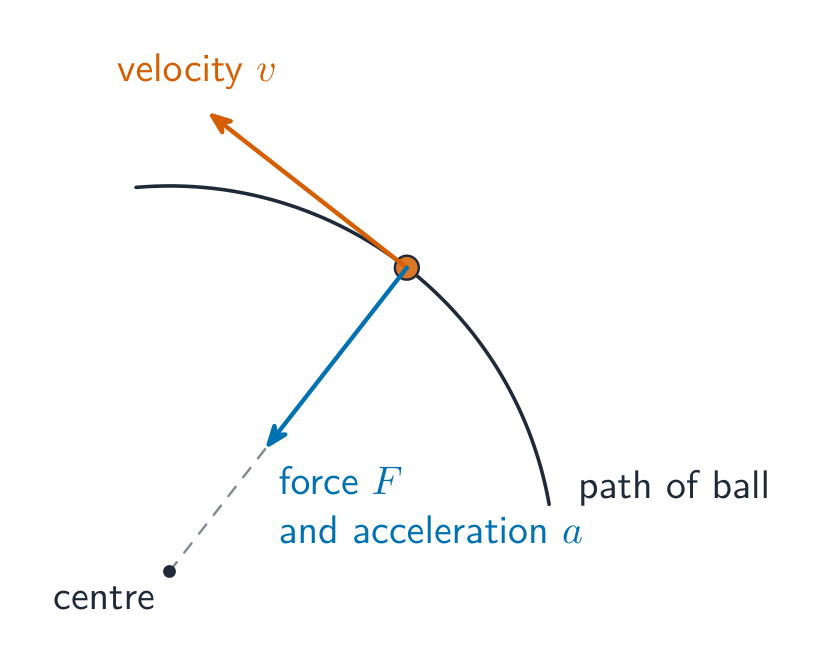
    An object moving in a circle at constant speed still accelerates, because its velocity direction keeps changing. This centripetal acceleration 向心加速度 points toward the center:

    $$a_c=\frac{v^2}{r}.$$
    It is produced by a net inward (centripetal) force 向心力 $F_c=\dfrac{mv^2}{r}$ – supplied by whatever real force points inward (tension, gravity, friction, normal). The time for one full revolution is the period 周期 $T$, and the number of revolutions per second is the frequency 频率 $f$; they are reciprocals, $f = 1/T$, and the same definitions describe any rotation or oscillation.There is no separate outward force; "centrifugal" is only an apparent effect.

    The velocity points along the tangent; the centripetal force and acceleration point to the centre
    The velocity points along the tangent; the centripetal force and acceleration point to the centre

    Worked example. A $0.30\ \text{kg}$ ball on a string is whirled in a horizontal circle of radius $0.80\ \text{m}$ at $4.0\ \text{m/s}$. Find the tension in the string. The tension supplies the whole centripetal force:

    $$T=\frac{mv^2}{r}=\frac{0.30\times4.0^2}{0.80}=6.0\ \text{N}.$$
    If the string can take at most $6.0\ \text{N}$, this is the fastest the ball can go at that radius – spin any faster and the string breaks.

    Vocabulary · ⁨คำศัพท์⁩ Train · ⁨ฝึกฝน⁩
    English ไทย
    centripetal acceleration/senˈtrɪpɪtl əkˌseləˈreɪʃn/ ความเร่งเข้าสู่ศูนย์กลาง
    net inward (centripetal) force/net ˈɪnwəd fɔːs/ แรง净额เข้าหาศูนย์กลาง (แรงรวมศูนย์)
    period/ˈpɪərɪəd/ รอบ
    frequency/ˈfriːkwənsi/ ความถี่
    2.9

    Exam tips

    • Always draw a free-body diagram first: only real forces on the chosen object (weight, normal, tension, friction, applied) — never an "$ma$" arrow.
    • Apply $\sum F = ma$ one axis at a time; on an incline resolve gravity into $mg\sin\theta$ (along) and $mg\cos\theta$ (perpendicular).
    • A Newton's third-law pair acts on two different objects — a book's weight and the table's normal force are not a pair (both act on the book).
    • Static friction adjusts up to $\mu_s N$ (use it to test whether motion starts); once sliding, use kinetic friction $f_k=\mu_k N$.
    • Circular motion needs a net inward (centripetal) force $mv^2/r$ supplied by a real force — there is no outward "centrifugal" force.
  • 3

    Work, Energy, and Power · ⁨งาน พลังงาน และกำลัง⁩

    Watch lesson · ⁨ดูบทเรียน⁩
    3.1

    Translational Kinetic Energy · ⁨พลังงานจลน์เชิงแปล⁩

    Syllabus · ⁨หลักสูตร⁩
    English

    Learning Objective 3.1.A: Describe the translational kinetic energy of an object in terms of the object's mass and velocity.

    • 3.1.A.1 An object's translational kinetic energy is given by the equation
      • Equation: $K = \dfrac{1}{2}mv^2$
    • 3.1.A.2 Translational kinetic energy is a scalar quantity.
    • 3.1.A.3 Different observers may measure different values of the translational kinetic energy of an object, depending on the observer's frame of reference.
    ไทย

    วัตถุประสงค์การเรียนรู้ 3.1.A: อธิบายพลังงานจลน์แบบเลื่อนของวัตถุในแง่ของมวลและความเร็วของวัตถุนั้น

    • 3.1.A.1 พลังงานจลน์แบบเลื่อนของวัตถุกำหนดโดยสมการ
      • สมการ: $K = \dfrac{1}{2}mv^2$
    • 3.1.A.2 พลังงานจลน์แบบเลื่อนเป็นปริมาณสเกลาร์
    • 3.1.A.3 ผู้สังเกตที่แตกต่างกันอาจวัดค่าพลังงานจลน์แบบเลื่อนของวัตถุได้แตกต่างกัน ขึ้นอยู่กับกรอบอ้างอิงของผู้สังเกต

    Source: College Board AP Course and Exam Description · ⁨แหล่งที่มา: คำอธิบายหลักสูตรและข้อสอบ College Board AP⁩

    English

    Energy 能量 is the capacity to do work, measured in joules 焦耳 (J). A moving object has kinetic energy 动能:

    $$K=\tfrac{1}{2}mv^2.$$
    It depends on the square of the speed, so doubling the speed quadruples the kinetic energy. Kinetic energy is a scalar and is never negative.

    Worked example. A $1500\ \text{kg}$ car travels at $20\ \text{m/s}$. Its kinetic energy is $K=\tfrac12\times1500\times20^2=3.0\times10^{5}\ \text{J}=300\ \text{kJ}$. If it speeds up to $40\ \text{m/s}$ (double), the kinetic energy becomes $4\times$ larger, $1200\ \text{kJ}$ – which is why stopping distance grows so fast with speed.

    ไทย

    พลังงาน คือความสามารถในการทำงาน วัดในหน่วย จูล (J). วัตถุที่เคลื่อนที่จะมี พลังงานจลน์:

    $$K=\tfrac{1}{2}mv^2.$$
    ขึ้นอยู่กับ กำลังสอง ของความเร็ว ดังนั้นการเพิ่มความเร็วเป็นสองเท่าจะทำให้พลังงานจลน์เพิ่มขึ้นเป็น สี่เท่า พลังงานจลน์เป็นสเกลาร์และไม่เคยเป็นลบ

    ตัวอย่างวิธีทำ. รถ $1500\ \text{kg}$ ขับเคลื่อนด้วยความเร็ว $20\ \text{m/s}$. พลังงานจลน์ของมันคือ $K=\tfrac12\times1500\times20^2=3.0\times10^{5}\ \text{J}=300\ \text{kJ}$. หากมันเร่งความเร็วเป็น $40\ \text{m/s}$ (สองเท่า) พลังงานจลน์จะเพิ่มขึ้น $4\times$ เท่า, $1200\ \text{kJ}$ – นี่คือเหตุผลที่ระยะทางเบรกเพิ่มขึ้นอย่างรวดเร็วเมื่อความเร็วสูงขึ้น

    3.2

    Work · ⁨งาน⁩

    Syllabus · ⁨หลักสูตร⁩
    English

    Learning Objective 3.2.A: Describe the work done on an object or system by a given force or collection of forces.

    • 3.2.A.1 Work is the amount of energy transferred into or out of a system by a force exerted on that system over a distance.
      • 3.2.A.1.i The work done by a conservative force exerted on a system is path-independent and only depends on the initial and final configurations of that system.
      • 3.2.A.1.ii The work done by a conservative force on a system—or the change in the potential energy of the system—will be zero if the system returns to its initial configuration.
      • 3.2.A.1.iii Potential energies are associated only with conservative forces.
      • 3.2.A.1.iv The work done by a nonconservative force is path-dependent.
      • 3.2.A.1.v Examples of nonconservative forces are friction and air resistance.
    • 3.2.A.2 Work is a scalar quantity that may be positive, negative, or zero.
    • 3.2.A.3 The amount of work done on a system by a constant force is related to the components of that force and the displacement of the point at which that force is exerted.
      • 3.2.A.3.i Only the component of the force exerted on a system that is parallel to the displacement of the point of application of the force will change the system's total energy.
        • Equation: $W = F_{\parallel}d = Fd\cos\theta$
      • 3.2.A.3.ii The component of the force exerted on a system perpendicular to the direction of the displacement of the system's center of mass can change the direction of the system's motion without changing the system's kinetic energy.
    • 3.2.A.4 The work-energy theorem states that the change in an object's kinetic energy is equal to the sum of the work (net work) being done by all forces exerted on the object.
      • Equation: $\Delta K = \sum_{i} W_i = \sum_{i} F_{\parallel,i}\,d$
      • 3.2.A.4.i An external force may change the configuration of a system. The component of the external force parallel to the displacement times the displacement of the point of application of the force gives the change in kinetic energy of the system.
      • 3.2.A.4.ii If the system's center of mass and the point of application of the force move the same distance when a force is exerted on a system, then the system may be modeled as an object, and only the system's kinetic energy can change.
      • 3.2.A.4.iii The energy dissipated by friction is typically equated to the force of friction times the length of the path over which the force is exerted
        • Equation: $\Delta E_{\text{mech}} = F_f\,d\cos\theta$
    • 3.2.A.5 Work is equal to the area under the curve of a graph of $F_{\parallel}$ as a function of displacement.

    Boundary statement: AP Physics 1 only expects students to analyze the transfer of mechanical energy (as defined in Unit 3, Topic 4: Conservation of Energy), although students should be aware that mechanical energy may be dissipated in the form of thermal energy or sound. In AP Physics 2, students will also study how thermal energy can be transferred between systems through heating or cooling.

    ไทย

    วัตถุประสงค์การเรียนรู้ 3.2.A: อธิบายงานที่ทำต่อวัตถุหรือระบบโดยแรงที่กำหนดหรือกลุ่มแรง

    • 3.2.A.1 งานคือปริมาณพลังงานที่ถูกถ่ายโอนเข้าสู่หรือออกจากระบบโดยแรงที่กระทำต่อระบบนั้นตลอดระยะทาง
      • 3.2.A.1.i งานที่ทำโดยแรงอนุรักษ์ที่กระทำต่อระบบไม่ขึ้นอยู่กับเส้นทางและขึ้นอยู่กับเพียงการจัดวางตัวเริ่มต้นและสุดท้ายของระบบเท่านั้น
      • 3.2.A.1.ii งานที่ทำโดยแรงอนุรักษ์ต่อระบบ—หรือการเปลี่ยนแปลงพลังงานศักย์ของระบบ—จะเป็นศูนย์หากระบบกลับไปยังการจัดวางตัวเริ่มต้น
      • 3.2.A.1.iii พลังงานศักย์เกี่ยวข้องกับเฉพาะแรงอนุรักษ์เท่านั้น
      • 3.2.A.1.iv งานที่ทำโดยแรงที่ไม่ใช่แรงอนุรักษ์ขึ้นอยู่กับเส้นทาง
      • 3.2.A.1.v ตัวอย่างของแรงที่ไม่ใช่แรงอนุรักษ์ ได้แก่ แรงเสียดทานและแรงต้านอากาศ
    • 3.2.A.2 งานเป็นปริมาณสเกลาร์ซึ่งอาจมีค่าเป็นบวก ลบ หรือศูนย์
    • 3.2.A.3 ปริมาณงานที่ทำต่อระบบโดยแรงคงที่สัมพันธ์กับองค์ประกอบของแรงนั้นและการกระจัดของจุดที่แรงถูกกระทำ
      • 3.2.A.3.i เฉพาะองค์ประกอบของแรงที่กระทำต่อระบบที่ขนานกับการกระจัดของจุดประบดแรงเท่านั้นที่จะเปลี่ยนพลังงานรวมของระบบ
        • สมการ: $W = F_{\parallel}d = Fd\cos\theta$
      • 3.2.A.3.ii องค์ประกอบของแรงที่กระทำต่อระบบตั้งฉากกับทิศทางการกระจัดของศูนย์กลางมวลของระบบสามารถเปลี่ยนทิศทางของการเคลื่อนที่ของระบบโดยไม่เปลี่ยนพลังงานจลน์ของระบบ
    • 3.2.A.4 ทฤษฎีบทงาน-พลังงานระบุว่า การเปลี่ยนแปลงพลังงานจลน์ของวัตถุเท่ากับผลรวมของงาน (งานสุทธิ) ที่ทำต่อวัตถุนั้นโดยแรงทั้งหมด
      • สมการ: $\Delta K = \sum_{i} W_i = \sum_{i} F_{\parallel,i}\,d$
      • 3.2.A.4.i แรงภายนอกอาจเปลี่ยนแปลงการจัดวางตัวของระบบ ผลคูณขององค์ประกอบของแรงภายนอกที่ขนานกับการกระจัดกับการกระจัดของจุดประบดแรงให้ค่าการเปลี่ยนแปลงพลังงานจลน์ของระบบ
      • 3.2.A.4.ii หากศูนย์กลางมวลของระบบและจุดประบดแรงเคลื่อนที่ในระยะเท่ากันเมื่อมีแรงกระทำต่อระบบ ระบบสามารถจำลองเป็นวัตถุได้ และการเปลี่ยนแปลงจะเกิดขึ้นเฉพาะพลังงานจลน์ของระบบเท่านั้น
      • 3.2.A.4.iii พลังงานที่สูญเสียจากแรงเสียดทานโดยทั่วไปจะเทียบเท่ากับแรงเสียดทานคูณกับความยาวของเส้นทางที่แรงถูกกระทำ
        • สมการ: $\Delta E_{\text{mech}} = F_f\,d\cos\theta$
    • 3.2.A.5 งานเท่ากับพื้นที่ใต้กราฟของ $F_{\parallel}$ ในฟังก์ชันของการกระจัด

    ข้อจำกัด: AP Physics 1 คาดหวังให้นักเรียนวิเคราะห์เฉพาะการถ่ายโอนพลังงานกล (ตามนิยามในหน่วยที่ 3 หัวข้อ 4: กฎการอนุรักษ์พลังงาน) although นักเรียนควรรู้ว่าพลังงานกลอาจถูกกระจาย出去ในรูปแบบของพลังงานความร้อนหรือเสียง ใน AP Physics 2 นักเรียนจะได้ศึกษาเพิ่มเติมว่าการถ่ายโอนพลังงานความร้อนระหว่างระบบสามารถเกิดขึ้นได้ผ่านการให้ความร้อนหรือความเย็น

    Source: College Board AP Course and Exam Description · ⁨แหล่งที่มา: คำอธิบายหลักสูตรและข้อสอบ College Board AP⁩

    English

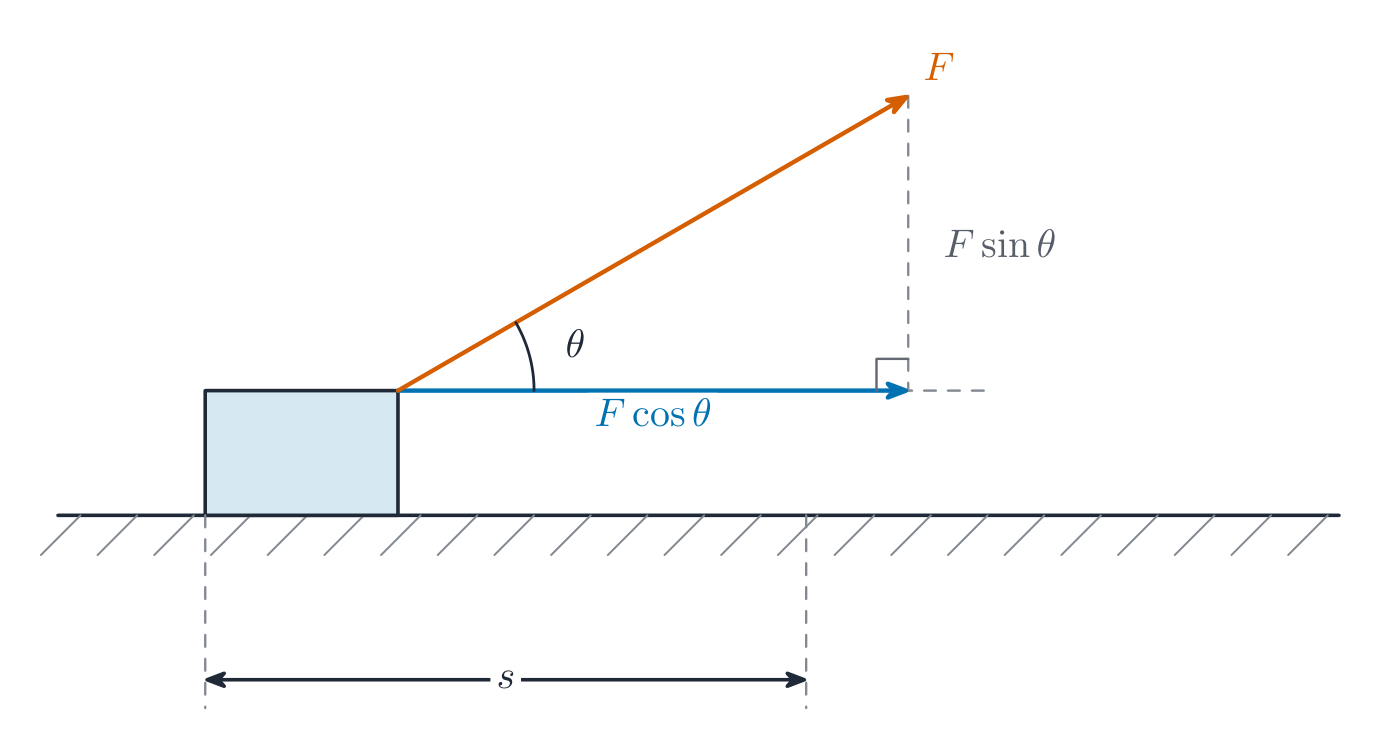
    Work 功 is energy transferred by a force acting over a displacement:

    $$W=F\,d\cos\theta,$$
    where $\theta$ is the angle between the force and the displacement. Work is positive when the force has a component along the motion (adds energy), negative when it opposes the motion (removes energy), and zero when the force is perpendicular. On a force–position graph, work is the area under the curve. The work–energy theorem 动能定理 states that the net work equals the change in kinetic energy: $W_{\text{net}}=\Delta K$.

    Worked example. A $2.0\ \text{kg}$ block moving at $3.0\ \text{m/s}$ on a frictionless floor is pushed by a $5.0\ \text{N}$ force over $4.0\ \text{m}$ in the direction of motion. Find its final speed. The net work is $W=Fd=5.0\times4.0=20\ \text{J}$, and by the work–energy theorem $W=\tfrac12 m(v^2-v_0^2)$:

    $$20=\tfrac12\times2.0\times(v^2-3.0^2)\;\Rightarrow\;v^2=29\;\Rightarrow\;v=5.4\ \text{m/s}.$$

    ไทย

    งาน คือพลังงานที่ถูกถ่ายโอนโดยแรงที่กระทำผ่านระยะการกระจัด:

    $$W=F\,d\cos\theta,$$
    โดยที่ $\theta$ คือมุมระหว่างแรงและการกระจัด งานจะเป็น บวก เมื่อแรงมีองค์ประกอบตามทิศทางการเคลื่อนที่ (เพิ่มพลังงาน), ลบ เมื่อต้านทานการเคลื่อนที่ (ลดพลังงาน), และ ศูนย์ เมื่อแรงตั้งฉาก On a force–position graph, work is the area under the curve. The work–energy theorem states that the net work equals the change in kinetic energy: $W_{\text{net}}=\Delta K$.

    มีเพียงองค์ประกอบของแรงตามการกระจัดเท่านั้นที่ทำ功
    มีเพียงองค์ประกอบของแรงตามการกระจัดเท่านั้นที่ทำ功

    ตัวอย่างวิธีทำ. บล็อกมวล $2.0\ \text{kg}$ เคลื่อนที่ด้วยความเร็ว $3.0\ \text{m/s}$ บนพื้นไร้แรงเสียดทาน ถูกดันด้วยแรง $5.0\ \text{N}$ ผ่านระยะ $4.0\ \text{m}$ ตามทิศทางการเคลื่อนที่. หาความเร็วสุดท้าย. งานสุทธิคือ $W=Fd=5.0\times4.0=20\ \text{J}$, และโดยทฤษฎีบทงาน-พลังงาน $W=\tfrac12 m(v^2-v_0^2)$:

    $$20=\tfrac12\times2.0\times(v^2-3.0^2)\;\Rightarrow\;v^2=29\;\Rightarrow\;v=5.4\ \text{m/s}.$$

    Vocabulary · ⁨คำศัพท์⁩ Train · ⁨ฝึกฝน⁩
    English ไทย
    Energy/ˈenədʒi/ พลังงาน
    joules/dʒuːlz/ จูล
    kinetic energy/kɪˈnetɪk ˈenədʒi/ พลังงานจลน์
    Work/wɜːk/ งาน
    work–energy theorem/wɜːk ˈenədʒi ˈθɪərəm/ ทฤษฎีงาน–พลังงาน
    Potential energy/pəˈtenʃl ˈenədʒi/ พลังงานศักย์
    Gravitational potential energy/ˌɡrævɪˈteɪʃənl pəˈtenʃl ˈenədʒi/ พลังงานศักย์โน้มถ่วง
    Elastic potential energy/ɪˈlæstɪk pəˈtenʃl ˈenədʒi/ พลังงานศักย์ยืดหยุ่น
    conservative forces/kənˈsɜːvətɪv ˈfɔːsɪz/ แรงอนุรักษ์
    total mechanical energy/ˈtəʊtl mɪˈkænɪkl ˈenədʒi/ พลังงานกลทั้งหมด
    conserved/kənˈsɜːvd/ คงที่
    thermal energy/ˈθɜːml ˈenədʒi/ 热能
    3.3

    Potential Energy · ⁨พลังงานศักย์⁩

    Syllabus · ⁨หลักสูตร⁩
    English

    Learning Objective 3.3.A: Describe the potential energy of a system.

    • 3.3.A.1 A system composed of two or more objects has potential energy if the objects within that system only interact with each other through conservative forces.
    • 3.3.A.2 Potential energy is a scalar quantity associated with the position of objects within a system.
    • 3.3.A.3 The definition of zero potential energy for a given system is a decision made by the observer considering the situation to simplify or otherwise assist in analysis.
    • 3.3.A.4 The potential energy of common physical systems can be described using the physical properties of that system.
      • 3.3.A.4.i The elastic potential energy of an ideal spring is given by the following equation, where $\Delta x$ is the distance the spring has been stretched or compressed from its equilibrium length.
        • Equation: $U_s = \dfrac{1}{2}k(\Delta x)^2$
      • 3.3.A.4.ii The general form for the gravitational potential energy of a system consisting of two approximately spherical distributions of mass (e.g., moons, planets or stars) is given by the equation
        • Equation: $U_g = -G\dfrac{m_1 m_2}{r}$
      • 3.3.A.4.iii Because the gravitational field near the surface of a planet is nearly constant, the change in gravitational potential energy in a system consisting of an object with mass $m$ and a planet with gravitational field of magnitude $g$ when the object is near the surface of the planet may be approximated by the equation
        • Equation: $\Delta U_g = mg\Delta y$
    • 3.3.A.5 The total potential energy of a system containing more than two objects is the sum of the potential energy of each pair of objects within the system.
    ไทย

    วัตถุประสงค์การเรียนรู้ 3.3.A: อธิบายพลังงานศักย์ของระบบ

    • 3.3.A.1 ระบบที่ประกอบด้วยวัตถุสองชิ้นขึ้นไปจะมีพลังงานศักย์หากวัตถุภายในระบบ tersebut相互作用กันเฉพาะผ่านแรงอนุรักษ์เท่านั้น
    • 3.3.A.2 พลังงานศักย์เป็นปริมาณสเกลาร์ที่เกี่ยวข้องกับตำแหน่งของวัตถุภายในระบบ
    • 3.3.A.3 การกำหนดจุดศูนย์ของพลังงานศักย์สำหรับระบบหนึ่งเป็นการตัดสินใจของผู้สังเกตพิจารณาจากสถานการณ์เพื่อทำให้การวิเคราะห์ง่ายขึ้นหรือช่วยในการวิเคราะห์อื่นๆ
    • 3.3.A.4 พลังงานศักย์ของระบบทางฟิสิกส์ทั่วไปสามารถอธิบายได้ด้วยคุณสมบัติทางกายภาพของระบบนั้น
      • 3.3.A.4.i พลังงานศักย์ยืดหยุ่นของสปริงอุดมคติกำหนดโดยสมการต่อไปนี้ โดยที่ $\Delta x$ คือระยะทางที่สปริงถูกยืดหรืออัดจากความยาวสมดุล
        • สมการ: $U_s = \dfrac{1}{2}k(\Delta x)^2$
      • 3.3.A.4.ii รูปแบบทั่วไปของพลังงานศักย์โน้มถ่วงของระบบ consisting of two approximately spherical distributions of mass (เช่น ดวงจันทร์ ดาวเคราะห์ หรือดวงดาว) กำหนดโดยสมการ
        • สมการ: $U_g = -G\dfrac{m_1 m_2}{r}$
      • 3.3.A.4.iii เนื่องจากสนามโน้มถ่วงใกล้พื้นผิวของดาวเคราะห์มีค่าเกือบคงที่ การเปลี่ยนแปลงพลังงานศักย์โน้มถ่วงในระบบ consisting of an object with mass $m$ และดาวเคราะห์ที่มีขนาดของสนามโน้มถ่วง $g$ เมื่อวัตถุอยู่ใกล้พื้นผิวดาวเคราะห์สามารถประมาณได้ด้วยสมการ
        • สมการ: $\Delta U_g = mg\Delta y$
    • 3.3.A.5 พลังงานศักย์รวมของระบบที่มีวัตถุมากกว่าสองชิ้นคือผลรวมของพลังงานศักย์ของแต่ละคู่ของวัตถุภายในระบบ

    Source: College Board AP Course and Exam Description · ⁨แหล่งที่มา: คำอธิบายหลักสูตรและข้อสอบ College Board AP⁩

    English

    Potential energy 势能 is stored energy that depends on position or configuration:

    • Gravitational potential energy 重力势能 near the surface: $U_g=mgh$ (height $h$ above a reference level).
    • Elastic potential energy 弹性势能 in a spring: $U_s=\tfrac{1}{2}kx^2$.

    Potential energy is defined only for conservative forces 保守力 (gravity, springs), for which the stored energy depends on position, not path. Only changes in potential energy matter, so you may put the zero level wherever is convenient.

    The $U_g=mgh$ form only holds near a surface where $g$ is roughly constant. The general form, for two spherical masses a distance $r$ apart, is

    $$U_g=-\frac{G m_1 m_2}{r}.$$
    It is negative and defined to be zero at infinite separation, so gravitational PE rises toward zero as the masses move apart. $mgh$ is simply its near-surface approximation. (This is the form you need for satellites and escape speed.)

    ไทย

    พลังงานศักย์ คือพลังงานที่สะสมซึ่งขึ้นอยู่กับตำแหน่งหรือการจัดเรียง:

    • พลังงานศักย์โน้มถ่วง Near the surface: $U_g=mgh$ (ความสูง $h$ เหนือระดับอ้างอิง).
    • พลังงานศักย์ยืดหยุ่น ในสปริง: $U_s=\tfrac{1}{2}kx^2$.

    พลังงานศักย์กำหนดไว้สำหรับ แรงอนุรักษ์ (แรงโน้มถ่วง, สปริง) เท่านั้น ซึ่งพลังงานที่สะสมขึ้นอยู่กับตำแหน่ง ไม่ใช่เส้นทาง เพียง การเปลี่ยนแปลง ของพลังงานศักย์ที่สำคัญเท่านั้น ดังนั้นคุณอาจวางระดับศูนย์ได้ทุกที่ที่สะดวก

    รูป $U_g=mgh$ นั้นใช้ได้เฉพาะ near a surface where $g$ is roughly constant. The general form, สำหรับมวลทรงกลมสองก้อนที่ห่างกัน $r$, คือ

    $$U_g=-\frac{G m_1 m_2}{r}.$$
    มันมีค่า ลบ และกำหนดให้เป็น ศูนย์ที่ระยะไกล vô hạn, ดังนั้นพลังงานศักย์โน้มถ่วงจะเพิ่มขึ้นเข้าใกล้ศูนย์เมื่อมวลเคลื่อนที่ออกจากกัน $mgh$ เป็นเพียงการประมาณ near-surface ของมัน (นี่คือรูปแบบที่คุณต้องใช้สำหรับดาวเทียมและความเร็วหลบหนี)

    Explore · ⁨สำรวจ⁩

    Store elastic potential energy in a spring · ⁨เก็บพลังงานศักย์ยืดหยุ่นในสปริง⁩

    Stretching a spring stores elastic potential energy $\tfrac12 kx^2$ — the area under the force-extension line. Release it and that energy becomes kinetic. · ⁨การยืดสปริงจะเก็บ พลังงานศักย์ยืดหยุ่น $\tfrac12 kx^2$ — ซึ่งเท่ากับพื้นที่ใต้เส้นแรง-การต่อ ย่อสปริงแล้ว พลังงานนี้จะเปลี่ยนเป็นพลังงานจลน์⁩

    3.4

    Conservation of Energy · ⁨กฎการอนุรักษ์พลังงาน⁩

    Syllabus · ⁨หลักสูตร⁩
    English

    Learning Objective 3.4.A: Describe the energies present in a system.

    • 3.4.A.1 A system composed of only a single object can only have kinetic energy.
    • 3.4.A.2 A system that contains objects that interact via conservative forces or that can change its shape reversibly may have both kinetic and potential energies.

    Learning Objective 3.4.B: Describe the behavior of a system using conservation of mechanical energy principles.

    • 3.4.B.1 Mechanical energy is the sum of a system's kinetic and potential energies.
    • 3.4.B.2 Any change to a type of energy within a system must be balanced by an equivalent change of other types of energies within the system or by a transfer of energy between the system and its surroundings.
    • 3.4.B.3 A system may be selected so that the total energy of that system is constant.
    • 3.4.B.4 If the total energy of a system changes, that change will be equivalent to the energy transferred into or out of the system.

    Learning Objective 3.4.C: Describe how the selection of a system determines whether the energy of that system changes.

    • 3.4.C.1 Energy is conserved in all interactions.
    • 3.4.C.2 If the work done on a selected system is zero and there are no nonconservative interactions within the system, the total mechanical energy of the system is constant.
    • 3.4.C.3 If the work done on a selected system is nonzero, energy is transferred between the system and the environment.

    Boundary statement: AP Physics 1 expects students to know that mechanical energy can be dissipated as thermal energy or sound by nonconservative forces.

    ไทย

    วัตถุประสงค์การเรียนรู้ 3.4.A: อธิบายพลังงานที่มีอยู่ในระบบ

    • 3.4.A.1 ระบบ consisting of only a single object สามารถมีเพียงพลังงานจลน์เท่านั้น
    • 3.4.A.2 ระบบที่มีวัตถุที่相互作用กันผ่านแรงอนุรักษ์หรือสามารถเปลี่ยนรูปร่างได้อย่างย้อนกลับอาจมีทั้งพลังงานจลน์และพลังงานศักย์

    วัตถุประสงค์การเรียนรู้ 3.4.B: อธิบายพฤติกรรมของระบบโดยใช้หลักการอนุรักษ์พลังงานกล

    • 3.4.B.1 พลังงานกลคือผลรวมของพลังงานจลน์และพลังงานศักย์ของระบบ
    • 3.4.B.2 การเปลี่ยนแปลง任何形式的พลังงานภายในระบบต้องถูกสมดุลด้วยการเปลี่ยนแปลงของพลังงานประเภทอื่นที่มีค่าเท่ากันภายในระบบ หรือโดยการถ่ายโอนพลังงานระหว่างระบบกับสิ่งแวดล้อมรอบข้าง
    • 3.4.B.3 สามารถเลือกกำหนดระบบได้โดยที่พลังงานรวมของระบบนั้นคงที่
    • 3.4.B.4 หากพลังงานรวมของระบบมีการเปลี่ยนแปลง การเปลี่ยนแปลงนั้นจะมีค่าเท่ากับพลังงานที่ถูกถ่ายโอนเข้าสู่หรือออกจากระบบ

    วัตถุประสงค์การเรียนรู้ 3.4.C: อธิบายว่าการกำหนดระบบมีผลต่อการเปลี่ยนแปลงพลังงานของระบบอย่างไร

    • 3.4.C.1 พลังงานถูกอนุรักษ์ในทุกการมีปฏิสัมพันธ์
    • 3.4.C.2 หากงานที่ทำต่อระบบที่กำหนดเป็นศูนย์และไม่มีการมีปฏิสัมพันธ์ที่ไม่ถาวรภายใน ระบบ พลังงานกลรวมของระบบจะคงที่
    • 3.4.C.3 หากงานที่ทำต่อระบบที่กำหนดไม่ใช่ศูนย์ จะมีการถ่ายโอนพลังงานระหว่างระบบกับสิ่งแวดล้อม

    ข้อจำกัด: AP Physics 1 คาดหวังให้นักเรียนรู้ว่าพลังงานกลสามารถสูญเสียกลายเป็นพลังงานความร้อนหรือเสียงผ่านแรงที่ไม่ถาวรได้

    Source: College Board AP Course and Exam Description · ⁨แหล่งที่มา: คำอธิบายหลักสูตรและข้อสอบ College Board AP⁩

    English
    Energy conservation: KE ⇄ PE

    The total mechanical energy 机械能 is $E=K+U$. When only conservative forces do work, mechanical energy is conserved 守恒:

    $$K_1+U_1=K_2+U_2.$$
    When friction or other non-conservative forces act, they transfer mechanical energy to thermal energy 热能; then the general statement is that total energy (including thermal) is conserved. Energy bar charts are a good way to track where the energy goes.

    Worked example. A ball is released from rest at the top of a frictionless ramp $5.0\ \text{m}$ high. Find its speed at the bottom. All the gravitational potential energy becomes kinetic energy:

    $$mgh=\tfrac12 mv^2\;\Rightarrow\;v=\sqrt{2gh}=\sqrt{2\times9.8\times5.0}=9.9\ \text{m/s}.$$
    The mass cancels, so every object reaches the same speed – exactly the free-fall result, now got from energy. If instead $30\ \text{J}$ were lost to friction, you would subtract it: $mgh-30=\tfrac12 mv^2$.

    ไทย
    การอนุรักษ์พลังงาน: KE ⇄ PE
    รถเหวี่ยงที่มีวงแหวนสูงสีเขียวน้ำตาลแดงตัดกับท้องฟ้า
    รถเหวี่ยงแลกเปลี่ยนพลังงานไปมา: สูงสุด (พลังงานศักย์มากที่สุด) ที่ยอด และเร็วที่สุด (พลังงานจลน์มากที่สุด) ที่ก้น

    พลังงานกลรวม คือ $E=K+U$. เมื่อมีเพียงแรงอนุรักษ์ที่ทำ功, พลังงานกลจะถูก อนุรักษ์:

    $$K_1+U_1=K_2+U_2.$$
    เมื่อแรงเสียดทานหรือแรงที่ไม่อนุรักษ์อื่นๆ ทำ عمل จะถ่ายโอนพลังงานกลไปเป็น พลังงานความร้อน; ดังนั้นข้อความทั่วไปคือ พลังงานรวม (รวมถึงพลังงานความร้อน) จะถูกอนุรักษ์ กราฟแท่งพลังงานเป็นวิธีที่ดีในการติดตามว่าพลังงาน去向何方

    ลูกตุ้มนานาเล็งแลกเปลี่ยนพลังงานศักย์โน้มถ่วงเป็นพลังงานจลน์และกลับคืนมา
    ลูกตุ้มนานาเล็งแลกเปลี่ยนพลังงานศักย์โน้มถ่วงเป็นพลังงานจลน์และกลับคืนมา

    ตัวอย่างที่คำนวณแล้ว. ลูกบอลปล่อยจากจุดหยุดนิ่งบนทางลื่น $5.0\ \text{m}$ สูง จงหาความเร็วที่ด้านล่าง พลังงานศักย์โน้มถ่วงทั้งหมดเปลี่ยนเป็นพลังงานจลน์:

    $$mgh=\tfrac12 mv^2\;\Rightarrow\;v=\sqrt{2gh}=\sqrt{2\times9.8\times5.0}=9.9\ \text{m/s}.$$
    มวลจะตัดกัน ทำให้วัตถุทุกชิ้นถึงความเร็วเท่ากัน – ซึ่งเป็นผลลัพธ์ของการตกอิสระเช่นเดียวกัน แต่ได้มาจากการใช้พลังงาน หากแทนที่จะ $30\ \text{J}$ จะสูญเสียไปกับแรงเสียดทาน คุณต้องลบออก: $mgh-30=\tfrac12 mv^2$.

    Explore · ⁨สำรวจ⁩

    Watch energy convert as an object falls · ⁨สังเกตการแปลงพลังงานขณะวัตถุตก⁩

    With no friction, mechanical energy is conserved: as an object falls, gravitational potential energy turns into kinetic energy while the total stays fixed. · ⁨เมื่อไม่มีแรงเสียดทาน พลังงานกลคงที่: ขณะวัตถุตก พลังงาน ศักย์ ของแรงโน้มถ่วงเปลี่ยนเป็นพลังงาน จลน์ โดยรวมคงที่⁩

    3.5

    Power · ⁨กำลัง⁩

    Syllabus · ⁨หลักสูตร⁩
    English

    Learning Objective 3.5.A: Describe the transfer of energy into, out of, or within a system in terms of power.

    • 3.5.A.1 Power is the rate at which energy changes with respect to time, either by transfer into or out of a system or by conversion from one type to another within a system.
    • 3.5.A.2 Average power is the amount of energy being transferred or converted, divided by the time it took for that transfer or conversion to occur.
      • Equation: $P_{\text{avg}} = \dfrac{\Delta E}{\Delta t}$
    • 3.5.A.3 Because work is the change in energy of an object or system due to a force, average power is the total work done, divided by the time during which that work was done.
      • Equation: $P_{\text{avg}} = \dfrac{W}{\Delta t}$
    • 3.5.A.4 The instantaneous power delivered to an object by the component of a constant force parallel to the object's velocity can be described with the derived equation.
      • Equation: $P_{\text{inst}} = F_{\parallel}v = Fv\cos\theta$
    ไทย

    วัตถุประสงค์การเรียนรู้ 3.5.A: อธิบายการถ่ายโอนพลังงานเข้าสู่ ออก หรือภายในระบบในเชิงกำลัง

    • 3.5.A.1 กำลังคืออัตราการเปลี่ยนแปลงพลังงานเทียบกับเวลา โดยอาจเป็นการถ่ายโอนเข้าสู่หรือออกจากระบบ หรือการเปลี่ยนจากพลังงานประเภทหนึ่งไปเป็นอีกประเภทหนึ่งในระบบ
    • 3.5.A.2 กำลังเฉลี่ยคือปริมาณพลังงานที่ถูกถ่ายโอนหรือเปลี่ยน تقด้วยด้วยระยะเวลาที่ใช้ในการถ่ายโอนหรือการเปลี่ยนนั้น
      • สมการ: $P_{\text{avg}} = \dfrac{\Delta E}{\Delta t}$
    • 3.5.A.3 เนื่องจากงานคือการเปลี่ยนแปลงพลังงานของวัตถุหรือระบบเนื่องจากแรง ดังนั้นกำลังเฉลี่ยจึงเท่ากับงานทั้งหมดที่ทำหารด้วยช่วงเวลาที่ทำงานนั้น
      • สมการ: $P_{\text{avg}} = \dfrac{W}{\Delta t}$
    • 3.5.A.4 กำลังทันทีที่ส่งให้วัตถุโดยองค์ประกอบของแรงคงที่ที่ขนานกับความเร็วของวัตถุ สามารถอธิบายได้ด้วยสมการที่ได้จากการวิเคราะห์
      • สมการ: $P_{\text{inst}} = F_{\parallel}v = Fv\cos\theta$

    Source: College Board AP Course and Exam Description · ⁨แหล่งที่มา: คำอธิบายหลักสูตรและข้อสอบ College Board AP⁩

    English

    Power 功率 is the rate of doing work or transferring energy, measured in watts 瓦特 (W):

    $$P=\frac{W}{\Delta t}=\frac{\Delta E}{\Delta t},\qquad\text{and instantaneously}\qquad P=Fv.$$
    So the same job done faster requires more power. On an energy–time graph, power is the slope.

    Worked example. A motor lifts a $50\ \text{kg}$ load at a steady $2.0\ \text{m/s}$. Because it moves at constant speed, the lifting force equals the weight, so

    $$P=Fv=mgv=50\times9.8\times2.0=980\ \text{W}.$$

    Real machines waste some energy, so we quote efficiency 效率 – useful output power divided by total input power. If this motor draws $1400\ \text{W}$ of electrical power to deliver $980\ \text{W}$ of useful lifting, its efficiency is $980/1400=0.70$, or $70\%$; the other $30\%$ becomes heat and sound.

    ไทย

    กำลัง คือ อัตรา ของการทำ工作或การถ่ายโอนพลังงาน วัดในหน่วย วัตต์ (W):

    $$P=\frac{W}{\Delta t}=\frac{\Delta E}{\Delta t},\qquad\text{and instantaneously}\qquad P=Fv.$$
    ดังนั้น งานเดียวกันที่ทำเร็วขึ้นต้องใช้กำลังมากขึ้น บนกราฟพลังงาน–เวลา กำลังคือความชัน

    กำลังคือความชันของกราฟงาน–เวลา: งานเท่ากันในเวลาที่น้อยกว่าหมายถึงกำลังมากกว่า
    กำลังคือความชันของกราฟงาน–เวลา: งานเท่ากันในเวลาที่น้อยกว่าหมายถึงกำลังมากกว่า

    ตัวอย่างที่คำนวณแล้ว. มอเตอร์ยกน้ำหนัก $50\ \text{kg}$ ด้วยความเร็วคงที่ $2.0\ \text{m/s}$ เนื่องจากเคลื่อนที่ด้วยความเร็วคงที่ แรงยกจึงเท่ากับน้ำหนัก ดังนั้น

    $$P=Fv=mgv=50\times9.8\times2.0=980\ \text{W}.$$

    เครื่องจักรจริงมีการสูญเสียพลังงานบางส่วน เราจึงระบุค่า ประสิทธิภาพ – กำลังใช้งานที่ได้หารด้วยกำลังไฟฟ้าที่ป้อนเข้า หากมอเตอร์นี้ใช้ไฟฟ้า $1400\ \text{W}$ เพื่อสร้างกำลังยกที่มีประโยชน์ $980\ \text{W}$ ประสิทธิภาพของมันคือ $980/1400=0.70$ หรือ $70\%$; ส่วนที่เหลือ $30\%$ กลายเป็นความร้อนและเสียง

    น้ำตก: กำลังคือความเร็วในการถ่ายโอนพลังงาน – การตกสูงเท่ากันในเวลาที่น้อยกว่าหมายถึงกำลังมากกว่า
    น้ำตก: กำลังคือความเร็วในการถ่ายโอนพลังงาน – การตกสูงเท่ากันในเวลาที่น้อยกว่าหมายถึงกำลังมากกว่า
    Vocabulary · ⁨คำศัพท์⁩ Train · ⁨ฝึกฝน⁩
    English ไทย
    Power/ˈpaʊə/ กำลัง
    watts/wɒts/ วัตต์
    efficiency/ɪˈfɪʃənsi/ ประสิทธิภาพ
    3.5

    Exam tips · ⁨ข้อแนะนำสำหรับการสอบ⁩

    English
    • Use $W=Fd\cos\theta$: work is zero when the force is perpendicular to the motion, and negative when it opposes it.
    • Reach for the work–energy theorem ($W_{\text{net}}=\Delta K$) or energy conservation ($K_1+U_1=K_2+U_2$) instead of forces whenever the path is complicated.
    • When friction acts, mechanical energy is not conserved — subtract the energy lost to heat.
    • Remember $K\propto v^2$: doubling the speed quadruples the kinetic energy (and the stopping distance).
    • Use $P=Fv$ for power at a steady speed; at constant velocity the net force is zero but the power is not.
    ไทย
    • ใช้ $W=Fd\cos\theta$: งานจะเป็นศูนย์เมื่อแรงตั้งฉากกับการเคลื่อนที่ และเป็นลบเมื่อต้านการเคลื่อนที่
    • ใช้อธิบาย ทฤษฎีบทงาน-พลังงาน ($W_{\text{net}}=\Delta K$) หรือ การอนุรักษ์พลังงาน ($K_1+U_1=K_2+U_2$) แทนการใช้แรงเสมอเมื่อเส้นทางซับซ้อน
    • เมื่อมีแรงเสียดทาน พลังงานกลจะ ไม่ ถูกอนุรักษ์ – ให้ลบพลังงานที่สูญเสียไปเป็นความร้อนออก
    • จำ $K\propto v^2$ ได้: การเพิ่มความเร็วเป็นสองเท่าจะทำให้พลังงานจลน์เพิ่มขึ้น สี่เท่า (และระยะเบรกด้วย)
    • ใช้ $P=Fv$ สำหรับกำลังที่ความเร็วคงที่; ที่ความเร็วคงที่ แรงลัพธ์จะเป็นศูนย์แต่กำลังจะ ไม่ เป็นศูนย์
  • 4

    Linear Momentum · ⁨โมเมนตัมเชิงเส้น⁩

    Watch lesson · ⁨ดูบทเรียน⁩
    4.1

    Linear Momentum

    Syllabus · ⁨หลักสูตร⁩
    English

    Learning Objective 4.1.A: Describe the linear momentum of an object or system.

    • 4.1.A.1 Linear momentum is defined by the equation $\vec{p} = m\vec{v}$.
      • Equation: $\vec{p} = m\vec{v}$
    • 4.1.A.2 Momentum is a vector quantity and has the same direction as the velocity.
    • 4.1.A.3 Momentum can be used to analyze collisions and explosions.
      • 4.1.A.3.i A collision is a model for an interaction where the forces exerted between the involved objects in the system are much larger than the net external force exerted on those objects during the interaction.
      • 4.1.A.3.ii As only the initial and final states of a collision are analyzed, the object model may be used to analyze collisions.
      • 4.1.A.3.iii An explosion is a model for an interaction in which forces internal to the system move objects within that system apart.

    Boundary statement: Unless otherwise stated, the general term "momentum" will refer specifically to linear momentum.

    ไทย

    วัตถุประสงค์การเรียนรู้ 4.1.A: อธิบายโมเมนตัมเชิงเส้นของวัตถุหรือระบบ

    • 4.1.A.1 โมเมนตัมเชิงเส้นนิยามได้จากสมการ $\vec{p} = m\vec{v}$
      • สมการ: $\vec{p} = m\vec{v}$
    • 4.1.A.2 โมเมนตัมเป็นปริมาณเวกเตอร์และมีทิศทางเดียวกับความเร็ว
    • 4.1.A.3 โมเมนตัมสามารถใช้วิเคราะห์การชนและการระเบิดได้
      • 4.1.A.3.i การชนเป็นแบบจำลองของการมีปฏิสัมพันธ์ที่แรงกระทำระหว่างวัตถุที่เกี่ยวข้องในระบบมีค่ามากกว่าแรงภายนอกสุทธิที่กระทำต่อวัตถุนั้นมากduring การมีปฏิสัมพันธ์
      • 4.1.A.3.ii เนื่องจากพิจารณาเฉพาะสถานะเริ่มต้นและสถานะสุดท้ายของการชน จึงสามารถใช้แบบจำลองวัตถุเพื่อวิเคราะห์การชนได้
      • 4.1.A.3.iii การระเบิดเป็นแบบจำลองของการมีปฏิสัมพันธ์ที่แรงภายในระบบทำให้วัตถุภายในระบบเคลื่อนที่ออกห่างจากกัน

    ข้อจำกัด: เว้นแต่จะระบุไว้ khác คำว่า "โมเมนตัม" ในทางทั่วไปจะหมายถึงโมเมนตัมเชิงเส้นโดยเฉพาะ

    Source: College Board AP Course and Exam Description · ⁨แหล่งที่มา: คำอธิบายหลักสูตรและข้อสอบ College Board AP⁩

    Linear momentum 动量 is mass times velocity – a vector pointing the same way as the velocity:

    $$\vec{p}=m\vec{v}.$$
    It measures "how hard it is to stop" a moving object. A heavy slow truck and a light fast ball can have the same momentum. Its unit is $\text{kg m/s}$, the same as $\text{N s}$.

    Vocabulary · ⁨คำศัพท์⁩ Train · ⁨ฝึกฝน⁩
    English ไทย
    Linear momentum/ˈlɪnɪə məʊˈmentəm/ โมเมนตัมเชิงเส้น
    4.2

    Change in Momentum and Impulse

    Syllabus · ⁨หลักสูตร⁩
    English

    Learning Objective 4.2.A: Describe the impulse delivered to an object or system.

    • 4.2.A.1 The rate of change of momentum is equal to the net external force exerted on an object or system.
      • Equation: $\vec{F}_{\text{net}} = \dfrac{\Delta \vec{p}}{\Delta t}$
    • 4.2.A.2 Impulse is defined as the product of the average force exerted on a system and the time interval during which that force is exerted on the system.
      • Equation: $\vec{J} = \vec{F}_{\text{avg}} \Delta t$
    • 4.2.A.3 Impulse is a vector quantity and has the same direction as the net force exerted on the system.
    • 4.2.A.4 The impulse delivered to a system by a net external force is equal to the area under the curve of a graph of the net external force exerted on the system as a function of time.
    • 4.2.A.5 The net external force exerted on a system is equal to the slope of a graph of the momentum of the system as a function of time.

    Learning Objective 4.2.B: Describe the relationship between the impulse exerted on an object or a system and the change in momentum of the object or system.

    • 4.2.B.1 Change in momentum is the difference between a system's final momentum and its initial momentum.
      • Equation: $\Delta \vec{p} = \vec{p} - \vec{p}_0$
    • 4.2.B.2 The impulse–momentum theorem relates the impulse exerted on a system and the system's change in momentum.
      • Equation: $\vec{J} = \vec{F}_{\text{avg}} \Delta t = \Delta \vec{p}$
    • 4.2.B.3 Newton's second law of motion is a direct result of the impulse–momentum theorem applied to systems with constant mass.
      • Equation: $\vec{F}_{\text{net}} = \dfrac{\Delta \vec{p}}{\Delta t} = m\dfrac{\Delta \vec{v}}{\Delta t} = m\vec{a}$

    Boundary statement: AP Physics 1 does not require students to quantitatively analyze systems in which the mass of the system changes with respect to time.

    ไทย

    วัตถุประสงค์การเรียนรู้ 4.2.A: อธิบายแรงกระแทก (Impulse) ที่ส่งให้กับวัตถุหรือระบบ

    • 4.2.A.1 อัตราการเปลี่ยนแปลงโมเมนตัมมีค่าเท่ากับแรงภายนอกสุทธิที่กระทำต่อวัตถุหรือระบบ
      • สมการ: $\vec{F}_{\text{net}} = \dfrac{\Delta \vec{p}}{\Delta t}$
    • 4.2.A.2 แรงกระแทกนิยามเป็นผลคูณของแรงเฉลี่ยที่กระทำต่อระบบและช่วงเวลาเวลาที่แรงนั้นกระทำต่อระบบ
      • สมการ: $\vec{J} = \vec{F}_{\text{avg}} \Delta t$
    • 4.2.A.3 แรงกระแทกเป็นปริมาณเวกเตอร์และมีทิศทางเดียวกับแรงสุทธิที่กระทำต่อระบบ
    • 4.2.A.4 แรงกระแทกที่ส่งให้กับระบบโดยแรงภายนอกสุทธิมีค่าเท่ากับพื้นที่ใต้กราฟของแรงภายนอกสุทธิที่กระทำต่อระบบเมื่อพิจารณาเป็นฟังก์ชันของเวลา
    • 4.2.A.5 แรงภายนอกสุทธิที่กระทำต่อระบบมีค่าเท่ากับความชันของกราฟโมเมนตัมของระบบเมื่อพิจารณาเป็นฟังก์ชันของเวลา

    วัตถุประสงค์การเรียนรู้ 4.2.B: อธิบายความสัมพันธ์ระหว่างแรงกระแทกที่กระทำต่อวัตถุหรือระบบกับการเปลี่ยนแปลงโมเมนตัมของวัตถุหรือระบบ

    • 4.2.B.1 การเปลี่ยนแปลงโมเมนตัมคือผลต่างระหว่างโมเมนตัมสุดท้ายและโมเมนตัมเริ่มต้นของระบบ
      • สมการ: $\Delta \vec{p} = \vec{p} - \vec{p}_0$
    • 4.2.B.2 ทฤษฎีบทแรงกระแทก-โมเมนตัมเชื่อมโยงแรงกระแทกที่กระทำต่อระบบกับการเปลี่ยนแปลงโมเมนตัมของระบบ
      • สมการ: $\vec{J} = \vec{F}_{\text{avg}} \Delta t = \Delta \vec{p}$
    • 4.2.B.3 กฎข้อที่สองของนิวตันเกี่ยวกับการเคลื่อนที่ เป็นผลโดยตรงจากการประยุกต์ใช้ทฤษฎีบทแรงกระแทก-โมเมนตัมกับระบบที่มีมวลคงที่
      • สมการ: $\vec{F}_{\text{net}} = \dfrac{\Delta \vec{p}}{\Delta t} = m\dfrac{\Delta \vec{v}}{\Delta t} = m\vec{a}$

    ข้อจำกัด: AP Physics 1 ไม่ต้องการให้นักเรียนวิเคราะห์ระบบที่มีมวลเปลี่ยนแปลงตามเวลาในเชิงปริมาณ

    Source: College Board AP Course and Exam Description · ⁨แหล่งที่มา: คำอธิบายหลักสูตรและข้อสอบ College Board AP⁩

    A net force acting over time changes momentum. The impulse 冲量 delivered is

    $$\vec{J}=\vec{F}\,\Delta t=\Delta\vec{p}.$$
    This is the impulse–momentum theorem: impulse equals the change in momentum. On a force–time graph, impulse is the area under the curve. It explains why airbags and follow-through help – spreading the same momentum change over a longer time reduces the force.

    Impulse is the area under the force-time curve, equal to the average force times the contact time
    Impulse is the area under the force-time curve, equal to the average force times the contact time

    Worked example. A $0.15\ \text{kg}$ ball hits a wall at $20\ \text{m/s}$ and bounces straight back at $15\ \text{m/s}$. The contact lasts $0.020\ \text{s}$. Find the average force on the ball. Take the rebound direction as positive, so $u=-20\ \text{m/s}$ and $v=+15\ \text{m/s}$:

    $$\Delta p=m(v-u)=0.15\big(15-(-20)\big)=5.25\ \text{kg m/s},\qquad F=\frac{\Delta p}{\Delta t}=\frac{5.25}{0.020}=260\ \text{N}.$$
    The sign work matters: forgetting that the velocity reverses is the most common mistake here.

    Vocabulary · ⁨คำศัพท์⁩ Train · ⁨ฝึกฝน⁩
    English ไทย
    impulse/ˈɪmpʌls/ สัญญาณ
    4.3

    Conservation of Linear Momentum

    Syllabus · ⁨หลักสูตร⁩
    English

    Learning Objective 4.3.A: Describe the behavior of a system using conservation of linear momentum.

    • 4.3.A.1 A collection of objects with individual momenta can be described as one system with one center-of-mass velocity.
      • 4.3.A.1.i For a collection of objects, the velocity of a system's center of mass can be calculated using the equation $\vec{v}_{\text{cm}} = \dfrac{\sum \vec{p}_i}{\sum m_i} = \dfrac{\sum m_i \vec{v}_i}{\sum m_i}$.
      • 4.3.A.1.ii The velocity of a system's center of mass is constant in the absence of a net external force.
    • 4.3.A.2 The total momentum of a system is the sum of the momenta of the system's constituent parts.
    • 4.3.A.3 In the absence of net external forces, any change to the momentum of an object within a system must be balanced by an equivalent and opposite change of momentum elsewhere within the system. Any change to the momentum of a system is due to a transfer of momentum between the system and its surroundings.
      • 4.3.A.3.i The impulse exerted by one object on a second object is equal and opposite to the impulse exerted by the second object on the first. This is a direct result of Newton's third law.
      • 4.3.A.3.ii A system may be selected so that the total momentum of that system is constant.
      • 4.3.A.3.iii If the total momentum of a system changes, that change will be equivalent to the impulse exerted on the system.
        • Equation: $\vec{J} = \Delta \vec{p}$
    • 4.3.A.4 Correct application of conservation of momentum can be used to determine the velocity of a system immediately before and immediately after collisions or explosions.

    Boundary statement: AP Physics 1 includes a quantitative and qualitative treatment of conservation of momentum in one dimension and a semiquantitative treatment of conservation of momentum in two dimensions. Exam questions involving solution of simultaneous equations are not included in AP Physics 1, but the AP Physics 1 Exam may include questions that assess whether students can set up the equations properly and reason about how changing a given mass, speed, or angle would affect other quantities. AP Physics 2 includes a full treatment of conservation of momentum in two dimensions for problems that include one unknown final velocity.

    Learning Objective 4.3.B: Describe how the selection of a system determines whether the momentum of that system changes.

    • 4.3.B.1 Momentum is conserved in all interactions.
    • 4.3.B.2 If the net external force on the selected system is zero, the total momentum of the system is constant.
    • 4.3.B.3 If the net external force on the selected system is nonzero, momentum is transferred between the system and the environment.
    ไทย

    วัตถุประสงค์การเรียนรู้ 4.3.A: อธิบายพฤติกรรมของระบบโดยใช้หลักการอนุรักษ์โมเมนตัมเชิงเส้น

    • 4.3.A.1 กลุ่มวัตถุที่มีโมเมนตัมของแต่ละตัวสามารถอธิบายได้ว่าเป็นระบบเดียวที่มีความเร็วของจุดศูนย์กลางมวลเพียงค่าเดียว
      • 4.3.A.1.i สำหรับกลุ่มวัตถุ ความเร็วของจุดศูนย์กลางมวลของระบบสามารถคำนวณได้จากสมการ $\vec{v}_{\text{cm}} = \dfrac{\sum \vec{p}_i}{\sum m_i} = \dfrac{\sum m_i \vec{v}_i}{\sum m_i}$
      • 4.3.A.1.ii ความเร็วของจุดศูนย์กลางมวลของระบบจะคงที่หากไม่มีแรงภายนอกสุทธิกระทำ
    • 4.3.A.2 โมเมนตัมรวมของระบบคือผลรวมของโมเมนตัมของส่วนประกอบต่างๆ ของระบบ
    • 4.3.A.3 หากไม่มีแรงภายนอกสุทธิ การเปลี่ยนแปลงใดๆ ต่อโมเมนตัมของวัตถุภายในระบบจะต้องถูกสมดุลด้วยการเปลี่ยนแปลงโมเมนตัมที่มีค่าเท่ากันแต่ตรงกันข้ามในที่อื่นภายในระบบ การเปลี่ยนแปลงใดๆ ต่อโมเมนตัมของระบบเกิดจากการถ่ายโอนโมเมนตัมระหว่างระบบกับสิ่งแวดล้อมรอบข้าง
      • 4.3.A.3.i แรงกระแทกที่วัตถุหนึ่งกระทำต่ออีกวัตถุหนึ่งมีค่าเท่ากันและตรงกันข้ามกับแรงกระแทกที่วัตถุที่สองกระทำต่อวัตถุแรก ซึ่งเป็นผลโดยตรงจากกฎข้อที่สามของนิวตัน
      • 4.3.A.3.ii สามารถเลือกระบบได้โดยที่โมเมนตัมรวมของระบบนั้นคงที่
      • 4.3.A.3.iii หากโมเมนตัมรวมของระบบมีการเปลี่ยนแปลง การเปลี่ยนแปลงนี้จะเทียบเท่ากับแรงกระแทก (impulse) ที่กระทำต่อระบบ
        • สมการ: $\vec{J} = \Delta \vec{p}$
    • 4.3.A.4 การประยุกต์ใช้กฎการอนุรักษ์โมเมนตัมอย่างถูกต้องสามารถใช้ในการหาความเร็วของระบบทันทีก่อนและทันทีหลังการชนหรือการระเบิด

    คำชี้แจงขอบเขต: AP Physics 1 รวมถึงการวิเคราะห์ทั้งเชิงปริมาณและเชิงคุณภาพของการอนุรักษ์โมเมนตัมในหนึ่งมิติ และการวิเคราะห์แบบกึ่งปริมาณของการอนุรักษ์โมเมนตัมในสองมิติ ข้อสอบที่เกี่ยวข้องกับการแก้สมการพร้อมกันจะไม่อยู่ใน AP Physics 1 แต่ข้อสอบ AP Physics 1 อาจมีคำถามที่ประเมินว่านักเรียนสามารถตั้งสมการได้อย่างถูกต้องและให้เหตุผลได้ว่าเมื่อเปลี่ยนมวล ความเร็ว หรือมุมที่กำหนดจะส่งผลต่อปริมาณอื่นๆ อย่างไร AP Physics 2 รวมถึงการวิเคราะห์เต็มรูปแบบของการอนุรักษ์โมเมนตัมในสองมิติสำหรับปัญหาที่มีตัวแปรความเร็วสุดท้ายที่ไม่ทราบค่าเพียงตัวเดียว

    วัตถุประสงค์การเรียนรู้ 4.3.B: อธิบายว่าการเลือกระบบกำหนดว่าโมเมนตัมของระบบนั้นจะเปลี่ยนแปลงหรือไม่อย่างไร

    • 4.3.B.1 โมเมนตัมถูกอนุรักษ์ในทุกปฏิกิริยา
    • 4.3.B.2 หากผลรวมของแรงภายนอกที่กระทำต่อระบบที่เลือกเป็นศูนย์ โมเมนตัมรวมของระบบจะคงที่
    • 4.3.B.3 หากผลรวมของแรงภายนอกที่กระทำต่อระบบที่เลือกไม่เป็นศูนย์ จะมีการถ่ายโอนโมเมนตัมระหว่างระบบและสิ่งแวดล้อม

    Source: College Board AP Course and Exam Description · ⁨แหล่งที่มา: คำอธิบายหลักสูตรและข้อสอบ College Board AP⁩

    If the net external force on a system is zero, its total momentum is conserved 守恒:

    $$\sum \vec{p}_{\text{before}}=\sum \vec{p}_{\text{after}}.$$
    Internal forces (like the push between two colliding carts) come in third-law pairs and cancel, so they cannot change the total momentum. This is the key tool for collisions 碰撞 and explosions – apply it separately in the $x$ and $y$ directions.

    A head-on collision: total momentum before equals total momentum after
    A head-on collision: total momentum before equals total momentum after

    Worked example (recoil 反冲). A $60\ \text{kg}$ skater, initially at rest on frictionless ice, throws a $2.0\ \text{kg}$ ball at $8.0\ \text{m/s}$. Find her recoil speed. The total momentum starts at zero and stays zero:

    $$0=(60)v+(2.0)(8.0)\;\Rightarrow\;v=-\frac{16}{60}=-0.27\ \text{m/s},$$
    so she moves at $0.27\ \text{m/s}$ in the opposite direction to the ball – the principle behind rockets and guns.

    A whole collection of objects can be described by a single center-of-mass velocity 质心速度:

    $$\vec{v}_{\text{cm}}=\frac{\sum m_i\vec{v}_i}{\sum m_i}=\frac{\vec{p}_{\text{total}}}{M_{\text{total}}}.$$
    Since total momentum is conserved when no net external force acts, $\vec{v}_{\text{cm}}$ then stays constant – a $v_{\text{cm}}$-versus-time graph is flat unless an outside force acts. An internal collision or explosion never changes it, however violently the parts fly apart.

    Explore · ⁨สำรวจ⁩

    Collide two carts and conserve momentum · ⁨ชนรถเข็นสองคันและรักษาโมเมนตัมไว้⁩

    In any collision the total momentum $\sum mv$ before equals the total after. Set the masses and speeds and check the momentum bookkeeping. · ⁨ในการชนใดๆ โมเมนตัมรวม $\sum mv$ ก่อนเท่าหลัง ตั้งค่ามวลและความเร็วแล้วตรวจสอบการบัญชีโมเมนตัม⁩

    Vocabulary · ⁨คำศัพท์⁩ Train · ⁨ฝึกฝน⁩
    English ไทย
    conserved/kənˈsɜːvd/ คงที่
    collisions/kəˈlɪʒnz/ การชนกัน
    center-of-mass velocity/ˈsentə ɒv mæs vəˈlɒsɪti/ ความเร็วของจุดมวล
    recoil/rɪˈkɔɪl/ การดีดกลับ
    4.4

    Elastic and Inelastic Collisions

    Syllabus · ⁨หลักสูตร⁩
    English

    Learning Objective 4.4.A: Describe whether an interaction between objects is elastic or inelastic.

    • 4.4.A.1 An elastic collision between objects is one in which the initial kinetic energy of the system is equal to the final kinetic energy of the system.
    • 4.4.A.2 In an elastic collision, the final kinetic energies of each of the objects within the system may be different from their initial kinetic energies.
    • 4.4.A.3 An inelastic collision between objects is one in which the total kinetic energy of the system decreases.
    • 4.4.A.4 In an inelastic collision, some of the initial kinetic energy is not restored to kinetic energy but is transformed by nonconservative forces into other forms of energy.
    • 4.4.A.5 In a perfectly inelastic collision, the objects stick together and move with the same velocity after the collision.
    ไทย

    วัตถุประสงค์การเรียนรู้ 4.4.A: อธิบายว่าปฏิกิริยาระหว่างวัตถุเป็นการชนแบบยืดหยุ่นหรือไม่ยืดหยุ่น

    • 4.4.A.1 การชนแบบยืดหยุ่นระหว่างวัตถุคือการชนที่พลังงานจลน์เริ่มต้นของระบบเท่ากับพลังงานจลน์สุดท้ายของระบบ
    • 4.4.A.2 ในการชนแบบยืดหยุ่น พลังงานจลน์สุดท้ายของแต่ละวัตถุภายในระบบอาจต่างจากพลังงานจลน์เริ่มต้นของวัตถุนั้นๆ
    • 4.4.A.3 การชนแบบไม่ยืดหยุ่นระหว่างวัตถุคือการชนที่พลังงานจลน์รวมของระบบลดลง
    • 4.4.A.4 ในการชนแบบไม่ยืดหยุ่น บางส่วนของพลังงานจลน์เริ่มต้นไม่ได้กลับคืนมาเป็นพลังงานจลนอีกต่อไป แต่ถูกแปลงโดยแรงที่ไม่อนุรักษ INTO เป็นรูปพลังงานอื่น
    • 4.4.A.5 ในกรณีการชนแบบไม่ยืดหยุ่นเต็มที่ วัตถุจะติดกันและเคลื่อนที่ด้วยความเร็วเดียวกันหลังจากการชน

    Source: College Board AP Course and Exam Description · ⁨แหล่งที่มา: คำอธิบายหลักสูตรและข้อสอบ College Board AP⁩

    Conservation of momentum in a collision

    Momentum is conserved in every collision (with no external force). Kinetic energy is not:

    A glancing collision, resolved along two perpendicular axes
    A glancing collision, resolved along two perpendicular axes
    • In an elastic collision 弹性碰撞, kinetic energy is also conserved (objects bounce apart cleanly).
    • In an inelastic collision 非弹性碰撞, some kinetic energy becomes heat or deformation. In a perfectly inelastic collision the objects stick together and move with one common velocity afterward.

    Strategy: always write momentum conservation; add energy conservation only if the collision is stated to be elastic. One elastic fact worth memorising: in a 1D elastic collision between equal masses, the two objects simply swap velocities (a moving ball striking an identical stationary one stops dead, and the target flies off at the incoming speed).

    Worked example. A $1000\ \text{kg}$ car moving at $20\ \text{m/s}$ runs into a stationary $1500\ \text{kg}$ car and they lock together. Find their common speed, and the kinetic energy lost. Momentum conservation gives

    $$1000\times20=(1000+1500)\,v\;\Rightarrow\;v=\frac{20000}{2500}=8.0\ \text{m/s}.$$
    Kinetic energy before is $\tfrac12(1000)(20^2)=2.0\times10^{5}\ \text{J}$; after is $\tfrac12(2500)(8.0^2)=8.0\times10^{4}\ \text{J}$. So $1.2\times10^{5}\ \text{J}$ (about $60\%$) is lost to crumpling and heat – momentum is still conserved, but kinetic energy is not.

    A Newton's cradle: five steel balls hanging in a row
    A Newton's cradle shows momentum and kinetic energy passing through a line of balls in a near-elastic collision
    Explore · ⁨สำรวจ⁩

    Compare elastic and inelastic collisions · ⁨เปรียบเทียบการชนแบบยืดหยุ่นและไม่ยืดหยุ่น⁩

    Momentum is always conserved, but kinetic energy is only conserved in an elastic collision. In an inelastic one the carts stick and some energy becomes heat. · ⁨โมเมนตัมถูกอนุรักษ์เสมอ แต่ พลังงานจลน์ จะถูกอนุรักษ์เฉพาะใน การชนแบบยืดหยุ่น เท่านั้น ในการชนที่ไม่ยืดหยุ่น รถเข็นจะติดกันและพลังงานบางส่วนจะกลายเป็นความร้อน⁩

    Vocabulary · ⁨คำศัพท์⁩ Train · ⁨ฝึกฝน⁩
    English ไทย
    elastic collision/ɪˈlæstɪk kəˈlɪʒn/ การชนแบบยืดหยุ่น
    inelastic collision/ɪnɪˈlæstɪk kəˈlɪʒn/ การชนแบบไม่ยืดหยุ่น
    4.4

    Exam tips

    • Momentum is a vector — assign $+$/$-$ signs before adding; a ball that rebounds reverses its velocity, giving a large $\Delta p$.
    • Momentum is conserved in every collision (no external force); kinetic energy is conserved only if the collision is stated to be elastic.
    • In a perfectly inelastic collision the objects stick and move with one common velocity.
    • Impulse $=F\,\Delta t=\Delta p$ = the area under a force–time graph; spreading a collision over a longer time reduces the force (airbags, bending knees).
    • For recoil/explosions, set the total momentum equal before and after (often zero before).
  • 5

    Torque and Rotational Dynamics · ⁨โมเมนต์และพลวัตการหมุน⁩

    Watch lesson · ⁨ดูบทเรียน⁩
    5.1

    Rotational Kinematics · ⁨จลนศาสตร์การหมุน⁩

    Syllabus · ⁨หลักสูตร⁩
    English

    Learning Objective 5.1.A: Describe the rotation of a system with respect to time using angular displacement, angular velocity, and angular acceleration.

    • 5.1.A.1 Angular displacement is the measurement of the angle, in radians, through which a point on a rigid system rotates about a specified axis.
      • Equation: $\Delta\theta = \theta - \theta_0$
      • 5.1.A.1.i A rigid system is one that holds its shape but in which different points on the system move in different directions during rotation. A rigid system cannot be modeled as an object.
      • 5.1.A.1.ii One direction of angular displacement about an axis of rotation—clockwise or counterclockwise—is typically indicated as mathematically positive, with the other direction becoming mathematically negative.
      • 5.1.A.1.iii If the rotation of a system about an axis may be well described using the motion of the system's center of mass, the system may be treated as a single object. For example, the rotation of Earth about its axis may be considered negligible when considering the revolution of Earth about the center of mass of the Earth–Sun system.
    • 5.1.A.2 Average angular velocity is the average rate at which angular position changes with respect to time.
      • Equation: $\omega_{\text{avg}} = \dfrac{\Delta\theta}{\Delta t}$
    • 5.1.A.3 Average angular acceleration is the average rate at which the angular velocity changes with respect to time.
      • Equation: $\alpha_{\text{avg}} = \dfrac{\Delta\omega}{\Delta t}$
    • 5.1.A.4 Angular displacement, angular velocity, and angular acceleration around one axis are analogous to linear displacement, velocity, and acceleration in one dimension and demonstrate the same mathematical relationships.
      • 5.1.A.4.i For constant angular acceleration, the mathematical relationships between angular displacement, angular velocity, and angular acceleration can be described with the following equations:
        • Equation: $\omega = \omega_0 + \alpha t$
        • Equation: $\theta = \theta_0 + \omega_0 t + \dfrac{1}{2}\alpha t^2$
        • Equation: $\omega^2 = \omega_0^2 + 2\alpha(\theta - \theta_0)$
      • 5.1.A.4.ii Graphs of angular displacement, angular velocity, and angular acceleration as functions of time can be used to find the relationships between those quantities.

    Boundary statement: Descriptions of the directions of rotation for a point or object are limited to clockwise and counterclockwise with respect to a given axis of rotation.

    ไทย

    วัตถุประสงค์การเรียนรู้ 5.1.A: อธิบายการหมุนของระบบเทียบกับเวลาโดยใช้การกระจัดเชิงมุม ความเร็วเชิงมุม และความเร่งเชิงมุม

    • 5.1.A.1 การกระจัดเชิงมุมคือขนาดของมุมในหน่วยเรเดียน ที่จุดหนึ่งบนระบบแข็งหมุนรอบแกนที่กำหนด
      • สมการ: $\Delta\theta = \theta - \theta_0$
      • 5.1.A.1.i ระบบแข็งคือระบบที่รักษารูปทรงไว้ได้แต่จุดต่างๆ บนระบบเคลื่อนที่ไปในทิศทางที่แตกต่างกันระหว่างการหมุน ระบบแข็งไม่สามารถจำลองเป็นวัตถุเดี่ยวได้
      • 5.1.A.1.ii ทิศทางหนึ่งของการกระจัดเชิงมุมรอบแกนหมุน—ตามทเข็มนาฬิกาหรือทวนทเข็มนาฬิกา—มักถูกกำหนดให้เป็นค่าบวกทางคณิตศาสตร์ โดยทิศทางอีกด้านจะเป็นค่าลบทางคณิตศาสตร์
      • 5.1.A.1.iii หากการหมุนของระบบรอบแกนสามารถอธิบายได้ดีด้วยการเคลื่อนที่ของศูนย์กลางมวลของระบบ ระบบสามารถพิจารณาเป็นวัตถุเดียวได้ ตัวอย่างเช่น การหมุนของโลก حولตัวเองอาจถูกละเลยเมื่อพิจารณาถึงการโคจรของโลกรอบศูนย์กลางมวลของระบบโลก-ดวงอาทิตย์
    • 5.1.A.2 ความเร็วเชิงมุมเฉลี่ยคืออัตราเฉลี่ยที่ตำแหน่งเชิงมุมเปลี่ยนแปลงเทียบกับเวลา
      • สมการ: $\omega_{\text{avg}} = \dfrac{\Delta\theta}{\Delta t}$
    • 5.1.A.3 ความเร่งเชิงมุมเฉลี่ยคืออัตราเฉลี่ยที่ความเร็วเชิงมุมเปลี่ยนแปลงเทียบกับเวลา
      • สมการ: $\alpha_{\text{avg}} = \dfrac{\Delta\omega}{\Delta t}$
    • 5.1.A.4 การกระจัดเชิงมุม ความเร็วเชิงมุม และความเร่งเชิงมุมรอบแกนหนึ่งมีความคล้ายคลึงกับการกระจัดเชิงเส้น ความเร็ว และ ความเร่ง ในหนึ่งมิติ และแสดงความสัมพันธ์ทางคณิตศาสตร์เดียวกัน
      • 5.1.A.4.i สำหรับความเร่งเชิงมุมคงที่ ความสัมพันธ์ทางคณิตศาสตร์ระหว่างการกระจัดเชิงมุม ความเร็วเชิงมุม และความเร่งเชิงมุมสามารถอธิบายได้ด้วยสมการต่อไปนี้:
        • สมการ: $\omega = \omega_0 + \alpha t$
        • สมการ: $\theta = \theta_0 + \omega_0 t + \dfrac{1}{2}\alpha t^2$
        • สมการ: $\omega^2 = \omega_0^2 + 2\alpha(\theta - \theta_0)$
      • 5.1.A.4.ii กราฟของการกระจัดเชิงมุม ความเร็วเชิงมุม และความเร่งเชิงมุมในฐานะฟังก์ชันของเวลาสามารถใช้เพื่อหาความสัมพันธ์ระหว่างปริมาณเหล่านั้นได้

    คำชี้แจงขอบเขต: คำอธิบายทิศทางการหมุนสำหรับจุดหรือวัตถุจำกัดอยู่เฉพาะตามทเข็มนาฬิกาและทวนทเข็มนาฬิกาเทียบกับแกนหมุนที่กำหนดเท่านั้น

    Source: College Board AP Course and Exam Description · ⁨แหล่งที่มา: คำอธิบายหลักสูตรและข้อสอบ College Board AP⁩

    English

    Rotation is described by angular quantities that mirror the linear ones:

    • angular displacement 角位移 $\theta$ (in radians 弧度),
    • angular velocity 角速度 $\omega=\dfrac{\Delta\theta}{\Delta t}$,
    • angular acceleration 角加速度 $\alpha=\dfrac{\Delta\omega}{\Delta t}$.

    For constant $\alpha$, the rotational kinematic equations have the same form as the linear ones, with $\theta,\omega,\alpha$ replacing $x,v,a$: $\omega=\omega_0+\alpha t$, $\theta=\omega_0 t+\tfrac12\alpha t^2$, and $\omega^2=\omega_0^2+2\alpha\theta$.

    Worked example. A wheel starts from rest and speeds up uniformly to $30\ \text{rad/s}$ in $6.0\ \text{s}$. Find its angular acceleration and the total angle turned:

    $$\alpha=\frac{\Delta\omega}{\Delta t}=\frac{30}{6.0}=5.0\ \text{rad/s}^2,\qquad \theta=\tfrac12\alpha t^2=\tfrac12\times5.0\times6.0^2=90\ \text{rad}.$$

    ไทย
    การชนทดสอบความรุนแรง: แรงและแรงบิดขนาดใหญ่ทำให้เกิดการเปลี่ยนแปลงอย่างรวดเร็วในการเคลื่อนที่เชิงเส้นและเชิงมุม
    การทดสอบการชน: แรงและแรงบิดขนาดใหญ่ก่อให้เกิดการเปลี่ยนแปลงอย่างรวดเร็วในการเคลื่อนที่เชิงเส้นและเชิงมุม
    สปริงภายใต้แรงกด: กฎของฮุคเชื่อมโยงระหว่างแรงและการยืดออก – เป็นบริบทที่มีประโยชน์สำหรับพลังงานในระบบหมุน
    สปริงภายใต้ภาระ: กฎของฮุคเชื่อมโยงแรงและการยืดออก – เป็นข้อมูล زمینهที่มีประโยชน์สำหรับพลังงานในระบบหมุน

    การหมุนถูกอธิบายด้วยปริมาณเชิงมุมซึ่งมีรูปแบบคล้ายคลึงกับปริมาณเชิงเส้น:

    หนึ่งเรเดียนคือมุมที่มีความยาวส่วนโค้งเท่ากับรัศมี
    หนึ่งเรเดียนคือมุมที่มีความยาวส่วน弧เท่ากับรัศมี
    • การกระจัดเชิงมุม $\theta$ (ในหน่วย เรเดียน),
    • ความเร็วเชิงมุม $\omega=\dfrac{\Delta\theta}{\Delta t}$,
    • ความเร่งเชิงมุม $\alpha=\dfrac{\Delta\omega}{\Delta t}$.

    สำหรับ $\alpha$ ที่คงที่ สมการจลนศาสตร์การหมุนจะมีรูปแบบเดียวกับสมการเชิงเส้น โดยที่ $\theta,\omega,\alpha$ แทนที่ $x,v,a$: $\omega=\omega_0+\alpha t$, $\theta=\omega_0 t+\tfrac12\alpha t^2$ และ $\omega^2=\omega_0^2+2\alpha\theta$.

    ตัวอย่างที่แสดงวิธีทำ. ล้อเริ่มจากสถานะหยุดนิ่งและมีความเร็วเพิ่มขึ้นอย่างสม่ำเสมอถึง $30\ \text{rad/s}$ ในช่วงเวลา $6.0\ \text{s}$. หาความเร่งเชิงมุมและมุมรวมที่หมุนได้:

    $$\alpha=\frac{\Delta\omega}{\Delta t}=\frac{30}{6.0}=5.0\ \text{rad/s}^2,\qquad \theta=\tfrac12\alpha t^2=\tfrac12\times5.0\times6.0^2=90\ \text{rad}.$$

    Vocabulary · ⁨คำศัพท์⁩ Train · ⁨ฝึกฝน⁩
    English ไทย
    angular displacement/ˈæŋɡjʊlə dɪˈspleɪsmənt/ การกระจัดเชิงมุม
    radians/ˈreɪdɪənz/ เรเดียน
    angular velocity/ˈæŋɡjʊlə vəˈlɒsɪti/ ความเร็วเชิงมุม
    angular acceleration/ˈæŋɡjʊlə əkˌseləˈreɪʃn/ ความเร่งมุม
    Torque/tɔːk/ โมเมนต์แรงบิด
    moment arm/ˈməʊmənt ɑːm/ แขนงแรงบิด
    Rotational inertia/rəʊˈteɪʃənl ɪˈnɜːʃə/ ความเฉื่อยในการหมุน
    rotational equilibrium/rəʊˈteɪʃənl ˌiːkwɪˈlɪbrɪəm/ สมดุลการหมุน
    5.2

    Connecting Linear and Rotational Motion · ⁨การเชื่อมโยงการเคลื่อนที่เชิงเส้นและการเคลื่อนที่เชิงมุม⁩

    Syllabus · ⁨หลักสูตร⁩
    English

    Learning Objective 5.2.A: Describe the linear motion of a point on a rotating rigid system that corresponds to the rotational motion of that point, and vice versa.

    • 5.2.A.1 For a point at a distance $r$ from a fixed axis of rotation, the linear distance $s$ traveled by the point as the system rotates through an angle $\Delta\theta$ is given by the equation $\Delta s = r\Delta\theta$.
    • 5.2.A.2 Derived relationships of linear velocity and of the tangential component of acceleration to their respective angular quantities are given by the following equations:
      • Equation: $s = r\theta$
      • Equation: $v = r\omega$
      • Equation: $a_T = r\alpha$
    • 5.2.A.3 For a rigid system, all points within that system have the same angular velocity and angular acceleration.

    Boundary statement: Descriptions of the directions of rotation for a point or object are limited to clockwise and counterclockwise with respect to a given axis of rotation.

    ไทย

    วัตถุประสงค์การเรียนรู้ 5.2.A: อธิบายการเคลื่อนที่เชิงเส้นของจุดบนระบบแข็งที่กำลังหมุนซึ่งสอดคล้องกับการเคลื่อนที่แบบหมุนของจุดนั้น และในทางกลับกัน

    • 5.2.A.1 สำหรับจุดที่อยู่ที่ระยะ $r$ จากแกนหมุนคงที่ ระยะทางเชิงเส้น $s$ ที่จุดนั้นเคลื่อนที่ขณะระบบหมุนผ่านมุม $\Delta\theta$ ให้โดยสมการ $\Delta s = r\Delta\theta$
    • 5.2.A.2 ความสัมพันธ์ที่ได้มาของความเร็วจงเส้นและองค์ประกอบแนวสัมผัสของความเร่งเทียบกับปริมาณเชิงมุมที่เกี่ยวข้องให้โดยสมการต่อไปนี้:
      • สมการ: $s = r\theta$
      • สมการ: $v = r\omega$
      • สมการ: $a_T = r\alpha$
    • 5.2.A.3 สำหรับระบบแข็ง จุดทั้งหมดภายในระบบมีความเร็วเชิงมุมและความเร่งเชิงมุมเท่ากัน

    คำชี้แจงขอบเขต: คำอธิบายทิศทางการหมุนสำหรับจุดหรือวัตถุจำกัดอยู่เฉพาะตามทเข็มนาฬิกาและทวนทเข็มนาฬิกาเทียบกับแกนหมุนที่กำหนดเท่านั้น

    Source: College Board AP Course and Exam Description · ⁨แหล่งที่มา: คำอธิบายหลักสูตรและข้อสอบ College Board AP⁩

    English

    A point at radius $r$ from the axis has linear quantities tied to the angular ones:

    $$s=r\theta,\qquad v=r\omega,\qquad a_t=r\alpha.$$
    Points farther from the axis move faster. This link lets you switch between "how fast the wheel spins" and "how fast a point on its rim moves."

    Worked example. A bicycle wheel of radius $0.35\ \text{m}$ spins at $12\ \text{rad/s}$. A point on the rim (and so the bike) moves at $v=r\omega=0.35\times12=4.2\ \text{m/s}$. A point halfway to the axis moves at half that speed.

    ไทย

    จุดที่ระยะ $r$ จากแกนหมุน จะมีปริมาณเชิงเส้นสัมพันธ์กับปริมาณเชิงมุมดังนี้:

    $$s=r\theta,\qquad v=r\omega,\qquad a_t=r\alpha.$$
    จุดที่อยู่ห่างจากแกนยิ่งมากยิ่งเคลื่อนที่เร็วขึ้น ความสัมพันธ์นี้ช่วยให้สลับระหว่าง "ความเร็วในการหมุนของล้อ" กับ "ความเร็วของจุดบนขอบล้อ移动的" ได้

    เมื่อรัศมีหมุนผ่านมุมหนึ่ง จุดจะเคลื่อนที่ตามส่วนโค้งด้วยความเร็ว v
    เมื่อรัศมีหมุนผ่านมุมหนึ่ง จุดจะเคลื่อนที่ตามส่วนโค้งด้วยความเร็ว v

    ตัวอย่างที่แสดงวิธีทำ. ล้อจักรยานที่มีรัศมี $0.35\ \text{m}$ หมุนด้วยความเร็ว $12\ \text{rad/s}$. จุดบนขอบล้อ (ดังนั้นรถจักรยาน) เคลื่อนที่ด้วยความเร็ว $v=r\omega=0.35\times12=4.2\ \text{m/s}$. จุดที่อยู่กึ่งกลางระหว่างขอบล้อกับแกนหมุนจะเคลื่อนที่ด้วยความเร็วครึ่งหนึ่งของค่าดังกล่าว.

    5.3

    Torque · ⁨แรงบิด⁩

    Syllabus · ⁨หลักสูตร⁩
    English

    Learning Objective 5.3.A: Identify the torques exerted on a rigid system.

    • 5.3.A.1 Torque results only from the force component perpendicular to the position vector from the axis of rotation to the point of application of the force.
    • 5.3.A.2 The lever arm is the perpendicular distance from the axis of rotation to the line of action of the exerted force.

    Learning Objective 5.3.B: Describe the torques exerted on a rigid system.

    • 5.3.B.1 Torques can be described using force diagrams.
      • 5.3.B.1.i Force diagrams are similar to free-body diagrams and are used to analyze the torques exerted on a rigid system.
      • 5.3.B.1.ii Similar to free-body diagrams, force diagrams represent the relative magnitude and direction of the forces exerted on a rigid system. Force diagrams also depict the location at which those forces are exerted relative to the axis of rotation.
    • 5.3.B.2 The magnitude of the torque exerted on a rigid system by a force is described by the following equation, where $\theta$ is the angle between the force vector and the position vector from the axis of rotation to the point of application of the force.
      • Equation: $\tau = rF_{\perp} = rF\sin\theta$

    Boundary statement: While AP Physics 1 expects students to mathematically manipulate the magnitude of torque using vector conventions, the direction of torque is beyond the scope of the course.

    ไทย

    วัตถุประสงค์การเรียนรู้ 5.3.A: ระบุแรงบิดที่กระทำต่อระบบแข็ง

    • 5.3.A.1 แรงบิดเกิดจากองค์ประกอบของแรงที่ตั้งฉากกับเวกเตอร์ตำแหน่งจากแกนหมุนไปยังจุดที่แรงกระทำเท่านั้น
    • 5.3.A.2 ค้างคาว (lever arm) คือระยะทางตั้งฉากจากแกนหมุนไปยังเส้นกระทำของแรงที่ exerted

    วัตถุประสงค์การเรียนรู้ 5.3.B: อธิบายโมเมนต์แรงที่กระทำต่อระบบแข็ง

    • 5.3.B.1 โมเมนต์แรงสามารถอธิบายได้โดยใช้แผนภาพแรง
      • 5.3.B.1.i แผนภาพแรงคล้ายกับแผนภาพวัตถุอิสระ (free-body diagrams) และใช้เพื่อวิเคราะห์โมเมนต์แรงที่กระทำต่อระบบแข็ง
      • 5.3.B.1.ii คล้ายกับแผนภาพวัตถุอิสระ แผนภาพแรงแสดงขนาดสัมพัทธ์และทิศทางของแรงที่กระทำต่อระบบแข็ง นอกจากนี้แผนภาพแรงยังแสดงตำแหน่งที่แรงเหล่านั้นถูกกระทำเมื่อเทียบกับแกนหมุน
    • 5.3.B.2 ขนาดของโมเมนต์แรงที่กระทำต่อระบบแข็งโดยแรงหนึ่งๆ สามารถอธิบายได้ด้วยสมการต่อไปนี้ โดยที่ $\theta$ คือมุมระหว่างเวกเตอร์แรงกับเวกเตอร์ตำแหน่งจากแกนหมุนไปยังจุดที่แรงถูกกระทำ
      • สมการ: $\tau = rF_{\perp} = rF\sin\theta$

    ขอบเขตเนื้อหา: ในขณะที่ AP Physics 1要求学生ทางคณิตศาสตร์ในการจัดการขนาดของโมเมนต์แรงตามกฎของเวกเตอร์ ทิศทางของโมเมนต์แรงอยู่นอกขอบเขตของหลักสูตรนี้

    Source: College Board AP Course and Exam Description · ⁨แหล่งที่มา: คำอธิบายหลักสูตรและข้อสอบ College Board AP⁩

    English
    The principle of moments (torque)

    Torque 力矩 is the rotational effect of a force – how effectively it turns an object about an axis:

    $$\tau=r F\sin\theta = F\cdot r_\perp,$$
    where $r_\perp$ is the moment arm 力臂 (the perpendicular distance from the axis to the force's line of action). A force applied farther out, or more perpendicular, produces more torque. Torque has a sign (clockwise vs counterclockwise).

    Worked example. You push with $20\ \text{N}$ at the end of a $0.30\ \text{m}$ wrench. Perpendicular to the wrench the torque is $\tau=rF=0.30\times20=6.0\ \text{N m}$. If you push at $60^{\circ}$ to the wrench instead, only the perpendicular part counts: $\tau=rF\sin 60^{\circ}=0.30\times20\times0.87=5.2\ \text{N m}$ – which is why you push at a right angle for the most turning effect.

    ไทย
    หลักการของโมเมนต์ (แรงบิด)

    แรงบิด คือผลกระทบจากการหมุนของแรง – ประสิทธิภาพในการทำให้วัตถุหมุนรอบแกน:

    $$\tau=r F\sin\theta = F\cdot r_\perp,$$
    โดยที่ $r_\perp$ คือ แขนของโมเมนต์ (ระยะตั้งฉากจากแกนไปยังแนวกระทำของแรง) หากแรงกระทำอยู่ห่างออกไปมากขึ้น หรือตั้งฉากมากขึ้น จะเกิดแรงบิดมากขึ้น แรงบิดมีเครื่องหมาย (ตามเข็มนาฬิกา vs ทวนเข็มนาฬิกา).

    โมเมนต์ของแรงขึ้นอยู่กับระยะตั้งฉากจากจุดหมุน
    โมเมนต์ของแรงขึ้นอยู่กับระยะตั้งฉากจากจุดหมุน

    ตัวอย่างที่แสดงวิธีทำ. คุณดันด้วยแรง $20\ \text{N}$ ที่ปลายประแจยาว $0.30\ \text{m}$. ตั้งฉากกับประแจ แรงบิดคือ $\tau=rF=0.30\times20=6.0\ \text{N m}$. หากคุณดันที่มุม $60^{\circ}$ กับประแจแทน那เพียงองค์ประกอบที่ตั้งฉากเท่านั้นที่มีผล: $\tau=rF\sin 60^{\circ}=0.30\times20\times0.87=5.2\ \text{N m}$ – นั่นคือเหตุผลที่คุณควรดันในมุมฉากเพื่อให้เกิดผลหมุนมากที่สุด.

    Explore · ⁨สำรวจ⁩

    Balance torques on a beam · ⁨ปรับสมดุลแรงบิดบนคาน⁩

    Torque is force times perpendicular distance, $\tau=Fd$. The beam is in rotational equilibrium when the torques on each side are equal. · ⁨แรงบิด คือ แรงคูณด้วยระยะตั้งฉาก $\tau=Fd$ คานจะอยู่ใน สภาวะสมดุลหมุน เมื่อแรงบิดทั้งสองข้างมีค่าเท่ากัน⁩

    5.4

    Rotational Inertia · ⁨ความเฉื่อยต่อการหมุน⁩

    Syllabus · ⁨หลักสูตร⁩
    English

    Learning Objective 5.4.A: Describe the rotational inertia of a rigid system relative to a given axis of rotation.

    • 5.4.A.1 Rotational inertia measures a rigid system's resistance to changes in rotation and is related to the mass of the system and the distribution of that mass relative to the axis of rotation.
    • 5.4.A.2 The rotational inertia of an object rotating a perpendicular distance $r$ from an axis is described by the equation
      • Equation: $I = mr^2$
    • 5.4.A.3 The total rotational inertia of a collection of objects about an axis is the sum of the rotational inertias of each object about that axis:
      • Equation: $I_{\text{tot}} = \sum I_i = \sum m_i r_i^2$

    Learning Objective 5.4.B: Describe the rotational inertia of a rigid system rotating about an axis that does not pass through the system's center of mass.

    • 5.4.B.1 A rigid system's rotational inertia in a given plane is at a minimum when the rotational axis passes through the system's center of mass.
    • 5.4.B.2 The parallel axis theorem uses the following equation to relate the rotational inertia of a rigid system about any axis that is parallel to an axis through its center of mass:
      • Equation: $I' = I_{\text{cm}} + Md^2$

    Boundary statement: AP Physics 1 only expects students to calculate the rotational inertia for systems of five or fewer objects arranged in a two-dimensional configuration.

    Boundary statement: Students do not need to know the rotational inertia of extended rigid systems, as these will be provided within the exam. Students should have a qualitative understanding of the factors that affect rotational inertia; for example, how rotational inertia is greater when mass is farther from the axis of rotation, which is why a hoop has more rotational inertia than a solid disk of the same mass and radius.

    ไทย

    วัตถุประสงค์การเรียนรู้ 5.4.A: อธิบายความเฉื่อยรอบแกนหมุนของระบบแข็งเมื่อเทียบกับแกนหมุนที่กำหนด

    • 5.4.A.1 ความเฉื่อยรอบแกนหมุนวัดความต้านทานของการเปลี่ยนแปลงการหมุนของระบบแข็ง และมีความสัมพันธ์กับมวลของระบบและการกระจายตัวของมวลนั้นเมื่อเทียบกับแกนหมุน
    • 5.4.A.2 ความเฉื่อยรอบแกนหมุนของวัตถุที่หมุนในระยะตั้งฉาก $r$ จากแกนใดแกนหนึ่ง สามารถอธิบายได้ด้วยสมการ
      • สมการ: $I = mr^2$
    • 5.4.A.3 ความเฉื่อยรอบแกนหมุนรวมของกลุ่มวัตถุรอบแกนหนึ่งๆ เป็นผลรวมของความเฉื่อยรอบแกนหมุนของแต่ละวัตถุรอบแกนนั้น:
      • สมการ: $I_{\text{tot}} = \sum I_i = \sum m_i r_i^2$

    วัตถุประสงค์การเรียนรู้ 5.4.B: อธิบายความเฉื่อยรอบแกนหมุนของระบบแข็งที่หมุนรอบแกนที่ไม่ผ่านศูนย์กลางมวลของระบบ

    • 5.4.B.1 ความเฉื่อยรอบแกนหมุนของระบบแข็งในระนาบหนึ่งๆ จะมีค่าต่ำสุดเมื่อแกนหมุนผ่านศูนย์กลางมวลของระบบ
    • 5.4.B.2 theorem แกขนอนขนานใช้สมการต่อไปนี้เพื่อแสดงความสัมพันธ์ของความเฉื่อยรอบแกนหมุนของระบบแข็งรอบแกนใดๆ ที่ขนานกับแกนที่ผ่านศูนย์กลางมวล:
      • สมการ: $I' = I_{\text{cm}} + Md^2$

    ขอบเขตเนื้อหา: AP Physics 1要求学生คำนวณเฉพาะความเฉื่อยรอบแกนหมุนสำหรับระบบที่มีวัตถุห้าชิ้นหรือน้อยกว่าที่จัดอยู่ในรูปทรงสองมิติเท่านั้น

    ขอบเขตเนื้อหา: นักเรียนไม่จำเป็นต้องทราบความเฉื่อยรอบแกนหมุนของระบบแข็งที่มีขนาดต่อเนื่อง เนื่องจากจะได้รับการให้มาภายในข้อสอบ นักเรียนควรมีความเข้าใจเชิงคุณภาพเกี่ยวกับปัจจัยที่ส่งผลต่อความเฉื่อยรอบแกนหมุน เช่น ความเฉื่อยรอบแกนหมุนจะมีค่ามากขึ้นเมื่อมวลอยู่ห่างจากแกนหมุน ซึ่งอธิบายได้ว่าทำไมห่วงกลมจึงมีความเฉื่อยรอบแกนหมุนมากกว่าดิสก์ทึบที่มีมวลและรัศมีเท่ากัน

    Source: College Board AP Course and Exam Description · ⁨แหล่งที่มา: คำอธิบายหลักสูตรและข้อสอบ College Board AP⁩

    English

    Rotational inertia 转动惯量 (moment of inertia) $I$ measures how hard it is to change an object's rotation – the rotational version of mass. It depends on both the mass and how far that mass sits from the axis: mass spread farther out gives a larger $I$. For a point mass, $I=mr^2$; for extended bodies, standard formulas are provided (a hoop is $mR^2$, a solid disk $\tfrac12 mR^2$). This is why a figure skater spins faster when she pulls her arms in – she reduces $I$.

    ไทย

    ความเฉื่อยต่อการหมุน (โมเมนต์ของความเฉื่อย) $I$ วัดความยากในการเปลี่ยนการหมุนของวัตถุ – เป็น versi ของมวลสำหรับการหมุน. มันขึ้นอยู่กับทั้งมวล และระยะทางที่มวลนั้นห่างจากแกน: มวลที่กระจายอยู่ไกลออกไป越多 จะให้ค่า $I$ ที่更大. สำหรับมวลจุดเดียว, $I=mr^2$; สำหรับวัตถุที่มีขนาด, มีสูตรมาตรฐานให้ (วงแหวนคือ $mR^2$, จานทึบคือ $\tfrac12 mR^2$). นี่คือเหตุผลที่นักเล่นสเก็ตหน้าแข็งหมุนเร็วขึ้นเมื่อกอดแขนเข้าหาตัว – เพราะเธอลดค่า $I$ ลง.

    5.5

    Rotational Equilibrium · ⁨สมดุลเชิงมุม⁩

    Syllabus · ⁨หลักสูตร⁩
    English

    Learning Objective 5.5.A: Describe the conditions under which a system's angular velocity remains constant.

    • 5.5.A.1 A system may exhibit rotational equilibrium (constant angular velocity) without being in translational equilibrium, and vice versa.
      • 5.5.A.1.i Free-body and force diagrams describe the nature of the forces and torques exerted on an object or rigid system.
      • 5.5.A.1.ii Rotational equilibrium is a configuration of torques such that the net torque exerted on the system is zero.
        • Equation: $\sum \tau_i = 0$
      • 5.5.A.1.iii The rotational analog of Newton's first law is that a system will have a constant angular velocity only if the net torque exerted on the system is zero.
    • 5.5.A.2 A rotational corollary to Newton's second law states that if the torques exerted on a rigid system are not balanced, the system's angular velocity must be changing.

    Boundary statement: AP Physics 1 does not expect students to simultaneously analyze rotation in multiple planes.

    ไทย

    วัตถุประสงค์การเรียนรู้ 5.5.A: อธิบายเงื่อนไขที่ทำให้ความเร็วเชิงมุมของระบบคงที่

    • 5.5.A.1 ระบบอาจอยู่ในสภาวะสมดุลการหมุน (ความเร็วเชิงมุมคงที่) โดยไม่ได้อยู่ในสภาวะสมดุลการเคลื่อนที่ และการเคลื่อนที่ก็反之亦然
      • 5.5.A.1.i แผนภาพวัตถุอิสระและแผนภาพแรงอธิบายลักษณะของแรงและโมเมนต์แรงที่กระทำต่อวัตถุหรือระบบแข็ง
      • 5.5.A.1.ii สมดุลการหมุนคือสภาวะของโมเมนต์แรง使得ผลรวมของโมเมนต์แรงที่กระทำต่อระบบเป็นศูนย์
        • สมการ: $\sum \tau_i = 0$
      • 5.5.A.1.iii รูปแบบการหมุนของกฎข้อแรกของนิวตันระบุว่าระบบจะมีความเร็วเชิงมุมคงที่ก็ต่อเมื่อผลรวมของโมเมนต์แรงที่กระทำต่อ系统是ศูนย์
    • 5.5.A.2 บทสรุปของการหมุนของกฎข้อที่สองของนิวตันระบุว่าหากโมเมนต์แรงที่กระทำต่อระบบแข็งไม่สมดุล ความเร็วเชิงมุมของระบบจะต้องมีการเปลี่ยนแปลง

    ขอบเขตเนื้อหา: AP Physics 1要求学生ไม่ต้องการให้วิเคราะห์การหมุนในหลายระนาบพร้อมกัน

    Source: College Board AP Course and Exam Description · ⁨แหล่งที่มา: คำอธิบายหลักสูตรและข้อสอบ College Board AP⁩

    English

    An object is in rotational equilibrium 转动平衡 when the net torque is zero, so its angular velocity stays constant. For a balanced (static) object, both the net force and the net torque are zero. Choosing the axis at an unknown force's location removes it from the torque equation – a useful trick for beam and ladder problems.

    Worked example. A $30\ \text{kg}$ child sits $2.0\ \text{m}$ from the pivot of a seesaw. Where must a $40\ \text{kg}$ child sit on the other side to balance it? Set the clockwise torque equal to the anticlockwise torque (the $g$'s cancel):

    $$30\times2.0=40\times d\;\Rightarrow\;d=\frac{60}{40}=1.5\ \text{m}.$$
    The heavier child sits closer to the pivot – less distance, same torque.

    ไทย

    วัตถุอยู่ใน สมดุลเชิงมุม เมื่อ แรงบิดสุทธิ เป็นศูนย์ ทำให้ความเร็วเชิงมุมคงที่ สำหรับวัตถุที่สมดุล (สถิต) ทั้งแรงสุทธิ และ แรงบิดสุทธิจะเป็นศูนย์ การเลือกแกนที่ตำแหน่งของแรงที่ไม่ทราบค่า จะทำให้แรงนั้นหายไปจากสมการแรงบิด – ซึ่งเป็นเทคนิคที่มีประโยชน์สำหรับโจทย์คานและบันได.

    ที่จุดสมดุล โมเมนต์ตามเข็มนาฬิกาและทวนเข็มนาวิกาโดยรอบจุดหมุนมีค่าเท่ากัน
    ที่จุดสมดุล โมเมนต์ตามเข็มนาฬิกาและทวนเข็มนาวิกาโดยรอบจุดหมุนมีค่าเท่ากัน

    ตัวอย่างวิธีทำ. เด็ก $30\ \text{kg}$ นั่งอยู่ห่างจากจุดหมุนของสาด $2.0\ \text{m}$. เด็ก $40\ \text{kg}$ ต้องนั่งด้านตรงข้ามที่ใดเพื่อให้สาดสมดุล? ตั้งให้แรงบิดตามเข็มนาฬิกาเท่ากับแรงบิดทวนเข็มนาฬิกา ($g$ ตัดกัน):

    $$30\times2.0=40\times d\;\Rightarrow\;d=\frac{60}{40}=1.5\ \text{m}.$$
    เด็กที่หนักกว่านั่งใกล้จุดหมุน – ระยะทางสั้นลง แต่ได้แรงบิดเท่าเดิม.

    Explore · ⁨สำรวจ⁩

    Find the balance point · ⁨หาค่าสมดุล⁩

    For rotational equilibrium the total clockwise torque equals the total anticlockwise torque. Move the forces and distances until the beam balances. · ⁨สำหรับ สภาวะสมดุลหมุน แรงบิดตามนัยรวมต้องเท่ากับแรงบิดทวนนัยรวม เคลื่อนย้ายแรงและระยะทางจนกว่าคานจะสมดุล⁩

    5.6

    Newton's Second Law in Rotational Form · ⁨กฎข้อที่สองของนิวตันในรูปแบบการหมุน⁩

    Syllabus · ⁨หลักสูตร⁩
    English

    Learning Objective 5.6.A: Describe the conditions under which a system's angular velocity changes.

    • 5.6.A.1 Angular velocity changes when the net torque exerted on the object or system is not equal to zero.
    • 5.6.A.2 The rate at which the angular velocity of a rigid system changes is directly proportional to the net torque exerted on the rigid system and is in the same direction. The angular acceleration of the rigid system is inversely proportional to the rotational inertia of the rigid system.
      • Equation: $\alpha_{\text{sys}} = \dfrac{\sum \tau}{I_{\text{sys}}} = \dfrac{\tau_{\text{net}}}{I_{\text{sys}}}$
    • 5.6.A.3 To fully describe a rotating rigid system, linear and rotational analyses may need to be performed independently.
    ไทย

    วัตถุประสงค์การเรียนรู้ 5.6.A: อธิบายเงื่อนไขที่ทำให้ความเร็วเชิงมุมของระบบเปลี่ยนแปลง

    • 5.6.A.1 ความเร็วเชิงมุมจะเปลี่ยนเมื่อผลรวมของโมเมนต์แรงที่กระทำต่อวัตถุหรือระบบไม่เท่ากับศูนย์
    • 5.6.A.2 อัตราการเปลี่ยนแปลงความเร็วเชิงมุมของระบบแข็งแปรผันตรงกับโมเมนต์แรงสุทธิที่กระทำต่อระบบแข็งและมีทิศทางเดียวกัน ความเร่งเชิงมุมของระบบแข็งแปรผกผันกับความเฉื่อยรอบแกนหมุนของระบบแข็ง
      • สมการ: $\alpha_{\text{sys}} = \dfrac{\sum \tau}{I_{\text{sys}}} = \dfrac{\tau_{\text{net}}}{I_{\text{sys}}}$
    • 5.6.A.3 เพื่ออธิบายระบบแข็งที่กำลังหมุนอย่างสมบูรณ์ อาจจำเป็นต้องทำการวิเคราะห์แบบเส้นตรงและการวิเคราะห์แบบการหมุนแยกต่างหาก

    Source: College Board AP Course and Exam Description · ⁨แหล่งที่มา: คำอธิบายหลักสูตรและข้อสอบ College Board AP⁩

    English

    Net torque produces angular acceleration, in direct analogy with $F=ma$:

    $$\sum\tau = I\alpha.$$
    So a larger net torque, or a smaller rotational inertia, gives a larger angular acceleration. Solve rotation problems just like translation problems, with $\tau\leftrightarrow F$, $I\leftrightarrow m$, and $\alpha\leftrightarrow a$.

    Worked example. A net torque of $12\ \text{N m}$ acts on a wheel with rotational inertia $I=3.0\ \text{kg m}^2$. Its angular acceleration is $\alpha=\tau/I=12/3.0=4.0\ \text{rad/s}^2$ – the exact rotational twin of $a=F/m$.

    ไทย

    แรงบิดสุทธิทำให้เกิดความเร่งเชิงมุม ซึ่งมีความสัมพันธ์โดยตรงกับ $F=ma$:

    $$\sum\tau = I\alpha.$$
    ดังนั้น แรงบิดสุทธิที่ใหญ่ขึ้น หรือความเฉื่อยต่อการหมุนที่น้อยลง จะส่งผลให้ความเร่งเชิงมุมมากขึ้น แก้โจทย์การหมุนได้เหมือนโจทย์การเคลื่อนที่ โดยใช้ $\tau\leftrightarrow F$, $I\leftrightarrow m$ และ $\alpha\leftrightarrow a$.

    ตัวอย่างที่แสดงวิธีทำ. แรงบิดสุทธิ $12\ \text{N m}$作用于ล้อที่มีความเฉื่อยต่อการหมุน $I=3.0\ \text{kg m}^2$. ความเร่งเชิงมุมของมันคือ $\alpha=\tau/I=12/3.0=4.0\ \text{rad/s}^2$ – ซึ่งเป็นคู่ขนานเชิงมุมที่แท้จริงของ $a=F/m$.

    5.6

    Exam tips · ⁨ข้อแนะนำสำหรับการสอบ⁩

    English
    • Torque $\tau=Fr_\perp$ uses the perpendicular distance from the pivot; a force through the pivot gives zero torque.
    • For balance, set clockwise torque = anticlockwise torque; choosing the pivot at an unknown force removes it from the equation.
    • Use the rotational analogues: $\tau\leftrightarrow F$, $I\leftrightarrow m$, $\alpha\leftrightarrow a$, so $\sum\tau=I\alpha$ mirrors $\sum F=ma$.
    • Rotational inertia depends on how far the mass sits from the axis, not just its amount — a hoop resists spinning more than a disc of equal mass.
    • Convert angles to radians and link linear to angular with $v=r\omega$, $a_t=r\alpha$.
    ไทย
    • แรงบิด $\tau=Fr_\perp$ ใช้ระยะตั้งฉากจากจุดหมุน; แรงที่ผ่านจุดหมุนจะให้แรงบิดเป็นศูนย์.
    • เพื่อความสมดุล ให้ตั้งโมเมนต์ตามเข็มนาฬิกา = โมเมนต์ทวนเข็มนาฬิกา; การเลือกจุดหมุนที่แรงที่ไม่ทราบค่าจะช่วยให้แรงนั้นหายไปจากสมการ
    • ใช้ตัวเทียบในทางหมุน: $\tau\leftrightarrow F$, $I\leftrightarrow m$, $\alpha\leftrightarrow a$, ดังนั้น $\sum\tau=I\alpha$ จึงเป็นภาพสะท้อนของ $\sum F=ma$
    • โมเมนต์ความเฉื่อย ขึ้นอยู่กับ ระยะห่าง ของมวลจากแกนหมุน ไม่ใช่แค่ปริมาณมวล — ห่วงวงกลมจะต้านทานการหมุนมากกว่าดิสก์ที่มีมวลเท่ากัน
    • แปลงมุมเป็น เรเดียน และเชื่อมโยงการเคลื่อนที่เชิงเส้นกับการหมุนด้วย $v=r\omega$, $a_t=r\alpha$
  • 6

    Energy and Momentum of Rotating Systems · ⁨พลังงานและโมเมนตัมของระบบหมุน⁩

    Watch lesson · ⁨ดูบทเรียน⁩
    6.1

    Rotational Kinetic Energy · ⁨พลังงานจลน์จากการหมุน⁩

    Syllabus · ⁨หลักสูตร⁩
    English

    Learning Objective 6.1.A: Describe the rotational kinetic energy of a rigid system in terms of the rotational inertia and angular velocity of that rigid system.

    • 6.1.A.1 The rotational kinetic energy of an object or rigid system is related to the rotational inertia and angular velocity of the rigid system and is given by the equation $K = \frac{1}{2} I \omega^2$.
      • 6.1.A.1.i The rotational inertia of an object about a fixed axis can be used to show that the rotational kinetic energy of that object is equivalent to its translational kinetic energy, which is its total kinetic energy.
      • 6.1.A.1.ii The total kinetic energy of a rigid system is the sum of its rotational kinetic energy due to its rotation about its center of mass and the translational kinetic energy due to the linear motion of its center of mass.
    • 6.1.A.2 A rigid system can have rotational kinetic energy while its center of mass is at rest due to the individual points within the rigid system having linear speed and, therefore, kinetic energy.
    • 6.1.A.3 Rotational kinetic energy is a scalar quantity.
    ไทย

    วัตถุประสงค์การเรียนรู้ 6.1.A: อธิบายพลังงานจลน์การหมุนของระบบแข็งในterms of ความเฉื่อยรอบแกนหมุนและความเร็วเชิงมุมของระบบแข็งนั้น

    • 6.1.A.1 พลังงานจลน์การหมุนของวัตถุหรือระบบแข็งมีความสัมพันธ์กับความเฉื่อยรอบแกนหมุนและความเร็วเชิงมุมของระบบแข็ง และกำหนดโดยสมการ $K = \frac{1}{2} I \omega^2$
      • 6.1.A.1.i ความเฉื่อยรอบแกนหมุนของวัตถุรอบแกนคงที่สามารถใช้เพื่อบ่งชี้ว่าพลังงานจลน์การหมุนของวัตถุนั้นเทียบเท่าพลังงานจลน์การเคลื่อนที่ ซึ่งคือพลังงานจลน์ทั้งหมดของมัน
      • 6.1.A.1.ii พลังงานจลน์รวมของระบบแข็งคือผลรวมของพลังงานจลน์การหมุนเนื่องจากหมุนรอบศูนย์กลางมวล และพลังงานจลน์การเคลื่อนที่เนื่องจากการเคลื่อนที่เชิงตรงของศูนย์กลางมวล
    • 6.1.A.2 ระบบแข็งสามารถมีพลังงานจลน์การหมุนในขณะที่ศูนย์กลางมวลหยุดนิ่งได้ เนื่องจากจุดต่างๆ ภายในระบบแข็งมีความเร็วเชิงเส้นและดังนั้นจึงมีพลังงานจลน์
    • 6.1.A.3 พลังงานจลน์การหมุนเป็นปริมาณสเกลาร์

    Source: College Board AP Course and Exam Description · ⁨แหล่งที่มา: คำอธิบายหลักสูตรและข้อสอบ College Board AP⁩

    English

    A spinning object has rotational kinetic energy 转动动能, the rotational twin of $\tfrac12 mv^2$:

    $$K_{\text{rot}}=\tfrac{1}{2}I\omega^2.$$
    An object that both moves and spins (like a rolling ball) has both translational and rotational kinetic energy, and its total is $K=\tfrac12 mv^2+\tfrac12 I\omega^2$.

    ไทย

    วัตถุที่กำลังหมุนจะมี พลังงานจลน์จากการหมุน ซึ่งเป็นคู่แบบหมุนของ $\tfrac12 mv^2$:

    $$K_{\text{rot}}=\tfrac{1}{2}I\omega^2.$$
    วัตถุที่ทั้งเคลื่อนที่และหมุน (เช่น ลูกบอลกลิ้ง) จะมี ทั้ง พลังงานจลน์เชิงเส้นและการหมุน และผลรวมทั้งหมดคือ $K=\tfrac12 mv^2+\tfrac12 I\omega^2$

    6.2

    Torque and Work · ⁨โมเมนต์แรงและงาน⁩

    Syllabus · ⁨หลักสูตร⁩
    English

    Learning Objective 6.2.A: Describe the work done on a rigid system by a given torque or collection of torques.

    • 6.2.A.1 A torque can transfer energy into or out of an object or rigid system if the torque is exerted over an angular displacement.
    • 6.2.A.2 The amount of work done on a rigid system by a torque is related to the magnitude of that torque and the angular displacement through which the rigid system rotates during the interval in which that torque is exerted.
      • Equation: $W = \tau \Delta\theta$
    • 6.2.A.3 Work done on a rigid system by a given torque can be found from the area under the curve of a graph of torque as a function of angular position.
    ไทย

    จุดประสงค์การเรียนรู้ 6.2.A: อธิบายงานที่ทำต่อระบบแข็งโดยโมเมนต์แรงหรือกลุ่มโมเมนต์ที่กำหนดให้

    • 6.2.A.1 โมเมนต์แรงสามารถถ่ายโอนพลังงานเข้าสู่หรือออกจากวัตถุหรือระบบแข็งได้ หากโมเมนต์แรงนั้นกระทำต่อวัตถุในระหว่างที่มีการเลื่อนตัวเชิงมุม
    • 6.2.A.2 ปริมาณงานที่ทำต่อระบบแข็งโดยโมเมนต์แรงมีสัมพันธ์กับความใหญ่ของโมเมนต์แรงนั้นและการเลื่อนตัวเชิงมุมที่ระบบแข็งหมุนไปในช่วงเวลาที่โมเมนต์แรงนั้นถูกกระทำ
      • สมการ: $W = \tau \Delta\theta$
    • 6.2.A.3 งานที่ทำต่อระบบแข็งโดยโมเมนต์แรงที่กำหนดให้สามารถหาได้จากพื้นที่ใต้กราฟของโมเมนต์แรงในฟังก์ชันของตำแหน่งเชิงมุม

    Source: College Board AP Course and Exam Description · ⁨แหล่งที่มา: คำอธิบายหลักสูตรและข้อสอบ College Board AP⁩

    English

    A torque acting through an angular displacement does work, changing rotational kinetic energy:

    $$W=\tau\,\Delta\theta,\qquad P=\tau\omega.$$
    This is the rotational form of $W=Fd$ and $P=Fv$, and it extends the work–energy theorem to rotation.

    Worked example. A motor applies a steady torque of $8.0\ \text{N m}$ to a flywheel while it turns through $10\ \text{rad}$. The work done is $W=\tau\,\Delta\theta=8.0\times10=80\ \text{J}$, and if the flywheel started from rest this all becomes rotational kinetic energy.

    ไทย

    โมเมนต์แรงที่กระทำผ่านมุมการหมุนจะสร้าง งาน เปลี่ยนแปลงพลังงานจลน์จากการหมุน:

    $$W=\tau\,\Delta\theta,\qquad P=\tau\omega.$$
    นี่คือรูปแบบการหมุนของ $W=Fd$ และ $P=Fv$ และเป็นการขยายทฤษฎีบทงาน-พลังงานไปสู่การหมุน

    ตัวอย่างวิธีทำ. มอเตอร์ให้โมเมนต์คงที่ขนาด $8.0\ \text{N m}$ กับเฟลวHEEL mientras它旋转 $10\ \text{rad}$. งานที่ทำคือ $W=\tau\,\Delta\theta=8.0\times10=80\ \text{J}$, และถ้าเฟลวWheelเริ่มจากหยุดนิ่ง ทั้งหมดนี้จะกลายเป็นพลังงานจลน์จากการหมุน

    Explore · ⁨สำรวจ⁩

    Balance torques on a seesaw · ⁨ปรับสมดุลแรงบิดบนไม้กระดก⁩

    Torque is force times perpendicular distance, $\tau = Fd$. The beam balances when the torques on each side are equal — move the forces and distances to find the balance point. · ⁨แรงบิด คือ แรงคูณด้วยระยะตั้งฉาก $\tau = Fd$ คานจะสมดุลเมื่อแรงบิดทั้งสองข้างมีค่าเท่ากัน — เคลื่อนย้ายแรงและระยะทางเพื่อหาจุดสมดุล⁩

    6.3

    Angular Momentum and Angular Impulse · ⁨โมเมนตัมเชิงมุมและแรงกระแทกเชิงมุม⁩

    Syllabus · ⁨หลักสูตร⁩
    English

    Learning Objective 6.3.A: Describe the angular momentum of an object or rigid system.

    • 6.3.A.1 The magnitude of the angular momentum of a rigid system about a specific axis can be described with the equation $L = I\omega$.
    • 6.3.A.2 The magnitude of the angular momentum of an object about a given point is $L = rmv \sin\theta$.
      • 6.3.A.2.i The selection of the axis about which an object is considered to rotate influences the determination of the angular momentum of that object.
      • 6.3.A.2.ii The measured angular momentum of an object traveling in a straight line depends on the distance between the reference point and the object, the mass of the object, the speed of the object, and the angle between the radial distance and the velocity of the object.

    Learning Objective 6.3.B: Describe the angular impulse delivered to an object or rigid system by a torque.

    • 6.3.B.1 Angular impulse is defined as the product of the torque exerted on an object or rigid system and the time interval during which the torque is exerted.
      • Equation: $\text{angular impulse} = \tau \Delta t$
    • 6.3.B.2 Angular impulse has the same direction as the torque exerted on the object or system.
    • 6.3.B.3 The angular impulse delivered to an object or rigid system by a torque can be found from the area under the curve of a graph of the torque as a function of time.

    Learning Objective 6.3.C: Relate the change in angular momentum of an object or rigid system to the angular impulse given to that object or rigid system.

    • 6.3.C.1 The magnitude of the change in angular momentum can be described by comparing the magnitudes of the final and initial angular momenta of the object or rigid system: $\Delta L = L - L_0$
    • 6.3.C.2 A rotational form of the impulse–momentum theorem relates the angular impulse delivered to an object or rigid system and the change in angular momentum of that object or rigid system.
      • 6.3.C.2.i The angular impulse exerted on an object or rigid system is equal to the change in angular momentum of that object or rigid system.
        • Equation: $\Delta L = \tau \Delta t$
      • 6.3.C.2.ii The rotational form of the impulse–momentum theorem is a direct result of the rotational form of Newton's second law of motion for cases in which rotational inertia is constant: $\tau_{\text{net}} = \dfrac{\Delta L}{\Delta t} = I \dfrac{\Delta\omega}{\Delta t} = I\alpha$
    • 6.3.C.3 The net torque exerted on an object is equal to the slope of the graph of the angular momentum of an object as a function of time.
    • 6.3.C.4 The angular impulse delivered to an object is equal to the area under the curve of a graph of the net external torque exerted on an object as a function of time.

    Boundary statement: While AP Physics 1 expects that students can mathematically manipulate the magnitude of angular momentum using one-dimensional vector conventions, the direction of angular momentum and angular impulse is beyond the scope of the course.

    ไทย

    จุดประสงค์การเรียนรู้ 6.3.A: อธิบายโมเมนตัมเชิงมุมของวัตถุหรือระบบแข็ง

    • 6.3.A.1 ความใหญ่ของโมเมนตัมเชิงมุมของระบบแข็งรอบแกนเฉพาะสามารถอธิบายได้ด้วยสมการ $L = I\omega$
    • 6.3.A.2 ความใหญ่ของโมเมนตัมเชิงมุมของวัตถุรอบจุดที่กำหนดคือ $L = rmv \sin\theta$
      • 6.3.A.2.i การเลือกแกนที่วัตถุถูกพิจารณาว่าหมุนรอบนั้นมีผลต่อการกำหนดโมเมนตัมเชิงมุมของวัตถุนั้น
      • 6.3.A.2.ii โมเมนตัมเชิงมุมที่วัดได้จากวัตถุที่เคลื่อนที่เป็นเส้นตรงขึ้นอยู่กับระยะห่างระหว่างจุดอ้างอิงกับวัตถุ มวลของวัตถุ ความเร็วของวัตถุ และมุมระหว่างระยะรัศมีและความเร็วของวัตถุ

    จุดประสงค์การเรียนรู้ 6.3.B: อธิบายอิมพัลส์เชิงมุมที่ถูกส่งไปยังวัตถุหรือระบบแข็งโดยโมเมนต์แรง

    • 6.3.B.1 อิมพัลส์เชิงมุมนิยามเป็นผลคูณของโมเมนต์แรงที่ทำต่อวัตถุหรือระบบแข็งกับช่วงเวลาที่ใช้ในการกระทำโมเมนต์แรงนั้น
      • สมการ: $\text{angular impulse} = \tau \Delta t$
    • 6.3.B.2 อิมพัลส์เชิงมุมมีทิศทางเดียวกับโมเมนต์แรงที่ทำต่อวัตถุหรือระบบ
    • 6.3.B.3 อิมพัลส์เชิงมุมที่ถูกส่งไปยังวัตถุหรือระบบแข็งโดยโมเมนต์แรงสามารถหาได้จากพื้นที่ใต้กราฟของโมเมนต์แรงในฟังก์ชันของเวลา

    จุดประสงค์การเรียนรู้ 6.3.C: เชื่อมโยงการเปลี่ยนแปลงโมเมนตัมเชิงมุมของวัตถุหรือระบบแข็งกับอิมพัลส์เชิงมุมที่ได้รับจากวัตถุนั้นหรือระบบนั้น

    • 6.3.C.1 ความใหญ่ของการเปลี่ยนแปลงโมเมนตัมเชิงมุมสามารถอธิบายได้โดยการเปรียบเทียบความใหญ่ของโมเมนตัมเชิงมุมสุดท้ายและเริ่มต้นของวัตถุหรือระบบแข็ง: $\Delta L = L - L_0$
    • 6.3.C.2 รูปแบบการหมุนของทฤษฎีบทอิมพัลส์-โมเมนตัมเชื่อมโยงอิมพัลส์เชิงมุมที่ถูกส่งไปยังวัตถุหรือระบบแข็งกับการเปลี่ยนแปลงโมเมนตัมเชิงมุมของวัตถุนั้นหรือระบบนั้น
      • 6.3.C.2.i อิมพัลส์เชิงมุมที่ทำต่อวัตถุหรือระบบแข็งมีค่าเท่ากับการเปลี่ยนแปลงโมเมนตัมเชิงมุมของวัตถุนั้นหรือระบบนั้น
        • สมการ: $\Delta L = \tau \Delta t$
      • 6.3.C.2.ii รูปแบบการหมุนของทฤษฎีบทอิมพัลส์-โมเมนตัมเป็นผลลัพธ์โดยตรงของรูปแบบการหมุนของกฎข้อที่สองของนิวตันสำหรับการเคลื่อนที่ในกรณีที่มีความเฉื่อยเชิงมุมคงที่: $\tau_{\text{net}} = \dfrac{\Delta L}{\Delta t} = I \dfrac{\Delta\omega}{\Delta t} = I\alpha$
    • 6.3.C.3 โมเมนต์แรงสุทธิที่ทำต่อวัตถุมีค่าเท่ากับความชันของกราฟของโมเมนตัมเชิงมุมของวัตถุในฟังก์ชันของเวลา
    • 6.3.C.4 อิมพัลส์เชิงมุมที่ถูกส่งไปยังวัตถุมีค่าเท่ากับพื้นที่ใต้กราฟของโมเมนต์แรงภายนอกสุทธิที่ทำต่อวัตถุในฟังก์ชันของเวลา

    คำประกาศขอบเขต: แม้ AP Physics 1 จะคาดหวังให้นักเรียนสามารถจัดการทางคณิตศาสตร์ของความใหญ่ของโมเมนตัมเชิงมุมโดยใช้ระเบียบวิธีเวกเตอร์แบบหนึ่งมิติ แต่ทิศทางของโมเมนตัมเชิงมุมและอิมพัลส์เชิงมุมอยู่นอกขอบเขตของรายวิชานี้

    Source: College Board AP Course and Exam Description · ⁨แหล่งที่มา: คำอธิบายหลักสูตรและข้อสอบ College Board AP⁩

    English

    Angular momentum 角动量 is the rotational version of linear momentum:

    $$L=I\omega.$$
    A net torque acting over time delivers an angular impulse 角冲量 that changes it: $\tau\,\Delta t=\Delta L$ – the rotational impulse–momentum theorem.

    ไทย

    โมเมนตัมเชิงมุม เป็นเวอร์ชันการหมุนของโมเมนตัมเชิงเส้น:

    $$L=I\omega.$$
    โมเมนต์แรงสุทธิที่กระทำในช่วงเวลาหนึ่งจะส่งผ่าน แรงกระแทกเชิงมุม ที่ทำให้มันเปลี่ยนไป: $\tau\,\Delta t=\Delta L$ – ทฤษฎีบทแรงกระแทก-โมเมนตัมสำหรับการหมุน

    6.4

    Conservation of Angular Momentum · ⁨การอนุรักษ์โมเมนตัมเชิงมุม⁩

    Syllabus · ⁨หลักสูตร⁩
    English

    Learning Objective 6.4.A: Describe the behavior of a system using conservation of angular momentum.

    • 6.4.A.1 The total angular momentum of a system about a rotational axis is the sum of the angular momenta of the system's constituent parts about that axis.
    • 6.4.A.2 Any change to a system's angular momentum must be due to an interaction between the system and its surroundings.
      • 6.4.A.2.i The angular impulse exerted by one object or system on a second object or system is equal and opposite to the angular impulse exerted by the second object or system on the first. This is a direct result of Newton's third law.
      • 6.4.A.2.ii A system may be selected so that the total angular momentum of that system is constant.
      • 6.4.A.2.iii The angular speed of a nonrigid system may change without the angular momentum of the system changing if the system changes shape by moving mass closer to or further from the rotational axis.
      • 6.4.A.2.iv If the total angular momentum of a system changes, that change will be equivalent to the angular impulse exerted on the system.

    Learning Objective 6.4.B: Describe how the selection of a system determines whether the angular momentum of that system changes.

    • 6.4.B.1 Angular momentum is conserved in all interactions.
    • 6.4.B.2 If the net external torque exerted on a selected object or rigid system is zero, the total angular momentum of that system is constant.
    • 6.4.B.3 If the net external torque exerted on a selected object or rigid system is nonzero, angular momentum is transferred between the system and the environment.
    ไทย

    จุดประสงค์การเรียนรู้ 6.4.A: อธิบายพฤติกรรมของระบบโดยใช้หลักการอนุรักษ์โมเมนตัมเชิงมุม

    • 6.4.A.1 โมเมนตัมเชิงมุมรวมของระบบรอบแกนหมุนคือผลบวกของโมเมนตัมเชิงมุมของส่วนประกอบต่างๆ ของระบบรอบแกนนั้น
    • 6.4.A.2 การเปลี่ยนแปลงใดๆ ต่อโมเมนตัมเชิงมุมของระบบต้องเกิดจากการมีปฏิสัมพันธ์ระหว่างระบบกับสิ่งแวดล้อมรอบข้าง
      • 6.4.A.2.i อิมพัลส์เชิงมุมที่ทำโดยวัตถุหรือระบบหนึ่งต่อวัตถุหรือระบบอีกแห่งหนึ่งมีขนาดเท่ากันแต่มีทิศทางตรงข้ามกับอิมพัลส์เชิงมุมที่ทำโดยวัตถุหรือระบบนั้นต่อวัตถุหรือระบบแรก นี่คือผลลัพธ์โดยตรงของกฎข้อที่สามของนิวตัน
      • 6.4.A.2.ii สามารถเลือกระบบได้这样一种使得该系统的总角动量保持不变。
      • 6.4.A.2.iii ความเร็วเชิงมุมของระบบที่ไม่แข็งอาจเปลี่ยนแปลงได้โดยไม่ทำให้โมเมนตัมเชิงมุมของระบบเปลี่ยนไป หากระบบมีการเปลี่ยนรูปโดยการย้ายมวลเข้าใกล้หรือไกลจากแกนหมุนมากขึ้น
      • 6.4.A.2.iv หากโมเมนตัมเชิงมุมรวมของระบบเปลี่ยนแปลง การเปลี่ยนแปลงนั้นจะเท่ากับอิมพัลส์เชิงมุมที่ทำต่อระบบ

    จุดประสงค์การเรียนรู้ 6.4.B: อธิบายว่าการเลือกระบบมีผลอย่างไรต่อการ决定是否该系统的角动量是否改变。

    • 6.4.B.1 โมเมนตัมเชิงมุมจะถูกอนุรักษ์ในทุกการมีปฏิสัมพันธ์
    • 6.4.B.2 หากโมเมนต์แรงภายนอกสุทธิที่ทำต่อวัตถุหรือระบบแข็งที่ถูกเลือกมีค่าเป็นศูนย์ โมเมนตัมเชิงมุมรวมของระบบนั้นจะมีค่าคงที่
    • 6.4.B.3 หากโมเมนต์แรงภายนอกสุทธิที่ทำต่อวัตถุหรือระบบแข็งที่ถูกเลือกมีค่าน้อยกว่าหรือมากกว่าศูนย์ โมเมนตัมเชิงมุมจะถูกถ่ายโอนระหว่างระบบกับสภาพแวดล้อม

    Source: College Board AP Course and Exam Description · ⁨แหล่งที่มา: คำอธิบายหลักสูตรและข้อสอบ College Board AP⁩

    English

    If the net external torque on a system is zero, its total angular momentum is conserved 守恒:

    $$I_1\omega_1=I_2\omega_2.$$
    So if $I$ decreases, $\omega$ increases to keep $L$ constant – this is why a spinning skater speeds up when pulling their arms in. It applies to collisions and explosions of rotating systems too.

    Worked example. A skater spins at $2.0\ \text{rev/s}$ with rotational inertia $I_1=4.0\ \text{kg m}^2$. She pulls her arms in, dropping her rotational inertia to $I_2=1.6\ \text{kg m}^2$. With no external torque, angular momentum is conserved:

    $$\omega_2=\frac{I_1}{I_2}\,\omega_1=\frac{4.0}{1.6}\times2.0=5.0\ \text{rev/s}.$$
    Her kinetic energy actually rises – the extra energy comes from the work her muscles do pulling her arms in against the outward pull.

    ไทย

    หาก แรงบิดภายนอกสุทธิ ของระบบเป็นศูนย์ โมเมนตัมเชิงมุมรวมของ它会 คงที่:

    $$I_1\omega_1=I_2\omega_2.$$
    ดังนั้นหาก $I$ ลดลง $\omega$ จะเพิ่มขึ้นเพื่อรักษา $L$ ให้คงที่ – นี่คือเหตุผลว่าทำไมนักสเก็ตที่หมุนแล้วดึงแขนเข้าข้างกายจึงหมุนเร็วขึ้น มันใช้กับการชนและการระเบิดของระบบหมุนได้เช่นกัน

    ตัวอย่างวิธีทำ. นักสเก็ตหมุนด้วยความเร็ว $2.0\ \text{rev/s}$ โดยมีโมเมนต์ความเฉื่อย $I_1=4.0\ \text{kg m}^2$. เธอลากแขนเข้าใกล้ลำตัว ทำให้โมเมนต์ความเฉื่อยลดลงเหลือ $I_2=1.6\ \text{kg m}^2$. โดยไม่มีแรงบิดภายนอก โมเมนตัมเชิงมุมจะคงที่:

    $$\omega_2=\frac{I_1}{I_2}\,\omega_1=\frac{4.0}{1.6}\times2.0=5.0\ \text{rev/s}.$$
    พลังงานจลน์ของเธอจริง ๆ แล้ว เพิ่มขึ้น – พลังงานส่วนเพิ่มมาจากงานที่กล้ามเนื้อของเธอทำในการดึงแขนเข้าหาแกนหมุนต่อต้านแรงเหวี่ยง

    การดึงมวลเข้าใกล้แกนลด I ลง sehingga ω เพิ่มขึ้นเพื่อรักษา L = Iω ไว้
    การดึงมวลเข้าใกล้แกนลด I ลง sehingga ω เพิ่มขึ้นเพื่อรักษา L = Iω ไว้
    Vocabulary · ⁨คำศัพท์⁩ Train · ⁨ฝึกฝน⁩
    English ไทย
    rotational kinetic energy/rəʊˈteɪʃənl kɪˈnetɪk ˈenədʒi/ พลังงานจลน์เชิงหมุน
    Angular momentum/ˈæŋɡjʊlə məʊˈmentəm/ โมเมนตัมเชิงมุม
    angular impulse/ˈæŋɡjʊlə ˈɪmpʌls/ แรงกระแทกเชิงมุม
    conserved/kənˈsɜːvd/ คงที่
    6.5

    Rolling · ⁨การกลิ้ง⁩

    Syllabus · ⁨หลักสูตร⁩
    English

    Learning Objective 6.5.A: Describe the kinetic energy of a system that has translational and rotational motion.

    • 6.5.A.1 The total kinetic energy of a system is the sum of the system's translational and rotational kinetic energies.
      • Equation: $K_{\text{tot}} = K_{\text{trans}} + K_{\text{rot}}$

    Learning Objective 6.5.B: Describe the motion of a system that is rolling without slipping.

    • 6.5.B.1 While rolling without slipping, the translational motion of a system's center of mass is related to the rotational motion of the system itself with the equations:
      • Equation: $\Delta x_{\text{cm}} = r\Delta\theta$
      • Equation: $v_{\text{cm}} = r\omega$
      • Equation: $a_{\text{cm}} = r\alpha$
    • 6.5.B.2 For ideal cases, rolling without slipping implies that the frictional force does not dissipate any energy from the rolling system.

    Learning Objective 6.5.C: Describe the motion of a system that is rolling while slipping.

    • 6.5.C.1 When slipping, the motion of a system's center of mass and the system's rotational motion cannot be directly related.
    • 6.5.C.2 When a rotating system is slipping relative to another surface, the point of application of the force of kinetic friction exerted on the system moves with respect to the surface, so the force of kinetic friction will dissipate energy from the system.

    Boundary statement: Rolling friction is beyond the scope of AP Physics 1.

    Boundary statement: The precise mathematical relationships between linear and angular quantities while a rigid body is rolling while slipping are beyond the scope of AP Physics 1 and 2, and students will not be expected to model those relationships quantitatively. However, students are expected to qualitatively explain the changes to linear and angular quantities while a rigid body is rolling while slipping.

    ไทย

    จุดประสงค์การเรียนรู้ 6.5.A: อธิบายพลังงานจลน์ของระบบที่มีทั้งการเคลื่อนที่แบบแปลนและการเคลื่อนที่แบบหมุน

    • 6.5.A.1 พลังงานจลน์รวมของ系统是ผลบวกของพลังงานจลน์แบบแปลนและพลังงานจลน์แบบหมุนของระบบ
      • สมการ: $K_{\text{tot}} = K_{\text{trans}} + K_{\text{rot}}$

    จุดประสงค์การเรียนรู้ 6.5.B: อธิบายการเคลื่อนที่ของระบบที่กลิ้งโดยไม่ลื่นไถล

    • 6.5.B.1 ขณะกลิ้งโดยไม่ลื่นไถล การเคลื่อนที่แบบแปลนของจุดศูนย์กลางมวลของระบบมีความสัมพันธ์กับการเคลื่อนที่แบบหมุนของระบบด้วยสมการ:
      • สมการ: $\Delta x_{\text{cm}} = r\Delta\theta$
      • สมการ: $v_{\text{cm}} = r\omega$
      • สมการ: $a_{\text{cm}} = r\alpha$
    • 6.5.B.2 สำหรับกรณีในอุดมคติ การกลิ้งโดยไม่ลื่นไถลหมายถึงแรงเสียดทานไม่ทำให้พลังงานของระบบกลิ้งลดลง

    วัตถุประสงค์การเรียนรู้ 6.5.C: อธิบายการเคลื่อนที่ของระบบที่กำลังกลิ้งพร้อมทั้งลื่นไถล

    • 6.5.C.1 เมื่อมีการลื่นไถล การเคลื่อนที่ของจุดศูนย์กลางมวลและระบบไม่ได้มีความสัมพันธ์โดยตรงกับการเคลื่อนที่แบบหมุนของระบบ
    • 6.5.C.2 เมื่อระบบหมุนกำลังลื่นไถลเทียบกับพื้นผิวอื่น จุดที่แรงเสียดทานจลน์กระทำต่อระบบจะเคลื่อนที่เทียบกับพื้นผิวนั้น ดังนั้นแรงเสียดทานจลน์จึงทำให้พลังงานของระบบลดลง

    ข้อจำกัด: แรงเสียดทานจากการกลิ้งอยู่นอกขอบเขตของ AP Physics 1

    ข้อจำกัด: ความสัมพันธ์ทางคณิตศาสตร์ที่แม่นยำระหว่างปริมาณเชิงเส้นและเชิงมุมขณะวัตถุแข็งตัวกลิ้งพร้อมลื่นไถลอยู่นอกขอบเขตของ AP Physics 1 และ 2 และนักเรียนจะไม่ถูกคาดหวังให้สร้างแบบจำลองความสัมพันธ์เหล่านั้นเชิงปริมาณ อย่างไรก็ตาม นักเรียนจะถูกคาดหวังให้อธิบายเชิงคุณภาพถึงการเปลี่ยนแปลงของปริมาณเชิงเส้นและเชิงมุมขณะวัตถุแข็งตัวกลิ้งพร้อมลื่นไถล

    Source: College Board AP Course and Exam Description · ⁨แหล่งที่มา: คำอธิบายหลักสูตรและข้อสอบ College Board AP⁩

    English

    Rolling without slipping 纯滚动 links the translational and rotational motions: the contact point is momentarily at rest, so

    $$v=r\omega \qquad\text{and}\qquad a=r\alpha.$$
    A rolling object's energy splits between translation and rotation, so on an incline it accelerates more slowly than a frictionless sliding object – some energy goes into spin.

    Worked example. For a solid disk ($I=\tfrac12 mR^2$) that rolls without slipping, what fraction of its kinetic energy is rotational? Using $v=R\omega$, the rotational part is $\tfrac12 I\omega^2=\tfrac12(\tfrac12 mR^2)\omega^2=\tfrac14 mv^2$, while the translational part is $\tfrac12 mv^2$. So the total is $\tfrac34 mv^2$ and the rotational share is $\tfrac{1/4}{3/4}=\tfrac13$. A hoop, with its mass farther out, stores half its energy in spin and rolls down a ramp even more slowly.

    ไทย

    การกลิ้งโดยไม่ลื่นไถล เชื่อมโยงการเคลื่อนที่เชิงเส้นและการหมุน: จุดสัมผัสมีสถานะหยุดนิ่งชั่วคราว ดังนั้น

    $$v=r\omega \qquad\text{and}\qquad a=r\alpha.$$
    พลังงานของวัตถุที่กลิ้งจะแบ่งระหว่างการเคลื่อนที่และการหมุน ดังนั้นบนทางลาดมันจะเร่งความเร็ว ช้ากว่า วัตถุที่ลื่นไถลโดยไร้แรงเสียดทาน – บางส่วนพลังงานถูกนำไปใช้ในการหมุน

    ตัวอย่างวิธีทำ. สำหรับดิสก์ทึบ ($I=\tfrac12 mR^2$) ที่กลิ้งโดยไม่ลื่นไถล ส่วนใดของพลังงานจลน์ทั้งหมดที่เป็นพลังงานจากการหมุน? โดยใช้ $v=R\omega$, ส่วนของการหมุนคือ $\tfrac12 I\omega^2=\tfrac12(\tfrac12 mR^2)\omega^2=\tfrac14 mv^2$, ในขณะที่ส่วนของการเคลื่อนที่คือ $\tfrac12 mv^2$. ดังนั้นผลรวมคือ $\tfrac34 mv^2$ และสัดส่วนของการหมุนคือ $\tfrac{1/4}{3/4}=\tfrac13$. ห่วงวงกลมซึ่งมวลอยู่ห่างจากแกนมากขึ้น เก็บพลังงานครึ่งหนึ่งในรูปของการหมุน และกลิ้งลงทางลาดได้ช้ายิ่งกว่า

    ในการกลิ้งโดยไม่ลื่นไถล จุดสัมผัสจะหยุดนิ่ง ดังนั้น v = rω
    ในการกลิ้งโดยไม่ลื่นไถล จุดสัมผัสจะหยุดนิ่ง ดังนั้น v = rω
    Vocabulary · ⁨คำศัพท์⁩ Train · ⁨ฝึกฝน⁩
    English ไทย
    Rolling without slipping/ˈrəʊlɪŋ wɪˈðaʊt ˈslɪpɪŋ/ การกลิ้งโดยไม่ลื่นไถล
    satellite/ˈsætəlaɪt/ ดาวเทียม
    Escape velocity/eˈskeɪp vəˈlɒsɪti/ ความเร็ว 탈출 Escape velocity
    6.6

    Motion of Orbiting Satellites · ⁨การเคลื่อนที่ของดาวเทียมโคจร⁩

    Syllabus · ⁨หลักสูตร⁩
    English

    Learning Objective 6.6.A: Describe the motions of a system consisting of two objects interacting only via gravitational forces.

    • 6.6.A.1 In a system consisting only of a massive central object and an orbiting satellite with mass that is negligible in comparison to the central object's mass, the motion of the central object itself is negligible.
    • 6.6.A.2 The motion of satellites in orbits is constrained by conservation laws.
      • 6.6.A.2.i In circular orbits, the system's total mechanical energy, the system's gravitational potential energy, and the satellite's angular momentum and kinetic energy are constant.
      • 6.6.A.2.ii In elliptical orbits, the system's total mechanical energy and the satellite's angular momentum are constant, but the system's gravitational potential energy and the satellite's kinetic energy can each change.
      • 6.6.A.2.iii The gravitational potential energy of a system consisting of a satellite and a massive central object is defined to be zero when the satellite is an infinite distance from the central object.
        • Equation: $U_g = -G\dfrac{m_1 m_2}{r}$
    • 6.6.A.3 The escape velocity of a satellite is the satellite's velocity such that the mechanical energy of the satellite–central-object system is equal to zero.
      • 6.6.A.3.i When the only force exerted on a satellite is gravity from a central object, a satellite that reaches escape velocity will move away from the central body until its speed reaches zero at an infinite distance from the central body.
      • 6.6.A.3.ii The escape velocity of a satellite from a central body of mass $M$ can be derived using conservation of energy laws.
        • Equation (derived): $v_{\text{esc}} = \sqrt{\dfrac{2GM}{r}}$
    ไทย

    วัตถุประสงค์การเรียนรู้ 6.6.A: อธิบายการเคลื่อนที่ของระบบที่มีวัตถุสองชิ้นซึ่งมีปฏิสัมพันธ์กันผ่านแรงโน้มถ่วงเท่านั้น

    • 6.6.A.1 ในระบบที่ประกอบด้วยวัตถุกลางที่มีมวลมากและดาวเทียมโคจรที่มีมวลน้อยเมื่อเทียบกับมวลของวัตถุกลาง การเคลื่อนที่ของวัตถุกลางเองนั้นน้อยมากจนสามารถละเลยได้
    • 6.6.A.2 การเคลื่อนที่ของดาวเทียมในวงโคจรถูกกำหนดโดยกฎการอนุรักษ์
      • 6.6.A.2.i ในวงโคจรเป็นวงกลม พลังงานกลรวมของระบบ พลังงานศักย์โน้มถ่วงของระบบ และโมเมนตัมเชิงมุมกับพลังงานจลน์ของดาวเทียมจะมีค่าคงที่
      • 6.6.A.2.ii ในวงโคจรเป็นวงรี พลังงานกลรวมของระบบและโมเมนตัมเชิงมุมของดาวเทียมจะมีค่าคงที่ แต่พลังงานศักย์โน้มถ่วงของระบบและพลังงานจลน์ของดาวเทียมสามารถเปลี่ยนแปลงได้
      • 6.6.A.2.iii พลังงานศักย์โน้มถ่วงของระบบที่ประกอบด้วยดาวเทียมและวัตถุกลางที่มีมวลมากถูกกำหนดให้มีค่าเป็นศูนย์เมื่อดาวเทียมอยู่ที่ระยะห่างอนันต์จากวัตถุกลาง
        • สมการ: $U_g = -G\dfrac{m_1 m_2}{r}$
    • 6.6.A.3 ความเร็วหลุดพ้นของดาวเทียมคือความเร็วที่ทำให้พลังงานกลของระบบดาวเทียม-วัตถุกลางมีค่าเท่ากับศูนย์
      • 6.6.A.3.i เมื่อแรงเดียวที่ทำต่อดาวเทียมคือแรงโน้มถ่วงจากวัตถุกลาง ดาวเทียมที่มีความเร็วหลุดพ้นจะเคลื่อนที่ออกจากวัตถุกลางไปจนถึงจุดที่ความเร็วลดลงเหลือศูนย์ที่ระยะห่างอนันต์จากวัตถุกลาง
      • 6.6.A.3.ii ความเร็วหลุดพ้นของดาวเทียมจากวัตถุกลางที่มีมวล $M$ สามารถหาได้จากกฎการอนุรักษ์พลังงาน
        • สมการ (หาได้): $v_{\text{esc}} = \sqrt{\dfrac{2GM}{r}}$

    Source: College Board AP Course and Exam Description · ⁨แหล่งที่มา: คำอธิบายหลักสูตรและข้อสอบ College Board AP⁩

    English
    Orbital motion (Kepler's 2nd law)

    A satellite 卫星 in orbit is in free fall: gravity provides the exact centripetal force needed to curve its path into an orbit. Setting gravity equal to the centripetal requirement,

    $$\frac{GMm}{r^2}=\frac{mv^2}{r}\ \Rightarrow\ v=\sqrt{\frac{GM}{r}}.$$
    So a larger orbit means a slower speed. For a circular orbit, angular momentum and mechanical energy are both constant; for an elliptical orbit, angular momentum is conserved (no torque about the planet) while speed varies – fastest when closest.

    Worked example. Find the speed of a satellite in a low orbit just above the Earth, radius $r=6.4\times10^{6}\ \text{m}$, with $GM=4.0\times10^{14}\ \text{m}^3/\text{s}^2$:

    $$v=\sqrt{\frac{GM}{r}}=\sqrt{\frac{4.0\times10^{14}}{6.4\times10^{6}}}=\sqrt{6.25\times10^{7}}\approx 7.9\times10^{3}\ \text{m/s},$$
    about $7.9\ \text{km/s}$ – and notice that the satellite's mass cancels, so all low orbits share this speed.

    Escape velocity 逃逸速度 is the launch speed that just lets an object leave for good: its total mechanical energy is exactly zero, so it slows to zero speed only at infinite distance. Setting $\tfrac12 mv^2 - \dfrac{GMm}{r}=0$ (using the general gravitational PE $U_g=-GMm/r$) and solving for $v$,

    $$v_{\text{esc}}=\sqrt{\frac{2GM}{r}}.$$
    It is $\sqrt2$ times the circular-orbit speed at the same radius, and (like orbital speed) does not depend on the escaping object's mass.

    ไทย
    Orbital motion (Kepler's 2nd law)

    ดาวเทียม ที่โคจรอยู่ในวงโคจรกำลังตกอย่างอิสระ: แรงโน้มถ่วงให้ แรงสู่ศูนย์กลาง ที่จำเป็นพอดี чтобыโค้งเส้นทางของมันให้เป็นวงโคจร ตั้งให้แรงโน้มถ่วงเท่ากับความต้องการแรงสู่ศูนย์กลาง,

    $$\frac{GMm}{r^2}=\frac{mv^2}{r}\ \Rightarrow\ v=\sqrt{\frac{GM}{r}}.$$
    ดังนั้นวงโคจรที่ใหญ่กว่าจะมีความเร็วที่ช้ากว่า สำหรับวงโคจรวงกลม โมเมนตัมเชิงมุมและพลังงานกลเป็นค่าคงที่both; สำหรับวงโคจรวงรี โมเมนตัมเชิงมุมจะคงที่ (ไม่มีโมเมนต์รอบดาวเคราะห์) ความเร็วจะแปรผัน – เร็วที่สุดเมื่ออยู่ใกล้ที่สุด

    แรงโน้มถ่วงให้แรงสู่ศูนย์กลางที่ยึดดาวเทียมไว้ในวงโคจร
    แรงโน้มถ่วงให้แรงสู่ศูนย์กลางที่ยึดดาวเทียมไว้ในวงโคจร

    ตัวอย่างวิธีทำ. หาความเร็วของดาวเทียมในวงโคจรต่ำเหนือพื้นผิวโลกมาก มีรัศมี $r=6.4\times10^{6}\ \text{m}$, และมี $GM=4.0\times10^{14}\ \text{m}^3/\text{s}^2$:

    $$v=\sqrt{\frac{GM}{r}}=\sqrt{\frac{4.0\times10^{14}}{6.4\times10^{6}}}=\sqrt{6.25\times10^{7}}\approx 7.9\times10^{3}\ \text{m/s},$$
    ประมาณ $7.9\ \text{km/s}$ – และสังเกตว่ามวลของดาวเทียมตัดกัน ดังนั้นวงโคจรต่ำทั้งหมดจึงมีความเร็วนี้

    ภาพถ่ายสถานีอวกาศนานาชาติที่โคจรรอบโลก
    สถานีอวกาศนานาชาติ: ดาวเทียมจริงที่ถูกยึดไว้ในวงโคจรด้วยแรงโน้มถ่วงเพียงอย่างเดียว

    ความเร็วหลบหนี คือความเร็วในการปล่อยที่ทำให้วัตถุสามารถออกจากโลกไปตลอดกาลได้อย่างพอดี: พลังงานกลรวมของมันเป็นศูนย์พอดี ดังนั้นมันจึงชะลอความเร็วลงจนเหลือศูนย์ที่ระยะทางอนันต์ ตั้ง $\tfrac12 mv^2 - \dfrac{GMm}{r}=0$ (โดยใช้พลังงานศักย์โน้มถ่วงทั่วไป $U_g=-GMm/r$) และแก้สมการหา $v$,

    $$v_{\text{esc}}=\sqrt{\frac{2GM}{r}}.$$
    ค่ามันคือ $\sqrt2$ เท่าของความเร็วดวงโคจรวงกลมที่รัศมีเดียวกัน, และ (เหมือนความเร็ววงโคจร) ไม่ขึ้นอยู่กับมวลของวัตถุที่หลบหนี

    Explore · ⁨สำรวจ⁩

    Compare orbits at different radii · ⁨เปรียบเทียบวงโคจรที่รัศมิต่างๆ⁩

    A satellite is in free fall, its gravity supplying the centripetal force. A larger orbit means a slower speed and a longer period — Kepler's third law. · ⁨ดาวเทียมอยู่ใน การตกอิสระ โดยแรงโน้มถ่วงทำหน้าที่เป็นแรงสู่ศูนย์กลาง วงโคจรที่ใหญ่ขึ้นหมายถึงความเร็วที่ช้าลงและรอบที่นานขึ้น — กฎที่สามของเคปเลอร์⁩

    6.6

    Exam tips · ⁨ข้อแนะนำสำหรับการสอบ⁩

    English
    • Conserve angular momentum $L=I\omega$ when no external torque acts: a smaller $I$ (arms pulled in) gives a larger $\omega$.
    • A rolling object splits its energy between $\tfrac12 mv^2$ and $\tfrac12 I\omega^2$, linked by $v=r\omega$ — so it accelerates down a ramp more slowly than a sliding one.
    • For a circular orbit set gravity equal to the centripetal requirement: $v=\sqrt{GM/r}$, so a larger orbit is slower and the satellite's mass cancels.
    • Pulling in raises the spin and the kinetic energy — the extra energy comes from the work done pulling inward; $L$ is unchanged.
    • Watch which rotational quantity is conserved: $L$ (no torque) versus energy (no friction) are different conditions.
    ไทย
    • รักษา โมเมนตัมเชิงมุม $L=I\omega$ เมื่อไม่มีโมเมนต์ภายนอกกระทำ: ค่า $I$ ที่เล็กลง (แขนดึงเข้าหาแกน) ให้ค่า $\omega$ ที่ใหญ่ขึ้น
    • วัตถุที่กลิ้งจะแบ่งพลังงานระหว่าง $\tfrac12 mv^2$ และ $\tfrac12 I\omega^2$, เชื่อมต่อกันด้วย $v=r\omega$ – ดังนั้นมันจะเร่งความเร็วลงทางลาด ช้ากว่า วัตถุที่ลื่นไถล
    • สำหรับวงโคจรวงกลม ให้ตั้งแรงโน้มถ่วงเท่ากับความต้องการแรงสู่ศูนย์กลาง: $v=\sqrt{GM/r}$, ดังนั้นวงโคจรที่ใหญ่กว่าจะ ช้ากว่า และมวลของดาวเทียมจะตัดกัน
    • การดึงแขนเข้าข้างกายทำให้การหมุน และ พลังงานจลน์เพิ่มขึ้น – พลังงานส่วนเพิ่มมาจากงานที่ทำในการดึงเข้าหาแกน; $L$ ไม่เปลี่ยนแปลง
    • สังเกตว่าปริมาณการหมุนชนิดใดถูกอนุรักษ์: $L$ (ไม่มีโมเมนต์) เทียบกับพลังงาน (ไม่มีแรงเสียดทาน) เป็นเงื่อนไขที่แตกต่างกัน
  • 7

    Oscillations · ⁨การสั่นสะเทือน⁩

    Watch lesson · ⁨ดูบทเรียน⁩
    7.1

    Defining Simple Harmonic Motion · ⁨นิยามการเคลื่อนที่แบบฮาร์มอนิกอย่างง่าย⁩

    Syllabus · ⁨หลักสูตร⁩
    English

    Learning Objective 7.1.A: Describe simple harmonic motion.

    • 7.1.A.1 Simple harmonic motion is a special case of periodic motion.
    • 7.1.A.2 SHM results when the magnitude of the restoring force exerted on an object is proportional to that object's displacement from its equilibrium position.
      • Equation: $ma_x = -k\Delta x$
      • 7.1.A.2.i A restoring force is a force that is exerted in a direction opposite to the object's displacement from an equilibrium position.
      • 7.1.A.2.ii An equilibrium position is a location at which the net force exerted on an object or system is zero.
      • 7.1.A.2.iii The motion of a pendulum with a small angular displacement can be modeled as simple harmonic motion because the restoring torque is proportional to the angular displacement.
    ไทย

    วัตถุประสงค์การเรียนรู้ 7.1.A: อธิบายการเคลื่อนที่แบบฮาร์มอนิกง่าย

    • 7.1.A.1 การเคลื่อนที่แบบฮาร์มอนิกง่ายเป็นกรณีพิเศษของการเคลื่อนที่แบบซ้ำ周期
    • 7.1.A.2 SHM เกิดขึ้นเมื่อขนาดของแรงคืนกลับที่ทำต่อวัตถุแปรผันตรงกับระยะการกระจัดของวัตถุนั้นจากตำแหน่งสมดุล
      • สมการ: $ma_x = -k\Delta x$
      • 7.1.A.2.i แรงคืนกลับคือแรงที่กระทำในทิศทางตรงข้ามกับระยะการกระจัดของวัตถุจากตำแหน่งสมดุล
      • 7.1.A.2.ii ตำแหน่งสมดุลคือตำแหน่งที่ผลรวมแรงที่ทำต่อวัตถุหรือระบบมีค่าเป็นศูนย์
      • 7.1.A.2.iii การเคลื่อนที่ของลูกตุ้มนาฬิกาที่มีการกระจัดมุมเล็กน้อยสามารถจำลองเป็นการเคลื่อนที่แบบฮาร์มอนิกง่ายได้ เพราะแรงบิดคืนกลับแปรผันตรงกับมุมการกระจัด

    Source: College Board AP Course and Exam Description · ⁨แหล่งที่มา: คำอธิบายหลักสูตรและข้อสอบ College Board AP⁩

    English
    Simple harmonic motion

    Simple harmonic motion 简谐运动 (SHM) is a back-and-forth oscillation 振动 caused by a restoring force 回复力 that is proportional to the displacement from equilibrium and always points back toward it: $F=-kx$. A mass on a spring and (for small angles) a pendulum are the standard examples. Because the force grows with displacement, the motion is smooth and repeating, tracing a sine curve in time.

    The test for SHM is exactly this: acceleration proportional to displacement and opposite in direction, $a=-\dfrac{k}{m}x$. A pendulum only obeys it for small swings, where $\sin\theta\approx\theta$; large swings are not quite SHM.

    ไทย
    การเคลื่อนที่แบบฮาร์มอนิกอย่างง่าย

    การเคลื่อนที่แบบฮาร์มอนิก (SHM) คือ การสั่นสะเทือนไปมาที่เกิดจาก แรงคืนตัว which เป็นสัดส่วนกับการกระจัดจากจุดสมดุลและชี้กลับเข้าหาจุดเสมอ: $F=-kx$. มวลบนสปริงและ (สำหรับมุมเล็ก) นานพินิดเป็นตัวอย่างมาตรฐาน เนื่องจากแรงเพิ่มขึ้นตามการกระจัด การเคลื่อนที่จึงราบรื่นและซ้ำซาก ทอดเส้นโค้งไซน์ในเชิงเวลา

    ในการเคลื่อนที่แบบฮาร์มอนิก ความเร่งจะชี้กลับเข้าหาจุดสมดุลเสมอ ตรงข้ามกับการกระจัด
    ในการเคลื่อนที่แบบฮาร์มอนิก ความเร่งจะชี้กลับเข้าหาจุดสมดุล เสมอ ตรงข้ามกับการกระจัด

    การทดสอบว่าเป็นการเคลื่อนที่แบบฮาร์มอนิกหรือไม่ มีดังนี้: ความเร่งเป็นสัดส่วนกับการกระจัดและมีทิศทางตรงกันข้าม, $a=-\dfrac{k}{m}x$. นานพินิดจะปฏิบัติตามกฎนี้เฉพาะสำหรับการแกว่ง ขนาดเล็ก เท่านั้น ซึ่ง $\sin\theta\approx\theta$; การแกว่งขนาดใหญ่จะไม่完全是การเคลื่อนที่แบบฮาร์มอนิก.

    สปริงภายใต้ภาระ: กฎของฮุค F = −kx คือแรงคืนตัวที่ทำให้เกิดการเคลื่อนที่แบบฮาร์มอนิก
    สปริงภายใต้ภาระ: กฎของฮุค F = −kx คือแรงคืนตัวที่ทำให้เกิดการเคลื่อนที่แบบฮาร์มอนิก
    7.2

    Frequency and Period of SHM · ⁨ความถี่และคาบของการเคลื่อนที่แบบฮาร์มอนิก⁩

    Syllabus · ⁨หลักสูตร⁩
    English

    Learning Objective 7.2.A: Describe the frequency and period of an object exhibiting SHM.

    • 7.2.A.1 The period of SHM is related to the frequency $f$ of the object's motion by the following equation:
      • Equation: $T = \dfrac{1}{f}$
      • 7.2.A.1.i The period of an object–ideal-spring oscillator is given by the equation $T_s = 2\pi\sqrt{\dfrac{m}{k}}$.
      • 7.2.A.1.ii The period of a simple pendulum displaced by a small angle is given by the equation $T_p = 2\pi\sqrt{\dfrac{\ell}{g}}$.
    ไทย

    วัตถุประสงค์การเรียนรู้ 7.2.A: อธิบายความถี่และคาบของวัตถุที่แสดงการเคลื่อนที่แบบฮาร์มอนิกง่าย

    • 7.2.A.1 คาบของการเคลื่อนที่แบบฮาร์มอนิกง่ายมีความสัมพันธ์กับความถี่ $f$ ของการเคลื่อนที่ของวัตถุด้วยสมการต่อไปนี้:
      • สมการ: $T = \dfrac{1}{f}$
      • 7.2.A.1.i คาบของออสซิลเลเตอร์วัตถุ-สปริงอุดมคติกำหนดโดยสมการ $T_s = 2\pi\sqrt{\dfrac{m}{k}}$
      • 7.2.A.1.ii คาบของลูกตุ้มนาฬิกา简单ที่ถูกกระจัดด้วยมุมเล็กกำหนดโดยสมการ $T_p = 2\pi\sqrt{\dfrac{\ell}{g}}$

    Source: College Board AP Course and Exam Description · ⁨แหล่งที่มา: คำอธิบายหลักสูตรและข้อสอบ College Board AP⁩

    English
    • The period 周期 $T$ is the time for one full cycle.
    • The frequency 频率 $f=\dfrac{1}{T}$ is cycles per second (hertz).

    For SHM these depend only on the system, not on the amplitude:

    $$T_{\text{spring}}=2\pi\sqrt{\frac{m}{k}},\qquad T_{\text{pendulum}}=2\pi\sqrt{\frac{L}{g}}.$$
    So a stiffer spring or smaller mass oscillates faster; a longer pendulum swings slower.

    Worked example. A $0.25\ \text{kg}$ mass hangs on a spring of stiffness $k=100\ \text{N/m}$. Its period is

    $$T=2\pi\sqrt{\frac{m}{k}}=2\pi\sqrt{\frac{0.25}{100}}=0.31\ \text{s},\qquad f=\frac{1}{T}=3.2\ \text{Hz}.$$

    Worked example. A pendulum clock ticks with a period of exactly $2.0\ \text{s}$. How long is it? Rearranging $T=2\pi\sqrt{L/g}$,

    $$L=g\left(\frac{T}{2\pi}\right)^2=9.8\times\left(\frac{2.0}{2\pi}\right)^2=0.99\ \text{m}.$$
    Notice the amplitude never entered – a wide or narrow swing keeps the same time, which is what makes pendulums good clocks.

    ไทย
    • คาบ $T$ คือเวลาสำหรับหนึ่งรอบเต็ม
    • ความถี่ $f=\dfrac{1}{T}$ คือจำนวนรอบต่อวินาที (เฮิร์ตซ์).

    สำหรับการเคลื่อนที่แบบฮาร์มอนิก ค่าเหล่านี้ขึ้นอยู่กับระบบเท่านั้น ไม่ ขึ้นกับแอมพลิจูด:

    $$T_{\text{spring}}=2\pi\sqrt{\frac{m}{k}},\qquad T_{\text{pendulum}}=2\pi\sqrt{\frac{L}{g}}.$$
    ดังนั้น สปริงที่ยืดหยุ่นกว่าหรือมวลที่เบากว่าจะสั่นเร็วขึ้น; นานพินิดที่ยาวกว่าจะแกว่งช้าลง

    ตัวอย่างวิธีทำ. มวล $0.25\ \text{kg}$ แขวนอยู่บนสปริงที่มีความแข็ง $k=100\ \text{N/m}$. คาบของมันคือ

    $$T=2\pi\sqrt{\frac{m}{k}}=2\pi\sqrt{\frac{0.25}{100}}=0.31\ \text{s},\qquad f=\frac{1}{T}=3.2\ \text{Hz}.$$

    ตัวอย่างวิธีทำ. นาฬิกานานพินิดติ๊กด้วยคาบที่ $2.0\ \text{s}$ พอดี. ยาวเท่าไร? จัดรูป $T=2\pi\sqrt{L/g}$,

    $$L=g\left(\frac{T}{2\pi}\right)^2=9.8\times\left(\frac{2.0}{2\pi}\right)^2=0.99\ \text{m}.$$
    สังเกตว่าแอมพลิจูดไม่เคยถูกนำมาใช้ – การแกว่งกว้างหรือแคบก็ใช้เวลาเท่าเดิม ซึ่งนี่คือเหตุผลที่ทำให้นานพินิดเหมาะสำหรับการทำนาฬิกา

    ชุดส้อมปรับเสียงที่มีขนาดต่างกัน
    ส้อมปรับเสียง: ส้อมที่ยาวและหนักกว่าจะสั่นช้ากว่า ให้ค่าความถี่ต่ำ
    Explore · ⁨สำรวจ⁩

    Time a pendulum's swing · ⁨วัดเวลาแกว่งของลูกตุ้มน้ำหนัก⁩

    A pendulum's period depends on its length and gravity, not its mass or (small) amplitude: $T=2\pi\sqrt{L/g}$. Lengthen it and each swing takes longer. · ⁨คาบ ของลูกตุ้มน้ำหนักขึ้นอยู่กับความยาวและแรงโน้มถ่วง ไม่ใช่มวลหรือขนาดการแกว่ง (เล็ก): $T=2\pi\sqrt{L/g}$. ยืดความยาวออกแล้วแต่ละรอบจะใช้เวลา lâuขึ้น⁩

    7.3

    Representing and Analyzing SHM · ⁨การแสดงและการวิเคราะห์การเคลื่อนที่แบบฮาร์มอนิก⁩

    Syllabus · ⁨หลักสูตร⁩
    English

    Learning Objective 7.3.A: Describe the displacement, velocity, and acceleration of an object exhibiting SHM.

    • 7.3.A.1 For an object exhibiting SHM, the displacement of that object measured from its equilibrium position can be represented by the equations $x = A\cos(2\pi ft)$ or $x = A\sin(2\pi ft)$.
      • 7.3.A.1.i Minima, maxima, and zeros of displacement, velocity, and acceleration are features of harmonic motion.
      • 7.3.A.1.ii Recognizing the positions or times at which the displacement, velocity, and acceleration for SHM have extrema or zeros can help in qualitatively describing the behavior of the motion.
    • 7.3.A.2 Changing the amplitude of a system exhibiting SHM will not change the period of that system.
    • 7.3.A.3 Properties of SHM can be determined and analyzed using graphical representations.
    ไทย

    วัตถุประสงค์การเรียนรู้ 7.3.A: อธิบายการกระจัด ความเร็ว และความเร่งของวัตถุที่แสดงการเคลื่อนที่แบบฮาร์มอนิกง่าย

    • 7.3.A.1 สำหรับวัตถุที่แสดงการเคลื่อนที่แบบฮาร์มอนิกง่าย การกระจัดของวัตถุนั้นวัดจากตำแหน่งสมดุลสามารถแทนได้ด้วยสมการ $x = A\cos(2\pi ft)$ หรือ $x = A\sin(2\pi ft)$
      • 7.3.A.1.i ค่าต่ำสุด ค่าสูงสุด และค่าศูนย์ของการกระจัด ความเร็ว และความเร่งเป็นลักษณะของการเคลื่อนที่แบบฮาร์มอนิก
      • 7.3.A.1.ii การระบุตำแหน่งหรือเวลาที่การกระจัด ความเร็ว และความเร่งสำหรับการเคลื่อนที่แบบฮาร์มอนิกง่ายมีค่าสูงสุดหรือต่ำสุดหรือศูนย์ ช่วยในการอธิบายพฤติกรรมของการเคลื่อนที่เชิงคุณภาพ
    • 7.3.A.2 การเปลี่ยนแอมพลิจูดของระบบที่แสดงการเคลื่อนที่แบบฮาร์มอนิกง่ายจะไม่ทำให้คาบของระบบนั้นเปลี่ยน
    • 7.3.A.3 คุณสมบัติของการเคลื่อนที่แบบฮาร์มอนิกง่ายสามารถระบุและวิเคราะห์ได้โดยใช้กราฟ

    Source: College Board AP Course and Exam Description · ⁨แหล่งที่มา: คำอธิบายหลักสูตรและข้อสอบ College Board AP⁩

    English

    The displacement varies sinusoidally: $x(t)=A\cos(\omega t)$ (or sine), where $A$ is the amplitude 振幅 (maximum displacement) and $\omega=2\pi f$ is the angular frequency 角频率. Reading the motion:

    • At the extremes ($x=\pm A$): displacement and restoring force are maximum, so acceleration is maximum, but velocity is zero.
    • At equilibrium 平衡 ($x=0$): force and acceleration are zero, but speed is maximum.

    Velocity and acceleration are also sinusoidal, shifted in phase 相位 from the displacement – velocity leads displacement by a quarter cycle, and acceleration is exactly opposite to displacement.

    Read the figure as a story: where $x$ is largest (the turning point), $v$ has just fallen to zero and $a$ is at its most negative, hauling the mass back; a quarter-cycle later the mass races through the middle at top speed with zero acceleration.

    ไทย

    การกระจัดแปรผันตามฟังก์ชันไซน์: $x(t)=A\cos(\omega t)$ (หรือ sine), โดยที่ $A$ คือ แอมพลิจูด (การกระจัดสูงสุด) และ $\omega=2\pi f$ คือ ความถี่เชิงมุม. การอ่านการเคลื่อนที่:

    Displacement varies sinusoidally with time in simple harmonic motion
    ระยะกระจัดแปรผันตามเวลาแบบไซน์ในกรณีการเคลื่อนที่แบบฮาร์มอนิกเชิงเส้น
    • ที่ จุดสุดขั้ว ($x=\pm A$): การกระจัดและแรงคืนตัวมีค่าสูงสุด ดังนั้นความเร่งจะมีค่าสูงสุด แต่ความเร็วเป็น ศูนย์.
    • ที่ จุดสมดุล ($x=0$): แรงและความเร่งเป็นศูนย์ แต่ ความเร็วมีค่าสูงสุด.

    ความเร็วและความเร่งก็เป็นฟังก์ชันไซน์เช่นกัน โดยมีการเลื่อน เฟส จาก การกระจัด – ความเร็วนำหน้าการกระจัดไปหนึ่ง-fourth cycle และความเร่งตรงข้ามกับการกระจัดอย่างสมบูรณ์

    การกระจัด ความเร็ว และความเร่งในการเคลื่อนที่แบบฮาร์มอนิก แต่ละตัวห่างกันหนึ่ง-fourth-cycle
    การกระจัด ความเร็ว และความเร่งในการเคลื่อนที่แบบฮาร์มอนิก แต่ละตัวห่างกันหนึ่ง-fourth-cycle

    อ่านกราฟในฐานะเรื่องราว: เมื่อ $x$ มีค่ามากที่สุด (จุดเปลี่ยนทิศ), $v$ ได้ลดลงเหลือศูนย์แล้ว และ $a$ อยู่ที่ค่าลบที่สุด ดึงมวลกลับ; หลังหนึ่ง-fourth-cycle มวลจะพุ่งผ่านกลางด้วยความเร็วสูงสุดด้วยความเร่งเป็นศูนย์

    Vocabulary · ⁨คำศัพท์⁩ Train · ⁨ฝึกฝน⁩
    English ไทย
    Simple harmonic motion/ˈsɪmpl hɑːˈmɒnɪk ˈməʊʃn/ การเคลื่อนที่แบบฮาร์มอนิกอย่างง่าย
    oscillation/ˌɒsɪˈleɪʃn/ การสั่นสะเทือน
    restoring force/rɪˈstɔːrɪŋ fɔːs/ แรงฟื้นฟู
    period/ˈpɪərɪəd/ รอบ
    frequency/ˈfriːkwənsi/ ความถี่
    amplitude/ˈæmplɪtjuːd/ แอมพลิจูด
    angular frequency/ˈæŋɡjʊlə ˈfriːkwənsi/ ความถี่เชิงมุม
    phase/feɪz/ เฟส
    equilibrium/ˌiːkwɪˈlɪbrɪəm/ จุดดุลยภาพ
    7.4

    Energy of Simple Harmonic Oscillators · ⁨พลังงานของเครื่องสั่นแบบฮาร์มอนิก⁩

    Syllabus · ⁨หลักสูตร⁩
    English

    Learning Objective 7.4.A: Describe the mechanical energy of a system exhibiting SHM.

    • 7.4.A.1 The total energy of a system exhibiting SHM is the sum of the system's kinetic and potential energies.
      • Equation: $E_{\text{total}} = U + K$
    • 7.4.A.2 Conservation of energy indicates that the total energy of a system exhibiting SHM is constant.
    • 7.4.A.3 The kinetic energy of a system exhibiting SHM is at a maximum when the system's potential energy is at a minimum.
    • 7.4.A.4 The potential energy of a system exhibiting SHM is at a maximum when the system's kinetic energy is at a minimum.
      • 7.4.A.4.i The minimum kinetic energy of a system exhibiting SHM is zero.
      • 7.4.A.4.ii Changing the amplitude of a system exhibiting SHM will change the maximum potential energy of the system and, therefore, the total energy of the system.
      • Relevant equation for a spring–object system: $E_{\text{total}} = \dfrac{1}{2}kA^2$
    ไทย

    วัตถุประสงค์การเรียนรู้ 7.4.A: อธิบายพลังงานกลของระบบที่แสดงการเคลื่อนที่แบบฮาร์มอนิกง่าย

    • 7.4.A.1 พลังงานรวมของระบบที่แสดงการเคลื่อนที่แบบฮาร์มอนิกง่ายคือผลบวกของพลังงานจลน์และพลังงานศักย์ของระบบ
      • สมการ: $E_{\text{total}} = U + K$
    • 7.4.A.2 กฎการอนุรักษ์พลังงานบ่งชี้ว่าพลังงานรวมของระบบที่แสดงการเคลื่อนที่แบบฮาร์มอนิกง่ายมีค่าคงที่
    • 7.4.A.3 พลังงานจลน์ของระบบที่แสดงการเคลื่อนที่แบบฮาร์มอนิกง่ายจะมีค่าสูงสุดเมื่อพลังงานศักย์ของระบบมีค่าน้อยที่สุด
    • 7.4.A.4 พลังงานศักย์ของระบบที่แสดงการเคลื่อนที่แบบฮาร์มอนิกอย่างง่าย (SHM) จะมีค่าสูงสุดเมื่อพลังงานจลน์ของระบบมีค่าน้อยที่สุด
      • 7.4.A.4.i พลังงานจลน์ต่ำสุดของระบบที่แสดงการเคลื่อนที่แบบฮาร์มอนิกอย่างง่ายมีค่าเป็นศูนย์
      • 7.4.A.4.ii การเปลี่ยนขนาดแอมพลิจูดของระบบที่แสดงการเคลื่อนที่แบบฮาร์มอนิกอย่างง่ายจะส่งผลต่อพลังงานศักย์สูงสุดของระบบ และดังนั้นก็ส่งผลต่อพลังงานรวมของระบบด้วย
      • สมการที่เกี่ยวข้องสำหรับระบบสปิง–วัตถุ: $E_{\text{total}} = \dfrac{1}{2}kA^2$

    Source: College Board AP Course and Exam Description · ⁨แหล่งที่มา: คำอธิบายหลักสูตรและข้อสอบ College Board AP⁩

    English
    Energy conservation: KE ⇄ PE

    Energy sloshes between kinetic and potential while the total stays constant (no friction):

    $$E=\tfrac{1}{2}kA^2 = \tfrac{1}{2}kx^2+\tfrac{1}{2}mv^2.$$
    At the extremes it is all potential; at equilibrium it is all kinetic (maximum speed). Because $E\propto A^2$, doubling the amplitude quadruples the energy.

    Worked example. A $0.50\ \text{kg}$ mass on a spring of stiffness $k=200\ \text{N/m}$ oscillates with amplitude $A=0.10\ \text{m}$. Find its maximum speed. All the energy is kinetic at the equilibrium point, so $\tfrac12 kA^2=\tfrac12 mv_{\max}^2$:

    $$v_{\max}=A\sqrt{\frac{k}{m}}=0.10\times\sqrt{\frac{200}{0.50}}=0.10\times20=2.0\ \text{m/s}.$$
    The energy method is faster than tracking the sine functions when you only need the greatest speed.

    ไทย
    การอนุรักษ์พลังงาน: KE ⇄ PE

    พลังงานไหลเวียนระหว่างพลังงานจลน์และศักย์ ในขณะที่ รวม คงที่ (ไม่มีแรงเสียดทาน):

    $$E=\tfrac{1}{2}kA^2 = \tfrac{1}{2}kx^2+\tfrac{1}{2}mv^2.$$
    ที่จุดสุดขั้วเป็น ศักย์ทั้งหมด; ที่จุดสมดุลเป็น จลน์ทั้งหมด (ความเร็วสูงสุด). เนื่องจาก $E\propto A^2$, การเพิ่มแอมพลิจูดเป็นสองเท่าจะทำให้พลังงานเพิ่มขึ้นสี่เท่า

    การแลกเปลี่ยนระหว่างพลังงานจลน์และพลังงานศักย์ตลอดรอบwhileพลังงานรวมคงที่
    พลังงานจลนและพลังงานศักย์สลับกันตลอดรอบ mientrasพลังงานรวมคงที่

    ตัวอย่างวิธีทำ. มวล $0.50\ \text{kg}$ บนสปริงที่มีความแข็ง $k=200\ \text{N/m}$ สั่นด้วยแอมพลิจูด $A=0.10\ \text{m}$. หาความเร็วสูงสุด. พลังงานทั้งหมดเป็นจลน์ที่จุดสมดุล ดังนั้น $\tfrac12 kA^2=\tfrac12 mv_{\max}^2$:

    $$v_{\max}=A\sqrt{\frac{k}{m}}=0.10\times\sqrt{\frac{200}{0.50}}=0.10\times20=2.0\ \text{m/s}.$$
    วิธีการทางพลังงานเร็วกว่าการติดตามฟังก์ชันไซน์เมื่อคุณต้องการเพียงความเร็วสูงสุด

    Explore · ⁨สำรวจ⁩

    Trade kinetic and potential energy in SHM · ⁨แลกเปลี่ยนพลังงานจลน์และศักย์ในการเคลื่อนที่แบบฮาร์มอนิกอย่างง่าย⁩

    In simple harmonic motion, energy sloshes between kinetic (fastest at the centre) and potential (greatest at the extremes) while the total stays constant. · ⁨ใน การเคลื่อนที่แบบฮาร์มอนิกอย่างง่าย พลังงานสลับระหว่างพลังงานจลน์ (เร็วที่สุดที่จุดกึ่งกลาง) และศักย์ (มากที่สุดที่จุดสุดขั้ว) ในขณะที่พลังงานรวมคงที่⁩

    7.4

    Exam tips · ⁨ข้อแนะนำสำหรับการสอบ⁩

    English
    • Test for SHM: the acceleration must be proportional to the displacement and directed back toward the middle ($a=-\tfrac{k}{m}x$).
    • The period does not depend on amplitude — use $T=2\pi\sqrt{m/k}$ (spring) or $T=2\pi\sqrt{L/g}$ (pendulum, small angles).
    • Speed is maximum at the middle (all kinetic) and zero at the extremes (all potential); acceleration is largest at the extremes.
    • Use energy ($\tfrac12 kA^2 = \tfrac12 kx^2 + \tfrac12 mv^2$) to find the maximum speed quickly: $v_{\max}=A\sqrt{k/m}$.
    • Total energy $\propto A^2$, so doubling the amplitude quadruples the energy.
    ไทย
    • ทดสอบ SHM: ความเร่งต้องเป็นสัดส่วนกับการกระจัดและชี้กลับเข้าสู่กึ่งกลาง ($a=-\tfrac{k}{m}x$).
    • คาบไม่ขึ้นอยู่กับแอมพลิจูด — ใช้ $T=2\pi\sqrt{m/k}$ (สปริง) หรือ $T=2\pi\sqrt{L/g}$ (นานพินิด, มุมเล็ก).
    • ความเร็วมีค่า สูงสุดที่กึ่งกลาง (เป็นจลน์ทั้งหมด) และเป็น ศูนย์ที่จุดสุดขั้ว (เป็นศักย์ทั้งหมด); ความเร่งมีค่ามากที่สุดในจุดสุดขั้ว
    • ใช้พลังงาน ($\tfrac12 kA^2 = \tfrac12 kx^2 + \tfrac12 mv^2$) เพื่อหาความเร็วสูงสุดได้อย่างรวดเร็ว: $v_{\max}=A\sqrt{k/m}$.
    • พลังงานรวม $\propto A^2$, ดังนั้นการเพิ่มแอมพลิจูดเป็นสองเท่าจะทำให้พลังงานเพิ่มขึ้นสี่เท่า
  • 8

    Fluids · ⁨ของไหล⁩

    Watch lesson · ⁨ดูบทเรียน⁩
    8.1

    Internal Structure and Density · ⁨โครงสร้างภายในและความหนาแน่น⁩

    Syllabus · ⁨หลักสูตร⁩
    English

    Learning Objective 8.1.A: Describe the properties of a fluid.

    • 8.1.A.1 Distinguishing properties of solids, liquids, and gases stem from the varying interactions between atoms and molecules.
    • 8.1.A.2 A fluid is a substance that has no fixed shape.
    • 8.1.A.3 Fluids can be characterized by their density. Density is defined as a ratio of mass to volume.
      • Equation: $\rho = \dfrac{m}{V}$
    • 8.1.A.4 An ideal fluid is incompressible and has no viscosity.
    ไทย

    จุดประสงค์การเรียนรู้ 8.1.A: อธิบายคุณสมบัติของของไหล

    • 8.1.A.1 คุณสมบัติที่แตกต่างของของแข็ง ของเหลว และแก๊สเกิดจากการมีปฏิสัมพันธ์ระหว่างอะตอมและโมเลกุลที่แตกต่างกัน
    • 8.1.A.2 ของไหลคือสารที่ไม่มีรูปร่างตายตัว
    • 8.1.A.3 ของไหลสามารถจำแนกตามความหนาแน่นได้ ความหนาแน่นนิยามว่าเป็นอัตราส่วนระหว่างมวลต่อปริมาตร
      • สมการ: $\rho = \dfrac{m}{V}$
    • 8.1.A.4 ของไหลในอุดมคติเป็นของที่ไม่สามารถบีบอัดได้และไม่มีความหนืด

    Source: College Board AP Course and Exam Description · ⁨แหล่งที่มา: คำอธิบายหลักสูตรและข้อสอบ College Board AP⁩

    English

    The differences between solids, liquids, and gases come from how strongly their particles interact. A fluid 流体 (liquid or gas) has no fixed shape – it flows because its particles move past one another. Density 密度 is mass per unit volume:

    $$\rho=\frac{m}{V}.$$
    It depends on the substance and its state. An object sinks or floats depending on how its density compares with the surrounding fluid's – less dense floats, more dense sinks. An ideal fluid 理想流体 is incompressible 不可压缩 (constant density, whatever the pressure) and has no viscosity 黏度 (internal friction) – the model AP uses throughout.

    ไทย

    ความแตกต่างระหว่างของแข็ง ของเหลว และ ก๊าซ มาจากการที่อนุภาคมีปฏิสัมพันธ์กันอย่างไร ของไหล (ของเหลวหรือก๊าซ) ไม่มีรูปร่างตายตัว – ไหลได้เพราะอนุภาคเคลื่อนที่ผ่านกัน ความหนาแน่น คือมวลต่อหน่วยปริมาตร:

    $$\rho=\frac{m}{V}.$$
    ขึ้นอยู่กับสารและสถานะ物体 sinking or floating取决于其密度与周围流体的比较 – ความหนาแน่นน้อยกว่าลอย, ความหนาแน่นมากกว่าจม. ของไหลในอุดมคติ เป็น ของอัดไม่ได้ (ความหนาแน่นคงที่ ไม่ว่าแรงดันจะเป็นอย่างไร) และไม่มี ความหนืด (แรงเสียดทานภายใน) – โมเดลที่ AP ใช้ตลอดทั้งบท

    Explore · ⁨สำรวจ⁩

    Float or sink by density · ⁨ลอยหรือจมตามความหนาแน่น⁩

    An object floats if it is less dense than the fluid. Change the density and watch it ride higher or sink, displacing its own weight of fluid. · ⁨วัตถุจะลอยหากมีความ หนาแน่นน้อยกว่า ของเหลว เปลี่ยนความหนาแน่นเพื่อดูว่ามันลอยสูงขึ้นหรือจมลง โดยFeatureน้ำหนักของของเหลวเท่ากัน⁩

    8.2

    Pressure · ⁨ความดัน⁩

    Syllabus · ⁨หลักสูตร⁩
    English

    Learning Objective 8.2.A: Describe the pressure exerted on a surface by a given force.

    • 8.2.A.1 Pressure is defined as the magnitude of the perpendicular force component exerted per unit area over a given surface area, as described by the equation
      • Equation: $P = \dfrac{F_\perp}{A}$
    • 8.2.A.2 Pressure is a scalar quantity.
    • 8.2.A.3 The volume and density of a given amount of an incompressible fluid is constant regardless of the pressure exerted on that fluid.

    Learning Objective 8.2.B: Describe the pressure exerted by a fluid.

    • 8.2.B.1 The pressure exerted by a fluid is the result of the entirety of the interactions between the fluid's constituent particles and the surface with which those particles interact.
    • 8.2.B.2 The absolute pressure of a fluid at a given point is equal to the sum of a reference pressure $P_0$, such as the atmospheric pressure $P_{\text{atm}}$, and the gauge pressure $P_{\text{gauge}}$.
      • Equation: $P = P_0 + \rho g h$
    • 8.2.B.3 The gauge pressure of a vertical column of fluid is described by the equation
      • Equation: $P_{\text{gauge}} = \rho g h$
    ไทย

    จุดประสงค์การเรียนรู้ 8.2.A: อธิบายความดันที่กระทำต่อพื้นผิวโดยแรงที่กำหนดให้

    • 8.2.A.1 ความดันนิยามMagnitudeขององค์ประกอบแรงที่ตั้งฉากต่อหน่วยพื้นที่บนพื้นผิวที่กำหนด ตามสมการที่อธิบายไว้
      • สมการ: $P = \dfrac{F_\perp}{A}$
    • 8.2.A.2 ความดันเป็นปริมาณสเกลาร์
    • 8.2.A.3 ปริมาตรและความหนาแน่นของปริมาณของไหลที่ไม่สามารถบีบอัดได้หนึ่งๆจะมีค่าคงที่ไม่ว่าจะมีแรงกดทับลงบนของไหลนั้นก็ตาม

    จุดประสงค์การเรียนรู้ 8.2.B: อธิบายความดันที่ของไหลกระทำ

    • 8.2.B.1 ความดันที่ของไหลกระทำเป็นผลจากปฏิสัมพันธ์ทั้งหมดระหว่างอนุภาคส่วนประกอบของของไหลกับพื้นผิวที่อนุภาคเหล่านั้นมีปฏิสัมพันธ์ด้วย
    • 8.2.B.2 ความดันสัมบูรณ์ของของไหลที่จุดใดจุดหนึ่งเท่ากับผลรวมของความดันอ้างอิง $P_0$ เช่น ความดันบรรยากาศ $P_{\text{atm}}$ และความดันเกจ $P_{\text{gauge}}$
      • สมการ: $P = P_0 + \rho g h$
    • 8.2.B.3 ความดันเกจของแนวตั้งของของไหลหนึ่งๆอธิบายได้ด้วยสมการ
      • สมการ: $P_{\text{gauge}} = \rho g h$

    Source: College Board AP Course and Exam Description · ⁨แหล่งที่มา: คำอธิบายหลักสูตรและข้อสอบ College Board AP⁩

    English

    Pressure 压强 is the perpendicular force per unit area, a scalar 标量 measured in pascals (Pa):

    $$P=\frac{F_\perp}{A}.$$
    In a fluid at rest, pressure increases with depth 深度 because of the weight of fluid above:
    $$P=P_0+\rho g h,$$
    where $P_0$ is the pressure at the surface and $h$ is the depth. Pressure acts equally in all directions at a point and pushes perpendicular to any surface.

    Distinguish the two pressures AP asks about: the gauge pressure 表压 is the extra pressure the fluid column adds, $P_{\text{gauge}}=\rho g h$, while the absolute pressure 绝对压强 is the total, $P=P_0+P_{\text{gauge}}$ (with $P_0$ usually atmospheric). A tyre gauge reading "$200\ \text{kPa}$" is gauge pressure; the air inside is really at about $300\ \text{kPa}$ absolute.

    Worked example. Find the total pressure on a diver $10\ \text{m}$ below the surface of water ($\rho=1000\ \text{kg/m}^3$, surface pressure $P_0=1.0\times10^{5}\ \text{Pa}$):

    $$P=P_0+\rho g h=1.0\times10^{5}+1000\times9.8\times10=1.98\times10^{5}\ \text{Pa}.$$
    Every $10\ \text{m}$ of water adds roughly one extra atmosphere of pressure. Notice the pressure does not depend on the shape or width of the container, only on the depth.

    ไทย

    ความดัน คือแรงตั้งฉากต่อหน่วยพื้นที่, สเกลาร์ วัดเป็นปาสคาล (Pa):

    $$P=\frac{F_\perp}{A}.$$
    ในของไหลที่หยุดนิ่ง ความดันเพิ่มขึ้นตาม ความลึก เนื่องจากน้ำหนักของของไหลด้านบน:
    $$P=P_0+\rho g h,$$
    โดยที่ $P_0$ คือความดันที่พื้นผิว และ $h$ คือความลึก. ความดันกระทำ เท่ากันในทุกทิศทาง ที่จุดใดจุดหนึ่ง และดัน ตั้งฉาก กับพื้นผิวใดๆ

     JACK HYDRAULIC สองตัวยืนคู่กัน แต่ละตัวมีคันโยกปั๊มแคบและลูกสูบยกกว้าง
    JACK HYDRAULIC: ความดันที่ applied กับลูกสูบเล็กจะถูกส่งต่อไปโดยไม่ลดทอน ผ่านของไหลไปยังลูกสูบใหญ่ ดังนั้นแรงเล็กสามารถยกรถได้

    แยกแยะความดันสองประเภทที่ AP ถามถึง: ความดันเกจ คือความดันเพิ่มเติมที่ column ของไหลเพิ่มเข้าไป, $P_{\text{gauge}}=\rho g h$, ใน حالیที่ ความดันสัมบูรณ์ คือค่ารวม, $P=P_0+P_{\text{gauge}}$ (โดยที่ $P_0$ มักจะเป็นความดันบรรยากาศ).读数 "$200\ \text{kPa}$" บนเกจยางลมคือความดันเกจ; อากาศภายในอยู่ที่ประมาณ $300\ \text{kPa}$ จริงๆ เป็นความดันสัมบูรณ์.

    น้ำหนักของ column ของเหลวกำหนดความดันเพิ่มเติมที่ความลึก
    น้ำหนักของ column ของเหลวกำหนดความดันเพิ่มเติมที่ความลึก

    ตัวอย่างที่คำนวณแล้ว. หาความดันรวม作用于潜水员 $10\ \text{m}$ ใต้ผิวน้ำ ($\rho=1000\ \text{kg/m}^3$, ความดันผิว $P_0=1.0\times10^{5}\ \text{Pa}$):

    $$P=P_0+\rho g h=1.0\times10^{5}+1000\times9.8\times10=1.98\times10^{5}\ \text{Pa}.$$
    ทุก $10\ \text{m}$ ของน้ำจะเพิ่มแรงดันประมาณหนึ่ง atmosfer เดิม การสังเกตว่าความดันนี้ไม่ขึ้นอยู่กับรูปร่างหรือความกว้างของภาชนะ แต่ขึ้นอยู่กับความลึกเท่านั้น

    Barometer แบบ aneroid ที่มีหน้าปัดวงกลม
    Barometer แบบ aneroid วัดความดันอากาศด้วยกล่องโลหะปิดผนึกที่ยืดหยุ่นได้เมื่อความดันภายนอกเปลี่ยนแปลง
    Vocabulary · ⁨คำศัพท์⁩ Train · ⁨ฝึกฝน⁩
    English ไทย
    Pressure/ˈpreʃə/ ความดัน
    scalar/ˈskeɪlə/ สเกลาร์
    depth/depθ/ มิติลึก
    gauge pressure/ɡeɪdʒ ˈpreʃə/ แรงดันIndices gauge pressure
    absolute pressure/ˈæbsəluːt ˈpreʃə/ แรงดันสัมบูรณ์
    buoyant force/ˈbɔɪənt fɔːs/ แรงลอยตัว
    Archimedes' principle/ˌɑːkɪˈmiːdiːz ˈprɪnsɪpl/ หลักของอาร์คิมิดีส
    Continuity/kɒntɪˈnjuːɪti/ ความต่อเนื่อง
    Bernoulli's equation/ˈbɜːnaʊliz ɪˈkweɪʒn/ สมการ伯努利 Bernoulli's equation
    8.3

    Fluids and Newton's Laws · ⁨ไหล่และกฎของนิวตัน⁩

    Syllabus · ⁨หลักสูตร⁩
    English

    Learning Objective 8.3.A: Describe the conditions under which a fluid's velocity changes.

    • 8.3.A.1 Newton's laws can be used to describe the motion of particles within a fluid.
    • 8.3.A.2 The macroscopic behavior of a fluid is a result of the internal interactions between the fluid's constituent particles and external forces exerted on the fluid.

    Learning Objective 8.3.B: Describe the buoyant force exerted on an object interacting with a fluid.

    • 8.3.B.1 The buoyant force is a net upward force exerted on an object by a fluid.
    • 8.3.B.2 The buoyant force exerted on an object by a fluid is a result of the collective forces exerted on the object by the particles making up the fluid.
    • 8.3.B.3 The magnitude of the buoyant force exerted on an object by a fluid is equivalent to the weight of the fluid displaced by the object.
      • Equation: $F_b = \rho V g$
    ไทย

    จุดประสงค์การเรียนรู้ 8.3.A: อธิบายเงื่อนไขที่ความเร็วของของไหลเปลี่ยนแปลง

    • 8.3.A.1 กฎของนิวตันสามารถใช้เพื่ออธิบายการเคลื่อนที่ของอนุภาคภายในของไหล
    • 8.3.A.2 พฤติกรรมระดับมหภาคของของไหลเป็นผลจากปฏิสัมพันธ์ภายในระหว่างอนุภาคส่วนประกอบของของไหลและแรงภายนอกที่กระทำต่อของไหล

    จุดประสงค์การเรียนรู้ 8.3.B: อธิบายแรงลอยตัวที่กระทำต่อวัตถุที่มีปฏิสัมพันธ์กับของไหล

    • 8.3.B.1 แรงลอยตัวคือแรงสุทธิในแนวตั้งขึ้นที่ของไหลกระทำต่อวัตถุ
    • 8.3.B.2 แรงลอยตัวที่ของไหลกระทำต่อวัตถุเป็นผลจากแรงรวมที่อนุภาคส่วนประกอบของของไหลกระทำต่อวัตถุนั้น
    • 8.3.B.3 ขนาดของแรงลอยตัวที่ของไหลกระทำต่อวัตถุมีค่าเท่ากับน้ำหนักของของไหลที่ถูกวัตถุแทนที่
      • สมการ: $F_b = \rho V g$

    Source: College Board AP Course and Exam Description · ⁨แหล่งที่มา: คำอธิบายหลักสูตรและข้อสอบ College Board AP⁩

    English
    Buoyancy: float or sink

    An object in a fluid feels an upward buoyant force 浮力 equal to the weight of the fluid it displaces – Archimedes' principle 阿基米德原理:

    $$F_b=\rho_{\text{fluid}}\,g\,V_{\text{displaced}}.$$
    Combine this with Newton's laws: the object floats when buoyancy balances weight, sinks when weight wins, and rises when buoyancy wins. A floating object displaces exactly its own weight of fluid.

    Worked example. A block of density $600\ \text{kg/m}^3$ floats in water ($1000\ \text{kg/m}^3$). What fraction is under the surface? For floating, the buoyant force equals the weight, so $\rho_{\text{fluid}}\,g\,V_{\text{sub}}=\rho_{\text{object}}\,g\,V$:

    $$\frac{V_{\text{sub}}}{V}=\frac{\rho_{\text{object}}}{\rho_{\text{fluid}}}=\frac{600}{1000}=0.60.$$
    So $60\%$ sits below the water – the same reason most of an iceberg (density $\approx 900$) hides underwater.

    ไทย
    แรงลอยตัว: ลอยหรือจม

    วัตถุใน流体 จะรู้สึกถึง แรงลอยตัว ขึ้นไปเท่ากับความหนักของ流体 ที่วัตถุแทนที่ – กฎของอาร์คิมิดีส:

    $$F_b=\rho_{\text{fluid}}\,g\,V_{\text{displaced}}.$$
    รวมกับกฎของนิวตัน: วัตถุลอยเมื่อแรงลอยตัวสมดุลกับความหนัก จมเมื่อความหนักชนะ และลอยตัวขึ้นเมื่อแรงลอยตัวชนะ วัตถุลอยจะแทนที่流体的Exactly equal to its own weight of fluid.

    ตัวอย่างที่คำนวณแล้ว. บล็อกที่มีความหนาแน่น $600\ \text{kg/m}^3$ ลอยอยู่ในน้ำ ($1000\ \text{kg/m}^3$). ส่วนใดอยู่ใต้ผิวน้ำ? สำหรับการลอย, แรงลอยตัวเท่ากับน้ำหนัก, ดังนั้น $\rho_{\text{fluid}}\,g\,V_{\text{sub}}=\rho_{\text{object}}\,g\,V$:

    $$\frac{V_{\text{sub}}}{V}=\frac{\rho_{\text{object}}}{\rho_{\text{fluid}}}=\frac{600}{1000}=0.60.$$
    ดังนั้น $60\%$ อยู่ใต้ผิวน้ำ – เหตุผลเดียวกันที่ทำให้ iceberg ส่วนใหญ่ (ความหนาแน่น $\approx 900$) ซ่อนอยู่ใต้น้ำ

    Vocabulary · ⁨คำศัพท์⁩ Train · ⁨ฝึกฝน⁩
    English ไทย
    fluid/ˈfluːɪd/ ของไหล
    Density/ˈdensɪti/ ความหนาแน่น
    ideal fluid/aɪˈdɪəl ˈfluːɪd/ ของไหลในอุดมคติ
    incompressible/ˌɪnkəmˈpresəbl/ อัดตัวไม่ได้
    viscosity/vɪˈskɒsɪti/ ความหนืด
    8.4

    Fluids and Conservation Laws · ⁨ของเหลวและกฎการอนุรักษ์⁩

    Syllabus · ⁨หลักสูตร⁩
    English

    Learning Objective 8.4.A: Describe the flow of an incompressible fluid through a cross-sectional area by using mass conservation.

    • 8.4.A.1 A difference in pressure between two locations causes a fluid to flow.
      • 8.4.A.1.i The rate at which matter enters a fluid-filled tube open at both ends must equal the rate at which matter exits the tube.
      • 8.4.A.1.ii The rate at which matter flows into a location is proportional to the cross-sectional area of the flow and the speed at which the fluid flows.
        • Derived equation: $\dfrac{V}{t} = A v$
    • 8.4.A.2 The continuity equation for fluid flow describes conservation of mass flow rate in incompressible fluids.
      • Equation: $A_1 v_1 = A_2 v_2$
    ไทย

    จุดประสงค์การเรียนรู้ 8.4.A: อธิบายการไหลของของไหลที่ไม่สามารถบีบอัดได้ผ่านพื้นที่หน้าตัดโดยใช้กฎการอนุรักษ์มวล

    • 8.4.A.1 ความแตกต่างของความดันระหว่างสองตำแหน่งทำให้ของไหลไหลได้
      • 8.4.A.1.i อัตราที่สสารเข้าสู่ท่อที่บรรจุของไหลและเปิดทั้งสองปลายต้องเท่ากับอัตราที่สสารออกจากท่อนั้น
      • 8.4.A.1.ii อัตราที่สสารไหลเข้าหาตำแหน่งหนึ่งแปรผันตรงกับพื้นที่หน้าตัดของการไหลและความเร็วที่ของไหลไหล
        • สมการที่ได้จาก: $\dfrac{V}{t} = A v$
    • 8.4.A.2 สมการความต่อเนื่องสำหรับการไหลของของไหลอธิบายถึงการอนุรักษ์อัตราการไหลของมวลในของไหลที่ไม่สามารถบีบอัดได้
      • สมการ: $A_1 v_1 = A_2 v_2$

    Source: College Board AP Course and Exam Description · ⁨แหล่งที่มา: คำอธิบายหลักสูตรและข้อสอบ College Board AP⁩

    English

    For an ideal fluid flowing steadily, two conservation ideas apply:

    • Continuity 连续性 (conservation of mass): the volume flow rate is constant, so $A_1 v_1 = A_2 v_2$. A narrower pipe forces faster flow.
    • Bernoulli's equation 伯努利方程 (conservation of energy per volume): along a streamline,
      $$P+\tfrac{1}{2}\rho v^2+\rho g y = \text{constant}.$$

    Together they explain why fluid speeds up and its pressure drops where a pipe narrows or where flow is fastest.

    Worked example. Water flows at $2.0\ \text{m/s}$ through a pipe of cross-section $0.010\ \text{m}^2$, then enters a narrower section of $0.0040\ \text{m}^2$. By continuity the speed there is

    $$v_2=\frac{A_1 v_1}{A_2}=\frac{0.010\times2.0}{0.0040}=5.0\ \text{m/s}.$$
    By Bernoulli's equation this faster stream is at lower pressure – the effect that lifts an aeroplane wing and pulls two passing ships together.

    Exam skill. Choose the right law by what changes. If the pipe changes width, start with continuity ($A_1v_1=A_2v_2$) to get the speeds; if you then need a pressure, feed those speeds into Bernoulli. Watch the height term $\rho g y$ only when the pipe also changes level.

    ไทย

    สำหรับ流体อุดมคติที่ไหลอย่างสม่ำเสมอ มีหลักการอนุรักษ์สองประการที่ใช้ได้:

    แรงยกเกิดขึ้นเพราะความดันที่ด้านล่างของวัตถุมากกว่าด้านบน
    แรงยกเกิดขึ้นเพราะความดันที่ด้านล่างของวัตถุมากกว่าด้านบน
    • ความต่อเนื่อง (การอนุรักษ์มวล): อัตราการไหลของปริมาตรคงที่, ดังนั้น $A_1 v_1 = A_2 v_2$. ท่อแคบกว่าบังคับให้ เร็วขึ้น การไหล
    • สมการ伯努利 (การอนุรักษ์พลังงานต่อหน่วยปริมาตร): ตามเส้นกระแส,
      $$P+\tfrac{1}{2}\rho v^2+\rho g y = \text{constant}.$$

    ทั้งสองอธิบายร่วมกันว่าทำไม流体จึงเร็วขึ้นและความดันลดลงเมื่อท่อแคบลงหรือเมื่อการไหลเร็วที่สุด

    เมื่อท่อแคบลง流体จะเร็วขึ้น (ความต่อเนื่อง) และความดันลดลง (伯努利)
    เมื่อท่อแคบลง流体จะเร็วขึ้น (ความต่อเนื่อง) และความดันลดลง (伯努利)

    ตัวอย่างที่คำนวณแล้ว. น้ำไหลด้วยความเร็ว $2.0\ \text{m/s}$ ผ่านท่อที่มีพื้นที่หน้าตัด $0.010\ \text{m}^2$, จากนั้นเข้าสู่ส่วนที่แคบกว่า $0.0040\ \text{m}^2$. จากความต่อเนื่องความเร็วที่นั่นคือ

    $$v_2=\frac{A_1 v_1}{A_2}=\frac{0.010\times2.0}{0.0040}=5.0\ \text{m/s}.$$
    จากสมการ伯努利 กระแสที่เร็วนี้จะมีความดัน ต่ำกว่า – ผลลัพธ์ที่ยกปีกเครื่องบินและดึงเรือสองลำที่ผ่านกันเข้าหากัน

    ทักษะการสอบ. เลือกกฎที่เหมาะสมตามสิ่งที่เปลี่ยน หากท่อเปลี่ยน ความกว้าง ให้เริ่มจากความต่อเนื่อง ($A_1v_1=A_2v_2$) เพื่อหาความเร็ว; หากคุณต้องการ ความดัน ในขั้นตอนถัดไป ให้ใส่ความเร็วเหล่านั้นลงใน伯努利. ระวังพจน์ความสูง $\rho g y$ เฉพาะเมื่อท่อก็เปลี่ยนระดับด้วย

    8.4

    Exam tips · ⁨ข้อแนะนำสำหรับการสอบ⁩

    English
    • Pressure with depth is $P=P_0+\rho g h$ — it depends on depth only, not the container's shape or width.
    • Buoyant force = weight of fluid displaced ($\rho_{\text{fluid}}\,gV_{\text{disp}}$); a floating object displaces its own weight, so the fraction submerged is $\rho_{\text{object}}/\rho_{\text{fluid}}$.
    • Compare densities to predict floating vs sinking; a floating object is in equilibrium (buoyancy = weight), not weightless.
    • Use continuity $A_1v_1=A_2v_2$: a narrower pipe means faster flow.
    • Bernoulli: where a fluid flows faster its pressure is lower (wing lift, spray).
    ไทย
    • ความดันกับความลึกเป็น $P=P_0+\rho g h$ — มันขึ้นอยู่กับ ความลึกเท่านั้น ไม่ใช่รูปร่างหรือความกว้างของภาชนะ
    • แรงลอยตัว = น้ำหนักของ流体ที่ถูกแทนที่ ($\rho_{\text{fluid}}\,gV_{\text{disp}}$); วัตถุลอยจะแทนที่น้ำหนักของตัวเอง, ดังนั้นเศษส่วนที่จมน้ำคือ $\rho_{\text{object}}/\rho_{\text{fluid}}$
    • เปรียบเทียบความหนาแน่นเพื่อทำนายการลอยหรือจม; วัตถุลอยอยู่ในสภาวะสมดุล (แรงลอยตัว = น้ำหนัก), ไม่ใช่มวลศูนย์
    • ใช้ ความต่อเนื่อง $A_1v_1=A_2v_2$: ท่อแคบกว่าหมายถึงการไหลที่เร็วขึ้น
    • 伯努利: เมื่อ流体ไหลเร็วขึ้นความดันจะ ниже (ยกปีก, สเปรย์)

Log in or create account · ⁨เข้าสู่ระบบหรือสร้างบัญชี⁩

IGCSE, A-Level & AP