Skip to content · ⁨ข้ามไปยังเนื้อหา⁩

Cold War and Contemporary Europe · ⁨สงครามเย็นและยุโรปสมัยใหม่⁩

AP European History · ⁨AP ประวัติศาสตร์ยุโรป⁩ · Topic 9 · ⁨หัวข้อ 9⁩

Video lesson for this topic · ⁨บทเรียนวิดีโอสำหรับหัวข้อนี้⁩ Open the video page · ⁨เปิดหน้าวิดีโอ⁩
9:37

Unit 9: Cold War and Contemporary Europe

หน่วยนี้มีสองส่วนที่ต้องถูกเชื่อมโยงไว้ด้วยกัน การแบ่งแยก จนกว่าจะถึง 1991 และการรวมตัว ซึ่งดำเนินคู่ขนานไปกับมัน และต่อยอดไป beyond มัน ทั้งสองส่วนไม่ใช่แบบลำดับขั้นตอน...

English narration · English + 中文 subtitles burned in · ⁨การบรรยายภาษาอังกฤษ · คำบรรยายภาษาอังกฤษ + 中文 ลอยตัวบนภาพ⁩

9.1

Contextualizing Cold War and Contemporary Europe · ⁨การวางบริบทของ Cold War และยุโรปสมัยใหม่⁩

Syllabus · ⁨หลักสูตร⁩
English

9.1 Contextualizing Cold War and Contemporary Europe

Learning Objective Unit 9.A: Explain the context in which the Cold War developed, spread, and ended in Europe.

  • KC-4.1 Total war and political instability in the first half of the 20th century gave way to a polarized state order during the Cold War and eventually to efforts at transnational union.
    • KC-4.1.IV As World War II ended, a Cold War between the liberal democratic West and the communist East began, lasting nearly half a century.
  • KC-4.2 The stresses of economic collapse and total war engendered internal conflicts within European states and created conflicting conceptions of the relationship between the individual and the state, as demonstrated in the ideological battle between and among democracy, communism, and fascism.
  • KC-4.3 During the 20th century, diverse intellectual and cultural movements questioned the existence of objective knowledge, the ability of reason to arrive at truth, and the role of religion in determining moral standards.
    • KC-4.3.I.ii The experience of war intensified a sense of anxiety that permeated many facets of thought and culture, giving way by the century’s end to a plurality of intellectual frameworks.
  • KC-4.4 Demographic changes, economic growth, total war, disruptions of traditional social patterns, and competing definitions of freedom and justice altered the experiences of everyday life.
    • KC-4.4.III New voices gained prominence in political, intellectual, and social discourse.
ไทย

9.1 การวางบริบทสงครามเย็นและยุโรปสมัยใหม่

วัตถุประสงค์การเรียนรู้หน่วย 9.A: อธิบายบริบทที่สงครามเย็นพัฒนาขึ้น กว้างขวาง และสิ้นสุดในยุโรป

  • KC-4.1 สงครามรวมและ instability比上年政治ในครึ่งแรกของศตวรรษที่ 20 ได้ถูกแทนที่ด้วย state order ที่ polarized ระหว่างสงครามเย็นและสุดท้ายคือ efforts at transnational union
    • KC-4.1.IV เมื่อสงครามโลกครั้งที่สองใกล้สิ้นสุด สงครามเย็นระหว่างตะวันตกที่มีประชาธิปไตยและตะวันออกคอมมิวนิสต์ก็เริ่มต้นขึ้น ดำเนินไปเกือบครึ่งศตวรรษ
  • KC-4.2 The stresses of economic collapse and total war engendered internal conflicts within European states and created conflicting conceptions of the relationship between the individual and the state, as demonstrated in the ideological battle between and among democracy, communism, and fascism
  • KC-4.3 ในช่วงศตวรรษที่ 20, diverse intellectual and cultural movements questioned the existence of objective knowledge, the ability of reason to arrive at truth, and the role of religion in determining moral standards
    • KC-4.3.I.ii ประสบการณ์จากสงคราม intensified ความรู้สึกกังวลที่แผ่ซ่านไปในหลายมิติของการคิดและการวัฒนธรรม ให้ที่สำหรับความหลากหลายของกรอบความคิดทางปัญญาโดยสิ้นเชิงเมื่อถึงปลายศตวรรษ
  • KC-4.4 Demographic changes, economic growth, total war, disruptions of traditional social patterns, and competing definitions of freedom and justice altered the experiences of everyday life
    • KC-4.4.III เสียงใหม่ๆ ได้แสดงออกชัดเจนในการสนทนาทางการเมือง ปัญญาและสังคม
Source: College Board AP Course and Exam Description · ⁨แหล่งที่มา: คำอธิบายหลักสูตรและข้อสอบ College Board AP⁩

English

Unit 9 takes Europe from 1945 to the present. The same four key concepts as Unit 8 apply, but the emphasis shifts: a polarised state order, competing conceptions of the individual and the state, continued questioning of objective knowledge, and demographic and economic change reshaping everyday life.

The unit has two halves that must be held together - division until 1991, and integration running alongside and then beyond it.

ไทย

Unit 9 นำยุโรปจาก 1945 จนถึงปัจจุบัน Same four key concepts as Unit 8 apply, แต่ emphasis shifting: a polarised state order, competing conceptions of the individual and the state, continued questioning of objective knowledge, และ demographic และ economic change reshaping everyday life.

Unit นี้มีสอง half ที่ต้องยึดติดกัน - division จนกระทั่ง 1991, และ integration运行 alongside และ beyond มัน

9.2

Rebuilding Europe · ⁨การสร้างยุโรปใหม่⁩

Syllabus · ⁨หลักสูตร⁩
English

9.2 Rebuilding Europe

Thematic Focus (ECD): Economic and Commercial Developments — Economic development, especially the development of capitalism, played an important role in Europe’s history, often having significant social, political, and cultural effects.

Learning Objective Unit 9.B: Explain how economic developments resulted in economic, political, and cultural change in the period after World War II.

  • KC-4.2.IV.A Marshall Plan funds from the United States financed an extensive reconstruction of industry and infrastructure and stimulated an extended period of growth in Western and Central Europe, often referred to as an “economic miracle,” which increased the economic and cultural importance of consumerism.
ไทย

9.2 การก่อสร้างยุโรปขึ้นใหม่

Thematic Focus (ECD): Economic and Commercial Developments — Economic development, โดยเฉพาะการ phát triểnของ资本主义, played an important role in Europe’s history, มักมี significant social, political และ cultural effects

จุดประสงค์การเรียนรู้หน่วยที่ 9.B: อธิบายว่าพัฒนาการทางเศรษฐกิจนำไปสู่การเปลี่ยนแปลงทางเศรษฐกิจ การเมือง และวัฒนธรรมในช่วงหลังสงครามโลกครั้งที่สองได้อย่างไร

  • KC-4.2.IV.A เงินทุนจาก Marshall Plan จากสหรัฐฯ ครอบคลุมการก่อสร้างอุตสาหกรรมและโครงสร้างพื้นฐานอย่างกว้างขวาง และกระตุ้นช่วงการเติบโตที่ยาวนานในยุโรปตะวันตกและกลาง ซึ่งมักเรียกว่า "经济 miracle" ซึ่งเพิ่มความสำคัญของ consumerism ทั้งในด้านเศรษฐกิจและวัฒนธรรม

Source: College Board AP Course and Exam Description · ⁨แหล่งที่มา: คำอธิบายหลักสูตรและข้อสอบ College Board AP⁩

English

Marshall Plan 马歇尔计划 funds from the United States financed an extensive reconstruction of industry and infrastructure and stimulated an economic revival in Western Europe.

The Marshall Plan is examinable in two directions at once: it rebuilt Western Europe, and by being refused for the Soviet bloc it helped harden the division that defines the rest of the unit.

ไทย

แผนมาร์แชลล์ จากสหรัฐอเมริกาเป็นเงินทุนในการฟื้นฟูอุตสาหกรรมและโครงสร้างพื้นฐานอย่างกว้างขวาง และกระตุ้นการฟื้นตัวของเศรษฐกิจในยุโรปตะวันตก

แผนมาร์แชลล์สามารถทดสอบได้สองทางพร้อมกัน: มันช่วยสร้างยุโรปตะวันตกขึ้นใหม่ และโดยการถูกปฏิเสธโดยกลุ่มโซเวียต ทำให้การแบ่งแยกที่กำหนดขอบเขตของหน่วยเรียนนี้ชัดเจนยิ่งขึ้น

9.3

The Cold War · ⁨สงครามเย็น⁩

Syllabus · ⁨หลักสูตร⁩
English

9.3 The Cold War

Thematic Focus (INT): Interaction of Europe and the World — Motivated by a variety of factors, Europe’s interaction with the world led to political, economic, social, and cultural exchanges that influenced both European and non-European societies.

Learning Objective Unit 9.C: Explain the causes, events, and effects of the Cold War in the period following World War II.

  • KC-4.1.IV.A Despite efforts to maintain international cooperation through the newly created United Nations, deep-seated tensions between the USSR and the West led to the division of Europe, which was referred to in the West as the Iron Curtain.
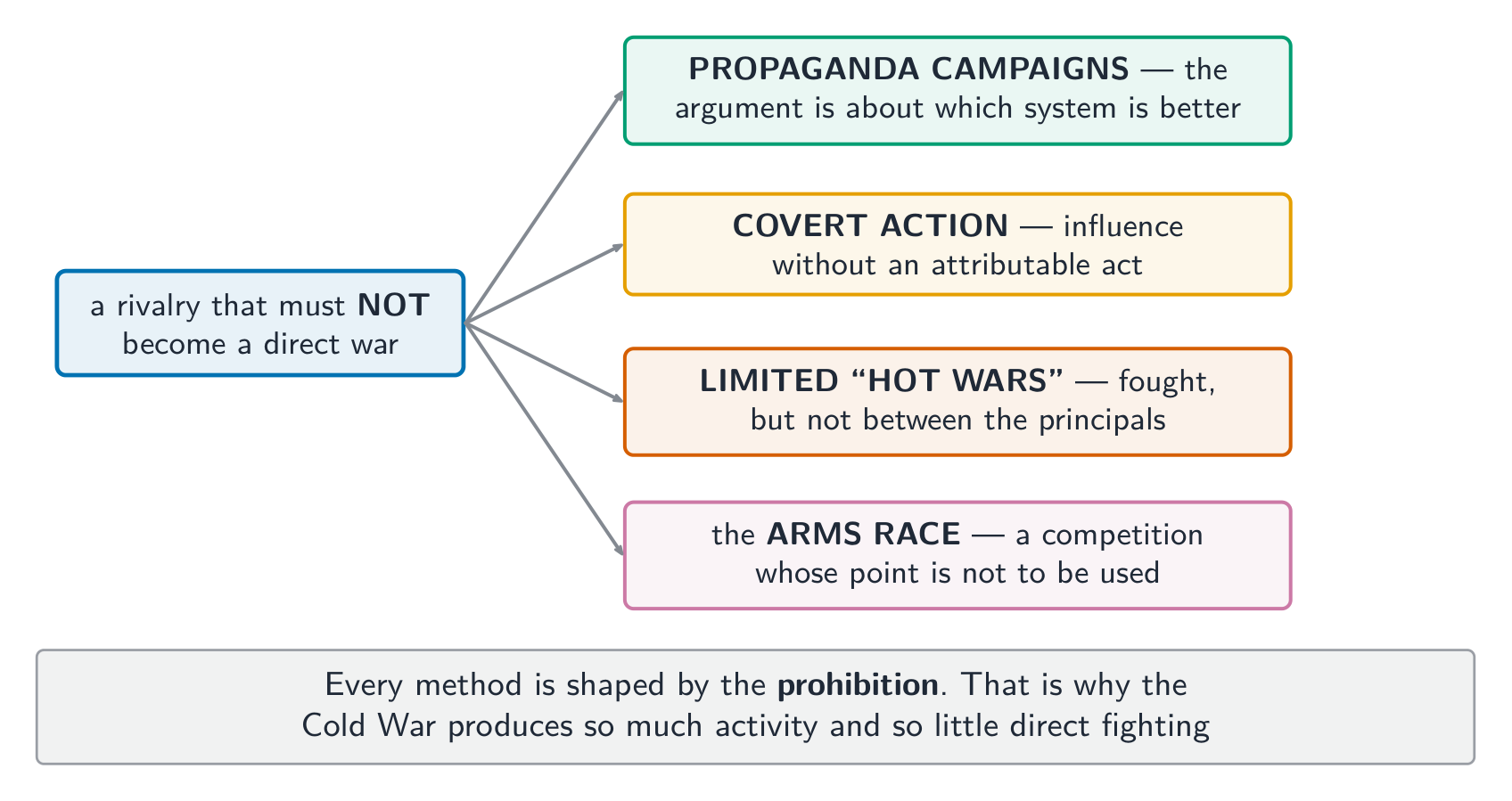
  • KC-4.1.IV.B The Cold War played out on a global stage and involved propaganda campaigns; covert actions; limited “hot wars” in Asia, Africa, Latin America, and the Caribbean; and an arms race, with the threat of a nuclear war.

Illustrative examples:

  • Hot wars outside of Europe in which the United States and the USSR supported opposite sides:
    • Korean War
    • Vietnam War
    • Yom Kippur War
    • Soviet invasion of Afghanistan
ไทย

9.3 สงครามเย็น

จุดเน้นเชิงหัวข้อ (INT): ปฏิสัมพันธ์ระหว่างยุโรปกับโลก — ถูกขับเคลื่อนด้วยปัจจัยหลากหลาย การที่มีปฏิสัมพันธ์กับโลกของยุโรปได้นำไปสู่การแลกเปลี่ยนด้านการเมือง เศรษฐกิจ สังคม และวัฒนธรรม ซึ่งส่งผลกระทบต่อทั้งสังคมยุโรปและที่ไม่ใช่ยุโรป

จุดประสงค์การเรียนรู้หน่วยที่ 9.C: อธิบายสาเหตุ เหตุการณ์ และผลกระทบของสงครามเย็นในช่วงหลังสงครามโลกครั้งที่สอง

  • KC-4.1.IV.A แม้จะมีการพยายามรักษาความร่วมมือระหว่างประเทศผ่าน United Nations ที่เพิ่งก่อตั้งขึ้น แต่ความตึงเครียดที่ฝังรากลึกระหว่าง USSR และตะวันตก นำไปสู่การแบ่งแยกยุโรป ซึ่งถูกเรียกว่า "Iron Curtain" ในตะวันตก
  • KC-4.1.IV.B สงครามเย็นดำเนินไปบนเวทีระดับโลกและเกี่ยวข้องกับการรณรงค์ propaganda; การกระทำลับ; "hot wars" ขนาดเล็กในเอเชีย แอฟริกา อเมริกาเหนือและใต้ และicast;以及军备竞赛,伴有核战争的威胁。

ตัวอย่างประกอบ:

  • Hot wars นอกยุโรปที่สหรัฐฯ และ USSR สนับสนุนฝ่ายตรงข้าม:
    • Korean War
    • Vietnam War
    • Yom Kippur War
    • Soviet invasion of Afghanistan

Source: College Board AP Course and Exam Description · ⁨แหล่งที่มา: คำอธิบายหลักสูตรและข้อสอบ College Board AP⁩

English

Despite efforts to maintain international cooperation through the newly created United Nations 联合国, deep-seated tensions between the two blocs produced the Cold War.

The CED lists how it was actually conducted, and the list is worth memorising because questions ask for methods:

  • propaganda campaigns 宣传战;
  • covert actions 秘密行动;
  • limited "hot wars" 有限热战 in other regions;
  • an arms race 军备竞赛.

Note what is absent: direct war between the principals. The methods list is the answer to "how could a conflict this intense produce no direct war".

ไทย

แม้จะมีการพยายามรักษาความร่วมมือระหว่างประเทศผ่าน สหประชาชาติ ที่เพิ่งก่อตั้งขึ้น แต่ความตึงเครียดที่ฝังรากลึกระหว่างสองขั้วอำนาจทำให้เกิด สงครามเย็น

ตาราง CED แสดงวิธีการดำเนินการจริง และรายการนี้มีค่าแก่การท่องจำเนื่องจากข้อสอบถามถึงวิธีการ:

  • แคมเปญโฆษณาชวนเชื่อ;
  • การกระทำลับ;
  • สงครามร้อนจำกัด ในภูมิภาคอื่นๆ;
  • การแข่งขันอาวุธ

สังเกตสิ่งที่ขาดหายไป: สงครามโดยตรงระหว่างผู้มีส่วนได้ส่วนเสียหลัก รายการวิธีเหล่านี้ คือ คำตอบสำหรับคำถามว่า "ขัดแย้งที่รุนแรงระดับนี้จะไม่เกิดสงครามโดยตรงได้อย่างไร"

ทุกวิธีถูกกำหนดโดยข้อห้ามเดียว: ไม่มีการสงครามโดยตรงระหว่างผู้มีส่วนได้ส่วนเสียหลัก
9.4

Two Superpowers Emerge · ⁨superpower สองตัวปรากฏตัวขึ้น⁩

Syllabus · ⁨หลักสูตร⁩
English

9.4 Two Super Powers Emerge

Thematic Focus (ECD): Economic and Commercial Developments — Economic development, especially the development of capitalism, played an important role in Europe’s history, often having significant social, political, and cultural effects.

Learning Objective Unit 9.D: Explain the economic and political consequences of the Cold War for Europe.

  • KC-4.1.IV.C The United States exerted a strong military, political, and economic influence in Western Europe, leading to the creation of world monetary and trade systems and geopolitical alliances, including NATO.
  • KC-4.1.IV.D Countries east of the Iron Curtain came under the military, political, and economic domination of the Soviet Union within the Council for Mutual Economic Assistance (COMECON) and the Warsaw Pact.
  • KC-4.2.V.A Central and Eastern European nations within the Soviet bloc followed an economic model based on central planning, extensive social welfare, and specialized production among bloc members. This brought with it the restriction of individual rights and freedoms, suppression of dissent, and constraint of emigration for the various populations within the Soviet bloc.
  • KC-4.2.V Eastern European nations were bound by their relationships with the Soviet Union, which oscillated between repression and limited reform, until the collapse of communist governments in Eastern Europe and the fall of the Soviet Union.
    • KC-4.2.V.B After 1956, Soviet leader Nikita Khrushchev’s de-Stalinization policies failed to meet their economic goals within the Soviet Union; combined with reactions to existing limitations on individual rights, this prompted revolts in Eastern Europe, which ended with a reimposition of Soviet rule and repressive totalitarian regimes.
  • KC-4.2.V.D.i The rise of new nationalisms in Central and Eastern Europe brought peaceful revolution in most countries but resulted in instability in some former Soviet republics.

Illustrative examples:

  • The world monetary and trade system:
    • International Monetary Fund (IMF)
    • World Bank
    • General Agreement on Tariffs and Trade (GATT)
    • World Trade Organization (WTO)
  • Revolts against Soviet control:
    • Prague Spring
    • Hungarian Revolt
ไทย

9.4 สองมหาอำนาจเกิดขึ้น

Thematic Focus (ECD): Economic and Commercial Developments — Economic development, โดยเฉพาะการ phát triểnของ资本主义, played an important role in Europe’s history, มักมี significant social, political และ cultural effects

จุดประสงค์การเรียนรู้หน่วยที่ 9.D: อธิบายผลกระทบทางเศรษฐกิจและการเมืองของสงครามเย็นต่อยุโรป

  • KC-4.1.IV.C สหรัฐอเมริกา exerted อธิปไตยทางทหาร การเมือง และเศรษฐกิจอย่างเข้มงวดในยุโรปตะวันตก นำไปสู่การสร้างระบบการเงินและการค้าระดับโลก รวมถึงพันธสัญญาทางการเมืองระหว่างประเทศ เช่น NATO
  • KC-4.1.IV.D ประเทศที่อยู่ทางตะวันออกของม่านเหล็กตกอยู่ภายใต้การครอบงำทางทหาร การเมือง และเศรษฐกิจของสหภาพโซเวียต ภายในกรอบของ Council for Mutual Economic Assistance (COMECON) และ Warsaw Pact
  • KC-4.2.V.A ประเทศในยุโรปกลางและตะวันออกที่เป็นส่วนหนึ่งของ bloc ของโซเวียต ใช้แบบแผนทางเศรษฐกิจที่เน้นการวางแผนจากส่วนกลาง การดูแลสังคมอย่างกว้างขวาง และการผลิตเฉพาะทางระหว่างสมาชิกใน bloc ซึ่งนำไปสู่การจำกัดสิทธิและอิสรภาพส่วนบุคคล การปราบปรามเสียงคัดค้าน และการควบคุมการเดินทางออกนอกประเทศของประชากรต่างๆ ใน bloc ของโซเวียต
  • KC-4.2.V ประเทศในยุโรปตะวันออกถูกผูกพันด้วยความสัมพันธ์กับสหภาพโซเวียต ซึ่งสลับระหว่างการกดขี่กับการปฏิรูปที่จำกัด จนกระทั่งรัฐบาลคอมมิวนิสต์ในยุโรปตะวันออกล่มสลายและสหภาพโซเวียตแตกสลาย
    • KC-4.2.V.B หลังปี 1956 นโยบาย de-Stalinization ของผู้นำโซเวียต Nikita Khrushchev ไม่สามารถบรรลุเป้าหมายทางเศรษฐกิจภายในสหภาพโซเวียตได้ เมื่อรวมกับปฏิกิริยาต่อข้อจำกัดที่มีอยู่เกี่ยวกับสิทธิส่วนบุคคล ได้กระตุ้นให้เกิดการกบฏในยุโรปตะวันออก ซึ่งสิ้นสุดด้วยการบังคับใช้กฎระเบียบของโซเวียตใหม่และระบอบ(cn totalitarian regime ที่压抑)
  • KC-4.2.V.D.i การเกิดขึ้นของชาติพันธุ์ใหม่ในยุโรปกลางและตะวันออกนำมาซึ่งการปฏิวัติสันติในหลายประเทศ แต่ก่อให้เกิดความไม่เสถียรในบางสาธารณรัฐแห่งอดีตของโซเวียต

ตัวอย่างประกอบ:

  • ระบบการเงินและการค้าของโลก:
    • International Monetary Fund (IMF)
    • World Bank
    • General Agreement on Tariffs and Trade (GATT)
    • World Trade Organization (WTO)
  • การกบฏต่อต้านการควบคุมของโซเวียต:
    • Prague Spring
    • Hungarian Revolt

Source: College Board AP Course and Exam Description · ⁨แหล่งที่มา: คำอธิบายหลักสูตรและข้อสอบ College Board AP⁩

English
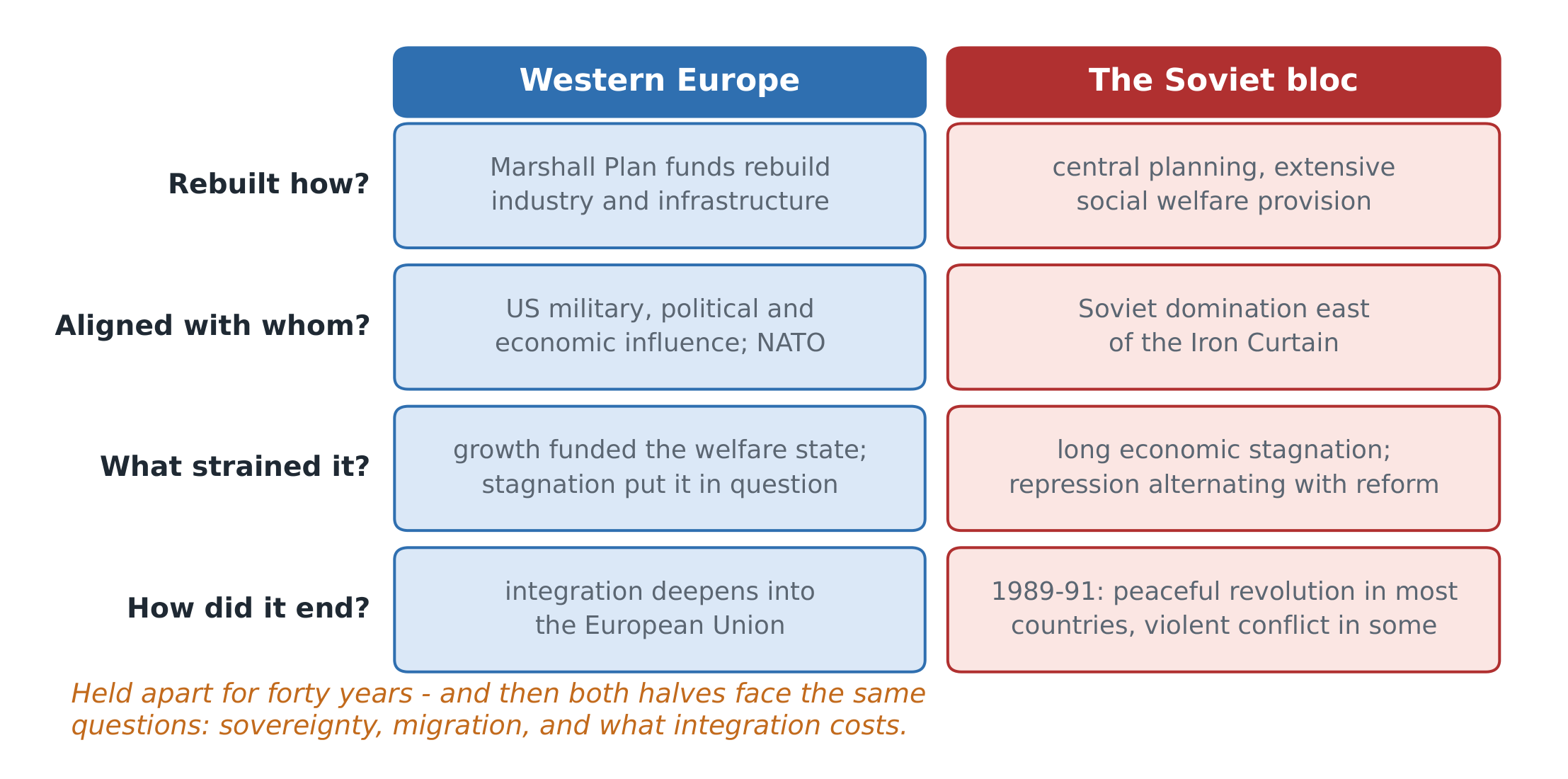
  • The United States exerted strong military, political, and economic influence in Western Europe, leading to the creation of NATO 北约.
  • Countries east of the Iron Curtain 铁幕 came under the military, political, and economic domination of the Soviet Union.
  • Central and Eastern European nations within the Soviet bloc followed an economic model based on central planning 中央计划 and extensive social welfare provision.
  • Those nations' relationship with the Soviet Union oscillated between repression and reform - which is the CED's own phrase and a better answer than either alone.
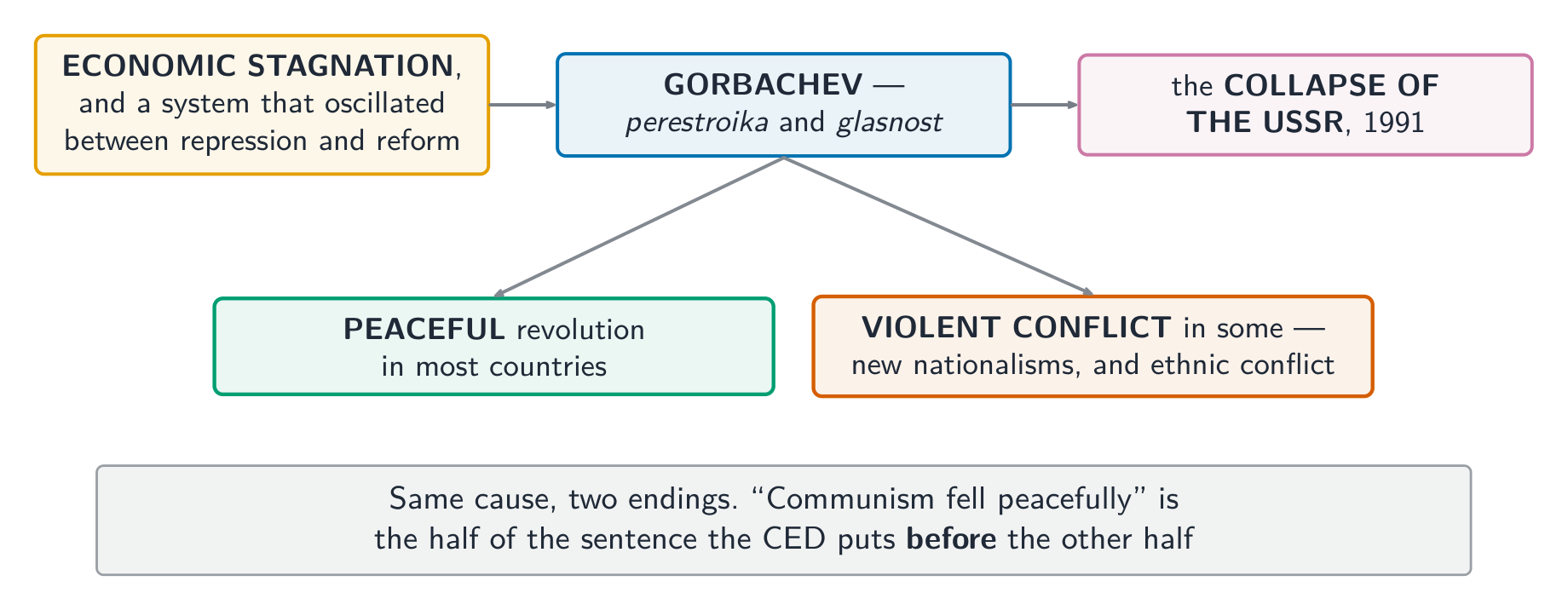
  • The rise of new nationalisms in Central and Eastern Europe eventually brought peaceful revolution in most countries, but violent conflict in some.
ไทย
ยุโรปสองฝั่งในแถวเดียวกัน - การเปรียบเทียบที่หน่วยเรียนออกแบบมาเพื่อสอบถาม
การแบ่งแยกนี้คงอยู่เป็นเวลาสี่สิบปี และจากนั้นทั้งสองฝั่งก็เผชิญกับคำถามเดียวกัน
  • สหรัฐอเมริกา มีอิทธิพลทางทหาร การเมือง และเศรษฐกิจอย่างแรงต่อยุโรปตะวันตก นำไปสู่การสร้าง นาโต (NATO)
  • ประเทศทางตะวันออกของ ม่านเหล็ก อยู่ภายใต้การครอบงำทางทหาร การเมือง และเศรษฐกิจของ สหภาพโซเวียต
  • ประเทศในยุโรปกลางและตะวันออกภายในกลุ่มโซเวียตปฏิบัติตามแบบจำลองเศรษฐกิจที่เน้น การวางแผนส่วนกลาง และการจัดสรรสวัสดิการสังคมอย่างกว้างขวาง
  • ความสัมพันธ์ของประเทศเหล่านี้กับสหภาพโซเวียต สลับระหว่างการกดขี่และการปฏิรูป - ซึ่งเป็นวลีของ CED เองและเป็นคำตอบที่ดีกว่าเมื่อใช้แยกกัน
  • การเกิดขึ้นของ Nationalism ใหม่ ในยุโรปกลางและตะวันออกในที่สุดก็นำไปสู่ การปฏิวัติอย่างสันติใน hầuทุกประเทศ แต่มี ความขัดแย้งอย่างรุนแรงในบางแห่ง
Vocabulary · ⁨คำศัพท์⁩ Train · ⁨ฝึกฝน⁩
English ไทย
NATO/ˈneɪtəʊ/ NATO
Iron Curtain/ˈaɪən ˈkɜːtn/ ผืนม่านเหล็ก
central planning/ˈsentrəl ˈplænɪŋ/ การวางแผนกลาง
increase in welfare benefits/ˈɪŋkriːs ɪn ˈwelfeə ˈbenɪfɪts/ การเพิ่มขึ้นของสวัสดิการ
economic stagnation/ˌiːkəˈnɒmɪk stæɡˈneɪʃn/ ความชะงักทางเศรษฐกิจ
9.5

Postwar Nationalism, Ethnic Conflict, and Atrocities · ⁨Nationalism หลังสงคราม ความขัดแย้งด้านเชื้อชาติ และอาชญากรรมร้ายแรง⁩

Syllabus · ⁨หลักสูตร⁩
English

9.5 Postwar Nationalism, Ethnic Conflict, and Atrocities

Thematic FocusLearning ObjectiveHistorical Developments

NEI
National and European Identity — Definitions and perceptions of regional, cultural, national, and European identity have developed and been challenged over time, with varied and often profound effects on the political, social, and cultural order in Europe.

Unit 9.E
Explain the causes and effects of mass atrocities in the period following World War II to the present.

  • KC-4.1.V Nationalist and separatist movements, along with ethnic conflict and ethnic cleansing, periodically disrupted the post-World War II peace.
    • KC-4.2.V.D.ii New nationalisms in central and eastern Europe resulted in war and genocide in the Balkans.

Illustrative examples:

  • Nationalist violence:
    • Ireland
    • Chechnya
  • Separatist movements:
    • Basque (ETA)
    • Flemish
  • Ethnic cleansing: §Bullet Bosnian Muslims
    • Albanian Muslims of Kosovo
ไทย

9.5 ความเป็นชาตินิยมหลังสงคราม ความขัดแย้งทางชาติพันธุ์ และอาชญากรรมต่อมนุษยชาติ

Тематический фокус (NEI): Национальная и европейская идентичность — Определения и восприятие региональной, культурной, национальной и европейской идентичности развивались и подвергались критике на протяжении времени, оказывая разнообразные и часто глубокие последствия на политический, социальный и культурный порядок в Европе.

Learning ObjectiveHistorical Developments

Unit 9.E
อธิบายสาเหตุและผลกระทบของอาชญากรรมต่อมนุษยชาติในระดับmass ในช่วงหลังสงครามโลกครั้งที่สองจนถึงปัจจุบัน

  • KC-4.1.V ขบวนการชาตินิยมและแยกตัวออก性以及ความขัดแย้งทางชาติพันธุ์และการล้างชาติพันธุ์ ได้รบกวนสันติภาพหลังสงครามโลกครั้งที่สองเป็นระยะๆ
    • KC-4.2.V.D.ii ความเป็นชาตินิยมใหม่ในยุโรปกลางและตะวันออกนำไปสู่สงครามและ genocide ใน Balkans

ตัวอย่างประกอบ:

  • ความรุนแรงทางชาตินิยม:
    • Irlandia
    • Chechnya
  • ขบวนการแยกตัว:
    • Basque (ETA)
    • Flemish
  • การล้างชาติพันธุ์: §Bullet Bosnian Muslims
    • Albanian Muslims of Kosovo

Source: College Board AP Course and Exam Description · ⁨แหล่งที่มา: คำอธิบายหลักสูตรและข้อสอบ College Board AP⁩

English

Nationalist and separatist movements, along with ethnic conflict and ethnic cleansing, periodically disrupted the post-war order. The examinable point is that 1945 did not end the problem of nationalism in Europe; it suppressed it in some places and postponed it in others.

ไทย

ขบวนการNationalism และ séparatist ร่วมกับ ความขัดแย้งด้านเชื้อชาติและการล้างเชื้อชาติ รบกวนระเบียบหลังสงครามเป็นระยะๆ จุดที่ควรทดสอบคือปี 1945 ไม่ได้แก้ปัญหาNationalism ในยุโรป; มันเพียงยับยั้ง它在某些地方และเลื่อนไว้直到其他一些地方

9.6

Contemporary Western Democracies · ⁨ประชาธิปไตยตะวันตกสมัยใหม่⁩

Syllabus · ⁨หลักสูตร⁩
English

9.6 Contemporary Western Democracies

Thematic FocusLearning ObjectiveHistorical Developments

ECD
Economic and Commercial Developments — Economic development, especially the development of capitalism, played an important role in Europe’s history, often having significant social, political, and cultural effects.

Unit 9.F
Explain state-based economic developments following World War II and the responses to these developments.

  • KC-4.2.IV Postwar economic growth supported an increase in welfare benefits; however, subsequent economic stagnation led to criticism and limitation of the welfare state.
    • KC-4.2.IV.B The expansion of cradle-to-grave social welfare programs in the aftermath of World War II, accompanied by high taxes, became a contentious domestic political issue as the budgets of European nations came under pressure in the late 20th century.
ไทย

9.6 Demokracyzacja Zachodnia Współczesna

Thematic FocusLearning ObjectiveHistorical Developments

ECD
Economic and Commercial Developments — Economic development, โดยเฉพาะการ phát triểnของ资本主义, played an important role in Europe’s history, มักมี significant social, political และ cultural effects

Unit 9.F
อธิบายการพัฒนาทางเศรษฐกิจ由国家 following World War II และ responses to these developments.

  • KC-4.2.IV การเติบโตทางเศรษฐกิจหลังสงครามสนับสนุนการเพิ่มขึ้นของสวัสดิการสังคม; อย่างไรก็ตาม stagnation ทางเศรษฐกิจในภายหลังได้นำมาซึ่งการวิพากษ์วิจารณ์และการจำกัดของ welfare state
    • KC-4.2.IV.B การขยายตัวของ cradle-to-grave social welfare programs หลังสงครามโลกครั้งที่สอง พร้อมด้วยภาษีสูง กลายเป็น issue การเมืองภายในประเทศที่争议เมื่อ budgets ของประเทศยุโรปอยู่ใน压力下 during the late 20th century.

Source: College Board AP Course and Exam Description · ⁨แหล่งที่มา: คำอธิบายหลักสูตรและข้อสอบ College Board AP⁩

English

Postwar economic growth supported an increase in welfare benefits 福利待遇; subsequent economic stagnation 经济停滞 led to criticism and scaling back of the welfare state 福利国家.

Hold both halves. Growth funded the welfare state; the end of growth is what put it under argument - which is a causal claim, not just a sequence of events.

ไทย

การเติบโตทางเศรษฐกิจหลังสงครามสนับสนุน การเพิ่มขึ้นของสวัสดิการ;此后 经济停滞导致对 福利国家 的批评和缩减。

记住两半部分。增长资助了福利国家;增长的结束才是使其受到争议的原因——这是一个因果主张,而不仅仅是事件序列。

9.7

The Fall of Communism · ⁨共产主义的崩溃⁩

Syllabus · ⁨หลักสูตร⁩
English

9.7 The Fall of Communism

Thematic FocusLearning ObjectiveHistorical Developments

SOP
States and Other Institutions of Power — European states and nations developed governmental and civil institutions from 1450 to the present to organize society and consolidate political power, with a variety of social, cultural, and economic effects.

Unit 9.G
Explain the causes and effects of the end of the Cold War.

  • KC-4.2.V.C Following a long period of economic stagnation, Mikhail Gorbachev’s internal reforms of perestroika and glasnost, designed to make the Soviet system more flexible, failed to stave off the collapse of the Soviet Union and the end of its hegemonic control over Eastern and Central European satellites.
  • KC-4.1.IV.E The collapse of the USSR in 1991 ended the Cold War and led to the establishment of capitalist economies throughout Eastern Europe. Germany was reunited, the Czechs and the Slovaks parted, Yugoslavia dissolved, and the European Union was enlarged through the admission of former Eastern bloc countries.

Illustrative examples:

  • Collapse of Soviet Union and satellites:
    • Fall of the Berlin Wall
    • Polish elections in 1989
ไทย

9.7 The Fall of Communism

จุดเน้นเชิง主题 (SOP): รัฐและสถาบันอำนาจอื่นๆ — รัฐและชาติยุโรปได้พัฒนารัฐบาลและสถาบันพลเมืองตั้งแต่ปี ค.ศ. 1450 จนถึงปัจจุบัน เพื่อจัดระเบียบสังคมและรวมศูนย์อำนาจทางการเมือง โดยมีผลกระทบทางสังคม วัฒนธรรม และเศรษฐกิจที่หลากหลาย

Learning ObjectiveHistorical Developments

Unit 9.G
อธิบายสาเหตุและผลกระทบของการสิ้นสุดของ Cold War

  • KC-4.2.V.C หลังช่วงเวลา dàiของ economic stagnation, Mikhail Gorbachev’s internal reforms of perestroika and glasnost ซึ่งออกแบบมาเพื่อทำให้ Soviet system ยืดหยุ่นมากขึ้น ล้มเหลวในการป้องกันไม่ให้苏联解体และการสิ้นสุดของ hegemonic control ของมันเหนือ Eastern and Central European satellites
  • KC-4.1.IV.E การล่มสลายของ USSR ในปี 1991 สิ้นสุด Cold War และนำไปสู่การจัดตั้ง capitalist economies throughout Eastern Europe. เยอรมนี được reunified, Czechs and Slovaks parted, Yugoslavia dissolved, และ European Union was enlarged through the admission of former Eastern bloc countries.

ตัวอย่างประกอบ:

  • Collapse of Soviet Union and satellites:
    • Fall of the Berlin Wall
    • Polish elections in 1989

Source: College Board AP Course and Exam Description · ⁨แหล่งที่มา: คำอธิบายหลักสูตรและข้อสอบ College Board AP⁩

English

Following a long period of economic stagnation, Mikhail Gorbachev's 戈尔巴乔夫 internal reforms of perestroika 改革 and glasnost 开放 - despite being intended to strengthen the system - contributed to its collapse.

The collapse of the USSR in 1991 ended the Cold War and led to the establishment of capitalist economies throughout Eastern Europe.

The shape of the argument matters: reform intended to save a system helped end it. That is the kind of claim an evaluation question rewards.

ไทย

在长期的 经济停滞 之后,米哈伊尔·戈尔巴乔夫 的内部改革——perestroika 和 glasnost——尽管旨在加强该体制,却促成了其崩溃。

1991年苏联解体 结束了冷战,并导致了整个东欧资本主义经济的建立。

论证的结构很重要:旨在拯救体制的改革帮助终结了它。这是评估题所奖励的那种主张。

同一原因,两种结局——CED将‘大多数和平’置于‘少数暴力’之前
Explore · ⁨สำรวจ⁩

Trace the collapse, then split its ending · ⁨ติดตามการล่มสลาย แล้วแยกแยะจุดจบของเหตุการณ์นั้น⁩

The CED pairs 'peaceful revolution in most countries' with 'violent conflict in some'. Students drop the second half. · ⁨The CED คู่ 'การปฏิวัติอย่างสันติในประเทศส่วนใหญ่' กับ 'ความขัดแย้งแบบรุนแรงในบางประเทศ' นักเรียนตัดส่วนหลังออก⁩

Vocabulary · ⁨คำศัพท์⁩ Train · ⁨ฝึกฝน⁩
English ไทย
perestroika/ˈperɪstrɔɪkə/ perestroika
glasnost/ˈɡlæsnɒst/ glasnost
decolonisation/dɪˌkɒlənaɪˈzeɪʃn/ การปลดปล่อยอาณานิคม
European Union/ˌjʊərəˈpɪən ˈjuːnɪən/ สหภาพยุโรป
migrant workers/ˈmaɪɡrənt ˈwɜːkəz/ แรงงานอพยพ
altered Europe's religious makeup/ˈɒltəd ˈjʊərəps rɪˈlɪdʒəs ˈmeɪkʌp/ เปลี่ยนโครงสร้างทางศาสนาของยุโรป
eluded consensus/ɪˈluːdɪd kənˈsensəs/ หลบหลีก consensus
both enthusiasm and criticism/bəʊθ enˈθjuːziæzəm ænd ˈkrɪtɪsɪzəm/ ทั้งความตื่นเต้นและการวิพากษ์วิจารณ์
Green parties/ɡriːn ˈpɑːtiz/ พรรคกรีน
sustainable development/səˈsteɪnəbl dɪˈveləpmənt/ การพัฒนาที่ยั่งยืน
consumer culture/kənˈsuːmə ˈkʌltʃə/ วัฒนธรรมผู้บริโภค
9.8

20th-Century Feminism · ⁨20世纪女权主义⁩

Syllabus · ⁨หลักสูตร⁩
English

9.8 20th-Century Feminism

Thematic FocusLearning ObjectiveHistorical Developments

SCD
Social Organization and Development — Economic, political, and cultural factors have influenced the form and status of family, class, and social groups in European history, which has, in turn, affected both the individual and society.

Unit 9.H
Explain how women’s roles and status developed and changed throughout the 20th and 21st centuries.

  • KC-4.4.II The lives of women were defined by family and work responsibilities, economic changes, and feminism.
    • KC-4.4.II.B In Western Europe through the efforts of feminists, and in Eastern Europe and the Soviet Union through government policy, women finally gained the vote, greater educational opportunities, and access to professional careers, even while continuing to face social inequalities.
    • KC-4.4.II.D New modes of marriage, partnership, motherhood, divorce, and reproduction gave women more options in their personal lives.
    • KC-4.4.II.E Women attained high political office and increased their representation in legislative bodies in many nations.

Illustrative examples:

  • Feminists and feminism: §Bullet Simone de Beauvoir
    • Second-wave feminism
  • New modes of managing reproduction:
    • Birth control pill
    • Scientific means of fertilization
  • Women who attained high political office:
    • Margaret Thatcher of Great Britain
    • Mary Robinson of Ireland
    • Édith Cresson of France
ไทย

9.8 Feminismera dalam Abad ke-20

Thematic FocusLearning ObjectiveHistorical Developments

SCD
Social Organization and Development — Economic, political และ cultural factors have influenced the form และ status ของ family, class และ social groups ในประวัติศาสตร์ยุโรป ซึ่งส่งผลต่อทั้ง individual และ society

Unit 9.H
อธิบายว่าบทบาทและสถานะของผู้หญิงได้พัฒนาและเปลี่ยนแปลงตลอด abad ke-20 dan abad ke-21 bagaimana.

  • KC-4.4.II ชีวิตของผู้หญิงถูกกำหนดโดย family responsibilities, work responsibilities, economic changes, dan feminism.
    • KC-4.4.II.B ใน Western Europe melalui efforts of feminists, dan di Eastern Europe dan Soviet Union melalui government policy, perempuan akhirnya mendapatkan hak suara, opportunities pendidikan yang lebih baik, dan akses ke careers profesional, meskipun tetap menghadapi social inequalities.
    • KC-4.4.II.D New modes of marriage, partnership, motherhood, divorce, dan reproduction memberikan women more options dalam personal lives mereka.
    • KC-4.4.II.E Perempuan mencapai high political office dan meningkatkan representation mereka dalam legislative bodies di banyak negara.

ตัวอย่างประกอบ:

  • Feminists and feminism: §Bullet Simone de Beauvoir
    • Second-wave feminism
  • New modes of managing reproduction:
    • Birth control pill
    • Scientific means of fertilization
  • Women who attained high political office:
    • Margaret Thatcher dari Great Britain
    • Mary Robinson dari Ireland
    • Édith Cresson dari France

Source: College Board AP Course and Exam Description · ⁨แหล่งที่มา: คำอธิบายหลักสูตรและข้อสอบ College Board AP⁩

English

The lives of women were defined by family and work responsibilities, economic changes, and feminism. Across the century: expanding participation in paid work, especially during both wars; the extension of political rights; and organised movements that changed law and expectation in the postwar decades.

ไทย

女性的生活由 家庭与工作职责、经济变革以及女权运动 所定义。纵观整个世纪:参与有薪工作的范围扩大,尤其是在两次战争期间;政治权利的扩展;以及在战后数十年中改变法律和社会期望的有组织的运动。

9.9

Decolonization · ⁨去殖民化⁩

Syllabus · ⁨หลักสูตร⁩
English

9.9 Decolonization

Thematic FocusLearning ObjectiveHistorical Developments

INT
Interaction of Europe and the World — Motivated by a variety of factors, Europe’s interaction with the world led to political, economic, social, and cultural exchanges that influenced both European and non-European societies.

Unit 9.I
Explain the various ways in which colonial groups around the world sought independence from colonizers in the 20th and 21st centuries.

  • KC-4.1.VI The process of decolonization occurred over the course of the century with varying degrees of cooperation, interference, or resistance from European imperialist states.
    • KC-4.1.VI.A At the end of World War I, U.S. President Woodrow Wilson’s principle of national self-determination raised expectations in the non-European world for new policies and freedoms.
    • KC-4.1.VI.C Despite indigenous nationalist movements, independence for many African and Asian territories was delayed until the mid- and even late 20th century by the imperial powers’ reluctance to relinquish control, threats of interference from other nations, unstable economic and political systems, and Cold War strategic alignments.

Illustrative examples:

  • Indigenous nationalist movements:
    • Indian National Congress
    • Algeria’s National Liberation Front (FLN)
    • Ho Chi Minh’s Viet Minh
    • Sukarno and Indonesian nationalism
ไทย

9.9 Dekolonisasi

จุดเน้นเชิงหัวข้อ (INT): ปฏิสัมพันธ์ระหว่างยุโรปกับโลก — ถูกขับเคลื่อนด้วยปัจจัยหลากหลาย การที่มีปฏิสัมพันธ์กับโลกของยุโรปได้นำไปสู่การแลกเปลี่ยนด้านการเมือง เศรษฐกิจ สังคม และวัฒนธรรม ซึ่งส่งผลกระทบต่อทั้งสังคมยุโรปและที่ไม่ใช่ยุโรป

Learning ObjectiveHistorical Developments

Unit 9.I
Jelaskan berbagai cara yang dilakukan oleh kelompok kolonial di seluruh dunia untuk mencari kemerdekaan dari penjajah selama abad ke-20 dan ke-21.

  • KC-4.1.VI Proses dekolonisasi terjadi sepanjang abad dengan varying degrees of cooperation, interference, atau resistance dari European imperialist states.
    • KC-4.1.VI.A ในช่วงปลายสงครามโลกครั้งที่หนึ่ง หลักการแห่งการกำหนด nasib ของตนเองnational self-determination ของประธานาธิบดีสหรัฐอเมริกา Woodrow Wilson ได้สร้างความคาดหวังในโลกนอกยุโรปต่อนโยบายและอิสรภาพใหม่
    • KC-4.1.VI.C แม้จะมีขบวนการNationalism ในท้องถิ่น แต่เอกราชของดินแดนแอฟริกาและเอเชียหลายแห่งถูกชะลอจนถึงช่วงกลางและแม้แต่ช่วงปลาย 20th Century เนื่องจากความไม่เต็มใจของaces จักรวรรดิที่จะ relinquish การควบคุม threats ของการแทรกแซงจากประเทศอื่น ๆ ระบบเศรษฐกิจและการเมืองที่ไม่มั่นคง และการจัด aligning ทางยุทธศาสตร์ during Cold War

ตัวอย่างประกอบ:

  • การเคลื่อนไหวทางชาตินิยมพื้นเมือง:
    • สภาแห่งชาติอินเดีย
    • Front of Algeria's National Liberation (FLN)
    • Viet Minh ของ Ho Chi Minh
    • Sukarno และ民族主义ของอินโดนีเซีย

Source: College Board AP Course and Exam Description · ⁨แหล่งที่มา: คำอธิบายหลักสูตรและข้อสอบ College Board AP⁩

English

The process of decolonisation 去殖民化 occurred over the course of the century with varying degrees of cooperation, interference, or resistance from the European imperial powers.

The consequence for Europe itself is the part students omit: losing empire changed what a European state was, and it produced the migration examined two topics below.

ไทย

去殖民化 的过程贯穿了整个世纪,欧洲帝国列强表现出 不同程度的合作、干涉或抵抗。

对欧洲本身而言,学生容易忽略的后果是:失去帝国改变了欧洲国家的性质,并引发了下面两个话题中讨论的移民问题。

9.10

The European Union · ⁨欧盟⁩

Syllabus · ⁨หลักสูตร⁩
English

9.10 The European Union

Thematic Focus (ECD): Economic and Commercial Developments — Economic development, especially the development of capitalism, played an important role in Europe’s history, often having significant social, political, and cultural effects.

Thematic Focus (NEI): National and European Identity — Definitions and perceptions of regional, cultural, national, and European identity have developed and been challenged over time, with varied and often profound effects on the political, social, and cultural order in Europe.

Learning Objective Unit 9.J: Explain how the formation and existence of the European Union influenced economic developments throughout the period following World War II to the present.

  • KC-4.4.IV European states began to set aside nationalist rivalries in favor of economic and political integration, forming a series of transnational unions that grew in size and scope over the second half of the 20th century.
    • KC-4.4.IV.A As the economic alliance known as the European Coal and Steel Community, envisioned as a means to spur postwar economic recovery, developed into the European Economic Community (EEC or Common Market) and the European Union (EU), Europe experienced increasing economic and political integration and efforts to establish a shared European identity.

Learning Objective Unit 9.K: Explain how the European Union affected national and European identity throughout the period following World War II to the present.

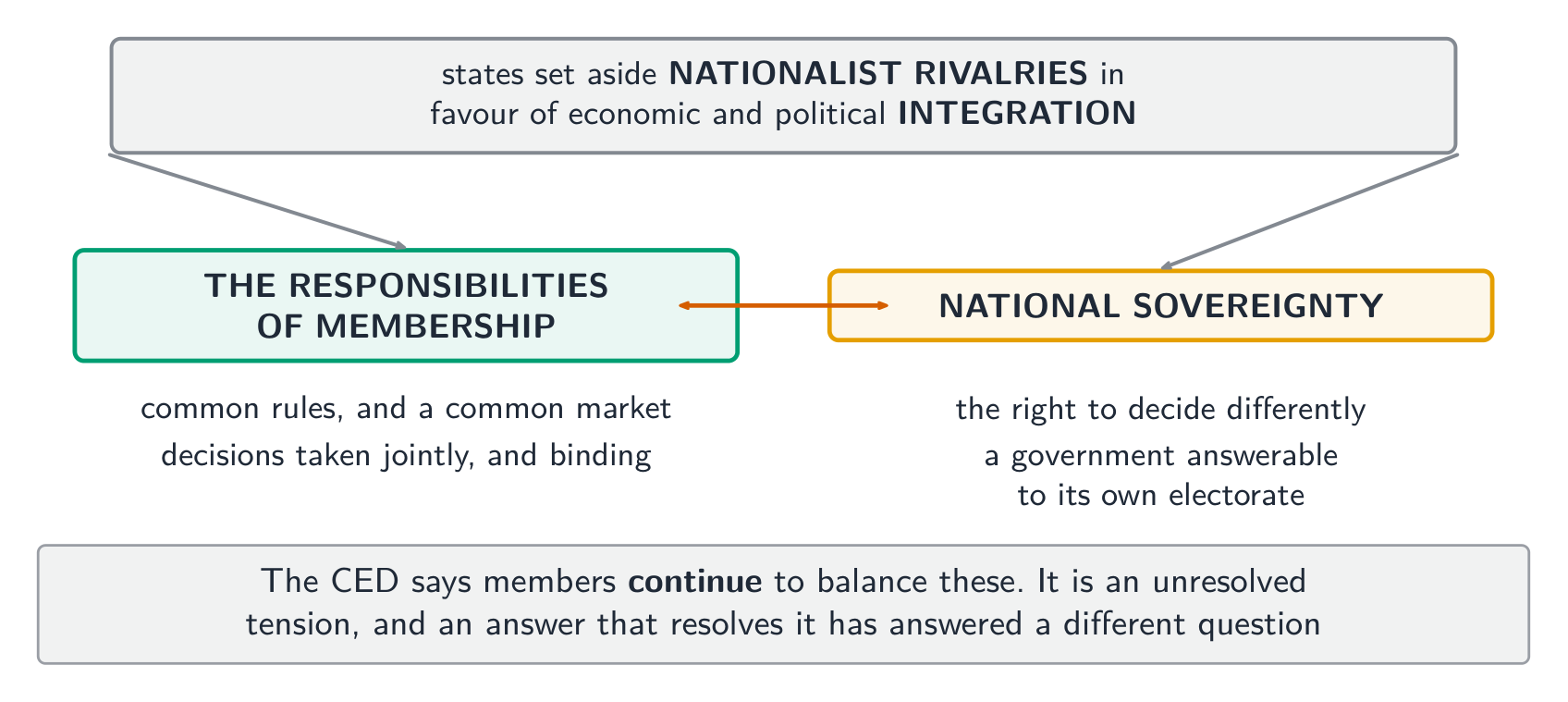
  • KC-4.4.IV.B EU member nations continue to balance questions of national sovereignty with the responsibilities of membership in an economic and political union.

Illustrative examples:

  • Challenges to national sovereignty within the EU:
    • The euro
    • European Parliament
    • Issue of remaining in the EU (e.g., Britain’s “Brexit”)
    • Free movement across borders
ไทย

9.10 สหภาพยุโรป

Thematic Focus (ECD): Economic and Commercial Developments — Economic development, โดยเฉพาะการ phát triểnของ资本主义, played an important role in Europe’s history, มักมี significant social, political และ cultural effects

Тематический фокус (NEI): Национальная и европейская идентичность — Определения и восприятие региональной, культурной, национальной и европейской идентичности развивались и подвергались критике на протяжении времени, оказывая разнообразные и часто глубокие последствия на политический, социальный и культурный порядок в Европе.

วัตถุประสงค์การเรียนรู้หน่วย 9.J: อธิบายว่าการก่อตัวและการดำรงอยู่ของสหภาพยุโรปส่งผลต่อการพัฒนาเศรษฐกิจในช่วงหลังสงครามโลกครั้งที่สองจนถึงปัจจุบันอย่างไร

  • KC-4.4.IV รัฐยุโรปเริ่มวางความขัดแย้งด้านชาตินิยมไว้ข้างหลังเพื่อแลกกับการบูรณาการทางเศรษฐกิจและการเมือง สร้างชุดของสหภาพข้ามชาติซึ่งขยายขนาดและขอบเขตตลอดครึ่งหลังของศตวรรษที่ 20
    • KC-4.4.IV.A ในฐานะพันธมิตรทางเศรษฐกิจที่เรียกว่า European Coal and Steel Community ซึ่งถูก设想ว่าเป็น Means เพื่อเร่งการฟื้นตัวทางเศรษฐกิจหลังสงคราม พัฒนาเป็น European Economic Community (EEC หรือ Common Market) และสหภาพยุโรป (EU) ยุโรปประสบกับการบูรณาการทางเศรษฐกิจและการเมืองที่เพิ่มขึ้นและความพยายามในการสร้างอัตลักษณ์ยุโรปร่วมกัน

วัตถุประสงค์การเรียนรู้หน่วย 9.K: อธิบายว่าสหภาพยุโรปส่งผลต่ออัตลักษณ์ระดับชาติและยุโรปในช่วงหลังสงครามโลกครั้งที่สองจนถึงปัจจุบันอย่างไร

  • KC-4.4.IV.B ประเทศสมาชิก EU ยังคงสมดุลระหว่างคำถามเรื่องอธิปไตยแห่งชาติกับหน้าที่ความรับผิดชอบของการเป็นสมาชิกในสหภาพทางเศรษฐกิจและการเมือง

ตัวอย่างประกอบ:

  • ความท้าทายต่อดิษสิทธิ์แห่งชาติภายใน EU:
    • ยูโร
    • สภาeuroparlament
    • เรื่องการคงอยู่ใน EU (เช่น Brexit ของอังกฤษ)
    • การเคลื่อนย้ายอิสระข้ามพรมแดน

Source: College Board AP Course and Exam Description · ⁨แหล่งที่มา: คำอธิบายหลักสูตรและข้อสอบ College Board AP⁩

English

European states began to set aside nationalist rivalries in favour of economic and political integration, forming a series of institutions that became the European Union 欧盟.

And the tension the CED names explicitly: EU member nations continue to balance questions of national sovereignty against the responsibilities of membership in an international body. That balance is the examinable issue, not the institutional history.

ไทย

欧洲国家 开始搁置民族主义竞争,转而追求经济和政治一体化,形成了一系列机构,最终成为 欧盟。

此外,CED明确指出的张力在于:欧盟成员国 继续在国家主权问题与国际组织成员责任之间寻求平衡。这种平衡才是考试的重点,而非制度历史本身。

An unresolved balance - an answer that resolves it has answered a different question
Explore · ⁨สำรวจ⁩

Weigh membership against sovereignty · ⁨ชั่งน้ำหนักสมาชิกภาพเทียบกับเอกราช⁩

The CED says members 'continue to balance' these — it is an unresolved tension, and an answer that resolves it has answered a different question. · ⁨The CED กล่าวว่า สมาชิก 'ยังคงสมดุล' สิ่งเหล่านี้ — มันคือความตึงเครียดที่ยังไม่ได้แก้ไข และการตอบคำถามที่แก้ความตึงเครียดนี้ได้ ก็เป็นการตอบคำถามอื่นแทน⁩

9.11

Migration and Immigration · ⁨移民与移入⁩

Syllabus · ⁨หลักสูตร⁩
English

9.11 Migration and Immigration

Thematic Focus (SCD): Social Organization and Development — Economic, political, and cultural factors have influenced the form and status of family, class, and social groups in European history, which has, in turn, affected both the individual and society.

Learning Objective Unit 9.L: Explain the causes and effects of changes to migration within and immigration to Europe throughout the period following World War II to the present.

  • KC-4.3.III.C Increased immigration into Europe altered Europe’s religious makeup, causing debate and conflict over the role of religion in social and political life.
  • KC-4.4.III.D Because of the economic growth of the 1950s and 1960s, migrant workers from southern Europe, Asia, and Africa immigrated to western and central Europe; however, after the economic downturn of the 1970s, these workers and their families often became targets of anti-immigrant agitation and extreme nationalist political parties.

Illustrative examples:

  • Anti-immigration, conservative parties:
    • French National Front
    • Austrian Freedom Party
ไทย

9.11 การอพยพและ nhập cư

Thematic Focus (SCD): Social Organization and Development — Economic, political และ cultural factors have influenced the form และ status ของ family, class และ social groups ในประวัติศาสตร์ยุโรป ซึ่งส่งผลต่อทั้ง individual และ society

วัตถุประสงค์การเรียนรู้หน่วย 9.L: อธิบายสาเหตุและผลกระทบของการเปลี่ยนแปลงในการอพยพภายในและ immigration เข้ายุโรปตลอดช่วงหลังสงครามโลกครั้งที่สองจนถึงปัจจุบัน

  • KC-4.3.III.C การเพิ่มจำนวน immigration เข้ายุโรปเปลี่ยนองค์ประกอบทางศาสนาของยุโรป ทำให้เกิดการถกเถียงและความขัดแย้งเกี่ยวกับบทบาทของศาสนาในชีวิตสังคมและการเมือง
  • KC-4.4.III.D เนื่องจากเศรษฐกิจเติบโตในช่วงทศวรรษ 1950 และ 1960 นักงานAlign จากยุโรปใต้ เอเชีย และแอฟริกา immigrated เข้ายุโรปตะวันตกและกลาง; อย่างไรก็ตาม หลังภาวะเศรษฐกิจถดถอยของทศวรรษ 1970 พนักงานเหล่านี้และครอบครัวมักกลายเป็นเป้าหมายของความเคลื่อนไหวต่อต้าน immigration และพรรคการเมืองNationalist Extremes

ตัวอย่างประกอบ:

  • พรรคอนุรักษ์นิยมต่อต้าน immigration:
    • French National Front
    • Austrian Freedom Party

Source: College Board AP Course and Exam Description · ⁨แหล่งที่มา: คำอธิบายหลักสูตรและข้อสอบ College Board AP⁩

English
  • Because of the economic growth of the 1950s and 1960s, migrant workers 外来劳工 from southern Europe, Asia, and Africa immigrated to northern and western Europe.
  • Increased immigration altered Europe's religious makeup 宗教构成, causing debate and conflict over the role of religion in public life.

Note the CED's own causal order: economic growth created labour demand, and migration followed it. The debates came afterwards.

ไทย
  • 由于 1950年代和1960年代的经济增长,来自南欧、亚洲和非洲的 外籍劳工 移居到北欧和西欧。
  • 移民增加 改变了欧洲的宗教构成,引发了关于 宗教在公共生活中的作用 的争论和冲突。

注意CED自身的因果顺序:经济增长创造了劳动力需求,随后才出现移民。随后的辩论发生在之后。

9.12 9.13

Technology and Globalization · ⁨技术与全球化⁩

Syllabus · ⁨หลักสูตร⁩
English

9.12 Technology

Thematic Focus (TSI): Technological and Scientific Innovation — Scientific and technological innovations have increased efficiency, improved daily life, and shaped human development and interactions, having both intended and unintended consequences.

Learning Objective Unit 9.M: Explain how innovation and advances in technology influenced cultural and intellectual developments in the period 1914 to the present.

  • KC-4.3.II.B Medical theories and technologies extended life but posed social and moral questions that eluded consensus and crossed religious, political, and philosophical perspectives.

Illustrative examples:

  • Medical theories and technologies:
    • Birth control
    • Abortion
    • Fertility treatments
    • Genetic engineering
ไทย

9.12 เทคโนโลยี

จุดเน้นเชิง主题的 (TSI): นวัตกรรมทางเทคโนโลยีและวิทยาศาสตร์ — นวัตกรรมทางวิทยาศาสตร์และเทคโนโลยีได้เพิ่มประสิทธิภาพ ปรับปรุงชีวิตประจำวัน และกำหนดทิศทางการพัฒนาและการมีปฏิสัมพันธ์ของมนุษย์ โดยมีทั้งผลกระทบที่ตั้งใจไว้และไม่ตั้งใจ

วัตถุประสงค์การเรียนรู้หน่วย 9.M: อธิบายว่านวัตกรรมและความก้าวหน้าทางเทคโนโลยีมีอิทธิพลต่อการพัฒนาทางวัฒนธรรมและปัญญาในช่วงปี 1914 ถึงปัจจุบันอย่างไร

  • KC-4.3.II.B ทฤษฎีและเทคโนโลยีทางการแพทย์ยืดอายุชีวิตแต่ đặtคำถามทางสังคมและจริยธรรมที่ขาดความเห็นพ้องและข้ามมุมมองทางศาสนา การเมืองและปรัชญา

ตัวอย่างประกอบ:

  • ทฤษฎีและเทคโนโลยีทางการแพทย์:
    • การคุมกำเนิด
    • การ中止การตั้งครรภ์
    • การรักษาความไม่fertile
    • วิศวกรรมพันธุกรรม
English

9.13 Globalization

Thematic Focus (TSI): Technological and Scientific Innovation — Scientific and technological innovations have increased efficiency, improved daily life, and shaped human development and interactions, having both intended and unintended consequences.

Learning Objective Unit 9.N: Explain the technological and cultural causes and consequences of increasing European globalization in the period from 1914 to the present.

  • KC-4.3.IV.C Increased imports of U.S. technology and popular culture after World War II generated both enthusiasm and criticism.
  • KC-4.4.I.D New communication and transportation technologies multiplied the connections across space and time, transforming daily life and contributing to the proliferation of ideas and to globalization.
  • KC-4.4.III.A Green parties in Western and Central Europe challenged consumerism, urged sustainable development, and, by the late 20th century, cautioned against globalization.

Illustrative examples:

  • New communication technologies:
    • Telephone
    • Radio
    • Television
    • Computer
    • Cell phone
    • Internet
ไทย

9.13 โลก globalization

จุดเน้นเชิง主题的 (TSI): นวัตกรรมทางเทคโนโลยีและวิทยาศาสตร์ — นวัตกรรมทางวิทยาศาสตร์และเทคโนโลยีได้เพิ่มประสิทธิภาพ ปรับปรุงชีวิตประจำวัน และกำหนดทิศทางการพัฒนาและการมีปฏิสัมพันธ์ของมนุษย์ โดยมีทั้งผลกระทบที่ตั้งใจไว้และไม่ตั้งใจ

วัตถุประสงค์การเรียนรู้หน่วย 9.N: อธิบายสาเหตุทางเทคโนโลยีและวัฒนธรรมและผลกระทบของการเพิ่มขึ้นของยุโรป globalizing ในช่วงปี 1914 ถึงปัจจุบัน

  • KC-4.3.IV.C การเพิ่มจำนวน imports ของเทคโนโลยีและวัฒนธรรมประชานิยมของสหรัฐฯ หลังสงครามโลกครั้งที่สองก่อให้เกิดทั้งความตื่นเต้นและการวิพากษ์วิจารณ์
  • KC-4.4.I.D เทคโนโลยีการสื่อสารและการขนส่งใหม่ได้เพิ่มการเชื่อมโยงผ่านพื้นที่และเวลา เปลี่ยนแปลงชีวิตประจำวัน และส่งผลให้เกิดการแพร่กระจายของแนวคิด sertaความก้าวหน้าทางโลกาภิวัตน์
  • KC-4.4.III.A พรรคสีเขียวในยุโรปตะวันตกและกลางได้ท้าทายวัฒนธรรมผู้บริโภค ส่งเสริมการพัฒนาที่ยั่งยืน และในช่วงปลายศตวรรษที่ 20 ได้เตือนภัยเรื่องโลกาภิวัตน์

ตัวอย่างประกอบ:

  • เทคโนโลยีการสื่อสารใหม่:
    • โทรศัพท์
    • วิทยุ
    • โทรทัศน์
    • คอมพิวเตอร์
    • โทรศัพท์มือถือ
    • อินเทอร์เน็ต

Source: College Board AP Course and Exam Description · ⁨แหล่งที่มา: คำอธิบายหลักสูตรและข้อสอบ College Board AP⁩

English
  • Medical theories and technologies extended life but posed social and moral questions that eluded consensus 未能形成共识.
  • Increased imports of US technology and popular culture after the war generated both enthusiasm and criticism 既受欢迎也遭批评.
  • New communication and transportation technologies multiplied connections across space and time, transforming daily life.
  • Green parties 绿党 in Western and Central Europe challenged consumerism and urged sustainable development 可持续发展.
ไทย
  • 医学理论与技术延长了寿命,但也带来了 未能达成共识 的社会与伦理问题。
  • 战后美国 技术和流行文化 的进口增加,既产生了 热情 也招致了 批评。
  • 新的 通信与交通技术 极大地增加了时空连接,改变了日常生活。
  • 西欧和中欧的 绿色政党 挑战消费主义,并呼吁 可持续发展。
9.14

Culture, Arts, and Demographic Trends · ⁨文化、艺术与人口趋势⁩

Syllabus · ⁨หลักสูตร⁩
English

9.14 20th- and 21st-Century Culture, Arts, and Demographic Trends

Thematic Focus (CID): Cultural and Intellectual Developments — The creation and transmission of knowledge, including the relationship between traditional sources of authority and the development of differing world views, had significant political, intellectual, economic, cultural, and social effects on European and world societies.

Learning Objective Unit 9.O: Explain how and why European culture changed from the period following World War II to the present.

  • KC-4.3.I.B The effects of world war and economic depression undermined this confidence in science and human reason, giving impetus to existentialism and producing postmodernism in the post-1945 period.
  • KC-4.3.III Organized religion continued to play a role in European social and cultural life despite the challenges of military and ideological conflict, modern secularism, and rapid social changes.
    • KC-4.3.III.A The challenges of totalitarianism and communism in central and eastern Europe brought mixed responses from the Christian churches.
    • KC-4.3.III.B Reform in the Catholic Church found expression in the Second Vatican Council, which redefined the church’s doctrine and practices and started to redefine its relations with other religious communities.
  • KC-4.3.IV During the 20th century, the arts were defined by experimentation, self-expression, subjectivity, and the increasing influence of the United States in both elite and popular culture.
    • KC-4.3.IV.A New movements in the visual arts, architecture, and music radically shifted existing aesthetic standards, explored subconscious and subjective states, and satirized Western society and its values.
    • KC-4.3.IV.B Throughout the century, a number of writers challenged traditional literary conventions, questioned Western values, and addressed controversial social and political issues.
  • KC-4.4.I.C Mass production, new food technologies, and industrial efficiency increased disposable income and created a consumer culture in which greater domestic comforts such as electricity, indoor plumbing, plastics, and synthetic fibers became available.
  • KC-4.4.II.C With economic recovery after World War II, the birth rate increased dramatically (the baby boom), often promoted by government policies.
  • KC-4.4.III.B Various movements, including women’s movements, political and social movements, gay and lesbian movements, and others, worked for expanded civil rights, in some cases obtaining the goals they sought, and in others facing strong opposition.
  • KC-4.4.III.C Intellectuals and youth reacted against perceived bourgeois materialism and decadence, most significantly with the revolts of 1968.

Illustrative examples:

  • Christian responses to totalitarianism:
    • Dietrich Bonhoeffer
    • Martin Niemöller
    • Pope John Paul II
    • Solidarity
  • New movements in the visual arts:
    • Cubism
    • Futurism
    • Dadaism
    • Surrealism
    • Abstract Expressionism
    • Pop Art
  • New architectural movements:
    • Bauhaus
    • Modernism
    • Postmodernism
  • New movements in music:
    • Igor Stravinsky
    • Arnold Schoenberg
    • Richard Strauss
  • Writers:
    • Franz Kafka
    • James Joyce
    • Erich Maria Remarque
    • Virginia Woolf
    • Jean-Paul Sartre
  • Government policies promoting population growth: §Bullet Neonatalism
    • Childcare facilities
ไทย

9.14 วัฒนธรรม ศิลปะ และแนวโน้มทางประชากรศาสตร์ในศตวรรษที่ 20 และ 21

ประเด็นสำคัญ (CID): การพัฒนาทางวัฒนธรรมและปัญญา — การสร้างสรรค์และการถ่ายทอดองค์ความรู้ รวมถึงความสัมพันธ์ระหว่างแหล่งอำนาจดั้งเดิมกับการพัฒนาโลกทัศน์ที่หลากหลาย ได้มีผลกระทบอย่างมีนัยสำคัญต่อสังคมยุโรปและทั่วโลกทั้งด้านการเมือง ปัญญา เศรษฐกิจ วัฒนธรรม และสังคม

จุดประสงค์การเรียนรู้หน่วยที่ 9.O: อธิบายว่าและทำไมวัฒนธรรมยุโรปจึงเปลี่ยนแปลงตั้งแต่ช่วงหลังสงครามโลกครั้งที่สองจนถึงปัจจุบัน

  • KC-4.3.I.B ผลกระทบจากสงครามโลกและความเศรษฐกิจตกต่ำได้ทำลายความเชื่อมั่นในวิทยาศาสตร์และเหตุผลของมนุษย์ ให้แรงผลักดันแก่กระแสอस्तิตววิทยา (existentialism) และนำไปสู่การสร้างลัทธิ pós-modernism ในยุคหลังปี ค.ศ. 1945
  • KC-4.3.III ศาสนาที่มีองค์กรยังคงมีบทบาทในชีวิตสังคมและวัฒนธรรมของยุโรป แม้จะเผชิญกับความท้าทายจากการขัดแย้งทางทหารและอุดมการณ์ การ secularism แบบสมัยใหม่ และการเปลี่ยนแปลงทางสังคมอย่างรวดเร็ว
    • KC-4.3.III.A ความท้าทายจากลัทธิ totalitarianism และคอมมิวนิสต์ในยุโรปกลางและตะวันออก นำไปสู่การตอบสนองที่หลากหลายจากโบสถ์คริสต์
    • KC-4.3.III.B การปฏิรูปใน Church of Rome (Catholic Church) แสดงออกผ่านสังคตนิคมวาติกันครั้งที่สอง ซึ่งกำหนดนิยามหลักธรรมและปฏิบัติของโบสถ์ใหม่ และเริ่มกำหนดความสัมพันธ์กับชุมชนศาสนาอื่นๆ ใหม่ด้วย
  • KC-4.3.IV ในช่วงศตวรรษที่ 20 ศิลปะถูกกำหนดโดยการทดลอง การแสดงออกตนเอง ความชอบส่วนตัว และอิทธิพลที่เพิ่มขึ้นของสหรัฐอเมริกาทั้งในวัฒนธรรมระดับสูงและวัฒนธรรม masses
    • KC-4.3.IV.A กระแสใหม่ในศิลปะภาพวาด สถาปัตยกรรม และดนตรี ได้เปลี่ยนมาตรฐานด้านสุนทรียภาพเดิมอย่าง radicale สำรวจสถานะทางจิตใต้สำนึกและความชอบส่วนตัว และเสียดสีสังคมตะวันตกและค่านิยมต่างๆ ของมัน
    • KC-4.3.IV.B ตลอดศตวรรษนี้ นักเขียนจำนวนมากได้ท้าทายประเพณีวรรณกรรมดั้งเดิม ตั้งคำถามต่อค่านิยมตะวันตก และพูดถึงประเด็นทางสังคมและการเมืองที่ถกเถียงกัน
  • KC-4.4.I.C การผลิต mass, เทคโนโลยีอาหารใหม่ และประสิทธิภาพทางอุตสาหกรรม ทำให้รายได้ส่วนเกินเพิ่มขึ้นและสร้างวัฒนธรรมผู้บริโภค ที่ความสะดวกสบายในบ้านเช่น ไฟฟ้า ท่อระบายน้ำภายในบ้าน พลาสติก และเส้นใยสังเคราะห์ เริ่มมีให้ใช้
  • KC-4.4.II.C หลังการฟื้นตัวของเศรษฐกิจจากสงครามโลกครั้งที่สอง อัตราการเกิดเพิ่มขึ้นอย่างมาก (baby boom) ซึ่งมักได้รับการส่งเสริมโดยนโยบายรัฐบาล
  • KC-4.4.III.B กระแสต่างๆ รวมถึงขบวนการสตรี ขบวนการทางการเมืองและสังคม ขบวนการคนรักเพศเดียวกัน และอื่นๆ ทำงานเพื่อสิทธิพลเรือนที่กว้างขึ้น ในบางกรณีบรรลุเป้าหมายที่ต้องการ และในบางกรณีต้องเผชิญกับการต่อต้านอย่างรุนแรง
  • KC-4.4.III.C intelektuals และเยาวชนตอบโต้ต่อ materialism และ decadence ของชนชั้น bourgeois ที่พวกเขารู้สึกว่าไม่ถูกต้อง โดยเฉพาะอย่างยิ่งผ่านการจลาจลในปี ค.ศ. 1968

ตัวอย่างประกอบ:

  • การตอบสนองของ基督ต่อลัทธิ totalitarianism:
    • Dietrich Bonhoeffer
    • Martin Niemöller
    • Pope John Paul II
    • Solidarity
  • กระแสใหม่ในศิลปะภาพวาด:
    • Cubism
    • Futurism
    • Dadaism
    • Surrealism
    • Abstract Expressionism
    • Pop Art
  • กระแสสถาปัตยกรรมใหม่:
    • Bauhaus
    • Modernism
    • Postmodernism
  • กระแสดนตรีใหม่:
    • Igor Stravinsky
    • Arnold Schoenberg
    • Richard Strauss
  • นักเขียน:
    • Franz Kafka
    • James Joyce
    • Erich Maria Remarque
    • Virginia Woolf
    • Jean-Paul Sartre
  • นโยบายรัฐบาลที่ส่งเสริมการเติบโตของประชากร: § Bullet Neonatalism
    • facilities ดูแลเด็ก

Source: College Board AP Course and Exam Description · ⁨แหล่งที่มา: คำอธิบายหลักสูตรและข้อสอบ College Board AP⁩

English
  • The effects of world war and economic depression undermined confidence in science and human reason, giving impetus to new intellectual currents.
  • Organised religion continued to play a role in European social and cultural life despite these challenges - a continuity worth stating, because answers tend to assume simple secularisation.
  • The arts were defined by experimentation, self-expression, subjectivity, and increasing global influence.
  • Mass production, new food technologies, and industrial efficiency increased disposable income and created a consumer culture 消费文化.
  • With postwar recovery the birth rate rose dramatically - the baby boom 婴儿潮 - often promoted by government policy.
  • Various movements - women's movements, political and social movements, gay and lesbian movements - pressed for rights and recognition.
  • Intellectuals and youth reacted against perceived bourgeois materialism, most significantly in the movements of the later 1960s.
ไทย
  • ผลกระทบของสงครามโลกและวิกฤตเศรษฐกิจ ทำให้ความเชื่อมั่นในวิทยาศาสตร์และเหตุผลของมนุษย์ลดลง ซึ่งกระตุ้นให้เกิดกระแสทางปัญญาใหม่ ๆ
  • ศาสนาที่จัดตั้งขึ้นยังคงมีบทบาทสำคัญ ในชีวิตสังคมและวัฒนธรรมยุโรป แม้จะเผชิญกับความท้าทายเหล่านี้ - ซึ่งเป็นความต่อเนื่องที่ควรระบุไว้ เพราะคำตอบมักสันนิษฐานว่ามีการ świeżość (secularization) แบบง่าย ๆ
  • ศิลปะถูกกำหนดโดย การทดลอง การแสดงออกของตนเอง และความ subjetividade (subjectivity) และอิทธิพลต่อโลกที่เพิ่มขึ้น
  • การผลิตจำนวนมาก เทคโนโลยีอาหารใหม่ และประสิทธิภาพทางอุตสาหกรรม ทำให้รายได้สุทธิเพิ่มขึ้นและสร้าง วัฒนธรรมผู้บริโภค
  • หลังการฟื้นตัวหลังสงคราม อัตราการเกิดพุ่งสูงขึ้นอย่างมีนัยสำคัญ - Baby boom - ซึ่งมักได้รับการส่งเสริมโดยนโยบายของรัฐบาล
  • ขบวนการต่าง ๆ เช่น ขบวนการผู้หญิง ขบวนการทางการเมืองและสังคม และขบวนการคนรักเพศเดียวกัน ได้เรียกร้องสิทธิและการยอมรับ
  • intelektuals (intellectuals) และเยาวชน phản đối materialism ของชนชั้นกลาง (bourgeois materialism) ที่รับรู้กัน โดยชัดเจนที่สุดในขบวนการช่วงปลายทศวรรษ 1960
Vocabulary · ⁨คำศัพท์⁩ Train · ⁨ฝึกฝน⁩
English ไทย
baby boom/ˈbeɪbi buːm/ baby boom
9.15

Continuity and Change in the 20th and 21st Centuries · ⁨ความต่อเนื่องและการเปลี่ยนแปลงในศตวรรษที่ 20 และ 21⁩

Syllabus · ⁨หลักสูตร⁩
English

9.15 Continuity and Change in the 20th and 21st Centuries

Learning Objective Unit 9.P: Explain how the challenges of the 20th century influenced what it means to be European.

  • KC-4.1 Total war and political instability in the first half of the 20th century gave way to a polarized state order during the Cold War and eventually to efforts at transnational union.
    • KC-4.1.IV As World War II ended, a Cold War between the liberal democratic West and the communist East began, lasting nearly half a century.
    • KC-4.1.V Nationalist and separatist movements, along with ethnic conflict and ethnic cleansing, periodically disrupted the post-World War II peace.
  • KC-4.2 The stresses of economic collapse and total war engendered internal conflicts within European states and created conflicting conceptions of the relationship between the individual and the state, as demonstrated in the ideological battle between and among democracy, communism, and fascism.
  • KC-4.3 During the 20th century, diverse intellectual and cultural movements questioned the existence of objective knowledge, the ability of reason to arrive at truth, and the role of religion in determining moral standards.
    • KC-4.3.I.ii The experience of war intensified a sense of anxiety that permeated many facets of thought and culture, giving way by the century’s end to a plurality of intellectual frameworks.
  • KC-4.4 Demographic changes, economic growth, total war, disruptions of traditional social patterns, and competing definitions of freedom and justice altered the experiences of everyday life.
    • KC-4.4.III New voices gained prominence in political, intellectual, and social discourse.
ไทย

9.15 ความต่อเนื่องและการเปลี่ยนแปลงในศตวรรษที่ 20 และ 21

จุดประสงค์การเรียนรู้หน่วยที่ 9.P: อธิบายว่าความท้าทายในศตวรรษที่ 20 มีผลต่อความหมายของการเป็นยุโรปอย่างไร

  • KC-4.1 สงครามรวมและ instability比上年政治ในครึ่งแรกของศตวรรษที่ 20 ได้ถูกแทนที่ด้วย state order ที่ polarized ระหว่างสงครามเย็นและสุดท้ายคือ efforts at transnational union
    • KC-4.1.IV เมื่อสงครามโลกครั้งที่สองใกล้สิ้นสุด สงครามเย็นระหว่างตะวันตกที่มีประชาธิปไตยและตะวันออกคอมมิวนิสต์ก็เริ่มต้นขึ้น ดำเนินไปเกือบครึ่งศตวรรษ
    • KC-4.1.V ขบวนการnationalist และ separatist รวมถึงความขัดแย้งระหว่างชาติพันธุ์และการล้างล้างชาติพันธุ์ ได้รบกวนสันติภาพหลังสงครามโลกครั้งที่สองเป็นระยะๆ
  • KC-4.2 The stresses of economic collapse and total war engendered internal conflicts within European states and created conflicting conceptions of the relationship between the individual and the state, as demonstrated in the ideological battle between and among democracy, communism, and fascism
  • KC-4.3 ในช่วงศตวรรษที่ 20, diverse intellectual and cultural movements questioned the existence of objective knowledge, the ability of reason to arrive at truth, and the role of religion in determining moral standards
    • KC-4.3.I.ii ประสบการณ์จากสงคราม intensified ความรู้สึกกังวลที่แผ่ซ่านไปในหลายมิติของการคิดและการวัฒนธรรม ให้ที่สำหรับความหลากหลายของกรอบความคิดทางปัญญาโดยสิ้นเชิงเมื่อถึงปลายศตวรรษ
  • KC-4.4 Demographic changes, economic growth, total war, disruptions of traditional social patterns, and competing definitions of freedom and justice altered the experiences of everyday life
    • KC-4.4.III เสียงใหม่ๆ ได้แสดงออกชัดเจนในการสนทนาทางการเมือง ปัญญาและสังคม
Source: College Board AP Course and Exam Description · ⁨แหล่งที่มา: คำอธิบายหลักสูตรและข้อสอบ College Board AP⁩

English

The unit's reasoning skill is continuity and change.

Worked example (a real AP exam question). AP European History short-answer questions here ask, for example, to "Explain one way in which European integration after 1945 represented a change from earlier European international relations." A full-mark answer states the change against what it replaced: "Before 1945 European states pursued national interest through competing alliances and, repeatedly, war. After 1945 states began to set aside those rivalries in favour of shared institutions, accepting binding common rules on trade and law - so a dispute between members became a matter for negotiation within an institution rather than a matter for the balance of power." Notice that a change claim needs the prior state of affairs to be named.

ไทย

本单元的推理技能是延续与变迁。

ตัวอย่างคำถามที่แก้แล้ว (ข้อสอบ AP จริง). ข้อสอบตอบสั้นประวัติศาสตร์ยุโรป AP在这里 asks, for example, to "Explain one way in which European integration after 1945 represented a change from earlier European international relations." A full-mark answer states the change against what it replaced: "Before 1945 European states pursued national interest through competing alliances and, repeatedly, war. After 1945 states began to set aside those rivalries in favour of shared institutions, accepting binding common rules on trade and law - so a dispute between members became a matter for negotiation within an institution rather than a matter for the balance of power." Notice that a change claim needs the prior state of affairs to be named.

9.15

Exam tips · ⁨ข้อแนะนำสำหรับการสอบ⁩

English
  • The unit has two simultaneous stories - division until 1991 and integration throughout. Weak answers tell only one.
  • Memorise the Cold War's methods: propaganda, covert action, limited hot wars, arms race. The absence of direct war is the point.
  • "Oscillated between repression and reform" is the CED's phrase for the Soviet bloc. It beats either half alone.
  • Gorbachev's reforms were intended to strengthen the system. That irony is what an evaluation question is looking for.
  • The welfare state grew on growth and was questioned when growth stopped. State the causal link.
  • Migration followed labour demand created by the postwar boom. Get the causal order right before discussing the debates.
ไทย
  • หน่วยนี้มี เรื่องราวสองเรื่อง happening พร้อมกัน - การแบ่งแยกจนถึงปี 1991 และการรวมตัวตลอดช่วงเวลา คำตอบที่อ่อนแอบอกเพียงเรื่องเดียว
  • จจำ methods ของ Cold War: propaganda, covert action, limited hot wars, arms race. The absence of direct war is the point.
  • "Oscillated between repression and reform" is the CED's phrase for the Soviet bloc. It beats either half alone.
  • Gorbachev's reforms were intended to strengthen the system. That irony is what an evaluation question is looking for.
  • The welfare state grew on growth and was questioned when growth stopped. State the causal link.
  • Migration followed labour demand created by the postwar boom. Get the causal order right before discussing the debates.
Vocabulary · ⁨คำศัพท์⁩ Train · ⁨ฝึกฝน⁩
English ไทย
Marshall Plan/ˈmɑːʃl plæn/ แผน Marshall
United Nations/juːˈnaɪtɪd ˈneɪʃnz/ องค์การสหประชาชาติ
propaganda campaigns/ˌprɒpəˈɡændə kæmˈpeɪnz/ kampanya โฆษณา
covert actions/kəʊˈvɜːt ˈækʃnz/ การกระทำลับ
limited "hot wars"/ˈlɪmɪtɪd hɒt wɔːz/ "สงครามร้อน" ขนาดจำกัด
arms race/ɑːmz reɪs/ การแข่งขันอาวุธ
welfare state/ˈwelfeə steɪt/ รัฐ welfare
Mikhail Gorbachev's/ˈmɪkaɪl ˈɡɔːbəʃevz/ ของมิคาอิล กอร์บาชอฟ

Interactive lessons on this topic · ⁨บทเรียนเชิงโต้ตอบสำหรับหัวข้อนี้⁩

Work through it step by step, with instant-check exercises. · ⁨ทำทีละขั้นตอน พร้อมแบบฝึกหัดตรวจสอบผลทันที⁩

Past Papers · ⁨ข้อสอบย้อนหลัง⁩

More topics in AP European History · ⁨AP ประวัติศาสตร์ยุโรป⁩ · ⁨หัวข้อเพิ่มเติมใน AP European History · ⁨AP ประวัติศาสตร์ยุโรป⁩⁩

Log in or create account · ⁨เข้าสู่ระบบหรือสร้างบัญชี⁩

IGCSE, A-Level & AP