Skip to content · ⁨ข้ามไปยังเนื้อหา⁩

Line of Reasoning and Methods of Development · ⁨เส้นทางการให้เหตุผลและวิธีการพัฒนาเนื้อหา⁩

AP English Language and Composition · ⁨AP ภาษาอังกฤษเพื่อการสื่อสารและการเขียน⁩ · Topic 3 · ⁨หัวข้อ 3⁩

Video lesson for this topic · ⁨บทเรียนวิดีโอสำหรับหัวข้อนี้⁩ Open the video page · ⁨เปิดหน้าวิดีโอ⁩
5:57

หน่วยที่ 3: แนวคิดและวิธีการพัฒนา

หน่วยที่ 3 คือจุดที่หลักสูตรหยุด是关于 parts และเริ่ม是关于 structure และนี่คือทดสอบที่บอกว่าคุณมีหรือไม่ นำEssay ของคุณ...

English narration · English + 中文 subtitles burned in · ⁨การบรรยายภาษาอังกฤษ · คำบรรยายภาษาอังกฤษ + 中文 ลอยตัวบนภาพ⁩

3.1

Identifying Claims and Evidence · ⁨การระบุข้ออ้างและหลักฐาน⁩

Syllabus · ⁨หลักสูตร⁩
English

Enduring Understanding (CLE-1): Writers make claims about subjects, rely on evidence that supports the reasoning that justifies the claim, and often acknowledge or respond to other, possibly opposing, arguments.

Learning Objective 3.A: Reading – Identify and explain claims and evidence within an argument.

  • CLE-1.K Effective use of evidence uses commentary to establish a logical relationship between the evidence and the claim it supports.
  • CLE-1.L Writers introduce source material by using commentary to properly integrate it into their line of reasoning.
  • CLE-1.M Synthesis requires consideration, explanation, and integration of others’ arguments into one’s own argument.
  • CLE-1.N Writers must acknowledge words, ideas, images, texts, and other intellectual property of others through attribution, citation, or reference.
ไทย

ความเข้าใจที่ยั่งยืน (CLE-1): นักเขียนทำข้ออ้างเกี่ยวกับหัวข้อ อิงกับหลักฐานที่สนับสนุนเหตุผลที่ใช้เพื่อพิสูจน์ข้ออ้าง tersebut และมักยอมรับหรือตอบโต้ข้อโต้แย้งอื่น ๆ ซึ่งอาจเป็นฝ่ายตรงข้าม

เป้าหมายการเรียนรู้ 3.A: การอ่าน – ระบุและอธิบายข้ออ้างและหลักฐานภายในข้อโต้แย้ง

  • CLE-1.K การใช้หลักฐานที่มีประสิทธิภาพต้องใช้คำบรรยาย (commentary) เพื่อสร้างความสัมพันธ์เชิงตรรกะระหว่างหลักฐานกับข้ออ้างที่มันสนับสนุน
  • CLE-1.L นักเขียนนำเสนอข้อมูลจากแหล่งที่มาโดยใช้คำบรรยายเพื่อบูรณาการมันเข้ากับเส้นทางการคิดของตนเองอย่างเหมาะสม
  • CLE-1.M การสังเคราะห์ (Synthesis) ต้องการการพิจารณา อธิบาย และการบูรณาการข้อโต้แย้งของคนอื่นเข้าไปในข้อโต้แย้งของตนเอง
  • CLE-1.N นักเขียนต้องยกย่องคำ Ideas Images texts และทรัพย์สินทางปัญญาอื่นๆ ของผู้อื่น通过对 attribution, citation, or reference.
Source: College Board AP Course and Exam Description · ⁨แหล่งที่มา: คำอธิบายหลักสูตรและข้อสอบ College Board AP⁩

English

Unit 3 is where the course stops being about parts and starts being about structure. Its subject is the line of reasoning 推理线索 - the path an argument takes from where it starts to what it proves.

First, four claims about how evidence gets into an argument properly:

  • Effective use of evidence uses commentary 评述 to establish a logical relationship between the evidence and the claim.
  • Writers introduce source material using commentary to integrate it into their line of reasoning - so commentary comes before as well as after.
  • Synthesis 综合 requires consideration, explanation, and integration of others' arguments into one's own. That is the exact skill Question 1 tests, and the word integration rules out a paragraph that simply summarises each source in turn.
  • Writers must acknowledge the words, ideas, images, and texts of others through attribution and citation 归属与引用.
ไทย

หน่วยที่ 3 คือจุดที่รายวิชาหยุด是关于ส่วนย่อยและเริ่ม是关于 โครงสร้าง Subjects it is the line of reasoning 推理线索 - เส้นทางที่ข้อโต้แย้งเดินทางตั้งแต่จุดเริ่มต้นไปจนถึงสิ่งที่พิสูจน์ได้

ก่อนอื่น สี่ข้ออ้างเกี่ยวกับการที่หลักฐานเข้าสู่ข้อโต้แย้งอย่างถูกต้อง:

  • การใช้หลักฐานที่มีประสิทธิภาพใช้ คำอธิบายประกอบ 评述 เพื่อสร้าง ความสัมพันธ์เชิงตรรกะระหว่างหลักฐานกับข้ออ้าง
  • ผู้เขียน แนะนำแหล่งที่มา โดยใช้คำอธิบายประกอบเพื่อรวมมันเข้ากับเส้นทางการคิดของพวกเขา - ดังนั้นคำอธิบายประกอบจึงมาก่อนและถัดจาก
  • การสังเคราะห์ 综合 Requires การพิจารณา คำอธิบาย และการบูรณาการข้อโต้แย้งของคนอื่นเข้าด้วยกัน นั่นคือทักษะที่ข้อ 1 ทดสอบพอดี และคำว่า integration ลบบทย่อหน้าที่สรุปแต่ละแหล่งมาทีละแหล่ง
  • ผู้เขียนต้อง ยอมรับ คำ想法 Images และข้อความของคนอื่นผ่าน การระบุตัวตนและการอ้างอิง 归属与引用
Vocabulary · ⁨คำศัพท์⁩ Train · ⁨ฝึกฝน⁩
English ไทย
line of reasoning/laɪn ɒv ˈriːzənɪŋ/ เส้นทางการคิด
3.2

Developing a Paragraph with Claim and Evidence · ⁨การพัฒนาย่อหน้าด้วยข้ออ้างและหลักฐาน⁩

Syllabus · ⁨หลักสูตร⁩
English

Enduring Understanding (CLE-1): Writers make claims about subjects, rely on evidence that supports the reasoning that justifies the claim, and often acknowledge or respond to other, possibly opposing, arguments.

Learning Objective 4.A: Writing – Develop a paragraph that includes a claim and evidence supporting the claim.

  • CLE-1.K Effective use of evidence uses commentary to establish a logical relationship between the evidence and the claim it supports.
  • CLE-1.L Writers introduce source material by using commentary to properly integrate it into their line of reasoning.
  • CLE-1.M Synthesis requires consideration, explanation, and integration of others’ arguments into one’s own argument.
  • CLE-1.N Writers must acknowledge words, ideas, images, texts, and other intellectual property of others through attribution, citation, or reference.
ไทย

ความเข้าใจที่ยั่งยืน (CLE-1): นักเขียนทำข้ออ้างเกี่ยวกับหัวข้อ อิงกับหลักฐานที่สนับสนุนเหตุผลที่ใช้เพื่อพิสูจน์ข้ออ้าง tersebut และมักยอมรับหรือตอบโต้ข้อโต้แย้งอื่น ๆ ซึ่งอาจเป็นฝ่ายตรงข้าม

เป้าหมายการเรียนรู้ 4.A: การเขียน – พัฒนาย่อหน้าที่ประกอบด้วยข้ออ้างและหลักฐานที่สนับสนุนข้ออ้างนั้น

  • CLE-1.K การใช้หลักฐานที่มีประสิทธิภาพต้องใช้คำบรรยาย (commentary) เพื่อสร้างความสัมพันธ์เชิงตรรกะระหว่างหลักฐานกับข้ออ้างที่มันสนับสนุน
  • CLE-1.L นักเขียนนำเสนอข้อมูลจากแหล่งที่มาโดยใช้คำบรรยายเพื่อบูรณาการมันเข้ากับเส้นทางการคิดของตนเองอย่างเหมาะสม
  • CLE-1.M การสังเคราะห์ (Synthesis) ต้องการการพิจารณา อธิบาย และการบูรณาการข้อโต้แย้งของคนอื่นเข้าไปในข้อโต้แย้งของตนเอง
  • CLE-1.N นักเขียนต้องยกย่องคำ Ideas Images texts และทรัพย์สินทางปัญญาอื่นๆ ของผู้อื่น通过对 attribution, citation, or reference.
Source: College Board AP Course and Exam Description · ⁨แหล่งที่มา: คำอธิบายหลักสูตรและข้อสอบ College Board AP⁩

English

Applied to your own writing, the change from Unit 2 is that commentary now has two jobs, not one: it introduces the evidence into the reasoning, and it explains the relationship afterwards.

A paragraph that does both reads: claim - a sentence positioning the evidence - the evidence, embedded - commentary establishing the logical relationship - the link onward. The sentence before the quotation is doing as much work as the one after it, and most students write neither.

ไทย

เมื่อประยุกต์กับการเขียนของคุณเอง การเปลี่ยนแปลงจากหน่วยที่ 2 คือคำอธิบายประกอบตอนนี้มี สองงาน ไม่ใช่หนึ่ง: แนะนำหลักฐานเข้าสู่การคิด และอธิบายความสัมพันธ์หลังจากนั้น

ย่อหน้าที่ทำทั้งสองอย่างอ่าน: ข้ออ้าง - ประโยคจัดวางหลักฐาน - หลักฐานที่ฝังตัว - คำอธิบายประกอบ establishing的逻辑关系 - link onward. ประโยคก่อนคำพูดมีบทบาทเท่าประโยคหลังและนักเรียนส่วนใหญ่เขียนทั้งสองอย่างไม่ได้

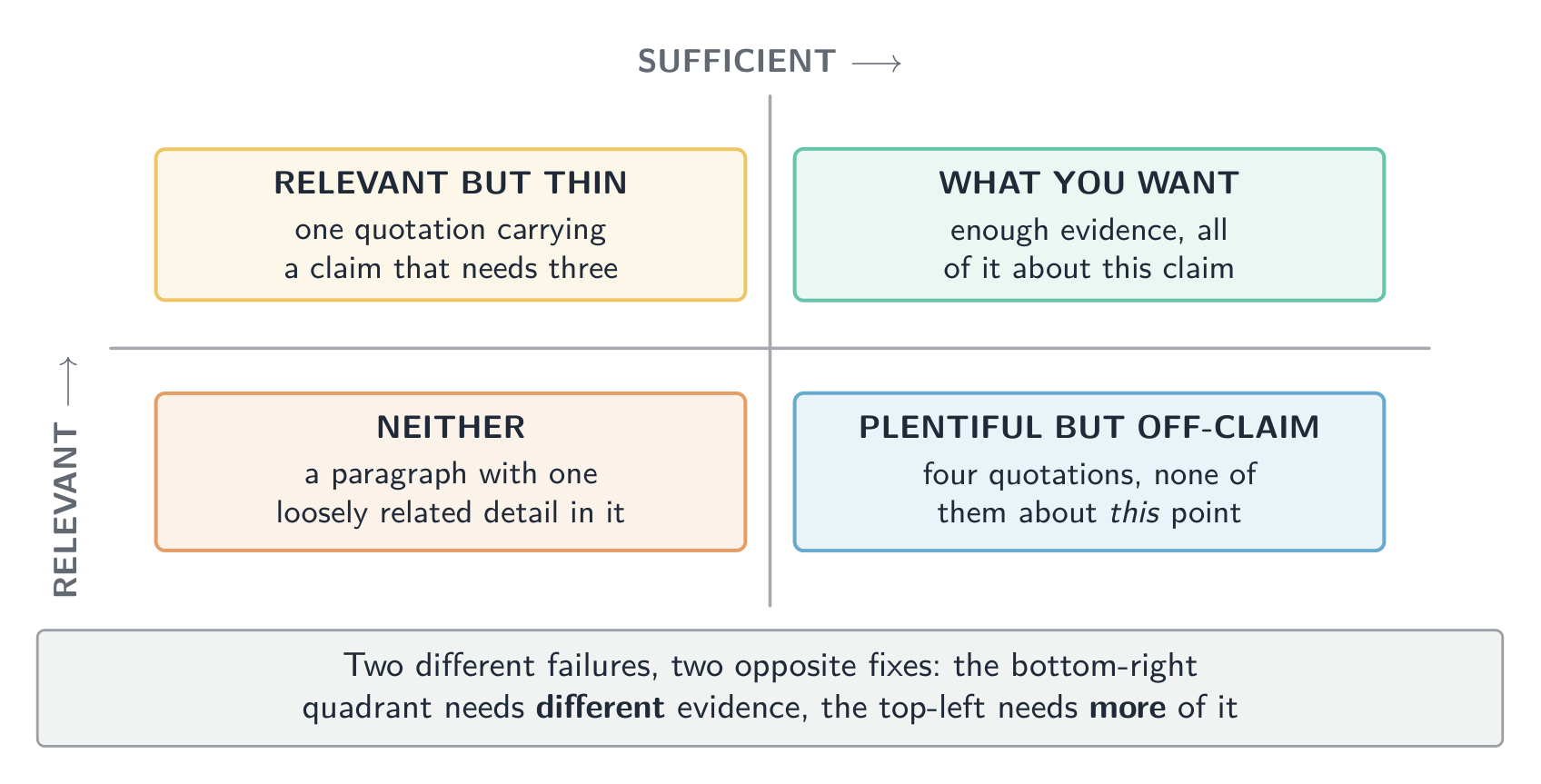
ที่เกี่ยวข้องและเพียงพอคือความล้มเหลวสองประเภทที่มีการแก้ไขตรงกันข้าม
Explore · ⁨สำรวจ⁩

Diagnose the evidence problem · ⁨วินิจฉัยปัญหาลักษณะหลักฐาน⁩

Relevant and sufficient are two different failures with two opposite fixes. · ⁨เกี่ยวข้องและเพียงพอคือความล้มเหลวสองแบบที่มีทางแก้ตรงข้ามกัน⁩

3.3

Describing the Line of Reasoning · ⁨การอธิบายเส้นทางการคิด⁩

Syllabus · ⁨หลักสูตร⁩
English

Enduring Understanding (REO-1): Writers guide understanding of a text’s lines of reasoning and claims through that text’s organization and integration of evidence.

Learning Objective 5.A: Reading – Describe the line of reasoning and explain whether it supports an argument’s overarching thesis.

  • REO-1.A Writers may lead readers through a line of reasoning and then arrive at a thesis.
  • REO-1.B Writers may express a claim and then develop a line of reasoning to justify the claim.
  • REO-1.C Writers explain their reasoning through commentary that connects chosen evidence to a claim.
  • REO-1.D Commentary explains the significance and relevance of evidence in relation to the line of reasoning.
  • REO-1.E The sequence of paragraphs in a text reveals the argument’s line of reasoning.
  • REO-1.F Flaws in a line of reasoning may render an argument specious or illogical.
ไทย

ความเข้าใจที่ยั่งยืน (REO-1): นักเขียนนำความเข้าใจในเส้นทางการคิดและข้ออ้างของข้อความผ่านการจัดระเบียบและการบูรณาการหลักฐานของข้อความนั้น

เป้าหมายการเรียนรู้ 5.A: การอ่าน – อธิบายเส้นทางการคิดและอธิบายว่ามันสนับสนุน论点หลักของข้อโต้แย้งหรือไม่

  • REO-1.A นักเขียนอาจนำผู้อ่านผ่านเส้นทางการคิดแล้วจึง arrives at a thesis.
  • REO-1.B นักเขียนอาจแสดงข้ออ้างแล้วพัฒนาเส้นทางการคิดเพื่อพิสูจน์ข้ออ้างนั้น
  • REO-1.C นักเขียนอธิบายเหตุผลของตนผ่านคำบรรยายที่เชื่อมโยงหลักฐานที่เลือกเข้ากับข้ออ้าง
  • REO-1.D คำบรรยายอธิบายความสำคัญและความเกี่ยวข้องของหลักฐานในบริบทของเส้นทางการคิด
  • REO-1.E ลำดับของย่อหน้าในข้อความสะท้อนเส้นทางการคิดของข้อโต้แย้ง
  • REO-1.F ความบกพร่องในเส้นทางการคิดอาจทำให้ข้อโต้แย้งดูไม่สมเหตุสมผลหรือไร้เหตุผล

Source: College Board AP Course and Exam Description · ⁨แหล่งที่มา: คำอธิบายหลักสูตรและข้อสอบ College Board AP⁩

English

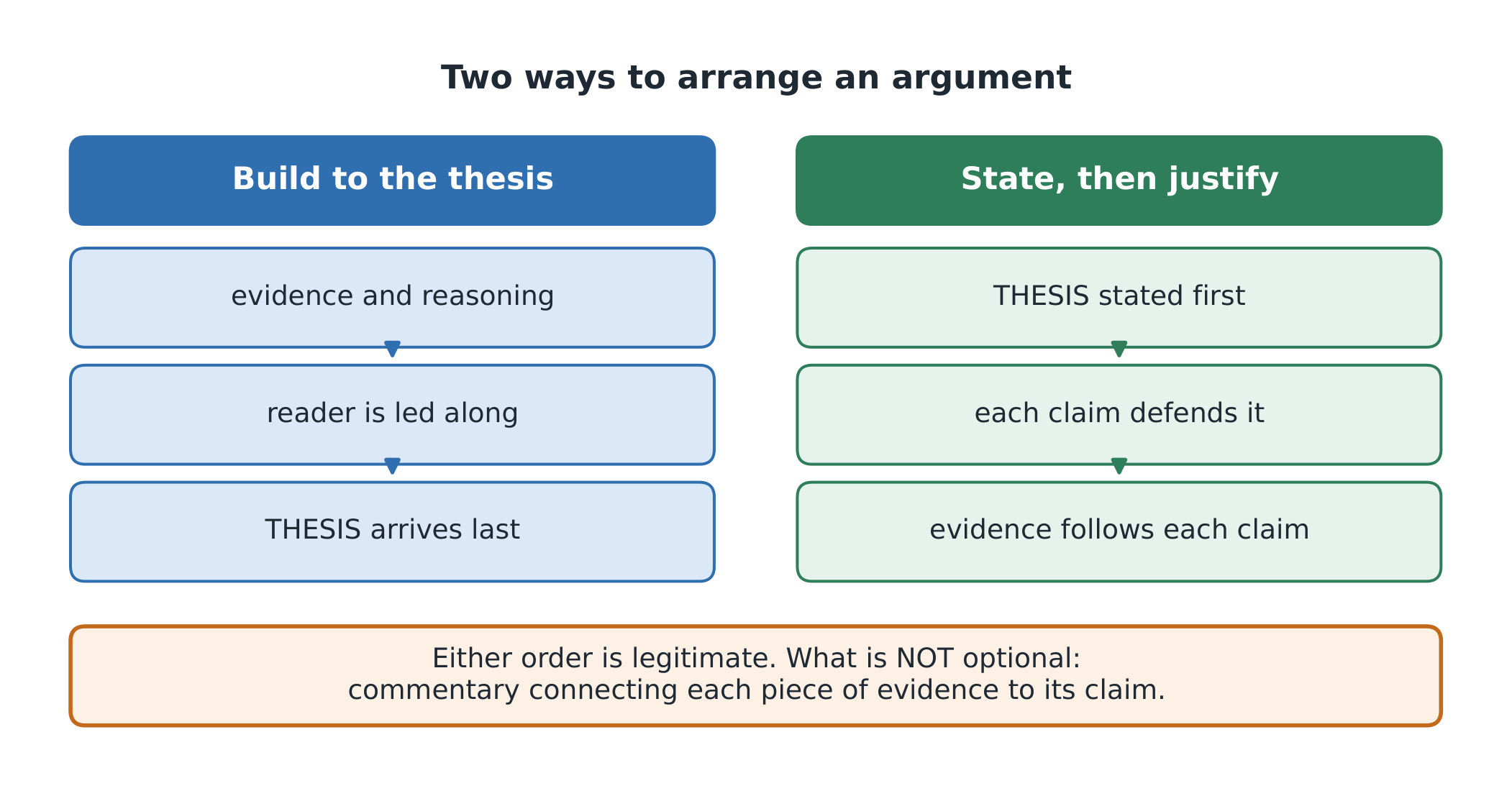
The CED allows two arrangements, and both are valid:

  • Writers may lead readers through a line of reasoning and then arrive at a thesis - the argument builds to its claim.
  • Writers may express a claim and then develop a line of reasoning to justify it - the argument declares and then defends.

Whichever order is used, the same requirements hold:

  • Writers explain their reasoning through commentary that connects chosen evidence to a claim.
  • Commentary explains the significance and relevance of evidence in relation to the line of reasoning.
  • The sequence of paragraphs in a text reveals the argument's line of reasoning - which is the practical tool for reading. To find a writer's reasoning, write one sentence per paragraph and read the list.
  • Flaws in a line of reasoning may render an argument specious or illogical.
ไทย
ลำดับ legitimately สองอย่าง ความต้องการหนึ่ง - และความต้องการคือคำอธิบายประกอบ
ลำดับเป็นการเลือก; เนื้อเยื่อเชื่อมต่อไม่ใช่

CEDอนุญาตการเรียงสองแบบและทั้งสองถูกต้อง:

  • ผู้เขียนอาจ นำผู้อ่านผ่านเส้นทางการคิดแล้วจึงถึงข้อโต้แย้ง - ข้อโต้แย้งสร้างขึ้นสู่ข้ออ้าง
  • ผู้เขียนอาจ แสดงข้ออ้างแล้วพัฒนาเส้นทางการคิดเพื่อสนับสนุนมัน - ข้อโต้แย้งประกาศและ затемปกป้อง

ไม่ว่าลำดับไหนจะถูกใช้ ข้อกำหนดเดียวกันยังคงอยู่:

  • Writers explain their reasoning through commentary that connects chosen evidence to a claim
  • Commentary explains the significance and relevance of evidence in relation to the line of reasoning
  • ลำดับของย่อหน้าในข้อความเปิดเผยเส้นทางการคิดของข้อโต้แย้ง - ซึ่งเป็นเครื่องมือสำหรับการอ่านเพื่อหาการคิดของผู้เขียน เขียนหนึ่งประโยคต่อย่อหน้าและอ่านรายการ
  • ข้อบกพร่องในเส้นทางการคิดอาจทำให้ข้อโต้แย้งดูหลอกลวงหรือไม่เป็นตรรกะ
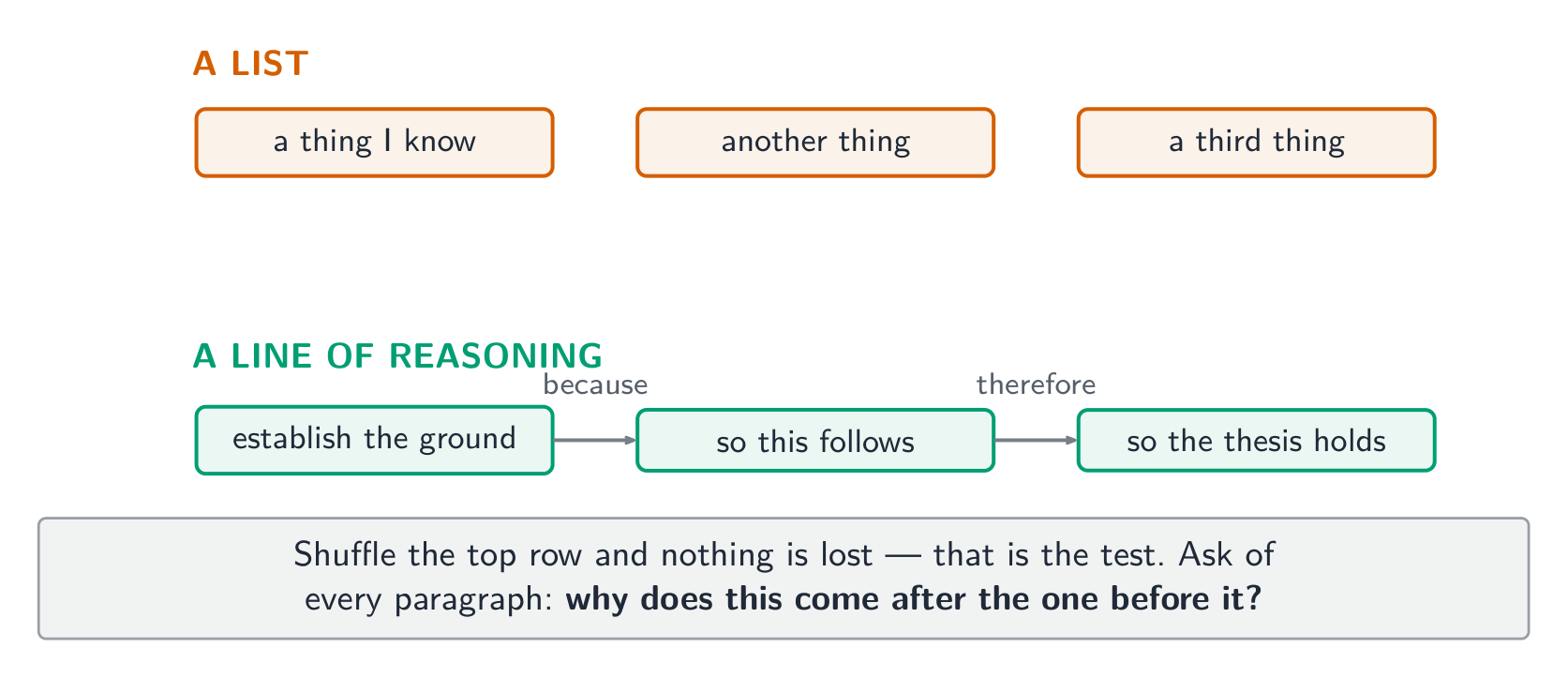
การทดสอบสับ: ถ้าย่อหน้าสามารถเรียงใหม่โดยไม่สูญเสีย แสดงว่าเป็นรายการ
Vocabulary · ⁨คำศัพท์⁩ Train · ⁨ฝึกฝน⁩
English ไทย
commentary/ˈkɒməntri/ คำวิจารณ์ (commentary)
3.4

Developing a Line of Reasoning and Commentary · ⁨การพัฒนาเส้นทางการคิดและคำอธิบายประกอบ⁩

Syllabus · ⁨หลักสูตร⁩
English

Enduring Understanding (REO-1): Writers guide understanding of a text’s lines of reasoning and claims through that text’s organization and integration of evidence.

Learning Objective 6.A: Writing – Develop a line of reasoning and commentary that explains it throughout an argument.

  • REO-1.A Writers may lead readers through a line of reasoning and then arrive at a thesis.
  • REO-1.B Writers may express a claim and then develop a line of reasoning to justify the claim.
  • REO-1.C Writers explain their reasoning through commentary that connects chosen evidence to a claim.
  • REO-1.D Commentary explains the significance and relevance of evidence in relation to the line of reasoning.
  • REO-1.E The sequence of paragraphs in a text reveals the argument’s line of reasoning.
  • REO-1.F Flaws in a line of reasoning may render an argument specious or illogical.
ไทย

ความเข้าใจที่ยั่งยืน (REO-1): นักเขียนนำความเข้าใจในเส้นทางการคิดและข้ออ้างของข้อความผ่านการจัดระเบียบและการบูรณาการหลักฐานของข้อความนั้น

วัตถุประสงค์การเรียนรู้ 6.A: การเขียน – พัฒนาเส้นทางการคิดและการวิเคราะห์แสดงความคิดเห็นที่อธิบายตลอดทั้งข้อโต้แย้ง

  • REO-1.A นักเขียนอาจนำผู้อ่านผ่านเส้นทางการคิดแล้วจึง arrives at a thesis.
  • REO-1.B นักเขียนอาจแสดงข้ออ้างแล้วพัฒนาเส้นทางการคิดเพื่อพิสูจน์ข้ออ้างนั้น
  • REO-1.C นักเขียนอธิบายเหตุผลของตนผ่านคำบรรยายที่เชื่อมโยงหลักฐานที่เลือกเข้ากับข้ออ้าง
  • REO-1.D คำบรรยายอธิบายความสำคัญและความเกี่ยวข้องของหลักฐานในบริบทของเส้นทางการคิด
  • REO-1.E ลำดับของย่อหน้าในข้อความสะท้อนเส้นทางการคิดของข้อโต้แย้ง
  • REO-1.F ความบกพร่องในเส้นทางการคิดอาจทำให้ข้อโต้แย้งดูไม่สมเหตุสมผลหรือไร้เหตุผล

Source: College Board AP Course and Exam Description · ⁨แหล่งที่มา: คำอธิบายหลักสูตรและข้อสอบ College Board AP⁩

English

For your own essays, the useful discipline is to decide the order of your claims before writing any of them. An essay whose paragraphs could be shuffled without loss has no line of reasoning - it has a list.

Test a draft by asking of each paragraph: why does this come after the one before it? If the only answer is "it is another thing I know about the topic", the structure is a list and the reasoning point is at risk.

ไทย

สำหรับบทความของคุณเอง วินัยที่มีประโยชน์คือการตัดสินใจ ลำดับของข้ออ้างของคุณก่อนเขียน บทความ whose paragraphs could be shuffled without loss has no line of reasoning - it has a list

ทดสอบร่างโดยตั้งคำถามกับแต่ละย่อหน้าว่า: ทำไมส่วนนี้ถึงมาต่อจากส่วนก่อนหน้า? หากคำตอบเดียวคือ "เป็นอีกสิ่งที่ฉันรู้เกี่ยวกับหัวข้อนี้" โครงสร้างจะเป็นเพียงรายการ และจุดให้เหตุผลจะอยู่ในภาวะเสี่ยง

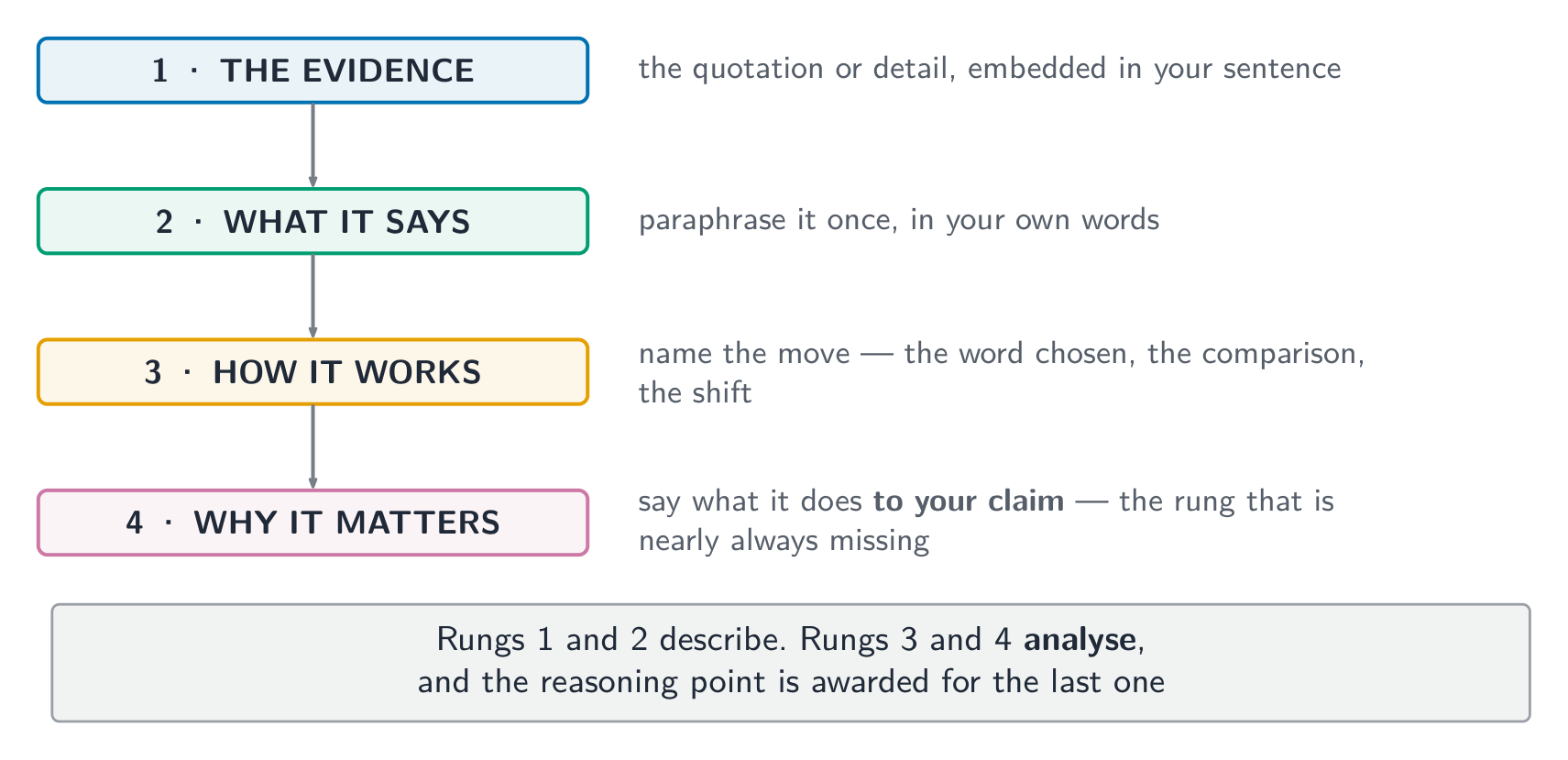
คำอธิบายเป็นขั้นบันไดสี่ขั้น - จุดให้เหตุผลจะถูกมอบให้ขั้นสุดท้าย
Explore · ⁨สำรวจ⁩

Climb the four rungs of commentary · ⁨ปีนบันไดสี่ขั้นของคำวิจารณ์⁩

'Explain your evidence' is unusable. Four questions, each answerable in a sentence, make it a procedure. · ⁨"อธิบายหลักฐานของคุณ" ใช้ไม่ได้จริง สี่คำถาม ที่แต่ละข้อตอบเป็นประโยค ได้将其变为ขั้นตอน⁩

3.5

Recognizing Methods of Development · ⁨การระบุวิธีการพัฒนาเนื้อหา⁩

Syllabus · ⁨หลักสูตร⁩
English

Enduring Understanding (REO-1): Writers guide understanding of a text’s lines of reasoning and claims through that text’s organization and integration of evidence.

Learning Objective 5.C: Reading – Recognize and explain the use of methods of development to accomplish a purpose.

  • REO-1.G Methods of development are common approaches writers frequently use to develop and organize the reasoning of their arguments. A method of development provides an audience with the means to trace a writer’s reasoning in an argument.
  • REO-1.H Some typical methods of development are narration, cause-effect, comparison-contrast, definition, and description.
  • REO-1.I When developing ideas through narration, writers offer details about real-life experiences and offer reflections and insights on the significance of those experiences.
  • REO-1.J When developing ideas through cause-effect, writers present a cause, assert effects or consequences of that cause, or present a series of causes and the subsequent effect(s).
ไทย

ความเข้าใจที่ยั่งยืน (REO-1): นักเขียนนำความเข้าใจในเส้นทางการคิดและข้ออ้างของข้อความผ่านการจัดระเบียบและการบูรณาการหลักฐานของข้อความนั้น

วัตถุประสงค์การเรียนรู้ 5.C: การอ่าน – จดจำและอธิบายการใช้วิธีการพัฒนาเนื้อหาเพื่อบรรลุวัตถุประสงค์

  • REO-1.G วิธีการพัฒนาเนื้อหาคือแนวทางทั่วไปที่นักเขียนมักใช้เพื่อพัฒนาและจัดระเบียบการคิดในข้อโต้แย้ง วิธีการพัฒนาเนื้อหาให้ผู้ฟังมีเครื่องมือในการติดตามเส้นทางการคิดของนักเขียนในข้อโต้แย้ง
  • REO-1.H ตัวอย่างวิธีการพัฒนาเนื้อหาที่พบบ่อย ได้แก่ การเล่าเรื่อง, สาเหตุ-ผล, การเปรียบเทียบ-ความแตกต่าง, นิยามศัพท์ และการบรรยาย
  • REO-1.I เมื่อพัฒนาความคิดผ่านการเล่าเรื่อง นักเขียนจะนำเสนอรายละเอียดเกี่ยวกับประสบการณ์จริง และแสดงการสะท้อนคิดพร้อมความเข้าใจในนัยสำคัญของประสบการณ์เหล่านั้น
  • REO-1.J เมื่อพัฒนาความคิดผ่านสาเหตุ-ผล นักเขียนจะเสนอสาเหตุ, ยืนยันถึงผลลัพธ์หรือผลกระทบจากสาเหตุนั้น, หรือเสนอชุดของสาเหตุและผลลัพธ์ตามลำดับ

Source: College Board AP Course and Exam Description · ⁨แหล่งที่มา: คำอธิบายหลักสูตรและข้อสอบ College Board AP⁩

English

Methods of development 展开方法 are common approaches writers use to develop and organise the reasoning of an argument. The CED's list: narration, cause-effect, comparison-contrast, definition, and description. This unit treats the first two.

  • Developing through narration 叙述: writers offer details about real-life experiences and reflections on them. The reflection is what makes narration an argument rather than a story - an anecdote with no reflection has supplied no reasoning.
  • Developing through cause-effect 因果: writers present a cause, then assert the effects or consequences of that cause - or begin from an effect and trace it back.
ไทย

วิธีการพัฒนา (展开方法) เป็น แนวทางทั่วไปที่นักเขียนใช้เพื่อพัฒนาและจัดระเบียบการให้เหตุผล ในข้อโต้แย้ง รายการของ CED ได้แก่: การเล่าเรื่อง, สาเหตุ-ผล, เปรียบเทียบ-แยกแยะ, นิยาม, และการบรรยาย หน่วยเรียนนี้จะครอบคลุมสองอย่างแรกเท่านั้น

  • การพัฒนาผ่าน การเล่าเรื่อง (叙述): นักเขียนเสนอรายละเอียดเกี่ยวกับ ประสบการณ์ในชีวิตจริง และ การสะท้อนคิด ต่อสิ่งเหล่านั้น การสะท้อนคิดคือสิ่งที่ทำให้การเล่าเรื่องกลายเป็นข้อโต้แย้ง ไม่ใช่เพียงเรื่องราว - แอนิโดตที่ไม่มีการสะท้อนคิดไม่ได้ให้เหตุผลใดๆ
  • การพัฒนาผ่าน สาเหตุ-ผล (因果): นักเขียน นำเสนอสาเหตุ แล้ว assertions ผลกระทบหรือผลลัพธ์ ของสาขานั้น - หรือเริ่มต้นจากผลกระทบแล้วย้อนกลับหาสาเหตุ
3.6

Using Methods of Development · ⁨การใช้วิธีการพัฒนาเนื้อหา⁩

Syllabus · ⁨หลักสูตร⁩
English

Enduring Understanding (REO-1): Writers guide understanding of a text’s lines of reasoning and claims through that text’s organization and integration of evidence.

Learning Objective 6.C: Writing – Use appropriate methods of development to advance an argument.

  • REO-1.G Methods of development are common approaches writers frequently use to develop and organize the reasoning of their arguments. A method of development provides an audience with the means to trace a writer’s reasoning in an argument.
  • REO-1.H Some typical methods of development are narration, cause-effect, comparison-contrast, definition, and description.
  • REO-1.I When developing ideas through narration, writers offer details about real-life experiences and offer reflections and insights on the significance of those experiences.
  • REO-1.J When developing ideas through cause-effect, writers present a cause, assert effects or consequences of that cause, or present a series of causes and the subsequent effect(s).
ไทย

ความเข้าใจที่ยั่งยืน (REO-1): นักเขียนนำความเข้าใจในเส้นทางการคิดและข้ออ้างของข้อความผ่านการจัดระเบียบและการบูรณาการหลักฐานของข้อความนั้น

วัตถุประสงค์การเรียนรู้ 6.C: การเขียน – ใช้วิธีการพัฒนาเนื้อหาที่เหมาะสมเพื่อยกระดับข้อโต้แย้ง

  • REO-1.G วิธีการพัฒนาเนื้อหาคือแนวทางทั่วไปที่นักเขียนมักใช้เพื่อพัฒนาและจัดระเบียบการคิดในข้อโต้แย้ง วิธีการพัฒนาเนื้อหาให้ผู้ฟังมีเครื่องมือในการติดตามเส้นทางการคิดของนักเขียนในข้อโต้แย้ง
  • REO-1.H ตัวอย่างวิธีการพัฒนาเนื้อหาที่พบบ่อย ได้แก่ การเล่าเรื่อง, สาเหตุ-ผล, การเปรียบเทียบ-ความแตกต่าง, นิยามศัพท์ และการบรรยาย
  • REO-1.I เมื่อพัฒนาความคิดผ่านการเล่าเรื่อง นักเขียนจะนำเสนอรายละเอียดเกี่ยวกับประสบการณ์จริง และแสดงการสะท้อนคิดพร้อมความเข้าใจในนัยสำคัญของประสบการณ์เหล่านั้น
  • REO-1.J เมื่อพัฒนาความคิดผ่านสาเหตุ-ผล นักเขียนจะเสนอสาเหตุ, ยืนยันถึงผลลัพธ์หรือผลกระทบจากสาเหตุนั้น, หรือเสนอชุดของสาเหตุและผลลัพธ์ตามลำดับ

Source: College Board AP Course and Exam Description · ⁨แหล่งที่มา: คำอธิบายหลักสูตรและข้อสอบ College Board AP⁩

English

Choosing a method is a rhetorical decision, not a stylistic one. Narration works when the audience needs to feel the situation before they will accept a claim about it. Cause-effect works when the audience already accepts the facts but not the connection between them.

Worked example (a real AP exam task). On a Question 1 synthesis prompt, compare two paragraphs using the same two sources. The weak version: "Source A says X. Source C says Y. Both discuss the issue." That is summary in sequence - no claim, no integration, no reasoning. The strong version: "The strongest objection to the proposal is not that it fails but that it succeeds too narrowly: Source A's data show the intended outcome improving, while Source C's account of the same programme records the second-order costs that the measurement in Source A was never designed to capture." Here the sources are integrated into the writer's own claim, and the commentary establishes the logical relationship - which is what the four evidence-and-commentary points are awarded for.

ไทย

การเลือกวิธีเป็น decisiónทางอรรถศาสตร์ (rhetorical) ไม่ใช่แบบแผนภาษา การเล่าเรื่องใช้ได้เมื่อผู้ฟังจำเป็นต้อง รู้สึก กับสถานการณ์ก่อนจะยอมรับข้ออ้างเกี่ยวกับมัน การ cause-effect ใช้ได้เมื่อผู้ฟังยอมรับความจริงอยู่แล้วแต่ไม่เห็นความเชื่อมโยงระหว่างกัน

ตัวอย่างที่แสดงวิธีทำ (โจทย์สอบ AP จริง). ใน Question 1 synthesis prompt เปรียบเทียบสองย่อหน้าโดยใช้แหล่งข้อมูลเดียวกันสองแหล่ง เวอร์ชันที่อ่อน: "Source A บอก X. Source C บอก Y. ทั้งคู่พูดถึงประเด็นนั้น" นั่นคือการสรุปตามลำดับ - ไม่มีข้ออ้าง ไม่มีการบูรณาการ ไม่มีเหตุผล เวอร์ชันที่แข็งแรง: "ข้อโต้แย้งที่แข็งแกร่งที่สุดต่อข้อเสนอไม่ใช่ اینکهมันล้มเหลว แต่ اینکهมันประสบความสำเร็จแคบเกินไป: ข้อมูลจาก Source A แสดงให้เห็นว่าผลลัพธ์ที่ตั้งใจไว้ดีขึ้น ในขณะที่คำบรรยายจาก Source C เกี่ยวกับโปรแกรมเดียวกันบันทึกต้นทุนระดับที่สองซึ่งการวัดผลใน Source A ไม่เคยถูกออกแบบมาเพื่อจับค่าได้" ที่นี่แหล่งข้อมูลถูก บูรณาการเข้ากับข้ออ้างของผู้เขียนเอง และการ(commentary)确立ความสัมพันธ์เชิงตรรกะ - ซึ่งเป็นสิ่งที่จุด four evidence-and-commentary ถูกมอบให้

Vocabulary · ⁨คำศัพท์⁩ Train · ⁨ฝึกฝน⁩
English ไทย
Synthesis/ˈsɪnθəsɪs/ การบูรณาการ
attribution and citation/ətrɪˈbjuːʃn ænd saɪˈteɪʃn/ การให้เครดิตและการอ้างอิง
Methods of development/ˈmeθədz ɒv dɪˈveləpmənt/ วิธีการพัฒนา
narration/nəˈreɪʃn/ การเล่าเรื่อง
cause-effect/kɔːz ɪˈfekt/ สาเหตุ-ผลลัพธ์
3.6

Exam tips · ⁨ข้อแนะนำสำหรับการสอบ⁩

English
  • Commentary has two jobs: introducing evidence into the reasoning, and explaining the relationship afterwards. Write both sentences.
  • Synthesis means integration, not summary in sequence. A paragraph per source is the classic low-scoring shape.
  • To find a writer's line of reasoning, summarise each paragraph in one sentence and read the list.
  • Ask of your own paragraphs: why does this one follow that one? No answer means no line of reasoning.
  • Narration needs reflection. An anecdote without it has told a story, not made an argument.
  • Choose a method of development for a rhetorical reason and be able to say what it is.
ไทย
  • คำอธิบายมี หน้าที่สองอย่าง: นำหลักฐานเข้าสู่การให้เหตุผล และอธิบายความสัมพันธ์ afterwards เขียนทั้งสองประโยค
  • Synthesis คือการบูรณาการ ไม่ใช่การสรุปตามลำดับ ย่อหน้าละแหล่งข้อมูลคือรูปแบบ的低分ที่คลาสสิก
  • เพื่อหาเส้นทางการให้เหตุผลของนักเขียน สรุปแต่ละย่อหน้าในหนึ่งประโยค แล้วอ่านรายการ
  • ตั้งคำถามกับย่อหน้าของคุณเอง: ทำไมส่วนนี้ถึงตามหลังส่วนนั้น? ไม่มีคำตอบแปลว่าไม่มีเส้นทางการให้เหตุผล
  • การเล่าเรื่องต้องการการสะท้อนคิด แอนิโดตที่ไม่มีมันได้บอกเรื่องราว ไม่ใช่สร้างข้อโต้แย้ง
  • เลือกวิธีการพัฒนาด้วยเหตุผลทาง rhetorical และสามารถบอกได้ว่าคืออะไร

Interactive lessons on this topic · ⁨บทเรียนเชิงโต้ตอบสำหรับหัวข้อนี้⁩

Work through it step by step, with instant-check exercises. · ⁨ทำทีละขั้นตอน พร้อมแบบฝึกหัดตรวจสอบผลทันที⁩

Past Papers · ⁨ข้อสอบย้อนหลัง⁩

More topics in AP English Language and Composition · ⁨AP ภาษาอังกฤษเพื่อการสื่อสารและการเขียน⁩ · ⁨หัวข้อเพิ่มเติมใน AP English Language and Composition · ⁨AP ภาษาอังกฤษเพื่อการสื่อสารและการเขียน⁩⁩

Log in or create account · ⁨เข้าสู่ระบบหรือสร้างบัญชี⁩

IGCSE, A-Level & AP