| Enduring Understanding | Learning Objective | Essential Knowledge |
|---|---|---|
RHS-1 | 1.B |
|
Audience, Tone, and Sentence Craft
AP English Language and Composition · Topic 8
 5:44
5:44
Unit 8: Audience, Tone, and Sentence Craft
A writer's style is the mix of word choice, syntax and conventions employed by that writer. Style is a composite — which is why "the writer's style is formal"…
English narration · English + 中文 subtitles burned in
8.1
Understanding an Audience's Beliefs and Needs
Syllabus
Source: College Board AP Course and Exam Description
Unit 8 is the course's most advanced treatment of style 文体 - the point at which word choice, syntax, and audience stop being separate topics.
- Writers may make comparisons - similes, metaphors, analogies, or anecdotes - in an attempt to relate to an audience.
- Writers' choices regarding syntax and diction 句法与措辞 influence how the writer is perceived by an audience.
- Word choice may reflect a writer's biases and may affect their credibility with a particular audience.
- Because audiences are unique and dynamic, writers must consider the perspectives, contexts, and needs of the intended audience.
The third point is worth dwelling on. Diction does not only characterise the subject - it characterises the writer. A reader who notices loaded word choice starts to discount everything that follows, which is why an unqualified vocabulary is a credibility risk, not a strength.
Vocabulary
Train
| English |
|---|
| style/staɪl/ |
| syntax and diction/ˈsɪntæks ænd ˈdɪkʃn/ |
8.2
Writing for an Audience's Beliefs and Needs
Syllabus
| Enduring Understanding | Learning Objective | Essential Knowledge |
|---|---|---|
RHS-1 | 2.B |
|
Source: College Board AP Course and Exam Description
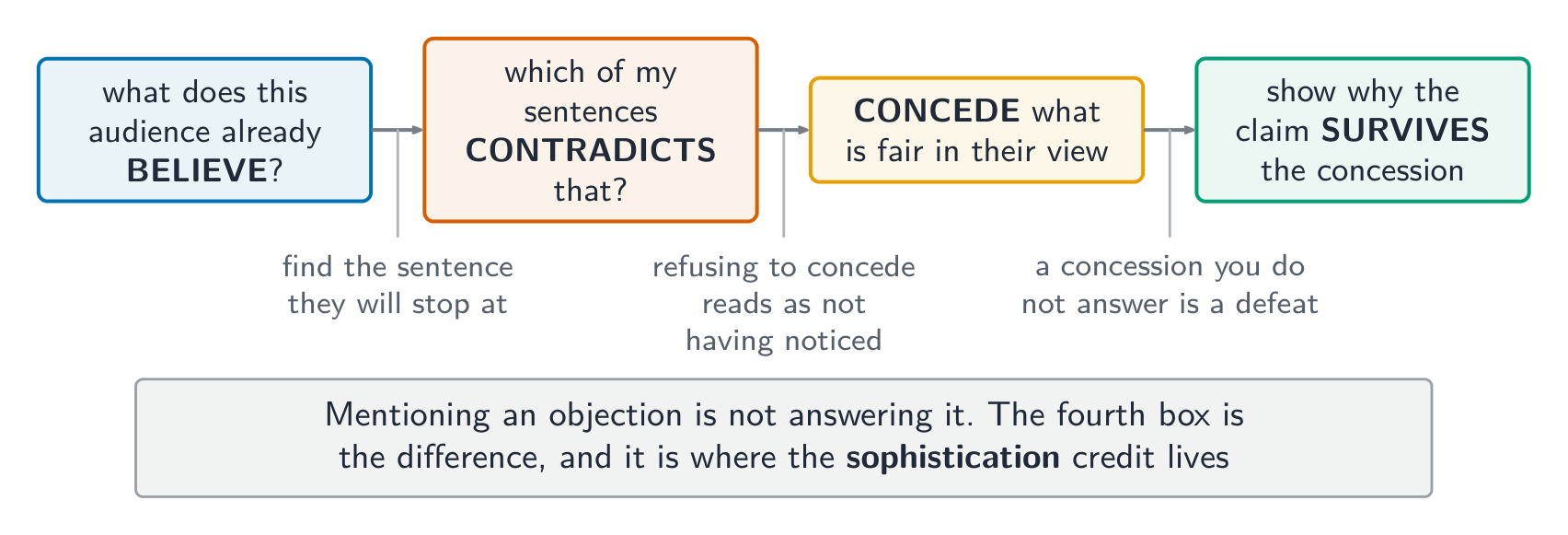
The instruction here is that audiences are dynamic: they change as they read. An argument that has just conceded something is being read by a slightly different audience than the one that began the essay.
Practically, this means the ordering of concession and claim matters. Concede before you press, and you address a reader who now believes you are fair. Press first and concede afterwards, and the concession reads as retreat.
Explore
Anticipate where the reader will refuse
Mentioning an objection is not answering it. The fourth step is the difference, and it is where the sophistication credit lives.
8.3
Word Choice, Comparisons, and Syntax
Syllabus
| Enduring Understanding | Learning Objective | Essential Knowledge |
|---|---|---|
STL-1 | 7.A |
|
Source: College Board AP Course and Exam Description
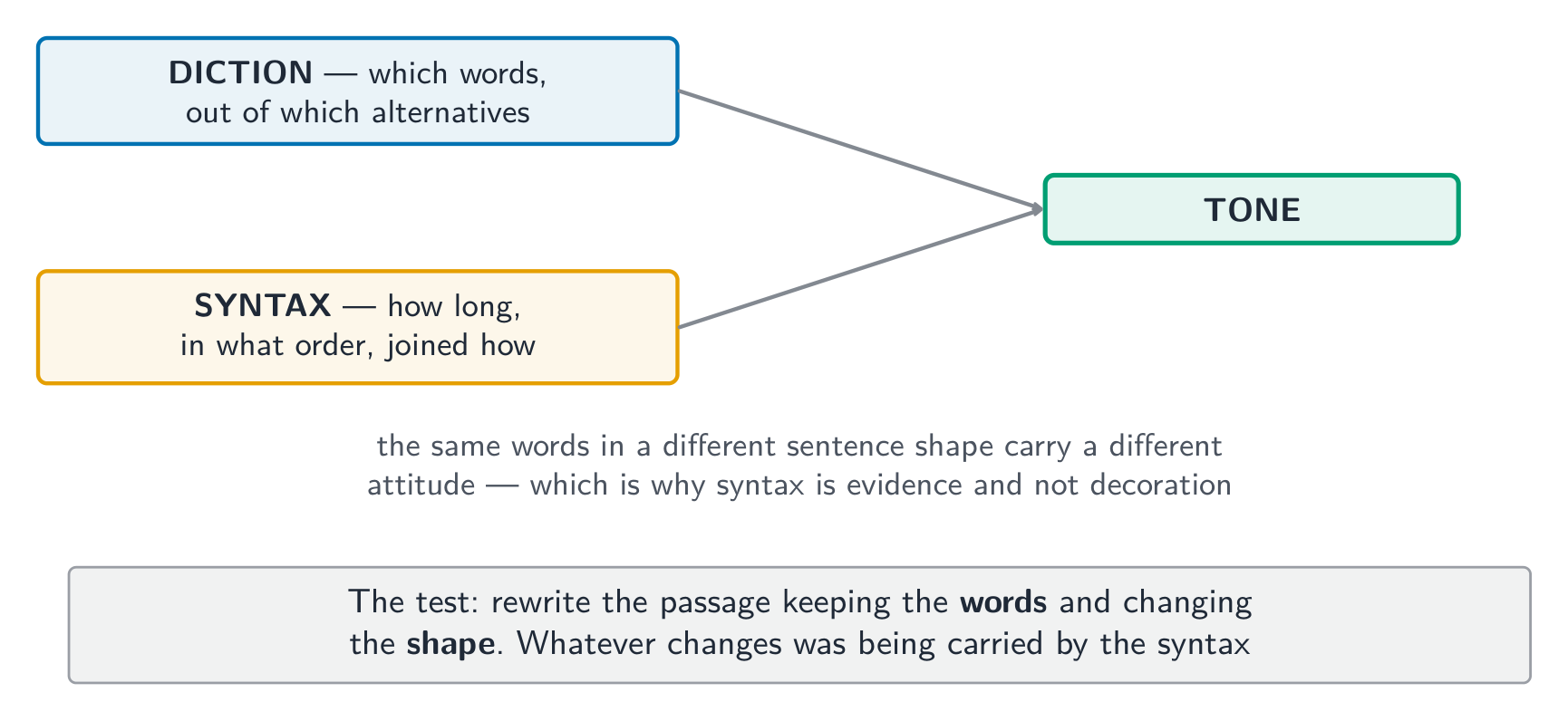
- A writer's style is the mix of word choice, syntax, and conventions employed by that writer. Style is a composite, which is why "the writer's style is formal" is not analysis - it names the result without any of the components.
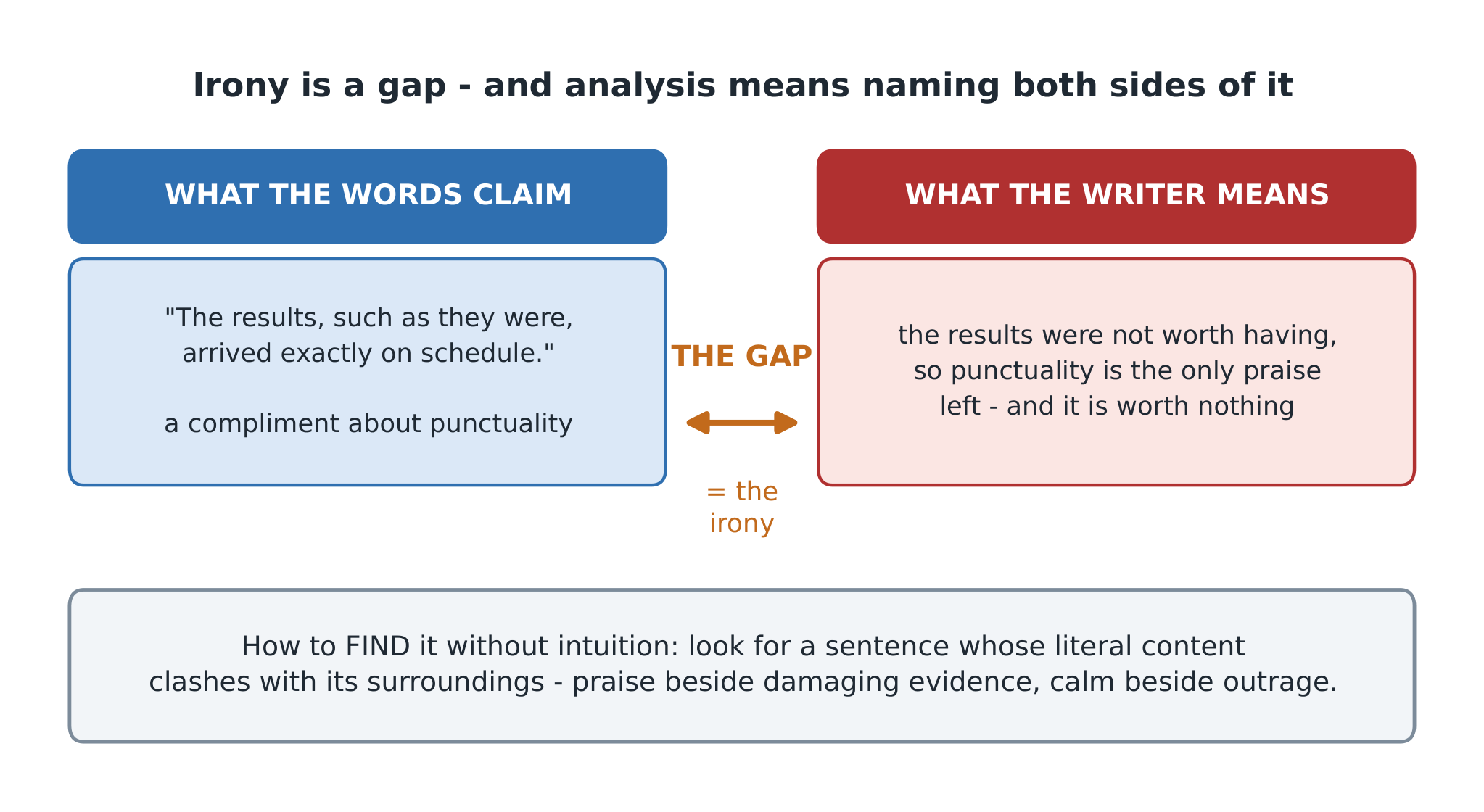
- Writers may signal a complex or ironic perspective through stylistic choices. Irony 反讽 may emerge from the difference between what is said and what is meant, or between what is expected and what occurs.
Irony is the hardest thing on this exam for a second-language reader, because it cannot be looked up. The workable method is structural rather than intuitive: find a sentence whose literal content does not match its surroundings - excessive praise beside damaging evidence, calm register beside an outrageous fact - and the mismatch is the signal.
Vocabulary
Train
| English |
|---|
| Irony/ˈaɪrəni/ |
8.4
Using Words and Syntax for Tone and Style
Syllabus
| Enduring Understanding | Learning Objective | Essential Knowledge |
|---|---|---|
STL-1 | 8.A |
|
Source: College Board AP Course and Exam Description
For your own writing, the safest use of irony is none. What the sophistication point actually rewards is control: a consistent register, a vocabulary that is precise rather than inflated, and syntax that ranks ideas deliberately.
Explore
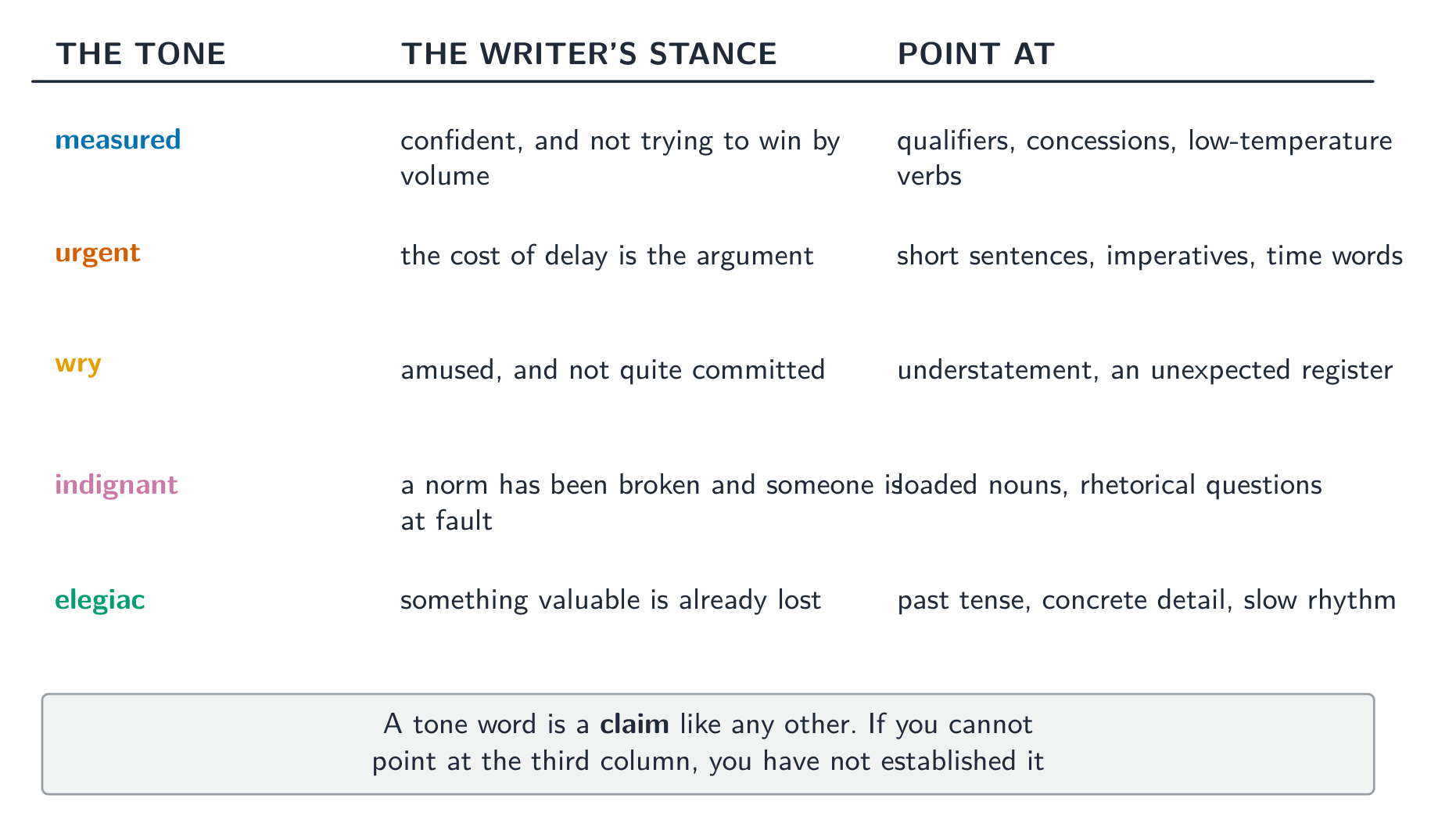
Match each tone to the evidence for it
A tone word is a claim like any other. If you cannot point at the evidence, you have not established it.
8.5
Clauses and Relationships Between Ideas
Syllabus
| Enduring Understanding | Learning Objective | Essential Knowledge |
|---|---|---|
STL-1 | 7.B |
|
Source: College Board AP Course and Exam Description
- Modifiers 修饰成分 - words, phrases, or clauses - qualify, clarify, or specify information about the thing they modify.
- Parenthetical elements 插入成分 - though not essential to understanding what they describe - interrupt the sentence to add information, comment, or emphasis.
Both are stylistically rich and analytically useful. A modifier is where a writer's judgement hides: the long-delayed report has evaluated the report while appearing only to identify it. A parenthetical is an aside the writer chose to make - and the choice to interrupt is itself an emphasis.
Vocabulary
Train
| English |
|---|
| Modifiers/ˈmɒdɪfaɪəz/ |
| Parenthetical elements/pərənˈθetɪkl ˈelɪmənts/ |
8.6
Writing Clear Sentences
Syllabus
| Enduring Understanding | Learning Objective | Essential Knowledge |
|---|---|---|
STL-1 | 8.B |
|
Source: College Board AP Course and Exam Description
A concrete discipline: place modifiers next to what they modify, and use parentheticals sparingly. One well-placed interruption creates emphasis; three in a paragraph destroy it, because a reader cannot tell which interruption mattered.
Worked example (a real AP exam task). A rhetorical-analysis passage says of a policy: "The results, such as they were, arrived exactly on schedule." A low answer says the writer "uses a parenthetical phrase". A scoring answer explains both parts: "The parenthetical 'such as they were' dismisses the results in four words, without offering an argument against them - and placing it before 'arrived exactly on schedule' means the praise for punctuality lands on results the reader has just been told to discount. The sentence appears to compliment the programme and in fact withdraws the only thing it could be complimented for." Modifier, parenthetical, irony, and effect on audience, all in one.
8.6
Exam tips
- Style is a composite - word choice, syntax, conventions. Naming the components is analysis; naming the result is not.
- Loaded diction damages the writer's credibility. Say so; it is examinable.
- Find irony structurally: a sentence whose literal content clashes with its surroundings.
- Concede before you press. The audience that reads your claim will already have decided whether you are fair.
- A modifier is where judgement hides. The long-delayed report has already evaluated it.
- Use parentheticals sparingly in your own writing. Three in a paragraph cancel each other out.
Interactive lessons on this topic
Work through it step by step, with instant-check exercises.