| Enduring Understanding | Learning Objective | Essential Knowledge |
|---|---|---|
RHS-1 | 1.B |
|
Audience, Thesis, and Supporting Evidence
AP English Language and Composition · Topic 2
 5:54
5:54
Unit 2: Audience, Thesis, and Supporting Evidence
Here is a test you can run on your own drafts in about ten seconds. Read one paragraph and ask: would this read identically to a completely different audience?…
English narration · English + 中文 subtitles burned in
2.1
Understanding an Audience's Beliefs and Needs
Syllabus
Source: College Board AP Course and Exam Description
Unit 1 established that a text has an audience. Unit 2 makes that audience the engine of every choice a writer makes.
- Writers' perceptions of an audience's values, beliefs, needs, and background guide the choices they make. Note the word perceptions: what steers the writing is the writer's picture of the audience, which may be accurate or not.
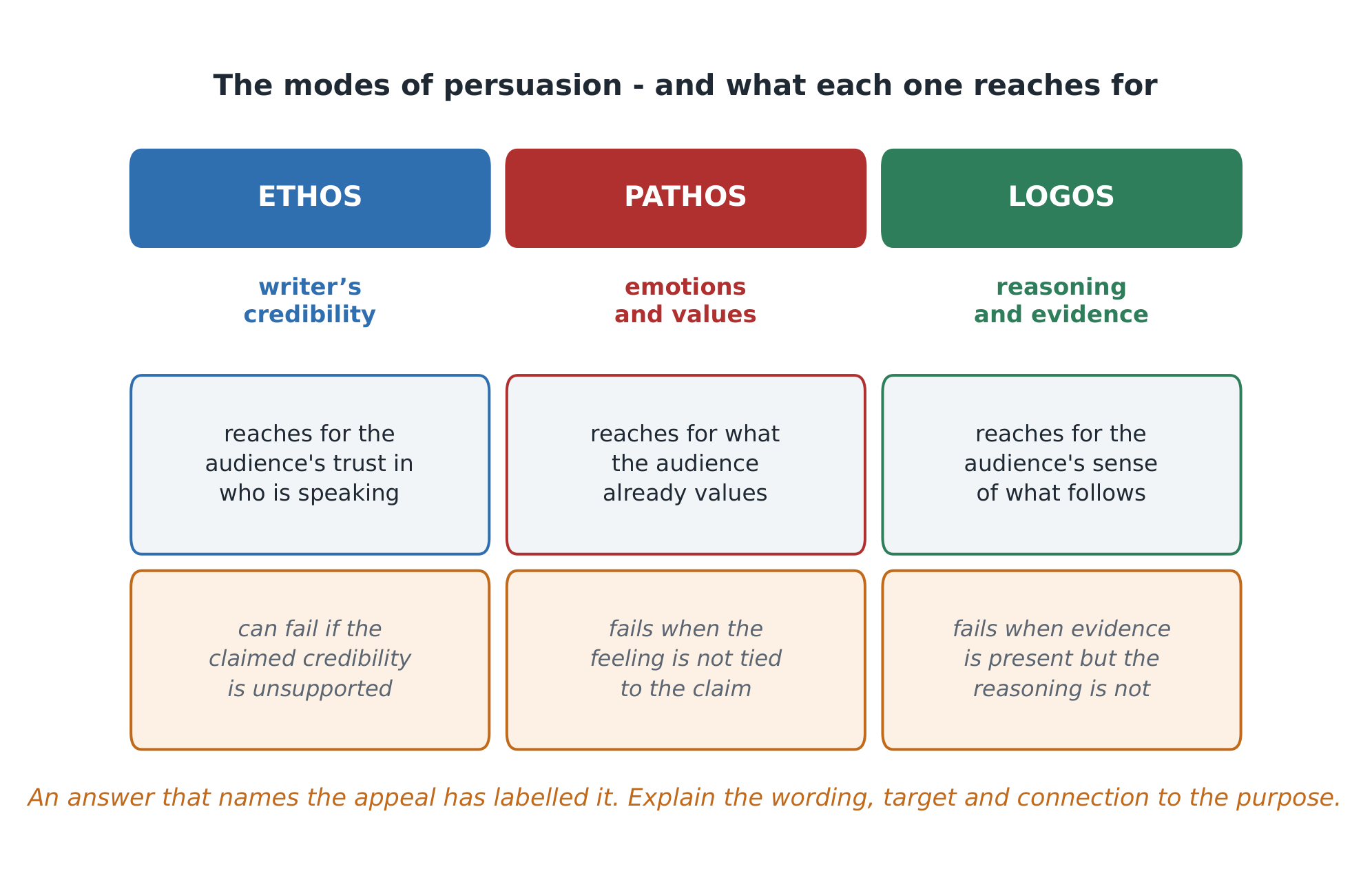
- To achieve a purpose, writers make choices in an attempt to relate to an intended audience's emotions and values.
- Arguments seek to persuade or motivate action through appeals 诉求 - the modes of persuasion 说服方式.
Explore
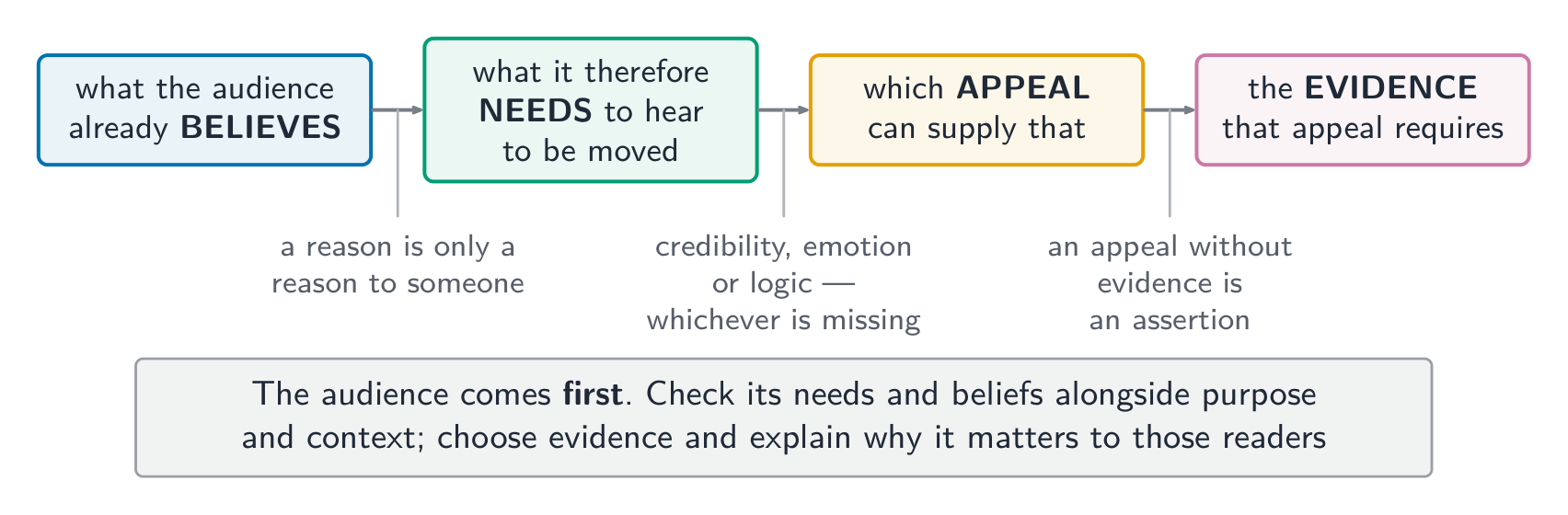
Start from the audience, not the appeal
Perceived needs and values guide audience choices, alongside purpose, context and evidence.
Vocabulary
Train
| English |
|---|
| appeals/əˈpiːlz/ |
| modes of persuasion/məʊdz ɒv pəˈsweɪʒn/ |
2.2
Writing for an Audience's Beliefs and Needs
Syllabus
| Enduring Understanding | Learning Objective | Essential Knowledge |
|---|---|---|
RHS-1 | 2.B |
|
Source: College Board AP Course and Exam Description
The same three statements now become a writing instruction. Before drafting, decide:
- What does this audience already believe about the subject?
- What do they need - information, reassurance, a reason to act?
- What do they value, and which of those values can honestly be connected to my position?
Compare drafts for different audiences: which needs and values does each address? The same wording can sometimes serve overlapping audiences; similarity alone does not prove that no audience was considered.
2.3
Identifying Claims and Evidence
Syllabus
| Enduring Understanding | Learning Objective | Essential Knowledge |
|---|---|---|
CLE-1 | 3.A |
|
Source: College Board AP Course and Exam Description
Unit 2 deepens Unit 1's treatment of evidence with three claims about how evidence works:
- Writers use evidence strategically and purposefully to illustrate, clarify, set a mood, exemplify, associate, or amplify. Evidence does a job, and naming that job is analysis.
- Strategically selected evidence strengthens the validity and reasoning of the argument, relates to an audience's emotions and values, and helps establish the writer's credibility 可信度.
- An effective argument contains sufficient evidence 充分的证据 - sufficient when its quantity and quality provide apt support for the line of reasoning.
That third point is often misread as "more is better". Sufficiency is quantity and quality together: relevant, reliable evidence with explained connections is more useful than a larger pile of loosely related material. No fixed count guarantees sufficiency.
Explore
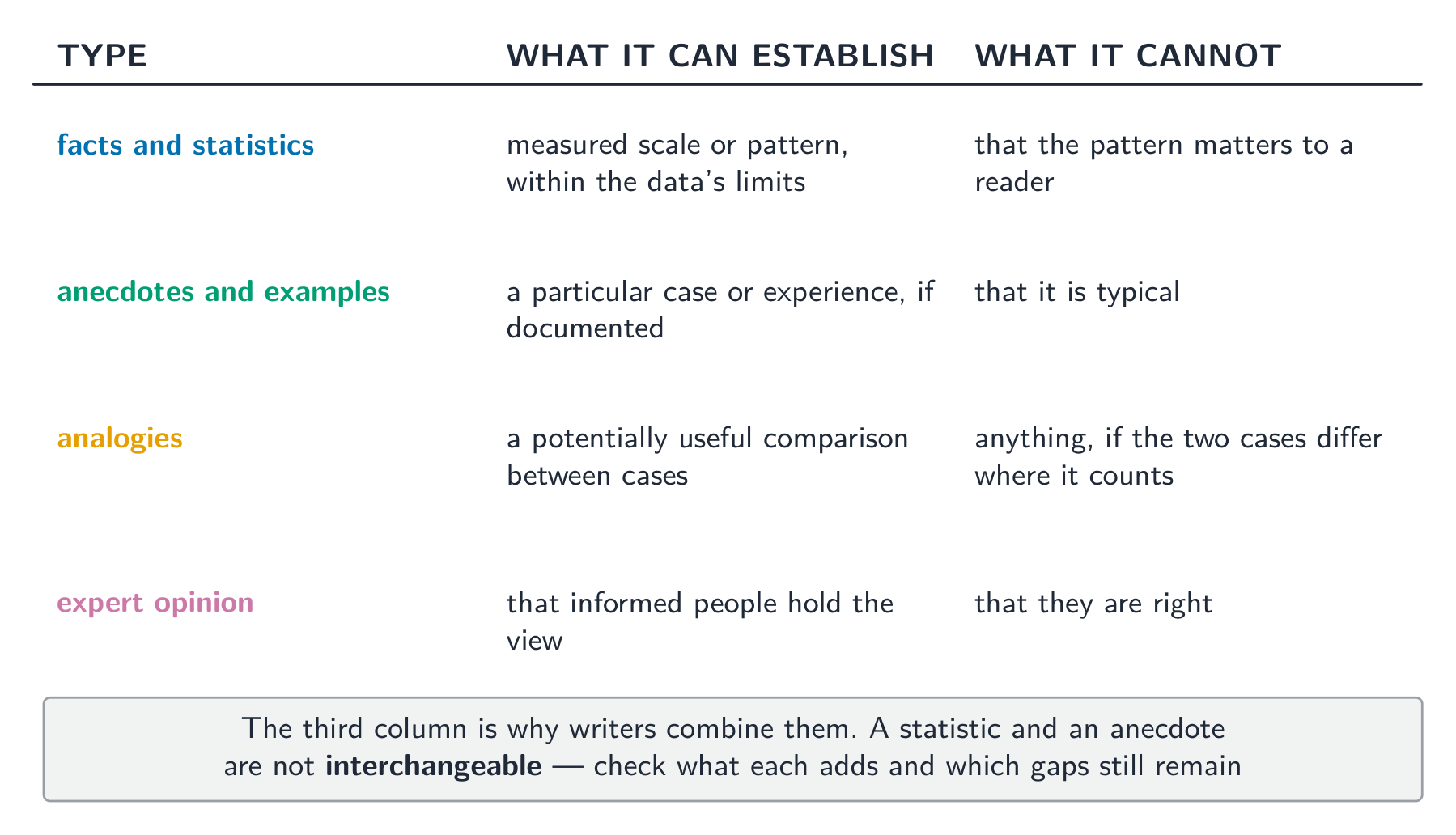
Match each evidence type to what it cannot prove
Different evidence contributes different support; combining types does not automatically close every gap.
Vocabulary
Train
| English |
|---|
| credibility/ˌkredɪˈbɪlɪti/ |
| sufficient evidence/səˈfɪʃənt ˈevɪdəns/ |
2.4
Developing a Paragraph with Claim and Evidence
Syllabus
| Enduring Understanding | Learning Objective | Essential Knowledge |
|---|---|---|
CLE-1 | 4.A |
|
Source: College Board AP Course and Exam Description
Applying the above to your own writing, choose each piece of evidence for a stated reason. In practice this means being able to finish the sentence: I am using this piece because it ...
- ... illustrates a claim that would otherwise stay abstract;
- ... establishes my credibility on a subject where readers may doubt it;
- ... connects my position to a value the audience already holds.
Selecting evidence for a reason helps you plan commentary, but you must still explain how it supports the claim and acknowledge what it cannot establish.
2.5
Identifying the Overarching Thesis
Syllabus
| Enduring Understanding | Learning Objective | Essential Knowledge |
|---|---|---|
CLE-1 | 3.B |
|
Source: College Board AP Course and Exam Description
- A thesis 论点 is the main, overarching claim a writer seeks to defend or prove by using reasoning supported by evidence.
- A writer's thesis is not necessarily a single sentence or an explicit statement, and may require a thorough reading to identify.
That second point matters for the reading side of the exam. On a rhetorical-analysis passage, the thesis may be distributed across the text or implied by its structure. Do not assume the first sentence of the second paragraph is the thesis because that is where you would put yours.
Vocabulary
Train
| English |
|---|
| thesis/ˈθiːsɪs/ |
2.6
Writing a Thesis Statement
Syllabus
| Enduring Understanding | Learning Objective | Essential Knowledge |
|---|---|---|
CLE-1 | 4.B |
|
Source: College Board AP Course and Exam Description
The writing objective is precise: write a thesis statement that requires proof or defence and that may preview the structure of the argument.
Two independent requirements sit in that sentence:
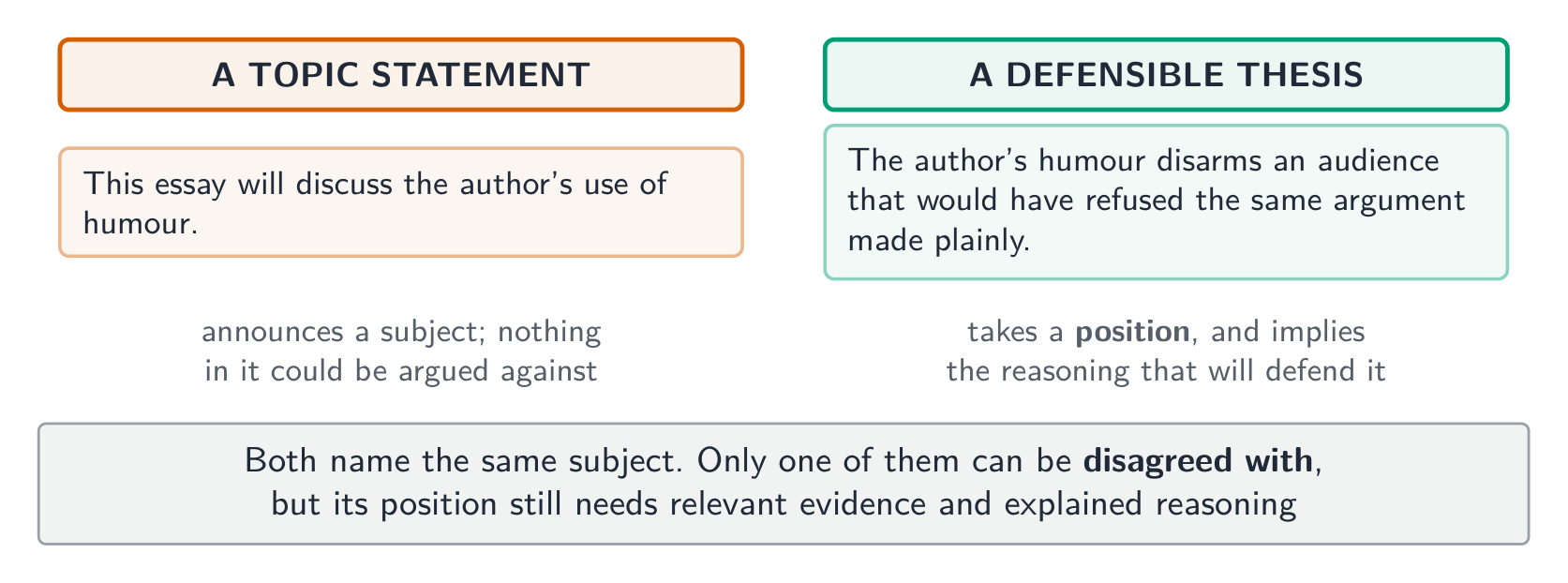
- It must require defence. Apply the Unit 1 test again: could a reasonable person disagree? A topic or uncontested observation alone may leave the position unstated; factual claims can themselves require evidence. State the position the task asks you to defend.
- It may preview the structure - optional, but useful, because a thesis that names the lines of reasoning it will pursue gives the essay its shape.
A defensible thesis responds to the actual task and states a position requiring support. Restating a prompt alone does not supply that position. A weak thesis does not by itself determine all other parts of an essay's assessment; do not claim a guaranteed total from one sentence.
Original practice source pack: an evening library trial
This prompt, evidence and letter are fictional teaching material, not an authentic AP question or real school survey. The task is to recommend whether a principal should try one evening library session each week for four weeks. The principal must consider access, staffing and cost.
| Supplied evidence | What it can support |
|---|---|
| 18 of 30 volunteer respondents say they would attend. | Interest among respondents; not actual attendance or a whole-school estimate. |
| One respondent says, “I share a room and need somewhere quiet.” | A specific need; not its prevalence across all students. |
| Staffing and transport costs have not been checked. | A feasibility question remains; interest alone cannot settle it. |
Original model letter. “Please trial one evening library session a week for four weeks, subject to confirmed staffing and safe travel arrangements. In our practice survey, 18 of 30 volunteer respondents said they would attend; one explained that sharing a room makes quiet study difficult. Those responses suggest a reason to test access, not a guarantee of attendance. Record visits and costs during the trial before deciding whether to continue.”
Worked analysis. The letter connects a concrete need to access, acknowledges the principal's staffing concern, and uses survey results as a reason for a limited test rather than permanent opening. The respondent's situation illustrates the need; the numbers describe this sample; the qualification limits the conclusion. Transparent limits can support credibility, but do not prove that the principal will be persuaded.
Practice. Revise the recommendation for students who want a quiet study space. Then state one reason the principal might still decline. Keep the underlying evidence and its limits honest.
Thesis comparison. “There are arguments for and against opening the library” names a topic without deciding. “The school should test one evening session for four weeks, because the responses suggest an access need while uncertain attendance and costs make permanent opening premature” states a specific, arguable position and previews its reasoning. It still needs support.
2.6
Exam tips
- Consider the audience’s needs and values alongside purpose, context and evidence. Similar wording may serve overlapping audiences.
- Name what evidence does - illustrate, clarify, associate, amplify. That is analysis; listing evidence is not.
- Sufficiency is quantity and quality, not volume. Explain relevance and reliability; no fixed number guarantees enough support.
- A thesis in a passage may be implied or distributed. Read the whole text before deciding.
- Your own thesis must be arguable. Restating the prompt alone leaves the position unstated; it does not determine the whole essay’s assessment.
- Previewing your line of reasoning in the thesis is optional but makes the rest of the essay easier to organise.
Interactive lessons on this topic
Work through it step by step, with instant-check exercises.