| Enduring Understanding | Learning Objective | Essential Knowledge |
|---|---|---|
CLE-1 | 3.C |
|
Refining Qualified Arguments
AP English Language and Composition · Topic 9
 4:51
4:51
Unit 9: Refining Qualified Arguments
Unit 9 is short, and it is the course's final move: how to handle the arguments that oppose yours. Everything here is directly rewarded on the exam, and the…
English narration · English + 中文 subtitles burned in
9.1
How Claims Are Qualified
Syllabus
Source: College Board AP Course and Exam Description
Unit 9 is short and it is the course's final move: how to handle the arguments that oppose yours. Everything here is directly rewarded on the exam, and the three key verbs are constantly confused.
The framing first:
- Effectively entering an ongoing conversation about a subject means engaging the positions that have already been taken. An argument that ignores them is not participating in the discussion, only announcing into it.
- Evidence and sources will either support, complement, or contradict 支持、补充或反驳 a writer's thesis. All three are usable - contradicting evidence is not a problem to be hidden but material to be handled.
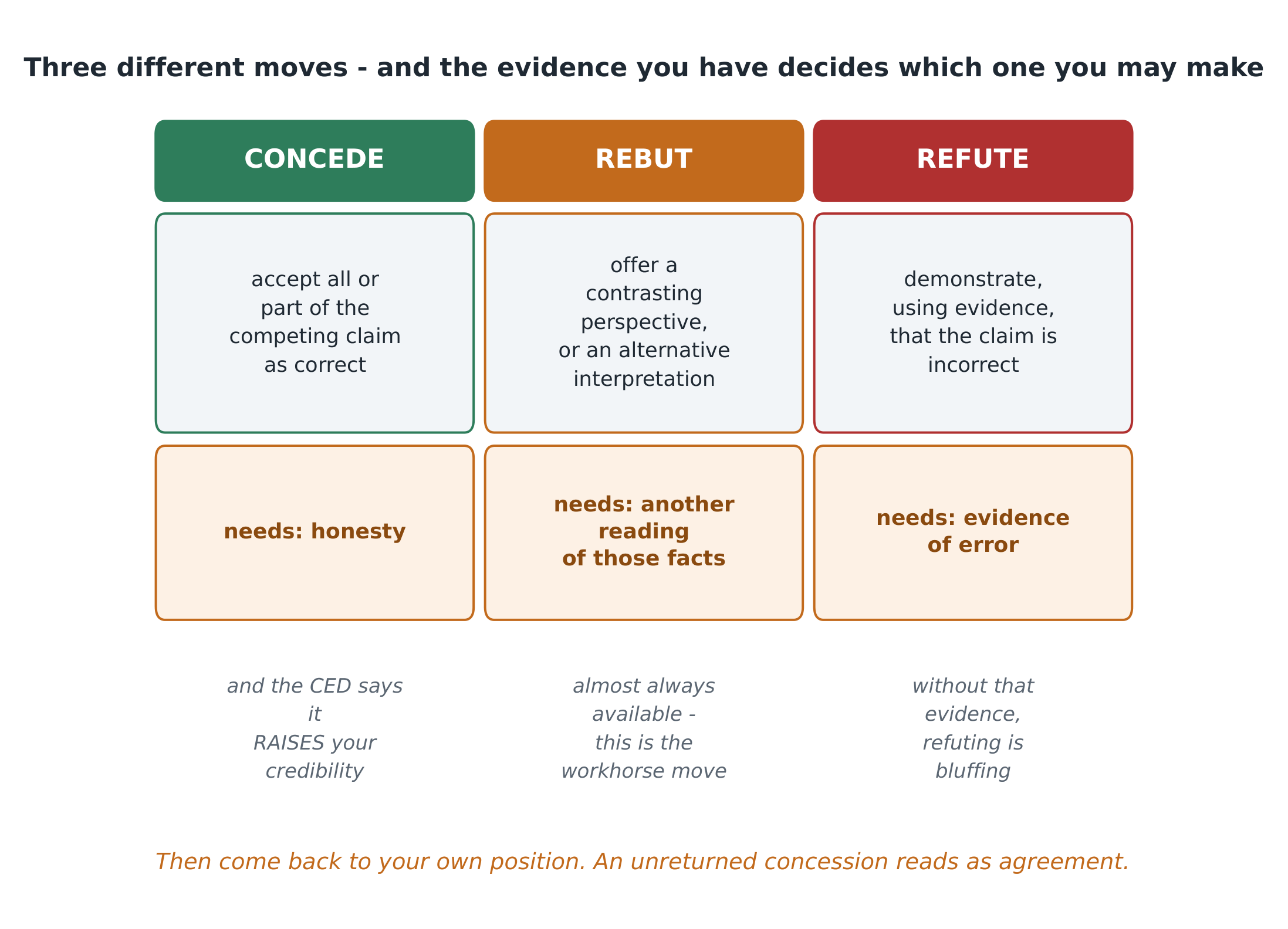
- Writers enhance their credibility when they refute, rebut, or concede opposing arguments and contradictory evidence.
The three moves, in the CED's own definitions:
- Concede 让步: writers accept all or a portion of a competing position or claim as correct, and agree that the opposing point has merit.
- Rebut 反驳: writers offer a contrasting perspective on an argument and its evidence, or provide an alternative interpretation.
- Refute 驳倒: writers demonstrate, using evidence, that all or a portion of a competing position or claim is incorrect.
The distinction is what your evidence lets you do. Refuting requires evidence of error; if you do not have it, refuting is bluffing and a reader will see it. Rebutting requires only an alternative reading of the same facts, which is far more often available. Conceding requires honesty, and it costs nothing - the CED says explicitly that it enhances credibility.
Two further points:
- Transitions may be used to introduce counterarguments - and, as in Unit 5, the transition should signal the relationship. Critics argue announces one; the strongest objection to this is announces one and ranks it.
- Not all arguments explicitly address a counterargument. True of texts you read, and worth noting when analysing - an argument that engages no opposition has told you something about its intended audience.
Explore
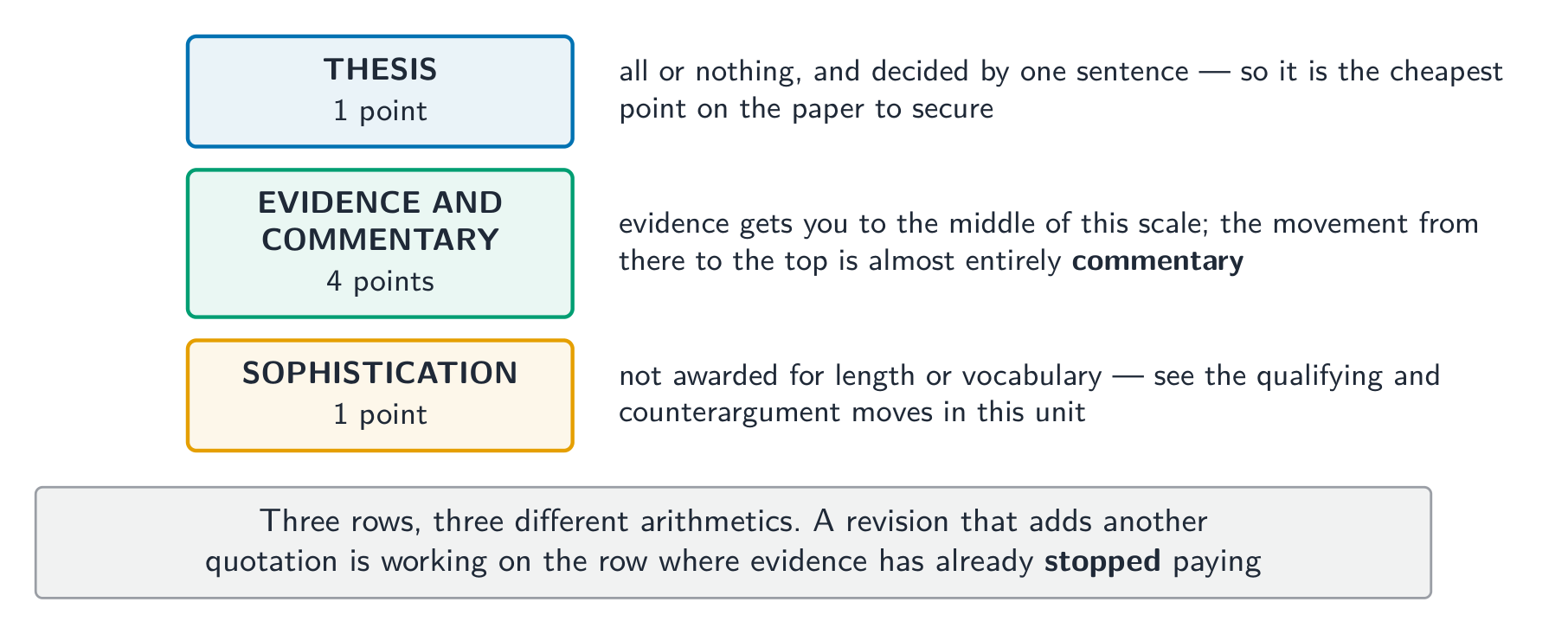
Place the counterargument, and say what it signals
Position carries meaning: early it frames the essay, late it can read as a box being ticked.
Vocabulary
Train
| English |
|---|
| support, complement, or contradict/səˈpɔːt ˈkɒmplɪmənt ɔː ˌkɒntrəˈdɪkt/ |
| Concede/kənˈsiːd/ |
| Rebut/rɪˈbʌt/ |
| Refute/rɪˈfjuːt/ |
9.2
Qualifying a Claim
Syllabus
| Enduring Understanding | Learning Objective | Essential Knowledge |
|---|---|---|
CLE-1 | 4.C |
|
Source: College Board AP Course and Exam Description
For your own writing, the strongest and most reliable shape on Question 3 is:
- State your position, qualified to the ground your evidence covers.
- Concede the part of the opposing position that is genuinely correct.
- Rebut or refute the rest - rebut if you have an alternative reading, refute only if you have evidence of error.
- Show why your position survives the concession.
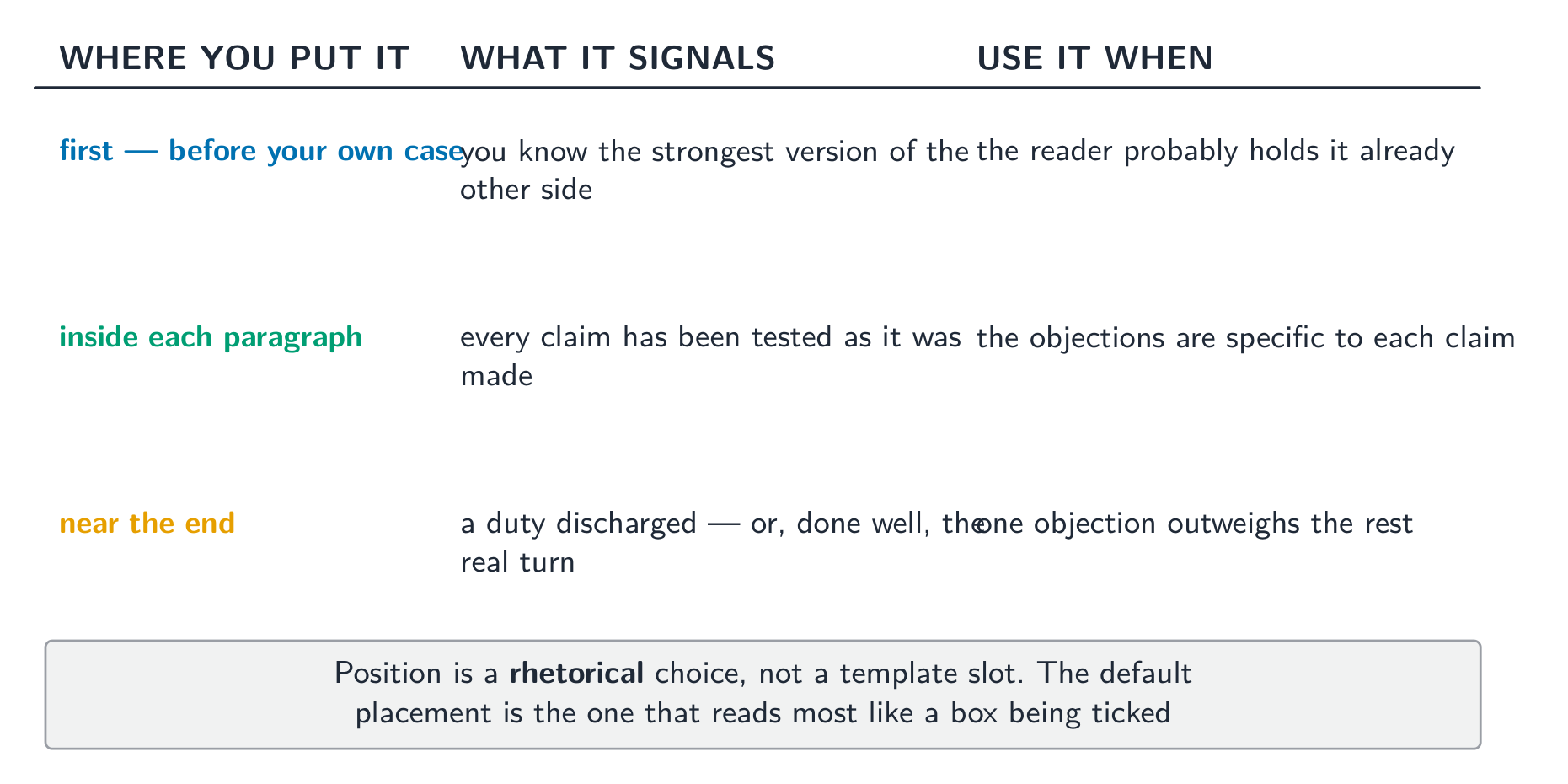
Step 4 is the one most students omit, and it is where the sophistication point lives. Conceding and then not returning to your own argument reads as having changed your mind.
Worked example (a real AP exam question). On a Question 3 argument prompt, compare two treatments of the same objection. Weak: "Some people disagree, but they are wrong." That names an opposing position without engaging it - it is neither concession, rebuttal, nor refutation. Strong: "The objection that the policy is too costly is correct as far as it goes: the direct expenditure is higher than any alternative considered. But cost is only decisive if the alternatives achieve the same result, and the same report shows they do not - so the comparison the objection depends on is not available." That paragraph concedes the cost, refutes the comparison with evidence, and returns to the writer's own position. Three moves, and every one of them is on the rubric.
Explore
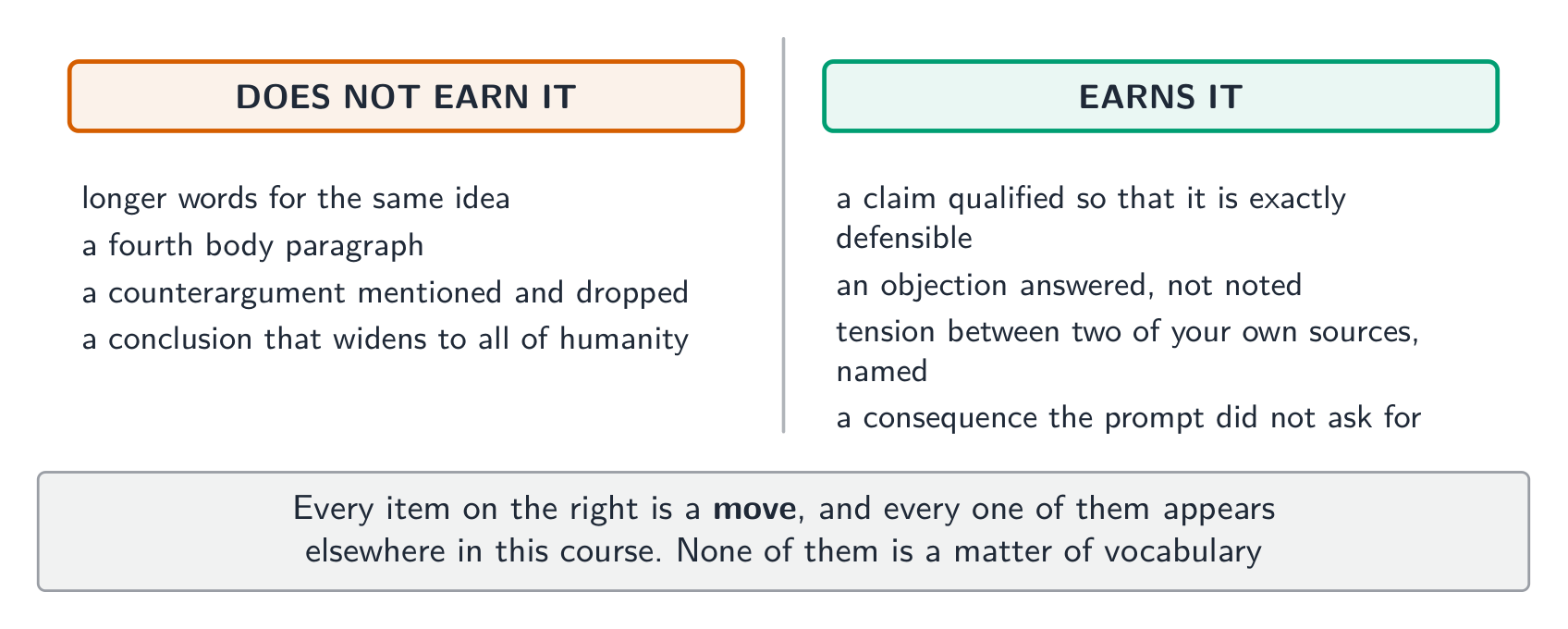
Sort what earns the sophistication point
It rewards a specific set of moves, all taught elsewhere in this course. None of them is a matter of vocabulary.
9.2
Exam tips
- Concede, rebut, refute are three different claims. Do not use the words interchangeably.
- Refute only with evidence of error. Without it, rebut instead - an alternative interpretation is almost always available.
- Conceding raises credibility, by the CED's own statement. It is not a weakness.
- After conceding, come back. An unreturned concession reads as agreement with the other side.
- Use a transition that ranks the counterargument: the strongest objection to this is beats some people say.
- When analysing a text, notice when it addresses no counterargument. That absence tells you who it was written for.
Interactive lessons on this topic
Work through it step by step, with instant-check exercises.