| Enduring Understanding | Learning Objective | Essential Knowledge |
|---|---|---|
REO-1 | 5.A |
|
Organization, Coherence, and Style
AP English Language and Composition · Topic 5
 5:41
5:41
Unit 5: Organization, Coherence, and Style
The CED's statement of the body paragraph is exact and worth memorising. The body paragraphs of a written argument make claims, support them with evidence, and…
English narration · English + 中文 subtitles burned in
5.1
Describing the Line of Reasoning
Syllabus
Source: College Board AP Course and Exam Description
Unit 5 turns from what an argument contains to how it holds together. It has two subjects: coherence 连贯 and the beginnings of style 文体.
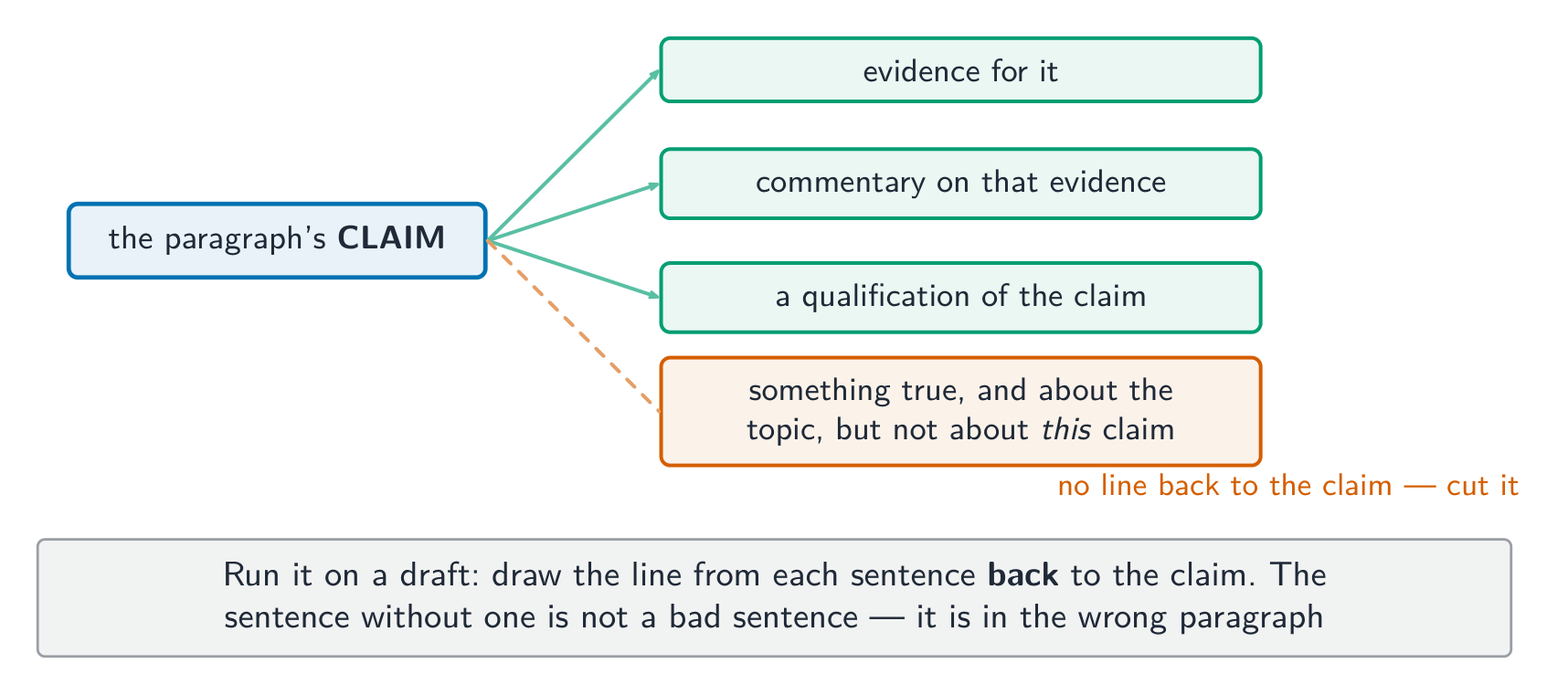
The CED's statement of the body paragraph is exact and worth memorising: the body paragraphs of a written argument make claims, support them with evidence, and provide commentary that explains the relationship of the evidence to the claim.
Three parts, in that order, in every body paragraph. When an AP essay loses evidence-and-commentary points, it is almost always because the third part is missing from paragraphs that have the first two.
Vocabulary
Train
| English |
|---|
| coherence/kəʊˈhɪərəns/ |
| style/staɪl/ |
5.2
Developing a Line of Reasoning and Commentary
Syllabus
| Enduring Understanding | Learning Objective | Essential Knowledge |
|---|---|---|
REO-1 | 6.A |
|
Source: College Board AP Course and Exam Description
Applied to your own writing: draft the claims first, as a list, before writing any paragraph. You then have the line of reasoning in front of you and can check that it moves.
Then, for each claim, write the paragraph in its three parts deliberately. A useful habit under exam conditions is to make the commentary sentence begin with a word that forces a relationship - because, which means, so, the effect of this is - because those words cannot be followed by a restatement.
5.3
Organization, Unity, and Coherence

Syllabus
| Enduring Understanding | Learning Objective | Essential Knowledge |
|---|---|---|
REO-1 | 5.B |
|
Source: College Board AP Course and Exam Description
Coherence occurs at different levels in a piece of writing:
- In a sentence, the idea in one clause logically links to the idea in another.
- In a paragraph, each sentence builds on the one before it.
- Across the whole text, each paragraph relates to the line of reasoning.
The CED then names the devices that create those links:
- Repetition 重复, synonyms 同义词, pronoun references 代词指代, and parallel structure 平行结构 may indicate or develop a relationship between ideas.
- Transitional elements 过渡成分 are words or other elements - phrases, clauses, sentences, or whole paragraphs - that assist in creating coherence.
Vocabulary
Train
| English |
|---|
| Repetition/ˌrepəˈtɪʃn/ |
| synonyms/ˈsɪnənɪmz/ |
| pronoun references/ˈprəʊnaʊn ˈrefrənsɪz/ |
| parallel structure/ˈpærəlel ˈstrʌktʃə/ |
| Transitional elements/trænˈsɪʃənl ˈelɪmənts/ |
5.4
Using Transitional Elements
Syllabus
| Enduring Understanding | Learning Objective | Essential Knowledge |
|---|---|---|
REO-1 | 6.B |
|
Source: College Board AP Course and Exam Description
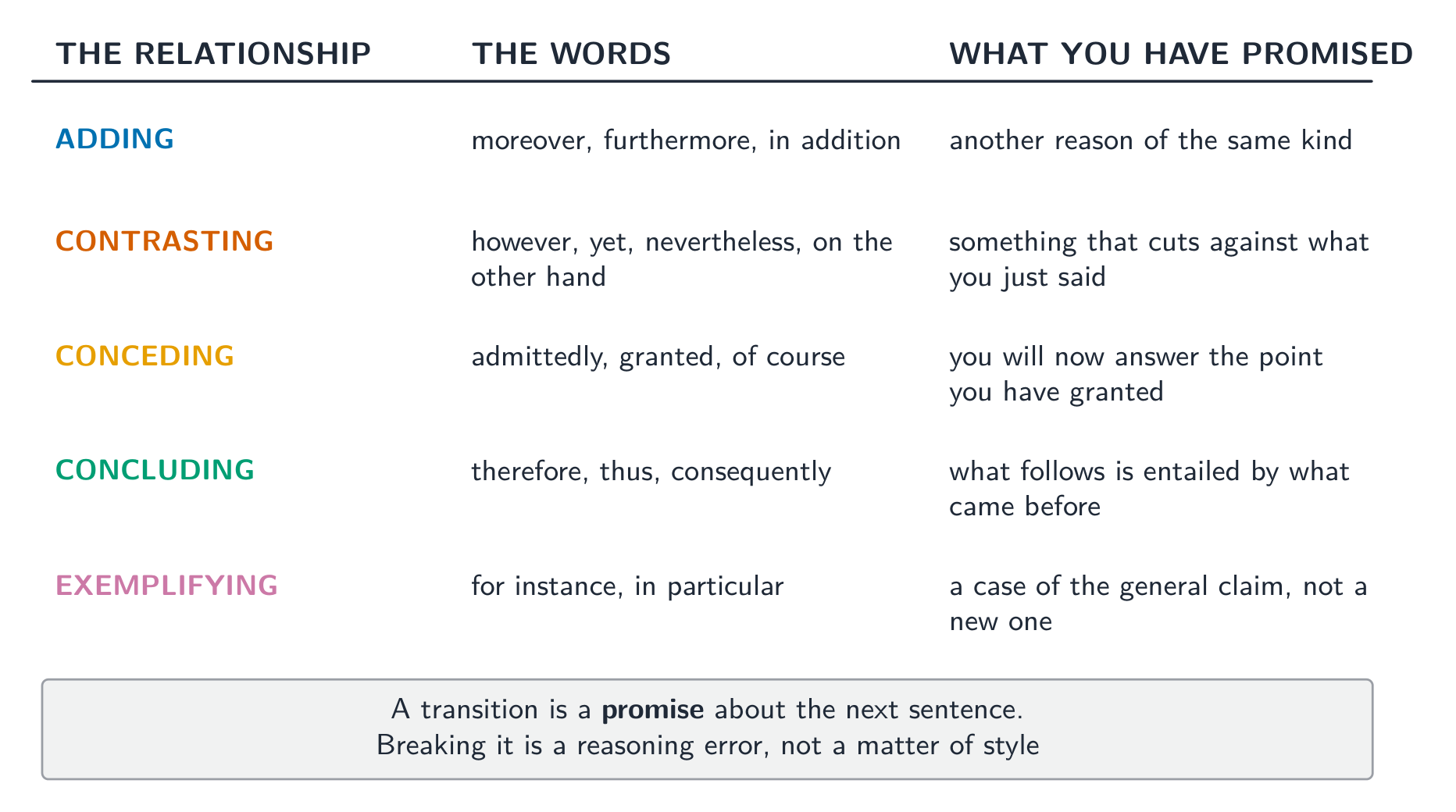
Transitions have a second job the CED names explicitly: they introduce evidence or indicate its relationship to other ideas or evidence.
That is the difference between decorative and functional transitions. Furthermore adds nothing - it says only "here is another sentence". Even in the cases where the effect is smallest tells the reader what relationship is coming. Choose transitions that carry information about the relationship, not ones that merely mark a boundary.
Note also that a transitional element may be a whole paragraph. In a long argument, a short paragraph whose only job is to turn the reasoning is legitimate and often elegant.
Explore
Match each transition to the promise it makes
A transition is a claim about how two ideas stand to each other. Breaking that promise is a reasoning error, not a style problem.
5.5
Word Choice, Comparisons, and Syntax
Syllabus
| Enduring Understanding | Learning Objective | Essential Knowledge |
|---|---|---|
STL-1 | 7.A |
|
Source: College Board AP Course and Exam Description
Unit 5 opens the course's treatment of style with three claims about diction:
- Words have both connotative and denotative meanings 内涵义与外延义. Denotation is what a word refers to; connotation is what it carries.
- Descriptive words - adjectives and adverbs - not only qualify or modify what they describe but convey a perspective toward it.
- Precise word choice reduces confusion and helps the audience perceive the writer's perspective.
The second is the analytically useful one. When a rhetorical-analysis passage calls a policy ambitious rather than expensive, no fact has changed and the reader's disposition has. That is a rhetorical choice, and it is exactly what the question asks you to explain.
Vocabulary
Train
| English |
|---|
| connotative and denotative meanings/kɒnəˈtætɪv ænd dɪˈnəʊtətɪv ˈmiːnɪŋz/ |
5.6
Using Words and Syntax for Tone and Style
Syllabus
| Enduring Understanding | Learning Objective | Essential Knowledge |
|---|---|---|
STL-1 | 8.A |
|
Source: College Board AP Course and Exam Description
For your own writing, precision is worth more than range. A concrete rule: prefer the word that is exactly right to the word that is impressive. Examiners reward control, and an inflated word used slightly wrongly reads as loss of control.
Worked example (a real AP exam task). In a rhetorical-analysis passage a writer describes a proposal's supporters as "determined" in one paragraph and "unyielding" in the next. A low-scoring answer notes that the writer uses "strong diction". A scoring answer explains the shift: "Both words denote persistence, but 'determined' carries approval and 'unyielding' carries obstruction. By moving from one to the other without changing the facts described, the writer withdraws sympathy from the supporters while appearing only to continue describing them - so the audience's judgement shifts before any counter-argument is made." That is connotation, tone, and effect on audience in one move.
Explore
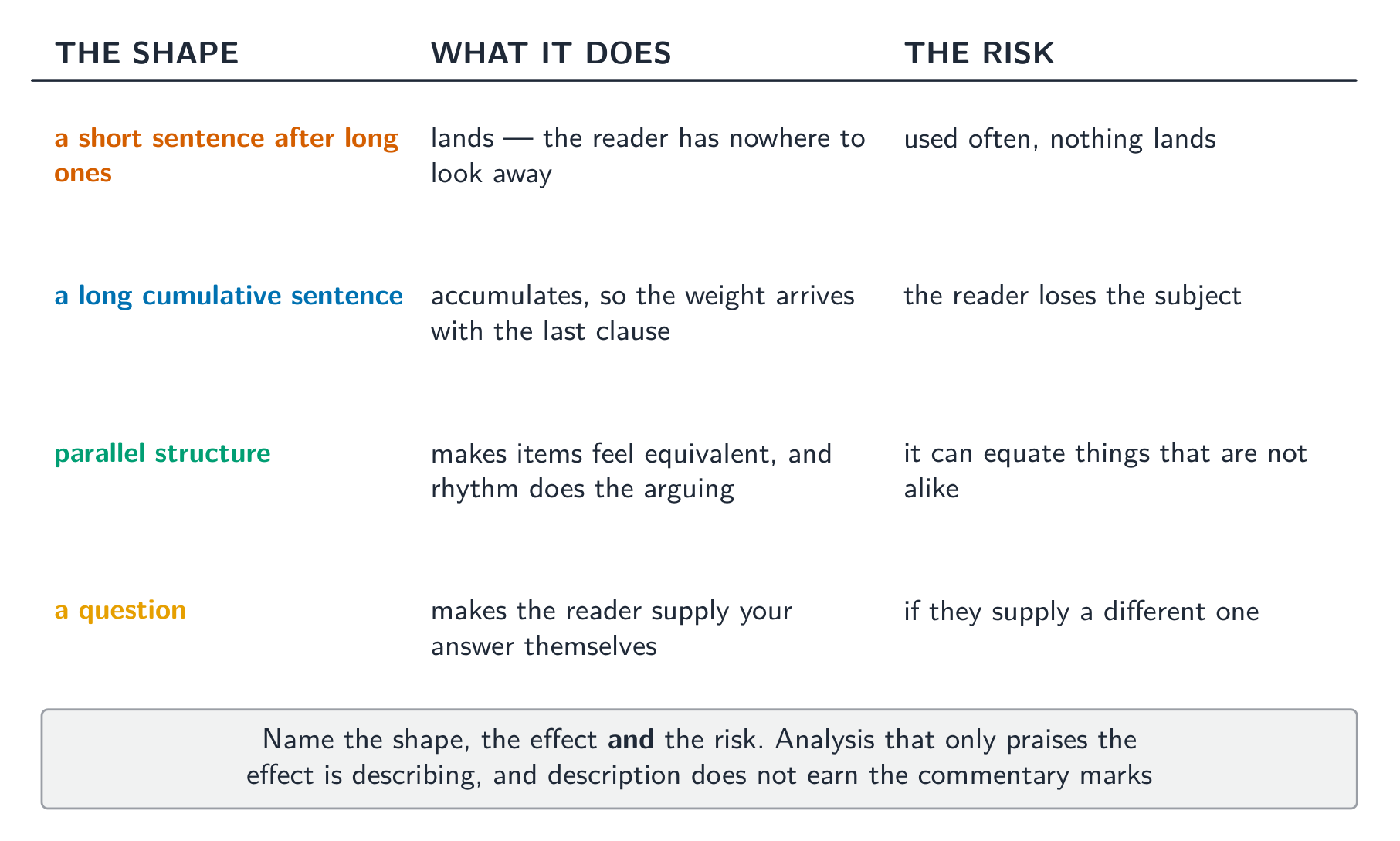
Name the shape, the effect and the risk
Analysis that only praises the effect is describing — and description does not earn commentary marks.
5.6
Exam tips
- Every body paragraph: claim, evidence, commentary. Lost points are nearly always the third.
- Draft your claims as a list first. It is the only way to see whether the reasoning moves.
- Begin commentary with because, which means, so - words that cannot be followed by a restatement.
- Know the coherence devices by name: repetition, synonyms, pronoun reference, parallel structure, transitions.
- A transition should carry the relationship, not just mark a boundary. Furthermore usually carries nothing.
- Connotation is where diction analysis lives. Same denotation, different disposition, is a rhetorical choice worth explaining.
Interactive lessons on this topic
Work through it step by step, with instant-check exercises.