| Enduring Understanding | Learning Objective | Essential Knowledge |
|---|---|---|
RHS-1 | 1.A |
|
Qualifying Arguments, Syntax, and Conventions
AP English Language and Composition · Topic 7
 6:19
6:19
Unit 7: Qualifying Arguments, Syntax, and Conventions
Most students assume a stronger-sounding claim scores better. The opposite is true, and it is easy to see why. An unqualified claim is easy to defeat with one…
English narration · English + 中文 subtitles burned in
7.1
Introductions and Conclusions Revisited
Syllabus
Source: College Board AP Course and Exam Description
Unit 7 returns to introductions and conclusions with more experience behind you, then moves to the two things that most separate competent writing from strong writing: qualification 限定 and sentence structure.
On introductions and conclusions, the CED's statements are unchanged - the introduction introduces subject and writer to the audience; the conclusion brings the argument to a unified end and may present the thesis, explain its significance, or situate the argument in a broader context.
Vocabulary
Train
| English |
|---|
| qualification/ˌkwɒlɪfɪˈkeɪʃn/ |
7.2
Writing Introductions and Conclusions
Syllabus
| Enduring Understanding | Learning Objective | Essential Knowledge |
|---|---|---|
RHS-1 | 2.A |
|
Source: College Board AP Course and Exam Description
At this stage the useful upgrade is to make the conclusion do the work the CED permits. A conclusion may:
- Explain the significance of the argument - why it matters that this is true;
- Situate it in a broader context - what larger question it belongs to;
- Present the thesis in its final, now-earned form.
The third is the strongest under exam conditions: restate the thesis in language you could not have used in the introduction, because the argument had not yet been made.
7.3
How Claims Are Qualified
Syllabus
| Enduring Understanding | Learning Objective | Essential Knowledge |
|---|---|---|
CLE-1 | 3.C |
|
Source: College Board AP Course and Exam Description
- A lack of understanding of the complexities of a subject can lead to oversimplification or generalisation 过度简化与以偏概全.
- Because arguments are usually part of an ongoing discourse, effective arguments often avoid expressing claims in absolute terms.
- Writers may strategically use words, phrases, and clauses as modifiers to qualify or limit the scope of an argument.
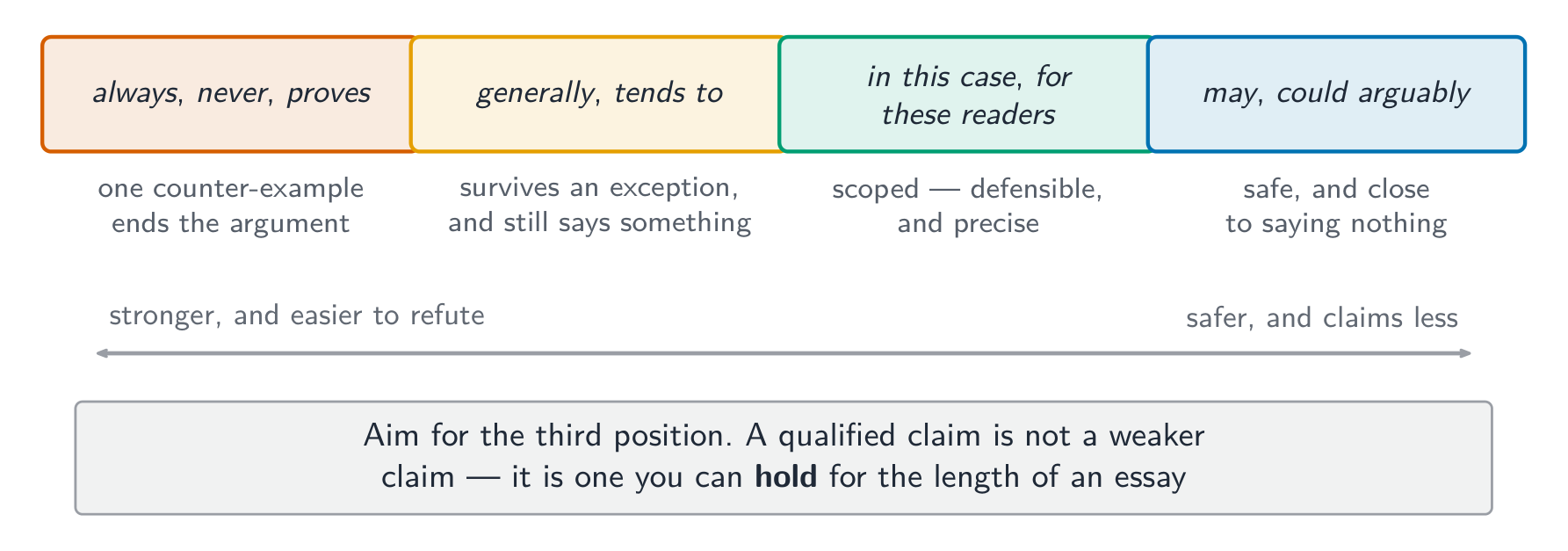
This is counter-intuitive for many students, who assume that a stronger-sounding claim scores better. The opposite is true: an unqualified claim is easy to defeat with one counter-example, while a qualified claim survives it. Schools should ban phones invites a single exception. Schools should restrict phone use during instructional time, where the cost to attention is measurable does not.
Vocabulary
Train
| English |
|---|
| oversimplification or generalisation/ˌəʊvəˌsɪmplɪfɪˈkeɪʃn ɔː ˌdʒenərəlaɪˈzeɪʃn/ |
7.4
Qualifying a Claim
Syllabus
| Enduring Understanding | Learning Objective | Essential Knowledge |
|---|---|---|
CLE-1 | 4.C |
|
Source: College Board AP Course and Exam Description
The tools are ordinary words used deliberately: in most cases, where X holds, for this population, unless, to the extent that. Each narrows the claim to the ground the evidence actually covers.
Qualification is also what the sophistication point most often rewards. A student who states a position, then shows they know its limits and defends it anyway, has demonstrated exactly the control the rubric is looking for.
Explore
Place each claim on the qualification scale
Each step left is stronger and easier to refute; each step right is safer and worth less. Aim for the scoped position.
7.5
Clauses and Relationships Between Ideas

Syllabus
| Enduring Understanding | Learning Objective | Essential Knowledge |
|---|---|---|
STL-1 | 7.B |
|
Source: College Board AP Course and Exam Description
- Writers express ideas in sentences, made up of clauses, at least one of which must be independent 独立分句.
- The arrangement of sentences in a text can emphasise particular ideas.
- Subordination and coordination 从属与并列 express the intended relationship between ideas in a sentence.
- Writers use coordination to illustrate balance or equality between ideas.
- Writers use subordination to illustrate imbalance or inequality between ideas.
- The arrangement of clauses, phrases, and words within a sentence can emphasise ideas.
Those two middle statements make sentence structure analysable rather than decorative. The measure was expensive, and it worked treats cost and effect as equals. Although the measure was expensive, it worked subordinates the cost - it is still true, but it has been ranked below the result. Same facts, different argument.
Vocabulary
Train
| English |
|---|
| independent/ˌɪndɪˈpendənt/ |
| Subordination and coordination/ˌsʌbɔːdɪˈneɪʃn ænd kəʊˈɔːdɪneɪʃn/ |
7.6
Writing Clear Sentences
Syllabus
| Enduring Understanding | Learning Objective | Essential Knowledge |
|---|---|---|
STL-1 | 8.B |
|
Source: College Board AP Course and Exam Description
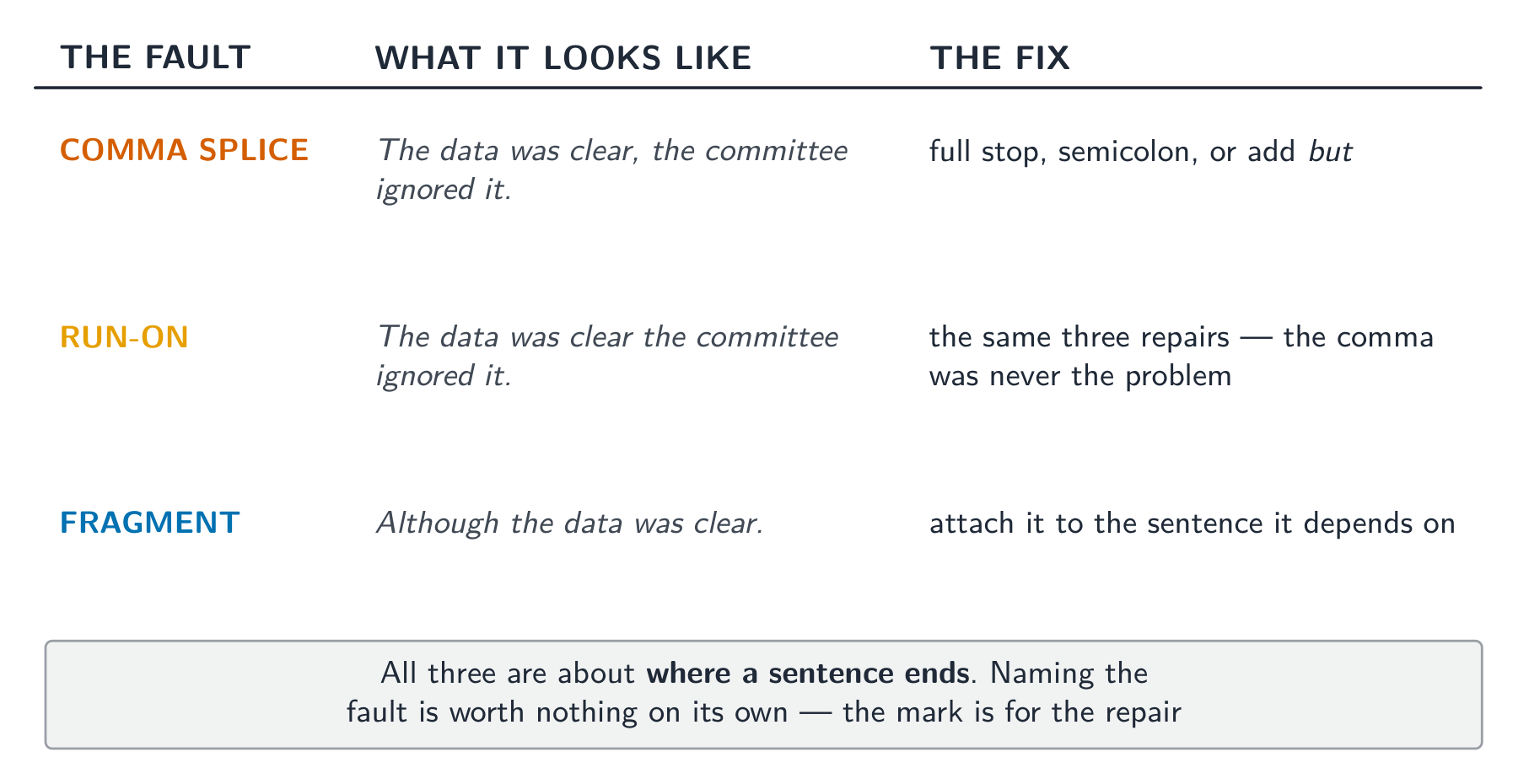
For your own writing: decide the relationship first, then choose the structure that expresses it. If two ideas genuinely carry equal weight, coordinate them. If one is a concession and the other your point, subordinate the concession - and put your point in the independent clause, where the emphasis falls.
Explore
Identify the sentence fault, then the repair
All three faults are about where a sentence ends. Naming one is worth nothing — the mark is for the repair.
7.7
Grammar, Mechanics, and Clarity
Syllabus
| Enduring Understanding | Learning Objective | Essential Knowledge |
|---|---|---|
STL-1 | 7.C |
|
Source: College Board AP Course and Exam Description
- Grammar and mechanics that follow established conventions enable clear communication.
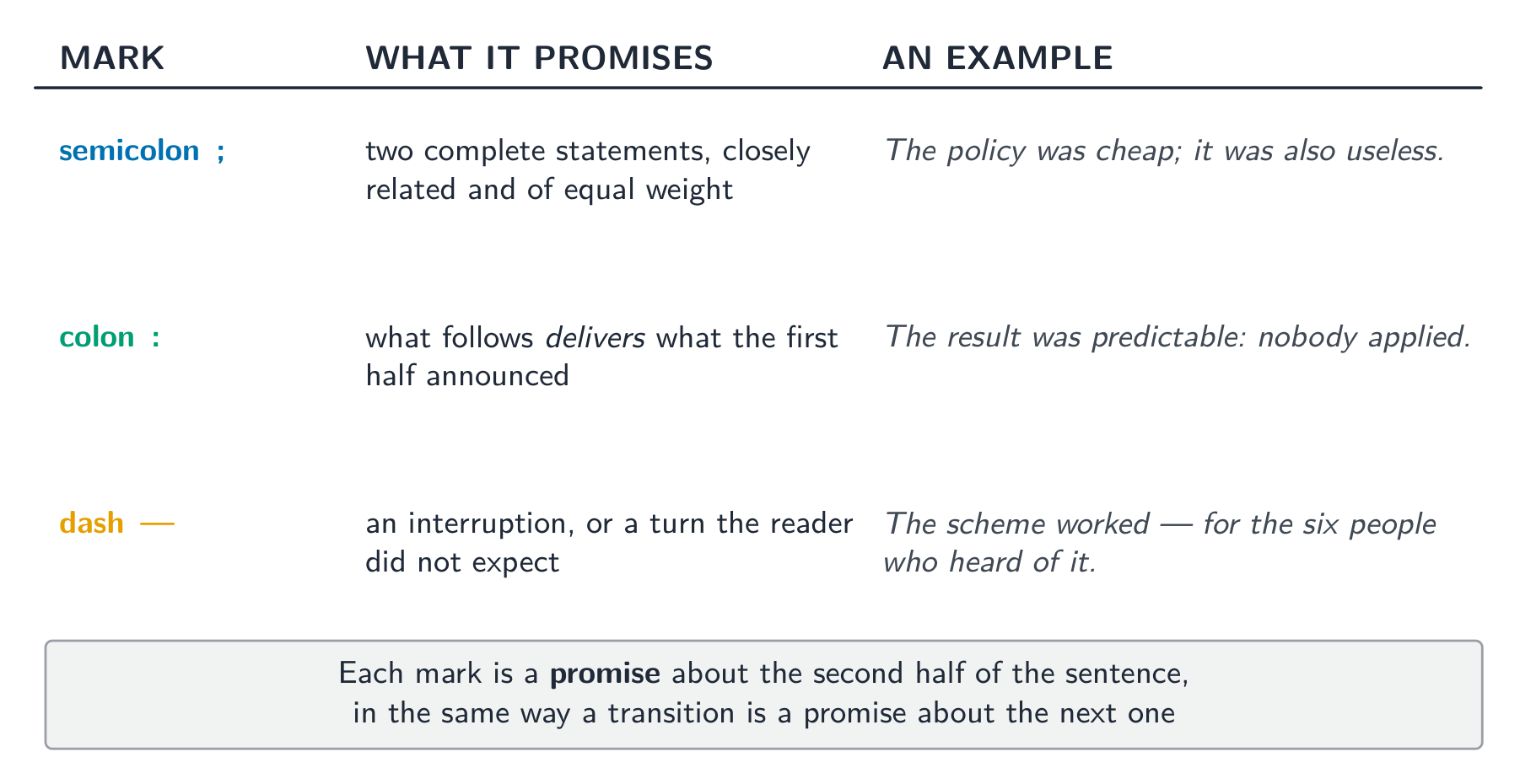
- Writers use punctuation strategically to demonstrate relationships among ideas.
- Punctuation - commas, colons, semicolons, dashes, hyphens, parentheses, quotation marks, end marks - advances the argument.
- Design features such as italics or boldface create emphasis.
7.8
Conventions of Grammar and Mechanics
Syllabus
| Enduring Understanding | Learning Objective | Essential Knowledge |
|---|---|---|
STL-1 | 8.C |
|
Source: College Board AP Course and Exam Description
The examinable framing is that punctuation is argumentative, not merely correct. A colon promises that what follows explains what preceded. A semicolon asserts that two independent statements belong together. A dash interrupts, and the interruption is the point.
Worked example (a real AP exam task). A rhetorical-analysis passage reads: "The programme was popular; it was also, by every measure the department itself proposed, ineffective." A low answer notes "the writer uses a semicolon". A scoring answer explains the structure: "The semicolon presents the two facts as equal and simultaneous rather than as a contrast, so the reader cannot dismiss the failure as an objection to popularity - both are simply true at once. The parenthetical 'by every measure the department itself proposed' then removes the department's escape route before the word 'ineffective' arrives." That is syntax analysed as argument.
7.8
Exam tips
- Qualify your claims. An absolute claim is defeated by one counter-example; a qualified one is not.
- Qualification is the most reliable route to the sophistication point.
- Coordination = balance. Subordination = imbalance. The CED says so, and it makes syntax analysable.
- Put your point in the independent clause. Concessions belong in the subordinate one.
- Punctuation advances the argument. A colon explains, a semicolon joins as equals, a dash interrupts.
- Never write "the writer uses a semicolon" without saying what relationship it asserts.
Interactive lessons on this topic
Work through it step by step, with instant-check exercises.