| Enduring Understanding | Learning Objective | Essential Knowledge |
|---|---|---|
RHS-1 | 1.A |
|
Claims, Evidence, and the Rhetorical Situation
AP English Language and Composition · Topic 1
 6:20
6:20
Unit 1: Claims, Evidence, and the Rhetorical Situation
Here is the single most common weak answer in this whole course. "The writer uses a rhetorical question." That sentence earns nothing, and it is what most…
English narration · English + 中文 subtitles burned in
1.1
The Rhetorical Situation
Syllabus
Source: College Board AP Course and Exam Description
AP English Language is not a literature course. It is a course in how texts do work on readers, and Unit 1 installs the two ideas everything else is built on: the rhetorical situation and the claim-plus-evidence paragraph.
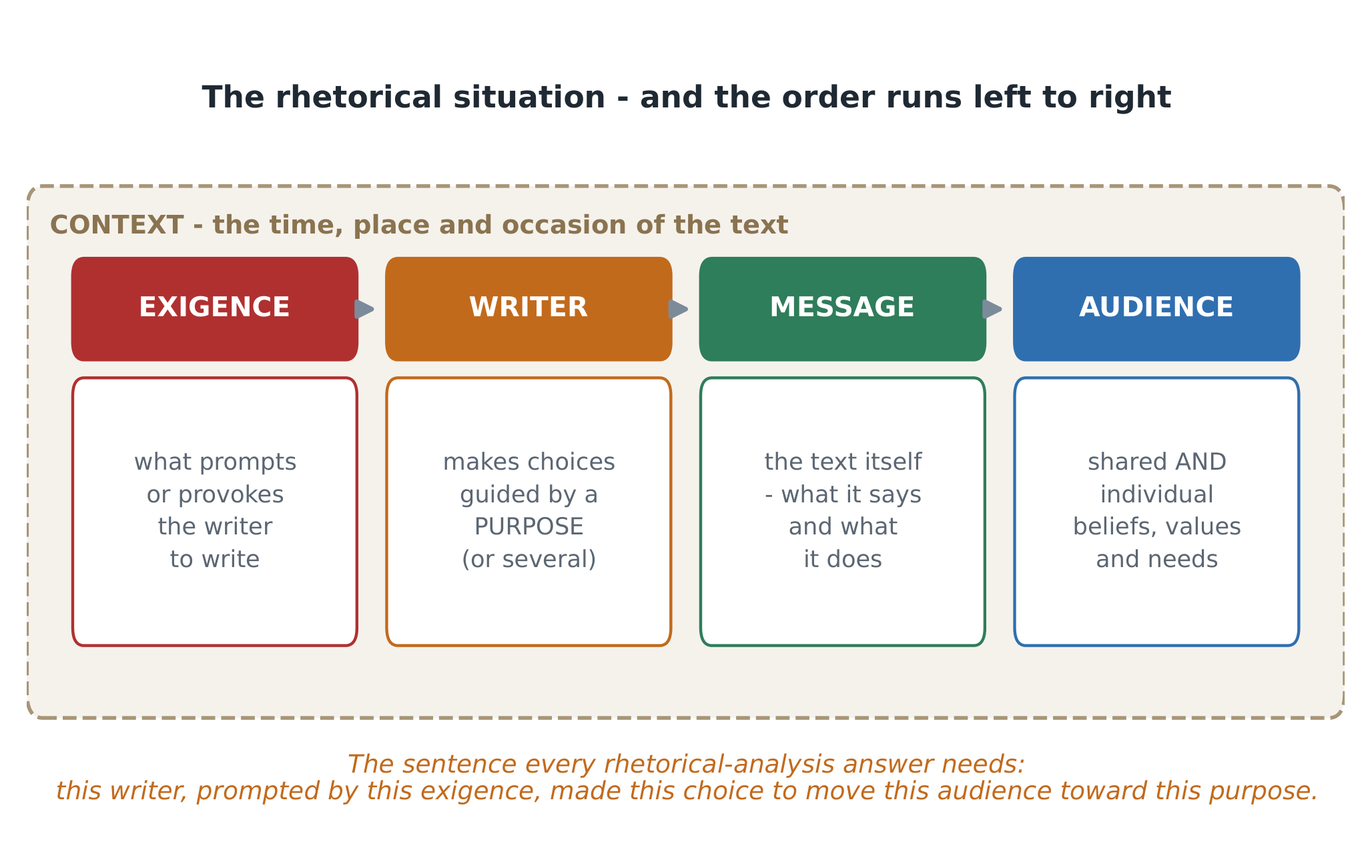
The CED defines the rhetorical situation 修辞情境 as the exigence, purpose, audience, writer, context, and message taken together. Each has a precise meaning, and using them precisely is what separates a strong answer from a vague one:
- The exigence 促因 is the part of the situation that inspires, stimulates, provokes, or prompts a writer to create a text. It is the reason this text exists now.
- The purpose 目的 is what the writer hopes to accomplish. A text may have more than one purpose.
- The audience 受众 has shared as well as individual beliefs, values, needs, and backgrounds - so "the audience" is never a single uniform thing.
- The context 语境 includes the time, place, and occasion in which the text was created.
- The message is what the text actually says and does.
The most common weak answer in this course names a device and stops. The rhetorical situation is what turns a device into an argument: this writer, prompted by this exigence, made this choice to move this audience toward this purpose.
Vocabulary
Train
| English |
|---|
| rhetorical situation/reˈtɒrɪkl ˌsɪtʃuːˈeɪʃn/ |
| exigence/ˈeksɪdʒəns/ |
| purpose/ˈpɜːpəs/ |
| audience/ˈɔːdɪəns/ |
| context/ˈkɒntekst/ |
1.2
Identifying Claims and Evidence
Syllabus
| Enduring Understanding | Learning Objective | Essential Knowledge |
|---|---|---|
CLE-1 | 3.A |
|
Source: College Board AP Course and Exam Description
- Writers convey their positions through one or more claims 主张 that require a defence.
- Writers defend their claims with evidence and/or reasoning 证据与推理.
- Types of evidence include facts, anecdotes, analogies, statistics, examples, details, illustrations, expert opinions, and personal experience - a deliberately wide list, because recognising an anecdote or an analogy as evidence is itself a skill.
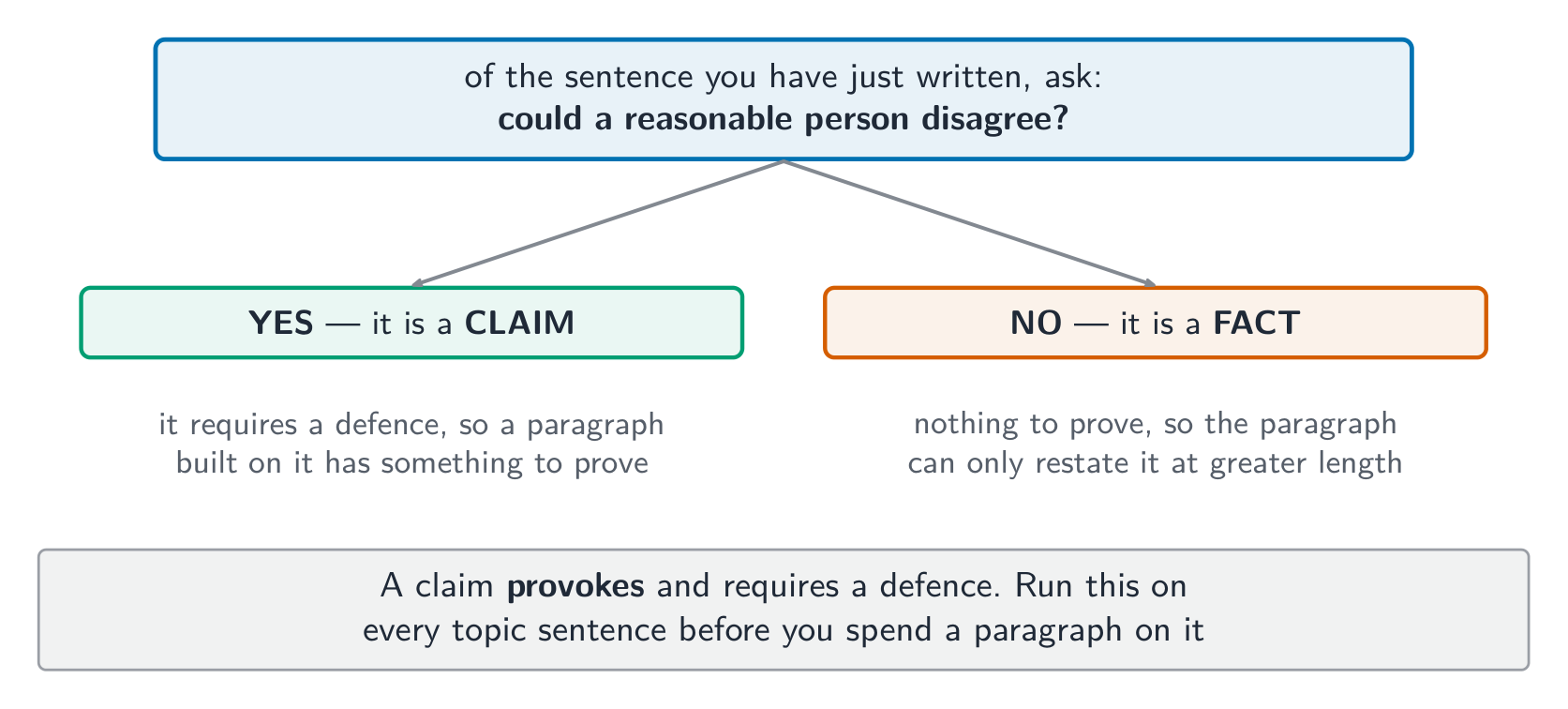
- Effective claims provoke interest and require a defence, rather than stating an obvious, known fact that requires no proof.
That fourth point is the most useful test you have. Ask of any sentence: could a reasonable person disagree? If not, it is not a claim - it is a fact, and building a paragraph on it produces writing with nothing to prove.
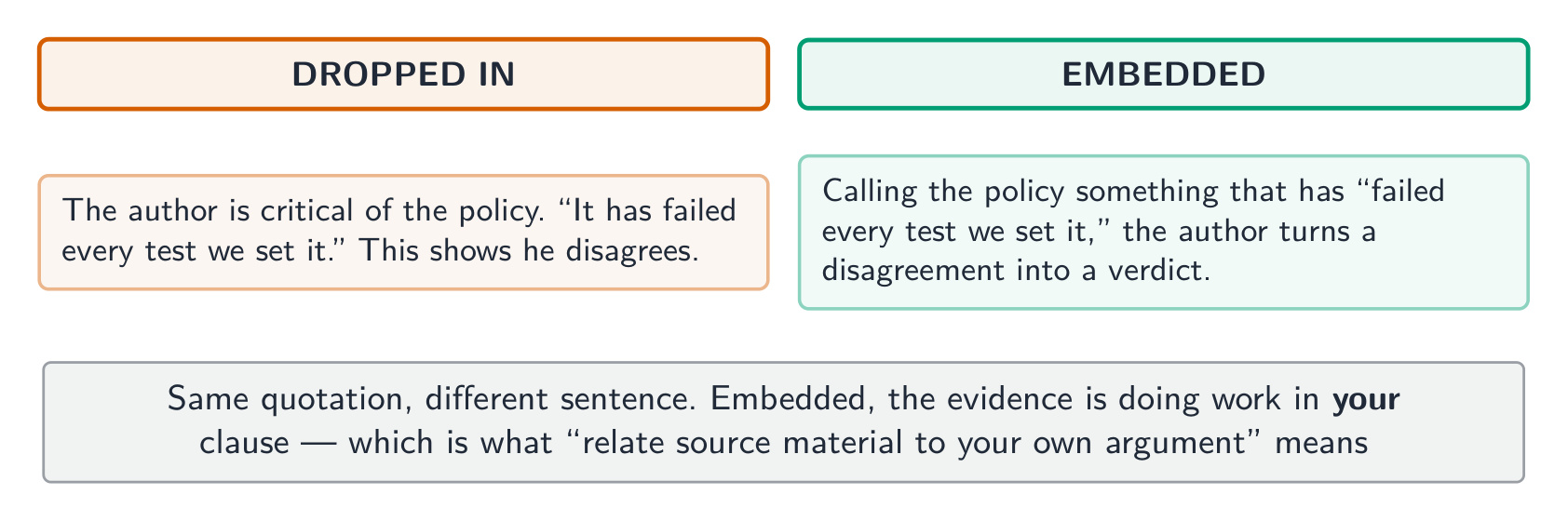
Finally, writers relate source material to their own argument by syntactically embedding quoted, paraphrased, or summarised material into their own sentences. The evidence is not dropped in beside your sentence; it is built into it.
Explore
Claim or fact? Run the test on each sentence
The test is one question: could a reasonable person disagree? If not, it is not a claim and a paragraph on it has nothing to prove.
Vocabulary
Train
| English |
|---|
| claims/kleɪmz/ |
| evidence and/or reasoning/ˈevɪdəns ænd ɔː ˈriːzənɪŋ/ |
1.3
Developing a Paragraph with Claim and Evidence
Syllabus
| Enduring Understanding | Learning Objective | Essential Knowledge |
|---|---|---|
CLE-1 | 4.A |
|
Source: College Board AP Course and Exam Description
Unit 1's writing objective is deliberately small: write one paragraph containing a claim and evidence that supports it. Everything later in the course is an elaboration of this.
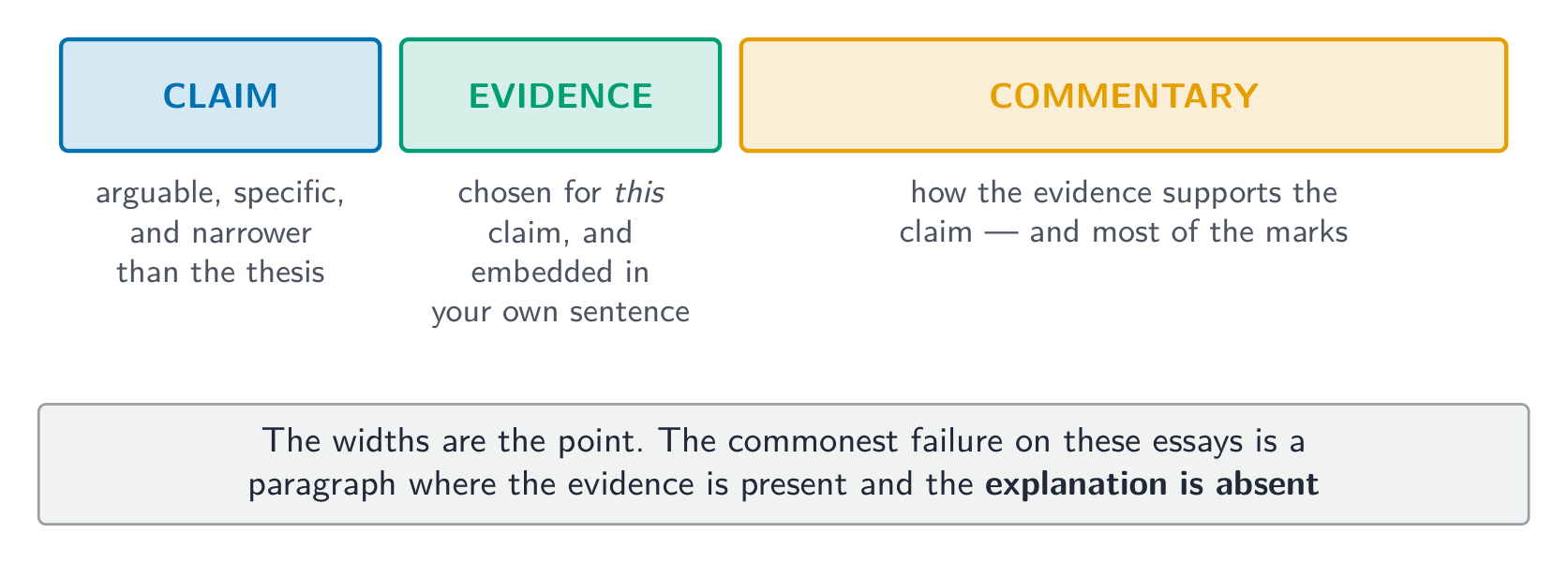
A working shape:
- A claim that requires defence - arguable, specific, and narrower than the whole thesis.
- Evidence chosen because it supports this claim, embedded syntactically rather than dropped in.
- Commentary explaining how the evidence supports the claim - the step students skip, and the one that carries most of the marks on the exam.
The single most common failure on the AP Language essays is a paragraph in which the evidence is present and the explanation is absent. The reader can see the quotation; what they cannot see is why you think it proves your point.
Explore
Build a paragraph in proportion
The commonest failure on these essays is a paragraph where the evidence is present and the explanation is absent.
1.3
What the Exam Actually Asks
The free-response section has three questions, and they use the same skills in different arrangements:
- Question 1, Synthesis 综合写作: you are given several sources and must build your own argument, using the sources as evidence rather than summarising them.
- Question 2, Rhetorical Analysis 修辞分析: you are given one text and must explain the choices the writer makes and how those choices contribute to purpose - which is the rhetorical situation applied.
- Question 3, Argument 论证写作: you are given a claim or a scenario and must argue a position, using evidence from your own knowledge and experience.
All three are marked on a six-point rubric with the same three rows: thesis (1 point), evidence and commentary (4 points), and sophistication (1 point). Knowing that shape from Unit 1 tells you where the marks are: four of the six come from evidence and the commentary on it, so a plan that produces evidence without explanation caps you at low marks no matter how good the writing sounds.
Worked example (a real AP exam task). A Rhetorical Analysis prompt asks you to "explain the writer's rhetorical choices" in a given passage. A row-scoring answer does not say "the writer uses a rhetorical question." It says: "Faced with an audience that already agrees on the problem but not on its urgency, the writer opens with a question rather than a statement, forcing readers to supply the answer themselves and so to feel the conclusion as their own rather than as one imposed on them." Notice what earns the points: the audience, the choice, and the effect on purpose - the rhetorical situation, used.
Vocabulary
Train
| English |
|---|
| Question 1, Synthesis/ˈkwestʃn wɒn ˈsɪnθəsɪs/ |
| Question 2, Rhetorical Analysis/ˈkwestʃn tuː reˈtɒrɪkl əˈnæləsɪs/ |
| Question 3, Argument/ˈkwestʃn θriː ˈɑːɡjuːmənt/ |
1.3
Exam tips
- Learn the six components by name and use the names. Precision here is directly rewarded.
- Exigence is not the same as purpose. Exigence is what prompted the text; purpose is what the writer wants to achieve.
- Test every claim with could a reasonable person disagree? If not, it is a fact, not a claim.
- Embed evidence in your own sentence. Dropped quotations read as unprocessed.
- Four of six points are evidence and commentary. Write the commentary; it is where most lost marks live.
- Never name a device without saying what it does to the audience. A device with no effect earns nothing.
Interactive lessons on this topic
Work through it step by step, with instant-check exercises.