| Enduring Understanding | Learning Objective | Essential Knowledge |
|---|---|---|
CLE-1 | 3.A |
|
Evidence, Thesis, and Stylistic Choices
AP English Language and Composition · Topic 6
 5:21
5:21
Unit 6: Evidence, Thesis, and Stylistic Choices
Unit 6 is the synthesis unit, and it contains the single sharpest distinction in the course. A position and a perspective are different. Sources may hold the…
English narration · English + 中文 subtitles burned in
6.1
Identifying Claims and Evidence
Syllabus
Source: College Board AP Course and Exam Description
Unit 6 is the synthesis unit, and it contains the single sharpest distinction in the course.
- When synthesising, writers draw on arguments from multiple sources, strategically select the most relevant information, and integrate it into their own argument.
- A source provides information for an argument, and some sources are more reliable or credible than others.
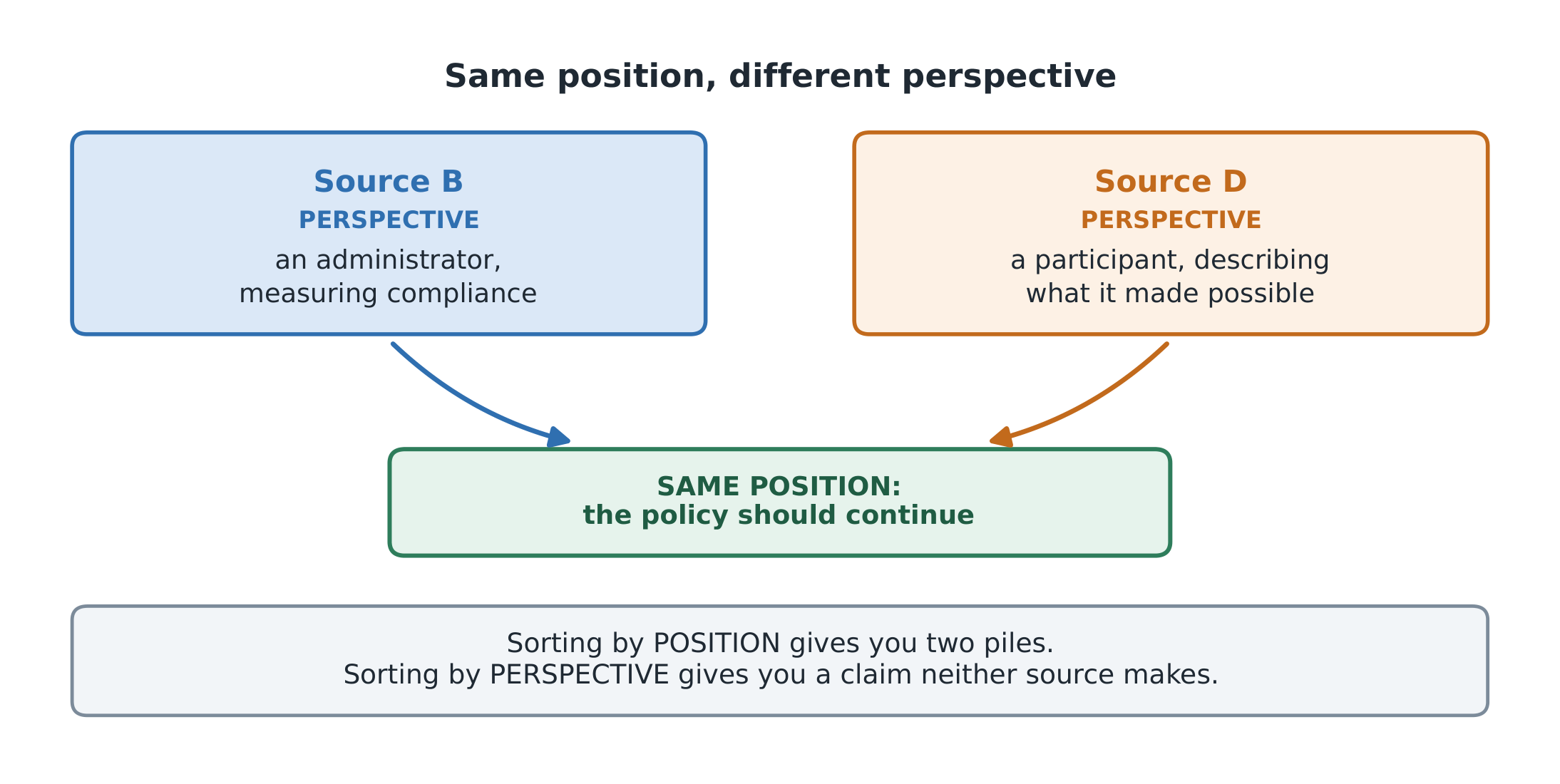
- A position and a perspective are different. Sources may hold the same position on a subject and yet each come from a different perspective.
- The strongest arguments recognise and acknowledge the other positions that exist.
- The degree to which a source considers other positions reflects the degree to which that source is credible - a test you can apply to any source on the exam.
Explore
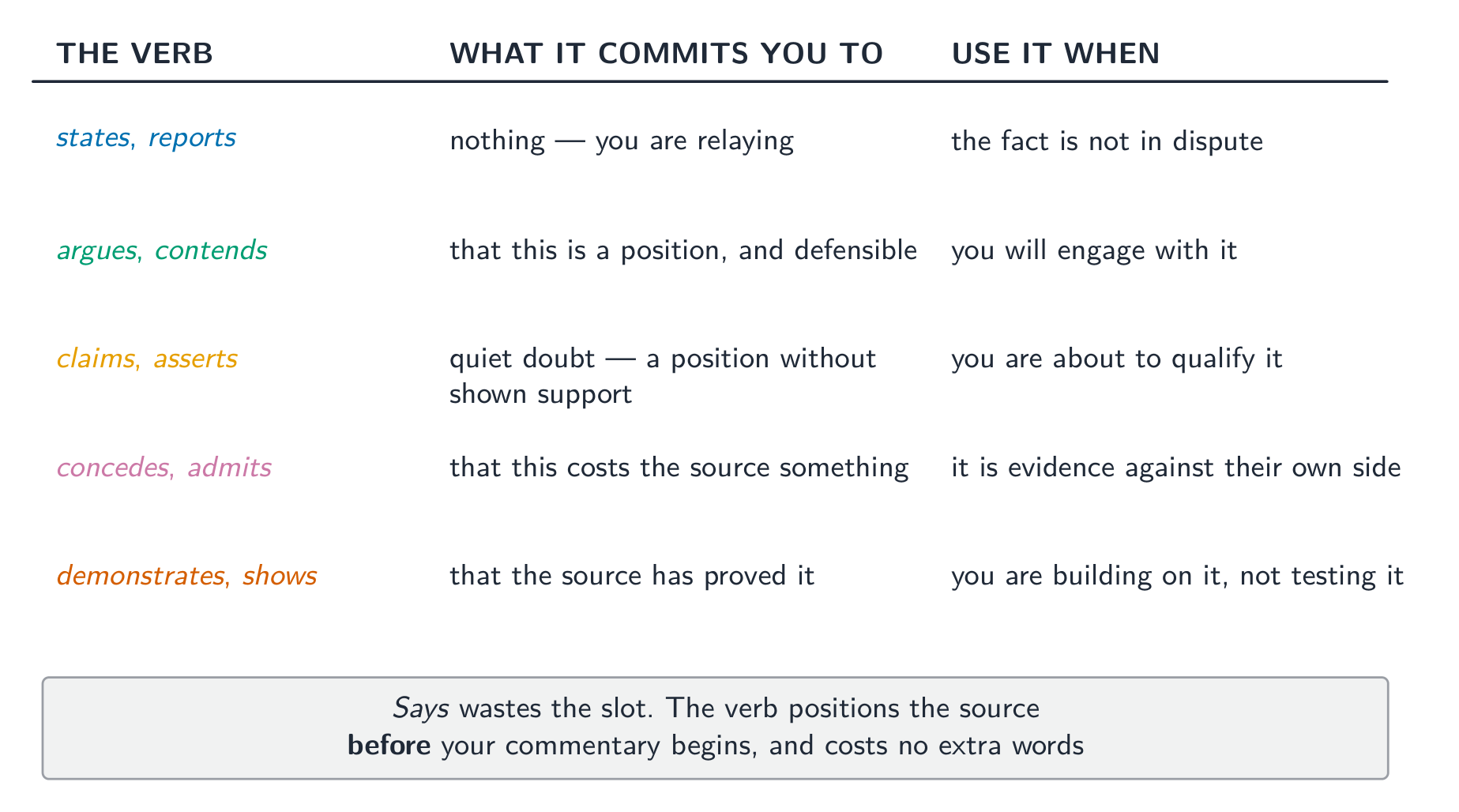
Choose the attribution verb that positions the source
The verb commits you to something about the source's status, before your commentary starts, and costs no extra words.
6.2
Developing a Paragraph with Claim and Evidence
Syllabus
| Enduring Understanding | Learning Objective | Essential Knowledge |
|---|---|---|
CLE-1 | 4.A |
|
Source: College Board AP Course and Exam Description
The position-and-perspective distinction is what makes synthesis possible. If you sort the sources only by position, you get two piles - for and against - and a paragraph per pile. If you sort them by perspective, you can say things like:
Both the economist and the teacher support the measure, but they support it for reasons that do not survive together: one values the measurable gain, the other the change in what students attempt.
That sentence is synthesis. It uses two sources, is grounded in what each actually says, and produces a claim neither source makes.
Also examinable: use the credibility test. A source that never acknowledges any other position is, by the CED's own standard, less credible - and saying so about a source is legitimate evidence in your essay.
Explore
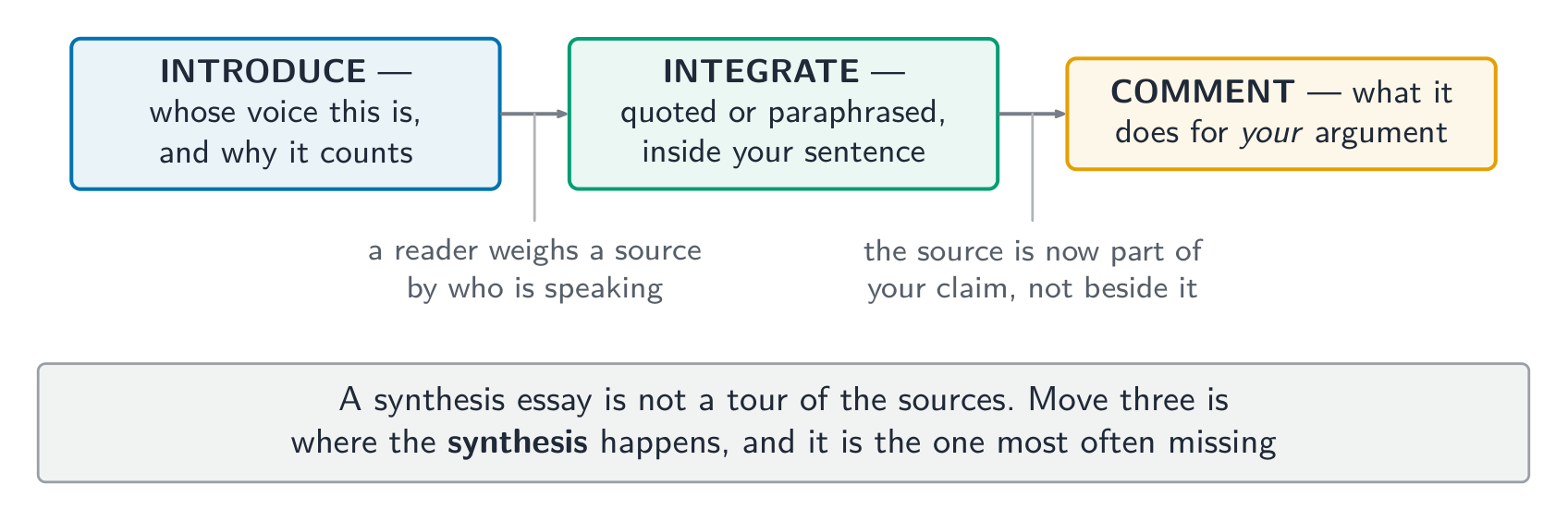
Turn a source into evidence in three moves
A synthesis essay is not a tour of the sources. The third move is where the synthesis happens, and it is the one most often missing.
6.3
Identifying the Overarching Thesis
Syllabus
| Enduring Understanding | Learning Objective | Essential Knowledge |
|---|---|---|
CLE-1 | 3.B |
|
Source: College Board AP Course and Exam Description
A short but load-bearing point: consideration and use of new evidence may require revision of the thesis statement and/or changes to the line of reasoning.
Reading a text, this means a writer's thesis may be responsive - shaped by the evidence rather than imposed on it. Look for where an argument turns.
6.4
Writing a Thesis Statement
Syllabus
| Enduring Understanding | Learning Objective | Essential Knowledge |
|---|---|---|
CLE-1 | 4.B |
|
Source: College Board AP Course and Exam Description
Writing under time pressure, this is permission you should use. If, while drafting, you find the evidence does not support the thesis you began with, change the thesis, not the evidence. Examiners reward an argument that fits its evidence; there are no marks for having predicted your own conclusion.
In practice, spend the first minutes reading sources and sketching claims before fixing the thesis. A thesis written after the evidence is nearly always better than one written before it.
6.5
Word Choice, Comparisons, and Syntax
Syllabus
| Enduring Understanding | Learning Objective | Essential Knowledge |
|---|---|---|
STL-1 | 7.A |
|
Source: College Board AP Course and Exam Description
- A writer's tone 语调 is the writer's attitude or feeling about a subject, conveyed through word choice and writing style.
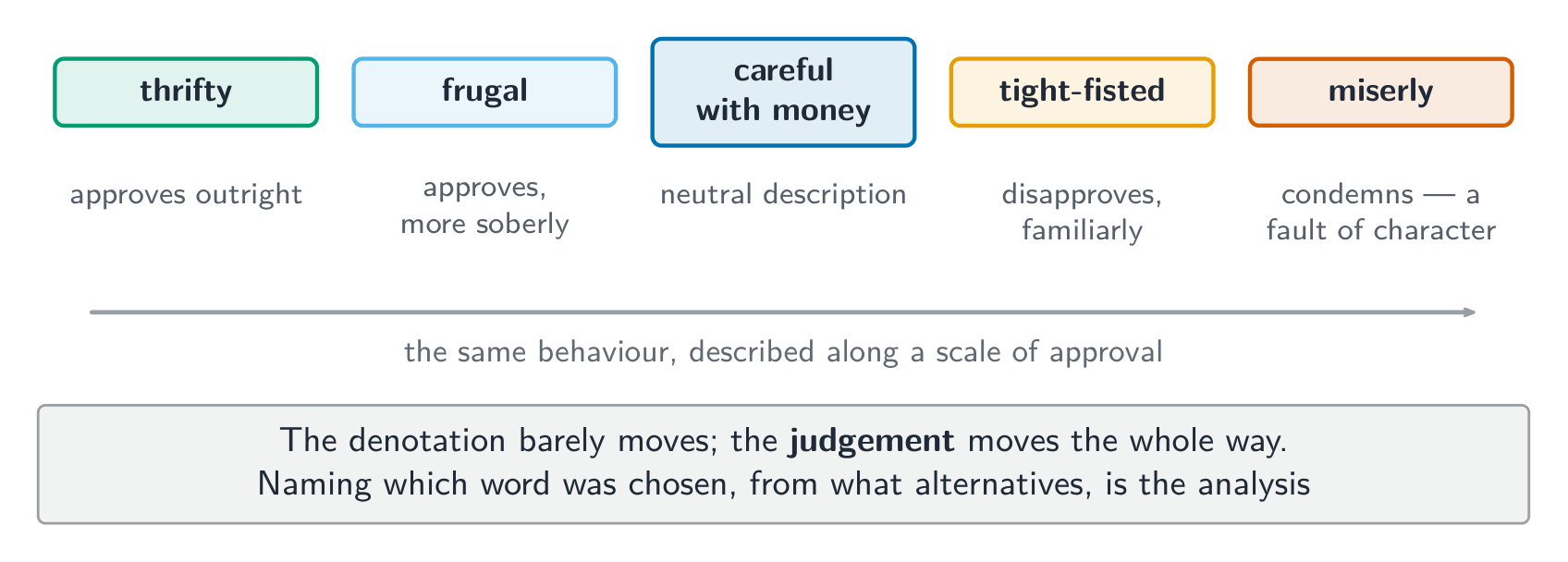
- Readers infer tone from word choice - especially from the positive, negative, or otherwise charged associations of the words chosen.
- A writer's shifts in tone 语调转变 from one part of a text to another may suggest qualification, refinement, or a change in perspective.
The third is the analytical gold. A tone shift is a visible event in a text: something changed at that point, and explaining what the writer wanted the reader to do differently after it is exactly the kind of answer that scores.
Vocabulary
Train
| English |
|---|
| tone/təʊn/ |
| shifts in tone/ʃɪfts ɪn təʊn/ |
6.6
Using Words and Syntax for Tone and Style
Syllabus
| Enduring Understanding | Learning Objective | Essential Knowledge |
|---|---|---|
STL-1 | 8.A |
|
Source: College Board AP Course and Exam Description
In your own writing, tone should be consistent and controlled, and deliberately shifted only where the argument turns - for example when moving from stating your position to conceding part of an opposing one.
Worked example (a real AP exam task). On a synthesis prompt, compare two uses of the same two sources. Weak: "Source B agrees with Source D that the policy should continue." That is position-sorting, and it produces nothing. Strong: "Sources B and D both defend the policy, but B defends it as an administrator measuring compliance while D defends it as a participant describing what it made possible - so the agreement is thinner than it appears, and the case rests on whether we are measuring the policy's operation or its effect." Same two sources, but the perspectives are doing the work, and the claim belongs to the writer.
6.6
Exam tips
- Position and perspective are different. This one distinction lifts most synthesis essays out of the middle band.
- Sort sources by perspective, not by side. Sorting by side produces a paragraph per pile and no argument.
- Use the CED's credibility test: a source that ignores all other positions is weaker, and you may say so.
- If the evidence does not fit the thesis, change the thesis. There are no marks for consistency with your first idea.
- A tone shift is a visible event. Say what changed and what the reader was meant to do after it.
- Keep your own tone controlled. Shift it only where the argument genuinely turns.
Interactive lessons on this topic
Work through it step by step, with instant-check exercises.