Skip to content · ⁨ข้ามไปยังเนื้อหา⁩
Subjects · ⁨รายวิชา⁩

AP English Language and Composition · ⁨AP ภาษาอังกฤษเพื่อการสื่อสารและการเขียน⁩

Tips · ⁨เคล็ดลับ⁩

AP English Language and Composition เป็นรายวิชาใน retorics : วิธีที่นักเขียนใช้ภาษาเพื่อสร้างผลกระทบต่อบทอ่าน เนื้อหาที่ต้องเรียนประกอบด้วยชุดของ ทักษะ ที่จัดอยู่ในสี่แนวคิดหลัก - สถานการณ์ทาง retorics, ข้ออ้างและหลักฐาน, การให้เหตุผลและการจัดโครงสร้าง, และ สไตล์

ทักษะทุกประการมีทั้งส่วนการอ่านและส่วนการเขียน คุณจะได้เรียนรู้ที่จะอธิบายว่านักเขียนอีกคนสร้างข้อโต้แย้งอย่างไร แล้วจึงสร้างข้อโต้แย้งของคุณเองโดยใช้เทคนิคเดียวกัน ส่วนทั้งสองถูกสอนพร้อมกันอย่างตั้งใจ

สถานการณ์ทาง retorics คือรากฐาน ความจำเป็น, กลุ่มเป้าหมาย, นักเขียน, วัตถุประสงค์, บริบท และข้อความ อธิบายว่า *ทำไม* ข้อความจึงเลือกทำสิ่งที่มันทำ - และการบอกว่า "นักเขียนใช้เครื่องมือนี้" จะไม่ได้รับคะแนนจนกว่าคุณจะระบุได้ว่ามันทำหน้าที่อย่างไรสำหรับกลุ่มเป้าหมายนั้น

ข้อเขียนส่วนใหญ่เป็นงานสารคดี -_EQssay_, บทพูด, จดหมาย, journalism. เนื่องจากครูผู้สอนเลือกข้อเขียนและหัวข้อด้วยตนเอง หน่วยการเรียนรู้จึงกำหนดโดยทักษะที่พัฒนาขึ้นแทนที่จะกำหนดโดยหนังสือที่กำหนดไว้

หมายเหตุด้านล่างนี้เป็นไปตามกรอบของ College Board แบบหน่วยต่อหน่วย โดยแต่ละทักษะและความรู้พื้นฐานที่อยู่เบื้องหลังมัน

  • 1

    Claims, Evidence, and the Rhetorical Situation · ⁨ข้ออ้าง หลักฐาน และสถานการณ์เชิง retorics⁩

    Watch lesson · ⁨ดูบทเรียน⁩
    1.1

    The Rhetorical Situation · ⁨สถานการณ์เชิงวาทกรรม⁩

    Syllabus · ⁨หลักสูตร⁩
    English

    Enduring Understanding (RHS-1): Individuals write within a particular situation and make strategic writing choices based on that situation.

    Learning Objective 1.A: Reading – Identify and describe components of the rhetorical situation: the exigence, audience, writer, purpose, context, and message.

    • RHS-1.A The rhetorical situation of a text collectively refers to the exigence, purpose, audience, writer, context, and message.
    • RHS-1.B The exigence is the part of a rhetorical situation that inspires, stimulates, provokes, or prompts writers to create a text.
    • RHS-1.C The purpose of a text is what the writer hopes to accomplish with it. Writers may have more than one purpose in a text.
    • RHS-1.D An audience of a text has shared as well as individual beliefs, values, needs, and backgrounds.
    • RHS-1.E Writers create texts within a particular context that includes the time, place, and occasion.
    ไทย

    ความเข้าใจที่ยั่งยืน (RHS-1): บุคคลเขียนภายในสถานการณ์เฉพาะและเลือกการเขียนเชิงกลยุทธ์โดยอาศัยสถานการณ์นั้น

    วัตถุประสงค์การเรียนรู้ 1.A: การอ่าน – ระบุและอธิบายองค์ประกอบของสถานการณ์เชิงวาท拉克: exigence, ผู้ฟัง, ผู้เขียน, วัตถุประสงค์, บริบท, และข้อความ

    • RHS-1.A สถานการณ์เชิงวาท拉克ของข้อความอ้างถึง itemId exigence, วัตถุประสงค์, ผู้ฟัง, ผู้เขียน, บริบท, และข้อความ
    • RHS-1.B ความจำเป็น (exigence) คือส่วนหนึ่งของสถานการณ์ทาง retorics ที่กระตุ้น กระตุ้นใจ กระตุ้นให้ หรือชี้นำนักเขียนให้สร้างข้อความ
    • RHS-1.C วัตถุประสงค์ของข้อความคือสิ่งที่นักเขียนหวังว่าจะบรรลุได้ด้วยข้อความนั้น นักเขียนอาจมีวัตถุประสงค์มากกว่าหนึ่งอย่างในข้อความเดียว
    • RHS-1.D กลุ่มผู้อ่านของข้อความมีทั้งความเชื่อ ค่านิยม ความต้องการ และพื้นหลังที่ร่วมกันและที่เป็นส่วนตัว
    • RHS-1.E นักเขียนสร้างข้อความภายในบริบทเฉพาะซึ่งประกอบด้วยเวลา สถานที่ และโอกาส
    Source: College Board AP Course and Exam Description · ⁨แหล่งที่มา: คำอธิบายหลักสูตรและข้อสอบ College Board AP⁩

    English

    AP English Language is not a literature course. It is a course in how texts do work on readers, and Unit 1 installs the two ideas everything else is built on: the rhetorical situation and the claim-plus-evidence paragraph.

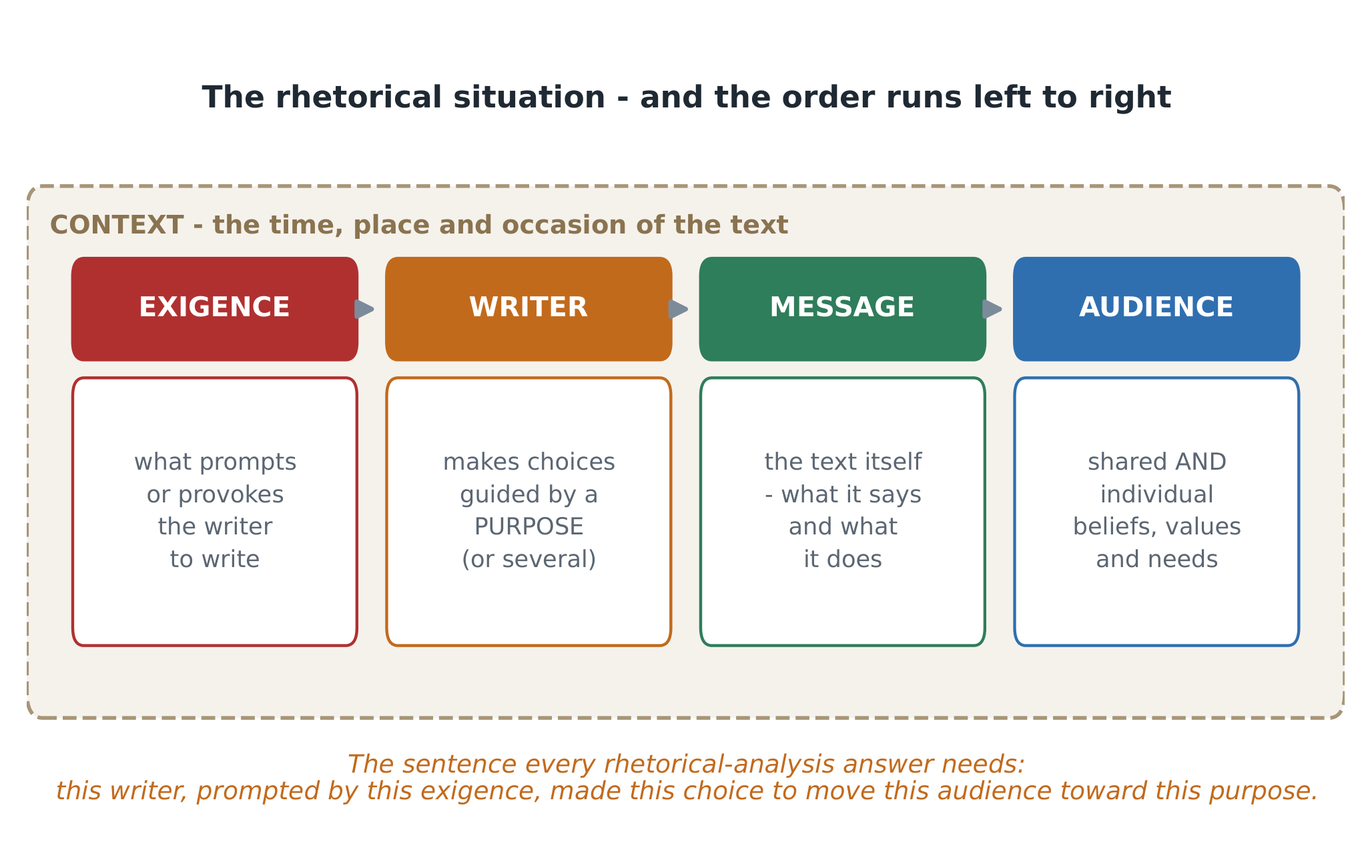
    The CED defines the rhetorical situation 修辞情境 as the exigence, purpose, audience, writer, context, and message taken together. Each has a precise meaning, and using them precisely is what separates a strong answer from a vague one:

    • The exigence 促因 is the part of the situation that inspires, stimulates, provokes, or prompts a writer to create a text. It is the reason this text exists now.
    • The purpose 目的 is what the writer hopes to accomplish. A text may have more than one purpose.
    • The audience 受众 has shared as well as individual beliefs, values, needs, and backgrounds - so "the audience" is never a single uniform thing.
    • The context 语境 includes the time, place, and occasion in which the text was created.
    • The message is what the text actually says and does.

    The most common weak answer in this course names a device and stops. The rhetorical situation is what turns a device into an argument: this writer, prompted by this exigence, made this choice to move this audience toward this purpose.

    ไทย

    AP English Language ไม่ใช่วิชาวรรณกรรม เป็นวิชาใน วิธีที่ข้อความมีผลต่อผู้อ่าน, และหน่วยที่ 1 จะแนะนำสองแนวคิดที่ everything else is built on: สถานการณ์เชิงวาทกรรม และย่อหน้า ข้ออ้างบวกหลักฐาน

    องค์ประกอบทั้งหก, จัดเรียงเพื่อให้ลำดับเหตุและผลมองเห็นได้
    促因กระตุ้นนักเขียน; 语境ล้อมรอบทุกอย่าง — และทุกคำถามเกี่ยวกับ "ทางเลือก" ตอบได้จากที่นี่

    CED นิยาม สถานการณ์เชิงวาทกรรม 修辞情境 เป็น 促因, วัตถุประสงค์, กลุ่มเป้าหมาย, นักเขียน, 语境 และข้อความ รวมกัน แต่ละอย่างมีความหมายที่แม่นยำ และการใช้งาน将它们อย่างแม่นยำคือสิ่งที่แยกคำตอบที่แข็งแกร่งออกจากคำตอบที่เบลอ:

    • 促因 促因 คือส่วนหนึ่งของสถานการณ์ที่ แรงบันดาลใจ, กระตุ้น, กระตุ้น หรือกระตุ้นให้นักเขียนสร้างข้อความ มันคือเหตุผลที่ข้อความนี้เกิดขึ้น ตอนนี้
    • วัตถุประสงค์ 目的 คือสิ่งที่นักเขียนหวังว่าจะบรรลุ ข้อความอาจมี มากกว่าหนึ่งวัตถุประสงค์
    • กลุ่มเป้าหมาย 受众 มี ความเชื่อ ค่านิยม ความต้องการ และพื้นหลังที่แบ่งปันกัน รวมถึงรายบุคคล ดังนั้น "กลุ่มเป้าหมาย" จึงไม่ใช่สิ่งเดียวกันทั้งหมด
    • 语境 语境 รวมถึง เวลา สถานที่ และโอกาส ที่ข้อความถูกสร้างขึ้น
    • ข้อความ คือสิ่งที่ข้อความนั้นบอกและกระทำจริง

    คำตอบที่อ่อนแอที่สุดที่พบบ่อยในวิชานี้คือการระบุอุปกรณ์แล้วหยุด Situational rhetorical คือสิ่งที่เปลี่ยนอุปกรณ์ให้เป็นข้อโต้แย้ง: นักเขียนคนนี้, ถูกกระตุ้นด้วย促因นี้, เลือกทำสิ่งนี้เพื่อขับเคลื่อนกลุ่มเป้าหมายนี้ไปสู่วัตถุประสงค์นี้

    Vocabulary · ⁨คำศัพท์⁩ Train · ⁨ฝึกฝน⁩
    English ไทย
    rhetorical situation/reˈtɒrɪkl ˌsɪtʃuːˈeɪʃn/ สถานการณ์ทาง retorics
    1.2

    Identifying Claims and Evidence · ⁨การระบุข้ออ้างและหลักฐาน⁩

    Syllabus · ⁨หลักสูตร⁩
    English

    Enduring Understanding (CLE-1): Writers make claims about subjects, rely on evidence that supports the reasoning that justifies the claim, and often acknowledge or respond to other, possibly opposing, arguments.

    Learning Objective 3.A: Reading – Identify and explain claims and evidence within an argument.

    • CLE-1.A Writers convey their positions through one or more claims that require a defense.
    • CLE-1.B Writers defend their claims with evidence and/or reasoning.
    • CLE-1.C Types of evidence may include facts, anecdotes, analogies, statistics, examples, details, illustrations, expert opinions, personal observations, personal experiences, testimonies, or experiments.
    • CLE-1.D Effective claims provoke interest and require a defense, rather than simply stating an obvious, known fact that requires no defense or justification.
    • CLE-1.E Writers relate source material to their own argument by syntactically embedding particular quoted, paraphrased, or summarized information from one or more sources into their own ideas.
    ไทย

    ความเข้าใจที่ยั่งยืน (CLE-1): นักเขียนทำข้ออ้างเกี่ยวกับหัวข้อ อิงกับหลักฐานที่สนับสนุนเหตุผลที่ใช้เพื่อพิสูจน์ข้ออ้าง tersebut และมักยอมรับหรือตอบโต้ข้อโต้แย้งอื่น ๆ ซึ่งอาจเป็นฝ่ายตรงข้าม

    เป้าหมายการเรียนรู้ 3.A: การอ่าน – ระบุและอธิบายข้ออ้างและหลักฐานภายในข้อโต้แย้ง

    • CLE-1.A นักเขียนแสดงมุมมองของตนผ่านข้ออ้างหนึ่งหรือหลายข้อที่ต้องการการปกป้องหรือพิสูจน์
    • CLE-1.B นักเขียนปกป้องข้ออ้างของตนด้วยหลักฐานและ/หรือเหตุผล
    • CLE-1.C ประเภทของหลักฐานอาจรวมถึงข้อเท็จจริง เรื่องเล่าสั้นๆ เปรียบเทียบ สถิติ ตัวอย่าง รายละเอียด ภาพประกอบ ความคิดเห็นของผู้เชี่ยวชาญ การสังเกตส่วนบุคคล ประสบการณ์ส่วนบุคคล คำพยาน หรือการทดลอง
    • CLE-1.D ข้ออ้างที่มีประสิทธิภาพควรกระตุ้นความสนใจและต้องการการปกป้อง ไม่ใช่เพียงการบอกข้อเท็จจริงที่ชัดเจนและเป็นที่รู้จักแล้วซึ่งไม่ต้องการการปกป้องหรือพิสูจน์
    • CLE-1.E นักเขียนเชื่อมโยงข้อมูลจากแหล่งที่มาเข้ากับข้อโต้แย้งของตนเอง通过将 particular quoted, paraphrased, or summarized information from one or more sources into their own ideas through syntactic embedding.

    Source: College Board AP Course and Exam Description · ⁨แหล่งที่มา: คำอธิบายหลักสูตรและข้อสอบ College Board AP⁩

    English
    • Writers convey their positions through one or more claims 主张 that require a defence.
    • Writers defend their claims with evidence and/or reasoning 证据与推理.
    • Types of evidence include facts, anecdotes, analogies, statistics, examples, details, illustrations, expert opinions, and personal experience - a deliberately wide list, because recognising an anecdote or an analogy as evidence is itself a skill.
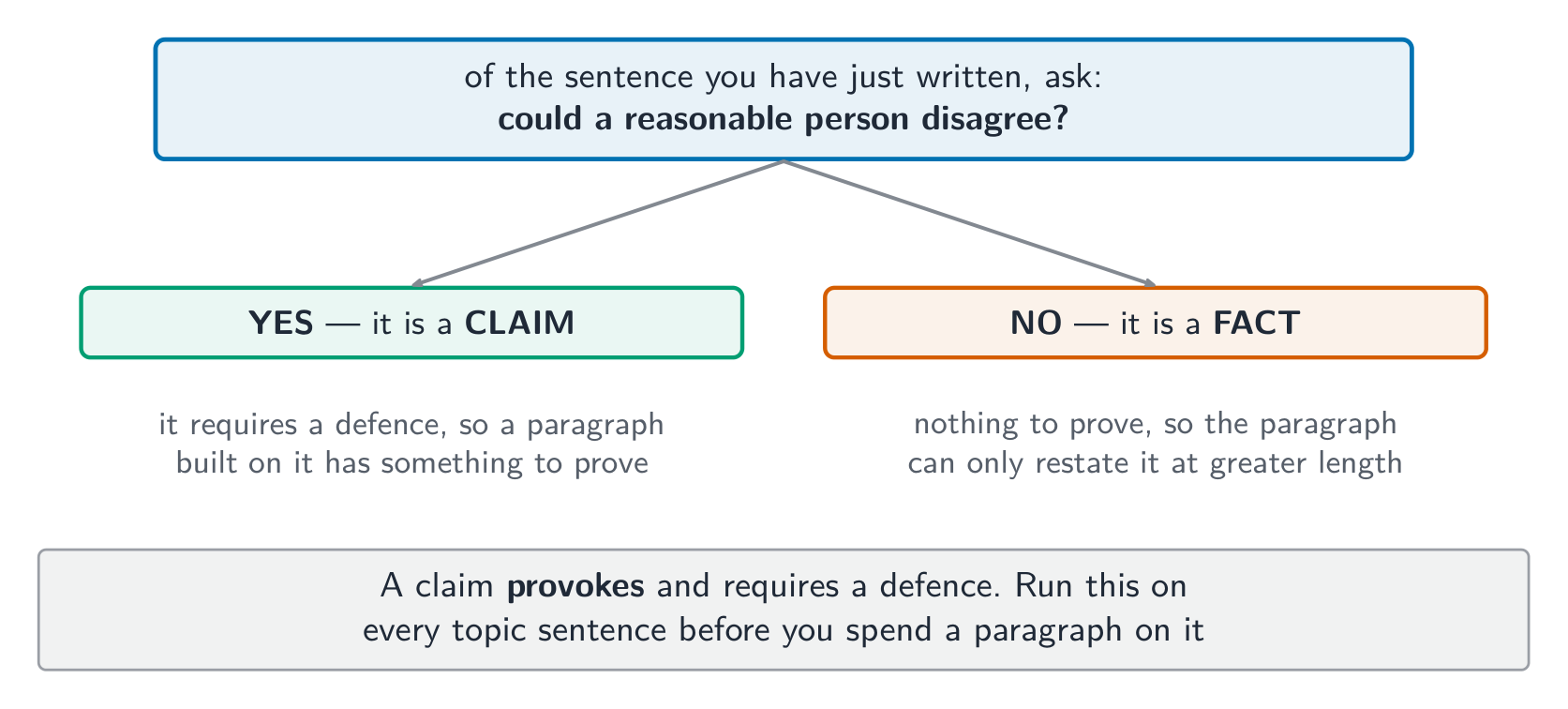
    • Effective claims provoke interest and require a defence, rather than stating an obvious, known fact that requires no proof.

    That fourth point is the most useful test you have. Ask of any sentence: could a reasonable person disagree? If not, it is not a claim - it is a fact, and building a paragraph on it produces writing with nothing to prove.

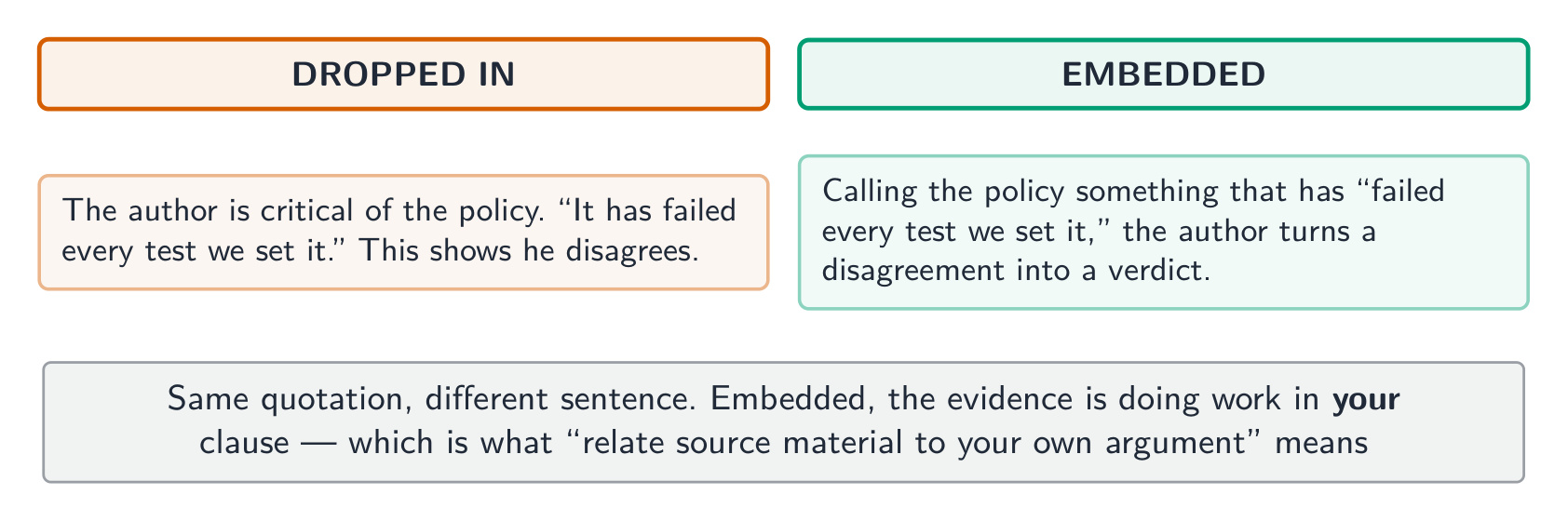
    Finally, writers relate source material to their own argument by syntactically embedding quoted, paraphrased, or summarised material into their own sentences. The evidence is not dropped in beside your sentence; it is built into it.

    ไทย
    • นักเขียนสื่อสารตำแหน่งของตนผ่าน ข้ออ้าง 主张 หนึ่งหรือมากกว่า ที่ต้องการการป้องกัน
    • นักเขียนปกป้องข้ออ้างของพวกเขากับ หลักฐานและ/หรือการให้เหตุผล 证据与推理
    • ประเภทของหลักฐานรวมถึง ข้อเท็จจริง, เรื่องเล่าสั้นๆ, อุปมาอุปไมย, สถิติ, ตัวอย่าง, รายละเอียด, ภาพประกอบ, ความคิดเห็นผู้เชี่ยวชาญ และประสบการณ์ส่วนตัว — รายการที่กว้างอย่างตั้งใจ เพราะการรับรู้เรื่องเล่าสั้นๆ หรืออุปมาอุปไมย ว่า它们是 evidence เองก็เป็นทักษะหนึ่ง
    • ข้ออ้างที่มีประสิทธิภาพกระตุ้นความสนใจและต้องการการป้องกัน แทนที่จะบอกข้อเท็จจริงที่ชัดเจนและเป็นที่รู้จักซึ่งไม่ต้องการการพิสูจน์

    จุดที่สี่นี้เป็นทดสอบที่มีประโยชน์ที่สุดที่คุณมี ถามกับประโยคใดๆ: คนธรรมดาสามารถเห็นต่างได้หรือไม่? ถ้าไม่ได้ มันไม่ใช่ข้ออ้าง — มันเป็นข้อเท็จจริง และการสร้างย่อหน้าโดยอิงจากมันจะทำให้การเขียนไม่มีอะไรต้องพิสูจน์

    สุดท้าย, นักเขียน เชื่อมโยงวัสดุด้านต้นทางเข้ากับข้อโต้แย้งของตนเองโดยการฝังทางไวยากรณ์ 引用, Paraphrased, หรือ summarized material เข้าไปในประโยคของตนเอง หลักฐานไม่ได้วางไว้ข้างเคียงประโยคของคุณ; มันถูกสร้างเข้าไปในประโยค itself

    ทดสอบเดียวที่แยกข้ออ้างออกจากข้อเท็จจริง: คนธรรมดาสามารถเห็นต่างได้หรือไม่?
    การ 인용เดียวกันที่ถูกวางลง และฝัง — มีเพียงอย่างใดอย่างหนึ่งเท่านั้นที่ทำงานได้ในประโยคของคุณ
    Explore · ⁨สำรวจ⁩

    Claim or fact? Run the test on each sentence · ⁨ข้ออ้างหรือข้อเท็จจริง? ทดสอบแต่ละประโยค⁩

    The test is one question: could a reasonable person disagree? If not, it is not a claim and a paragraph on it has nothing to prove. · ⁨การทดสอบมีคำถามเดียว: คนทั่วไปจะโต้แย้งได้หรือไม่? ถ้าตอบว่าไม่ได้ มันไม่ใช่ข้ออ้าง และย่อหน้าเกี่ยวกับมันไม่มีอะไรต้องพิสูจน์⁩

    1.3

    Developing a Paragraph with Claim and Evidence · ⁨การพัฒนาย่อหน้าด้วยข้ออ้างและหลักฐาน⁩

    Syllabus · ⁨หลักสูตร⁩
    English

    Enduring Understanding (CLE-1): Writers make claims about subjects, rely on evidence that supports the reasoning that justifies the claim, and often acknowledge or respond to other, possibly opposing, arguments.

    Learning Objective 4.A: Writing – Develop a paragraph that includes a claim and evidence supporting the claim.

    • CLE-1.A Writers convey their positions through one or more claims that require a defense.
    • CLE-1.B Writers defend their claims with evidence and/or reasoning.
    • CLE-1.C Types of evidence may include facts, anecdotes, analogies, statistics, examples, details, illustrations, expert opinions, personal observations, personal experiences, testimonies, or experiments.
    • CLE-1.D Effective claims provoke interest and require a defense, rather than simply stating an obvious, known fact that requires no defense or justification.
    • CLE-1.E Writers relate source material to their own argument by syntactically embedding particular quoted, paraphrased, or summarized information from one or more sources into their own ideas.
    ไทย

    ความเข้าใจที่ยั่งยืน (CLE-1): นักเขียนทำข้ออ้างเกี่ยวกับหัวข้อ อิงกับหลักฐานที่สนับสนุนเหตุผลที่ใช้เพื่อพิสูจน์ข้ออ้าง tersebut และมักยอมรับหรือตอบโต้ข้อโต้แย้งอื่น ๆ ซึ่งอาจเป็นฝ่ายตรงข้าม

    เป้าหมายการเรียนรู้ 4.A: การเขียน – พัฒนาย่อหน้าที่ประกอบด้วยข้ออ้างและหลักฐานที่สนับสนุนข้ออ้างนั้น

    • CLE-1.A นักเขียนแสดงมุมมองของตนผ่านข้ออ้างหนึ่งหรือหลายข้อที่ต้องการการปกป้องหรือพิสูจน์
    • CLE-1.B นักเขียนปกป้องข้ออ้างของตนด้วยหลักฐานและ/หรือเหตุผล
    • CLE-1.C ประเภทของหลักฐานอาจรวมถึงข้อเท็จจริง เรื่องเล่าสั้นๆ เปรียบเทียบ สถิติ ตัวอย่าง รายละเอียด ภาพประกอบ ความคิดเห็นของผู้เชี่ยวชาญ การสังเกตส่วนบุคคล ประสบการณ์ส่วนบุคคล คำพยาน หรือการทดลอง
    • CLE-1.D ข้ออ้างที่มีประสิทธิภาพควรกระตุ้นความสนใจและต้องการการปกป้อง ไม่ใช่เพียงการบอกข้อเท็จจริงที่ชัดเจนและเป็นที่รู้จักแล้วซึ่งไม่ต้องการการปกป้องหรือพิสูจน์
    • CLE-1.E นักเขียนเชื่อมโยงข้อมูลจากแหล่งที่มาเข้ากับข้อโต้แย้งของตนเอง通过将 particular quoted, paraphrased, or summarized information from one or more sources into their own ideas through syntactic embedding.

    Source: College Board AP Course and Exam Description · ⁨แหล่งที่มา: คำอธิบายหลักสูตรและข้อสอบ College Board AP⁩

    English

    Unit 1's writing objective is deliberately small: write one paragraph containing a claim and evidence that supports it. Everything later in the course is an elaboration of this.

    A working shape:

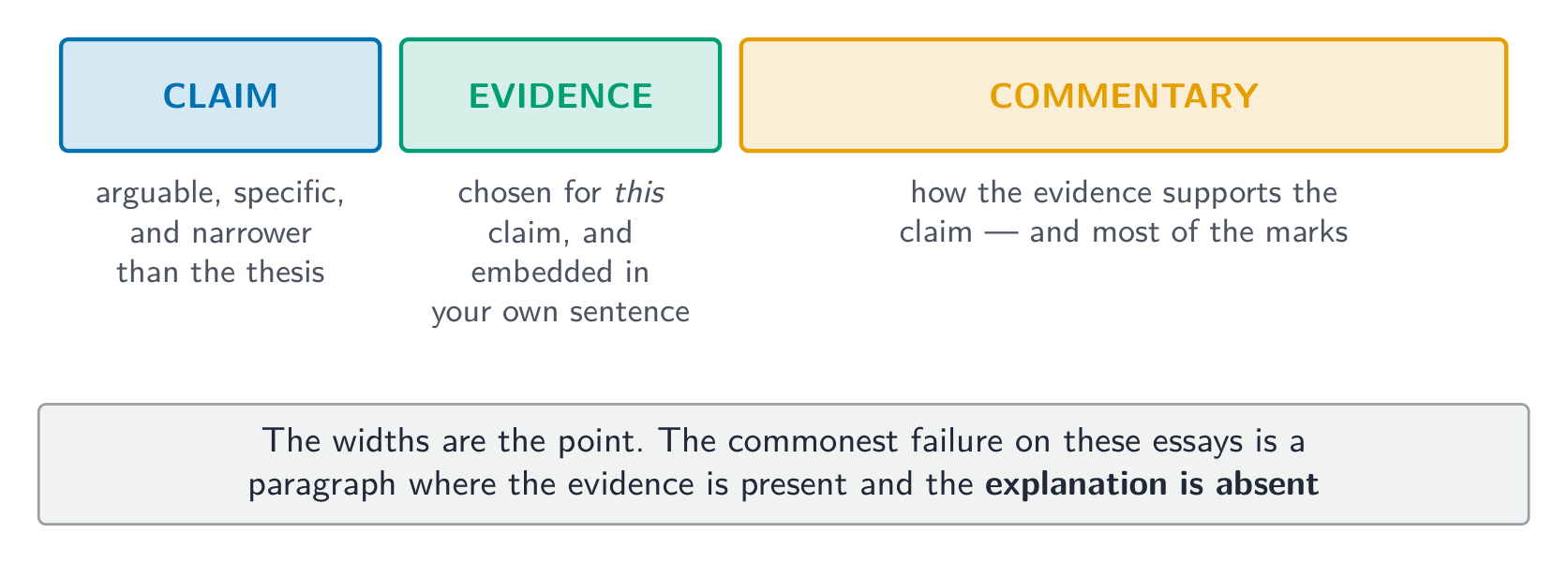
    1. A claim that requires defence - arguable, specific, and narrower than the whole thesis.
    2. Evidence chosen because it supports this claim, embedded syntactically rather than dropped in.
    3. Commentary explaining how the evidence supports the claim - the step students skip, and the one that carries most of the marks on the exam.

    The single most common failure on the AP Language essays is a paragraph in which the evidence is present and the explanation is absent. The reader can see the quotation; what they cannot see is why you think it proves your point.

    ไทย

    วัตถุประสงค์การเขียนของหน่วยที่ 1 ตั้งใจให้มีขนาดเล็ก: เขียนย่อหน้าหนึ่งที่มีข้ออ้างและหลักฐานที่สนับสนุน Everything later in the course is an elaboration of this

    รูปแบบการทำงาน:

    1. ข้ออ้าง ที่ต้องการการป้องกัน — สามารถโต้แย้งได้, เฉพาะเจาะจง, และแคบกว่า论点ทั้งหมด
    2. หลักฐาน ที่เลือกเพราะว่า оно поддерживает this claim, ฝังทางไวยากรณ์แทนที่จะถูกวางลงไป
    3. คำอธิบายประกอบ ที่ชี้ให้เห็นว่าหลักฐานสนับสนุนข้อโต้แย้งได้อย่างไร -这一步是学生最容易忽略的,也是考试中得分最高的部分。

    AP Language 作文中最常见的失败在于:段落里有证据,却缺少解释。读者能看到引文,但无法理解你为什么认为它能证明你的观点。

    The paragraph drawn to the proportions it should have - the widths are the point
    Explore · ⁨สำรวจ⁩

    Build a paragraph in proportion · ⁨สร้างย่อหน้าให้มีความสมดุล⁩

    The commonest failure on these essays is a paragraph where the evidence is present and the explanation is absent. · ⁨ความล้มเหลวที่พบบ่อยที่สุดในบทความเหล่านี้คือย่อหน้าที่มีหลักฐานแต่ขาดคำอธิบาย⁩

    1.3

    What the Exam Actually Asks · ⁨การสอบต้องการอะไรกันแน่⁩

    English

    The free-response section has three questions, and they use the same skills in different arrangements:

    • Question 1, Synthesis 综合写作: you are given several sources and must build your own argument, using the sources as evidence rather than summarising them.
    • Question 2, Rhetorical Analysis 修辞分析: you are given one text and must explain the choices the writer makes and how those choices contribute to purpose - which is the rhetorical situation applied.
    • Question 3, Argument 论证写作: you are given a claim or a scenario and must argue a position, using evidence from your own knowledge and experience.

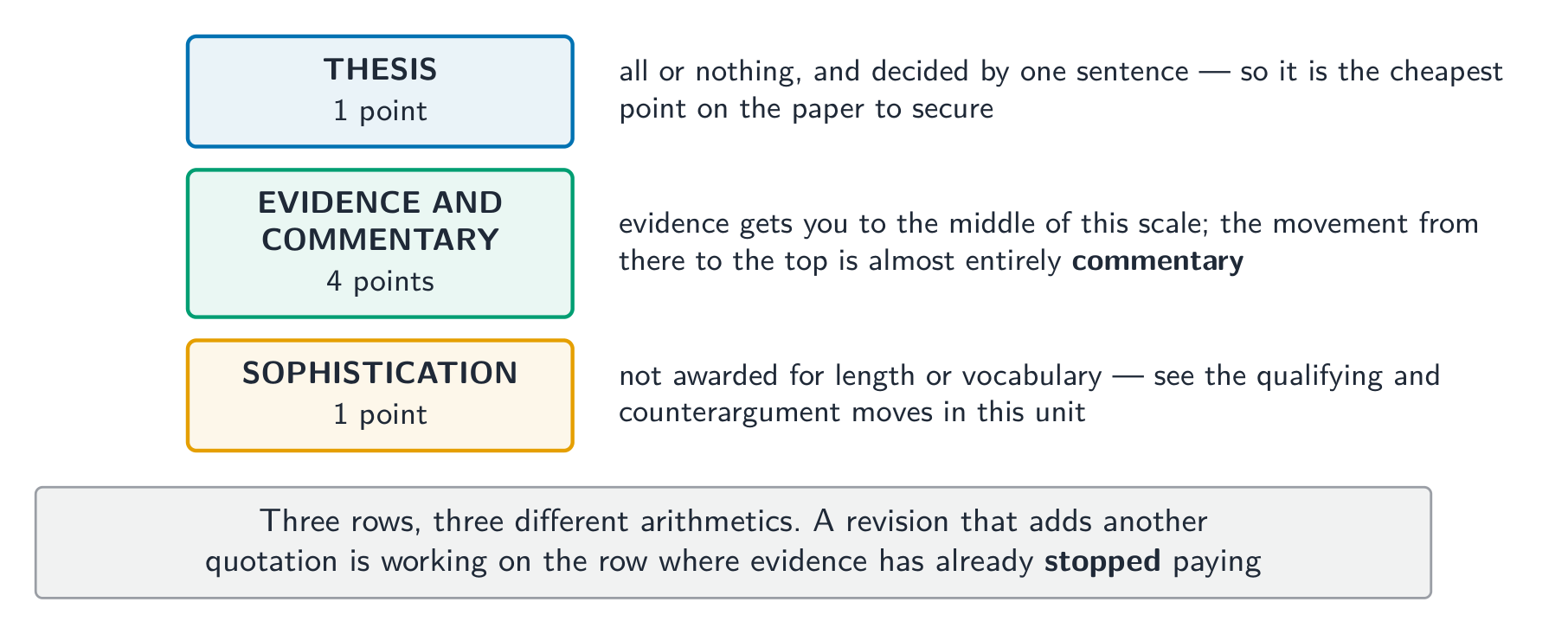
    All three are marked on a six-point rubric with the same three rows: thesis (1 point), evidence and commentary (4 points), and sophistication (1 point). Knowing that shape from Unit 1 tells you where the marks are: four of the six come from evidence and the commentary on it, so a plan that produces evidence without explanation caps you at low marks no matter how good the writing sounds.

    Worked example (a real AP exam task). A Rhetorical Analysis prompt asks you to "explain the writer's rhetorical choices" in a given passage. A row-scoring answer does not say "the writer uses a rhetorical question." It says: "Faced with an audience that already agrees on the problem but not on its urgency, the writer opens with a question rather than a statement, forcing readers to supply the answer themselves and so to feel the conclusion as their own rather than as one imposed on them." Notice what earns the points: the audience, the choice, and the effect on purpose - the rhetorical situation, used.

    ไทย

    ส่วน自由-response มี 3 ข้อ และใช้ทักษะเดียวกันแต่จัดเรียงต่างกัน:

    • ข้อที่ 1, Synthesis (การสังเคราะห์): คุณได้รับแหล่งข้อมูลหลายแห่งและต้องสร้าง ข้อโต้แย้งของคุณเอง โดยใช้แหล่งข้อมูลเหล่านั้นเป็นหลักฐาน ไม่ใช่แค่สรุปเนื้อหา
    • ข้อที่ 2, Rhetorical Analysis (การวิเคราะห์เชิง retorics): คุณได้รับข้อความหนึ่งและต้องอธิบาย ทางเลือกของผู้เขียน ว่าทางเลือกเหล่านั้นมีผลต่อเป้าหมายอย่างไร ซึ่งคือการนำสภาวะ retorics มาประยุกต์ใช้
    • ข้อที่ 3, Argument (การเขียนArgument): คุณได้รับข้อโต้แย้งหรือสถานการณ์มา แล้วต้อง arguments一个立场 โดยใช้หลักฐานจากความรู้และประสบการณ์ส่วนตัว

    ทั้งสามข้อถูกให้คะแนนตาม เกณฑ์คะแนนหกระดับ ที่มีแถวเดิมๆ สามแถว: thesis (1 คะแนน), evidence and commentary (4 คะแนน), และ sophistication (1 คะแนน). การเข้าใจโครงสร้างนี้ตั้งแต่ Unit 1 จะช่วยให้คุณรู้ว่าคะแนนอยู่ที่ไหน: จากคะแนน 6 ส่วน来自 evidence และ commentaries sobre ella, ดังนั้นแผนงานที่สร้างหลักฐานโดยไม่มีการอธิบายจะจำกัดคะแนนไว้ที่ต่ำเสมอ ไม่ว่าการเขียนจะดีเพียงใด

    ตัวอย่างการทำงานจริง (โจทย์สอบ AP จริง). โจทย์ Rhetorical Analysis สั่งให้คุณ "อธิบายทางเลือกทาง retorics ของผู้เขียน" ในย่อที่กำหนดคำตอบแบบให้คะแนนตามแถวจะไม่พูดว่า "ผู้เขียนใช้คำถามเชิง retorics" แต่จะพูดว่า: "เมื่อเผชิญกับกลุ่มผู้ฟังที่ยอมรับปัญหาคือแต่ไม่ยอมรับความเร่งด่วน ผู้เขียนจึงเปิดด้วยคำถามแทนการบอกเล่า บังคับให้ผู้อ่านต้องหาคำตอบเอง ทำให้รู้สึกถึงข้อสรุปว่าเป็นของพวกเขากันเอง ไม่ใช่สิ่งที่ถูกบีบคั้นจากภายนอก" ระวังสิ่งที่จะได้คะแนน: กลุ่มผู้ฟัง, ทางเลือก, และ ผลกระทบที่มีต่อเป้าหมาย - สภาวะ retorics ที่ถูกนำมาใช้

    1.3

    Exam tips · ⁨ข้อแนะนำสำหรับการสอบ⁩

    English
    • Learn the six components by name and use the names. Precision here is directly rewarded.
    • Exigence is not the same as purpose. Exigence is what prompted the text; purpose is what the writer wants to achieve.
    • Test every claim with could a reasonable person disagree? If not, it is a fact, not a claim.
    • Embed evidence in your own sentence. Dropped quotations read as unprocessed.
    • Four of six points are evidence and commentary. Write the commentary; it is where most lost marks live.
    • Never name a device without saying what it does to the audience. A device with no effect earns nothing.
    ไทย
    • เรียนรู้ องค์ประกอบทั้งหก ให้เป็นชื่อและใช้ชื่อนั้น ความแม่นยำในจุดนี้จะได้รับการตอบรับโดยตรง
    • Exigence ไม่เหมือนกับ Purpose. Exigence คือสิ่งที่กระตุ้นให้เกิดข้อความ; Purpose คือสิ่งที่ผู้เขียนต้องการบรรลุ
    • ทดสอบทุกข้อโต้แย้งด้วยคำถามว่า "คนทั่วไปอาจเห็นต่างไหม?" ถ้าไม่ได้ มันคือข้อเท็จจริง ไม่ใช่ข้อโต้แย้ง
    • ฝัง หลักฐานไว้ในประโยคของคุณ คำพูดที่วางทิ้งไว้เหมือนถูกdrop out ดูไม่ผ่านการประมวลผล
    • สี่จากหกคะแนนคือหลักฐานและการอธิบายประกอบ. เขียนคำอธิบายประกอบ; นั่นคือจุดที่คะแนนหายวับไป
    • ห้ามระบุชื่อเครื่องมือretorics โดยไม่บอกว่า มันทำอะไรให้กับกลุ่มผู้ฟัง. เครื่องมือretorics ที่ไม่มีผลลัพธ์ anything at all does not earn anything.
    Vocabulary · ⁨คำศัพท์⁩ Train · ⁨ฝึกฝน⁩
    English ไทย
    exigence/ˈeksɪdʒəns/ exigence
    purpose/ˈpɜːpəs/ purpose
    audience/ˈɔːdɪəns/ audience
    context/ˈkɒntekst/ บริบท
    claims/kleɪmz/ ข้ออ้าง
    evidence and/or reasoning/ˈevɪdəns ænd ɔː ˈriːzənɪŋ/ หลักฐานและ/หรือเหตุผล
    Question 1, Synthesis/ˈkwestʃn wɒn ˈsɪnθəsɪs/ ข้อ 1, การสังเคราะห์
    Question 2, Rhetorical Analysis/ˈkwestʃn tuː reˈtɒrɪkl əˈnæləsɪs/ ข้อ 2, การวิเคราะห์ทาง retorics
    Question 3, Argument/ˈkwestʃn θriː ˈɑːɡjuːmənt/ ข้อ 3, การให้เหตุผล
  • 2

    Audience, Thesis, and Supporting Evidence · ⁨กลุ่มผู้ฟัง, Thesis และหลักฐานสนับสนุน⁩

    Watch lesson · ⁨ดูบทเรียน⁩
    2.1

    Understanding an Audience's Beliefs and Needs · ⁨เข้าใจความเชื่อและความต้องการของกลุ่มผู้ฟัง⁩

    Syllabus · ⁨หลักสูตร⁩
    English

    Enduring Understanding (RHS-1): Individuals write within a particular situation and make strategic writing choices based on that situation.

    Learning Objective 1.B: Reading – Explain how an argument demonstrates understanding of an audience’s beliefs, values, or needs.

    • RHS-1.F Writers’ perceptions of an audience’s values, beliefs, needs, and background guide the choices they make.
    • RHS-1.G To achieve a purpose, writers make choices in an attempt to relate to an intended audience’s emotions and values.
    • RHS-1.H Arguments seek to persuade or motivate action through appeals—the modes of persuasion.
    ไทย

    ความเข้าใจที่ยั่งยืน (RHS-1): บุคคลเขียนภายในสถานการณ์เฉพาะและเลือกการเขียนเชิงกลยุทธ์โดยอาศัยสถานการณ์นั้น

    เป้าหมายการเรียนรู้ 1.B: การอ่าน – อธิบายว่าข้อโต้แย้งแสดงถึงการเข้าใจความเชื่อ ค่านิยม หรือความต้องการของกลุ่มผู้อ่านอย่างไร

    • RHS-1.F มุมมองของนักเขียนต่อค่านิยม ความเชื่อ ความต้องการ และพื้นหลังของกลุ่มผู้อ่านจะนำไปสู่การตัดสินใจเลือกสิ่งต่างๆ ของพวกเขา
    • RHS-1.G เพื่อให้บรรลุวัตถุประสงค์ นักเขียนจะทำการเลือกโดยพยายามเชื่อมโยงกับอารมณ์และค่านิยมของกลุ่มผู้อ่านเป้าหมาย
    • RHS-1.H ข้อโต้แย้งมุ่งหวังที่จะโน้มน้าวใจหรือกระตุ้นให้เกิดการกระทำผ่านการเรียกร้อง (appeals) ซึ่งเป็นรูปแบบของการโน้มน้าวใจ

    Source: College Board AP Course and Exam Description · ⁨แหล่งที่มา: คำอธิบายหลักสูตรและข้อสอบ College Board AP⁩

    English

    Unit 1 established that a text has an audience. Unit 2 makes that audience the engine of every choice a writer makes.

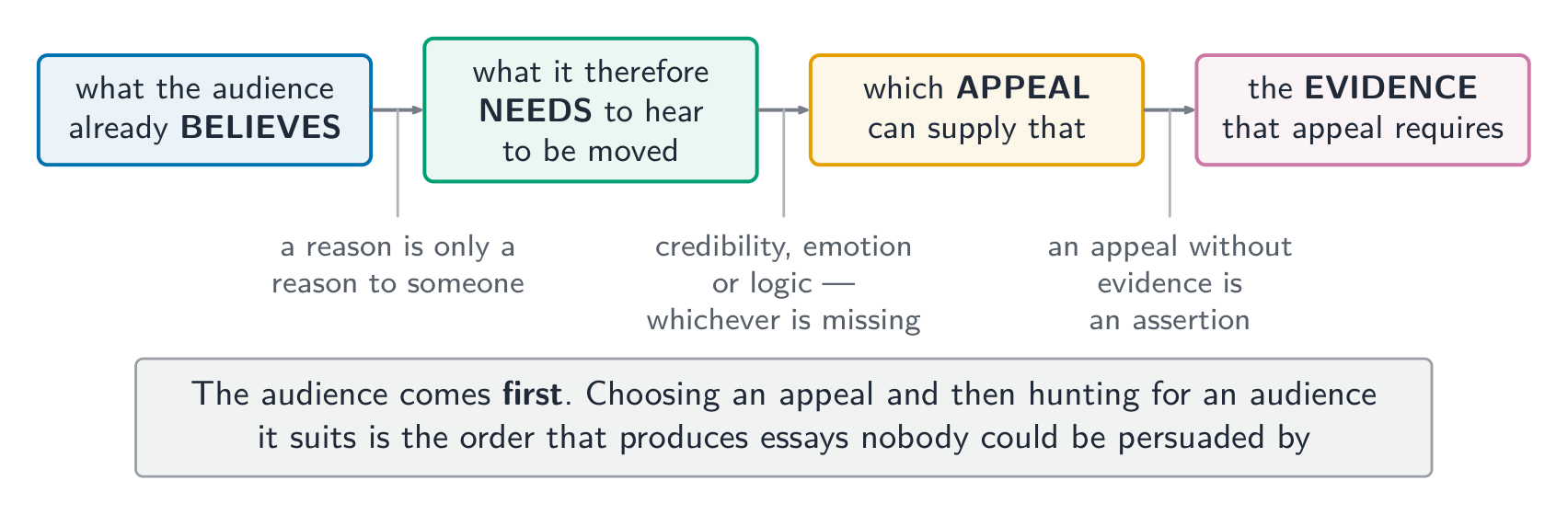
    • Writers' perceptions of an audience's values, beliefs, needs, and background guide the choices they make. Note the word perceptions: what steers the writing is the writer's picture of the audience, which may be accurate or not.
    • To achieve a purpose, writers make choices in an attempt to relate to an intended audience's emotions and values.
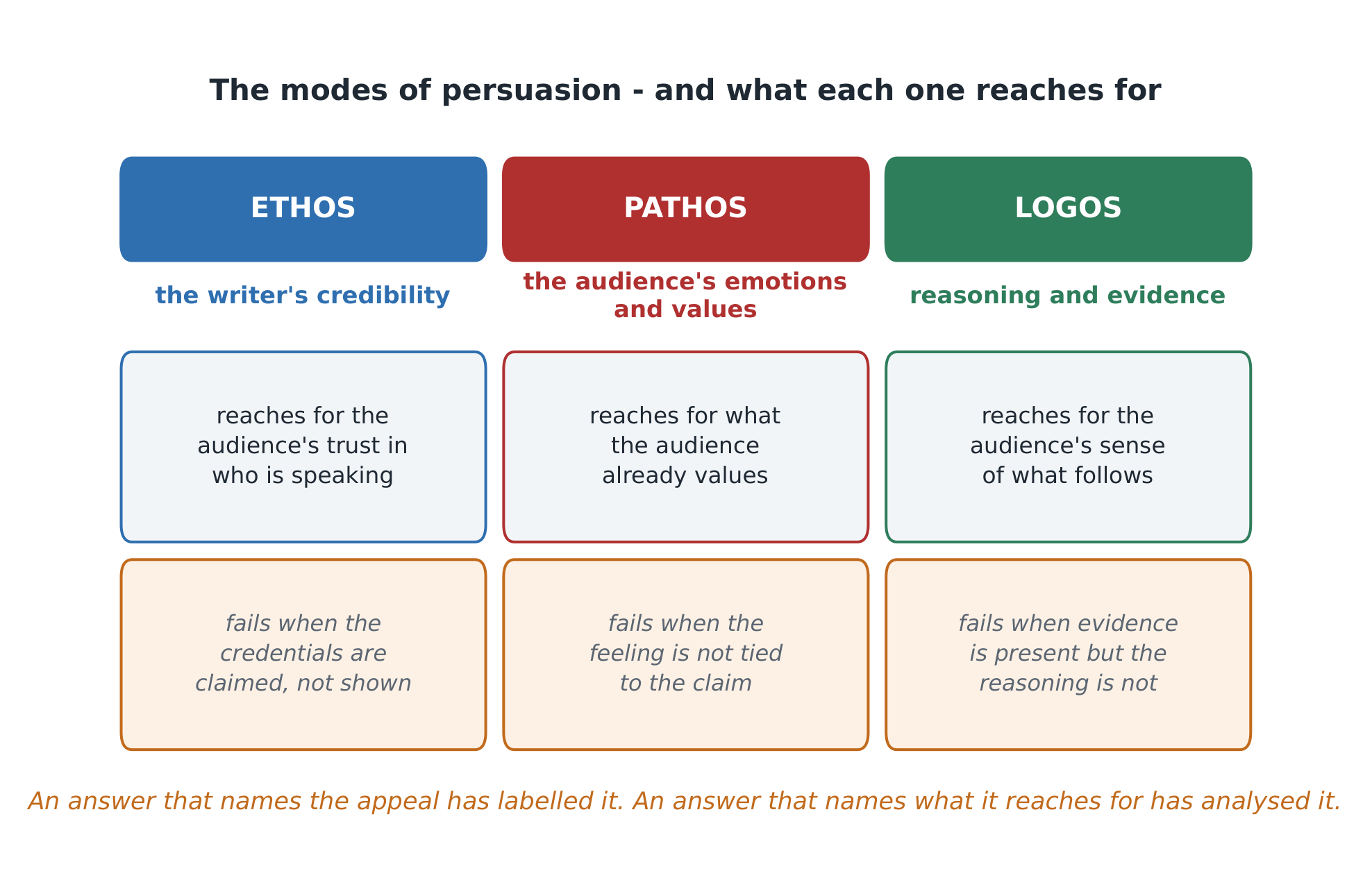
    • Arguments seek to persuade or motivate action through appeals 诉求 - the modes of persuasion 说服方式.
    ไทย

    Unit 1 กำหนดว่าข้อความมีกลุ่มผู้ฟัง Unit 2 ทำให้กลุ่มผู้ฟังนี้เป็นเครื่องยนต์ของการเลือกทุกอย่างที่ผู้เขียนทำ

    • การรับรู้ของผู้เขียนเกี่ยวกับค่านิยม ความเชื่อ ความต้องการ และพื้นฐานของกลุ่มผู้ฟัง จะนำไปสู่ทางเลือกที่พวกเขาทำ. ระวังคำว่า perceptions: สิ่งที่ควบคุมการเขียนคือภาพของผู้เขียนเกี่ยวกับกลุ่มผู้ฟัง ซึ่งอาจถูกต้องหรือไม่ก็ได้นะ
    • เพื่อให้บรรลุเป้าหมาย ผู้เขียนจะเลือกทางเลือกเพื่อพยายาม เชื่อมโยงกับอารมณ์และค่านิยมของกลุ่มผู้ฟังเป้าหมาย
    • Arguments试图 persuades or motivate action through appeals诉求- modes of persuasion说服方式.

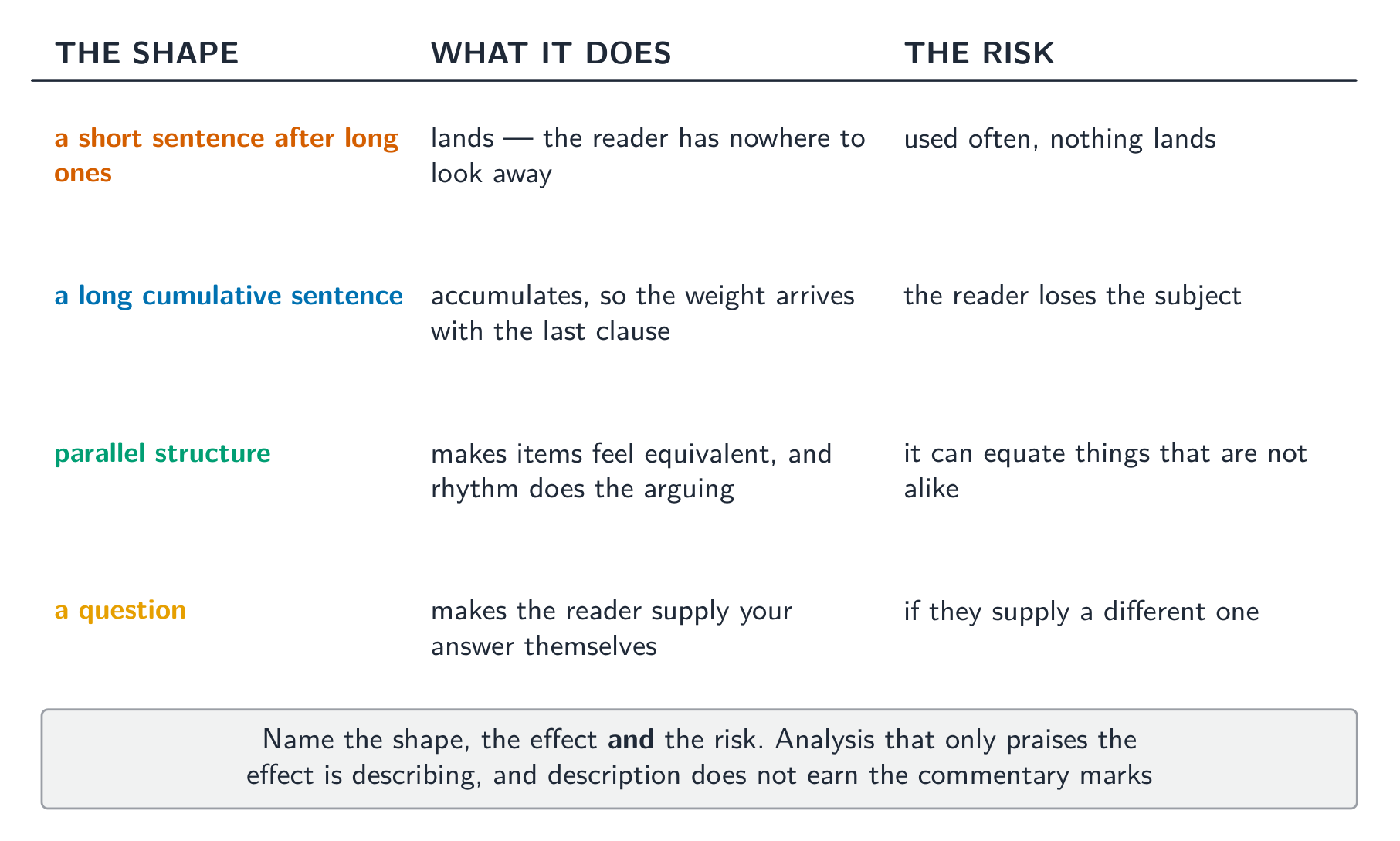
    Each appeal reaches for something different in the audience - and each can fail in its own way *การตั้งชื่อ appealing is worth nothing on its own; naming what it reaches for is the analysis

    The audience comes first: what it believes determines what will count as a reason
    Explore · ⁨สำรวจ⁩

    Start from the audience, not the appeal · ⁨เริ่มต้นจากผู้ฟัง ไม่ใช่การอวดอ้าง⁩

    What the audience already believes determines what will count as a reason to them. · ⁨สิ่งที่ผู้ฟังเชื่ออยู่แล้วกำหนดว่าอะไรจะถือเป็นเหตุผลสำหรับพวกเขา⁩

    Vocabulary · ⁨คำศัพท์⁩ Train · ⁨ฝึกฝน⁩
    English ไทย
    appeals/əˈpiːlz/ การโน้มน้าวใจ
    modes of persuasion/məʊdz ɒv pəˈsweɪʒn/ รูปแบบการโน้มน้าวใจ
    2.2

    Writing for an Audience's Beliefs and Needs · ⁨เขียนเพื่อตอบสนองความเชื่อและความต้องการของกลุ่มผู้ฟัง⁩

    Syllabus · ⁨หลักสูตร⁩
    English

    Enduring Understanding (RHS-1): Individuals write within a particular situation and make strategic writing choices based on that situation.

    Learning Objective 2.B: Writing – Demonstrate an understanding of an audience’s beliefs, values, or needs.

    • RHS-1.F Writers’ perceptions of an audience’s values, beliefs, needs, and background guide the choices they make.
    • RHS-1.G To achieve a purpose, writers make choices in an attempt to relate to an intended audience’s emotions and values.
    • RHS-1.H Arguments seek to persuade or motivate action through appeals—the modes of persuasion.
    ไทย

    ความเข้าใจที่ยั่งยืน (RHS-1): บุคคลเขียนภายในสถานการณ์เฉพาะและเลือกการเขียนเชิงกลยุทธ์โดยอาศัยสถานการณ์นั้น

    เป้าหมายการเรียนรู้ 2.B: การเขียน – แสดงให้เห็นถึงความรู้ความเข้าใจในความเชื่อ ค่านิยม หรือความต้องการของกลุ่มผู้อ่าน

    • RHS-1.F มุมมองของนักเขียนต่อค่านิยม ความเชื่อ ความต้องการ และพื้นหลังของกลุ่มผู้อ่านจะนำไปสู่การตัดสินใจเลือกสิ่งต่างๆ ของพวกเขา
    • RHS-1.G เพื่อให้บรรลุวัตถุประสงค์ นักเขียนจะทำการเลือกโดยพยายามเชื่อมโยงกับอารมณ์และค่านิยมของกลุ่มผู้อ่านเป้าหมาย
    • RHS-1.H ข้อโต้แย้งมุ่งหวังที่จะโน้มน้าวใจหรือกระตุ้นให้เกิดการกระทำผ่านการเรียกร้อง (appeals) ซึ่งเป็นรูปแบบของการโน้มน้าวใจ

    Source: College Board AP Course and Exam Description · ⁨แหล่งที่มา: คำอธิบายหลักสูตรและข้อสอบ College Board AP⁩

    English

    The same three statements now become a writing instruction. Before drafting, decide:

    • What does this audience already believe about the subject?
    • What do they need - information, reassurance, a reason to act?
    • What do they value, and which of those values can honestly be connected to my position?

    An argument that ignores these produces writing addressed to nobody. And the CED's framing gives you a useful test for your own drafts: if this paragraph would read identically to a completely different audience, it has not been shaped by one.

    ไทย

    สามประโยคเดิมตอนนี้กลายเป็นคำแนะนำในการเขียน ก่อนร่างเนื้อหา ต้องตัดสินใจ:

    • กลุ่มผู้ฟังนี้ เชื่อ อะไรเกี่ยวกับ subject แล้ว?
    • พวกเขา ต้องการอะไร - ข้อมูล, ความมั่นใจ, หรือเหตุผลที่จะกระทำ?
    • พวกเขา ให้ความสำคัญกับอะไร และค่า nàoจากนั้นที่สามารถเชื่อมต่อกับตำแหน่งของคุณได้อย่างตรงไปตรงมา?

    Argument yang mengabaikan hal ini menghasilkan tulisan yang ditujukan kepada siapa pun. Dan kerangka kerja CED memberikan Anda tes berguna untuk draft Anda sendiri: jika paragraf ini akan dibaca sama persis oleh audiens yang sama sekali berbeda, maka itu tidak dibentuk oleh satu.

    2.3

    Identifying Claims and Evidence · ⁨การระบุข้ออ้างและหลักฐาน⁩

    Syllabus · ⁨หลักสูตร⁩
    English

    Enduring Understanding (CLE-1): Writers make claims about subjects, rely on evidence that supports the reasoning that justifies the claim, and often acknowledge or respond to other, possibly opposing, arguments.

    Learning Objective 3.A: Reading – Identify and explain claims and evidence within an argument.

    • CLE-1.F Writers use evidence strategically and purposefully to illustrate, clarify, set a mood, exemplify, associate, or amplify a point.
    • CLE-1.G Strategically selected evidence strengthens the validity and reasoning of the argument, relates to an audience’s emotions and values, and increases a writer’s credibility.
    • CLE-1.H An effective argument contains sufficient evidence; evidence is sufficient when its quantity and quality provide apt support for the argument.
    ไทย

    ความเข้าใจที่ยั่งยืน (CLE-1): นักเขียนทำข้ออ้างเกี่ยวกับหัวข้อ อิงกับหลักฐานที่สนับสนุนเหตุผลที่ใช้เพื่อพิสูจน์ข้ออ้าง tersebut และมักยอมรับหรือตอบโต้ข้อโต้แย้งอื่น ๆ ซึ่งอาจเป็นฝ่ายตรงข้าม

    เป้าหมายการเรียนรู้ 3.A: การอ่าน – ระบุและอธิบายข้ออ้างและหลักฐานภายในข้อโต้แย้ง

    • CLE-1.F นักเขียนใช้หลักฐานอย่างมีกลยุทธ์และมีจุดประสงค์เพื่อแสดงตัวอย่าง อธิบาย ให้บรรยากาศ สร้างตัวอย่าง เชื่อมโยง หรือขยายความประเด็นใดประเด็นหนึ่ง
    • CLE-1.G การเลือกหลักฐานอย่างมีกลยุทธ์ช่วยเสริมสร้างความน่าเชื่อถือและเหตุผลของข้อโต้แย้ง เชื่อมโยงกับอารมณ์และค่านิยมของกลุ่มผู้อ่าน และเพิ่มเครดิตของนักเขียน
    • CLE-1.H ข้อโต้แย้งที่มีประสิทธิภาพควรมีหลักฐานเพียงพอ; หลักฐานจะถือว่าเพียงพอเมื่อปริมาณและคุณภาพของมันให้การสนับสนุนที่เหมาะสมแก่ข้อโต้แย้ง

    Source: College Board AP Course and Exam Description · ⁨แหล่งที่มา: คำอธิบายหลักสูตรและข้อสอบ College Board AP⁩

    English

    Unit 2 deepens Unit 1's treatment of evidence with three claims about how evidence works:

    • Writers use evidence strategically and purposefully to illustrate, clarify, set a mood, exemplify, associate, or amplify. Evidence does a job, and naming that job is analysis.
    • Strategically selected evidence strengthens the validity and reasoning of the argument, relates to an audience's emotions and values, and helps establish the writer's credibility 可信度.
    • An effective argument contains sufficient evidence 充分的证据 - sufficient when its quantity and quality provide apt support for the line of reasoning.

    That third point is often misread as "more is better". Sufficiency is quantity and quality together: three well-chosen pieces of evidence that bear directly on the claim beat six that only touch it.

    ไทย

    Unit 2 memperdalam perlakuan Unit 1 tentang bukti dengan tiga klaim tentang bagaimana bukti bekerja:

    • Penulis menggunakan bukti secara strategis dan terarah untuk mengilustrasikan, menjelaskan, menetapkan suasana, memberi contoh, menghubungkan, atau memperkuat. Bukti melakukan pekerjaan, dan menyebut pekerjaan itu adalah analisis.
    • Bukti yang dipilih secara strategis memperkuat validitas dan penalaran argumen, berkaitan dengan emosi dan nilai audiens, dan membantu membangun kredibilitas penulis.
    • Argumen yang efektif mengandung bukti yang memadai - memadai ketika jumlah dan kualitasnya memberikan dukungan yang tepat untuk garis penalaran.

    Poin ketiga sering disalahartikan sebagai "lebih banyak lebih baik". Kecukupan adalah jumlah dan kualitas bersama-sama: tiga potongan bukti yang dipilih dengan baik yang langsung terkait dengan klaim mengalahkan enam yang hanya menyentuhnya.

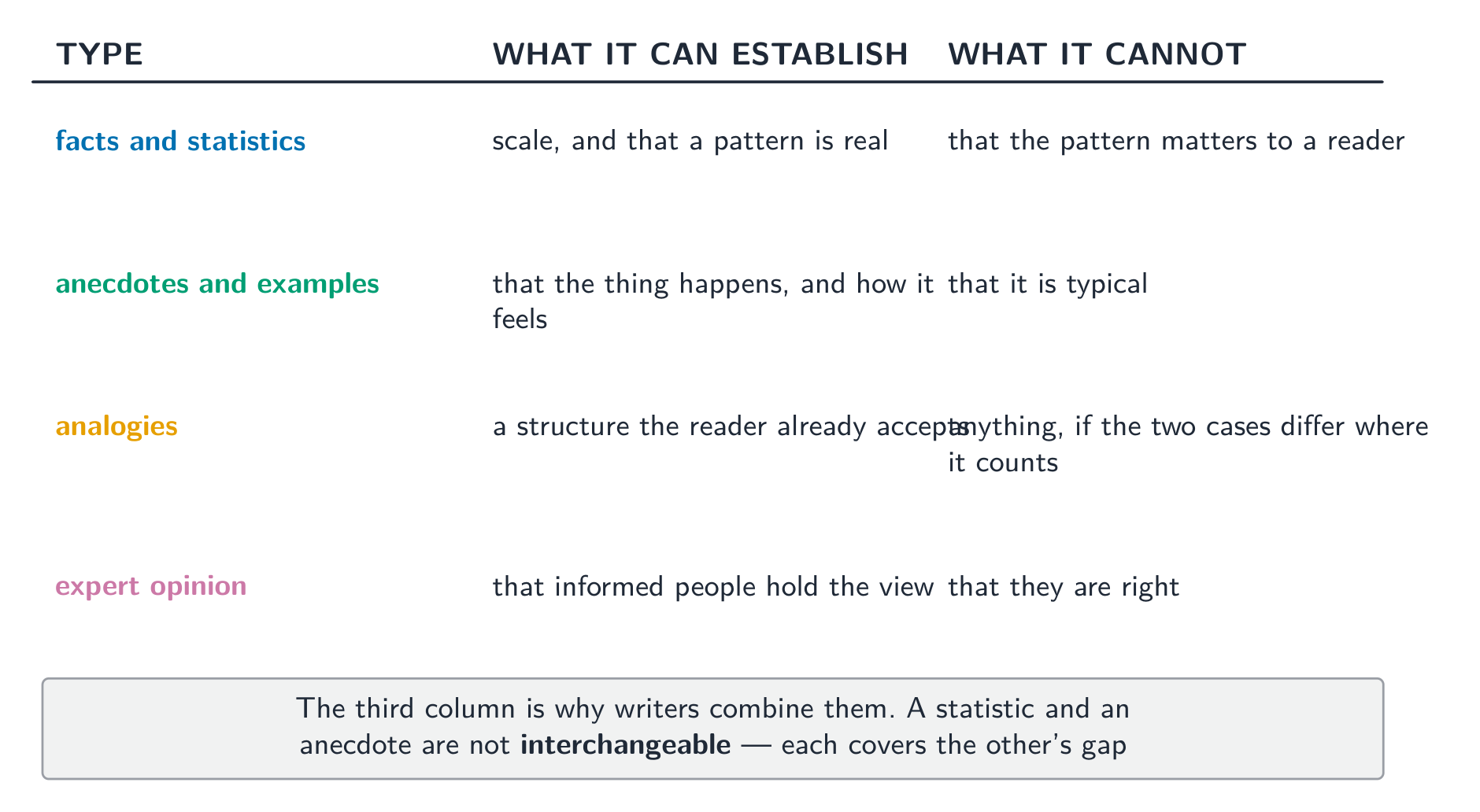
    Evidence types sorted by what each can and cannot establish
    Explore · ⁨สำรวจ⁩

    Match each evidence type to what it cannot prove · ⁨จับคู่ประเภทหลักฐานกับสิ่งที่มันไม่สามารถพิสูจน์ได้⁩

    A statistic and an anecdote are not interchangeable — each covers the other's gap. · ⁨สถิติและเรื่องเล่าไม่สามารถสลับกันได้ — แต่ละอย่างเติมเต็มช่องว่างของอีกฝ่าย⁩

    2.4

    Developing a Paragraph with Claim and Evidence · ⁨การพัฒนาย่อหน้าด้วยข้ออ้างและหลักฐาน⁩

    Syllabus · ⁨หลักสูตร⁩
    English

    Enduring Understanding (CLE-1): Writers make claims about subjects, rely on evidence that supports the reasoning that justifies the claim, and often acknowledge or respond to other, possibly opposing, arguments.

    Learning Objective 4.A: Writing – Develop a paragraph that includes a claim and evidence supporting the claim.

    • CLE-1.F Writers use evidence strategically and purposefully to illustrate, clarify, set a mood, exemplify, associate, or amplify a point.
    • CLE-1.G Strategically selected evidence strengthens the validity and reasoning of the argument, relates to an audience’s emotions and values, and increases a writer’s credibility.
    • CLE-1.H An effective argument contains sufficient evidence; evidence is sufficient when its quantity and quality provide apt support for the argument.
    ไทย

    ความเข้าใจที่ยั่งยืน (CLE-1): นักเขียนทำข้ออ้างเกี่ยวกับหัวข้อ อิงกับหลักฐานที่สนับสนุนเหตุผลที่ใช้เพื่อพิสูจน์ข้ออ้าง tersebut และมักยอมรับหรือตอบโต้ข้อโต้แย้งอื่น ๆ ซึ่งอาจเป็นฝ่ายตรงข้าม

    เป้าหมายการเรียนรู้ 4.A: การเขียน – พัฒนาย่อหน้าที่ประกอบด้วยข้ออ้างและหลักฐานที่สนับสนุนข้ออ้างนั้น

    • CLE-1.F นักเขียนใช้หลักฐานอย่างมีกลยุทธ์และมีจุดประสงค์เพื่อแสดงตัวอย่าง อธิบาย ให้บรรยากาศ สร้างตัวอย่าง เชื่อมโยง หรือขยายความประเด็นใดประเด็นหนึ่ง
    • CLE-1.G การเลือกหลักฐานอย่างมีกลยุทธ์ช่วยเสริมสร้างความน่าเชื่อถือและเหตุผลของข้อโต้แย้ง เชื่อมโยงกับอารมณ์และค่านิยมของกลุ่มผู้อ่าน และเพิ่มเครดิตของนักเขียน
    • CLE-1.H ข้อโต้แย้งที่มีประสิทธิภาพควรมีหลักฐานเพียงพอ; หลักฐานจะถือว่าเพียงพอเมื่อปริมาณและคุณภาพของมันให้การสนับสนุนที่เหมาะสมแก่ข้อโต้แย้ง

    Source: College Board AP Course and Exam Description · ⁨แหล่งที่มา: คำอธิบายหลักสูตรและข้อสอบ College Board AP⁩

    English

    Applying the above to your own writing, choose each piece of evidence for a stated reason. In practice this means being able to finish the sentence: I am using this piece because it ...

    • ... illustrates a claim that would otherwise stay abstract;
    • ... establishes my credibility on a subject where readers may doubt it;
    • ... connects my position to a value the audience already holds.

    Evidence chosen this way produces commentary almost automatically, because you already know what the evidence is doing. Evidence chosen because it was available produces the blank space where commentary should be.

    ไทย

    Menerapkan poin di atas ke dalam penulisan Anda sendiri, pilih setiap bagian bukti karena alasan yang dinyatakan. Dalam praktiknya ini berarti mampu menyelesaikan kalimat: Saya menggunakan bagian ini karena ...

    • ... mengilustrasikan klaim yang jika tidak akan tetap abstrak;
    • ... establishes my credibility on a subject where readers may doubt it;
    • ... connects my position to a value the audience already holds.

    การเลือกหลักฐานด้วยวิธีนี้จะสร้างคำอธิบายประกอบได้เกือบอัตโนมัติ เพราะคุณรู้แล้วว่าหลักฐานนั้นทำหน้าที่อะไร การเลือกหลักฐานเพราะมีอยู่จริงจะสร้างความว่างเปล่าแทนที่คำอธิบายประกอบ

    Vocabulary · ⁨คำศัพท์⁩ Train · ⁨ฝึกฝน⁩
    English ไทย
    credibility/ˌkredɪˈbɪlɪti/ ความน่าเชื่อถือ
    sufficient evidence/səˈfɪʃənt ˈevɪdəns/ หลักฐานที่เพียงพอ
    2.5

    Identifying the Overarching Thesis · ⁨การระบุข้อโต้แย้งหลัก⁩

    Syllabus · ⁨หลักสูตร⁩
    English

    Enduring Understanding (CLE-1): Writers make claims about subjects, rely on evidence that supports the reasoning that justifies the claim, and often acknowledge or respond to other, possibly opposing, arguments.

    Learning Objective 3.B: Reading – Identify and describe the overarching thesis of an argument, and any indication it provides of the argument’s structure.

    • CLE-1.I A thesis is the main, overarching claim a writer is seeking to defend or prove by using reasoning supported by evidence.
    • CLE-1.J A writer’s thesis is not necessarily a single sentence or an explicit statement and may require a thorough reading of the text to identify, but when a thesis is directly expressed, it is called a thesis statement. [Note: While the texts you assign your students to analyze may not always contain obvious thesis statements, they should each have a thesis. It can be good practice for students to write a thesis statement for such texts. On the AP Exam, a clear communication of the thesis is required in students’ essays.]
    ไทย

    ความเข้าใจที่ยั่งยืน (CLE-1): นักเขียนทำข้ออ้างเกี่ยวกับหัวข้อ อิงกับหลักฐานที่สนับสนุนเหตุผลที่ใช้เพื่อพิสูจน์ข้ออ้าง tersebut และมักยอมรับหรือตอบโต้ข้อโต้แย้งอื่น ๆ ซึ่งอาจเป็นฝ่ายตรงข้าม

    เป้าหมายการเรียนรู้ 3.B: การอ่าน – ระบุและอธิบาย论点หลักของข้อโต้แย้ง และบ่งชี้โครงสร้างของข้อโต้แย้งใดๆ ที่论点หลักนั้นให้ไว้

    • CLE-1.I论点หลักคือข้ออ้างหลักและ overarching claim ที่นักเขียนกำลังพยายามปกป้องหรือพิสูจน์โดยใช้เหตุผลที่รองรับด้วยหลักฐาน
    • CLE-1.J论点หลักของนักเขียนไม่จำเป็นต้องเป็นประโยคเดียวหรือคำกล่าวที่ชัดเจนเสมอไปและอาจต้องอ่านข้อความอย่างละเอียดเพื่อระบุ แต่เมื่อ论点หลักถูกแสดงออกโดยตรง จะเรียกว่า论点 statement。 [หมายเหตุ: แม้ข้อความที่คุณมอบหมายให้นักเรียนวิเคราะห์อาจไม่มี论点 statement ที่ชัดเจนเสมอไป แต่แต่ละเรื่องควรมี论点หลัก การฝึกให้นักเรียนเขียน论点 statement สำหรับข้อความประเภทนี้ถือเป็นสิ่งที่ดี ในการสอบ AP ต้องมีการสื่อสาร论点หลักอย่างชัดเจนในบทความเขียนของนักเรียน]

    Source: College Board AP Course and Exam Description · ⁨แหล่งที่มา: คำอธิบายหลักสูตรและข้อสอบ College Board AP⁩

    English
    • A thesis 论点 is the main, overarching claim a writer seeks to defend or prove by using reasoning supported by evidence.
    • A writer's thesis is not necessarily a single sentence or an explicit statement, and may require a thorough reading to identify.

    That second point matters for the reading side of the exam. On a rhetorical-analysis passage, the thesis may be distributed across the text or implied by its structure. Do not assume the first sentence of the second paragraph is the thesis because that is where you would put yours.

    ไทย
    • ข้อโต้แย้ง论点 คือ ข้ออ้างหลักและครอบคลุม ที่ผู้เขียนพยายามปกป้องหรือพิสูจน์โดยใช้เหตุผลที่มีหลักฐานรองรับ
    • ข้อโต้แย้งของผู้เขียน ไม่จำเป็นต้องเป็นประโยคเดียวหรือข้อความที่ระบุชัดเจน และอาจต้องอ่านให้ละเอียดเพื่อระบุได้

    จุดที่สองนี้มีความสำคัญสำหรับส่วนการอ่านของข้อสอบ ในบทความการวิเคราะห์เชิง retorics ข้อโต้แย้งอาจกระจายอยู่ในข้อความทั้งหมดหรือถูกสื่อโดยโครงสร้างของข้อความ อย่าสันนิษฐานว่าประโยคแรกในย่อหน้าที่สองคือข้อโต้แย้ง เพียงเพราะนั่นคือตำแหน่งที่คุณน่าจะทำให้มันเอง

    2.6

    Writing a Thesis Statement · ⁨การเขียนประโยคข้อโต้แย้ง⁩

    Syllabus · ⁨หลักสูตร⁩
    English

    Enduring Understanding (CLE-1): Writers make claims about subjects, rely on evidence that supports the reasoning that justifies the claim, and often acknowledge or respond to other, possibly opposing, arguments.

    Learning Objective 4.B: Writing – Write a thesis statement that requires proof or defense and that may preview the structure of the argument.

    • CLE-1.I A thesis is the main, overarching claim a writer is seeking to defend or prove by using reasoning supported by evidence.
    • CLE-1.J A writer’s thesis is not necessarily a single sentence or an explicit statement and may require a thorough reading of the text to identify, but when a thesis is directly expressed, it is called a thesis statement. [Note: While the texts you assign your students to analyze may not always contain obvious thesis statements, they should each have a thesis. It can be good practice for students to write a thesis statement for such texts. On the AP Exam, a clear communication of the thesis is required in students’ essays.]
    ไทย

    ความเข้าใจที่ยั่งยืน (CLE-1): นักเขียนทำข้ออ้างเกี่ยวกับหัวข้อ อิงกับหลักฐานที่สนับสนุนเหตุผลที่ใช้เพื่อพิสูจน์ข้ออ้าง tersebut และมักยอมรับหรือตอบโต้ข้อโต้แย้งอื่น ๆ ซึ่งอาจเป็นฝ่ายตรงข้าม

    เป้าหมายการเรียนรู้ 4.B: การเขียน – เขียน论点 statement ที่ต้องการการพิสูจน์หรือปกป้อง และอาจแนะนำโครงสร้างของข้อโต้แย้ง

    • CLE-1.I论点หลักคือข้ออ้างหลักและ overarching claim ที่นักเขียนกำลังพยายามปกป้องหรือพิสูจน์โดยใช้เหตุผลที่รองรับด้วยหลักฐาน
    • CLE-1.J论点หลักของนักเขียนไม่จำเป็นต้องเป็นประโยคเดียวหรือคำกล่าวที่ชัดเจนเสมอไปและอาจต้องอ่านข้อความอย่างละเอียดเพื่อระบุ แต่เมื่อ论点หลักถูกแสดงออกโดยตรง จะเรียกว่า论点 statement。 [หมายเหตุ: แม้ข้อความที่คุณมอบหมายให้นักเรียนวิเคราะห์อาจไม่มี论点 statement ที่ชัดเจนเสมอไป แต่แต่ละเรื่องควรมี论点หลัก การฝึกให้นักเรียนเขียน论点 statement สำหรับข้อความประเภทนี้ถือเป็นสิ่งที่ดี ในการสอบ AP ต้องมีการสื่อสาร论点หลักอย่างชัดเจนในบทความเขียนของนักเรียน]

    Source: College Board AP Course and Exam Description · ⁨แหล่งที่มา: คำอธิบายหลักสูตรและข้อสอบ College Board AP⁩

    English

    The writing objective is precise: write a thesis statement that requires proof or defence and that may preview the structure of the argument.

    Two independent requirements sit in that sentence:

    • It must require defence. Apply the Unit 1 test again: could a reasonable person disagree? A thesis that states a fact cannot be defended, only repeated.
    • It may preview the structure - optional, but useful, because a thesis that names the lines of reasoning it will pursue gives the essay its shape.

    On the exam, the thesis point is one of six and it is the cheapest point on the rubric: a defensible thesis in response to the prompt earns it. A restatement of the prompt does not.

    Worked example (a real AP exam task). For a Question 3 argument prompt asking you to take a position on the value of a proposed practice, compare two openings. "There are many arguments both for and against this practice." - that earns nothing, because nobody could disagree with it. "Because the practice rewards visible effort rather than actual improvement, it produces the appearance of progress while removing the incentive to seek it." - that earns the point: it is arguable, specific, and it previews the reasoning the essay will develop.

    ไทย

    วัตถุประสงค์ในการเขียนคือความแม่นยำ: เขียนประโยคข้อโต้แย้งที่ต้องมีการพิสูจน์หรือปกป้อง และสามารถชี้นำโครงสร้างของข้อโต้แย้งได้

    สองข้อกำหนดที่เป็นอิสระอยู่ในประโยคนั้น:

    • มันต้อง ต้องการการปกป้อง ใช้การทดสอบหน่วยที่ 1 อีกครั้ง: คนทั่วไปสามารถเห็นต่างได้หรือไม่? ข้อโต้แย้งที่บอกเพียงข้อเท็จจริงไม่สามารถปกป้องได้ มีแต่จะซ้ำซ้อน
    • มัน อาจชี้นำโครงสร้าง - เป็นทางเลือกแต่มีประโยชน์ เพราะข้อโต้แย้งที่ระบุเส้นทางการคิดที่จะนำไปใช้ จะกำหนดรูปร่างให้กับบทความ

    ในข้อสอบ คะแนนข้อโต้แย้งเป็นหนึ่งในหก และเป็นคะแนนที่ง่ายที่สุดตามเกณฑ์การให้คะแนน: ข้อโต้แย้งที่ยืนยันได้ซึ่งตอบสนองต่อโจทย์จะรับคะแนนได้ แต่การทวนโจทย์จะไม่ได้รับ

    ตัวอย่างแบบฝึกหัด (โจทย์ข้อสอบ AP จริง) สำหรับโจทย์ข้อ 3 ที่ให้แสดงทัศนะเกี่ยวกับคุณค่าของแนวปฏิบัติที่เสนอ เปรียบเทียบการเปิดเรื่องสองแบบ "มีทั้งข้อดีและข้อเสียมากมายสำหรับแนวทางปฏิบัตินี้" - ไม่ได้คะแนนเลย เพราะไม่มีใครเห็นต่างกับมันได้ "เนื่องจากแนวทางปฏิบัตินี้ให้รางวัลแก่ความพยายามที่มองเห็นได้มากกว่าการพัฒนาที่แท้จริง มันจึงสร้างภาพลวงตาของความก้าวหน้าในขณะที่กำจัดแรงจูงใจในการค้นหาสิ่งนั้น" - ได้คะแนน: เป็นสิ่งที่ถกเถียงได้ เฉพาะเจาะจง และชี้นำเหตุผลที่บทความจะพัฒนาต่อไป

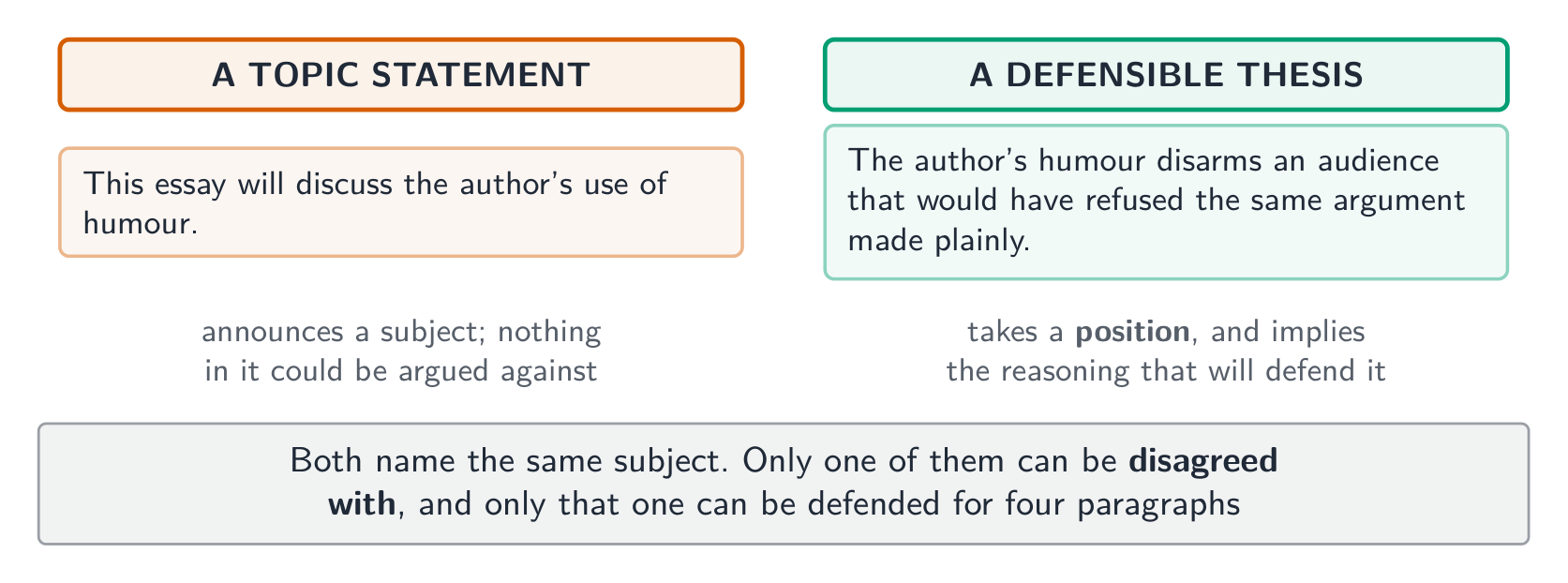
    หัวข้อเดียวกัน และมีเพียงอย่างใดอย่างหนึ่งที่สามารถเห็นต่างได้
    Vocabulary · ⁨คำศัพท์⁩ Train · ⁨ฝึกฝน⁩
    English ไทย
    thesis/ˈθiːsɪs/ thesis
    2.6

    Exam tips · ⁨ข้อแนะนำสำหรับการสอบ⁩

    English
    • The audience drives everything. If a paragraph would read the same to any audience, it has not been shaped for one.
    • Name what evidence does - illustrate, clarify, associate, amplify. That is analysis; listing evidence is not.
    • Sufficiency is quantity and quality, not volume. Three apt pieces beat six loose ones.
    • A thesis in a passage may be implied or distributed. Read the whole text before deciding.
    • Your own thesis must be arguable. Restating the prompt earns zero of the six points.
    • Previewing your line of reasoning in the thesis is optional but makes the rest of the essay easier to organise.
    ไทย
    • ผู้ฟังขับเคลื่อนทุกอย่าง หากย่อหน้าหนึ่งอ่านเหมือนเดิม对所有ผู้ฟัง แสดงว่าไม่ได้ปรับแต่ง为谁
    • ระบุ ว่าหลักฐานทำอะไร - อธิบาย, ชี้แจง, เชื่อมโยง, ขยายความ นั่นคือการวิเคราะห์; การรายการหลักฐานไม่ใช่
    • ความเพียงพอคือปริมาณและคุณภาพ ไม่ใช่จำนวนสามชิ้นที่เหมาะสมดีกว่าหกชิ้นที่ไม่เหมาะสม
    • ข้อโต้แย้งในบทความอาจ ถูกสื่อหรือกระจาย อ่านข้อความทั้งหมดก่อนตัดสินใจ
    • ข้อโต้แย้งของคุณเองต้อง ถกเถียงได้ การทวนโจทย์จะได้ศูนย์จากหกคะแนน
    • การชี้นำเส้นทางการคิดของคุณในข้อโต้แย้งเป็นเรื่องตัวเลือกแต่ทำให้การจัดระเบียบส่วนที่เหลือของบทความง่ายขึ้น
  • 3

    Line of Reasoning and Methods of Development · ⁨เส้นทางการให้เหตุผลและวิธีการพัฒนาเนื้อหา⁩

    Watch lesson · ⁨ดูบทเรียน⁩
    3.1

    Identifying Claims and Evidence · ⁨การระบุข้ออ้างและหลักฐาน⁩

    Syllabus · ⁨หลักสูตร⁩
    English

    Enduring Understanding (CLE-1): Writers make claims about subjects, rely on evidence that supports the reasoning that justifies the claim, and often acknowledge or respond to other, possibly opposing, arguments.

    Learning Objective 3.A: Reading – Identify and explain claims and evidence within an argument.

    • CLE-1.K Effective use of evidence uses commentary to establish a logical relationship between the evidence and the claim it supports.
    • CLE-1.L Writers introduce source material by using commentary to properly integrate it into their line of reasoning.
    • CLE-1.M Synthesis requires consideration, explanation, and integration of others’ arguments into one’s own argument.
    • CLE-1.N Writers must acknowledge words, ideas, images, texts, and other intellectual property of others through attribution, citation, or reference.
    ไทย

    ความเข้าใจที่ยั่งยืน (CLE-1): นักเขียนทำข้ออ้างเกี่ยวกับหัวข้อ อิงกับหลักฐานที่สนับสนุนเหตุผลที่ใช้เพื่อพิสูจน์ข้ออ้าง tersebut และมักยอมรับหรือตอบโต้ข้อโต้แย้งอื่น ๆ ซึ่งอาจเป็นฝ่ายตรงข้าม

    เป้าหมายการเรียนรู้ 3.A: การอ่าน – ระบุและอธิบายข้ออ้างและหลักฐานภายในข้อโต้แย้ง

    • CLE-1.K การใช้หลักฐานที่มีประสิทธิภาพต้องใช้คำบรรยาย (commentary) เพื่อสร้างความสัมพันธ์เชิงตรรกะระหว่างหลักฐานกับข้ออ้างที่มันสนับสนุน
    • CLE-1.L นักเขียนนำเสนอข้อมูลจากแหล่งที่มาโดยใช้คำบรรยายเพื่อบูรณาการมันเข้ากับเส้นทางการคิดของตนเองอย่างเหมาะสม
    • CLE-1.M การสังเคราะห์ (Synthesis) ต้องการการพิจารณา อธิบาย และการบูรณาการข้อโต้แย้งของคนอื่นเข้าไปในข้อโต้แย้งของตนเอง
    • CLE-1.N นักเขียนต้องยกย่องคำ Ideas Images texts และทรัพย์สินทางปัญญาอื่นๆ ของผู้อื่น通过对 attribution, citation, or reference.

    Source: College Board AP Course and Exam Description · ⁨แหล่งที่มา: คำอธิบายหลักสูตรและข้อสอบ College Board AP⁩

    English

    Unit 3 is where the course stops being about parts and starts being about structure. Its subject is the line of reasoning 推理线索 - the path an argument takes from where it starts to what it proves.

    First, four claims about how evidence gets into an argument properly:

    • Effective use of evidence uses commentary 评述 to establish a logical relationship between the evidence and the claim.
    • Writers introduce source material using commentary to integrate it into their line of reasoning - so commentary comes before as well as after.
    • Synthesis 综合 requires consideration, explanation, and integration of others' arguments into one's own. That is the exact skill Question 1 tests, and the word integration rules out a paragraph that simply summarises each source in turn.
    • Writers must acknowledge the words, ideas, images, and texts of others through attribution and citation 归属与引用.
    ไทย

    หน่วยที่ 3 คือจุดที่รายวิชาหยุด是关于ส่วนย่อยและเริ่ม是关于 โครงสร้าง Subjects it is the line of reasoning 推理线索 - เส้นทางที่ข้อโต้แย้งเดินทางตั้งแต่จุดเริ่มต้นไปจนถึงสิ่งที่พิสูจน์ได้

    ก่อนอื่น สี่ข้ออ้างเกี่ยวกับการที่หลักฐานเข้าสู่ข้อโต้แย้งอย่างถูกต้อง:

    • การใช้หลักฐานที่มีประสิทธิภาพใช้ คำอธิบายประกอบ 评述 เพื่อสร้าง ความสัมพันธ์เชิงตรรกะระหว่างหลักฐานกับข้ออ้าง
    • ผู้เขียน แนะนำแหล่งที่มา โดยใช้คำอธิบายประกอบเพื่อรวมมันเข้ากับเส้นทางการคิดของพวกเขา - ดังนั้นคำอธิบายประกอบจึงมาก่อนและถัดจาก
    • การสังเคราะห์ 综合 Requires การพิจารณา คำอธิบาย และการบูรณาการข้อโต้แย้งของคนอื่นเข้าด้วยกัน นั่นคือทักษะที่ข้อ 1 ทดสอบพอดี และคำว่า integration ลบบทย่อหน้าที่สรุปแต่ละแหล่งมาทีละแหล่ง
    • ผู้เขียนต้อง ยอมรับ คำ想法 Images และข้อความของคนอื่นผ่าน การระบุตัวตนและการอ้างอิง 归属与引用
    Vocabulary · ⁨คำศัพท์⁩ Train · ⁨ฝึกฝน⁩
    English ไทย
    line of reasoning/laɪn ɒv ˈriːzənɪŋ/ เส้นทางการคิด
    3.2

    Developing a Paragraph with Claim and Evidence · ⁨การพัฒนาย่อหน้าด้วยข้ออ้างและหลักฐาน⁩

    Syllabus · ⁨หลักสูตร⁩
    English

    Enduring Understanding (CLE-1): Writers make claims about subjects, rely on evidence that supports the reasoning that justifies the claim, and often acknowledge or respond to other, possibly opposing, arguments.

    Learning Objective 4.A: Writing – Develop a paragraph that includes a claim and evidence supporting the claim.

    • CLE-1.K Effective use of evidence uses commentary to establish a logical relationship between the evidence and the claim it supports.
    • CLE-1.L Writers introduce source material by using commentary to properly integrate it into their line of reasoning.
    • CLE-1.M Synthesis requires consideration, explanation, and integration of others’ arguments into one’s own argument.
    • CLE-1.N Writers must acknowledge words, ideas, images, texts, and other intellectual property of others through attribution, citation, or reference.
    ไทย

    ความเข้าใจที่ยั่งยืน (CLE-1): นักเขียนทำข้ออ้างเกี่ยวกับหัวข้อ อิงกับหลักฐานที่สนับสนุนเหตุผลที่ใช้เพื่อพิสูจน์ข้ออ้าง tersebut และมักยอมรับหรือตอบโต้ข้อโต้แย้งอื่น ๆ ซึ่งอาจเป็นฝ่ายตรงข้าม

    เป้าหมายการเรียนรู้ 4.A: การเขียน – พัฒนาย่อหน้าที่ประกอบด้วยข้ออ้างและหลักฐานที่สนับสนุนข้ออ้างนั้น

    • CLE-1.K การใช้หลักฐานที่มีประสิทธิภาพต้องใช้คำบรรยาย (commentary) เพื่อสร้างความสัมพันธ์เชิงตรรกะระหว่างหลักฐานกับข้ออ้างที่มันสนับสนุน
    • CLE-1.L นักเขียนนำเสนอข้อมูลจากแหล่งที่มาโดยใช้คำบรรยายเพื่อบูรณาการมันเข้ากับเส้นทางการคิดของตนเองอย่างเหมาะสม
    • CLE-1.M การสังเคราะห์ (Synthesis) ต้องการการพิจารณา อธิบาย และการบูรณาการข้อโต้แย้งของคนอื่นเข้าไปในข้อโต้แย้งของตนเอง
    • CLE-1.N นักเขียนต้องยกย่องคำ Ideas Images texts และทรัพย์สินทางปัญญาอื่นๆ ของผู้อื่น通过对 attribution, citation, or reference.

    Source: College Board AP Course and Exam Description · ⁨แหล่งที่มา: คำอธิบายหลักสูตรและข้อสอบ College Board AP⁩

    English

    Applied to your own writing, the change from Unit 2 is that commentary now has two jobs, not one: it introduces the evidence into the reasoning, and it explains the relationship afterwards.

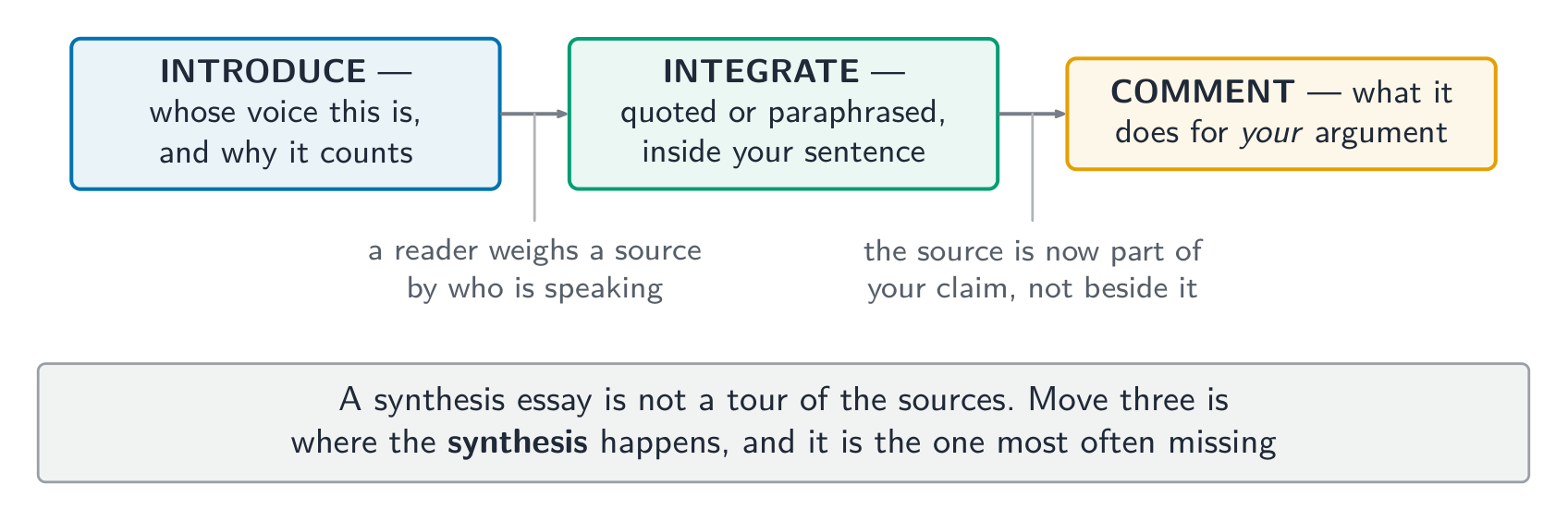
    A paragraph that does both reads: claim - a sentence positioning the evidence - the evidence, embedded - commentary establishing the logical relationship - the link onward. The sentence before the quotation is doing as much work as the one after it, and most students write neither.

    ไทย

    เมื่อประยุกต์กับการเขียนของคุณเอง การเปลี่ยนแปลงจากหน่วยที่ 2 คือคำอธิบายประกอบตอนนี้มี สองงาน ไม่ใช่หนึ่ง: แนะนำหลักฐานเข้าสู่การคิด และอธิบายความสัมพันธ์หลังจากนั้น

    ย่อหน้าที่ทำทั้งสองอย่างอ่าน: ข้ออ้าง - ประโยคจัดวางหลักฐาน - หลักฐานที่ฝังตัว - คำอธิบายประกอบ establishing的逻辑关系 - link onward. ประโยคก่อนคำพูดมีบทบาทเท่าประโยคหลังและนักเรียนส่วนใหญ่เขียนทั้งสองอย่างไม่ได้

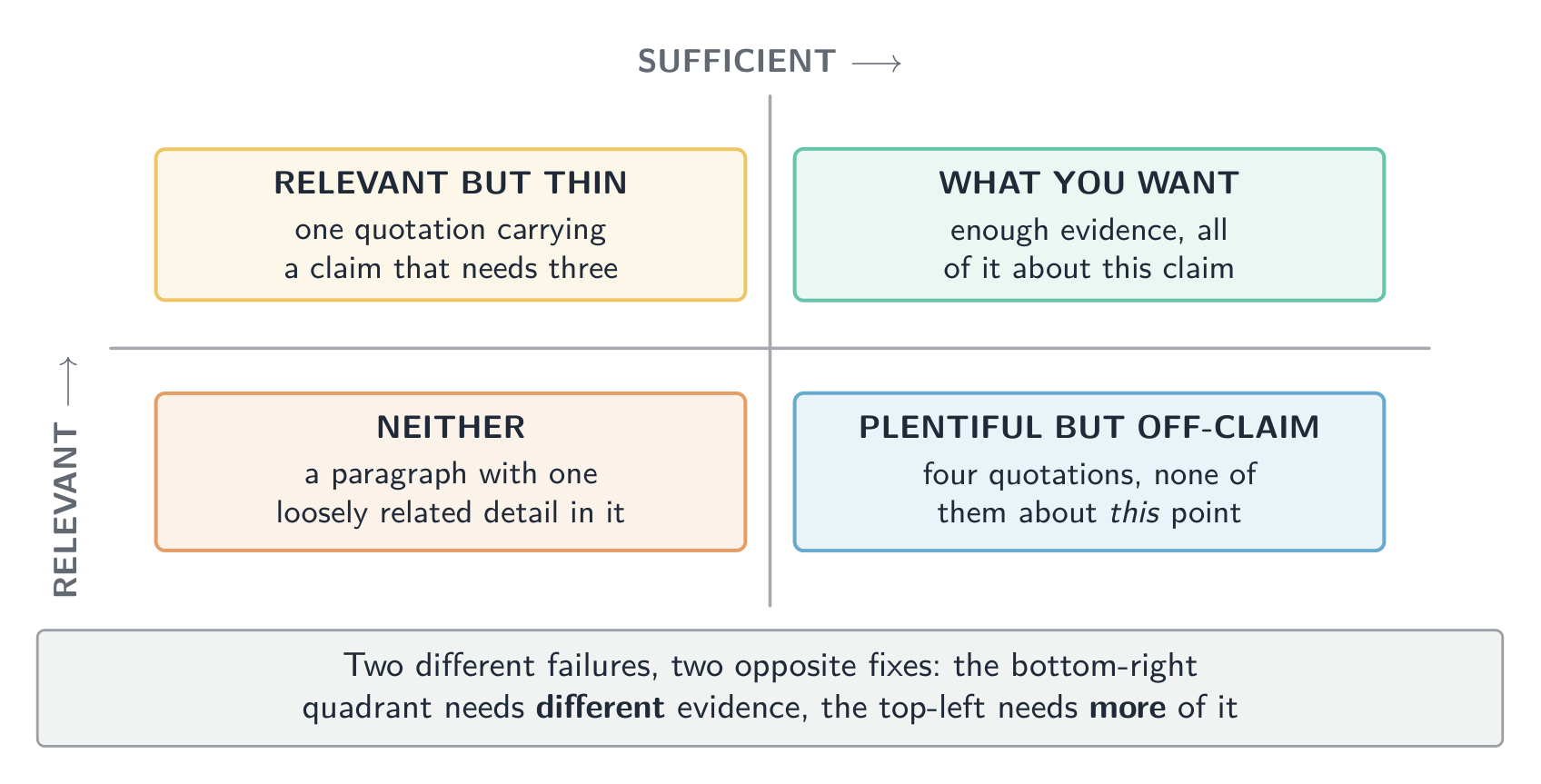
    ที่เกี่ยวข้องและเพียงพอคือความล้มเหลวสองประเภทที่มีการแก้ไขตรงกันข้าม
    Explore · ⁨สำรวจ⁩

    Diagnose the evidence problem · ⁨วินิจฉัยปัญหาลักษณะหลักฐาน⁩

    Relevant and sufficient are two different failures with two opposite fixes. · ⁨เกี่ยวข้องและเพียงพอคือความล้มเหลวสองแบบที่มีทางแก้ตรงข้ามกัน⁩

    3.3

    Describing the Line of Reasoning · ⁨การอธิบายเส้นทางการคิด⁩

    Syllabus · ⁨หลักสูตร⁩
    English

    Enduring Understanding (REO-1): Writers guide understanding of a text’s lines of reasoning and claims through that text’s organization and integration of evidence.

    Learning Objective 5.A: Reading – Describe the line of reasoning and explain whether it supports an argument’s overarching thesis.

    • REO-1.A Writers may lead readers through a line of reasoning and then arrive at a thesis.
    • REO-1.B Writers may express a claim and then develop a line of reasoning to justify the claim.
    • REO-1.C Writers explain their reasoning through commentary that connects chosen evidence to a claim.
    • REO-1.D Commentary explains the significance and relevance of evidence in relation to the line of reasoning.
    • REO-1.E The sequence of paragraphs in a text reveals the argument’s line of reasoning.
    • REO-1.F Flaws in a line of reasoning may render an argument specious or illogical.
    ไทย

    ความเข้าใจที่ยั่งยืน (REO-1): นักเขียนนำความเข้าใจในเส้นทางการคิดและข้ออ้างของข้อความผ่านการจัดระเบียบและการบูรณาการหลักฐานของข้อความนั้น

    เป้าหมายการเรียนรู้ 5.A: การอ่าน – อธิบายเส้นทางการคิดและอธิบายว่ามันสนับสนุน论点หลักของข้อโต้แย้งหรือไม่

    • REO-1.A นักเขียนอาจนำผู้อ่านผ่านเส้นทางการคิดแล้วจึง arrives at a thesis.
    • REO-1.B นักเขียนอาจแสดงข้ออ้างแล้วพัฒนาเส้นทางการคิดเพื่อพิสูจน์ข้ออ้างนั้น
    • REO-1.C นักเขียนอธิบายเหตุผลของตนผ่านคำบรรยายที่เชื่อมโยงหลักฐานที่เลือกเข้ากับข้ออ้าง
    • REO-1.D คำบรรยายอธิบายความสำคัญและความเกี่ยวข้องของหลักฐานในบริบทของเส้นทางการคิด
    • REO-1.E ลำดับของย่อหน้าในข้อความสะท้อนเส้นทางการคิดของข้อโต้แย้ง
    • REO-1.F ความบกพร่องในเส้นทางการคิดอาจทำให้ข้อโต้แย้งดูไม่สมเหตุสมผลหรือไร้เหตุผล

    Source: College Board AP Course and Exam Description · ⁨แหล่งที่มา: คำอธิบายหลักสูตรและข้อสอบ College Board AP⁩

    English

    The CED allows two arrangements, and both are valid:

    • Writers may lead readers through a line of reasoning and then arrive at a thesis - the argument builds to its claim.
    • Writers may express a claim and then develop a line of reasoning to justify it - the argument declares and then defends.

    Whichever order is used, the same requirements hold:

    • Writers explain their reasoning through commentary that connects chosen evidence to a claim.
    • Commentary explains the significance and relevance of evidence in relation to the line of reasoning.
    • The sequence of paragraphs in a text reveals the argument's line of reasoning - which is the practical tool for reading. To find a writer's reasoning, write one sentence per paragraph and read the list.
    • Flaws in a line of reasoning may render an argument specious or illogical.
    ไทย
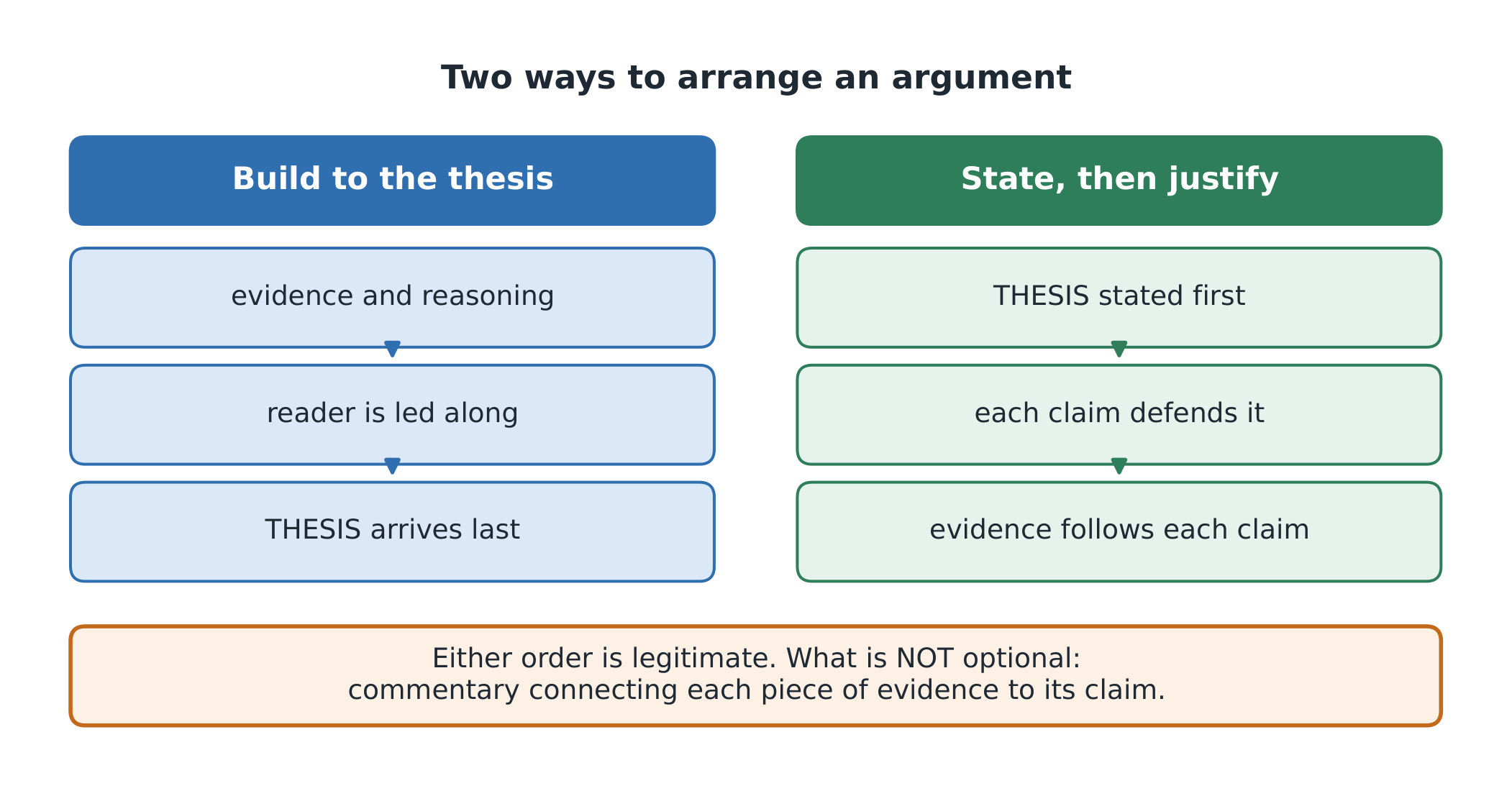
    ลำดับ legitimately สองอย่าง ความต้องการหนึ่ง - และความต้องการคือคำอธิบายประกอบ
    ลำดับเป็นการเลือก; เนื้อเยื่อเชื่อมต่อไม่ใช่

    CEDอนุญาตการเรียงสองแบบและทั้งสองถูกต้อง:

    • ผู้เขียนอาจ นำผู้อ่านผ่านเส้นทางการคิดแล้วจึงถึงข้อโต้แย้ง - ข้อโต้แย้งสร้างขึ้นสู่ข้ออ้าง
    • ผู้เขียนอาจ แสดงข้ออ้างแล้วพัฒนาเส้นทางการคิดเพื่อสนับสนุนมัน - ข้อโต้แย้งประกาศและ затемปกป้อง

    ไม่ว่าลำดับไหนจะถูกใช้ ข้อกำหนดเดียวกันยังคงอยู่:

    • Writers explain their reasoning through commentary that connects chosen evidence to a claim
    • Commentary explains the significance and relevance of evidence in relation to the line of reasoning
    • ลำดับของย่อหน้าในข้อความเปิดเผยเส้นทางการคิดของข้อโต้แย้ง - ซึ่งเป็นเครื่องมือสำหรับการอ่านเพื่อหาการคิดของผู้เขียน เขียนหนึ่งประโยคต่อย่อหน้าและอ่านรายการ
    • ข้อบกพร่องในเส้นทางการคิดอาจทำให้ข้อโต้แย้งดูหลอกลวงหรือไม่เป็นตรรกะ
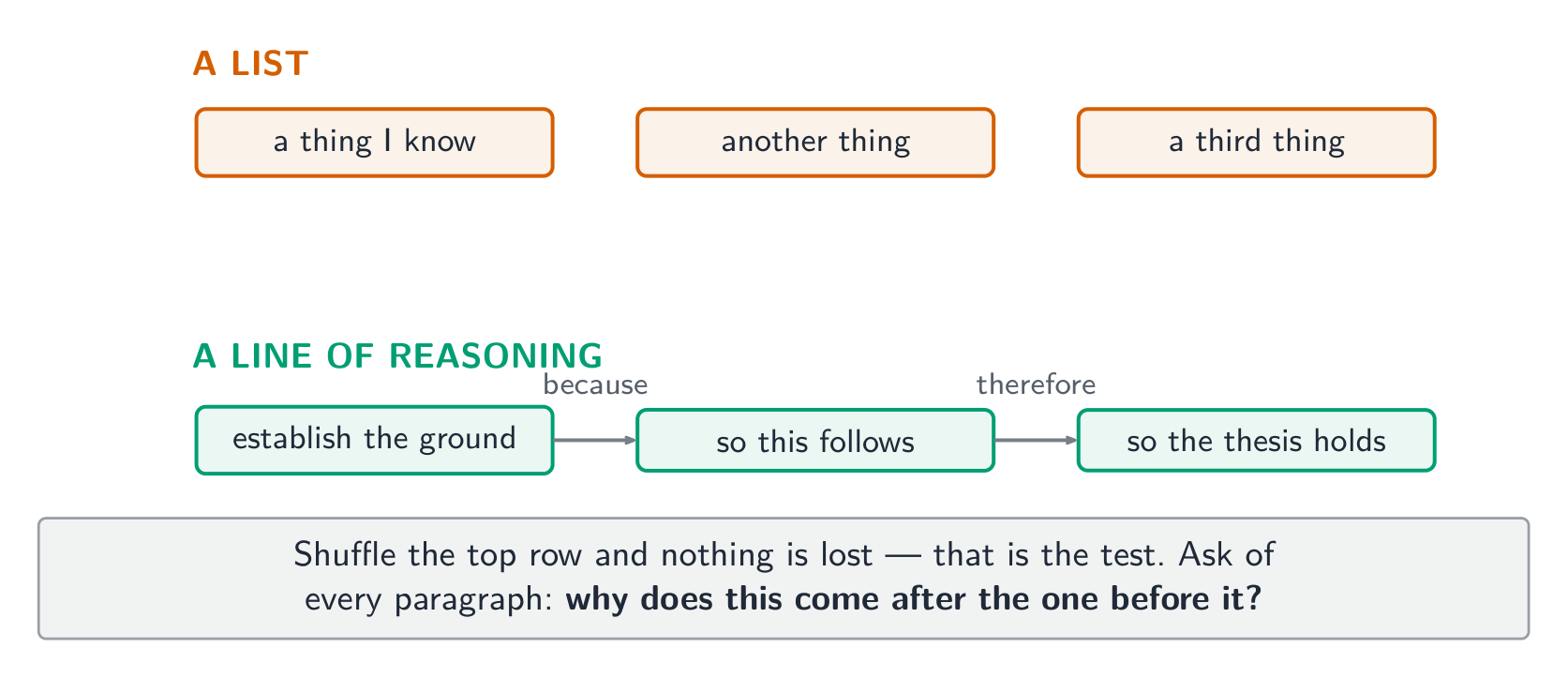
    การทดสอบสับ: ถ้าย่อหน้าสามารถเรียงใหม่โดยไม่สูญเสีย แสดงว่าเป็นรายการ
    Vocabulary · ⁨คำศัพท์⁩ Train · ⁨ฝึกฝน⁩
    English ไทย
    commentary/ˈkɒməntri/ คำวิจารณ์ (commentary)
    3.4

    Developing a Line of Reasoning and Commentary · ⁨การพัฒนาเส้นทางการคิดและคำอธิบายประกอบ⁩

    Syllabus · ⁨หลักสูตร⁩
    English

    Enduring Understanding (REO-1): Writers guide understanding of a text’s lines of reasoning and claims through that text’s organization and integration of evidence.

    Learning Objective 6.A: Writing – Develop a line of reasoning and commentary that explains it throughout an argument.

    • REO-1.A Writers may lead readers through a line of reasoning and then arrive at a thesis.
    • REO-1.B Writers may express a claim and then develop a line of reasoning to justify the claim.
    • REO-1.C Writers explain their reasoning through commentary that connects chosen evidence to a claim.
    • REO-1.D Commentary explains the significance and relevance of evidence in relation to the line of reasoning.
    • REO-1.E The sequence of paragraphs in a text reveals the argument’s line of reasoning.
    • REO-1.F Flaws in a line of reasoning may render an argument specious or illogical.
    ไทย

    ความเข้าใจที่ยั่งยืน (REO-1): นักเขียนนำความเข้าใจในเส้นทางการคิดและข้ออ้างของข้อความผ่านการจัดระเบียบและการบูรณาการหลักฐานของข้อความนั้น

    วัตถุประสงค์การเรียนรู้ 6.A: การเขียน – พัฒนาเส้นทางการคิดและการวิเคราะห์แสดงความคิดเห็นที่อธิบายตลอดทั้งข้อโต้แย้ง

    • REO-1.A นักเขียนอาจนำผู้อ่านผ่านเส้นทางการคิดแล้วจึง arrives at a thesis.
    • REO-1.B นักเขียนอาจแสดงข้ออ้างแล้วพัฒนาเส้นทางการคิดเพื่อพิสูจน์ข้ออ้างนั้น
    • REO-1.C นักเขียนอธิบายเหตุผลของตนผ่านคำบรรยายที่เชื่อมโยงหลักฐานที่เลือกเข้ากับข้ออ้าง
    • REO-1.D คำบรรยายอธิบายความสำคัญและความเกี่ยวข้องของหลักฐานในบริบทของเส้นทางการคิด
    • REO-1.E ลำดับของย่อหน้าในข้อความสะท้อนเส้นทางการคิดของข้อโต้แย้ง
    • REO-1.F ความบกพร่องในเส้นทางการคิดอาจทำให้ข้อโต้แย้งดูไม่สมเหตุสมผลหรือไร้เหตุผล

    Source: College Board AP Course and Exam Description · ⁨แหล่งที่มา: คำอธิบายหลักสูตรและข้อสอบ College Board AP⁩

    English

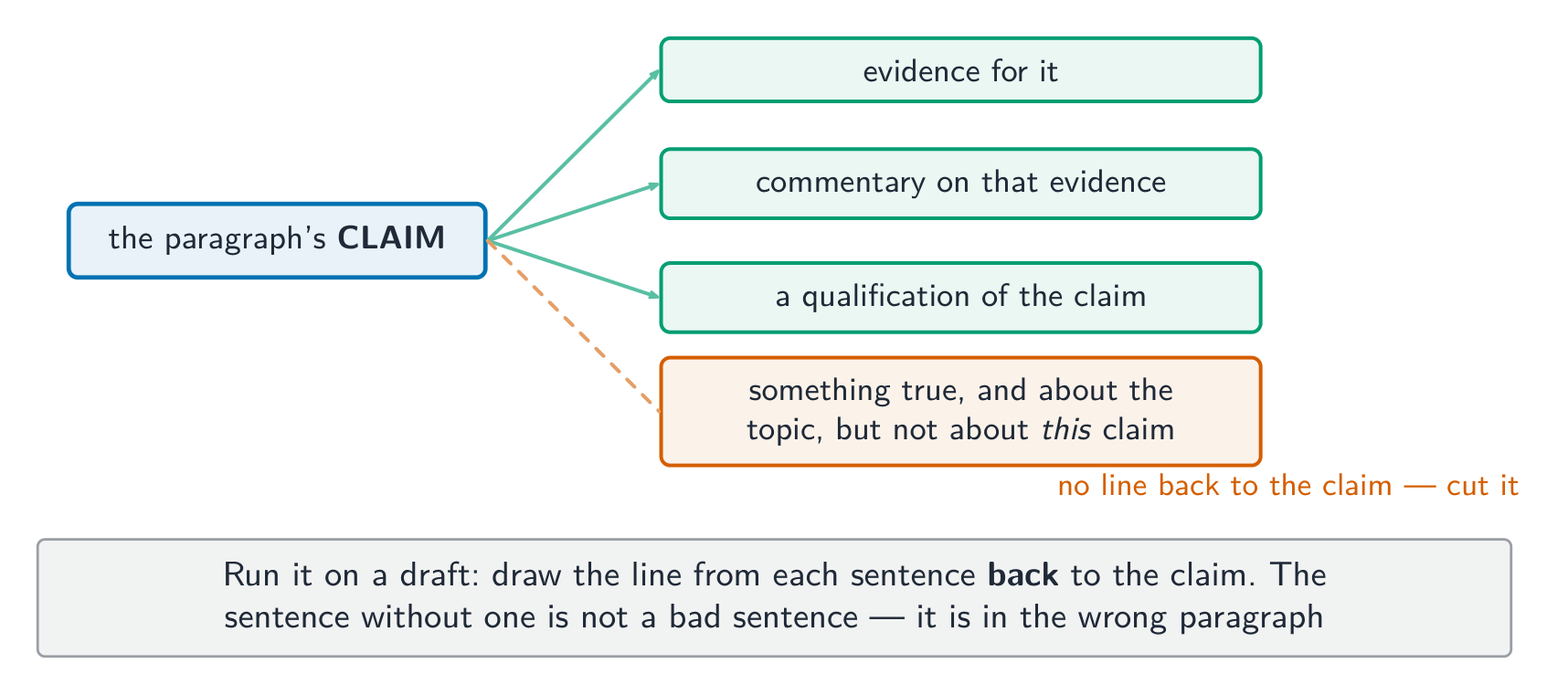
    For your own essays, the useful discipline is to decide the order of your claims before writing any of them. An essay whose paragraphs could be shuffled without loss has no line of reasoning - it has a list.

    Test a draft by asking of each paragraph: why does this come after the one before it? If the only answer is "it is another thing I know about the topic", the structure is a list and the reasoning point is at risk.

    ไทย

    สำหรับบทความของคุณเอง วินัยที่มีประโยชน์คือการตัดสินใจ ลำดับของข้ออ้างของคุณก่อนเขียน บทความ whose paragraphs could be shuffled without loss has no line of reasoning - it has a list

    ทดสอบร่างโดยตั้งคำถามกับแต่ละย่อหน้าว่า: ทำไมส่วนนี้ถึงมาต่อจากส่วนก่อนหน้า? หากคำตอบเดียวคือ "เป็นอีกสิ่งที่ฉันรู้เกี่ยวกับหัวข้อนี้" โครงสร้างจะเป็นเพียงรายการ และจุดให้เหตุผลจะอยู่ในภาวะเสี่ยง

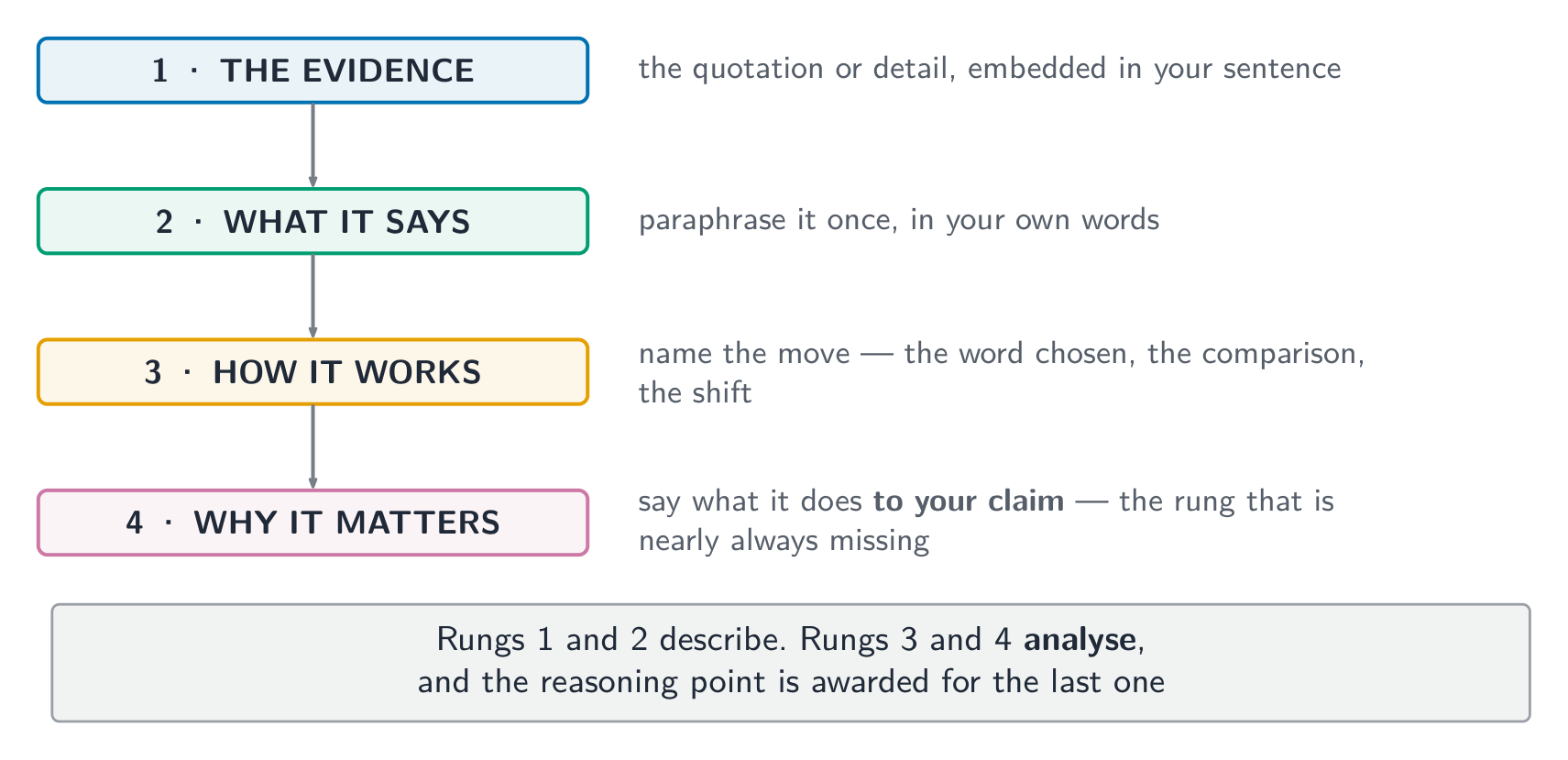
    คำอธิบายเป็นขั้นบันไดสี่ขั้น - จุดให้เหตุผลจะถูกมอบให้ขั้นสุดท้าย
    Explore · ⁨สำรวจ⁩

    Climb the four rungs of commentary · ⁨ปีนบันไดสี่ขั้นของคำวิจารณ์⁩

    'Explain your evidence' is unusable. Four questions, each answerable in a sentence, make it a procedure. · ⁨"อธิบายหลักฐานของคุณ" ใช้ไม่ได้จริง สี่คำถาม ที่แต่ละข้อตอบเป็นประโยค ได้将其变为ขั้นตอน⁩

    3.5

    Recognizing Methods of Development · ⁨การระบุวิธีการพัฒนาเนื้อหา⁩

    Syllabus · ⁨หลักสูตร⁩
    English

    Enduring Understanding (REO-1): Writers guide understanding of a text’s lines of reasoning and claims through that text’s organization and integration of evidence.

    Learning Objective 5.C: Reading – Recognize and explain the use of methods of development to accomplish a purpose.

    • REO-1.G Methods of development are common approaches writers frequently use to develop and organize the reasoning of their arguments. A method of development provides an audience with the means to trace a writer’s reasoning in an argument.
    • REO-1.H Some typical methods of development are narration, cause-effect, comparison-contrast, definition, and description.
    • REO-1.I When developing ideas through narration, writers offer details about real-life experiences and offer reflections and insights on the significance of those experiences.
    • REO-1.J When developing ideas through cause-effect, writers present a cause, assert effects or consequences of that cause, or present a series of causes and the subsequent effect(s).
    ไทย

    ความเข้าใจที่ยั่งยืน (REO-1): นักเขียนนำความเข้าใจในเส้นทางการคิดและข้ออ้างของข้อความผ่านการจัดระเบียบและการบูรณาการหลักฐานของข้อความนั้น

    วัตถุประสงค์การเรียนรู้ 5.C: การอ่าน – จดจำและอธิบายการใช้วิธีการพัฒนาเนื้อหาเพื่อบรรลุวัตถุประสงค์

    • REO-1.G วิธีการพัฒนาเนื้อหาคือแนวทางทั่วไปที่นักเขียนมักใช้เพื่อพัฒนาและจัดระเบียบการคิดในข้อโต้แย้ง วิธีการพัฒนาเนื้อหาให้ผู้ฟังมีเครื่องมือในการติดตามเส้นทางการคิดของนักเขียนในข้อโต้แย้ง
    • REO-1.H ตัวอย่างวิธีการพัฒนาเนื้อหาที่พบบ่อย ได้แก่ การเล่าเรื่อง, สาเหตุ-ผล, การเปรียบเทียบ-ความแตกต่าง, นิยามศัพท์ และการบรรยาย
    • REO-1.I เมื่อพัฒนาความคิดผ่านการเล่าเรื่อง นักเขียนจะนำเสนอรายละเอียดเกี่ยวกับประสบการณ์จริง และแสดงการสะท้อนคิดพร้อมความเข้าใจในนัยสำคัญของประสบการณ์เหล่านั้น
    • REO-1.J เมื่อพัฒนาความคิดผ่านสาเหตุ-ผล นักเขียนจะเสนอสาเหตุ, ยืนยันถึงผลลัพธ์หรือผลกระทบจากสาเหตุนั้น, หรือเสนอชุดของสาเหตุและผลลัพธ์ตามลำดับ

    Source: College Board AP Course and Exam Description · ⁨แหล่งที่มา: คำอธิบายหลักสูตรและข้อสอบ College Board AP⁩

    English

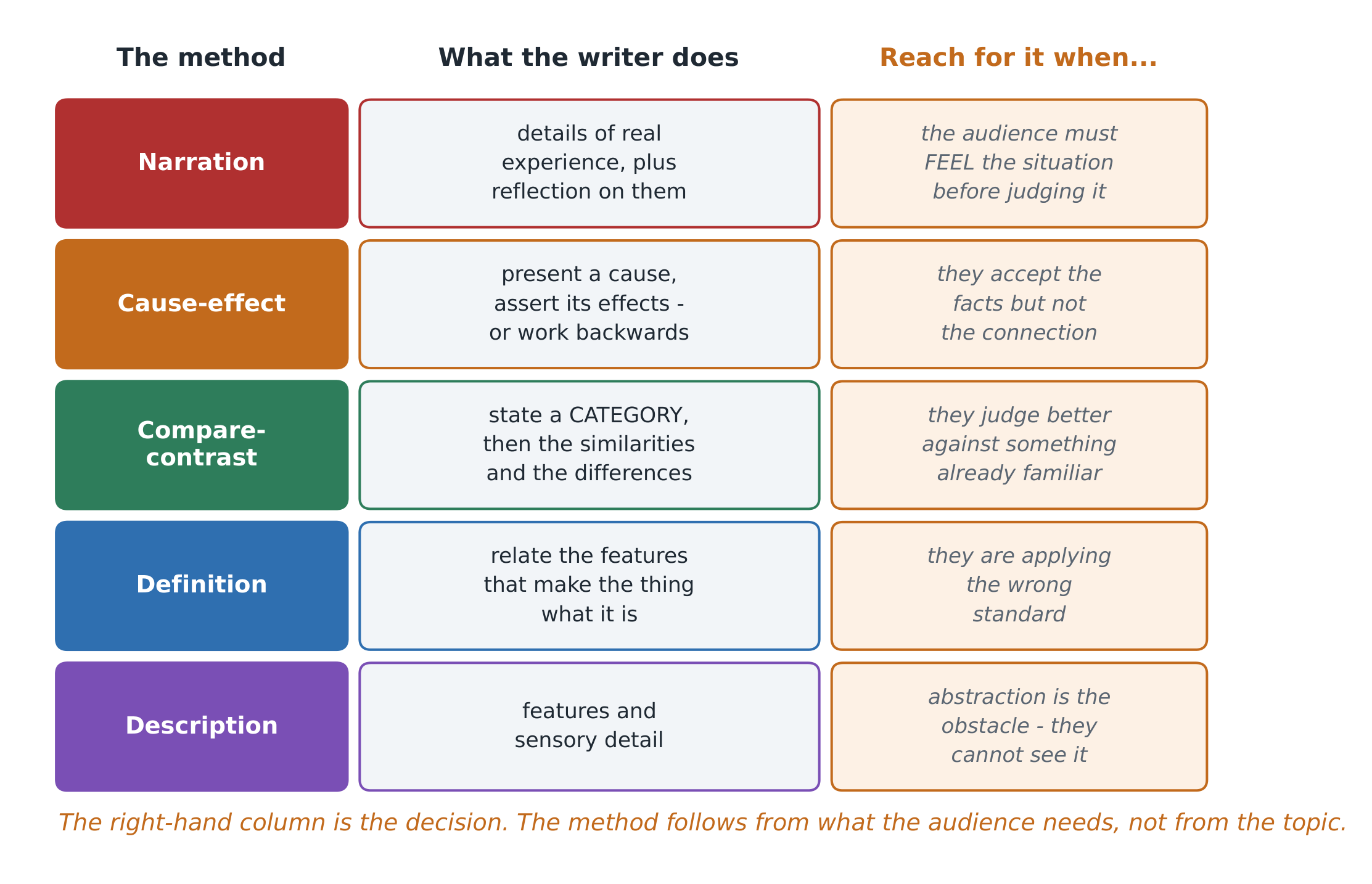
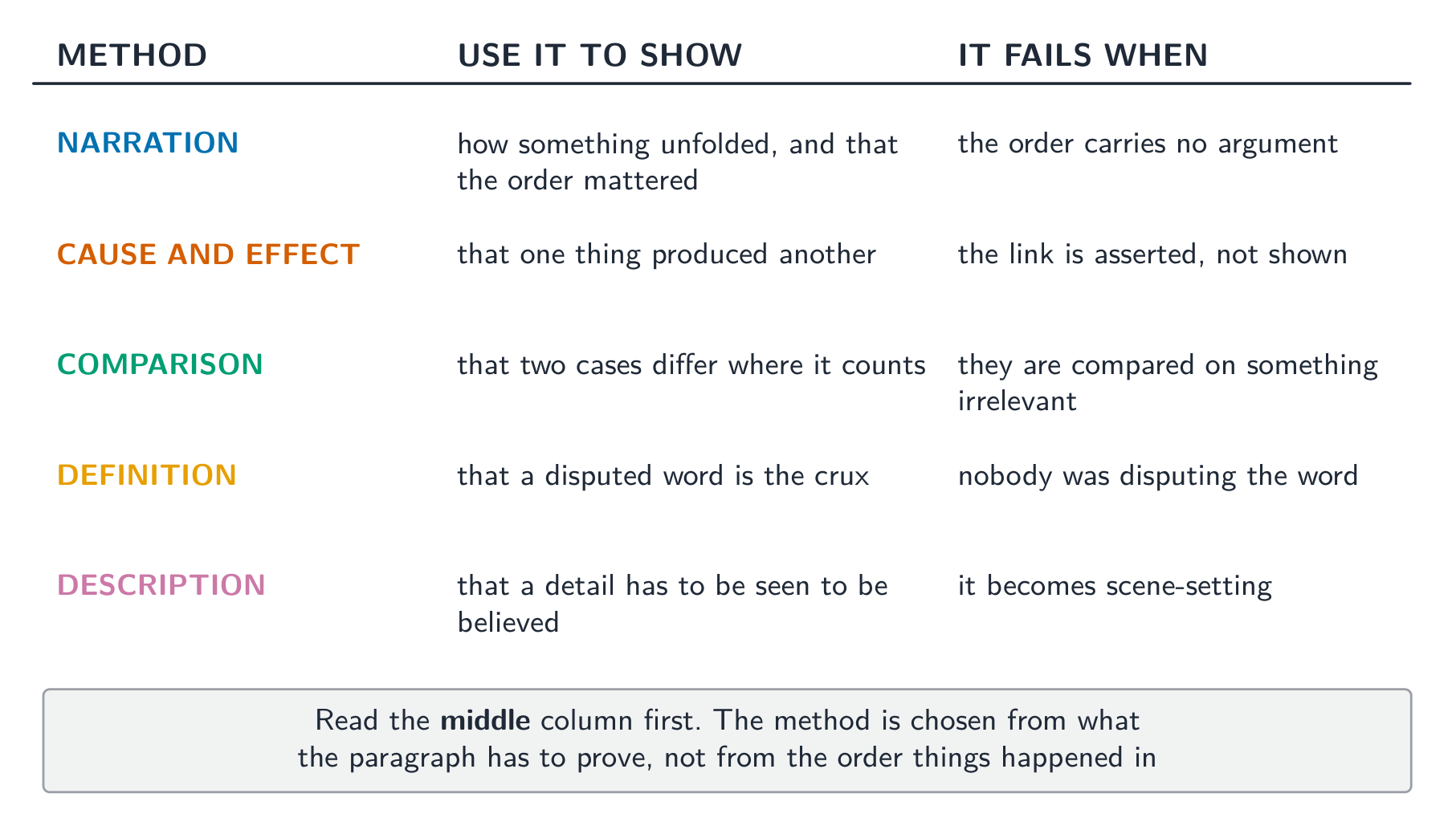
    Methods of development 展开方法 are common approaches writers use to develop and organise the reasoning of an argument. The CED's list: narration, cause-effect, comparison-contrast, definition, and description. This unit treats the first two.

    • Developing through narration 叙述: writers offer details about real-life experiences and reflections on them. The reflection is what makes narration an argument rather than a story - an anecdote with no reflection has supplied no reasoning.
    • Developing through cause-effect 因果: writers present a cause, then assert the effects or consequences of that cause - or begin from an effect and trace it back.
    ไทย

    วิธีการพัฒนา (展开方法) เป็น แนวทางทั่วไปที่นักเขียนใช้เพื่อพัฒนาและจัดระเบียบการให้เหตุผล ในข้อโต้แย้ง รายการของ CED ได้แก่: การเล่าเรื่อง, สาเหตุ-ผล, เปรียบเทียบ-แยกแยะ, นิยาม, และการบรรยาย หน่วยเรียนนี้จะครอบคลุมสองอย่างแรกเท่านั้น

    • การพัฒนาผ่าน การเล่าเรื่อง (叙述): นักเขียนเสนอรายละเอียดเกี่ยวกับ ประสบการณ์ในชีวิตจริง และ การสะท้อนคิด ต่อสิ่งเหล่านั้น การสะท้อนคิดคือสิ่งที่ทำให้การเล่าเรื่องกลายเป็นข้อโต้แย้ง ไม่ใช่เพียงเรื่องราว - แอนิโดตที่ไม่มีการสะท้อนคิดไม่ได้ให้เหตุผลใดๆ
    • การพัฒนาผ่าน สาเหตุ-ผล (因果): นักเขียน นำเสนอสาเหตุ แล้ว assertions ผลกระทบหรือผลลัพธ์ ของสาขานั้น - หรือเริ่มต้นจากผลกระทบแล้วย้อนกลับหาสาเหตุ
    3.6

    Using Methods of Development · ⁨การใช้วิธีการพัฒนาเนื้อหา⁩

    Syllabus · ⁨หลักสูตร⁩
    English

    Enduring Understanding (REO-1): Writers guide understanding of a text’s lines of reasoning and claims through that text’s organization and integration of evidence.

    Learning Objective 6.C: Writing – Use appropriate methods of development to advance an argument.

    • REO-1.G Methods of development are common approaches writers frequently use to develop and organize the reasoning of their arguments. A method of development provides an audience with the means to trace a writer’s reasoning in an argument.
    • REO-1.H Some typical methods of development are narration, cause-effect, comparison-contrast, definition, and description.
    • REO-1.I When developing ideas through narration, writers offer details about real-life experiences and offer reflections and insights on the significance of those experiences.
    • REO-1.J When developing ideas through cause-effect, writers present a cause, assert effects or consequences of that cause, or present a series of causes and the subsequent effect(s).
    ไทย

    ความเข้าใจที่ยั่งยืน (REO-1): นักเขียนนำความเข้าใจในเส้นทางการคิดและข้ออ้างของข้อความผ่านการจัดระเบียบและการบูรณาการหลักฐานของข้อความนั้น

    วัตถุประสงค์การเรียนรู้ 6.C: การเขียน – ใช้วิธีการพัฒนาเนื้อหาที่เหมาะสมเพื่อยกระดับข้อโต้แย้ง

    • REO-1.G วิธีการพัฒนาเนื้อหาคือแนวทางทั่วไปที่นักเขียนมักใช้เพื่อพัฒนาและจัดระเบียบการคิดในข้อโต้แย้ง วิธีการพัฒนาเนื้อหาให้ผู้ฟังมีเครื่องมือในการติดตามเส้นทางการคิดของนักเขียนในข้อโต้แย้ง
    • REO-1.H ตัวอย่างวิธีการพัฒนาเนื้อหาที่พบบ่อย ได้แก่ การเล่าเรื่อง, สาเหตุ-ผล, การเปรียบเทียบ-ความแตกต่าง, นิยามศัพท์ และการบรรยาย
    • REO-1.I เมื่อพัฒนาความคิดผ่านการเล่าเรื่อง นักเขียนจะนำเสนอรายละเอียดเกี่ยวกับประสบการณ์จริง และแสดงการสะท้อนคิดพร้อมความเข้าใจในนัยสำคัญของประสบการณ์เหล่านั้น
    • REO-1.J เมื่อพัฒนาความคิดผ่านสาเหตุ-ผล นักเขียนจะเสนอสาเหตุ, ยืนยันถึงผลลัพธ์หรือผลกระทบจากสาเหตุนั้น, หรือเสนอชุดของสาเหตุและผลลัพธ์ตามลำดับ

    Source: College Board AP Course and Exam Description · ⁨แหล่งที่มา: คำอธิบายหลักสูตรและข้อสอบ College Board AP⁩

    English

    Choosing a method is a rhetorical decision, not a stylistic one. Narration works when the audience needs to feel the situation before they will accept a claim about it. Cause-effect works when the audience already accepts the facts but not the connection between them.

    Worked example (a real AP exam task). On a Question 1 synthesis prompt, compare two paragraphs using the same two sources. The weak version: "Source A says X. Source C says Y. Both discuss the issue." That is summary in sequence - no claim, no integration, no reasoning. The strong version: "The strongest objection to the proposal is not that it fails but that it succeeds too narrowly: Source A's data show the intended outcome improving, while Source C's account of the same programme records the second-order costs that the measurement in Source A was never designed to capture." Here the sources are integrated into the writer's own claim, and the commentary establishes the logical relationship - which is what the four evidence-and-commentary points are awarded for.

    ไทย

    การเลือกวิธีเป็น decisiónทางอรรถศาสตร์ (rhetorical) ไม่ใช่แบบแผนภาษา การเล่าเรื่องใช้ได้เมื่อผู้ฟังจำเป็นต้อง รู้สึก กับสถานการณ์ก่อนจะยอมรับข้ออ้างเกี่ยวกับมัน การ cause-effect ใช้ได้เมื่อผู้ฟังยอมรับความจริงอยู่แล้วแต่ไม่เห็นความเชื่อมโยงระหว่างกัน

    ตัวอย่างที่แสดงวิธีทำ (โจทย์สอบ AP จริง). ใน Question 1 synthesis prompt เปรียบเทียบสองย่อหน้าโดยใช้แหล่งข้อมูลเดียวกันสองแหล่ง เวอร์ชันที่อ่อน: "Source A บอก X. Source C บอก Y. ทั้งคู่พูดถึงประเด็นนั้น" นั่นคือการสรุปตามลำดับ - ไม่มีข้ออ้าง ไม่มีการบูรณาการ ไม่มีเหตุผล เวอร์ชันที่แข็งแรง: "ข้อโต้แย้งที่แข็งแกร่งที่สุดต่อข้อเสนอไม่ใช่ اینکهมันล้มเหลว แต่ اینکهมันประสบความสำเร็จแคบเกินไป: ข้อมูลจาก Source A แสดงให้เห็นว่าผลลัพธ์ที่ตั้งใจไว้ดีขึ้น ในขณะที่คำบรรยายจาก Source C เกี่ยวกับโปรแกรมเดียวกันบันทึกต้นทุนระดับที่สองซึ่งการวัดผลใน Source A ไม่เคยถูกออกแบบมาเพื่อจับค่าได้" ที่นี่แหล่งข้อมูลถูก บูรณาการเข้ากับข้ออ้างของผู้เขียนเอง และการ(commentary)确立ความสัมพันธ์เชิงตรรกะ - ซึ่งเป็นสิ่งที่จุด four evidence-and-commentary ถูกมอบให้

    Vocabulary · ⁨คำศัพท์⁩ Train · ⁨ฝึกฝน⁩
    English ไทย
    Synthesis/ˈsɪnθəsɪs/ การบูรณาการ
    attribution and citation/ətrɪˈbjuːʃn ænd saɪˈteɪʃn/ การให้เครดิตและการอ้างอิง
    Methods of development/ˈmeθədz ɒv dɪˈveləpmənt/ วิธีการพัฒนา
    narration/nəˈreɪʃn/ การเล่าเรื่อง
    cause-effect/kɔːz ɪˈfekt/ สาเหตุ-ผลลัพธ์
    3.6

    Exam tips · ⁨ข้อแนะนำสำหรับการสอบ⁩

    English
    • Commentary has two jobs: introducing evidence into the reasoning, and explaining the relationship afterwards. Write both sentences.
    • Synthesis means integration, not summary in sequence. A paragraph per source is the classic low-scoring shape.
    • To find a writer's line of reasoning, summarise each paragraph in one sentence and read the list.
    • Ask of your own paragraphs: why does this one follow that one? No answer means no line of reasoning.
    • Narration needs reflection. An anecdote without it has told a story, not made an argument.
    • Choose a method of development for a rhetorical reason and be able to say what it is.
    ไทย
    • คำอธิบายมี หน้าที่สองอย่าง: นำหลักฐานเข้าสู่การให้เหตุผล และอธิบายความสัมพันธ์ afterwards เขียนทั้งสองประโยค
    • Synthesis คือการบูรณาการ ไม่ใช่การสรุปตามลำดับ ย่อหน้าละแหล่งข้อมูลคือรูปแบบ的低分ที่คลาสสิก
    • เพื่อหาเส้นทางการให้เหตุผลของนักเขียน สรุปแต่ละย่อหน้าในหนึ่งประโยค แล้วอ่านรายการ
    • ตั้งคำถามกับย่อหน้าของคุณเอง: ทำไมส่วนนี้ถึงตามหลังส่วนนั้น? ไม่มีคำตอบแปลว่าไม่มีเส้นทางการให้เหตุผล
    • การเล่าเรื่องต้องการการสะท้อนคิด แอนิโดตที่ไม่มีมันได้บอกเรื่องราว ไม่ใช่สร้างข้อโต้แย้ง
    • เลือกวิธีการพัฒนาด้วยเหตุผลทาง rhetorical และสามารถบอกได้ว่าคืออะไร
  • 4

    Introductions, Conclusions, and Development · ⁨บทนำ บทสรุป และการพัฒนาเนื้อหา⁩

    Watch lesson · ⁨ดูบทเรียน⁩
    4.1

    Introductions and Conclusions in a Text · ⁨บทนำและบทสรุปในข้อความ⁩

    Syllabus · ⁨หลักสูตร⁩
    English

    Enduring Understanding (RHS-1): Individuals write within a particular situation and make strategic writing choices based on that situation.

    Learning Objective 1.A: Reading – Identify and describe components of the rhetorical situation: the exigence, audience, writer, purpose, context, and message.

    • RHS-1.I The introduction of an argument introduces the subject and/ or writer of the argument to the audience. An introduction may present the argument’s thesis. An introduction may orient, engage, and/or focus the audience by presenting quotations, intriguing statements, anecdotes, questions, statistics, data, contextualized information, or a scenario.
    • RHS-1.J The conclusion of an argument brings the argument to a unified end. A conclusion may present the argument’s thesis. It may engage and/or focus the audience by explaining the significance of the argument within a broader context, making connections, calling the audience to act, suggesting a change in behavior or attitude, proposing a solution, leaving the audience with a compelling image, explaining implications, summarizing the argument, or connecting to the introduction.
    ไทย

    ความเข้าใจที่ยั่งยืน (RHS-1): บุคคลเขียนภายในสถานการณ์เฉพาะและเลือกการเขียนเชิงกลยุทธ์โดยอาศัยสถานการณ์นั้น

    วัตถุประสงค์การเรียนรู้ 1.A: การอ่าน – ระบุและอธิบายองค์ประกอบของสถานการณ์เชิงวาท拉克: exigence, ผู้ฟัง, ผู้เขียน, วัตถุประสงค์, บริบท, และข้อความ

    • RHS-1.I ส่วนนำของข้อโต้แย้งจะแนะนำหัวข้อและ/หรือนักเขียนต่อผู้ฟัง ส่วนนำอาจนำเสนอ论点 (thesis) ของข้อโต้แย้ง ส่วนนำอาจช่วยกำหนดทิศทาง ดึงดูดความสนใจ และ/หรือโฟกัสผู้ฟังโดยการนำเสนอคำquoted, statements ที่น่าสงสัย, เรื่องสั้น, คำถาม, สถิติ, ข้อมูล, ข้อมูลที่มีบริบท, หรือสถานการณ์จำลอง
    • RHS-1.J ส่วนสรุปของข้อโต้แย้งจะนำข้อโต้แย้งไปสู่จุดสิ้นสุดอย่างเป็นหนึ่งเดียว ส่วนสรุปอาจนำเสนอ论点 (thesis) ของข้อโต้แย้ง อาจดึงดูดและ/หรือโฟกัสผู้ฟังโดยการอธิบายนัยสำคัญของข้อโต้แย้งในบริบทที่กว้างขึ้น, การเชื่อมโยง, การเรียกร้องให้ผู้กระทำกิจกรรม, การ sugerating การเปลี่ยนแปลงพฤติกรรมหรือทัศนคติ, การเสนอทางออก, การทิ้งภาพที่ทรงพลังไว้ในใจผู้ฟัง, การอธิบายผลกระทบ, การสรุปข้อโต้แย้ง, หรือการเชื่อมโยงกลับเข้าสู่ส่วนนำ

    Source: College Board AP Course and Exam Description · ⁨แหล่งที่มา: คำอธิบายหลักสูตรและข้อสอบ College Board AP⁩

    English

    Unit 4 covers the two positions in a text where a writer's choices are most visible - the beginning and the end - and completes the CED's list of methods of development.

    • The introduction 引言 of an argument introduces the subject and/or the writer to the audience. It may orient the reader, establish the exigence and context, and gain attention.
    • The conclusion 结论 brings the argument to a unified end. It may present the argument's thesis, explain its significance, or situate the argument in a broader context.

    Note the verb in the second: unified. A conclusion is not a summary; it is the point at which the parts are shown to have been one argument.

    ไทย

    Unit 4 ครอบคลุมตำแหน่งสองตำแหน่งในข้อความที่ตัวเลือกของนักเขียนมองเห็นได้ชัดที่สุด - ต้นฉบับและท้าย - และเติมเต็มรายการของ CED ของ วิธีการพัฒนาเนื้อหา

    • บทนำ (引言) ของข้อโต้แย้ง แนะนำหัวข้อและ/หรือนักเขียน แก่ผู้ฟัง อาจช่วย orient读者,确立exigenceและcontext, และดึงความสนใจ
    • บทสรุป (结论) นำข้อโต้แย้งไปสู่จุดสิ้นสุดที่เป็นเอกภาพ อาจนำเสนอthesisของข้อโต้แย้ง, อธิบายความสำคัญ, หรือจัดวางข้อโต้แย้งในบริบทที่กว้างขึ้น

    สังเกตกริยาในข้อที่สอง: unified. บทสรุปไม่ใช่การสรุป; มันคือจุดที่ส่วนต่างๆ แสดงให้เห็นว่าเป็นข้อโต้แย้งเดียวกัน

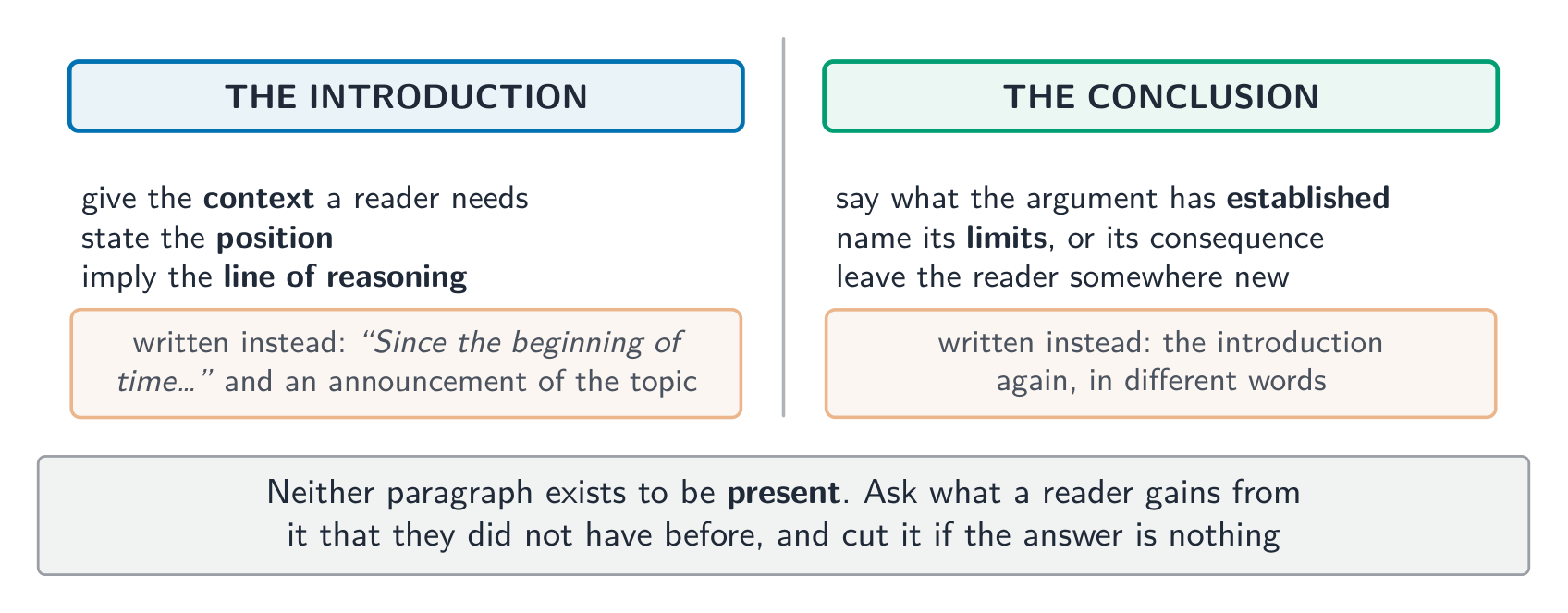
    ไม่มีย่อหน้าใดมีอยู่เพื่อมีอยู่ - ถามว่าผู้อ่านได้รับอะไรจากมัน
    Vocabulary · ⁨คำศัพท์⁩ Train · ⁨ฝึกฝน⁩
    English ไทย
    introduction/ˌɪntrəˈdʌkʃn/ การแนะนำ
    conclusion/kənˈkluːʒn/ ข้อสรุป
    4.2

    Writing Introductions and Conclusions · ⁨การเขียนบทนำและบทสรุป⁩

    Syllabus · ⁨หลักสูตร⁩
    English

    Enduring Understanding (RHS-1): Individuals write within a particular situation and make strategic writing choices based on that situation.

    Learning Objective 2.A: Writing – Write introductions and conclusions appropriate to the purpose and context of the rhetorical situation.

    • RHS-1.I The introduction of an argument introduces the subject and/ or writer of the argument to the audience. An introduction may present the argument’s thesis. An introduction may orient, engage, and/or focus the audience by presenting quotations, intriguing statements, anecdotes, questions, statistics, data, contextualized information, or a scenario.
    • RHS-1.J The conclusion of an argument brings the argument to a unified end. A conclusion may present the argument’s thesis. It may engage and/or focus the audience by explaining the significance of the argument within a broader context, making connections, calling the audience to act, suggesting a change in behavior or attitude, proposing a solution, leaving the audience with a compelling image, explaining implications, summarizing the argument, or connecting to the introduction.
    ไทย

    ความเข้าใจที่ยั่งยืน (RHS-1): บุคคลเขียนภายในสถานการณ์เฉพาะและเลือกการเขียนเชิงกลยุทธ์โดยอาศัยสถานการณ์นั้น

    วัตถุประสงค์การเรียนรู้ 2.A: การเขียน – เขียนส่วนนำและส่วนสรุปที่เหมาะสมกับวัตถุประสงค์และบริบทของสถานการณ์ทาง retorics

    • RHS-1.I ส่วนนำของข้อโต้แย้งจะแนะนำหัวข้อและ/หรือนักเขียนต่อผู้ฟัง ส่วนนำอาจนำเสนอ论点 (thesis) ของข้อโต้แย้ง ส่วนนำอาจช่วยกำหนดทิศทาง ดึงดูดความสนใจ และ/หรือโฟกัสผู้ฟังโดยการนำเสนอคำquoted, statements ที่น่าสงสัย, เรื่องสั้น, คำถาม, สถิติ, ข้อมูล, ข้อมูลที่มีบริบท, หรือสถานการณ์จำลอง
    • RHS-1.J ส่วนสรุปของข้อโต้แย้งจะนำข้อโต้แย้งไปสู่จุดสิ้นสุดอย่างเป็นหนึ่งเดียว ส่วนสรุปอาจนำเสนอ论点 (thesis) ของข้อโต้แย้ง อาจดึงดูดและ/หรือโฟกัสผู้ฟังโดยการอธิบายนัยสำคัญของข้อโต้แย้งในบริบทที่กว้างขึ้น, การเชื่อมโยง, การเรียกร้องให้ผู้กระทำกิจกรรม, การ sugerating การเปลี่ยนแปลงพฤติกรรมหรือทัศนคติ, การเสนอทางออก, การทิ้งภาพที่ทรงพลังไว้ในใจผู้ฟัง, การอธิบายผลกระทบ, การสรุปข้อโต้แย้ง, หรือการเชื่อมโยงกลับเข้าสู่ส่วนนำ

    Source: College Board AP Course and Exam Description · ⁨แหล่งที่มา: คำอธิบายหลักสูตรและข้อสอบ College Board AP⁩

    English

    On the exam, both are worth writing well but neither is worth writing long. A useful discipline:

    • An introduction that positions the subject and states a defensible thesis in two or three sentences is complete. Everything else in a timed essay is better spent on evidence and commentary.
    • A conclusion that says what follows from the argument - its significance, or its wider implication - does more than one that restates the paragraphs.

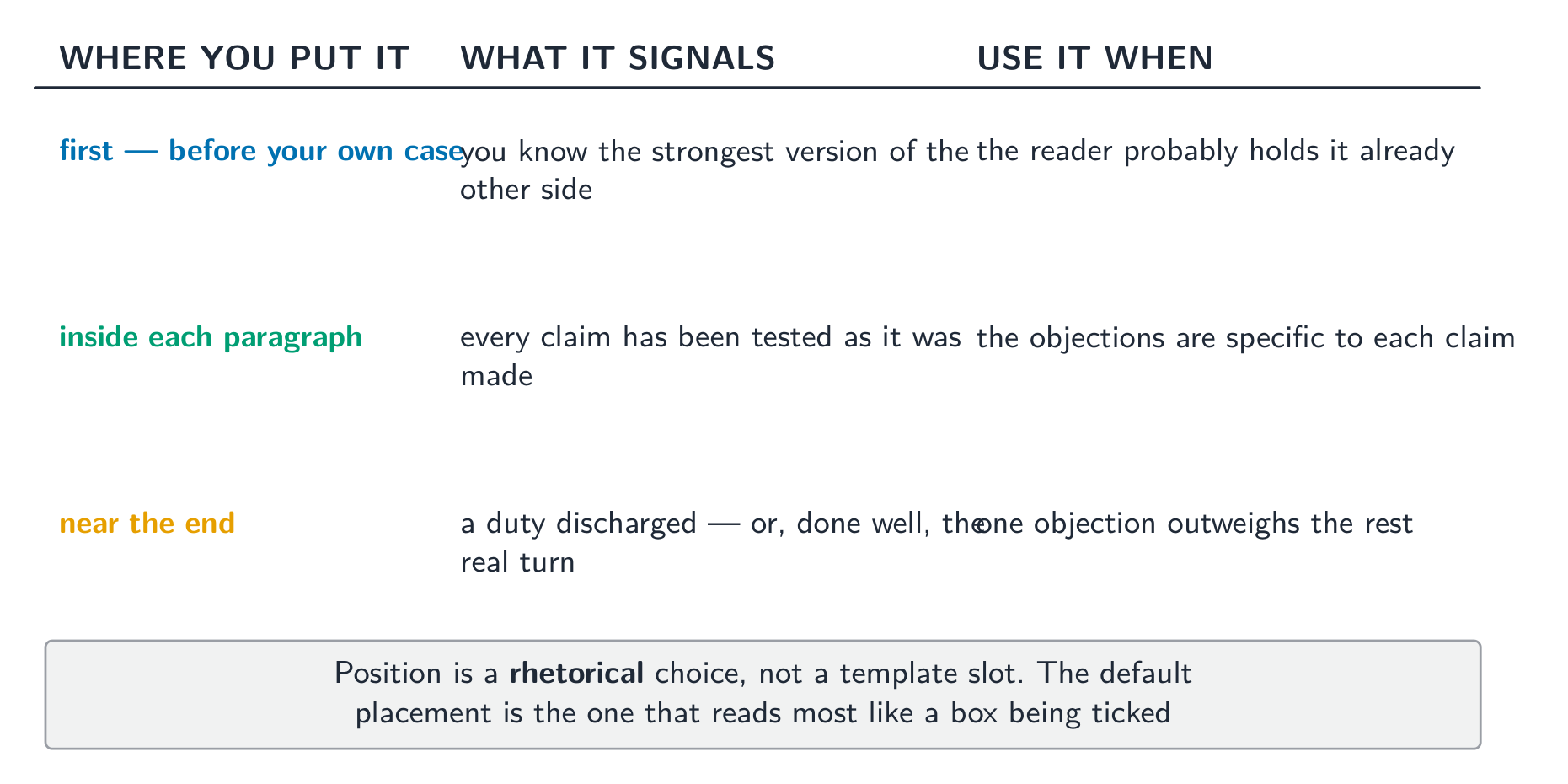
    The weakest conclusion is the one that re-lists what the essay already said. The reader has just read it. Say instead what it means, or what it obliges.

    ไทย

    ในการสอบ ทั้งสองมีค่าที่จะเขียนให้ดีแต่ไม่มีค่าที่จะเขียนยาววินัยที่มีประโยชน์:

    • บทนำที่ กำหนดตำแหน่งหัวข้อและ stating a defensible thesis ในสองหรือสามประโยคก็ครบถ้วน Everything else ใน timed essay ดีกว่าที่จะใช้เวลาไปกับevidenceและcommentary
    • บทสรุปที่ บอกว่าอะไรเกิดขึ้นจากข้อโต้แย้ง - ความสำคัญ, หรือimplicationที่กว้างขึ้น - ทำมากกว่าบทสรุปที่restateย่อหน้า

    บทสรุปที่อ่อน weakest คือone that re-listswhat essay说过แล้ว Reader刚读完它。Say instead what it means, or what it obliges.

    4.3

    Identifying the Overarching Thesis · ⁨การระบุข้อโต้แย้งหลัก⁩

    Syllabus · ⁨หลักสูตร⁩
    English

    Enduring Understanding (CLE-1): Writers make claims about subjects, rely on evidence that supports the reasoning that justifies the claim, and often acknowledge or respond to other, possibly opposing, arguments.

    Learning Objective 3.B: Reading – Identify and describe the overarching thesis of an argument, and any indication it provides of the argument’s structure.

    • CLE-1.O A thesis statement may preview the line of reasoning of an argument. This is not to say that a thesis statement must list the points of an argument, aspects to be analyzed, or specific evidence to be used in an argument.
    ไทย

    ความเข้าใจที่ยั่งยืน (CLE-1): นักเขียนทำข้ออ้างเกี่ยวกับหัวข้อ อิงกับหลักฐานที่สนับสนุนเหตุผลที่ใช้เพื่อพิสูจน์ข้ออ้าง tersebut และมักยอมรับหรือตอบโต้ข้อโต้แย้งอื่น ๆ ซึ่งอาจเป็นฝ่ายตรงข้าม

    เป้าหมายการเรียนรู้ 3.B: การอ่าน – ระบุและอธิบาย论点หลักของข้อโต้แย้ง และบ่งชี้โครงสร้างของข้อโต้แย้งใดๆ ที่论点หลักนั้นให้ไว้

    • CLE-1.O ประโยค论点 อาจทบทวนล่วงหน้าถึงเส้นทางการคิดของข้อโต้แย้ง สิ่งนี้ไม่ได้หมายความว่าประโยค论点 ต้องระบุรายการจุดของข้อโต้แย้ง, ด้านที่จะวิเคราะห์, หรือหลักฐานเฉพาะที่จะใช้ในข้อโต้แย้ง

    Source: College Board AP Course and Exam Description · ⁨แหล่งที่มา: คำอธิบายหลักสูตรและข้อสอบ College Board AP⁩

    English

    The CED adds a precise refinement here: a thesis statement may preview the line of reasoning of an argument - and then, immediately, this is not to say that a thesis statement must list the reasons.

    That double statement is worth holding, because both errors are common. A thesis that previews nothing leaves the essay shapeless. A thesis mechanically listing three reasons is not required and often produces a rigid essay that cannot develop.

    ไทย

    CEDเพิ่ม refinement ที่แม่นยำที่นี่: a thesis statement อาจ previewเส้นทางการให้เหตุผลของข้อโต้แย้ง - และจากนั้น, ทันที, นี่ไม่ใช่ meant to say ว่าa thesis statement ต้อง listingเหตุผล。

    That double statement worth holding, เพราะ both errors are common. A thesis that previews nothing leaves the essay shapeless. A thesis mechanically listing three reasons is not required and often produces a rigid essay that cannot develop.

    4.4

    Writing a Thesis Statement · ⁨การเขียนประโยคข้อโต้แย้ง⁩

    Syllabus · ⁨หลักสูตร⁩
    English

    Enduring Understanding (CLE-1): Writers make claims about subjects, rely on evidence that supports the reasoning that justifies the claim, and often acknowledge or respond to other, possibly opposing, arguments.

    Learning Objective 4.B: Writing – Write a thesis statement that requires proof or defense and that may preview the structure of the argument.

    • CLE-1.O A thesis statement may preview the line of reasoning of an argument. This is not to say that a thesis statement must list the points of an argument, aspects to be analyzed, or specific evidence to be used in an argument.
    ไทย

    ความเข้าใจที่ยั่งยืน (CLE-1): นักเขียนทำข้ออ้างเกี่ยวกับหัวข้อ อิงกับหลักฐานที่สนับสนุนเหตุผลที่ใช้เพื่อพิสูจน์ข้ออ้าง tersebut และมักยอมรับหรือตอบโต้ข้อโต้แย้งอื่น ๆ ซึ่งอาจเป็นฝ่ายตรงข้าม

    เป้าหมายการเรียนรู้ 4.B: การเขียน – เขียน论点 statement ที่ต้องการการพิสูจน์หรือปกป้อง และอาจแนะนำโครงสร้างของข้อโต้แย้ง

    • CLE-1.O ประโยค论点 อาจทบทวนล่วงหน้าถึงเส้นทางการคิดของข้อโต้แย้ง สิ่งนี้ไม่ได้หมายความว่าประโยค论点 ต้องระบุรายการจุดของข้อโต้แย้ง, ด้านที่จะวิเคราะห์, หรือหลักฐานเฉพาะที่จะใช้ในข้อโต้แย้ง

    Source: College Board AP Course and Exam Description · ⁨แหล่งที่มา: คำอธิบายหลักสูตรและข้อสอบ College Board AP⁩

    English

    For your own writing, the practical version:

    • The thesis must be defensible. Non-negotiable, and it is the whole of the thesis point.
    • It may indicate the shape of the reasoning. Do it when the shape is genuinely load-bearing; do not do it as a formula.
    • It should be specific enough to constrain what follows. A thesis so broad that any paragraph could belong under it is not directing the essay.
    ไทย

    สำหรับงานเขียนของคุณเอง, practical version:

    • Thesis must be defensible. Non-negotiable, และ它是整个thesis point。
    • It may indicate the shape of the reasoning. Do it when the shape is genuinely load-bearing; do not do it as a formula.
    • It should be specific enough to constrain what follows. A thesis so broad that any paragraph could belong under it is not directing the essay.
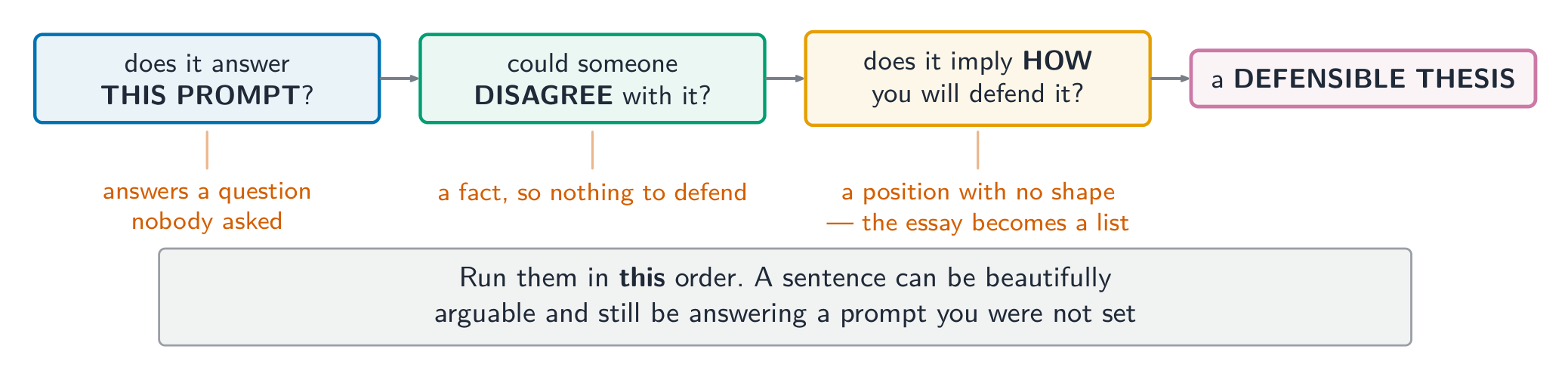
    สามคำถาม, run in this order, ก่อนที่essay will被write
    Explore · ⁨สำรวจ⁩

    Run the three thesis gates in order · ⁨ใช้ประตูตรวจสอบข้อสรุปทั้งสามตามลำดับ⁩

    A sentence can be beautifully arguable and still answer a prompt you were not set — which is why the order matters. · ⁨ประโยคหนึ่งอาจมีความน่า tranh cãi สวยงาม แต่ยังตอบคำถามที่คุณไม่ได้ได้รับมอบหมาย — นั่นคือเหตุผลว่าทำไมลำดับถึงสำคัญ⁩

    4.5

    Recognizing Methods of Development · ⁨การระบุวิธีการพัฒนาเนื้อหา⁩

    Syllabus · ⁨หลักสูตร⁩
    English

    Enduring Understanding (REO-1): Writers guide understanding of a text’s lines of reasoning and claims through that text’s organization and integration of evidence.

    Learning Objective 5.C: Reading – Recognize and explain the use of methods of development to accomplish a purpose.

    • REO-1.G Methods of development are common approaches writers frequently use to develop and organize the reasoning of their arguments. A method of development provides an audience with the means to trace a writer’s reasoning in an argument.
    • REO-1.K When developing ideas through comparison-contrast, writers present a category of comparison and then examine the similarities and/or differences between the objects of the comparison. When analyzing similarities and/or differences, like categories of comparison must be used.
    • REO-1.L When developing ideas through a definition or description, writers relate the characteristics, features, or sensory details of an object or idea, sometimes using examples or illustrations.
    ไทย

    ความเข้าใจที่ยั่งยืน (REO-1): นักเขียนนำความเข้าใจในเส้นทางการคิดและข้ออ้างของข้อความผ่านการจัดระเบียบและการบูรณาการหลักฐานของข้อความนั้น

    วัตถุประสงค์การเรียนรู้ 5.C: การอ่าน – จดจำและอธิบายการใช้วิธีการพัฒนาเนื้อหาเพื่อบรรลุวัตถุประสงค์

    • REO-1.G วิธีการพัฒนาเนื้อหาคือแนวทางทั่วไปที่นักเขียนมักใช้เพื่อพัฒนาและจัดระเบียบการคิดในข้อโต้แย้ง วิธีการพัฒนาเนื้อหาให้ผู้ฟังมีเครื่องมือในการติดตามเส้นทางการคิดของนักเขียนในข้อโต้แย้ง
    • REO-1.K เมื่อพัฒนาความคิดผ่านการเปรียบเทียบ-ความแตกต่าง นักเขียนจะนำเสนอหมวดหมู่ของการเปรียบเทียบ จากนั้นตรวจสอบความคล้ายคลึงและ/หรือความแตกต่างระหว่างวัตถุของการเปรียบเทียบ ในการวิเคราะห์ความคล้ายคลึงและ/หรือความแตกต่าง ต้องใช้หมวดหมู่การเปรียบเทียบแบบเดียวกัน
    • REO-1.L เมื่อพัฒนาความคิดผ่านการนิยามศัพท์หรือการบรรยาย นักเขียนจะเชื่อมโยงลักษณะคุณสมบัติ, คุณสมบัติ, หรือรายละเอียดทางประสาทสัมผัสของวัตถุหรือแนวคิด โดยบางครั้งใช้ตัวอย่างหรือภาพประกอบ

    Source: College Board AP Course and Exam Description · ⁨แหล่งที่มา: คำอธิบายหลักสูตรและข้อสอบ College Board AP⁩

    English

    Unit 3 covered narration and cause-effect. Unit 4 adds the rest:

    • Developing through comparison-contrast 比较对照: writers present a category of comparison and then examine similarities and differences within it. The category is the part students omit - a comparison without a stated basis is two descriptions side by side.
    • Developing through definition or description 定义与描写: writers relate the characteristics, features, or sensory details of a subject.

    Definition is more powerful than it looks. An argument that turns on what a word means - what counts as success, as fairness, as progress - is an argument that has moved to the ground where it can actually be won.

    ไทย
    ห้าmethods, with the job each one is right for
    เลือกmethodที่reasoning需要, ไม่ใช่one that topic suggests

    Unit 3 covering narration and cause-effect. Unit 4 adding the rest:

    • Development through comparison-contrast (比较对照): writers present a category of comparison และthen examine similarities and differences within it. The category是students omit的部分 - a comparison without a stated basis是two descriptions side by side。
    • การพัฒนาโดย นิยามหรือคำอธิบาย นิยามและคำอธิบาย: นักเขียนเชื่อมโยง ลักษณะคุณสมบัติ, จุดเด่น หรือรายละเอียดทางประสาทสัมผัส ของหัวข้อที่กล่าวถึง

    นิยามมีพลังมากกว่าที่เห็น Argument ที่ขึ้นอยู่กับความหมายของคำ - ว่าสิ่งใดนับเป็น ความสำเร็จ, ความยุติธรรม, ความก้าวหน้า - คือข้อโต้แย้งที่เคลื่อนย้ายไปยังพื้นที่ที่แท้จริงซึ่งสามารถชนะได้

    Vocabulary · ⁨คำศัพท์⁩ Train · ⁨ฝึกฝน⁩
    English ไทย
    comparison-contrast/kəmˈpærɪsn ˈkɒntræst/ การเปรียบเทียบ-ความแตกต่าง
    definition or description/ˌdefɪˈnɪʃn ɔː dɪˈskrɪpʃn/ นิยามหรือคำอธิบาย
    4.6

    Using Methods of Development · ⁨การใช้วิธีการพัฒนาเนื้อหา⁩

    Syllabus · ⁨หลักสูตร⁩
    English

    Enduring Understanding (REO-1): Writers guide understanding of a text’s lines of reasoning and claims through that text’s organization and integration of evidence.

    Learning Objective 6.C: Writing – Use appropriate methods of development to advance an argument.

    • REO-1.G Methods of development are common approaches writers frequently use to develop and organize the reasoning of their arguments. A method of development provides an audience with the means to trace a writer’s reasoning in an argument.
    • REO-1.K When developing ideas through comparison-contrast, writers present a category of comparison and then examine the similarities and/or differences between the objects of the comparison. When analyzing similarities and/or differences, like categories of comparison must be used.
    • REO-1.L When developing ideas through a definition or description, writers relate the characteristics, features, or sensory details of an object or idea, sometimes using examples or illustrations.
    ไทย

    ความเข้าใจที่ยั่งยืน (REO-1): นักเขียนนำความเข้าใจในเส้นทางการคิดและข้ออ้างของข้อความผ่านการจัดระเบียบและการบูรณาการหลักฐานของข้อความนั้น

    วัตถุประสงค์การเรียนรู้ 6.C: การเขียน – ใช้วิธีการพัฒนาเนื้อหาที่เหมาะสมเพื่อยกระดับข้อโต้แย้ง

    • REO-1.G วิธีการพัฒนาเนื้อหาคือแนวทางทั่วไปที่นักเขียนมักใช้เพื่อพัฒนาและจัดระเบียบการคิดในข้อโต้แย้ง วิธีการพัฒนาเนื้อหาให้ผู้ฟังมีเครื่องมือในการติดตามเส้นทางการคิดของนักเขียนในข้อโต้แย้ง
    • REO-1.K เมื่อพัฒนาความคิดผ่านการเปรียบเทียบ-ความแตกต่าง นักเขียนจะนำเสนอหมวดหมู่ของการเปรียบเทียบ จากนั้นตรวจสอบความคล้ายคลึงและ/หรือความแตกต่างระหว่างวัตถุของการเปรียบเทียบ ในการวิเคราะห์ความคล้ายคลึงและ/หรือความแตกต่าง ต้องใช้หมวดหมู่การเปรียบเทียบแบบเดียวกัน
    • REO-1.L เมื่อพัฒนาความคิดผ่านการนิยามศัพท์หรือการบรรยาย นักเขียนจะเชื่อมโยงลักษณะคุณสมบัติ, คุณสมบัติ, หรือรายละเอียดทางประสาทสัมผัสของวัตถุหรือแนวคิด โดยบางครั้งใช้ตัวอย่างหรือภาพประกอบ

    Source: College Board AP Course and Exam Description · ⁨แหล่งที่มา: คำอธิบายหลักสูตรและข้อสอบ College Board AP⁩

    English

    The choice is rhetorical. Ask what the audience needs before they will accept your claim:

    • They need to see it, and abstraction is the obstacle: description.
    • They accept the facts but not the connection: cause-effect.
    • They are applying the wrong standard: definition.
    • They will judge better against something familiar: comparison-contrast.
    • They need to feel the situation: narration.

    Worked example (a real AP exam task). A Question 3 argument prompt asks you to take a position on whether a common practice is beneficial. A student who reaches for description writes a vivid paragraph nobody disputes. A student who reaches for definition writes: "Whether the practice is beneficial depends on what we count as benefit. If benefit means measurable short-term gain, the practice succeeds; if it means durable capability, the same evidence shows it failing." That paragraph has relocated the argument onto ground where the evidence actually decides something - which is the kind of move the sophistication point exists to reward.

    ไทย

    การเลือกนี้มีความสำคัญด้าน retorics. ถามว่าผู้ฟังต้องการอะไรก่อนจึงจะยอมรับข้ออ้างของคุณ:

    • พวกเขาต้อง เห็น มัน, และความนามธรรมคืออุปสรรค: คำอธิบาย.
    • พวกเขายอมรับข้อเท็จจริงแต่ไม่ยอมรับความเชื่อมโยง: เหตุ-ผล.
    • พวกเขาใช้มาตรฐานที่ไม่ถูกต้อง: นิยาม.
    • พวกเขาจะตัดสินได้ดีกว่าเมื่อเทียบกับสิ่งที่คุ้นเคย: การเปรียบเทียบ-ความแตกต่าง.
    • พวกเขาต้องการรู้สึกกับสถานการณ์: การเล่าเรื่อง.

    ตัวอย่างวิธีทำ (โจทย์สอบ AP จริง). ข้อคำถามที่ 3 แบบ argument prompt ให้คุณแสดงมุมมองว่าปฏิบัติการณ์ทั่วไปนั้นเป็นประโยชน์หรือไม่ นักเรียนwhoหยิบมาเพื่อทำคำอธิบายเขียนย่อหน้าที่สดใสไม่มีใครโต้แย้ง นักเรียนwhoหยิบมาเพื่อ นิยาม เขียนว่า: “ว่าปฏิบัติการณ์นั้นเป็นประโยชน์ขึ้นอยู่กับว่าเรา算什么ว่าประโยชน์ หากประโยชน์หมายถึงผลกำไรระยะสั้นที่วัดได้ ปฏิบัติการณ์นี้สำเร็จ; แต่หากหมายถึงความสามารถที่ยั่งยืน หลักฐานเดียวกันก็ชี้ให้เห็นว่ามันล้มเหลว” ย่อหน้าดังกล่าวได้ย้าย论点 onto พื้นที่ที่หลักฐานสามารถตัดสินใจได้จริง - ซึ่งเป็นการเคลื่อนไหวแบบ that the sophistication point มีไว้ให้รางวัล

    อ่านคอลัมน์กลางก่อน: วิธีการเกิดจากสิ่งที่ย่อหน้าต้องพิสูจน์
    Explore · ⁨สำรวจ⁩

    Choose the method from the job · ⁨เลือกวิธีจากงานที่ต้องทำ⁩

    The method follows from what the paragraph has to prove, not from the order things happened in. · ⁨วิธีเกิดจากสิ่งที่ย่อหน้าต้องพิสูจน์ ไม่ใช่ลำดับเหตุการณ์ที่เกิดขึ้น⁩

    4.6

    Exam tips · ⁨ข้อแนะนำสำหรับการสอบ⁩

    English
    • Introductions should be short and load-bearing: position the subject, state a defensible thesis, move on.
    • A conclusion that restates earns least. Say what the argument means or obliges.
    • A thesis may preview the reasoning; it is not required to list reasons. Both errors are common.
    • Comparison needs a stated category. Without one you have written two descriptions, not a comparison.
    • Definition is the strongest move available in an argument essay whose terms are contestable.
    • Pick a method of development from what the audience needs, not from what the topic suggests.
    ไทย
    • บทนำควร สั้นและรองรับน้ำหนัก: วางตำแหน่งหัวข้อ, บอกรายละเอียด thesis ที่ป้องกันได้, แล้วไปต่อ
    • บทสรุปที่ ทบทวนใหม่ ได้คะแนนน้อยที่สุด บอกว่า论点meanอะไรหรือบังคับอะไร
    • Thesis อาจ ทบทวนเหตุผล; ไม่จำเป็น ต้องระบุเหตุผล ทั้งสองข้อผิดพลาดนี้พบบ่อย
    • การเปรียบเทียบจำเป็นต้องมีหมวดหมู่ที่ระบุไว้. โดยไม่มีมัน คุณเขียนแค่คำอธิบายสองชิ้น ไม่ใช่การเปรียบเทียบ
    • นิยาม คือการเคลื่อนไหวที่ทรงพลังที่สุดในessay argument whose terms are contestable
    • เลือกวิธีการพัฒนาจาก สิ่งที่ผู้ฟังต้องการ, ไม่ใช่จากสิ่งที่หัวข้อแนะนำ
  • 5

    Organization, Coherence, and Style · ⁨การจัดระเบียบ ความสอดคล้องกัน และสไตล์⁩

    Watch lesson · ⁨ดูบทเรียน⁩
    5.1

    Describing the Line of Reasoning · ⁨การอธิบายเส้นทางการคิด⁩

    Syllabus · ⁨หลักสูตร⁩
    English

    Enduring Understanding (REO-1): Writers guide understanding of a text’s lines of reasoning and claims through that text’s organization and integration of evidence.

    Learning Objective 5.A: Reading – Describe the line of reasoning and explain whether it supports an argument’s overarching thesis.

    • REO-1.M The body paragraphs of a written argument make claims, support them with evidence, and provide commentary that explains how the paragraph contributes to the reasoning of the argument.
    ไทย

    ความเข้าใจที่ยั่งยืน (REO-1): นักเขียนนำความเข้าใจในเส้นทางการคิดและข้ออ้างของข้อความผ่านการจัดระเบียบและการบูรณาการหลักฐานของข้อความนั้น

    เป้าหมายการเรียนรู้ 5.A: การอ่าน – อธิบายเส้นทางการคิดและอธิบายว่ามันสนับสนุน论点หลักของข้อโต้แย้งหรือไม่

    • REO-1.M ย่อหน้าเนื้อหาหลักของข้อโต้แย้งที่เขียนขึ้นจะ提出了 claims, รองรับ them ด้วย evidence, และให้ commentary ที่อธิบายว่าย่อหน้านั้นมีส่วนร่วมอย่างไรต่อการคิดของข้อโต้แย้ง

    Source: College Board AP Course and Exam Description · ⁨แหล่งที่มา: คำอธิบายหลักสูตรและข้อสอบ College Board AP⁩

    English

    Unit 5 turns from what an argument contains to how it holds together. It has two subjects: coherence 连贯 and the beginnings of style 文体.

    The CED's statement of the body paragraph is exact and worth memorising: the body paragraphs of a written argument make claims, support them with evidence, and provide commentary that explains the relationship of the evidence to the claim.

    Three parts, in that order, in every body paragraph. When an AP essay loses evidence-and-commentary points, it is almost always because the third part is missing from paragraphs that have the first two.

    ไทย

    Unit 5 เปลี่ยนจาก what一个argument.has إلى how it holds together.它有 two subjects: coherence 连贯 and the beginnings of style 文体.

    The CED's statement of the body paragraph is exact and worth memorising: the body paragraphs of a written argument make claims, support them with evidence, and provide commentary that explains the relationship of the evidence to the claim.

    Three parts, in that order, in every body paragraph. When an AP essay loses evidence-and-commentary points, it is almost always because the third part is missing from paragraphs that have the first two.

    Vocabulary · ⁨คำศัพท์⁩ Train · ⁨ฝึกฝน⁩
    English ไทย
    coherence/kəʊˈhɪərəns/ coherence
    style/staɪl/ style
    5.2

    Developing a Line of Reasoning and Commentary · ⁨การพัฒนาเส้นทางการคิดและคำอธิบายประกอบ⁩

    Syllabus · ⁨หลักสูตร⁩
    English

    Enduring Understanding (REO-1): Writers guide understanding of a text’s lines of reasoning and claims through that text’s organization and integration of evidence.

    Learning Objective 6.A: Writing – Develop a line of reasoning and commentary that explains it throughout an argument.

    • REO-1.M The body paragraphs of a written argument make claims, support them with evidence, and provide commentary that explains how the paragraph contributes to the reasoning of the argument.
    ไทย

    ความเข้าใจที่ยั่งยืน (REO-1): นักเขียนนำความเข้าใจในเส้นทางการคิดและข้ออ้างของข้อความผ่านการจัดระเบียบและการบูรณาการหลักฐานของข้อความนั้น

    วัตถุประสงค์การเรียนรู้ 6.A: การเขียน – พัฒนาเส้นทางการคิดและการวิเคราะห์แสดงความคิดเห็นที่อธิบายตลอดทั้งข้อโต้แย้ง

    • REO-1.M ย่อหน้าเนื้อหาหลักของข้อโต้แย้งที่เขียนขึ้นจะ提出了 claims, รองรับ them ด้วย evidence, และให้ commentary ที่อธิบายว่าย่อหน้านั้นมีส่วนร่วมอย่างไรต่อการคิดของข้อโต้แย้ง

    Source: College Board AP Course and Exam Description · ⁨แหล่งที่มา: คำอธิบายหลักสูตรและข้อสอบ College Board AP⁩

    Applied to your own writing: draft the claims first, as a list, before writing any paragraph. You then have the line of reasoning in front of you and can check that it moves.

    Then, for each claim, write the paragraph in its three parts deliberately. A useful habit under exam conditions is to make the commentary sentence begin with a word that forces a relationship - because, which means, so, the effect of this is - because those words cannot be followed by a restatement.

    5.3

    Organization, Unity, and Coherence

    Syllabus · ⁨หลักสูตร⁩
    English

    Enduring Understanding (REO-1): Writers guide understanding of a text’s lines of reasoning and claims through that text’s organization and integration of evidence.

    Learning Objective 5.B: Reading – Explain how the organization of a text creates unity and coherence and reflects a line of reasoning.

    • REO-1.N Coherence occurs at different levels in a piece of writing. In a sentence, the idea in one clause logically links to an idea in the next. In a paragraph, the idea in one sentence logically links to an idea in the next. In a text, the ideas in one paragraph logically link to the ideas in the next.
    • REO-1.O Repetition, synonyms, pronoun references, and parallel structure may indicate or develop a relationship between elements of a text.
    • REO-1.P Transitional elements are words or other elements (phrases, clauses, sentences, or paragraphs) that assist in creating coherence among sentences, paragraphs, or sections in a text by showing relationships among ideas.
    • REO-1.Q Transitional elements can be used to introduce evidence or to indicate its relationship to other ideas or evidence in that paragraph or in the text as a whole.
    ไทย

    ความเข้าใจที่ยั่งยืน (REO-1): นักเขียนนำความเข้าใจในเส้นทางการคิดและข้ออ้างของข้อความผ่านการจัดระเบียบและการบูรณาการหลักฐานของข้อความนั้น

    วัตถุประสงค์การเรียนรู้ 5.B: การอ่าน – อธิบายว่าการจัดเรียงของข้อความสร้างความเป็นเอกภาพและความต่อเนื่องอย่างไรและสะท้อนเส้นทางการคิด

    • REO-1.N ความต่อเนื่องเกิดขึ้นในระดับต่างๆ ในงานเขียน ในระดับประโยค, ความคิดใน clause หนึ่งเชื่อมโยงกันอย่างมีเหตุผลกับความคิดในอีก clause หนึ่ง ในระดับย่อหน้า, ความคิดในประโยคหนึ่งเชื่อมโยงกันอย่างมีเหตุผลกับความคิดในอีกประโยคหนึ่ง ในระดับข้อความ, ความคิดในย่อหน้าหนึ่งเชื่อมโยงกันอย่างมีเหตุผลกับความคิดในย่อหน้าถัดไป
    • REO-1.O การซ้ำ, คำPLATFORM, การอ้างอิง代词, และโครงสร้างขนานกัน อาจบ่งชี้หรือพัฒนาความสัมพันธ์ระหว่างองค์ประกอบของข้อความ
    • REO-1.P องค์ประกอบเชื่อม (Transitional elements) คือคำหรือองค์ประกอบอื่นๆ (phrases, clauses, sentences, หรือ paragraphs) ที่ช่วยสร้างความต่อเนื่องระหว่างประโยค, ย่อหน้า, หรือส่วนต่างๆ ของข้อความโดยแสดงความสัมพันธ์ระหว่างความคิด
    • REO-1.Q องค์ประกอบเชื่อมสามารถใช้เพื่อแนะนำ evidence หรือเพื่อแสดงความสัมพันธ์其与 ideas อื่นๆ หรือ evidence นั้นในย่อหน้าหรือข้อความโดยรวม

    Source: College Board AP Course and Exam Description · ⁨แหล่งที่มา: คำอธิบายหลักสูตรและข้อสอบ College Board AP⁩

    Coherence is built at three levels, and by five named devices
    The devices are examinable by name - and they are what a "structure" question is actually asking about

    Coherence occurs at different levels in a piece of writing:

    • In a sentence, the idea in one clause logically links to the idea in another.
    • In a paragraph, each sentence builds on the one before it.
    • Across the whole text, each paragraph relates to the line of reasoning.

    The CED then names the devices that create those links:

    • Repetition 重复, synonyms 同义词, pronoun references 代词指代, and parallel structure 平行结构 may indicate or develop a relationship between ideas.
    • Transitional elements 过渡成分 are words or other elements - phrases, clauses, sentences, or whole paragraphs - that assist in creating coherence.
    The unity test: draw a line from each sentence back to the claim
    Vocabulary · ⁨คำศัพท์⁩ Train · ⁨ฝึกฝน⁩
    English ไทย
    Repetition/ˌrepəˈtɪʃn/ การซ้ำ
    synonyms/ˈsɪnənɪmz/ คำพ้องความหมาย
    pronoun references/ˈprəʊnaʊn ˈrefrənsɪz/ คำสรรพนามอ้างอิง
    parallel structure/ˈpærəlel ˈstrʌktʃə/ โครงสร้างขนาน
    Transitional elements/trænˈsɪʃənl ˈelɪmənts/ องค์ประกอบเชื่อมต่อ
    5.4

    Using Transitional Elements

    Syllabus · ⁨หลักสูตร⁩
    English

    Enduring Understanding (REO-1): Writers guide understanding of a text’s lines of reasoning and claims through that text’s organization and integration of evidence.

    Learning Objective 6.B: Writing – Use transitional elements to guide the reader through the line of reasoning of an argument.

    • REO-1.N Coherence occurs at different levels in a piece of writing. In a sentence, the idea in one clause logically links to an idea in the next. In a paragraph, the idea in one sentence logically links to an idea in the next. In a text, the ideas in one paragraph logically link to the ideas in the next.
    • REO-1.O Repetition, synonyms, pronoun references, and parallel structure may indicate or develop a relationship between elements of a text.
    • REO-1.P Transitional elements are words or other elements (phrases, clauses, sentences, or paragraphs) that assist in creating coherence among sentences, paragraphs, or sections in a text by showing relationships among ideas.
    • REO-1.Q Transitional elements can be used to introduce evidence or to indicate its relationship to other ideas or evidence in that paragraph or in the text as a whole.
    ไทย

    ความเข้าใจที่ยั่งยืน (REO-1): นักเขียนนำความเข้าใจในเส้นทางการคิดและข้ออ้างของข้อความผ่านการจัดระเบียบและการบูรณาการหลักฐานของข้อความนั้น

    วัตถุประสงค์การเรียนรู้ 6.B: การเขียน – ใช้องค์ประกอบเชื่อมเพื่อแนะนำผู้อ่านผ่านเส้นทางการคิดของข้อโต้แย้ง

    • REO-1.N ความต่อเนื่องเกิดขึ้นในระดับต่างๆ ในงานเขียน ในระดับประโยค, ความคิดใน clause หนึ่งเชื่อมโยงกันอย่างมีเหตุผลกับความคิดในอีก clause หนึ่ง ในระดับย่อหน้า, ความคิดในประโยคหนึ่งเชื่อมโยงกันอย่างมีเหตุผลกับความคิดในอีกประโยคหนึ่ง ในระดับข้อความ, ความคิดในย่อหน้าหนึ่งเชื่อมโยงกันอย่างมีเหตุผลกับความคิดในย่อหน้าถัดไป
    • REO-1.O การซ้ำ, คำPLATFORM, การอ้างอิง代词, และโครงสร้างขนานกัน อาจบ่งชี้หรือพัฒนาความสัมพันธ์ระหว่างองค์ประกอบของข้อความ
    • REO-1.P องค์ประกอบเชื่อม (Transitional elements) คือคำหรือองค์ประกอบอื่นๆ (phrases, clauses, sentences, หรือ paragraphs) ที่ช่วยสร้างความต่อเนื่องระหว่างประโยค, ย่อหน้า, หรือส่วนต่างๆ ของข้อความโดยแสดงความสัมพันธ์ระหว่างความคิด
    • REO-1.Q องค์ประกอบเชื่อมสามารถใช้เพื่อแนะนำ evidence หรือเพื่อแสดงความสัมพันธ์其与 ideas อื่นๆ หรือ evidence นั้นในย่อหน้าหรือข้อความโดยรวม

    Source: College Board AP Course and Exam Description · ⁨แหล่งที่มา: คำอธิบายหลักสูตรและข้อสอบ College Board AP⁩

    Transitions have a second job the CED names explicitly: they introduce evidence or indicate its relationship to other ideas or evidence.

    That is the difference between decorative and functional transitions. Furthermore adds nothing - it says only "here is another sentence". Even in the cases where the effect is smallest tells the reader what relationship is coming. Choose transitions that carry information about the relationship, not ones that merely mark a boundary.

    Note also that a transitional element may be a whole paragraph. In a long argument, a short paragraph whose only job is to turn the reasoning is legitimate and often elegant.

    A transition is a promise about the next sentence - breaking it is a reasoning error
    Explore · ⁨สำรวจ⁩

    Match each transition to the promise it makes · ⁨จับคู่คำเชื่อมแต่ละตัวกับสัญญาที่มันมอบหมาย⁩

    A transition is a claim about how two ideas stand to each other. Breaking that promise is a reasoning error, not a style problem. · ⁨คำเชื่อมคือการอ้างถึงความสัมพันธ์ระหว่างสองความคิด การละเมิดสัญญานี้คือความผิดพลาดทางเหตุผล ไม่ใช่ปัญหาเรื่องสไตล์⁩

    5.5

    Word Choice, Comparisons, and Syntax

    Syllabus · ⁨หลักสูตร⁩
    English

    Enduring Understanding (STL-1): The rhetorical situation informs the strategic stylistic choices that writers make.

    Learning Objective 7.A: Reading – Explain how word choice, comparisons, and syntax contribute to the specific tone or style of a text.

    • STL-1.A Words have both connotative and denotative meanings.
    • STL-1.B Descriptive words, such as adjectives and adverbs, not only qualify or modify the things they describe but also convey a perspective toward those things.
    • STL-1.C Precise word choice reduces confusion and may help the audience perceive the writer’s perspective.
    ไทย

    ความเข้าใจที่ยั่งยืน (STL-1): สถานการณ์ทาง retorics informing การเลือก stylistic แบบกลยุทธ์ที่นักเขียนทำ

    วัตถุประสงค์การเรียนรู้ 7.A: การอ่าน – อธิบายว่าการเลือกคำ, การเปรียบเทียบ, และไวยากรณ์มีผลต่อ tone หรือ style เฉพาะของข้อความอย่างไร

    • STL-1.A คำมีทั้งความหมายเชิงนัย (connotative) และความหมายตรงตัว (denotative)
    • STL-1.B คำบรรยาย เช่น adjectives และ adverbs ไม่ได้เพียงแต่ qualify หรือ modify things ที่ they describe เท่านั้น แต่ยัง convey perspective ต่อสิ่งเหล่านั้นด้วย
    • STL-1.C การเลือกคำที่แม่นยำลดความสับสนและอาจช่วยให้ผู้ฟังรับรู้ perspective ของนักเขียน

    Source: College Board AP Course and Exam Description · ⁨แหล่งที่มา: คำอธิบายหลักสูตรและข้อสอบ College Board AP⁩

    English

    Unit 5 opens the course's treatment of style with three claims about diction:

    • Words have both connotative and denotative meanings 内涵义与外延义. Denotation is what a word refers to; connotation is what it carries.
    • Descriptive words - adjectives and adverbs - not only qualify or modify what they describe but convey a perspective toward it.
    • Precise word choice reduces confusion and helps the audience perceive the writer's perspective.

    The second is the analytically useful one. When a rhetorical-analysis passage calls a policy ambitious rather than expensive, no fact has changed and the reader's disposition has. That is a rhetorical choice, and it is exactly what the question asks you to explain.

    ไทย

    Unit 5 opens the course's treatment of style with three claims about diction:

    • Words have both connotative and denotative meanings 内涵义与外延义. Denotation is what a word refers to; connotation is what it carries.
    • Descriptive words - adjectives and adverbs - not only qualify or modify what they describe but convey a perspective toward it.
    • Precise word choice reduces confusion and helps the audience perceive the writer's perspective.

    ข้อที่สองนี้มีความเป็นประโยชน์ต่อการวิเคราะห์ เมื่อการเขียนเชิงวิพากษ์วิจารณ์ระบุถึงนโยบายหนึ่งว่าเป็น * ambitious* แทนที่จะ说是 expensive ความจริงไม่ได้เปลี่ยนไป แต่ทัศนคติของผู้อ่านก็เปลี่ยนตาม นั่นคือการเลือกทางวาทศิลป์ และนี่คือสิ่งที่คำถามต้องการให้คุณอธิบาย

    Vocabulary · ⁨คำศัพท์⁩ Train · ⁨ฝึกฝน⁩
    English ไทย
    connotative and denotative meanings/kɒnəˈtætɪv ænd dɪˈnəʊtətɪv ˈmiːnɪŋz/ ความหมายเชิงนัยและนัยแท้
    5.6

    Using Words and Syntax for Tone and Style · ⁨การใช้คำและไวยากรณ์เพื่อสร้างอารมณ์และสไตล์⁩

    Syllabus · ⁨หลักสูตร⁩
    English

    Enduring Understanding (STL-1): The rhetorical situation informs the strategic stylistic choices that writers make.

    Learning Objective 8.A: Writing – Strategically use words, comparisons, and syntax to convey a specific tone or style in an argument.

    • STL-1.A Words have both connotative and denotative meanings.
    • STL-1.B Descriptive words, such as adjectives and adverbs, not only qualify or modify the things they describe but also convey a perspective toward those things.
    • STL-1.C Precise word choice reduces confusion and may help the audience perceive the writer’s perspective.
    ไทย

    ความเข้าใจที่ยั่งยืน (STL-1): สถานการณ์ทาง retorics informing การเลือก stylistic แบบกลยุทธ์ที่นักเขียนทำ

    จุดประสงค์การเรียนรู้ 8.A: การเขียน – ใช้คำ เปรียบเทียบ และโครงสร้างประโยคอย่างมีกลยุทธ์เพื่อบอกอารมณ์หรือสไตล์เฉพาะในบทวิพากษ์วิจารณ์

    • STL-1.A คำมีทั้งความหมายเชิงนัย (connotative) และความหมายตรงตัว (denotative)
    • STL-1.B คำบรรยาย เช่น adjectives และ adverbs ไม่ได้เพียงแต่ qualify หรือ modify things ที่ they describe เท่านั้น แต่ยัง convey perspective ต่อสิ่งเหล่านั้นด้วย
    • STL-1.C การเลือกคำที่แม่นยำลดความสับสนและอาจช่วยให้ผู้ฟังรับรู้ perspective ของนักเขียน

    Source: College Board AP Course and Exam Description · ⁨แหล่งที่มา: คำอธิบายหลักสูตรและข้อสอบ College Board AP⁩

    English

    For your own writing, precision is worth more than range. A concrete rule: prefer the word that is exactly right to the word that is impressive. Examiners reward control, and an inflated word used slightly wrongly reads as loss of control.

    Worked example (a real AP exam task). In a rhetorical-analysis passage a writer describes a proposal's supporters as "determined" in one paragraph and "unyielding" in the next. A low-scoring answer notes that the writer uses "strong diction". A scoring answer explains the shift: "Both words denote persistence, but 'determined' carries approval and 'unyielding' carries obstruction. By moving from one to the other without changing the facts described, the writer withdraws sympathy from the supporters while appearing only to continue describing them - so the audience's judgement shifts before any counter-argument is made." That is connotation, tone, and effect on audience in one move.

    ไทย

    สำหรับการเขียนของคุณเอง ความแม่นยำมีค่ามากกว่าความหลากหลาย กฎที่ชัดเจน: เลือกใช้คำที่ตรงประเด็นที่สุดแทนคำที่ดูน่าประทับใจ ผู้สอบจะให้คะแนน与控制力, และคำที่ดูฟุ่มเฟือยแต่ใช้ผิดเพี้ยนเล็กน้อย จะถูกตีความว่าขาดการควบคุม

    ตัวอย่างฝึกปฏิบัติ (โจทย์จริงจากข้อสอบ AP). ในการเขียนเชิงวิพากษ์วิจารณ์ นักเขียนอธิบายผู้สนับสนุนข้อเสนอหนึ่งในย่อหน้าว่า "determined" และในย่อหน้าถัดไปว่า "unyielding" คำตอบที่ได้คะแนนต่ำจะระบุว่านักเขียนใช้ "diction ที่เข้มแข็ง" คำตอบที่ได้คะแนนสูงจะอธิบายถึงการเปลี่ยนแปลงนี้: "ทั้งสองคำสื่อถึงความมุ่งมั่น แต่ 'determined' นำความยอมรับมาด้วย ในขณะที่ 'unyielding' นำความขัดขวางมาด้วย การที่นักเขียนเปลี่ยนจากคำหนึ่งไปอีกคำหนึ่งโดยไม่เปลี่ยนความจริงที่ถูกบรรยาย ทำให้ผู้เขียนถอยห่างจากความเห็นอกเห็นใจที่มีต่อผู้สนับสนุน ขณะที่ยังคงดูเหมือนกำลังบรรยายเกี่ยวกับพวกเขาอยู่ - ดังนั้นการตัดสินของผู้อ่านจึงเปลี่ยนไปก่อนที่จะมีการโต้แย้งใด ๆ" นั้นคือความหมายแฝง อารมณ์ และผลกระทบต่อดูแลในขั้นตอนเดียว

    ชื่อรูปทรง ผลกระทบ และความเสี่ยง - การชมเชยเพียงอย่างเดียวคือการบรรยาย
    Explore · ⁨สำรวจ⁩

    Name the shape, the effect and the risk · ⁨ระบุรูปร่าง ผลกระทบ และความเสี่ยง⁩

    Analysis that only praises the effect is describing — and description does not earn commentary marks. · ⁨การวิเคราะห์ที่ชมเพียงผลกระทบคือการบรรยาย — และการบรรยายไม่ได้ทำให้ได้คะแนนความคิดเห็น⁩

    5.6

    Exam tips · ⁨ข้อแนะนำสำหรับการสอบ⁩

    English
    • Every body paragraph: claim, evidence, commentary. Lost points are nearly always the third.
    • Draft your claims as a list first. It is the only way to see whether the reasoning moves.
    • Begin commentary with because, which means, so - words that cannot be followed by a restatement.
    • Know the coherence devices by name: repetition, synonyms, pronoun reference, parallel structure, transitions.
    • A transition should carry the relationship, not just mark a boundary. Furthermore usually carries nothing.
    • Connotation is where diction analysis lives. Same denotation, different disposition, is a rhetorical choice worth explaining.
    ไทย
    • ทุกย่อหน้าหลัก: ข้ออ้าง หลักฐาน การแสดงความคิดเห็น คะแนนที่หายไปเกือบทั้งหมดมักจะเป็นส่วนที่สาม
    • ร่าง ข้ออ้างของคุณเป็นรายการก่อน นี่คือวิธีเดียวที่จะตรวจสอบได้ว่าเหตุผลนั้นเคลื่อนตัวได้หรือไม่
    • เริ่มการแสดงความคิดเห็นด้วย because, which means, so - คำที่ไม่สามารถตามด้วยการทวนข้อความได้
    • รู้จักเครื่องมือความเชื่อมโยงกัน ตามชื่อ: การซ้ำคำ, คำPLATFORM, การอ้างอิงด้วยคำสรรพนาม, โครงสร้างขนาน, คำเชื่อม
    • คำเชื่อมควร นำความสัมพันธ์มาด้วย ไม่ใช่แค่ทำเครื่องหมายขอบเขต Furthermore มักจะไม่สื่ออะไรเลย
    • ความหมายแฝง (Connotation) คือพื้นที่ของการวิเคราะห์การใช้คำ ความหมายพื้นฐานเดียวกันแต่ทัศนคติต่างกัน เป็นการเลือกทางวาทศิลป์ที่มีค่าที่จะอธิบาย
  • 6

    Evidence, Thesis, and Stylistic Choices · ⁨หลักฐาน Thesis และการเลือกด้านสไตล์⁩

    Watch lesson · ⁨ดูบทเรียน⁩
    6.1

    Identifying Claims and Evidence · ⁨การระบุข้ออ้างและหลักฐาน⁩

    Syllabus · ⁨หลักสูตร⁩
    English

    Enduring Understanding (CLE-1): Writers make claims about subjects, rely on evidence that supports the reasoning that justifies the claim, and often acknowledge or respond to other, possibly opposing, arguments.

    Learning Objective 3.A: Reading – Identify and explain claims and evidence within an argument.

    • CLE-1.P When synthesizing, writers draw upon arguments from multiple sources, strategically select the most relevant information, and combine apt and specific source material as part of their own argument.
    • CLE-1.Q A source provides information for an argument, and some sources are more reliable or credible than others.
    • CLE-1.R A position and a perspective are different. Sources may have the same position on a subject, yet each comes from a different perspective based on their background, interests, and expertise.
    • CLE-1.S When incorporating evidence or sources into an argument, the strongest arguments recognize and acknowledge the biases and limitations of the material and account for those limitations in their reasoning.
    • CLE-1.T The degree to which a source does or does not consider other positions reflects the degree to which that source is biased.
    ไทย

    ความเข้าใจที่ยั่งยืน (CLE-1): นักเขียนทำข้ออ้างเกี่ยวกับหัวข้อ อิงกับหลักฐานที่สนับสนุนเหตุผลที่ใช้เพื่อพิสูจน์ข้ออ้าง tersebut และมักยอมรับหรือตอบโต้ข้อโต้แย้งอื่น ๆ ซึ่งอาจเป็นฝ่ายตรงข้าม

    เป้าหมายการเรียนรู้ 3.A: การอ่าน – ระบุและอธิบายข้ออ้างและหลักฐานภายในข้อโต้แย้ง

    • CLE-1.P เมื่อสังเคราะห์ ผู้เขียนจะอ้างอิงจากข้อโต้แย้งจากแหล่งข้อมูลหลายแห่ง เลือกข้อมูลที่เกี่ยวข้องที่สุดอย่างมีกลยุทธ์ และรวมวัสดุจากแหล่งข้อมูลที่เหมาะสมและเฉพาะเจาะจงเข้าเป็นส่วนหนึ่งของข้อโต้แย้งของตนเอง
    • CLE-1.Q แหล่งข้อมูลให้ข้อมูลสำหรับข้อโต้แย้ง และบางแหล่งมีความน่าเชื่อถือมากกว่าแหล่งอื่น
    • CLE-1.R ตำแหน่งและมุมมองแตกต่างกัน แหล่งข้อมูลอาจมีตำแหน่งเดียวกันในประเด็นหนึ่ง แต่แต่ละแหล่งมาจากมุมมองที่แตกต่างกันโดยอิงตามพื้นฐาน ความสนใจ และความเชี่ยวชาญของตน
    • CLE-1.S เมื่อนำหลักฐานหรือแหล่งข้อมูลมาใช้ในข้อโต้แย้ง ข้อโต้แย้งที่แข็งแกร่งที่สุดจะตระหนักถึงและยอมรับความลำเอียงและข้อจำกัดของวัสดุนั้นๆ และคำนึงถึงข้อจำกัดเหล่านั้นในการใช้เหตุผล
    • CLE-1.T ระดับที่แหล่งข้อมูลพิจารณาหรือไม่พิจารณามุมมองอื่นๆ สะท้อนถึงระดับของความลำเอียงของแหล่งข้อมูลนั้น

    Source: College Board AP Course and Exam Description · ⁨แหล่งที่มา: คำอธิบายหลักสูตรและข้อสอบ College Board AP⁩

    English

    Unit 6 is the synthesis unit, and it contains the single sharpest distinction in the course.

    • When synthesising, writers draw on arguments from multiple sources, strategically select the most relevant information, and integrate it into their own argument.
    • A source provides information for an argument, and some sources are more reliable or credible than others.
    • A position and a perspective are different. Sources may hold the same position on a subject and yet each come from a different perspective.
    • The strongest arguments recognise and acknowledge the other positions that exist.
    • The degree to which a source considers other positions reflects the degree to which that source is credible - a test you can apply to any source on the exam.
    ไทย

    หน่วยที่ 6 เป็นหน่วยการสังเคราะห์ และมีข้อแตกต่างที่คมชัดที่สุดในหลักสูตร

    • เมื่อ สังเคราะห์, นักเขียน ดึง arguments จากแหล่งข้อมูลหลายแหล่ง, เลือกข้อมูลที่เกี่ยวข้องมากที่สุดอย่างมีกลยุทธ์ และบูรณาการมันเข้าไปใน论点ของตนเอง
    • แหล่งข้อมูล ให้ข้อมูล สำหรับข้อโต้แย้ง และ บางแหล่งเชื่อถือได้หรือมีความน่าเชื่อถือสูงกว่าแหล่งอื่น
    • ตำแหน่งและมุมมองแตกต่างกัน แหล่งข้อมูลอาจมี ตำแหน่งเดียวกัน ต่อเรื่องหนึ่งแต่ยังคงมาจาก มุมมองที่แตกต่างกัน
    • Arguments ที่แข็งแกร่งที่สุด ตระหนักและยอมรับตำแหน่งอื่น ๆ ที่มีอยู่
    • ระดับที่แหล่งข้อมูลพิจารณาตำแหน่งอื่น ๆ สะท้อนถึงระดับที่แหล่งข้อมูลนั้นเชื่อถือได้ - ซึ่งเป็นทดสอบที่คุณสามารถนำไปใช้กับแหล่งข้อมูลใด ๆ ในข้อสอบ
    ความแตกต่างที่คำถามสังเคราะห์สร้างขึ้น
    สองแหล่งข้อมูลอาจเห็นด้วยกันและยังทำงาน完全不同的 dalam论点ของคุณ
    กริยาจัดตำแหน่งแหล่งข้อมูลไว้ก่อนการแสดงความคิดเห็นของคุณเริ่มต้น
    Explore · ⁨สำรวจ⁩

    Choose the attribution verb that positions the source · ⁨เลือกกริยาที่อ้างอิงเพื่อวางตำแหน่งแหล่งข้อมูล⁩

    The verb commits you to something about the source's status, before your commentary starts, and costs no extra words. · ⁨กริยานี้ผูกมัดคุณเกี่ยวกับสถานะของแหล่งข้อมูล ก่อนความคิดเห็นของคุณเริ่มต้น และไม่เสียคำเพิ่ม⁩

    6.2

    Developing a Paragraph with Claim and Evidence · ⁨การพัฒนาย่อหน้าด้วยข้ออ้างและหลักฐาน⁩

    Syllabus · ⁨หลักสูตร⁩
    English

    Enduring Understanding (CLE-1): Writers make claims about subjects, rely on evidence that supports the reasoning that justifies the claim, and often acknowledge or respond to other, possibly opposing, arguments.

    Learning Objective 4.A: Writing – Develop a paragraph that includes a claim and evidence supporting the claim.

    • CLE-1.P When synthesizing, writers draw upon arguments from multiple sources, strategically select the most relevant information, and combine apt and specific source material as part of their own argument.
    • CLE-1.Q A source provides information for an argument, and some sources are more reliable or credible than others.
    • CLE-1.R A position and a perspective are different. Sources may have the same position on a subject, yet each comes from a different perspective based on their background, interests, and expertise.
    • CLE-1.S When incorporating evidence or sources into an argument, the strongest arguments recognize and acknowledge the biases and limitations of the material and account for those limitations in their reasoning.
    • CLE-1.T The degree to which a source does or does not consider other positions reflects the degree to which that source is biased.
    ไทย

    ความเข้าใจที่ยั่งยืน (CLE-1): นักเขียนทำข้ออ้างเกี่ยวกับหัวข้อ อิงกับหลักฐานที่สนับสนุนเหตุผลที่ใช้เพื่อพิสูจน์ข้ออ้าง tersebut และมักยอมรับหรือตอบโต้ข้อโต้แย้งอื่น ๆ ซึ่งอาจเป็นฝ่ายตรงข้าม

    เป้าหมายการเรียนรู้ 4.A: การเขียน – พัฒนาย่อหน้าที่ประกอบด้วยข้ออ้างและหลักฐานที่สนับสนุนข้ออ้างนั้น

    • CLE-1.P เมื่อสังเคราะห์ ผู้เขียนจะอ้างอิงจากข้อโต้แย้งจากแหล่งข้อมูลหลายแห่ง เลือกข้อมูลที่เกี่ยวข้องที่สุดอย่างมีกลยุทธ์ และรวมวัสดุจากแหล่งข้อมูลที่เหมาะสมและเฉพาะเจาะจงเข้าเป็นส่วนหนึ่งของข้อโต้แย้งของตนเอง
    • CLE-1.Q แหล่งข้อมูลให้ข้อมูลสำหรับข้อโต้แย้ง และบางแหล่งมีความน่าเชื่อถือมากกว่าแหล่งอื่น
    • CLE-1.R ตำแหน่งและมุมมองแตกต่างกัน แหล่งข้อมูลอาจมีตำแหน่งเดียวกันในประเด็นหนึ่ง แต่แต่ละแหล่งมาจากมุมมองที่แตกต่างกันโดยอิงตามพื้นฐาน ความสนใจ และความเชี่ยวชาญของตน
    • CLE-1.S เมื่อนำหลักฐานหรือแหล่งข้อมูลมาใช้ในข้อโต้แย้ง ข้อโต้แย้งที่แข็งแกร่งที่สุดจะตระหนักถึงและยอมรับความลำเอียงและข้อจำกัดของวัสดุนั้นๆ และคำนึงถึงข้อจำกัดเหล่านั้นในการใช้เหตุผล
    • CLE-1.T ระดับที่แหล่งข้อมูลพิจารณาหรือไม่พิจารณามุมมองอื่นๆ สะท้อนถึงระดับของความลำเอียงของแหล่งข้อมูลนั้น

    Source: College Board AP Course and Exam Description · ⁨แหล่งที่มา: คำอธิบายหลักสูตรและข้อสอบ College Board AP⁩

    English

    The position-and-perspective distinction is what makes synthesis possible. If you sort the sources only by position, you get two piles - for and against - and a paragraph per pile. If you sort them by perspective, you can say things like:

    Both the economist and the teacher support the measure, but they support it for reasons that do not survive together: one values the measurable gain, the other the change in what students attempt.

    That sentence is synthesis. It uses two sources, is grounded in what each actually says, and produces a claim neither source makes.

    Also examinable: use the credibility test. A source that never acknowledges any other position is, by the CED's own standard, less credible - and saying so about a source is legitimate evidence in your essay.

    ไทย

    ความแตกต่างระหว่างตำแหน่งและมุมมองคือสิ่งที่ทำให้การสังเคราะห์เป็นไปได้ หากคุณเรียงแหล่งข้อมูลโดยตำแหน่งเท่านั้น คุณจะได้สองกอง - สำหรับและต่อต้าน - และย่อหน้าต่อกอง หากคุณเรียงตาม มุมมอง คุณสามารถพูดสิ่งต่าง ๆ ได้เช่น:

    ทั้งเศรษฐศาสตร์และครูสนับสนุนมาตรการนี้ แต่พวกเขาสบับสนุน它以不同的理由: คนหนึ่งให้ความสำคัญกับการเพิ่มขึ้นที่วัดได้ อีกคนให้ความสำคัญกับการเปลี่ยนแปลงในสิ่งที่นักเรียนพยายามทำ

    ประโยคนี้คือการสังเคราะห์ มันใช้แหล่งข้อมูลสองแหล่ง มีรากฐานในสิ่งที่แต่ละแหล่งพูดจริง และสร้างข้ออ้างที่แหล่งข้อมูลใดไม่กล่าวถึง

    สิ่งที่ข้อสอบประเมินได้เพิ่มเติม: ใช้การทดสอบความน่าเชื่อถือ แหล่งข้อมูลที่ไม่เคยยอมรับตำแหน่งอื่นเลย ตามมาตรฐานของ CED เอง มีความน่า信ห menos - และการกล่าวถึงสิ่งนี้เกี่ยวกับแหล่งข้อมูลเป็นหลักฐานที่ถูกต้องในบทความของคุณ

    สามขั้นตอนเปลี่ยนแหล่งข้อมูลให้เป็นหลักฐาน - ขั้นตอนที่สามคือจุดที่การสังเคราะห์เกิดขึ้น
    Explore · ⁨สำรวจ⁩

    Turn a source into evidence in three moves · ⁨แปลง Source เป็นหลักฐานในสามขั้นตอน⁩

    A synthesis essay is not a tour of the sources. The third move is where the synthesis happens, and it is the one most often missing. · ⁨บทเรียงความสังเคราะห์ไม่ใช่การนำเที่ยวแหล่งข้อมูล การเคลื่อนไหวที่สามคือจุดที่สังเคราะห์เกิดขึ้น และนี่คือส่วนที่ขาดหายมากที่สุด⁩

    6.3

    Identifying the Overarching Thesis · ⁨การระบุข้อโต้แย้งหลัก⁩

    Syllabus · ⁨หลักสูตร⁩
    English

    Enduring Understanding (CLE-1): Writers make claims about subjects, rely on evidence that supports the reasoning that justifies the claim, and often acknowledge or respond to other, possibly opposing, arguments.

    Learning Objective 3.B: Reading – Identify and describe the overarching thesis of an argument, and any indication it provides of the argument’s structure.

    • CLE-1.U Consideration and use of new evidence may require revision of the thesis statement and/or changes to the line of reasoning.
    ไทย

    ความเข้าใจที่ยั่งยืน (CLE-1): นักเขียนทำข้ออ้างเกี่ยวกับหัวข้อ อิงกับหลักฐานที่สนับสนุนเหตุผลที่ใช้เพื่อพิสูจน์ข้ออ้าง tersebut และมักยอมรับหรือตอบโต้ข้อโต้แย้งอื่น ๆ ซึ่งอาจเป็นฝ่ายตรงข้าม

    เป้าหมายการเรียนรู้ 3.B: การอ่าน – ระบุและอธิบาย论点หลักของข้อโต้แย้ง และบ่งชี้โครงสร้างของข้อโต้แย้งใดๆ ที่论点หลักนั้นให้ไว้

    • CLE-1.U การพิจารณาและการใช้หลักฐานใหม่อาจต้องมีการปรับปรุงประโยคบทสรุปหลักและ/หรือการเปลี่ยนแปลงเส้นทางการใช้เหตุผล

    Source: College Board AP Course and Exam Description · ⁨แหล่งที่มา: คำอธิบายหลักสูตรและข้อสอบ College Board AP⁩

    English

    A short but load-bearing point: consideration and use of new evidence may require revision of the thesis statement and/or changes to the line of reasoning.

    Reading a text, this means a writer's thesis may be responsive - shaped by the evidence rather than imposed on it. Look for where an argument turns.

    ไทย

    จุดสั้นแต่สำคัญ: การพิจารณาและการใช้หลักฐานใหม่อาจต้องมีการทบทวน statement thesis และ/หรือการเปลี่ยนแปลงในเส้นทางการคิด

    ในการอ่านข้อความ สิ่งนี้หมายความว่า论点ของนักเขียนอาจเป็น responsive - ถูก shaped โดยหลักฐานแทนที่จะถูก imposed ลงบนมัน มองหาจุดที่argument เปลี่ยนแปลง

    6.4

    Writing a Thesis Statement · ⁨การเขียนประโยคข้อโต้แย้ง⁩

    Syllabus · ⁨หลักสูตร⁩
    English

    Enduring Understanding (CLE-1): Writers make claims about subjects, rely on evidence that supports the reasoning that justifies the claim, and often acknowledge or respond to other, possibly opposing, arguments.

    Learning Objective 4.B: Writing – Write a thesis statement that requires proof or defense and that may preview the structure of the argument.

    • CLE-1.U Consideration and use of new evidence may require revision of the thesis statement and/or changes to the line of reasoning.
    ไทย

    ความเข้าใจที่ยั่งยืน (CLE-1): นักเขียนทำข้ออ้างเกี่ยวกับหัวข้อ อิงกับหลักฐานที่สนับสนุนเหตุผลที่ใช้เพื่อพิสูจน์ข้ออ้าง tersebut และมักยอมรับหรือตอบโต้ข้อโต้แย้งอื่น ๆ ซึ่งอาจเป็นฝ่ายตรงข้าม

    เป้าหมายการเรียนรู้ 4.B: การเขียน – เขียน论点 statement ที่ต้องการการพิสูจน์หรือปกป้อง และอาจแนะนำโครงสร้างของข้อโต้แย้ง

    • CLE-1.U การพิจารณาและการใช้หลักฐานใหม่อาจต้องมีการปรับปรุงประโยคบทสรุปหลักและ/หรือการเปลี่ยนแปลงเส้นทางการใช้เหตุผล

    Source: College Board AP Course and Exam Description · ⁨แหล่งที่มา: คำอธิบายหลักสูตรและข้อสอบ College Board AP⁩

    English

    Writing under time pressure, this is permission you should use. If, while drafting, you find the evidence does not support the thesis you began with, change the thesis, not the evidence. Examiners reward an argument that fits its evidence; there are no marks for having predicted your own conclusion.

    In practice, spend the first minutes reading sources and sketching claims before fixing the thesis. A thesis written after the evidence is nearly always better than one written before it.

    ไทย

    ในการเขียนภายใต้แรงกดดันด้านเวลา สิ่งนี้คืออนุญาตที่คุณควรใช้ หากคุณ mientras draft พบว่าหลักฐานไม่ supporting论点ที่คุณเริ่มต้นด้วย เปลี่ยน论点, ไม่ใช่หลักฐาน ผู้สอบจะให้คะแนน Argument ที่ fits กับหลักฐาน; ไม่มีคะแนนสำหรับการ predicted ข้อสรุปของคุณเอง

    ในทางปฏิบัติ ใช้ช่วงเวลาแรกในการอ่านแหล่งข้อมูลและร่าง claims ก่อน will fixing论点论点ที่เขียนหลังหลักฐานมักดีกว่า论点ที่เขียนก่อนหลักฐานเสมอ

    6.5

    Word Choice, Comparisons, and Syntax

    Syllabus · ⁨หลักสูตร⁩
    English

    Enduring Understanding (STL-1): The rhetorical situation informs the strategic stylistic choices that writers make.

    Learning Objective 7.A: Reading – Explain how word choice, comparisons, and syntax contribute to the specific tone or style of a text.

    • STL-1.D A writer’s tone is the writer’s attitude or feeling about a subject, conveyed through word choice and writing style.
    • STL-1.E Readers infer a writer’s tone from the writer’s word choice, and especially the positive, negative, or other connotations of those words.
    • STL-1.F A writer’s shifts in tone from one part of a text to another may suggest the writer’s qualification, refinement, or reconsideration of their perspective on a subject.
    ไทย

    ความเข้าใจที่ยั่งยืน (STL-1): สถานการณ์ทาง retorics informing การเลือก stylistic แบบกลยุทธ์ที่นักเขียนทำ

    วัตถุประสงค์การเรียนรู้ 7.A: การอ่าน – อธิบายว่าการเลือกคำ, การเปรียบเทียบ, และไวยากรณ์มีผลต่อ tone หรือ style เฉพาะของข้อความอย่างไร

    • STL-1.D อารมณ์ของผู้เขียนคือทัศนคติหรือความรู้สึกของผู้เขียนต่อเรื่องหนึ่ง ซึ่งสื่อผ่านการใช้คำและสไตล์การเขียน
    • STL-1.E ผู้อ่านอนุมานอารมณ์ของผู้เขียนจากการใช้คำของผู้เขียน โดยเฉพาะนัยเชิงบวก นัยเชิงลบ หรือนัยอื่นๆ ของคำเหล่านั้น
    • STL-1.F การเปลี่ยนอารมณ์ของผู้เขียนจากส่วนหนึ่งของข้อความไปยังอีกส่วนหนึ่งอาจบ่งบอกถึงการปรับลด การปรับปรุง หรือการทบทวนมุมมองของผู้เขียนเกี่ยวกับเรื่องหนึ่ง

    Source: College Board AP Course and Exam Description · ⁨แหล่งที่มา: คำอธิบายหลักสูตรและข้อสอบ College Board AP⁩

    English
    • A writer's tone 语调 is the writer's attitude or feeling about a subject, conveyed through word choice and writing style.
    • Readers infer tone from word choice - especially from the positive, negative, or otherwise charged associations of the words chosen.
    • A writer's shifts in tone 语调转变 from one part of a text to another may suggest qualification, refinement, or a change in perspective.

    The third is the analytical gold. A tone shift is a visible event in a text: something changed at that point, and explaining what the writer wanted the reader to do differently after it is exactly the kind of answer that scores.

    ไทย
    • tone ของนักเขียน 语调是作者对主题的态度或感受, 通过词选择和写作风格传达。
    • ผู้ đọc infer tone จากคำเลือก - โดยเฉพาะจาก positive, negative, หรือ otherwise charged associations ของคำที่เลือก
    • shifts in tone ของนักwriter 语调转变 from one part of a text to another อาจsuggest qualification, refinement, หรือa change in perspective

    ข้อที่สามคือทองคำแห่งการวิเคราะห์ Tone shift เป็นเหตุการณ์ที่มองเห็นได้ในข้อความ: บางสิ่งเปลี่ยนไปที่จุดนั้น และการอธิบายว่านักwriter ต้องการให้ผู้读做什么 differently afterwards คือ exactly the kind of answer that scores

    Same denotation, five judgements - which word was chosen is the analysis
    Vocabulary · ⁨คำศัพท์⁩ Train · ⁨ฝึกฝน⁩
    English ไทย
    tone/təʊn/ น้ำเสียง
    shifts in tone/ʃɪfts ɪn təʊn/ การเปลี่ยนแปลงโทนเสียง
    6.6

    Using Words and Syntax for Tone and Style · ⁨การใช้คำและไวยากรณ์เพื่อสร้างอารมณ์และสไตล์⁩

    Syllabus · ⁨หลักสูตร⁩
    English

    Enduring Understanding (STL-1): The rhetorical situation informs the strategic stylistic choices that writers make.

    Learning Objective 8.A: Writing – Strategically use words, comparisons, and syntax to convey a specific tone or style in an argument.

    • STL-1.D A writer’s tone is the writer’s attitude or feeling about a subject, conveyed through word choice and writing style.
    • STL-1.E Readers infer a writer’s tone from the writer’s word choice, and especially the positive, negative, or other connotations of those words.
    • STL-1.F A writer’s shifts in tone from one part of a text to another may suggest the writer’s qualification, refinement, or reconsideration of their perspective on a subject.
    ไทย

    ความเข้าใจที่ยั่งยืน (STL-1): สถานการณ์ทาง retorics informing การเลือก stylistic แบบกลยุทธ์ที่นักเขียนทำ

    จุดประสงค์การเรียนรู้ 8.A: การเขียน – ใช้คำ เปรียบเทียบ และโครงสร้างประโยคอย่างมีกลยุทธ์เพื่อบอกอารมณ์หรือสไตล์เฉพาะในบทวิพากษ์วิจารณ์

    • STL-1.D อารมณ์ของผู้เขียนคือทัศนคติหรือความรู้สึกของผู้เขียนต่อเรื่องหนึ่ง ซึ่งสื่อผ่านการใช้คำและสไตล์การเขียน
    • STL-1.E ผู้อ่านอนุมานอารมณ์ของผู้เขียนจากการใช้คำของผู้เขียน โดยเฉพาะนัยเชิงบวก นัยเชิงลบ หรือนัยอื่นๆ ของคำเหล่านั้น
    • STL-1.F การเปลี่ยนอารมณ์ของผู้เขียนจากส่วนหนึ่งของข้อความไปยังอีกส่วนหนึ่งอาจบ่งบอกถึงการปรับลด การปรับปรุง หรือการทบทวนมุมมองของผู้เขียนเกี่ยวกับเรื่องหนึ่ง

    Source: College Board AP Course and Exam Description · ⁨แหล่งที่มา: คำอธิบายหลักสูตรและข้อสอบ College Board AP⁩

    English

    In your own writing, tone should be consistent and controlled, and deliberately shifted only where the argument turns - for example when moving from stating your position to conceding part of an opposing one.

    Worked example (a real AP exam task). On a synthesis prompt, compare two uses of the same two sources. Weak: "Source B agrees with Source D that the policy should continue." That is position-sorting, and it produces nothing. Strong: "Sources B and D both defend the policy, but B defends it as an administrator measuring compliance while D defends it as a participant describing what it made possible - so the agreement is thinner than it appears, and the case rests on whether we are measuring the policy's operation or its effect." Same two sources, but the perspectives are doing the work, and the claim belongs to the writer.

    ไทย

    ในการเขียนของคุณเอง, tone ควร consistent and controlled, และ deliberately shifted เฉพาะเมื่อargument เปลี่ยนแปลง - เช่นเมื่อ moving from stating your position to conceding part of an opposing one

    ตัวอย่างการวิเคราะห์ (โจทย์จริงจากข้อสอบ AP). ในโจทย์สังเคราะห์ ให้เปรียบเทียบการใช้แหล่งข้อมูลสองชุดเดียวกันในสองบริบท: แบบอ่อน: “แหล่ง B ยอมรับกับแหล่ง D ว่านโยบายควรดำเนินต่อไป” นี่คือการจัดเรียงตามตำแหน่ง ซึ่งไม่สร้างข้อโต้แย้งใดๆ แบบแข็ง: “แหล่ง B และ D ทั้งคู่สนับสนุนนโยบาย แต่ B สนับสนุนในฐานะผู้บริหารที่วัดความสอดคล้อง ในขณะที่ D สนับสนุนในฐานะผู้มีส่วนร่วมที่อธิบายว่านโยบายนี้เปิดทางให้อะไรได้ — ดังนั้นความเห็นตรงกันจึงบางกว่าที่เห็นชัดเจน และประเด็นขึ้นอยู่กับว่าเรากำลังวัดการดำเนินงานของนโยบายหรือผลกระทบของมัน” ใช้แหล่งข้อมูลเดิมสองชุดแต่ มุมมอง ที่ทำหน้าที่หลัก และข้ออ้างเป็นของผู้เขียน

    6.6

    Exam tips · ⁨ข้อแนะนำสำหรับการสอบ⁩

    English
    • Position and perspective are different. This one distinction lifts most synthesis essays out of the middle band.
    • Sort sources by perspective, not by side. Sorting by side produces a paragraph per pile and no argument.
    • Use the CED's credibility test: a source that ignores all other positions is weaker, and you may say so.
    • If the evidence does not fit the thesis, change the thesis. There are no marks for consistency with your first idea.
    • A tone shift is a visible event. Say what changed and what the reader was meant to do after it.
    • Keep your own tone controlled. Shift it only where the argument genuinely turns.
    ไทย
    • ตำแหน่งและมุมมองต่างกัน ความแตกต่างเพียงอย่างเดียวนี้ยกessayสังเคราะห์ส่วนใหญ่ออกจากกลุ่มกลาง
    • จัดแหล่งข้อมูลตาม มุมมอง ไม่ใช่ตามฝ่าย การจัดตามฝ่ายจะทำให้เกิดย่อหน้าต่อกองข้อมูลโดยไม่มีการArgument
    • ใช้ การทดสอบความน่าเชื่อถือ ของ CED: แหล่งข้อมูลที่เพิกเฉยต่อทุกมุมมองอื่นจะอ่อนแอกว่า และคุณสามารถระบุสิ่งนี้ได้
    • หากหลักฐานไม่ตรงกับ论点 เปลี่ยน论点 ไม่มีคะแนนสำหรับการยึดติดกับไอเดียแรกของคุณ
    • การเปลี่ยนแปลงน้ำเสียง เป็นเหตุการณ์ที่สังเกตได้ บอกว่าอะไรเปลี่ยนไปและผู้อ่านควรทำอะไรหลังจากนั้น
    • รักษาน้ำเสียงของคุณให้ควบคุมอยู่ เปลี่ยนเฉพาะเมื่อ Argument REALLY เปลี่ยนแปลง
  • 7

    Qualifying Arguments, Syntax, and Conventions · ⁨การจำกัดข้อโต้แย้ง ไวยากรณ์ และธรรมเนียมปฏิบัติ⁩

    Watch lesson · ⁨ดูบทเรียน⁩
    7.1

    Introductions and Conclusions Revisited · ⁨บทนำและบทสรุปที่ทบทวนอีกครั้ง⁩

    Syllabus · ⁨หลักสูตร⁩
    English

    Enduring Understanding (RHS-1): Individuals write within a particular situation and make strategic writing choices based on that situation.

    Learning Objective 1.A: Reading – Identify and describe components of the rhetorical situation: the exigence, audience, writer, purpose, context, and message.

    • RHS-1.I The introduction of an argument introduces the subject and/ or writer of the argument to the audience. An introduction may present the argument’s thesis. An introduction may orient, engage, and/or focus the audience by presenting quotations, intriguing statements, anecdotes, questions, statistics, data, contextualized information, or a scenario.
    • RHS-1.J The conclusion of an argument brings the argument to a unified end. A conclusion may present the argument’s thesis. It may engage and/or focus the audience by explaining the significance of the argument within a broader context, making connections, calling the audience to act, suggesting a change in behavior or attitude, proposing a solution, leaving the audience with a compelling image, explaining implications, summarizing the argument, or connecting to the introduction.
    ไทย

    ความเข้าใจที่ยั่งยืน (RHS-1): บุคคลเขียนภายในสถานการณ์เฉพาะและเลือกการเขียนเชิงกลยุทธ์โดยอาศัยสถานการณ์นั้น

    วัตถุประสงค์การเรียนรู้ 1.A: การอ่าน – ระบุและอธิบายองค์ประกอบของสถานการณ์เชิงวาท拉克: exigence, ผู้ฟัง, ผู้เขียน, วัตถุประสงค์, บริบท, และข้อความ

    • RHS-1.I ส่วนนำของข้อโต้แย้งจะแนะนำหัวข้อและ/หรือนักเขียนต่อผู้ฟัง ส่วนนำอาจนำเสนอ论点 (thesis) ของข้อโต้แย้ง ส่วนนำอาจช่วยกำหนดทิศทาง ดึงดูดความสนใจ และ/หรือโฟกัสผู้ฟังโดยการนำเสนอคำquoted, statements ที่น่าสงสัย, เรื่องสั้น, คำถาม, สถิติ, ข้อมูล, ข้อมูลที่มีบริบท, หรือสถานการณ์จำลอง
    • RHS-1.J ส่วนสรุปของข้อโต้แย้งจะนำข้อโต้แย้งไปสู่จุดสิ้นสุดอย่างเป็นหนึ่งเดียว ส่วนสรุปอาจนำเสนอ论点 (thesis) ของข้อโต้แย้ง อาจดึงดูดและ/หรือโฟกัสผู้ฟังโดยการอธิบายนัยสำคัญของข้อโต้แย้งในบริบทที่กว้างขึ้น, การเชื่อมโยง, การเรียกร้องให้ผู้กระทำกิจกรรม, การ sugerating การเปลี่ยนแปลงพฤติกรรมหรือทัศนคติ, การเสนอทางออก, การทิ้งภาพที่ทรงพลังไว้ในใจผู้ฟัง, การอธิบายผลกระทบ, การสรุปข้อโต้แย้ง, หรือการเชื่อมโยงกลับเข้าสู่ส่วนนำ

    Source: College Board AP Course and Exam Description · ⁨แหล่งที่มา: คำอธิบายหลักสูตรและข้อสอบ College Board AP⁩

    English

    Unit 7 returns to introductions and conclusions with more experience behind you, then moves to the two things that most separate competent writing from strong writing: qualification 限定 and sentence structure.

    On introductions and conclusions, the CED's statements are unchanged - the introduction introduces subject and writer to the audience; the conclusion brings the argument to a unified end and may present the thesis, explain its significance, or situate the argument in a broader context.

    ไทย

    หน่วยที่ 7 กลับมาที่บทนำและบทสรุปพร้อมประสบการณ์ที่มากขึ้น แล้วก้าวไปสู่สองสิ่งที่แยกการเขียนที่มีประสิทธิภาพออกจากการเขียนที่แข็งแกร่งที่สุด: การจำกัดขอบเขต 限定 และ โครงสร้างประโยค

    เกี่ยวกับบทนำและบทสรุป คำกล่าวของ CED ไม่เปลี่ยนแปลง — บทนำแนะนำหัวข้อและผู้เขียนต่อผู้อ่าน; บทสรุปนำArgumentไปสู่ จุดสิ้นสุดที่เป็นหนึ่งเดียว และอาจนำเสนอ论点 อธิบายความสำคัญ หรือวางArgumentไว้ในบริบทที่กว้างขึ้น

    7.2

    Writing Introductions and Conclusions · ⁨การเขียนบทนำและบทสรุป⁩

    Syllabus · ⁨หลักสูตร⁩
    English

    Enduring Understanding (RHS-1): Individuals write within a particular situation and make strategic writing choices based on that situation.

    Learning Objective 2.A: Writing – Write introductions and conclusions appropriate to the purpose and context of the rhetorical situation.

    • RHS-1.I The introduction of an argument introduces the subject and/ or writer of the argument to the audience. An introduction may present the argument’s thesis. An introduction may orient, engage, and/or focus the audience by presenting quotations, intriguing statements, anecdotes, questions, statistics, data, contextualized information, or a scenario.
    • RHS-1.J The conclusion of an argument brings the argument to a unified end. A conclusion may present the argument’s thesis. It may engage and/or focus the audience by explaining the significance of the argument within a broader context, making connections, calling the audience to act, suggesting a change in behavior or attitude, proposing a solution, leaving the audience with a compelling image, explaining implications, summarizing the argument, or connecting to the introduction.
    ไทย

    ความเข้าใจที่ยั่งยืน (RHS-1): บุคคลเขียนภายในสถานการณ์เฉพาะและเลือกการเขียนเชิงกลยุทธ์โดยอาศัยสถานการณ์นั้น

    วัตถุประสงค์การเรียนรู้ 2.A: การเขียน – เขียนส่วนนำและส่วนสรุปที่เหมาะสมกับวัตถุประสงค์และบริบทของสถานการณ์ทาง retorics

    • RHS-1.I ส่วนนำของข้อโต้แย้งจะแนะนำหัวข้อและ/หรือนักเขียนต่อผู้ฟัง ส่วนนำอาจนำเสนอ论点 (thesis) ของข้อโต้แย้ง ส่วนนำอาจช่วยกำหนดทิศทาง ดึงดูดความสนใจ และ/หรือโฟกัสผู้ฟังโดยการนำเสนอคำquoted, statements ที่น่าสงสัย, เรื่องสั้น, คำถาม, สถิติ, ข้อมูล, ข้อมูลที่มีบริบท, หรือสถานการณ์จำลอง
    • RHS-1.J ส่วนสรุปของข้อโต้แย้งจะนำข้อโต้แย้งไปสู่จุดสิ้นสุดอย่างเป็นหนึ่งเดียว ส่วนสรุปอาจนำเสนอ论点 (thesis) ของข้อโต้แย้ง อาจดึงดูดและ/หรือโฟกัสผู้ฟังโดยการอธิบายนัยสำคัญของข้อโต้แย้งในบริบทที่กว้างขึ้น, การเชื่อมโยง, การเรียกร้องให้ผู้กระทำกิจกรรม, การ sugerating การเปลี่ยนแปลงพฤติกรรมหรือทัศนคติ, การเสนอทางออก, การทิ้งภาพที่ทรงพลังไว้ในใจผู้ฟัง, การอธิบายผลกระทบ, การสรุปข้อโต้แย้ง, หรือการเชื่อมโยงกลับเข้าสู่ส่วนนำ

    Source: College Board AP Course and Exam Description · ⁨แหล่งที่มา: คำอธิบายหลักสูตรและข้อสอบ College Board AP⁩

    English

    At this stage the useful upgrade is to make the conclusion do the work the CED permits. A conclusion may:

    • Explain the significance of the argument - why it matters that this is true;
    • Situate it in a broader context - what larger question it belongs to;
    • Present the thesis in its final, now-earned form.

    The third is the strongest under exam conditions: restate the thesis in language you could not have used in the introduction, because the argument had not yet been made.

    ไทย

    ในระดับนี้ การอัปเกรดที่มีประโยชน์คือการทำให้บทสรุปทำหน้าที่ตามที่ CED อนุญาต: บทสรุปสามารถ:

    • อธิบายความสำคัญของ Argument — ทำไมความจริงนี้ถึงสำคัญ;
    • วางมันในบริบทที่กว้างขึ้น — มันเกี่ยวข้องกับคำถามที่ใหญ่กว่าอย่างไร;
    • นำเสนอ论点 ในรูปแบบสุดท้ายที่ کسبมาได้แล้ว

    อันที่สามคือแบบที่แข็งแกร่งที่สุดในสภาวะข้อสอบ: ทบทวน论点ด้วยภาษาที่คุณไม่สามารถใช้ได้ในบทนำ เพราะArgumentยังไม่ถูกนำเสนอ

    7.3

    How Claims Are Qualified · ⁨วิธีการจำกัดขอบเขตข้ออ้าง⁩

    Syllabus · ⁨หลักสูตร⁩
    English

    Enduring Understanding (CLE-1): Writers make claims about subjects, rely on evidence that supports the reasoning that justifies the claim, and often acknowledge or respond to other, possibly opposing, arguments.

    Learning Objective 3.C: Reading – Explain ways claims are qualified through modifiers, counterarguments, and alternative perspectives.

    • CLE-1.V A lack of understanding of the complexities of a subject or an issue can lead to oversimplification or generalizations.
    • CLE-1.W Because arguments are usually part of ongoing discourse, effective arguments often avoid expressing claims, reasoning, and evidence in absolute terms.
    • CLE-1.X Writers may strategically use words, phrases, and clauses as modifiers to qualify or limit the scope of an argument.
    ไทย

    ความเข้าใจที่ยั่งยืน (CLE-1): นักเขียนทำข้ออ้างเกี่ยวกับหัวข้อ อิงกับหลักฐานที่สนับสนุนเหตุผลที่ใช้เพื่อพิสูจน์ข้ออ้าง tersebut และมักยอมรับหรือตอบโต้ข้อโต้แย้งอื่น ๆ ซึ่งอาจเป็นฝ่ายตรงข้าม

    จุดประสงค์การเรียนรู้ 3.C: การอ่าน – อธิบายวิธีการปรับลดข้ออ้างโดยใช้คำขยาย ข้อโต้แย้งทางเลือก และมุมมองทางเลือก

    • CLE-1.V ความไม่เข้าใจในความซับซ้อนของเรื่องหรือประเด็นสามารถนำไปสู่การสรุปแบบง่ายเกินไปหรือการ generalize
    • CLE-1.W เนื่องจากข้อโต้แย้งมักเป็นส่วนหนึ่งของการสนทนาอย่างต่อเนื่อง ข้อโต้แย้งที่มีประสิทธิภาพจึงมักหลีกเลี่ยงการแสดงข้ออ้าง การใช้เหตุผล และหลักฐานในรูปแบบเด็ดขาด
    • CLE-1.X ผู้เขียนอาจใช้คำวลี และประโยคย่อยเป็นคำขยายอย่างมีกลยุทธ์เพื่อปรับลดหรือจำกัดขอบเขตของข้อโต้แย้ง

    Source: College Board AP Course and Exam Description · ⁨แหล่งที่มา: คำอธิบายหลักสูตรและข้อสอบ College Board AP⁩

    English
    • A lack of understanding of the complexities of a subject can lead to oversimplification or generalisation 过度简化与以偏概全.
    • Because arguments are usually part of an ongoing discourse, effective arguments often avoid expressing claims in absolute terms.
    • Writers may strategically use words, phrases, and clauses as modifiers to qualify or limit the scope of an argument.

    This is counter-intuitive for many students, who assume that a stronger-sounding claim scores better. The opposite is true: an unqualified claim is easy to defeat with one counter-example, while a qualified claim survives it. Schools should ban phones invites a single exception. Schools should restrict phone use during instructional time, where the cost to attention is measurable does not.

    ไทย
    • ความเข้าใจที่ไม่เพียงพอถึงความซับซ้อน ของหัวข้อสามารถนำไปสู่ การลดทอนหรือการสรุปโดยทั่วไป 过度简化与以偏概全.
    • เนื่องจากArgumentมักเป็นส่วนหนึ่งของ บทสนทนาที่ยังคงดำเนินอยู่ Argumentที่มีประสิทธิภาพมัก หลีกเลี่ยงการแสดงข้ออ้างในรูปแบบเด็ดขาด
    • ผู้เขียนอาจใช้ คำวลีและประโยคย่อย อย่างมีกลยุทธ์เพื่อ กำหนดขอบเขตหรือจำกัด Argument

    สิ่งนี้ขัดกับสัญชาตญาณของนักเรียนหลายคนซึ่งเชื่อว่าข้ออ้างที่ดูแข็งกร้าว有更好的分数。但事实恰恰相反:未加限定的主张很容易用一个反例推翻,而有限定的主张则能经受住它。学校应该禁止手机 会招致一个例外。学校应在教学时段限制手机使用,因为此时注意力损失是可衡量的 则不会。

    7.4

    Qualifying a Claim · ⁨การกำหนดขอบเขตข้ออ้าง⁩

    Syllabus · ⁨หลักสูตร⁩
    English

    Enduring Understanding (CLE-1): Writers make claims about subjects, rely on evidence that supports the reasoning that justifies the claim, and often acknowledge or respond to other, possibly opposing, arguments.

    Learning Objective 4.C: Writing – Qualify a claim using modifiers, counterarguments, or alternative perspectives.

    • CLE-1.V A lack of understanding of the complexities of a subject or an issue can lead to oversimplification or generalizations.
    • CLE-1.W Because arguments are usually part of ongoing discourse, effective arguments often avoid expressing claims, reasoning, and evidence in absolute terms.
    • CLE-1.X Writers may strategically use words, phrases, and clauses as modifiers to qualify or limit the scope of an argument.
    ไทย

    ความเข้าใจที่ยั่งยืน (CLE-1): นักเขียนทำข้ออ้างเกี่ยวกับหัวข้อ อิงกับหลักฐานที่สนับสนุนเหตุผลที่ใช้เพื่อพิสูจน์ข้ออ้าง tersebut และมักยอมรับหรือตอบโต้ข้อโต้แย้งอื่น ๆ ซึ่งอาจเป็นฝ่ายตรงข้าม

    จุดประสงค์การเรียนรู้ 4.C: การเขียน – ปรับลดข้ออ้างโดยใช้คำขยาย ข้อโต้แย้งทางเลือก หรือมุมมองทางเลือก

    • CLE-1.V ความไม่เข้าใจในความซับซ้อนของเรื่องหรือประเด็นสามารถนำไปสู่การสรุปแบบง่ายเกินไปหรือการ generalize
    • CLE-1.W เนื่องจากข้อโต้แย้งมักเป็นส่วนหนึ่งของการสนทนาอย่างต่อเนื่อง ข้อโต้แย้งที่มีประสิทธิภาพจึงมักหลีกเลี่ยงการแสดงข้ออ้าง การใช้เหตุผล และหลักฐานในรูปแบบเด็ดขาด
    • CLE-1.X ผู้เขียนอาจใช้คำวลี และประโยคย่อยเป็นคำขยายอย่างมีกลยุทธ์เพื่อปรับลดหรือจำกัดขอบเขตของข้อโต้แย้ง

    Source: College Board AP Course and Exam Description · ⁨แหล่งที่มา: คำอธิบายหลักสูตรและข้อสอบ College Board AP⁩

    English

    The tools are ordinary words used deliberately: in most cases, where X holds, for this population, unless, to the extent that. Each narrows the claim to the ground the evidence actually covers.

    Qualification is also what the sophistication point most often rewards. A student who states a position, then shows they know its limits and defends it anyway, has demonstrated exactly the control the rubric is looking for.

    ไทย

    เครื่องมือคือคำธรรมดาที่ใช้อย่างตั้งใจ: ในกรณีส่วนใหญ่, เมื่อ X มีผล, สำหรับประชากรนี้, เว้นแต่, 的程度ที่。แต่ละคำ.comments narrowing down the claim to what the evidence actually covers.

    การกำหนดขอบเขตยังเป็นสิ่งที่ จุดความลึกซึ้ง มามักให้รางวัล最常。学生表明立场后,展示其局限性但仍为其辩护,正是评分标准所寻找的掌控力的体现。

    ข้ออ้างที่กำหนดขอบเขตไม่ใช่ข้ออ้างที่อ่อนแอกว่า — แต่มันคือข้ออ้างที่คุณสามารถถือไว้ตลอดทั้งessay
    Explore · ⁨สำรวจ⁩

    Place each claim on the qualification scale · ⁨วางข้ออ้างแต่ละข้อบนสเกลการปรับเงื่อนไข⁩

    Each step left is stronger and easier to refute; each step right is safer and worth less. Aim for the scoped position. · ⁨ทุกขั้นตอนไปทางซ้ายแรงขึ้นและ反驳ได้ง่ายขึ้น; ทุกขั้นตอนไปทางขวาปลอดภัยขึ้นแต่มีค่าน้อยลง เป้าหมายคือตำแหน่งที่จำกัดขอบเขต⁩

    Vocabulary · ⁨คำศัพท์⁩ Train · ⁨ฝึกฝน⁩
    English ไทย
    qualification/ˌkwɒlɪfɪˈkeɪʃn/ การกำหนดเงื่อนไข
    oversimplification or generalisation/ˌəʊvəˌsɪmplɪfɪˈkeɪʃn ɔː ˌdʒenərəlaɪˈzeɪʃn/ การสรุปอย่างง่ายเกินไปหรือการ generalize
    7.5

    Clauses and Relationships Between Ideas · ⁨ประโยคย่อยและความสัมพันธ์ระหว่างความคิด⁩

    Syllabus · ⁨หลักสูตร⁩
    English

    Enduring Understanding (STL-1): The rhetorical situation informs the strategic stylistic choices that writers make.

    Learning Objective 7.B: Reading – Explain how writers create, combine, and place independent and dependent clauses to show relationships between and among ideas. (Note: Students should be able to read and analyze these complexities but are not expected to write with them on timed essays.)

    • STL-1.G Writers express ideas in sentences. Sentences are made up of clauses, at least one of which must be independent.
    • STL-1.H The arrangement of sentences in a text can emphasize particular ideas.
    • STL-1.I Subordination and coordination are used to express the intended relationship between ideas in a sentence.
    • STL-1.J Writers frequently use coordination to illustrate a balance or equality between ideas.
    • STL-1.K Writers frequently use subordination to illustrate an imbalance or inequality between ideas.
    • STL-1.L The arrangement of clauses, phrases, and words in a sentence can emphasize ideas.
    ไทย

    ความเข้าใจที่ยั่งยืน (STL-1): สถานการณ์ทาง retorics informing การเลือก stylistic แบบกลยุทธ์ที่นักเขียนทำ

    จุดประสงค์การเรียนรู้ 7.B: การอ่าน – อธิบายว่าผู้เขียนสร้าง ผสมผสาน และวางประโยคอิสระและประโยค subordinate อย่างไรเพื่อแสดงความสัมพันธ์ระหว่างและภายในความคิด (หมายเหตุ: นักเรียนควรจะสามารถอ่านและวิเคราะห์ความซับซ้อนเหล่านี้ได้แต่ไม่คาดหวังว่าจะเขียนด้วยโครงสร้างเหล่านี้ในบทความทดสอบเวลา)

    • STL-1.G ผู้เขียนแสดงความคิดเห็นในรูปประโยค ประโยคประกอบด้วยประโยคย่อย อย่างน้อยหนึ่งประโยคต้องเป็นประโยคอิสระ
    • STL-1.H การจัดเรียงประโยคในข้อความสามารถเน้นย้ำความคิด tertentuได้
    • STL-1.I การทำประโยค subordinate และการจัดเรียงประโยคแบบ parallel ถูกใช้เพื่อแสดงความสัมพันธ์ที่ต้องการระหว่างความคิดในประโยค
    • STL-1.J ผู้เขียนมักใช้การจัดเรียงประโยคแบบ parallel เพื่อแสดงความสมดุลหรือความเท่าเทียมกันระหว่างความคิด
    • STL-1.K ผู้เขียนมักใช้การทำประโยค subordinate เพื่อแสดงความไม่สมดุลหรือความไม่เท่าเทียมกันระหว่างความคิด
    • STL-1.L การจัดเรียงประโยคย่อย วาจา และคำในประโยคสามารถเน้นย้ำความคิดได้

    Source: College Board AP Course and Exam Description · ⁨แหล่งที่มา: คำอธิบายหลักสูตรและข้อสอบ College Board AP⁩

    English
    • Writers express ideas in sentences, made up of clauses, at least one of which must be independent 独立分句.
    • The arrangement of sentences in a text can emphasise particular ideas.
    • Subordination and coordination 从属与并列 express the intended relationship between ideas in a sentence.
    • Writers use coordination to illustrate balance or equality between ideas.
    • Writers use subordination to illustrate imbalance or inequality between ideas.
    • The arrangement of clauses, phrases, and words within a sentence can emphasise ideas.

    Those two middle statements make sentence structure analysable rather than decorative. The measure was expensive, and it worked treats cost and effect as equals. Although the measure was expensive, it worked subordinates the cost - it is still true, but it has been ranked below the result. Same facts, different argument.

    ไทย
    สองวิธีการเชื่อมความคิด และความหมายต่างกัน
    CED ชัดเจน: การประสานงานแสดงความสมดุล, การขึ้นต้นประโยคแสดงความไม่สมดุล
    • ผู้เขียนแสดงความคิดผ่าน ประโยค ซึ่งประกอบด้วย ประโยคย่อย อย่างน้อยหนึ่งส่วนต้องเป็น ประโยคอิสระ 独立分句。
    • การจัดเรียงประโยค ในข้อความสามารถ เน้นย้ำความคิด tertentu
    • การขึ้นต้นประโยคและการประสานงาน 从属与并列 แสดงความสัมพันธ์ที่ต้องการระหว่างความคิดในประโยค
    • ผู้เขียนใช้ การประสานงานเพื่อแสดงความสมดุลหรือความเท่าเทียม ระหว่างความคิด
    • ผู้เขียนใช้ การขึ้นต้นประโยคเพื่อแสดงความไม่สมดุลหรือไม่เท่าเทียม ระหว่างความคิด
    • การจัดเรียงประโยคย่อย วลี และคำภายในประโยคสามารถ เน้นย้ำความคิด

    สอง statement กลาง那两个使句子结构可分析而非装饰性。The measure was expensive, and it worked treating cost and effect as equals. Although the measure was expensive, it worked subordinating the cost - it is still true, but it has been ranked below the result. Same facts, different argument.

    7.6

    Writing Clear Sentences · ⁨การเขียนประโยคที่ชัดเจน⁩

    Syllabus · ⁨หลักสูตร⁩
    English

    Enduring Understanding (STL-1): The rhetorical situation informs the strategic stylistic choices that writers make.

    Learning Objective 8.B: Writing – Write sentences that clearly convey ideas and arguments.

    • STL-1.G Writers express ideas in sentences. Sentences are made up of clauses, at least one of which must be independent.
    • STL-1.H The arrangement of sentences in a text can emphasize particular ideas.
    • STL-1.I Subordination and coordination are used to express the intended relationship between ideas in a sentence.
    • STL-1.J Writers frequently use coordination to illustrate a balance or equality between ideas.
    • STL-1.K Writers frequently use subordination to illustrate an imbalance or inequality between ideas.
    • STL-1.L The arrangement of clauses, phrases, and words in a sentence can emphasize ideas.
    ไทย

    ความเข้าใจที่ยั่งยืน (STL-1): สถานการณ์ทาง retorics informing การเลือก stylistic แบบกลยุทธ์ที่นักเขียนทำ

    จุดประสงค์การเรียนรู้ 8.B: การเขียน – เขียนประโยคที่สื่อสารความคิดและข้อโต้แย้งได้อย่างชัดเจน

    • STL-1.G ผู้เขียนแสดงความคิดเห็นในรูปประโยค ประโยคประกอบด้วยประโยคย่อย อย่างน้อยหนึ่งประโยคต้องเป็นประโยคอิสระ
    • STL-1.H การจัดเรียงประโยคในข้อความสามารถเน้นย้ำความคิด tertentuได้
    • STL-1.I การทำประโยค subordinate และการจัดเรียงประโยคแบบ parallel ถูกใช้เพื่อแสดงความสัมพันธ์ที่ต้องการระหว่างความคิดในประโยค
    • STL-1.J ผู้เขียนมักใช้การจัดเรียงประโยคแบบ parallel เพื่อแสดงความสมดุลหรือความเท่าเทียมกันระหว่างความคิด
    • STL-1.K ผู้เขียนมักใช้การทำประโยค subordinate เพื่อแสดงความไม่สมดุลหรือความไม่เท่าเทียมกันระหว่างความคิด
    • STL-1.L การจัดเรียงประโยคย่อย วาจา และคำในประโยคสามารถเน้นย้ำความคิดได้

    Source: College Board AP Course and Exam Description · ⁨แหล่งที่มา: คำอธิบายหลักสูตรและข้อสอบ College Board AP⁩

    English

    For your own writing: decide the relationship first, then choose the structure that expresses it. If two ideas genuinely carry equal weight, coordinate them. If one is a concession and the other your point, subordinate the concession - and put your point in the independent clause, where the emphasis falls.

    ไทย

    สำหรับการเขียนของคุณเอง: ตัดสินใจความสัมพันธ์ก่อน แล้วเลือกโครงสร้างที่แสดงออก ถ้าสอง想法 genuinely carry equal weight, coordinate them. If one is a concession and the other your point, subordinate the concession - and put your point in the independent clause, where the emphasis falls.

    ความผิดพลาดทั้งสาม是关于句子结尾的位置——重点在于修复
    Explore · ⁨สำรวจ⁩

    Identify the sentence fault, then the repair · ⁨ระบุข้อบกพร่องของประโยค จากนั้นระบุการแก้ไข⁩

    All three faults are about where a sentence ends. Naming one is worth nothing — the mark is for the repair. · ⁨ข้อบกพร่องทั้งหมดสามข้อ是关于句子的结尾位置。提及一个毫无意义 — คะแนนมาจากการแก้ไขเท่านั้น⁩

    Vocabulary · ⁨คำศัพท์⁩ Train · ⁨ฝึกฝน⁩
    English ไทย
    independent/ˌɪndɪˈpendənt/ เป็นอิสระต่อกัน
    Subordination and coordination/ˌsʌbɔːdɪˈneɪʃn ænd kəʊˈɔːdɪneɪʃn/ การขึ้นบรรทัดและการจัดกลุ่ม
    7.7

    Grammar, Mechanics, and Clarity · ⁨ไวยากรณ์ เครื่องมือการพิมพ์ และความชัดเจน⁩

    Syllabus · ⁨หลักสูตร⁩
    English

    Enduring Understanding (STL-1): The rhetorical situation informs the strategic stylistic choices that writers make.

    Learning Objective 7.C: Reading – Explain how grammar and mechanics contribute to the clarity and effectiveness of an argument.

    • STL-1.M Grammar and mechanics that follow established conventions of language enable clear communication.
    • STL-1.N Writers use punctuation strategically to demonstrate the relationships among ideas in a sentence.
    • STL-1.O Punctuation (commas, colons, semicolons, dashes, hyphens, parentheses, quotation marks, or end marks) advances a writer’s purpose by clarifying, organizing, emphasizing, indicating purpose, supplementing information, or contributing to tone.
    • STL-1.P Some design features, such as italics or boldface, create emphasis.
    ไทย

    ความเข้าใจที่ยั่งยืน (STL-1): สถานการณ์ทาง retorics informing การเลือก stylistic แบบกลยุทธ์ที่นักเขียนทำ

    จุดประสงค์การเรียนรู้ 7.C: การอ่าน – อธิบายว่าไวยากรณ์และกากเพชรมีส่วนร่วมอย่างไรกับความชัดเจนและประสิทธิภาพของข้อโต้แย้ง

    • STL-1.M ไวยากรณ์และกากเพชรที่เป็นไปตามระเบียบวิธีภาษาที่ยอมรับแล้วช่วยให้การสื่อสารมีความชัดเจน
    • STL-1.N ผู้เขียนใช้เครื่องหมายวรรคตอนอย่างมีกลยุทธ์เพื่อแสดงความสัมพันธ์ระหว่างความคิดในประโยค
    • STL-1.O เครื่องหมายวรรคตอน (ลูกน้ำ จุดสองจุด จุดกึ่งคั่นกลาง เส้นขีดขีด เส้นขีดสั้น วงเล็บเครื่องหมายอรรถยุกต์ หรือเครื่องหมายจบประโยค) ช่วยสนับสนุนวัตถุประสงค์ของผู้เขียนโดยการทำให้ชัดเจน จัดระเบียบ เน้นย้ำ บ่งชี้วัตถุประสงค์ เติมเต็มข้อมูล หรือมีส่วนร่วมในอารมณ์
    • STL-1.P คุณสมบัติการออกแบบบางอย่าง เช่น ตัวเอียงหรือตัวหนา สร้างความเน้นย้ำ

    Source: College Board AP Course and Exam Description · ⁨แหล่งที่มา: คำอธิบายหลักสูตรและข้อสอบ College Board AP⁩

    English
    • Grammar and mechanics that follow established conventions enable clear communication.
    • Writers use punctuation strategically to demonstrate relationships among ideas.
    • Punctuation - commas, colons, semicolons, dashes, hyphens, parentheses, quotation marks, end marks - advances the argument.
    • Design features such as italics or boldface create emphasis.
    ไทย
    • ไวยากรณ์และเครื่องมือการพิมพ์ ที่ปฏิบัติตามกฎระเบียบ established conventions ช่วยให้สื่อสารได้อย่างชัดเจน
    • ผู้เขียนใช้ เครื่องหมายวรรคตอนอย่างมีกลยุทธ์ เพื่อแสดงความสัมพันธ์ระหว่าง ideas
    • เครื่องหมายวรรคตอน -逗号, 冒号, 分号, 破折号, 连字符, 括号,引号, 结束标点— **ช่วย推进argument
    • ลักษณะการออกแบบ เช่น ตัวเอียงหรือตัวหนา ช่วยสร้างจุดเน้น
    7.8

    Conventions of Grammar and Mechanics · ⁨ระเบียบวิธีทางไวยากรณ์และกลไกการเขียน⁩

    Syllabus · ⁨หลักสูตร⁩
    English

    Enduring Understanding (STL-1): The rhetorical situation informs the strategic stylistic choices that writers make.

    Learning Objective 8.C: Use established conventions of grammar and mechanics to communicate clearly and effectively.

    • STL-1.M Grammar and mechanics that follow established conventions of language enable clear communication.
    • STL-1.N Writers use punctuation strategically to demonstrate the relationships among ideas in a sentence.
    • STL-1.O Punctuation (commas, colons, semicolons, dashes, hyphens, parentheses, quotation marks, or end marks) advances a writer’s purpose by clarifying, organizing, emphasizing, indicating purpose, supplementing information, or contributing to tone.
    • STL-1.P Some design features, such as italics or boldface, create emphasis.
    ไทย

    ความเข้าใจที่ยั่งยืน (STL-1): สถานการณ์ทาง retorics informing การเลือก stylistic แบบกลยุทธ์ที่นักเขียนทำ

    จุดประสงค์การเรียนรู้ 8.C: ใช้ระเบียบวิธีของไวยากรณ์และกากเพชรที่ยอมรับแล้วเพื่อสื่อสารได้อย่างชัดเจนและมีประสิทธิภาพ

    • STL-1.M ไวยากรณ์และกากเพชรที่เป็นไปตามระเบียบวิธีภาษาที่ยอมรับแล้วช่วยให้การสื่อสารมีความชัดเจน
    • STL-1.N ผู้เขียนใช้เครื่องหมายวรรคตอนอย่างมีกลยุทธ์เพื่อแสดงความสัมพันธ์ระหว่างความคิดในประโยค
    • STL-1.O เครื่องหมายวรรคตอน (ลูกน้ำ จุดสองจุด จุดกึ่งคั่นกลาง เส้นขีดขีด เส้นขีดสั้น วงเล็บเครื่องหมายอรรถยุกต์ หรือเครื่องหมายจบประโยค) ช่วยสนับสนุนวัตถุประสงค์ของผู้เขียนโดยการทำให้ชัดเจน จัดระเบียบ เน้นย้ำ บ่งชี้วัตถุประสงค์ เติมเต็มข้อมูล หรือมีส่วนร่วมในอารมณ์
    • STL-1.P คุณสมบัติการออกแบบบางอย่าง เช่น ตัวเอียงหรือตัวหนา สร้างความเน้นย้ำ

    Source: College Board AP Course and Exam Description · ⁨แหล่งที่มา: คำอธิบายหลักสูตรและข้อสอบ College Board AP⁩

    English

    The examinable framing is that punctuation is argumentative, not merely correct. A colon promises that what follows explains what preceded. A semicolon asserts that two independent statements belong together. A dash interrupts, and the interruption is the point.

    Worked example (a real AP exam task). A rhetorical-analysis passage reads: "The programme was popular; it was also, by every measure the department itself proposed, ineffective." A low answer notes "the writer uses a semicolon". A scoring answer explains the structure: "The semicolon presents the two facts as equal and simultaneous rather than as a contrast, so the reader cannot dismiss the failure as an objection to popularity - both are simply true at once. The parenthetical 'by every measure the department itself proposed' then removes the department's escape route before the word 'ineffective' arrives." That is syntax analysed as argument.

    ไทย

    กรอบการทดสอบที่ผู้สอบต้องเข้าใจคือเครื่องหมายวรรคตอนมีบทบาทในการ นำเสนอข้อโต้แย้ง ไม่ใช่แค่ความถูกต้องตามหลักภาษา คอลอน (colon) บ่งบอกว่าสิ่งที่ตามมาจะอธิบายสิ่งที่มาก่อน คอลอน (semicolon) แสดงว่าประโยคอิสระสองประโยคมีสัมพันธ์กันเป็นหนึ่งเดียว จุดขีด (dash) ใช้เพื่อขัดจังหวะ และการขัดจังหวะนั้นเองคือจุดประสงค์ของการใช้

    ตัวอย่างวิธีทำ (โจทย์จริงจากการสอบ AP) ข้อความสำหรับการวิเคราะห์เชิง retorics อ่านว่า: "โครงการนี้เป็นที่นิยม; และด้วยทุกเกณฑ์ที่ฝ่ายบริหารเสนอเอง ก็ไม่มีความมีประสิทธิภาพ" คำตอบระดับต่ำจะระบุว่า "ผู้เขียนใช้คอลอน" แต่คำตอบที่ได้คะแนนสูงจะอธิบายโครงสร้างว่า: "คอลอนนำเสนอความจริงทั้งสองอย่างในตำแหน่งที่เท่าเทียมและเกิดขึ้นพร้อมกัน แทนที่จะเป็นการเปรียบเทียบขั้วตรงข้าม ทำให้ผู้อ่านไม่สามารถปฏิเสธความล้มเหลวโดยอ้างว่าเป็นข้อ反对ต่อความนิยม - ทั้งสองสิ่งเป็นเพียงความจริงที่เกิดขึ้นพร้อมกัน การใส่ข้อมูลเสริม '(ด้วยทุกเกณฑ์ที่ฝ่ายบริหารเสนอเอง)' ทำลายช่องว่างของฝ่ายบริหารก่อนที่คำว่า 'ไม่มีประสิทธิภาพ' จะปรากฏขึ้น" นี่คือการใช้ไวยากรณ์เพื่อวิเคราะห์เชิงArgument

    ทุกเครื่องหมายคือคำสัญญาเกี่ยวกับครึ่งหลังของประโยค
    7.8

    Exam tips · ⁨ข้อแนะนำสำหรับการสอบ⁩

    English
    • Qualify your claims. An absolute claim is defeated by one counter-example; a qualified one is not.
    • Qualification is the most reliable route to the sophistication point.
    • Coordination = balance. Subordination = imbalance. The CED says so, and it makes syntax analysable.
    • Put your point in the independent clause. Concessions belong in the subordinate one.
    • Punctuation advances the argument. A colon explains, a semicolon joins as equals, a dash interrupts.
    • Never write "the writer uses a semicolon" without saying what relationship it asserts.
    ไทย
    • กำหนดขอบเขตคำกล่าวของคุณ คำกล่าวที่เด็ดขาดสามารถถูกทลายได้โดยตัวอย่าง反驳เพียงหนึ่งข้อ แต่คำกล่าวที่มีเงื่อนไขจะไม่ถูกทลายง่ายขนาดนั้น
    • การกำหนดขอบเขตคำกล่าวคือเส้นทางที่เชื่อถือได้ที่สุดสำหรับการได้ คะแนนความลึกซึ้ง
    • การเชื่อม = ความสมดุล การขึ้นต้น/ต่อยอด = ความไม่สมดุล CED อธิบายไว้ demikian และทำให้การวิเคราะห์โครงสร้างประโยคทำได้ชัดเจน
    • วางประเด็นสำคัญของคุณใน ประโยคอิสระ ส่วนการยอมรับข้อ反驳ควรอยู่ในประโยคที่ไม่อิสระ
    • เครื่องหมายวรรคตอนช่วย ขับเคลื่อนข้อโต้แย้ง คอลอนใช้อธิบาย คอลอนใช้เชื่อมเท่ากัน จุดขีดใช้ขัดจังหวะ
    • ห้ามเขียนว่า "ผู้เขียนใช้คอลอน" โดยไม่ระบุถึง **ความสัมพันธ์ที่มันแสดงออก
  • 8

    Audience, Tone, and Sentence Craft · ⁨กลุ่มผู้ฟัง น้ำเสียง และการประพันธ์ประโยค⁩

    Watch lesson · ⁨ดูบทเรียน⁩
    8.1

    Understanding an Audience's Beliefs and Needs · ⁨เข้าใจความเชื่อและความต้องการของกลุ่มผู้ฟัง⁩

    Syllabus · ⁨หลักสูตร⁩
    English

    Enduring Understanding (RHS-1): Individuals write within a particular situation and make strategic writing choices based on that situation.

    Learning Objective 1.B: Reading – Explain how an argument demonstrates understanding of an audience’s beliefs, values, or needs.

    • RHS-1.K Writers may make comparisons (e.g., similes, metaphors, analogies, or anecdotes) in an attempt to relate to an audience. Effective comparisons must be shared and understood by the audience to advance the writer’s purpose.
    • RHS-1.L Writers’ choices regarding syntax and diction influence how the writer is perceived by an audience and may influence the degree to which an audience accepts an argument.
    • RHS-1.M Word choice may reflect writers’ biases and may affect their credibility with a particular audience.
    • RHS-1.N Because audiences are unique and dynamic, writers must consider the perspectives, contexts, and needs of the intended audience when making choices of evidence, organization, and language in an argument.
    ไทย

    ความเข้าใจที่ยั่งยืน (RHS-1): บุคคลเขียนภายในสถานการณ์เฉพาะและเลือกการเขียนเชิงกลยุทธ์โดยอาศัยสถานการณ์นั้น

    เป้าหมายการเรียนรู้ 1.B: การอ่าน – อธิบายว่าข้อโต้แย้งแสดงถึงการเข้าใจความเชื่อ ค่านิยม หรือความต้องการของกลุ่มผู้อ่านอย่างไร

    • RHS-1.K ผู้เขียนอาจ进行比较 (เช่น เปรียบเทียบ simile, เปรียบเทียบ metaphor, คำเปรียบ analogies หรือ เรื่องเล่า anecdotes) ในความพยายามที่จะสร้างความสัมพันธ์กับผู้ฟัง การเปรียบเทียบที่มีประสิทธิภาพต้องถูกแบ่งปันและเข้าใจโดยผู้ฟังเพื่อสนับสนุนวัตถุประสงค์ของผู้เขียน
    • RHS-1.L ตัวเลือกของผู้เขียนเกี่ยวกับโครงสร้างประโยคและการเลือกใช้คำมีอิทธิพลต่อการรับรู้ของผู้ฟังและผู้เขียน และอาจมีอิทธิพลต่อระดับที่ผู้ฟังยอมรับข้อโต้แย้ง
    • RHS-1.M การเลือกใช้คำอาจสะท้อนความลำเอียงของผู้เขียนและอาจส่งผลกระทบถึงความน่าเชื่อถือกับกลุ่มผู้ฟัง某一个
    • RHS-1.N เนื่องจากผู้ฟังมีความหลากหลายและเปลี่ยนแปลงอยู่ตลอดเวลา ผู้เขียนต้องพิจารณา มุมมอง บริบท และความต้องการของกลุ่มผู้ฟังเป้าหมายเมื่อเลือกหลักฐาน การจัดระเบียบ และภาษาในข้อโต้แย้ง

    Source: College Board AP Course and Exam Description · ⁨แหล่งที่มา: คำอธิบายหลักสูตรและข้อสอบ College Board AP⁩

    English

    Unit 8 is the course's most advanced treatment of style 文体 - the point at which word choice, syntax, and audience stop being separate topics.

    • Writers may make comparisons - similes, metaphors, analogies, or anecdotes - in an attempt to relate to an audience.
    • Writers' choices regarding syntax and diction 句法与措辞 influence how the writer is perceived by an audience.
    • Word choice may reflect a writer's biases and may affect their credibility with a particular audience.
    • Because audiences are unique and dynamic, writers must consider the perspectives, contexts, and needs of the intended audience.

    The third point is worth dwelling on. Diction does not only characterise the subject - it characterises the writer. A reader who notices loaded word choice starts to discount everything that follows, which is why an unqualified vocabulary is a credibility risk, not a strength.

    ไทย

    หน่วย 8 เป็นการนำเสนอระดับสูงสุดของรายวิชาเกี่ยวกับ สไตล์ 文体 - จุดที่การเลือกคำ, โครงสร้างประโยคและกลุ่มผู้ฟังไม่แยกออกจากกันอีกต่อไป

    • นักเขียนอาจใช้ การเปรียบเทียบ - การเปรียบเปรย, นัยยะ, อุปมาอุปไมย หรือเรื่องเล่าส่วนตัว เพื่อสร้างความสัมพันธ์กับผู้ฟัง
    • การเลือกของนักเขียนเกี่ยวกับ โครงสร้างประโยคและการใช้คำ 句法与措辞 ส่งผลต่อ วิธีที่ผู้ฟังมองตัวนักเขียน
    • การเลือกคำอาจสะท้อนอคติของนักเขียน และอาจส่งผลต่อ ความน่าเชื่อถือ กับกลุ่มผู้ฟัง某一个特定
    • เนื่องจาก กลุ่มผู้ฟังมีความหลากหลายและเปลี่ยนแปลงได้ นักเขียนจึงต้องพิจารณา มุมมอง, บริบทและความต้องการ ของกลุ่มเป้าหมาย

    ประเด็นที่สามมีค่าพอที่จะหยุดคิดไว้สักครู่ การใช้คำไม่ได้เพียงแต่อธิบายถึงตัวถูกพูดเท่านั้น แต่ยังอธิบายถึงตัวนักเขียนด้วย ผู้ đọc ที่สังเกตเห็นการใช้คำที่มีน้ำหนักจะเริ่มลดทอนสิ่งที่ตามมา ซึ่งนี่คือเหตุผลว่าทำไมคำศัพท์ที่ไม่เหมาะสมจึงเป็นความเสี่ยงต่อความน่าเชื่อถือ ไม่ใช่จุดแข็ง

    8.2

    Writing for an Audience's Beliefs and Needs · ⁨เขียนเพื่อตอบสนองความเชื่อและความต้องการของกลุ่มผู้ฟัง⁩

    Syllabus · ⁨หลักสูตร⁩
    English

    Enduring Understanding (RHS-1): Individuals write within a particular situation and make strategic writing choices based on that situation.

    Learning Objective 2.B: Writing – Demonstrate an understanding of an audience’s beliefs, values, or needs.

    • RHS-1.K Writers may make comparisons (e.g., similes, metaphors, analogies, or anecdotes) in an attempt to relate to an audience. Effective comparisons must be shared and understood by the audience to advance the writer’s purpose.
    • RHS-1.L Writers’ choices regarding syntax and diction influence how the writer is perceived by an audience and may influence the degree to which an audience accepts an argument.
    • RHS-1.M Word choice may reflect writers’ biases and may affect their credibility with a particular audience.
    • RHS-1.N Because audiences are unique and dynamic, writers must consider the perspectives, contexts, and needs of the intended audience when making choices of evidence, organization, and language in an argument.
    ไทย

    ความเข้าใจที่ยั่งยืน (RHS-1): บุคคลเขียนภายในสถานการณ์เฉพาะและเลือกการเขียนเชิงกลยุทธ์โดยอาศัยสถานการณ์นั้น

    เป้าหมายการเรียนรู้ 2.B: การเขียน – แสดงให้เห็นถึงความรู้ความเข้าใจในความเชื่อ ค่านิยม หรือความต้องการของกลุ่มผู้อ่าน

    • RHS-1.K ผู้เขียนอาจ进行比较 (เช่น เปรียบเทียบ simile, เปรียบเทียบ metaphor, คำเปรียบ analogies หรือ เรื่องเล่า anecdotes) ในความพยายามที่จะสร้างความสัมพันธ์กับผู้ฟัง การเปรียบเทียบที่มีประสิทธิภาพต้องถูกแบ่งปันและเข้าใจโดยผู้ฟังเพื่อสนับสนุนวัตถุประสงค์ของผู้เขียน
    • RHS-1.L ตัวเลือกของผู้เขียนเกี่ยวกับโครงสร้างประโยคและการเลือกใช้คำมีอิทธิพลต่อการรับรู้ของผู้ฟังและผู้เขียน และอาจมีอิทธิพลต่อระดับที่ผู้ฟังยอมรับข้อโต้แย้ง
    • RHS-1.M การเลือกใช้คำอาจสะท้อนความลำเอียงของผู้เขียนและอาจส่งผลกระทบถึงความน่าเชื่อถือกับกลุ่มผู้ฟัง某一个
    • RHS-1.N เนื่องจากผู้ฟังมีความหลากหลายและเปลี่ยนแปลงอยู่ตลอดเวลา ผู้เขียนต้องพิจารณา มุมมอง บริบท และความต้องการของกลุ่มผู้ฟังเป้าหมายเมื่อเลือกหลักฐาน การจัดระเบียบ และภาษาในข้อโต้แย้ง

    Source: College Board AP Course and Exam Description · ⁨แหล่งที่มา: คำอธิบายหลักสูตรและข้อสอบ College Board AP⁩

    English

    The instruction here is that audiences are dynamic: they change as they read. An argument that has just conceded something is being read by a slightly different audience than the one that began the essay.

    Practically, this means the ordering of concession and claim matters. Concede before you press, and you address a reader who now believes you are fair. Press first and concede afterwards, and the concession reads as retreat.

    ไทย

    คำสั่งในที่นี้คือ กลุ่มผู้ฟังมีการเปลี่ยนแปลง: พวกเขาเปลี่ยนไปเมื่อ他們อ่าน ข้อโต้แย้งที่ยอม承认某件事 recently กำลังถูกอ่านโดยกลุ่มผู้ฟังที่แตกต่างกันเล็กน้อยจากกลุ่มที่เริ่มต้นบทความ

    ในทางปฏิบัติสิ่งนี้หมายถึงการจัดลำดับการยอม承认และข้ออ้างสำคัญ การยอม承认ก่อนแล้วค่อยกดดัน คุณกำลังพูดคุยกับผู้อ่านที่ตอนนี้เชื่อว่าคุณยุติธรรม กดดันก่อนแล้วค่อยยอม承认 afterwards การยอม承认จะดูเป็นการถอยหลัง

    การกล่าวถึงข้อโต้แย้งไม่ใช่การตอบกลับมัน - กล่องที่สี่คือความแตกต่าง
    Explore · ⁨สำรวจ⁩

    Anticipate where the reader will refuse · ⁨ anticipate where the reader will refuse⁩

    Mentioning an objection is not answering it. The fourth step is the difference, and it is where the sophistication credit lives.

    8.3

    Word Choice, Comparisons, and Syntax

    Syllabus · ⁨หลักสูตร⁩
    English

    Enduring Understanding (STL-1): The rhetorical situation informs the strategic stylistic choices that writers make.

    Learning Objective 7.A: Reading – Explain how word choice, comparisons, and syntax contribute to the specific tone or style of a text.

    • STL-1.Q A writer’s style is made up of the mix of word choice, syntax, and conventions employed by that writer.
    • STL-1.R Writers may signal a complex or ironic perspective through stylistic choices. Irony may emerge from the differences between an argument and the readers’ expectations or values.
    ไทย

    ความเข้าใจที่ยั่งยืน (STL-1): สถานการณ์ทาง retorics informing การเลือก stylistic แบบกลยุทธ์ที่นักเขียนทำ

    วัตถุประสงค์การเรียนรู้ 7.A: การอ่าน – อธิบายว่าการเลือกคำ, การเปรียบเทียบ, และไวยากรณ์มีผลต่อ tone หรือ style เฉพาะของข้อความอย่างไร

    • STL-1.Q สไตล์ของนักเขียนประกอบด้วยองค์ประกอบที่ผสมผสานกันระหว่างการใช้คำ โครงสร้างประโยค และรูปแบบการเขียนที่นักเขียนนั้นเลือกใช้
    • STL-1.R นักเขียนอาจสื่อสารมุมมองที่ซับซ้อนหรือมีนัยยะทางอ้อมผ่านทางเลือกด้านสไตล์ นัยยะทางอ้อมอาจเกิดขึ้นจากความแตกต่างระหว่างข้อโต้แย้งกับสิ่งที่ผู้อ่านคาดหวังหรือคุณค่าที่ผู้อ่านยึดถือ

    Source: College Board AP Course and Exam Description · ⁨แหล่งที่มา: คำอธิบายหลักสูตรและข้อสอบ College Board AP⁩

    English
    • A writer's style is the mix of word choice, syntax, and conventions employed by that writer. Style is a composite, which is why "the writer's style is formal" is not analysis - it names the result without any of the components.
    • Writers may signal a complex or ironic perspective through stylistic choices. Irony 反讽 may emerge from the difference between what is said and what is meant, or between what is expected and what occurs.

    Irony is the hardest thing on this exam for a second-language reader, because it cannot be looked up. The workable method is structural rather than intuitive: find a sentence whose literal content does not match its surroundings - excessive praise beside damaging evidence, calm register beside an outrageous fact - and the mismatch is the signal.

    ไทย
    • สไตล์ ของนักเขียนคือ ส่วนผสมของการเลือกคำ, โครงสร้างประโยคและขนบธรรมเนียม ที่นักเขียนคนนั้นใช้ สไตล์เป็น composite, นี่คือเหตุผลที่ว่า "สไตล์ของนักเขียนเป็นทางการ" ไม่ใช่การวิเคราะห์ - มันระบุผลลัพธ์โดยไม่提及ส่วนประกอบใด ๆ
    • นักเขียนอาจส่งสัญญาณ มุมมองที่ซับซ้อนหรือมีนัย讽刺 ผ่านการเลือกทางสไตล์ Irony 反讽 อาจเกิดขึ้นจากความแตกต่างระหว่างสิ่งที่พูดกับสิ่งที่หมาย, หรือระหว่างสิ่งที่คาดหวังกับสิ่งที่เกิดขึ้นจริง
    Irony คือช่องว่าง และการวิเคราะห์คือการระบุทั้งสองด้านของมัน
    บอกสิ่งที่คำเหล่านั้นอ้าง, บอกสิ่งที่นักเขียนหมายถึง, และช่องว่างนั้นคือข้อโต้แย้ง

    Irony คือสิ่งที่ยากที่สุดในการสอบนี้สำหรับผู้读ภาษาที่สอง เพราะมันไม่สามารถค้นคว้าได้ในพจนานุกรม วิธีที่ใช้งานได้จริงคือโครงสร้างมากกว่าสัญชาตญาณ: หาประโยค whose เนื้อหาตามตัวอักษรไม่ตรงกับบริบทรอบข้าง - การชมเชยเกินจริงข้างหลักฐานที่ทำลาย, ระดับเสียงสงบข้างข้อเท็จจริงที่ประหลาดใจ - และความไม่ตรงกันนี้คือสัญญาณ

    Tone มีสองแหล่งเข้า และ大多数การวิเคราะห์ระบุเพียงหนึ่ง
    Vocabulary · ⁨คำศัพท์⁩ Train · ⁨ฝึกฝน⁩
    English ไทย
    style/staɪl/ style
    syntax and diction/ˈsɪntæks ænd ˈdɪkʃn/ ไวยากรณ์และการเลือกคำ
    Irony/ˈaɪrəni/ Irony
    8.4

    Using Words and Syntax for Tone and Style · ⁨การใช้คำและไวยากรณ์เพื่อสร้างอารมณ์และสไตล์⁩

    Syllabus · ⁨หลักสูตร⁩
    English

    Enduring Understanding (STL-1): The rhetorical situation informs the strategic stylistic choices that writers make.

    Learning Objective 8.A: Writing – Strategically use words, comparisons, and syntax to convey a specific tone or style in an argument.

    • STL-1.Q A writer’s style is made up of the mix of word choice, syntax, and conventions employed by that writer.
    • STL-1.R Writers may signal a complex or ironic perspective through stylistic choices. Irony may emerge from the differences between an argument and the readers’ expectations or values.
    ไทย

    ความเข้าใจที่ยั่งยืน (STL-1): สถานการณ์ทาง retorics informing การเลือก stylistic แบบกลยุทธ์ที่นักเขียนทำ

    จุดประสงค์การเรียนรู้ 8.A: การเขียน – ใช้คำ เปรียบเทียบ และโครงสร้างประโยคอย่างมีกลยุทธ์เพื่อบอกอารมณ์หรือสไตล์เฉพาะในบทวิพากษ์วิจารณ์

    • STL-1.Q สไตล์ของนักเขียนประกอบด้วยองค์ประกอบที่ผสมผสานกันระหว่างการใช้คำ โครงสร้างประโยค และรูปแบบการเขียนที่นักเขียนนั้นเลือกใช้
    • STL-1.R นักเขียนอาจสื่อสารมุมมองที่ซับซ้อนหรือมีนัยยะทางอ้อมผ่านทางเลือกด้านสไตล์ นัยยะทางอ้อมอาจเกิดขึ้นจากความแตกต่างระหว่างข้อโต้แย้งกับสิ่งที่ผู้อ่านคาดหวังหรือคุณค่าที่ผู้อ่านยึดถือ

    Source: College Board AP Course and Exam Description · ⁨แหล่งที่มา: คำอธิบายหลักสูตรและข้อสอบ College Board AP⁩

    English

    For your own writing, the safest use of irony is none. What the sophistication point actually rewards is control: a consistent register, a vocabulary that is precise rather than inflated, and syntax that ranks ideas deliberately.

    ไทย

    สำหรับการเขียนของคุณเอง วิธีที่ปลอดภัยที่สุดในการใช้ irony คือการไม่ใช้เลย จุดที่ความซับซ้อนของภาษาให้รางวัลนั้นจริงๆ คือ การควบคุม: ระดับภาษาที่สม่ำเสมอ, คำศัพท์ที่แม่นยำและไม่ฟุ่มเฟือย, และโครงสร้างประโยคที่จัดลำดับความคิดอย่างมีเจตนา

    คำอธิบายโทนเสียงเป็นการอ้างถึง - หากคุณไม่สามารถชี้ไปที่คอลัมน์ที่สามได้ แสดงว่าคุณไม่ได้ทำมันสำเร็จ
    Explore · ⁨สำรวจ⁩

    Match each tone to the evidence for it · ⁨จับคู่ tone กับหลักฐานสำหรับมัน⁩

    A tone word is a claim like any other. If you cannot point at the evidence, you have not established it. · ⁨tone word คือข้ออ้างอย่างอื่น ๆ หากคุณไม่สามารถชี้ไปที่หลักฐาน คุณยังไม่ได้establishing它⁩

    8.5

    Clauses and Relationships Between Ideas · ⁨ประโยคย่อยและความสัมพันธ์ระหว่างความคิด⁩

    Syllabus · ⁨หลักสูตร⁩
    English

    Enduring Understanding (STL-1): The rhetorical situation informs the strategic stylistic choices that writers make.

    Learning Objective 7.B: Reading – Explain how writers create, combine, and place independent and dependent clauses to show relationships between and among ideas.

    • STL-1.S Modifiers—including words, phrases, or clauses—qualify, clarify, or specify information about the thing with which they are associated. To reduce ambiguity, modifiers should be placed closest to the word, phrase, or clause that they are meant to modify.
    • STL-1.T Parenthetical elements—though not essential to understanding what they are describing—interrupt sentences to provide additional information that may address an audience’s needs and/or advance a writer’s purpose.
    ไทย

    ความเข้าใจที่ยั่งยืน (STL-1): สถานการณ์ทาง retorics informing การเลือก stylistic แบบกลยุทธ์ที่นักเขียนทำ

    วัตถุประสงค์การเรียนรู้ 7.B: การอ่าน – อธิบายว่านักเขียนสร้าง ผสมผสาน และวางตำแหน่งประโยคอิสระและประโยคขึ้นตอนอย่างไรเพื่อแสดงความสัมพันธ์ระหว่างและภายในแนวคิดต่างๆ

    • STL-1.S คำขยาย—includingคำ,วลี,หรือประโยค–ช่วยกำหนดขอบเขต อธิบาย หรือระบุรายละเอียดเพิ่มเติมเกี่ยวกับสิ่งที่มันเกี่ยวข้อง เพื่อลดความกำกวม คำขยายควรอยู่ใกล้กับคำ วลี หรือประโยคที่ต้องการขยายมากที่สุดเท่าที่จะทำได้
    • STL-1.T ส่วนเสริมในวงเล็บ–แม้จะไม่จำเป็นต่อการเข้าใจสิ่งที่กำลังถูกอธิบาย–แต่จะรบกวนความต่อเนื่องของประโยคเพื่อให้ข้อมูลเพิ่มเติมซึ่งอาจตอบโจทย์ความต้องการของผู้อ่านและ/หรือส่งเสริมจุดประสงค์ของนักเขียน

    Source: College Board AP Course and Exam Description · ⁨แหล่งที่มา: คำอธิบายหลักสูตรและข้อสอบ College Board AP⁩

    English
    • Modifiers 修饰成分 - words, phrases, or clauses - qualify, clarify, or specify information about the thing they modify.
    • Parenthetical elements 插入成分 - though not essential to understanding what they describe - interrupt the sentence to add information, comment, or emphasis.

    Both are stylistically rich and analytically useful. A modifier is where a writer's judgement hides: the long-delayed report has evaluated the report while appearing only to identify it. A parenthetical is an aside the writer chose to make - and the choice to interrupt is itself an emphasis.

    ไทย
    • คำขยาย (Modifiers) - คำ,วลี หรือ clause - ช่วยระบุ, อธิบาย หรือระบุรายละเอียดเกี่ยวกับสิ่งที่กำลังถูกขยายความ
    • ส่วนแทรกในวงเล็บ (Parenthetical elements) - แม้จะไม่จำเป็นต่อการเข้าใจสิ่งที่กำลังถูกอธิบาย - แต่จะ ขัดจังหวะประโยคเพื่อเพิ่มข้อมูล, ความเห็น หรือเน้นย้ำ

    ทั้งสองอย่างนี้มีความหลากหลายทางสไตล์และมีประโยชน์ในการวิเคราะห์ คำขยายคือจุดที่ตัดสินของผู้เขียนซ่อนอยู่: รายงานที่ถูกเลื่อนนาน ได้มีการประเมินรายงานแล้วแม้ว่าจะดูเหมือนแค่ระบุชื่อ它也 A parenthetical is an aside the writer chose to make - and the choice to interrupt is itself an emphasis.

    Vocabulary · ⁨คำศัพท์⁩ Train · ⁨ฝึกฝน⁩
    English ไทย
    Modifiers/ˈmɒdɪfaɪəz/ คำขยาย
    Parenthetical elements/pərənˈθetɪkl ˈelɪmənts/ องค์ประกอบในวงเล็บ
    8.6

    Writing Clear Sentences · ⁨การเขียนประโยคที่ชัดเจน⁩

    Syllabus · ⁨หลักสูตร⁩
    English

    Enduring Understanding (STL-1): The rhetorical situation informs the strategic stylistic choices that writers make.

    Learning Objective 8.B: Writing – Write sentences that clearly convey ideas and arguments.

    • STL-1.S Modifiers—including words, phrases, or clauses—qualify, clarify, or specify information about the thing with which they are associated. To reduce ambiguity, modifiers should be placed closest to the word, phrase, or clause that they are meant to modify.
    • STL-1.T Parenthetical elements—though not essential to understanding what they are describing—interrupt sentences to provide additional information that may address an audience’s needs and/or advance a writer’s purpose.
    ไทย

    ความเข้าใจที่ยั่งยืน (STL-1): สถานการณ์ทาง retorics informing การเลือก stylistic แบบกลยุทธ์ที่นักเขียนทำ

    จุดประสงค์การเรียนรู้ 8.B: การเขียน – เขียนประโยคที่สื่อสารความคิดและข้อโต้แย้งได้อย่างชัดเจน

    • STL-1.S คำขยาย—includingคำ,วลี,หรือประโยค–ช่วยกำหนดขอบเขต อธิบาย หรือระบุรายละเอียดเพิ่มเติมเกี่ยวกับสิ่งที่มันเกี่ยวข้อง เพื่อลดความกำกวม คำขยายควรอยู่ใกล้กับคำ วลี หรือประโยคที่ต้องการขยายมากที่สุดเท่าที่จะทำได้
    • STL-1.T ส่วนเสริมในวงเล็บ–แม้จะไม่จำเป็นต่อการเข้าใจสิ่งที่กำลังถูกอธิบาย–แต่จะรบกวนความต่อเนื่องของประโยคเพื่อให้ข้อมูลเพิ่มเติมซึ่งอาจตอบโจทย์ความต้องการของผู้อ่านและ/หรือส่งเสริมจุดประสงค์ของนักเขียน

    Source: College Board AP Course and Exam Description · ⁨แหล่งที่มา: คำอธิบายหลักสูตรและข้อสอบ College Board AP⁩

    English

    A concrete discipline: place modifiers next to what they modify, and use parentheticals sparingly. One well-placed interruption creates emphasis; three in a paragraph destroy it, because a reader cannot tell which interruption mattered.

    Worked example (a real AP exam task). A rhetorical-analysis passage says of a policy: "The results, such as they were, arrived exactly on schedule." A low answer says the writer "uses a parenthetical phrase". A scoring answer explains both parts: "The parenthetical 'such as they were' dismisses the results in four words, without offering an argument against them - and placing it before 'arrived exactly on schedule' means the praise for punctuality lands on results the reader has just been told to discount. The sentence appears to compliment the programme and in fact withdraws the only thing it could be complimented for." Modifier, parenthetical, irony, and effect on audience, all in one.

    ไทย

    วินัยที่เป็นรูปธรรม: วางคำขยายไว้ใกล้กับสิ่งที่มันขยาย, และใช้ส่วนแทรกในวงเล็บอย่างประหยัด การขัดจังหวะหนึ่งครั้งที่มีตำแหน่งเหมาะสมจะสร้างความเน้นย้ำ; แต่สามครั้งในย่อหน้าเดียวจะทำลายผลดังกล่าว เพราะผู้อ่านจะไม่รู้ว่าการขัดจังหวะไหนสำคัญ

    ตัวอย่างที่แสดงวิธีทำ (โจทย์จริงจากข้อสอบ AP). ข้อเขียนวิเคราะห์การสื่อสารระบุว่าเกี่ยวกับนโยบายว่า: "ผลลัพธ์ที่มีอยู่ ซึ่งก็เท่าที่มีนั้น มาถึงตามกำหนดเวลาพอดี" คำตอบระดับต่ำระบุเพียงว่าผู้เขียน "ใช้วลีแทรกในวงเล็บ" แต่คำตอบที่ได้คะแนนสูงจะอธิบายทั้งสองส่วน: "วลีแทรกในวงเล็บ 'ซึ่งก็เท่าที่มีนั้น' ตัดทอนค่าของผลลัพธ์ให้เหลือเพียงสี่คำ โดยไม่เสนอข้อโต้แย้งใด ๆ ต่อผลลัพธ์ tersebut - และการวางไว้ก่อน 'มาถึงตามกำหนดเวลาพอดี' ทำให้คำชมเชยในความตรงต่อเวลาตกลงบนผลลัพธ์ที่เพิ่งบอกให้ผู้อ่านลดทอนค่าไปแล้ว ประโยคนี้ดูเหมือนจะชมเชยโครงการ แต่ในความเป็นจริงกลับถอนสิ่งที่สามารถชมเชยได้เพียงอย่างเดียวออก" คำขยาย, วลีแทรกในวงเล็บ, อารมณ์ขันแบบย้อนแย้ง และผลกระทบต่อดูเอียนซ์ รวมอยู่ในประโยคเดียว

    8.6

    Exam tips · ⁨ข้อแนะนำสำหรับการสอบ⁩

    English
    • Style is a composite - word choice, syntax, conventions. Naming the components is analysis; naming the result is not.
    • Loaded diction damages the writer's credibility. Say so; it is examinable.
    • Find irony structurally: a sentence whose literal content clashes with its surroundings.
    • Concede before you press. The audience that reads your claim will already have decided whether you are fair.
    • A modifier is where judgement hides. The long-delayed report has already evaluated it.
    • Use parentheticals sparingly in your own writing. Three in a paragraph cancel each other out.
    ไทย
    • สไตล์เป็นการผสมผสาน - การเลือกคำ, โครงสร้างประโยค, และธรรมเนียมปฏิบัติ การระบุองค์ประกอบเหล่านี้คือการวิเคราะห์ แต่การระบุผลลัพธ์เพียงอย่างเดียวไม่ใช่การวิเคราะห์
    • การใช้คำที่มีน้ำหนักทางอารมณ์ (Loaded diction) ทำลายความน่าเชื่อถือของผู้เขียน ให้ระบุสิ่งนี้ไว้อย่างชัดเจน เพราะเป็นสิ่งที่ออกข้อสอบได้
    • ค้นหาอารมณ์ขันแบบย้อนแย้งในระดับโครงสร้าง: หาประโยค whose เนื้อหาตามตัวอักษรขัดแย้งกับบริบทโดยรอบ
    • ยอม承认ก่อนแล้วค่อยกดดัน ผู้อ่านที่จะรับข้อความอ้างของคุณอาจตัดสินใจไปแล้วว่าคุณยุติธรรมหรือไม่
    • คำขยาย (Modifier) คือจุดที่การตัดสินซ่อนอยู่ เช่น รายงานที่ล่าช้านาน ได้มีการประเมินค่ามันไปล่วงหน้าแล้ว
    • ใช้วลีแทรกในวงเล็บอย่างประหยัด ในการเขียนของคุณเอง สามวลีในย่อหน้าเดียวจะหักล้างกันเอง
  • 9

    Refining Qualified Arguments · ⁨การปรับปรุงข้อโต้แย้งที่มีเงื่อนไข⁩

    Watch lesson · ⁨ดูบทเรียน⁩
    9.1

    How Claims Are Qualified · ⁨วิธีการจำกัดขอบเขตข้ออ้าง⁩

    Syllabus · ⁨หลักสูตร⁩
    English

    Enduring Understanding (CLE-1): Writers make claims about subjects, rely on evidence that supports the reasoning that justifies the claim, and often acknowledge or respond to other, possibly opposing, arguments.

    Learning Objective 3.C: Reading – Explain ways claims are qualified through modifiers, counterarguments, and alternative perspectives.

    • CLE-1.AA Writers enhance their credibility when they refute, rebut, or concede opposing arguments and contradictory evidence.
    • CLE-1.AB When writers concede, they accept all or a portion of a competing position or claim as correct, agree that the competing position or claim is correct under a different set of circumstances, or acknowledge the limitations of their own argument.
    • CLE-1.AC When writers rebut, they offer a contrasting perspective on an argument and its evidence or provide alternative evidence to propose that all or a portion of a competing position or claim is invalid.
    • CLE-1.AD When writers refute, they demonstrate, using evidence, that all or a portion of a competing position or claim is invalid.
    • CLE-1.AE Transitions may be used to introduce counterarguments.
    • CLE-1.AF Not all arguments explicitly address a counterargument.
    • CLE-1.Y Effectively entering into an ongoing conversation about a subject means engaging the positions that have already been considered and argued about.
    • CLE-1.Z Evidence and sources will either support, complement, or contradict a writer’s thesis.
    ไทย

    ความเข้าใจที่ยั่งยืน (CLE-1): นักเขียนทำข้ออ้างเกี่ยวกับหัวข้อ อิงกับหลักฐานที่สนับสนุนเหตุผลที่ใช้เพื่อพิสูจน์ข้ออ้าง tersebut และมักยอมรับหรือตอบโต้ข้อโต้แย้งอื่น ๆ ซึ่งอาจเป็นฝ่ายตรงข้าม

    จุดประสงค์การเรียนรู้ 3.C: การอ่าน – อธิบายวิธีการปรับลดข้ออ้างโดยใช้คำขยาย ข้อโต้แย้งทางเลือก และมุมมองทางเลือก

    • CLE-1.AA นักเขียนเพิ่ม credibility เมื่อพวกเขา反驳,反驳,หรือยอมรับข้อโต้แย้งและหลักฐานที่ขัดแย้งกัน
    • CLE-1.AB เมื่อนักเขียนยอมรับ (concede) พวกเขาจะยอมรับทั้งหมด或部分ของมุมมองหรือข้อโต้แย้งที่แข่งขันกันว่าเป็นจริง ยอมรับว่ามุมมองหรือข้อโต้แย้งที่แข่งขันกันนั้นเป็นจริงภายใต้สถานการณ์อื่น หรือรับทราบข้อจำกัดของข้อโต้แย้งของตนเอง
    • CLE-1.AC เมื่อนักเขียน反驳 (rebut) พวกเขาเสนอมุมมองที่ตรงข้ามต่อข้อโต้แย้งและหลักฐาน หรือเสนอหลักฐานทางเลือกเพื่อชี้ให้เห็นว่าทั้งหมด或部分ของมุมมองหรือข้อโต้แย้งที่แข่งขันกันนั้นไม่ถูกต้อง
    • CLE-1.AD เมื่อนักเขียน反驳 (refute) พวกเขาแสดงด้วยหลักฐานว่าทั้งหมด或部分ของมุมมองหรือข้อโต้แย้งที่แข่งขันกันนั้นไม่ถูกต้อง
    • CLE-1.AE คำเชื่อมสามารถ Used เพื่อแนะนำข้อโต้แย้งที่ countered
    • CLE-1.AF ไม่ใช่ทุกข้อโต้แย้งจะ addressing ข้อโต้แย้งที่ countered อย่างชัดเจน
    • CLE-1.Y การเข้าร่วมในการสนทนาเกี่ยวกับหัวข้ออย่างต่อเนื่องอย่างมีประสิทธิภาพหมายถึงการ engaging กับตำแหน่งที่已经被考虑และถกเถียงแล้ว
    • CLE-1.Z หลักฐานและแหล่งที่มาจะ either supporting, complementing, หรือ contradicting thesis ของนักเขียน

    Source: College Board AP Course and Exam Description · ⁨แหล่งที่มา: คำอธิบายหลักสูตรและข้อสอบ College Board AP⁩

    English

    Unit 9 is short and it is the course's final move: how to handle the arguments that oppose yours. Everything here is directly rewarded on the exam, and the three key verbs are constantly confused.

    The framing first:

    • Effectively entering an ongoing conversation about a subject means engaging the positions that have already been taken. An argument that ignores them is not participating in the discussion, only announcing into it.
    • Evidence and sources will either support, complement, or contradict 支持、补充或反驳 a writer's thesis. All three are usable - contradicting evidence is not a problem to be hidden but material to be handled.
    • Writers enhance their credibility when they refute, rebut, or concede opposing arguments and contradictory evidence.

    The three moves, in the CED's own definitions:

    • Concede 让步: writers accept all or a portion of a competing position or claim as correct, and agree that the opposing point has merit.
    • Rebut 反驳: writers offer a contrasting perspective on an argument and its evidence, or provide an alternative interpretation.
    • Refute 驳倒: writers demonstrate, using evidence, that all or a portion of a competing position or claim is incorrect.

    The distinction is what your evidence lets you do. Refuting requires evidence of error; if you do not have it, refuting is bluffing and a reader will see it. Rebutting requires only an alternative reading of the same facts, which is far more often available. Conceding requires honesty, and it costs nothing - the CED says explicitly that it enhances credibility.

    Two further points:

    • Transitions may be used to introduce counterarguments - and, as in Unit 5, the transition should signal the relationship. Critics argue announces one; the strongest objection to this is announces one and ranks it.
    • Not all arguments explicitly address a counterargument. True of texts you read, and worth noting when analysing - an argument that engages no opposition has told you something about its intended audience.
    ไทย

    หน่วยที่ 9 สั้นๆ และเป็นขั้นตอนสุดท้ายของหลักสูตร: วิธีการจัดการกับข้อโต้แย้งที่ opposing กับคุณ ทุกสิ่งในที่นี้ถูกให้คะแนนโดยตรงในข้อสอบ และสามกริยาหลักมักถูกสับสนเสมอ

    กรอบแนวคิดเริ่มต้นดังนี้:

    • เข้าสู่บทสนทนา关于เรื่องใดเรื่องหนึ่งอย่างมีประสิทธิภาพ หมายถึง การมีส่วนร่วมในตำแหน่งทางความคิดที่已经被提出来了 ข้อโต้แย้งที่ ignore它们ไม่ได้มีบทบาทในการถกเถียง มีแต่การประกาศเสียงเข้าไปในบทสนทนาเท่านั้น
    • หลักฐานและแหล่งข้อมูลจะ either support, complement, or contradict thesis ของผู้เขียน ทั้งสามรูปแบบสามารถใช้ได้ - หลักฐานที่ขัดแย้งกันไม่ใช่ปัญหาที่ต้องซ่อนเร้น แต่เป็นวัสดุที่ต้องจัดการ
    • ผู้เขียนเพิ่ม credibility เมื่อ反驳, ตอบโต้, หรือยอม承认 ข้อโต้แย้งและหลักฐานที่ขัดแย้งกัน
    สามท่าทางที่แตกต่างกัน, การยอมรับที่แตกต่างกันสามแบบ - และนักเรียนมักสับสน将它们
    Concede ยอมรับ, Rebut ตอบโต้, Refute ปฏิเสธให้พิสูจน์ เลือกคำที่หลักฐานของคุณสามารถ support จริงๆ

    สามท่าทางนี้ ตามนิยามของ CED เอง:

    • Concede (ยอม承认): ผู้เขียน accept ทั้งหมดหรือบางส่วน ofresources competing position หรือ claim ว่าถูกต้อง และยินยอมว่า观点 opposite มีคุณค่า
    • Rebut (反驳): ผู้เขียน เสนอมุมมองที่แตกต่าง sobre一个argument และหลักฐานของมัน, หรือให้ interpretation แบบอื่น
    • Refute (驳倒): ผู้เขียน demonstrate, โดยใช้หลักฐาน, ว่าทั้งหมด或部分 ofresources competing position หรือ claim ไม่ถูกต้อง

    ความแตกต่างอยู่ที่ว่าหลักฐานของคุณทำให้คุณทำได้อะไร Refuting ต้องใช้หลักฐาน that proves error; ถ้าไม่มี Refuting ก็เป็นการ bluffing และผู้อ่านจะมองเห็น Rebutting ต้องการแค่ alternative reading ของ facts เดียวกัน ซึ่งหาได้ง่ายกว่ามาก Conceding ต้องการความซื่อสัตย์, และไม่เสียค่าใช้จ่ายใดๆ - CED บอก explicitly ว่ามัน enhances credibility

    สองประเด็นเพิ่มเติม:

    • Transitions อาจใช้เพื่อ introduce counterarguments - และ какในหน่วยที่ 5, transition ควร signal ความสัมพันธ์ นักวิจารณ์ argue ประกาศหนึ่ง; ข้อ反对ที่แข็งแกร่งที่สุดต่อสิ่งนี้ ประกาศหนึ่งและจัดอันดับมัน
    • ไม่ใช่ทุกข้อโต้แย้งที่ addressing a counterargument อย่างชัดเจน เป็นจริงสำหรับ texts ที่คุณอ่าน, และมีประโยชน์เมื่อ analyzing - an argument ที่ไม่ engage任何 opposition บอกให้คุณทราบบางอย่างเกี่ยวกับ intended audience ของมัน
    สามแถว, คณิตศาสตร์ที่แตกต่างกันสามแบบ - ทบทวนแบบที่ยังคงให้คะแนน
    Explore · ⁨สำรวจ⁩

    Place the counterargument, and say what it signals

    Position carries meaning: early it frames the essay, late it can read as a box being ticked.

    Vocabulary · ⁨คำศัพท์⁩ Train · ⁨ฝึกฝน⁩
    English ไทย
    support, complement, or contradict/səˈpɔːt ˈkɒmplɪmənt ɔː ˌkɒntrəˈdɪkt/ สนับสนุน เสริม หรือขัดแย้ง
    Concede/kənˈsiːd/ ยอมรับ
    Rebut/rɪˈbʌt/ ยืนยัน
    Refute/rɪˈfjuːt/ ปฏิเสธ
    9.2

    Qualifying a Claim · ⁨การกำหนดขอบเขตข้ออ้าง⁩

    Syllabus · ⁨หลักสูตร⁩
    English

    Enduring Understanding (CLE-1): Writers make claims about subjects, rely on evidence that supports the reasoning that justifies the claim, and often acknowledge or respond to other, possibly opposing, arguments.

    Learning Objective 4.C: Writing – Qualify a claim using modifiers, counterarguments, or alternative perspectives.

    • CLE-1.AA Writers enhance their credibility when they refute, rebut, or concede opposing arguments and contradictory evidence.
    • CLE-1.AB When writers concede, they accept all or a portion of a competing position or claim as correct, agree that the competing position or claim is correct under a different set of circumstances, or acknowledge the limitations of their own argument.
    • CLE-1.AC When writers rebut, they offer a contrasting perspective on an argument and its evidence or provide alternative evidence to propose that all or a portion of a competing position or claim is invalid.
    • CLE-1.AD When writers refute, they demonstrate, using evidence, that all or a portion of a competing position or claim is invalid.
    • CLE-1.AE Transitions may be used to introduce counterarguments.
    • CLE-1.AF Not all arguments explicitly address a counterargument.
    • CLE-1.Y Effectively entering into an ongoing conversation about a subject means engaging the positions that have already been considered and argued about.
    • CLE-1.Z Evidence and sources will either support, complement, or contradict a writer’s thesis.
    ไทย

    ความเข้าใจที่ยั่งยืน (CLE-1): นักเขียนทำข้ออ้างเกี่ยวกับหัวข้อ อิงกับหลักฐานที่สนับสนุนเหตุผลที่ใช้เพื่อพิสูจน์ข้ออ้าง tersebut และมักยอมรับหรือตอบโต้ข้อโต้แย้งอื่น ๆ ซึ่งอาจเป็นฝ่ายตรงข้าม

    จุดประสงค์การเรียนรู้ 4.C: การเขียน – ปรับลดข้ออ้างโดยใช้คำขยาย ข้อโต้แย้งทางเลือก หรือมุมมองทางเลือก

    • CLE-1.AA นักเขียนเพิ่ม credibility เมื่อพวกเขา反驳,反驳,หรือยอมรับข้อโต้แย้งและหลักฐานที่ขัดแย้งกัน
    • CLE-1.AB เมื่อนักเขียนยอมรับ (concede) พวกเขาจะยอมรับทั้งหมด或部分ของมุมมองหรือข้อโต้แย้งที่แข่งขันกันว่าเป็นจริง ยอมรับว่ามุมมองหรือข้อโต้แย้งที่แข่งขันกันนั้นเป็นจริงภายใต้สถานการณ์อื่น หรือรับทราบข้อจำกัดของข้อโต้แย้งของตนเอง
    • CLE-1.AC เมื่อนักเขียน反驳 (rebut) พวกเขาเสนอมุมมองที่ตรงข้ามต่อข้อโต้แย้งและหลักฐาน หรือเสนอหลักฐานทางเลือกเพื่อชี้ให้เห็นว่าทั้งหมด或部分ของมุมมองหรือข้อโต้แย้งที่แข่งขันกันนั้นไม่ถูกต้อง
    • CLE-1.AD เมื่อนักเขียน反驳 (refute) พวกเขาแสดงด้วยหลักฐานว่าทั้งหมด或部分ของมุมมองหรือข้อโต้แย้งที่แข่งขันกันนั้นไม่ถูกต้อง
    • CLE-1.AE คำเชื่อมสามารถ Used เพื่อแนะนำข้อโต้แย้งที่ countered
    • CLE-1.AF ไม่ใช่ทุกข้อโต้แย้งจะ addressing ข้อโต้แย้งที่ countered อย่างชัดเจน
    • CLE-1.Y การเข้าร่วมในการสนทนาเกี่ยวกับหัวข้ออย่างต่อเนื่องอย่างมีประสิทธิภาพหมายถึงการ engaging กับตำแหน่งที่已经被考虑และถกเถียงแล้ว
    • CLE-1.Z หลักฐานและแหล่งที่มาจะ either supporting, complementing, หรือ contradicting thesis ของนักเขียน

    Source: College Board AP Course and Exam Description · ⁨แหล่งที่มา: คำอธิบายหลักสูตรและข้อสอบ College Board AP⁩

    English

    For your own writing, the strongest and most reliable shape on Question 3 is:

    1. State your position, qualified to the ground your evidence covers.
    2. Concede the part of the opposing position that is genuinely correct.
    3. Rebut or refute the rest - rebut if you have an alternative reading, refute only if you have evidence of error.
    4. Show why your position survives the concession.

    Step 4 is the one most students omit, and it is where the sophistication point lives. Conceding and then not returning to your own argument reads as having changed your mind.

    Worked example (a real AP exam question). On a Question 3 argument prompt, compare two treatments of the same objection. Weak: "Some people disagree, but they are wrong." That names an opposing position without engaging it - it is neither concession, rebuttal, nor refutation. Strong: "The objection that the policy is too costly is correct as far as it goes: the direct expenditure is higher than any alternative considered. But cost is only decisive if the alternatives achieve the same result, and the same report shows they do not - so the comparison the objection depends on is not available." That paragraph concedes the cost, refutes the comparison with evidence, and returns to the writer's own position. Three moves, and every one of them is on the rubric.

    ไทย

    สำหรับการเขียนของคุณเอง, รูปแบบที่แข็งแรงและเชื่อถือได้ที่สุดใน Question 3 คือ:

    1. ระบุตำแหน่งของคุณ, qualified ให้ตรงกับพื้นที่ที่หลักฐานของคุณครอบคลุม
    2. Concede ส่วน ofresources competing position ที่ถูกต้องจริง
    3. Rebut หรือ Refute ส่วนที่เหลือ - rebut ถ้าคุณมี alternative reading, refute เฉพาะถ้าคุณมีหลักฐาน of error
    4. แสดงว่าทำไมตำแหน่งของคุณ survive การ承认นั้น

    ขั้นตอนที่ 4 เป็นสิ่งที่นักเรียนส่วนใหญ่ omit, และนั่นคือจุดที่มี sophistication Conceding แล้วไม่กลับคืนสู่ arguments ของตัวเอง อ่านเหมือนเปลี่ยนใจ

    ตัวอย่างที่แสดงวิธีทำ (โจทย์จริงจากข้อสอบ AP). ใน Question 3 argument prompt, เปรียบเทียบ two treatments ของ objection เดียวกัน. อ่อน: "บางคนไม่เห็นด้วย,但他们错了." That naming一个opposing positionโดยไม่ engaging与之 - It neither concession, rebuttal, nor refutation. แข็งแรง: *"ข้อ反对ว่านโยบายมีค่าใช้จ่ายสูงเกินไปถูกต้องใน extent ที่มันไปถึง: ค่าใช้จ่ายโดยตรงสูงกว่า any alternative ที่考虑过. แต่ค่าใช้จ่ายจะ decisive ก็ต่อเมื่อ alternatives บรรลุ results เดียวกัน, และรายงานเดียวกันแสดงว่าพวกเขาไม่ได้ - ดังนั้นการเปรียบเทียบที่ objection ขึ้นอยู่กับ it ไม่ได้รับอนุญาต"*ย่อหน้านี้ concede ค่าใช้จ่าย, refute การ comparing with หลักฐาน, และกลับคืนสู่ตำแหน่ง of the writer. สามท่าทาง, และแต่ละอย่าง on rubric

    Position เป็น rhetorical choice, ไม่ใช่ template slot
    Items ทั้งหมด on right เป็น moves taught elsewhere ใน course นี้
    Explore · ⁨สำรวจ⁩

    Sort what earns the sophistication point

    It rewards a specific set of moves, all taught elsewhere in this course. None of them is a matter of vocabulary.

    9.2

    Exam tips · ⁨ข้อแนะนำสำหรับการสอบ⁩

    English
    • Concede, rebut, refute are three different claims. Do not use the words interchangeably.
    • Refute only with evidence of error. Without it, rebut instead - an alternative interpretation is almost always available.
    • Conceding raises credibility, by the CED's own statement. It is not a weakness.
    • After conceding, come back. An unreturned concession reads as agreement with the other side.
    • Use a transition that ranks the counterargument: the strongest objection to this is beats some people say.
    • When analysing a text, notice when it addresses no counterargument. That absence tells you who it was written for.
    ไทย
    • Concede, rebut, refute เป็น claims ที่แตกต่างกันสามแบบ อย่าใช้คำเหล่านี้แทนกันได้
    • Refute ด้วยหลักฐาน of error เท่านั้น โดยไม่มีมัน, use rebut แทน - alternative interpretation มักจะมีอยู่เกือบเสมอ
    • Conceding เพิ่ม credibility, ตาม statement ของ CED เอง มันไม่ใช่จุดอ่อน
    • หลัง conceding, กลับมา การ承认ที่ไม่ return อ่านเหมือน agrees withอีกฝ่าย
    • ใช้การเชื่อมโยงที่ จัดอันดับ ข้อโต้แย้ง: ข้อโต้แย้งที่แข็งแกร่งที่สุดต่อเรื่องนี้คือ ดีกว่า บางคนกล่าวว่า
    • เมื่อวิเคราะห์ข้อความ ให้สังเกตว่าเมื่อใดที่มันไม่ได้กล่าวถึง ข้อโต้แย้ง ความขาดหายไปนี้บ่งบอกถึงกลุ่มเป้าหมายที่เขียนไว้

Log in or create account · ⁨เข้าสู่ระบบหรือสร้างบัญชี⁩

IGCSE, A-Level & AP