Skip to content · ⁨ข้ามไปยังเนื้อหา⁩

Thermodynamics and Electrochemistry · ⁨อุณหพลศาสตร์และอิเล็กโทรเคมี⁩

AP Chemistry · Topic 9 · ⁨หัวข้อ 9⁩

Video lesson for this topic · ⁨บทเรียนวิดีโอสำหรับหัวข้อนี้⁩ Open the video page · ⁨เปิดหน้าวิดีโอ⁩
8:16

อุณหพลศาสตร์และอิเล็กโทรเคมี

ปริศนาสองข้อ. ถือก้อนน้ำแข็ง: มันละลายในมือคุณ แม้ว่าการละลายต้องใช้พลังงาน. ตอนนี้ดูเพชร. เพชรทุกก้อนควรค่อยๆ เปลี่ยนเป็น…

English narration · English + 中文 subtitles burned in · ⁨การบรรยายภาษาอังกฤษ · คำบรรยายภาษาอังกฤษ + 中文 ลอยตัวบนภาพ⁩

9.1

Introduction to Entropy · ⁨บทนำเรื่องเอนโทรปี⁩

Syllabus · ⁨หลักสูตร⁩
English

Learning Objective 9.1.A: Identify the sign and relative magnitude of the entropy change associated with chemical or physical processes.

  • 9.1.A.1 Entropy increases when matter becomes more dispersed. For example, the phase change from solid to liquid or from liquid to gas results in a dispersal of matter as the individual particles become freer to move and generally occupy a larger volume. Similarly, for a gas, the entropy increases when there is an increase in volume (at constant temperature), and the gas molecules are able to move within a larger space. For reactions involving gas-phase reactants or products, the entropy generally increases when the total number of moles of gas-phase products is greater than the total number of moles of gas-phase reactants.
  • 9.1.A.2 Entropy increases when energy is dispersed. According to kinetic molecular theory (KMT), the distribution of kinetic energy among the particles of a gas broadens as the temperature increases. As a result, the entropy of the system increases with an increase in temperature.
ไทย

วัตถุประสงค์การเรียนรู้ 9.1.A: ระบุเครื่องหมายและขนาดสัมพัทธ์ของการเปลี่ยนแปลงเอนโทรปีที่เกี่ยวข้องกับกระบวนการทางเคมีหรือทางกายภาพ

  • 9.1.A.1 เอนโทรปีเพิ่มขึ้นเมื่อสสารกระจายตัวมากขึ้น ตัวอย่างเช่น การเปลี่ยนสถานะจากของแข็งเป็นของเหลวหรือจากของเหลวเป็นแก๊ส ส่งผลให้เกิดการกระจายตัวของสสารเนื่องจากอนุภาคแต่ละตัวเคลื่อนที่ได้อิสระขึ้นและโดยทั่วไปจะครอบคลุมพื้นที่ที่ใหญ่ขึ้น เช่นเดียวกัน สำหรับแก๊ส เอนโทรปี会增加เมื่อมีปริมาตรเพิ่มขึ้น (ที่อุณหภูมิคงที่) และโมเลกุลของแก๊สสามารถเคลื่อนที่ภายในพื้นที่ที่ใหญ่ขึ้น สำหรับปฏิกิริยาที่มีสารตั้งต้นหรือผลิตภัณฑ์เป็นเฟสแก๊ส เอนโทรปีจะเพิ่มขึ้นโดยทั่วไปเมื่อจำนวนโมลรวมของผลิตภัณฑ์ที่เป็นเฟสแก๊สมากกว่าจำนวนโมลรวมของสารตั้งต้นที่เป็นเฟสแก๊ส
  • 9.1.A.2 เอนโทรปีเพิ่มขึ้นเมื่อพลังงานกระจายตัวออกไป ตามทฤษฎีโมเลกุลเชิงจลน์ (KMT) การแจกแจงพลังงานจลน์ในหมู่อนุภาคของแก๊สจะกว้างขึ้นเมื่ออุณหภูมิสูงขึ้น ผลที่ตามมาคือเอนโทรปีของระบบจะเพิ่มขึ้นเมื่ออุณหภูมิสูงขึ้น
Source: College Board AP Course and Exam Description · ⁨แหล่งที่มา: คำอธิบายหลักสูตรและข้อสอบ College Board AP⁩

English

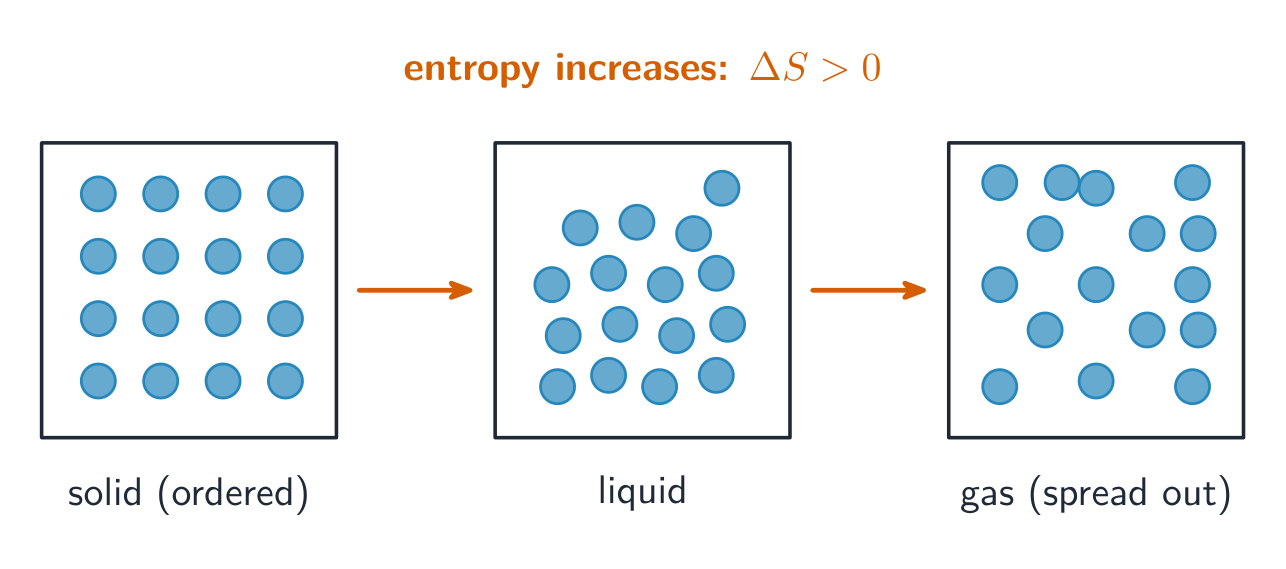
Entropy 熵 $S$ measures the dispersal of energy and matter – loosely, the number of ways to arrange a system. Entropy increases when a substance goes solid → liquid → gas, when a solid dissolves, when gas moles increase, or when temperature rises. More disorder means higher entropy.

ไทย
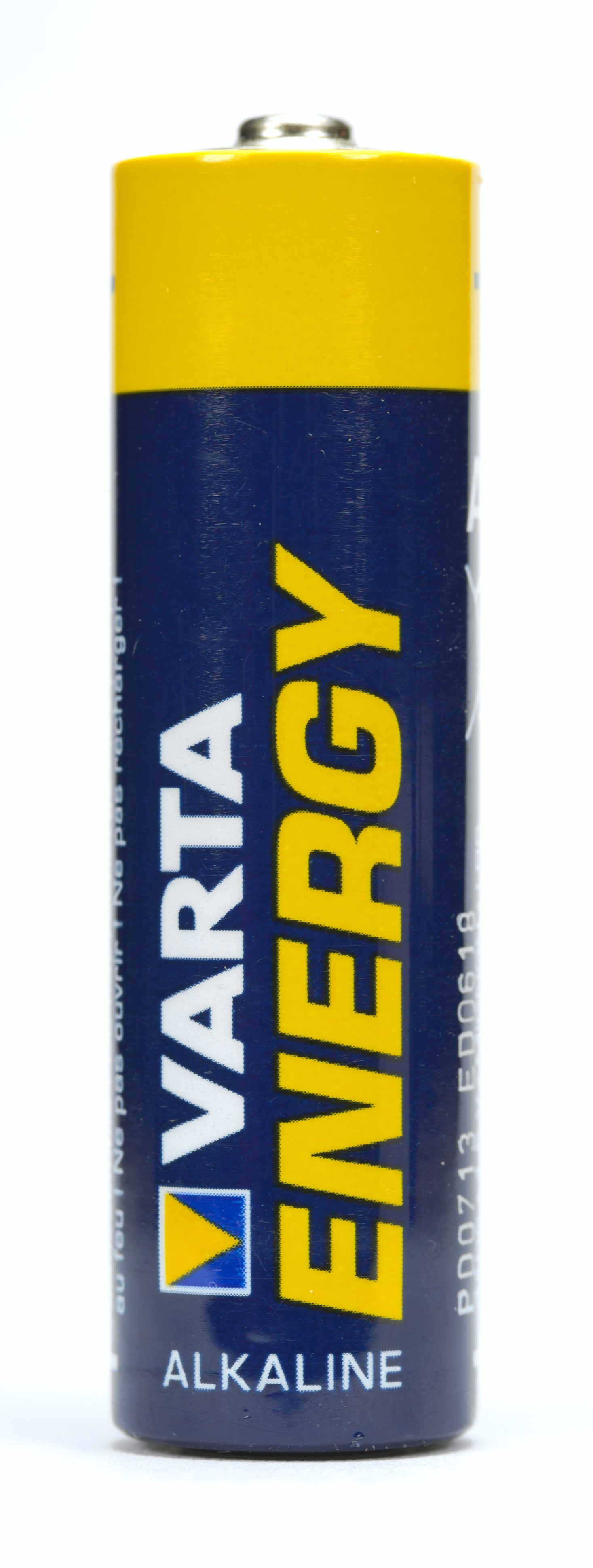
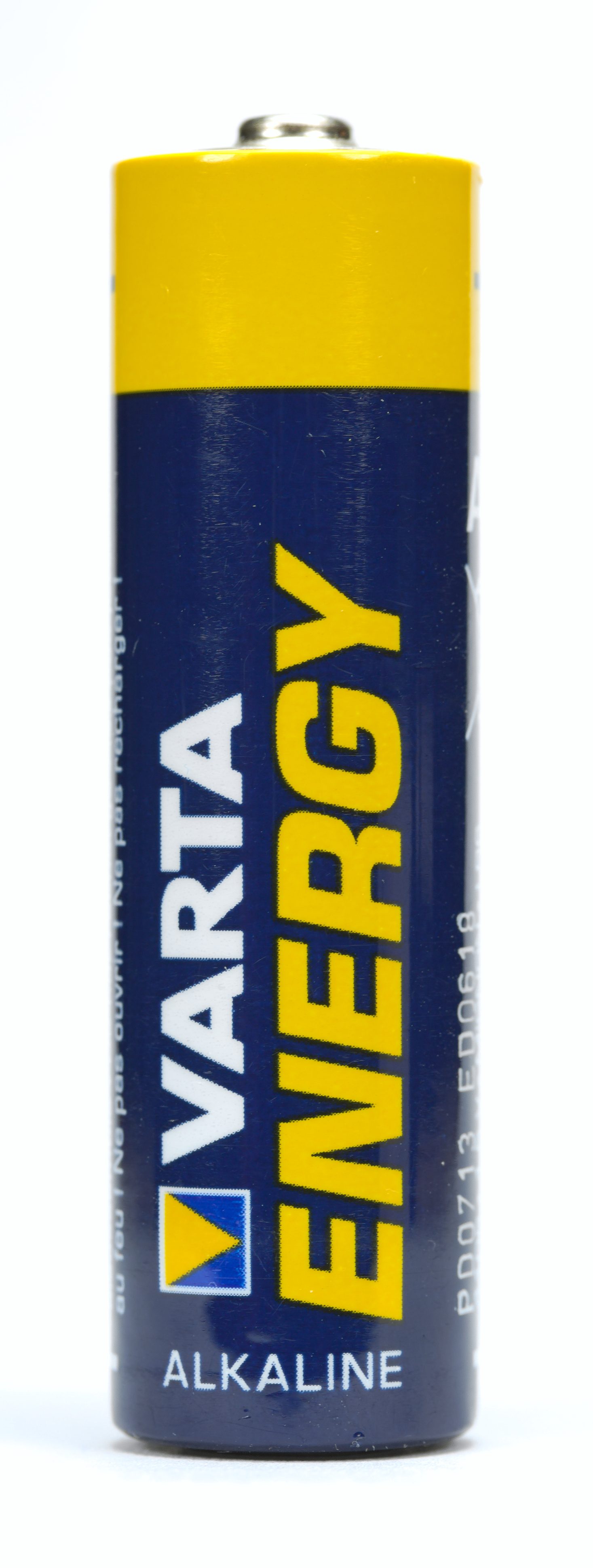
แบตเตอรี่ในบ้าน: เซลล์ไฟฟ้าเคมีแปลงพลังงานอิสระทางเคมีให้เป็นงานไฟฟ้า

เอนโทรปี $S$ วัดการกระจายตัวของพลังงานและสสาร – โดยสังเขปคือจำนวนวิธีที่จะจัดเรียงระบบ เอนโทรปีจะ เพิ่มขึ้น เมื่อสารเปลี่ยนสถานะจากแข็ง → ของเหลว → ก๊าซ, เมื่อแข็งละลาย, เมื่อจำนวนโมลของก๊าซเพิ่มขึ้น, หรือเมื่ออุณหภูมิสูงขึ้น ความไร้ระเบียบที่มากขึ้นหมายความว่าเอนโทรปีสูงขึ้น

เอนโทรปีเพิ่มขึ้นจากของแข็งเป็นของเหลวเป็นแก๊ส
Vocabulary · ⁨คำศัพท์⁩ Train · ⁨ฝึกฝน⁩
English ไทย
Entropy/ˈentrəpi/ เอนโทรปี
Gibbs free energy/ɡɪbz friː ˈenədʒi/ พลังงานอิสระของ吉布斯
thermodynamically favorable/ˌθɜːməʊdaɪˈnæmɪkli ˈfeɪvərəbl/ เป็นไปได้อย่างมีนัยสำคัญทางอุณหพลศาสตร์
galvanic (voltaic) cell/ɡælˈvænɪk sel/ เซลล์กัลวานิก (โวลตาइค)
9.2

Absolute Entropy and Entropy Change · ⁨เอนโทรปีสัมบูรณ์และการเปลี่ยนแปลงเอนโทรปี⁩

Syllabus · ⁨หลักสูตร⁩
English

Learning Objective 9.2.A: Calculate the standard entropy change for a chemical or physical process based on the absolute entropies (standard molar entropies) of the species involved in the process.

  • 9.2.A.1 The entropy change for a process can be calculated from the absolute entropies of the species involved before and after the process occurs.
    • Equation: $\Delta S^{\circ}_{reaction} = \Sigma S^{\circ}_{products} - \Sigma S^{\circ}_{reactants}$
ไทย

จุดประสงค์การเรียนรู้ 9.2.A: คำนวณการเปลี่ยนแปลงเอนโทรปีมาตรฐานสำหรับกระบวนการทางเคมีหรือฟิสิกส์ โดยอาศัยค่าเอนโทรปีสัมบูรณ์ (เอนโทรปีโมลาร์มาตรฐาน) ของสปีชีส์ที่เกี่ยวข้องในกระบวนการนั้น

  • 9.2.A.1 การเปลี่ยนแปลงเอนโทรปีของกระบวนการหนึ่งสามารถคำนวณได้จากค่าเอนโทรปีสัมบูรณ์ของสปีชีส์ที่เกี่ยวข้องก่อนและหลังที่กระบวนการนั้นเกิดขึ้น
    • สมการ: $\Delta S^{\circ}_{reaction} = \Sigma S^{\circ}_{products} - \Sigma S^{\circ}_{reactants}$

Source: College Board AP Course and Exam Description · ⁨แหล่งที่มา: คำอธิบายหลักสูตรและข้อสอบ College Board AP⁩

English

Every substance has a positive absolute entropy $S^\circ$. For a reaction,

$$\Delta S^\circ = \sum S^\circ(\text{products}) - \sum S^\circ(\text{reactants}).$$
Predict its sign from the change in gas moles: making more gas raises entropy ($\Delta S>0$).

ไทย

ทุกสารมีค่าเอนโทรปีสัมบูรณ์เป็นบวก $S^\circ$ สำหรับปฏิกิริยา,

$$\Delta S^\circ = \sum S^\circ(\text{products}) - \sum S^\circ(\text{reactants}).$$
ทำนาย เครื่องหมาย จากการเปลี่ยนแปลงจำนวนโมลของก๊าซ: การเกิดก๊าซมากขึ้นเพิ่มเอนโทรปี ($\Delta S>0$)

9.3

Gibbs Free Energy and Thermodynamic Favorability · ⁨พลังงานอิสระของกิบส์และความเอื้ออำนวยทางอุณหพลศาสตร์⁩

Syllabus · ⁨หลักสูตร⁩
English

Learning Objective 9.3.A: Explain whether a physical or chemical process is thermodynamically favored based on an evaluation of $\Delta G^{\circ}$.

  • 9.3.A.1 The Gibbs free energy change for a chemical process in which all the reactants and products are present in a standard state (as pure substances, as solutions of 1.0 M concentration, or as gases at a pressure of 1.0 atm (or 1.0 bar)) is given the symbol $\Delta G^{\circ}$.

  • 9.3.A.2 The standard Gibbs free energy change for a chemical or physical process is a measure of thermodynamic favorability. Historically, the term "spontaneous" has been used to describe processes for which $\Delta G^{\circ} < 0$. The phrase "thermodynamically favored" is preferred instead so that common misunderstandings (equating "spontaneous" with "suddenly" or "without cause") can be avoided. When $\Delta G^{\circ} < 0$ for the process, it is said to be thermodynamically favored.

  • 9.3.A.3 The standard Gibbs free energy change for a physical or chemical process may also be determined from the standard Gibbs free energy of formation of the reactants and products.

    • Equation: $\Delta G^{\circ}_{reaction} = \Sigma \Delta G^{\circ}_{f\ products} - \Sigma \Delta G^{\circ}_{f\ reactants}$
  • 9.3.A.4 In some cases, it is necessary to consider both enthalpy and entropy to determine if a process will be thermodynamically favored. The freezing of water and the dissolution of sodium nitrate are examples of such phenomena.

  • 9.3.A.5 Knowing the values of $\Delta H^{\circ}$ and $\Delta S^{\circ}$ for a process at a given temperature allows $\Delta G^{\circ}$ to be calculated directly.

    • Equation: $\Delta G^{\circ} = \Delta H^{\circ} - T\,\Delta S^{\circ}$
  • 9.3.A.6 In general, the temperature conditions for a process to be thermodynamically favored ($\Delta G^{\circ} < 0$) can be predicted from the signs of $\Delta H^{\circ}$ and $\Delta S^{\circ}$ as shown in the table below:

    $\Delta H^{\circ}$ $\Delta S^{\circ}$ Symbols $\Delta G^{\circ} < 0$, favored at:
    $< 0$ $> 0$ $<\ >$ all $T$
    $> 0$ $< 0$ $>\ <$ no $T$
    $> 0$ $> 0$ $>\ >$ high $T$
    $< 0$ $< 0$ $<\ <$ low $T$

    In cases where $\Delta H^{\circ} < 0$ and $\Delta S^{\circ} > 0$, no calculation of $\Delta G^{\circ}$ is necessary to determine that the process is thermodynamically favored ($\Delta G^{\circ} < 0$). In cases where $\Delta H^{\circ} > 0$ and $\Delta S^{\circ} < 0$, no calculation of $\Delta G^{\circ}$ is necessary to determine that the process is thermodynamically unfavored ($\Delta G^{\circ} > 0$).

ไทย

จุดประสงค์การเรียนรู้ 9.3.A: อธิบายว่ากระบวนการทางฟิสิกส์หรือเคมีใดมีความเอื้ออำนวยทางอุณหพลศาสตร์หรือไม่ โดยพิจารณาจากการประเมิน $\Delta G^{\circ}$

  • 9.3.A.1 การเปลี่ยนแปลงพลังงานอิสระของกิบส์สำหรับกระบวนการทางเคมีที่สารตั้งต้นและผลิตภัณฑ์ทั้งหมดอยู่ในสถานะมาตรฐาน (เป็นสารบริสุทธิ์, เป็นสารละลายที่มีความเข้มข้น 1.0 M, หรือเป็นแก๊สที่มีความดัน 1.0 atm (หรือ 1.0 bar)) ใช้สัญลักษณ์แทนด้วย $\Delta G^{\circ}$

  • 9.3.A.2 การเปลี่ยนแปลงพลังงานอิสระของกิบส์มาตรฐานสำหรับกระบวนการทางเคมีหรือฟิสิกส์เป็นตัวชี้วัดความเอื้ออำนวยทางอุณหพลศาสตร์ ในอดีตมีการใช้คำว่า " serviço" (spontaneous) เพื่ออธิบายกระบวนการที่มี $\Delta G^{\circ} < 0$ แต่ปัจจุบันนิยมใช้คำว่า "มีความเอื้ออำนวยทางอุณหพลศาสตร์" (thermodynamically favored) แทน เพื่อหลีกเลี่ยงความเข้าใจผิดทั่วไป (เช่น การเทียบคำว่า " serviço" กับ "ทันที" หรือ "โดยไม่มีสาเหตุ") เมื่อ $\Delta G^{\circ} < 0$ สำหรับกระบวนการ则该被认为具有热力学优势。

  • 9.3.A.3 การเปลี่ยนแปลงพลังงานอิสระของกิบส์มาตรฐานสำหรับกระบวนการทางฟิสิกส์หรือเคมียังสามารถกำหนดได้จากค่าพลังงานอิสระของกิบส์มาตรฐานของการเกิดของสารตั้งต้นและผลิตภัณฑ์

    • สมการ: $\Delta G^{\circ}_{reaction} = \Sigma \Delta G^{\circ}_{f\ products} - \Sigma \Delta G^{\circ}_{f\ reactants}$
  • 9.3.A.4 ในบางกรณี จำเป็นต้องพิจารณาทั้งเอนทาลปีและเอนโทรปีเพื่อตัดสินว่ากระบวนการจะมีความเอื้ออำนวยทางอุณหพลศาสตร์หรือไม่ ตัวอย่างของปรากฏการณ์เหล่านี้คือการแข็งตัวของน้ำและการละลายของโซเดียมไนเตรต

  • 9.3.A.5 การทราบค่าของ $\Delta H^{\circ}$ และ $\Delta S^{\circ}$ สำหรับกระบวนการที่อุณหภูมิที่กำหนด สามารถทำให้ $\Delta G^{\circ}$ ถูกคำนวณได้โดยตรง

    • สมการ: $\Delta G^{\circ} = \Delta H^{\circ} - T\,\Delta S^{\circ}$
  • 9.3.A.6 โดยทั่วไป สภาวะอุณหภูมิสำหรับกระบวนการที่จะมีความเอื้ออำนวยทางอุณหพลศาสตร์ ($\Delta G^{\circ} < 0$) สามารถทำนายได้จากเครื่องหมายของ $\Delta H^{\circ}$ และ $\Delta S^{\circ}$ ตามที่แสดงในตารางด้านล่าง:

    $\Delta H^{\circ}$ $\Delta S^{\circ}$ สัญลักษณ์ $\Delta G^{\circ} < 0$, ที่เอื้ออำนวยที่:
    $< 0$ $> 0$ $<\ >$ ทุก $T$
    $> 0$ $< 0$ $>\ <$ ไม่มี $T$
    $> 0$ $> 0$ $>\ >$ อุณหภูมิสูง $T$
    $< 0$ $< 0$ $<\ <$ อุณหภูมิต่ำ $T$

    ในกรณีที่ $\Delta H^{\circ} < 0$ และ $\Delta S^{\circ} > 0$ ไม่จำเป็นต้องคำนวณ $\Delta G^{\circ}$ เพื่อดูว่ากระบวนการมีความเอื้ออำนวยทางอุณหพลศาสตร์ ($\Delta G^{\circ} < 0$) ในกรณีที่ $\Delta H^{\circ} > 0$ และ $\Delta S^{\circ} < 0$ ไม่จำเป็นต้องคำนวณ $\Delta G^{\circ}$ เพื่อดูว่ากระบวนการไม่มีความเอื้ออำนวยทางอุณหพลศาสตร์ ($\Delta G^{\circ} > 0$)

Source: College Board AP Course and Exam Description · ⁨แหล่งที่มา: คำอธิบายหลักสูตรและข้อสอบ College Board AP⁩

English

Gibbs free energy 吉布斯自由能 combines enthalpy and entropy:

$$\Delta G = \Delta H - T\Delta S.$$
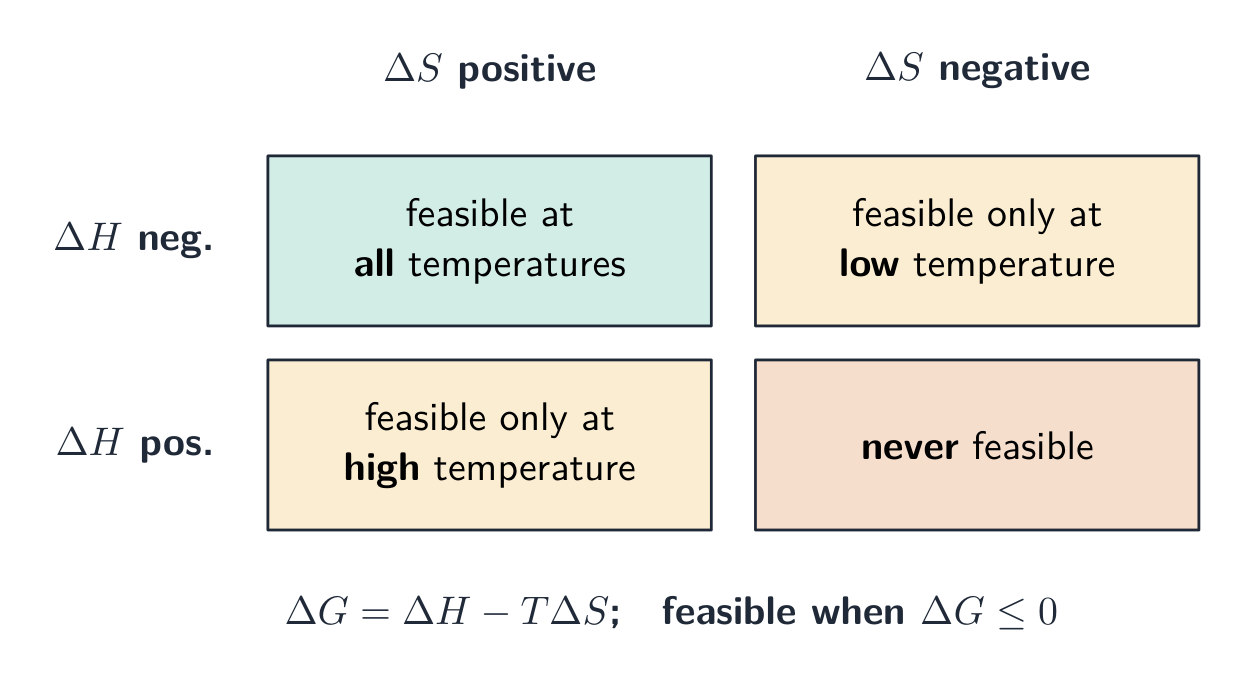
A process is thermodynamically favorable 热力学有利 when $\Delta G<0$. So exothermic ($\Delta H<0$) and entropy-increasing ($\Delta S>0$) reactions are always favorable; when the two oppose, temperature decides.

Worked example. A reaction has $\Delta H=+40\ \text{kJ/mol}$ and $\Delta S=+120\ \text{J/(mol K)}$. It is endothermic (unfavorable enthalpy) but entropy-increasing, so it becomes favorable only when hot enough. Setting $\Delta G=\Delta H-T\Delta S<0$ and matching units ($\Delta S=0.120\ \text{kJ}$):

$$T>\frac{\Delta H}{\Delta S}=\frac{40}{0.120}=333\ \text{K}\;(60\,{}^{\circ}\text{C}).$$

ไทย

พลังงานอิสระของกิบส์ รวมเอนทาลปีและเอนโทรปีเข้าด้วยกัน:

$$\Delta G = \Delta H - T\Delta S.$$
กระบวนการหนึ่งจะ เกิดเองทางอุณหพลศาสตร์ เมื่อ $\Delta G<0$ ดังนั้นปฏิกิริยาคายความร้อน ($\Delta H<0$) และเพิ่มเอนโทรปี ($\Delta S>0$) จึงเกิดเองเสมอ; เมื่อทั้งสองอย่างขัดแย้งกัน อุณหภูมิจะเป็นตัวชี้ขาด

ว่าปฏิกิริยาจะเอื้อหรือไม่ จากเครื่องหมายของการเปลี่ยนแปลงเอนทาลปีและเอนโทรปี

ตัวอย่างฝึกปฏิบัติ. ปฏิกิริยานี้มี $\Delta H=+40\ \text{kJ/mol}$ และ $\Delta S=+120\ \text{J/(mol K)}$ มันเป็นปฏิกิริยาดูดความร้อน (เอนทาลปีไม่เป็นผลดี) แต่เพิ่มเอนโทรปี ดังนั้นจึงจะเป็นผลดีก็ต่อเมื่อร้อนพอแล้ว ตั้งค่า $\Delta G=\Delta H-T\Delta S<0$ และปรับหน่วยให้ตรง ($\Delta S=0.120\ \text{kJ}$):

$$T>\frac{\Delta H}{\Delta S}=\frac{40}{0.120}=333\ \text{K}\;(60\,{}^{\circ}\text{C}).$$

9.4

Thermodynamic and Kinetic Control · ⁨การควบคุมทางอุณหพลศาสตร์และจลนศาสตร์⁩

Syllabus · ⁨หลักสูตร⁩
English

Learning Objective 9.4.A: Explain, in terms of kinetics, why a thermodynamically favored reaction might not occur at a measurable rate.

  • 9.4.A.1 Many processes that are thermodynamically favored do not occur to any measurable extent, or they occur at extremely slow rates.
  • 9.4.A.2 Processes that are thermodynamically favored, but do not proceed at a measurable rate, are under "kinetic control." High activation energy is a common reason for a process to be under kinetic control. The fact that a process does not proceed at a noticeable rate does not mean that the chemical system is at equilibrium. If a process is known to be thermodynamically favored, and yet does not occur at a measurable rate, it is reasonable to conclude that the process is under kinetic control.
ไทย

จุดประสงค์การเรียนรู้ 9.4.A: อธิบายในเชิงจลนศาสตร์ว่าทำไมปฏิกิริยาที่มีความเอื้ออำนวยทางอุณหพลศาสตร์อาจไม่เกิดขึ้นในอัตราที่วัดได้

  • 9.4.A.1 กระบวนการหลายอย่างที่มีความเอื้ออำนวยทางอุณหพลศาสตร์ไม่เกิดขึ้นในระดับที่วัดได้ หรือเกิดขึ้นด้วยอัตราที่ช้ามาก
  • 9.4.A.2 กระบวนการที่มีความเอื้ออำนวยทางอุณหพลศาสตร์แต่ไม่ดำเนินต่อไปในอัตราที่วัดได้ อยู่ภายใต้ "การควบคุมทางจลนศาสตร์" (kinetic control) พลังงานกระตุ้นที่สูงเป็นเหตุผลทั่วไปที่ทำให้กระบวนการอยู่ภายใต้การควบคุมทางจลนศาสตร์ ความจริงที่ว่ากระบวนการไม่ดำเนินต่อไปในอัตราที่สังเกตได้并不意味着 chemical system处于平衡状态。如果一个过程已知是热力学有利的,但并未以可测量的速率发生,可以合理推断该过程受动力学控制。

Source: College Board AP Course and Exam Description · ⁨แหล่งที่มา: คำอธิบายหลักสูตรและข้อสอบ College Board AP⁩

English

$\Delta G<0$ says a reaction can happen, not that it will happen fast. A reaction can be thermodynamically favorable yet kinetically slow because of a high activation energy (diamond → graphite). Thermodynamics gives the direction; kinetics gives the speed.

ไทย

$\Delta G<0$ บอกว่าปฏิกิริยา สามารถ เกิดขึ้นได้ ไม่ใช่บอกว่า它会 เร็ว如此发生。 ปฏิกิริยาอาจเป็นไปตามหลักอุณหพลศาสตร์แต่ ช้า ทางจลนศาสตร์เนื่องจากพลังงานก่อกวนสูง (เพชร → แกลไฟต์) อุณหพลศาสตร์บอกทิศทาง; จลนศาสตร์บอกความเร็ว

9.5

Free Energy and Equilibrium · ⁨พลังงานอิสระและสมดุล⁩

Syllabus · ⁨หลักสูตร⁩
English

Learning Objective 9.5.A: Explain whether a process is thermodynamically favored using the relationships between $K$, $\Delta G^{\circ}$, and $T$.

  • 9.5.A.1 The phrase "thermodynamically favored" ($\Delta G^{\circ} < 0$) means that the products are favored at equilibrium ($K > 1$) under standard conditions.
  • 9.5.A.2 The equilibrium constant is related to free energy by the equations
    • Equation: $K = e^{-\Delta G^{\circ}/RT}$
    • Equation: $\Delta G^{\circ} = -RT \ln K$
  • 9.5.A.3 Connections between $K$ and $\Delta G^{\circ}$ can be made qualitatively through estimation. When $\Delta G^{\circ}$ is near zero, the equilibrium constant will be close to 1. When $\Delta G^{\circ}$ is much larger or much smaller than $RT$, the value of $K$ deviates strongly from 1.
  • 9.5.A.4 Processes with $\Delta G^{\circ} < 0$ favor products (i.e., $K > 1$) and those with $\Delta G^{\circ} > 0$ favor reactants (i.e., $K < 1$).
ไทย

จุดประสงค์การเรียนรู้ 9.5.A: อธิบายว่ากระบวนการมีความเอื้ออำนวยทางอุณหพลศาสตร์หรือไม่ โดยใช้ความสัมพันธ์ระหว่าง $K$, $\Delta G^{\circ}$ และ $T$

  • 9.5.A.1 คำว่า "มีความเอื้ออำนวยทางอุณหพลศาสตร์" ($\Delta G^{\circ} < 0$) หมายถึง/products被优先于反应物在平衡状态下($K > 1$)在标准条件下。
  • 9.5.A.2 ค่าคงที่สมดุลเกี่ยวข้องกับพลังงานอิสระผ่านสมการ
    • สมการ: $K = e^{-\Delta G^{\circ}/RT}$
    • สมการ: $\Delta G^{\circ} = -RT \ln K$
  • 9.5.A.3 ความเชื่อมโยงระหว่าง $K$ และ $\Delta G^{\circ}$ สามารถทำได้แบบคุณภาพผ่านการประมาณค่า เมื่อ $\Delta G^{\circ}$ ใกล้เคียงศูนย์ ค่าคงที่สมดุลจะใกล้กับ 1 เมื่อ $\Delta G^{\circ}$ มีค่ามากกว่าหรือน้อยกว่า $RT$ อย่างมาก ค่าของ $K$ จะเบี่ยงเบนอย่างมากจาก 1
  • 9.5.A.4 กระบวนการที่มี $\Delta G^{\circ} < 0$ favore products (คือ $K > 1$) และกระบวนการที่มี $\Delta G^{\circ} > 0$ favore reactants (คือ $K < 1$)

Source: College Board AP Course and Exam Description · ⁨แหล่งที่มา: คำอธิบายหลักสูตรและข้อสอบ College Board AP⁩

English

Free energy links to the equilibrium constant:

$$\Delta G^\circ = -RT\ln K.$$
So $\Delta G^\circ<0$ gives $K>1$ (products favored), and $\Delta G^\circ>0$ gives $K<1$. At equilibrium $\Delta G=0$.

ไทย

พลังงานอิสระเชื่อมโยงกับค่าคงที่สมดุล:

$$\Delta G^\circ = -RT\ln K.$$
ดังนั้น $\Delta G^\circ<0$ ให้ $K>1$ (ผลิตภัณฑ์ถูกสนับสนุน), และ $\Delta G^\circ>0$ ให้ $K<1$. ที่สมดุล $\Delta G=0$

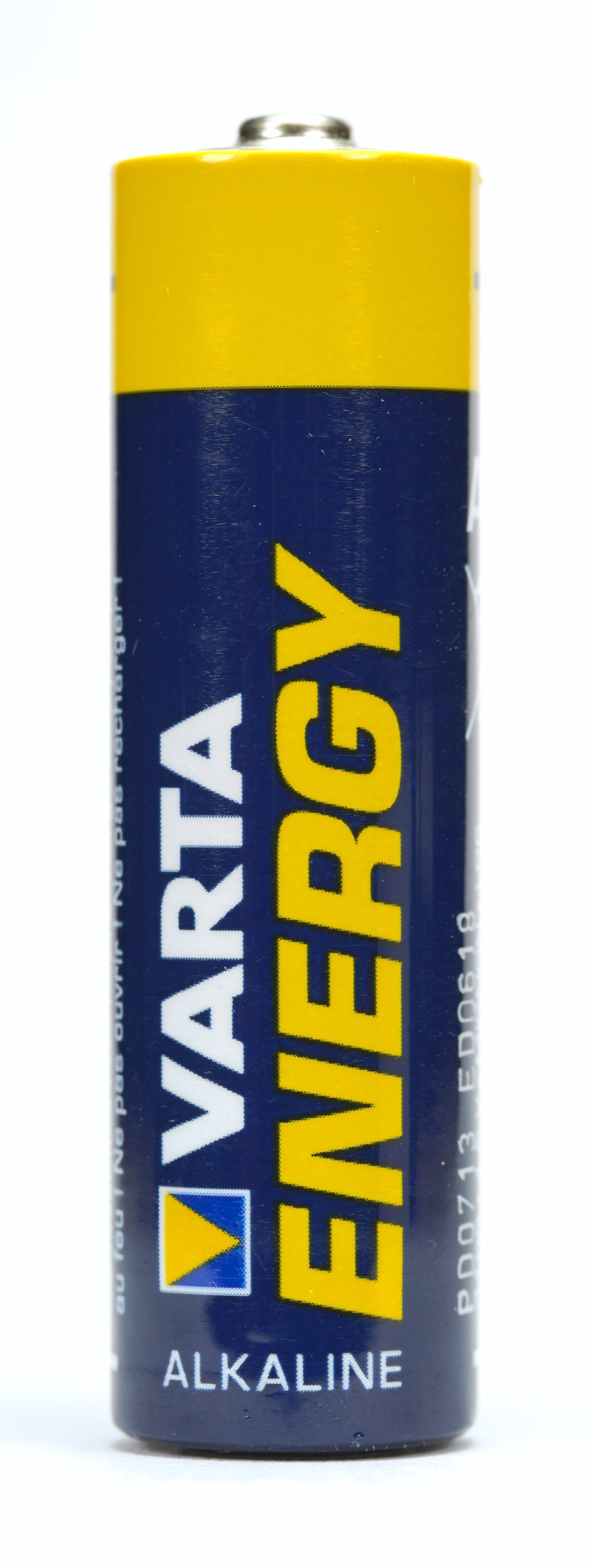
แบตเตอรี่แปลงพลังงานอิสระของปฏิกิริยารีดักชัน-ออกซิเดชันที่เกิดขึ้นเองให้เป็นงานไฟฟ้า
9.6

Free Energy of Dissolution · ⁨พลังงานอิสระของการละลาย⁩

Syllabus · ⁨หลักสูตร⁩
English

Learning Objective 9.6.A: Explain the relationship between the solubility of a salt and changes in the enthalpy and entropy that occur in the dissolution process.

  • 9.6.A.1 The free energy change ($\Delta G^{\circ}$) for dissolution of a substance reflects a number of factors: the breaking of the intermolecular interactions that hold the solid together, the reorganization of the solvent around the dissolved species, and the interaction of the dissolved species with the solvent. It is possible to estimate the sign and relative magnitude of the enthalpic and entropic contributions to each of these factors. However, making predictions for the total change in free energy of dissolution can be challenging due to the cancellations among the free energies associated with the three factors cited.
ไทย

จุดประสงค์การเรียนรู้ 9.6.A: อธิบายความสัมพันธ์ระหว่างความละลายของเกลือกับการเปลี่ยนแปลงของเอนทาลปีและเอนโทรピーที่เกิดขึ้นในกระบวนการละลาย

  • 9.6.A.1 การเปลี่ยนแปลงพลังงานอิสระ ($\Delta G^{\circ}$) จากกระบวนการละลายของสารสะท้อนปัจจัยหลายประการ: การแตกหักของแรงยึดเหนี่ยวระหว่างโมเลกุลที่จับก้อนของแข็งไว้ together, การจัดเรียงตัวใหม่ของตัวทำละลายรอบสปีชีส์ที่ละลายแล้ว และการมีปฏิสัมพันธ์ของสปีชีส์ที่ละลายแล้วกับตัวทำละลาย เป็นไปได้ที่จะประมาณค่าเครื่องหมายและขนาดสัมพัทธ์ของการมีส่วนร่วมด้านเอนทาลปีและเอนโทรปีของแต่ละปัจจัยเหล่านี้ อย่างไรก็ตาม การทำนายการเปลี่ยนแปลงพลังงานอิสระรวมจากการละลายอาจเป็นเรื่องยากเนื่องจากผลลบกันของพลังงานอิสระที่เกี่ยวข้องกับปัจจัยทั้งสามที่กล่าวถึงข้างต้น

Source: College Board AP Course and Exam Description · ⁨แหล่งที่มา: คำอธิบายหลักสูตรและข้อสอบ College Board AP⁩

English

Whether a salt dissolves depends on the free-energy change of dissolving. Dissolving often increases entropy (ordered solid → dispersed ions) but may cost enthalpy; the sign of $\Delta G$ (and thus $K_{sp}$) follows from $\Delta H - T\Delta S$.

ไทย

ว่าเกลือจะละลายขึ้นอยู่กับค่าการเปลี่ยนแปลงพลังงานอิสระของการละลาย การละลายมักเพิ่มเอนโทรปี (แข็งที่มีระเบียบ → ไอออนกระจายตัว) แต่อาจต้องใช้เอนทาลปี; เครื่องหมายของ $\Delta G$ (และดังนั้น $K_{sp}$) มาจาก $\Delta H - T\Delta S$

9.7

Coupled Reactions · ⁨ปฏิกิริยาที่จับคู่กัน⁩

Syllabus · ⁨หลักสูตร⁩
English

Learning Objective 9.7.A: Explain the relationship between external sources of energy or coupled reactions and their ability to drive thermodynamically unfavorable processes.

  • 9.7.A.1 An external source of energy can be used to make a thermodynamically unfavorable process occur. Examples include:
    • 9.7.A.1.i Electrical energy to drive an electrolytic cell or charge a battery.
    • 9.7.A.1.ii Light to drive the overall conversion of carbon dioxide to glucose in photosynthesis.
  • 9.7.A.2 A desired product can be formed by coupling a thermodynamically unfavorable reaction that produces that product to a favorable reaction (e.g., the conversion of $ATP$ to $ADP$ in biological systems). In the coupled system, the individual reactions share one or more common intermediates. The sum of the individual reactions produces an overall reaction that achieves the desired outcome and has $\Delta G^{\circ} < 0$.
ไทย

จุดประสงค์การเรียนรู้ 9.7.A: อธิบายความสัมพันธ์ระหว่างแหล่งพลังงานภายนอกหรือปฏิกิริยาแบบคู่กับความสามารถในการขับเคลื่อนกระบวนการที่ไม่เป็นไปตามทางอุณหพลศาสตร์

  • 9.7.A.1 แหล่งพลังงานภายนอกสามารถนำมาใช้เพื่อให้กระบวนการที่ไม่เป็นไปตามทางอุณหพลศาสตร์เกิดขึ้นได้ ตัวอย่างเช่น:
    • 9.7.A.1.i พลังงานไฟฟ้าเพื่อขับเคลื่อนเซลล์อิเล็กโทรไลต์หรือชาร์จแบตเตอรี่
    • 9.7.A.1.ii แสงเพื่อขับเคลื่อนการแปลงคาร์บอนไดออกไซด์เป็นกลูโคสในภาพรวมของกระบวนการสังเคราะห์ด้วยแสง
  • 9.7.A.2 ผลิตภัณฑ์ที่ต้องการสามารถเกิดได้โดยการจับคู่ปฏิกิริยาที่ไม่เป็นไปตามทางอุณหพลศาสตร์ซึ่งผลิตผลิตภัณฑ์นั้นเข้ากับปฏิกิริยาที่เป็นไปตามทาง (เช่น การเปลี่ยน $ATP$ เป็น $ADP$ ในระบบชีวภาพ) ในระบบที่ถูกจับคู่ ปฏิกิริยาแต่ละอย่างจะแบ่งปันตัวกลางร่วมกันหนึ่งหรือมากกว่า ผลรวมของปฏิกิริยาแต่ละอย่างจะสร้างปฏิกิริยารวมที่บรรลุผลลัพธ์ที่ต้องการและมี $\Delta G^{\circ} < 0$

Source: College Board AP Course and Exam Description · ⁨แหล่งที่มา: คำอธิบายหลักสูตรและข้อสอบ College Board AP⁩

English

An unfavorable reaction ($\Delta G>0$) can be driven by coupling it to a favorable one ($\Delta G<0$) that shares a common intermediate, as long as the sum has $\Delta G<0$. This is how cells use ATP to power otherwise unfavorable processes.

ไทย

ปฏิกิริยาที่ไม่เอื้อ ($\Delta G>0$) สามารถถูกขับเคลื่อนโดย การจับคู่它与一个有利的反应($\Delta G<0$)共享共同中间体,只要总和有$\Delta G<0$。这就是细胞使用ATP驱动其他不利过程的方式。

9.8

Galvanic and Electrolytic Cells · ⁨เซลล์กัลวานิกและอิเล็กโทรไลติก⁩

Syllabus · ⁨หลักสูตร⁩
English

Learning Objective 9.8.A: Explain the relationship between the physical components of an electrochemical cell and the overall operational principles of the cell.

  • 9.8.A.1 Each component of an electrochemical cell (electrodes, solutions in the half-cells, salt bridge, voltage/current measuring device) plays a specific role in the overall functioning of the cell. The operational characteristics of the cell (galvanic vs. electrolytic, direction of electron flow, reactions occurring in each half-cell, change in electrode mass, evolution of a gas at an electrode, ion flow through the salt bridge) can be described at both the macroscopic and particulate levels.
  • 9.8.A.2 Galvanic, sometimes called voltaic, cells involve a thermodynamically favored reaction, whereas electrolytic cells involve a thermodynamically unfavored reaction. Visual representations of galvanic and electrolytic cells are tools of analysis to identify where half-reactions occur and in what direction current flows.
  • 9.8.A.3 For all electrochemical cells, oxidation occurs at the anode and reduction occurs at the cathode.
    • Exclusion statement: Labeling an electrode as positive or negative will not be assessed on the AP Exam.
ไทย

จุดประสงค์การเรียนรู้ 9.8.A: อธิบายความสัมพันธ์ระหว่างส่วนประกอบทางกายภาพของเซลล์เคมีไฟฟ้าและหลักการดำเนินการโดยรวมของเซลล์

  • 9.8.A.1 ส่วนประกอบแต่ละตัวของเซลล์เคมีไฟฟ้า (ขั้วไฟฟ้า, สารละลายในครึ่งเซลล์, สะพานเกลือ, อุปกรณ์วัดแรงดัน/กระแส) มีบทบาทเฉพาะในการทำงานโดยรวมของเซลล์ ลักษณะการดำเนินงานของเซลล์ (กัลวานิก vs อิเล็กโทรไลต์, ทิศทางการไหลของอิเล็กตรอน, ปฏิกิริยาที่เกิดขึ้นในครึ่งเซลล์แต่ละอัน, การเปลี่ยนแปลงมวลของขั้วไฟฟ้า, การเกิดแก๊สที่ขั้วไฟฟ้า, การไหลของไอออนผ่านสะพานเกลือ) สามารถอธิบายได้ในระดับมหภาคและระดับอนุภาค
  • 9.8.A.2 เซลล์กัลวานิก บางครั้งเรียกว่าเซลล์โวลตา เกี่ยวข้องกับปฏิกิริยาที่เป็นไปตามทางอุณหพลศาสตร์ ในขณะที่เซลล์อิเล็กโทรไลต์เกี่ยวข้องกับปฏิกิริยาที่ไม่เป็นไปตามทางอุณหพลศาสตร์ ภาพแสดงของเซลล์กัลวานิกและเซลล์อิเล็กโทรไลต์เป็นเครื่องมือวิเคราะห์เพื่อระบุตำแหน่งที่เกิดปฏิกิริยາครึ่งเซลล์และทิศทางที่กระแสไหล
  • 9.8.A.3 สำหรับเซลล์เคมีไฟฟ้าทั้งหมด การเกิดออกซิเดชันเกิดขึ้นที่อะโนดและการเกิดรีดักชันเกิดขึ้นที่แคโทด
    • ข้อความยกเว้น: การกำหนดป้ายชื่อขั้วไฟฟ้าว่าเป็นบวกหรือลบจะไม่ถูกประเมินในข้อสอบ AP

Source: College Board AP Course and Exam Description · ⁨แหล่งที่มา: คำอธิบายหลักสูตรและข้อสอบ College Board AP⁩

English
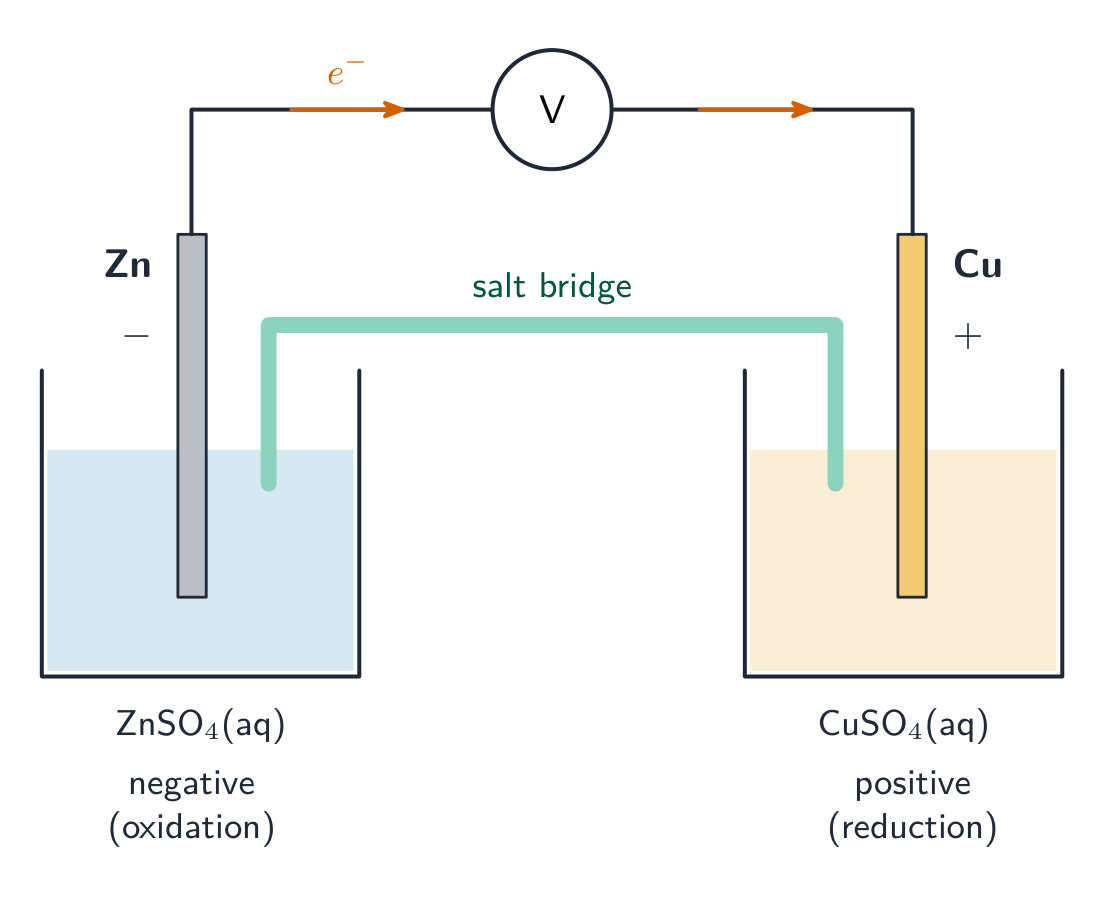
The galvanic cell

Redox reactions can move electrons through a wire:

  • A galvanic (voltaic) cell 原电池 uses a favorable reaction ($\Delta G<0$) to produce electricity – a battery.
  • An electrolytic cell 电解池 uses electricity to force an unfavorable reaction ($\Delta G>0$).

In both, oxidation happens at the anode 阳极 and reduction at the cathode 阴极.

ไทย
เซลล์กัลวานิก

ปฏิกิริยารีดักชัน-ออกซิเดชันสามารถเคลื่อนย้ายอิเล็กตรอนผ่านสายไฟได้:

เซลล์กัลวานิกที่มีสะพานเกลือและโวลต์มิเตอร์
  • เซลล์กัลวานิก (โวลตาิก) ใช้ปฏิกิริยาที่เป็นไปเอง ($\Delta G<0$) เพื่อผลิตไฟฟ้า – เช่น แบตเตอรี่
  • เซลล์อิเล็กโทรไลต์ ใช้ไฟฟ้าเพื่อ บังคับให้ปฏิกิริยาที่ไม่เป็นไปเอง ($\Delta G>0$) เกิดขึ้น

ในทั้งสองกรณี การเกิดออกซิเดชัน เกิดที่ อะโนด และ การเกิดรีดักชัน เกิดที่ แคโทด

แบตเตอรี่เชิงพาณิชย์: เซลล์กัลวานิกเปลี่ยนพลังงานอิสระทางเคมีให้เป็นงานไฟฟ้า
Explore · ⁨สำรวจ⁩

Transfer electrons in a cell · ⁨ถ่ายโอนอิเล็กตรอนในเซลล์⁩

In a galvanic cell a spontaneous redox reaction drives electrons through a wire, doing electrical work; oxidation at one electrode, reduction at the other. · ⁨ใน เซลล์กัลวานิก ปฏิกิริยารีดอกซ์ที่เกิดขึ้นเองจะขับเคลื่อนอิเล็กตรอนผ่านสายไฟ เพื่อสร้างงานไฟฟ้า; เกิดการออกซิเดชันที่ขั้วหนึ่ง และการรีดิวซ์ที่อีกขั้วหนึ่ง⁩

9.9

Cell Potential and Free Energy · ⁨ศักย์ของเซลล์และพลังงานอิสระ⁩

Syllabus · ⁨หลักสูตร⁩
English

Learning Objective 9.9.A: Explain whether an electrochemical cell is thermodynamically favored, based on its standard cell potential and the constituent half-reactions within the cell.

  • 9.9.A.1 Electrochemistry encompasses the study of redox reactions that occur within electrochemical cells. The reactions are either thermodynamically favored (resulting in a positive voltage) or thermodynamically unfavored (resulting in a negative voltage and requiring an externally applied potential for the reaction to proceed).
  • 9.9.A.2 The standard cell potential of electrochemical cells can be calculated by identifying the oxidation and reduction half-reactions and their respective standard reduction potentials.
  • 9.9.A.3 $\Delta G^{\circ}$ (standard Gibbs free energy change) is proportional to the negative of the cell potential for the redox reaction from which it is constructed. Thus, a cell with a positive $E^{\circ}$ involves a thermodynamically favored reaction, and a cell with a negative $E^{\circ}$ involves a thermodynamically unfavored reaction.
    • Equation: $\Delta G^{\circ} = -nFE^{\circ}$
ไทย

จุดประสงค์การเรียนรู้ 9.9.A: อธิบายว่าเซลล์เคมีไฟฟ้าเป็นไปตามทางอุณหพลศาสตร์หรือไม่ โดยอ้างอิงจากแรงดันเซลล์มาตรฐานและปฏิกิริยาครึ่งเซลล์องค์ประกอบภายในเซลล์

  • 9.9.A.1 เคมีไฟฟ้าครอบคลุมการศึกษาปฏิกิริยาระหว่างออกซิเดชัน-รีดักชันที่เกิดขึ้นภายในเซลล์เคมีไฟฟ้า ปฏิกิริยาเหล่านั้นอาจเป็นไปตามทางอุณหพลศาสตร์ (ส่งผลให้ได้รับแรงดันบวก) หรือไม่เป็นไปตามทางอุณหพลศาสตร์ (ส่งผลให้ได้รับแรงดันลบและต้องการแรงดันไฟฟ้าภายนอกที่นำไปใช้เพื่อให้ปฏิกิริยานั้นดำเนินต่อไป)
  • 9.9.A.2 แรงดันเซลล์มาตรฐานของเซลล์เคมีไฟฟ้าสามารถคำนวณได้โดยระบุปฏิกิริยาครึ่งออกซิเดชันและครึ่งรีดักชันและค่าศักย์รีดักชันมาตรฐานของแต่ละปฏิกิริยา
  • 9.9.A.3 $\Delta G^{\circ}$ (การเปลี่ยนแปลงพลังงานอิสระกิบส์มาตรฐาน) สัมพันธ์โดยตรงกับค่าลบของแรงดันเซลล์สำหรับปฏิกิริยาระหว่างออกซิเดชัน-รีดักชันที่สร้างมันขึ้นมา ดังนั้น เซลล์ที่มี $E^{\circ}$ บวกจะเกี่ยวข้องกับปฏิกิริยาที่เป็นไปตามทางอุณหพลศาสตร์ และเซลล์ที่มี $E^{\circ}$ ลบจะเกี่ยวข้องกับปฏิกิริยาที่ไม่เป็นไปตามทางอุณหพลศาสตร์
    • สมการ: $\Delta G^{\circ} = -nFE^{\circ}$

Source: College Board AP Course and Exam Description · ⁨แหล่งที่มา: คำอธิบายหลักสูตรและข้อสอบ College Board AP⁩

English

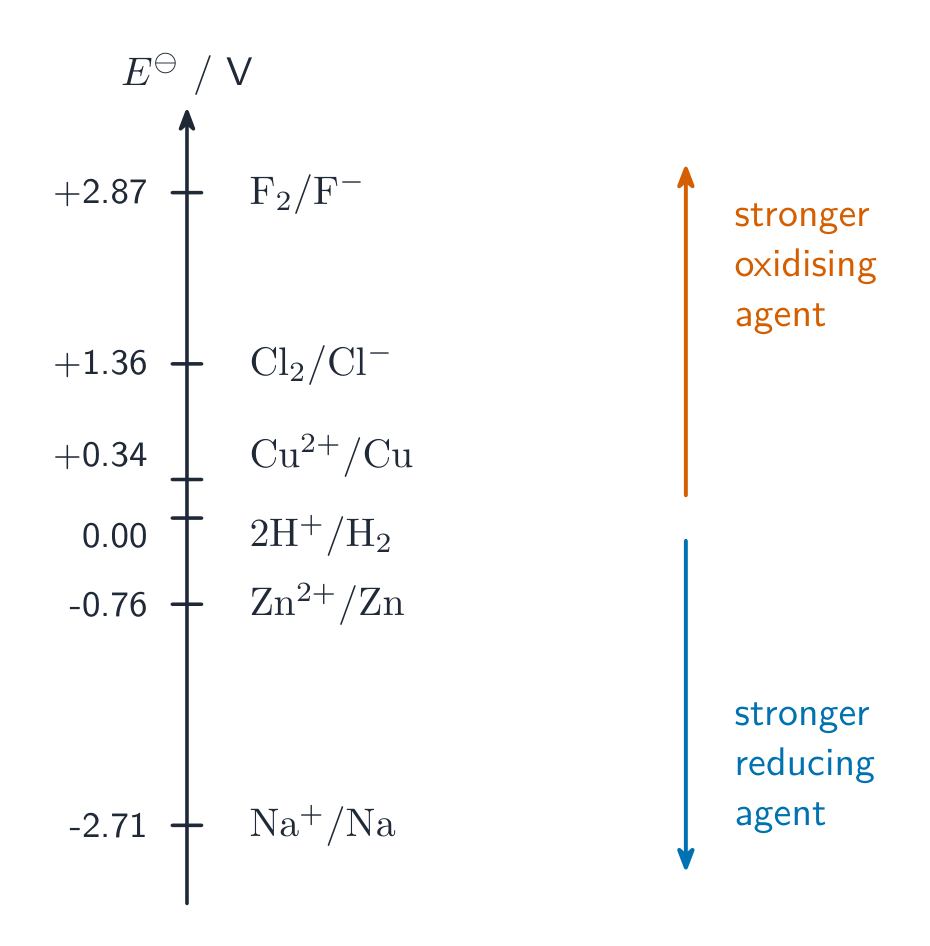
The cell potential 电池电势 $E^\circ_{\text{cell}}$ measures the driving force in volts, found from standard reduction potentials ($E^\circ_{\text{cathode}}-E^\circ_{\text{anode}}$). It links to free energy by

$$\Delta G^\circ = -nFE^\circ_{\text{cell}},$$
where $n$ is moles of electrons and $F$ the Faraday constant. A positive $E^\circ_{\text{cell}}$ means a favorable (galvanic) reaction.

Worked example. A cell pairs a copper cathode ($\text{Cu}^{2+}+2e^-\rightarrow\text{Cu}$, $E^\circ=+0.34\ \text{V}$) with a zinc anode ($\text{Zn}^{2+}+2e^-\rightarrow\text{Zn}$, $E^\circ=-0.76\ \text{V}$). The cell potential is

$$E^\circ_{\text{cell}}=E^\circ_{\text{cathode}}-E^\circ_{\text{anode}}=0.34-(-0.76)=1.10\ \text{V}.$$
It is positive, so the reaction is spontaneous and the cell (a Daniell cell) acts as a battery.

ไทย

ศักย์ของเซลล์ $E^\circ_{\text{cell}}$ วัดแรงขับเคลื่อนเป็นโวลต์ ซึ่งหาได้จากศักย์การเกิดรีดักชันมาตรฐาน ($E^\circ_{\text{cathode}}-E^\circ_{\text{anode}}$) เชื่อมโยงกับพลังงานอิสระโดย

$$\Delta G^\circ = -nFE^\circ_{\text{cell}},$$
โดยที่ $n$ คือจำนวนโมลของอิเล็กตรอน และ $F$ คือค่าคงที่ฟาราเดย์ ค่า บวก ของ $E^\circ_{\text{cell}}$ บ่งบอกถึงปฏิกิริยาที่เป็นไปเอง (เซลล์กัลวานิก)

อนุกรมศักย์ขั้วไฟฟ้ามาตรฐาน

ตัวอย่างคำนวณ. เซลล์นี้จับคู่แคโทดทองแดง ($\text{Cu}^{2+}+2e^-\rightarrow\text{Cu}$, $E^\circ=+0.34\ \text{V}$) กับอะโนดสังกะสี ($\text{Zn}^{2+}+2e^-\rightarrow\text{Zn}$, $E^\circ=-0.76\ \text{V}$) ศักย์ของเซลล์คือ

$$E^\circ_{\text{cell}}=E^\circ_{\text{cathode}}-E^\circ_{\text{anode}}=0.34-(-0.76)=1.10\ \text{V}.$$
มีค่าบวก ดังนั้นปฏิกิริยาจึงเกิดขึ้นเอง และเซลล์ (เซลล์เดเนียล) ทำหน้าที่เหมือนแบตเตอรี่

Vocabulary · ⁨คำศัพท์⁩ Train · ⁨ฝึกฝน⁩
English ไทย
anode/ˈænəʊd/ แอนโอด
cathode/ˈkæθəʊd/ แคโทด
cell potential/sel pəˈtenʃl/ ศักย์ไฟฟ้าเซลล์
Nernst equation/nɜːnst ɪˈkweɪʒn/ สมการนرنสต์
9.10

Cell Potential Under Nonstandard Conditions · ⁨ศักย์ของเซลล์ภายใต้สภาวะที่ไม่ใช่มาตรฐาน⁩

Syllabus · ⁨หลักสูตร⁩
English

Learning Objective 9.10.A: Explain the relationship between deviations from standard cell conditions and changes in the cell potential.

  • 9.10.A.1 In a real system under nonstandard conditions, the cell potential will vary depending on the concentrations of the active species. The cell potential is a driving force toward equilibrium; the farther the reaction is from equilibrium, the greater the magnitude of the cell potential.

  • 9.10.A.2 Equilibrium arguments such as Le Châtelier's principle do not apply to electrochemical systems, because the systems are not in equilibrium.

  • 9.10.A.3 The standard cell potential $E^{\circ}$ corresponds to the standard conditions of $Q = 1$. As the system approaches equilibrium, the magnitude (i.e., absolute value) of the cell potential decreases, reaching zero at equilibrium (when $Q = K$). Deviations from standard conditions that take the cell further from equilibrium than $Q = 1$ will increase the magnitude of the cell potential relative to $E^{\circ}$. Deviations from standard conditions that take the cell closer to equilibrium than $Q = 1$ will decrease the magnitude of the cell potential relative to $E^{\circ}$. In concentration cells, the direction of spontaneous electron flow can be determined by considering the direction needed to reach equilibrium.

  • 9.10.A.4 Algorithmic calculations using the Nernst equation are insufficient to demonstrate an understanding of electrochemical cells under nonstandard conditions. However, students should qualitatively understand the effects of concentration on cell potential and use conceptual reasoning, including the qualitative use of the Nernst equation:

    • Equation: $E = E^{\circ} - (RT/nF) \ln Q$

    to solve problems.

ไทย

วัตถุประสงค์การเรียนรู้ 9.10.A: อธิบายความสัมพันธ์ระหว่างความเบี่ยงเบนจากสภาวะมาตรฐานของเซลล์กับการเปลี่ยนแปลงศักย์เซลล์

  • 9.10.A.1 ในระบบจริงภายใต้สภาวะที่ไม่มาตรฐาน ศักย์เซลล์จะแปรผันตามความเข้มข้นของสเปชีส์ที่ทำปฏิกิริยา ศักย์เซลล์เป็นแรงขับเคลื่อนไปสู่สมดุลยิ่งปฏิกิริยาระยะห่างจากสมดุลมากเท่าใด ขนาดของศักย์เซลล์ก็ยิ่งมีค่ามากเท่านั้น
  • 9.10.A.2 หลักการสมดุลเช่นกฎของเลอชาเตอลิเยร์ไม่สามารถใช้กับระบบไฟฟ้าเคมีได้ เนื่องจากระบบเหล่านั้นไม่ได้อยู่ในสภาวะสมดุล
  • 9.10.A.3 ศักย์เซลล์มาตรฐาน $E^{\circ}$ สอดคล้องกับสภาวะมาตรฐานของ $Q = 1$ เมื่อระบบเข้าใกล้สมดุล ขนาด (即 ค่าสัมบูรณ์) ของศักย์เซลล์จะลดลง จนเป็นศูนย์ที่จุดสมดุล (เมื่อ $Q = K$) ความเบี่ยงเบนจากสภาวะมาตรฐานที่ทำให้เซลล์ห่างจากสมดุลมากกว่า $Q = 1$ จะเพิ่มขนาดของศักย์เซลล์เมื่อเทียบกับ $E^{\circ}$ ความเบี่ยงเบนจากสภาวะมาตรฐานที่ทำให้เซลล์เข้าใกล้สมดุลมากกว่า $Q = 1$ จะลดขนาดของศักย์เซลล์เมื่อเทียบกับ $E^{\circ}$ ในเซลล์ความเข้มข้น ทิศทางของการไหลของอิเล็กตรอนโดยธรรมชาติสามารถกำหนดได้ด้วยการพิจารณาทิศทางที่ต้องใช้เพื่อให้ถึงสมดุล
  • 9.10.A.4 การคำนวณด้วยอัลกอริทึมโดยใช้สมการเนิร์นสต์ไม่เพียงพอที่จะแสดงถึงความเข้าใจเรื่องเซลล์ไฟฟ้าเคมีภายใต้สภาวะที่ไม่มาตรฐาน อย่างไรก็ตาม นักเรียนควรมีความเข้าใจเชิงคุณภาพเกี่ยวกับผลกระทบของความเข้มข้นต่อศักย์เซลล์และใช้เหตุผลเชิงแนวคิด รวมถึงการใช้สมการเนิร์นซ์เชิงคุณภาพ:
    • สมการ: $E = E^{\circ} - (RT/nF) \ln Q$

เพื่อแก้ปัญหา

Source: College Board AP Course and Exam Description · ⁨แหล่งที่มา: คำอธิบายหลักสูตรและข้อสอบ College Board AP⁩

English

Away from standard conditions, the potential shifts with concentration – the Nernst equation 能斯特方程 (qualitatively): as reactants are consumed, $Q$ rises and $E_{\text{cell}}$ falls, reaching zero at equilibrium (a dead battery). Changing a concentration shifts $E_{\text{cell}}$ the way Le Chatelier predicts.

ไทย

นอกเหนือจากสภาวะมาตรฐาน ศักย์จะเปลี่ยนแปลงตามความเข้มข้น – สมการเนิร์นสต์ (แบบคุณภาพ): เมื่อสารตั้งต้นถูกใช้ไป $Q$ จะเพิ่มขึ้นและ $E_{\text{cell}}$ จะลดลง จนถึงศูนย์ที่จุดสมดุล (แบตเตอรี่ย่อย) การเปลี่ยนความเข้มข้นจะ SHIFT $E_{\text{cell}}$ ในทิศทางที่เลอชาเตอลีเย predicted

9.11

Electrolysis and Faraday's Law · ⁨อิเล็กโทรไลซิสและกฎของฟาราเดย์⁩

Syllabus · ⁨หลักสูตร⁩
English

Learning Objective 9.11.A: Calculate the amount of charge flow based on changes in the amounts of reactants and products in an electrochemical cell.

  • 9.11.A.1 Faraday's laws can be used to determine the stoichiometry of the redox reaction occurring in an electrochemical cell with respect to the following:
    • 9.11.A.1.i Number of electrons transferred
    • 9.11.A.1.ii Mass of material deposited on or removed from an electrode (as in electroplating)
    • 9.11.A.1.iii Current
    • 9.11.A.1.iv Time elapsed
    • 9.11.A.1.v Charge of ionic species
    • Equation: $I = q/t$
ไทย

จุดประสงค์การเรียนรู้ 9.11.A: คำนวณปริมาณการไหลของประจุไฟฟ้าจากผลเปลี่ยนแปลงของปริมาณสารตั้งต้นและผลิตภัณฑ์ในเซลล์ไฟฟ้าเคมี

  • 9.11.A.1 กฎของฟาราเดย์สามารถนำไปใช้เพื่อกำหนดสโตichiometry (สัมประสิทธิ์ stoichiometric) ของปฏิกิริยารีดออกซ์ที่เกิดขึ้นในเซลล์ไฟฟ้าเคมี相对于สิ่งต่อไปนี้:
    • 9.11.A.1.i จำนวนอิเล็กตรอนที่ถูกถ่ายโอน
    • 9.11.A.1.ii มวลของวัสดุที่สะสมอยู่หรือถูกกำจัดออกจากขั้วไฟฟ้า (เช่น ในการชุบไฟฟ้า)
    • 9.11.A.1.iii กระแสไฟฟ้า
    • 9.11.A.1.iv เวลาที่ผ่านไป
    • 9.11.A.1.v ประจุของสปีชีส์ไอออน
    • สมการ: $I = q/t$

Source: College Board AP Course and Exam Description · ⁨แหล่งที่มา: คำอธิบายหลักสูตรและข้อสอบ College Board AP⁩

English
Electrolysis

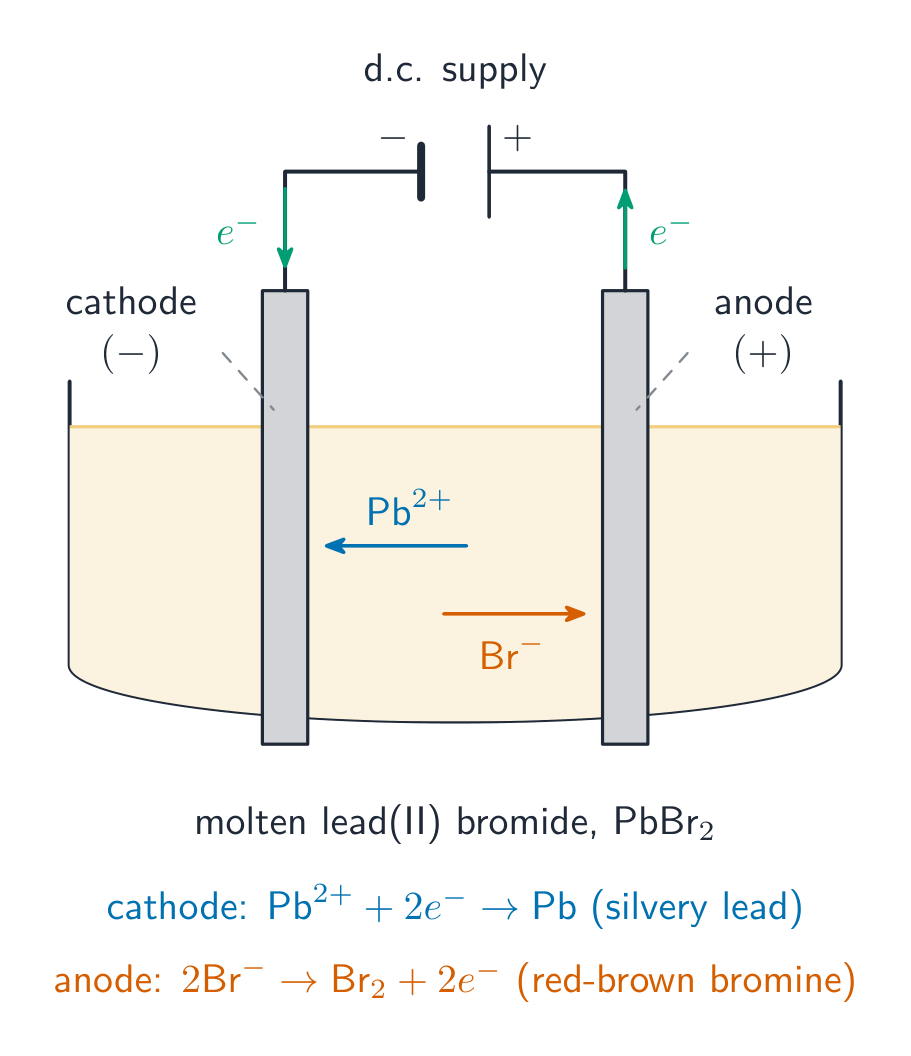
In electrolysis 电解, the charge passed determines how much substance is deposited or produced – Faraday's law 法拉第定律. Convert current × time to charge, charge to moles of electrons ($F=96{,}485$ C/mol), then use the half-reaction's electron ratio to get moles (and mass) of product.

Worked example. A current of $2.0\ \text{A}$ flows for $30\ \text{minutes}$ through copper(II) sulfate ($\text{Cu}^{2+}+2e^-\rightarrow\text{Cu}$). How much copper is deposited? The charge is $Q=It=2.0\times1800=3600\ \text{C}$, giving $3600/96485=0.0373\ \text{mol}$ of electrons. Since each Cu needs $2$ electrons, $0.0187\ \text{mol}$ of Cu forms, a mass of $0.0187\times63.5=1.2\ \text{g}$.

ไทย
อิเล็กโทรไลซิส

ใน อิเล็กโทรไลซิส ปริมาณประจุที่ไหลผ่านกำหนดปริมาณสารที่ตกตะกอนหรือเกิดขึ้น – กฎของฟาราเดย์ แปลงกระแส × เวลา เป็นประจุ เปลี่ยนประจุเป็นโมลของอิเล็กตรอน ($F=96{,}485$ C/mol) แล้วใช้อัตราส่วนอิเล็กตรอนจาก HALF-REACTION เพื่อหาโมล (และมวล) ของผลิตภัณฑ์

การอิเล็กโทรไลซิส: ไอออนเคลื่อนที่ไปยังขั้วไฟฟ้าและถูกปลดประจุ
อิเล็กโทรไลซิส: ไอออนเคลื่อนที่ไปยังขั้วไฟฟ้าและเกิดการปลดประจุ

ตัวอย่างคำนวณ. กระแส $2.0\ \text{A}$ ไหลผ่านสำหรับ $30\ \text{minutes}$ ผ่าน铜(II) ซัลเฟต ($\text{Cu}^{2+}+2e^-\rightarrow\text{Cu}$) มีทองแดงตกตะกอนกี่กรัม? ประจุที่ได้คือ $Q=It=2.0\times1800=3600\ \text{C}$ ทำให้ได้ $3600/96485=0.0373\ \text{mol}$ ของอิเล็กตรอน เนื่องจาก Cu แต่ละตัวต้องใช้ $2$ อิเล็กตรอน จึงได้ $0.0187\ \text{mol}$ ของ Cu เกิดขึ้น ซึ่งมีมวลเท่ากับ $0.0187\times63.5=1.2\ \text{g}$

Explore · ⁨สำรวจ⁩

Electrolyse a molten salt · ⁨อิเล็กโทรไลต์เกลือหลอมเหลว⁩

Electrolysis uses current to force a non-spontaneous reaction: positive ions gain electrons at the cathode, negative ions lose them at the anode. Charge sets the amount deposited. · ⁨การแยกอิเล็กโทรไลต์ ใช้กระแสไฟเพื่อกระตุ้นปฏิกิริยาที่ไม่เกิดขึ้นเอง: ไอออนบวกรับอิเล็กตรอนที่ขั้วแคโทด และไอออนลบเสียอิเล็กตรอนที่ขั้วแอโนด ปริมาณประจุกำหนดปริมาณสารที่สะสม⁩

Vocabulary · ⁨คำศัพท์⁩ Train · ⁨ฝึกฝน⁩
English ไทย
electrolytic cell/ɪˌlektrəˈlɪtɪk sel/ เซลล์อิเล็กโทรไลต์
electrolysis/ɪlekˈtrɒləsɪs/ electrolysis
Faraday's law/ˈfærədeɪz lɔː/ กฎของ فارาเดย์
9.11

Exam tips · ⁨ข้อแนะนำสำหรับการสอบ⁩

English
  • A process is thermodynamically favourable when $\Delta G<0$; combine enthalpy and entropy with $\Delta G=\Delta H-T\Delta S$ (match units — kJ vs J).
  • Entropy increases solid→liquid→gas and when more gas moles are produced.
  • Favourable does not mean fast — a high activation energy can make a $\Delta G<0$ reaction extremely slow (kinetic control).
  • In electrochemistry a positive $E^\circ_{\text{cell}}=E^\circ_{\text{cathode}}-E^\circ_{\text{anode}}$ means a spontaneous (galvanic) cell; oxidation is at the anode, reduction at the cathode.
  • In electrolysis the charge passed ($Q=It$) fixes the amount deposited (Faraday's law).
ไทย
  • กระบวนการหนึ่งจะ เกิดเองทางอุณหพลศาสตร์ เมื่อ $\Delta G<0$; รวมเอนทาลปีและเอนโทรปีด้วย $\Delta G=\Delta H-T\Delta S$ (ตรวจสอบให้แน่ใจว่าหน่วยตรงกัน — kJ เทียบกับ J)
  • เอนโทรپی เพิ่มขึ้น จากของแข็ง→ของเหลว→แก๊ส และเมื่อเกิดแก๊สมোলมากขึ้น
  • เป็นไปได้ไม่แปลว่าเร็ว – พลังงานกระตุ้นที่สูงอาจทำให้ปฏิกิริยา $\Delta G<0$ ช้ามาก (ควบคุมโดยจลนศาสตร์)
  • ในเคมีไฟฟ้า ค่าบวก ของ $E^\circ_{\text{cell}}=E^\circ_{\text{cathode}}-E^\circ_{\text{anode}}$ หมายถึงเซลล์ที่เกิดขึ้นเอง (กัลวานิก); ออกซิเดชันอยู่ที่ อะโนด, รีดักชันอยู่ที่ แคโทด
  • ในอิเล็กโทรไลซิสประจุที่ไหลผ่าน ($Q=It$) กำหนดปริมาณที่ตกตะกอน (กฎของฟาราเดย์)

Interactive lessons on this topic · ⁨บทเรียนเชิงโต้ตอบสำหรับหัวข้อนี้⁩

Work through it step by step, with instant-check exercises. · ⁨ทำทีละขั้นตอน พร้อมแบบฝึกหัดตรวจสอบผลทันที⁩

Past Papers · ⁨ข้อสอบย้อนหลัง⁩

More topics in AP Chemistry · ⁨หัวข้อเพิ่มเติมใน AP Chemistry⁩

Log in or create account · ⁨เข้าสู่ระบบหรือสร้างบัญชี⁩

IGCSE, A-Level & AP