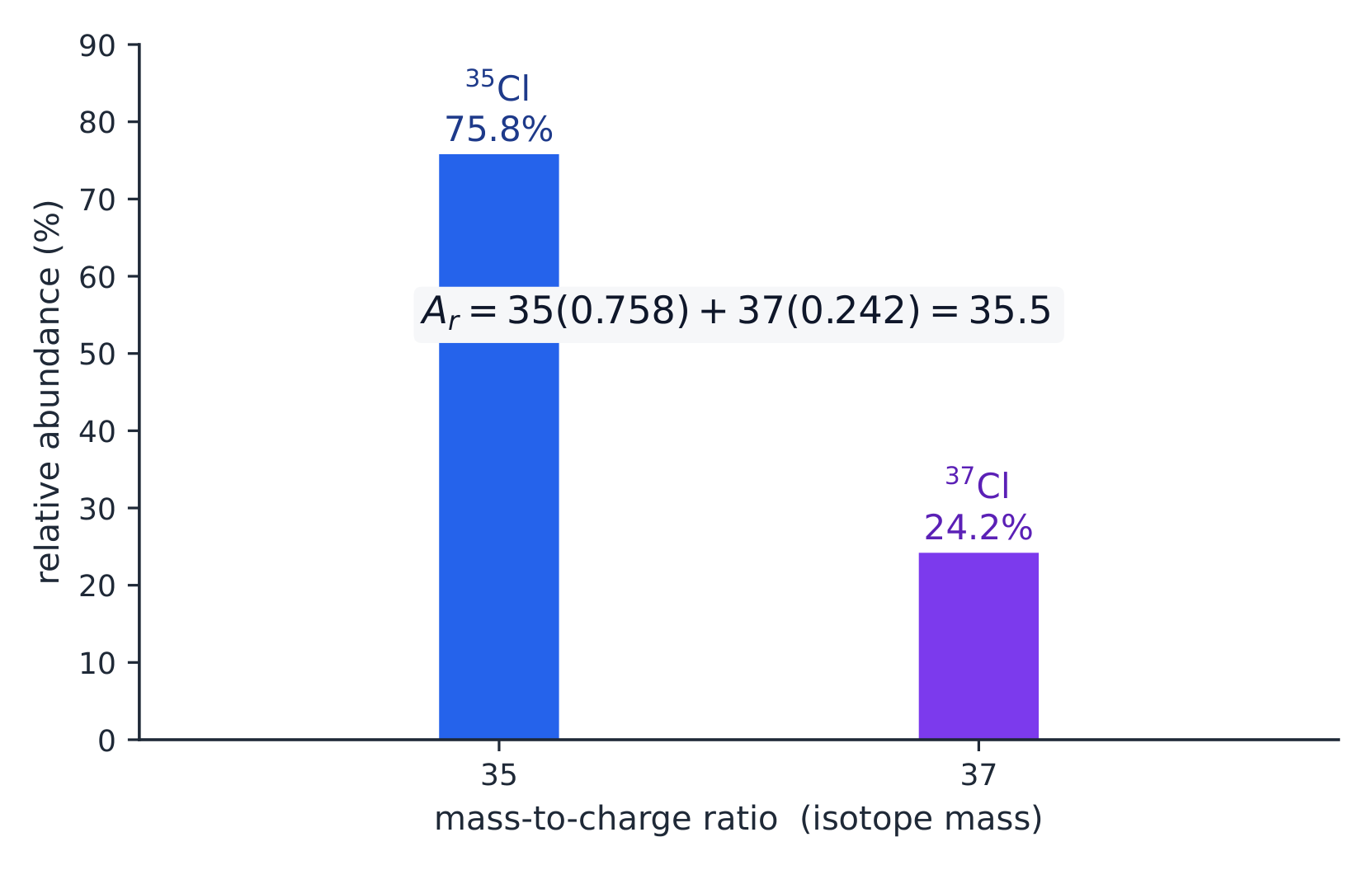
ข้อยกเว้น: การตีความสเปกตรัมมวลของตัวอย่างที่มีหลายองค์ประกอบหรือยอดที่เกิดจากสปีชีส์อื่นนอกจากไอออนอะตอมเดี่ยวที่มีประจุเดียว จะไม่ถูกประเมินในการสอบ AP
แหล่งที่มา: คำอธิบายหลักสูตรและข้อสอบ College Board AP
แหล่งที่มา: คำอธิบายหลักสูตรและข้อสอบ College Board AP
Unlike a pure compound, a mixture has variable composition – its parts keep their own identities. Describe a mixture by the mass or mole fraction of each component; these do not follow a fixed formula. Spectroscopy (like PES or absorption) can measure how much of each component is present.
ข้อควรระวัง: การกำหนดเลขควอนตัมให้กับอิเล็กตรอนในชั้นย่อยของอะตอมจะไม่ถูกทดสอบในการสอบ AP
1.5.A.4 The relative energy required to remove an electron from different subshells of an atom or ion or from the same subshell in different atoms or ions (ionization energy) can be estimated through a qualitative application of Coulomb's law. This energy is related to the distance from the nucleus and the effective (shield) charge of the nucleus.
แหล่งที่มา: คำอธิบายหลักสูตรและข้อสอบ College Board AP
วัตถุประสงค์การเรียนรู้ 1.6.A: อธิบายความสัมพันธ์ระหว่างสเปกตรัมโฟโตอิเล็กตรอนของอะตอมหรือไอออนกับ:
i. การจัดเรียงอิเล็กตรอนสถานะพื้นของสปีชีสนั้น
ii. การมีปฏิสัมพันธ์ระหว่างอิเล็กตรอนกับนิวเคลียส
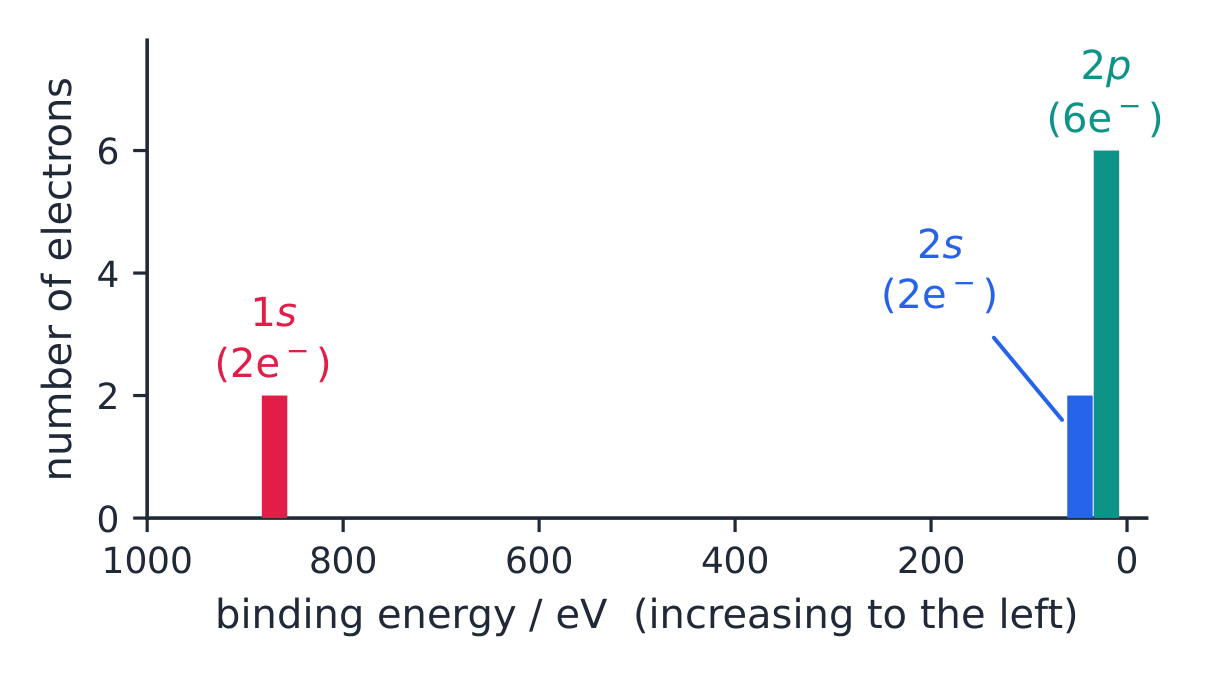
1.6.A.1 พลังงานของอิเล็กตรอนในชั้นที่กำหนดสามารถวัดได้ by photoelectron spectroscopy (PES) ตำแหน่งของยอดแหลมแต่ละตัวในสเปกตรัม PES เกี่ยวข้องกับพลังงานที่ต้องการในการดึงอิเล็กตรอนออกจากชั้นย่อยที่เกี่ยวข้อง และความสูงสัมพัทธ์ของยอดแหลมแต่ละตัวจะ (ในทางทฤษฎี) แปรผันตรงกับจำนวนอิเล็กตรอนในชั้นย่อยนั้น
แหล่งที่มา: คำอธิบายหลักสูตรและข้อสอบ College Board AP
1.7.A.1 The organization of the periodic table is based on patterns of recurring properties of the elements, which are explained by patterns of ground-state electron configurations and the presence of completely or partially filled shells (and subshells) of electrons in atoms.
ข้อยกเว้น: การเขียนการกำหนดค่าอิเล็กตรอนของธาตุที่เป็นข้อยกเว้นต่อหลักอ๊อฟบาว will not be assessed on the AP Exam.
电负性 rises across a period and falls down a groupEnergy ionization rises across each period, drops at each new shell, and dips slightly at boron/aluminium and oxygen/sulfur