| Big Idea | Learning Objective | Essential Knowledge |
|---|---|---|
Big Idea 3 — Information Storage and Transmission | 5.1.A |
|
5.1.B |
|
Heredity · พันธุกรรม
AP Biology · Topic 5 · หัวข้อ 5
 7:53
7:53
พันธุกรรม
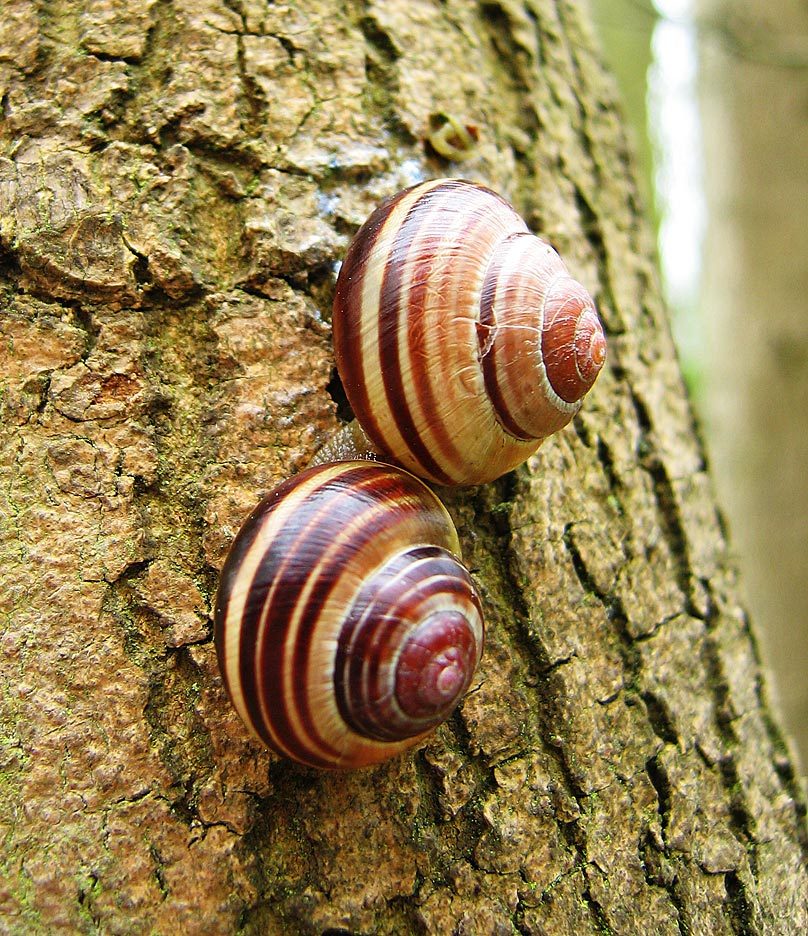
หอยทากสองตัวอยู่บนต้นไม้เดียวกัน สายพันธุ์เดียวกัน cortey เดียวกันสภาพอากาศเหมือนกัน แต่ลองมองที่เปลือกหอย ตัวหนึ่งมีสีอ่อนพร้อมแถบสีเข้มบางๆ อีกตัวหนึ่งมีสีเข้มพร้อมแถบกว้าง…
English narration · English + 中文 subtitles burned in · การบรรยายภาษาอังกฤษ · คำบรรยายภาษาอังกฤษ + 中文 ลอยตัวบนภาพ
5.1
Meiosis
Syllabus · หลักสูตร
Source: College Board AP Course and Exam Description · แหล่งที่มา: คำอธิบายหลักสูตรและข้อสอบ College Board AP
English
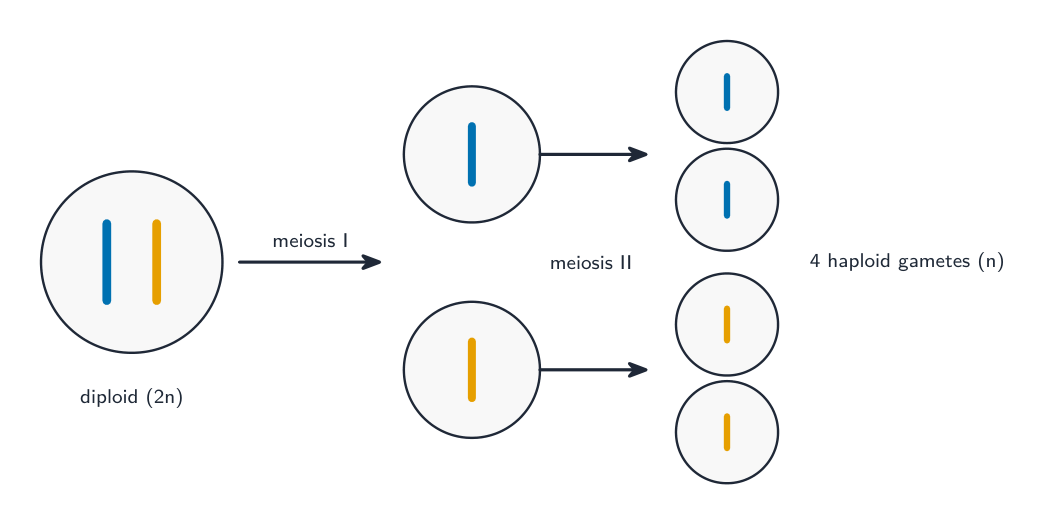
Meiosis 减数分裂 makes gametes 配子 (eggs and sperm) with half the chromosome number, so fertilization restores the full set. One diploid cell divides twice to give four haploid cells. Meiosis I separates homologous chromosomes 同源染色体 (reducing the number); meiosis II separates sister chromatids (like mitosis).
ไทย
Meiosis สร้าง ** gametes** (ไข่และอสุจิ) ที่มีจำนวนโครโมโซม ครึ่งหนึ่ง เพื่อให้การปฏิสนธิคืนจำนวนเต็มชุด เซลล์ diploid หนึ่งเซลล์แบ่ง สองครั้ง เพื่อให้เกิด haploid cells สี่เซลล์ Meiosis I แยก homologous chromosomes (ลดจำนวน); Meiosis II แยก sister chromatids (เหมือน mitosis)
Explore · สำรวจ
Divide a cell's chromosomes · 分离细胞的染色体
Meiosis halves the chromosome number and shuffles genes, making four genetically varied gametes. Step through to see the divisions. · 减数分裂减半染色体数量并重新组合基因,产生四个遗传上多样的配子。逐步浏览以查看分裂过程。
Vocabulary · คำศัพท์
Train · ฝึกฝน
| English | ไทย |
|---|---|
| Meiosis/meɪˈəʊsɪs/ | Meiosis |
| gametes/ˈɡæmiːts/ | 配子 |
| homologous chromosomes/həˈmɒləɡəs ˈkrəʊməsəʊmz/ | โครโมโซมโฮโมโลกัส |
5.2
Meiosis and Genetic Diversity · Meiosis และความหลากหลายทางพันธุกรรม
Syllabus · หลักสูตร
English
Enduring Understanding (BIG IDEA 3 — Information Storage and Transmission): Living systems store, retrieve, transmit, and respond to information essential to life processes.
Learning Objective 5.2.A: Explain how the process of meiosis generates genetic diversity.
- 5.2.A.1 Correct separation of the homologous chromosomes in meiosis I and sister chromatids in meiosis II ensures that each gamete receives a haploid (1n) set of chromosomes that comprises an assortment of both maternal and paternal chromosomes. When incorrect separation occurs (nondisjunction), gametes are no longer haploid.
- 5.2.A.2 During prophase I of meiosis, non-sister chromatids exchange genetic material via a process called crossing over (recombination), which increases genetic diversity among the resultant gametes.
- 5.2.A.3 Sexual reproduction in eukaryotes increases genetic variation, including crossing over, random assortment of chromosomes during meiosis, and subsequent fertilization of gametes.
- Exclusion statement: Knowledge of the details of sexual reproduction cycles in various plants and animals is beyond the scope of the AP Exam.
ไทย
ความเข้าใจที่ยั่งยืน (BIG IDEA 3 — การจัดเก็บและการถ่ายทอดข้อมูล): ระบบชีวภาพจัดเก็บ รื้อค้น ถ่ายทอด และตอบสนองต่อข้อมูลที่จำเป็นต่อกระบวนการดำรงชีวิต
วัตถุประสงค์การเรียนรู้ 5.2.A: อธิบายว่ากระบวนการไมโอซิสสร้างความหลากหลายทางพันธุกรรมได้อย่างไร
- 5.2.A.1 การแยกโครโมโซมโฮโมโลกัสในไมโอซิส I และโครมาทิดพี่น้องในไมโอซิส II อย่างถูกต้อง ทำให้มั่นใจได้ว่า GAMETE แต่ละตัวจะได้รับชุดโครโมโซมเฮปอยด์ (1n) ที่ประกอบด้วยชุดผสมผสานของโครโมโซมจากทั้งแม่และพ่อ เมื่อเกิดการแยกไม่ถูกต้อง (nondisjunction) GAMETE จะ不再是เฮปอยด์
- 5.2.A.2 ในช่วงโพรเฟส I ของไมโอซิส โครมาทิดที่ไม่ใช่พี่น้องแลกเปลี่ยนวัสดุทางพันธุกรรมผ่านกระบวนการที่เรียกว่า crossing over (recombination) ซึ่งเพิ่มความหลากหลายทางพันธุกรรมใน GAMETE ที่เกิดขึ้นใหม่
- 5.2.A.3 การสืบพันธุ์แบบอาศัยเพศในสิ่งมีชีวิตมีนิวเคลียสเพิ่มความหลากหลายทางพันธุกรรม ซึ่งรวมถึงการแลกเปลี่ยนส่วนยีนระหว่างโครโมโซม (crossing over), การจัดเรียงโครโมโซมแบบสุ่มduring meiosis และการผสมพันธุ์ของเซลล์สืบพันธุ์ต่อไป
- ข้อจำกัด: ความรู้รายละเอียดเกี่ยวกับวงจรการสืบพันธุ์แบบอาศัยเพศในพืชและสัตว์ต่างๆ อยู่เหนือขอบเขตของข้อสอบ AP
Source: College Board AP Course and Exam Description · แหล่งที่มา: คำอธิบายหลักสูตรและข้อสอบ College Board AP
English
Meiosis shuffles genes three ways, so offspring differ from parents and each other:
- Crossing over 交叉互换: homologous chromosomes swap segments in meiosis I.
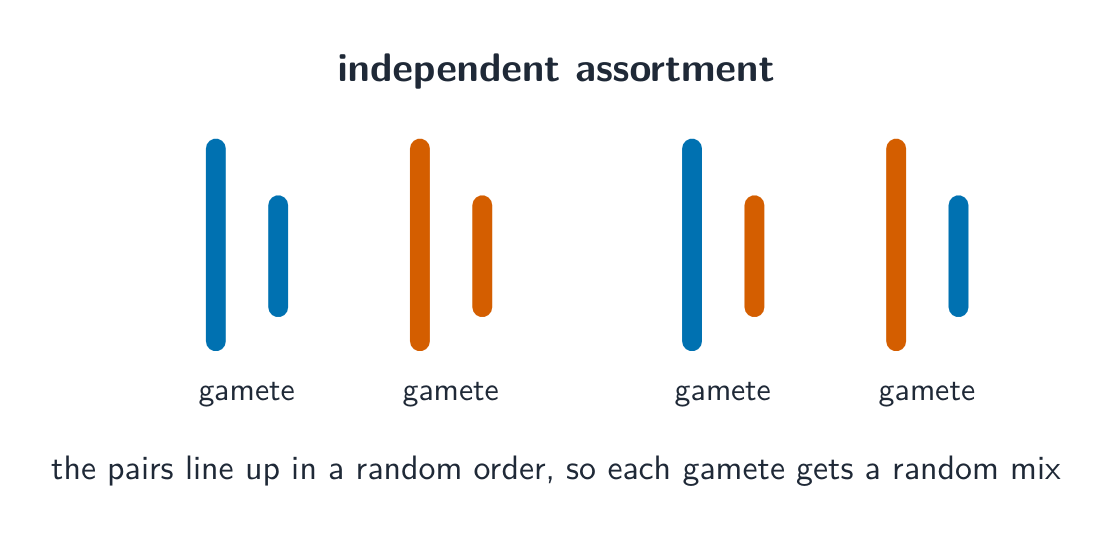
- Independent assortment 自由组合: each homologous pair lines up and separates randomly.
- Random fertilization: any sperm can meet any egg.
Together these create enormous variation – the raw material for evolution.
ไทย
Meiosis จัดเรียง.splice genes สามวิธี ทำให้ลูกหลานแตกต่างจากพ่อแม่และ друг друг:
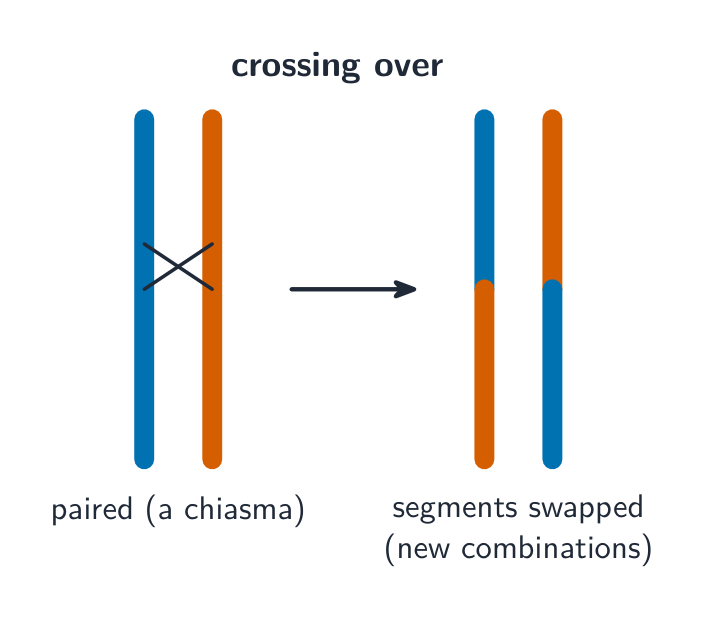
- Crossing over: homologous chromosomes สลับ fragments ใน meiosis I
- Independent assortment: แต่ละ homologous pair เรียงตัวและแยกอย่างสุ่ม
- Random fertilization: อสุจิตัวใดก็พบไข่ตัวใดก็ได้
ทั้งหมดนี้สร้างความหลากหลายมหาศาล – วัตถุดิบสำหรับการวิวัฒนาการ
Vocabulary · คำศัพท์
Train · ฝึกฝน
| English | ไทย |
|---|---|
| Crossing over/ˈkrɒsɪŋ ˈəʊvə/ | Crossing over |
| Independent assortment/ˌɪndɪˈpendənt əˈsɔːtmənt/ | Independent assortment |
5.3
Mendelian Genetics · พันธุศาสตร์ของเมนเดล
Syllabus · หลักสูตร
English
Enduring Understanding (BIG IDEA 1 — Evolution): The process of evolution drives the diversity and unity of life.
Enduring Understanding (BIG IDEA 3 — Information Storage and Transmission): Living systems store, retrieve, transmit, and respond to information essential to life processes.
Learning Objective 5.3.A: Explain the inheritance of genes and traits as described by Mendel's laws.
- 5.3.A.1 Mendel's laws of segregation and independent assortment can be applied to genes that are on different chromosomes.
- 5.3.A.2 In most cases, fertilization involves the fusion of two haploid gametes, restoring the diploid number of chromosomes and increasing genetic variation in populations by creating new combinations of alleles in the zygote.
- i. Rules of probability can be applied to analyze the passing of single-gene traits from parent to offspring.
- ii. Monohybrid, dihybrid, and test crosses can be used to determine whether alleles are dominant or recessive.
- iii. An organism's genotype is the set of alleles inherited for one or more genes by an individual organism. An organism's genotype can be homozygous or heterozygous for each gene.
- iv. An organism's phenotype is the observable expression of the inherited traits.
- v. Patterns of inheritance (autosomal, genetically linked, sex-linked) and whether an allele is dominant or recessive can often be predicted from data, including pedigrees. Punnett squares can be used to predict the genotypes and phenotypes of parents and offspring.
- Equation (Laws of Probability): If $A$ and $B$ are mutually exclusive, then: $P(A \text{ or } B) = P(A) + P(B)$
- Equation (Laws of Probability): If $A$ and $B$ are independent, then: $P(A \text{ and } B) = P(A) \times P(B)$
ไทย
ความเข้าใจที่ยั่งยืน (BIG IDEA 1 — วิวัฒนาการ): กระบวนการวิวัฒนาการขับเคลื่อนความหลากหลายและความสามัคคีของชีวิต
ความเข้าใจที่ยั่งยืน (BIG IDEA 3 — การจัดเก็บและการถ่ายทอดข้อมูล): ระบบชีวภาพจัดเก็บ รื้อค้น ถ่ายทอด และตอบสนองต่อข้อมูลที่จำเป็นต่อกระบวนการดำรงชีวิต
วัตถุประสงค์การเรียนรู้ 5.3.A: อธิบายการถ่ายทอดยีนและลักษณะตามกฎของเมนเดล
- 5.3.A.1 กฎการแยกตัวของเมนเดลและการจัดกลุ่มอิสระสามารถนำไปใช้กับยีนที่อยู่บนโครโมโซมที่ต่างกันได้
- 5.3.A.2 ในส่วนใหญ่แล้ว การผสมพันธุ์เกี่ยวข้องกับการรวมกันของเซลล์สืบพันธุ์ haploid สองเซลล์ ซึ่งคืนค่าจำนวนโครโมโซมเป็น diploid และเพิ่มความหลากหลายทางพันธุกรรมในประชากรโดยการสร้างชุดอัลลีลใหม่ใน zygotе
- i. กฎของความน่าจะเป็นสามารถนำไปใช้วิเคราะห์การถ่ายทอดลักษณะจากยีนเดี่ยวจากผู้ปกครองไปยังลูกหลานได้
- ii. การข้ามสายพันธุ์ monohybrid, dihybrid และการทดสอบ (test cross) สามารถใช้เพื่อบอกได้ว่าอัลลีลนั้นเป็นดอமிแนนต์หรือรีเซสซีฟ
- iii. จีโนไทป์ของสิ่งมีชีวิตคือชุดของอัลลีลที่ถูกถ่ายทอดมาสำหรับยีนหนึ่งหรือมากกว่าโดยสิ่งมีชีวิตหนึ่งๆ จีโนไทป์ของสิ่งมีชีวิตอาจเป็นโฮโมไซกัสหรือเฮเทอโรไซกัสสำหรับแต่ละยีน
- iv. Phenotype ของสิ่งมีชีวิตคือการแสดงออกที่สังเกตได้จากลักษณะที่ถูกถ่ายทอดมา
- v. รูปแบบการถ่ายทอด (autosomal, genetic linkage, sex-linked) และว่าอัลลีลใดเป็นดอமிแนนต์หรือรีเซสซีฟ มักจะคาดการณ์ได้จากข้อมูล รวมถึงแผนภูมิต้นไม้ (pedigrees) ตารางพันต์ (Punnett squares) สามารถใช้เพื่อทำนายจีโนไทป์และฟีโนไทป์ของผู้ปกครองและลูกหลาน
- สมการ (กฎของความน่าจะเป็น): หาก $A$ และ $B$ เป็น mutually exclusive แล้ว: $P(A \text{ or } B) = P(A) + P(B)$
- สมการ (กฎของความน่าจะเป็น): หาก $A$ และ $B$ เป็น independent แล้ว: $P(A \text{ and } B) = P(A) \times P(B)$
Source: College Board AP Course and Exam Description · แหล่งที่มา: คำอธิบายหลักสูตรและข้อสอบ College Board AP
English
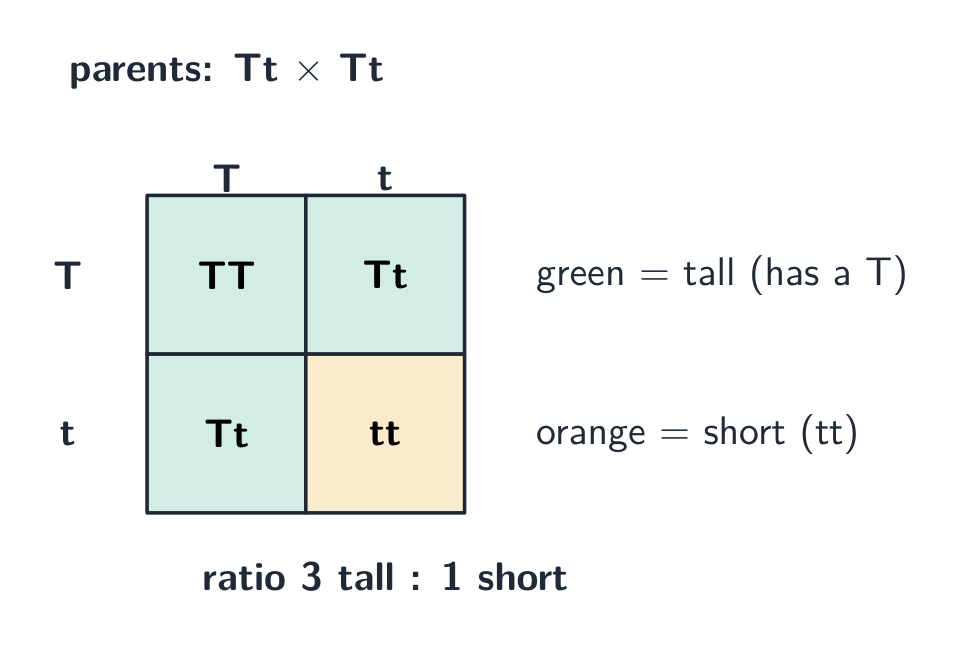
A gene's alternative versions are alleles 等位基因. An organism's genotype 基因型 (its alleles) produces its phenotype 表型 (its traits). Mendel's rules: a dominant 显性 allele masks a recessive 隐性 one; the two alleles segregate into different gametes (law of segregation); genes for different traits assort independently. A Punnett square 庞纳特方格 predicts offspring ratios (a heterozygous cross gives 3:1). Homozygous 纯合 means two identical alleles; heterozygous 杂合 means two different.
Worked example. For a dihybrid cross of two independent genes, $AaBb\times AaBb$, use the multiplication rule instead of a $16$-box square. Each gene alone gives $\tfrac34$ dominant, so the chance an offspring shows both dominant traits is $\tfrac34\times\tfrac34=\tfrac{9}{16}$, and the chance of the fully recessive $aabb$ is $\tfrac14\times\tfrac14=\tfrac{1}{16}$. Multiplying two independent $3{:}1$ ratios is what produces the classic $9{:}3{:}3{:}1$ pattern.
ไทย
เวอร์ชันทางเลือกของ gene คือ alleles. Genotype ของสิ่งมีชีวิต (alleles ของมัน) ผลิต phenotype (ลักษณะของ nó). กฎของเมนเดล: dominant allele บดบัง recessive allele; alleles ทั้งสอง segregate เข้า gametes ที่แตกต่างกัน (กฎของการ segregate); genes สำหรับลักษณะต่างๆ assortment independently. Punnett square ทำนายอัตราส่วนลูก (การ cross ของ heterozygous ให้ 3:1). Homozygous หมายความว่า alleles สองตัวเหมือนกัน; heterozygous หมายความว่าสองตัวต่างกัน
ตัวอย่างฝึกหัด. สำหรับ dihybrid cross ของ two independent genes, $AaBb\times AaBb$, ใช้ multiplication rule แทน $16$-box square. Each gene alone ให้ $\tfrac34$ dominant, ดังนั้นโอกาสที่ลูกจะแสดง both dominant traits คือ $\tfrac34\times\tfrac34=\tfrac{9}{16}$, และโอกาสของ fully recessive $aabb$ คือ $\tfrac14\times\tfrac14=\tfrac{1}{16}$. การคูณสอง independent $3{:}1$ ratios คือสิ่งที่ผลิต classic $9{:}3{:}3{:}1$ pattern
Explore · สำรวจ
Cross two parents · 杂交两个亲本
A Punnett square combines each parent's alleles to predict the offspring ratios. Set the parent genotypes and read off the expected proportions. · 庞尼特方格结合每个亲本的等位基因以预测后代比例。设置亲本基因型并读取预期比例。
Vocabulary · คำศัพท์
Train · ฝึกฝน
| English | ไทย |
|---|---|
| alleles/əˈliːlz/ | อัลลีล |
| genotype/ˈdʒenətaɪp/ | genotype |
| phenotype/ˈfenətaɪp/ | phenotype |
| dominant/ˈdɒmɪnənt/ | หลัก (dominant) |
| recessive/rɪˈsesɪv/ | recessive |
| Punnett square/ˈpʌnɪt skweə/ | ตารางพันเนต |
| Homozygous/ˌhɒməˈzɪɡəs/ | โฮโมไซกัส |
| heterozygous/ˌhetrəˈzɪɡəs/ | เฮเทอโรไซกัส |
5.4
Non-Mendelian Genetics · พันธุศาสตร์นอกเหนือจากเมนเดล
Syllabus · หลักสูตร
English
Enduring Understanding (BIG IDEA 3 — Information Storage and Transmission): Living systems store, retrieve, transmit, and respond to information essential to life processes.
Learning Objective 5.4.A: Explain deviations from Mendel's model of the inheritance of traits.
- 5.4.A.1 Patterns of inheritance of many traits do not follow the ratios predicted by Mendel's laws and can be identified by quantitative analysis, when the observed phenotypic ratios statistically differ from the predicted ratios.
- i. Genes located on the same chromosome are referred to as being genetically linked. The probability that these linked genes segregate together during meiosis can be used to calculate the map distance (or map units) between them on a chromosome. This calculation is called gene or genetic mapping.
- ii. Codominance occurs when the phenotype from both alleles is expressed such that the heterozygote would have a different phenotype than either homozygote.
- iii. Incomplete dominance occurs when neither allele of a gene can mask the other, so the phenotype of the heterozygote is a blended version of the dominant and recessive phenotypes.
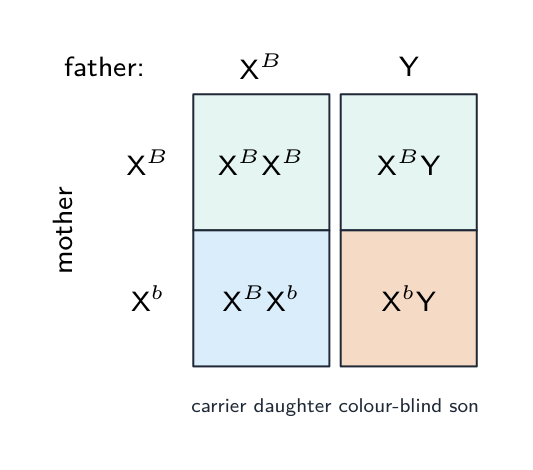
- 5.4.A.2 Some traits, known as sex-linked traits (X- or Y-linked), are determined by genes on sex chromosomes. The pattern of inheritance of sex-linked traits can often be predicted from data, including pedigrees, indicating the genotypes and phenotypes of both parents and offspring.
- Illustrative examples for EK 5.4.A.2:
- Sex-linked traits (X- or Y-linked) reside on sex chromosomes.
- Sex-linked traits (X- or Y-linked) are inherited at higher rates in XY individuals than they are in XX individuals.
- In certain species, the chromosomal basis of sex determination is not based on X and Y chromosomes (e.g., ZW in birds, haplodiploidy in bees).
- Illustrative examples for EK 5.4.A.2:
- 5.4.A.3 Pleiotropy is a phenomenon in which the expression of a single gene results in multiple traits or effects; these traits therefore do not segregate independently.
- 5.4.A.4 Some traits result from non-nuclear inheritance.
- i. Chloroplasts and mitochondria are randomly assorted to gametes and daughter cells; thus, traits determined by chloroplast and mitochondrial DNA do not follow simple Mendelian rules.
- ii. In animals, mitochondria are usually transmitted by the egg and not by sperm; thus, traits determined by the mitochondrial DNA are typically maternally inherited.
- iii. In plants, mitochondria and chloroplasts are transmitted in the ovule and not in the pollen; as such, mitochondria-determined and chloroplast-determined traits are typically maternally inherited.
ไทย
ความเข้าใจที่ยั่งยืน (BIG IDEA 3 — การจัดเก็บและการถ่ายทอดข้อมูล): ระบบชีวภาพจัดเก็บ รื้อค้น ถ่ายทอด และตอบสนองต่อข้อมูลที่จำเป็นต่อกระบวนการดำรงชีวิต
วัตถุประสงค์การเรียนรู้ 5.4.A: อธิบายความเบี่ยงเบนจากโมเดลการถ่ายทอดลักษณะตามแนวคิดของเมนเดล
- 5.4.A.1 รูปแบบการถ่ายทอดของหลายลักษณะไม่สอดคล้องกับอัตราส่วนที่กฎของเมนเดลทำนายไว้ และสามารถระบุได้จากการวิเคราะห์เชิงปริมาณ เมื่ออัตราส่วน phenotype ที่สังเกตพบแตกต่างจากอัตราส่วนที่คาดไว้อย่างมีนัยสำคัญทางสถิติ
- i. ยีนที่อยู่บนโครโมโซมเดียวกันเรียกว่ามีการเชื่อมโยงทางพันธุกรรม (genetically linked) ความน่าจะเป็นที่ยีนเหล่านี้จะแยกตัวออกจากกันพร้อมกันในระหว่าง meiosis สามารถใช้คำนวณระยะห่างบนแผนที่ (map distance หรือ map units) ระหว่างพวกมันบนโครโมโซม การคำนวณนี้เรียกว่าการทำแผนที่ยีนหรือการทำแผนที่พันธุกรรม
- ii. Codominance เกิดขึ้นเมื่อ phenotype จากอัลลีลทั้งสองถูกแสดงออก ทำให้เฮเทอโรไซกัสมี phenotype ที่ต่างจากโฮโมไซกัสทั้งสองข้าง
- iii. Incomplete dominance เกิดขึ้นเมื่อไม่มีอัลลีลใดของยีนที่สามารถบดบังอีกอัลลีลหนึ่งได้ ดังนั้น phenotype ของเฮเทอโรไซกัสจึงเป็นการผสมผสานของ phenotype ดอமிแนนต์และรีเซสซีฟ
- 5.4.A.2 ลักษณะบางอย่างที่เรียกว่าลักษณะที่ LINK กับเพศ (X-linked หรือ Y-linked) ถูกกำหนดโดยยีนบนโครโมโซมเพศ รูปแบบการสืบทอดลักษณะที่ LINK กับเพศสามารถทำนายได้จากข้อมูลต่างๆ รวมถึงแผนภูมิต้นไม้ ซึ่งแสดงเจนotyep และฟีโนไทป์ของทั้งผู้ปกครองและลูกหลาน
- ตัวอย่างสำหรับ EK 5.4.A.2:
- ลักษณะที่ LINK กับเพศ (X-linked หรือ Y-linked) อยู่บนโครโมโซมเพศ
- ลักษณะที่ LINK กับเพศ (X-linked หรือ Y-linked) สืบทอดในอัตราที่สูงกว่าในบุคคล XY เมื่อเทียบกับบุคคล XX
- ในบางชนิด ความพื้นฐานทางโครโมโซมของการกำหนดเพศไม่ได้ขึ้นอยู่กับโครโมโซม X และ Y (เช่น ZW ในนก, haplodiploidy ในผึ้ง)
- ตัวอย่างสำหรับ EK 5.4.A.2:
- 5.4.A.3 Phenomenon ที่เรียกว่า Pleiotropy เกิดขึ้นเมื่อการแสดงออกของยีนตัวเดียวส่งผลให้เกิดหลายลักษณะหรือผลกระทบ؛ ดังนั้นลักษณะเหล่านี้จึงไม่แยกตัวอย่างอิสระ
- 5.4.A.4 บางลักษณะเกิดจากการสืบทอดที่ไม่ใช่จากนิวเคลียส
- i. คลอโรพลาสต์และไมโทคอนเดรียถูกจัดสรรแบบสุ่มไปยังแกมีตและเซลล์ลูก; ดังนั้นลักษณะที่กำหนดโดย DNA ของคลอโรพlasต์และไมโทคอนเดรียจึงไม่เป็นไปตามกฎเมนเดลแบบง่าย
- ii. ในสัตว์ ไมโทคอนเดรียจะถูกส่งต่อโดยไข่ส่วนใหญ่และไม่ถูกส่งต่อโดยสเปิร์ม ดังนั้นลักษณะที่กำหนดโดยดีเอ็นเอในไมโทคอนเดรียจึงมักถูกสืบทอดทางฝ่ายแม่
- iii. ในพืช ไมโทคอนเดรียและคลอโรพลาสต์จะถูกส่งต่อไปยังผลไม่แต่ไม่ถูกส่งต่อไปยังเกสร เมื่อเป็นเช่นนี้ ลักษณะที่กำหนดโดยไมโทคอนเดรียและคลอโรพลาสต์จึงมักถูกสืบทอดทางฝ่ายแม่
Source: College Board AP Course and Exam Description · แหล่งที่มา: คำอธิบายหลักสูตรและข้อสอบ College Board AP
English
Many traits do not follow simple dominance:
- Incomplete dominance 不完全显性: heterozygotes are a blend (red × white → pink).
- Codominance 共显性: both alleles show fully (AB blood type).
- Multiple alleles, polygenic 多基因 traits (many genes, like height), pleiotropy (one gene, many effects), and sex-linked 伴性 genes (on the X chromosome) all give more complex ratios.
Worked example (chi-square test). To check whether real data fit a predicted ratio, use $\chi^2=\sum\dfrac{(o-e)^2}{e}$. A monohybrid cross predicts $3{:}1$, so of $80$ offspring you expect $60$ dominant and $20$ recessive, but you observe $55$ and $25$. Then $\chi^2=\dfrac{(55-60)^2}{60}+\dfrac{(25-20)^2}{20}=\dfrac{25}{60}+\dfrac{25}{20}=0.42+1.25=1.67$. With $1$ degree of freedom the critical value at $p=0.05$ is $3.84$; since $1.67<3.84$, we fail to reject the null hypothesis – the deviation is within chance.
ไทย
หลายลักษณะไม่ได้遵循 simple dominance:
- Incomplete dominance: heterozygotes เป็นผสม (red × white → pink)
- Codominance: alleles ทั้งสองแสดงออกเต็มที่ (AB blood type)
- Multiple alleles, polygenic traits (many genes, เช่น ส่วนสูง), pleiotropy (one gene, many effects), และ sex-linked genes (on the X chromosome) ทั้งหมดให้ ratios ที่ซับซ้อนมากขึ้น
ตัวอย่างวิธีทำ (การทดสอบ chi-square). เพื่อตรวจสอบว่าข้อมูลจริงสอดคล้องกับอัตราส่วนที่คาดไว้หรือไม่ ให้ใช้ $\chi^2=\sum\dfrac{(o-e)^2}{e}$ การผสมพันธุ์แบบ monohybrid คาดหวัง $3{:}1$ ดังนั้นจาก $80$ ลูกหลาน คุณคาดว่าจะเห็น $60$ แบบเด่นและ $20$ แบบด้อย แต่ในความเป็นจริงพบ $55$ และ $25$ จากนั้น $\chi^2=\dfrac{(55-60)^2}{60}+\dfrac{(25-20)^2}{20}=\dfrac{25}{60}+\dfrac{25}{20}=0.42+1.25=1.67$ ด้วย $1$ องศาอิสรภาพ ค่าวิกฤตที่ $p=0.05$ คือ $3.84$; เนื่องจาก $1.67<3.84$ เรา ไม่ปฏิเสธ สมมติฐานศูนย์ – ความเบี่ยงเบนอยู่ในขอบเขตของความบังเอิญ
Vocabulary · คำศัพท์
Train · ฝึกฝน
| English | ไทย |
|---|---|
| Incomplete dominance/ɪŋkəmˈpliːt ˈdɒmɪnəns/ | การไม่สมบูรณ์ในการแสดงออก |
| Codominance/ˈkəʊdəmɪnəns/ | การแสดงออกของอัลลีลคู่ |
| polygenic/ˌpɒlɪˈdʒenɪk/ | หลายยีน |
| sex-linked/seks lɪŋkt/ | ติดกับเพศ |
5.5
Environmental Effects on Phenotype · ผลกระทบของสิ่งแวดล้อมต่อฟีโนไทป์
Syllabus · หลักสูตร
English
Enduring Understanding (BIG IDEA 4 — Systems Interactions): Biological systems interact, and these systems and their interactions exhibit complex properties.
Learning Objective 5.5.A: Explain how the same genotype can result in multiple phenotypes under different environmental conditions.
- 5.5.A.1 Environmental conditions influence gene expression and can lead to phenotypic plasticity (e.g., the ability of individual genotypes to produce different phenotypes).
- Illustrative examples for EK 5.5.A.1:
- Height and weight in humans
- Flower color based on soil pH
- Seasonal fur color in arctic animals
- Sex determination in reptiles
- Effect of increased UV on melanin production in animals
- Presence of the opposite mating type on pheromone production in yeast and other fungi
- Illustrative examples for EK 5.5.A.1:
ไทย
ความเข้าใจที่ยั่งยืน (BIG IDEA 4 — การมีปฏิสัมพันธ์ของระบบ): ระบบชีวภาพมีการมีปฏิสัมพันธ์กัน และระบบเหล่านี้พร้อมทั้งการมีปฏิสัมพันธ์将它们展现出复杂的性质。
วัตถุประสงค์การเรียนรู้ 5.5.A: อธิบายว่าจีโนไทป์เดียวกันสามารถสร้างฟีโนไทป์ที่หลากหลายภายใต้สภาพแวดล้อมที่แตกต่างกันได้อย่างไร
- 5.5.A.1 สภาพแวดล้อมมีอิทธิพลต่อการแสดงออกของยีนและอาจนำไปสู่ความยืดหยุ่นของฟีโนไทป์ (เช่น ความสามารถในการผลิตฟีโนไทป์ที่แตกต่างกันของจีโนไทป์แต่ละตัว)
- ตัวอย่างประกอบสำหรับ EK 5.5.A.1:
- ส่วนสูงและน้ำหนักในมนุษย์
- สีของดอกไม้ขึ้นอยู่กับค่า pH ของดิน
- สีขนตามฤดูกาลในสัตว์ขั้วโลก
- การกำหนดเพศในสัตว์เลื้อยคลาน
- ผลของการเพิ่มขึ้นของรังสี UV ต่อการผลิตเมลานินในสัตว์
- การมีอยู่ของประเภทการจับคู่ที่ตรงข้ามในการผลิตฟีโรโมนในยีสต์และเชื้อราอื่นๆ
- ตัวอย่างประกอบสำหรับ EK 5.5.A.1:
Source: College Board AP Course and Exam Description · แหล่งที่มา: คำอธิบายหลักสูตรและข้อสอบ College Board AP
English
Phenotype is not set by genes alone – the environment also matters. Temperature, nutrition, and other factors can change how genes are expressed (a Himalayan rabbit's dark fur where it is cold, a plant's height with more sunlight). So identical genotypes can give different phenotypes in different conditions.
ไทย
ฟีโนไทป์ไม่ได้กำหนดโดยยีนเพียงอย่างเดียว – สิ่งแวดล้อม ก็มีความสำคัญเช่นกัน อุณหภูมิ อาหาร และปัจจัยอื่นๆ สามารถเปลี่ยนแปลงการแสดงออกของยีน (ขนสีเข้มของกระต่ายหิมาลัยในพื้นที่หนาว, ความสูงของพืชเมื่อได้รับแสงแดดมากขึ้น) ดังนั้นจีโนไทป์ที่เหมือนกันอาจให้ฟีโนไทป์ที่แตกต่างกันในสภาวะแวดล้อมที่ต่างกัน
5.5
Exam tips · ข้อแนะนำสำหรับการสอบ
English
- Contrast mitosis (2 identical, full chromosome number) with meiosis (4 non-identical gametes, half the number).
- Explain variation from crossing over, independent assortment, and random fertilisation.
- Use the multiplication rule for dihybrid crosses (each gene's $3{:}1$ multiplied), and a chi-square test ($\chi^2=\sum\frac{(o-e)^2}{e}$) to judge observed vs expected ratios.
- Keep genotype (the alleles) separate from phenotype (what you see) — $AA$ and $Aa$ can look the same.
- Recognise non-Mendelian patterns: incomplete dominance, codominance, and sex linkage.
ไทย
- เปรียบเทียบ mitosis (2 เซลล์ identical, จำนวนโครโมโซมเต็มจำนวน) กับ meiosis (4 gametes ไม่ identical, จำนวนครึ่งหนึ่ง)
- อธิบายความแปรปรวนจาก crossing over, independent assortment และ random fertilisation
- ใช้กฎการคูณสำหรับการผสมพันธุ์แบบ dihybrid (multiply $3{:}1$ ของแต่ละยีน), และการทดสอบ chi-square ($\chi^2=\sum\frac{(o-e)^2}{e}$) เพื่อตัดสินอัตราส่วนที่สังเกตได้เทียบกับที่คาดหวัง
- แยก genotype (อัลลีล) ออกจาก phenotype (สิ่งที่มองเห็น) — $AA$ และ $Aa$ อาจดูเหมือนกัน
- รับรู้รูปแบบที่ไม่เป็น Mendelian: incomplete dominance, codominance และ sex linkage
Interactive lessons on this topic · บทเรียนเชิงโต้ตอบสำหรับหัวข้อนี้
Work through it step by step, with instant-check exercises. · ทำทีละขั้นตอน พร้อมแบบฝึกหัดตรวจสอบผลทันที
Past Papers · ข้อสอบย้อนหลัง