Skip to content · ⁨ข้ามไปยังเนื้อหา⁩

Superposition · ⁨การซ้อนทับ⁩

A-Level Physics · ⁨Physics A-Level⁩ · Topic 8 · ⁨หัวข้อ 8⁩

Video lesson for this topic · ⁨บทเรียนวิดีโอสำหรับหัวข้อนี้⁩ Open the video page · ⁨เปิดหน้าวิดีโอ⁩
19:48

การซ้อนทับ

ใส่หูฟังลดเสียงรบกวน และเสียงดังของเครื่องยนต์เครื่องบินจะเงียบลง แต่ส่วนที่แปลกประหลาดคือ: พวกมันไม่ได้บล็อกเสียง — พวกมัน…

English narration · English + 中文 subtitles burned in · ⁨การบรรยายภาษาอังกฤษ · คำบรรยายภาษาอังกฤษ + 中文 ลอยตัวบนภาพ⁩

8.1

Principle of superposition · ⁨หลักการซ้อนทับ⁩

Syllabus · ⁨หลักสูตร⁩
English
  1. explain and use the principle of superposition
  2. show an understanding of experiments that demonstrate stationary waves using microwaves, stretched strings and air columns (it will be assumed that end corrections are negligible; knowledge of the concept of end corrections is not required)
  3. explain the formation of a stationary wave using a graphical method, and identify nodes and antinodes
  4. understand how wavelength may be determined from the positions of nodes or antinodes of a stationary wave
ไทย
  1. อธิบายและใช้ หลักการซ้อนทับ
  2. แสดงความเข้าใจในการทดลองที่สาธิต คลื่นนิ่ง โดยใช้ไมโครเวฟ, เชือกตึง และคอลัมน์อากาศ (จะถือว่าค่าแก้ไขปลายมีค่าน้อยมาก; ไม่จำเป็นต้องรู้แนวคิดเรื่องค่าแก้ไขปลาย)
  3. อธิบายการเกิดคลื่นนิ่งโดยใช้วิธีกราฟิก และระบุตำแหน่ง โหนด และ แอนติโหนด
  4. เข้าใจวิธีการหา ความยาวคลื่น จากตำแหน่งของโหนดหรือแอนติโหนดของคลื่นนิ่ง

Source: Cambridge International syllabus · ⁨แหล่งที่มา: หลักสูตร Cambridge International⁩

English
Two waves make a standing wave

When two or more waves 波 overlap at a point, the displacement 位移 there is the vector sum 矢量和 of the displacements each wave would make on its own. This is the principle of superposition 叠加.

The waves pass through each other and come out unchanged. Superposition is the base of everything in this topic.

For the two-mark statement: when two or more waves meet at a point, the resultant displacement is the sum of the displacements of the individual waves. It is the displacements that add, not the amplitudes or the intensities, and the principle applies whenever waves of the same type overlap; the waves do not have to be coherent or of equal amplitude.

If two waves of amplitude 振幅 $A_{1}$ and $A_{2}$ meet:

  • in phase 同相 (crest 波峰 meets crest): the amplitude is $A_{1} + A_{2}$ (constructive interference 相长干涉).
  • exactly out of phase (crest meets trough 波谷, phase difference 相位差 $\pi$): the amplitude is $|A_{1} - A_{2}|$ (destructive interference 相消干涉).
  • any other phase difference $\phi$: the amplitude is somewhere between these two.

For intensity 强度, $I \propto A^{2}$. Two equal waves meeting in phase give intensity $(2A)^{2} = 4A^{2}$ — four times the intensity of one wave alone.

Because $I \propto A^{2}$, work in amplitudes first. Two waves of intensities $I$ and $4I$ have amplitudes $A$ and $2A$: superposing in phase gives amplitude $3A$ and intensity $9I$, in antiphase amplitude $A$ and intensity $I$. So two coherent waves of different intensities never cancel completely: the minima have intensity $(A_{2} - A_{1})^{2}$, not zero. A wave of amplitude $2A$ meeting one of amplitude $A/2$ travelling the opposite way gives a resultant that varies between $2.5A$ and $1.5A$, a stationary pattern with no true nodes. Doubling the amplitude of one of two equal waves that meet in phase takes the resultant from $2A$ to $3A$, so the intensity rises from $4A^{2}$ to $9A^{2}$: $2.25$ times.

ไทย
คลื่นสองลูกสร้างคลื่นนิ่ง

เมื่อคลื่นสองลูกหรือมากกว่ามาบรรจบกันที่จุดหนึ่ง การกระจัด ที่จุดนั้นจะเป็น ผลรวมเวกเตอร์ ของการกระจัดที่แต่ละคลื่นจะทำให้เกิดหากมันอยู่เดี่ยวๆ นี่คือ หลักการซ้อนทับ

คลื่นเหล่านี้ทะลุผ่านกันและออกมาโดยไม่เปลี่ยนแปลง การซ้อนทับเป็นพื้นฐานของทุกสิ่งในเรื่องนี้

สำหรับประโยค 2 คะแนน: เมื่อคลื่นสองลูกหรือมากกว่ามาบรรจบกันที่จุดหนึ่ง ผลรวมการกระจัดจะเป็นผลรวมของการกระจัดของคลื่นแต่ละลูก การกระจัดคือสิ่งที่ถูกนำมารวมกัน ไม่ใช่แอมพลิจูดหรือความเข้ม และหลักการนี้ใช้ได้ whenever คลื่นชนิดเดียวกันซ้อนทับกัน; คลื่นไม่จำเป็นต้องเป็น coherent หรือมีแอมพลิจูดเท่ากัน

หากคลื่นสองลูกที่มี แอมพลิจูด $A_{1}$ และ $A_{2}$ มาบรรจบกัน:

  • in phase (crest เจอกับ crest): แอมพลิจูดคือ $A_{1} + A_{2}$ (constructive interference).
  • Exactly out of phase (crest เจอกับ trough, phase difference $\pi$): แอมพลิจูดคือ $|A_{1} - A_{2}|$ (destructive interference).
  • ความต่างเฟสอื่น ๆ $\phi$: แอมพลิจูดจะอยู่ที่บางจุดระหว่างสองกรณีนี้
Two identical waves drawn in phase, one above the other, adding to give a resultant wave of twice the amplitude
Two waves arriving in phase add to give double the amplitude (constructive)
Two identical waves drawn exactly out of phase adding to give a flat resultant line of zero amplitude
Two waves arriving exactly out of phase cancel to zero (destructive)

สำหรับ ความเข้ม, $I \propto A^{2}$. คลื่นสองลูกเท่ากันมาบรรจบกันแบบ in phase ให้ความเข้ม $(2A)^{2} = 4A^{2}$ — สี่เท่า ของความเข้มของคลื่นเดียว

เนื่องจาก $I \propto A^{2}$ ให้ทำงานกับแอมพลิจูดก่อนคลื่นสองคลื่นที่มีความเข้ม $I$ และ $4I$ มีแอมพลิจูด $A$ และ $2A$: การซ้อนทับในเฟสให้แอมพลิจูด $3A$ และความเข้ม $9I$, ในเฟสตรงข้ามแอมพลิจูด $A$ และความเข้ม $I$. ดังนั้น คลื่น cohorent สองคลื่นที่มีความเข้มต่างกันจะไม่หักล้างกันสนิท: จุดต่ำสุดมีความเข้ม $(A_{2} - A_{1})^{2}$, ไม่ใช่ศูนย์. คลื่นที่มีแอมพลิจูด $2A$ พบกับคลื่นที่มีแอมพลิจูด $A/2$ ที่เคลื่อนที่ไปทางตรงข้าม จะได้ผลรวมที่แปรผันระหว่าง $2.5A$ และ $1.5A$, เป็นรูปแบบนิ่งที่มีโหนดจริง (true nodes) ไม่มี. การเพิ่มแอมพลิจูดของคลื่นหนึ่งจากคลื่นเท่ากันสองคลื่นที่ซ้อนทับกันในเฟส ทำให้ผลรวมเปลี่ยนจาก $2A$ เป็น $3A$, ดังนั้นความเข้มเพิ่มขึ้นจาก $4A^{2}$ เป็น $9A^{2}$: $2.25$ เท่า.

Explore · ⁨สำรวจ⁩

Adding two waves · ⁨การบวกคลื่นสองคลื่น⁩

Two waves overlap and add. Line them up for constructive interference, or oppose them for destructive — change the phase to see both. · ⁨คลื่นสองคลื่นทับซ้อนและ บวกกัน เรียงให้เข้าที่เพื่อการเสริมกัน หรือต้านกันเพื่อการหักล้าง — ปรับเฟสเพื่อดูทั้งสองกรณี⁩

Vocabulary · ⁨คำศัพท์⁩ Train · ⁨ฝึกฝน⁩
English ไทย
amplitude/ˈæmplɪtjuːd/ แอมพลิจูด
coherent/kəʊˈhɪərənt/ มีความสอดคล้องกัน (coherent)
in phase/ɪn feɪz/ อยู่ในเฟสเดียวกัน
crest/krest/ ยอดcrest
constructive interference/kənˈstrʌktɪv ˌɪntəˈfɪərəns/ การแทรกสอดแบบเสริมกัน
interference/ˌɪntəˈfɪərəns/ การแทรกแซง
trough/trɒf/ trough
phase difference/feɪz ˈdɪfrəns/ ความต่างเฟส
destructive interference/dɪˈstrʌktɪv ˌɪntəˈfɪərəns/ การแทรกสอดแบบหักล้างกัน
node/nəʊd/ โหนด
Watch lesson · ⁨ดูบทเรียน⁩
8.1

Stationary (standing) waves · ⁨คลื่นนิ่ง (standing waves)⁩

English

When two identical progressive waves 行波 travel in opposite directions and overlap, they make a stationary wave 驻波. Examples: a wave on a string reflected 反射 from a fixed end overlapping the incoming wave; sound in an air column reflected from a closed end; microwaves between an emitter and a metal sheet.

Explain how the stationary wave is formed (three or four marks, asked for a string, an air column and microwaves alike): the wave from the source travels to the far end (the wall, the closed end, the metal plate) and is reflected; the incident and reflected waves have the same frequency, wavelength and speed and travel in opposite directions; they superpose where they overlap; at the points where they always meet in phase the displacements add to give the maximum amplitude, an antinode, and at the points where they always meet in antiphase they cancel, a node. For "state the conditions": two waves of the same type, with the same frequency (and wavelength) and speed, travelling in opposite directions along the same line; equal amplitudes are needed only for the nodes to have zero amplitude. The metal plate in the microwave experiment is there to reflect the waves back along their own path.

Nodes and antinodes

In a stationary wave:

  • node 波节 — a point that is always at zero displacement (the two waves always cancel). The distance between next-door nodes is $\lambda/2$.
  • antinode 波腹 — a point of largest amplitude (the two waves always add). The distance between next-door antinodes is $\lambda/2$.
  • a node and the next antinode are $\lambda/4$ apart.

Particles between two nodes oscillate in phase with each other, but with different amplitudes (largest at the antinode, zero at the nodes). Particles on opposite sides of a node oscillate in antiphase 反相 (phase difference $\pi$).

So the phase difference between two points on the same loop (between adjacent nodes) is $0°$; between points on neighbouring loops it is $180°$; and between points on loops separated by one whole loop it is $0°$ again. Every point reaches its maximum displacement at the same instant and passes through zero at the same instant. A sketch of the string a quarter of a cycle after the instant of maximum displacement is a straight line along the rest position; half a cycle later it is the mirror image of the first sketch. In one period a particle at an antinode travels four amplitudes, so a particle that moves $72\ \text{mm}$ in one and a half periods has an amplitude of $12\ \text{mm}$.

Worked example. A string of length $0.80\ \text{m}$ is fixed at both ends and vibrates in its fundamental mode, where the wave speed is $240\ \text{m s}^{-1}$. Find the fundamental frequency.

One loop fits the string, so $\lambda = 2L = 1.60\ \text{m}$. Then

$$f = \frac{v}{\lambda} = \frac{240}{1.60} = 150\ \text{Hz}.$$

How a stationary wave differs from a progressive wave: it does not carry energy 能量 along its length, the pattern does not move along, and the nodes stay fixed; a progressive wave has the same amplitude everywhere and carries energy. The three differences the scheme lists: a progressive wave transfers energy and a stationary wave does not; in a progressive wave every point has the same amplitude, in a stationary wave the amplitude varies from zero at a node to a maximum at an antinode; in a progressive wave neighbouring points differ in phase, in a stationary wave all the points between two nodes are in phase.

Measuring wavelength from node spacing

Drive a string with a vibrator at frequency $f$ until a stationary pattern appears. Measure the distance between two well-separated nodes and divide by the number of half-wavelengths 波长 between them. Then $\lambda$ is known, and $v = f\lambda$ gives the wave speed.

For a tube closed at one end and open at the other (a resonance tube 共鸣管), the closed end is a displacement node and the open end is a displacement antinode. The fundamental 基频 has $L = \lambda/4$; the next resonance is at $L = 3\lambda/4$; and so on. For a tube open at both ends, both ends are antinodes; the fundamental is at $L = \lambda/2$.

The general rule: a closed end is a node and an open end an antinode, and a string fixed at both ends has a node at each end. So a closed pipe fits an odd number of quarter-wavelengths ($L = \lambda/4, 3\lambda/4, 5\lambda/4, \ldots$), while an open pipe and a fixed string fit whole half-wavelengths ($L = \lambda/2, \lambda, 3\lambda/2, \ldots$); a pipe open at both ends with $n$ nodes has $n + 1$ antinodes. Frequencies follow from $f = v/\lambda$: a closed pipe whose lowest note is $820\ \text{Hz}$ has $\lambda = 4L$, and a corridor $13.2\ \text{m}$ long with a reflecting door at each end resonates lowest at $f = v/2L = 330/26.4 = 12.5\ \text{Hz}$.

Worked example. A loudspeaker at the open end of a tube $0.51\ \text{m}$ long, closed at the other end, sets up a stationary wave with two nodes and two antinodes. Find the wavelength and, with $v = 340\ \text{m s}^{-1}$, the frequency.

Two nodes and two antinodes is the second mode of a closed pipe, $L = 3\lambda/4$, so $\lambda = 4 \times 0.51 / 3 = 0.68\ \text{m}$ and $f = 340 / 0.68 = 500\ \text{Hz}$. The longest wavelength that can resonate in this tube is $4L = 2.0\ \text{m}$.

The experiments the syllabus names all measure $\lambda$ from node or antinode spacing. In the resonance tube, a tube is raised out of water while a loudspeaker or tuning fork sounds at its open end; the sound is suddenly loud at the first resonance, when the air column is $\lambda/4$ long, and again at $3\lambda/4$, so the tube moves $\lambda/2$ between the two (a student needs no equipment to detect the resonance: the note becomes loud). In a dust tube, fine powder settles into heaps at the displacement nodes, $\lambda/2$ apart. With microwaves, a receiver moved along the line between the transmitter and a metal reflecting plate reads a minimum every $\lambda/2$: a receiver that starts at a minimum and passes six more minima in $1.05\ \text{m}$ has crossed $3\lambda$, so $\lambda = 0.35\ \text{m}$ and, with $v = 340\ \text{m s}^{-1}$ for the equivalent sound experiment, $f = 970\ \text{Hz}$. A stationary wave in a microwave oven melts chocolate at the antinodes, $\lambda/2$ apart, so the spot spacing and the oven's frequency ($2.45\ \text{GHz}$) give the speed of light from $c = f\lambda$.

ไทย

เมื่อ คลื่นหน้า (progressive waves) แบบเดียวกันสองคลื่นเคลื่อนที่ใน ทิศทางตรงกันข้าม และซ้อนทับกัน จะเกิด คลื่นนิ่ง. ตัวอย่าง: คลื่นบนสาย สะท้อน จากปลายตรึง ซ้อนทับกับคลื่นที่เข้ามา; เสียงในคอลัมน์อากาศสะท้อนจากปลายปิด; ไมโครเวฟระหว่างตัวส่งและแผ่นโลหะ.

อธิบายการเกิดคลื่นนิ่ง (สามหรือสี่คะแนน, ถามสำหรับสาย คอลัมน์อากาศ และไมโครเวฟเหมือนกัน): คลื่นจากแหล่งกำเนิดเคลื่อนที่ไปยังปลายด้านไกล (กำแพง ปลายปิด หรือแผ่นโลหะ) และ สะท้อน; คลื่นตกกระทบและคลื่นสะท้อนมีความถี่ ความยาวคลื่น และความเร็วเท่ากัน และเคลื่อนที่ใน ทิศทางตรงกันข้าม; พวกมัน ซ้อนทับ เมื่อซ้อนทับกัน; ที่จุดที่พวกมันพบกันเสมอในเฟส การกระจัดบวกกันเพื่อให้ได้แอมพลิจูดสูงสุด คือแอนติโหนด, และที่จุดที่พวกมันพบกันเสมอในเฟสตรงข้าม พวกมันหักล้างกัน เป็นโหนด. สำหรับ "ระบุเงื่อนไข": คลื่นสองชนิดเดียวกัน มีความถี่ (และความยาวคลื่น) และความเร็วเท่ากัน เคลื่อนที่ในทิศทางตรงกันข้ามตามเส้นตรงเดียวกัน; แอมพลิจูดเท่ากันจำเป็นต่อโหนดเพื่อให้ความเข้มเป็นศูนย์เท่านั้น. แผ่นโลหะในการทดลองไมโครเวฟมีไว้เพื่อสะท้อนคลื่นกลับไปตามเส้นทางเดิม.

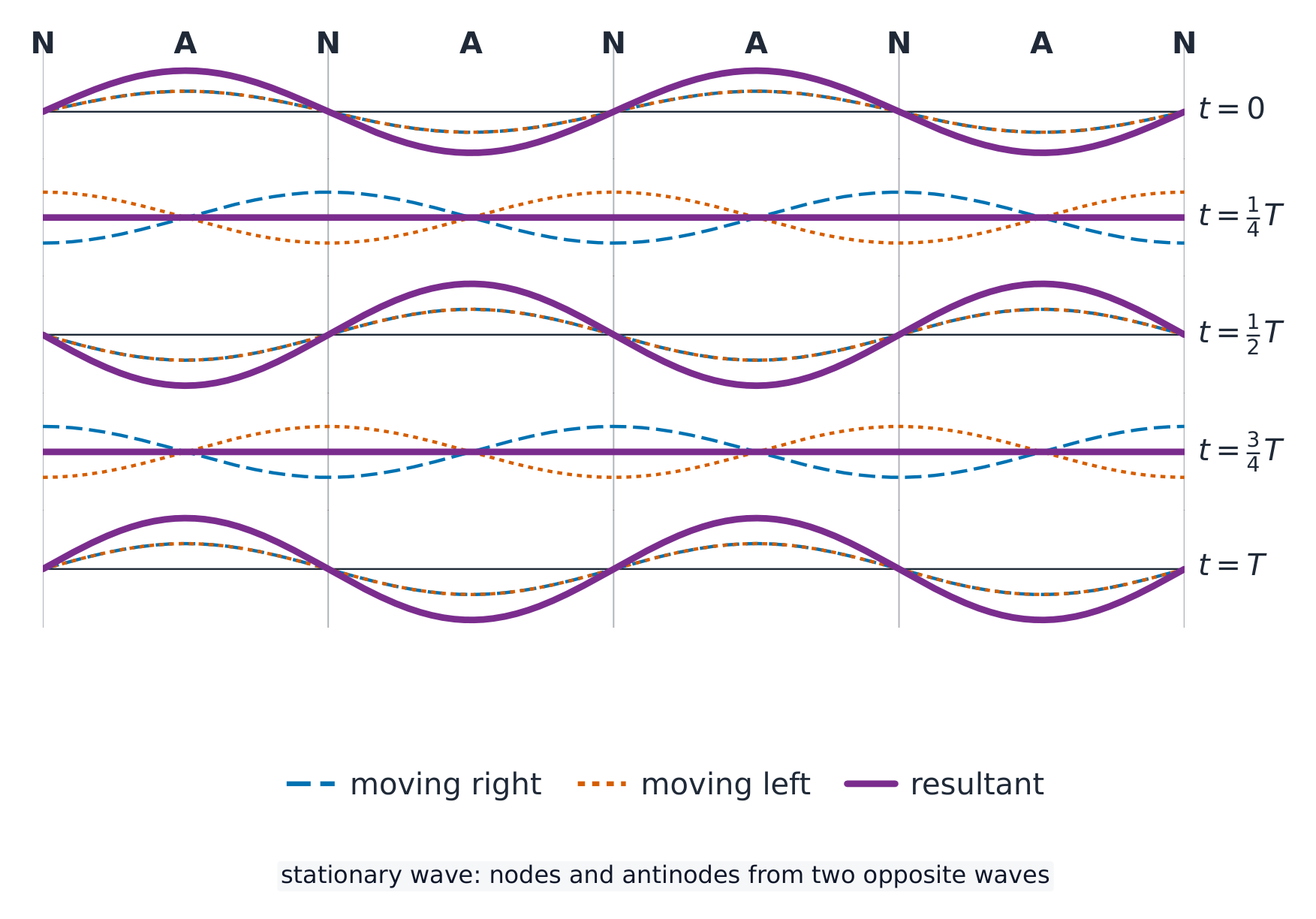
ภาพ snapshots ห้าชุดซ้อนกันที่ t = 0, T/4, T/2, 3T/4 และ T แสดงคลื่นหน้าสองคลื่นเคลื่อนที่ในทิศทางตรงกันข้ามและผลรวมของพวกมัน พร้อมโหนด (N) และแอนติโหนด (A) ที่กำหนดไว้ด้านบน
คลื่นนิ่งเกิดขึ้นเมื่อคลื่นตรงกันข้ามสองคลื่นซ้อนทับกัน (N แทนโหนด, A แทนแอนติโหนด)

โหนดและแอนติโหนด

ในคลื่นนิ่ง:

  • โหนด (node) — จุดที่มีค่าการกระจัดเป็นศูนย์เสมอ (คลื่นทั้งสองจะหักล้างกันเสมอ) ระยะห่างระหว่างโหนดที่อยู่ติดกันคือ $\lambda/2$
  • แอนติโหนด — จุดที่มีแอมพลิจูดสูงสุด (คลื่นทั้งสองบวกกันเสมอ). ระยะห่างระหว่างแอนติโหนดติดกันคือ $\lambda/2$.
  • โหนดและแอนติโหนดถัดไปอยู่ห่างกัน $\lambda/4$.

อนุภาคระหว่างโหนดสองจุดสั่น ในเฟส กับกันเอง แต่มีแอมพลิจูดต่างกัน (มากที่สุดในแอนติโหนด, เป็นศูนย์ที่โหนด). อนุภาคบนฝั่งตรงข้ามของโหนดสั่นใน เฟสตรงข้าม (ความต่างเฟส $\pi$).

ดังนั้น ความต่างเฟสระหว่างจุดสองจุดบนลูปเดียวกัน (ระหว่างโหนดติดกัน) คือ $0°$; ระหว่างจุดบนลูปคู่ขนานคือ $180°$; และระหว่างจุดบนลูปที่แยกออกจากกันด้วยลูปเต็มหนึ่งรอบคือ $0°$ อีกครั้ง. ทุกจุดถึงความกระจัดสูงสุดในเวลาเดียวกันและผ่านจุดศูนย์ในเวลาเดียวกัน. ภาพวาดของสายหลังจากช่วงเวลาของความกระจัดสูงสุด四分之一รอบคือเส้นตรงตามตำแหน่งพัก; หลังครึ่งรอบคือภาพสะท้อนของภาพวาดแรก. ในช่วงเวลาหนึ่งรอบ อนุภาคที่แอนติโหนดเดินทางสี่เท่าของแอมพลิจูด, ดังนั้น อนุภาคที่เคลื่อนที่ $72\ \text{mm}$ ในหนึ่งและครึ่งรอบจะมีแอมพลิจูด $12\ \text{mm}$.

สายตึงสั่นในโหมดพื้นฐาน: ลูปเดียวพร้อมโหนดที่ปลายตรึงแต่ละข้างและแอนติโหนดตรงกลาง, ความยาว L เท่ากับครึ่งหนึ่งของความยาวคลื่น
โหมดพื้นฐานบนสายตึง — ลูปเดียว, โดยที่ L เท่ากับครึ่งของความยาวคลื่น

ตัวอย่างวิธีทำ. สายยาว $0.80\ \text{m}$ ตอกบอกร้อย.exists และสั่นในโหมดพื้นฐาน, ซึ่งความเร็วคลื่นคือ $240\ \text{m s}^{-1}$. หาความถี่พื้นฐาน.

ลูปเดียวพอดีกับสาย, ดังนั้น $\lambda = 2L = 1.60\ \text{m}$. จากนั้น

$$f = \frac{v}{\lambda} = \frac{240}{1.60} = 150\ \text{Hz}.$$

ความแตกต่างของคลื่นนิ่งจากคลื่นหน้า: มันไม่ส่ง พลังงาน ตามความยาวของมัน, รูปแบบไม่เคลื่อนที่ไปตาม, และโหนดคงที่; คลื่นหน้ามีแอมพลิจูดเท่ากันทุกจุดและส่งพลังงาน. ความแตกต่างสามอย่างที่แผนข้อสอบระบุ: คลื่นหน้าถ่ายโอนพลังงานและคลื่นนิ่งไม่; ในคลื่นหน้าทุกจุดมีแอมพลิจูดเท่ากัน, ในคลื่นนิ่งแอมพลิจูดแปรผันจากศูนย์ที่โหนดถึงสูงสุดที่แอนติโหนด; ในคลื่นหน้าจุดติดกันมีความต่างเฟส, ในคลื่นนิ่งทุกจุดระหว่างโหนดสองจุดอยู่ในเฟสเดียวกัน.

วัดความยาวคลื่นจากความห่างของโหนด

ขับเคลื่อนสายด้วยวібраторที่ความถี่ $f$ จนกว่ารูปแบบนิ่งจะปรากฏ. วัดระยะห่างระหว่างโหนดสองจุดที่ห่างกันดีและหารด้วยจำนวนครึ่ง-ความยาวคลื่น ระหว่าง них. แล้ว $\lambda$Known, และ $v = f\lambda$ให้ความเร็วคลื่น.

สำหรับท่อปิดที่ปลายด้านหนึ่งและเปิดที่อีกด้านหนึ่ง (ท่อเรโซแนนซ์), ปลายปิดเป็นโหนดการกระจัดและปลายเปิดเป็นแอนติโหนดการกระจัด. พื้นฐาน มี $L = \lambda/4$; เรโซแนนซ์ถัดไปอยู่ที่ $L = 3\lambda/4$; และอื่นๆ. สำหรับท่อเปิดทั้งสองด้าน ปลายทั้งสองเป็นแอนติโหนด; พื้นฐานอยู่ที่ $L = \lambda/2$.

กฎทั่วไป: ปลายปิดคือจุดกึ่ง standing wave และปลายเปิดคือจุดกึ่ง standing wave最大 และสายที่ยึดติดกันทั้งสองด้านจะมีจุดกึ่ง standing wave ที่ปลายแต่ละข้าง ดังนั้นท่อปิดจะรองรับจำนวนครึ่งความยาวคลื่นเป็นเลขคี่ ($L = \lambda/4, 3\lambda/4, 5\lambda/4, \ldots$) ในขณะที่ท่อเปิดและสายที่ยึดติดกันจะรองรับจำนวนเต็มของความยาวคลื่นครึ่งหนึ่ง ($L = \lambda/2, \lambda, 3\lambda/2, \ldots$); ท่อที่เปิดทั้งสองด้านซึ่งมี $n$ จุดกึ่ง standing wave จะมี $n + 1$ จุดกึ่ง standing wave最大. ความถี่สามารถหาได้จาก $f = v/\lambda$: ท่อปิดที่มีโน้ตต่ำสุดที่ $820\ \text{Hz}$ จะมี $\lambda = 4L$, และทางเดินยาว $13.2\ \text{m}$ ที่มีประตูสะท้อนเสียงที่ปลายทั้งสองข้างจะเกิดเสียงดังที่สุดที่ $f = v/2L = 330/26.4 = 12.5\ \text{Hz}$.

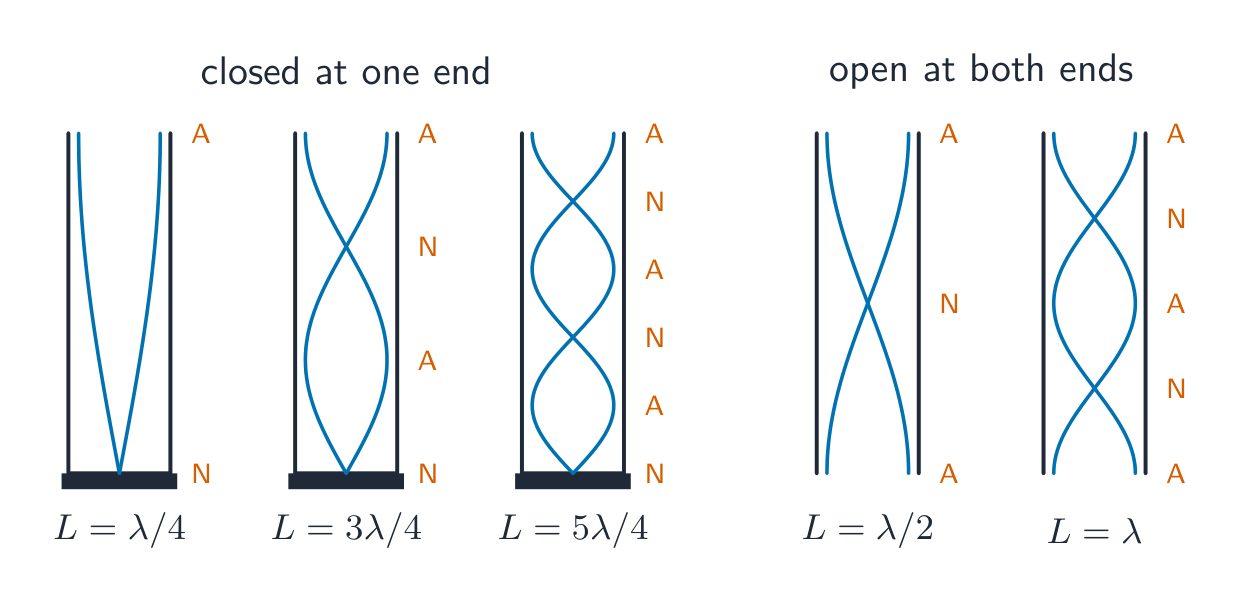
หอคอยอากาศห้าช่องเรียงต่อกัน: ท่อปิดด้านหนึ่งในโหมดแรกสามแบบ โดยมีจุดกึ่ง standing wave ที่ปลายปิดและจุดกึ่ง standing wave最大 ที่ปลายเปิด และ L เท่ากับหนึ่งสี่, สามสี่ และห้าสี่ของความยาวคลื่น; และท่อเปิดทั้งสองด้านในโหมดแรกสองแบบ โดยมีจุดกึ่ง standing wave最大 ที่ปลายทั้งสองข้าง และ L เท่ากับความยาวคลื่นครึ่งหนึ่งและความยาวคลื่นหนึ่ง
โหมดของหอคอยอากาศ: ปลายปิดคือจุดกึ่ง standing wave, ปลายเปิดคือจุดกึ่ง standing wave最大

ตัวอย่างฝึกปฏิบัติ. ลำโพงอยู่ที่ปลายเปิดของท่อยาว $0.51\ \text{m}$ ปิดอีกด้านหนึ่ง สร้างคลื่นนิ่งที่มีจุดกึ่ง standing wave สองจุดและจุดกึ่ง standing wave最大 สองจุด หาความยาวคลื่น และด้วย $v = 340\ \text{m s}^{-1}$ หาความถี่

จุดกึ่ง standing wave สองจุดและจุดกึ่ง standing wave最大 สองจุดคือโหมดที่สองของท่อปิด, $L = 3\lambda/4$, ดังนั้น $\lambda = 4 \times 0.51 / 3 = 0.68\ \text{m}$ และ $f = 340 / 0.68 = 500\ \text{Hz}$. ความยาวคลื่นที่ยาวที่สุดที่สามารถเกิดเสียงดังที่สุดในท่อนี้คือ $4L = 2.0\ \text{m}$.

การทดลองที่หลักสูตรระบุทั้งหมดวัด $\lambda$ จากระยะห่างระหว่างจุดกึ่ง standing wave หรือจุดกึ่ง standing wave最大. ใน หลอดเสียง, ท่อจะถูกยกขึ้นจากน้ำขณะที่ลำโพงหรือส้อมสั่นส่งเสียงที่ปลายเปิด; เสียงจะดังขึ้นอย่างฉับพลันที่การสั่นพ้องครั้งแรก เมื่อหอคอยอากาศยาว $\lambda/4$, และอีกครั้งที่ $3\lambda/4$, ดังนั้นท่อเคลื่อนที่ $\lambda/2$ ระหว่างสองจุดนี้ (นักเรียนไม่จำเป็นต้องใช้เครื่องมือเพื่อตรวจจับการสั่นพ้อง: โน้ตจะกลายเป็นเสียงดัง). ใน หลอดฝุ่น, ฝุ่นละเอียดจะตกตัวเป็นกองอยู่ที่จุดกึ่ง standing wave การกระจัด, $\lambda/2$ ห่างกัน. ด้วย ไมโครเวฟ, ตัวรับสัญญาณที่เคลื่อนที่ไปตามเส้นระหว่างเครื่องส่งสัญญาณและแผ่นโลหะสะท้อนจะอ่านค่าต่ำสุดทุก $\lambda/2$: ตัวรับสัญญาณที่เริ่มจากค่าต่ำสุดและผ่านค่าต่ำสุดเพิ่มอีกหกครั้งใน $1.05\ \text{m}$ ได้ข้าม $3\lambda$, ดังนั้น $\lambda = 0.35\ \text{m}$ และ, ด้วย $v = 340\ \text{m s}^{-1}$ สำหรับการทดลองเสียงเทียบเท่า, $f = 970\ \text{Hz}$. คลื่นนิ่งในเตาไมโครเวฟทำให้ช็อกโกแลตละลายที่จุดกึ่ง standing wave最大, $\lambda/2$ ห่างกัน, ดังนั้นระยะห่างของจุดและความถี่ของเตา ($2.45\ \text{GHz}$) ให้ความเร็วแสงจาก $c = f\lambda$.

ท่อปิดด้านล่างและเปิดด้านบน ยาว L, dengan kurva amplitudo perpindahan yang menunjukkan titik simpul (N) di ujung tertutup dan titik perut (A) di ujung terbuka
โหมดพื้นฐานในท่อปิด — จุดกึ่ง standing wave ที่ปลายปิด, จุดกึ่ง standing wave最大 ที่ปลายเปิด
Explore · ⁨สำรวจ⁩

Standing waves & harmonics · ⁨คลื่นนิ่งและฮาร์มอนิก⁩

A string fixed at both ends only resonates at its harmonics. Drag n to see the nodes, antinodes and how the wavelength changes. · ⁨เชือกที่ยึดติดกันทั้งสองด้านจะเกิดสั่นพ้องเฉพาะที่ฮาร์มอนิก ลาก n เพื่อดูโหนด, แอนติโหนด และการเปลี่ยนแปลงของความยาวคลื่น⁩

Explore · ⁨สำรวจ⁩

Stationary waves · ⁨คลื่นนิ่ง⁩

y = y₁ + y₂

Two waves superpose: where they reinforce you get antinodes, where they cancel, nodes. · ⁨คลื่นสองตัว ซ้อนทับ: ที่ซึ่งเสริมกันจะได้แอนติโหนด, ที่ซึ่งหักล้างกันได้โหนด⁩

Vocabulary · ⁨คำศัพท์⁩ Train · ⁨ฝึกฝน⁩
English ไทย
principle of superposition/ˈprɪnsɪpl ɒv ˌsuːpəpəˈzɪʃn/ หลักการ叠加 (superposition)
superposition/ˌsuːpəpəˈzɪʃn/ การ叠加 (email: superposition)
wave/weɪv/ คลื่น
displacement/dɪˈspleɪsmənt/ การกระจัด
vector sum/ˈvektə sʌm/ ผลบวกเวกเตอร์
progressive wave/prəˈɡresɪv weɪv/ คลื่นเคลื่อนที่
stationary wave/ˈsteɪʃənəri weɪv/ คลื่นนิ่ง
reflected/rɪˈflektɪd/ สะท้อน
wavelength/ˈweɪvleŋθ/ ความยาวคลื่น
fundamental/ˌfʌndəˈmentl/ พื้นฐาน
energy/ˈenədʒi/ พลังงาน
resonance tube/ˈrezənəns tjuːb/ ท่อเรโซแนนซ์
8.2

Diffraction · ⁨การหักเห⁩

Syllabus · ⁨หลักสูตร⁩
English
  1. explain the meaning of the term diffraction
  2. show an understanding of experiments that demonstrate diffraction including the qualitative effect of the gap width relative to the wavelength of the wave; for example diffraction of water waves in a ripple tank
ไทย
  1. อธิบายความหมายของคำว่า การหักเห
  2. แสดงความเข้าใจในการทดลองที่สาธิตการหักเห รวมถึงผลกระทบเชิงคุณภาพของ ความกว้างช่องเปิด เทียบกับ ความยาวคลื่น; ตัวอย่างเช่น การหักเหของคลื่นน้ำในอ่างน้ำ

Source: Cambridge International syllabus · ⁨แหล่งที่มา: หลักสูตร Cambridge International⁩

English

Diffraction 衍射 is the spreading of a wave after it passes through a gap or around an obstacle 障碍物. All waves diffract — water, sound, light, microwaves.

For the two-mark "state what is meant by diffraction": the spreading of a wave as it passes through a gap (an aperture) or around the edge of an obstacle, into the region behind it. Diffraction changes the direction the wave travels in, but not its speed, frequency or wavelength.

The amount of spreading depends on the ratio of wavelength to gap width:

  • gap much wider than $\lambda$: very little spreading; the wave goes nearly straight through.
  • gap about the size of $\lambda$: a lot of spreading; the wave fans out.
  • gap smaller than $\lambda$: very strong spreading; the gap acts almost like a point source.

Show this with water waves in a ripple tank 水波槽: straight waves meet a barrier with a gap, and the waves curve more as the gap is made narrower. The same idea is why you can hear someone around a corner (speech has $\lambda$ near 1 m, close to the gap size) but cannot see them (visible light has $\lambda \sim 500\ \text{nm}$, far smaller than the gap).

For the strongest spreading the gap should be about one wavelength wide. So to increase the diffraction of a given wave, make the gap narrower; for a given gap, use a longer wavelength, which means a lower frequency. Radio waves of wavelength $1.5\ \text{km}$ diffract around a mountain and reach an aerial behind it; microwaves of $1.5\ \text{cm}$ do not. Sound of $0.44\ \text{kHz}$ in air has $\lambda = 330 / 440 = 0.75\ \text{m}$, so features of about $0.75\ \text{m}$ diffract it most, and of the sounds passing through a doorway $0.80\ \text{m}$ wide the low frequencies spread out most. Making the gap many wavelengths wide, or raising the frequency, reduces the spreading.

ไทย

การหักเห คือการแผ่ขยายของคลื่นหลังจากที่มันผ่านช่องว่างหรือรอบๆ สิ่งกีดขวาง. คลื่นทุกชนิดเกิดการหักเห — น้ำ, เสียง, แสง, ไมโครเวฟ.

สำหรับข้อสอบคะแนนสอง "บอกความหมายของการหักเห": การแผ่ขยายของคลื่นขณะมันผ่านช่องว่าง (รูพรุน) หรือรอบขอบของสิ่งกีดขวาง, เข้าไปในพื้นที่ด้านหลังของมัน. การหักเหเปลี่ยนทิศทางที่คลื่นเดินทาง แต่ไม่เปลี่ยนความเร็ว, ความถี่ หรือความยาวคลื่นของมัน.

ปริมาณการแผ่ขยายขึ้นอยู่กับอัตราส่วนของ ความยาวคลื่นต่อความกว้างช่อง:

  • ช่อง กว้างกว่ามาก ของ $\lambda$: การแผ่ขยายน้อยมาก; คลื่นวิ่งผ่านเกือบตรง.
  • ช่อง ประมาณขนาดของ $\lambda$: การแผ่ขยายมาก; คลื่นกระจายออก.
  • ช่อง เล็กกว่า $\lambda$: การแผ่ขยายแรงมาก; ช่องทำหน้าที่เหมือนแหล่งกำเนิดจุดเกือบสนิท.

แสดงสิ่งนี้ด้วยคลื่นน้ำใน อ่างripple: คลื่นตรงพบกำแพงที่มีช่องว่าง, และคลื่นโค้งมากขึ้นเมื่อช่องแคบลง. หลักการเดียวกันนี้คือเหตุผลที่คุณได้ยินคนอยู่หลังมุม (เสียงมีความยาวคลื่น $\lambda$ ใกล้ 1 m, ใกล้เคียงกับขนาดช่อง) แต่ไม่สามารถมองเห็นเขาได้ (แสงที่มองเห็นได้มีความยาวคลื่น $\lambda \sim 500\ \text{nm}$, เล็กกว่าช่องมาก).

สำหรับการแผ่ขยายที่_SIM最, ช่องควรกว้างประมาณหนึ่งความยาวคลื่น. ดังนั้นเพื่อเพิ่มการหักเหของคลื่นที่กำหนดให้, ทำช่องให้แคบลง; สำหรับช่องที่กำหนดให้, ใช้ความยาวคลื่นที่ยาวกว่า, ซึ่งหมายความว่าความถี่ต่ำกว่า. คลื่นวิทยุที่มีความยาวคลื่น $1.5\ \text{km}$ หักเหรอบภูเขาและเข้าถึงเสาอากาศที่อยู่เบื้องหลัง; ไมโครเวฟที่มีความยาว $1.5\ \text{cm}$ ไม่ทำเช่นนั้น. เสียงที่มีความยาว $0.44\ \text{kHz}$ ในอากาศมี $\lambda = 330 / 440 = 0.75\ \text{m}$, ดังนั้นลักษณะประมาณ $0.75\ \text{m}$ จะหักเหมันมากที่สุด, และของเสียงที่ผ่านประตูกว้าง $0.80\ \text{m}$, ความถี่ต่ำจะกระจายออกมากที่สุด. การทำให้ช่องกว้างหลายความยาวคลื่น, หรือเพิ่มความถี่, ลดการแผ่ขยาย.

คลื่นน้ำตรงในอ่างripple พบกับกำแพงที่มีช่องว่าง: ผ่านช่องกว้าง (a) พวกมันผ่านเกือบตรง, ผ่านช่องแคบ (b) พวกมันกระจายออกเป็นหน้าคลื่นโค้ง
การรบกวนในอ่างripple — ช่องกว้าง (a) กระจายตัวน้อย, ช่องแคบ (b) กระจายตัวมาก
Explore · ⁨สำรวจ⁩

Waves adding and cancelling · ⁨คลื่นบวกกันและหักล้างกัน⁩

Two overlapping waves add where they are in phase and cancel where out of phase — change the phase to see the result. This is what makes diffraction patterns. · ⁨คลื่นสองตัวซ้อนทับกันจะบวกกันเมื่อเฟสเดียวกันและหักล้างกันเมื่อต่างเฟส — เปลี่ยนเฟสเพื่อดูผลลัพธ์ นี่คือสิ่งที่สร้างรูปแบบการเลี้ยวเบน⁩

Vocabulary · ⁨คำศัพท์⁩ Train · ⁨ฝึกฝน⁩
English ไทย
diffraction/dɪˈfrækʃn/ 衍射
obstacle/ˈɒbstəkl/ สิ่งกีดขวาง
ripple tank/ˈrɪpl tæŋk/ อ่างน้ำripple
Watch lesson · ⁨ดูบทเรียน⁩
8.3

Interference · ⁨การแทรกสอด⁩

Syllabus · ⁨หลักสูตร⁩
English
  1. understand the terms interference and coherence
  2. show an understanding of experiments that demonstrate two-source interference using water waves in a ripple tank, sound, light and microwaves
  3. understand the conditions required if two-source interference fringes are to be observed
  4. recall and use $\lambda = ax / D$ for double-slit interference using light
ไทย
  1. เข้าใจคำศัพท์ การแทรกสอด และ ความสอดคล้องกัน
  2. แสดงความเข้าใจในการทดลองที่สาธิต การแทรกสอดสองแหล่งกำเนิด โดยใช้คลื่นน้ำในอ่างน้ำ เสียง แสง และไมโครเวฟ
  3. เข้าใจเงื่อนไขที่จำเป็นหากต้องการ quan sát แถบการแทรกสอด จากสองแหล่งกำเนิด
  4. จำและใช้ $\lambda = ax / D$ สำหรับการ การแทรกสอดช่องคู่ โดยใช้แสง

Source: Cambridge International syllabus · ⁨แหล่งที่มา: หลักสูตร Cambridge International⁩

English
Two-slit interference

Interference 干涉 is the superposition of two coherent 相干 waves to give a steady pattern of high-amplitude regions (constructive) and low-amplitude regions (destructive).

Coherence

Two sources are coherent when they emit waves with a constant phase difference (which also needs the same frequency). Two separate lamps are not coherent — their phase changes randomly, so any pattern flickers too fast to see and you get only an average.

The one-mark definition: coherent waves have a constant phase difference, which requires the same frequency. They need not be in phase with each other: two coherent sources emitting $180°$ apart give a pattern whose central line is a minimum. Two separate lasers, or a lamp and a laser, are not coherent even when their frequencies happen to match, so no steady pattern forms.

To make coherent light from one source, pass it through two slits 狭缝 in a double-slit 双缝 setup. Both slits are lit by the same wavefront, so the two beams keep a fixed phase relationship.

Conditions for a clear pattern

To see two-source fringes you need:

  1. two coherent sources (constant phase difference).
  2. roughly equal amplitudes (or the dark regions are not very dark).
  3. the waves overlap where you look.
  4. for light (a transverse wave), the same plane of polarisation 偏振.

In practice, for light: a single slit (or a laser) makes the two slits coherent; the slits are narrow, so each diffracts the light into the region where the two beams overlap; and the slits are close together with the screen far away, so that the fringes are wide enough to see.

Path difference

For two coherent sources, what happens at a point depends on the path difference 路程差 $\Delta x$ between the two waves arriving there:

  • constructive: $\Delta x = n\lambda$ (for whole numbers $n = 0, 1, 2, \ldots$).
  • destructive: $\Delta x = (n + \tfrac{1}{2})\lambda$.

The path difference fixes the phase difference: one wavelength of path is $360°$. Waves that have travelled $100\ \text{cm}$ and $80\ \text{cm}$ from two in-phase sources of wavelength $8.0\ \text{cm}$ arrive with a path difference of $2.5\lambda$, a phase difference of $180°$, and cancel; microwaves of wavelength $4\ \text{cm}$ whose paths differ by $6\ \text{cm}$ ($1.5\lambda$) give a minimum, of zero intensity only if the two amplitudes are equal. Lowering both source frequencies equally lengthens the wavelength, so the same path difference is a smaller number of wavelengths and the point is no longer a minimum.

Double-slit (Young's) experiment

For two slits a distance $a$ apart, with a screen a distance $D$ away (assume $D \gg a$), light of wavelength $\lambda$ makes fringes on the screen.

The fringe spacing 条纹间距 $x$ (one fringe 条纹 to the next) is

$$\lambda = \frac{a x}{D}, \qquad x = \frac{\lambda D}{a}.$$

Bright fringes (maximum 极大) are where the path difference is a whole number of $\lambda$; dark fringes (minimum 极小) where it is $(n + \tfrac{1}{2})\lambda$. The fringes are equally spaced.

To make the fringe spacing smaller: increase $a$ (slits further apart), reduce $D$ (screen closer), or use a shorter $\lambda$ (bluer light).

Explain how the pattern of bright and dark fringes is formed (three marks): the light diffracts at each slit; the two diffracted beams overlap and superpose; where the path difference from the two slits is a whole number of wavelengths the waves arrive in phase and interfere constructively, giving a bright fringe, and where it is an odd number of half-wavelengths they arrive in antiphase and interfere destructively, giving a dark fringe. A brighter source makes the bright fringes brighter but does not change their spacing; changing to blue light makes the spacing smaller, so to keep the same spacing the slits must be moved closer together; making each slit narrower increases the diffraction, so fringes appear across a wider region, with the spacing unchanged.

Worked example. In a double-slit experiment the slits are $0.50\ \text{mm}$ apart and lit by light of wavelength $600\ \text{nm}$. The screen is $2.0\ \text{m}$ away. Find the fringe spacing.

$$x = \frac{\lambda D}{a} = \frac{(600 \times 10^{-9})(2.0)}{0.50 \times 10^{-3}} = 2.4 \times 10^{-3}\ \text{m} = 2.4\ \text{mm}.$$

Worked example. Red light of wavelength $680\ \text{nm}$ falls on slits $0.16\ \text{mm}$ apart. The distance between the centres of the first and ninth dark fringes is $3.2\ \text{cm}$. Find the distance $D$ to the screen.

Eight fringe spacings make $3.2\ \text{cm}$, so $x = 4.0\ \text{mm}$ and $D = ax / \lambda = (0.16 \times 10^{-3})(4.0 \times 10^{-3}) / (680 \times 10^{-9}) = 0.94\ \text{m}$. On a screen $5.0\ \text{cm}$ wide centred on the pattern, with $x = 2.4\ \text{mm}$, ten bright fringes fit on each side of the central one: $21$ in all. A graph of $x$ against $a$ is a curve falling as $1/a$; a graph of $x$ against $\lambda$ (or against $D$) is a straight line through the origin with gradient $D/a$ (or $\lambda/a$), from which $a$ can be found.

ไทย
การแทรกสอดสองช่อง
ฟองสบู่สีรุ้ง
การเปลี่ยนสีบนฟองสบู่มาจากการแทรกสอดของแสง.

การแทรกสอด คือการ叠加กันของคลื่น cohherent สองคลื่นเพื่อให้ได้รูปแบบที่มั่นคงของบริเวณที่มีแอมพลิจูดสูง (แบบเสริมกัน) และบริเวณที่มีแอมพลิจูดต่ำ (แบบหักล้างกัน).

หน้าคลื่นวงกลมซ้อนทับกันจากแหล่งกำเนิดจุด cohherent สองจุด, พร้อมจุดสีน้ำเงินทำเครื่องหมายตำแหน่งที่crest bertemu crest และเส้นแห่งการกระจัดสูงสุดที่กระจายออกจากระหว่างแหล่งกำเนิด
แหล่งกำเนิดสอดคล้องสองแหล่งให้เส้นการกระจัดสูงสุดเมื่อcrest gặp crest
ภาพถ่ายจริงของอ่างripple: คลื่นน้ำวงกลมสองชุดจากแหล่งกำเนิดสองข้างกันซ้อนทับกัน, ทิ้งร่องสงบ (การยกเลิก) กระจายออกจากระหว่างชุดคลื่นrippleสว่างสองชุด
ผลเดียวกันในอ่างripple จริง — แหล่งกำเนิด cohherent สองจุดให้รูปแบบการแทรกสอดที่มั่นคง

ความcohherent

แหล่งกำเนิดสองแหล่งเป็น cohherent เมื่อพวกมันปล่อยคลื่นที่มี ความต่างเฟสคงที่ (ซึ่งยังต้องการความถี่เหมือนกัน). หลอดไฟสองดวงแยกกันไม่ใช่ cohherent — เฟสของพวกมันเปลี่ยนแปลงแบบสุ่ม, ดังนั้นรูปแบบใดๆ จึงกะพริบเร็วเกินกว่าจะมองเห็นและคุณจะได้เพียงค่าเฉลี่ยเท่านั้น

นิยามแบบ 1 คะแนน: คลื่นที่สอดคล้องกัน (coherent waves) มี ความต่างเฟสคงที่ ซึ่งจำเป็นต้องมีความถี่เท่ากัน ไม่จำเป็นต้องอยู่ในเฟสเดียวกัน: แหล่งกำเนิดคลื่นที่สอดคล้องกันสองแหล่งซึ่งห่างกัน $180°$ จะเกิดลวดลายที่มีเส้นตรงกลางเป็นจุดต่ำสุด (minimum) เลเซอร์แยกจากกันสองดวง หรือโคมไฟกับเลเซอร์ ไม่ใช่คลื่นที่สอดคล้องกัน แม้แต่เมื่อความถี่ของพวกมันบังเอิญตรงกัน ดังนั้นจึงไม่เกิดลวดลายที่เสถียร

ในการสร้างแสงที่สอดคล้องกันจากแหล่งกำเนิดเดียว ให้ส่งผ่านช่องเปิด สองช่อง ในชุดการทดลองแบบ ช่องคู่ (double-slit) ช่องทั้งสองถูกส่องสว่างด้วยหน้าคลื่นเดียวกัน ทำให้ลำแสงทั้งสองรักษาความสัมพันธ์Regardingフェสที่คงที่ไว้ได้

เงื่อนไขสำหรับลวดลายที่ชัดเจน

เพื่อให้เห็นแถบ干涉 (fringes) จากแหล่งกำเนิดสองแหล่ง คุณต้องการ:

  1. แหล่งกำเนิดคลื่นที่สอดคล้องกันสองแหล่ง (coherent) (ความต่างเฟสคงที่).
  2. แอมพลิจูดประมาณเท่ากัน (หรือบริเวณมืดจะไม่มืดมาก)
  3. คลื่นซ้อนทับกันในพื้นที่ที่คุณมอง
  4. สำหรับแสง (ซึ่งเป็นคลื่นตามขวาง) ต้องมีระนาบ โพลาไรเซชัน (polarisation) เดียวกัน

ในทางปฏิบัติ สำหรับแสง: ช่องเดี่ยว (หรือเลเซอร์) ช่วยทำให้ช่องทั้งสองสอดคล้องกัน; ช่องแคบมากดังนั้นแต่ละช่องจะเกิดการกระจาย (diffract) ของแสงเข้าไปในพื้นที่ที่ลำแสงทั้งสองซ้อนทับกัน; และช่องอยู่ใกล้กันพร้อมทั้งจ่อหน้าจออยู่ไกล ทำให้แถบ干涉กว้างพอที่จะมองเห็นได้

ความแตกต่างของระยะทางเดิน

สำหรับแหล่งกำเนิดคลื่นที่สอดคล้องกันสองแหล่ง สิ่งที่เกิดขึ้นที่จุดใดจุดหนึ่งขึ้นอยู่กับ ความแตกต่างของระยะทางเดิน (path difference) $\Delta x$ ระหว่างคลื่นทั้งสองที่มาถึงจุดนั้น:

  • การเสริมกัน (constructive): $\Delta x = n\lambda$ (สำหรับจำนวนเต็ม $n = 0, 1, 2, \ldots$).
  • การหักล้างกัน (destructive): $\Delta x = (n + \tfrac{1}{2})\lambda$.

ความต่างของระยะทางกำหนด ความต่างของเฟส: ระยะทางหนึ่งความยาวคลื่นเท่ากับ $360°$ คลื่นที่เดินทางมา $100\ \text{cm}$ และ $80\ \text{cm}$ จากแหล่งกำเนิดสองจุดที่มีเฟสเดียวกันและความยาวคลื่น $8.0\ \text{cm}$ จะมาถึงพร้อมกันด้วยความต่างของระยะทาง $2.5\lambda$, ความต่างของเฟส $180°$, และหักล้างกัน; ไมโครเวฟที่มีความยาวคลื่น $4\ \text{cm}$ ที่มีความต่างของเส้นทาง $6\ \text{cm}$ ($1.5\lambda$) จะให้ค่าต่ำสุด ซึ่งมีความเข้มเป็นศูนย์ก็ต่อเมื่อความสูงคลื่นของทั้งสองเท่ากันเท่านั้น การลดความถี่ของแหล่งกำเนิดทั้งสองลงเท่าๆ กันจะทำให้ความยาวคลื่นยาวขึ้น ดังนั้นความต่างของระยะทางเดิมจึงมีค่าเป็นจำนวนของความยาวคลื่นน้อยลง และจุดนั้นจะไม่เป็นจุดต่ำสุดอีกต่อไป

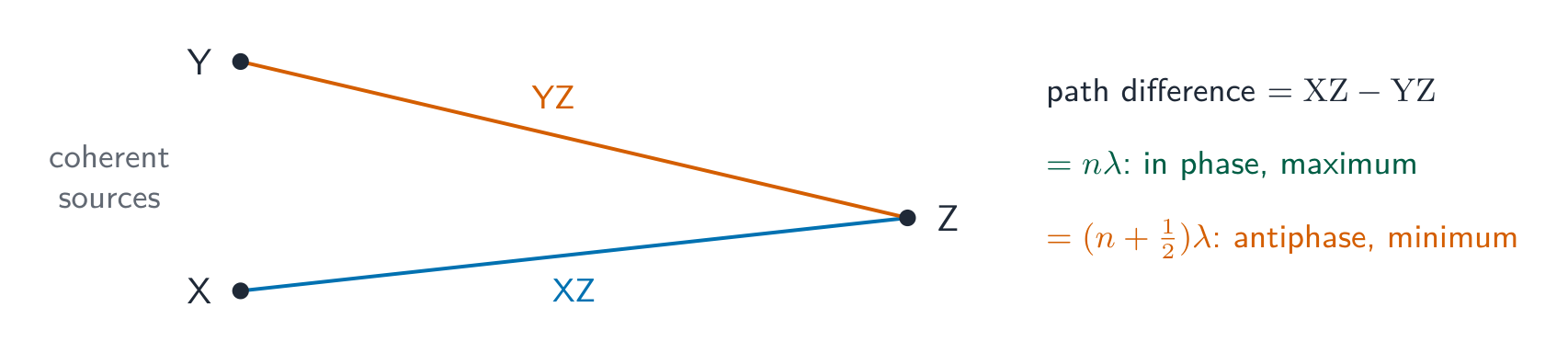
แหล่งกำเนิดคลื่นที่สอดคล้องกัน X และ Y และจุด Z โดยวาดเส้นทางการเดินทาง XZ และ YZ; ความแตกต่างของระยะทางเดินคือ XZ ลบด้วย YZ ซึ่งเป็นจำนวนเต็มของความยาวคลื่นสำหรับค่าสูงสุดและเป็นจำนวนคี่ของครึ่งความยาวคลื่นสำหรับค่าต่ำสุด
สิ่งที่เกิดขึ้นที่ Z ขึ้นอยู่กับความแตกต่างของระยะทางเดิน XZ − YZ ที่วัดในความยาวคลื่น

การทดลองช่องคู่ (Young's experiment)

สำหรับช่องคู่ที่ห่างกัน $a$ และมีจอภาพอยู่ห่าง $D$ (สมมติว่า $D \gg a$), แสงที่มีความยาวคลื่น $\lambda$ จะเกิดแถบ干涉บนจอภาพ

แสงสีเดียวผ่านช่องเดี่ยวแล้วไปช่องคู่ที่ห่างกัน a; แสงที่กระจายจากแต่ละช่องซ้อนทับกันเพื่อสร้างลวดลาย干涉บนจอภาพที่ห่าง D, โดยมีระยะห่างระหว่างแถบ x
การทดลองช่องคู่ของyoung — ช่องเดี่ยวทำให้ช่องคู่เป็นแหล่งกำเนิดสอดคล้อง

ระยะห่างระหว่างแถบ干涉 (fringe spacing) $x$ (จากหนึ่ง แถบ干涉 (fringe) ไปยังอีกแถบถัดไป) คือ

$$\lambda = \frac{a x}{D}, \qquad x = \frac{\lambda D}{a}.$$

แถบสว่าง (สูงสุด) คือตำแหน่งที่ความต่างของระยะทางเป็นจำนวนเต็มของความยาวคลื่น $\lambda$; แถบมืด (ต่ำสุด) คือตำแหน่งที่ความต่างของระยะทางเป็น $(n + \tfrac{1}{2})\lambda$. แถบเหล่านี้มีระยะห่างเท่าๆ กัน

เพื่อให้ระยะห่างของแถบเล็กลง: เพิ่ม $a$ (ช่องแยกห่างกัน), ลด $D$ (จอใกล้ขึ้น), หรือใช้แสงที่มีความยาวคลื่นสั้นกว่า $\lambda$ (แสงสีฟ้า)

อธิบายวิธีการเกิดลวดลายของแถบสว่างและแถบมืด (3 คะแนน): แสง กระจาย (diffracts) ที่แต่ละช่อง; ลำแสงที่กระจายทั้งสอง ซ้อนทับ (overlap) และแทรกสอดกัน; ที่ซึ่งความแตกต่างของระยะทางเดินจากช่องทั้งสองเป็นจำนวนเต็มของความยาวคลื่น คลื่นจะมาถึงพร้อมเฟสเดียวกันและแทรกสอดแบบเสริมกัน เกิดเป็นแถบสว่าง; และที่ซึ่งเป็นจำนวนคี่ของครึ่งความยาวคลื่น คลื่นจะมาถึงตรงข้ามเฟสและแทรกสอดแบบหักล้างกัน เกิดเป็นแถบมืด. แหล่งกำเนิดแสงที่สว่างขึ้นจะทำให้แถบสว่างสว่างขึ้นแต่ไม่เปลี่ยนระยะห่าง; เปลี่ยนเป็นแสงสีฟ้าจะทำให้ระยะห่างเล็กลง ดังนั้นเพื่อรักษาระยะห่างเดิม ช่องต้องถูกย้ายเข้าหากันมากขึ้น; การทำให้แต่ละช่องแคบลง会增加การกระจาย (increases the diffraction), sehingga interference patterns ปรากฏในพื้นที่ที่กว้างขึ้น โดยที่ระยะห่างไม่เปลี่ยนแปลง.

ตัวอย่างฝึกหัด. ในการทดลองช่องคู่ ช่องห่างกัน $0.50\ \text{mm}$ และส่องด้วยแสงที่มีความยาวคลื่น $600\ \text{nm}$. จอภาพอยู่ห่าง $2.0\ \text{m}$. หาระยะห่างระหว่างแถบ干涉.

$$x = \frac{\lambda D}{a} = \frac{(600 \times 10^{-9})(2.0)}{0.50 \times 10^{-3}} = 2.4 \times 10^{-3}\ \text{m} = 2.4\ \text{mm}.$$

ตัวอย่างโจทย์ทำ แสงสีแดงที่มีความยาวคลื่น $680\ \text{nm}$ ตกกระทบช่องแยก相距 $0.16\ \text{mm}$. ระยะห่างระหว่างกึ่งกลางของแถบมืดที่หนึ่งและแถบมืดที่เก้าคือ $3.2\ \text{cm}$. จงหาระยะทาง $D$ ไปยังจอ

แปดระยะห่างระหว่างแถบ interference สร้าง $3.2\ \text{cm}$, ดังนั้น $x = 4.0\ \text{mm}$ และ $D = ax / \lambda = (0.16 \times 10^{-3})(4.0 \times 10^{-3}) / (680 \times 10^{-9}) = 0.94\ \text{m}$. บนจอภาพกว้าง $5.0\ \text{cm}$ ที่ตั้งกึ่งกลางกับลวดลาย, พร้อมกับ $x = 2.4\ \text{mm}$, แถบสว่างสิบแถบสามารถใส่ได้ด้านละห้าแถบรอบแถบตรงกลาง: รวม $21$. กราฟของ $x$ เทียบกับ $a$ เป็นโค้งที่ลดลงตาม $1/a$; กราฟของ $x$ เทียบกับ $\lambda$ (หรือเทียบกับ $D$) เป็นเส้นตรงผ่านจุดเริ่มต้นที่มีความชัน $D/a$ (หรือ $\lambda/a$), จากนั้นสามารถหา $a$ ได้

Explore · ⁨สำรวจ⁩

Interference · ⁨การรบกวน⁩

y = y₁ + y₂

In phase → constructive (bright/loud); antiphase → destructive (dark/quiet). · ⁨เฟสเดียวกัน → เสริมกัน (สว่าง/ดัง); เฟสตรงข้าม → หักล้างกัน (มืด/เบา)⁩

Vocabulary · ⁨คำศัพท์⁩ Train · ⁨ฝึกฝน⁩
English ไทย
minimum/ˈmɪnɪməm/ ต่ำสุด
slit/slɪt/ ช่องเปิด
double-slit/ˈdʌbl slɪt/ ช่องเปิดคู่
fringe/frɪndʒ/ แถบสว่าง/มืด
polarisation/ˌpəʊləraɪˈzeɪʃn/ การทำให้มีขั้ว
path difference/pæθ ˈdɪfrəns/ ความแตกต่างของเส้นทาง
fringe spacing/frɪndʒ ˈspeɪsɪŋ/ ระยะห่างของแถบสว่าง
Watch lesson · ⁨ดูบทเรียน⁩
8.4

Diffraction grating · ⁨เกรตติงการกระจาย (Diffraction grating)⁩

Syllabus · ⁨หลักสูตร⁩
English
  1. recall and use $d \sin \theta = n\lambda$
  2. describe the use of a diffraction grating to determine the wavelength of light (the structure and use of the spectrometer are not included)
ไทย
  1. จำและใช้ $d \sin \theta = n\lambda$
  2. อธิบายการใช้ เกรตติ้งการหักเห เพื่อหา ความยาวคลื่น ของแสง (โครงสร้างและการใช้สเปกโทรมิเตอร์ไม่รวมอยู่ในเนื้อหา)

Source: Cambridge International syllabus · ⁨แหล่งที่มา: หลักสูตร Cambridge International⁩

English

A diffraction grating 衍射光栅 has many equally spaced slits — often hundreds or thousands per millimetre. Each slit is a coherent source. A maximum is seen at angle $\theta$ from the normal 法线 to the grating when

$$d \sin\theta = n \lambda,$$

where $d$ is the slit spacing 缝间距 (centre to centre), $n = 0, \pm 1, \pm 2, \ldots$ is the order 级次, and $\lambda$ is the wavelength.

Worked example. A diffraction grating has $500$ lines per mm. Light of wavelength $600\ \text{nm}$ is shone normally on it. Find the angle of the first-order ($n = 1$) maximum.

The slit spacing is $d = \dfrac{1}{500}\ \text{mm} = 2.0 \times 10^{-6}\ \text{m}$, so

$$\sin\theta = \frac{n\lambda}{d} = \frac{600 \times 10^{-9}}{2.0 \times 10^{-6}} = 0.30 \quad\Rightarrow\quad \theta \approx 17°.$$

Compared with the double slit, a grating gives much sharper maxima, because more slits add together — every other direction is cancelled by many slits.

To describe the diffraction at the grating: the light spreads out (diffracts) at every slit, and the waves from all the slits superpose; in the directions where the path difference between neighbouring slits is a whole number of wavelengths they are all in phase, so sharp maxima form there and almost nothing in between. A graph of intensity against angle is a set of narrow peaks at $\theta = 0$ and at $\pm\theta_{1}, \pm\theta_{2}, \ldots$, where $\sin\theta_{n} = n\lambda/d$: equally spaced in $\sin\theta$, so slightly further apart in $\theta$ at the higher orders.

Worked example. Light of wavelength $680\ \text{nm}$ is incident normally on a grating with $450$ lines per mm. Find the angle between the two second-order maxima.

$d = 1/450\ \text{mm} = 2.22 \times 10^{-6}\ \text{m}$, so $\sin\theta_{2} = 2 \times 680 \times 10^{-9} / (2.22 \times 10^{-6}) = 0.612$ and $\theta_{2} = 37.7°$; the two second-order beams are $2\theta_{2} = 75°$ apart.

Slit spacing from "lines per mm"

If a grating has $N$ lines per millimetre, then $d = 1/N$ millimetres $= 10^{-3}/N$ metres. For $450$ lines per mm, $d = 1/450\ \text{mm} \approx 2.22\ \mu\text{m}$.

Highest order

For a given grating and wavelength, $\sin\theta = n\lambda/d$ cannot be more than $1$, so the highest order seen is

$$n_{\text{max}} = \left\lfloor \frac{d}{\lambda} \right\rfloor.$$

If $d/\lambda = 3.27$, orders up to $n = 3$ exist; $n = 4$ would need $\sin\theta > 1$ and is not seen.

So the total number of maxima on a wide screen is $2n_{\text{max}} + 1$: for $700\ \text{nm}$ light and $400$ lines per mm, $d/\lambda = 3.57$, so $n_{\text{max}} = 3$ and seven beams are seen. A shorter wavelength gives more orders at smaller angles. With white light every order except the zero order is a spectrum, violet nearest the centre and red furthest out, because $\theta$ grows with $\lambda$; the zero order stays white. Two wavelengths give a maximum at the same angle when $n_{1}\lambda_{1} = n_{2}\lambda_{2}$: the third order of $400\ \text{nm}$ coincides with the second order of $600\ \text{nm}$.

Finding $\lambda$ with a grating

Shine parallel light of unknown wavelength straight at the grating. Measure the angle $\theta_{1}$ of the first-order maximum from the centre. Then $\lambda = d \sin\theta_{1}$. Repeating for higher orders and averaging reduces error.

Measure the angle between the first-order maxima on the two sides and halve it, which cancels any error in setting the zero; higher orders give larger angles and so a smaller percentage uncertainty; and plotting $\sin\theta$ against $n$ for several orders gives a straight line through the origin of gradient $\lambda/d$, so $\lambda = Gd$ (or, for a known wavelength, $d = \lambda/G$). Two things must be right: $\theta$ is measured from the normal to the grating, not from its surface, and $d$ is the distance between adjacent lines, so $400$ lines per mm means $d = 2.5\ \mu\text{m}$, never $400$.

ไทย

เกรตติงการกระจาย (diffraction grating) มีช่องเปิดจำนวนมากที่เว้นระยะเท่ากัน — มักจะมีหลายร้อยหรือหลายพันช่องต่อมิลลิเมตร แต่ละช่องเป็นแหล่งกำเนิดคลื่นที่สอดคล้องกัน ค่าสูงสุด (maximum) จะเห็นได้ที่มุม $\theta$ จาก แนวฉาก (normal) ต่อเกรตติงเมื่อ

$$d \sin\theta = n \lambda,$$

โดยที่ $d$ คือ ระยะห่างระหว่างช่อง (slit spacing) (จากศูนย์กลางถึงศูนย์กลาง), $n = 0, \pm 1, \pm 2, \ldots$ คือ อันดับ (order), และ $\lambda$ คือความยาวคลื่น

ตัวอย่างฝึกหัด. เกรตติงการกระจายมี $500$ เส้นต่อมิลลิเมตร. แสงที่มีความยาวคลื่น $600\ \text{nm}$ ส่อง:normal incidence. หามุมของค่าสูงสุดอันดับแรก ($n = 1$)

ระยะห่างระหว่างช่องคือ $d = \dfrac{1}{500}\ \text{mm} = 2.0 \times 10^{-6}\ \text{m}$, ดังนั้น

$$\sin\theta = \frac{n\lambda}{d} = \frac{600 \times 10^{-9}}{2.0 \times 10^{-6}} = 0.30 \quad\Rightarrow\quad \theta \approx 17°.$$

เมื่อเทียบกับช่องคู่ เกรตติงให้ค่าสูงสุดที่ คมชัด (sharper) มากขึ้น เพราะช่อง越多加起来 — ทุกทิศทางอื่น ๆ ถูกหักล้างโดยช่อง非常多.

เพื่ออธิบายการหกลายที่เกรตติ้ง: แสงจะกระจายออก (หกลาย) ที่ช่องทุกช่อง และคลื่นจากช่องทั้งหมดจะ叠加กัน; ในทิศทางที่ความต่างของระยะทางระหว่างช่องเพื่อนบ้านเป็นจำนวนเต็มเท่าของความยาวคลื่น คลื่นเหล่านั้นจะมีเฟสเดียวกันทั้งหมด ดังนั้นจึงเกิด maxima ที่คมชัดขึ้นและแทบไม่มีความเข้มเลยในระหว่างนั้น กราฟของความเข้มเทียบกับมุมจะเป็นชุดของยอดแหลมแคบๆ ที่ $\theta = 0$ และที่ $\pm\theta_{1}, \pm\theta_{2}, \ldots$, โดยที่ $\sin\theta_{n} = n\lambda/d$: เรียงห่างกันเท่าๆ ใน $\sin\theta$, ดังนั้นจะห่างกันเล็กน้อยมากขึ้นใน $\theta$ สำหรับอันดับที่สูงกว่า

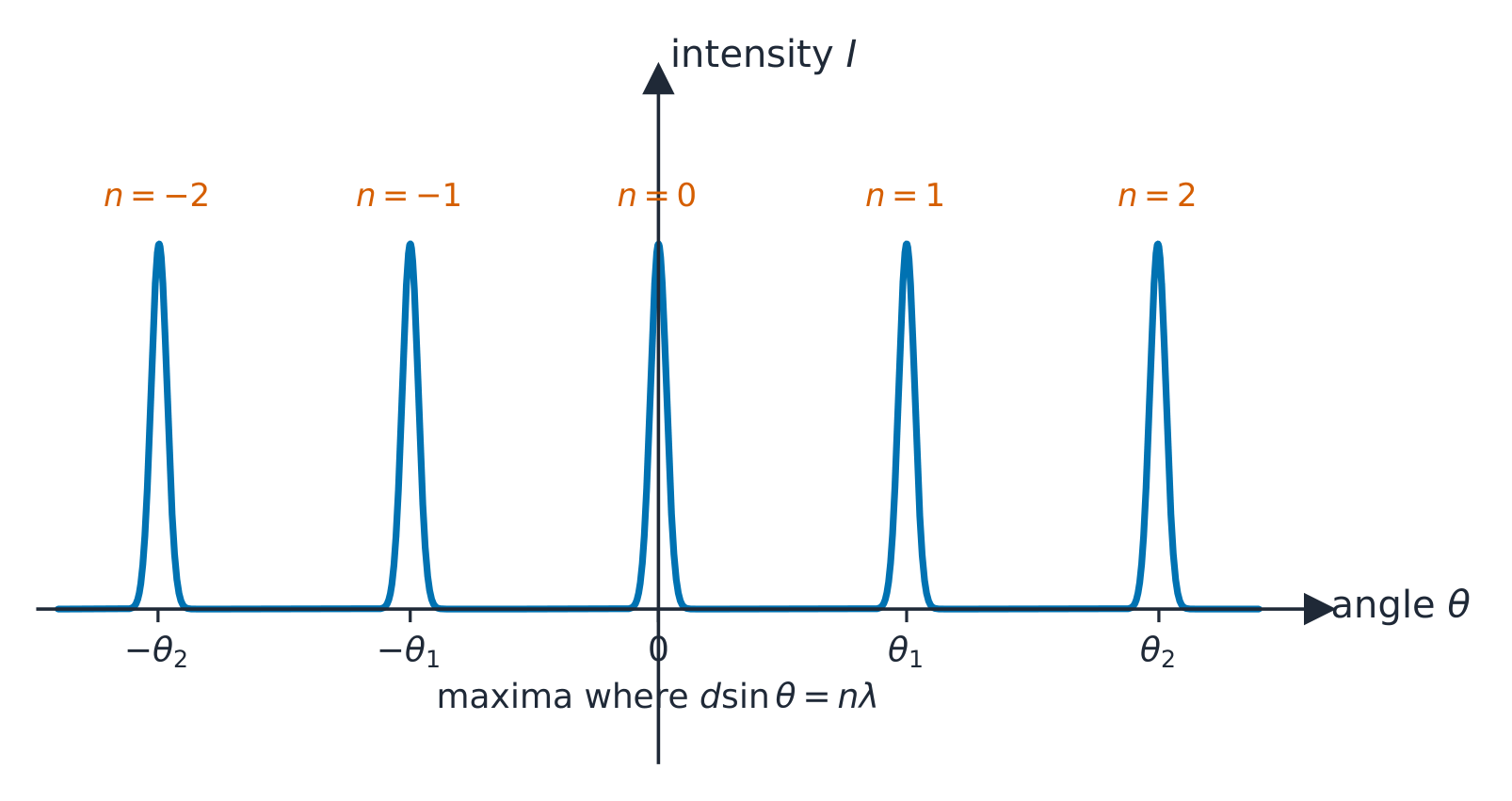
กราฟแสดงความเข้มเทียบกับมุมสำหรับเกรตติ้งหกลาย: ยอดแหลมแคบๆ คมชัดที่มีขนาดใกล้เคียงกันที่ศูนย์และที่บวกลบเทต้าหนึ่งและเทต้าสอง, มีป้ายกำกับว่า n = 0, บวกหรือลบ 1, บวกหรือลบ 2, โดยมีความเข้มเกือบไม่มีอยู่ระหว่างยอดเหล่านี้
ความเข้มเทียบกับมุมสำหรับเกรตติ้ง: maxima คมชัดที่ $d\sin\theta = n\lambda$

ตัวอย่างวิธีทำ. แสงที่มีความยาวคลื่น $680\ \text{nm}$ ส่องตกกระทบกับเกรตติ้งที่มี $450$ เส้นต่อมิลลิเมตรอย่างตั้งฉาก หามุมระหว่าง maxima อันดับสองทั้งสอง

$d = 1/450\ \text{mm} = 2.22 \times 10^{-6}\ \text{m}$, ดังนั้น $\sin\theta_{2} = 2 \times 680 \times 10^{-9} / (2.22 \times 10^{-6}) = 0.612$ และ $\theta_{2} = 37.7°$; รังสีลำดับที่สองทั้งสองอยู่ห่างกัน $2\theta_{2} = 75°$

ลำแสงขนานของแสงสีเดียวที่ส่องลงบนเกรตติ้งหกลายและแยกออกเป็นหลายรังสีคมชัดที่ไปถึงจอที่มุมต่างๆ (อันดับ)
เกรตติ้งการหักเหแยกแสงสีเดียวเป็นจุดสูงสุดแหลมบนจอ

ระยะห่างช่องจาก "เส้นต่อมิลลิเมตร"

ถ้าเกรตติ้งมี $N$ เส้นต่อมิลลิเมตร, แล้ว $d = 1/N$ มิลลิเมตร $= 10^{-3}/N$ เมตร. สำหรับ $450$ เส้นต่อมิลลิเมตร, $d = 1/450\ \text{mm} \approx 2.22\ \mu\text{m}$.

อันดับสูงสุด

สำหรับเกรตติ้งและความยาวคลื่นที่กำหนด $\sin\theta = n\lambda/d$ ไม่สามารถมากกว่า $1$ ได้, ดังนั้นอันดับสูงสุดที่มองเห็นได้คือ

$$n_{\text{max}} = \left\lfloor \frac{d}{\lambda} \right\rfloor.$$

หาก $d/\lambda = 3.27$, จะมีอันดับตั้งแต่ $n = 3$; $n = 4$ จะต้องใช้ $\sin\theta > 1$ และไม่ปรากฏ

ดังนั้นจำนวนสูงสุดทั้งหมดบนจอกว้างคือ $2n_{\text{max}} + 1$: สำหรับแสง $700\ \text{nm}$ และ $400$ เส้นต่อมิลลิเมตร, $d/\lambda = 3.57$, ดังนั้น $n_{\text{max}} = 3$ และเห็นรังสีเจ็ดลำ. ความยาวคลื่นที่สั้นกว่าจะให้ลำดับมากกว่าที่มุมเล็กกว่า. ด้วยแสงสีขาว ทุกลำดับยกเว้นลำดับศูนย์จะเป็นสเปกตรัม สีน้ำเงินอยู่ใกล้กึ่งกลางที่สุดและสีแดงอยู่ไกลออกไปที่สุด เนื่องจาก $\theta$ เพิ่มขึ้นตาม $\lambda$; ลำดับศูนย์ยังคงเป็นสีขาว. สองความยาวคลื่นจะให้เกิดค่าสูงสุดที่มุมเดียวกันเมื่อ $n_{1}\lambda_{1} = n_{2}\lambda_{2}$: ลำดับที่สามของ $400\ \text{nm}$ ชนกับลำดับที่สองของ $600\ \text{nm}$

การหา $\lambda$ ด้วยเกรตติ้ง

ส่องแสงขนานที่มีความยาวคลื่นไม่ทราบค่าตรงๆ เข้ากับเกรตติ้ง วัดมุม $\theta_{1}$ ของ first-order maximum จากศูนย์กลาง จากนั้น $\lambda = d \sin\theta_{1}$. ทำซ้ำสำหรับอันดับที่สูงกว่าและหาค่าเฉลี่ยจะช่วยลดข้อผิดพลาด

วัดมุมระหว่างค่าสูงสุดลำดับแรกจากทั้งสองด้านแล้วหารสอง เพื่อตัดข้อผิดพลาดในการตั้งค่าศูนย์; ลำดับที่สูงกว่าจะให้มุมที่ใหญ่ขึ้นดังนั้นความคลาดเคลื่อนแบบเปอร์เซ็นต์จะน้อยกว่า; และการกราฟ $\sin\theta$ เทียบกับ $n$ สำหรับหลายลำดับจะได้เส้นตรงผ่านจุดกำเนิดที่มีความชัน $\lambda/d$, ดังนั้น $\lambda = Gd$ (หรือ, สำหรับความยาวคลื่นที่กำหนดไว้, $d = \lambda/G$). สิ่งสองอย่างต้องถูกต้อง: $\theta$ วัดจาก แนวฉาก กับเกรตติ่ง ไม่ใช่จากพื้นผิวของมัน, และ $d$ เป็นระยะห่างระหว่างเส้นที่อยู่ติดกัน, ดังนั้น $400$ เส้นต่อมิลลิเมตร หมายความว่า $d = 2.5\ \mu\text{m}$, ไม่เคย $400$

Explore · ⁨สำรวจ⁩

Why the grating gives sharp maxima · ⁨ทำไมกรวยจึงให้ maksima คมชัด⁩

Two waves add when in phase and cancel when out of phase — change the phase and watch the resultant. A grating's many slits make the bright fringes razor-sharp. · ⁨คลื่นสองคลื่นบวกกันเมื่อเฟสเดียวกันและหักล้างกันเมื่อเฟสต่างกัน — เปลี่ยนเฟสและดูผลลัพธ์. กรวยที่มีช่องจำนวนมากทำให้แถบสว่างคมกริบ⁩

Vocabulary · ⁨คำศัพท์⁩ Train · ⁨ฝึกฝน⁩
English ไทย
intensity/ɪnˈtensɪti/ ความเข้ม
antiphase/ˌæntɪˈfeɪz/ ตรงข้ามเฟส
maximum/ˈmæksɪməm/ สูงสุด
antinode/ˌæntɪˈnəʊd/ จุดแอมพลิจูดสูงสุด
diffraction grating/dɪˈfrækʃn ˈɡreɪtɪŋ/ เกรตติ้งเลี้ยวเบน
normal/ˈnɔːml/ เส้นปกติ
slit spacing/slɪt ˈspeɪsɪŋ/ ระยะห่างระหว่างช่องเปิด
order/ˈɔːdə/ ลำดับ (order)
Watch lesson · ⁨ดูบทเรียน⁩
8.4

Definitions the examiner accepts · ⁨คำนิยามที่ผู้สอบยอมรับ⁩

English

A definition question is marked against fixed wording. Learn these exactly, and give one answer only.

Term Definition
principle of superposition when two or more waves meet at a point, the resultant displacement is the sum of the displacements of the individual waves
stationary wave the pattern formed when two progressive waves of the same frequency and speed travel in opposite directions and superpose, with nodes and antinodes that do not move
node a point on a stationary wave where the displacement is always zero
antinode a point on a stationary wave where the amplitude is a maximum
diffraction the spreading of a wave as it passes through a gap or around the edge of an obstacle
interference the superposition of waves from coherent sources, giving a steady pattern of maxima and minima
coherence waves that have a constant phase difference (and so the same frequency)
path difference the difference between the distances travelled by two waves from their sources to a point
fringe spacing the distance between the centres of two adjacent bright (or dark) fringes
order of a maximum the whole number $n$ in $d\sin\theta = n\lambda$, the number of wavelengths of path difference between adjacent slits
ไทย

คำถามคำนิยามจะให้คะแนนตามข้อความที่กำหนดไว้你必须 exact. เรียนรู้ให้ถูกต้องและตอบเพียงคำตอบเดียวเท่านั้น

พจน์ นิยาม
หลักการ叠加 เมื่อคลื่นสองหรือมากกว่ามาพบกันที่จุดหนึ่ง การกระจัดรวมจะเป็นผลบวกของการกระจัดของคลื่นแต่ละตัว
คลื่นนิ่ง รูปแบบที่เกิดขึ้นเมื่อคลื่น propagated สองคลื่นที่มีความถี่และความเร็วเท่ากันเดินทางในทิศทางตรงกันข้ามและ叠加กัน, โดยมีโหนดและแอนติโหนดที่ไม่เคลื่อนที่
โหนด จุดบนคลื่นนิ่งที่การกระจัดเป็นศูนย์ตลอดเวลา
แอนติโหนด จุดบนคลื่นนิ่งที่แอมพลิจูดมีค่าสูงสุด
การหกลาย การกระจายตัวของคลื่นขณะผ่านช่องหรือรอบขอบของสิ่งกีดขวาง
การแทรกสอด การ叠加ของคลื่นจากแหล่งกำเนิดที่สอดคล้องกัน, ให้รูปแบบที่เสถียรของ maxima และ minima
ความเป็น cohherence คลื่นที่มีผลต่างเฟสคงที่ (และดังนั้นมีความถี่เท่ากัน)
ความต่างของระยะทาง ความแตกต่างระหว่างระยะทางที่คลื่นสองคลื่นเดินทางจากแหล่งกำเนิดไปยังจุดหนึ่ง
ระยะห่างของแถบ ระยะห่างระหว่างศูนย์กลางของแถบสว่าง (หรือมืด) ที่ติดกันสองแถบ
อันดับของ maxima จำนวนเต็ม $n$ ใน $d\sin\theta = n\lambda$, จำนวนของความยาวคลื่นของความต่างระยะทางระหว่างช่องเพื่อนบ้าน
8.4

Exam tips · ⁨ข้อแนะนำสำหรับการสอบ⁩

English
  • Two-source interference: constructive when path difference $= n\lambda$, destructive when $= (n + \tfrac{1}{2})\lambda$; the sources must be coherent.
  • Double slit: $\lambda = ax/D$; diffraction grating: $d\sin\theta = n\lambda$ — know every symbol.
  • On a stationary wave mark nodes and antinodes; adjacent nodes are $\lambda/2$ apart; it stores energy but does not transfer it.
  • A stationary wave needs two waves of the same frequency travelling in opposite directions.

Common mistakes

  • Adding amplitudes or intensities in the principle of superposition. Displacements add; the intensity then follows from the resultant amplitude squared.
  • "Adjacent nodes are one wavelength apart." Half a wavelength; a node to the next antinode is a quarter.
  • Using $d =$ lines per millimetre in $d\sin\theta = n\lambda$. Invert: $d = 10^{-3}/N$ metres.
  • Measuring $\theta$ from the grating surface, or forgetting that the angle between the two first-order beams is $2\theta_{1}$.
  • Writing "in phase" for coherent. Coherent means a constant phase difference; the sources may be permanently out of step.
  • Saying the fringe spacing changes when the source is made brighter, or that narrower slits change the spacing. Brightness and slit width change the contrast and the number of visible fringes, not $x = \lambda D/a$.
ไทย
  • การแทรกสอดแบบสองแหล่งกำเนิด: เสริมกัน เมื่อความต่างระยะทาง $= n\lambda$, หักล้างกัน เมื่อ $= (n + \tfrac{1}{2})\lambda$; แหล่งกำเนิดต้อง cohherent
  • ช่องคู่: $\lambda = ax/D$; เกรตติ่งการกระจาย: $d\sin\theta = n\lambda$ — ต้องรู้สัญลักษณ์ทุกตัว
  • บน คลื่นนิ่ง แสดงโหนดและแอนติโหนด; โหนดที่ติดกันจะ $\lambda/2$ จากกัน; เก็บพลังงานแต่ไม่ส่งต่อ
  • คลื่นนิ่งต้องการคลื่นสองคลื่นที่มี ความถี่เท่ากันเดินทางในทิศทางตรงกันข้าม

ข้อผิดพลาดที่พบบ่อย

  • การบวกแอมพลิจูดหรือความเข้มในหลักการ叠加. การกระจัดบวกกัน; ความเข้มจากนั้นเกิดจากกำลังสองของแอมพลิจูดรวม
  • "โหนดที่ติดกันอยู่ห่างกันหนึ่งความยาวคลื่น" ครึ่งความยาวคลื่น; โหนดถึงแอนติโหนดถัดไปคือหนึ่งในสี่
  • การใช้ $d =$ เส้นต่อมิลลิเมตรใน $d\sin\theta = n\lambda$. กลับค่า: $d = 10^{-3}/N$ เมตร
  • การวัด $\theta$ จากพื้นผิวเกรตติ้ง, หรือลืมว่ามุมระหว่างรังสี first-order ทั้งสองคือ $2\theta_{1}$
  • เขียนว่า "in phase" สำหรับ cohherent. Coherent หมายความว่าผลต่างเฟสคงที่; แหล่งกำเนิดอาจไม่ตรงกันตลอดกาล
  • บอกว่าระยะห่างของแถบเปลี่ยนเมื่อแหล่งกำเนิดสว่างขึ้น, หรือว่าช่องแคบลงเปลี่ยนระยะห่าง. ความสว่างและความกว้างของช่องเปลี่ยนความคมชัดและจำนวนแถบที่มองเห็นได้, ไม่ใช่ $x = \lambda D/a$

Interactive lessons on this topic · ⁨บทเรียนเชิงโต้ตอบสำหรับหัวข้อนี้⁩

Work through it step by step, with instant-check exercises. · ⁨ทำทีละขั้นตอน พร้อมแบบฝึกหัดตรวจสอบผลทันที⁩

Past Papers · ⁨ข้อสอบย้อนหลัง⁩

More topics in A-Level Physics · ⁨Physics A-Level⁩ · ⁨หัวข้อเพิ่มเติมใน A-Level Physics · ⁨Physics A-Level⁩⁩

Log in or create account · ⁨เข้าสู่ระบบหรือสร้างบัญชี⁩

IGCSE, A-Level & AP