Skip to content · ⁨ข้ามไปยังเนื้อหา⁩

Quantum physics · ⁨ฟิสิกส์ควอนตัม⁩

A-Level Physics · ⁨Physics A-Level⁩ · Topic 22 · ⁨หัวข้อ 22⁩

Video lesson for this topic · ⁨บทเรียนวิดีโอสำหรับหัวข้อนี้⁩ Open the video page · ⁨เปิดหน้าวิดีโอ⁩
15:44

โฟตอน

นี่คือปริศนาที่ทำลายฟิสิกส์คลาสสิก ส่องโคมไฟสีแดงที่สว่างที่สุดที่คุณหาได้ onto的金属 plate. ใส่อุณหภูมิและแสงมากขึ้นเรื่อยๆ และอย่างไรก็ตาม — ไม่มีอะไรเกิดขึ้น…

English narration · English + 中文 subtitles burned in · ⁨การบรรยายภาษาอังกฤษ · คำบรรยายภาษาอังกฤษ + 中文 ลอยตัวบนภาพ⁩

22.1

Photons: the particle nature of light · ⁨โฟตอน: ธรรมชาติแบบอนุภาคของแสง⁩

Syllabus · ⁨หลักสูตร⁩
English
  1. understand that electromagnetic radiation has a particulate nature
  2. understand that a photon is a quantum of electromagnetic energy
  3. recall and use $E = hf$
  4. use the electronvolt (eV) as a unit of energy
  5. understand that a photon has momentum and that the momentum is given by $p = E/c$
ไทย
  1. เข้าใจว่า รังสีแม่เหล็กไฟฟ้า (electromagnetic radiation) มี ธรรมชาติเป็นอนุภาค (particulate nature)
  2. เข้าใจว่า โฟตอน (photon) เป็น ควอนตัม (quantum) ของพลังงานแม่เหล็กไฟฟ้า
  3. จำและใช้ $E = hf$
  4. ใช้ อิเล็กตรอนโวลต์ (electronvolt, eV) เป็นหน่วยของพลังงาน
  5. เข้าใจว่าโฟตอนมี โมเมนตัม (momentum) และโมเมนตัมถูกกำหนดโดย $p = E/c$

Source: Cambridge International syllabus · ⁨แหล่งที่มา: หลักสูตร Cambridge International⁩

English

Electromagnetic radiation behaves like particles as well as like a wave. The particles of EM radiation are photons 光子 — small packets ("quanta" 量子) of EM energy that travel at the speed of light.

"State what is meant by a photon" (two marks). A photon is a quantum (a discrete packet) of energy of electromagnetic radiation. Both halves score: quantum or packet (or "discrete amount"), and of electromagnetic radiation (or "of light"). "A particle of light" alone is not enough. That radiation comes in such packets is what the syllabus calls its particulate nature 粒子性: energy is delivered in lumps of $hf$, never in smaller pieces.

Energy of a photon

A photon of frequency 频率 $f$ has energy

$$E = h f,$$

where $h = 6.63 \times 10^{-34}\ \text{J s}$ is the Planck constant 普朗克常量. Using $c = f\lambda$:

$$E = \frac{h c}{\lambda}.$$

Worked example. Find the energy of a photon of green light of wavelength $500\ \text{nm}$. ($h = 6.63 \times 10^{-34}\ \text{J s}$, $c = 3.0 \times 10^{8}\ \text{m s}^{-1}$.)

$$E = \frac{hc}{\lambda} = \frac{(6.63 \times 10^{-34})(3.0 \times 10^{8})}{500 \times 10^{-9}} \approx 4.0 \times 10^{-19}\ \text{J}\ (\approx 2.5\ \text{eV}).$$

Higher-frequency (shorter-wavelength 波长) photons carry more energy: one $\gamma$-ray photon carries far more than one radio photon.

The electronvolt

The electronvolt 电子伏特 (eV) is a handy energy unit on the atomic scale:

$$1\ \text{eV} = 1.60 \times 10^{-19}\ \text{J}.$$

It is the kinetic energy 动能 an electron 电子 gains moving through a potential difference 电势差 of 1 V. For example, a visible photon ($\lambda \approx 500\ \text{nm}$) has energy $\approx 2.5\ \text{eV}$. To go eV → J multiply by $1.60 \times 10^{-19}$; J → eV divide.

Using the electronvolt. Photon energies, work functions and energy levels are all a few eV, so the exam quotes them that way and expects you to move between units without fuss: a $2.0\ \text{eV}$ work function is $2.0 \times 1.60 \times 10^{-19} = 3.2 \times 10^{-19}\ \text{J}$; a photon of $4.0 \times 10^{-19}\ \text{J}$ is $2.5\ \text{eV}$. A useful shortcut for wavelengths: $hc = 1.99 \times 10^{-25}\ \text{J m} = 1240\ \text{eV nm}$, so a $2.0\ \text{eV}$ photon has $\lambda = 1240/2.0 = 620\ \text{nm}$ (red) and a $400\ \text{nm}$ photon carries $3.1\ \text{eV}$.

Momentum of a photon

A photon also carries momentum 动量:

$$p = \frac{E}{c} = \frac{h}{\lambda}.$$

It has zero rest mass but a non-zero momentum $E/c$. Radiation pressure (photons pushing on a surface) follows from this.

"Show that $p = h/\lambda$." Start from the two photon relations: $E = hf$ and $p = E/c$. Then $p = hf/c$, and since $c = f\lambda$, $f/c = 1/\lambda$, so $p = h/\lambda$. Give both starting equations and the wave equation; the mark is for the chain, not the result.

Worked example. A photon in free space has momentum $9.5 \times 10^{-28}\ \text{N s}$. Show that it is a photon of red light.

$\lambda = h/p = 6.63 \times 10^{-34}/9.5 \times 10^{-28} = 7.0 \times 10^{-7}\ \text{m} = 700\ \text{nm}$, which lies at the red end of the visible spectrum ($400$–$700\ \text{nm}$). The energy is $pc = 2.9 \times 10^{-19}\ \text{J} = 1.8\ \text{eV}$.

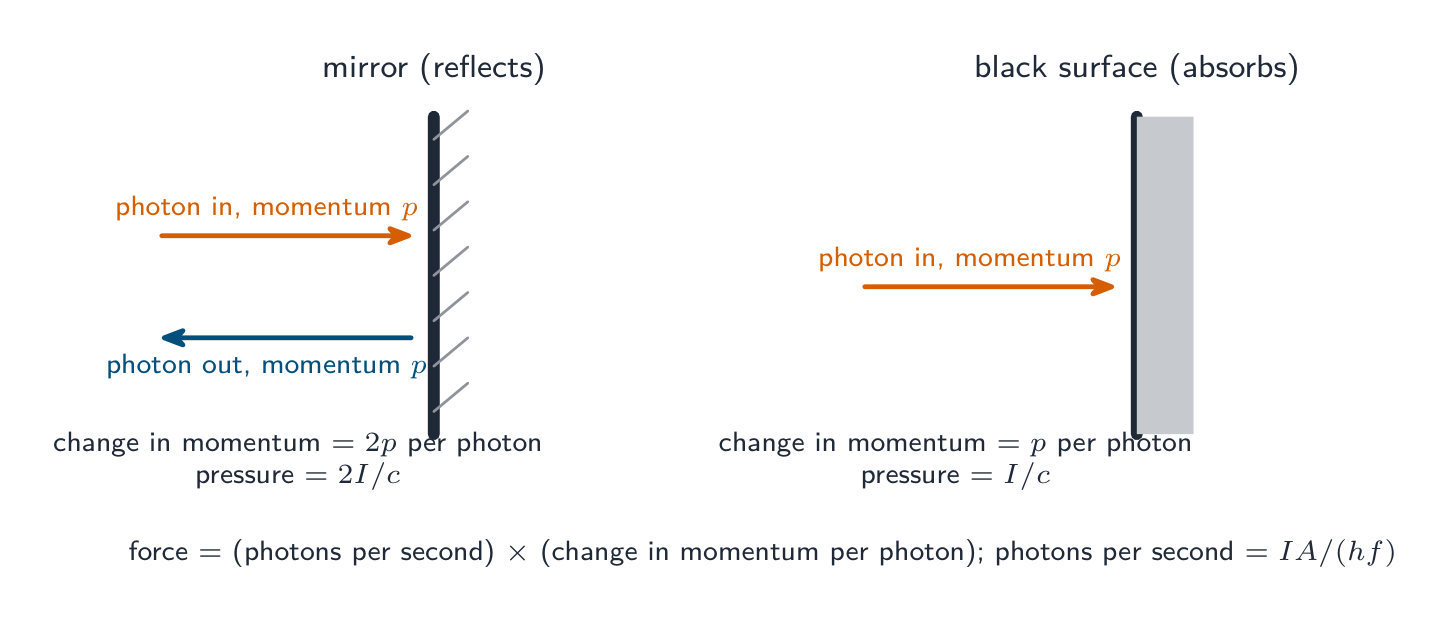
Radiation pressure 辐射压. A beam of intensity $I$ (power per unit area) falling on area $A$ delivers $IA/(hf)$ photons per second, each with momentum $h/\lambda$. Force is the rate of change of momentum. On a mirror each photon bounces back, so its momentum changes by $2p$ and the force is $F = 2IA/c$ (pressure $2I/c$); on a black surface each photon is absorbed, the change is $p$, and the pressure is $I/c$. Two things follow, and both are examined: the pressure depends on the intensity, not on the colour, because blue light of the same intensity has fewer photons per second but each carries proportionally more momentum; and even sunlight ($I \approx 1\ \text{kW m}^{-2}$) exerts only a few micropascals.

Worked example. Red light of intensity $160\ \text{W m}^{-2}$ falls normally on a plane mirror; each photon has momentum $9.5 \times 10^{-28}\ \text{N s}$. Find the number of photons hitting $1.0\ \text{m}^{2}$ of the mirror per second, and the pressure on it.

Photon energy $E = pc = (9.5 \times 10^{-28})(3.00 \times 10^{8}) = 2.85 \times 10^{-19}\ \text{J}$. Photons per second on $1.0\ \text{m}^{2}$: $160/2.85 \times 10^{-19} = 5.6 \times 10^{20}\ \text{s}^{-1}$. Each is reflected, so the force is $F = 5.6 \times 10^{20} \times 2 \times 9.5 \times 10^{-28} = 1.1 \times 10^{-6}\ \text{N}$ on $1.0\ \text{m}^{2}$: a pressure of $1.1 \times 10^{-6}\ \text{Pa}$ (check: $2I/c = 320/3.00 \times 10^{8} = 1.1 \times 10^{-6}\ \text{Pa}$). Replace the beam with blue light of the same intensity and the pressure is unchanged.

Worked example. A laser emits $2.0\ \text{mW}$ of light of wavelength $650\ \text{nm}$. Find the number of photons it emits per second, and the force on a surface that absorbs the beam completely.

$E = hc/\lambda = (6.63 \times 10^{-34})(3.00 \times 10^{8})/(650 \times 10^{-9}) = 3.06 \times 10^{-19}\ \text{J}$, so the rate is $P/E = 2.0 \times 10^{-3}/3.06 \times 10^{-19} = 6.5 \times 10^{15}\ \text{s}^{-1}$. The force is the momentum delivered per second: $F = P/c = 2.0 \times 10^{-3}/3.00 \times 10^{8} = 6.7 \times 10^{-12}\ \text{N}$ (or $6.5 \times 10^{15} \times h/\lambda$, the same thing).

ไทย

รังสีแม่เหล็กไฟฟ้า behaving เปรียบเสมือน อนุภาค.enable เปรียบเสมือนคลื่น อนุภาคของรังสี EM คือ โฟตอน — แพ็คเก็ตเล็กๆ ("ควอนตัม") ของพลังงาน EM ที่เดินทางด้วยความเร็วแสง

"บอกความหมายของโฟตอน" (2 คะแนน). โฟตอนคือควอนตัม (แพ็คเก็ตที่เป็นเอกเทศ) ของพลังงานของรังสีแม่เหล็กไฟฟ้า. ทั้งสองส่วนได้คะแนน: ควอนตัมหรือแพ็คเก็ต (หรือ "ปริมาณเอกเทศ"), และ ของรังสีแม่เหล็กไฟฟ้า (หรือ "ของแสง") "อนุภาคของแสง" เพียงอย่างเดียวไม่เพียงพอ สิ่งที่หลักสูตรเรียกว่า nature แบบอนุภาค: พลังงานถูกส่งในรูปแบบก้อนของ $hf$, ไม่เคยเป็นชิ้นส่วนที่เล็กกว่า

โฟตอนคือแพ็คเก็ตของพลังงาน EM, มีพลังงาน E = h f
โฟตอนคือแพ็คเก็ตของพลังงาน, E = hf

พลังงานของโฟตอน

โฟตอนที่มี ความถี่ $f$ มีพลังงาน

$$E = h f,$$

โดยที่ $h = 6.63 \times 10^{-34}\ \text{J s}$ คือ ค่าคงที่ของพลังค์ ใช้ $c = f\lambda$:

$$E = \frac{h c}{\lambda}.$$

ตัวอย่างวิธีทำ. หาพลังงานของโฟตอนแสงสีเขียวที่มีความยาวคลื่น $500\ \text{nm}$. ($h = 6.63 \times 10^{-34}\ \text{J s}$, $c = 3.0 \times 10^{8}\ \text{m s}^{-1}$.)

$$E = \frac{hc}{\lambda} = \frac{(6.63 \times 10^{-34})(3.0 \times 10^{8})}{500 \times 10^{-9}} \approx 4.0 \times 10^{-19}\ \text{J}\ (\approx 2.5\ \text{eV}).$$

โฟตอนที่มีความถี่สูงกว่า (ความยาวคลื่นสั้นกว่า) พกพาพลังงานมากกว่า: โฟตอนรังสี $\gamma$ หนึ่งตัวมีพลังงานมากกว่าโฟตอนวิทยุหนึ่งตัวมาก

อิเล็กตรอนโวลต์

อิเล็กตรอนโวลต์ (eV) เป็นหน่วยพลังงานที่สะดวกบนระดับอะตอม:

$$1\ \text{eV} = 1.60 \times 10^{-19}\ \text{J}.$$

นี่คือ พลังงานจลน์ ที่ อิเล็กตรอน ได้รับเมื่อเคลื่อนที่ผ่าน ความต่างศักย์ 1 V ตัวอย่างเช่น โฟตอนแสงที่มองเห็นได้ ($\lambda \approx 500\ \text{nm}$) มีพลังงาน $\approx 2.5\ \text{eV}$. ในการแปลง eV → J คูณด้วย $1.60 \times 10^{-19}$; J → eV หารด้วย

การใช้อิเล็กตรอนโวลต์. พลังงานโฟตอน ฟังก์ชันงาน และระดับพลังงานทั้งหมดมีค่าประมาณหลาย eV ดังนั้นข้อสอบจึงระบุค่าเหล่านี้เป็น eV และคาดหวังให้คุณเปลี่ยนหน่วยระหว่างกันได้อย่างคล่องแคล่ว: ฟังก์ชันงาน $2.0\ \text{eV}$ เท่ากับ $2.0 \times 1.60 \times 10^{-19} = 3.2 \times 10^{-19}\ \text{J}$; โฟตอนที่มี $4.0 \times 10^{-19}\ \text{J}$ มีพลังงาน $2.5\ \text{eV}$. วิธีลัดที่มีประโยชน์สำหรับความยาวคลื่น: $hc = 1.99 \times 10^{-25}\ \text{J m} = 1240\ \text{eV nm}$, ดังนั้นโฟตอนความยาวคลื่น $2.0\ \text{eV}$ จึงมีพลังงาน $\lambda = 1240/2.0 = 620\ \text{nm}$ (แสงสีแดง) และโฟตอนความยาวคลื่น $400\ \text{nm}$ พกพาพลังงาน $3.1\ \text{eV}$.

โมเมนตัมของโฟตอน

โฟตอนยังพกพา โมเมนตัม ด้วย:

$$p = \frac{E}{c} = \frac{h}{\lambda}.$$

มันมีมวลหยุด/rest mass เป็นศูนย์แต่มีโมเมนตัมที่ไม่เป็นศูนย์ $E/c$. ความดันรังสี (โฟตอนชนกับพื้นผิว) เกิดขึ้นจากสิ่งนี้

"แสดงว่า $p = h/\lambda$." เริ่มจากความสัมพันธ์สองอย่างของโฟตอน: $E = hf$ และ $p = E/c$. จากนั้น $p = hf/c$, และเนื่องจาก $c = f\lambda$, $f/c = 1/\lambda$, ดังนั้น $p = h/\lambda$. ให้ทั้งสองสมการเริ่มต้นและสมการคลื่น; คะแนนอยู่ที่ chain, ไม่ใช่ผลลัพธ์

ตัวอย่างวิธีทำ. โฟตอนในสุญญากาศมีโมเมนตัม $9.5 \times 10^{-28}\ \text{N s}$. แสดงว่าเป็นโฟตอนของแสงสีแดง

$\lambda = h/p = 6.63 \times 10^{-34}/9.5 \times 10^{-28} = 7.0 \times 10^{-7}\ \text{m} = 700\ \text{nm}$, ซึ่งอยู่ที่ปลายสีแดงของสเปกตรัมที่มองเห็นได้ ($400$–$700\ \text{nm}$). พลังงานคือ $pc = 2.9 \times 10^{-19}\ \text{J} = 1.8\ \text{eV}$

สองแผง: โฟตอนชนกระจกแล้วออกด้วยโมเมนตัมที่กลับด้าน, ดังนั้นแต่ละตัวจึงถ่ายโอนโมเมนตัมสองเท่าและความดันคือ 2I over c; โฟตอนชนพื้นสีดำจะถูกดูดกลืนและถ่ายโอนโมเมนตัมครั้งเดียว, ดังนั้นความดันคือ I over c
ความดันรังสี: แรงเท่ากับจำนวนโฟตอนที่มาถึงต่อวินาทีคูณกับการเปลี่ยนแปลงโมเมนตัมของแต่ละตัว; กระจกเพิ่มการเปลี่ยนแปลงสองเท่า, ตัวดูดกลืนไม่เพิ่ม

ความดันรังสี. รังสีที่มีความเข้ม $I$ (กำลังไฟต่อหน่วยพื้นที่) ชนกับพื้นที่ $A$ จะส่งโฟตอนจำนวน $IA/(hf)$ ต่อวินาที โดยแต่ละตัวมีโมเมนตัม $h/\lambda$. แรงคืออัตราการเปลี่ยนแปลงของโมเมนตัม. บน กระจก โฟตอนแต่ละตัวจะสะท้อนกลับ ทำให้โมเมนตัมเปลี่ยนแปลงไป $2p$ และแรงคือ $F = 2IA/c$ (ความดัน $2I/c$); บน พื้นผิวดำ โฟตอนแต่ละตัวจะถูกดูดกลืน การเปลี่ยนแปลงคือ $p$ และความดันคือ $I/c$. ผลลัพธ์สองอย่างเกิดขึ้นและทั้งสองถูกทดสอบ: ความดันขึ้นอยู่กับ ความเข้ม ไม่ใช่สี เพราะแสงสีฟ้าที่มีความเข้มเท่ากันจะมีจำนวนโฟตอนต่อวินาทีน้อยกว่าแต่แต่ละตัวมีโมเมนตัมสัดส่วนที่มากกว่า; และแม้แต่แสงอาทิตย์ ($I \approx 1\ \text{kW m}^{-2}$) ก็สร้างความดันเพียงไม่กี่ไมโครปาสคาลเท่านั้น

ตัวอย่างวิธีทำ. แสงสีแดงที่มีความเข้ม $160\ \text{W m}^{-2}$ ส่องตั้งฉากกับกระจกเรียบ โฟตอนแต่ละตัวมีโมเมนตัม $9.5 \times 10^{-28}\ \text{N s}$. จงหาจำนวนโฟตอนชน $1.0\ \text{m}^{2}$ ของกระจกต่อวินาที และความดันบนกระจกนั้น

พลังงานโฟตอน $E = pc = (9.5 \times 10^{-28})(3.00 \times 10^{8}) = 2.85 \times 10^{-19}\ \text{J}$. โฟตอนต่อวินาทีบน $1.0\ \text{m}^{2}$: $160/2.85 \times 10^{-19} = 5.6 \times 10^{20}\ \text{s}^{-1}$. แต่ละตัวถูกสะท้อน ดังนั้นแรงคือ $F = 5.6 \times 10^{20} \times 2 \times 9.5 \times 10^{-28} = 1.1 \times 10^{-6}\ \text{N}$ บน $1.0\ \text{m}^{2}$: คือความดัน $1.1 \times 10^{-6}\ \text{Pa}$ (ตรวจสอบ: $2I/c = 320/3.00 \times 10^{8} = 1.1 \times 10^{-6}\ \text{Pa}$). เปลี่ยนลำแสงด้วยแสงสีฟ้าที่มีความเข้มเท่าเดิม แล้วความดันจะ ไม่เปลี่ยนแปลง.

ตัวอย่างวิธีทำ. เลเซอร์ปล่อยแสงกำลัง $2.0\ \text{mW}$ ที่มีคลื่นยาว $650\ \text{nm}$. จงหาจำนวนโฟตอนที่ปล่อยต่อวินาที และแรงบนพื้นผิวที่ดูดกลืนลำแสงนั้นทั้งหมด

$E = hc/\lambda = (6.63 \times 10^{-34})(3.00 \times 10^{8})/(650 \times 10^{-9}) = 3.06 \times 10^{-19}\ \text{J}$, ดังนั้นอัตราคือ $P/E = 2.0 \times 10^{-3}/3.06 \times 10^{-19} = 6.5 \times 10^{15}\ \text{s}^{-1}$. แรงคือโมเมนตัมที่ส่งมอบต่อวินาที: $F = P/c = 2.0 \times 10^{-3}/3.00 \times 10^{8} = 6.7 \times 10^{-12}\ \text{N}$ (หรือ $6.5 \times 10^{15} \times h/\lambda$, สิ่งเดียวกัน)

Explore · ⁨สำรวจ⁩

Energy of a photon · ⁨พลังงานของโฟตอน⁩

E = h·f

Photon energy is proportional to frequency — the gradient is Planck's constant h. · ⁨พลังงานของโฟตอน แปรผันตรงกับ ความถี่ — ความชันคือค่าคงที่ของแพลงก์ h⁩

Vocabulary · ⁨คำศัพท์⁩ Train · ⁨ฝึกฝน⁩
English ไทย
photon/ˈfəʊtɒn/ โฟตอน
quanta/ˈkwɒntə/ ควอนตัม
discrete/dɪˈskriːt/ แบบไม่ต่อเนื่อง
particulate nature/pəˈtɪkjʊleɪt ˈneɪtʃə/ ธรรมชาติแบบอนุภาค
Radiation pressure/ˌreɪdɪˈeɪʃn ˈpreʃə/ แรงดันรังสี
photoelectric effect/ˌfəʊtəʊɪˈlektrɪk ɪˈfekt/ ปรากฏการณ์โฟโตอิเล็กทริก
photoelectron/ˌfəʊtəʊɪˈlektrɒn/ อิเล็กตรอนโฟโต
22.2

Photoelectric effect · ⁨ผล_photoelectric⁩

Syllabus · ⁨หลักสูตร⁩
English
  1. understand that photoelectrons may be emitted from a metal surface when it is illuminated by electromagnetic radiation
  2. understand and use the terms threshold frequency and threshold wavelength
  3. explain photoelectric emission in terms of photon energy and work function energy
  4. recall and use $hf = \Phi + \frac{1}{2}m{v_{\text{max}}}^2$
  5. explain why the maximum kinetic energy of photoelectrons is independent of intensity, whereas the photoelectric current is proportional to intensity
ไทย
  1. เข้าใจว่า อิเล็กตรอนจากปรากฏการณ์โฟโตอิเล็กทริก อาจถูกปล่อยออกจากพื้นผิวโลหะเมื่อได้รับรังสีแม่เหล็กไฟฟ้า
  2. เข้าใจและใช้ศัพท์ ความถี่ ngưỡng และ ความยาวคลื่น ngưỡng
  3. อธิบาย การปล่อยอิเล็กตรอนจากปรากฏการณ์โฟโตอิเล็กทริก ในเชิงพลังงานของโฟตอนและ พลังงานงานออก
  4. จำและใช้ $hf = \Phi + \frac{1}{2}m{v_{\text{max}}}^2$
  5. อธิบายว่าทำไม พลังงานจลน์สูงสุด ของอิเล็กตรอนจากปรากฏการณ์โฟโตอิเล็กทริกจึงไม่ขึ้นอยู่กับความเข้ม ในขณะที่กระแสไฟฟ้าวงจรโฟโตอิเล็กทริกแปรผันตรงกับความเข้ม

Source: Cambridge International syllabus · ⁨แหล่งที่มา: หลักสูตร Cambridge International⁩

English
The photoelectric effect, photon by photon

When EM radiation of high enough frequency hits a metal, electrons are emitted. These are photoelectrons 光电子, and the effect is the photoelectric effect 光电效应.

"State what is meant by the photoelectric effect." The emission of electrons from (the surface of) a metal when electromagnetic radiation of high enough frequency is incident on it. Two marks: emission of electrons and from a metal surface illuminated by electromagnetic radiation (or "when light is shone on it"). It is the syllabus's evidence for the particulate nature of radiation, because a wave could not explain what follows.

Threshold frequency and work function

Each metal has a lowest photon frequency, the threshold frequency 极限频率 $f_{0}$, below which no electrons come out, however bright the light. The work function 逸出功 $\Phi$ is the least energy needed to free an electron from the surface:

$$\Phi = h f_{0}.$$

Different metals have different work functions (about $2$–$5\ \text{eV}$).

The two-mark definitions. The work function energy of a metal is the minimum energy needed to remove an electron from the surface of the metal. Both "minimum" and "from the surface" carry marks: an electron deeper in the metal needs more, which is why the equation gives a maximum kinetic energy. The threshold frequency is the minimum frequency of radiation for which photoelectrons are emitted, and the threshold wavelength 极限波长 $\lambda_{0} = c/f_{0} = hc/\Phi$ is the corresponding maximum wavelength: longer wavelengths do nothing.

Worked example. Light of wavelength $400\ \text{nm}$ falls on four metals whose work functions are: caesium $2.1\ \text{eV}$, sodium $2.3\ \text{eV}$, zinc $4.3\ \text{eV}$, platinum $5.6\ \text{eV}$. Which emit photoelectrons, and with what maximum kinetic energy?

The photon energy is $hc/\lambda = 1240/400 = 3.1\ \text{eV}$. Emission needs $hf \geq \Phi$, so caesium ($3.1 - 2.1 = 1.0\ \text{eV}$) and sodium ($0.8\ \text{eV}$) emit; zinc and platinum do not, however intense the light. To make zinc emit, the wavelength must fall below $\lambda_{0} = 1240/4.3 = 290\ \text{nm}$, in the ultraviolet, which is why the electroscope demonstration needs a UV lamp on zinc.

Worked example. A polished magnesium sheet in a vacuum emits electrons only when the ultraviolet frequency is at least $8.8 \times 10^{14}\ \text{Hz}$. It is illuminated at $1.2 \times 10^{15}\ \text{Hz}$. Find the work function and the maximum speed of the photoelectrons.

$\Phi = hf_{0} = (6.63 \times 10^{-34})(8.8 \times 10^{14}) = 5.8 \times 10^{-19}\ \text{J}$ ($3.6\ \text{eV}$). Then $\tfrac{1}{2}mv_{\text{max}}^{2} = h(f - f_{0}) = (6.63 \times 10^{-34})(1.2 \times 10^{15} - 8.8 \times 10^{14}) = 2.1 \times 10^{-19}\ \text{J}$, so $v_{\text{max}} = \sqrt{2 \times 2.1 \times 10^{-19}/9.11 \times 10^{-31}} = 6.8 \times 10^{5}\ \text{m s}^{-1}$. Subtract the frequencies before multiplying by $h$; rounding $hf$ and $\Phi$ separately loses a significant figure in the small difference.

Einstein's photoelectric equation

One photon gives all its energy to one electron. If the photon energy $hf$ is more than the work function, the electron escapes with kinetic energy up to a maximum:

$$h f = \Phi + \tfrac{1}{2} m v_{\text{max}}^{2}, \qquad\text{so}\qquad \tfrac{1}{2} m v_{\text{max}}^{2} = h(f - f_{0}).$$

Worked example. A metal has a work function of $2.0\ \text{eV}$. Light made of photons of energy $3.5\ \text{eV}$ shines on it. Find the maximum kinetic energy of the photoelectrons.

$$\tfrac{1}{2}mv_{\text{max}}^{2} = hf - \Phi = 3.5 - 2.0 = 1.5\ \text{eV}\ (= 2.4 \times 10^{-19}\ \text{J}).$$

So the maximum KE of photoelectrons depends linearly on frequency, not on brightness.

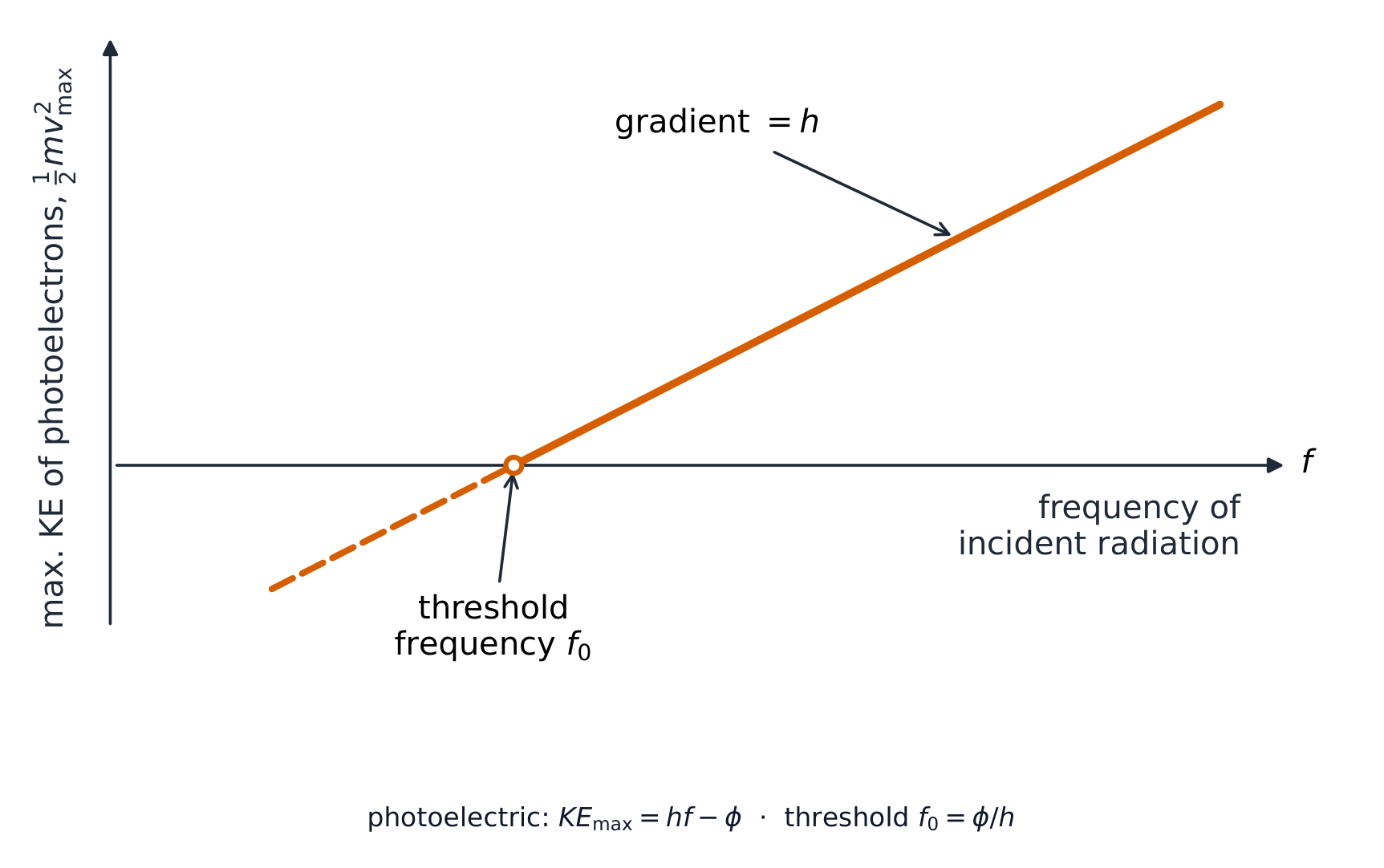
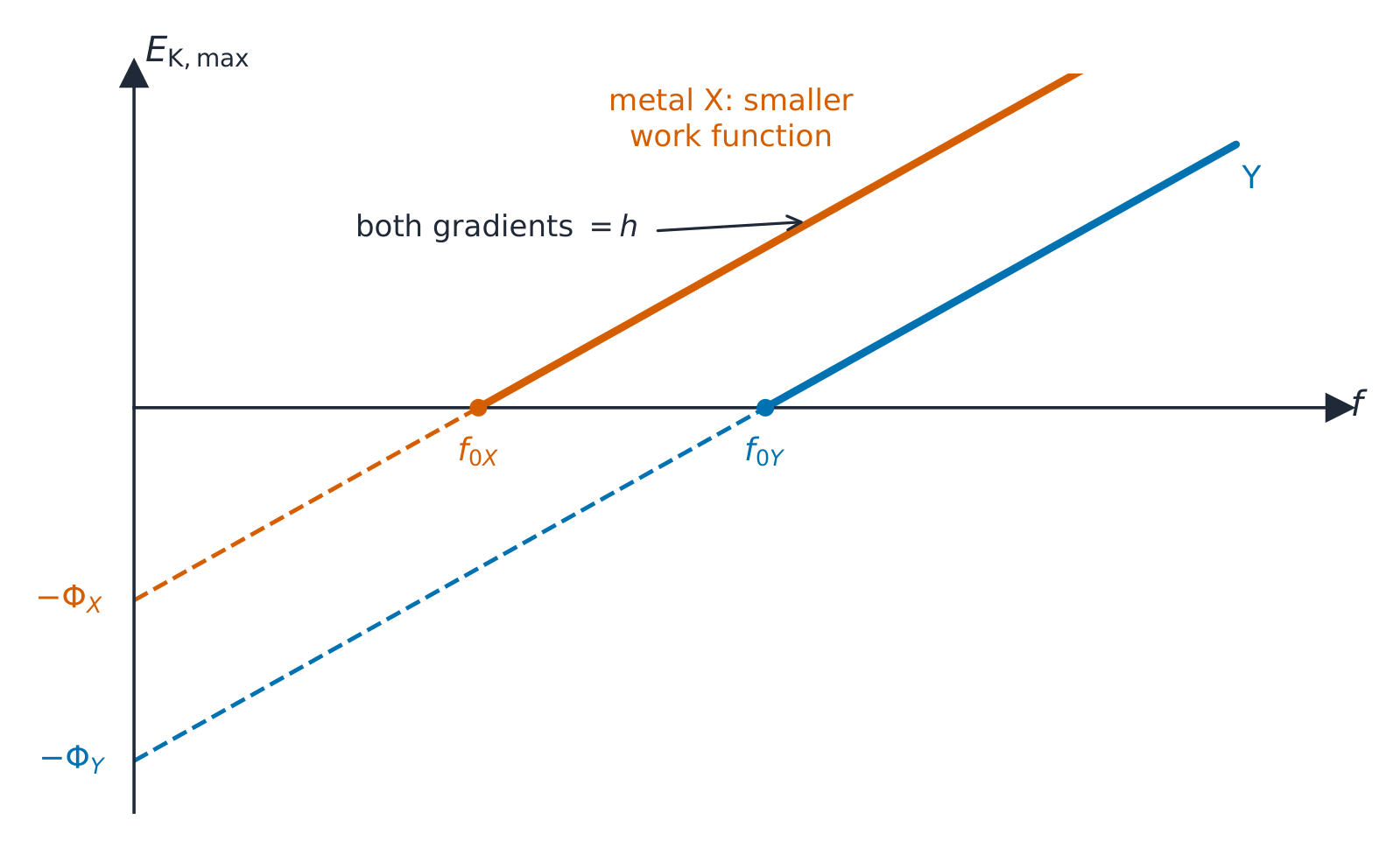
Reading the graph. Write the equation as $E_{\text{K,max}} = hf - \Phi$: a straight line of gradient $h$, intercept $-\Phi$ on the energy axis and $f_{0} = \Phi/h$ on the frequency axis. So a graph for two metals shows two parallel lines (same gradient $h$ for every metal), the metal with the larger work function cutting the frequency axis further to the right; the intensity of the light moves neither line. This is how the Planck constant is measured, and "sketch the line for metal Y" is marked on exactly those two features.

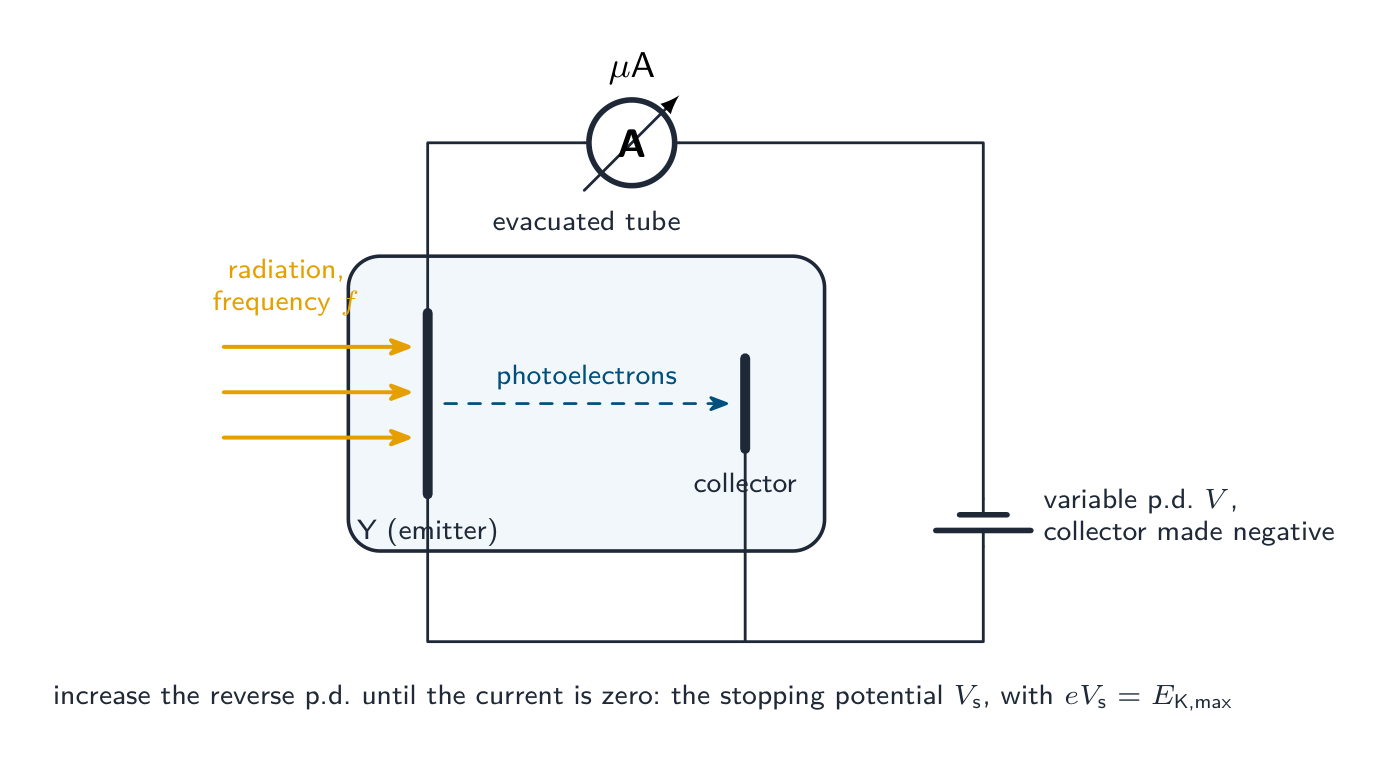
Measuring the maximum kinetic energy. In a photocell the photoelectrons cross a vacuum to a collector and the current is a count of electrons per second. Make the collector negative and the electrons must climb a potential hill; raise the reverse p.d. until the current just reaches zero, the stopping potential 遏止电势 $V_{\text{s}}$, and then $eV_{\text{s}} = E_{\text{K,max}}$. Two results, both examined: at fixed frequency, doubling the intensity doubles the current at low reverse p.d. but leaves $V_{\text{s}}$ unchanged; raising the frequency raises $V_{\text{s}}$ but, at fixed intensity, does not raise the current.

Why the wave model fails

A wave model predicts that brightness should set the electrons' kinetic energy, and that emission should happen at any frequency given enough time. But experiments show:

  • no emission below the threshold frequency, however bright.
  • immediate emission at or above the threshold, even when dim.
  • maximum KE depends on frequency, not brightness.
  • the number of photoelectrons (the current) depends on brightness.

The photon model explains this: light arrives as photons each of energy $hf$. One photon–electron interaction either has enough energy to free the electron ($hf \geq \Phi$) or it does not.

Why max KE is fixed but current grows with brightness

A brighter beam of the same frequency has more photons per second, but each still carries $hf$. So the maximum KE of any electron is $hf - \Phi$ (set by $f$ only), while the rate of emission (the current) grows with the number of photons, i.e. with brightness. Doubling the brightness doubles the current but does not change the maximum KE.

Writing the explanation (a standard three-marker). (1) Each photon interacts with, and gives all its energy to, one electron. (2) The photon energy $hf$ depends only on the frequency, so the maximum energy an electron can leave with, $hf - \Phi$, is fixed by the frequency. (3) Increasing the intensity at the same frequency increases the number of photons per second, so more electrons are emitted per second (a larger current), but each still receives the same energy. A wave, by contrast, would spread its energy over the surface, so a brighter wave should have given faster electrons and a dim one should have needed a delay to accumulate energy; neither happens.

ไทย
效应โฟโตอิเล็กทริก, โฟตอนต่อโฟตอน
สนามเซลล์แสงอาทิตย์
เซลล์แสงอาทิตย์ใช้效应โฟโตอิเล็กทริกเพื่อแปลงแสงเป็นไฟฟ้า.

เมื่อรังสีแม่เหล็กไฟฟ้าที่มีความถี่สูงพอกระทบโลหะ จะเกิด การปล่อยอิเล็กตรอน出来. เหล่านี้คือ โฟโตอิเล็กตรอน และปรากฏการณ์นี้เรียกว่า 效应โฟโตอิเล็กทริก.

"อธิบายความหมายของ效应โฟโตอิเล็กทริก." การปล่อยอิเล็กตรอนจาก (พื้นผิวของ) โลหะเมื่อรังสีแม่เหล็กไฟฟ้าที่มีความถี่สูงพอตกกระทบ คะแนนสองข้อ: การปล่อยอิเล็กตรอน และ จากพื้นผิวโลหะที่ถูกส่องด้วยรังสีแม่เหล็กไฟฟ้า (หรือ "เมื่อส่องแสงลงบนมัน"). นี่คือหลักฐานในหลักสูตรว่ารังสีมีลักษณะเป็นอนุภาค เพราะคลื่นไม่สามารถอธิบายสิ่งที่เกิดขึ้นต่อไปได้.

โฟตอนที่มีพลังงาน hf ชนพื้นผิวโลหะและฉีกอิเล็กตรอนหนึ่งตัวออก; พลังงานของโฟตอนแบ่งออกเป็นฟังก์ชันงาน (เพื่อปลดล็อกอิเล็กตรอน) บวกกับพลังงานจลน์สูงสุดของอิเล็กตรอน
โฟตอนหนึ่งตัวให้พลังงาน $hf$ แก่electrons หนึ่งตัว: ส่วนหนึ่งปลดล็อกมัน (ฟังก์ชันงาน $\Phi$), ส่วนที่เหลือคือพลังงานจลน์ของelectrons
เครื่องวัดประจุไฟฟ้าใบทองสองเครื่องที่มีแผ่นสังกะสีประจุลบ: เครื่องแรกใบทองยังคงเบี่ยงเบน; เครื่องที่สอง แสงยูวีที่ส่องลงบนแผ่นทำให้ใบทองตกลงมาเนื่องจากสูญเสียประจุ
แผ่นสังกะสีที่มีประจุสูญเสียประจุ — ใบทองตกลงมา — เมื่อแสงยูวีส่องลงบนมัน

ความถี่ขีดจำกัดและฟังก์ชันงาน

โลหะแต่ละชนิดมีความถี่โฟตอนต่ำสุดที่เรียกว่า ความถี่ขีดจำกัด $f_{0}$, ต่ำกว่านี้ ไม่มีelectrons ใดออกมา ไม่ว่าแสงจะสว่างแค่ไหน ฟังก์ชันงาน $\Phi$ คือ พลังงานขั้นต่ำ ที่จำเป็นในการปลดล็อกelectrons ออกจากพื้นผิว:

$$\Phi = h f_{0}.$$

โลหะต่างกันมีฟังก์ชันงานต่างกัน (ประมาณ $2$–$5\ \text{eV}$).

นิยามคะแนนสองข้อ. พลังงานฟังก์ชันงานของโลหะคือพลังงานขั้นต่ำที่ต้องการในการดึงelectrons ออกจากพื้นผิวของโลหะ. คำว่า "minimum" (ขั้นต่ำ) และ "from the surface" (จากพื้นผิว) ล้วนได้คะแนน: electron ที่อยู่ลึกภายในโลหะต้องใช้พลังงานมากกว่า นั่นจึงเป็นเหตุผลที่สมการให้ค่า maximum (สูงสุด) ของพลังงานจลน์. ความถี่ขีดจำกัดคือความถี่ต่ำสุดของรังสีที่จะเกิดelectrons出来 และ ความยาวคลื่นขีดจำกัด $\lambda_{0} = c/f_{0} = hc/\Phi$ คือ ความยาวคลื่นสูงสุด ที่สอดคล้องกัน: ความยาวคลื่นที่ยาวกว่านี้จะไม่เกิดผลอะไรเลย.

ตัวอย่างวิธีทำ. แสงที่มีความยาวคลื่น $400\ \text{nm}$ ส่องลงบนโลหะสี่ชนิดที่มีฟังก์ชันงานดังนี้: ซีเซียม $2.1\ \text{eV}$, โซเดียม $2.3\ \text{eV}$, สังกะสี $4.3\ \text{eV}$, พลัตตินัม $5.6\ \text{eV}$. ชนิดไหนจะ放出electrons出来 และมีพลังงานจลน์สูงสุดเท่าใด?

พลังงานโฟตอนคือ $hc/\lambda = 1240/400 = 3.1\ \text{eV}$. การปล่อยelectrons ต้องใช้ $hf \geq \Phi$, ดังนั้น ซีเซียม ($3.1 - 2.1 = 1.0\ \text{eV}$) และ โซเดียม ($0.8\ \text{eV}$) จะ放出electrons出来; สังกะสีและพลัตตินัมจะไม่放出electrons出来 ไม่ว่าแสงจะเข้มแค่ไหน เพื่อให้สังกะสี放出electrons出来 ความยาวคลื่นต้องสั้นกว่า $\lambda_{0} = 1240/4.3 = 290\ \text{nm}$, ซึ่งอยู่ในย่านยูวี, นั่นจึงเป็นเหตุผลว่าทำไมการสาธิตด้วยเครื่องวัดประจุไฟฟ้าต้องใช้หลอดไฟยูวีกับสังกะสี

ตัวอย่างวิธีทำ. แผ่นแมกนีเซียมขัดเงาในสุญญากาศจะ放出electrons出来 เฉพาะเมื่อความถี่ยูวีอย่างน้อย $8.8 \times 10^{14}\ \text{Hz}$. มันถูกส่องด้วยแสงที่ $1.2 \times 10^{15}\ \text{Hz}$. จงหาฟังก์ชันงานและความเร็วสูงสุดของโฟโตอิเล็กตรอน

$\Phi = hf_{0} = (6.63 \times 10^{-34})(8.8 \times 10^{14}) = 5.8 \times 10^{-19}\ \text{J}$ ($3.6\ \text{eV}$). จากนั้น $\tfrac{1}{2}mv_{\text{max}}^{2} = h(f - f_{0}) = (6.63 \times 10^{-34})(1.2 \times 10^{15} - 8.8 \times 10^{14}) = 2.1 \times 10^{-19}\ \text{J}$, ดังนั้น $v_{\text{max}} = \sqrt{2 \times 2.1 \times 10^{-19}/9.11 \times 10^{-31}} = 6.8 \times 10^{5}\ \text{m s}^{-1}$. ลบความถี่ ก่อน คูณด้วย $h$; การปัดเศษ $hf$ และ $\Phi$ แยกกันจะทำให้เสีย significant figure ในผลต่างที่น้อย

สมการ效应โฟโตอิเล็กทริกของไอน์สไตน์

โฟตอนหนึ่งตัวให้พลังงานทั้งหมดแก่electrons หนึ่งตัว. หากพลังงานโฟตอน $hf$ มากกว่าฟังก์ชันงาน, electron จะหลุดออกมาพร้อมพลังงานจลน์สูงสุดถึงระดับหนึ่ง:

$$h f = \Phi + \tfrac{1}{2} m v_{\text{max}}^{2}, \qquad\text{so}\qquad \tfrac{1}{2} m v_{\text{max}}^{2} = h(f - f_{0}).$$

ตัวอย่างวิธีทำ. โลหะหนึ่งมีฟังก์ชันงาน $2.0\ \text{eV}$. แสงที่ทำจากโฟตอนที่มีพลังงาน $3.5\ \text{eV}$ ส่องลงบนมัน. จงหาพลังงานจลน์สูงสุดของโฟโตอิเล็กตรอน

$$\tfrac{1}{2}mv_{\text{max}}^{2} = hf - \Phi = 3.5 - 2.0 = 1.5\ \text{eV}\ (= 2.4 \times 10^{-19}\ \text{J}).$$

ดังนั้นพลังงานจลน์สูงสุดของelectrons出来ขึ้นกับ ความถี่แบบเส้นตรง, ไม่ใช่ความสว่าง.

กราฟแสดงพลังงานจลน์สูงสุดของelectrons出来 เทียบกับความถี่ของรังสีตกกระทบ: เป็นเส้นตรงตัดแกนความถี่ที่ความถี่ขีดจำกัด f0 และสูงขึ้นสำหรับความถี่ที่สูงกว่า
พลังงานจลน์สูงสุดของอิเล็กตรอนโฟโตมีค่าเพิ่มขึ้นเป็นเส้นตรงตามความถี่ และลดลงเป็นศูนย์ที่ความถี่ขีดจำกัด $f_0$

กราฟพลังงานจลน์สูงสุดเทียบกับความถี่สำหรับโลหะสองชนิด X และ Y: เส้นตรงขนานกันที่มีความชัน h โดยโลหะ X ที่มีฟังก์ชันงานน้อยกว่าจะตัดแกนความถี่ที่ความถี่ขีดจำกัดต่ำกว่า; เมื่อต่อเส้นทั้งสองย้อนกลับจะตัดแกนพลังงานที่ลบด้วยฟังก์ชันงานของโลหะแต่ละชนิด *กราฟโลหะสองชนิดบนแผนภาพเดียวกัน: เส้นขนาน (มีความชันเท่ากับค่าคงที่ของพลังค์สำหรับทั้งสอง) โดยแต่ละเส้นตัดแกนความถี่ที่ความถี่ขีดจำกัดของตนเองและตัดแกนพลังงานที่ลบด้วยฟังก์ชันงานของตนเอง
การอ่านกราฟ. เขียนสมการในรูป $E_{\text{K,max}} = hf - \Phi$: เป็นเส้นตรงที่มีความชัน $h$, ตัดแกนพลังงานที่ $-\Phi$ และตัดแกนความถี่ที่ $f_{0} = \Phi/h$ ดังนั้นกราฟสำหรับโลหะสองชนิดจึงแสดง เส้นขนาน (มีความชัน $h$ เดียวกันสำหรับทุกโลหะ) โดยโลหะที่มีฟังก์ชันงานมากกว่าจะตัดแกนความถี่ไปทางขวามากขึ้น; ความเข้มของแสงไม่ทำให้เส้นใดเคลื่อนที่ นี่คือวิธีการวัดค่าคงที่ของพลังค์ และการสั่ง "วาดเส้นสำหรับโลหะ Y" จะให้คะแนนเฉพาะเมื่อระบุคุณสมบัติทั้งสองนี้เท่านั้น

วงจรเซลล์โฟโต:รังสีตกกระทบแผ่นปล่อยอิเล็กตรอนภายในหลอดสุญญากาศ อิเล็กตรอนโฟโตเคลื่อนที่ไปยังตัวเก็บประจุ และมีแรงดันไฟฟ้ากลับด้านแปรผันพร้อมมัลติมิเตอร์เพื่อวัดกระแส; ที่แรงดันหยุดกระแสจะเป็นศูนย์ *การสำรวจผล: กระแสวัดอัตราการปล่อยอิเล็กตรอน และแรงดันไฟฟ้ากลับด้านที่ยับยั้งอิเล็กตรอนที่เร็วที่สุดได้พอดี จะวัดพลังงานจลน์สูงสุดของอิเล็กตรอนเหล่านั้น

การวัดพลังงานจลน์สูงสุด. ในเซลล์โฟโต อิเล็กตรอนโฟโตจะข้ามสุญญากาศไปยังตัวเก็บประจุและ กระแส คือจำนวนนับของอิเล็กตรอนต่อวินาที ทำให้ตัวเก็บประจุมี ประจุลบ และอิเล็กตรอนต้องปีนขึ้นหุบเขาแห่งศักย์ไฟฟ้า; เพิ่มแรงดันไฟฟ้ากลับด้านจนกระแสลดลงเหลือศูนย์พอดี นั่นคือ แรงดันหยุด $V_{\text{s}}$ และจากนั้น $eV_{\text{s}} = E_{\text{K,max}}$. ผลลัพธ์สองอย่างที่ถูกตรวจสอบ: ที่ความถี่คงที่ การเพิ่มความเข้มเป็นสองเท่าจะทำให้กระแสเพิ่มขึ้นเป็นสองเท่าที่แรงดันกลับด้านต่ำ แต่ไม่ทำให้ $V_{\text{s}}$ เปลี่ยนแปลง; การเพิ่มความถี่จะทำให้ $V_{\text{s}}$ เพิ่มขึ้น แต่ที่ความเข้มคงที่จะไม่ทำให้กระแสเพิ่มขึ้น

ทำไมแบบคลื่นถึงล้มเหลว

แบบคลื่นทำนายว่าความสว่างควรกำหนดพลังงานจลน์ของอิเล็กตรอน และการปล่อยอิเล็กตรอนควรเกิดขึ้นได้ทุกความถี่หากใช้เวลาเพียงพอ แต่ผลการทดลองแสดงให้เห็น:

  • ไม่มีการปล่อยอิเล็กตรอนต่ำกว่าความถี่ขีดจำกัด ไม่ว่าความสว่างจะมากเพียงใด
  • มีการปล่อยอิเล็กตรอนทันที ที่หรือเหนือความถี่ขีดจำกัด แม้ความสว่างจะน้อย
  • พลังงานจลน์สูงสุดขึ้นอยู่กับความถี่ ไม่ใช่ความสว่าง
  • จำนวนอิเล็กตรอนโฟโต (กระแส) ขึ้นอยู่กับความสว่าง

แบบฟoton อธิบายสิ่งนี้ได้: แสงเดินทางมาเป็นฟoton แต่ละตัวมีพลังงาน $hf$. การกระทำระหว่างฟoton กับอิเล็กตรอนหนึ่งครั้งจะมีพลังงานเพียงพอที่จะปลดปล่อยอิเล็กตรอนออกหรือไม่ ($hf \geq \Phi$) หรือไม่มีเลย

ทำไมพลังงานจลน์สูงสุดถึงคงที่แต่กระแสเพิ่มขึ้นกับความสว่าง

ลำแสงที่มีความสว่างมากขึ้นแต่เป็น ความถี่เดียวกัน จะมี ฟoton จำนวนมากต่อวินาที แต่แต่ละตัวยังคงพกพา $hf$ อยู่ ดังนั้นพลังงานจลน์สูงสุดของอิเล็กตรอนใดๆ จึงเป็น $hf - \Phi$ (กำหนดโดย $f$ เท่านั้น) ในขณะที่อัตราการปล่อย (กระแส) เพิ่มขึ้นตามจำนวนฟoton นั่นคือความสว่าง การเพิ่มความสว่างเป็นสองเท่าจะทำให้กระแสเพิ่มขึ้นเป็นสองเท่าแต่ไม่เปลี่ยนพลังงานจลน์สูงสุด

การเขียนคำอธิบาย (มาตรฐาน 3 คะแนน). (1) ฟoton แต่ละตัวกระทำกับ อิเล็กตรอนหนึ่งตัว และถ่ายโอนพลังงานทั้งหมดให้กับมัน (2) พลังงานของฟoton $hf$ ขึ้นอยู่กับ ความถี่ เท่านั้น ดังนั้นพลังงานสูงสุดที่อิเล็กตรอนสามารถ離開ไปได้ $hf - \Phi$ จึงถูกกำหนดด้วยความถี่ (3) การเพิ่ม ความเข้ม ที่ความถี่เดียวกัน会增加 จำนวนฟoton ต่อวินาที sehingga มีอิเล็กตรอนถูกปล่อยออกมาต่อวินาทีมากขึ้น (กระแสใหญ่ขึ้น) แต่แต่ละตัวยังได้รับพลังงานเท่าเดิม ในทางตรงกันข้าม คลื่นจะกระจายพลังงานบนพื้นผิว ดังนั้นคลื่นที่สว่างกว่าควรให้อิเล็กตรอนที่เร็วขึ้นและคลื่นที่มืดกว่าควรรอสะสมพลังงาน; สิ่งเหล่านี้ไม่ได้เกิดขึ้น

Explore · ⁨สำรวจ⁩

The photoelectric effect · ⁨ปรากฏการณ์โฟโตอิเล็กทริก⁩

KEmax = h·f − φ

Max KE is a straight line in frequency, with intercept −φ (the work function). · ⁨Kinetic Energy สูงสุดเป็นเส้นตรงเมื่อเทียบกับความถี่ โดยมีจุดตัดแกน y ที่ −φ (Work function)⁩

Vocabulary · ⁨คำศัพท์⁩ Train · ⁨ฝึกฝน⁩
English ไทย
frequency/ˈfriːkwənsi/ ความถี่
Planck constant/plæŋk ˈkɒnstənt/ ค่าคงที่เพลังก์
electron/ɪˈlektrɒn/ อิเล็กตรอน
potential difference/pəˈtenʃl ˈdɪfrəns/ ต่างศักย์
22.3

Wave–particle duality · ⁨ทวิภาคيةคลื่น-อนุภาค⁩

Syllabus · ⁨หลักสูตร⁩
English
  1. understand that the photoelectric effect provides evidence for a particulate nature of electromagnetic radiation while phenomena such as interference and diffraction provide evidence for a wave nature
  2. describe and interpret qualitatively the evidence provided by electron diffraction for the wave nature of particles
  3. understand the de Broglie wavelength as the wavelength associated with a moving particle
  4. recall and use $\lambda = h/p$
ไทย
  1. เข้าใจว่า ปรากฏการณ์โฟโตอิเล็กทริก เป็นหลักฐานของ ธรรมชาติแบบอนุภาค ของรังสีแม่เหล็กไฟฟ้า ในขณะที่ปรากฏการณ์เช่น การแทรกสอด และ การเลี้ยวเบน เป็นหลักฐานของ ธรรมชาติแบบคลื่น
  2. อธิบายและตีความในเชิงคุณภาพซึ่งหลักฐานที่ การเลี้ยวเบนของอิเล็กตรอน ให้เห็นถึงธรรมชาติแบบคลื่นของอนุภาค
  3. เข้าใจ ความยาวคลื่นเด บรอยล์ ในฐานะความยาวคลื่นที่เกี่ยวข้องกับอนุภาคที่เคลื่อนที่
  4. จำและใช้ $\lambda = h/p$

Source: Cambridge International syllabus · ⁨แหล่งที่มา: หลักสูตร Cambridge International⁩

English

The photoelectric effect is strong evidence for the particle nature of light. But interference 干涉 (Young's double slit, the diffraction grating 衍射光栅) and diffraction 衍射 show its wave nature. So light has both wave and particle sides — this is wave–particle duality 波粒二象性.

"Describe what is meant by wave–particle duality" (two marks). Electromagnetic radiation (and matter) can exhibit both wave properties, such as interference and diffraction, and particle properties, such as the photoelectric effect (or, for matter, discrete collisions). Asked for one piece of evidence for each nature of radiation, give: particulate, the photoelectric effect (the threshold frequency and the immediate emission); wave, diffraction or interference (Young's slits, a diffraction grating). For matter, the wave evidence is electron diffraction.

De Broglie hypothesis

If a wave can act like particles, perhaps particles can act like waves. De Broglie proposed that any moving particle has a de Broglie wavelength 德布罗意波长:

$$\lambda = \frac{h}{p},$$

where $p = mv$. Example: an electron at $v = 4.9 \times 10^{7}\ \text{m s}^{-1}$ has $p = 4.46 \times 10^{-23}\ \text{kg m s}^{-1}$, so $\lambda = 1.49 \times 10^{-11}\ \text{m} \approx 0.015\ \text{nm}$ — close to atomic spacings.

"State what is meant by the de Broglie wavelength." The wavelength associated with a moving particle, or the wavelength of the wave associated with a particle of momentum $p$, given by $\lambda = h/p$ where $h$ is the Planck constant. In "state the formula and the meaning of any other symbol", name $h$ as the Planck constant and $p$ as the momentum of the particle. The wavelength is small because $h$ is small: a $0.10\ \text{kg}$ ball at $10\ \text{m s}^{-1}$ has $\lambda = 6.6 \times 10^{-34}\ \text{m}$, far below any slit or lattice spacing, which is why everyday objects show no diffraction.

Electron diffraction

When electrons are fired at a crystal lattice 晶格 (e.g. thin graphite), they make a diffraction pattern of bright rings on a screen — exactly what waves of wavelength $\lambda = h/p$ would do. This is direct evidence for the wave nature of particles (electron diffraction 电子衍射): only waves diffract, yet electrons do.

A faster electron has more momentum, so a shorter de Broglie wavelength, which diffracts less — the rings move closer together. Slowing the electrons spreads the rings apart. To calculate: $p = \sqrt{2 m E_{\text{K}}}$, and for an electron accelerated through p.d. $V$, $E_{\text{K}} = eV$, so $\lambda = h/\sqrt{2m_{e} e V}$.

Worked example. An electron is accelerated from rest through a p.d. of $2500\ \text{V}$. Find its de Broglie wavelength. ($m_{e} = 9.11 \times 10^{-31}\ \text{kg}$, $e = 1.6 \times 10^{-19}\ \text{C}$, $h = 6.63 \times 10^{-34}\ \text{J s}$.)

Its kinetic energy is $E_{\text{K}} = eV$, so $\lambda = \dfrac{h}{\sqrt{2 m_{e} e V}}$:

$$\lambda = \frac{6.63 \times 10^{-34}}{\sqrt{2(9.11 \times 10^{-31})(1.6 \times 10^{-19})(2500)}} \approx 2.5 \times 10^{-11}\ \text{m}.$$

This is close to the spacing between atoms in a crystal, which is why the electrons diffract off the graphite.

Deriving $\lambda$ for an accelerated electron. An electron of mass $m$ and charge $q$ accelerated from rest through a p.d. $V$ gains kinetic energy $qV = \tfrac{1}{2}mv^{2}$, so $v = \sqrt{2qV/m}$ and $p = mv = \sqrt{2mqV}$; hence $\lambda = h/\sqrt{2mqV}$. Two consequences the exam asks for: increasing $V$ increases the momentum and shortens the wavelength, so the diffraction rings shrink towards the centre; halving the wavelength needs four times the p.d.

Describing electron diffraction (four marks). (1) Electrons from a heated filament are accelerated through a high p.d. into a beam. (2) The beam meets a thin polycrystalline 多晶的 graphite film; the regular spacing of the carbon atoms, about $10^{-10}\ \text{m}$, acts as a diffraction grating. (3) On a fluorescent screen the electrons produce a bright central spot surrounded by concentric rings. (4) Rings are a diffraction pattern, and diffraction is a wave property, so the electrons are behaving as waves; the ring radii match a wavelength $h/p$, which confirms de Broglie's relation. Sketch the pattern as rings, not spots or a fringe pattern. A faster beam gives rings of smaller radius.

ไทย

ปรากฏการณ์โฟโตอิเลคทริกเป็นหลักฐานอันแข็งแกร่งของธรรมชาติแบบ อนุภาค ของแสง แต่ การแทรกสอด (ช่องคู่ของ Young, ตะแกรงเบี่ยงเบน) และ การเบี่ยงเบน แสดงถึงธรรมชาติแบบ คลื่น ของมัน ดังนั้นแสงจึงมีทั้งด้านคลื่นและด้านอนุภาค — นี่คือ ทวิภาคีคลื่น-อนุภาค

"อธิบายความหมายของทวิภาคีคลื่น-อนุภาค (2 คะแนน). รังสีแม่เหล็กไฟฟ้า (และสสาร) สามารถแสดงคุณสมบัติทั้งแบบคลื่น เช่น การแทรกสอดและการเบี่ยงเบน และแบบอนุภาค เช่น ปรากฏการณ์โฟโตอิเลคทริก (หรือสำหรับการเกิดปฏิกิริยาแบบแยกส่วน สำหรับสสาร). เมื่อถามหา หลักฐานหนึ่งชิ้น สำหรับธรรมชาติแต่ละประการของรังสี ให้ตอบ: ลักษณะอนุภาค, ปรากฏการณ์โฟโตอิเลคทริก (ความถี่ขีดจำกัดและการปล่อยอิเล็กตรอนทันที); ลักษณะคลื่น, การเบี่ยงเบนหรือการแทรกสอด (ช่องคู่ของ Young, ตะแกรงเบี่ยงเบน). สำหรับ สสาร, หลักฐานแบบคลื่นคือการเบี่ยงเบนของอิเล็กตรอน

สมมติฐานเดอบรอยล์

หากคลื่นสามารถ behaving เหมือนอนุภาค อาจเป็นไปได้ว่าอนุภาคก็ behaving เหมือนคลื่น เดอบรอยล์เสนอว่าอนุภาคเคลื่อนที่ใดๆ มี ความยาวคลื่นเดอบรอยล์:

$$\lambda = \frac{h}{p},$$

โดยที่ $p = mv$. ตัวอย่าง: อิเล็กตรอนที่ $v = 4.9 \times 10^{7}\ \text{m s}^{-1}$ มี $p = 4.46 \times 10^{-23}\ \text{kg m s}^{-1}$, ดังนั้น $\lambda = 1.49 \times 10^{-11}\ \text{m} \approx 0.015\ \text{nm}$ — ใกล้เคียงกับระยะห่างระหว่างอะตอม

"ระบุความหมายของความยาวคลื่นเดอบรอยล์. ความยาวคลื่นที่เกี่ยวข้องกับอนุภาคที่เคลื่อนที่, หรือ ความยาวคลื่นของคลื่นที่เกี่ยวข้องกับอนุภาคที่มีโมเมนตัม $p$, กำหนดโดย $\lambda = h/p$ โดยที่ $h$ คือค่าคงที่ของพลังค์. ใน "ระบุสูตรและความหมายของสัญลักษณ์อื่นๆ" ให้ตั้งชื่อ $h$ ว่าค่าคงที่ของพลังค์และ $p$ ว่าโมเมนตัมของอนุภาค. ความยาวคลื่นมีขนาดเล็กเพราะ $h$ มีค่าน้อย: ลูกบอล $0.10\ \text{kg}$ ที่ $10\ \text{m s}^{-1}$ มี $\lambda = 6.6 \times 10^{-34}\ \text{m}$, ต่ำกว่าช่องหรือระยะห่างของโครงผลึกอย่างมาก ซึ่งนี่คือเหตุผลว่าทำไมวัตถุในชีวิตประจำวันจึงไม่แสดงการเบี่ยงเบน

การเบี่ยงเบนของอิเล็กตรอน

เมื่ออิเล็กตรอนถูกยิงเข้าหา โครงผลึก (เช่น แกรไฟต์บาง) จะเกิด ลวดลายการรบกวน ของวงแหวนสว่างบนจอ — ซึ่งสอดคล้องกับสิ่งที่คลื่นความยาว $\lambda = h/p$ จะทำ พยานยืนยันโดยตรงของ ธรรมชาติแบบคลื่นของอนุภาค (การรบกวนของอิเล็กตรอน): เฉพาะคลื่นเท่านั้นที่เกิดการรบกวน แต่อิเล็กตรอนก็ทำได้

อิเล็กตรอนที่มีความเร็วสูงกว่าจะมีโมเมนตัมมากขึ้น จึงมีความยาวคลื่น de Broglie ที่ สั้นลง และการรบกวนน้อยลง — วงแหวนจะเคลื่อนที่เข้าหา กันมากขึ้น การลดความเร็วอิเล็กตรอนจะทำให้วงแหวนกระจายออกจากกันมากขึ้น ในการคำนวณ: $p = \sqrt{2 m E_{\text{K}}}$, และสำหรับอิเล็กตรอนที่เร่งด้วย p.d. $V$, $E_{\text{K}} = eV$, ดังนั้น $\lambda = h/\sqrt{2m_{e} e V}$

ลำแสงอิเล็กตรอนจากปืนอิเล็กตรอนผ่านฟิล์มแกรไฟต์บางและสร้างวงแหวนสว่างซ้อนกันพร้อมจุดสว่างตรงกลางบนจอฟอสเฟอร์สกรีน
อิเล็กตรอนที่ถูกยิงเข้าหาแกรไฟต์สร้างลวดลายการรบกวนแบบวงแหวน — เฉพาะคลื่นเท่านั้นที่รบกวนได้ ดังนั้นอิเล็กตรอนจึง behaving เป็นคลื่น

ตัวอย่างวิธีทำ. อิเล็กตรอนถูกเร่งจากสถานะหยุดนิ่งด้วย p.d. $2500\ \text{V}$. หาความยาวคลื่น de Broglie ของมัน ($m_{e} = 9.11 \times 10^{-31}\ \text{kg}$, $e = 1.6 \times 10^{-19}\ \text{C}$, $h = 6.63 \times 10^{-34}\ \text{J s}$.)

พลังงานจลน์ของมันคือ $E_{\text{K}} = eV$, ดังนั้น $\lambda = \dfrac{h}{\sqrt{2 m_{e} e V}}$:

$$\lambda = \frac{6.63 \times 10^{-34}}{\sqrt{2(9.11 \times 10^{-31})(1.6 \times 10^{-19})(2500)}} \approx 2.5 \times 10^{-11}\ \text{m}.$$

ค่านี้ใกล้เคียงกับระยะห่างระหว่างอะตอมในผลึก这正是为什么电子会从石墨上发生衍射。

การหา $\lambda$ สำหรับอิเล็กตรอนที่ถูกเร่ง. อิเล็กตรอนที่มีมวล $m$ และประจุ $q$ ถูกเร่งจากสถานะหยุดนิ่งด้วย p.d. $V$ ได้รับพลังงานจลน์ $qV = \tfrac{1}{2}mv^{2}$, ดังนั้น $v = \sqrt{2qV/m}$ และ $p = mv = \sqrt{2mqV}$; ดังนั้น $\lambda = h/\sqrt{2mqV}$. ผลลัพธ์สองประการที่ข้อสอบถามถึง: การเพิ่ม $V$ ทำให้โมเมนตัมเพิ่มขึ้นและ ทำให้ความยาวคลื่นสั้นลง, sehingga ลวดลายการรบกวนหดตัวเข้าหาศูนย์กลาง; การลดความยาวคลื่นลงครึ่งหนึ่งต้องใช้ p.d. สี่เท่า

การอธิบายการรบกวนของอิเล็กตรอน (สี่คะแนน). (1) อิเล็กตรอนจากไส้หลอดร้อนถูกเร่งด้วย p.d. สูงเป็นลำแสง (2) ลำแสงชนกับฟิล์มแกรไฟต์แบบ โพลีคริสตัลไลน์; ระยะห่างที่เป็นระเบียบของอะตอมคาร์บอน ประมาณ $10^{-10}\ \text{m}$, ทำหน้าที่เป็นเกรตติ้งการรบกวน (3) บนจอฟอสเฟอร์สกรีน อิเล็กตรอนสร้างจุดสว่างตรงกลางล้อมรอบด้วย วงแหวนซ้อนกัน (4) วงแหวนคือลวดลายการรบกวน และการรบกวนเป็นคุณสมบัติของคลื่น ดังนั้นอิเล็กตรอนจึง behaving เป็นคลื่น;รัศมีของวงแหวนสอดคล้องกับความยาวคลื่น $h/p$, ซึ่งยืนยันความสัมพันธ์ของ de Broglie วาดภาพลวดลายเป็นวงแหวน ไม่ใช่จุดหรือลวดลายแถบ แสงที่เร็วขึ้นจะให้วงแหวนที่มีรัศมี เล็กลง

Explore · ⁨สำรวจ⁩

The de Broglie wavelength · ⁨ความยาวคลื่น de Broglie⁩

λ = h/p

A particle's wavelength is inversely proportional to its momentum — faster, heavier particles have shorter waves. · ⁨ความยาวคลื่นของอนุภาค แปรผกผันกับโมเมนตum ของมัน — อนุภาคที่เร็วขึ้นหรือหนักขึ้นจะมีคลื่นสั้นลง⁩

Vocabulary · ⁨คำศัพท์⁩ Train · ⁨ฝึกฝน⁩
English ไทย
diffraction/dɪˈfrækʃn/ 衍射
electron diffraction/ɪˈlektrɒn dɪˈfrækʃn/ การเบี่ยงเบนของอิเล็กตรอน
de Broglie wavelength/də ˈbrəʊli ˈweɪvleŋθ/ ความยาวคลื่นเด บรอยล์
crystal lattice/ˈkrɪstl ˈlætɪs/ ตาข่ายคริสตัล
polycrystalline/ˌpɒlɪˈkrɪstəlaɪn/ หลายผลึก
ground state/ɡraʊnd steɪt/ สถานะพื้น
excited state/ekˈsaɪtɪd steɪt/ สถานะกระตุ้น
22.4

Energy levels in atoms · ⁨ระดับพลังงานในอะตอม⁩

Syllabus · ⁨หลักสูตร⁩
English
  1. understand that there are discrete electron energy levels in isolated atoms (e.g. atomic hydrogen)
  2. understand the appearance and formation of emission and absorption line spectra
  3. recall and use $hf = E_1 - E_2$
ไทย
  1. เข้าใจว่ามี ระดับพลังงานอิเล็กตรอนที่เป็นเอกเทศ ในอะตอมอิสระ (เช่น ไฮโดรเจนอะตอม)
  2. เข้าใจลักษณะและการเกิดของ สเปกตรัมเส้นจากการเปล่งแสง และ สเปกตรัมเส้นจากการดูดกลืนแสง
  3. จำและใช้ $hf = E_1 - E_2$

Source: Cambridge International syllabus · ⁨แหล่งที่มา: หลักสูตร Cambridge International⁩

English

In an isolated atom, electrons can only sit at certain discrete 分立 energy levels 能级 — never in between. The lowest is the ground state 基态; the others are excited states 激发态.

By convention, energies are written negative, with $E = 0$ for an electron just free of the atom. For hydrogen the ground state is $E_{1} = -13.6\ \text{eV}$; higher states approach zero.

Emission spectrum

When an electron drops from a higher level $E_{2}$ to a lower level $E_{1}$, it emits one photon of energy

$$h f = E_{2} - E_{1}.$$

(Both energies are negative; their difference is positive.) Because the levels are discrete, only certain photon energies — and so certain wavelengths — come out. The emission spectrum 发射光谱 is a set of sharp bright lines on a dark background, one line per transition 跃迁. The pattern is a "fingerprint" of the element.

Explaining a line spectrum (the standard four-marker). (1) The electrons in an isolated atom can only occupy discrete energy levels. (2) An electron in an excited state falls to a lower level and the energy it loses is emitted as one photon. (3) The photon energy equals the difference between the two levels, $hf = E_{2} - E_{1}$, so only certain frequencies (wavelengths) are emitted. (4) Each possible transition gives one line; the same set of levels gives the same lines every time, which is why a spectrum identifies the element. Asked to match lines to transitions: the largest energy gap gives the line of highest frequency and shortest wavelength.

Absorption spectrum

When white light passes through a cool gas, photons whose energy exactly matches an upward transition are absorbed. The light then shows dark lines on a bright background — the absorption spectrum 吸收光谱. The dark lines sit at the same wavelengths as the emission lines of the same gas.

Explaining the dark lines. Photons whose energy equals the difference between two levels are absorbed, raising an electron to the higher level; the excited electron soon falls back and re-emits a photon of the same energy, but in a random direction, so almost none of that light continues along the original path. The rest of the white light, whose photons match no gap, passes through unchanged. Hence dark lines at exactly the wavelengths the same gas would emit: the Sun's spectrum shows the absorption lines of the cooler gases in its outer layers.

Calculations

For a transition between two known levels:

$$hf = E_{2} - E_{1}, \qquad \lambda = \frac{hc}{E_{2} - E_{1}}.$$

Work in consistent units — convert eV to joules (× $1.60 \times 10^{-19}$) before finding $\lambda$ in metres, or use $hc \approx 1240\ \text{eV nm}$ for a quick estimate.

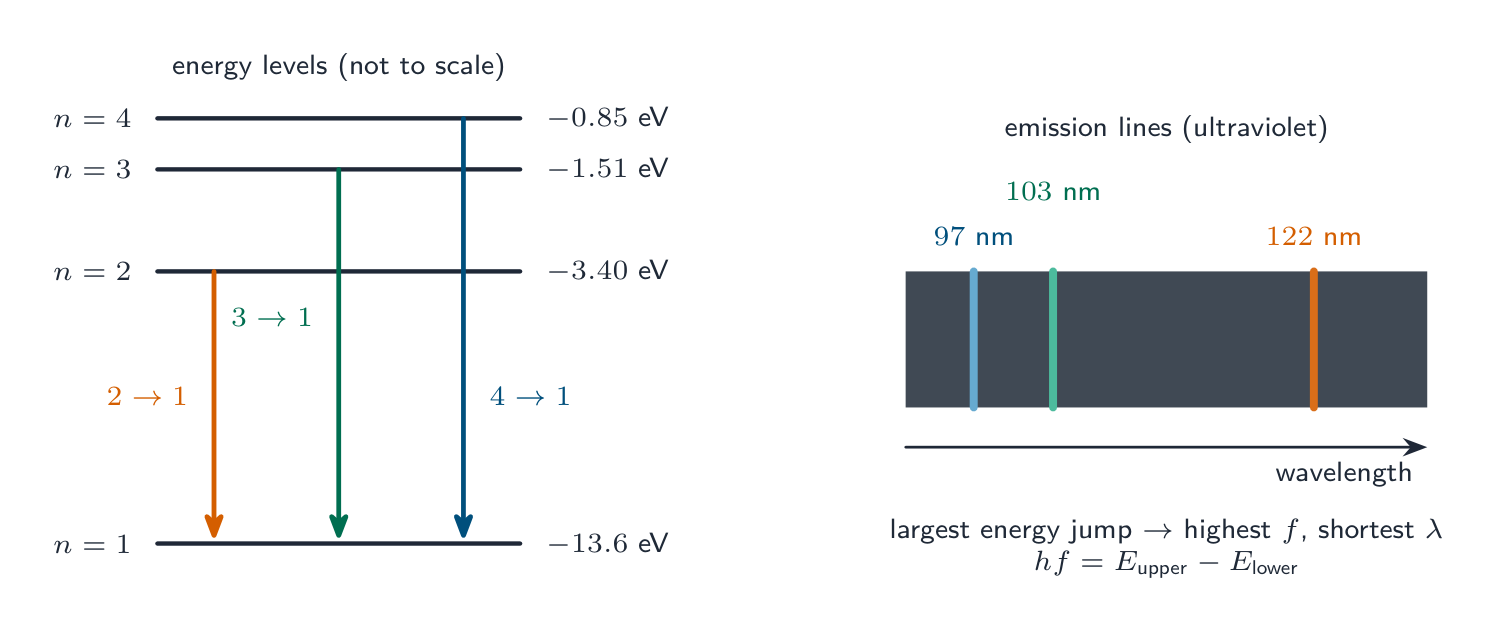
Worked example. The lowest four energy levels of hydrogen are $-13.6$, $-3.40$, $-1.51$ and $-0.85\ \text{eV}$. Find the wavelengths of the three lines produced by transitions to the ground state, and the number of lines these four levels can produce altogether.

Transition $2 \to 1$: $\Delta E = 13.6 - 3.40 = 10.2\ \text{eV}$, so $\lambda = 1240/10.2 = 122\ \text{nm}$. $3 \to 1$: $12.09\ \text{eV}$, $\lambda = 103\ \text{nm}$. $4 \to 1$: $12.75\ \text{eV}$, $\lambda = 97.3\ \text{nm}$: all ultraviolet, the largest jump giving the shortest wavelength. Four levels allow $4 \to 3$, $4 \to 2$, $4 \to 1$, $3 \to 2$, $3 \to 1$ and $2 \to 1$: six lines. The visible red line of hydrogen is $3 \to 2$: $1.89\ \text{eV}$, $656\ \text{nm}$. (Working in joules: $10.2\ \text{eV} = 1.63 \times 10^{-18}\ \text{J}$, $\lambda = hc/E = 1.99 \times 10^{-25}/1.63 \times 10^{-18} = 1.22 \times 10^{-7}\ \text{m}$.)

Worked example. A laser emits red light of wavelength $650\ \text{nm}$ when electrons drop from one level to another. Find the energy gap between the two levels.

$\Delta E = hc/\lambda = 1240/650 = 1.91\ \text{eV} = 3.1 \times 10^{-19}\ \text{J}$. The gap, not either level, fixes the colour: two atoms with different levels but the same gap emit the same line.

Worked example (annihilation). An electron and a positron, each moving slowly, meet and annihilate 湮灭, producing two identical photons. Find the wavelength of each photon. ($m_{\text{e}} = 9.11 \times 10^{-31}\ \text{kg}$.)

The rest energy of each particle is $E = mc^{2} = (9.11 \times 10^{-31})(3.00 \times 10^{8})^{2} = 8.2 \times 10^{-14}\ \text{J}$ ($0.51\ \text{MeV}$), and momentum conservation shares the energy between two photons moving in opposite directions, so each carries $8.2 \times 10^{-14}\ \text{J}$: $\lambda = hc/E = 1.99 \times 10^{-25}/8.2 \times 10^{-14} = 2.4 \times 10^{-12}\ \text{m}$, a gamma ray. (Any kinetic energy the pair had is added to the photon energies.)

ไทย

ในอะตอมอิสระ อิเล็กตรอนสามารถอยู่ได้เฉพาะที่ ระดับพลังงาน ที่ ไม่ต่อเนื่อง เท่านั้น — ไม่อยู่ในช่วงระหว่างเลย ระดับต่ำสุดคือ สถานะพื้นฐาน; ระดับอื่นๆ คือ สถานะกระตุ้น

ตามธรรมเนียม พลังงานจะถูกเขียนด้วยเครื่องหมาย ลบ, โดย $E = 0$ สำหรับอิเล็กตรอนที่หลุดออกจากอะตอมได้อย่างอิสระ สำหรับไฮโดรเจน สถานะพื้นฐานคือ $E_{1} = -13.6\ \text{eV}$; ระดับที่สูงขึ้นจะเข้าใกล้ศูนย์

แผนภูมิระดับพลังงานของไฮโดรเจน: เส้นแนวนอนที่ระดับพลังงานลบที่ไม่ต่อเนื่องตั้งแต่สถานะพื้นฐานที่ −13.6 eV ไปจนถึงศูนย์ที่ n=อนันต์ พร้อมลูกศรชี้ลงแสดงการเปลี่ยนสถานะการปล่อยแสง
ระดับพลังงานของอิเล็กตรอนในไฮโดรเจนเป็นแบบไม่ต่อเนื่องและเป็นลบ โดยสถานะพื้นฐานอยู่ที่ $-13.6\ \text{eV}$

สเปกตรัมการปล่อยแสง

เมื่ออิเล็กตรอนตกลงจากระดับสูง $E_{2}$ ไปยังระดับต่ำ $E_{1}$, มันจะปล่อยโฟตอนหนึ่งตัวที่มีพลังงาน

$$h f = E_{2} - E_{1}.$$

(พลังงานทั้งสองเป็นลบ; ผลต่างของ它们是บวก) เนื่องจากระดับพลังงานไม่ต่อเนื่อง จึงมีเพียงพลังงานโฟตอนบางชนิด — และดังนั้นความยาวคลื่นบางชนิดเท่านั้นที่ออกมา สเปกตรัมการปล่อยแสง คือชุดของ เส้นสว่างคมชัด บนพื้นหลังมืด有一条线对应一个转变. ลวดลายนี้เป็น "ลายนิ้วมือ" ของธาตุ

การอธิบายสเปกตรัมเส้น (ตัวบ่งชี้มาตรฐานสี่). (1) อิเล็กตรอนในอะตอมอิสระสามารถครอบครองได้เฉพาะ ระดับพลังงาน ที่ไม่ต่อเนื่องเท่านั้น (2) อิเล็กตรอนในสถานะกระตุ้นตกลงไปยังระดับต่ำกว่าและพลังงานที่สูญเสียจะถูกปล่อยออกมาเป็น โฟตอนหนึ่งตัว (3) พลังงานโฟตอนเท่ากับ ผลต่าง ระหว่างสองระดับ, $hf = E_{2} - E_{1}$, ดังนั้นจึงมีเพียงความถี่ (ความยาวคลื่น) บางชนิดที่ถูกปล่อยออกมา (4) การเปลี่ยนสถานะที่เป็นไปได้แต่ละครั้งให้ เส้น; ชุดระดับเดียวกันให้เส้นเหมือนกันทุกครั้ง ซึ่งเป็นเหตุผลที่สเปกตรัมระบุธาตุ เมื่อถูกถามให้จับคู่เส้นกับการเปลี่ยนสถานะ: ช่องว่างพลังงานที่ใหญ่ที่สุด ให้เส้นที่มีความถี่ สูงสุด และความยาวคลื่น สั้นที่สุด

สเปกตรัมการปล่อยแสงของไฮโดรเจน: เส้นสีคมชัดไม่กี่เส้น (ม่วง น้ำเงิน ฟ้าแดง) บนพื้นหลังสีดำ วาดเทียบกับความยาวคลื่น *สเปกตรัมการปล่อยแสงของไฮโดรเจนคือชุดของเส้นสว่างคมชัดบนพื้นหลังมืด

ตารางสารเคมีที่กล่องของแต่ละธาตุถูกแทนที่ด้วยภาพถ่ายสเปกตรัมการปล่อยแสงจริงของมัน -- ทุกอันเป็นชุดเส้นสว่างสีที่แตกต่างกันบนพื้นหลังดำ *สเปกตรัมการปล่อยแสงจริงของธาตุ: แต่ละอันเป็นชุดเส้นสว่างที่เป็นเอกลักษณ์ -- ลายนิ้วมือของธาตุนั้น
สเปกตรัมการดูดกลืนแสง

เมื่อแสงสีขาวผ่านแก๊สเย็น โฟตอนwhose energy exactly matches an upward transition are absorbed. Then the light shows dark lines on a bright background — the absorption spectrum. The dark lines sit at the same wavelengths as the emission lines of the same gas.

การอธิบายเส้นมืด. โฟตอน whose energy equals the difference between two levels are absorbed, elevating an electron to the higher level; the excited electron soon falls back and re-emits a photon of the same energy, but in a random direction, so almost none of that light continues along the original path. The rest of the white light, whose photons match no gap, passes through unchanged. Hence dark lines at exactly the wavelengths the same gas would emit: the Sun's spectrum shows the absorption lines of the cooler gases in its outer layers.

สเปกตรัมของดวงอาทิตย์: แถบรุ้งสีต่อเนื่องที่ตัดด้วยเส้นดูดกลืนแนวตั้งหลายเส้น วาดเทียบกับความยาวคลื่น
เส้นดูดกลืนสีเข้มในสเปกตรัมของดวงอาทิตย์บ่งบอกถึงคลื่นความยาวที่ถูกดูดกลืนโดยแก๊สที่มีอุณหภูมิต่ำกว่า

การคำนวณ

สำหรับการเปลี่ยนผ่านระหว่างสองระดับพลังงานที่ทราบค่า:

$$hf = E_{2} - E_{1}, \qquad \lambda = \frac{hc}{E_{2} - E_{1}}.$$

ทำงานด้วยหน่วยให้สอดคล้องกัน — แปลง eV เป็นจูล (× $1.60 \times 10^{-19}$) ก่อนหาค่า $\lambda$ ในหน่วยเมตร หรือใช้ $hc \approx 1240\ \text{eV nm}$ เพื่อประมาณค่าอย่างรวดเร็ว

สี่ระดับพลังงานของไฮโดรเจนพร้อมการเปลี่ยนผ่านสามครั้งสู่สถานะพื้นวาดเป็นลูกศร จับคู่กับเส้นการปล่อยแสงสามเส้นบนแถบมืดที่ 97, 103 และ 122 nm; การกระโดดพลังงานที่ใหญ่ที่สุดให้คลื่นความยาวสั้นที่สุด
จากระดับสู่เส้น: การเปลี่ยนผ่านลงสู่สถานะพื้นแต่ละครั้งสร้างเส้นหนึ่งเส้น และการกระโดดที่ใหญ่ที่สุดจะอยู่ห่างออกไปทางปลายคลื่นความยาวสั้น

ตัวอย่างวิธีทำ สี่ระดับพลังงานต่ำสุดของไฮโดรเจนคือ $-13.6$, $-3.40$, $-1.51$ และ $-0.85\ \text{eV}$. หาความยาวคลื่นของเส้นทั้งสามที่เกิดจากการเปลี่ยนผ่านสู่สถานะพื้น และจำนวนเส้นทั้งหมดที่สี่ระดับนี้สามารถสร้างได้

การเปลี่ยนผ่าน $2 \to 1$: $\Delta E = 13.6 - 3.40 = 10.2\ \text{eV}$, ดังนั้น $\lambda = 1240/10.2 = 122\ \text{nm}$. $3 \to 1$: $12.09\ \text{eV}$, $\lambda = 103\ \text{nm}$. $4 \to 1$: $12.75\ \text{eV}$, $\lambda = 97.3\ \text{nm}$: ทั้งหมดเป็นรังสีอัลตราไวโอเลต, การกระโดดที่ใหญ่ที่สุดให้คลื่นความยาวสั้นที่สุด. สี่ระดับอนุญาตให้ $4 \to 3$, $4 \to 2$, $4 \to 1$, $3 \to 2$, $3 \to 1$ และ $2 \to 1$: หก เส้น. เส้นสีแดงที่มองเห็นได้ในไฮโดรเจนคือ $3 \to 2$: $1.89\ \text{eV}$, $656\ \text{nm}$. (การทำงานด้วยหน่วยจูล: $10.2\ \text{eV} = 1.63 \times 10^{-18}\ \text{J}$, $\lambda = hc/E = 1.99 \times 10^{-25}/1.63 \times 10^{-18} = 1.22 \times 10^{-7}\ \text{m}$.)

ตัวอย่างวิธีทำ เลเซอร์ปล่อยแสงสีแดงที่มีความยาวคลื่น $650\ \text{nm}$ เมื่ออิเล็กตรอนตกลงจากหนึ่งระดับไปยังอีกระดับหนึ่ง. หาช่องว่างพลังงานระหว่างสองระดับนั้น

$\Delta E = hc/\lambda = 1240/650 = 1.91\ \text{eV} = 3.1 \times 10^{-19}\ \text{J}$. ช่องว่างพลังงาน ไม่ใช่ระดับใดระดับหนึ่งที่กำหนดสี: อะตอมสองตัวมีระดับพลังงานต่างกันแต่มีช่องว่างเท่ากันจะปล่อยเส้นเดียวกัน

ตัวอย่างวิธีทำ (การทำลายล้าง) อิเล็กตรอนและโพซิตรอนซึ่งเคลื่อนที่ช้าพบกันและ ทำลายล้างกัน เกิดโฟตอนสองตัวที่เหมือนกันทุกประการ. หาความยาวคลื่นของแต่ละโฟตอน. ($m_{\text{e}} = 9.11 \times 10^{-31}\ \text{kg}$.)

พลังงานนิ่งของอนุภาคแต่ละตัวคือ $E = mc^{2} = (9.11 \times 10^{-31})(3.00 \times 10^{8})^{2} = 8.2 \times 10^{-14}\ \text{J}$ ($0.51\ \text{MeV}$), และการอนุรักษ์โมเมนตัมแบ่งพลังงานระหว่างโฟตอนสองตัวที่เคลื่อนที่สวนทางกัน ดังนั้นแต่ละตัวจึงพกพา $8.2 \times 10^{-14}\ \text{J}$: $\lambda = hc/E = 1.99 \times 10^{-25}/8.2 \times 10^{-14} = 2.4 \times 10^{-12}\ \text{m}$, รังสีแกมมา. (พลังงานจลน์ใดๆ ที่คู่ดังกล่าวมีจะถูกเพิ่มเข้ากับพลังงานของโฟตอน)

Explore · ⁨สำรวจ⁩

Make an element's spectral lines · ⁨สร้างสเปกตรัมเชิงเส้นของธาตุ⁩

An electron dropping between fixed energy levels emits a photon of exactly the gap's energy — a fixed wavelength and colour. Each jump is one line of the element's barcode. · ⁨อิเล็กตรอนที่ตกลงระหว่างระดับพลังงานที่กำหนดจะปล่อยโฟตอนที่มีพลังงานเท่ากับช่องว่างนั้นพอดี — ความยาวคลื่นและสีที่แน่นอน Each jump คือ one line of element's barcode⁩

Vocabulary · ⁨คำศัพท์⁩ Train · ⁨ฝึกฝน⁩
English ไทย
wavelength/ˈweɪvleŋθ/ ความยาวคลื่น
electronvolt/ɪˈlektrɒnvəʊlt/ อิเล็กตรอนโวลต์
kinetic energy/kɪˈnetɪk ˈenədʒi/ พลังงานจลน์
energy level/ˈenədʒi ˈlevl/ ระดับพลังงาน
momentum/məʊˈmentəm/ โมเมนตัม
transition/trænˈsɪʃn/ transition
emission spectrum/ɪˈmɪʃn ˈspektrəm/ สเปกตรัมการแผ่รังสี
absorption spectrum/əbˈsɔːpʃn ˈspektrəm/ สเปกตรัมการดูดกลืนแสง
annihilate/əˈnaɪəleɪt/ การทำลายล้างกันและกัน
22.4

Definitions the examiner accepts · ⁨คำนิยามที่ผู้สอบยอมรับ⁩

English

A definition question is marked against fixed wording. Learn these exactly, and give one answer only.

Term Definition
photon a quantum (discrete packet) of energy of electromagnetic radiation
electronvolt the energy gained by an electron accelerated through a potential difference of one volt; $1.60 \times 10^{-19}\ \text{J}$
photoelectric effect the emission of electrons from a metal surface when electromagnetic radiation of high enough frequency is incident on it
work function energy the minimum energy needed to remove an electron from the surface of the metal
threshold frequency the minimum frequency of radiation that causes photoelectric emission from a metal
threshold wavelength the maximum wavelength of radiation that causes photoelectric emission, $\lambda_{0} = hc/\Phi$
wave–particle duality radiation and matter show both wave properties (diffraction, interference) and particle properties (photoelectric effect, discrete collisions)
de Broglie wavelength the wavelength associated with a moving particle, $\lambda = h/p$
energy level one of the discrete energies an electron in an isolated atom may have
emission line spectrum a set of bright lines of definite wavelengths, each from a transition between two energy levels
absorption line spectrum dark lines on a continuous spectrum at the wavelengths absorbed by transitions to higher levels
ไทย

คำถามคำนิยามจะให้คะแนนตามข้อความที่กำหนดไว้你必须 exact. เรียนรู้ให้ถูกต้องและตอบเพียงคำตอบเดียวเท่านั้น

พจน์ นิยาม
โฟตอน ควอนตัม (แพ็กเก็ตพลังงานแบบไม่ต่อเนื่อง) ของรังสีแม่เหล็กไฟฟ้า
อิเล็กตรอนโวลต์ พลังงานที่อิเล็กตรอนได้รับเมื่อถูกเร่งผ่านต่างศักย์หนึ่งโวลต์; $1.60 \times 10^{-19}\ \text{J}$
เอฟเฟกต์โฟโตอิเล็กทริก การปล่อยอิเล็กตรอนออกจากผิวโลหะเมื่อมีรังสีแม่เหล็กไฟฟ้าที่มีความถี่สูงพอตกกระทบ
ฟังก์ชันงาน (work function energy) พลังงานขั้นต่ำที่ต้องการเพื่อดึงอิเล็กตรอนออกจากพื้นผิวโลหะ
ความถี่ Threshold (threshold frequency) ความถี่ต่ำสุดของรังสีที่ทำให้เกิดปรากฏการณ์โฟโตอิเล็กทริกจากโลหะ
ความยาวคลื่นขีดจำกัด ความยาวคลื่นสูงสุดของรังสีที่ทำให้เกิดการปล่อยโฟโตอิเล็กทริก, $\lambda_{0} = hc/\Phi$
ธรรมชาติแบบคลื่น-อนุภาค รังสีและสสารแสดงทั้งคุณสมบัติคลื่น (การเลี้ยวเบน, การแทรกสอด) และคุณสมบัติอนุภาค (เอฟเฟกต์โฟโตอิเล็กทริก, การชนแบบไม่ต่อเนื่อง)
ความยาวคลื่นเดบริogli ความยาวคลื่นที่เกี่ยวข้องกับอนุภาคที่เคลื่อนที่, $\lambda = h/p$
ระดับพลังงาน พลังงานที่ไม่ต่อเนื่อง某一个的一个 electron in an isolated atom may have
สเปกตรัมเส้นการปล่อยแสง ชุดของเส้นสว่างที่มีความยาวคลื่นแน่นอน แต่ละเส้นเกิดจากการเปลี่ยนผ่านระหว่างสองระดับพลังงาน
สเปกตรัมเส้นดูดกลืนแสง เส้นมืดบนสเปกตรัมต่อเนื่องที่ความยาวคลื่นที่ถูกดูดกลืนจากการเปลี่ยนผ่านสู่ระดับที่สูงขึ้น
Vocabulary · ⁨คำศัพท์⁩ Train · ⁨ฝึกฝน⁩
English ไทย
work function/wɜːk ˈfʌŋkʃn/ work function
threshold frequency/ˈθreʃəʊld ˈfriːkwənsi/ threshold frequency
threshold wavelength/ˈθreʃəʊld ˈweɪvleŋθ/ threshold wavelength
stopping potential/ˈstɒpɪŋ pəˈtenʃl/ ศักย์หยุดยั้ง
wave–particle duality/weɪv ˈpɑːtɪkl djuːˈælɪti/ ทวิลักษณ์คลื่น-อนุภาค
interference/ˌɪntəˈfɪərəns/ การแทรกแซง
diffraction grating/dɪˈfrækʃn ˈɡreɪtɪŋ/ เกรตติ้งเลี้ยวเบน
22.4

Exam tips · ⁨ข้อแนะนำสำหรับการสอบ⁩

English
  • Photon: $E = hf = hc/\lambda$, $p = E/c = h/\lambda$. Use $hc = 1240\ \text{eV nm}$ to move between wavelength and energy in eV, then convert to joules only if the answer demands it.
  • Photoelectric equation $hf = \Phi + \tfrac{1}{2}mv_{\text{max}}^{2}$: maximum energy, one photon to one electron; the graph of $E_{\text{K,max}}$ against $f$ has gradient $h$ and intercepts $f_{0}$ and $-\Phi$.
  • Intensity changes the number of photons per second (the current); frequency changes the energy of each (the maximum kinetic energy). Keep those two sentences apart and every explanation writes itself.
  • Evidence: photoelectric effect for particles, diffraction and interference for waves; electron diffraction for the wave nature of matter, with $\lambda = h/p = h/\sqrt{2mqV}$.
  • Line spectra: discrete levels, one photon per transition, $hf = E_{2} - E_{1}$; the biggest gap gives the shortest wavelength; absorption lines sit where emission lines would, because the absorbed light is re-emitted in all directions.
  • Radiation pressure: force $=$ photons per second $\times$ momentum change per photon; $2p$ for a mirror, $p$ for an absorber; pressure depends on intensity, not colour.

Common mistakes

  • Defining a photon as "a particle of light" without "quantum/packet of energy", or the work function without "minimum" and "from the surface".
  • Saying brighter light gives faster photoelectrons, or that below the threshold frequency emission happens eventually.
  • Mixing eV and joules in one equation; forgetting to subtract the work function; using $\tfrac{1}{2}mv^{2}$ with the maximum kinetic energy in eV.
  • Writing the de Broglie wavelength for an accelerated electron as $h/(mv)$ with $v$ guessed, instead of $h/\sqrt{2mqV}$.
  • Describing electron diffraction as bright fringes or spots; the pattern is concentric rings, and a higher p.d. makes them smaller.
  • Getting the direction of a transition wrong: emission is a fall to a lower level, absorption a rise; the photon energy is the difference, never the energy of one level.
  • Claiming the largest energy gap gives the longest wavelength.
  • Forgetting that a reflected photon changes momentum by $2p$, or that the pressure of blue light of the same intensity is the same as red.
ไทย
  • โฟตอน: $E = hf = hc/\lambda$, $p = E/c = h/\lambda$. ใช้ $hc = 1240\ \text{eV nm}$ เพื่อแลกเปลี่ยนระหว่างความยาวคลื่นและพลังงานใน eV, แล้วแปลงเป็นจูลก็ต่อเมื่อคำตอบต้องการเท่านั้น
  • สมการโฟโตอิเล็กทริก $hf = \Phi + \tfrac{1}{2}mv_{\text{max}}^{2}$: พลังงานสูงสุด, โฟตอนหนึ่งต่ออิเล็กตรอนหนึ่ง; กราฟของ $E_{\text{K,max}}$ เทียบกับ $f$ มีความชัน $h$ และตัดแกนที่ $f_{0}$ และ $-\Phi$.
  • ความเข้มเปลี่ยนแปลง จำนวน โฟตอนต่อวินาที (กระแส); ความถี่เปลี่ยนแปลง พลังงาน ของแต่ละตัว (พลังงานจลน์สูงสุด). รักษาประโยคทั้งสองแยกออกจากกัน และคำอธิบายทุกอย่างก็จะเขียนตัวเอง
  • หลักฐาน: เอฟเฟกต์โฟโตอิเล็กทริกสำหรับอนุภาค, การเลี้ยวเบนและการแทรกสอดสำหรับคลื่น; การเลี้ยวเบนของอิเล็กตรอนสำหรับธรรมชาติคลื่นของสสาร, กับ $\lambda = h/p = h/\sqrt{2mqV}$.
  • สเปกตรัมเส้น: ระดับที่ไม่ต่อเนื่อง, โฟตอนหนึ่งต่อการเปลี่ยนผ่าน, $hf = E_{2} - E_{1}$; ช่องว่างที่ใหญ่ที่สุดให้คลื่นความยาวสั้นที่สุด; เส้นดูดกลืนอยู่ในตำแหน่งที่เส้นปล่อยแสงจะอยู่ เพราะแสงที่ถูกดูดกลืนจะถูกปล่อยออกใหม่ในทุกทิศทาง
  • แรงดันรังสี: แรง $=$ โฟตอนต่อวินาที $\times$ การเปลี่ยนแปลงโมเมนตัมต่อโฟตอน; $2p$ สำหรับกระจก, $p$ สำหรับตัวดูด; แรงดันขึ้นอยู่กับความเข้ม ไม่ใช่สี

ข้อผิดพลาดที่พบบ่อย

  • การนิยามโฟตอนว่าเป็น "อนุภาคของแสง" โดยไม่มี "ควอนตัม/แพ็กเก็ตพลังงาน", หรือฟังก์ชันงานโดยไม่ระบุ "ขั้นต่ำ" และ "จากผิว"
  • การบอกว่าแสงที่สว่างกว่าทำให้โฟโตอิเล็กตรอนเร็วขึ้น, หรือว่าต่ำกว่าความถี่ขีดจำกัดการปล่อยแสงจะเกิดขึ้นในภายหลัง
  • การผสม eV และจูลในสมการเดียวกัน; ลืมที่จะลบฟังก์ชันงาน; การใช้ $\tfrac{1}{2}mv^{2}$ กับพลังงานจลน์สูงสุดใน eV
  • การเขียนความยาวคลื่นเดบริogliสำหรับอิเล็กตรอนที่ถูกเร่งเป็น $h/(mv)$ dengan $v$ Guess, แทนที่จะเป็น $h/\sqrt{2mqV}$.
  • การอธิบายการเลี้ยวเบนของอิเล็กตรอนเป็นแถบสว่างหรือจุด; ลวดลายเป็นวงแหวนซ้อนกัน, และ p.d. สูงขึ้นทำให้มันเล็กลง
  • การกำหนดทิศทางการเปลี่ยนผ่านผิด: การปล่อยแสงคือการตกลงสู่ระดับที่ต่ำกว่า, การดูดกลืนคือการเพิ่มขึ้น; พลังงานโฟตอนคือผลต่าง, ไม่เคยเป็นพลังงานของระดับใดระดับหนึ่ง
  • การอ้างว่าช่องว่างพลังงานที่ใหญ่ที่สุดให้คลื่นความยาวที่ยาวที่สุด
  • การลืมว่าโฟตอนที่สะท้อนมีการเปลี่ยนแปลงโมเมนตัม $2p$, หรือว่าแรงดันของแสงสีฟ้าที่มีความเข้มเท่ากันเท่ากับแสงสีแดง

Interactive lessons on this topic · ⁨บทเรียนเชิงโต้ตอบสำหรับหัวข้อนี้⁩

Work through it step by step, with instant-check exercises. · ⁨ทำทีละขั้นตอน พร้อมแบบฝึกหัดตรวจสอบผลทันที⁩

Past Papers · ⁨ข้อสอบย้อนหลัง⁩

More topics in A-Level Physics · ⁨Physics A-Level⁩ · ⁨หัวข้อเพิ่มเติมใน A-Level Physics · ⁨Physics A-Level⁩⁩

Log in or create account · ⁨เข้าสู่ระบบหรือสร้างบัญชี⁩

IGCSE, A-Level & AP