Energy and momentum of a photon
Introduced| English | Meaning |
|---|---|
| photons/ˈfəʊtɒnz/ | Quanta of electromagnetic radiation, each carrying energy proportional to its frequency. |
| momentum/məʊˈmentəm/ | The product of mass and velocity. |
| particulate nature/pəˈtɪkjʊleɪt ˈneɪtʃə/ | The description of matter or radiation in terms of discrete particles. |
| quantum/ˈkwɒntəm/ | quantum |
| Planck constant/plæŋk ˈkɒnstənt/ | The constant relating a photon's energy to its frequency and setting the scale of quantum effects. |
| wavelength/ˈweɪvleŋθ/ | The distance between corresponding points on successive waves. |
| electronvolt/ɪˈlektrɒnvəʊlt/ | A unit of energy equal to the energy gained by one elementary charge moving through a potential difference of one volt. |
| kinetic energy/kɪˈnetɪk ˈenədʒi/ | The energy an object has because of its motion. |
| electron/ɪˈlektrɒn/ | A negatively charged subatomic particle found outside an atom's nucleus. |
| potential difference/pəˈtenʃl ˈdɪfrəns/ | The energy transferred per unit charge between two points. |
| radiation pressure/ˌreɪdɪˈeɪʃn ˈpreʃə/ | radiation pressure |
Light you can count
- Turn a lamp down far enough and the light does not simply get fainter. It starts arriving in countable lumps.
- A sensitive detector clicks: one, one, one. Never half a click. The lumps have a fixed size that depends on the colour, not on the brightness.
- Those lumps are photons 光子, and this lesson is what one of them carries: an energy $hf$ and a momentum $h/\lambda$.
- This is the syllabus's evidence for the particulate nature 粒子性 of electromagnetic radiation.
What a photon is
- A photon is a quantum 量子, a discrete packet, of energy of electromagnetic radiation. That is the two-mark definition, and both halves score.
- "A particle of light" alone is not enough. The marked words are quantum or packet or discrete amount, and of electromagnetic radiation.
- Particulate nature means energy is delivered in lumps of $hf$, never in smaller pieces. A detector receives one whole photon or none.

One packet, one arrival
Which phrases belong in the two-mark definition of a photon? Select all that apply.
Difficulty 2/5 · 140 coins + a small bonus on first completion today
"A particle of light" alone scores one at best. Both the quantum idea and the electromagnetic radiation must appear.
The energy of a photon
- A photon of frequency $f$ carries
where $h$ is the Planck constant 普朗克常量.
- Using $c = f\lambda$, the same thing in terms of wavelength 波长 is
- So shorter wavelength means more energy per photon. One gamma photon carries far more than one radio photon, whatever the total power of the two sources.
Energy of a photon
E = h·f
Photon energy is proportional to frequency — the gradient is Planck's constant h.
The energy of a photon is:
Difficulty 1/5 · 100 coins + a small bonus on first completion today
$E = hf = \dfrac{hc}{\lambda}$ — proportional to frequency.
Higher-frequency photons carry more energy.
Difficulty 1/5 · 100 coins + a small bonus on first completion today
$E = hf$, so energy rises with frequency — a γ-ray photon carries far more than a radio one.
Worked example: a photon of green light
- Find the energy of a photon of green light of wavelength $500\ \text{nm}$.
- $E = \dfrac{hc}{\lambda} = \dfrac{(6.63\times10^{-34})(3.0\times10^{8})}{500\times10^{-9}} = 4.0\times10^{-19}\ \text{J}$
- In electronvolts 电子伏特 that is $4.0\times10^{-19} / 1.60\times10^{-19} = 2.5\ \text{eV}$.
- Convert the nanometres before dividing. Leaving $\lambda$ as $500$ gives an answer wrong by $10^9$, and the size of the error is the giveaway.
The electronvolt
- $1\ \text{eV} = 1.60\times10^{-19}\ \text{J}$: the kinetic energy 动能 an electron 电子 gains moving through a potential difference 电势差 of one volt.
- eV to J, multiply by $1.60\times10^{-19}$. J to eV, divide.
- Photon energies, work functions and energy levels are all a few eV, which is why the exam quotes them that way.
- Worth memorising: $hc = 1240\ \text{eV nm}$. So a $2.0\ \text{eV}$ photon has $\lambda = 1240/2.0 = 620\ \text{nm}$, and a $400\ \text{nm}$ photon carries $3.1\ \text{eV}$, both in one step.
A photon has energy $3.2 \times 10^{-19}\ \text{J}$. What is this in eV? ($1\ \text{eV} = 1.6 \times 10^{-19}\ \text{J}$)
Difficulty 2/5 · 140 coins + a small bonus on first completion today
$\dfrac{3.2 \times 10^{-19}}{1.6 \times 10^{-19}} = 2.0\ \text{eV}$.
Using $hc = 1240$ eV nm, a photon of wavelength 620 nm has an energy of ____ eV.
Difficulty 1/5 · 100 coins + a small bonus on first completion today
1240/620 = 2.0 eV, in one step and with no powers of ten to lose. The same shortcut turns a 2.0 eV work function back into a 620 nm threshold wavelength.
The momentum of a photon
- A photon has zero rest mass and yet a non-zero momentum 动量:
- Show that $p = h/\lambda$ is a standard question and the mark is for the chain, not the result: start from $E = hf$ and $p = E/c$, so $p = hf/c$; then $c = f\lambda$ gives $f/c = 1/\lambda$, so $p = h/\lambda$.
- Quote both starting equations and the wave equation. A bare final line scores nothing.
A photon's momentum is:
Difficulty 1/5 · 100 coins + a small bonus on first completion today
$p = \dfrac{E}{c} = \dfrac{h}{\lambda}$.
A photon has zero rest mass but still carries momentum.
Difficulty 1/5 · 100 coins + a small bonus on first completion today
Its momentum is $\dfrac{E}{c}$ — non-zero even though its rest mass is zero. This gives radiation pressure.
Put the derivation of $p = h/\lambda$ in order.
Difficulty 3/5 · 200 coins + a small bonus on first completion today
The marks are on the chain. A bare final line scores nothing, even though the result is right.
Worked example: identifying a photon from its momentum
- A photon in free space has momentum $9.5\times10^{-28}\ \text{N s}$. Show that it is a photon of red light.
- $\lambda = \dfrac{h}{p} = \dfrac{6.63\times10^{-34}}{9.5\times10^{-28}} = 7.0\times10^{-7}\ \text{m} = 700\ \text{nm}$.
- The visible range is $400$ to $700\ \text{nm}$, and $700\ \text{nm}$ is its red end. Saying which end, and quoting the range, is what "show that" wants.
- Its energy is $pc = 2.9\times10^{-19}\ \text{J} = 1.8\ \text{eV}$.
Radiation pressure
- Force is the rate of change of momentum, so a stream of photons pushes on whatever it hits. This is radiation pressure 辐射压.
- On a mirror each photon bounces back, so its momentum changes by $2p$: pressure $= 2I/c$.
- On a black surface each photon is absorbed, the change is only $p$: pressure $= I/c$.
- The pressure depends on the intensity, not the colour. Blue light of the same intensity delivers fewer photons per second, but each carries proportionally more momentum, and the two effects cancel exactly.
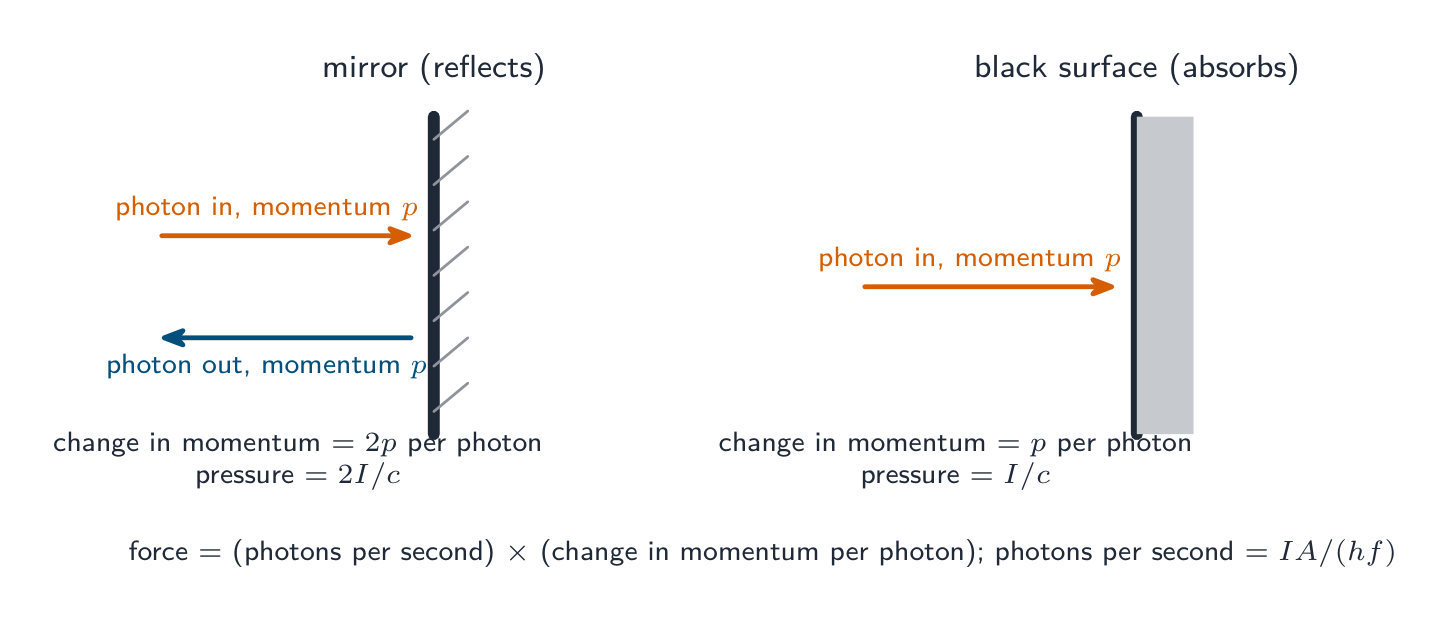
Bounce and you push twice as hard
Match each surface to the radiation pressure a beam of intensity $I$ exerts on it.
Difficulty 2/5 · 140 coins + a small bonus on first completion today
Force is the rate of change of momentum, and a reversal changes it by 2p rather than p.
Replacing a red beam with a blue beam of the same intensity increases the radiation pressure.
Difficulty 1/5 · 100 coins + a small bonus on first completion today
The blue beam delivers fewer photons per second, but each carries proportionally more momentum. The two effects cancel exactly, so the pressure depends on intensity alone.
Worked example: counting photons from a laser
- A laser emits $2.0\ \text{mW}$ at $650\ \text{nm}$. Find the photons emitted per second, and the force on a surface that absorbs the beam completely.
- Energy per photon: $E = hc/\lambda = (6.63\times10^{-34})(3.00\times10^{8})/(650\times10^{-9}) = 3.06\times10^{-19}\ \text{J}$.
- Rate: $\dfrac{P}{E} = \dfrac{2.0\times10^{-3}}{3.06\times10^{-19}} = 6.5\times10^{15}$ per second.
- Force: momentum delivered per second $= P/c = \dfrac{2.0\times10^{-3}}{3.00\times10^{8}} = 6.7\times10^{-12}\ \text{N}$.
- A mirror would feel twice that. Even full sunlight, at about $1\ \text{kW/m}^2$, exerts only a few micropascals.
A 2.0 mW laser beam is completely absorbed by a surface. What is the force on the surface, in piconewtons? (1 pN = 1e-12 N)
Difficulty 2/5 · 140 coins + a small bonus on first completion today
F = P/c = 2.0e-3 / 3.00e8 = 6.7e-12 N. A mirror would feel twice as much. You never need the photon count for the force, only for "how many photons per second".
Marks that slip away
- A photon is a quantum of energy of electromagnetic radiation. "A particle of light" is half an answer.
- Convert nm to m before dividing, and eV to J before using $\tfrac{1}{2}mv^2$.
- In "show that $p = h/\lambda$" the marks are on $E = hf$, $p = E/c$ and $c = f\lambda$. Write the chain out.
- A photon has zero rest mass but non-zero momentum. It is not "massless therefore momentumless".
- Radiation pressure on a mirror is double that on a black surface of the same area.
You've got it
- a photon is a quantum of energy of electromagnetic radiation, which is what the particulate nature of radiation means
- $E = hf = hc/\lambda$, and $1\ \text{eV} = 1.60\times10^{-19}\ \text{J}$, with $hc = 1240\ \text{eV nm}$ as the one-step shortcut
- a photon has momentum $p = E/c = h/\lambda$, derived from $E = hf$, $p = E/c$ and $c = f\lambda$
- radiation pressure is $I/c$ on an absorber and $2I/c$ on a mirror, and depends on intensity, not colour