Energy levels and line spectra
Introduced| English | Meaning |
|---|---|
| discrete/dɪˈskriːt/ | Consisting of separate, distinct values rather than a continuous range. |
| energy levels/ˈenədʒi ˈlevlz/ | The allowed energy values of a quantum system. |
| ground state/ɡraʊnd steɪt/ | The lowest-energy state available to an atom, particle or other quantum system. |
| excited states/ekˈsaɪtɪd steɪts/ | States of a system with energy above its ground-state energy. |
| emission spectrum/ɪˈmɪʃn ˈspektrəm/ | A set of sharp bright lines on a dark background, one line per transition. |
| transition/trænˈsɪʃn/ | A change between allowed energy states of an atom or another quantum system. |
| absorption spectrum/əbˈsɔːpʃn ˈspektrəm/ | The pattern of wavelengths absorbed by a substance, often seen as missing bands or lines in transmitted light. |
Every element has a barcode
- A sodium street lamp is orange. A neon sign is red. A mercury lamp is bluish-white. None of them can be persuaded to be any other colour.
- Split that light with a prism and you do not get a rainbow. You get a few sharp lines, always at the same wavelengths for that element.
- Those lines are how we know what the Sun and every distant star are made of, without going there.
- This lesson is why the lines exist: discrete energy levels 能级 inside the atom, and $hf = E_2 - E_1$.
Discrete energy levels
- In an isolated atom an electron can sit only at certain discrete 分立 energies, never in between. The lowest is the ground state 基态; the rest are excited states 激发态.
- By convention the energies are written negative, with $E = 0$ for an electron just free of the atom. For hydrogen the ground state is $E_1 = -13.6\ \text{eV}$, and the higher levels creep up towards zero.
- The negative sign means bound. The number is how much energy you would have to supply to remove the electron altogether.
- The levels get closer together as they rise, which is why the spectral lines crowd towards the short-wavelength end.

Rungs that get closer as they climb
Electrons in an atom can only occupy certain ____ energy levels.
Difficulty 1/5 · 100 coins + a small bonus on first completion today
The levels are discrete (quantised) — an electron cannot have an energy in between them.
Atomic energy levels are written as negative, with 0 for a just-free electron.
Difficulty 1/5 · 100 coins + a small bonus on first completion today
The most tightly bound (ground) state is the most negative; energy rises toward 0 as the electron is freed.
Emission: one drop, one photon
- When an electron falls from a higher level $E_2$ to a lower level $E_1$, it emits one photon:
- Both energies are negative and their difference is positive, so subtract carefully: $-3.40 - (-13.6) = 10.2\ \text{eV}$.
- Because the levels are discrete, only certain photon energies come out. The emission spectrum 发射光谱 is a set of sharp bright lines on a dark background, one line per transition 跃迁.

A handful of lines, always the same ones
Make an element's spectral lines
An electron dropping between fixed energy levels emits a photon of exactly the gap's energy — a fixed wavelength and colour. Each jump is one line of the element's barcode.
When an electron drops from level $E_2$ to $E_1$, the emitted photon has energy:
Difficulty 1/5 · 100 coins + a small bonus on first completion today
$hf = E_2 - E_1$ — a positive amount, since $E_2$ is the higher (less negative) level.
Explaining a line spectrum, the standard four-marker
- One. The electrons in an isolated atom can occupy only discrete energy levels.
- Two. An electron in an excited state falls to a lower level, and the energy it loses is emitted as one photon.
- Three. The photon energy equals the difference between the two levels, $hf = E_2 - E_1$, so only certain frequencies are emitted.
- Four. Each possible transition gives one line, and the same set of levels always gives the same lines, which is why a spectrum identifies the element.
- All four are separate marks. Answers that stop after "the levels are discrete" collect one of them.
An emission spectrum looks like:
Difficulty 1/5 · 100 coins + a small bonus on first completion today
Discrete transitions give discrete wavelengths — bright lines. (Dark lines on bright is an absorption spectrum.)
Put the four-mark explanation of a line emission spectrum in order.
Difficulty 3/5 · 200 coins + a small bonus on first completion today
All four ideas are separately marked. Stopping at "the levels are discrete" collects one mark of four.
Worked example: hydrogen's ultraviolet lines
- The lowest four levels of hydrogen are $-13.6$, $-3.40$, $-1.51$ and $-0.85\ \text{eV}$. Find the wavelengths of the three lines from transitions to the ground state, and how many lines the four levels give altogether.
- $2 \to 1$: $\Delta E = 10.2\ \text{eV}$, so $\lambda = 1240/10.2 = 122\ \text{nm}$.
- $3 \to 1$: $12.09\ \text{eV}$, $\lambda = 103\ \text{nm}$. $4 \to 1$: $12.75\ \text{eV}$, $\lambda = 97.3\ \text{nm}$. All three are ultraviolet, and the largest jump gives the shortest wavelength.
- Altogether: $4\to3$, $4\to2$, $4\to1$, $3\to2$, $3\to1$, $2\to1$, so six lines. Count every downward pair, not just the drops to the ground state.
- The visible red line of hydrogen is $3\to2$: $1.89\ \text{eV}$, $656\ \text{nm}$.
An electron drops from $-1.5\ \text{eV}$ to $-3.4\ \text{eV}$. What is the energy of the emitted photon?
Difficulty 2/5 · 140 coins + a small bonus on first completion today
$hf = E_2 - E_1 = (-1.5) - (-3.4) = 1.9\ \text{eV}$.
How many different spectral lines can four energy levels produce?
Difficulty 2/5 · 140 coins + a small bonus on first completion today
Every downward pair counts: 4-3, 4-2, 4-1, 3-2, 3-1, 2-1. In general n levels give n(n-1)/2 lines, not n-1.
From levels to lines
- The rule for matching a diagram to a spectrum is short: the largest energy gap gives the highest frequency and the shortest wavelength.
- So the widest arrow on the level diagram is the line furthest to the left on a wavelength scale.
- Two atoms with completely different levels but the same gap emit the same line. The gap fixes the colour, never either level on its own.
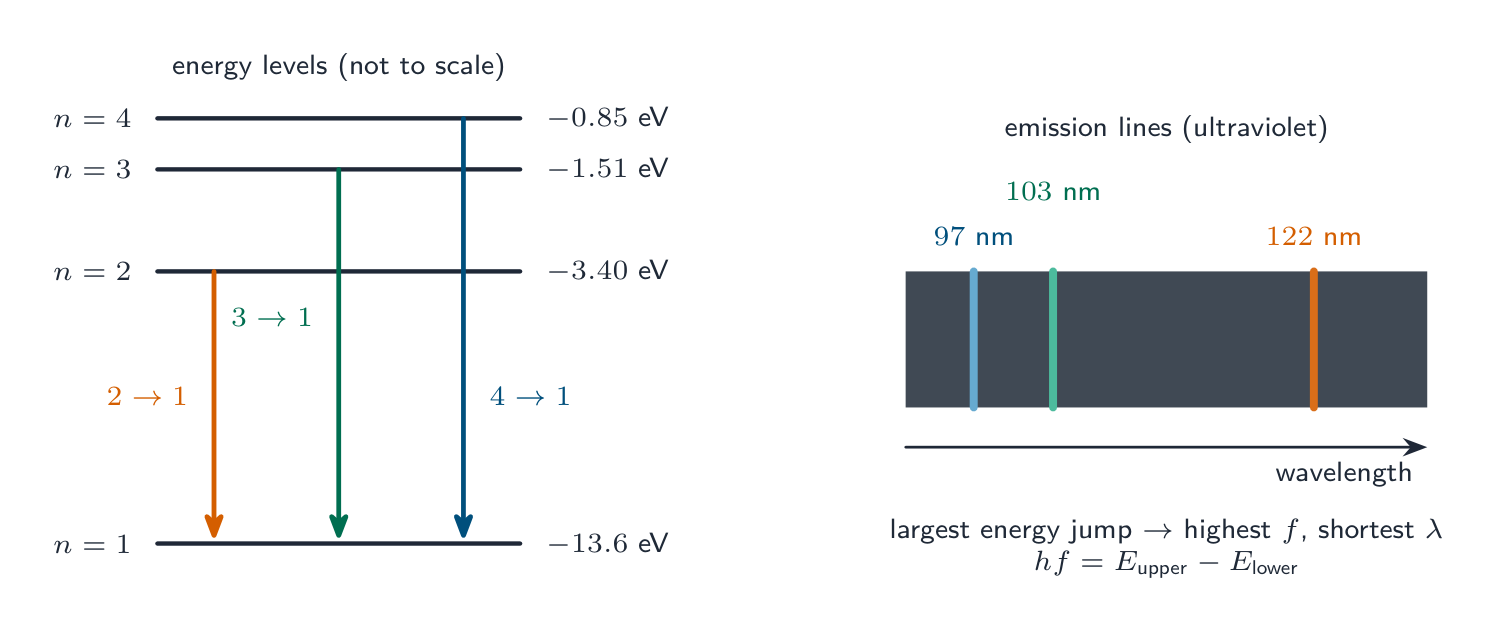
Widest arrow, leftmost line
Match each transition to the line it produces.
Difficulty 2/5 · 140 coins + a small bonus on first completion today
Frequency and wavelength move in opposite directions, which is where most of the confusion in this question type comes from.
On an energy-level diagram, the largest downward jump produces the line of ____ wavelength.
Difficulty 1/5 · 100 coins + a small bonus on first completion today
Largest gap, largest photon energy, highest frequency, shortest wavelength. On a wavelength scale that line sits furthest to the left.
Absorption: the same lines, dark
- Pass white light through a cool gas and photons whose energy exactly matches an upward transition are absorbed, lifting electrons to higher levels.
- The result is dark lines on a bright continuous background, the absorption spectrum 吸收光谱, at exactly the same wavelengths as that gas emits.
- The subtle part, and the marked part: the excited electron soon falls back and re-emits a photon of the same energy, but in a random direction, so almost none of it continues along the original beam.
- Everything else in the white light matches no gap and passes straight through. The Sun's dark lines are made by the cooler gases in its outer layers.

A rainbow with pieces missing
A gas absorbs light at the same wavelengths at which it emits.
Difficulty 1/5 · 100 coins + a small bonus on first completion today
The same energy gaps work both ways — so absorption lines sit exactly where the emission lines are.
Why does a cool gas produce dark lines in a continuous spectrum? Select all that apply.
Difficulty 2/5 · 140 coins + a small bonus on first completion today
The random direction is the marked point. Absorption alone would not darken the line, because the energy could have carried on forwards.
Worked example: from a wavelength to a gap
- A laser emits red light of wavelength $650\ \text{nm}$ when electrons drop between two levels. Find the energy gap.
- $\Delta E = \dfrac{hc}{\lambda} = \dfrac{1240}{650} = 1.91\ \text{eV} = 3.1\times10^{-19}\ \text{J}$.
- Use $hc = 1240\ \text{eV nm}$ when the answer is wanted in eV, and $hc = 1.99\times10^{-25}\ \text{J m}$ when it is wanted in joules. Mixing them is the standard slip.
- Note what the question can and cannot tell you: the gap, not either level. Two different atoms with the same gap give the same line.
A laser emits light of wavelength 650 nm. What is the energy gap between the two levels, in eV?
Difficulty 2/5 · 140 coins + a small bonus on first completion today
1240/650 = 1.91 eV. The measurement fixes the GAP, not either level: two different atoms with the same gap emit the same line.
Marks that slip away
- Energy levels are negative. Subtracting them the wrong way round gives a negative photon energy and a negative wavelength.
- $n$ levels give $\tfrac{1}{2}n(n-1)$ lines, not $n - 1$. Count every pair.
- The largest gap gives the shortest wavelength. The two words move in opposite directions.
- For absorption, say the re-emission goes in a random direction. "The photon is absorbed" alone does not explain a dark line, since the energy could have carried on forwards.
- Convert eV to joules before mixing with SI quantities, or stay in eV and use $1240\ \text{eV nm}$ throughout.
You've got it
- electrons in an isolated atom occupy discrete, negative energy levels, the lowest being the ground state
- a drop from $E_2$ to $E_1$ emits one photon with $hf = E_2 - E_1$, giving sharp bright lines unique to the element
- an absorption spectrum is dark lines on a bright background at the same wavelengths, because the re-emitted photons go off in random directions
- the largest energy gap gives the highest frequency and shortest wavelength, and $n$ levels give $\tfrac{1}{2}n(n-1)$ possible lines