Mass defect and nuclear binding energy
Introduced| English | Meaning |
|---|---|
| energy/ˈenədʒi/ | The capacity to do work or cause change. |
| nucleus/ˈnjuːklɪəs/ | The small, dense central part of an atom, containing protons and usually neutrons. |
| mass-energy equivalence/mæs ˈenədʒi ɪˈkwɪvələns/ | The relationship between mass and rest energy expressed by E = mc squared. |
| mass defect/mæs ˈdiːfekt/ | The difference between the total mass of the separate nucleons and the mass of the nucleus. |
| binding energy/ˈbaɪndɪŋ ˈenədʒi/ | The energy required to separate a bound system into specified free constituents. |
| luminosity/ˌluːmɪˈnɒsɪti/ | The total energy a star or other source emits as radiation per unit time. |
| nuclear reaction/ˈnjuːklɪə rɪˈækʃn/ | A process that changes an atomic nucleus or the arrangement of its nucleons. |
| nucleon number/ˈnjuːklɪən ˈnʌmbə/ | The total number of protons and neutrons in an atomic nucleus. |
| conservation of charge/ˌkɒnsəˈveɪʃn ɒv tʃɑːdʒ/ | The principle that total electric charge remains constant in an isolated system. |
| positron/ˈpɒzɪtrɒn/ | The positively charged antiparticle of the electron, with the same mass. |
| neutrino/njuːˈtriːnəʊ/ | An electrically neutral, very light elementary particle that interacts mainly through the weak interaction and gravity. |
| protons/ˈprəʊtɒnz/ | Positively charged subatomic particles found in atomic nuclei. |
| neutrons/ˈnjuːtrɒnz/ | Electrically neutral subatomic particles found in most atomic nuclei. |
| binding energy per nucleon/ˈbaɪndɪŋ ˈenədʒi pɜː ˈnjuːklɪən/ | A nucleus's total binding energy divided by its number of protons and neutrons. |
The Sun is four million tonnes lighter than a second ago
- Every second the Sun radiates $3.8\times10^{26}\ \text{J}$, and every second it is about four million tonnes lighter.
- Nothing is leaking out of it. The mass has become the energy, at the exchange rate $E = mc^2$.
- On the nuclear scale the same trade explains why a nucleus weighs less than the parts it is made of, and where the energy of a reactor comes from.
- This lesson is mass-energy equivalence 质能等价, mass defect 质量亏损 and binding energy 结合能.
Mass and energy are the same currency
- $E = mc^2$, with $c = 3.00\times10^{8}\ \text{m/s}$. For a change of mass:
- In nuclear physics the mass changes are tiny and $c^2$ is enormous, so a minute mass change is a large energy 能量.
- Learn the conversion, because almost every question uses it:

One quantity, two units
The mass-energy relation is:
Difficulty 1/5 · 100 coins + a small bonus on first completion today
Mass and energy are equivalent: $E = mc^{2}$, so a mass change $\Delta m$ releases $c^{2}\Delta m$.
A mass change of $1\ \text{u}$ corresponds to about how many MeV?
Difficulty 2/5 · 140 coins + a small bonus on first completion today
$1\ \text{u} = 1.66 \times 10^{-27}\ \text{kg}$ gives $\Delta E = c^{2}\Delta m \approx 931\ \text{MeV}$.
Worked example: weighing the output of a star
- Sirius loses mass by fusion at $1.09\times10^{11}\ \text{kg/s}$. Find the power it radiates.
- $P = c^2 \times (\text{mass lost per second}) = (3.00\times10^{8})^2(1.09\times10^{11}) = 9.8\times10^{27}\ \text{W}$.
- That is its luminosity 光度, and it is about $26$ times the Sun's $3.8\times10^{26}\ \text{W}$.
- The same sum backwards: a $1\ \text{GW}$ power station running for a year converts $E/c^2 = 3.2\times10^{16}/9.0\times10^{16} = 0.35\ \text{kg}$ of mass. That is why the spent fuel weighs almost exactly what it did going in.
Nuclear equations balance twice
- A nuclear reaction 核反应 conserves nucleon number 核子数 (the top numbers) and charge (the bottom numbers), which is conservation of charge 电荷守恒:
- Alpha decay: $A$ falls by $4$, $Z$ by $2$. Beta-minus: a neutron becomes a proton, so $A$ is unchanged and $Z$ rises by $1$, with an electron and an antineutrino.
- Beta-plus: a proton becomes a neutron, $Z$ falls by $1$, emitting a positron 正电子 and a neutrino 中微子. Gamma changes neither number.
- The neutrino is in the mark scheme. Leaving it out of a beta equation costs a mark every time.
In alpha decay the nucleon number falls by 4 and the proton number falls by ____.
Difficulty 1/5 · 100 coins + a small bonus on first completion today
An alpha particle is a helium-4 nucleus, 2 protons and 2 neutrons. Beta-minus leaves A unchanged and raises Z by 1, and the antineutrino must be written too.
Mass defect and binding energy
- A nucleus 原子核 has less mass than its separate protons 质子 and neutrons 中子. The difference is the mass defect:
- The mass defect is the difference between the total mass of the separate nucleons and the mass of the nucleus.
- The binding energy is the minimum energy required to separate the nucleus into its individual nucleons, and $B = \Delta m\, c^2$.
- Say "separate nucleons" or "individual protons and neutrons". "The energy holding the nucleus together" scores nothing.
- Binding energy is released when the nucleus forms, not stored in it. The nucleus has less energy than its parts, which is exactly why it stays together.

Assemble it and mass goes missing
A nucleus has ____ mass than its separate protons and neutrons added together.
Difficulty 1/5 · 100 coins + a small bonus on first completion today
That missing mass (the mass defect) was released as energy when the nucleus formed.
The binding energy is the energy needed to pull a nucleus completely apart.
Difficulty 1/5 · 100 coins + a small bonus on first completion today
$B = \Delta m\,c^{2}$ — the energy released on forming the nucleus, which must be returned to separate it.
Match each term to the definition the examiner marks.
Difficulty 2/5 · 140 coins + a small bonus on first completion today
"The energy holding the nucleus together" scores nothing. The marked phrase is separating it into individual nucleons.
Worked example: helium-4
- A helium-4 nucleus has a mass defect of $0.0304\ \text{u}$. Find its binding energy.
- $B = 0.0304 \times 931 = 28\ \text{MeV}$.
- Per nucleon that is $28/4 = 7.1\ \text{MeV}$, already high for such a light nucleus, which is why helium-4 shows as a spike on the curve.
- Binding energy per nucleon 比结合能 is $B/A$, and it is the fair way to compare two nuclides of very different size.
Worked example: polonium-212
- Proton $1.007276\ \text{u}$, neutron $1.008665\ \text{u}$, $^{212}_{84}\text{Po}$ nucleus $211.9454\ \text{u}$. Find the mass defect and the binding energy per nucleon.
- $Z = 84$ protons and $N = 212 - 84 = 128$ neutrons: $84(1.007276) + 128(1.008665) = 213.7203\ \text{u}$.
- $\Delta m = 213.7203 - 211.9454 = 1.7749\ \text{u}$.
- $B = 1.7749 \times 931.5 = 1653\ \text{MeV}$, so $B/A = 1653/212 = 7.80\ \text{MeV}$ per nucleon, on the falling part of the curve.
- Keep every decimal place until the subtraction. The defect is a small difference between two large numbers, and rounding early destroys it.
Polonium-212 has a mass defect of 1.7749 u. What is its binding energy per nucleon, in MeV? (Use 931.5 MeV per u.)
Difficulty 2/5 · 140 coins + a small bonus on first completion today
B = 1.7749 x 931.5 = 1653 MeV, then divide by A = 212 to get 7.80 MeV per nucleon, on the falling side of the curve.
The curve everything hangs on
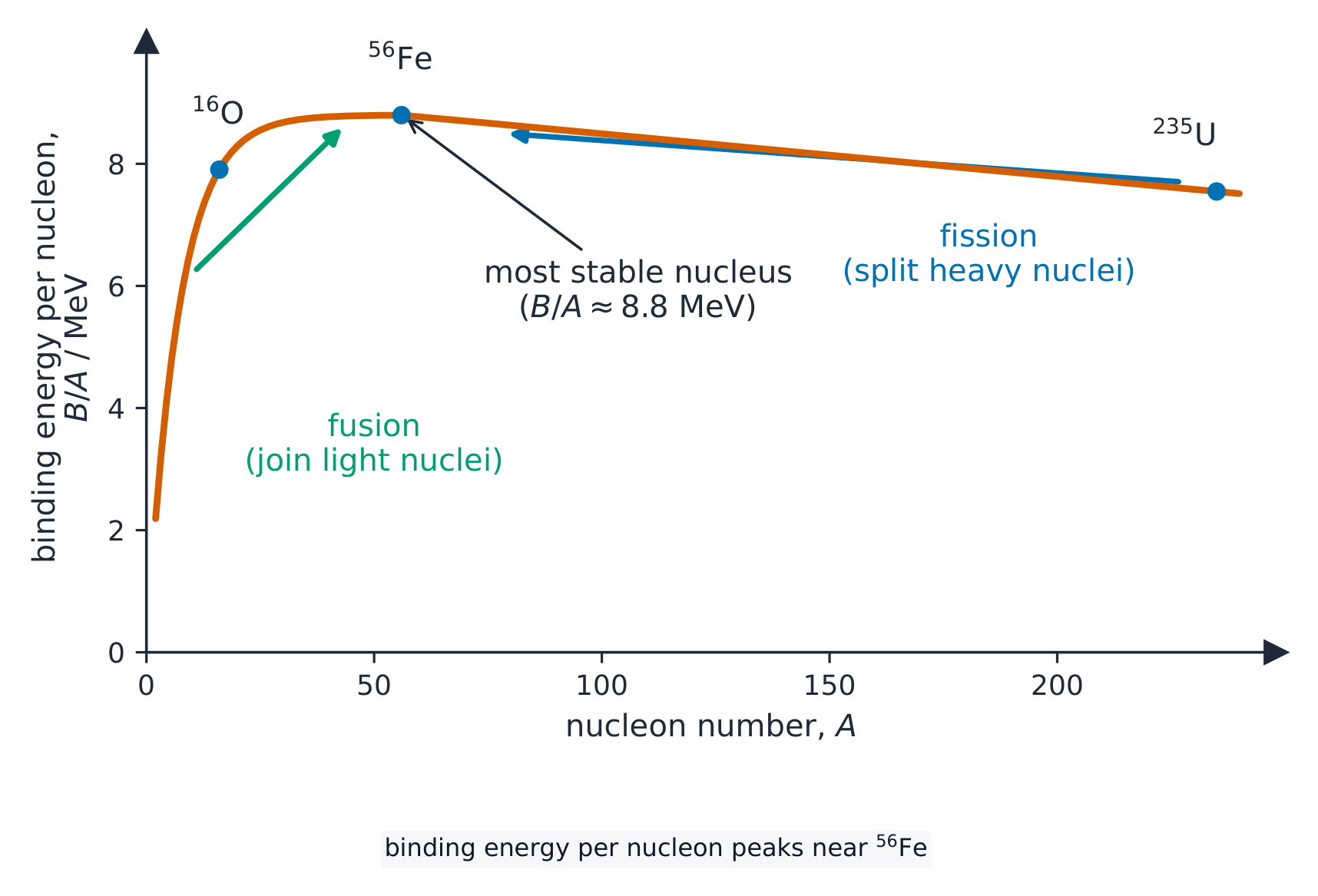
- Plot $B/A$ against $A$ and you get a dome: a steep rise for light nuclei, a maximum near $A = 56$ (iron) at about $8.8\ \text{MeV}$, then a slow fall to about $7.5\ \text{MeV}$ at uranium.
- Iron-56 is the most stable nucleus, and everything else can release energy by moving towards it.
- Sketching rules the exam marks: do not start at the origin, do not make the fall as steep as the rise, and do not let the curve reach zero on the right.
- Mark a nucleus that alpha decays on the far right ($A > 200$), and one that fuses on the far left ($A < 10$). Both sit low and both move up the curve when they react.
Everything climbs towards iron
Mass defect energy lab
E = delta m c^2
Change mass defect and see binding energy rise with E = mc^2.
The binding energy per nucleon is greatest for:
Difficulty 1/5 · 100 coins + a small bonus on first completion today
Iron ($A \approx 56$) sits at the peak — the most tightly bound, most stable nucleus.
Which are true of the binding-energy-per-nucleon curve? Select all that apply.
Difficulty 2/5 · 140 coins + a small bonus on first completion today
It falls only to about 7.5 MeV at uranium. Drawing it back down to zero is a marked error, as is starting the curve exactly at the origin.
Sketch the curve: put the features in order from left to right.
Difficulty 3/5 · 200 coins + a small bonus on first completion today
A fusing nucleus is marked at the far left and an alpha emitter at the far right. Both are low on the curve and both move up it when they react.
Marks that slip away
- Binding energy is the energy to pull the nucleus apart into separate nucleons, not "the energy holding it together".
- Keep full precision until you subtract. A mass defect is a small difference of large numbers.
- $1\ \text{u} \leftrightarrow 931\ \text{MeV}$ works only when $\Delta m$ is in u. In kilograms you must use $c^2$ and you get joules.
- Balance both lines of a nuclear equation, and include the neutrino in beta decay.
- The nucleus is lighter than its parts. Writing the mass defect the other way round makes the binding energy negative.
You've got it
- $\Delta E = c^2 \Delta m$, and $1\ \text{u} \leftrightarrow 931\ \text{MeV}$ is the conversion nearly every question needs
- a nuclear equation conserves nucleon number and charge, and beta decay emits a neutrino or antineutrino
- the mass defect is the mass of the separate nucleons minus the mass of the nucleus, and the binding energy $B = \Delta m c^2$ is the minimum energy to separate it into individual nucleons
- binding energy per nucleon peaks near iron-56 at about $8.8\ \text{MeV}$, so light nuclei fusing and heavy nuclei splitting both climb the curve