มองดูสะพานลอย suspension bridge宏伟。สายเคเบิล的巨大不是随机形状 — It hangs in a perfect parabola, a curve you can write with a single equation. The…
English narration · English + 中文 subtitles burned in · การบรรยายภาษาอังกฤษ · คำบรรยายภาษาอังกฤษ + 中文 ลอยตัวบนภาพ
English
This handout covers Topic 1: Pure Mathematics 纯数学 1. It is the algebra 代数 and calculus 微积分 core of the course. Each ## section is one syllabus subtopic.
Source: Cambridge International syllabus · แหล่งที่มา: หลักสูตร Cambridge International
English
Completing the square finds the vertex
A quadratic 二次式 is an expression of the form $ax^2 + bx + c$, where $a \neq 0$. The letters $a$, $b$, $c$ are the coefficients 系数 (the fixed numbers). Much of this section is about solving the equation$ax^2 + bx + c = 0$.
Completing the square
To complete the square 配方 means to write the quadratic in the form
$$a(x + p)^2 + q.$$
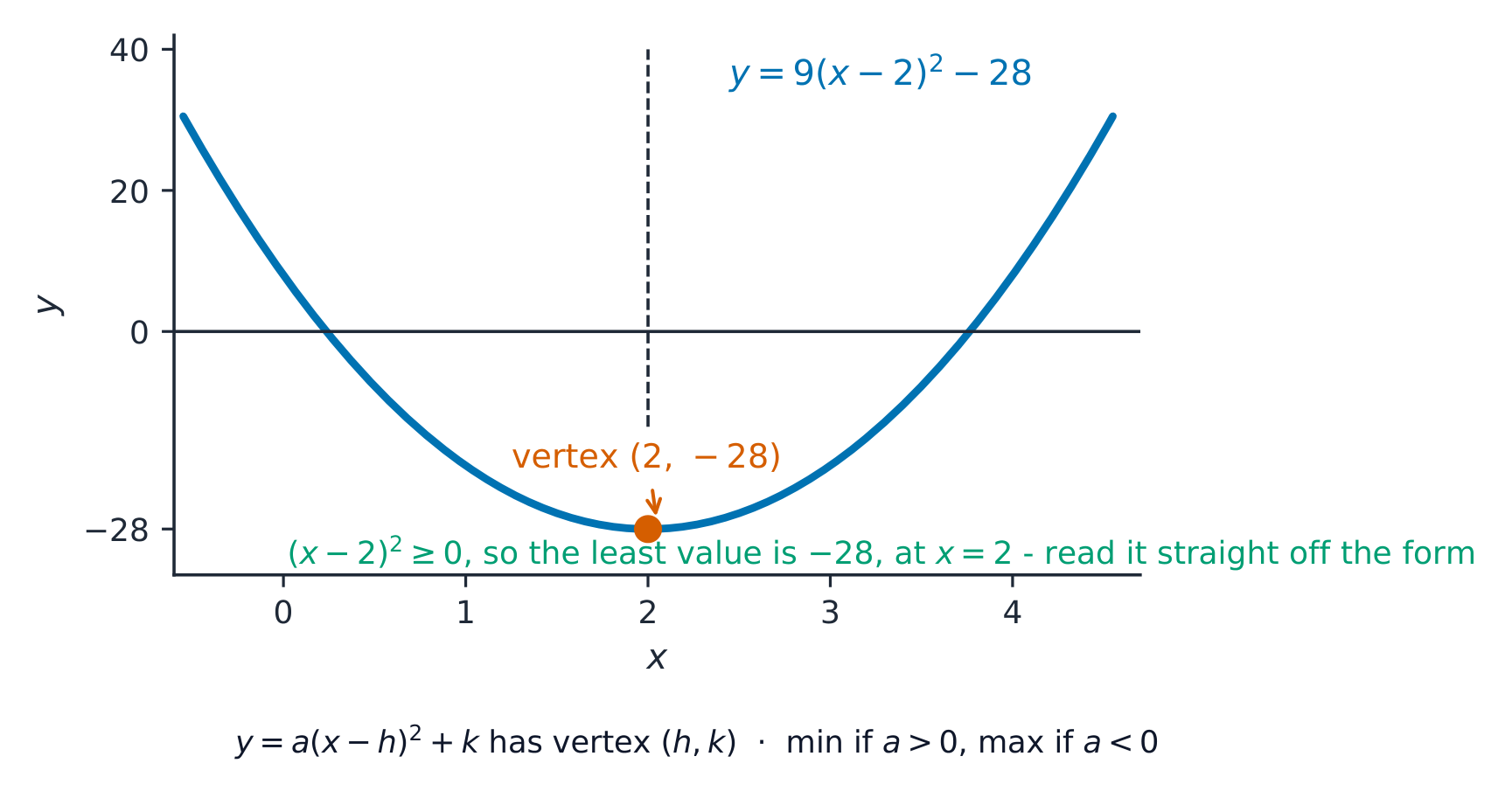
This form is useful: it shows the vertex 顶点 (turning point) of the curve at $(-p,\ q)$, and it gives a quick way to solve the equation.
Worked example. Write $9x^2 - 36x + 8$ in the form $p(x + q)^2 + r$.
Take the factor $9$ out of the first two terms, then complete the square inside:
Factorise: $(k - 4)(k - 16) > 0$, so $k < 4$ or $k > 16$. You also need $a \neq 0$, so $k \neq 0$.
Quadratic equations and inequalities
To solve a quadratic equation 二次方程, factorise, complete the square, or use the formula
$$x = \frac{-b \pm \sqrt{b^2 - 4ac}}{2a}.$$
To solve a quadratic inequality 二次不等式 such as $(k - 4)(k - 16) > 0$, find the two roots, then decide which side of each root makes the statement true. A sketch of the parabola 抛物线 helps: the curve is above the $x$-axis (positive) outside the roots and below it (negative) between them.
Simultaneous equations
To solve a pair of simultaneous equations 联立方程 where one is linear and one is quadratic, use substitution 代入: rearrange the linear equation for one letter, then put that into the quadratic. This gives a single quadratic to solve.
Equations that are quadratic in disguise
Some equations are quadratic in some function of$x$. For example $x^4 - 5x^2 + 4 = 0$ is quadratic in $x^2$: let $u = x^2$, solve $u^2 - 5u + 4 = 0$, then go back to $x$. You will use this idea again in trigonometry.
The shape of a quadratic · รูปร่างของฟังก์ชันกำลังสอง
y = ax² + bx + c
Drag a, b and c. Watch the vertex, the line of symmetry and the roots (where it cuts the x-axis) move as the coefficients change. · ลาก a, b และ c ดู จุดยอด, เส้นสมมาตร และ ราก (จุดตัดแกน x) เคลื่อนที่เมื่อสัมประสิทธิ์เปลี่ยน
understand the terms function, domain, range, one-one function, inverse function and composition of functions
identify the range of a given function in simple cases, and find the composition of two given functions
e.g. range of $f : x \mapsto \frac{1}{x}$ for $x \geqslant 1$ and range of $g : x \mapsto x^2 + 1$ for $x \in \mathbb{R}$. Including the condition that a composite function $gf$ can only be formed when the range of $f$ is within the domain of $g$.
determine whether or not a given function is one-one, and find the inverse of a one-one function in simple cases
e.g. finding the inverse of $h : x \mapsto (2x + 3)^2 - 4$ for $x < -\frac{3}{2}$.
illustrate in graphical terms the relation between a one-one function and its inverse
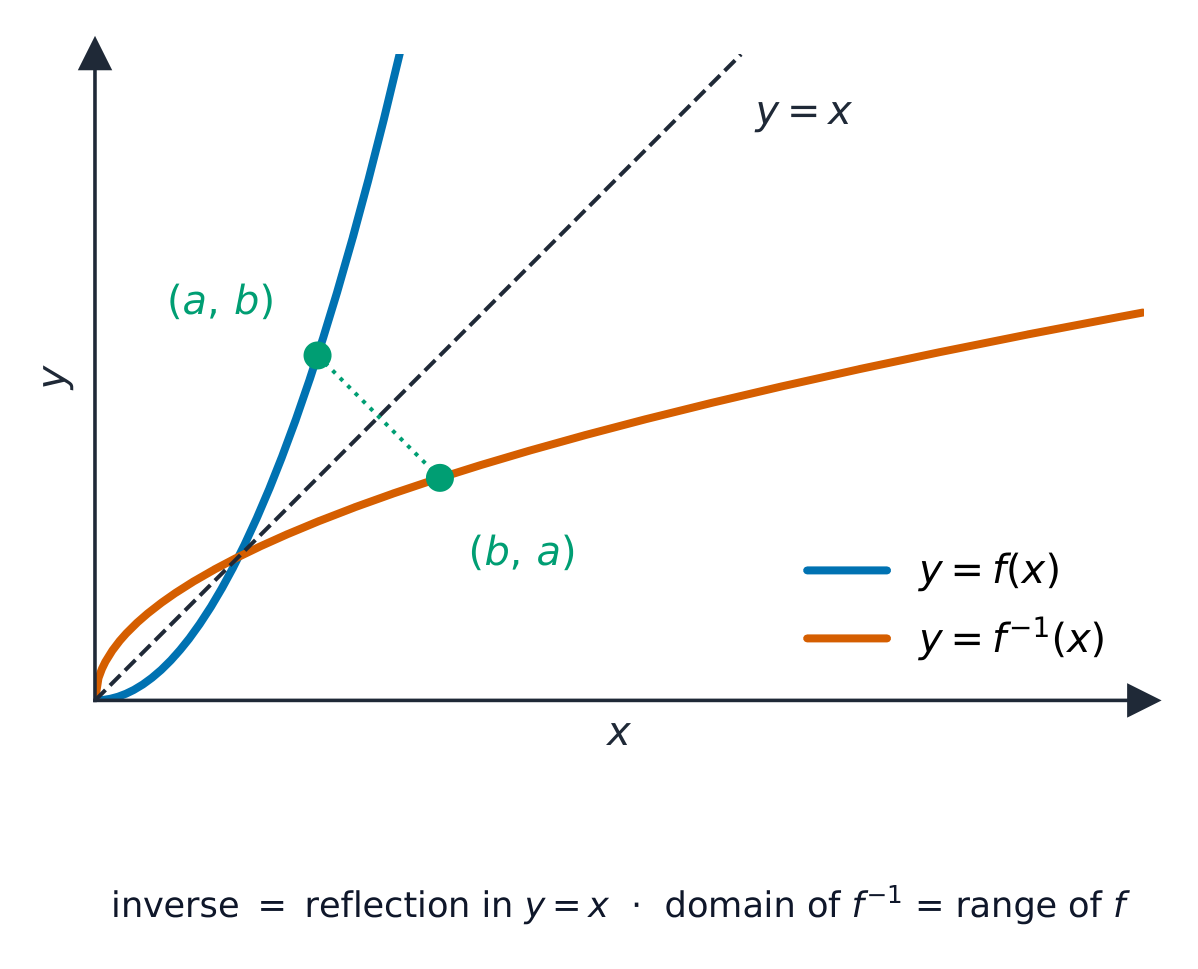
Sketches should include an indication of the mirror line $y = x$.
understand and use the transformations of the graph of $y = f(x)$ given by $y = f(x) + a$, $y = f(x + a)$, $y = af(x)$, $y = f(ax)$ and simple combinations of these.
Including use of the terms ‘translation’, ‘reflection’ and ‘stretch’ in describing transformations. Questions may involve algebraic or trigonometric functions, or other graphs with given features.
Source: Cambridge International syllabus · แหล่งที่มา: หลักสูตร Cambridge International
English
Transforming graphs: shift and stretch
A function 函数 is a rule that sends each input to exactly one output. Write it as $f(x)$. The composition of functions 复合函数$fg(x)$ means apply $g$ first, then apply $f$ to the result.
The domain 定义域 is the set of allowed inputs $x$.
The range 值域 is the set of outputs the function actually produces.
A function is one-one 一一对应 if different inputs always give different outputs. (No output is repeated.) Only a one-one function has an inverse function 反函数$f^{-1}$, which reverses the rule.
The composition 复合 of two functions means doing one after the other. $fg(x)$ means "do $g$ first, then $f$": $fg(x) = f(g(x))$. The composite function $fg$ exists only when the range of $g$ lies inside the domain of $f$.
Finding an inverse
To find $f^{-1}$: write $y = f(x)$, make $x$ the subject, then swap letters.
Worked example. The function $f(x) = (x + 3)^2 - 12$ is defined for $x \geqslant 0$. Find $f^{-1}(x)$.
Write $y = (x + 3)^2 - 12$ and solve for $x$:
$$(x + 3)^2 = y + 12 \;\Rightarrow\; x + 3 = \sqrt{y + 12} \;\Rightarrow\; x = \sqrt{y + 12} - 3.$$
You take the positive square root because $x \geqslant 0$ means $x + 3 \geqslant 3 > 0$. So
$$f^{-1}(x) = \sqrt{x + 12} - 3.$$
Graphs of inverses and transformations
The graph of $y = f^{-1}(x)$ is the reflection 反射 of $y = f(x)$ in the line $y = x$.
You should know these transformations 变换 of $y = f(x)$:
New equation
Effect on the graph
$y = f(x) + a$
translation 平移 up by $a$
$y = f(x + a)$
translation left by $a$
$y = a\,f(x)$
stretch 伸缩 in the $y$-direction, scale factor $a$
$y = f(ax)$
stretch in the $x$-direction, scale factor $\tfrac{1}{a}$
When two transformations are combined, the order can matter. State each one fully (type, direction, and amount).
A function turns each input into exactly one output — drag the coefficients and watch where the curve rises and falls. · ฟังก์ชันแปลง อินพุต แต่ละค่าให้เป็น เอาต์พุต Exactly หนึ่งค่า — ลากสัมประสิทธิ์และดูว่ากราฟ ขึ้น และ ลง ที่ไหน
find the equation of a straight line given sufficient information
e.g. given two points, or one point and the gradient.
interpret and use any of the forms $y = mx + c$, $y - y_1 = m(x - x_1)$, $ax + by + c = 0$ in solving problems
Including calculations of distances, gradients, midpoints, points of intersection and use of the relationship between the gradients of parallel and perpendicular lines.
understand that the equation $(x - a)^2 + (y - b)^2 = r^2$ represents the circle with centre $(a, b)$ and radius $r$
Including use of the expanded form $x^2 + y^2 + 2gx + 2fy + c = 0$.
use algebraic methods to solve problems involving lines and circles
Including use of elementary geometrical properties of circles, e.g. tangent perpendicular to radius, angle in a semicircle, symmetry. Implicit differentiation is not included.
understand the relationship between a graph and its associated algebraic equation, and use the relationship between points of intersection of graphs and solutions of equations.
e.g. to determine the set of values of $k$ for which the line $y = x + k$ intersects, touches or does not meet a quadratic curve.
Source: Cambridge International syllabus · แหล่งที่มา: หลักสูตร Cambridge International
English
What is a radian?
Radians
A radian 弧度 is another way to measure angles. One radian is the angle at the centre of a circle that cuts off an arc 弧 equal in length to the radius. The link between radians and degrees 度 is
$$\pi \text{ radians} = 180^\circ.$$
So to change degrees to radians, multiply by $\dfrac{\pi}{180}$; to change radians to degrees, multiply by $\dfrac{180}{\pi}$.
Arc length and sector area
For a sector 扇形 with radius $r$ and angle $\theta$in radians:
$$\text{arc length} = s = r\theta, \qquad \text{sector area} = A = \tfrac12 r^2 \theta.$$
A chord 弦 cuts the sector into a triangle and a segment 弓形. The segment area is the sector minus the triangle:
Worked example. A sector has centre $O$ and the angle at $O$ is $\tfrac{2}{3}\pi$ radians. Show that the segment cut off by the chord has area about $0.614 r^2$.
Radians, arcs and sectors · เรเดียน, ความยาวส่วนโค้ง และพื้นที่ส่วนวงกลม
Change the angle (in radians) and radius. See the arc length$s = r\theta$ and the sector area$\tfrac12 r^2\theta$ update. · เปลี่ยนมุม (เป็นเรเดียน) และรัศมี ดู ความยาวส่วนโค้ง$s = r\theta$ และ พื้นที่ส่วนวงกลม$\tfrac12 r^2\theta$ อัปเดต
Source: Cambridge International syllabus · แหล่งที่มา: หลักสูตร Cambridge International
English
Amplitude, period and midline of a sine curveThe unit circle draws the sine curve
Graphs and exact values
You must know the shape of the graphs of the sine 正弦, cosine 余弦 and tangent function 正切 (written $\sin$, $\cos$, $\tan$). The sine and cosine graphs wave between $-1$ and $1$ and repeat every $360^\circ$ ($2\pi$). Learn these exact values:
$\theta$
$30^\circ$
$45^\circ$
$60^\circ$
$\sin\theta$
$\tfrac12$
$\tfrac{1}{\sqrt2}$
$\tfrac{\sqrt3}{2}$
$\cos\theta$
$\tfrac{\sqrt3}{2}$
$\tfrac{1}{\sqrt2}$
$\tfrac12$
$\tan\theta$
$\tfrac{1}{\sqrt3}$
$1$
$\sqrt3$
The notations $\sin^{-1}x$, $\cos^{-1}x$, $\tan^{-1}x$ mean the inverse angle (the principal value 主值).
Identities
An identity 恒等式 is true for every value of the angle. The two you must know are
Drag the amplitude, period and shifts of y = a·sin(bx + c) + d and watch the curve change against the base wave. · ลาก Amplitude, Period และการเลื่อนของ y = a·sin(bx + c) + d และดูกราฟเปลี่ยนแปลงเทียบกับคลื่นพื้นฐาน
Explore · สำรวจ
Sine and cosine on the unit circle · ไซน์และโคไซน์บนวงกลมหน่วย
Drag the angle round the unit circle. The height is $\sin\theta$, the across-distance is $\cos\theta$ — that's where the graphs come from. · ลากมุมรอบ วงกลมหน่วย ความสูงคือ $\sin\theta$ ระยะทางแนวนอนคือ $\cos\theta$ — นั่นคือที่มาของกราฟ
use the expansion of $(a + b)^n$, where $n$ is a positive integer
Including the notations $\begin{pmatrix} n \\ r \end{pmatrix}$ and $n!$ Knowledge of the greatest term and properties of the coefficients are not required.
recognise arithmetic and geometric progressions
use the formulae for the $n$th term and for the sum of the first $n$ terms to solve problems involving arithmetic or geometric progressions
Including knowledge that numbers $a$, $b$, $c$ are 'in arithmetic progression' if $2b = a + c$ (or equivalent) and are 'in geometric progression' if $b^2 = ac$ (or equivalent). Questions may involve more than one progression.
use the condition for the convergence of a geometric progression, and the formula for the sum to infinity of a convergent geometric progression.
A progression 数列 (sequence) is a list of terms following a rule.
An arithmetic progression 等差数列 (AP) adds a fixed common difference 公差$d$ each step. The $n$th term 项 is $u_n = a + (n - 1)d$, and the sum of the first $n$ terms is $S_n = \tfrac{n}{2}\big(2a + (n - 1)d\big)$.
A geometric progression 等比数列 (GP) multiplies by a fixed common ratio 公比$r$ each step. The $n$th term is $u_n = ar^{\,n-1}$, and $S_n = \dfrac{a(1 - r^n)}{1 - r}$.
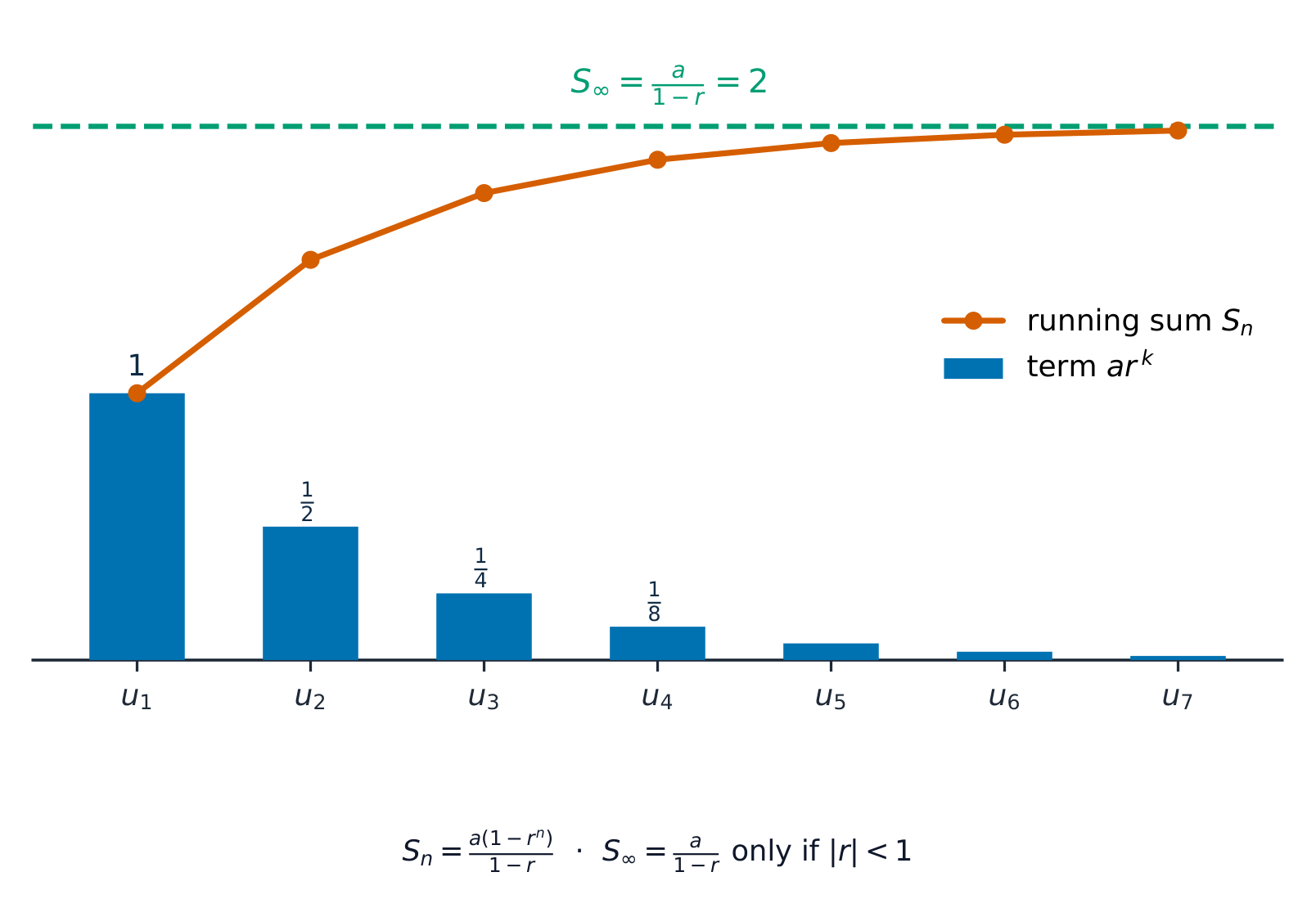
A GP is convergent — it converges 收敛 (settles to a limit) — when $|r| < 1$. Then it has a sum to infinity 无穷和
$$S_\infty = \frac{a}{1 - r}.$$
Worked example. The third term of a GP is $18$ and the sum of the first three terms is $26$. The common ratio is negative. Find the sum to infinity.
From $ar^2 = 18$ you get $a = \dfrac{18}{r^2}$. Put this into $a(1 + r + r^2) = 26$:
Convergent GP: เสาหดตัวเข้าหาศูนย์ mientras ผลรวมสะสมเข้าใกล้ S infinity = a/(1-r)
Explore · สำรวจ
Arithmetic and geometric sequences · อนุกรมเลขคณิตและเรขาคณิต
Switch between an arithmetic (add d) and a geometric (multiply by r) sequence and watch the terms and their sum build up. · สลับระหว่าง อนุกรมเลขคณิต (บวก d) และ อนุกรมเรขาคณิต (คูณ r) แล้วดูพจน์และผลรวมสะสมเพิ่มขึ้น
understand the gradient of a curve at a point as the limit of the gradients of a suitable sequence of chords, and use the notations $f'(x)$, $f''(x)$, $\frac{\text{d}y}{\text{d}x}$, and $\frac{\text{d}^2y}{\text{d}x^2}$ for first and second derivatives
Only an informal understanding of the idea of a limit is expected. e.g. includes consideration of the gradient of the chord joining the points with $x$ coordinates $2$ and $(2 + h)$ on the curve $y = x^3$. Formal use of the general method of differentiation from first principles is not required.
use the derivative of $x^n$ (for any rational $n$), together with constant multiples, sums and differences of functions, and of composite functions using the chain rule
e.g. find $\frac{\text{d}y}{\text{d}x}$, given $y = \sqrt{2x^3 + 5}$.
apply differentiation to gradients, tangents and normals, increasing and decreasing functions and rates of change
Including connected rates of change, e.g. given the rate of increase of the radius of a circle, find the rate of increase of the area for a specific value of one of the variables.
locate stationary points and determine their nature, and use information about stationary points in sketching graphs.
Including use of the second derivative for identifying maxima and minima; alternatives may be used in questions where no method is specified. Knowledge of points of inflexion is not included.
Source: Cambridge International syllabus · แหล่งที่มา: หลักสูตร Cambridge International
English
Differentiation from first principles
Differentiation 微分 finds the gradient of a curve 曲线斜率 at each point. The gradient is the limit 极限 of the gradients of shorter and shorter chords, called the derivative 导数.
The rules
Write the derivative as $f'(x)$ or $\dfrac{dy}{dx}$. The basic rule is
$$\frac{d}{dx}\left(x^n\right) = n x^{n-1} \quad \text{for any rational } n.$$
Differentiate sums term by term, and use the chain rule 链式法则 for a function inside a function:
$$\frac{d}{dx}\,f(g(x)) = f'(g(x)) \cdot g'(x).$$
Differentiating again gives the second derivative 二阶导数$f''(x)$ or $\dfrac{d^2y}{dx^2}$.
Using the derivative
Tangent and normal. The gradient of the curve at a point is the gradient of the tangent there. The normal 法线 is perpendicular to the tangent, so its gradient is $-\dfrac{1}{\text{(tangent gradient)}}$.
Increasing or decreasing. The function is an increasing function 增函数 where $\dfrac{dy}{dx} > 0$, and a decreasing function 减函数 where $\dfrac{dy}{dx} < 0$.
Rate of change. A derivative is a rate of change 变化率. Linked rates use the chain rule, e.g. $\dfrac{dy}{dt} = \dfrac{dy}{dx}\cdot\dfrac{dx}{dt}$.
Stationary points
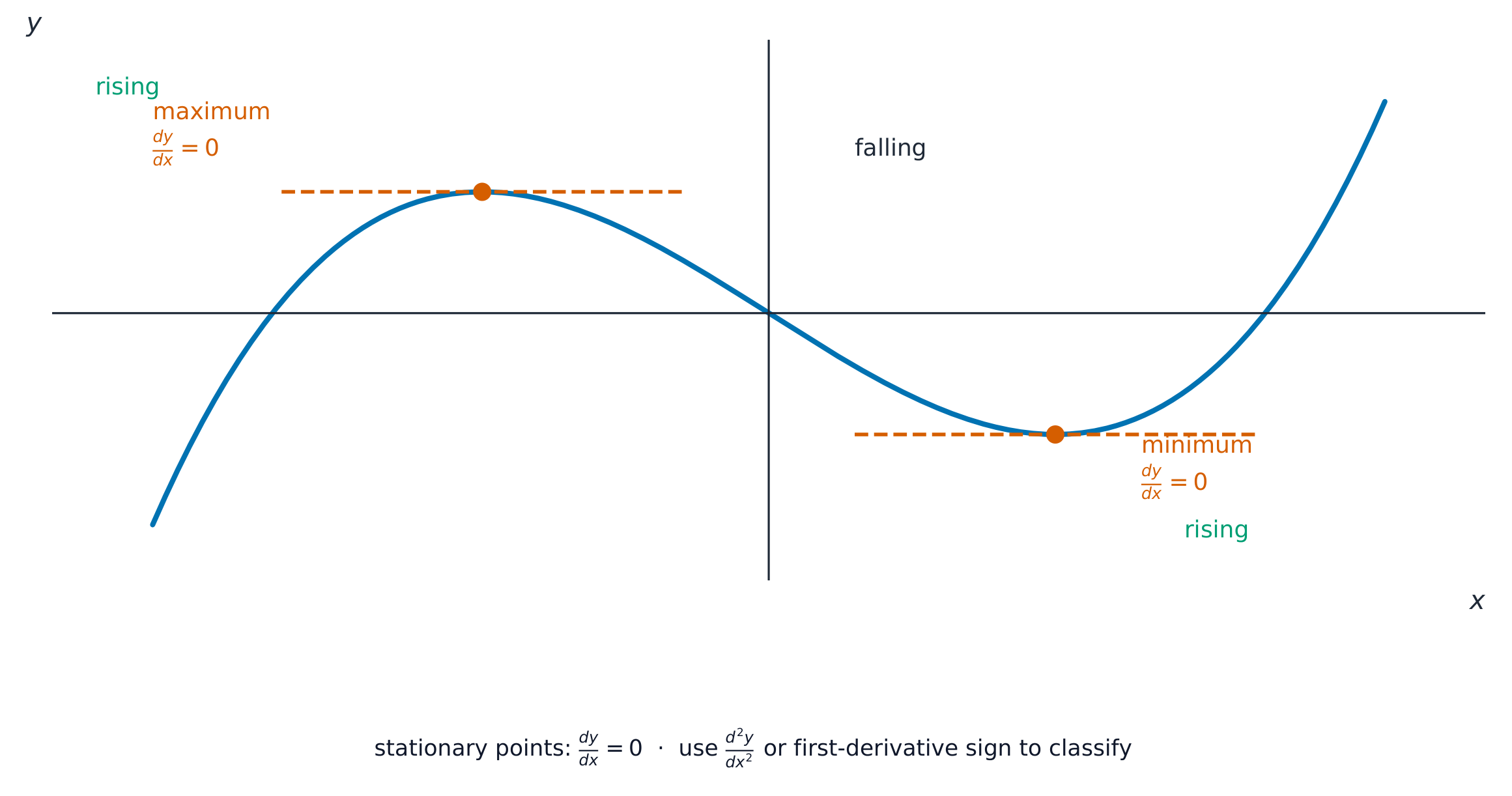
A stationary point 驻点 is where $\dfrac{dy}{dx} = 0$. Test its nature with the second derivative: $f''(x) > 0$ gives a minimum point 极小值点, and $f''(x) < 0$ gives a maximum point 极大值点. When $f''(x) = 0$ the test is inconclusive: the point may be a point of inflexion 拐点, where the curve changes concavity (the way it bends) – check the sign of $\dfrac{dy}{dx}$ just before and after to decide.
Worked example. The curve $y = 4x^{1/2} - x$ has a maximum point at $x = a$. Find $a$.
Slide the point along the curve. The tangent shows the gradient $\frac{dy}{dx}$ there — steeper where the curve bends more. · เลื่อนจุดตามเส้นโค้ง เส้นสัมผัส แสดงความชัน $\frac{dy}{dx}$ ที่จุดนั้น — ชันขึ้นเมื่อเส้นโค้งงอมากขึ้น
equation of a straight line/ɪˈkweɪʒn əvə streɪt laɪn/
สมการเส้นตรง
parallel/ˈpærəlel/
并联电路中
perpendicular/ˌpɜːpənˈdɪkjʊlə/
ตั้งฉาก
chord/kɔːd/
คอร์ด
Differentiation/ˌdɪfəˌrenʃɪˈeɪʃn/
การหาอนุพันธ์
gradient of a curve/ˈɡreɪdɪənt əvə kɜːv/
ความชันของเส้นโค้ง
limit/ˈlɪmɪt/
limit
derivative/dɪˈrɪvətɪv/
อนุพันธ์เชิงซ้อน (ดีริวทีฟ)
chain rule/tʃeɪn ruːl/
กฎโซ่ (Chain Rule)
second derivative/ˈsekənd dɪˈrɪvətɪv/
อนุพันธ์อันดับสอง
normal/ˈnɔːml/
เส้นปกติ
increasing function/ɪnˈkriːsɪŋ ˈfʌŋkʃn/
ฟังก์ชันเพิ่มขึ้น
decreasing function/ˈdiːkriːsɪŋ ˈfʌŋkʃn/
ฟังก์ชันลดลง
rate of change/reɪt ɒv tʃeɪndʒ/
อัตราการเปลี่ยนแปลง
stationary point/ˈsteɪʃənəri pɔɪnt/
จุดนิ่ง
minimum point/ˈmɪnɪməm pɔɪnt/
จุดต่ำสุด
maximum point/ˈmæksɪməm pɔɪnt/
จุดสูงสุด
point of inflexion/pɔɪnt ɒv ɪnˈflekʃn/
จุดเปลี่ยนเว้า
1.8
Integration · การหาอินทิกรัล (Integration)
Syllabus · หลักสูตร
English
Candidates should be able to:
Notes and examples
understand integration as the reverse process of differentiation, and integrate $(ax + b)^n$ (for any rational $n$ except $-1$), together with constant multiples, sums and differences
solve problems involving the evaluation of a constant of integration
e.g. to find the equation of the curve through $(1, -2)$ for which $\frac{\text{d}y}{\text{d}x} = \sqrt{2x + 1}$.
evaluate definite integrals
Including simple cases of 'improper' integrals, such as $\int_{0}^{1} x^{-\frac{1}{2}} \text{d}x$ and $\int_{1}^{\infty} x^{-2} \text{d}x$.
use definite integration to find: - the area of a region bounded by a curve and lines parallel to the axes, or between a curve and a line or between two curves - a volume of revolution about one of the axes.
A volume of revolution may involve a region not bounded by the axis of rotation, e.g. the region between $y = 9 - x^2$ and $y = 5$ rotated about the $x$-axis.
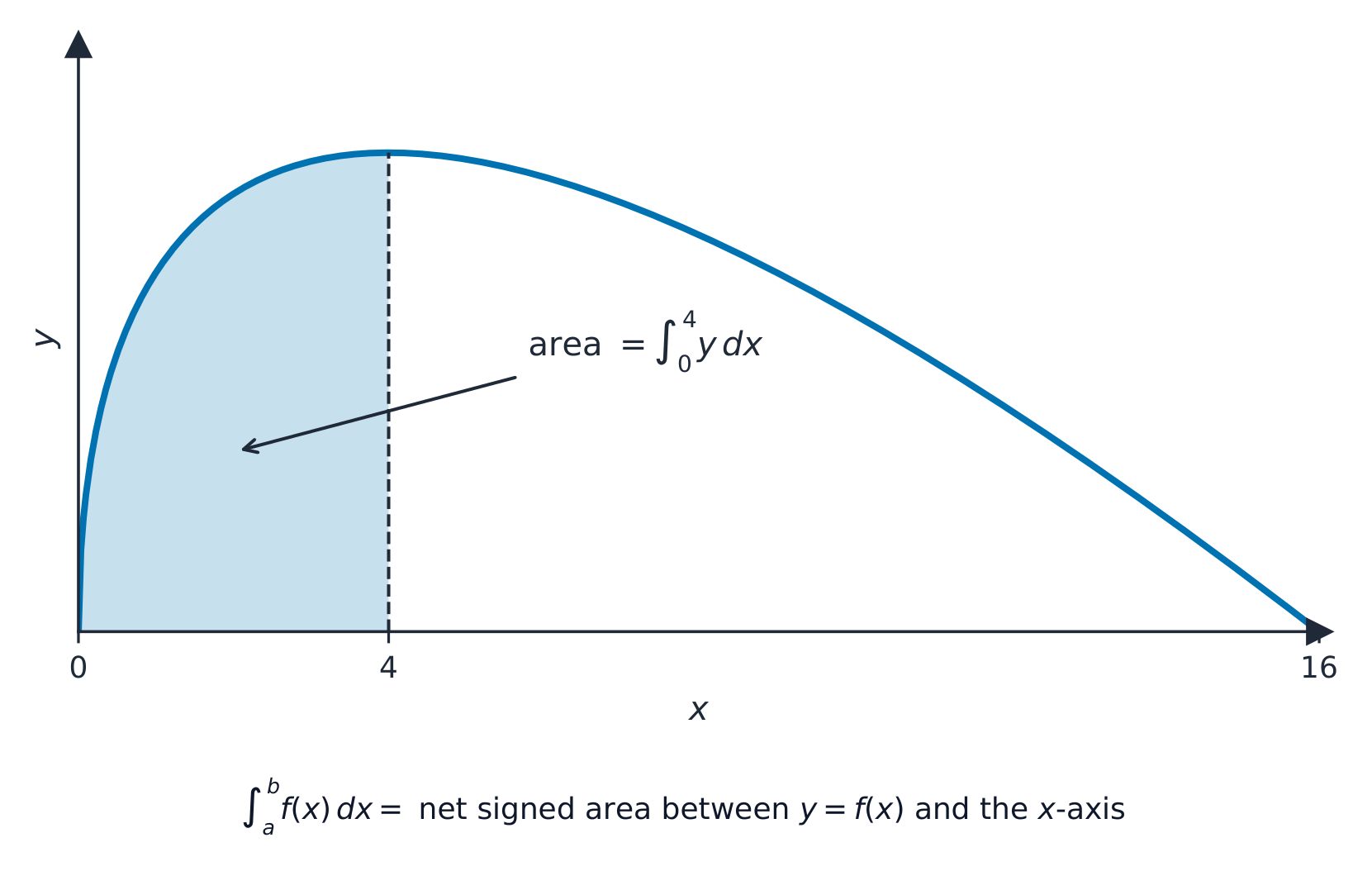
The area of the region 区域 between a curve and the $x$-axis, from $x = p$ to $x = q$, is $\displaystyle\int_p^q y \, dx$. For the area between two curves, integrate (top curve $-$ bottom curve).
Worked example. The curve $y = 4x^{1/2} - x$ meets the $x$-axis again at $x = 16$. Find the area between the curve and the $x$-axis from $x = 0$ to $x = 4$.
and $\displaystyle\int_0^{1}x^{-1/2}\, dx=\left[2x^{1/2}\right]_0^{1}=2$, which is finite even though the integrand blows up at $x=0$.
Volume of revolution
When a region is turned all the way around an axis it sweeps out a solid. The volume of revolution 旋转体体积 about the $x$-axis is
$$V = \pi \int_p^q y^2 \, dx,$$
and about the $y$-axis it is $V = \pi \displaystyle\int x^2 \, dy$. For example, the region under $y = \sqrt{x}$ from $x = 0$ to $x = 4$, turned about the $x$-axis, has volume $\pi\displaystyle\int_0^4 x\, dx = \pi\big[\tfrac{x^2}{2}\big]_0^4 = 8\pi$.
ไทย
Integration ในแง่ของพื้นที่: Riemann rectangles
Integration คือการย้อนกลับของการหาอนุพันธ์ การย้อนกลับ power rule จะได้
Drag the limits. The definite integral is the shaded area between the curve and the x-axis. · ลากขอบเขต อินทิกรัลจำกัด คือพื้นที่แรเงาระหว่างเส้นโค้งกับแกน x
Pick one and the site follows you — notes, papers, videos and practice all open on it. · เลือกหนึ่งตัว และเว็บจะติดตามคุณ — หมายเหตุ, ใบงาน, วิดีโอ และการฝึกฝนจะเปิดอยู่ที่นั้น
Type to search notes, lessons, code, vocabulary and past-paper questions across every subject. · พิมพ์เพื่อค้นหาบันทึก, บทเรียน, โค้ด, คำศัพท์ และคำถามข้อสอบเก่าในทุกวิชา