Functions
Introduced| English | Meaning |
|---|---|
| function/ˈfʌŋkʃn/ | A mapping that assigns exactly one output to each allowed input. |
| inverse/ɪnˈvɜːs/ | A function that reverses another function's mapping on a suitable one-to-one domain. |
| range/reɪndʒ/ | The set of output values actually attained by a function on its stated domain. |
| domain/dəˈmeɪn/ | The set of input values for which a function is defined. |
| one-one/wʌn wʌn/ | Describing a function in which different inputs always give different outputs. |
| composition/ˌkɒmpəˈzɪʃn/ | Combining functions by applying one function to the output of another. |
One input must have one output
- A vending-machine code should identify exactly one item. A function 函数 similarly assigns exactly one output to each allowed input; two different inputs may still give the same output.
- A rule and its allowed inputs belong together. The same formula with a different set of inputs can have a different set of outputs or a different inverse 反函数.
Find the range 值域 from the stated domain 定义域
- The domain is the set of allowed inputs; the range is the set of outputs actually attained. For $f(x)=\sqrt x$ on $x\geq0$, the range is $f(x)\geq0$.
- A boundary value need not be attained. For $g(x)=\dfrac1x$ on $x\geq1$, the range is $0<g(x)\leq1$: the value approaches $0$ but never equals it.
For $h(x)=(x-1)^2+2$ with $x\geq3$, the vertex at $x=1$ is outside the domain. Here $x-1\geq2$, so $h(x)\geq6$, attained at $x=3$. The range is not $h(x)\geq2$ for this restricted function.
Explore a function
y = ax³ + bx² + cx + d
A function turns each input into exactly one output — drag the coefficients and watch where the curve rises and falls.
The domain of f(x) = √(x − 4) is:
Difficulty 1/5 · 100 coins + a small bonus on first completion today
The expression under the square root must be non-negative: x − 4 ≥ 0, so x ≥ 4.
Find the range of $f(x)=1/x$ for $x>2$. Explain separately why each boundary value is included or excluded.
$0<f(x)<1/2$. The output is positive and approaches zero as $x$ grows, but never equals zero. It approaches $1/2$ as $x$ approaches 2 from above, but the input 2 is excluded, so $1/2$ is not attained.
Find the range of $q(x)=(x-2)^2+3$ for $x\leq 0$. A student gives $q(x)\geq 3$ by reading the vertex. Explain the mistake.
For the stated inputs, $x-2\leq-2$, so $(x-2)^2\geq 4$ and $q(x)\geq 7$, attained at $x=0$. The vertex input 2 is outside the domain, so its value 3 is not attained. As $x$ decreases without bound, the output grows without bound.
Decide whether the rule is one-one 一一对应
- A function is one-one when different inputs have different outputs. A horizontal line meets its graph at most once; the inverse then gives one output for each value in the original range.
- The function $x\mapsto x^2$ on all real inputs is not one-one because $2$ and $-2$ both give $4$. Restricting to either $x\geq0$ or $x\leq0$ gives a one-one branch; the choice changes the inverse.
Only a one-one function has an inverse function.
Difficulty 1/5 · 100 coins + a small bonus on first completion today
If two inputs gave the same output, the reverse rule would be ambiguous — so only one-one functions are invertible.
Compose in the correct order and check the inputs
- Composition 复合 means applying one function after another: $fg(x)=f(g(x))$, so $g$ acts first. If $f(x)=x^2$ and $g(x)=x+1$, then $fg(x)=(x+1)^2$ while $gf(x)=x^2+1$.
- For $fg$ to exist on the whole given domain of $g$, every output of $g$ must be an allowed input of $f$. Check that the range of $g$ lies inside the domain of $f$, not the other way round.
Let $f(x)=\sqrt x$ for $x\geq0$ and $g(x)=x-3$ for all real $x$. The formula $fg(x)=\sqrt{x-3}$ does not define a real output on all of $g$'s domain. Explicitly restricting the inner inputs to $x\geq3$ makes it valid there. Do not silently change a given domain when answering an existence question.
If f(x) = x² and g(x) = x + 1, what is fg(2) = f(g(2))?
Difficulty 2/5 · 140 coins + a small bonus on first completion today
g(2) = 3, then f(3) = 3² = 9.
Let $f(x)=\sqrt{x-1}$ for $x\geq 1$ and $g(x)=2 x-3$ for all real $x$. Determine whether $fg$ and $gf$ exist on their whole given inner domains. Find their formulas, stating a restriction that would make $fg$ valid.
The range of $g$ is all real numbers, not contained in the domain $[1,\infty)$ of $f$, so $fg$ does not exist on all of the given domain of $g$. Restricting its inner inputs to $x\geq 2$ makes $fg(x)=\sqrt{2 x-4}$ valid there. The range of $f$ is $[0,\infty)$, which is within the real domain of $g$, so $gf$ exists on $x\geq 1$, with $gf(x)=2\sqrt{x-1}-3$. Its range is $[-3,\infty)$.
Let $F(x)=1/(x-2)$ for $x>2$ and $G(x)=3 x+2$ for $x>a$. Find the set of $a$ for which $FG$ exists on the whole stated domain of $G$. Explain whether equality at your boundary is allowed.
The range of $G$ is $(3 a+2,\infty)$. Every such output must exceed 2, so $3 a+2\geq 2$, giving $a\geq 0$. Equality is allowed: when $a=0$, the inputs of $G$ are strictly positive, hence its outputs are strictly greater than 2. When $a<0$, input 0 is allowed and gives forbidden output 2.
Find an inverse and state its domain
- An inverse reverses a one-one rule. Write $y=f(x)$, solve for the original input $x$, then write the result using $f^{-1}$ notation. It is not the reciprocal $\dfrac1{f(x)}$.
- The inverse's domain is the original range, and its range is the original domain. The identities $f(f^{-1}(x))=x$ and $f^{-1}(f(x))=x$ hold on the appropriate domains.
For $f(x)=2x+6$ on the real numbers, $y=2x+6$ gives $x=\dfrac{y-6}{2}$. Thus $f^{-1}(x)=\dfrac{x-6}{2}$, with real domain and range. Check $f^{-1}(f(4))=f^{-1}(14)=4$.
To invert a composite of compatible one-one functions, reverse the operations in reverse order: $(gf)^{-1}=f^{-1}g^{-1}$. You can instead find $gf(x)$ first and solve its equation for the original input. Either way, keep the domain and branch restrictions.
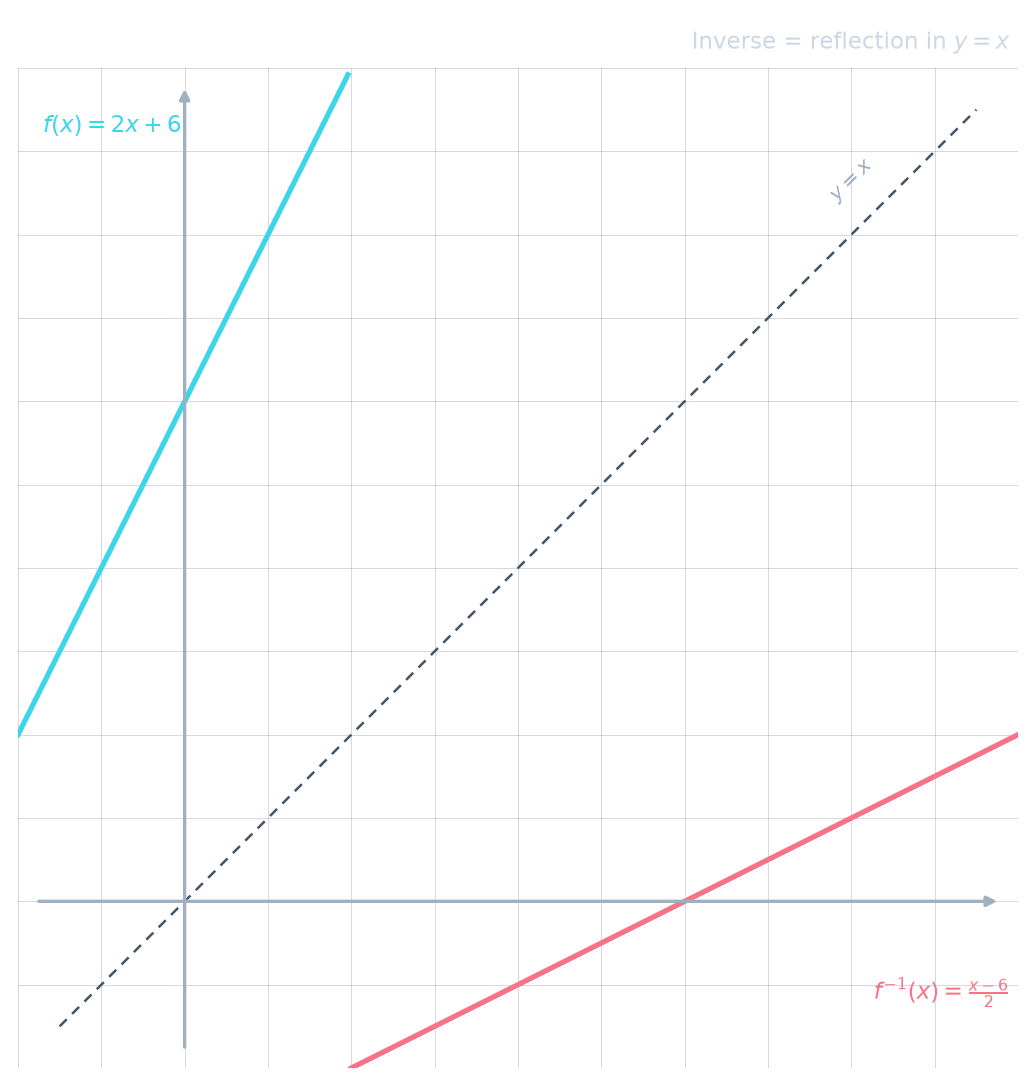
The point $(a,b)$ becomes $(b,a)$ under reflection in $y=x$.
For f(x) = 2 x + 6, the inverse is f⁻¹(x) = (x − 6)/2. What is f⁻¹(10)?
Difficulty 2/5 · 140 coins + a small bonus on first completion today
f⁻¹(10) = (10 − 6)/2 = 4/2 = 2.
For any function f with an inverse, f(f⁻¹(x)) = x.
Difficulty 1/5 · 100 coins + a small bonus on first completion today
Applying a function and then its inverse returns the original input — they undo each other.
For $f(x)=5 x-2$ on all real inputs, find $f^{-1}(x)$ and evaluate $f^{-1}(13)$. Separately, state the input excluded from $g(x)=1/(x-4)$.
Solve $y=5 x-2$ for $x$: $x=(y+2)/5$, so $f^{-1}(x)=(x+2)/5$ and $f^{-1}(13)=3$. The reciprocal rule $g$ excludes input 4 because its denominator would be zero.
Choose the square-root sign using the original branch
- Let $h(x)=(x+1)^2-5$ for $x\leq-1$. Its range is $h(x)\geq-5$. From $y+5=(x+1)^2$, use $x+1\leq0$ to choose $x=-1-\sqrt{y+5}$.
- Therefore $h^{-1}(x)=-1-\sqrt{x+5}$ for $x\geq-5$, with range $h^{-1}(x)\leq-1$. A $\pm$ expression would give two outputs; the positive choice alone would select the wrong original branch.
The function $h(x)=(x-2)^2+1$ is defined for $x\leq 2$. Find $h^{-1}(x)$ and its domain and range. Explain why the positive-square-root choice is incorrect for this given function.
The range of $h$ is $[1,\infty)$. From $y-1=(x-2)^2$ and $x-2\leq 0$, $x=2-\sqrt{y-1}$. Thus $h^{-1}(x)=2-\sqrt{x-1}$ for $x\geq 1$, with range $h^{-1}(x)\leq 2$. The plus choice gives outputs greater than 2 for inputs above 1, outside the original domain.
Let $f(x)=(x-1)^2+2$ for $x\leq1$ and $g(x)=5-x$ for all real $x$. Set $H=gf$. Find $H(x)$, its range, and $H^{-1}(x)$ with its domain and range. Show how the original branch fixes the square-root sign.
The inverse reverses the composite, with a negative square root because the original input satisfies $x\leq1$.
Sketch the inverse with its mirror line
- Reflect the restricted curve in $y=x$, swapping each point's coordinates. In the example, the endpoint $(-1,-5)$ becomes $(-5,-1)$ and $(-3,-1)$ becomes $(-1,-3)$.
- Keep endpoint inclusion, the correct branch and the mirror line. The inverse has the same exchanged domain and range as the algebraic calculation.

Both endpoints are included. The graphs continue beyond the plotting window; the marked endpoints are the restrictions, not the edges of the picture.
The graph of y = f⁻¹(x) is the reflection of y = f(x) in the line:
Difficulty 1/5 · 100 coins + a small bonus on first completion today
An inverse reflects the original graph in the line y = x; a point (a, b) becomes (b, a).
On paper sketch $y=(x+2)^2-1$ restricted to $x\leq-2$ and its inverse on the same axes. Find the inverse rule, mark endpoints and intercepts, include the mirror line, and show how the point $(-4,3)$ is mapped.
The inverse is $y=-2-\sqrt{x+1}$ for $x\geq-1$. The included endpoint $(-2,-1)$ reflects to $(-1,-2)$; the intercept $(-3,0)$ reflects to $(0,-3)$; the point $(-4,3)$ reflects to $(3,-4)$. Draw the left quadratic branch and the decreasing inverse branch with mirror line $y=x$. A teacher must review the actual sketch, not only these coordinate statements.
Transform inputs and outputs differently
- $f(x)+a$ translates vertically by $a$, while $f(x+a)$ translates horizontally by $-a$. For $a>0$, $af(x)$ stretches vertically by factor $a$ and $f(ax)$ stretches horizontally by factor $\dfrac1a$.
- A minus on the output, $-f(x)$, reflects in the $x$-axis; a minus on the input, $f(-x)$, reflects in the $y$-axis. Use a positive stretch factor and name any reflection separately.
| Rule | A point $(s,t)$ moves to |
|---|---|
| $f(x)+a$ | $(s,t+a)$ |
| $f(x+a)$ | $(s-a,t)$ |
| $af(x)$ | $(s,at)$ |
| $f(ax)$, $a\ne0$ | $(\dfrac{s}{a},t)$ |

A point $(6,-2)$ lies on $y=f(x)$. Describe transformations giving $y=-3 f(2 x)+4$ and find the corresponding point. Use a positive factor when naming each stretch.
Stretch horizontally by factor 1/2; stretch vertically by factor 3, reflect in the $x$-axis, then translate up 4. Tracking the point gives $x=6/2=3$ and $y=-3(-2)+4=10$, hence $(3,10)$. The minus outside the function reflects the output, not the input. Equivalent orders of commuting operations are acceptable.
State a valid order for combined transformations
- To obtain $g(x)=2f(x+3)-1$ with two transformations, stretch vertically by factor $2$, then translate left by $3$ and down by $1$ in one translation. The point $(4,5)$ becomes $(4,10)$, then $(1,9)$.
- Reversing those same two operations gives $2(f(x+3)-1)=2f(x+3)-2$, a different graph. A translation may move both coordinates at once; when two transformations are required, do not split its horizontal and vertical components into extra operations.
Changes inside the function affect which input is needed; changes outside affect the resulting output.
Describe a sequence of exactly two transformations from $y=f(x)$ to $y=3f(x-2)+4$. Track the point $(1,2)$. Explain why reversing those same two transformations does not give the same graph.
Stretch vertically by factor 3, then translate by $(2,4)$: right 2 and up 4 in one translation. The point $(1,2)$ becomes $(1,6)$, then $(3,10)$. Reversing these operations gives $3(f(x-2)+4)=3f(x-2)+12$, placing the point at $(3,18)$. The translation must follow the stretch for this stated vector.
You've got it
- Use the actual domain to find attained outputs and one-one branches.
- For a composite, check the inner function's range against the outer function's domain.
- An inverse needs the correct branch and exchanged domain/range. Transformations need direction, factor and a valid order.
A one-one function $u$ has $u(4)=11$. What does $u^{-1}(11)$ equal?
Difficulty 1/5 · 100 coins + a small bonus on first completion today
The inverse reverses the input/output pair; it is not a reciprocal.