Skip to content · ⁨ข้ามไปยังเนื้อหา⁩

Further Pure Mathematics 2 · ⁨คณิตศาสตร์บริสุทธิ์เพิ่มเติม 2⁩

A-Level Further Mathematics · ⁨Further Mathematics A-Level⁩ · Topic 2 · ⁨หัวข้อ 2⁩

Video lesson for this topic · ⁨บทเรียนวิดีโอสำหรับหัวข้อนี้⁩ Open the video page · ⁨เปิดหน้าวิดีโอ⁩
11:29

คณิตศาสตร์บริสุทธิ์เพิ่มเติม 2

มองดูโซ่ที่แขวน的任何一条, สายไฟ任何一条, หรือสายเคเบิล任何东西悬吊。它总是 settling into one special curve. คุณอาจเดาว่าเป็นพาราโบลา — แต่มันไม่ใช่ มันคือ…

English narration · English + 中文 subtitles burned in · ⁨การบรรยายภาษาอังกฤษ · คำบรรยายภาษาอังกฤษ + 中文 ลอยตัวบนภาพ⁩

English

This handout covers Topic 2: Further Pure Mathematics 进阶纯数学 2. It adds hyperbolic functions, eigenvalues, new differentiation and integration, de Moivre's theorem, and methods for differential equations.

ไทย

เอกสารฉบับนี้ครอบคลุมหัวข้อที่ 2: คณิตศาสตร์บริสุทธิ์เพิ่มเติม 2. ซึ่งเพิ่มฟังก์ชันไฮเปอร์โบลิก, ค่าเฉพาะ, การหาอนุพันธ์และการอินทิเกรตใหม่, ทฤษฎีบทเด มัวร์, และวิธีการสำหรับสมการเชิงอนุพันธ์.

2.1

Hyperbolic functions · ⁨ฟังก์ชันไฮเปอร์โบลิก⁩

Syllabus · ⁨หลักสูตร⁩
English
Candidates should be able to: Notes and examples
understand the definitions of the hyperbolic functions $\sinh x$, $\cosh x$, $\tanh x$, $\text{sech } x$, $\text{cosech } x$, $\text{coth } x$ in terms of the exponential function
sketch the graphs of hyperbolic functions
prove and use identities involving hyperbolic functions e.g. $\cosh^2 x - \sinh^2 x \equiv 1$, $\sinh 2x \equiv 2 \sinh x \cosh x$, and similar results corresponding to the standard trigonometric identities.
understand and use the definitions of the inverse hyperbolic functions and derive and use the logarithmic forms
ไทย
ผู้เข้าสอบควรสามารถ: หมายเหตุและตัวอย่าง
เข้าใจนิยามของ ฟังก์ชันไฮเปอร์โบลิก $\sinh x$, $\cosh x$, $\tanh x$, $\text{sech } x$, $\text{cosech } x$, $\text{coth } x$ ในtermsของฟังก์ชันเอ็กซ์โพเนนเชียล
วาดกราฟของ ฟังก์ชันไฮเปอร์โบลิก
พิสูจน์และใช้เอกลักษณ์ที่เกี่ยวข้องกับ ฟังก์ชันไฮเปอร์โบลิก เช่น: $\cosh^2 x - \sinh^2 x \equiv 1$, $\sinh 2x \equiv 2 \sinh x \cosh x$, และผลลัพธ์คล้ายคลึงกันที่สอดคล้องกับเอกลักษณ์ตรีโกณมิติมาตรฐาน
เข้าใจและใช้นิยามของ ฟังก์ชันไฮเปอร์โบลิกผกผัน และหาและใช้รูปแบบลอการิทึม

Source: Cambridge International syllabus · ⁨แหล่งที่มา: หลักสูตร Cambridge International⁩

English
cosh and sinh built from exponentials

The hyperbolic functions 双曲函数 are built from the exponential function:

$$\cosh x = \frac{e^x + e^{-x}}{2}, \qquad \sinh x = \frac{e^x - e^{-x}}{2}, \qquad \tanh x = \frac{\sinh x}{\cosh x}.$$

They obey identities much like the trigonometric ones, the main one being $\cosh^2 x - \sinh^2 x = 1$. The three reciprocals complete the set: $\operatorname{sech} x = \dfrac{1}{\cosh x}$, $\operatorname{cosech} x = \dfrac{1}{\sinh x}$, and $\coth x = \dfrac{1}{\tanh x} = \dfrac{\cosh x}{\sinh x}$ – all built from $e^x$ too, and worth recognising in integrals and mark schemes. The inverse hyperbolic functions 反双曲函数 have a logarithmic form 对数形式, for example $\sinh^{-1} x = \ln\!\left(x + \sqrt{x^2 + 1}\right)$.

Worked example. Show that $\cosh^2 x - \sinh^2 x = 1$.

$$\cosh^2 x - \sinh^2 x = \frac{(e^x + e^{-x})^2 - (e^x - e^{-x})^2}{4} = \frac{(e^{2x} + 2 + e^{-2x}) - (e^{2x} - 2 + e^{-2x})}{4} = \frac{4}{4} = 1.$$

ไทย
cosh และ sinh สร้างจากฟังก์ชันเอ็กซ์โพเนนเชียล
สายเคเบิล overhead ที่ห้อยตัวเป็นเส้นโค้งระหว่างจุดรองรับ
สายที่พาดลงจะเกิดรูปทรง catenary — ซึ่งเป็นโค้งของ hyperbolic cosine

ฟังก์ชันไฮเปอร์โบลิกถูกสร้างจากฟังก์ชันเอ็กซ์โพเนนเชียล:

$$\cosh x = \frac{e^x + e^{-x}}{2}, \qquad \sinh x = \frac{e^x - e^{-x}}{2}, \qquad \tanh x = \frac{\sinh x}{\cosh x}.$$

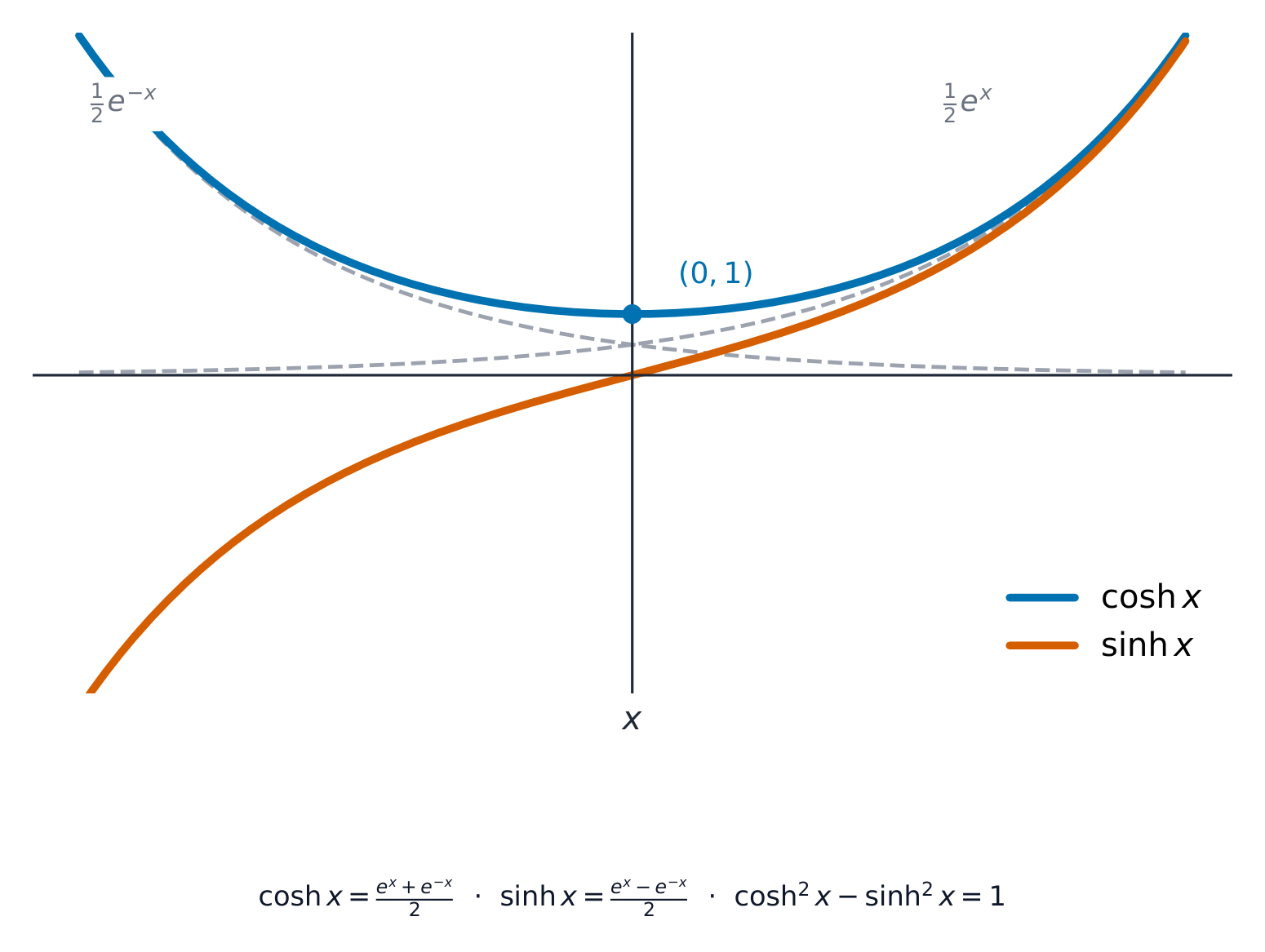
curve cosh และ sinh พร้อมเลขชี้กำลังทั้งสองที่สร้างมันขึ้นมา
$\cosh$ เป็นค่าเฉลี่ยของ $e^x$ และ $e^{-x}$; $\sinh$ เป็นครึ่งหนึ่งของผลต่างของทั้งสอง.

ฟังก์ชันเหล่านี้เป็นไปตามเอกลักษณ์คล้ายกับตรีโกณมิติ โดยหลักๆ คือ $\cosh^2 x - \sinh^2 x = 1$. ฟังก์ชัน ผกผัน (reciprocals) ทั้งสามเสริมชุดนี้ให้สมบูรณ์: $\operatorname{sech} x = \dfrac{1}{\cosh x}$, $\operatorname{cosech} x = \dfrac{1}{\sinh x}$, และ $\coth x = \dfrac{1}{\tanh x} = \dfrac{\cosh x}{\sinh x}$ – ซึ่งทั้งหมดสร้างจาก $e^x$ เช่นกัน และมีประโยชน์ในการจดจำเพื่อใช้ในอินทิกรัลและสเกลคะแนน The inverse hyperbolic functions มี รูปแบบลอการิทึม, ตัวอย่างเช่น $\sinh^{-1} x = \ln\!\left(x + \sqrt{x^2 + 1}\right)$.

ตัวอย่างวิธีทำ. แสดงว่า $\cosh^2 x - \sinh^2 x = 1$

$$\cosh^2 x - \sinh^2 x = \frac{(e^x + e^{-x})^2 - (e^x - e^{-x})^2}{4} = \frac{(e^{2x} + 2 + e^{-2x}) - (e^{2x} - 2 + e^{-2x})}{4} = \frac{4}{4} = 1.$$

Explore · ⁨สำรวจ⁩

Hyperbolic functions · ⁨ฟังก์ชันไฮเปอร์โบลิก⁩

y = a cosh(x)

cosh is the catenary (a hanging chain) — even, with its minimum at (0, a). · ⁨cosh คือ เส้นโค้งสายโซ่ (catenary) — แม้จะมีค่าต่ำสุดที่จุด (0, a)⁩

Vocabulary · ⁨คำศัพท์⁩ Train · ⁨ฝึกฝน⁩
English ไทย
Further Pure Mathematics/ˈfɜːðə pjʊə ˌmæθɪˈmætɪks/ คณิตศาสตร์บริสุทธิ์เพิ่มเติม
hyperbolic functions/ˌhaɪpəˈbɒlɪk ˈfʌŋkʃnz/ ฟังก์ชันไฮเปอร์โบลิก
inverse hyperbolic functions/ɪnˈvɜːs ˌhaɪpəˈbɒlɪk ˈfʌŋkʃnz/ ฟังก์ชันไฮเปอร์โบลิกผกผัน
logarithmic form/ˌlɒɡəˈrɪθmɪk fɔːm/ รูปเลขยกกำลัง
matrix equation/ˈmeɪtrɪks ɪˈkweɪʒn/ สมการเมทริกซ์
2.2

Matrices · ⁨เมทริกซ์⁩

Syllabus · ⁨หลักสูตร⁩
English
Candidates should be able to: Notes and examples
formulate a problem involving the solution of 3 linear simultaneous equations in 3 unknowns as a problem involving the solution of a matrix equation, or vice versa
understand the cases that may arise concerning the consistency or inconsistency of 3 linear simultaneous equations, relate them to the singularity or otherwise of the corresponding matrix, solve consistent systems, and interpret geometrically in terms of lines and planes e.g. three planes meeting in a common point, or in a common line, or having no common points.
understand the terms 'characteristic equation', 'eigenvalue' and 'eigenvector', as applied to square matrices Including use of the definition $\mathbf{Ae} = \lambda \mathbf{e}$ to prove simple properties, e.g. that $\lambda^n$ is an eigenvalue of $\mathbf{A}^n$.
find eigenvalues and eigenvectors of $2 \times 2$ and $3 \times 3$ matrices Restricted to cases where the eigenvalues are real and distinct.
express a square matrix in the form $\mathbf{QDQ}^{-1}$, where $\mathbf{D}$ is a diagonal matrix of eigenvalues and $\mathbf{Q}$ is a matrix whose columns are eigenvectors, and use this expression e.g. in calculating powers of $2 \times 2$ or $3 \times 3$ matrices.
use the fact that a square matrix satisfies its own characteristic equation. e.g. in finding successive powers of a matrix or finding an inverse matrix; restricted to $2 \times 2$ or $3 \times 3$ matrices only.
ไทย
ผู้เข้าสอบควรสามารถ: หมายเหตุและตัวอย่าง
จัดรูปโจทย์ปัญหา涉及的การแก้ระบบสมการเชิงเส้นพร้อมกัน 3 ตัวใน 3 ตัวแปร ให้เป็นการแก้ สมการเมทริกซ์ หรือในทางกลับกัน
เข้าใจกรณีต่างๆ ที่อาจเกิดขึ้นเกี่ยวกับการ consistency หรือ inconsistency ของระบบสมการเชิงเส้นพร้อมกัน 3 ตัว เชื่อมโยงกับความเป็น เอกฐาน หรือไม่ของเมทริกซ์ที่เกี่ยวข้อง แก้ระบบที่ consistent และตีความในเชิงเรขาคณิตโดยใช้เส้นตรงและระนาบ เช่น: สามระนาบตัดกันที่จุดเดียว, ตัดกันที่เส้นตรงเดียวกัน, หรือไม่มีจุดตัดร่วมกัน
เข้าใจคำว่า 'สมการลักษณะเฉพาะ', 'ค่า eigenvalue' และ 'vector eigenvector', ที่ใช้กับเมทริกซ์สี่เหลี่ยมจตุรัส รวมถึงการใช้นิยาม $\mathbf{Ae} = \lambda \mathbf{e}$ เพื่อพิสูจน์คุณสมบัติพื้นฐาน เช่น: ว่า $\lambda^n$ เป็น eigenvalue ของ $\mathbf{A}^n$
หา ค่าเฉพาะ (eigenvalues) และ เวกเตอร์เฉพาะ (eigenvectors) ของเมทริกซ์ $2 \times 2$ และ $3 \times 3$ จำกัดเฉพาะกรณีที่ค่าเฉพาะเป็นจำนวนจริงและแตกต่างกันเท่านั้น
แสดงเมทริกซ์กำลังสองในรูป $\mathbf{QDQ}^{-1}$, โดยที่ $\mathbf{D}$ เป็น เมทริกซ์แนวทแยง ที่มีค่าเฉพาะ และ $\mathbf{Q}$ เป็นเมทริกซ์ที่มีคอลัมน์เป็นเวกเตอร์เฉพาะ, และใช้การแสดงนี้ เช่น ในการหาacesของ $2 \times 2$ หรือ $3 \times 3$ matrices.
ใช้ข้อเท็จจริงว่าเมทริกซ์กำลังสองจะสอดคล้องกับ สมการลักษณะเฉพาะ (characteristic equation) ของมันเอง เช่น ในการหาacesต่อเนื่องของเมทริกซ์หรือในการหามาทริกซ์ผกผัน; จำกัดเฉพาะเมทริกซ์ $2 \times 2$ หรือ $3 \times 3$ เท่านั้น

Source: Cambridge International syllabus · ⁨แหล่งที่มา: หลักสูตร Cambridge International⁩

English
A matrix moves the plane

You can write three linear equations in three unknowns as a single matrix equation 矩阵方程 $A\mathbf{x} = \mathbf{b}$. If $A$ is non-singular there is one solution; if $A$ is singular the equations are either inconsistent (no solution) or have infinitely many.

For a square matrix $A$, the characteristic equation 特征方程 is $\det(A - \lambda I) = 0$. Its solutions are the eigenvalues 特征值 $\lambda$, and for each one the vector $\mathbf{v}$ with $A\mathbf{v} = \lambda\mathbf{v}$ is an eigenvector 特征向量. You can then write $A = QDQ^{-1}$, where $D$ is a diagonal matrix 对角矩阵 of eigenvalues and the columns of $Q$ are the eigenvectors.

Worked example. Find the eigenvalues of $A = \begin{pmatrix} 2 & 1 \\ 1 & 2 \end{pmatrix}$.

The characteristic equation is

$$\det\begin{pmatrix} 2 - \lambda & 1 \\ 1 & 2 - \lambda \end{pmatrix} = (2 - \lambda)^2 - 1 = 0 \;\Rightarrow\; 2 - \lambda = \pm 1.$$
So $\lambda = 1$ or $\lambda = 3$. (The eigenvector for $\lambda = 3$ is $\begin{pmatrix} 1 \\ 1 \end{pmatrix}$ and for $\lambda = 1$ is $\begin{pmatrix} 1 \\ -1 \end{pmatrix}$.)

ไทย
เมทริกซ์เคลื่อนที่ระนาบ

คุณสามารถเขียนสมการเชิงเส้นสามสมการในสามตัวแปรให้เป็น สมการเมทริกซ์ เดียว $A\mathbf{x} = \mathbf{b}$. หาก $A$ เป็น non-singular จะมีคำตอบเดียว; ถ้า $A$ เป็น singular สมการอาจไม่สอดคล้องกัน (ไม่มีคำตอบ) หรือมีคำตอบจำนวนนับไม่ถ้วน

สำหรับเมทริกซ์สี่เหลี่ยม $A$, สมการลักษณะเฉพาะ (characteristic equation) คือ $\det(A - \lambda I) = 0$. คำตอบของมันคือ ค่าไอเกน (eigenvalues) $\lambda$, และสำหรับแต่ละค่า เวกเตอร์ $\mathbf{v}$ ที่ satisfy $A\mathbf{v} = \lambda\mathbf{v}$ จะเรียกว่า เวกเตอร์ไอเกน (eigenvector). จากนั้นคุณสามารถเขียน $A = QDQ^{-1}$, โดยที่ $D$คือ เมทริกซ์แนวทแยง ของค่าไอเกนและคอลัมน์ของ $Q$คือเวกเตอร์ไอเกน

Eigenvector ที่ยืดออกตามแนวเดิมของตัวเอง ข้างๆเวกเตอร์ทั่วไปที่ถูกหมุนไปจากแนวเดิม
การคูณเวกเตอร์ไอเกนด้วย $A$จะทำให้มันยืดออกเพียงอย่างเดียว; เวกเตอร์ทั่วไปจะถูกหมุนไปยังทิศทางใหม่

ตัวอย่างวิธีทำ. หา eigenvalues ของ $A = \begin{pmatrix} 2 & 1 \\ 1 & 2 \end{pmatrix}$

สมการลักษณะเฉพาะคือ

$$\det\begin{pmatrix} 2 - \lambda & 1 \\ 1 & 2 - \lambda \end{pmatrix} = (2 - \lambda)^2 - 1 = 0 \;\Rightarrow\; 2 - \lambda = \pm 1.$$
ดังนั้น $\lambda = 1$ หรือ $\lambda = 3$. (Eigenvector สำหรับ $\lambda = 3$ คือ $\begin{pmatrix} 1 \\ 1 \end{pmatrix}$ และสำหรับ $\lambda = 1$ คือ $\begin{pmatrix} 1 \\ -1 \end{pmatrix}$.)

Explore · ⁨สำรวจ⁩

Transformations and the determinant · ⁨การแปลงและดีเทอร์มิแนนต์⁩

Change the matrix to rotate, stretch or shear the unit square; the determinant shows how area changes. · ⁨เปลี่ยนเมทริกซ์เพื่อหมุน ยืด หรือเอียงสี่เหลี่ยมหน่วย; ดีเทอร์มิแนนต์ แสดงการเปลี่ยนแปลงของพื้นที่⁩

Vocabulary · ⁨คำศัพท์⁩ Train · ⁨ฝึกฝน⁩
English ไทย
characteristic equation/ˌkærɪktəˈrɪstɪk ɪˈkweɪʒn/ สมการลักษณะเฉพาะ
eigenvalues/ˈaɪdʒənvæljuːz/ ค่า eigenvalue
eigenvector/ˈaɪdʒənvektə/ เวกเตอร์เฉพาะ
diagonal matrix/daɪˈæɡənl ˈmeɪtrɪks/ เมทริกซ์ทแยงมุม
Watch lesson · ⁨ดูบทเรียน⁩
2.3

Differentiation · ⁨การหาอนุพันธ์ (Differentiation)⁩

Syllabus · ⁨หลักสูตร⁩
English
Candidates should be able to: Notes and examples
• differentiate hyperbolic functions and differentiate $\sin^{-1}x$, $\cos^{-1}x$, $\sinh^{-1}x$, $\cosh^{-1}x$ and $\tanh^{-1}x$
• obtain an expression for $\frac{\text{d}^2y}{\text{d}x^2}$ in cases where the relation between $x$ and $y$ is defined implicitly or parametrically
• derive and use the first few terms of a Maclaurin's series for a function. Derivation of a general term is not included, but successive 'implicit' differentiation steps may be required, e.g. for $y = \tan x$ following an initial differentiation rearranged as $y' = 1 + y^2$.
ไทย
ผู้เข้าสอบควรสามารถ: หมายเหตุและตัวอย่าง
• หาอนุพันธ์ของ ฟังก์ชันไฮเปอร์บอลิก และหาอนุพันธ์ของ $\sin^{-1}x$, $\cos^{-1}x$, $\sinh^{-1}x$, $\cosh^{-1}x$ และ $\tanh^{-1}x$
• หาพจน์สำหรับ $\frac{\text{d}^2y}{\text{d}x^2}$ ในกรณีความสัมพันธ์ระหว่าง $x$ และ $y$ ถูกกำหนดโดย notification หรือ parametrically
• สร้างและใช้พจน์แรกๆ ของ อนุกรม Maclaurin สำหรับฟังก์ชันหนึ่ง ไม่รวมการสร้างพจน์ทั่วไป แต่อาจต้องใช้ขั้นตอนการหาอนุพันธ์แบบ 'implicit' ต่อเนื่อง เช่น สำหรับ $y = \tan x$ หลังจากการจัดรูปการหาอนุพันธ์ครั้งแรกเป็น $y' = 1 + y^2$

Source: Cambridge International syllabus · ⁨แหล่งที่มา: หลักสูตร Cambridge International⁩

English

You can now differentiate the hyperbolic functions and the inverse functions $\sin^{-1}x$, $\tan^{-1}x$, $\sinh^{-1}x$ and so on. You can also find $\dfrac{d^2y}{dx^2}$ for curves given implicitly or parametrically.

A Maclaurin's series 麦克劳林级数 writes a function as a power series:

$$f(x) = f(0) + f'(0)\,x + \frac{f''(0)}{2!}\,x^2 + \frac{f'''(0)}{3!}\,x^3 + \cdots$$
For example $e^x = 1 + x + \dfrac{x^2}{2!} + \dfrac{x^3}{3!} + \cdots$

Worked example. Find the Maclaurin series of $f(x) = \ln(1+x)$ up to the term in $x^3$.

$f(0) = 0$; $f'(x) = \dfrac{1}{1+x}$ so $f'(0) = 1$; $f''(x) = \dfrac{-1}{(1+x)^2}$ so $f''(0) = -1$; $f'''(x) = \dfrac{2}{(1+x)^3}$ so $f'''(0) = 2$. Substituting into the series:

$$\ln(1+x) = x - \frac{x^2}{2} + \frac{x^3}{3} - \cdots$$
ไทย

ตอนนี้คุณสามารถหาอนุพันธ์ของฟังก์ชันไฮเปอร์โบลิกและฟังก์ชันผกผัน $\sin^{-1}x$, $\tan^{-1}x$, $\sinh^{-1}x$ เป็นต้น คุณสามารถหา $\dfrac{d^2y}{dx^2}$ สำหรับโค้งที่กำหนดโดยทางอ้อมหรือแบบพารามิترได้เช่นกัน

อนุกรมมาคลอริน (Maclaurin's series) เขียนฟังก์ชันให้อยู่ในรูปอนุกรมกำลัง:

$$f(x) = f(0) + f'(0)\,x + \frac{f''(0)}{2!}\,x^2 + \frac{f'''(0)}{3!}\,x^3 + \cdots$$
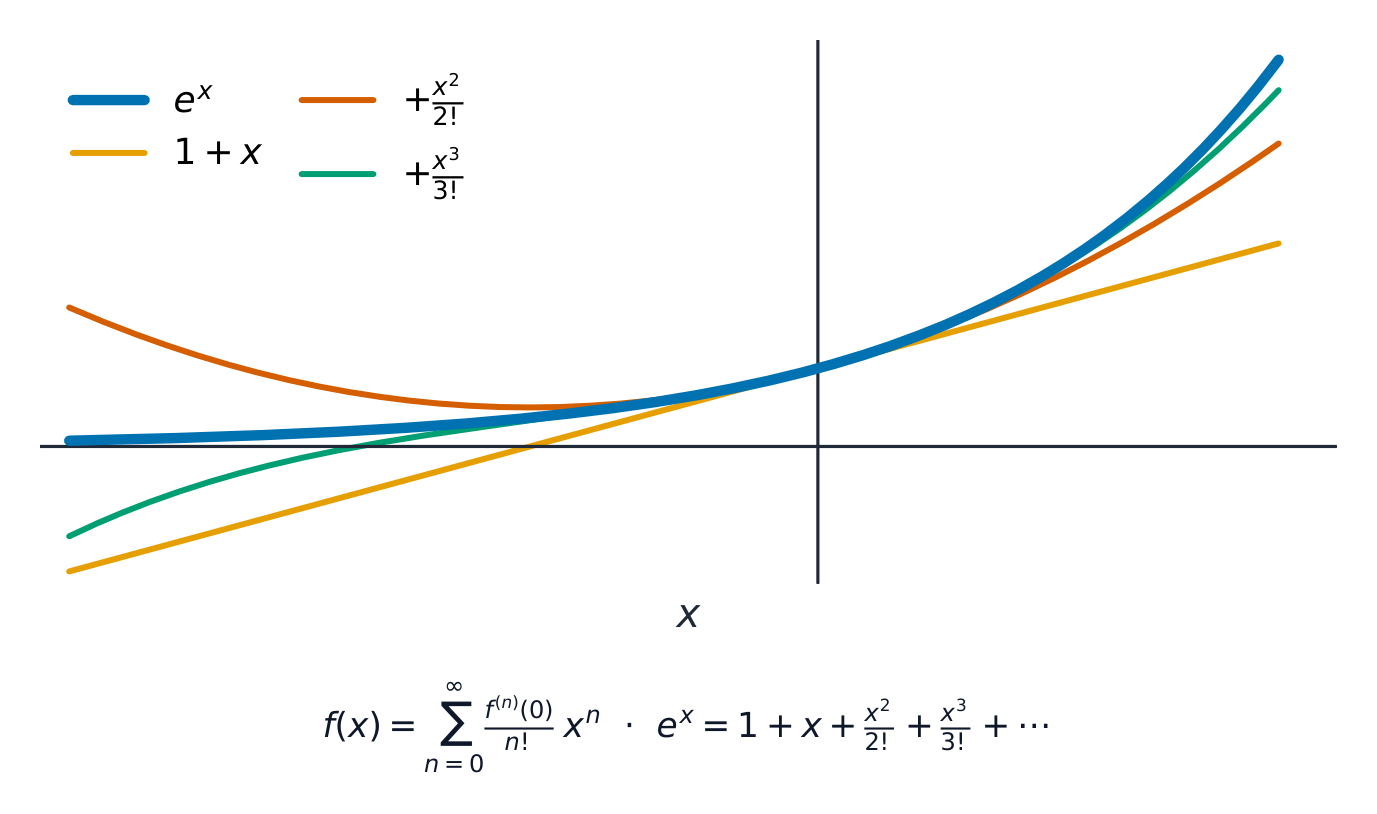
ตัวอย่างเช่น $e^x = 1 + x + \dfrac{x^2}{2!} + \dfrac{x^3}{3!} + \cdots$

curve e^x พร้อมการประมาณด้วยพหุนามสามแบบที่มีดีกรีเพิ่มขึ้น
การเพิ่มพจน์มากขึ้นทำให้พหุนามตรงกับ $e^x$ ได้ในช่วงกว้างขึ้นรอบ $x=0$

ตัวอย่างวิธีทำ. หา Maclaurin series ของ $f(x) = \ln(1+x)$ ไปจนถึงพจน์ที่มี $x^3$

$f(0) = 0$; $f'(x) = \dfrac{1}{1+x}$ ดังนั้น $f'(0) = 1$; $f''(x) = \dfrac{-1}{(1+x)^2}$ ดังนั้น $f''(0) = -1$; $f'''(x) = \dfrac{2}{(1+x)^3}$ ดังนั้น $f'''(0) = 2$. แทนค่าลงในอนุกรม:

$$\ln(1+x) = x - \frac{x^2}{2} + \frac{x^3}{3} - \cdots$$
Explore · ⁨สำรวจ⁩

The gradient at a point · ⁨ความชันที่จุดหนึ่ง⁩

gradient = dy/dx

The derivative is the slope of the tangent, however exotic the function. · ⁨อนุพันธ์ คือความชันของ เส้นสัมผัส ไม่ว่าฟังก์ชันนั้นจะซับซ้อนแค่ไหน⁩

Vocabulary · ⁨คำศัพท์⁩ Train · ⁨ฝึกฝน⁩
English ไทย
Maclaurin's series/məˈklɔːrɪnz ˈsɪəriːz/ อนุกรม Maclaurin
Watch lesson · ⁨ดูบทเรียน⁩
2.4

Integration · ⁨การหาอินทิกรัล (Integration)⁩

Syllabus · ⁨หลักสูตร⁩
English
Candidates should be able to: Notes and examples
• integrate hyperbolic functions and recognise integrals of functions of the form $\frac{1}{\sqrt{a^2 - x^2}}$, $\frac{1}{\sqrt{x^2 + a^2}}$ and $\frac{1}{\sqrt{x^2 - a^2}}$, and integrate associated functions using trigonometric substitutions or hyperbolic substitutions as appropriate Including use of completing the square where necessary, e.g. to integrate $\frac{1}{\sqrt{x^2 + x}}$.
• derive and use reduction formulae for the evaluation of definite integrals e.g. $\int_0^{\frac{1}{2}\pi} \sin^n x \text{ d}x$, $\int_0^1 \text{e}^{-x}(1-x)^n \text{ d}x$. In harder cases hints may be given, e.g. $\int_0^{\frac{1}{4}\pi} \sec^n x \text{ d}x$ by considering $\frac{\text{d}}{\text{d}x}(\tan x \sec^n x)$.
• understand how the area under a curve may be approximated by areas of rectangles, and use rectangles to estimate or set bounds for the area under a curve or to derive inequalities or limits concerning sums Questions may involve either rectangles of unit width or rectangles whose width can tend to zero, e.g. $1 + \ln n > \sum_{r=1}^n \frac{1}{r} > \ln(n+1)$, $\sum_{r=1}^n \frac{1}{n}\left(1 + \frac{r}{n}\right)^{-1} \approx \int_0^1 (1+x)^{-1} \text{ d}x$. continued
• use integration to find – arc lengths for curves with equations in Cartesian coordinates, including the use of a parameter, or in polar coordinates – surface areas of revolution about one of the axes for curves with equations in Cartesian coordinates, including the use of a parameter. Any questions involving integration may require techniques from Cambridge International A Level Mathematics (9709) applied to more difficult cases, e.g. integration by parts for $\int e^x \sin x \mathrm{d}x$, or use of the substitution $t = \tan \frac{1}{2}x$. Surface areas of revolution for curves with equations in polar coordinates will not be required.
ไทย
ผู้เข้าสอบควรสามารถ: หมายเหตุและตัวอย่าง
• หาปริณิยของ ฟังก์ชันไฮเปอร์บอลิก และระบุปริณิยของฟังก์ชันในรูป $\frac{1}{\sqrt{a^2 - x^2}}$, $\frac{1}{\sqrt{x^2 + a^2}}$ และ $\frac{1}{\sqrt{x^2 - a^2}}$, และหาปริณิยของฟังก์ชันที่เกี่ยวข้องโดยใช้ การแทนค่าตรีโกณมิติ หรือ การแทนค่าไฮเปอร์บอลิก ตามความเหมาะสม รวมถึงการใช้ การเติมเต็มกำลังสอง เมื่อจำเป็น เช่น เพื่อหาปริณิยของ $\frac{1}{\sqrt{x^2 + x}}$
• สร้างและใช้ สูตรลดรูป เพื่อหาค่าของปริณิยจำกัด เช่น $\int_0^{\frac{1}{2}\pi} \sin^n x \text{ d}x$, $\int_0^1 \text{e}^{-x}(1-x)^n \text{ d}x$ ในกรณีที่ยากขึ้นอาจมีคำแนะนำ เช่น $\int_0^{\frac{1}{4}\pi} \sec^n x \text{ d}x$ โดยการพิจารณา $\frac{\text{d}}{\text{d}x}(\tan x \sec^n x)$
• เข้าใจว่าพื้นที่ใต้กราฟสามารถประมาณได้ด้วยพื้นที่สี่เหลี่ยมผืนผ้า และใช้สี่เหลี่ยมผืนผ้าเพื่อประมาณหรือกำหนดขอบเขตของพื้นที่ใต้กราฟ หรือเพื่อสร้างอสมการหรือลิมิตเกี่ยวกับผลบวก คำถามอาจเกี่ยวข้องกับสี่เหลี่ยมผืนผ้าที่มีความกว้างเป็นหน่วยเดียวหรือสี่เหลี่ยมผืนผ้าwhose width สามารถเข้าใกล้ศูนย์ได้ เช่น $1 + \ln n > \sum_{r=1}^n \frac{1}{r} > \ln(n+1)$, $\sum_{r=1}^n \frac{1}{n}\left(1 + \frac{r}{n}\right)^{-1} \approx \int_0^1 (1+x)^{-1} \text{ d}x$. ต่อไป
ใช้ การหาปริณิย เพื่อหา – ความยาวส่วนโค้งสำหรับกราฟที่มีสมการในพิกัดคาร์ทีเซียน รวมถึงการใช้พารามิเตอร์, หรือในพิกัดขั้ว – พื้นที่ผิวของการหมุนรอบแกนใดแกนหนึ่งของกราฟที่มีสมการในพิกัดคาร์ทีเซียน รวมถึงการใช้พารามิเตอร์ คำถามใดๆ ที่เกี่ยวข้องกับการหาปริณิยอาจต้องใช้เทคนิคจาก Cambridge International A Level Mathematics (9709) กับกรณีที่ยากขึ้น เช่น การหาปริณิยด้วยการแบ่งส่วน (integration by parts) สำหรับ $\int e^x \sin x \mathrm{d}x$, หรือการใช้การแทนค่า $t = \tan \frac{1}{2}x$ พื้นที่ผิวของการหมุนสำหรับกราฟที่มีสมการในพิกัดขั้วจะไม่ต้องการ

Source: Cambridge International syllabus · ⁨แหล่งที่มา: หลักสูตร Cambridge International⁩

English

Learn these standard integrals:

$$\int \frac{1}{a^2 + x^2}\,dx = \frac{1}{a}\tan^{-1}\frac{x}{a} + C, \qquad \int \frac{1}{\sqrt{a^2 - x^2}}\,dx = \sin^{-1}\frac{x}{a} + C.$$
A trigonometric substitution, a hyperbolic substitution, or completing the square 配方法 in the denominator handles related forms. A reduction formula 递推公式 links an integral $I_n$ to $I_{n-1}$, so you can work down step by step. Integration also gives the arc length 弧长 of a curve and the surface area of revolution 旋转曲面面积 when a curve is turned about an axis.

Worked example. Find $\displaystyle\int \frac{1}{\sqrt{4 - x^2}}\,dx$.

Here $a^2 = 4$, so $a = 2$ and

$$\int \frac{1}{\sqrt{4 - x^2}}\,dx = \sin^{-1}\frac{x}{2} + C.$$

Bounding a sum by an integral. Draw rectangles of unit width under, or over, a decreasing curve such as $y=\frac1x$. Each rectangle of height $\frac1r$ is trapped between two integral strips, so summing gives

$$\ln(n+1) < \sum_{r=1}^{n}\frac1r < 1 + \ln n.$$
Shrinking the rectangle width to $\frac1n\to 0$ turns such a sum into a Riemann sum 黎曼和 that equals the integral in the limit, e.g. $\displaystyle\lim_{n\to\infty}\frac1n\sum_{r=1}^{n}f\!\left(\frac{r}{n}\right)=\int_0^1 f(x)\,dx$.

ไทย

จำอินทิกรัลมาตรฐานเหล่านี้:

$$\int \frac{1}{a^2 + x^2}\,dx = \frac{1}{a}\tan^{-1}\frac{x}{a} + C, \qquad \int \frac{1}{\sqrt{a^2 - x^2}}\,dx = \sin^{-1}\frac{x}{a} + C.$$
การแทนค่าตรีโกณมิติ, การแทนค่าไฮเปอร์โบลิก, หรือ การเติมให้สมบูรณ์กำลังสอง (completing the square) ในตัวส่วน สามารถจัดการกับรูปแบบที่เกี่ยวข้องได้ สูตรลดรูป (reduction formula) เชื่อมโยงอินทิกรัล $I_n$ กับ $I_{n-1}$ ทำให้คุณสามารถคำนวณทีละขั้นได้ การอินทิเกรตยังให้ ความยาวส่วนโค้ง (arc length) ของ曲线และ พื้นที่ผิวจากการหมุน (surface area of revolution) เมื่อcurve หมุนรอบแกน

ตัวอย่างมีคำตอบ. หา $\displaystyle\int \frac{1}{\sqrt{4 - x^2}}\,dx$.

ที่นี่ $a^2 = 4$, ดังนั้น $a = 2$ และ

$$\int \frac{1}{\sqrt{4 - x^2}}\,dx = \sin^{-1}\frac{x}{2} + C.$$

การจำกัดผลรวมด้วยอินทิกรัล. วาดสี่เหลี่ยมผืนผ้าที่มีความกว้างหนึ่งหน่วยใต้หรือเหนือ curve ที่ลดลงเช่น $y=\frac1x$. สี่เหลี่ยมผืนผ้าแต่ละอันมีความสูง $\frac1r$ ถูกขังอยู่ระหว่างแถบอินทิกรัลสองแถบ ดังนั้นเมื่อรวมกันจะได้

$$\ln(n+1) < \sum_{r=1}^{n}\frac1r < 1 + \ln n.$$
การหดขนาดความกว้างของสี่เหลี่ยมผืนผ้าให้เหลือ $\frac1n\to 0$ จะเปลี่ยนผลรวมดังกล่าวให้เป็น Riemann sum ซึ่งเท่ากับอินทิกรัลในลิมิต เช่น $\displaystyle\lim_{n\to\infty}\frac1n\sum_{r=1}^{n}f\!\left(\frac{r}{n}\right)=\int_0^1 f(x)\,dx$

Explore · ⁨สำรวจ⁩

The area under the curve · ⁨พื้นที่ใต้กราฟ⁩

area = ∫ f(x) dx

Every integral measures the area under the curve — drag the limits. · ⁨ทุกอินทิกรัลวัด พื้นที่ ภายใต้กราฟ — ลากขอบเขต⁩

Vocabulary · ⁨คำศัพท์⁩ Train · ⁨ฝึกฝน⁩
English ไทย
completing the square/kəmˈpliːtɪŋ ðə skweə/ การเติมกำลังสองสมบูรณ์
reduction formula/rɪˈdʌkʃn ˈfɔːmjʊlə/ สูตรลดรูป
arc length/ɑːk leŋθ/ ความยาวส่วนโค้ง
surface area of revolution/ˈsɜːfɪs ˈeərɪə ɒv ˌrevəˈluːʃn/ พื้นที่ผิวจากการหมุน
Riemann sum/ˈriːmən sʌm/ ผลรวมรีแมน
complex number/ˈkɒmpleks ˈnʌmbə/ จำนวนเชิงซ้อน
Watch lesson · ⁨ดูบทเรียน⁩
2.5

Complex numbers · ⁨จำนวนเชิงซ้อน (Complex numbers)⁩

Syllabus · ⁨หลักสูตร⁩
English
Candidates should be able to: Notes and examples
• understand de Moivre’s theorem, for a positive or negative integer exponent, in terms of the geometrical effect of multiplication and division of complex numbers
• prove de Moivre’s theorem for a positive integer exponent e.g. by induction.
• use de Moivre’s theorem for a positive or negative rational exponent e.g. expressing $\cos 5\theta$ in terms of $\cos \theta$ or $\tan 5\theta$ in terms of $\tan \theta$.
– to express trigonometrical ratios of multiple angles in terms of powers of trigonometrical ratios of the fundamental angle e.g. expressing $\sin^6 \theta$ in terms of $\cos 2\theta$, $\cos 4\theta$ and $\cos 6\theta$.
– to express powers of $\sin \theta$ and $\cos \theta$ in terms of multiple angles
– in the summation of series e.g. using the '$C + \mathrm{i}S$' method to sum series such as $\sum_{r=1}^{n} \binom{n}{r} \sin r\theta$.
– in finding and using the $n$th roots of unity.
ไทย
ผู้เข้าสอบควรสามารถ: หมายเหตุและตัวอย่าง
เข้าใจ ทฤษฎีบท de Moivre, สำหรับเลขชี้กำลังเป็นจำนวนเต็มบวกหรือลบ, ในแง่ของผลกระทบทางเรขาคณิตของการคูณและการหาร จำนวนเชิงซ้อน
พิสูจน์ ทฤษฎีบท de Moivre สำหรับเลขชี้กำลังเป็นจำนวนเต็มบวก เช่น โดยใช้การพิสูจน์ด้วยวิธีอุปนัย (induction)
ใช้ ทฤษฎีบท de Moivre สำหรับเลขชี้กำลังเป็นจำนวนตรรกยะบวกหรือลบ เช่น การแสดง $\cos 5\theta$ ในรูป $\cos \theta$ หรือ $\tan 5\theta$ ในรูป $\tan \theta$
– เพื่อแสดงอัตราส่วนตรีโกณมิติของมุมหลายเท่าในรูปกำลังของอัตราส่วนตรีโกณมิติของมุมพื้นฐาน เช่น การแสดง $\sin^6 \theta$ ในรูป $\cos 2\theta$, $\cos 4\theta$ และ $\cos 6\theta$
– เพื่อแสดงกำลังของ $\sin \theta$ และ $\cos \theta$ ในรูปมุมหลายเท่า
– ในการหาผลบวกของอนุกรม เช่น การใช้วิธี '$C + \mathrm{i}S$' เพื่อหาผลบวกอนุกรมเช่น $\sum_{r=1}^{n} \binom{n}{r} \sin r\theta$
– ในการหาและใช้ $n$th รากของเอกฐาน (roots of unity)

Source: Cambridge International syllabus · ⁨แหล่งที่มา: หลักสูตร Cambridge International⁩

English
The nth roots of unity form a polygon
Multiplying complex numbers: lengths multiply, angles add
Multiplying by i is a rotation

A complex number 复数 in polar form is $z = r(\cos\theta + i\sin\theta)$. De Moivre's theorem 棣莫弗定理 says that for any integer $n$,

$$(\cos\theta + i\sin\theta)^n = \cos n\theta + i\sin n\theta.$$
It is used to expand $\cos n\theta$ and $\sin n\theta$ in powers, to sum series, and to find the $n$ roots of unity 单位根 (the solutions of $z^n = 1$, equally spaced around the unit circle).

Worked example. Use de Moivre's theorem to express $\cos 3\theta$ in terms of $\cos\theta$.

Take the real part of $(\cos\theta + i\sin\theta)^3 = \cos 3\theta + i\sin 3\theta$:

$$\cos 3\theta = \cos^3\theta - 3\cos\theta\sin^2\theta = \cos^3\theta - 3\cos\theta(1 - \cos^2\theta) = 4\cos^3\theta - 3\cos\theta.$$

ไทย
รากที่ n ของเอกฐานประกอบด้วยรูปหลายเหลี่ยม
การคูณจำนวนเชิงซ้อน: ความยาวคูณกัน มุมบวกกัน
การคูณด้วย i คือการหมุน
หัวบรอกโคลี Romanesque แสดงเกลียวที่มีลักษณะซ้ำตัวเอง
ลวดลายที่เหมือนตัวเองอย่างบรอกโคลี Romanesco เกิดจากการทำซ้ำฟังก์ชันในระนาบเชิงซ้อน

จำนวนเชิงซ้อนในรูปแบบขั้วคือ $z = r(\cos\theta + i\sin\theta)$. ทฤษฎีบทเดโมวัวร์ (De Moivre's theorem) กล่าวว่าสำหรับจำนวนเต็ม $n$ ใดๆ,

$$(\cos\theta + i\sin\theta)^n = \cos n\theta + i\sin n\theta.$$
ใช้เพื่อขยาย $\cos n\theta$ และ $\sin n\theta$ เป็นกำลัง เพื่อรวมอนุกรม และหา $n$ รากของเอกฐาน (roots of unity) (คำตอบของ $z^n = 1$, เรียงห่างกันเท่าๆ รอบวงกลมหน่วย)

จุดห้าจุดกระจายตัวเท่าๆ บนวงกลมหน่วยบนแผนภาพ Argand
คำตอบทั้งห้าของ $z^5=1$ กระจายห่างกัน $72^\circ$ เท่าๆ บนวงกลมหน่วย

ตัวอย่างวิธีทำ. ใช้ทฤษฎีบทเดโมวัวร์เพื่อเขียน $\cos 3\theta$ ในเทอมของ $\cos\theta$

lấyส่วนจริงของ $(\cos\theta + i\sin\theta)^3 = \cos 3\theta + i\sin 3\theta$:

$$\cos 3\theta = \cos^3\theta - 3\cos\theta\sin^2\theta = \cos^3\theta - 3\cos\theta(1 - \cos^2\theta) = 4\cos^3\theta - 3\cos\theta.$$

Explore · ⁨สำรวจ⁩

The Argand diagram

Drag the point to explore modulus and argument — the language of complex numbers in polar (modulus–argument) form. · ⁨ลากจุดเพื่อสำรวจโมดูลัสและอาร์กิวเมนต์ — ภาษาของจำนวนเชิงซ้อนในรูปแบบเชิงขั้ว (โมดูลัส-อาร์กิวเมนต์)⁩

Vocabulary · ⁨คำศัพท์⁩ Train · ⁨ฝึกฝน⁩
English ไทย
De Moivre's theorem/də ˈmɔɪvəz ˈθɪərəm/ ทฤษฎีบท De Moivre
roots of unity/ruːts ɒv ˈjuːnɪti/ รากของหน่วย
Watch lesson · ⁨ดูบทเรียน⁩
2.6

Differential equations · ⁨สมการเชิงอนุพันธ์ (Differential equations)⁩

Syllabus · ⁨หลักสูตร⁩
English
Candidates should be able to: Notes and examples
• find an integrating factor for a first order linear differential equation, and use an integrating factor to find the general solution e.g. $\frac{\mathrm{d}y}{\mathrm{d}x} - 2y = x^2$, $x\frac{\mathrm{d}y}{\mathrm{d}x} - y = x^4$, $\frac{\mathrm{d}y}{\mathrm{d}x} + y\coth x = \cosh x$.
• recall the meaning of the terms 'complementary function' and 'particular integral' in the context of linear differential equations, and recall that the general solution is the sum of the complementary function and a particular integral
find the complementary function for a first or second order linear differential equation with constant coefficients For second order equations, including the cases where the auxiliary equation has distinct real roots, a repeated real root or conjugate complex roots.
recall the form of, and find, a particular integral for a first or second order linear differential equation in the cases where a polynomial or $ae^{bx}$ or $a\cos px + b\sin px$ is a suitable form, and in other simple cases find the appropriate coefficient(s) given a suitable form of particular integral e.g. evaluate $k$ given that $kx \cos 2x$ is a particular integral of
$$\frac{\text{d}^2y}{\text{d}x^2} + 4y = \sin 2x$$
.
use a given substitution to reduce a differential equation to a first or second order linear equation with constant coefficients or to a first order equation with separable variables e.g. the substitution $x = e^t$ to reduce to linear form a differential equation with terms of the form
$$ax^2\frac{\text{d}^2y}{\text{d}x^2} + bx\frac{\text{d}y}{\text{d}x} + cy$$
, or the substitution $y = ux$ to reduce
$$\frac{\text{d}y}{\text{d}x} = \frac{x+y}{x-y}$$
to separable form.
use initial conditions to find a particular solution to a differential equation, and interpret a solution in terms of a problem modelled by a differential equation.
ไทย
ผู้เข้าสอบควรสามารถ: หมายเหตุและตัวอย่าง
หา ตัวประกอบบูรณาการ (integrating factor) สำหรับ สมการเชิงอนุพันธ์เชิงเส้นอันดับหนึ่ง และใช้ ตัวประกอบบูรณาการ เพื่อหาคำตอบทั่วไป เช่น $\frac{\mathrm{d}y}{\mathrm{d}x} - 2y = x^2$, $x\frac{\mathrm{d}y}{\mathrm{d}x} - y = x^4$, $\frac{\mathrm{d}y}{\mathrm{d}x} + y\coth x = \cosh x$
จำความหมายของคำว่า 'ฟังก์ชันเสริม (complementary function)' และ 'อินทิกรัลเฉพาะ (particular integral)' ในบริบทของ สมการเชิงอนุพันธ์เชิงเส้น, และจำได้ว่าคำตอบทั่วไปคือผลบวกของ ฟังก์ชันเสริม และ อินทิกรัลเฉพาะ
หาค่า ฟังก์ชันเสริม สำหรับสมการเชิงอนุพันธ์เชิงเส้นอันดับหนึ่งหรืออันดับสองที่มีสัมประสิทธิ์คงที่ สำหรับสมการอันดับสอง รวมถึงกรณีที่ สมการช่วย (auxiliary equation) มีรากจริงที่แตกต่างกัน รากจริงซ้ำ หรือรากจินตภาพคู่สม
จำรูปแบบและหาค่า อินทิกรัลเฉพาะ สำหรับสมการเชิงอนุพันธ์เชิงเส้นอันดับหนึ่งหรืออันดับสองในกรณีที่พหุนามหรือ $ae^{bx}$ หรือ $a\cos px + b\sin px$ เป็นรูปแบบที่เหมาะสม, และในกรณีอื่นๆ ที่เรียบง่าย ให้หาสัมประสิทธิ์ที่เหมาะสมให้เมื่อทราบรูปแบบของอินทิกรัลเฉพาะ เช่น คำนวณ $k$ โดยกำหนดให้ $kx \cos 2x$ เป็นอินทิกรัลเฉพาะของ
$$\frac{\text{d}^2y}{\text{d}x^2} + 4y = \sin 2x$$
ใช้ การแทนค่า ที่กำหนดให้เพื่อลดรูปสมการเชิงอนุพันธ์ให้เป็นสมการเชิงเส้นอันดับหนึ่งหรืออันดับสองที่มีสัมประสิทธิ์คงที่ หรือให้เป็นสมการอันดับหนึ่งที่มี ตัวแปรแยกได้ (separable variables) เช่น การแทนค่า $x = e^t$ เพื่อลดรูปสมการเชิงอนุพันธ์ที่มีพจน์ในรูป
$$ax^2\frac{\text{d}^2y}{\text{d}x^2} + bx\frac{\text{d}y}{\text{d}x} + cy$$
ให้เป็นรูปเชิงเส้น, หรือการแทนค่า $y = ux$ เพื่อลด
$$\frac{\text{d}y}{\text{d}x} = \frac{x+y}{x-y}$$
ให้เป็นรูปที่แยกตัวแปรได้
ใช้ เงื่อนไขเริ่มต้น เพื่อหาค่า คำตอบเฉพาะ ของสมการเชิงอนุพันธ์, และตีความคำตอบในแง่ของปัญหาที่ถูกจำลองด้วยสมการเชิงอนุพันธ์

Source: Cambridge International syllabus · ⁨แหล่งที่มา: หลักสูตร Cambridge International⁩

English

For a first order linear equation $\dfrac{dy}{dx} + P(x)\,y = Q(x)$, multiply by the integrating factor 积分因子 $\mu = e^{\int P\,dx}$. The left side then becomes $\dfrac{d}{dx}(\mu y)$, so you can integrate directly.

For a linear equation with constant coefficients, the general solution 通解 is the sum of two parts: the complementary function 余函数 (the solution of the equation with the right side set to $0$, found from the auxiliary equation) and a particular integral 特积分 (any one solution of the full equation). Initial conditions then fix the constants to give the particular solution 特解; simpler equations with separable variables 可分离变量 are integrated directly.

Worked example. Solve $\dfrac{dy}{dx} + 2y = e^x$.

The integrating factor is $\mu = e^{\int 2\,dx} = e^{2x}$. Multiplying through gives $\dfrac{d}{dx}\!\left(y\,e^{2x}\right) = e^{3x}$, so

$$y\,e^{2x} = \tfrac13 e^{3x} + C \;\Rightarrow\; y = \tfrac13 e^x + C e^{-2x}.$$

Second order, constant coefficients. For $\dfrac{d^2y}{dx^2}+b\dfrac{dy}{dx}+cy=f(x)$, solve the auxiliary equation 辅助方程 $m^2+bm+c=0$. The complementary function depends on its roots:

  • two distinct real roots $m_1,m_2$: $y=Ae^{m_1x}+Be^{m_2x}$;
  • a repeated root $m$: $y=(A+Bx)e^{mx}$;
  • complex roots $p\pm qi$: $y=e^{px}(A\cos qx+B\sin qx)$.

Then add a particular integral by trying a form matching $f(x)$ (a polynomial, $ae^{bx}$, or $a\cos px+b\sin px$); if that trial already appears in the complementary function, multiply it by $x$.

Worked example. Solve $\dfrac{d^2y}{dx^2}-4\dfrac{dy}{dx}+4y=0$. The auxiliary equation $m^2-4m+4=(m-2)^2=0$ has a repeated root $m=2$, so $y=(A+Bx)e^{2x}$.

ไทย

สำหรับสมการเชิงเส้นอันดับหนึ่ง $\dfrac{dy}{dx} + P(x)\,y = Q(x)$, คูณด้วย ตัวประกอบอินทิเกรต (integrating factor) $\mu = e^{\int P\,dx}$. ด้านซ้ายจะกลายเป็น $\dfrac{d}{dx}(\mu y)$, sehinggaคุณสามารถอินทิเกรตโดยตรง

สำหรับสมการเชิงเส้นสัมประสิทธิ์คงที่ คำตอบทั่วไป (general solution) คือผลบวกของสองส่วน: ฟังก์ชันเสริม (complementary function) (คำตอบของสมการwhen side kanan ตั้งเป็น $0$, หาได้จาก auxiliary equation) และ อินทิกรัลเฉพาะ (particular integral) (คำตอบใดคำตอบหนึ่งของสมการเต็ม) เงื่อนไขเริ่มต้น (Initial conditions) จะกำหนดค่าคงที่เพื่อให้ได้ คำตอบเฉพาะ (particular solution); สมการที่ง่ายกว่าที่มี ตัวแปรแยกได้ (separable variables) จะอินทิเกรตโดยตรง

ตารางของส่วนเอียงสั้นๆ พร้อมเส้นโซลูชันสองเส้นวิ่งผ่านตารางนั้น
โค้งคำตอบจะติดตามสนามความชัน (slope field) โดยสัมผัสกับส่วนประกอบเล็กๆ ทุกที่

ตัวอย่างวิธีทำ. แก้ $\dfrac{dy}{dx} + 2y = e^x$

ตัวประกอบอินทิเกรตคือ $\mu = e^{\int 2\,dx} = e^{2x}$. คูณทั่วแล้วจะได้ $\dfrac{d}{dx}\!\left(y\,e^{2x}\right) = e^{3x}$, ดังนั้น

$$y\,e^{2x} = \tfrac13 e^{3x} + C \;\Rightarrow\; y = \tfrac13 e^x + C e^{-2x}.$$

สมการเชิงอนุพันธ์อันดับสอง สัมประสิทธิ์คงที่ สำหรับ $\dfrac{d^2y}{dx^2}+b\dfrac{dy}{dx}+cy=f(x)$ ให้แก้ สมการช่วย $m^2+bm+c=0$. ฟังก์ชันเสริมขึ้นอยู่กับรากของสมการนี้:

  • รากจริงที่แตกต่างกันสองค่า $m_1,m_2$: $y=Ae^{m_1x}+Be^{m_2x}$;
  • รากซ้ำ $m$: $y=(A+Bx)e^{mx}$;
  • รากเชิงซ้อน $p\pm qi$: $y=e^{px}(A\cos qx+B\sin qx)$.

จากนั้นเพิ่มผลเฉลยเฉพาะโดยลองใช้รูปแบบที่ตรงกับ $f(x)$ (พหุนาม, $ae^{bx}$, หรือ $a\cos px+b\sin px$); หากรูปแบบทดสอบนั้นปรากฏอยู่ในฟังก์ชันเสริมอยู่แล้ว ให้ คูณด้วย $x$

ตัวอย่างวิธีทำ. แก้ $\dfrac{d^2y}{dx^2}-4\dfrac{dy}{dx}+4y=0$. สมการช่วย $m^2-4m+4=(m-2)^2=0$ มีรากซ้ำ $m=2$ ดังนั้น $y=(A+Bx)e^{2x}$.

Explore · ⁨สำรวจ⁩

Differential equations · ⁨สมการเชิงอนุพันธ์⁩

dy/dx = a y

The equation sets the slope everywhere; the solution follows those slopes. · ⁨สมการกำหนด slope ทุกที่; คำตอบ จะตาม slope เหล่านี้⁩

Vocabulary · ⁨คำศัพท์⁩ Train · ⁨ฝึกฝน⁩
English ไทย
integrating factor/ˈɪntɪɡreɪtɪŋ ˈfæktə/ ตัวประกอบอินทิเกรต
general solution/ˈdʒenərəl səˈluːʃn/ คำตอบทั่วไป
complementary function/ˌkɒmplɪˈmentəri ˈfʌŋkʃn/ ฟังก์ชันเสริม
particular integral/pəˈtɪkjʊlə ˈɪntɪɡrəl/ อินทิกรัลเฉพาะ
particular solution/pəˈtɪkjʊlə səˈluːʃn/ คำตอบเฉพาะ
separable variables/ˈsepərəbl ˈveərɪəblz/ ตัวแปรแยกได้
auxiliary equation/ɔːkˈsɪlɪəri ɪˈkweɪʒn/ สมการช่วย
2.6

Exam tips · ⁨ข้อแนะนำสำหรับการสอบ⁩

English
  • Learn the hyperbolic identities and derivatives, and use the inverse hyperbolic functions in integration.
  • Solve a linear differential equation as complementary function $+$ particular integral, then apply the boundary conditions.
  • Use de Moivre's theorem for powers and roots of complex numbers and to derive trigonometric identities.
  • Reduce an integral to a standard form by a stated substitution.
ไทย
  • จำ เอกลักษณ์ forecast hyperbolic และอนุพันธ์ของมันได้ และใช้ฟังก์ชัน forecast hyperbolic แบบผกผันในการหาปริพันธ์
  • แก้ สมการเชิงอนุพันธ์เชิงเส้น โดยหาฟังก์ชันเสริม $+$ ผลเฉลยเฉพาะ แล้วใช้เงื่อนไขขอบเขต
  • ใช้ ทฤษฎีบท de Moivre สำหรับเลขยกกำลังและรากของจำนวนเชิงซ้อน และการพิสูจน์เอกลักษณ์ตรีโกณมิติ
  • ลดรูปปริพันธ์ให้อยู่ในมาตรฐาน bằng การแทนตัวแปรที่กำหนดให้

Interactive lessons on this topic · ⁨บทเรียนเชิงโต้ตอบสำหรับหัวข้อนี้⁩

Work through it step by step, with instant-check exercises. · ⁨ทำทีละขั้นตอน พร้อมแบบฝึกหัดตรวจสอบผลทันที⁩

Past Papers · ⁨ข้อสอบย้อนหลัง⁩

More topics in A-Level Further Mathematics · ⁨Further Mathematics A-Level⁩ · ⁨หัวข้อเพิ่มเติมใน A-Level Further Mathematics · ⁨Further Mathematics A-Level⁩⁩

Log in or create account · ⁨เข้าสู่ระบบหรือสร้างบัญชี⁩

IGCSE, A-Level & AP