English narration · English + 中文 subtitles burned in · การบรรยายภาษาอังกฤษ · คำบรรยายภาษาอังกฤษ + 中文 ลอยตัวบนภาพ
21.1
Organic synthesis · 有机合成
Syllabus · หลักสูตร
English
for an organic molecule containing several functional groups: (a) identify organic functional groups using the reactions in the syllabus (b) predict properties and reactions
devise multi-step synthetic routes for preparing organic molecules using the reactions in the syllabus
analyse a given synthetic route in terms of type of reaction and reagents used for each step of it, and possible by-products
Source: Cambridge International syllabus · แหล่งที่มา: หลักสูตร Cambridge International
English
This topic does not add new reactions. Instead it asks you to join up the reactions you already know, so you can build a target molecule in several steps.
Identifying functional groups
A molecule may have more than one functional group 官能团. Use the test reactions from the syllabus to identify each one, and then predict how the molecule will behave. For example:
decolourises bromine water → a C=C double bond (an alkene 烯烃).
gives a precipitate with silver nitrate → a halogenoalkane 卤代烷.
orange $\text{K}_2\text{Cr}_2\text{O}_7$ turns green → a primary or secondary alcohol 醇.
orange precipitate with 2,4-DNPH → an aldehyde 醛 or ketone 酮.
fizzes with a carbonate → a carboxylic acid 羧酸.
A map of the AS reactions
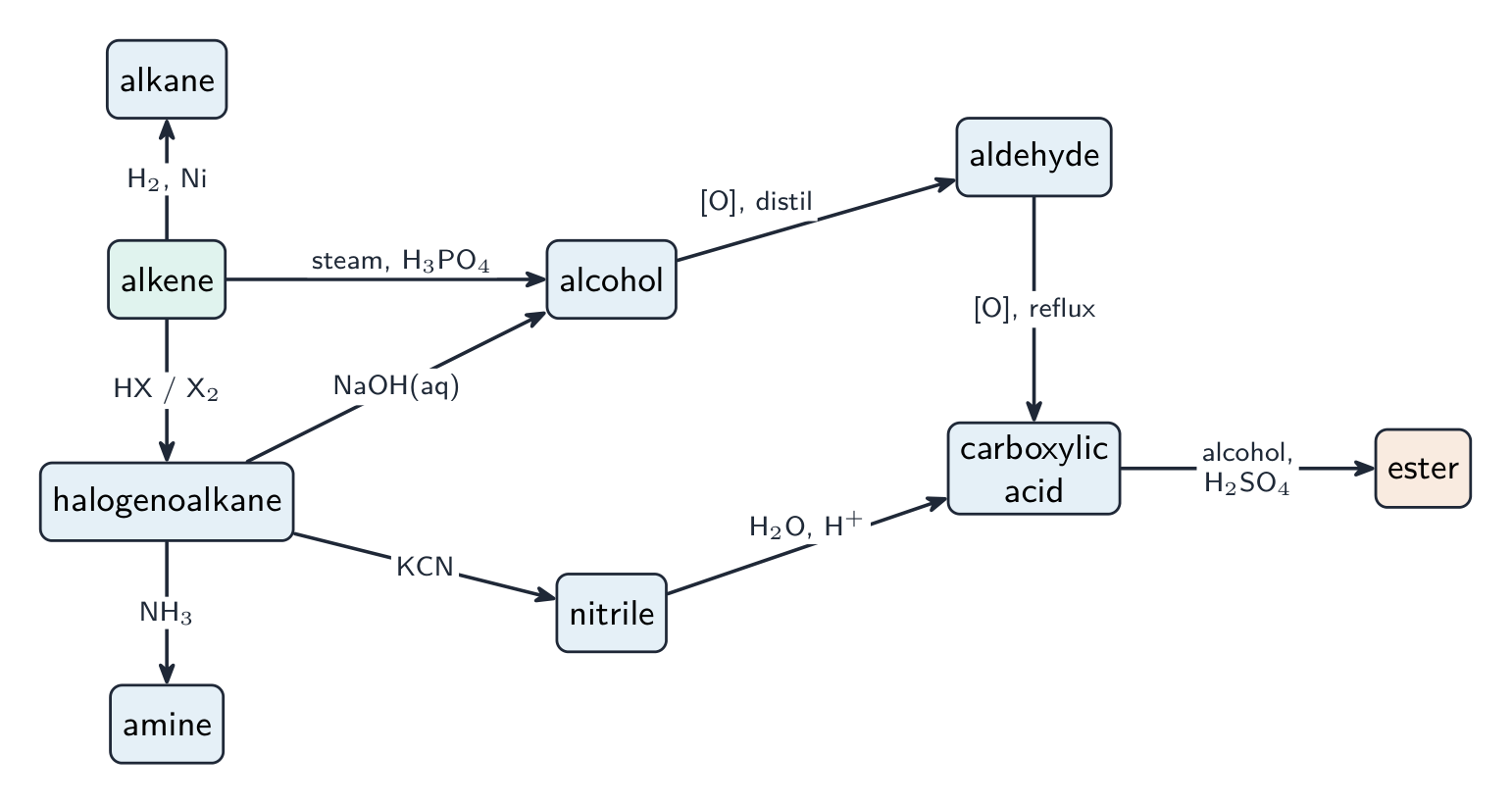
Each row turns one functional group into another. Learn it as a map you can travel around:
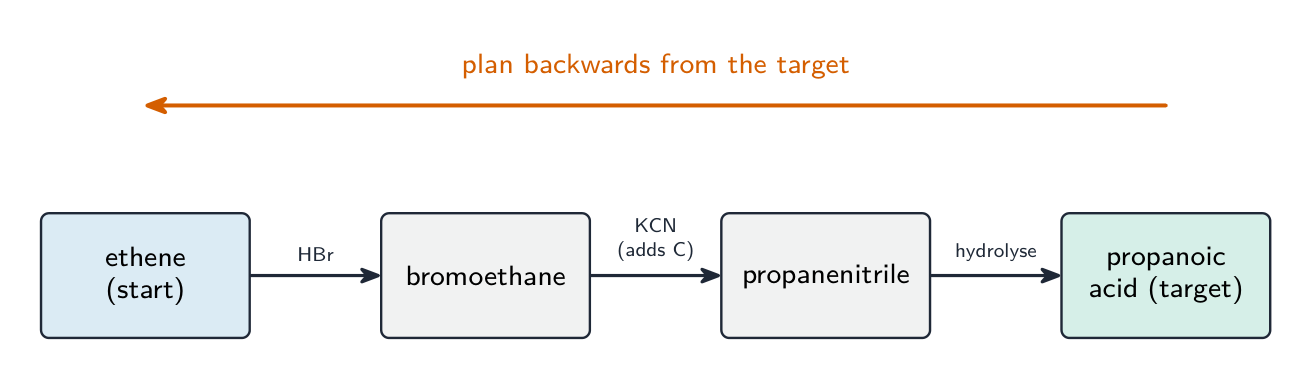
compare the target with the starting material — what has changed (the functional group, the number of carbons)?
work backwards from the target: which single reaction could make it, and from what?
repeat until you reach the starting material.
write each step with its reagent 试剂 and conditions.
If you need to add a carbon, the $\text{KCN}$ step is the key — it is the only AS reaction that lengthens the chain.
Analysing a route
When you are given a route, for each step state the type of reaction (such as oxidation 氧化, reduction 还原, substitution, addition or elimination) and the reagent used. Also think about possible by-products 副产物 — for example, making an amine from a halogenoalkane also gives a mixture of further-substituted amines, so the yield of the simple amine is low.
Worked example. Devise a route from propene to propanone, $\text{CH}_3\text{COCH}_3$. Work backwards from the target. A ketone comes from oxidising a secondary alcohol, so the step before propanone is propan-2-ol with acidified $\text{K}_2\text{Cr}_2\text{O}_7$ under reflux. Propan-2-ol comes from propene by adding steam over an $\text{H}_3\text{PO}_4$ catalyst - and Markovnikov's rule conveniently puts the $\text{OH}$ on the middle carbon, which is exactly the secondary alcohol needed. So the route is: propene, then steam with $\text{H}_3\text{PO}_4$, giving propan-2-ol; then acidified $\text{K}_2\text{Cr}_2\text{O}_7$ under reflux, giving propanone. Give a reagent and its conditions on every arrow: a route with the right intermediates but no reagents scores very little.
Pick one and the site follows you — notes, papers, videos and practice all open on it. · เลือกหนึ่งตัว และเว็บจะติดตามคุณ — หมายเหตุ, ใบงาน, วิดีโอ และการฝึกฝนจะเปิดอยู่ที่นั้น
Type to search notes, lessons, code, vocabulary and past-paper questions across every subject. · พิมพ์เพื่อค้นหาบันทึก, บทเรียน, โค้ด, คำศัพท์ และคำถามข้อสอบเก่าในทุกวิชา