Identifying groups and the reaction map
Introduced| English | Meaning |
|---|---|
| organic synthesis/ɔːˈɡænɪk ˈsɪnθəsɪs/ | organic synthesis |
| functional group/ˈfʌŋkʃənl ɡruːp/ | An atom or group of atoms responsible for characteristic chemical reactions of an organic compound. |
| bromine water/ˈbrəʊmaɪn ˈwɔːtə/ | An aqueous solution containing bromine, used in tests such as detecting carbon-carbon double bonds. |
| silver nitrate/ˈsɪlvə ˈnaɪtreɪt/ | An ionic compound with formula AgNO3, commonly used to test for halide ions. |
| nitrile/ˈnaɪtraɪl/ | An organic compound containing a carbon atom triple-bonded to a nitrogen atom. |
Reading a molecule's reactions
- Organic synthesis 有机合成 doesn't add new reactions — it joins the ones you know.
- First, identify the functional groups 官能团 present.
- Then use a map of reactions to get from one to another.
Reaction map lab
Classify clues that identify functional groups and reaction pathways.
A reaction map links functional groups by the reactions that interconvert them.
Difficulty 1/5 · 100 coins + a small bonus on first completion today
Used to plan and identify reactions.
Functional group tests
- decolourises bromine water 溴水 → a C=C (alkene).
- precipitate with silver nitrate 硝酸银 → a halogenoalkane.
- orange dichromate → green → a primary/secondary alcohol.
- orange precipitate with 2,4-DNPH → an aldehyde or ketone.
- fizzes with a carbonate → a carboxylic acid.

Identification tests for the AS functional groups
A compound that decolourises bromine water contains:
Difficulty 1/5 · 100 coins + a small bonus on first completion today
Decolourising bromine water is the test for a C=C double bond.
An orange precipitate with 2,4-DNPH indicates:
Difficulty 1/5 · 100 coins + a small bonus on first completion today
2,4-DNPH detects the carbonyl group (aldehyde or ketone).
Match each test to what it shows.
Difficulty 2/5 · 140 coins + a small bonus on first completion today
Each item links the term to its correct meaning.
The reaction map
| Start | Reagent | Product |
|---|---|---|
| alkene | steam, $\text{H}_3\text{PO}_4$ | alcohol |
| halogenoalkane | NaOH(aq) | alcohol |
| halogenoalkane | KCN in ethanol | nitrile 腈 (+1 carbon) |
| alcohol | dichromate (distil/reflux) | aldehyde / carboxylic acid |
| aldehyde/ketone | $\text{NaBH}_4$ | alcohol |
| nitrile | dilute acid | carboxylic acid |
| acid + alcohol | conc. $\text{H}_2\text{SO}_4$ | ester |
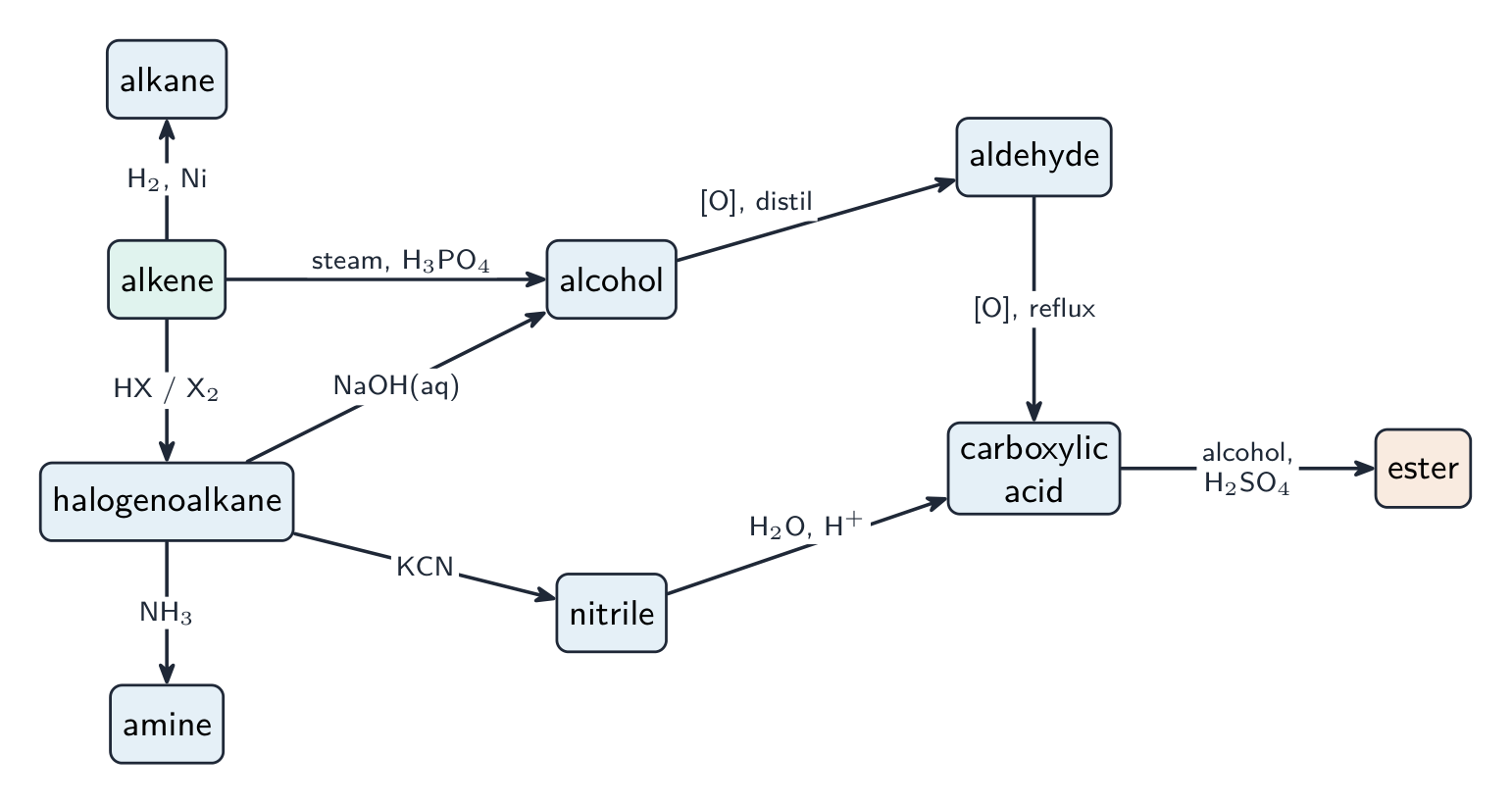
A map of the AS organic reactions to plan a synthesis
According to the reaction map, an alkene + steam (H₃PO₄) gives:
Difficulty 1/5 · 100 coins + a small bonus on first completion today
Electrophilic addition of water across the C=C gives an alcohol.
Which step lengthens the carbon chain by one?
Difficulty 1/5 · 100 coins + a small bonus on first completion today
KCN adds a CN group (a carbon) — the only AS reaction that lengthens the chain.
Worked example: a two-step synthesis
- Plan by working backwards from the target, then check each step's reagents.
Make propanoic acid (3 C) from bromoethane (2 C). You need to add a carbon, so use KCN:
- Bromoethane + KCN (in ethanol) → propanenitrile (CH₃CH₂CN) — chain lengthened by one carbon.
- Propanenitrile + dilute acid (hydrolysis) → propanoic acid (CH₃CH₂COOH).
The KCN step is the key — it's the only one here that adds a carbon.
You've got it
- synthesis joins known reactions to build a target — plan it backwards from the target
- tests: bromine water (alkene), AgNO₃ (halogenoalkane), dichromate (1°/2° alcohol), 2,4-DNPH (carbonyl), carbonate fizz (acid)
- the reaction map converts group to group; KCN is the only step that adds a carbon
- each arrow needs its reagents and conditions