Planning a synthetic route
Introduced| English | Meaning |
|---|---|
| target molecule/ˈtɑːɡɪt ˈmɒlɪkjuːl/ | target molecule |
| starting material/ˈstɑːtɪŋ məˈtɪərɪəl/ | starting material |
| reagent/rɪˈeɪdʒənt/ | A substance used to bring about a chemical reaction or test for another substance. |
| by-product/baɪ ˈprɒdʌkt/ | A secondary product formed alongside the main intended product of a process. |
| yield/jiːld/ | The amount of product obtained in a reaction, often expressed as a percentage of the theoretical amount. |
From start to target
- A target molecule 目标分子 is built in several steps.
- The trick is to work backwards from the target.
- You also analyse a given route step by step.
Synthetic route planning lab
Follow how a target molecule is planned backwards then made forwards.
A good synthetic route uses few steps and gives a high overall yield.
Difficulty 1/5 · 100 coins + a small bonus on first completion today
Fewer steps means less loss of product.
Planning a route
- compare the target with the starting material 起始材料 — what changed (the group, the number of carbons)?
- work backwards: which single reaction could make the target, and from what?
- repeat until you reach the starting material.
- write each step with its reagent 试剂 and conditions.
- To add a carbon, the KCN step is the key (the only chain-lengthening AS reaction).
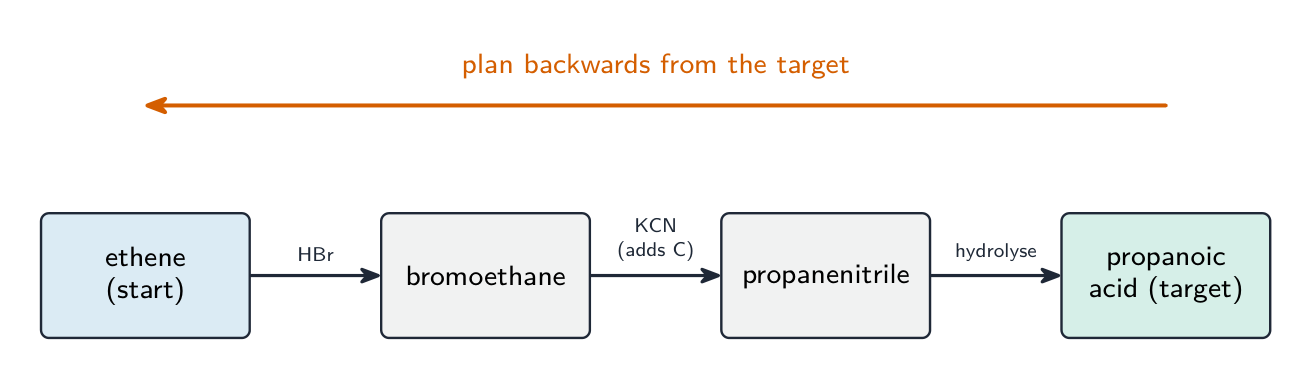
Plan a synthesis backwards — from the target, step by step, to the starting material

Medicines are built up by multi-step organic synthesis.
The best way to plan a multi-step synthesis is to:
Difficulty 1/5 · 100 coins + a small bonus on first completion today
Working backwards from the target finds which reaction makes it, and from what, step by step.
If your route needs to add a carbon atom, the key step is:
Difficulty 1/5 · 100 coins + a small bonus on first completion today
KCN is the only AS reaction that lengthens the carbon chain.
Match each synthesis idea.
Difficulty 2/5 · 140 coins + a small bonus on first completion today
Each item links the term to its correct meaning.
Analysing a route
- For each step, state the type of reaction (oxidation, reduction, substitution, addition, elimination) and the reagent.
- Think about by-products 副产物 — e.g. making an amine from a halogenoalkane also gives further-substituted amines, so the yield 产率 of the simple amine is low.
When analysing each step of a given route, you should state:
Difficulty 1/5 · 100 coins + a small bonus on first completion today
Identify the reaction type (oxidation, substitution, etc.) and the reagent/conditions for each step.
Why is the yield of a simple amine from a halogenoalkane low?
Difficulty 1/5 · 100 coins + a small bonus on first completion today
The amine is itself a nucleophile, so it reacts again — a by-product mixture lowers the yield.
Judging a route
- Prefer routes with few steps and high yield, using safe, cheap reagents.
- Each extra step loses product, so the overall yield falls quickly.
You've got it
- plan by working backwards from the target (compare groups and carbon count)
- write each step's reagent + conditions; use KCN to add a carbon
- to analyse a route, give each step's reaction type and reagent, and watch for by-products