Infrared spectroscopy
Introduced| English | Meaning |
|---|---|
| functional group/ˈfʌŋkʃənl ɡruːp/ | An atom or group of atoms responsible for characteristic chemical reactions of an organic compound. |
| wavenumber/ˈweɪvnʌmbə/ | The reciprocal of wavelength in cm^-1, the x-axis of an infrared spectrum. |
| mass spectrometry/mæs spekˈtrɒmətri/ | A technique that separates and detects ions according to their mass-to-charge ratios. |
| molecular ion/məˈlekjʊlə ˈaɪɒn/ | An ion formed from a whole molecule by gaining or losing electrons without breaking the molecule into fragments. |
Fingerprinting bonds with light
- Infrared (IR) spectroscopy helps find the functional group 官能团 in a molecule.
- Each kind of bond absorbs IR at its own range of frequencies.
- Where a bond absorbs strongly, the spectrum shows a dip.
IR spectroscopy lab
Match an absorption to the bond or functional group it reveals.
Infrared spectroscopy is mainly used to:
Difficulty 1/5 · 100 coins + a small bonus on first completion today
Each bond absorbs IR at its own wavenumber, so the dips reveal the functional groups present.
Infrared spectroscopy identifies bonds by the ______ they absorb.
Difficulty 1/5 · 100 coins + a small bonus on first completion today
Each bond absorbs a characteristic IR frequency.
Reading the spectrum
- The position is measured in wavenumber 波数 (per cm). You're given a data table, so just match dips to bonds:
- broad dip ~$3200$–$3650$ → O–H in an alcohol.
- dip ~$1700$ → C=O (aldehyde, ketone, acid, ester).
- broad dip $2500$–$3000$ with a C=O dip → a carboxylic acid.

An infrared spectrometer records which bonds a molecule contains.
A strong dip near a wavenumber of 1700 (per cm) indicates a:
Difficulty 1/5 · 100 coins + a small bonus on first completion today
A dip around a wavenumber of 1700 (per cm) is the C=O bond (aldehyde, ketone, acid or ester).
A broad dip around a wavenumber of 3200–3650 (per cm) indicates an:
Difficulty 1/5 · 100 coins + a small bonus on first completion today
The broad O–H absorption sits in the 3200–3650 (per cm) wavenumber region.
Match each IR feature to what it shows.
Difficulty 2/5 · 140 coins + a small bonus on first completion today
Each item links the term to its correct meaning.
Checking a reaction
- IR can confirm a reaction worked.
- E.g. if propene became propan-2-ol, the C=C dip should disappear and an O–H dip should appear.
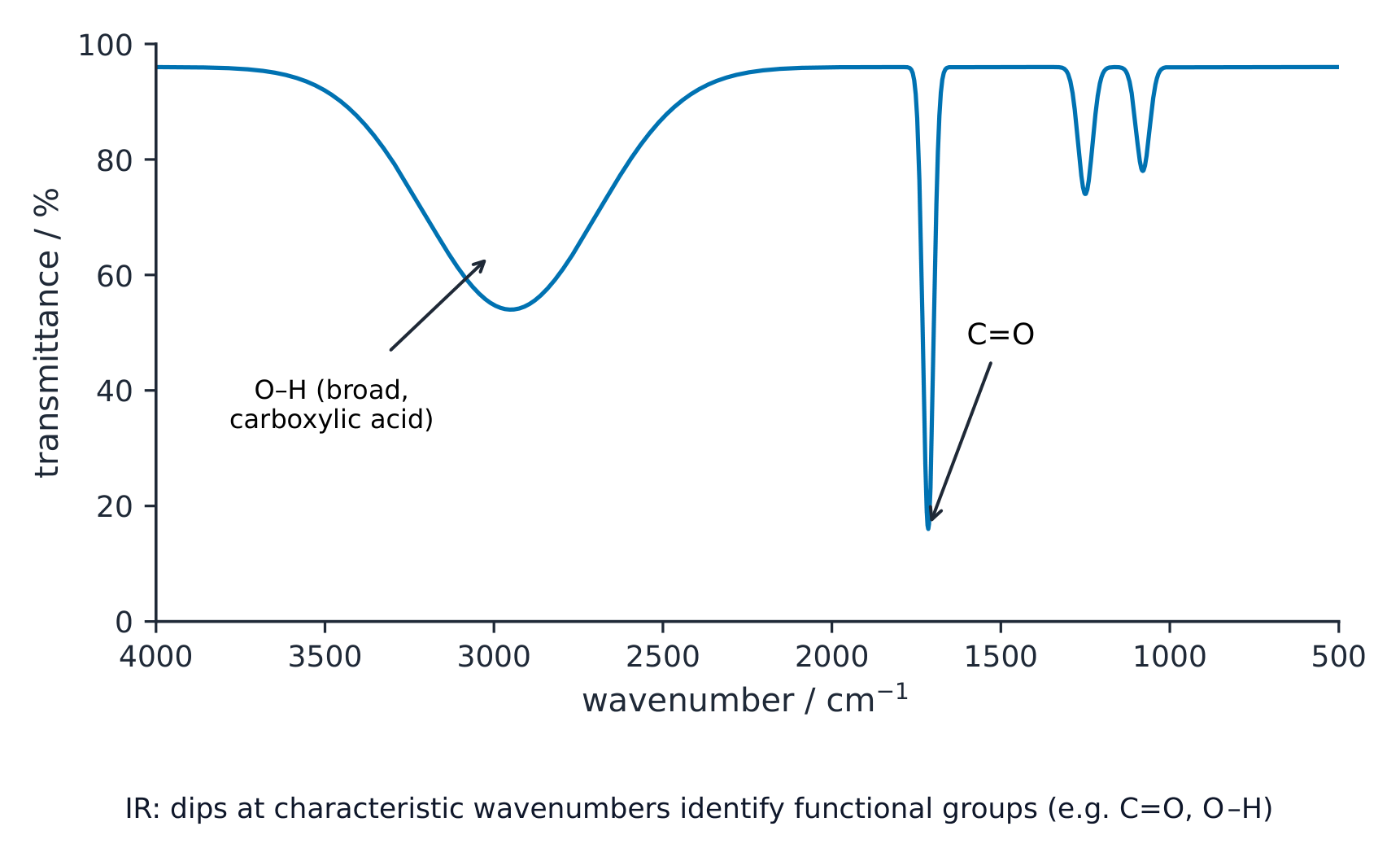
An IR spectrum: the broad O-H and C=O dips identify a carboxylic acid
How could IR confirm that an alkene has become an alcohol?
Difficulty 1/5 · 100 coins + a small bonus on first completion today
Losing the C=C and gaining an O–H dip shows the conversion to an alcohol.
Mass spectrometry 质谱: the M+2 clue
- The molecular ion 分子离子 peak (M⁺) gives the molecular mass.
- A peak two units higher (M+2) reveals a halogen:
- M+2 about ⅓ the height of M → chlorine present (³⁵Cl : ³⁷Cl ≈ 3 : 1).
- M+2 about equal to M → bromine present (⁷⁹Br : ⁸¹Br ≈ 1 : 1).
So the ratio of the M and M+2 peaks tells you which halogen the molecule contains.
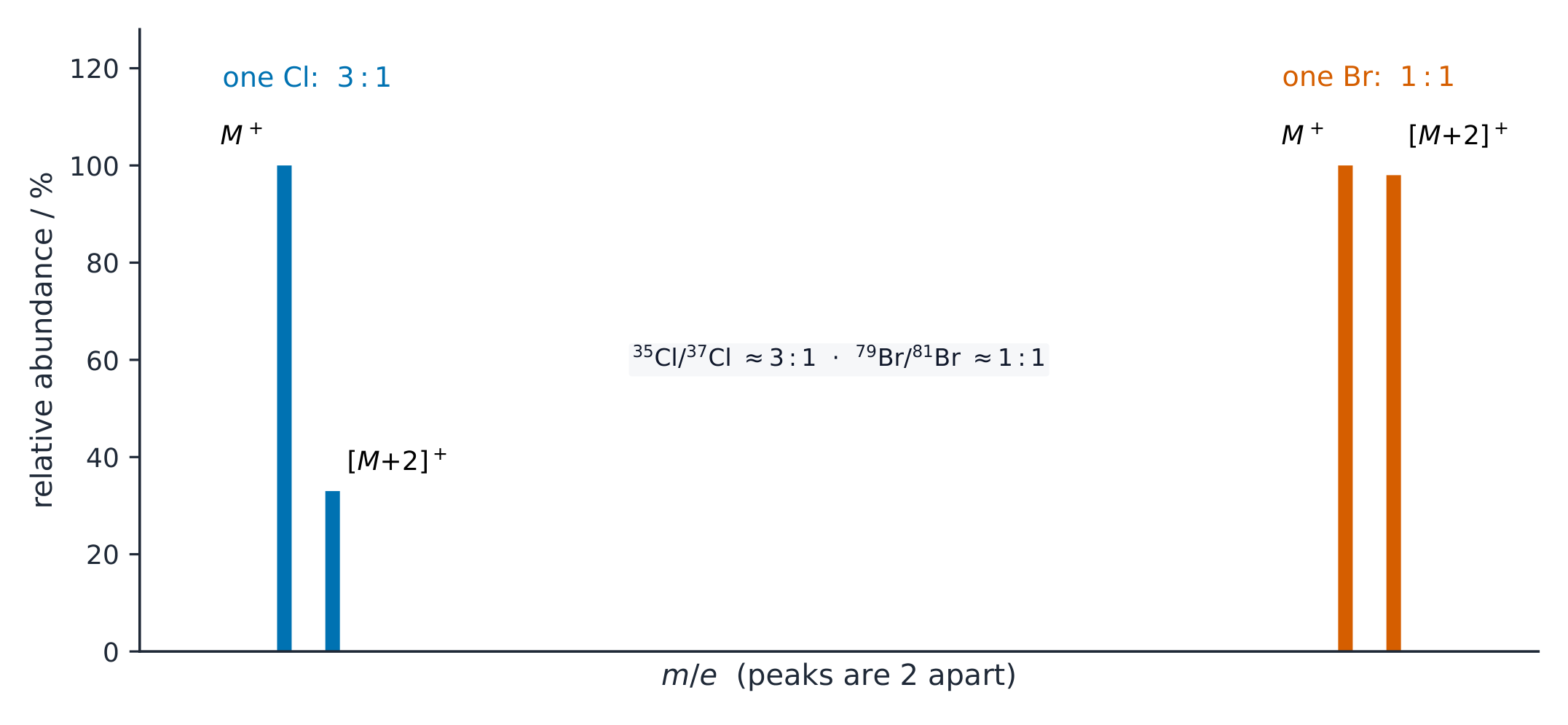
An (M+2) peak shows chlorine (3:1) or bromine (1:1)
You've got it
- IR finds functional groups: each bond gives a dip at its own wavenumber
- key dips: O–H (broad ~3200–3650), C=O (~1700); a broad O–H plus C=O = a carboxylic acid
- use IR to check a reaction (a group's dip disappears or appears)
- in mass spectra, an M+2 peak shows a halogen — ~⅓ of M = Cl, ~equal to M = Br