Skip to content · ⁨ข้ามไปยังเนื้อหา⁩

Atoms, molecules and stoichiometry · ⁨อะตอม, โมเลกุลและสโตกิโอเมทรี⁩

A-Level Chemistry · ⁨Chemistry A-Level⁩ · Topic 2 · ⁨หัวข้อ 2⁩

Video lesson for this topic · ⁨บทเรียนวิดีโอสำหรับหัวข้อนี้⁩ Open the video page · ⁨เปิดหน้าวิดีโอ⁩
19:02

อะตอม โมเลกุล & สโตइInstanceOfometry

นี่คือปัญหา ช้อนชาเดียวของน้ำมีโมเลกุลประมาณสองแสนล้านล้านโมเลกุล คุณนับไม่ได้ — ไม่ในชีวิตคุณ ไม่…

English narration · English + 中文 subtitles burned in · ⁨การบรรยายภาษาอังกฤษ · คำบรรยายภาษาอังกฤษ + 中文 ลอยตัวบนภาพ⁩

2.1

Relative masses of atoms and molecules · ⁨มวลสัมพัทธ์ของอะตอมและโมเลกุล⁩

Syllabus · ⁨หลักสูตร⁩
English
  1. define the unified atomic mass unit as one twelfth of the mass of a carbon-12 atom
  2. define relative atomic mass, $A_r$, relative isotopic mass, relative molecular mass, $M_r$, and relative formula mass in terms of the unified atomic mass unit
ไทย
  1. นิยาม หน่วยมวลอะตอมรวม ว่าคือหนึ่งในสิบสองของมวลของอะตอม คาร์บอน-12
  2. นิยาม มวลอะตอมสัมพัทธ์, $A_r$, มวลไอโซโทปสัมพัทธ์, มวลโมเลกุลสัมพัทธ์, $M_r$ และ มวลสูตรสัมพัทธ์ โดยอ้างอิงจากหน่วยมวลอะตอมรวม

Source: Cambridge International syllabus · ⁨แหล่งที่มา: หลักสูตร Cambridge International⁩

English

Atoms 原子 are far too light to weigh in grams, so we compare every mass to one standard. The standard is the unified atomic mass unit 统一原子质量单位 (symbol u), defined as exactly one twelfth of the mass of one carbon-12 atom.

Using this unit, we state masses as simple numbers:

  • the relative atomic mass 相对原子质量 $A_r$ of an element is the average mass of its atoms compared with $\tfrac{1}{12}$ of a carbon-12 atom. It is an average over all the isotopes 同位素, weighted by how common each one is.
  • the relative isotopic mass 相对同位素质量 is the mass of one atom of a single isotope, compared with $\tfrac{1}{12}$ of a carbon-12 atom.
  • the relative molecular mass 相对分子质量 $M_r$ of a molecule 分子 is the sum of the relative atomic masses of all its atoms.
  • the relative formula mass 相对式量 is the same idea for a substance that is not made of molecules (such as an ionic compound). Add up the relative atomic masses shown in the formula.

To find $A_r$ from isotope data, multiply each isotope mass by its percentage, add these up, and divide by 100.

Worked example. Chlorine is $75\%$ ${}^{35}\text{Cl}$ and $25\%$ ${}^{37}\text{Cl}$. Find its relative atomic mass.

$$A_r = \frac{(75 \times 35) + (25 \times 37)}{100} = \frac{2625 + 925}{100} = 35.5.$$

Worked example. A mass spectrometer shows copper is $69.2\%$ ${}^{63}\text{Cu}$ and $30.8\%$ ${}^{65}\text{Cu}$. Find its relative atomic mass.

$$A_r = \frac{(69.2 \times 63) + (30.8 \times 65)}{100} = \frac{4359.6 + 2002.0}{100} = 63.6.$$
ไทย

อะตอม มีน้ำหนักเบามากจนไม่สามารถชั่งด้วยกรัมได้ เราจึงเปรียบเทียบมวลทั้งหมดกับมาตรฐานหนึ่ง มาตรฐานนั้นคือ หน่วยมวลอะตอมรวม (unified atomic mass unit) (สัญลักษณ์ u) which ถูกนิยามว่าเป็นหนึ่งในสิบสองของมวลของคาร์บอน-12 อะตอมหนึ่ง

โดยใช้หน่วยนี้ เราระบุมวลเป็นตัวเลขง่ายๆ:

  • มวลอะตอมสัมพัทธ์ $A_r$ ของธาตุคือมวลเฉลี่ยของอะตอมของมันเมื่อเทียบกับ $\tfrac{1}{12}$ ของคาร์บอน-12 อะตอม เป็นค่าเฉลี่ยของ ไอโซโทป ทั้งหมด โดยถ่วงน้ำหนักด้วยความถี่ของแต่ละไอโซโทป
  • มวลไอโซโทปสัมพัทธ์ คือมวลของอะตอมเดียวของไอโซโทปหนึ่ง เมื่อเทียบกับ $\tfrac{1}{12}$ ของคาร์บอน-12 อะตอม
  • มวลโมเลกุลสัมพัทธ์ $M_r$ ของ โมเลกุล คือผลรวมของมวลอะตอมสัมพัทธ์ของอะตอมทั้งหมดในโมเลกุลนั้น
  • มวลสัมพัทธ์ของสูตร เป็นแนวคิดเดียวกันสำหรับสารที่ไม่ประกอบด้วยโมเลกุล (เช่น สารประกอบไอออน) ให้บวกมวลอะตอมสัมพัทธ์ที่แสดงในสูตรเข้าด้วยกัน
แท่งกราฟแสดงว่าคลอรีนประกอบด้วย 75% คลอรีน-35 และ 25% คลอรีน-37 โดยคำนวณค่ามวลอะตอมสัมพัทธ์จากค่าเฉลี่ยถ่วงน้ำหนักได้ 35.5
มวลอะตอมสัมพัทธ์คือค่าเฉลี่ยถ่วงน้ำหนัก: ไอโซโทปสองชนิดของคลอรีน (75% ³Cl, 25% ³⁷Cl) มีค่าเฉลี่ย Aᵣ = 35.5

ในการหาค่า $A_r$ จากข้อมูลไอโซโทป ให้คูณมวลของแต่ละไอโซโทปด้วยเปอร์เซ็นต์ แล้วนำผลรวมมาหารด้วย 100

ตัวอย่างวิธีทำ คลอรีนมี $75\%$ ${}^{35}\text{Cl}$ และมี $25\%$ ${}^{37}\text{Cl}$ จงหามวลอะตอมสัมพัทธ์ของมัน

$$A_r = \frac{(75 \times 35) + (25 \times 37)}{100} = \frac{2625 + 925}{100} = 35.5.$$

ตัวอย่างวิธีทำ เครื่องสเปกโทรมิเตอร์มวลชี้ให้เห็นว่าทองแดงมี $69.2\%$ ${}^{63}\text{Cu}$ และมี $30.8\%$ ${}^{65}\text{Cu}$ จงหามวลอะตอมสัมพัทธ์ของมัน

$$A_r = \frac{(69.2 \times 63) + (30.8 \times 65)}{100} = \frac{4359.6 + 2002.0}{100} = 63.6.$$
Explore · ⁨สำรวจ⁩

Relative mass lab · ⁨ห้องปฏิบัติการมวลสัมพัทธ์⁩

relative atomic mass = weighted mean · ⁨มวลอะตอมสัมพัทธ์ = ค่าเฉลี่ยถ่วงน้ำหนัก⁩

Change isotope abundance and see the weighted mean move. · ⁨เปลี่ยนความอุดมสมบูรณ์ของไอโซโทปเพื่อดูค่าเฉลี่ยถ่วงน้ำหนักเคลื่อนที่⁩

Vocabulary · ⁨คำศัพท์⁩ Train · ⁨ฝึกฝน⁩
English ไทย
atom/ˈætəm/ อะตอม
unified atomic mass unit/ˈjuːnɪfaɪd əˈtɒmɪk mæs ˈjuːnɪt/ หน่วยมวลอะตอมรวม
relative atomic mass/ˈrelətɪv əˈtɒmɪk mæs/ มวลอะตอมสัมพัทธ์
isotope/ˈaɪsətəʊp/ ไอโซโทป
relative isotopic mass/ˈrelətɪv ˌaɪsəˈtɒpɪk mæs/ มวลไอโซโทปสัมพัทธ์
relative molecular mass/ˈrelətɪv məˈlekjʊlə mæs/ มวลโมเลกุลสัมพัทธ์
molecule/ˈmɒlɪkjuːl/ โมเลกุล
relative formula mass/ˈrelətɪv ˈfɔːmjʊlə mæs/ มวลสูตรสัมพัทธ์
2.2

The mole and the Avogadro constant · ⁨โมลและค่าคงที่อาโวกาโดร⁩

Syllabus · ⁨หลักสูตร⁩
English
  1. define and use the term mole in terms of the Avogadro constant
ไทย
  1. นิยามและใช้คำว่า โมล โดยอ้างอิงจาก ค่าคงที่อาวากาโดโร

Source: Cambridge International syllabus · ⁨แหล่งที่มา: หลักสูตร Cambridge International⁩

English

Chemists count particles in groups called moles, just as we count eggs in dozens.

One mole 摩尔 (symbol mol) is the amount of substance that contains the same number of particles as there are atoms in exactly 12 g of carbon-12. That number is the Avogadro constant 阿伏伽德罗常量:

$$N_A = 6.02 \times 10^{23}\ \text{mol}^{-1}$$

So one mole of anything contains $6.02 \times 10^{23}$ particles. The particles may be atoms, molecules or ions 离子 — always say which.

The mass of one mole in grams equals the relative mass ($A_r$ or $M_r$). This is the molar mass 摩尔质量, with units $\text{g mol}^{-1}$. The key equation is:

$$n = \frac{m}{M}$$

where $n$ is the amount in moles, $m$ is the mass in grams, and $M$ is the molar mass.

Worked example. How many moles are in $8.0\ \text{g}$ of methane, $\text{CH}_4$? ($A_r$: C $= 12$, H $= 1$.)

The molar mass is $M = 12 + 4(1) = 16\ \text{g mol}^{-1}$, so

$$n = \frac{m}{M} = \frac{8.0}{16} = 0.50\ \text{mol}.$$
ไทย
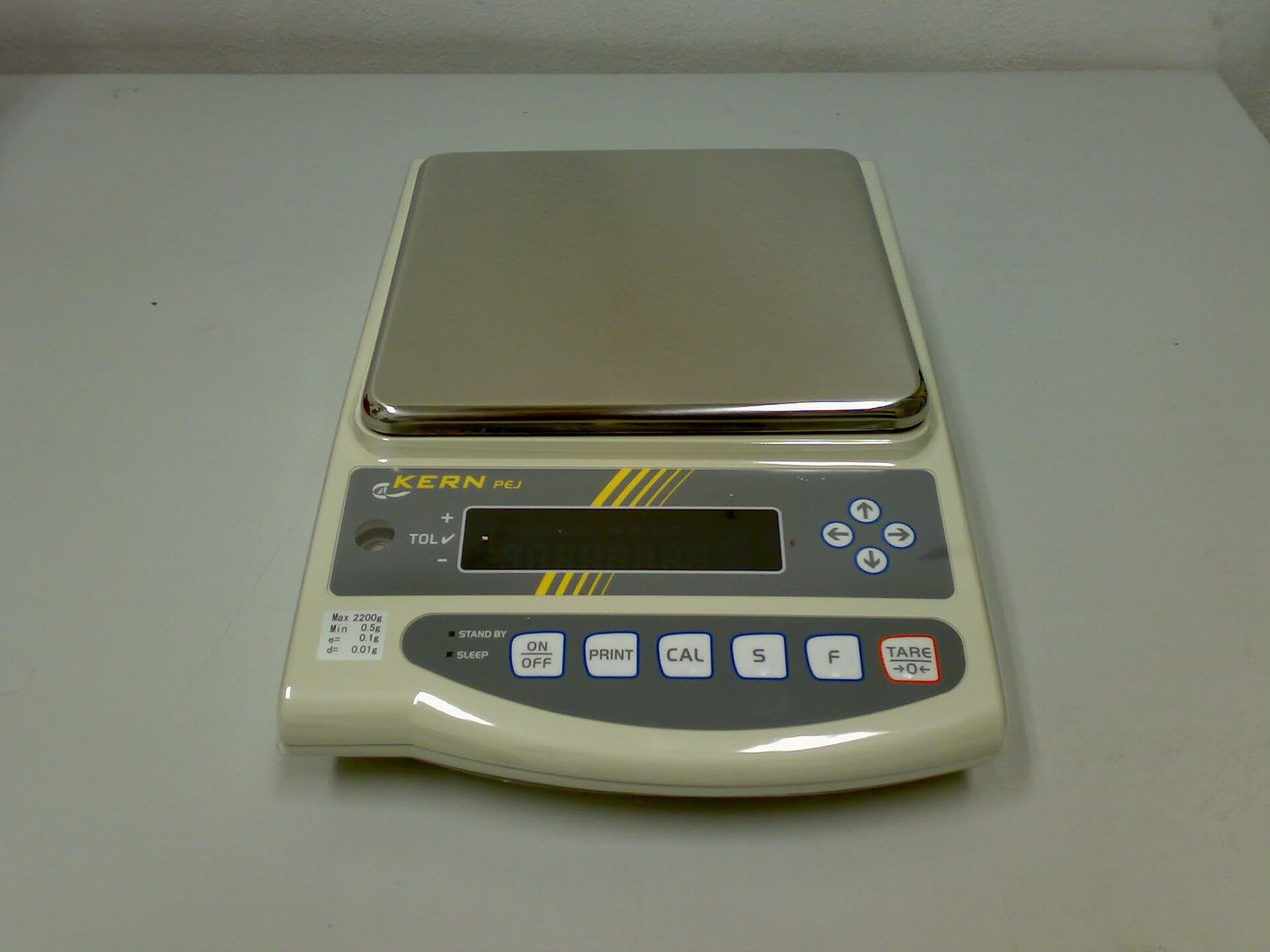
เครื่องชั่งไฟฟ้าสมัยใหม่ในห้องปฏิบัติการ
เครื่องชั่งไฟฟ้าสมัยใหม่ใช้วัดมวล — ซึ่งเป็นพื้นฐานของการคำนวณโมล

นักเคมีนับอนุภาคเป็นกลุ่มที่เรียกว่าโมล เหมือนกับการนับไข่เป็น dozzen

โมลหนึ่ง (สัญลักษณ์ mol) คือปริมาณสารที่มีจำนวนอนุภาคเท่ากับจำนวนอะตอมในคาร์บอน-12 จำนวน 12 กรัม พอดี จำนวนนี้คือ ค่าคงที่อาโวกาโดร:

$$N_A = 6.02 \times 10^{23}\ \text{mol}^{-1}$$

ดังนั้นโมลหนึ่งของสารใดๆ จะประกอบด้วย $6.02 \times 10^{23}$ อนุภาค อนุภาคอาจเป็นอะตอม โมเลกุลหรือ ไอออน — ต้องระบุให้ชัดเจนเสมอ

มวลของโมลหนึ่งเป็นกรัมจะเท่ากับมวลสัมพัทธ์ ($A_r$ หรือ $M_r$) นี่คือ มวลโมล โดยมีหน่วย $\text{g mol}^{-1}$ สมการสำคัญคือ:

$$n = \frac{m}{M}$$

โดยที่ $n$ คือปริมาณเป็นโมล $m$ คือมวลเป็นกรัม และ $M$ คือมวลโมล

ตัวอย่างวิธีทำ มีโมลกี่โมลใน $8.0\ \text{g}$ ของเมทาน $\text{CH}_4$ ? ($A_r$: C $= 12$, H $= 1$.)

มวลโมลคือ $M = 12 + 4(1) = 16\ \text{g mol}^{-1}$ ดังนั้น

$$n = \frac{m}{M} = \frac{8.0}{16} = 0.50\ \text{mol}.$$
กล่องโมลอยู่ตรงกลาง เชื่อมด้วยลูกศรคู่ไปยังมวล จำนวนอนุภาค ปริมาตรแก๊ส และความเข้มข้นของสารละลาย แต่ละลูกศรมีฉลากบอกการแปลงหน่วย
โมลเป็นศูนย์กลางของการคำนวณปริมาณทุกชนิด: แปลงเป็นมวล ($n=m/M$), จำนวนอนุภาค ($\times N_A$), ปริมาตรแก๊ส ($n=V/24$) หรือสารละลาย ($n=cV$)
Explore · ⁨สำรวจ⁩

Mole mass lab · ⁨ห้องปฏิบัติการมวลโมล⁩

n = m / M

Change mass and see moles scale through molar mass. · ⁨เปลี่ยนมวลเพื่อดูว่าโมลขยายตามมวลโมล⁩

Vocabulary · ⁨คำศัพท์⁩ Train · ⁨ฝึกฝน⁩
English ไทย
mole/məʊl/ โมล
Avogadro constant/ˌævəˈɡædrəʊ ˈkɒnstənt/ ค่าคงที่อาโวกาโดร
2.3

Formulas · ⁨สูตรเคมี⁩

Syllabus · ⁨หลักสูตร⁩
English
  1. write formulas of ionic compounds from ionic charges and oxidation numbers (shown by a Roman numeral), including: (a) the prediction of ionic charge from the position of an element in the Periodic Table (b) recall of the names and formulas for the following ions: $\text{NO}_3^-$, $\text{CO}_3^{2-}$, $\text{SO}_4^{2-}$, $\text{OH}^-$, $\text{NH}_4^+$, $\text{Zn}^{2+}$, $\text{Ag}^+$, $\text{HCO}_3^-$, $\text{PO}_4^{3-}$
  2. (a) write and construct equations (which should be balanced), including ionic equations (which should not include spectator ions) (b) use appropriate state symbols in equations
  3. define and use the terms empirical and molecular formula
  4. understand and use the terms anhydrous, hydrated and water of crystallisation
  5. calculate empirical and molecular formulas, using given data
ไทย
  1. เขียนสูตรของสารประกอบไอออนิกจากประจุไอออนและเลขออกซิเดชัน (แสดงด้วยตัวอักษรโรมัน) รวมถึง: (ก) การทำนายประจุไอออนจากตำแหน่งของธาตุในตารางสมบัตินิวเคลียส (ข) ทบทวนชื่อและสูตรของไอออนต่อไปนี้: $\text{NO}_3^-$, $\text{CO}_3^{2-}$, $\text{SO}_4^{2-}$, $\text{OH}^-$, $\text{NH}_4^+$, $\text{Zn}^{2+}$, $\text{Ag}^+$, $\text{HCO}_3^-$, $\text{PO}_4^{3-}$
  2. (ก) เขียนและสร้างสมการ (ซึ่งควรจัดให้สมดุล) รวมถึงสมการไอออน (ซึ่งไม่ควรมีไอออนผู้ชม) (ข) ใช้สัญลักษณ์สถานะที่เหมาะสมในสมการ
  3. นิยามและใช้คำว่า สูตรเชิงประมาตและสูตรโมเลกุล
  4. เข้าใจและใช้คำว่า ไม่มีการผสมน้ำ (anhydrous), มีการผสมน้ำ (hydrated) และ น้ำผลึก (water of crystallisation)
  5. คำนวณสูตรเชิงประมาตและสูตรโมเลกุล โดยใช้ข้อมูลที่ได้รับกำหนดให้

Source: Cambridge International syllabus · ⁨แหล่งที่มา: หลักสูตร Cambridge International⁩

English

A compound 化合物 is a substance made of two or more elements chemically joined.

Charges and formulas of ionic compounds

In an ionic compound 离子化合物 the total positive charge balances the total negative charge, so the compound is neutral overall.

You can predict the charge of many ions from the element's position in the Periodic Table:

Group 1 2 13 15 16 17
Usual ion charge $+1$ $+2$ $+3$ $-3$ $-2$ $-1$

Hydrogen forms $\text{H}^+$, and the Group 18 noble gases do not normally form ions.

Some ions you must know by name and formula:

Name Formula
nitrate $\text{NO}_3^{-}$
carbonate $\text{CO}_3^{2-}$
sulfate $\text{SO}_4^{2-}$
hydroxide $\text{OH}^{-}$
ammonium $\text{NH}_4^{+}$
zinc $\text{Zn}^{2+}$
silver $\text{Ag}^{+}$
hydrogencarbonate $\text{HCO}_3^{-}$
phosphate $\text{PO}_4^{3-}$

For a metal that can have more than one charge, a Roman numeral shows the oxidation number 氧化数. For example, iron(II) is $\text{Fe}^{2+}$ and iron(III) is $\text{Fe}^{3+}$. To write a formula, balance the charges: iron(III) oxide is $\text{Fe}_2\text{O}_3$, because two $\text{Fe}^{3+}$ balance three $\text{O}^{2-}$.

Equations and state symbols

A chemical equation must be balanced 配平 — the same number of each kind of atom on both sides. Add state symbols 状态符号 to show the state of each species: (s) solid, (l) liquid, (g) gas, and (aq) aqueous 水溶液 (dissolved in water).

An ionic equation 离子方程式 shows only the ions and molecules that actually change. The ions that do not change are spectator ions 旁观离子, and you leave them out. For example, the reaction that forms silver chloride is:

$$\text{Ag}^{+}(\text{aq}) + \text{Cl}^{-}(\text{aq}) \rightarrow \text{AgCl}(\text{s})$$

Empirical and molecular formulas

The empirical formula 实验式 is the simplest whole-number ratio of the atoms of each element in a compound. The molecular formula 分子式 shows the actual number of atoms of each element in one molecule.

For example, ethane has empirical formula $\text{CH}_3$ but molecular formula $\text{C}_2\text{H}_6$.

Hydrated and anhydrous solids

Some solids hold water inside their crystals. This water is the water of crystallisation 结晶水. A solid that contains it is hydrated 水合的; the same solid with the water removed is anhydrous 无水的.

For example, hydrated copper(II) sulfate is $\text{CuSO}_4 \cdot 5\text{H}_2\text{O}$. Heating it drives off the water to leave anhydrous $\text{CuSO}_4$.

Calculating empirical and molecular formulas

To find the empirical formula from masses (or percentages by mass):

  1. divide each element's mass by its $A_r$ to get the moles.
  2. divide all the mole values by the smallest one.
  3. round to the nearest whole numbers — that ratio is the empirical formula.

To get the molecular formula, you also need $M_r$. Find how many times the empirical formula mass fits into $M_r$, then multiply the formula by that number.

Worked example. A compound is $40.0\%$ carbon, $6.7\%$ hydrogen and $53.3\%$ oxygen by mass. Find its empirical formula. ($A_r$: C $= 12$, H $= 1$, O $= 16$.)

Take $100\ \text{g}$ and divide each mass by its $A_r$ to get moles: C $= 40.0/12 = 3.33$, H $= 6.7/1 = 6.7$, O $= 53.3/16 = 3.33$. Dividing through by the smallest ($3.33$) gives a ratio C : H : O $= 1 : 2 : 1$, so the empirical formula is $\text{CH}_2\text{O}$.

ไทย

สารประกอบ คือสารที่เกิดจากธาตุสองชนิดขึ้นไปเชื่อมต่อกันทางเคมี

ประจุและสูตรของสารประกอบไอออน

ใน สารประกอบไอออน ผลรวมของประจุบวกจะสมดุลกับผลรวมของประจุลบ ทำให้สารประกอบมีสภาพเป็นกลางโดยรวม

คุณสามารถทำนายประจุของไอออนหลายชนิดได้จากตำแหน่งของธาตุในตารางธาตุ:

กลุ่ม 1 2 13 15 16 17
ประจุไอออนปกติ $+1$ $+2$ $+3$ $-3$ $-2$ $-1$

ไฮโดรเจนสร้าง $\text{H}^+$ และแก๊สนoble กลุ่มที่ 18 มักจะไม่สร้างไอออน

บางไอออนที่คุณต้องจำชื่อและสูตรได้:

ชื่อ สูตร
ไนเตรต $\text{NO}_3^{-}$
คาร์บอเนต $\text{CO}_3^{2-}$
ซัลเฟต $\text{SO}_4^{2-}$
ไฮดรอกไซด์ $\text{OH}^{-}$
แอมโมเนียม $\text{NH}_4^{+}$
สังกะสี $\text{Zn}^{2+}$
เงิน $\text{Ag}^{+}$
ไฮโดรเจนคาร์บอเนต $\text{HCO}_3^{-}$
ฟอสเฟต $\text{PO}_4^{3-}$

สำหรับโลหะที่มีประจุมากกว่าหนึ่งชนิด的数字โรมันจะบ่งบอกถึง เลขออกซิเดชัน ตัวอย่างเช่น แร่เหล็ก(II) คือ $\text{Fe}^{2+}$ และแร่เหล็ก(III) คือ $\text{Fe}^{3+}$ ในการเขียนสูตร ให้ปรับสมดุลประจุ: เหล็ก(III) ออกไซด์ คือ $\text{Fe}_2\text{O}_3$ เนื่องจาก $\text{Fe}^{3+}$ สองตัว ชดเชย $\text{O}^{2-}$ สามตัว.

สมการและสัญลักษณ์สถานะ

สมการเคมีต้อง สมดุล — มีจำนวนอะตอมแต่ละชนิดเท่ากันทั้งสองข้าง เพิ่ม สัญลักษณ์สถานะ เพื่อแสดงสถานะของสปีชีส์แต่ละตัว: (s) ของแข็ง, (l) ของเหลว, (g) แก๊ส และ (aq) สารละลายน้ำ (ละลายในน้ำ)

สมการไอออน แสดงเฉพาะไอออนและโมเลกุลที่เปลี่ยนแปลงจริง ไอออนที่ไม่เปลี่ยนแปลงเรียกว่า ไอออนผู้สังเกตการณ์ และคุณตัดมันออกไป ตัวอย่างเช่น ปฏิกิริยาที่สร้างเงินคลอไรด์คือ:

$$\text{Ag}^{+}(\text{aq}) + \text{Cl}^{-}(\text{aq}) \rightarrow \text{AgCl}(\text{s})$$

สูตรเชิงประจักษ์และสูตรโมเลกุล

สูตรเชิงประจักษ์ คืออัตราส่วนจำนวนเต็มอย่างง่ายที่สุดของอะตอมแต่ละธาตุในสารประกอบ สูตรโมเลกุล แสดงจำนวนอะตอมจริงของแต่ละธาตุในหนึ่งโมเลกุล

ตัวอย่างเช่น เอเทนมีสูตรเชิงประจักษ์ $\text{CH}_3$ แต่มีสูตรโมเลกุล $\text{C}_2\text{H}_6$

ของแข็งแบบมีน้ำและแบบไม่มีน้ำ

บางชนิดของแข็งมีน้ำอยู่ภายในผลึก น้ำนี้คือ น้ำในผลึก ของแข็งที่มีน้ำอยู่คือ แบบมีน้ำ; ของแข็งเดียวกันเมื่อเอาน้ำออกแล้วจะเป็น แบบไม่มีน้ำ

ตัวอย่างเช่น ทองคopper(II) ซัลเฟตแบบมีน้ำคือ $\text{CuSO}_4 \cdot 5\text{H}_2\text{O}$ การให้ความร้อนจะทำให้ระเหยน้ำออกไปเหลือ $\text{CuSO}_4$ แบบไม่มีน้ำ

การคำนวณสูตรเชิงประจักษ์และสูตรโมเลกุล

ในการหาสูตรเชิงประจักษ์จากมวล (หรือเปอร์เซ็นต์โดยมวล):

  1. หารมวลของแต่ละธาตุด้วย $A_r$ ของมันเพื่อจะได้จำนวนโมล
  2. หารค่าโมลทั้งหมดด้วยค่าน้อยที่สุด
  3. ปัดเศษให้เป็นจำนวนเต็มที่ใกล้ที่สุด — อัตราส่วนนั้นคือสูตรเชิงประจักษ์

เพื่อให้ได้สูตรโมเลกุล คุณยังต้องใช้ $M_r$ ด้วย หาว่ามีสูตรเชิงประจักษ์เข้าไปใน $M_r$ กี่เท่า แล้วคูณสูตรด้วยตัวเลขนั้น

ตัวอย่างวิธีทำ สารประกอบหนึ่งประกอบด้วย $40.0\%$ คาร์บอน $6.7\%$ ไฮโดรเจน และ $53.3\%$ ออกซิเจน โดยมวล จงหาสูตรเชิงประจักษ์ ($A_r$: C $= 12$, H $= 1$, O $= 16$.)

ใช้ $100\ \text{g}$ และหารมวลแต่ละชนิดด้วย $A_r$ เพื่อได้โมล: C $= 40.0/12 = 3.33$, H $= 6.7/1 = 6.7$, O $= 53.3/16 = 3.33$ การหารตลอดด้วยค่าน้อยที่สุด ($3.33$) จะได้สัดส่วน C : H : O $= 1 : 2 : 1$ ดังนั้นสูตรเชิงประจักษ์คือ $\text{CH}_2\text{O}$

การจัดรูปแบบตัวอย่างวิธีทำเป็นตาราง: เปอร์เซ็นต์โดยมวลหารด้วย Ar ได้โมล การหารด้วยค่าน้อยที่สุดจะได้สัดส่วน 1 ต่อ 2 ต่อ 1 ดังนั้นสูตรเชิงประจักษ์คือ CH2O
สูตรการทำสูตรเชิงประจักษ์: หารด้วย Ar, หารด้วยค่าน้อยที่สุด, อ่านค่าสัดส่วนออกมา
Explore · ⁨สำรวจ⁩

Equation balancing route · ⁨เส้นทางการจัดสมการให้สมดุล⁩

Follow atoms through a chemical equation so both sides match. · ⁨ติดตามอะตอมผ่านสมการเคมีเพื่อให้ทั้งสองฝั่งตรงกัน⁩

Vocabulary · ⁨คำศัพท์⁩ Train · ⁨ฝึกฝน⁩
English ไทย
empirical formula/emˈpɪrɪkl ˈfɔːmjʊlə/ สูตรอย่างง่าย
molecular formula/məˈlekjʊlə ˈfɔːmjʊlə/ สูตรโมเลกุล
water of crystallisation/ˈwɔːtə ɒv ˌkrɪstəlaɪˈzeɪʃn/ น้ำในผลึก
hydrated/haɪˈdreɪtɪd/ ไฮเดรต
anhydrous/ænˈhaɪdrəs/ แอนไฮดรัส (ไร้สารละลาย)
2.4

Reacting masses and volumes · ⁨มวลและปริมาตรที่ทำปฏิกิริยากัน⁩

Syllabus · ⁨หลักสูตร⁩
English
  1. perform calculations including use of the mole concept, involving: (a) reacting masses (from formulas and equations) including percentage yield calculations (b) volumes of gases (e.g. in the burning of hydrocarbons) (c) volumes and concentrations of solutions (d) limiting reagent and excess reagent (When performing calculations, candidates’ answers should reflect the number of significant figures given or asked for in the question. When rounding up or down, candidates should ensure that significant figures are neither lost unnecessarily nor used beyond what is justified (see also Mathematical requirements section).) (e) deduce stoichiometric relationships from calculations such as those in 2.4.1(a)–(d)
ไทย
  1. ทำการคำนวณรวมถึงการใช้แนวคิดโมล ซึ่งประกอบด้วย: (ก) มวลที่參與ปฏิกิริยา (จากสูตรและสมการ) รวมถึงการคำนวณเปอร์เซ็นต์ผลผลิต (ข) ปริมาตรของแก๊ส (เช่น ในการเผาไหม้ไฮโดรคาร์บอน) (ค) ปริมาตรและความเข้มข้นของสารละลาย (ง) สารตั้งต้นจำกัด และ สารตั้งต้นเกิน (เมื่อทำการคำนวณ คำตอบของผู้เข้าสอบควรสะท้อนจำนวนหลักที่มีนัยสำคัญตามที่ระบุหรือถามถึงในโจทย์ เมื่อปัดเศษขึ้นหรือลง ผู้เข้าสอบควรตรวจสอบว่าจำนวนหลักที่มีนัยสำคัญไม่สูญเสียไปโดยไม่จำเป็นหรือไม่ถูกใช้เกินกว่าที่จะ justification ได้ (ดูเพิ่มเติมในส่วน ความต้องการทางคณิตศาสตร์)) (จ) สรุปความสัมพันธ์ storeschiometric จากการคำนวณเช่นในข้อ 2.4.1(ก)–(ง)

Source: Cambridge International syllabus · ⁨แหล่งที่มา: หลักสูตร Cambridge International⁩

English

Reacting masses and percentage yield

The numbers in front of each species in a balanced equation give the mole ratio — this is the stoichiometry 化学计量. To find a reacting mass: change the known mass to moles, use the mole ratio to find the moles you want, then change back to mass.

Worked example. What mass of magnesium oxide forms when $4.8\ \text{g}$ of magnesium burns completely? $2\text{Mg} + \text{O}_2 \rightarrow 2\text{MgO}$. ($A_r$: Mg $= 24$, O $= 16$.)

Moles of Mg $= 4.8/24 = 0.20\ \text{mol}$. The ratio Mg : MgO is $1 : 1$, so $0.20\ \text{mol}$ of MgO forms. Its molar mass is $24 + 16 = 40\ \text{g mol}^{-1}$, so

$$m = nM = 0.20 \times 40 = 8.0\ \text{g}.$$

In real reactions you usually get less product than the maximum. The percentage yield 产率 compares the amount you actually made with the most you could make:

$$\text{percentage yield} = \frac{\text{actual amount of product}}{\text{maximum possible amount}} \times 100\%$$

Limiting and excess reagent

When two reactants are mixed, one usually runs out first. The limiting reagent 限量试剂 is the one that runs out — it decides how much product forms. The other is the excess reagent 过量试剂, because there is more than enough of it. Always base the calculation on the limiting reagent.

To find it: work out the moles of each reactant, divide each by its number in the equation, and the smallest result is the limiting reagent.

Volumes of gases

At the same temperature and pressure, equal volumes of any gases contain equal numbers of molecules. At room temperature and pressure (r.t.p.), one mole of any gas takes up $24.0\ \text{dm}^3$, so:

$$n = \frac{V}{24.0}\qquad (V \text{ in } \text{dm}^3 \text{ at r.t.p.})$$

This is used when burning hydrocarbons 碳氢化合物 (compounds of only carbon and hydrogen), where you compare gas volumes.

Volumes and concentrations of solutions

The concentration 浓度 of a solution is the amount of solute 溶质 in each cubic decimetre of solution 溶液, measured in $\text{mol dm}^{-3}$:

$$n = c \times V$$

where $c$ is the concentration and $V$ is the volume in $\text{dm}^3$. Remember that $1000\ \text{cm}^3 = 1\ \text{dm}^3$.

Worked example. In a titration, $25.0\ \text{cm}^3$ of sodium hydroxide solution is exactly neutralised by $20.0\ \text{cm}^3$ of $0.100\ \text{mol dm}^{-3}$ hydrochloric acid: $\text{NaOH} + \text{HCl} \rightarrow \text{NaCl} + \text{H}_2\text{O}$. Find the concentration of the sodium hydroxide.

Moles of HCl $= cV = 0.100 \times \dfrac{20.0}{1000} = 2.00 \times 10^{-3}\ \text{mol}$. The ratio is $1 : 1$, so there are $2.00 \times 10^{-3}\ \text{mol}$ of NaOH in $25.0\ \text{cm}^3$:

$$c = \frac{n}{V} = \frac{2.00 \times 10^{-3}}{25.0/1000} = 0.0800\ \text{mol dm}^{-3}.$$

This is the basis of a titration 滴定, where you find an unknown concentration by reacting it with a solution whose concentration you already know.

Significant figures

Give your answer to a sensible number of significant figures 有效数字 — usually match the data in the question. Do not write more digits than the data supports, and do not round so early that you lose accuracy.

ไทย
การไทเทรตกำลังดำเนินการอยู่
การไทเทรตช่วยหาปริมาตรที่ทำปฏิกิริยากันได้อย่างแม่นยำ

มวลสารที่เข้าทำปฏิกิริยาและผลผลิตเป็นเปอร์เซ็นต์

ตัวเลขหน้าแต่ละสปีชีส์ในสมการที่ดุลแล้วแสดงถึงอัตราส่วนโมล — นี่คือ สโตਇโควมิตรี (stoichiometry) ในการหามวลสารที่เข้าทำปฏิกิริยา: เปลี่ยนมวลที่ทราบเป็นโมล ใช้ค่าอัตราส่วนโมลเพื่อหาจำนวนโมลที่ต้องการ แล้วแปลงกลับเป็นมวลอีกครั้ง

ตัวอย่างวิธีทำ มวลของแมกนีเซียมออกไซด์ที่เกิดขึ้นเมื่อ $4.8\ \text{g}$ ของแมกนีเซียมเผาไหม้จนหมดคือเท่าใด? $2\text{Mg} + \text{O}_2 \rightarrow 2\text{MgO}$. ($A_r$: Mg $= 24$, O $= 16$.)

โมลของ Mg $= 4.8/24 = 0.20\ \text{mol}$. อัตราส่วน Mg : MgO คือ $1 : 1$, ดังนั้น $0.20\ \text{mol}$ ของ MgO จะเกิดขึ้น. มวลโมลาร์ของมันคือ $24 + 16 = 40\ \text{g mol}^{-1}$, ดังนั้น

$$m = nM = 0.20 \times 40 = 8.0\ \text{g}.$$
สะพานโมลสำหรับตัวอย่างแมกนีเซียม: แมกนีเซียม 4.8 กรัมหารด้วย Ar ได้ 0.20 โมล, อัตราส่วน 1 ต่อ 1 ให้ 0.20 โมลของแมกนีเซียมออกไซด์, คูณด้วย Mr ได้ 8.0 กรัม
สะพานโมล: จากมวลสู่โมล, สัดส่วน, แล้วกลับสู่มวล

ในปฏิกิริยาจริง คุณมักจะได้ผลิตภัณฑ์น้อยกว่าปริมาณสูงสุด ผลผลิตเป็นเปอร์เซ็นต์ เปรียบเทียบปริมาณที่คุณสร้างได้จริงกับปริมาณมากที่สุดที่เป็นไปได้:

$$\text{percentage yield} = \frac{\text{actual amount of product}}{\text{maximum possible amount}} \times 100\%$$

สารกำหนดปฏิกิริยาและสารเกิน

เมื่อผสมสารตั้งต้นสองชนิดเข้าด้วยกัน โดยทั่วไปจะชนิดหนึ่งหมดก่อน สารกำหนดปฏิกิริยา คือสารที่หมดไป — มันกำหนดปริมาณผลิตภัณฑ์ที่เกิดขึ้น สารที่เหลือคือ สารเกิน เพราะมีมากกว่าพอเสมอ ควรคำนวณโดยอ้างอิงจากสารกำหนดปฏิกิริยาเสมอ

ในการหามัน: หาโมลของแต่ละสารตั้งต้น หารแต่ละตัวด้วยตัวเลขในสมการ และผลลัพธ์ที่น้อยที่สุดคือสารกำหนดปฏิกิริยา

การเผาไหม้โมเลกุลไฮโดรเจน 4 ตัวกับโมเลกุลออกซิเจน 1 ตัว สร้างโมเลกุลน้ำ 2 ตัว และเหลือโมเลกุลไฮโดรเจนไม่เข้าทำปฏิกิริยาอีก 2 ตัว
สารกำหนดปฏิกิริยาหมดก่อนและกำหนดปริมาณผลิตภัณฑ์; สารตั้งต้นที่เหลืออยู่ในรูปเกิน

ปริมาตรของแก๊ส

ที่อุณหภูมิและความดันเท่ากัน ปริมาตรที่เท่ากันของแก๊สใดๆ จะมีจำนวนโมเลกุลเท่ากัน ที่อุณหภูมิและความดันห้อง (r.t.p.), 1 โมลของแก๊สใดๆ ใช้พื้นที่ $24.0\ \text{dm}^3$, ดังนั้น:

$$n = \frac{V}{24.0}\qquad (V \text{ in } \text{dm}^3 \text{ at r.t.p.})$$
กล่องขนาดเท่ากันสองใบ ใบหนึ่งใส่ไฮโดรเจนและอีกใบใส่คาร์บอนไดออกไซด์ แต่ละใบมีโมเลกุลอยู่ 6 ตัว
ปริมาตรที่เท่ากันของแก๊สที่อุณหภูมิและความดันเท่ากันจะมีจำนวนโมเลกุลเท่ากัน ไม่ว่าแก๊สนั้นจะเป็นชนิดใด

ใช้เมื่อเผาไหม้ ไฮโดรคาร์บอน (สารประกอบที่มีคาร์บอนและไฮโดรเจนเท่านั้น) ซึ่งเปรียบเทียบปริมาตรของแก๊ส

ปริมาตรและความเข้มข้นของสารละลาย

ความเข้มข้น ของสารละลายคือปริมาณของ สารละลาย ในแต่ละลูกบาศก์เดซิมิเตอร์ของ สารละลาย, วัดเป็น $\text{mol dm}^{-3}$:

$$n = c \times V$$

โดยที่ $c$ คือความเข้มข้นและ $V$ คือปริมาตรใน $\text{dm}^3$. จำไว้ว่า $1000\ \text{cm}^3 = 1\ \text{dm}^3$.

ตัวอย่างวิธีทำ ในการไทเทรต $25.0\ \text{cm}^3$ ของสารละลายโซเดียมไฮดรอกไซด์ถูกทำให้เป็นกลางพอดีโดย $20.0\ \text{cm}^3$ ของ $0.100\ \text{mol dm}^{-3}$ กรดไฮโดรคลอริก: $\text{NaOH} + \text{HCl} \rightarrow \text{NaCl} + \text{H}_2\text{O}$. จงหาความเข้มข้นของโซเดียมไฮดรอกไซด์

โมลของ HCl $= cV = 0.100 \times \dfrac{20.0}{1000} = 2.00 \times 10^{-3}\ \text{mol}$. อัตราส่วนคือ $1 : 1$, ดังนั้นมี $2.00 \times 10^{-3}\ \text{mol}$ ของ NaOH ใน $25.0\ \text{cm}^3$:

$$c = \frac{n}{V} = \frac{2.00 \times 10^{-3}}{25.0/1000} = 0.0800\ \text{mol dm}^{-3}.$$

นี่คือพื้นฐานของ ไทเทรต ซึ่งคุณหาความเข้มข้นที่ไม่รู้จักโดยการให้มันทำปฏิกิริยากับสารละลายที่มีความเข้มข้นที่ทราบอยู่แล้ว

บิวเรตต์ยึดติดกับขาตั้งเหนือกระบอกวัดแบบกรวยบนแผ่นกระเบื้องสีขาว *ในการไทเทรต บิวเรตต์จะเติมสารละลายที่มีความเข้มข้นKnown ลงไปในสารที่ไม่ทราบค่าในกระบอกวัดแบบกรวย จนกว่าอินดิเคเตอร์เปลี่ยนสี

หลัก有意义的

ตอบคำถามด้วยจำนวน หลัก有意义的 ที่เหมาะสม — มักจะตรงกับข้อมูลในโจทย์ อย่าเขียนทศนิยมมากกว่าที่ข้อมูลรองรับ และไม่ปัดเศษเร็วเกินไปจนสูญเสียความแม่นยำ

Explore · ⁨สำรวจ⁩

Reacting mass route · ⁨เส้นทางมวลทำปฏิกิริยา⁩

Follow a balanced equation from known mass to predicted product mass. · ⁨ตามสมการที่ดุลจากมวลที่ทราบไปยังมวลผลิตภัณฑ์ที่คาดการณ์⁩

Explore · ⁨สำรวจ⁩

Gas volume lab · ⁨ห้องปฏิบัติการปริมาตรแก๊ส⁩

n = V / 24 dm3

Change gas volume and see moles scale at room conditions. · ⁨เปลี่ยนปริมาตรแก๊สและดูโมล按比例ที่อุณหภูมิห้อง⁩

Vocabulary · ⁨คำศัพท์⁩ Train · ⁨ฝึกฝน⁩
English ไทย
ion/ˈaɪɒn/ ไอออน
molar mass/ˈməʊlə mæs/ มวลโมลาร์
compound/ˈkɒmpaʊnd/ สารประกอบ
ionic compound/aɪˈɒnɪk ˈkɒmpaʊnd/ สารประกอบไอออนิก
oxidation number/ˌɒksɪˈdeɪʃn ˈnʌmbə/ เลขออกซิเดชัน
balanced/ˈbælənst/ balanced
state symbols/steɪt ˈsɪmblz/ สัญลักษณ์สถานะ
aqueous/ˈeɪkwɪəs/ สารละลายในน้ำ
ionic equation/aɪˈɒnɪk ɪˈkweɪʒn/ สมการไอออนิก
spectator ions/spekˈteɪtə ˈaɪɒnz/ ไอออนผู้ชม
stoichiometry/ˌstəʊɪkɪˈɒmətri/ สโตichiometry
percentage yield/pəˈsentɪdʒ jiːld/ เปอร์เซ็นต์ผลผลิต
limiting reagent/ˈlɪmɪtɪŋ rɪˈeɪdʒənt/ สารตั้งต้นจำกัด
excess reagent/ekˈses rɪˈeɪdʒənt/ สารตั้งต้นเกิน
hydrocarbons/ˈhaɪdrəkɑːbənz/ ไฮโดรคาร์บอน
concentration/ˌkɒnsənˈtreɪʃn/ ความเข้มข้น
solute/ˈsɒljuːt/ ตัวละลาย
solution/səˈluːʃn/ สารละลาย
titration/taɪˈtreɪʃn/ การไทเทรต
significant figures/sɪɡˈnɪfɪkənt ˈfɪɡəz/ ตัวเลข有意义的
Watch lesson · ⁨ดูบทเรียน⁩
2.4

Exam tips · ⁨ข้อแนะนำสำหรับการสอบ⁩

English
  • Convert volumes to $\text{dm}^3$ before using concentration ($25.0\ \text{cm}^3 = 0.0250\ \text{dm}^3$); the missing $\div 1000$ is the most common titration error.
  • Use the balancing numbers as the mole ratio between species — never the $M_r$ values.
  • Empirical formula: divide each mass/percentage by $A_r$, then by the smallest, then scale to whole numbers; use $M_r$ to reach the molecular formula.
  • For gases at r.t.p. use $\text{volume} = \text{moles} \times 24\ \text{dm}^3$; quote the equation you use every time.
  • Give the answer to the same significant figures as the data (usually 3) and always include units.
ไทย
  • แปลงปริมาตรเป็น $\text{dm}^3$ ก่อน ให้ความเข้มข้น ($25.0\ \text{cm}^3 = 0.0250\ \text{dm}^3$); การขาด $\div 1000$ เป็นข้อผิดพลาดที่พบบ่อยที่สุดในไทเทรต
  • ใช้ เลขดุล เป็นอัตราส่วนโมลระหว่างสปีชีส์ — ห้ามใช้ค่า $M_r$
  • สูตรเชิงประจักษ์: หารมวล/เปอร์เซ็นต์ของแต่ละตัวด้วย $A_r$, แล้วหารด้วยค่า น้อยสุด, จากนั้นปรับให้เป็นจำนวนเต็ม; ใช้ $M_r$ เพื่อหาสูตรโมเลกุล
  • สำหรับแก๊สที่ r.t.p. ใช้ $\text{volume} = \text{moles} \times 24\ \text{dm}^3$; 引用สมการที่ใช้ทุกครั้ง
  • ตอบด้วย หลัก有意义的 เดียวกับข้อมูล (มักจะเป็น 3) และต้องระบุหน่วยเสมอ

Interactive lessons on this topic · ⁨บทเรียนเชิงโต้ตอบสำหรับหัวข้อนี้⁩

Work through it step by step, with instant-check exercises. · ⁨ทำทีละขั้นตอน พร้อมแบบฝึกหัดตรวจสอบผลทันที⁩

Past Papers · ⁨ข้อสอบย้อนหลัง⁩

More topics in A-Level Chemistry · ⁨Chemistry A-Level⁩ · ⁨หัวข้อเพิ่มเติมใน A-Level Chemistry · ⁨Chemistry A-Level⁩⁩

Log in or create account · ⁨เข้าสู่ระบบหรือสร้างบัญชี⁩

IGCSE, A-Level & AP