Skip to content · ⁨ข้ามไปยังเนื้อหา⁩

Atomic structure · ⁨โครงสร้างอะตอม⁩

A-Level Chemistry · ⁨Chemistry A-Level⁩ · Topic 1 · ⁨หัวข้อ 1⁩

Video lesson for this topic · ⁨บทเรียนวิดีโอสำหรับหัวข้อนี้⁩ Open the video page · ⁨เปิดหน้าวิดีโอ⁩
23:05

โครงสร้างอะตอม

ไม่มีใครเคยเห็นภายในอะตอม มันเล็กมาก — อะตอมเดียวบางกว่าเส้นผมมนุษย์ถึงล้านเท่า และppure我们知道它的...确切结构

English narration · English + 中文 subtitles burned in · ⁨การบรรยายภาษาอังกฤษ · คำบรรยายภาษาอังกฤษ + 中文 ลอยตัวบนภาพ⁩

1.1

What an atom is made of · ⁨อะตอมประกอบด้วยอะไร⁩

Syllabus · ⁨หลักสูตร⁩
English
  1. understand that atoms are mostly empty space surrounding a very small, dense nucleus that contains protons and neutrons; electrons are found in shells in the empty space around the nucleus
  2. identify and describe protons, neutrons and electrons in terms of their relative charges and relative masses
  3. understand the terms atomic and proton number; mass and nucleon number
  4. describe the distribution of mass and charge within an atom
  5. describe the behaviour of beams of protons, neutrons and electrons moving at the same velocity in an electric field
  6. determine the numbers of protons, neutrons and electrons present in both atoms and ions given atomic or proton number, mass or nucleon number and charge
  7. state and explain qualitatively the variations in atomic radius and ionic radius across a period and down a group
ไทย
  1. เข้าใจว่าอะตอมประกอบด้วยพื้นที่ว่างส่วนใหญ่ล้อมรอบ นิวเคลียส ที่มีขนาดเล็กและหนาแน่นมาก ซึ่งประกอบด้วย โปรตอน และ นิวตรอน; อิเล็กตรอน จะอยู่ใน ชั้นพลังงาน ในพื้นที่ว่างรอบนิวเคลียส
  2. ระบุและอธิบายโปรตอน นิวตรอน และอิเล็กตรอนในแง่ของประจุสัมพัทธ์และมวลสัมพัทธ์
  3. เข้าใจคำศัพท์ เลขอะตอมและเลขโปรตอน; เลขมวลและเลขนิวคลีออน
  4. อธิบายการกระจายตัวของมวลและประจุภายในอะตอม
  5. อธิบายพฤติกรรมของลำโปรตอน นิวตรอน และอิเล็กตรอนที่เคลื่อนที่ด้วยความเร็วเท่ากันในสนามไฟฟ้า
  6. หาจำนวนโปรตอน นิวตรอน และอิเล็กตรอนที่มีอยู่ในอะตอมและไอออน โดยกำหนดจากเลขอะตอมหรือเลขโปรตอน เลขมวลหรือเลขนิวคลีออน และประจุ
  7. บอกรายละเอียดและอธิบายโดยสังเขปถึงความแตกต่างของ รัศมีอะตอม และ รัศมีไอออน ผ่านคาบและลงกลุ่ม

Source: Cambridge International syllabus · ⁨แหล่งที่มา: หลักสูตร Cambridge International⁩

English

Everything is made of atoms 原子. An atom is mostly empty space. At its centre is a tiny, heavy nucleus 原子核. The nucleus holds two kinds of particle: protons 质子 and neutrons 中子. Around the nucleus, in the empty space, move the electrons 电子. The electrons stay in shells 壳层 — layers at set distances from the nucleus.

The nucleus is very small but holds almost all the mass. The electrons take up almost all the space but have almost no mass.

Relative charge and relative mass

We compare the three particles using relative charge 相对电荷 and relative mass 相对质量. These are simple numbers, not real units.

Particle Relative charge Relative mass
proton $+1$ $1$
neutron $0$ $1$
electron $-1$ $\tfrac{1}{1836}$ (about $0$)

A proton and a neutron have almost the same mass. An electron is about 1836 times lighter. The proton is positive, the electron is negative, and the neutron has no charge — it is neutral 中性.

Proton number and nucleon number

Two numbers describe the nucleus:

  • the proton number 质子数 (also called the atomic number 原子序数), symbol $Z$ — the number of protons.
  • the nucleon number 核子数 (also called the mass number 质量数), symbol $A$ — the total number of protons and neutrons. Protons and neutrons are both nucleons 核子.

So the number of neutrons is $A - Z$.

Counting particles in an atom or ion

For a neutral atom, the number of electrons equals the number of protons, which equals $Z$.

An ion 离子 is an atom that has lost or gained electrons, so it has a charge:

  • a positive ion has fewer electrons than protons.
  • a negative ion has more electrons than protons.

Example: $^{27}_{13}\text{Al}^{3+}$ has $13$ protons, $27 - 13 = 14$ neutrons, and $13 - 3 = 10$ electrons (it lost 3 electrons to become $3+$).

How mass and charge are spread out

Almost all the mass sits in the nucleus, because protons and neutrons are heavy and electrons are very light. All the positive charge is in the nucleus (the protons). The negative charge is spread out in the shells (the electrons).

Beams of particles in an electric field

Imagine beams of protons, neutrons and electrons moving at the same speed into an electric field 电场 between two charged plates:

  • the proton beam bends towards the negative plate (protons are positive).
  • the electron beam bends the other way, towards the positive plate. It bends much more, because the electron is far lighter — the same force gives a bigger deflection 偏转 to a smaller mass.
  • the neutron beam goes straight through. It has no charge, so the field gives it no force.

Atomic radius and ionic radius

The atomic radius 原子半径 is the size of an atom. The ionic radius 离子半径 is the size of an ion.

Across a period 周期 (left to right), the atomic radius gets smaller. The nuclear charge 核电荷 (the pull from the protons) rises, but the electrons go into the same outer shell, so the shielding 屏蔽 by inner shells stays about the same. The stronger pull draws the outer shell inwards.

Down a group 族 (top to bottom), the atomic radius gets larger. Each step down adds a new shell, so the outer electrons are further out and feel more shielding from the nucleus.

For ions:

  • a positive ion (cation 阳离子) is smaller than its atom. It has lost its outer shell, and the electrons that remain feel a stronger pull each.
  • a negative ion (anion 阴离子) is larger than its atom. It has gained electrons, so there is more repulsion 排斥 between the electrons.
  • among ions that have the same number of electrons, the one with more protons is smaller.
ไทย
ภาพจุลทรรศน์แบบสแกนเนอร์แบบทะลุผ่านของอะตอม
จุลทรรศน์แบบสแกนเนอร์แบบทะลุผ่านสามารถถ่ายภาพอะตอมเดี่ยวๆ ได้

ทุกสิ่งประกอบด้วย อะตอม อะตอมส่วนใหญ่เป็นพื้นที่ว่าง ตรงกลางคือ นิวเคลียส เล็กๆ ที่หนัก นิวเคลียสมีอนุภาคสองชนิดคือ โปรตอน และ นิวตรอน รอบๆ นิวเคลียสในพื้นที่ว่าง มี อิเล็กตรอน เคลื่อนที่ อิเล็กตรอนอยู่ใน ชั้น — ชั้นที่ระยะห่างคงที่จากนิวเคลียส

นิวเคลียสมีขนาดเล็กมากแต่มีมวลเกือบทั้งหมด อิเล็กตรอนกินพื้นที่เกือบทั้งหมดแต่มีมวลน้อยมาก

อะตอมที่มีนิวเคลียสตรงกลางประกอบด้วยโปรตอนและนิวตรอน ล้อมรอบด้วยอิเล็กตรอนสองชั้น
อะตอมส่วนใหญ่เป็นพื้นที่ว่าง: โปรตอนและนิวตรอนอยู่ภายในนิวเคลียสตรงกลางเล็กๆ ในขณะที่อิเล็กตรอนเคลื่อนที่อยู่ในชั้นรอบๆ

ประจุสัมพัทธ์และมวลสัมพัทธ์

เราเปรียบเทียบอนุภาคทั้งสามโดยใช้ ประจุสัมพัทธ์ และ มวลสัมพัทธ์ นี่คือตัวเลขง่ายๆ ไม่ใช่หน่วยจริง

Particles Relative charge Relative mass
โปรตอน $+1$ $1$
นิวตรอน $0$ $1$
อิเล็กตรอน $-1$ $\tfrac{1}{1836}$ (ประมาณ $0$)

โปรตอนและนิวตรอนมีมวลใกล้เคียงกัน อิเล็กตรอนเบากว่าประมาณ 1836 เท่า โปรตอนมีประจุบวก อิเล็กตรอนมีประจุลบ และนิวตรอนไม่มีประจุ — มันคือ **กลาง

เลขอะตอมและเลขมวล

สองตัวเลขอธิบายนิวเคลียส:

  • เลขอะตอม (เรียกอีกอย่างว่า เลขอะตอม), สัญลักษณ์ $Z$ — จำนวนโปรตอน
  • เลขมวล (เรียกอีกอย่างว่า เลขมวล), สัญลักษณ์ $A$ — รวมจำนวนโปรตอนและนิวตรอน โปรตอนและนิวตรอนคือ นิวคลีออน ทั้งคู่

ดังนั้นจำนวนนิวตรอนคือ $A - Z$

นับอนุภาคในอะตอมหรือไอออน

สำหรับอะตอมที่เป็นกลาง จำนวนอิเล็กตรอนเท่ากับจำนวนโปรตอน ซึ่งเท่ากับ $Z$

ไอออน คืออะตอมที่สูญเสียหรือได้รับอิเล็กตรอน ทำให้มีประจุ:

  • ไอออนบวกมีอิเล็กตรอนน้อยกว่าโปรตอน
  • ไอออนลบมีอิเล็กตรอนมากกว่าโปรตอน

ตัวอย่าง: $^{27}_{13}\text{Al}^{3+}$ มี $13$ โปรตอน, $27 - 13 = 14$ นิวตรอน, และ $13 - 3 = 10$ อิเล็กตรอน (มันสูญเสีย 3 อิเล็กตรอนเพื่อกลายเป็น $3+$)

การกระจายตัวของมวลและประจุ

มวลเกือบทั้งหมดอยู่ที่นิวเคลียส เพราะโปรตอนและนิวตรอนหนักและอิเล็กตรอนเบามาก ประจุบวกทั้งหมดอยู่ในนิวเคลียส (โปรตอน) ประจุลบกระจายอยู่ในชั้น (อิเล็กตรอน)

ลำอนุภาคในสนามไฟฟ้า

สมมติว่ามีลำโปรตอน นิวตรอน และอิเล็กตรอนเคลื่อนที่ด้วยความเร็วเท่ากันเข้าสู่ สนามไฟฟ้า ระหว่างแผ่นประจุสองแผ่น:

  • ลำโปรตอนเบี่ยงเบนเข้าหาแผ่นประจุลบ (โปรตอนมีประจุบวก)
  • ลำอิเล็กตรอนเบี่ยงเบนไปทางตรงข้าม เข้าหาแผ่นประจุบวก มันเบี่ยงเบนมากกว่ามาก เพราะอิเล็กตรอนเบากว่ามาก — แรงเดียวกันทำให้เกิด การเบี่ยงเบน มากขึ้นในวัตถุที่มีมวลน้อย
  • ลำนิวตรอนวิ่งตรงผ่าน มันไม่มีประจุ ดังนั้นสนามไฟฟ้าจึงไม่ออกแรง对它
สามลำระหว่างแผ่นประจุ: อิเล็กตรอนเบี่ยงเบนรุนแรงเข้าหาแผ่นบวก, โปรตอนเบี่ยงเบนเล็กน้อยเข้าหาแผ่นลบ, นิวตรอนวิ่งตรง
ในสนามไฟฟ้า โปรตอนเบี่ยงเบนเข้าหา $-$ แผ่น และอิเล็กตรอนเบี่ยงเบนไปทางตรงข้ามและมากกว่ามาก (มันเบากว่ามาก); นิวตรอนวิ่งตรงผ่าน

รัศมีอะตอมและรัศมีไอออน

รัศมีอะตอม คือขนาดของอะตอม รัศมีไอออน คือขนาดของไอออน

ตาม คาบ (ซ้ายไปขวา) รัศมีอะตอมจะ เล็กลง ประจุนิวเคลียส (แรงดึงดูดจากโปรตอน) เพิ่มขึ้น แต่อิเล็กตรอนเข้าไปอยู่ในชั้นนอกเดียวกัน ดังนั้น การกั้น จากชั้นภายในจึงคงที่ใกล้เคียงเดิม แรงดึงดูดที่แรงขึ้นดึงชั้นนอกเข้าด้านใน

เมื่อลงตาม กลุ่ม (จากบนลงล่าง) รัศมีอะตอมจะ ใหญ่ขึ้น ทุกขั้นตอนที่ลงมาจะเพิ่มชั้นอิเล็กตรอนใหม่ ทำให้อิเล็กตรอนชั้นนอกอยู่ห่างจากนิวเคลียสมากขึ้นและได้รับผลบดบังจากนิวเคลียสมากขึ้น

แถวของอะตอมที่เล็กลงตามคาบ และคอลัมน์ของอะตอมที่ใหญ่ขึ้นตามกลุ่ม
ตามคาบ อะตอมจะหดตัว (แรงดึงดูดจากนิวเคลียสต่อชั้นนอกเดียวกันเพิ่มขึ้น); ตามกลุ่มอะตอมจะขยายตัว (ทุกขั้นตอนเพิ่มชั้น)

สำหรับไอออน:

  • ไอออนบวก (แคทไอออน) มีขนาดเล็กกว่าอะตอม它有它失去了外层电子壳,剩下的电子受到的吸引力更强。
  • ไอออนลบ (แอนไอออน) มีขนาดใหญ่กว่าอะตอม它有它获得了电子,因此电子之间有更多的排斥力。
  • ในหมู่ไอออนที่มีจำนวนอิเล็กตรอนเท่ากัน ไอออนที่มีโปรตอนมากกว่าจะมีขนาดเล็กกว่า
Explore · ⁨สำรวจ⁩

Explore the atom · ⁨สำรวจอะตอม⁩

Tap each part. A tiny dense nucleus of protons and neutrons holds the mass; light electrons orbit it in shells. · ⁨แตะแต่ละส่วน นิวเคลียสเล็กหนาแน่นของโปรตอนและนิวตรอนยึดมวลไว้; อิเล็กตรอนเบาโคจรรอบ它以ในชั้น⁩

Explore · ⁨สำรวจ⁩

Atomic and ionic radius trends · ⁨แนวโน้มรัศมีอะตอมและรัศมีไอออน⁩

Atomic radius falls across a period (rising nuclear charge pulls the same shell in) and rises down a group (an extra shell each time). Step across Period 3 to see it. · ⁨รัศมีอะตอมลดลงตามคาบ (ประจุนิวเคลียสเพิ่มขึ้นดึงชั้นเดียวกันเข้ามาใกล้) และเพิ่มขึ้นตามกลุ่ม (เพิ่มชั้นใหม่ทุกขั้นตอน) ลองเลื่อนผ่านคาบที่ 3 เพื่อดูการเปลี่ยนแปลงนี้⁩

Vocabulary · ⁨คำศัพท์⁩ Train · ⁨ฝึกฝน⁩
English ไทย
atom/ˈætəm/ อะตอม
nucleus/ˈnjuːklɪəs/ นิวเคลียส
proton/ˈprəʊtɒn/ โปรตอน
neutron/ˈnjuːtrɒn/ นิวตรอน
electron/ɪˈlektrɒn/ อิเล็กตรอน
relative charge/ˈrelətɪv tʃɑːdʒ/ ภาระสัมพัทธ์
relative mass/ˈrelətɪv mæs/ มวลสัมพัทธ์
neutral/ˈnjuːtrəl/ เป็นกลาง
proton number/ˈprəʊtɒn ˈnʌmbə/ เลขอะตอม
atomic number/əˈtɒmɪk ˈnʌmbə/ เลขอะตอม
nucleon number/ˈnjuːklɪən ˈnʌmbə/ เลขนิวคลีออน
mass number/mæs ˈnʌmbə/ เลขมวล
nucleon/ˈnjuːklɪən/ นิวคลีออน (nucleon)
ion/ˈaɪɒn/ ไอออน
electric field/ɪˈlektrɪk fiːld/ สนามไฟฟ้า
deflection/dɪˈflekʃn/ การเบี่ยงเบน
atomic radius/əˈtɒmɪk ˈreɪdɪəs/ รัศมีอะตอม
ionic radius/aɪˈɒnɪk ˈreɪdɪəs/ รัศมีไอออน
1.2

Isotopes · ⁨ไอโซโทป⁩

Syllabus · ⁨หลักสูตร⁩
English
  1. define the term isotope in terms of numbers of protons and neutrons
  2. understand the notation $_y^x\text{A}$ for isotopes, where $x$ is the mass or nucleon number and $y$ is the atomic or proton number
  3. state that and explain why isotopes of the same element have the same chemical properties
  4. state that and explain why isotopes of the same element have different physical properties, limited to mass and density
ไทย
  1. นิยามคำว่า ไอโซโทป ในแง่ของจำนวนโปรตอนและนิวตรอน
  2. เข้าใจสัญลักษณ์ $_y^x\text{A}$ สำหรับไอโซโทป โดยที่ $x$ คือเลขมวลหรือเลขนิวคลีโอออน และ $y$ คือเลขอะตอมหรือเลขโปรตอน
  3. บอกรายละเอียดและอธิบายว่าทำไมไอโซโทปของธาตุเดียวกันจึงมีคุณสมบัติทางเคมีเหมือนกัน
  4. บอกรายละเอียดและอธิบายว่าทำไมไอโซโทปของธาตุเดียวกันจึงมีคุณสมบัติทางกายภาพแตกต่างกัน โดยเน้นที่มวลและความหนาแน่นเท่านั้น

Source: Cambridge International syllabus · ⁨แหล่งที่มา: หลักสูตร Cambridge International⁩

English

Isotopes 同位素 are atoms of the same element with the same number of protons but a different number of neutrons. So isotopes have the same proton number $Z$ but a different nucleon number $A$.

We write an isotope as $^{A}_{Z}\text{X}$: the nucleon number $A$ on top, the proton number $Z$ below. For example, chlorine has two main isotopes, $^{35}_{17}\text{Cl}$ and $^{37}_{17}\text{Cl}$.

Same chemical properties

Chemical properties 化学性质 depend on the electrons, especially the outer electrons. Isotopes of one element have the same number of electrons arranged in the same way. So they react in exactly the same way — they have the same chemical properties.

Different physical properties

Some physical properties 物理性质 depend on mass, so they differ between isotopes. A heavier isotope has more neutrons, so more mass, and therefore a higher density 密度. (The syllabus limits this difference to mass and density.)

ไทย

ไอโซโทป คืออะตอมของธาตุเดียวกันซึ่งมีจำนวนโปรตอนเท่ากันแต่มีจำนวนนิวตรอนต่างกัน ดังนั้นไอโซโทปจึงมีเลขอะตอม $Z$ เท่ากันแต่มีเลขมวล $A$ แตกต่างกัน

ไอโซโทปของคลอรีนสองชนิด — ทั้งคู่มี 17 โปรตอน แต่หนึ่งชนิดมี 18 นิวตรอน อีกชนิดมี 20
ไอโซโทปสองชนิดของคลอรีน: โปรตอนเท่ากัน นิวตรอนต่างกัน

เราเขียนไอโซโทปในรูป $^{A}_{Z}\text{X}$: เลขมวล $A$ อยู่ด้านบน เลขอะตอม $Z$ อยู่ด้านล่าง ตัวอย่างเช่น คลอรีนมีไอโซโทปหลักสองชนิดคือ $^{35}_{17}\text{Cl}$ และ $^{37}_{17}\text{Cl}$

คุณสมบัติทางเคมีเหมือนกัน

คุณสมบัติทางเคมี ขึ้นอยู่กับอิเล็กตรอน โดยเฉพาะอิเล็กตรอนชั้นนอก ไอโซโทปของธาตุเดียวกันมีจำนวนอิเล็กตรอนเท่ากันและจัดเรียงในรูปแบบเดียวกัน ดังนั้นจึงเกิดปฏิกิริยาได้เหมือนกันอย่างสมบูรณ์ — มีคุณสมบัติทางเคมีเหมือนกัน

คุณสมบัติทางกายภาพต่างกัน

บาง คุณสมบัติทางกายภาพ ขึ้นอยู่กับมวล จึงแตกต่างกันระหว่างไอโซโทป ไอโซโทปที่มีมวลมากกว่าจะมีนิวตรอนมากกว่า ส่งผลให้มีมวลมากกว่าและดังนั้นมีความหนาแน่น выше (หลักสูตรกำหนดให้ข้อแตกต่างนี้อยู่ที่มวลและความหนาแน่นเท่านั้น)

Explore · ⁨สำรวจ⁩

Isotope lab · ⁨ห้องปฏิบัติการไอโซโทป⁩

Classify isotope facts by what changes and what stays the same. · ⁨จำแนกข้อเท็จจริงเกี่ยวกับไอโซโทปโดยสิ่งที่เปลี่ยนและสิ่งที่คงที่⁩

Vocabulary · ⁨คำศัพท์⁩ Train · ⁨ฝึกฝน⁩
English ไทย
isotope/ˈaɪsətəʊp/ ไอโซโทป
chemical properties/ˈkemɪkl ˈprɒpətiz/ คุณสมบัติทางเคมี
physical properties/ˈfɪzɪkl ˈprɒpətiz/ คุณสมบัติทางกายภาพ
density/ˈdensɪti/ ความหนาแน่น
principal quantum number/ˈprɪnsɪpl ˈkwɒntəm ˈnʌmbə/ เลขควอนตัมหลัก
sub-shell/sʌb ʃel/ ซับชัลล์
Watch lesson · ⁨ดูบทเรียน⁩
1.3

Electrons, energy levels and orbitals · ⁨อิเล็กตรอน ระดับพลังงาน และออร์บิทัล⁩

Syllabus · ⁨หลักสูตร⁩
English
  1. understand the terms: shells, sub-shells and orbitals; principal quantum number (n); ground state, limited to electronic configuration
  2. describe the number of orbitals making up s, p and d sub-shells, and the number of electrons that can fill s, p and d sub-shells
  3. describe the order of increasing energy of the sub-shells within the first three shells and the 4s and 4p sub-shells
  4. describe the electronic configurations to include the number of electrons in each shell, sub-shell and orbital
  5. explain the electronic configurations in terms of energy of the electrons and inter-electron repulsion
  6. determine the electronic configuration of atoms and ions given the atomic or proton number and charge, using either of the following conventions: e.g. for Fe: $1\text{s}^2 2\text{s}^2 2\text{p}^6 3\text{s}^2 3\text{p}^6 3\text{d}^6 4\text{s}^2$ (full electronic configuration) or [Ar] $3\text{d}^6 4\text{s}^2$ (shorthand electronic configuration)
  7. understand and use the electrons in boxes notation
  8. describe and sketch the shapes of s and p orbitals
  9. describe a free radical as a species with one or more unpaired electrons
ไทย
  1. เข้าใจคำศัพท์: ชั้นอิเล็กตรอน (shells), ชั้นย่อย (sub-shells) และ ออร์บิทัล; เลขควอนตัมหลัก (n); สถานะพื้น, โดยจำกัดอยู่แค่การจัดเรียงอิเล็กตรอน
  2. อธิบายจำนวนออร์บิทัลที่ประกอบเป็นชั้นย่อย s, p และ d รวมถึงจำนวนอิเล็กตรอนที่สามารถเติมในชั้นย่อย s, p และ d ได้
  3. อธิบายลำดับพลังงานที่เพิ่มขึ้นของชั้นย่อยภายในสามชั้นแรก และชั้นย่อย 4s และ 4p
  4. อธิบาย การจัดเรียงอิเล็กตรอน โดยระบุจำนวนอิเล็กตรอนในแต่ละชั้น ชั้นย่อย และออร์บิทัล
  5. อธิบายการจัดเรียงอิเล็กตรอนในแง่ของพลังงานของอิเล็กตรอนและแรงผลักระหว่างอิเล็กตรอน
  6. หาการจัดเรียงอิเล็กตรอนของอะตอมและไอออน เมื่อทราบเลขอะตอมหรือเลขโปรตอนและประจุ โดยใช้รูปแบบใดรูปแบบหนึ่งจากด้านล่างนี้: เช่น สำหรับ Fe: $1\text{s}^2 2\text{s}^2 2\text{p}^6 3\text{s}^2 3\text{p}^6 3\text{d}^6 4\text{s}^2$ (การจัดเรียงอิเล็กตรอนแบบเต็ม) หรือ [Ar] $3\text{d}^6 4\text{s}^2$ (การจัดเรียงอิเล็กตรอนแบบย่อ)
  7. เข้าใจและใช้สัญลักษณ์กล่องอิเล็กตรอน
  8. อธิบายและวาดรูปทรงของออร์บิทัล s และ p
  9. อธิบาย ære radical ว่าเป็นสปีชีส์ที่มีอิเล็กตรอนเดี่ยวหนึ่งตัวหรือมากกว่า

Source: Cambridge International syllabus · ⁨แหล่งที่มา: หลักสูตร Cambridge International⁩

English

Electrons are arranged in shells, sub-shells and orbitals.

Shells and the principal quantum number

Each shell is labelled by the principal quantum number 主量子数 $n = 1, 2, 3, \dots$ A larger $n$ means a shell that is further from the nucleus and higher in energy.

Sub-shells and orbitals

Each shell is split into sub-shells 亚层, named s, p and d. Each sub-shell is built from orbitals 轨道. An orbital is a small region that can hold up to two electrons.

Sub-shell Number of orbitals Maximum electrons
s 1 2
p 3 6
d 5 10

So an s sub-shell holds 2 electrons, a p sub-shell holds 6, and a d sub-shell holds 10.

Order of increasing energy

Electrons fill the lowest-energy sub-shell first. For the first three shells, plus 4s and 4p, the order of rising energy is:

$$1\text{s} < 2\text{s} < 2\text{p} < 3\text{s} < 3\text{p} < 4\text{s} < 3\text{d} < 4\text{p}$$

Notice the surprise: 4s is slightly lower in energy than 3d, so 4s fills first.

Electronic configuration

The electronic configuration 电子排布 lists how many electrons are in each sub-shell. The lowest-energy arrangement is the ground state 基态.

For iron (Fe, $Z = 26$):

$$1\text{s}^2\,2\text{s}^2\,2\text{p}^6\,3\text{s}^2\,3\text{p}^6\,3\text{d}^6\,4\text{s}^2$$

You can write a shorthand using the nearest noble gas 稀有气体 in square brackets:

$$[\text{Ar}]\,3\text{d}^6\,4\text{s}^2$$

Here $[\text{Ar}]$ stands for the full configuration of argon.

For ions, you add or remove electrons. One key rule: when a transition metal forms a positive ion, it loses its 4s electrons before its 3d electrons. So $\text{Fe}^{3+}$ is $[\text{Ar}]\,3\text{d}^5$.

Electrons in boxes

The electrons in boxes notation draws each orbital as a box and each electron as an arrow. Two electrons in the same orbital must point opposite ways, because each electron has a property called spin 自旋, and a shared orbital needs opposite spins.

Within a sub-shell, electrons fill empty orbitals one at a time, with parallel arrows, before any orbital gets a second electron. Spreading out like this keeps the electrons apart and lowers the repulsion between them.

Why the configuration takes this shape

Electrons fill from low energy to high energy because that gives the most stable (lowest-energy) atom. Within a sub-shell they spread out singly first to reduce the repulsion between the negative electrons.

Shapes of s and p orbitals

  • an s orbital is a sphere 球形 centred on the nucleus.
  • a p orbital has two lobes, like a dumbbell, pointing along one axis. The three p orbitals point along three directions at right angles (the $x$, $y$ and $z$ axes).

Free radicals

A free radical 自由基 is a species with one or more unpaired electrons 未成对电子. Free radicals are very reactive.

ไทย
สเปกตรัมการปล่อยแสงที่มองเห็นได้ของไฮโดรเจน: เส้นสว่างสี่เส้นบนพื้นดำ
ไฮโดรเจนปล่อยแสงเฉพาะที่ความยาวคลื่นที่เป็นจุดเฉพาะ ซึ่งเป็นลักษณะเฉพาะ — สเปกตรัมการปล่อยแสงแบบเส้น

อิเล็กตรอนถูกจัดเรียงในชั้นย่อยและออร์บิทัล

ชั้นและเลขควอนตัมหลัก

แต่ละชั้นถูกกำหนดโดย เลขควอนตัมหลัก $n = 1, 2, 3, \dots$ ค่า $n$ ที่สูงกว่าหมายถึงชั้นที่อยู่ห่างจากนิวเคลียสมากและมีพลังงานสูงขึ้น

ชั้นย่อยและออร์บิทัล

แต่ละชั้นแบ่งออกเป็น ชั้นย่อย ชื่อ s, p และ d แต่ละชั้นย่อยประกอบด้วย ออร์บิทัล ออร์บิทัลคือพื้นที่ขนาดเล็กที่สามารถรองรับอิเล็กตรอนได้สูงสุด 2 ตัว

ชั้นย่อย จำนวนออร์บิทัล อิเล็กตรอนสูงสุด
s 1 2
p 3 6
d 5 10

ดังนั้นชั้นย่อย s รองรับอิเล็กตรอนได้ 2 ตัว, ชั้นย่อย p รองรับได้ 6 ตัว และชั้นย่อย d รองรับได้ 10 ตัว

ลำดับพลังงานที่เพิ่มขึ้น

อิเล็กตรอนจะเติมในชั้นย่อยที่มีพลังงานต่ำที่สุดก่อน สำหรับสามชั้นแรก plus 4s และ 4p ลำดับพลังงานที่เพิ่มขึ้นคือ:

$$1\text{s} < 2\text{s} < 2\text{p} < 3\text{s} < 3\text{p} < 4\text{s} < 3\text{d} < 4\text{p}$$

สังเกตความประหลาดใจ: 4s มีพลังงานต่ำกว่า 3d เล็กน้อย ดังนั้น 4s จึงเติมก่อน

แผนภูมิระดับพลังงานของชั้นย่อยตั้งแต่ 1s ถึง 4p โดย 4s ถูกวาดไว้ใต้ 3d เล็กน้อย
ชั้นย่อยตามลำดับพลังงานที่เพิ่มขึ้น 4s อยู่ใต้ 3d เล็กน้อย ดังนั้น 4s จึงเติมก่อน

การจัดเรียงอิเล็กตรอน

การจัดเรียงอิเล็กตรอน บอกรายละเอียดว่าแต่ละชั้นย่อยมีอิเล็กตรอนกี่ตัว การจัดเรียงที่มีพลังงานต่ำที่สุดเรียกว่า สถานะพื้นฐาน

สำหรับเหล็ก (Fe, $Z = 26$):

$$1\text{s}^2\,2\text{s}^2\,2\text{p}^6\,3\text{s}^2\,3\text{p}^6\,3\text{d}^6\,4\text{s}^2$$

คุณสามารถเขียนแบบย่อโดยใช้ แก๊สนoble ที่ใกล้เคียงที่สุดในวงเล็บเหลี่ยม:

$$[\text{Ar}]\,3\text{d}^6\,4\text{s}^2$$

ในที่นี้ $[\text{Ar}]$ แทนการจัดเรียงเต็มของอาร์กอน

สำหรับไอออน ให้เพิ่มหรือลดอิเล็กตรอน กฎสำคัญหนึ่ง: เมื่อโลหะทรานซิชันสร้างไอออนบวก มันจะสูญเสียอิเล็กตรอน 4s ก่อน อิเล็กตรอน 3d ดังนั้น $\text{Fe}^{3+}$ จึงเป็น $[\text{Ar}]\,3\text{d}^5$

อิเล็กตรอนในกล่อง

สัญลักษณ์ อิเล็กตรอนในกล่อง วาดออร์บิทัลแต่ละตัวเป็นกล่องและอิเล็กตรอนแต่ละตัวเป็นลูกศร อิเล็กตรอนสองตัวในออร์บิทัลเดียวกันต้องชี้ไปในทิศทางตรงกันข้าม เพราะอิเล็กตรอนแต่ละตัวมีคุณสมบัติที่เรียกว่า สปิน และออร์บิทัลที่แชร์กันจำเป็นต้องมีสปินตรงกันข้าม

ภายในชั้นย่อย อิเล็กตรอนจะเติมออร์บิทัลว่างทีละตัวด้วยลูกศรขนาน ก่อนที่ออร์บิทัลใดจะได้รับอิเล็กตรอนตัวที่สอง การกระจายตัวแบบนี้ช่วยให้อิเล็กตรอนอยู่ห่างจากกันและลดแรงผลักระหว่างกัน

แผนภูมิกล่องสำหรับไนโตรเจน: กล่อง 1s และ 2s ที่เติมเต็มพร้อมลูกศรคู่ชี้ตรงกันข้าม และกล่อง 2p สามกล่อง แต่ละกล่องมีลูกศรชี้ขึ้นหนึ่งตัว
อิเล็กตรอนในกล่องสำหรับไนโตรเจน ($1\text{s}^2\,2\text{s}^2\,2\text{p}^3$): อิเล็กตรอนคู่ชี้ตรงกันข้าม และออร์บิทัล 2p เติมเดี่ยวๆ ด้วยสปินขนาน

เหตุผลที่การจัดเรียงมีรูปร่างเช่นนี้

อิเล็กตรอนเติมจากพลังงานต่ำไปสูงเพื่อให้ได้อะตอมที่เสถียรที่สุด (พลังงานต่ำสุด) ภายในชั้นย่อย他们会先单独分散开来以降低带负电的电子之间的排斥力。

รูปร่างของออร์บิทัล s และ p

  • ออร์บิทัล s เป็น ทรงกลม ที่มีนิวเคลียสอยู่ที่ศูนย์กลาง
  • ออร์บิทัล p มีสองกลีบคล้ายลูกตุ้มน้ำหนัก ชี้ไปตามแกนเดียว ออร์บิทัล p ทั้งสามชี้ไปตามสามทิศทางที่ตั้งฉากกัน (แกน $x$, $y$ และ $z$)
ด้านซ้ายคือออร์บิทัล s ทรงกลมที่มีนิวเคลียสอยู่ตรงกลาง; ด้านขวาคือออร์บิทัล p รูปทรงลูกตุ้มน้ำหนักสามอันชี้ตามแกน x, y และ z
ออร์บิทัล s เป็นทรงกลม; ออร์บิทัล p แต่ละอันเป็นลูกตุ้มน้ำหนัก และออร์บิทัล p ทั้งสามชี้ตามแกน $x$, $y$ และ $z$

รากอิสระ

รากอิสระ คือสปีชีส์ที่มี อิเล็กตรอนไม่จับคู่ อย่างน้อยหนึ่งตัว รากอิสระมีความไวต่อปฏิกิริยาสูงมาก

Explore · ⁨สำรวจ⁩

Filling the electron shells · ⁨เติมชั้นอิเล็กตรอน⁩

Change the atomic number Z and watch the electrons fill the shells (2, 8, 8, …) — the pattern that builds the Periodic Table. · ⁨เปลี่ยนเลขอะตอม Z และดูอิเล็กตรอนเติมชั้น (2, 8, 8, …) — รูปแบบที่สร้าง ตารางสมมาตรธาตุ⁩

Vocabulary · ⁨คำศัพท์⁩ Train · ⁨ฝึกฝน⁩
English ไทย
shell/ʃel/ เปลือกหอย
orbital/ˈɔːbɪtl/ ออร์บิตัล
electronic configuration/ɪlekˈtrɒnɪk kənˌfɪɡjəˈreɪʃn/ การจัดเรียงอิเล็กตรอน
ground state/ɡraʊnd steɪt/ สถานะพื้น
noble gas/ˈnəʊbl ɡæs/ แก๊สนoble
Watch lesson · ⁨ดูบทเรียน⁩
1.4

Ionisation energy · ⁨พลังงานไอออไนเซชัน⁩

Syllabus · ⁨หลักสูตร⁩
English
  1. define and use the term first ionisation energy, IE
  2. construct equations to represent first, second and subsequent ionisation energies
  3. identify and explain the trends in ionisation energies across a period and down a group of the Periodic Table
  4. identify and explain the variation in successive ionisation energies of an element
  5. understand that ionisation energies are due to the attraction between the nucleus and the outer electron
  6. explain the factors influencing the ionisation energies of elements in terms of nuclear charge, atomic/ionic radius, shielding by inner shells and sub-shells and spin-pair repulsion
  7. deduce the electronic configurations of elements using successive ionisation energy data
  8. deduce the position of an element in the Periodic Table using successive ionisation energy data
ไทย
  1. นิยามและใช้คำว่า พลังงานไอออไนเซชันแรก (first ionisation energy), IE
  2. เขียนสมการเพื่อแสดงพลังงานไอออไนเซชันครั้งแรก ครั้งที่สอง และครั้งถัดไป
  3. ระบุและอธิบายแนวโน้มของพลังงานไอออไนเซชันตามแนวนอนในคาบและตามแนวตั้งในกลุ่มของตารางธาตุ
  4. ระบุและอธิบายความแปรปรวนของพลังงานไอออไนเซชันต่อเนื่องกันของธาตุหนึ่ง
  5. เข้าใจว่าพลังงานไอออไนเซชันเกิดจากการดึงดูดระหว่างนิวเคลียสกับอิเล็กตรอนชั้นนอก
  6. อธิบายปัจจัยที่ส่งผลต่อพลังงานไอออไนเซชันของธาตุในแง่ของ ประจุ นิวเคลียส, รัศมีอะตอม/ไอออน, การป้องกัน (shielding) จากชั้นในและชั้นย่อย และ แรงผลักระยะใกล้ (spin-pair repulsion)
  7. สรุปการจัดเรียงอิเล็กตรอนของธาตุโดยใช้ข้อมูลพลังงานไอออไนเซชันต่อเนื่องกัน
  8. สรุปตำแหน่งของธาตุในตารางธาตุโดยใช้ข้อมูลพลังงานไอออไนเซชันต่อเนื่องกัน

Source: Cambridge International syllabus · ⁨แหล่งที่มา: หลักสูตร Cambridge International⁩

English

First ionisation energy

The first ionisation energy 第一电离能 (IE) is the energy needed to remove one electron from each atom in one mole of gaseous atoms, forming one mole of gaseous $+1$ ions.

We use gaseous atoms so there are no forces between the particles. The unit is $\text{kJ mol}^{-1}$. As an equation, for an element X:

$$\text{X}(\text{g}) \rightarrow \text{X}^{+}(\text{g}) + \text{e}^{-}$$

The $(\text{g})$ shows the species is a gas.

Successive ionisation energies

After removing one electron, you can remove another. The second ionisation energy removes one electron from each $+1$ ion:

$$\text{X}^{+}(\text{g}) \rightarrow \text{X}^{2+}(\text{g}) + \text{e}^{-}$$

You can keep going. These are the successive ionisation energies 逐级电离能. Each is larger than the one before, because every electron is pulled away from a more positive ion.

What ionisation energy depends on

Ionisation energy comes from the attraction between the positive nucleus and the outer electron. Three main factors set how strong that attraction is:

  • nuclear charge: more protons pull the electrons more strongly, so the ionisation energy is higher.
  • atomic radius: the further the outer electron sits from the nucleus, the weaker the pull, so the ionisation energy is lower.
  • shielding: inner shells block some of the pull on the outer electron. More inner shells mean more shielding and a lower ionisation energy.

There is a smaller effect too — spin-pair repulsion 自旋成对排斥. When two electrons share one orbital, they push each other a little, so one is easier to remove.

Trends in first ionisation energy

Across a period, the first ionisation energy generally rises. The nuclear charge grows while shielding stays about the same, so the outer electrons are held more tightly.

Down a group, the first ionisation energy falls. Lower elements have more shells, so more shielding and a larger radius, and the outer electron is easier to remove.

The dips are evidence for sub-shells

The rise across a period is not smooth. Two small dips appear, and you should be able to explain both:

  • Group 2 to Group 13 (for example Mg to Al): the electron removed from Al comes from a 3p sub-shell, which is higher in energy than the full 3s sub-shell in Mg. A 3p electron is easier to remove, so the value dips.
  • Group 15 to Group 16 (for example P to S): in S, one 3p orbital now holds a pair of electrons. Spin-pair repulsion makes one of them easier to remove, so the value dips.

These dips are evidence that sub-shells exist.

Successive ionisation energies are evidence for shells

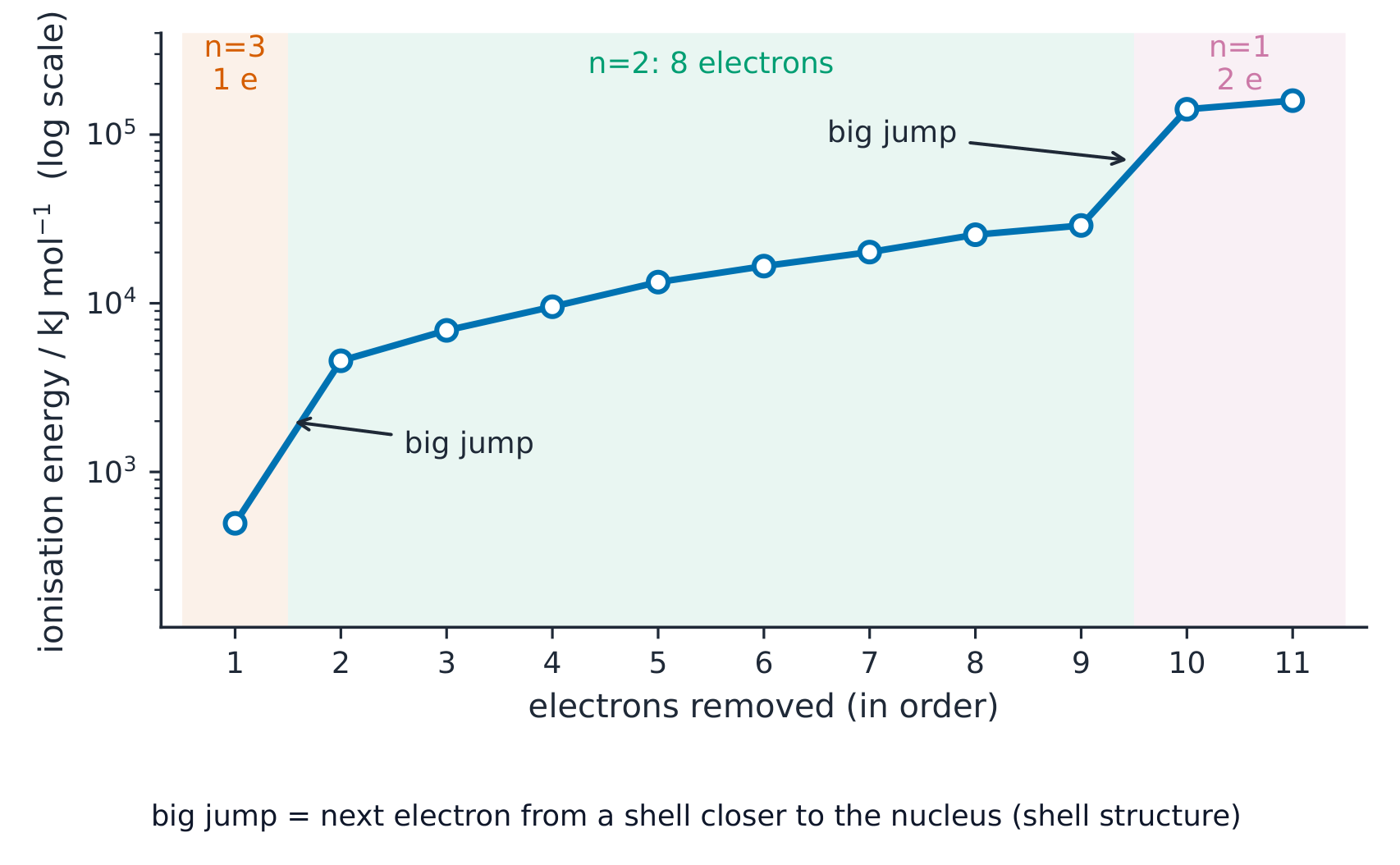
If you plot the successive ionisation energies of one element, the values rise, with big jumps at certain points. A big jump happens when the next electron must come from a shell closer to the nucleus.

Count how many electrons come off easily before the first big jump — that is the number of electrons in the outer shell, which tells you the group the element is in. You can also use the pattern to work out the electronic configuration and the position of the element in the Periodic Table.

Electrons removed before the first big jump Group
1 Group 1
2 Group 2
3 Group 13

Worked example. The first five successive ionisation energies of an element are $590$, $1150$, $4940$, $6480$ and $8120\ \text{kJ}\,\text{mol}^{-1}$. Which group is it in? Look for the big jump, not the biggest number. From the 1st to the 2nd the value roughly doubles, which is a normal rise. From the 2nd ($1150$) to the 3rd ($4940$) it more than quadruples: that is the jump. So two electrons come off easily before it, the outer shell holds 2 electrons, and the element is in Group 2. Count the electrons removed before the jump, and explain the jump properly: the next electron is being pulled from a shell closer to the nucleus, not from a different element.

ไทย

พลังงานไอออไนเซชันครั้งแรก

พลังงานไอออไนเซชันครั้งแรก (IE) คือพลังงานที่ต้องการในการดึงอิเล็กตรอนหนึ่งตัวออกจากอะตอมทั้งหมดในโมลของอะตอมแก๊ส เพื่อสร้างโมลของไอออน $+1$ แบบแก๊ส

เราใช้อะตอมในสถานะแก๊สเพื่อให้ไม่มีแรงระหว่างอนุภาค หน่วยคือ $\text{kJ mol}^{-1}$ หากเขียนเป็นสมการ สำหรับธาตุ X:

$$\text{X}(\text{g}) \rightarrow \text{X}^{+}(\text{g}) + \text{e}^{-}$$

$(\text{g})$ แสดงว่าสปีชีสนั้นอยู่ในสถานะแก๊ส

พลังงานไอออไนเซชันต่อเนื่อง

หลังจากถอดอิเล็กตรอนออกไปหนึ่งตัวแล้ว คุณสามารถถอดอีกได้ พลังงานไอออไนเซชันที่สองจะถอดอิเล็กตรอนหนึ่งตัวออกจาก $+1$ ไอออนแต่ละตัว:

$$\text{X}^{+}(\text{g}) \rightarrow \text{X}^{2+}(\text{g}) + \text{e}^{-}$$

คุณสามารถทำต่อไปได้อีก พลังงานเหล่านี้เรียกว่า พลังงานไอออไนเซชันต่อเนื่อง ค่าของแต่ละตัวมีค่ามากกว่าตัวก่อนหน้าเสมอ เนื่องจากอิเล็กตรอนถูกดึงออกจากไอออนที่มีประจุบวกมากขึ้นเรื่อยๆ

สิ่งที่พลังงานไอออไนเซชันขึ้นอยู่กับ

พลังงานไอออไนเซชันเกิดจากแรงดึงดูดระหว่างนิวเคลียสที่มีประจุบวกกับอิเล็กตรอนชั้นนอก ปัจจัยหลักสามอย่างกำหนดความแข็งแกร่งของแรงนี้:

  • ประจุนิวเคลียส: โปรตอน越多 ดึงอิเล็กตรอนแรงขึ้น ทำให้พลังงานไอออไนเซชันสูงขึ้น
  • รัศมีอะตอม: อิเล็กตรอนชั้นนอกอยู่ห่างจากนิวเคลียสมากเท่าไหร่ แรงดึงยิ่งอ่อนลง ทำให้พลังงานไอออไนเซชันต่ำลง
  • การป้องกัน (Shielding): ชั้นภายในบดบังแรงดึงต่ออิเล็กตรอนชั้นนอก บางชั้นภายใน越多 การป้องกัน越多 และพลังงานไอออไนเซชัน越低

ยังมีผลอื่นเล็กน้อยด้วย — แรงผลักของคู่สปิน (Spin-pair repulsion) เมื่ออิเล็กตรอนสองตัวอยู่ในออร์บิทัลเดียวกัน พวกมันจะผลักกันเล็กน้อย ทำให้ตัวหนึ่งถอดออกได้ง่ายกว่า

แนวโน้มของพลังงานไอออไนเซชันแรก

ข้ามคาบ พลังงานไอออไนเซชันแรกโดยทั่วไป เพิ่มขึ้น ประจุนิวเคลียสเพิ่มขึ้นในขณะที่การป้องกันคงที่เกือบเท่าเดิม ทำให้อิเล็กตรอนชั้นนอกถูกยึดเหนี่ยวแน่นขึ้น

ตามกลุ่ม พลังงานไอออไนเซชันแรก ลดลง ธาตุที่อยู่ด้านล่างมีชั้นอิเล็กตรอน越多 ดังนั้นการป้องกัน越多 และรัศมี越大 อิเล็กตรอนชั้นนอกจึงถอดออกได้ง่ายกว่า

จุดต่ำสุดเป็นหลักฐานของซับชัลล์

การเพิ่มขึ้นข้ามคาบไม่ราบรื่น มีจุดต่ำสุดเล็กๆ สองจุดที่คุณควรอธิบายได้ทั้งสองจุด:

  • กลุ่มที่ 2 ไปยังกลุ่มที่ 13 (เช่น Mg ถึง Al): อิเล็กตรอนที่ถูกถอดจาก Al มาจากซับชัลล์ 3p ซึ่งมีพลังงานสูงกว่าซับชัลล์ 3s ที่เต็มอยู่ใน Mg อิเล็กตรอน 3p ถอดออกง่ายกว่า ทำให้ค่าลดลง
  • กลุ่มที่ 15 ไปยังกลุ่มที่ 16 (เช่น P ถึง S): ใน S ออร์บิทัล 3p ตัวหนึ่งตอนนี้มีคู่อิเล็กตรอนอยู่ด้วย แรงผลักของคู่สปินทำให้ตัวหนึ่งถอดออกง่ายขึ้น ทำให้ค่าลดลง

จุดต่ำสุดเหล่านี้เป็นหลักฐานว่าซับชัลล์มีอยู่จริง

กราฟพลังงานไอออไนเซชันแรกข้ามคาบที่ 3 ซึ่งโดยรวมเพิ่มขึ้นแต่มีจุดต่ำสุดที่อะลูมิเนียมและกำมะถัน
พลังงานไอออไนเซชันแรกเพิ่มขึ้นข้ามคาบที่ 3 แต่มีจุดต่ำสุดที่ Al และ S — เป็นหลักฐานว่าซับชัลล์มีอยู่

พลังงานไอออไนเซชันต่อเนื่องเป็นหลักฐานของชั้นอิเล็กตรอน

หากคุณพล็อตพลังงานไอออไนเซชันต่อเนื่องของธาตุหนึ่ง ค่าจะเพิ่มขึ้น โดยมี การกระโดดใหญ่ ที่จุด tertentu การกระโดดใหญ่เกิดขึ้นเมื่ออิเล็กตรอนถัดไปต้องมาจากชั้นที่ใกล้กับนิวเคลียสมากขึ้น

นับจำนวนอิเล็กตรอนที่ถอดออกได้ง่ายก่อนการกระโดดใหญ่ครั้งแรก—that คือจำนวนอิเล็กตรอนในชั้นนอก ซึ่งบอกคุณถึง กลุ่ม ของธาตุนั้น คุณยังสามารถใช้รูปแบบนี้เพื่อหาการจัดเรียงอิเล็กตรอนและตำแหน่งของธาตุในตารางสารเคมีด้วย

กราฟสเกลลอการิทึมของพลังงานไอออไนเซชันต่อเนื่องทั้งสิบหนึ่งของโซเดียม ซึ่งมีการกระโดดใหญ่สองจุดแบ่งจุดข้อมูลออกเป็นกลุ่ม 1, 8 และ 2
พลังงานไอออไนเซชันต่อเนื่องของโซเดียม (สเกลลอการิทึม): การกระโดดใหญ่เผยให้เห็นโครงสร้างชั้น $2,8,1$
อิเล็กตรอนที่ถูกถอดออกก่อนการกระโดดใหญ่ครั้งแรก กลุ่ม
1 กลุ่มที่ 1
2 กลุ่มที่ 2
3 กลุ่มที่ 13

ตัวอย่างวิธีทำ พลังงานไอออไนเซชันต่อเนื่องห้าตัวแรกของธาตุหนึ่งคือ $590$, $1150$, $4940$, $6480$ และ $8120\ \text{kJ}\,\text{mol}^{-1}$ ธาตุนี้อยู่ในกลุ่มใด? ให้มองหา การกระโดดใหญ่ ไม่ใช่ตัวเลขที่ใหญ่ที่สุด จากตัวที่ 1 ไปตัวที่ 2 ค่าเพิ่มขึ้นประมาณสองเท่า ซึ่งเป็นปกติ จากตัวที่ 2 ($1150$) ไปตัวที่ 3 ($4940$) ค่าเพิ่มมากกว่าสี่เท่า: นั่นคือการกระโดด ดังนั้น สอง อิเล็กตรอนถูกถอดออกได้ง่ายก่อนการกระโดด ชั้นนอกมี 2 อิเล็กตรอน และธาตุนี้อยู่ใน กลุ่มที่ 2 นับจำนวนอิเล็กตรอนที่ถูกถอดออก ก่อน การกระโดด และอธิบายการกระโดดให้ถูกต้อง: อิเล็กตรอนถัดไปกำลังถูกดึงมาจากชั้นที่ ใกล้กับนิวเคลียสมากขึ้น ไม่ใช่จากธาตุอื่น

Explore · ⁨สำรวจ⁩

The ionisation-energy trend — and its dips · ⁨แนวโน้มพลังงานไอออนไนเซชัน — และจุดลดลง⁩

First ionisation energy generally rises across a period, but DIPS where a new p sub-shell starts and where a p-orbital pair first forms. Step across to find the two tell-tale dips. · ⁨พลังงานไอออนไนเซชันครั้งแรกโดยทั่วไปเพิ่มขึ้นตลอดช่วง แต่มีการลดลง (DIPS) เมื่อเริ่ม sub-shell p ใหม่และเมื่อเกิดคู่ในออร์บิตัล p ครั้งแรก ลากข้ามเพื่อหาจุดลดลงทั้งสองที่เป็นสัญญาณบอก⁩

Vocabulary · ⁨คำศัพท์⁩ Train · ⁨ฝึกฝน⁩
English ไทย
period/ˈpɪərɪəd/ รอบ
nuclear charge/ˈnjuːklɪə tʃɑːdʒ/ ประจุนิวเคลียส
shielding/ˈʃiːldɪŋ/ การป้องกันประจุ
group/ɡruːp/ กลุ่ม
cation/ˈkætaɪən/ แคทไอออน
anion/ˈænaɪən/ แอนไอออน
repulsion/rɪˈpʌlʃn/ แรงผลัก
spin/spɪn/ สปิน
sphere/sfɪə/ ทรงกลม
free radical/friː ˈrædɪkl/ free radical
unpaired electrons/ʌnˈpeəd ɪˈlektrɒnz/ อิเล็กตรอนคู่เดียว
first ionisation energy/fɜːst ˌaɪənaɪˈzeɪʃn ˈenədʒi/ พลังงานไอออไนเซชันแรก
successive ionisation energies/səkˈsesɪv ˌaɪənaɪˈzeɪʃn ˈenədʒiz/ พลังงานไอออไนเซชันต่อเนื่อง
spin-pair repulsion/spɪn peə rɪˈpʌlʃn/ แรงผลัดกันของสปินคู่
1.4

Exam tips · ⁨ข้อแนะนำสำหรับการสอบ⁩

English
  • Define isotopes in full: atoms of the same element with the same number of protons but a different number of neutrons — the mark scheme wants both halves.
  • 4s fills before 3d, but electrons are removed from 4s first when forming ions, so $\text{Fe}^{3+}$ is $[\text{Ar}]3\text{d}^5$ (not $[\text{Ar}]3\text{d}^3 4\text{s}^2$).
  • In successive ionisation energies, a big jump marks the start of a new (inner) shell — use the jumps to place the element in its group.
  • Explain every ionisation-energy trend with the same three factors: nuclear charge, distance and shielding, plus sub-shell effects for the small dips.
  • Learn the exact reason first ionisation energy of oxygen is below nitrogen: oxygen's paired 2p electrons repel, so one is easier to remove.
ไทย
  • นิยาม ไอโซโทป อย่างครบถ้วน: อะตอมของธาตุเดียวกันที่มีจำนวนโปรตอนเท่ากันแต่มีจำนวนนิวตรอนต่างกัน — แผนการให้คะแนนต้องการทั้งสองส่วน
  • 4s เติมเต็ม ก่อน 3d แต่อิเล็กตรอนจะถูก ดึงออกจาก 4s ก่อน เมื่อสร้างไอออน ดังนั้น $\text{Fe}^{3+}$ จึงเป็น $[\text{Ar}]3\text{d}^5$ (ไม่ใช่ $[\text{Ar}]3\text{d}^3 4\text{s}^2$).
  • ในพลังงานไอออไนเซชันต่อเนื่อง การกระโดดใหญ่ บ่งชี้เริ่มต้นของชั้นใหม่ (ชั้นใน) — ใช้การกระโดดเพื่อบอกตำแหน่งกลุ่มของธาตุ
  • อธิบายแนวโน้มทุกประการของพลังงานไอออไนเซชันด้วยปัจจัยสามอย่างเดียวกัน: ประจุนิวเคลียส, ระยะทาง และการป้องกัน plus ผลกระทบของซับชัลล์สำหรับจุดต่ำสุดเล็กๆ
  • จำเหตุผลที่พลังงานไอออไนเซชันแรกของออกซิเจน ต่ำกว่า ไนโตรเจนอย่างแม่นยำ: คู่อิเล็กตรอน 2p ของออกซิเจน ผลักกัน ทำให้ตัวหนึ่งถอดออกได้ง่ายกว่า

Interactive lessons on this topic · ⁨บทเรียนเชิงโต้ตอบสำหรับหัวข้อนี้⁩

Work through it step by step, with instant-check exercises. · ⁨ทำทีละขั้นตอน พร้อมแบบฝึกหัดตรวจสอบผลทันที⁩

Past Papers · ⁨ข้อสอบย้อนหลัง⁩

More topics in A-Level Chemistry · ⁨Chemistry A-Level⁩ · ⁨หัวข้อเพิ่มเติมใน A-Level Chemistry · ⁨Chemistry A-Level⁩⁩

Log in or create account · ⁨เข้าสู่ระบบหรือสร้างบัญชี⁩

IGCSE, A-Level & AP