Skip to content · ⁨ข้ามไปยังเนื้อหา⁩

Finance and accounting · ⁨การเงินและบัญชี⁩

A-Level Business · ⁨Business A-Level⁩ · Topic 5 · ⁨หัวข้อ 5⁩

Video lesson for this topic · ⁨บทเรียนวิดีโอสำหรับหัวข้อนี้⁩ Open the video page · ⁨เปิดหน้าวิดีโอ⁩
15:50

การเงินและบัญชี

ธุรกิจอาจมีกำไรแต่ยังล้มเหลวได้ นี่คือวิธีที่เกิดขึ้น คุณขายสินค้าเป็นมูลค่าหนึ่งแสนปอนด์แบบเครดิตในเดือนมีนาคม กำไรดูดีมาก แต่…

English narration · English + 中文 subtitles burned in · ⁨การบรรยายภาษาอังกฤษ · คำบรรยายภาษาอังกฤษ + 中文 ลอยตัวบนภาพ⁩

5.1

Why a business needs finance · ⁨ทำไมธุรกิจถึงต้องการเงินทุน⁩

Syllabus · ⁨หลักสูตร⁩
English
  1. explain the need for business finance (capital expenditure and revenue expenditure, working capital)
  2. distinguish the meaning of cash and profit
ไทย
  1. อธิบายความจำเป็นของ การเงินธุรกิจ (ค่าใช้จ่ายเพื่อลงทุน และ ค่าใช้จ่ายในการดำเนินงาน, เงินทุนหมุนเวียน)
  2. แยกแยะความหมายของ เงินสด และ กำไร

Source: Cambridge International syllabus · ⁨แหล่งที่มา: หลักสูตร Cambridge International⁩

English

Business finance 企业资金 is the money a firm needs to start, run and grow. A new firm needs money to buy premises 经营场所 and equipment; a growing firm needs money for new projects; and every firm needs money to pay day-to-day bills.

ไทย

การเงินธุรกิจ คือเงินที่บริษัทต้องการเพื่อเริ่ม, ดำเนินการ และเติบโต บริษัทใหม่ต้องการเงินเพื่อซื้อ สถานที่ และอุปกรณ์; บริษัทที่กำลังเติบโตต้องการเงินสำหรับโครงการใหม่; และทุกบริษัทต้องการเงินเพื่อชำระบิลรายวัน

อาคารสาขาธนาคารสมัยใหม่
ธนาคารเป็นแหล่งเงินทุนภายนอกที่สำคัญ主要通过 loans และ overdrafts.
Explore · ⁨สำรวจ⁩

Sources of finance lab · ⁨แหล่งเงินทุน⁩

Choose the best type of finance by time, risk and ownership. · ⁨เลือกประเภทเงินทุนที่ดีที่สุดตามระยะเวลา ความเสี่ยง และความเป็นเจ้าของ⁩

Vocabulary · ⁨คำศัพท์⁩ Train · ⁨ฝึกฝน⁩
English ไทย
loan/ləʊn/ สินเชื่อ
debenture/deˈbentʃə/ ตราสารหนี้
overdraft/ˈəʊvədræft/ เงินกู้เกินบัญชี
leasing/ˈliːsɪŋ/ การเช่า
hire purchase/ˈhaɪə ˈpɜːtʃɪs/ การซื้อผ่อนชำระ
trade credit/treɪd ˈkredɪt/ เครดิตการค้า
venture capital/ˈventʃə ˈkæpɪtl/ ทุน mạo風險
crowdfunding/ˈkraʊdfʌndɪŋ/ การระดมทุนจากประชาชน
microfinance/ˌmaɪkrəʊfaɪˈnæns/ microfinance
collateral/kəˈlætərəl/ ค้ำประกัน
5.1

Capital and revenue expenditure · ⁨การใช้จ่ายทุนและการใช้จ่ายรายวัน⁩

English

Spending falls into two types:

  • capital expenditure 资本性支出 — money spent on fixed assets 固定资产 that last a long time, such as machines, vehicles and buildings.
  • revenue expenditure 收益性支出 — money spent on day-to-day running, such as wages, rent and raw materials.
ไทย

การใช้จ่ายแบ่งออกเป็นสองประเภท:

การใช้จ่ายทุนซื้อ fixed assets ที่ทนนาน; การใช้จ่ายรายวันจ่ายค่า的运行 costs
Capital spending buys fixed assets; revenue spending covers running costs
  • การใช้จ่ายทุน — เงินที่ใช้ซื้อ fixed assets ที่ทนนาน เช่น เครื่องจักร, ยานพาหนะ และอาคาร
  • การใช้จ่ายรายวัน — เงินที่ใช้สำหรับการ运行รายวัน เช่น ค่าจ้าง, ค่าเช่า และวัตถุดิบ
Vocabulary · ⁨คำศัพท์⁩ Train · ⁨ฝึกฝน⁩
English ไทย
business finance/ˈbɪznəs ˈfaɪnæns/ การเงินธุรกิจ
premises/ˈpremɪsɪz/ สถานที่ประกอบกิจการ
capital expenditure/ˈkæpɪtl ekˈspendɪtʃə/ ต้นทุนการลงทุน (capital expenditure)
fixed assets/fɪkst ˈæsets/ สินทรัพย์ถาวร
revenue expenditure/ˈrevənjuː ekˈspendɪtʃə/ ค่าใช้จ่ายรายได้ (revenue expenditure)
cost/kɒst/ ต้นทุน
5.1

Working capital · ⁨ทุนหมุนเวียน⁩

English

Working capital 营运资本 is the money a firm has for its daily needs. It is found from the balance sheet 资产负债表:

$$\text{working capital} = \text{current assets} - \text{current liabilities}$$

Here current assets 流动资产 are things that become cash within a year (cash, inventory, money owed by customers), and current liabilities 流动负债 are debts due within a year. Too little working capital is dangerous — the firm may not be able to pay its bills.

ไทย

ทุนหมุนเวียน (Working capital) คือเงินที่บริษัทมีสำหรับความต้องการประจำวัน หาได้จาก งบดุล:

$$\text{working capital} = \text{current assets} - \text{current liabilities}$$

ในที่นี้ สินทรัพย์หมุนเวียน คือสิ่งที่แปลงเป็นเงินสดได้ในภายในหนึ่งปี (เงินสด, สินค้าคงเหลือ, ลูกหนี้การค้า) และ หนี้สินหมุนเวียน คือหนี้ที่ต้องชำระภายในหนึ่งปี หากเงินทุนหมุนเวียนน้อยเกินไปจะเป็นอันตราย — บริษัทอาจไม่สามารถชำระเงินบิลได้

เงินสดคือเงินทุนหมุนเวียน: บริษัทต้องการสินทรัพย์ที่สภาพคล่องเพียงพอเพื่อชำระบิลรายวัน
Vocabulary · ⁨คำศัพท์⁩ Train · ⁨ฝึกฝน⁩
English ไทย
working capital/ˈwɜːkɪŋ ˈkæpɪtl/ ทุนหมุนเวียน (working capital)
balance sheet/ˈbæləns ʃiːt/ งบดุล
current assets/ˈkʌrənt ˈæsets/ สินทรัพย์หมุนเวียน
current liabilities/ˈkʌrənt ˌlaɪəˈbɪlɪtiz/ หนี้สินหมุนเวียน
5.1

Cash is not the same as profit · ⁨เงินสดไม่เท่ากับกำไร⁩

English

This is a key idea.

  • profit 利润 is what is left when total costs are taken from total revenue over a period.
  • cash 现金 is the money the firm actually has right now to spend.

A firm can be profitable but still run out of cash — for example, if it sells goods but customers have not paid yet. Many firms fail not from low profit, but from running out of cash.

ไทย

นี่คือนิยามสำคัญ

  • กำไร คือสิ่งที่เหลืออยู่เมื่อหักต้นทุนรวมออกจากรายได้รวมในช่วงเวลาหนึ่ง
  • เงินสด คือเงินที่บริษัทมีอยู่ในปัจจุบันเพื่อใช้จ่ายจริง

บริษัทสามารถทำ กำไร ได้แต่ยังขาดเงินสด — ตัวอย่างเช่น หากขายสินค้าแต่ลูกค้ายังไม่ชำระเงิน หลายบริษัทล้มเหลวไม่ใช่เพราะกำไรต่ำ แต่เพราะเงินสดหมดมือ

กล่องสองใบสำหรับบริษัทเดียวกัน: กำไรทางบัญชีเป็นบวก แต่เงินสดในธนาคารต่ำเนื่องจากลูกค้ายังไม่ได้ชำระเงิน
กำไรและเงินสดต่างกัน: บริษัทอาจดูมีกำไรทางบัญชีแต่ไม่มีเงินสดชำระบิล — นี่คือเหตุผลที่ทำให้หลายบริษัทล้มเหลว
Vocabulary · ⁨คำศัพท์⁩ Train · ⁨ฝึกฝน⁩
English ไทย
profit/ˈprɒfɪt/ profit
cash/kæʃ/ เงินสด (cash)
internal sources/ɪnˈtɜːnl ˈsɔːsɪz/ แหล่งเงินทุนภายใน
external sources/ekˈstɜːnl ˈsɔːsɪz/ แหล่งเงินทุนภายนอก
short-term/ʃɔːt tɜːm/ ระยะสั้น
long-term/lɒŋ tɜːm/ ระยะยาว
retained profit/rɪˈteɪnd ˈprɒfɪt/ กำไรสะสม (retained profit)
sale of assets/seɪl ɒv ˈæsets/ การขายสินทรัพย์
5.2

Sources of finance · ⁨แหล่งเงินทุน⁩

Syllabus · ⁨หลักสูตร⁩
English
  1. describe internal and external, short- and long-term sources of finance (retained profit, sale of assets, share capital, loans, debentures, overdraft, leasing, hire purchase, trade credit, venture capital, crowdfunding, microfinance)
  2. explain the factors affecting the choice of source of finance
ไทย
  1. อธิบายแหล่งที่มาทางการเงินภายในและภายนอก ระยะสั้นและระยะยาว (กำไรคงเหลือ, การขายสินทรัพย์, ทุนตราสารหุ้น, หนี้สิน, พันธบัตร, การเกินวงเงิน, การเช่า, การซื้อผ่อนชำระ, เครดิตการค้า, ทุนความเสี่ยง, การระดมทุนจากสาธารณะ, การเงินขนาดเล็ก)
  2. อธิบายปัจจัยที่มีผลต่อการเลือกแหล่งที่มาทางการเงิน

Source: Cambridge International syllabus · ⁨แหล่งที่มา: หลักสูตร Cambridge International⁩

English

Finance can come from inside the business (internal sources 内部来源) or from outside (external sources 外部来源). It can also be short-term 短期 (paid back within a year) or long-term 长期.

Source Type What it is
retained profit 留存利润 internal, long profit kept in the business instead of paid out
sale of assets 出售资产 internal selling items the firm no longer needs
share capital 股本 external, long money raised by selling shares
loan 贷款 external, long borrowed money repaid with interest
debenture 公司债券 external, long a long-term loan certificate sold by a company
overdraft 透支 external, short the bank lets the account go below zero for a short time
leasing 租赁 external renting an asset instead of buying it
hire purchase 分期付款 external buying an asset by paying in instalments
trade credit 商业信用 external, short paying a supplier later (e.g. after 30 days)
venture capital 风险资本 external, long money from investors into risky young firms
crowdfunding 众筹 external small amounts raised from many people online
microfinance 小额信贷 external small loans for people with little access to banks
ไทย
พื้นที่ซื้อขายในตลาดหลักทรัพย์
ตลาดหลักทรัพย์: บริษัทจำกัดเปิดกว้างระดมทุนโดยการจำหน่ายหุ้น

เงินทุนสามารถมาจาก ภายใน ธุรกิจ (แหล่งภายใน) หรือจาก ภายนอก (แหล่งภายนอก) สามารถเป็น ระยะสั้น (ชำระคืนภายในหนึ่งปี) หรือ ระยะยาว

แหล่ง ประเภท คำอธิบาย
กำไรสะสม ภายใน, ยาว กำไรที่เก็บไว้ในธุรกิจแทนการจ่ายปันผล
การขายสินทรัพย์ ภายใน การขายสิ่งของที่บริษัทไม่ต้องการอีกต่อไป
เงินทุนหุ้น ภายนอก, ยาว เงินที่ได้จากการจำหน่ายหุ้น
เงินกู้ ภายนอก, ยาว เงินที่กู้มาและต้องคืนพร้อมดอกเบี้ย
ตั๋วหนี้ ภายนอก, ยาว บัตรแสดงหนี้ระยะยาวที่บริษัทออกจำหน่าย
บัญชีเกินวงเงิน ภายนอก, สั้น ธนาคารอนุญาตให้บัญชีมียอดติดลบได้ชั่วคราว
การเช่า ภายนอก การเช่าสินทรัพย์แทนการซื้อ
การซื้อผ่อนชำระ ภายนอก การซื้อสินทรัพย์ด้วยการชำระเป็นงวด
เครดิตการค้า ภายนอก, สั้น การชำระเงินผู้จัดจำหน่ายทีหลัง (เช่น หลัง 30 วัน)
เงินลงทุนความเสี่ยงสูง ภายนอก, ยาว เงินจากนักลงทุน投向บริษัท年轻的ที่มีความเสี่ยงสูง
การระดมทุนจากประชาชน ภายนอก การระดมเงินจำนวนเล็กน้อยจากผู้คนจำนวนมากผ่านออนไลน์
การเงินขนาดเล็ก ภายนอก กู้ยืมเงินจำนวนน้อยสำหรับผู้ที่มีโอกาสเข้าถึงธนาคารต่ำ
ต้นไม้แยกแหล่งเงินทุนออกเป็นภายใน (กำไรสะสม, การขายสินทรัพย์, เงินออมของเจ้าของ) และภายนอก (ทุนหุ้น, กู้เงิน, บัญชีเกิน limites, การเช่าซื้อ, เครดิตการค้า, การระดมทุนจากประชาชน)
แหล่งเงินทุนมาจากภายในธุรกิจ (ภายใน) หรือภายนอก (ภายนอก)
Explore · ⁨สำรวจ⁩

Sources of finance lab · ⁨แหล่งเงินทุน⁩

Choose the best type of finance by time, risk and ownership. · ⁨เลือกประเภทเงินทุนที่ดีที่สุดตามระยะเวลา ความเสี่ยง และความเป็นเจ้าของ⁩

Vocabulary · ⁨คำศัพท์⁩ Train · ⁨ฝึกฝน⁩
English ไทย
share capital/ʃeə ˈkæpɪtl/ ทุนหุ้น (share capital)
5.2

Choosing a source of finance · ⁨การเลือกแหล่งเงินทุน⁩

English

There is no single best source. The choice depends on:

  • the amount needed — large amounts may need shares or a long loan.
  • the purpose — long-term assets should use long-term finance.
  • the cost — interest and fees differ between sources.
  • the legal structure — only a company can sell shares.
  • how much the firm already owes, and whether it can offer collateral 抵押品 (an asset the lender can take if the loan is not repaid).
ไทย

ไม่มีแหล่งที่ดีที่สุดเพียงแห่งเดียว การเลือกขึ้นอยู่กับ:

  • จำนวนเงิน ที่ต้องการ — จำนวนมากอาจต้องใช้การออกหุ้นหรือกู้ยืมระยะยาว
  • วัตถุประสงค์ — สินทรัพย์ระยะยาวควรใช้แหล่งเงินทุนระยะยาว
  • ต้นทุน — อัตราดอกเบี้ยและค่าธรรมเนียมแตกต่างกันไปตามแหล่งเงินทุน
  • โครงสร้างทางกฎหมาย — มีเพียงบริษัทเท่านั้นที่ออกหุ้นขายได้
  • ว่ากิจการมีหนี้สินอยู่เท่าไหร่ และสามารถนำ ประกัน (สินทรัพย์ที่เจ้าหนี้ยึดได้หากไม่ชำระคืน) มาวางค้ำประกันได้หรือไม่
จับคู่แหล่งเงินทุนกับวัตถุประสงค์: ความต้องการระยะสั้นเช่นสต็อก ใช้เงินทุนระยะสั้นเช่นบัญชีเกินWithdrawl, ส่วนสินทรัพย์ระยะยาวเช่นเครื่องจักร ใช้เงินทุนระยะยาวเช่นกู้ยืมหรือออกหุ้น
จับคู่แหล่งเงินทุนกับวัตถุประสงค์: ความต้องการระยะสั้นใช้เงินทุนระยะสั้น, สินทรัพย์ระยะยาวใช้เงินทุนระยะยาว
5.3

Cash-flow forecasts · ⁨การคาดการณ์กระแสเงินสด⁩

Syllabus · ⁨หลักสูตร⁩
English
  1. construct and interpret a cash-flow forecast and explain the causes of cash-flow problems
  2. explain methods of improving cash flow and the importance of working capital management
ไทย
  1. สร้างและตีความ การคาดการณ์กระแสเงินสด และอธิบายสาเหตุของปัญหากระแสเงินสด
  2. อธิบายวิธีการปรับปรุงกระแสเงินสดและความสำคัญของการจัดการเงินทุนหมุนเวียน

Source: Cambridge International syllabus · ⁨แหล่งที่มา: หลักสูตร Cambridge International⁩

English
Cash-flow forecast

A cash-flow forecast 现金流量预测 predicts the cash coming in and going out each month. It helps a firm spot a shortage early.

  • cash inflows 现金流入 — money coming in, mostly from sales.
  • cash outflows 现金流出 — money going out, such as wages and rent.
  • net cash flow 净现金流 — inflows minus outflows for the period.
$$\text{net cash flow} = \text{cash inflows} - \text{cash outflows}$$

The opening balance 期初余额 is the cash at the start of the month. Adding net cash flow gives the closing balance 期末余额, which becomes next month's opening balance.

ไทย
การคาดการณ์กระแสเงินสด

การคาดการณ์กระแสเงินสด ทำนายกระแสเงินสดที่ไหลเข้าและไหลออกรายเดือน ช่วยให้องค์กรตรวจจับปัญหาขาดแคลนได้แต่เนิ่นๆ

  • กระแสเงินสดขาเข้า — เงินที่ไหลเข้า ส่วนใหญ่มาจากการขายสินค้า
  • กระแสเงินสดขาออก — เงินที่ไหลออก เช่น ค่าจ้างและค่าเช่า
  • กระแสเงินสดสุทธิ — กระแสเงินสดขาเข้าลบด้วยกระแสเงินสดขาออกสำหรับช่วงเวลานั้น
$$\text{net cash flow} = \text{cash inflows} - \text{cash outflows}$$

ยอดเปิด คือเงินสดต้นเดือน เมื่อบวกด้วยกระแสเงินสดสุทธิจะได้ ยอดปิด ซึ่งจะเป็นยอดเปิดของเดือนถัดไป

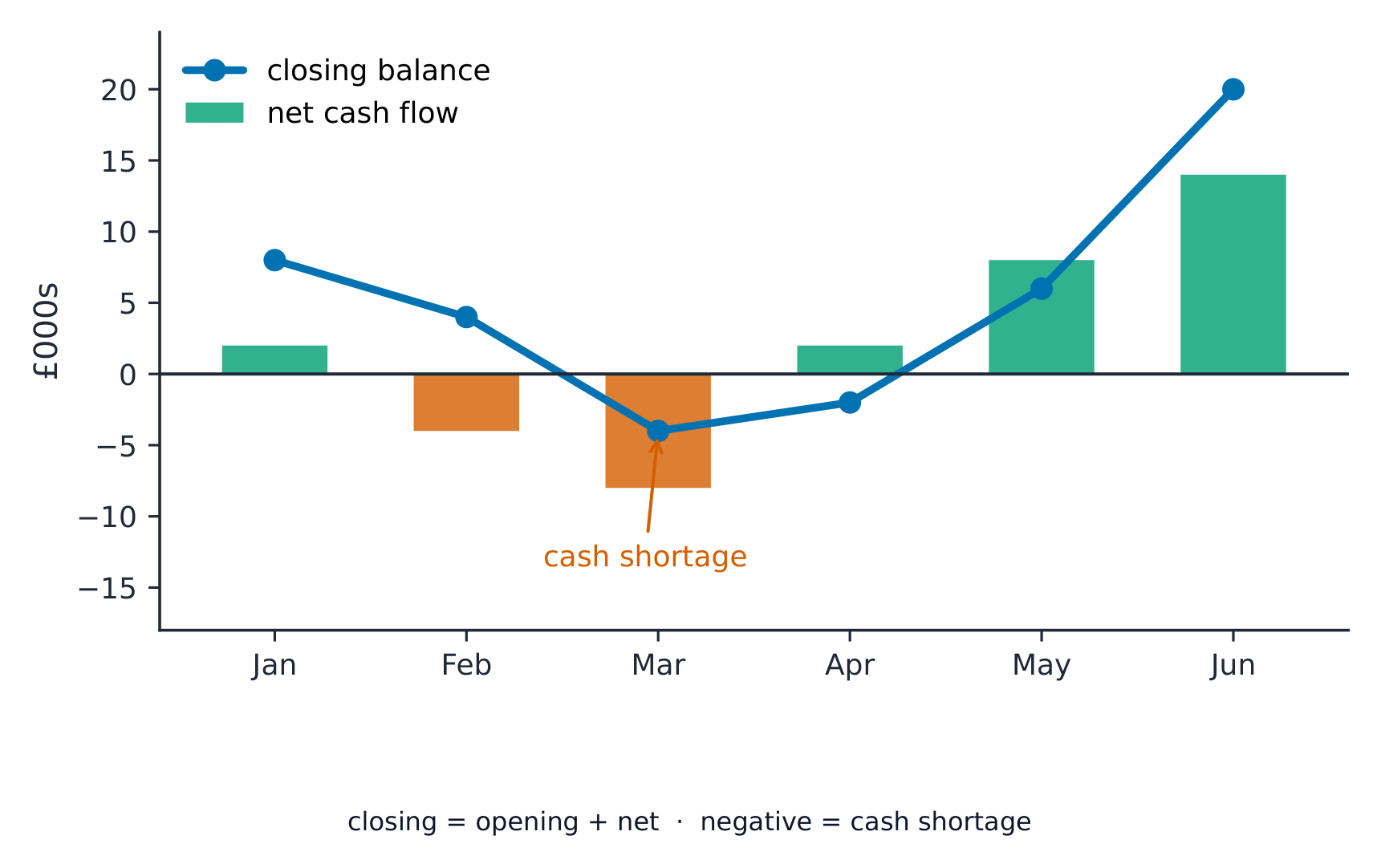
แผนภูมิการคาดการณ์กระแสเงินสด: แท่งกราฟกระแสเงินสดสุทธิรายเดือน (สีเขียวเมื่อเป็นบวก สีส้มเมื่อเป็นลบ) และเส้นยอดปิดที่ลดลงต่ำกว่าศูนย์เข้าสู่ภาวะขาดแคลนเงินสดก่อนจะฟื้นตัว
การคาดการณ์กระแสเงินสดติดตามยอดปิดรายเดือน เตือนเรื่องความขาดแคลนตั้งแต่เนิ่นๆ
Explore · ⁨สำรวจ⁩

A cash-flow forecast · ⁨การทำนายกระแสเงินสด (A cash-flow forecast)⁩

A cash-flow forecast tracks money in and out each month — to spot a shortfall before it happens. · ⁨การทำนายกระแสเงินสดติดตามเงินเข้าและออกแต่ละเดือน เพื่อระบุช่องว่างก่อนเกิดขึ้น⁩

Vocabulary · ⁨คำศัพท์⁩ Train · ⁨ฝึกฝน⁩
English ไทย
cash-flow forecast/kæʃ fləʊ ˈfɔːkæst/ คาดการณ์กระแสเงินสด
cash inflows/kæʃ ˈɪnfləʊz/ กระแสเงินสดเข้า
cash outflows/kæʃ aʊtˈfləʊz/ กระแสเงินสดออก
net cash flow/net kæʃ fləʊ/ กระแสเงินสดสุทธิ
opening balance/ˈəʊpənɪŋ ˈbæləns/ ยอดเริ่มต้น
closing balance/ˈkləʊzɪŋ ˈbæləns/ ยอดปิด
overtrading/ˌəʊvəˈtreɪdɪŋ/ การซื้อขายที่เกินกำลัง
Watch lesson · ⁨ดูบทเรียน⁩
5.3

Cash-flow problems and how to fix them · ⁨ปัญหากระแสเงินสดและวิธีแก้ไข⁩

English

Common causes of cash-flow problems are: too many sales on credit, holding too much stock, buying too many assets at once, and overtrading 过度交易 (growing too fast for the cash available).

Ways to improve cash flow:

  • bring cash in sooner — ask customers to pay faster, or offer discounts for quick payment.
  • delay cash going out — agree longer trade credit with suppliers.
  • arrange an overdraft or short loan to cover a gap.
  • hold less stock to free up cash.

Good working capital management keeps enough cash to stay safe without holding so much that money sits idle.

ไทย

สาเหตุทั่วไปของปัญหากระแสเงินสด ได้แก่ การขายบนเครดิตมากเกินไป, การถือสต็อกมากเกินไป, การซื้อสินทรัพย์จำนวนมากพร้อมกัน และ การซื้อขายที่มากเกินไป (ขยายตัวเร็วเกินกว่าเงินสดที่มี)

วิธีการปรับปรุงกระแสเงินสด:

  • นำเงินสดเข้ามาเร็วขึ้น — ขอให้ลูกค้าชำระเงินเร็วขึ้น หรือเสนอส่วนลดสำหรับการชำระที่รวดเร็ว
  • ชะลอการจ่ายเงินสดออก — ยอมรับเงื่อนไขเครดิตการค้าที่ยาวนานขึ้นกับผู้จัดจำหน่าย
  • จัดการสินเชื่อเกินบัญชีหรือเงินกู้ระยะสั้นเพื่อปิดช่องว่างทางการเงิน
  • ลดปริมาณสินค้าคงเหลือเพื่อปลดล็อกเงินสดออกมาใช้

การบริหารจัดการทุนหมุนเวียนที่ดีจะรักษาเงินสดให้เพียงพอต่อความปลอดภัยโดยไม่เก็บสะสมมากเกินไปจนเงินนิ่งและไม่ได้สร้างผลตอบแทน

Explore · ⁨สำรวจ⁩

Cash-flow forecast lab · ⁨ห้องปฏิบัติการคาดการณ์กระแสเงินสด⁩

Drag the monthly cash in, cash out and the one-off purchase — find the month that closes in the red, then fix it before it happens. · ⁨ลากเงินสดเข้าออกรายเดือนและการซื้อครั้งเดียว — หาเดือนที่ปิดบัญชีเป็นลบ แล้วแก้ไขก่อนเกิด⁩

5.4

Costs and how we classify them · ⁨ค่าใช้จ่ายและการจำแนกประเภท⁩

Syllabus · ⁨หลักสูตร⁩
English
  1. classify costs (fixed, variable, direct, indirect, marginal, average) and use cost information for decision-making
  2. construct and interpret break-even analysis (break-even point, margin of safety, contribution) and explain its limitations
ไทย
  1. จำแนกประเภทต้นทุน (ต้นทุนคงที่, ต้นทุนแปรผัน, ต้นทุนโดยตรง, ต้นทุนทางอ้อม, ต้นทุนส่วนเพิ่ม, ต้นทุนเฉลี่ย) และใช้ข้อมูลต้นทุนในการตัดสินใจ
  2. สร้างและตีความ การวิเคราะห์จุดคุ้มทุน (จุดคุ้มทุน, ส่วนต่างความปลอดภัย, ส่วนเพิ่ม) และอธิบายข้อจำกัด

Source: Cambridge International syllabus · ⁨แหล่งที่มา: หลักสูตร Cambridge International⁩

English
Break-even analysis, built line by line

A cost 成本 is money the business spends to make its product. We sort costs in several ways:

  • fixed costs 固定成本 — costs that do not change with output, such as rent.
  • variable costs 可变成本 — costs that rise and fall with output, such as raw materials.
  • direct costs 直接成本 — costs clearly linked to one product, such as its materials.
  • indirect costs 间接成本 (overheads) — costs not linked to one product, such as manager salaries.
  • marginal cost 边际成本 — the cost of making one more unit.
  • average cost 平均成本 — the cost per unit, found by total cost ÷ number of units.

Cost information helps managers set prices, choose what to make, and control spending.

ไทย
การวิเคราะห์จุดคุ้มทุน สร้างทีละบรรทัด

ค่าใช้จ่ายคือเงินที่ธุรกิจจ่ายไปเพื่อผลิตสินค้า เราสามารถจำแนกค่าใช้จ่ายได้หลายรูปแบบ:

  • ค่าใช้จ่ายคงที่ — ค่าใช้จ่ายที่ไม่เปลี่ยนแปลงตามระดับการผลิต เช่น ค่าเช่า
  • ค่าใช้จ่ายแปรผัน — ค่าใช้จ่ายที่เพิ่มขึ้นหรือลดลงตามระดับการผลิต เช่น วัตถุดิบ
  • ต้นทุนโดยตรง (direct costs) — ต้นทุนที่เชื่อมโยงกับผลิตภัณฑ์หนึ่งอย่างชัดเจน เช่น วัตถุดิบของผลิตภัณฑ์นั้น
  • ต้นทุนทางอ้อม (indirect costs) หรือ Overheads — ต้นทุนที่ไม่ได้เชื่อมโยงกับผลิตภัณฑ์เพียงตัวเดียว เช่น ค่าตอบแทนผู้บริหาร
  • ต้นทุนส่วนเพิ่ม (marginal cost) — ต้นทุนในการผลิตสินค้าอีกหนึ่งหน่วย
  • ต้นทุนเฉลี่ย (average cost) — ต้นทุนต่อหน่วย ซึ่งคำนวณได้จาก总成本 ÷ จำนวนหน่วยผลิต
กราฟพฤติกรรมต้นทุน: ต้นทุนคงที่แสดงเป็นเส้นราบ, ต้นทุนแปรผันเพิ่มขึ้นจากจุดศูนย์, และต้นทุนรวมวิ่งขนานกันอยู่เหนือต้นทุนแปรผัน โดยห่างกันด้วยระยะเท่าต้นทุนคงที่
ต้นทุนรวม = ต้นทุนคงที่ + ต้นทุนแปรผัน; มีเฉพาะต้นทุนแปรผันเท่านั้นที่เพิ่มขึ้นตามปริมาณการผลิต

ข้อมูลด้านต้นทุนช่วยผู้บริหารกำหนดราคา เลือกผลผลิตที่จะผลิต และควบคุมการใช้จ่าย

Explore · ⁨สำรวจ⁩

Costs · ⁨ต้นทุน (Costs)⁩

y = ax + b

Total cost = fixed cost (intercept) + variable cost per unit (gradient). · ⁨ต้นทุนรวม = ต้นทุนคงที่ (intercept) + ต้นทุนแปรผัน ต่อหน่วย (gradient).⁩

Vocabulary · ⁨คำศัพท์⁩ Train · ⁨ฝึกฝน⁩
English ไทย
direct costs/daɪˈrekt kɒsts/ ต้นทุนโดยตรง
indirect costs/ɪndaɪˈrekt kɒsts/ ต้นทุนทางอ้อม
marginal cost/ˈmɑːdʒɪnl kɒst/ ต้นทุน边际 (marginal cost)
average cost/ˈævrɪdʒ kɒst/ ต้นทุนเฉลี่ย
break-even/breɪk ˈiːvən/ จุดคุ้มทุน
Watch lesson · ⁨ดูบทเรียน⁩
5.4

Break-even analysis · ⁨การวิเคราะห์จุดคุ้มทุน⁩

English

Contribution 贡献 is how much each sale adds towards paying the fixed costs:

$$\text{contribution per unit} = \text{selling price} - \text{variable cost per unit}$$

Break-even 盈亏平衡 is the point where total revenue equals total costs, so profit is zero. The break-even point 盈亏平衡点 in units is:

$$\text{break-even point} = \frac{\text{fixed costs}}{\text{contribution per unit}}$$

The margin of safety 安全边际 is how far current sales are above the break-even point:

$$\text{margin of safety} = \text{actual output} - \text{break-even output}$$

Worked example. A product sells for £20 with a variable cost of £12 per unit. Fixed costs are £40,000, and the firm makes 6,000 units. Find the contribution per unit, the break-even output and the margin of safety.

$$\text{contribution per unit} = \text{\pounds} 20 - \text{\pounds} 12 = \text{\pounds} 8$$
$$\text{break-even point} = \frac{\text{\pounds} 40\,000}{\text{\pounds} 8} = 5\,000 \text{ units}$$
$$\text{margin of safety} = 6\,000 - 5\,000 = 1\,000 \text{ units}$$

A large margin of safety means sales can fall a lot before the firm makes a loss. Break-even analysis is quick and useful, but it has limitations 局限性: it assumes the selling price and costs stay the same, and that everything made is sold.

ไทย

ส่วนต่าง (Contribution) คือจำนวนเงินที่แต่ละการขายเพิ่มเข้ามาเพื่อชำระค่าต้นทุนคงที่:

$$\text{contribution per unit} = \text{selling price} - \text{variable cost per unit}$$

จุดคุ้มทุน (Break-even) คือจุดที่รายได้รวมเท่ากับต้นทุนรวม ดังนั้นกำไรจะเป็นศูนย์ จุดคุ้มทุน ในเชิงจำนวนหน่วยคือ:

$$\text{break-even point} = \frac{\text{fixed costs}}{\text{contribution per unit}}$$
กราฟจุดคุ้มทุนที่มีเส้นรายได้รวมตัดกับเส้นต้นทุนรวมที่จุดคุ้มทุน; มีโซนขาดทุนอยู่ทางซ้ายและโซนกำไรอยู่ทางขวา ซึ่งอยู่เหนือเส้นต้นทุนคงที่แนวนอน
จุดคุ้มทุนคือจุดที่รายได้รวมเท่ากับต้นทุนรวม — ทางซ้ายของจุดนี้คือขาดทุน ทางขวาคือกำไร

ส่วนเกินความปลอดภัย (margin of safety) คือระยะห่างระหว่างยอดขายปัจจุบันกับจุดคุ้มทุน:

$$\text{margin of safety} = \text{actual output} - \text{break-even output}$$

ตัวอย่างวิธีทำ. สินค้าขายได้ในราคา£20 และมีต้นทุนแปรผัน£12 ต่อหน่วย ต้นทุนคงที่อยู่ที่£40,000 และบริษัทผลิตได้6,000 หน่วย จงหาส่วนต่างต่อหน่วย จุดคุ้มทุน และส่วนเกินความปลอดภัย

$$\text{contribution per unit} = \text{\pounds} 20 - \text{\pounds} 12 = \text{\pounds} 8$$
$$\text{break-even point} = \frac{\text{\pounds} 40\,000}{\text{\pounds} 8} = 5\,000 \text{ units}$$
$$\text{margin of safety} = 6\,000 - 5\,000 = 1\,000 \text{ units}$$

ส่วนเกินความปลอดภัยที่สูงหมายความว่ายอดขายสามารถลดลงได้มากก่อนที่บริษัทจะเกิดขาดทุน การวิเคราะห์จุดคุ้มทุนทำได้รวดเร็วและมีประโยชน์ แต่มี ข้อจำกัด: สมมติว่าราคาขายและต้นทุนคงที่ และการผลิตทั้งหมดถูกขายหมด

Explore · ⁨สำรวจ⁩

Break-even chart · ⁨แผนภูมิจุดคุ้มทุน (Break-even chart)⁩

Add a revenue line to the fixed-cost and total-cost lines. Where revenue meets total cost is the break-even point; beyond it the firm makes a profit. · ⁨เพิ่มเส้นรายได้ลงในเส้นต้นทุนคงที่และต้นทุนรวม จุดที่รายได้ตัดกับต้นทุนรวมคือจุดคุ้มทุน; เกินจากนั้นบริษัทจะได้กำไร⁩

Explore · ⁨สำรวจ⁩

Break-even analysis · ⁨การวิเคราะห์จุดคุ้มทุน (Break-even analysis)⁩

Break-even is where total revenue crosses total cost. · ⁨จุดคุ้มทุน คือจุดที่ รายได้ รวมตัดกับ ต้นทุน รวม⁩

Vocabulary · ⁨คำศัพท์⁩ Train · ⁨ฝึกฝน⁩
English ไทย
fixed costs/fɪkst kɒsts/ ต้นทุนคงที่
variable costs/ˈveərɪəbl kɒsts/ ต้นทุนแปรผัน
contribution/ˌkɒntrɪˈbjuːʃn/ ส่วนร่วม
break-even point/breɪk ˈiːvən pɔɪnt/ จุดคุ้มทุน
margin of safety/ˈmɑːdʒɪn ɒv ˈseɪfti/ ระยะปลอดภัย
limitations/ˌlɪmɪˈteɪʃnz/ ข้อจำกัด
5.5

Budgets and variances · ⁨งบประมาณและส่วนต่าง⁩

Syllabus · ⁨หลักสูตร⁩
English
  1. explain the purpose of budgets and types of budget (incremental, zero-based)
  2. calculate and interpret variances (favourable and adverse) using variance analysis
ไทย
  1. อธิบายวัตถุประสงค์ของ งบประมาณ และประเภทของงบประมาณ (แบบเพิ่มทีละน้อย, แบบฐานศูนย์)
  2. คำนวณและตีความ ความเบี่ยงเบน (เป็นประโยชน์และเป็นผลเสีย) โดยใช้ การวิเคราะห์ความเบี่ยงเบน

Source: Cambridge International syllabus · ⁨แหล่งที่มา: หลักสูตร Cambridge International⁩

English

A budget 预算 is a financial plan for the future — a target for income or spending. Budgets help a firm plan, control money, and check performance. Two types are:

  • incremental budget 增量预算 — last year's budget changed by a small amount.
  • zero-based budget 零基预算 — every cost must be explained from zero each year.

A variance 差异 is the difference between the budgeted figure and the actual figure:

$$\text{variance} = \text{actual figure} - \text{budgeted figure}$$

Worked example. A firm budgeted £30,000 for wages but actually spent £34,000. Find the variance and say whether it is favourable or adverse.

$$\text{variance} = \text{\pounds} 34\,000 - \text{\pounds} 30\,000 = \text{\pounds} 4\,000$$

Costs came in higher than planned, so this is an adverse variance.

  • a favourable variance 有利差异 is better for profit (costs lower, or revenue higher, than planned).
  • an adverse variance 不利差异 is worse for profit (costs higher, or revenue lower, than planned).

Studying variances shows managers where the plan went wrong, so they can act.

ไทย

งบประมาณ (Budget) คือแผนการเงินสำหรับอนาคต — เป้าหมายสำหรับรายได้หรือการใช้จ่าย งบประมาณช่วยให้บริษัทวางแผน ควบคุมเงินทุน และประเมินผลงาน ประเภทสองประเภทคือ:

  • งบประมาณแบบเพิ่มทีละน้อย (incremental budget) — งบประมาณปีที่แล้วที่ปรับเพิ่ม/ลดไปเล็กน้อย
  • งบประมาณแบบเริ่มต้นใหม่ (zero-based budget) — ทุกค่าใช้จ่ายต้องอธิบายเหตุผลตั้งแต่ศูนย์ทุกปี

ส่วนต่าง (Variance) คือความแตกต่างระหว่างตัวเลขในงบประมาณกับตัวเลขจริง:

$$\text{variance} = \text{actual figure} - \text{budgeted figure}$$
ความเบี่ยงเบนคือ ค่าจริงลบด้วยงบประมาณ: บริษัทตั้งงบประมาณ 30,000 ปอนด์แต่ใช้จริง 34,000 ทำให้เกิดความเบี่ยงเบนบวก 4,000 ซึ่งเป็นผลเสียเพราะกระทบต่อกำไร
ส่วนต่างคือจริงลบงบประมาณ; ส่วนต่างที่เป็นผลดีช่วยกำไร ส่วนต่างที่เป็นผลเสียทำลายกำไร

ตัวอย่างวิธีทำ. บริษัทตั้งงบประมาณค่าจ้างไว้£30,000 แต่ใช้จริง£34,000 จงหาส่วนต่างและระบุว่าส่วนต่างนี้เป็นผลดีหรือผลเสีย

$$\text{variance} = \text{\pounds} 34\,000 - \text{\pounds} 30\,000 = \text{\pounds} 4\,000$$

ต้นทุนสูงกว่าที่วางแผนไว้ ดังนั้นจึงเป็นส่วนต่างที่เป็นผลเสีย

  • ส่วนต่างที่เป็นผลดี (favourable variance) ดีต่อกำไร (ต้นทุนต่ำกว่า หรือ รายได้สูงกว่า ที่วางแผนไว้)
  • ส่วนต่างที่เป็นผลเสีย (adverse variance) เสร็จต่อกำไร (ต้นทุนสูงกว่า หรือ รายได้น้อยกว่า ที่วางแผนไว้)

การศึกษาส่วนต่างช่วยให้ผู้บริหารเห็นจุดที่แผนล้มเหลว เพื่อจะได้ corrective action ได้

กราฟแท่งเปรียบเทียบงบประมาณกับค่าจริง: ความเบี่ยงเบนที่เป็นประโยชน์และเป็นผลเสียในต้นทุนและรายได้
ส่วนต่าง = จริง − งบประมาณ: การใช้จ่ายเกินงบด้านต้นทุนถือเป็นส่วนต่างที่เป็นผลเสีย; การได้รับรายได้เกินงบถือเป็นส่วนต่างที่เป็นผลดี
Explore · ⁨สำรวจ⁩

Budget control cycle · ⁨วงจรการควบคุมงบประมาณ⁩

Follow how a budget becomes a control system, not just a number. · ⁨ดูว่างบประมาณกลายเป็นระบบควบคุมได้อย่างไร ไม่ใช่แค่ตัวเลข⁩

Vocabulary · ⁨คำศัพท์⁩ Train · ⁨ฝึกฝน⁩
English ไทย
budget/ˈbʌdʒɪt/ งบประมาณ
incremental budget/ˌɪŋkrɪˈmentl ˈbʌdʒɪt/ งบประมาณแบบเพิ่มทีละน้อย
zero-based budget/ˈzɪərəʊ beɪst ˈbʌdʒɪt/ งบประมาณแบบฐานศูนย์
variance/ˈveərɪəns/ ความแปรปรวน
favourable variance/ˈfeɪvərəbl ˈveərɪəns/ ส่วนต่างเชิงบวก
adverse variance/ædˈvɜːs ˈveərɪəns/ ส่วนต่างเชิงลบ
5.5

Exam tips · ⁨ข้อแนะนำสำหรับการสอบ⁩

English
  • Show that cash is not profit — a profitable firm can still fail from a cash-flow shortage.
  • For break-even: contribution per unit $=$ price $-$ variable cost; break-even $=$ fixed costs $\div$ contribution; margin of safety $=$ actual $-$ break-even output.
  • Match a source of finance to the need (short-term for cash flow, long-term or equity for assets) and to the type of business.
  • Calculate a variance and label it favourable or adverse (actual against budget).
ไทย
  • แสดงให้เห็นว่า เงินสดไม่ใช่กำไร — บริษัทที่มีกำไรก็อาจล้มละลายได้จากปัญหากระแสเงินสด
  • สำหรับ จุดคุ้มทุน: ส่วนต่างต่อหน่วย $=$ ราคา $-$ ต้นทุนแปรผัน; จุดคุ้มทุน $=$ ต้นทุนคงที่ $\div$ ส่วนต่าง; ส่วนเกินความปลอดภัย $=$ จริง $-$ จุดคุ้มทุน
  • จับคู่ แหล่งเงินทุน กับความต้องการ (ระยะสั้นสำหรับกระแสเงินสด, ระยะยาวหรือหุ้นส่วนทุนสำหรับสินทรัพย์) และกับประเภทธุรกิจ
  • คำนวณ ส่วนต่าง และระบุว่าเป็น ส่วนต่างที่เป็นผลดีหรือผลเสีย (เปรียบเทียบระหว่างจริงกับงบประมาณ)

Interactive lessons on this topic · ⁨บทเรียนเชิงโต้ตอบสำหรับหัวข้อนี้⁩

Work through it step by step, with instant-check exercises. · ⁨ทำทีละขั้นตอน พร้อมแบบฝึกหัดตรวจสอบผลทันที⁩

Past Papers · ⁨ข้อสอบย้อนหลัง⁩

More topics in A-Level Business · ⁨Business A-Level⁩ · ⁨หัวข้อเพิ่มเติมใน A-Level Business · ⁨Business A-Level⁩⁩

Log in or create account · ⁨เข้าสู่ระบบหรือสร้างบัญชี⁩

IGCSE, A-Level & AP