Costs
Introduced| English | Meaning |
|---|---|
| variable costs/ˈveərɪəbl kɒsts/ | Costs that change as the level of output changes. |
| fixed costs/fɪkst kɒsts/ | Costs that do not change with output over the relevant period and production range. |
| output/ˈaʊtpʊt/ | The goods, services or other results produced by an activity or production process. |
| raw materials/rɔː məˈtɪərɪəlz/ | Basic substances used as inputs in making products. |
| total cost/ˈtəʊtl kɒst/ | The sum of all costs of producing a given level of output, including fixed and variable costs. |
| marginal cost/ˈmɑːdʒɪnl kɒst/ | The additional total cost of producing one more unit of output. |
| average cost/ˈævrɪdʒ kɒst/ | Total production cost divided by the quantity produced. |
What does it cost to make?
- Before a firm can price, budget or judge profit, it must understand its costs — and not all costs behave the same way.
- Some stay flat; others rise with every unit made.
Which is a fixed cost?
Difficulty 1/5 · 100 coins + a small bonus on first completion today
Rent does not change with output — a fixed cost.
Fixed cost 500, variable cost 4 per unit, output 200. What is total cost?
Difficulty 2/5 · 140 coins + a small bonus on first completion today
TC = 500 + 4 × 200 = 1300.
Total cost equals fixed cost plus ______ cost.
Difficulty 1/5 · 100 coins + a small bonus on first completion today
TC = FC + VC.
Fixed and variable costs 可变成本
- Fixed costs 固定成本 don't change with output 产出: rent, salaries, insurance.
- Variable costs rise with output: raw materials 原材料, piece-rate wages, power.
- Total cost 总成本 = fixed + variable costs.
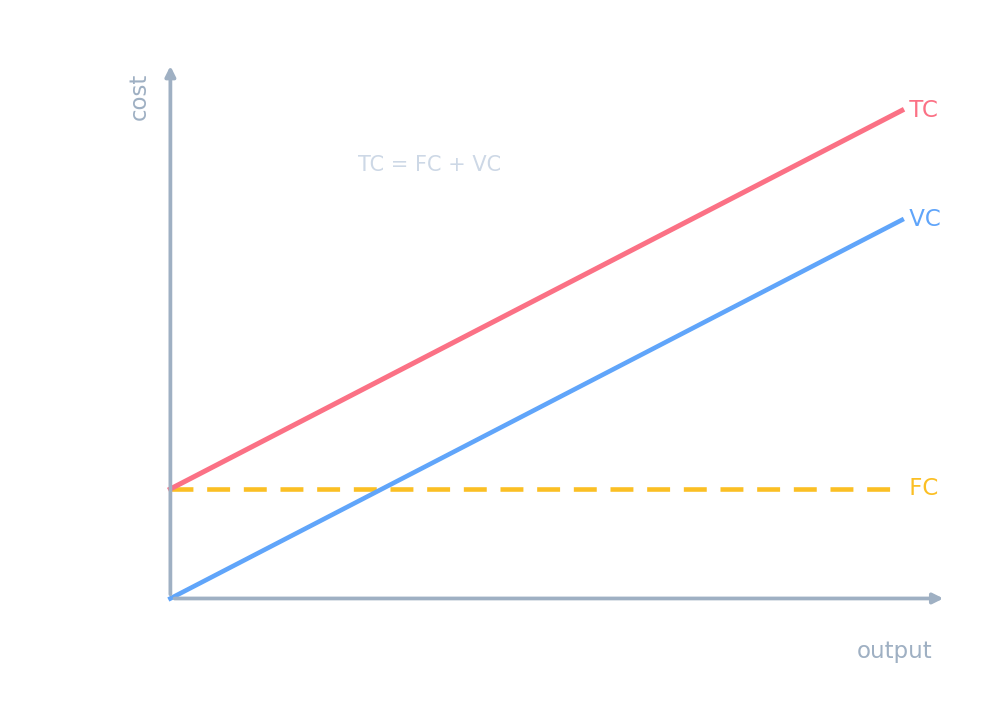
Total cost is fixed cost plus variable cost; it rises in parallel with variable cost.
Costs
y = ax + b
Total cost = fixed cost (intercept) + variable cost per unit (gradient).
Total cost is 1200 and output is 150 units. What is average cost per unit?
Difficulty 2/5 · 140 coins + a small bonus on first completion today
AC = 1200 ÷ 150 = 8 per unit.
Marginal cost is the cost of:
Difficulty 1/5 · 100 coins + a small bonus on first completion today
Marginal cost is the extra cost of one additional unit.
Average and marginal cost 边际成本
- Average cost 平均成本 = total cost ÷ output — the cost per unit.
- Marginal cost = the cost of making one more unit.
Worked example. Fixed cost 400, variable cost 6 per unit, output 100. Total cost = 400 + 6×100 = 1000. Average cost = 1000 ÷ 100 = 10 per unit.

Fixed, variable and total cost as output rises
Break-even chart
Add a revenue line to the fixed-cost and total-cost lines. Where revenue meets total cost is the break-even point; beyond it the firm makes a profit.
Why costs matter
- Costs set the floor for pricing and decide profit.
- Knowing fixed vs variable costs is essential for break-even and decision-making.

Capital spending buys fixed assets; revenue spending covers running costs
You've got it
- fixed costs don't change with output; variable costs do; total = fixed + variable
- average cost = total ÷ output; marginal cost = cost of one more unit
- understanding costs underpins pricing, profit and break-even